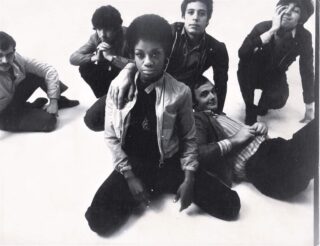
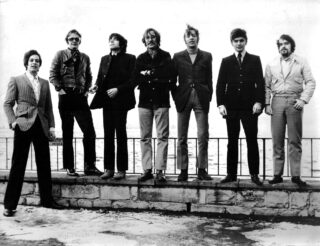
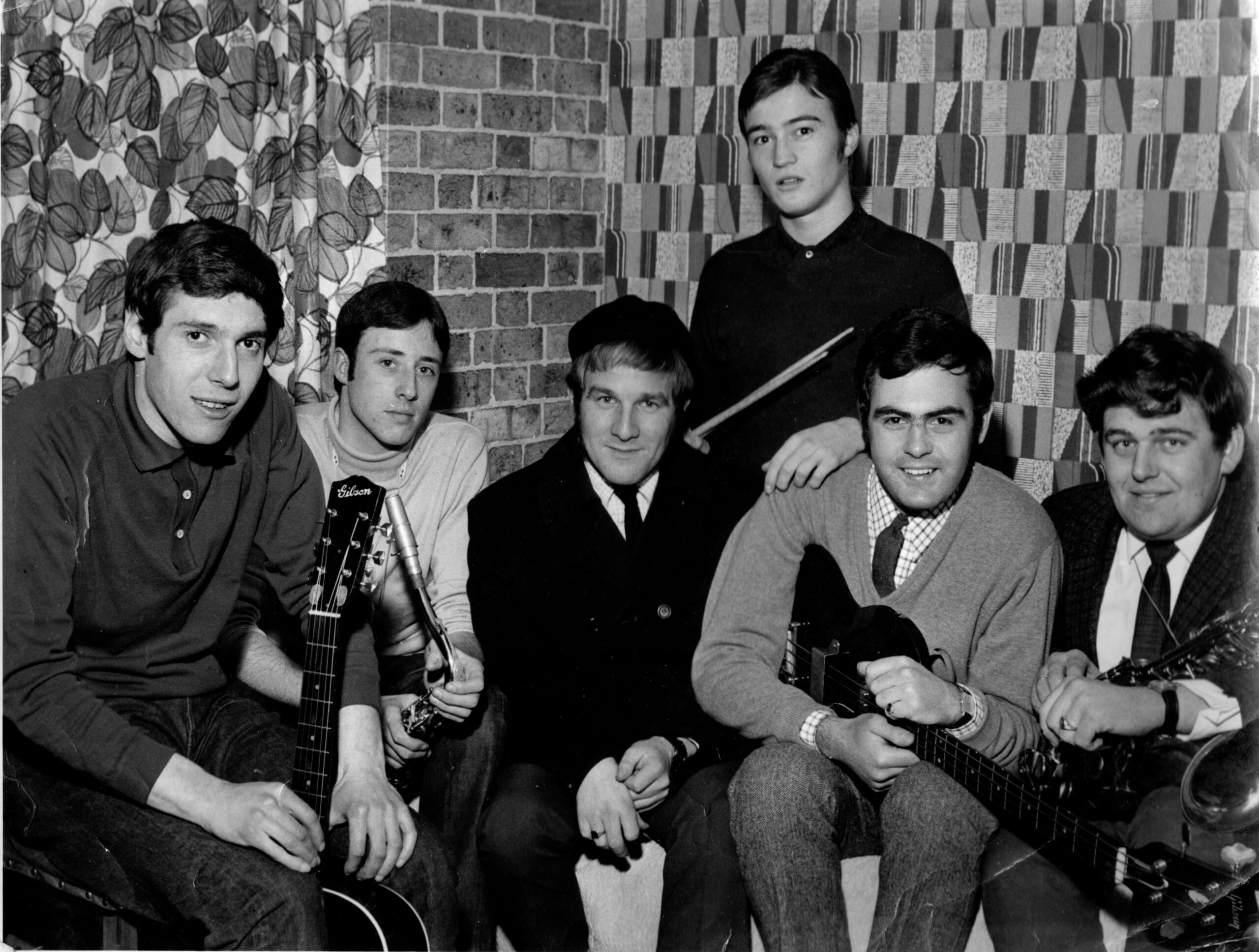
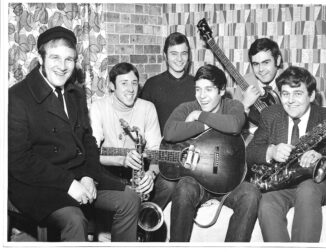
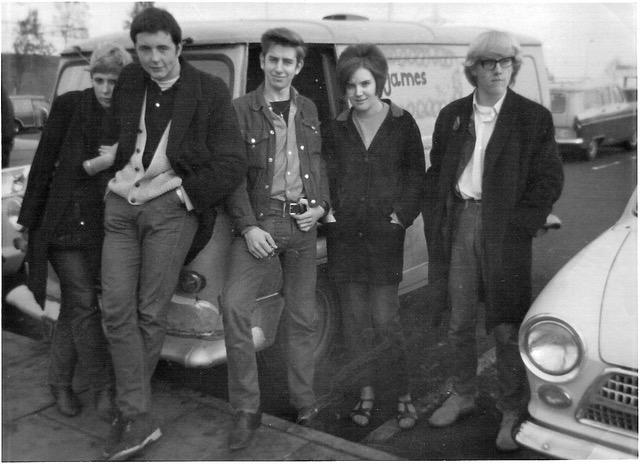
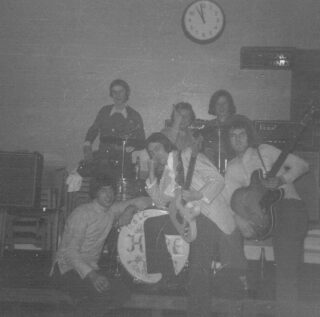
Forbes Walker got in touch with some photos of Scottish group The Haze, who opened for a number of visiting English bands, notably The Foundations in 1968.
The first photo above (circa 1968) was taken at the Star Bingo Hall, Bo’ness. Left to right: Neil Allan (bass), Alex Fisher (keyboards), Iain Walker (drums), Brian Ure (vocals) and Tom Ritchie ( guitar).
According to Forbes, Neil Allan, Tom Ritchie and Alex Fisher had all previously played together in a local band called The Jokers in the early 1960s. His brother Iain had played drums since he was about 12 years old and had been in The Sapphires, Finders Keepers and Five By Five before teaming up with the band. The Haze had been previously known and gigged as The Amazing Grace.
The second picture above shows a later line-up from around 1969. Left to right (back row): Brian Johnston with saxophone (he was 14 when he first played in the band), Iain Walker (drums), Billy Erskine (vocals). Front row, left to right: Alex Fisher (keyboards), Tom Ritchie (guitar), Gregor Risk (bass).
Thanks to Forbes Walker for providing the images and text.
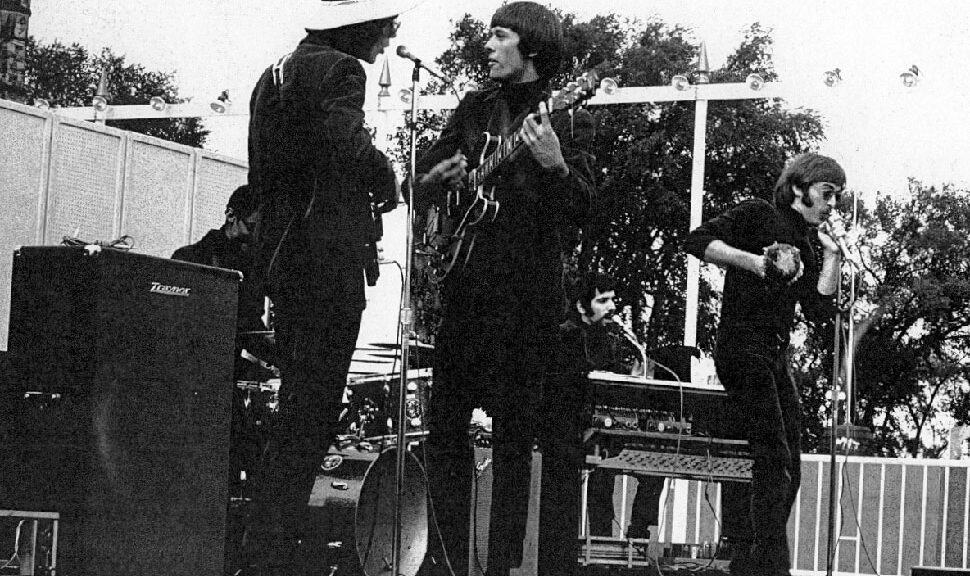
Parliament Hill, Ottawa, 1967. Photo: Stan Endersby. Left to right: Bob Ablack, Dennis Pendrith, Stan Endersby and Jimmy Livingston
Jimmy Livingston (Vocals)
Stan Endersby (Guitar, vocals)
Ed Roth (Keyboards)
Dennis Pendrith (Bass, vocals)
Bob Ablack (Drums)
Ted Sherrill (Drums)
Bobby Kris (Vocals)
This short-lived, albeit important, Toronto rock band evolved out of The Tripp in late May 1967 and was briefly known as Livingston’s Tripp. In July the musicians modified the name to Livingston’s Journey. However, adverts in the press often misspelt the names as Livingstone’s Tripp and Livingstone’s Journey.
Jimmy Livingston, Stan Endersby, Ed Roth and Bob Ablack had all earlier been in The Just Us. Livingston had also briefly co-fronted The Mynah Birds in 1965 with Ricky James Matthews (aka Rick James).
The Livingston-led line up entertained fans at Toronto’s Esplanade (a plaza on the ground floor of the Richmond-Adelaide Centre) during mid-August 1967 and played at Ottawa’s Mall and Parliament Hill (the latter at a ‘smoke-in’ in support of pot legislation).
Sometime in October, Ted Sherrill came in on drums from The Vendettas (Keith McKie of Kensington Market fame’s old band) and former The Imperials frontman Bobby Kris (real name Bob Burrows) was drafted in to replace Livingston.
The new line-up lasted only a few months and in the spring of 1968 the group played its final date at Toronto’s Night Owl (which was recorded live but never released).
Photo: Bob Burrows. Left to right: Dennis Pendrith, Stan Endersby, Ted Sherrill, Ed Roth and Bobby Kris (aka Bob Burrows)
These recordings included group originals ‘Inner City’ (written by Bobby Kris) and ‘Bull Feathers’ (written by Ted Sherrill), and a heavy version of The Beatles ‘You Can’t Do That’.
Endersby left for England soon after, where he met The Kinks’ Peter Quaife at Hatchettes Playground in Piccadilly, London (together they later formed Mapleoak), while Roth travelled to Los Angeles and worked with former Tripp members Neil Lillie (aka Neil Merryweather) and Livingston, who later died of cancer on 1 June 2002. Kris reformed The Imperials, who gigged into 1969.
Burrows and Pendrith continue to perform and record with Burrows & Company, who have a number of tracks on Spotify.
Selected gigs
2-4 June 1967 – Boris’ Red Gas Room, Toronto (billed as Livingstone’s Tripp)
9 June 1967 – Boris’, Toronto (billed as Livingstone’s Tripp)
11 June 1967 – Boris’, Toronto (billed as Livingstone’s Tripp)
30 June 1967 – North York Centennial Centre, Toronto with Mandala, The Spirit and The Power Project
1 July 1967 – Broom and Stone, Scarborough (billed as Livingstone’s Tripp) with The Reelers and The Deep End
5 July 1967 – Hawk’s Nest, Toronto (billed as Livingstone’s Tripp).
9 July 1967 – Broom and Stone, Scarborough with Mandala (billed as Livingstone’s Tripp)
28 July 1967 – Kin-Oak Arena, Oakville, Ontario (billed as Livingstone’s Tripp)
4 August 1967 – Hawk’s Nest, Toronto
5 August 1967 – Broom & Stone, Toronto with A Passing Fancy and The Dana
14-19 August 1967 – Esplanade, Toronto
19 August 1967 – Danceiro, near Sauble Falls, Ontario (Sun Times, Owen Sound)
22-27 August 1967 – Le Hibou, Ottawa (Ottawa Journal)
26 August 1967 – The Mall, Ottawa (Ottawa Journal)
August 1967 – Parliament Hill, Ottawa
29 August-3 September 1967 – Le Hibou, Ottawa
22 September 1967 – Purple Peanut Teen Club, Toronto
3 November 1967 – Hawk’s Nest, Toronto (billed as featuring Bobby Kris), with the Tiffanies
8 December 1967 – Purple Peanut, Toronto (billed as Bobby Kris with Livingstone’s Journey)
6 January 1968 – Purple Peanut, Toronto
26-27 January 1968 – Club 888, Toronto
10 February 1968 – El Patio, Toronto
15 February 1968 – The Flick, Toronto
8 March 1968 – BCI, Brantford, Ontario (cancelled when truck broke down) (billed as Bobby Kris & The Livingstone Journey) (The Expositor)
Toronto gigs from the Toronto Telegram and Ottawa gigs from the Ottawa Citizen. This article is based on research originally undertaken in the early 2000s. Many thanks to Bob Burrows, Stan Endersby, Ed Roth and others for their help.
Berry Window & The Movements, Seiler’s Atlantis, August 1967. Photo: Barry Window
Switzerland-based soul sensation Berry Window & The Movements recorded three soul-infused LPs during 1967-1968 and a clutch of superb 45s before finally breaking up in spring 1969. Despite also gaining a degree of popularity in southern Germany and northern Italy, the band were complete unknowns in Britain.
Formed by singer Barry Window aka Berry Window (b. 25 November 1946, Basel, Switzerland), the original formation comprised bass player Peter Rietmann (b. 14 June 1945, Switzerland; d. 2009); sax player Ferdinand Keller; drummer Dietmar Carl; keyboard player Fritz Trippel (b. 10 December 1937, Chur, Switzerland, d. 2010); and – last to join – lead guitarist Ronald William Bryer (b. 23 April 1947, London, England; d. 25 June 1973).
Window (whose real name is Urs Fenster; Fenster being German for window) started his career as the drummer for R&B/soul band The Sam Wee Five, a popular Basel outfit that never recorded, in 1964.
Window’s grandfather was born in Brazil while his father Kurt had arrived in Basel via Düsseldorf with the American Ringling Brothers and Barnum & Bailey Circus. Like his father, Berry mastered the drums but at heart had aspirations to be a singer. He certainly had the voice and stage presence to suggest he could be a dynamic front man and, by June 1967, was ready to step out from behind the drum kit and make his mark.
One of the first musicians he lined up for The Movements was Peter Rietmann, who had first come to prominence with The Dynamites in spring of 1964.
The bass player worked with this band until April 1966, leaving to join The Blue Sounds for two months. This fascinating outfit, featured two English musicians – singer/harp player Robert Muir and guitarist Mike Whitlock, who’d come to Basel with Merseyside band The Marksmen.
Rietmann, however, didn’t hang around long and soon joined top Austrian outfit, The Slaves, working with them until around March/April 1967 before he briefly gigged with The Countdowns. By early summer, he was ready to join Window in putting The Movements together.
While Dietmar Carl (aka Karl) was formerly a member of Basel group The Kettles, the much older Fritz Trippel was a seasoned musician steeped in jazz and well connected in music circles, notably in Stuttgart (more of which shortly).
According to the singer, Berry Window & The Movements secured an important engagement at Seiler’s Atlantis, a former coffeehouse that had specialised in jazz when it opened in the late 1940s, within a month of forming. By the mid-1960s, Seiler’s Atlantis had remodeled itself as a rock venue and had hosted a number of visiting British bands to the city.
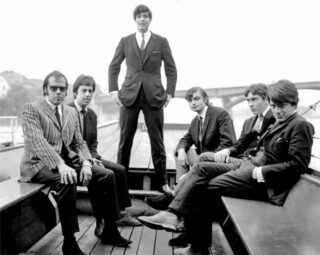
At the time The Movements were still without a guitar player but the club booking necessitated a photo session and so a “stand-in” was brought in to pose with the other musicians sitting in a boat in the middle of the River Rhine.
Left to right: Fritz Trippel, Peter Rietmann, Berry Window, Dietmar Carl, stand in guitarist, Ferdinand Keller. Photo: Barry Window
Window, however, already knew who he wanted as the guitarist – British musician Ron Bryer who until recently had been working with expatriates The Big Wheel, a popular R&B outfit that had played at the Hotel Hirschen in Zurich and the Tanzrad in Basel among others.
Bryer had started his career with Bexley, Kent group, The Loose Ends but had departed in mid-1965 before they signed with Decca Records and cut two great Mod 45s, including a cover of George Harrison’s “Taxman”.
Briefly adopting the stage name Ron Spence, the guitarist next worked with The Revellos for six months or so before joining The Carl Douglas Set with future “Kung Fu Fighter” Carl Douglas, and recording some unreleased tracks that were later issued by the Acid Jazz label.
In June 1966, however, he replaced Del Grace (ironically on his way to replace him in Carl Douglas’ band) in The Big Wheel. Keyboard player Andy Clark, later of Clark-Hutchinson and Upp fame, was instrumental in bringing Bryer into the group.
After releasing a lone 45 in Switzerland in February 1967– Clark’s “Don’t Give Up That Easy” c/w “You’re Only Hurting Yourself” on the Eurex label, Bryer was ready for a fresh challenge.
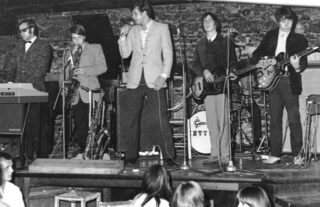
Debuting at Seiler’s Atlantis, Berry Window & The Movements proved so popular with local fans that the club’s owner extended their residency (a photo shows them performing on stage that August). By then, Trippel had used his contacts to secure a recording deal with the Bertelsmann Group Intercord label, based near Stuttgart in West Germany.
Seiler’s Atlantis, August 1967. Photo: Barry Window
Rushed into the studios, the band kicked off with two German-language recordings, penned by Trippel: “Abschiedslied” and “Ich Bin Allein”, which were coupled for the band’s debut 45 on the German label.
Soon afterwards, the group recorded its debut English-language single for Intercord, a cover of Bobby Robinson and Irral Berger’s “Warm and Tender Love” backed by Steve Cropper, Eddie Floyd and Alverts Isbell’s “I’ve Got Everything I Need”, issued in late 1967.
The same line-up was responsible for the follow-up release: an impressive reading of Isaac Hayes and Dave Porter’s “Hold On, I’m Coming” backed with Eddie Floyd and Steve Cropper’s “Knock On Wood”. Both English-language singles proved popular locally.
During this period the musicians were still heavily reliant on cover material and recorded their debut LP Soul & Loveat Bauer Studios in Ludwigsburg, north of Stuttgart over two days.
Drawing largely on the material they played live, this included impressive takes of Otis Redding and Arthur Conley’s “Sweet Soul Music”; Mack Rice’s “Mustang Sally”; James Brown’s “Papa’s Got a Brand New Bag”; and Smokey Robinson and Ronald White’s “My Girl”.
Wolfgang Paap and Ron Bryer, 1968. Photo: Barry Window
On 25 November 1967 (Berry’s 21st birthday), the band made a rare TV appearance, guesting on the “Hits A Go-Go” programme, aired in West Germany and Switzerland before resuming their busy live schedule, taking in the Chemilhütte in Basel and the Hazyland in Zurich among others.
Soon afterwards, Fritz Trippel departed and Belgian multi-instrumentalist, composer and keyboard extraordinaire Joel Vandroogenbroeck (b. 24 August 1938, Brussels, Belgium; d. 23 December 2019) took over, raising the standard of musicianship in the process.
Having made his first appearance on classical piano when he was only six years old, Vandroogenbroeck had toured Europe with The Quincy Jones Orchestra in the late 1950s but had a long and distinguished career. When he met Barry Window & The Movements he was playing with American singer Dee Dee McNeil (more of which shortly).
Around the same time Peter Rietmann followed Trippel out of the door and briefly reunited with the Chur-born keyboardist in the popular Swiss band Les Sauterelles.
Bass player Peter Giske (b. 1947, Basel, Switzerland) took over from Rietmann, who later progressed to work with Swiss band Crusade in 1969. Giske had Polish ancestry, adding to the diverse mix of nationalities that comprised The Movements.
During early 1968, the group returned to the studio with new drummer Hans-Peter Schweizer to record material for a Swiss-only EP entitled I Like Soul, which featured reworked (and superior) versions of “Knock On Wood”; “Hold On, I’m Coming”; and “Papa’s Got a Brand New Bag”. By this point Ferdinand Keller had departed.
Thanks to Joel Vandroogenbroeck’s connections with Dee Dee McNeil, the musicians next got the opportunity to record an LP with the American singer for the German MPS Records label in spring 1968. Entitled Soul Hour, the record was credited to Dee Dee, Barry & The Movements.
With new drummer Wolfgang Paap (b. 1944, Danzig, Germany) behind the kit, the sessions for the LP took place in Basel on 16 and 17 April 1968 and included powerful covers of Allen Touissaint’s “Get Out of My Life Woman”, Wilson Pickett and Steve Cropper’s “In the Midnight Hour”, plus yet another re-recording of “Hold On, I’m Coming”.
Soul Hour also came with some interesting sleeve notes about the individual musicians’ backgrounds. In addition to new member Wolfgang Paap on drums, the album also featured French sax player Barney Wilen (b. 1937, Nice, France), who’d previously worked with Miles Davis among many others.
Around this time Berry Window & The Movements appeared on West German TV show “We Like Soul” playing “Hold On, I’m Coming”. On several tracks Dee Dee McNeil joined Window for a duet and the recording also shows a second sax player.
Peter Giske, Wolfgang Paap, Dee Dee McNeil, Berry Window, Joel Vandroogenbroeck and Ron Bryer, 1968. Photo: Barry Window
Not long after, Berry Window & The Movements started work on their second studio LP Soul In Action, which remains arguably one of the best continental LPs recorded during the 1960s. Gone was the reliance on cover material, replaced by superb band originals, mainly co-penned by Vandroogenbroeck and Bryer, such as “I Gave You My Heart”, “Go Away” and the horn- driven soul-rocker “Give Me the Time”.
Berry Window had a hand in a few songs too, collaborating with Vandroogenbroeck and Bryer on “Rock Locomotion”, which was paired with Vandroogenbroeck and Bryer’s “I Wanna Get Moving out of Here” for a single, and the sublime, jazzy number “Stay as You Are”.
Vandroogenbroeck also came up with two gems on his own: the Hammond drenched soul outing, “Funky for Now” and the majestic “Solitude Street”, which saw the Belgian step away from the keys and demonstrate his mastery of the sitar.
In fact, his use of the Indian stringed instrument on several tracks created a unique psych-soul blend to the LP. The front cover shows him sitting on the floor with sitar in hand and Window standing over him.
Two non-LP tracks further demonstrate Vandroogenbroeck’s skills on the instrument, the hypnotic “I’ll Wait for You” and the driving, infectious “Hear Me, Help Me” again penned by Vandroogenbroeck and Bryer. Coupled as a single in the latter half of 1968, they are, as far as this writer is concerned, the band’s creative peak.
Like the group’s previous Intercord single release which paired two more non-LP Vandroogenbroeck and Bryer collaborations – “Remember The Rain” and “It Happened Once Before”, the recordings failed to achieve the commercial success the band deserved.
Undeterred by the public’s reaction to their excellent LP and cache of superb singles, Berry Window & The Movements continued to gig across southern Germany, Switzerland and also northern Italy. The highlight of this period was perhaps a 40-minute TV show that West German station ARD recorded in Baden-Baden in September 1968.
As 1968 turned to 1969, Wolfgang Paap bowed out (subsequently to reunite with Vandroogenbroeck and Bryer) and new drummer Marc Hellman stepped behind the kit. Barney Wilen also departed to record the brilliant Dear Prof. Leary LP.
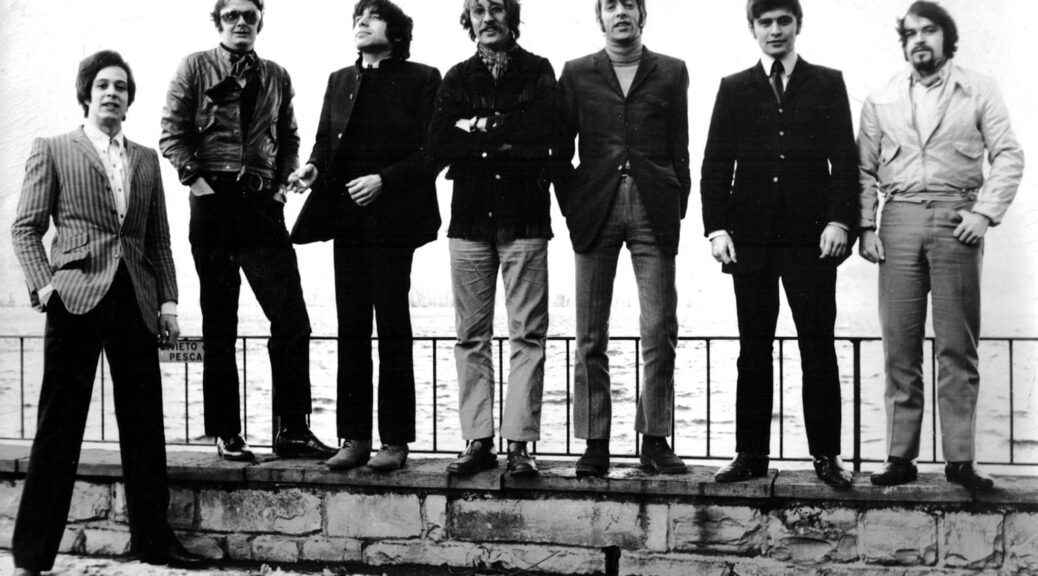
Berry Window, Joel Vandroogenbroeck, Ron Bryer, Marc Hellman, unknown player, unknown player and Peter Giske, late 1968. Photo: Barry Window
At this point, Window expanded the horn section bringing in two Caribbean musicians – Roy Edwards (trumpet) and Rudy Jones (sax) for some fresh recordings at SAAR Studios in Milan, Italy.
According to Window, a friend of his was on holiday in Spain at the time and had seen the two horn players at a club in Playa de Aro called the Maddox backing singer Eddie Lee Mattison and had alerted Window, who was on the look-out for a brass section.
Four tracks were recorded in early 1969 – English and Italian versions of Doug Sahm’s “Mendocino” and Alan Bergman, Marilyn Keith and Norman Luboff’s “Yellow Bird”, which were released in quick succession on the Italian Joker Dischi label.
Clockwise from top left: Pete Giske, Rudy Jones, Ron Bryer, Berry Window, Roy Edwards, Joel Vandroogenbroeck and Marc Hellman. Photo: Barry Window
By then, The Movements were on their last legs. With the end in sight, Bryer and Vandroogenbroeck pieced together a new, far more experimental band, The Third Eclipse, which soon became better known as Brainticket. The pair was reunited with Wolfgang Paap who joined the group’s most famous line-up and appears alongside the duo on the classic Cottonwoodhill LP.
The Belgian would continue to lead Brainticket for decades but Bryer soon returned to England where he subsequently reunited with former Loose Ends singer Alan Marshall in his band One. Sadly he died prematurely of an accidental drug overdose on 25 June 1973.
With a restructured band featuring Roy Edwards and Rudy Jones, Berry Window changed his name to Barry and took the revamped line-up to London where, as The London Cats, they recorded two tracks for Baf Records – David Porter and Isaac Hayes “I Thank You” and Roger Penzabene, Norman Whitefield and Barrett Strong’s “End of Our Road”, which were coupled for a British-only single.
The London Cats, 1969. Photo: Barry Window
That might have been the end of Berry Window & The Movements but that same year, RCA Records combined a recent recording that the singer had cut with Italian studio musicians, a cover of Herbert Pagani and Adriano De Grandis’ “Preistoria, Preistoria” with a second (and arguably superior) version of the classic “I’ll Wait For You”, cut in 1968 when Vandroogenbroeck and Bryer were still members.
With Edwards and Jones remaining in the UK to join JJ Jackson’s band, Window returned to Switzerland and embarked on an illustrious solo career which he continues to this day.
Fortunately, anyone who wants to check out the band’s excellent legacy can hear the group’s entire work (minus Soul Hour) on the Early Yearsdouble CD.
Thanks to Rolf ‘Ray’ Rieben of Feathered Apple Records and Barry Window for their help
The band was formed as Four + One in mid-1964. Les Jones and Ken Lawrence had both previously been members of The Tridents
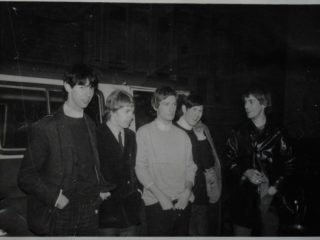
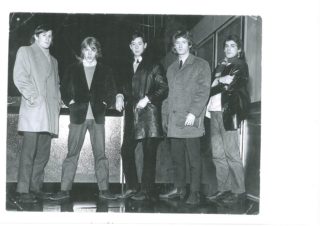
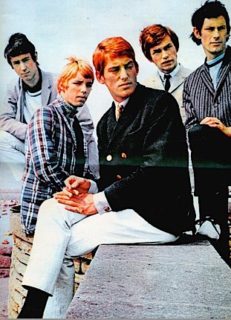
Four + One. Left to right: Ken, Junior, Les, Keith and Simon
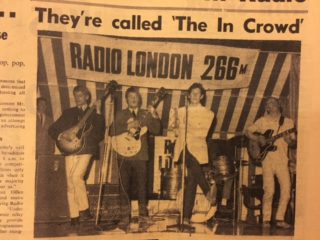
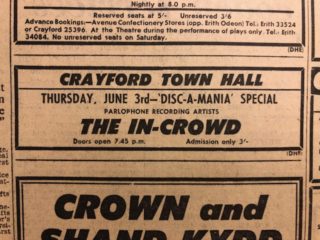
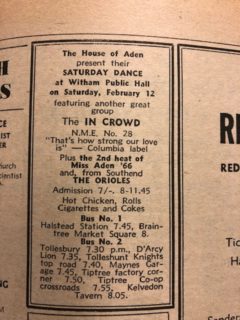
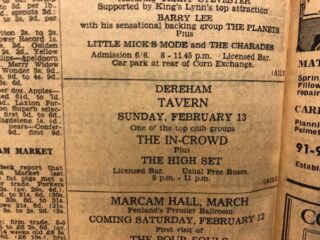
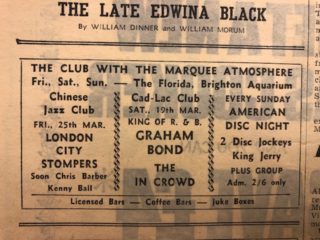
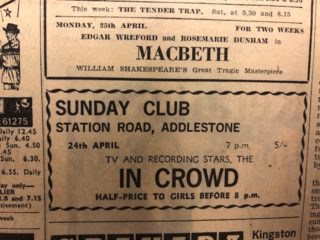
After a cover of “Time Is On My Side”, issued in January 1965, the band became The In Crowd and released a second single, “That’s How Strong My Love Is” in April 1965. According to Flashback magazine, the group became resident band at Club Noreik on Seven Sisters Road in north London
29 October 1965 – Harvest Moon Club, Guildford, Surrey with The Just Five (Surrey Advertiser/West Surrey Advertiser) May not be the same band; possibly Staines group
30 October 1965 – Silsoe Village Hall, Silsoe, Bedfordshire (Ampthill News & Flintwick Record)
In November, The In Crowd issued their third 45 – “Why Must They Criticise”
13 November 1965 – Harvest Moon Club, Guildford, Surrey with The Just Five (Surrey Advertiser/West Surrey Advertiser) May not be the same band; possibly Staines group
19 November 1965 – Scoobidoo, Worthing, West Susssex (Brighton Evening Argus)
21 November 1965 – Harvest Moon Club, Guildford, Surrey (Surrey Advertiser) May not be the same band; possibly Staines group
25 November 1965 – New Barn, Brighton, East Sussex (Brighton Evening Argus) Says direct from the Marquee
2 December 1965 – The New Barn, Brighton, East Sussex (Brighton Evening Argus) Says direct from the Marquee
10 December 1965 – Marquee, Wardour Street, Soho, central London with Gary Farr & The T-Bones (Tony Bacon’s book: London Live)
11 December 1965 – Victoria Cross Gallery, Wantage, Oxfordshire (Oxford Mail)
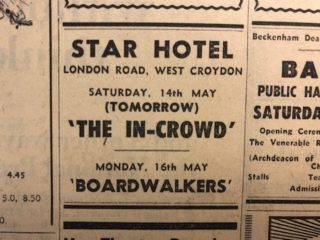
14 May 1966 – Star Hotel, Croydon, south London (Chris Broom book: Rockin’ and Around Croydon)
29 May 1966 – The Dolphin, Marine Court, St Leonards, East Sussex (Roger Bistow’s research at Dizzy Tiger Music website)
30 May 1966 – Le Discotheque, Grimsby, Humberside (Grimsby Evening Telegraph)
30 May 1966 – The Witchdoctor, the Lifeboat Hotel, Grimsby, Humberside (Grimsby Evening Telegraph)
10 June 1966 – Oscar’s Grotto, Ilford, east London (Redbridge & Ilford Recorder)
Thanks to Geoffrey Mason for the photo
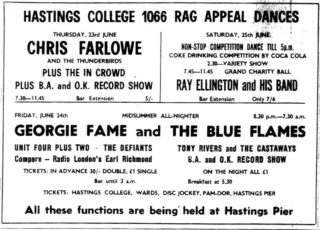
23 June 1966 – Hastings College 1066 Rag Appeal Dances, Hastings Pier, Hastings, East Sussex with Chris Farlowe & The Thunderbirds (Roger Bistow’s research at Dizzy Tiger Music website)
Record Mirror reported that John “Twink” Alder had left The Fairies and joined The In Crowd in early July after working at Café des Artists in Fulham.
14 July 1966 – Birdcage, Eastney, Hampshire (Dave Allen research)
15 July 1966 – Penthouse, Birmingham (Birmingham Evening Mail)
16 July 1966 – Rhodes Centre, Bishop’s Stortford, Herts with The Mode (Steve Ingless book: The Day Before Yesterday)
1 August 1966 – Disc Club, St Martin’s Centre, Colchester, Essex (Essex County Standard)
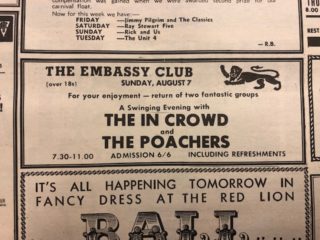
7 August 1966 – Embassy Club, Colchester, Essex with The Poachers (Essex County Standard)
20 August 1966 – Club De Danse, Colchester, Essex (Essex County Standard)
23 August 1966 – Chinese R&B Club, Corn Exchange, Bristol (Evening Post)
3 September 1966 – Birdcage, Eastney, Hampshire (Dave Allen research)
17 September 1966 – Cad-Lac Club, Brighton, East Sussex (Brighton Evening Argus)
According to Flashback magazine, the band played in the Netherlands in October
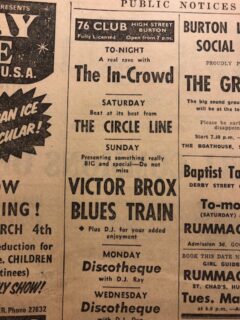
4 November 1966 – 76 Club, Burton on Trent, Staffordshire (Burton Daily Mail)
5 November 1966 – Princess Ballroom, Halifax, West Yorkshire with The Pythagoras Squares (Halifax Evening Courier & Guardian)
12 November 1966 – Witchdoctor, Lifeboat Hotel, Cleethorpes, North East Lincolnshire (Grimsby Evening Telegraph)
In mid-November, The In Crowd played at the Charlie Max in Milan, Italy for two weeks, according to Flashback magazine
1 December 1966 – Blaises, Imperial Hotel, Queen’s Gate, west London (London Life)
3 December 1966 – Birdcage, Eastney, Hampshire with Cream and The Wrong Direction (Dave Allen research)
8 December 1966 – Blaises, Imperial Hotel, Queen’s Gate, west London (London Life)
According to Flashback magazine, the band returned to play in the Netherlands in December
31 December 1966 – Birdcage, Eastney, Hampshire with Graham Bond Organisation and The Wrong Direction (Dave Allen research)
14 January 1967 – Birdcage, Eastney, Hampshire (Dave Allen research)
27 January 1967 – El Grotto, Ilford, east London (Redbridge & Ilford Recorder)
9 February 1967 – Marquee, Wardour Street, Soho, central London with Herbie Goins & The Night Timers and The Satin Dolls (Tony Bacon’s book: London Live)
17 February 1967 – 76 Club, Burton upon Trent, Staffordshire (Burton Daily Mail)
18 February 1967 – Birdcage, Eastney, Hampshire (Dave Allen research)
23 February 1967 – Marquee, Wardour Street, Soho, central London with Herbie Goins & The Night Timers (Tony Bacon’s book: London Live)
In late April 1967, The In Crowd change name to Tomorrow
29 April 1967 – Birdcage, Eastney, Hampshire (Dave Allen research) Billed as The In Crowd unless this is another band
6 May 1967 – Shoreline Club, Bognor Regis, West Sussex with Herbie Goins & The Nightimers (Dave Allen research) Billed as The In Crowd unless this is another band
Thanks to Ken Lawrence for sharing all of the photos
John Thompson – lead guitar (replaced by Pete Ross)
Brian Brown – bass
Terry Marshall – tenor saxophone
Peter Wright – tenor saxophone
Paul Atkinson – drums
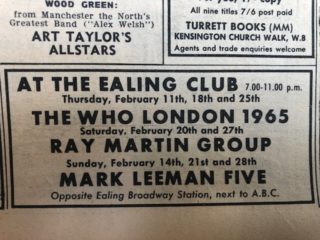
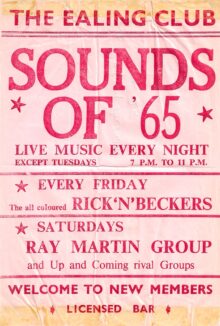
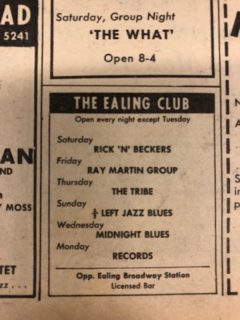
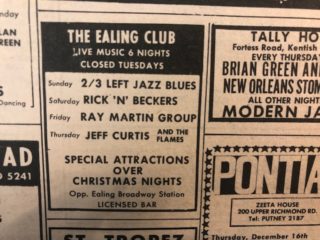
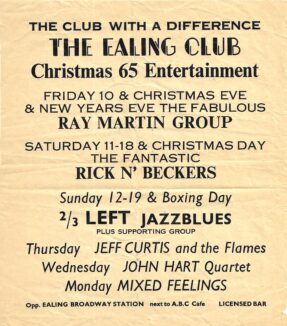
Formed sometime in 1964 after Terry Marshall left The Soul Messengers, the band appears to have worked at the Ealing Club on a weekly basis throughout 1965.
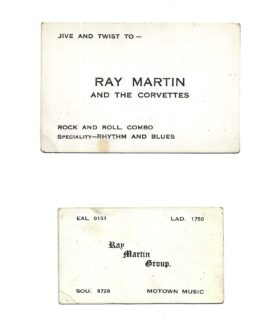
Ray Martin (aka Raymond Richardson) is the same Ray Martin who had previously led Ray Martin & The Corvettes.
Photo: Dean Richardson
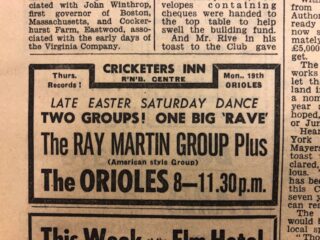
The Middlesex County Times & West Middlesex Gazette has The Ray Martin Group appearing at the Ealing Club on a Saturday (and sometimes a Sunday) throughout 1965, except in December when they switched to Fridays (see gig list below which is incomplete).
Ross, however, didn’t join until July 1965 after The Flexmen split up and John Thompson (see comments) was the original guitarist.
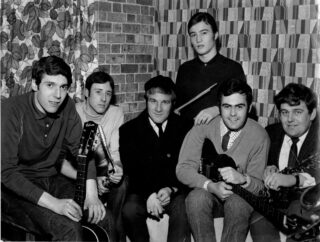
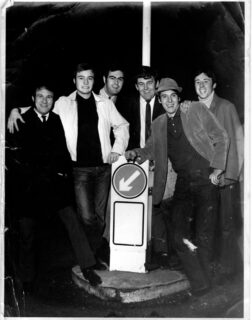
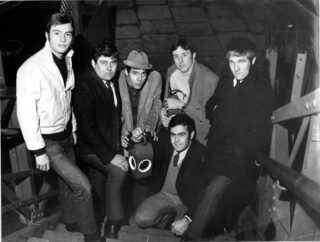
Left to right: Pete Ross, Peter Wright, Ray Martin, Paul Atkinson, Brian Brown and Terry Marshall. Photo: Brian Brown/Pete Ross
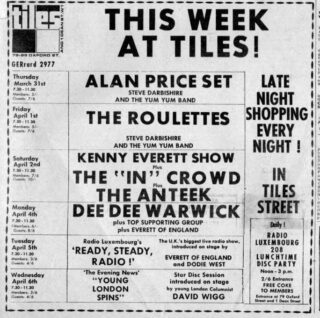
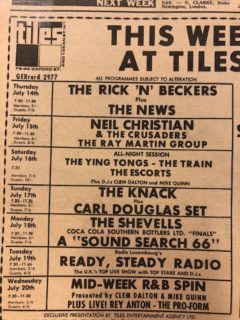
According to Ross, the band opened for James Brown at Tiles (circa March 1966). They also opened for Neil Christian & The Crusaders at Tiles later in July.
Thanks to Pete Ross and Terry Marshall for input. Thanks also to Dean Richardson (see comments) for images and further information.
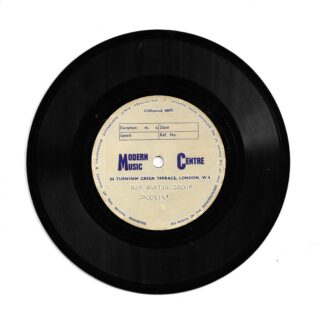
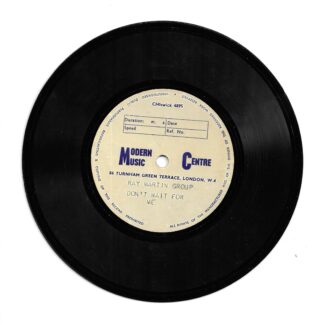
The band recorded two tracks, which were never released. Dean Richardson has these recordings (see below) and they can be heard for the first time at the top of this entry.
Selected gigs:
16 January 1965 – Ealing Club, Ealing, Middlesex (Saturday)
23 January 1965 – Ealing Club, Ealing, Middlesex (Saturday)
31 January 1965 – Ealing Club, Ealing, Middlesex (Sunday)
6 February 1965 – Ealing Club, Ealing, Middlesex (Saturday)
18 April 1965 – Ealing Club, Ealing, Middlesex (Sunday)
25 April 1965 – Ealing Club, Ealing, Middlesex (Sunday)
8 May 1965 – Ealing Club, Ealing, west London (Saturday)
15 May 1965 – Ealing Club, Ealing, west London (Saturday)
Photo: Dean Richardson
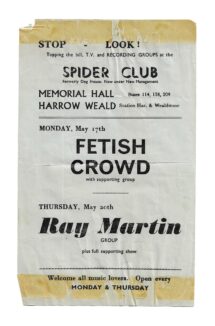
20 May 1965 – Spider Club, Memorial Hall, Harrow Weald, west London with support (Thursday)
22 May 1965 – Ealing Club, Ealing, west London (Saturday)
Photo: Southend Standard
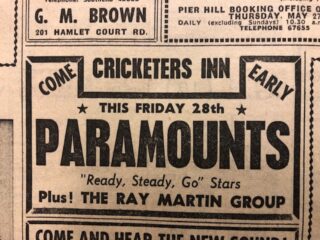
28 May 1965 – Cricketers Inn, Westcliff, Southend, Essex with The Paramounts (Southend Standard)
29 May 1965 – Ealing Club, Ealing, west London (Saturday)
5 June 1965 – Ealing Club, Ealing, west London (Saturday)
12 June 1965 – Ealing Club, Ealing, west London (Saturday)
Photo: Dean RichardsonPhoto: Dean Richardson
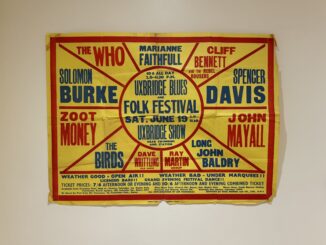
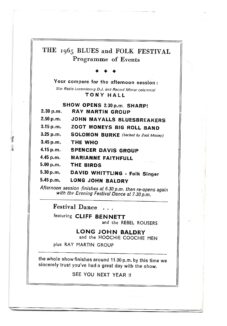
19 June 1965 – Uxbridge Blues Festival, Uxbridge, northwest London with Marianne Faithfull, The Who, Solomon Burke, Cliff Bennett & The Rebel Rousers, Long John Baldry, Zoot Money, The Birds, John Mayall, The Spencer Davis Group and Dave Whittling (Ruislip & Northwood Gazette)
Photo: Dean Richardson
24 July 1965 – Blue Moon, Cheltenham, Gloucestershire (Saturday)
31 July 1965 – Ealing Club, Ealing, west London (Saturday)
Photo: Dean Richardson
7 August 1965 – Ealing Club, Ealing, west London (Saturday)
14 August 1965 – Ealing Club, Ealing, west London (Saturday)
21 August 1965 – Ealing Club, Ealing, west London (Saturday)
Photo: Dean Richardson
11 September 1965 – Ealing Club, Ealing, west London (Saturday)
18 September 1965 – Ealing Club, Ealing, west London (Saturday)
30 October 1965 – Ealing Club, Ealing, west London (Saturday)
20 November 1965 – Ealing Club, Ealing, west London (Saturday)
Photo: Melody Maker
10 December 1965 – Ealing Club, Ealing, west London (Friday)
Photo: Melody Maker
17 December 1965 – Ealing Club, Ealing, west London (Friday)
Photo: Dean Richardson
24 December 1965 – Ealing Club, Ealing, west London (Friday)
31 December 1965 – Ealing Club, Ealing, west London (Friday)
21 May 1966 – The Beathouse Club, Hanwell Community Centre, Hanwell, west London (Ealing and Acton Gazette)
Photo: Melody Maker
15 July 1966 – Tiles, Oxford Street, central London with Neil Christian & The Crusaders (Melody Maker)
16 December (Friday) – White Hall, Southall, west London (Harrow Observer)
If you can add any further information, please leave a message in the comments below.
Left to right: Ray Martin, Paul Atkinson, Brian Brown, Terry Marshall, Pete Ross and Peter Wright. Photo: Brian Brown/Pete RossLeft to right: Paul Atkinson, Terry Marshall, Pete Ross, Brian Brown (front), Peter Wright (back) and Ray Martin. Photo: Brian Brown/Pete Ross
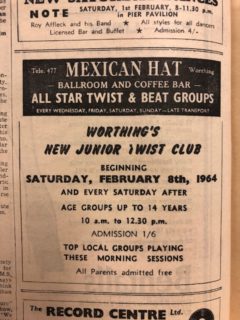
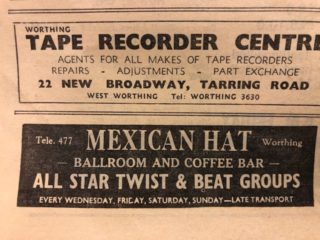
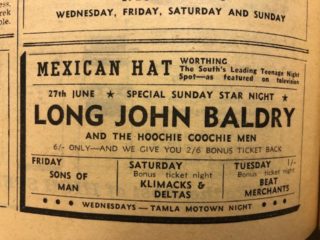
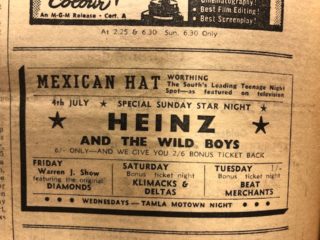
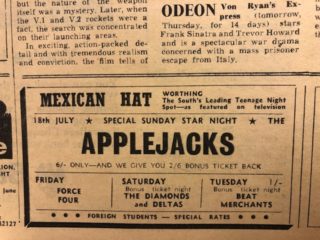
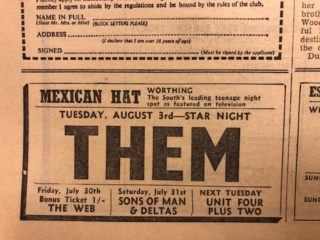
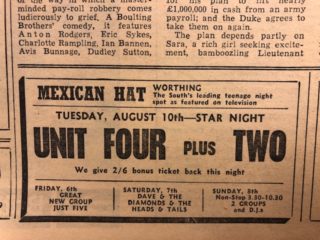
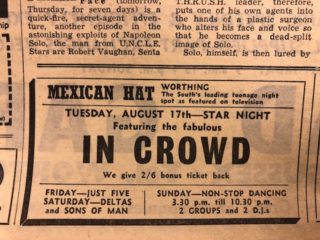
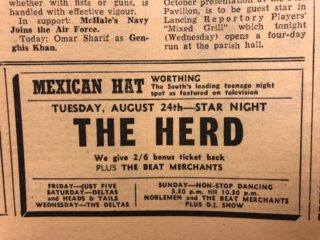
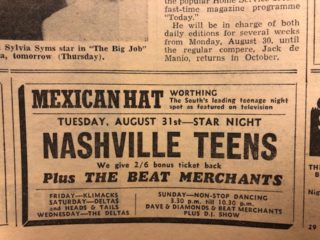
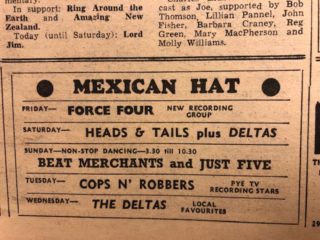
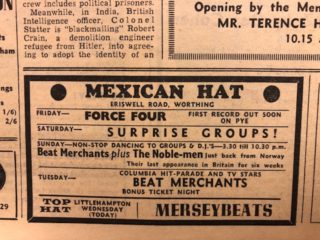
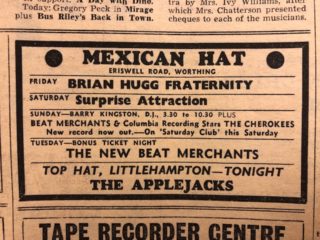
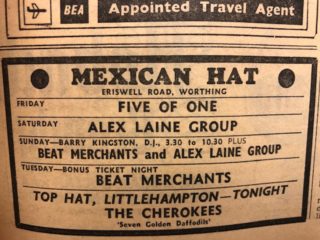
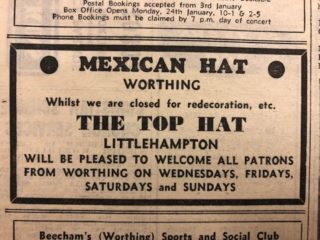
The Mexican Hat in Worthing, West Sussex was a popular live venue during the early-to-mid 1960s. The venue wasn’t advertised regularly in the local press so I’d be interested to hear from anyone who can add any further details of groups that performed there.
The Worthing Gazette only advertised the venue intermittently throughout 1964, so please get in touch if you can provide confirmed concert dates for this year.
Photo: Worthing Gazette
However, it looks like gigs took place every Wednesday, Friday, Saturday and Sunday and a ‘New Junior Twist Club’ may have started on 8 February 1964.
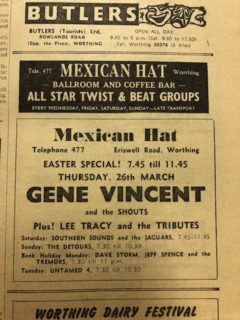
26 March 1964 – Gene Vincent & His Shouts and Lee Tracy & The Tributes (Thursday) (Worthing Gazette)
Photo: Worthing Gazette
28 March 1964 – The Southern Sounds and The Jaguars (Saturday) (Worthing Gazette)
29 March 1964 – The Detours (Sunday) (Worthing Gazette)
30 March 1964 – Dave Storm, Jeff Spence & The Tremors (Bank Holiday Monday) (Worthing Gazette)
31 March 1964 – The Untamed 4 (Tuesday) (Worthing Gazette)
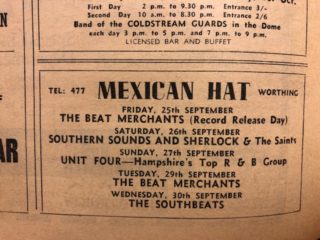
There is a massive gap in the Worthing Gazette until the following dates
Photo: Worthing Gazette
25 September 1964 – The Beat Merchants (Friday) (Worthing Gazette)
26 September 1964 – The Southern Sounds and Sherlock & The Saints (Saturday) (Worthing Gazette)
27 September 1964 – Unit Four (Sunday) (Worthing Gazette)
29 September 1964 – The Beat Merchants (Tuesday) (Worthing Gazette)
30 September 1964 – The Southbeats (Wednesday) (Worthing Gazette)
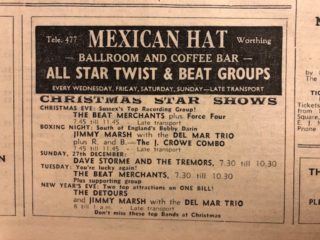
There is a massive gap in the Worthing Gazette until the following dates
Photo: Worthing Gazette
24 December 1964 – The Beat Merchants and Force Four (Thursday) (Worthing Gazette)
26 December 1964 – Jimmy Marsh & The Del Mar Trio and The J Crow Combo (Saturday) (Worthing Gazette)
27 December 1964 – Dave Storme & The Tremors (Sunday) (Worthing Gazette)
29 December 1964 – The Beat Merchants with supporting group (Tuesday) (Worthing Gazette)
31 December 1964 – The Detours and Jimmy Marsh & The Del Mar Trio (Thursday) (Worthing Gazette)
According to the Worthing Herald, the club was run by manager Chris Vallins. The newspaper only occasionally advertised gigs at the venue throughout 1965.
Photo: Worthing Gazette
However, the Worthing Gazette was better at advertising throughout 1965, although the list below isn’t complete. This newspaper notes that gigs took place every Wednesday, Friday, Saturday and Sunday.
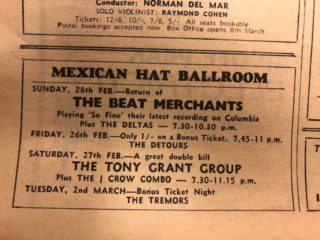
26 February 1965 – The Detours (Friday) (Worthing Gazette) This is interesting as The Detours had recently joined forces with Beau Brummell to become The Noblemen so perhaps a solo gig for the band?
Photo: Worthing Gazette
27 February 1965 – The Tony Grant Group and The J Crow Combo (Saturday) (Worthing Gazette)
28 February 1965 – The Beat Merchants and The Deltas (Sunday) (Worthing Gazette)
2 March 1965 – The Tremors (Tuesday) (Worthing Gazette)
There’s a gap then until the following dates
Photo: Worthing Gazette
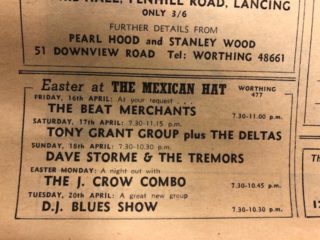
16 April 1965 – The Beat Merchants (Friday) (Worthing Gazette)
17 April 1965 – The Tony Grant Group and The Deltas (Saturday) (Worthing Gazette)
18 April 1965 – Dave Storme & The Tremors (Sunday) (Worthing Gazette)
19 April 1965 – The J Crow Combo (Monday) (Worthing Gazette)
20 April 1965 – DJ Blues Show (Tuesday) (Worthing Gazette)
There’s a gap then until the following dates
Photo: Worthing Herald
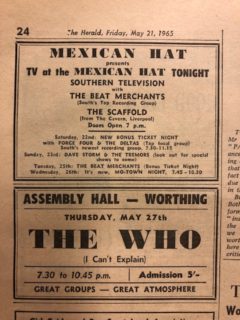
21 May 1965 – The Beat Merchants and The Scaffold (Friday) (Worthing Herald) Filmed live at the club for Southern television
22 May 1965 – The Force Four and The Deltas (Saturday) (Worthing Herald)
23 May 1965 – Dave Storm & The Tremors (Sunday) (Worthing Herald)
25 May 1965 – The Beat Merchants (Tuesday) (Worthing Herald)
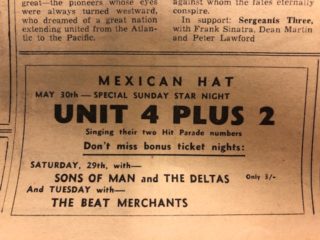
29 May 1965 – Sons of Man and The Deltas (Saturday) (Worthing Gazette)
Photo: Worthing Gazette
30 May 1965 – Unit 4 Plus 2 (Sunday) (Worthing Gazette)
1 June 1965 – The Beat Merchants (Tuesday) (Worthing Gazette)
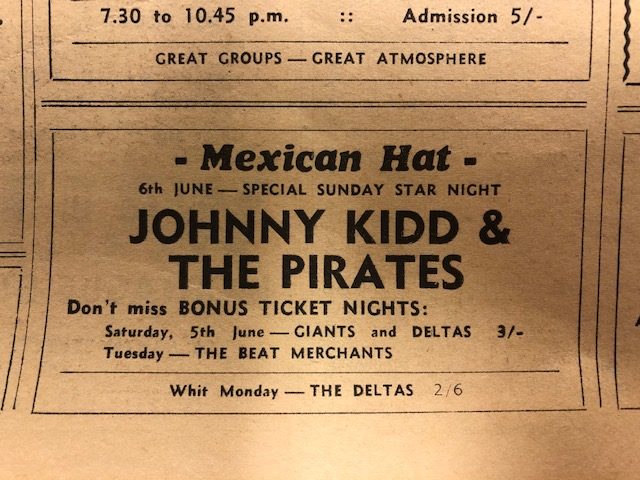
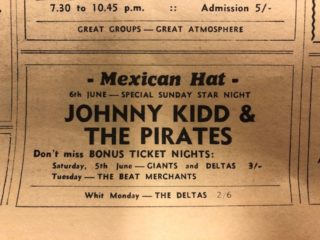
5 June 1965 – The Giants and The Deltas (Saturday) (Worthing Gazette)
Photo: Worthing Gazette
6 June 1965 – Johnny Kidd & The Pirates (Sunday) (Worthing Gazette)
7 June 1965 – The Deltas (Monday) (Worthing Gazette)
8 June 1965 – The Beat Merchants (Tuesday) (Worthing Gazette)
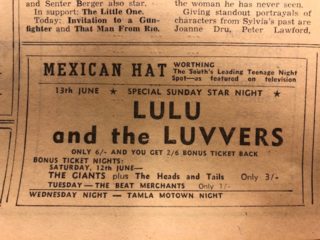
12 June 1965 – The Giants and The Heads and Tails (Saturday) (Worthing Gazette)
Photo: Worthing Gazette
13 June 1965 – Lulu & The Luvvers (Sunday) (Worthing Gazette)
15 June 1965 – The Beat Merchants (Tuesday) (Worthing Gazette)
18 June 1965 – The Force Four (Friday) (Worthing Gazette)
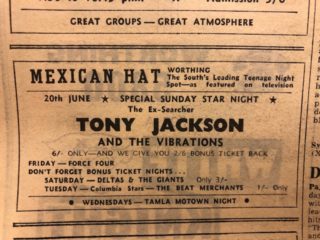
19 June 1965 – The Deltas and The Giants (Saturday) (Worthing Gazette)
Photo: Worthing Gazette
20 June 1965 – Tony Jackson & The Vibrations (Sunday) (Worthing Gazette)
22 June 1965 – The Beat Merchants (Tuesday) (Worthing Gazette)
25 June 1965 – Sons of Man (Friday) (Worthing Gazette)
26 June 1965 – The Klimacks and The Deltas (Saturday) (Worthing Gazette)
Photo: Worthing Gazette
27 June 1965 – Long John Baldry & The Hoochie Coochie Men (Sunday) (Worthing Gazette)
29 June 1965 – The Beat Merchants (Tuesday) (Worthing Gazette)
2 July 1965 – The Warren J Show and The Diamonds (Friday) (Worthing Gazette)
3 July 1965 – The Klimacks and The Deltas (Saturday) (Worthing Gazette)
Photo: Worthing Gazette
4 July 1965 – Heinz and The Wild Boys (Sunday) (Worthing Gazette)
6 July 1965 – The Beat Merchants (Tuesday) (Worthing Gazette)
9 July 1965 – The Klimacks (Friday) (Worthing Gazette)
10 July 1965 – The Deltas (Saturday) (Worthing Gazette)
11 July 1965 – The Four Pennies (Sunday) (Worthing Gazette)
13 July 1965 – Surprise group (Tuesday) (Worthing Gazette)
16 July 1965 – Force Four (Friday) (Worthing Gazette)
17 July 1965 – The Diamonds and The Deltas (Saturday) (Worthing Gazette)
Photo: Worthing Gazette
18 July 1965 – The Applejacks (Sunday) (Worthing Gazette)
20 July 1965 – The Beat Merchants (Tuesday) (Worthing Gazette)
27 July 1965 – Cliff Bennett & The Rebel Rousers (Tuesday) (Worthing Gazette)
30 July 1965 – The Web (Friday) (Worthing Gazette)
31 July 1965 – The Sons of Man and The Deltas (Saturday) (Worthing Gazette)
Photo: Worthing Gazette
3 August 1965 – Them (Tuesday) (Worthing Gazette)
6 August 1965 – Just Five (Friday) (Worthing Gazette)
7 August 1965 – Dave & The Diamonds and Heads & Tails (Saturday) (Worthing Gazette)
8 August 1965 – Two groups (Sunday) (Worthing Gazette)
Photo: Worthing Gazette
10 August 1965 – Unit Four Plus Two (Tuesday) (Worthing Gazette)
13 August 1965 – The Just Five (Friday) (Worthing Gazette)
14 August 1965 – The Deltas and The Sons of Man (Saturday) (Worthing Gazette)
15 August 1965 – Two groups (Sunday) (Worthing Gazette)
Photo: Worthing Gazette
17 August 1965 – The In Crowd (Tuesday) (Worthing Gazette)
20 August 1965 – The Just Five (Friday) (Worthing Gazette)
21 August 1965 – The Deltas and Heads & Tails (Saturday) (Worthing Gazette)
22 August 1965 – The Noblemen and The Beat Merchants (Sunday) (Worthing Gazette)
Photo: Worthing Gazette
24 August 1965 – The Herd and The Beat Merchants (Tuesday) (Worthing Gazette)
25 August 1965 – The Deltas (Wednesday) (Worthing Gazette)
27 August 1965 – The Klimacks (Friday) (Worthing Gazette)
28 August 1965 – The Deltas and The Heads & Tails (Saturday) (Worthing Gazette)
29 August 1965 – Dave & The Diamonds and The Beat Merchants (Sunday) (Worthing Gazette)
31 August 1965 – The Nashville Teens and The Beat Merchants (Tuesday) (Worthing Gazette)
Photo: Worthing Gazette
1 September 1965 – The Deltas (Wednesday) (Worthing Gazette)
3 September 1965 – Force Four (Friday) (Worthing Gazette)
4 September 1965 – Heads & Tails and The Deltas (Saturday) (Worthing Gazette)
5 September 1965 – The Beat Merchants and The Just Five (Sunday) (Worthing Gazette)
Photo: Worthing Gazette
7 September 1965 – Cops ‘N’ Robbers (Tuesday) (Worthing Gazette)
8 September 1965 – The Deltas (Wednesday) (Worthing Gazette)
10 September 1965 – The Sons of Man (Friday) (Worthing Gazette)
11 September 1965 – Heads & Tails and The Deltas (Saturday) (Worthing Gazette)
12 September 1965 – The Beat Merchants and surprise group (Sunday) (Worthing Gazette)
14 September 1965 – ‘Another Top of the Pops attraction’ (Tuesday) (Worthing Gazette)
15 September 1965 – The Deltas (Wednesday) (Worthing Gazette)
17 September 1965 – ‘One of the South’s top groups’ (Friday) (Worthing Gazette)
18 September 1965 – Surprise groups (Saturday) (Worthing Gazette)
19 September 1965 – The Beat Merchants and The Cyan Three (Sunday) (Worthing Gazette)
21 September 1965 – The Beat Merchants (Tuesday) (Worthing Gazette)
22 September 1965 – The Deltas (Wednesday) (Worthing Gazette)
24 September 1965 – Force Four (Friday) (Worthing Gazette)
25 September 1965 – Surprise groups (Saturday) (Worthing Gazette)
Photo: Worthing Gazette
26 September 1965 – The Beat Merchants and The Noblemen (Sunday) (Worthing Gazette) The Noblemen are just back from Norway and this is their last British appearance for six weeks
28 September 1965 – The Beat Merchants (Tuesday) (Worthing Gazette)
1 October 1965 – The Klimaks (Friday) (Worthing Gazette)
2 October 1965 – The Diplomats (Saturday) (Worthing Gazette)
3 October 1965 – The Beat Merchants and The Deltas (Sunday) (Worthing Gazette)
5 October 1965 – The Beat Merchants (Tuesday) (Worthing Gazette)
Photo: Worthing Gazette
8 October 1965 – The Brian Hugg Fraternity (Friday) (Worthing Gazette)
9 October 1965 – Surprise attraction (Saturday) (Worthing Gazette)
10 October 1965 – The Beat Merchants and The Cherokees (Sunday) (Worthing Gazette)
12 October 1965 – The New Beat Merchants (Tuesday) (Worthing Gazette)
15 October 1965 – The Sons of Man (Friday) (Worthing Gazette)
16 October 1965 – The Alex Laine Group (Saturday) (Worthing Gazette)
17 October 1965 – The Beat Merchants and The Orioles (Sunday) (Worthing Gazette)
19 October 1965 – The New Beat Merchants (Tuesday) (Worthing Gazette)
22 October 1965 – Force Four (Friday) (Worthing Gazette)
23 October 1965 – The Alex Laine Group (Saturday) (Worthing Gazette)
24 October 1965 – The Beat Merchants and The Orioles (Sunday) (Worthing Gazette)
26 October 1965 – The Beat Merchants (Tuesday) (Worthing Gazette)
Photo: Worthing Gazette
29 October 1965 – The Five of One (Friday) (Worthing Gazette)
30 October 1965 – The Alex Laine Group (Saturday) (Worthing Gazette)
31 October 1965 – The Beat Merchants and The Alex Laine Group (Sunday) (Worthing Gazette)
2 November 1965 – The Beat Merchants (Tuesday) (Worthing Gazette)
5 November 1965 – The Deltas (Friday) (Worthing Gazette)
6 November 1965 – The Five of One (Saturday) (Worthing Gazette)
7 November 1965 – The Profile with support (Sunday) (Worthing Gazette)
12 November 1965 – The Deltas (Friday) (Worthing Gazette)
13 November 1965 – The Five of One (Saturday) (Worthing Gazette)
14 November 1965 – Force Four and The Profile (Sunday) (Worthing Gazette)
Photo: Worthing Gazette
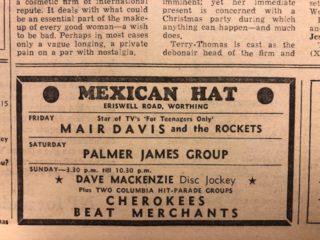
19 November 1965 – Mair Davis & The Rockets (Friday) (Worthing Gazette)
20 November 1965 – The Palmer James Group (Saturday) (Worthing Gazette)
21 November 1965 – The Cherokees and The Beat Merchants (Sunday) (Worthing Gazette)
26 November 1965 – The Sons of Man (Friday) (Worthing Gazette)
27 November 1965 – Top local group (Saturday) (Worthing Gazette)
28 November 1965 – Two top groups (Sunday) (Worthing Gazette)
The newspaper says The Profile and top group plays this week
3 December 1965 – The Deltas (Friday) (Worthing Gazette)
4 December 1965 – Alex Lane (Saturday) (Worthing Gazette)
5 December 1965 – The Beat Merchants and The Look (Sunday) (Worthing Gazette)
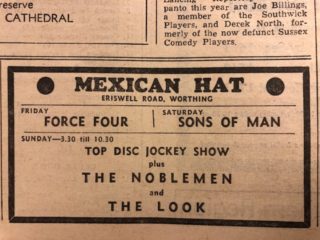
10 December 1965 – Force Four (Friday) (Worthing Gazette)
11 December 1965 – The Sons of Man (Saturday) (Worthing Gazette)
Photo: Worthing Gazette
12 December 1965 – The Noblemen and The Look (Sunday) (Worthing Gazette)
17 December 1965 – The Look (Friday) (Worthing Gazette)
18 December 1965 – The Palmer James Group (Saturday) (Worthing Gazette)
19 December 1965 – The Profile and The Look (Sunday) (Worthing Gazette)
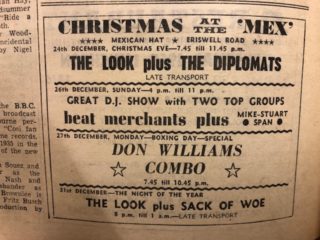
24 December 1965 – The Look and The Diplomats (Friday) (Worthing Gazette)
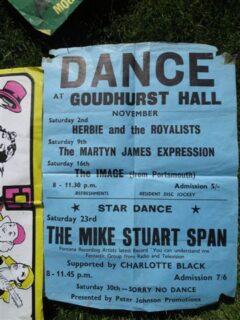
26 December 1965 – The Beat Merchants and The Mike Stuart Span (Sunday) (Worthing Gazette)
Photo: Worthing Gazette
27 December 1965 – The Don Williams Combo (Monday) (Worthing Gazette)
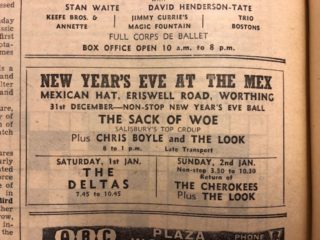
31 December 1965 – Chris Boyle & The Look and Sack of Woe (Friday) (Worthing Gazette)
Photo: Worthing Gazette
1 January 1966 – The Deltas (Saturday) (Worthing Gazette)
2 January 1966 – The Cherokees and The Look (Sunday) (Worthing Gazette)
According to the Worthing Gazette, the Mexican Hat was closed for a short period for alterations. However, the newspaper did not advertise the venue again in 1966
We’d welcome any additions below in the comments section with dates if possible
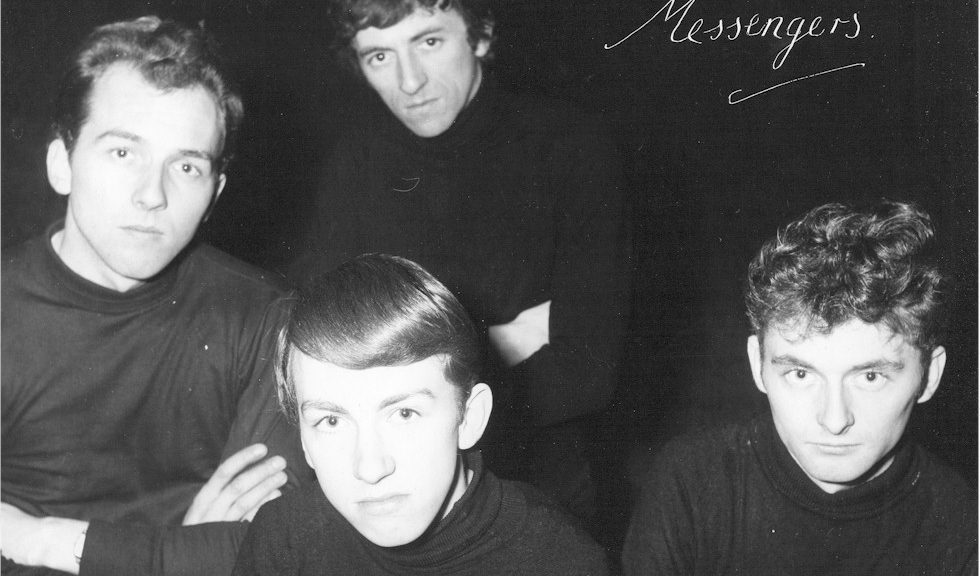
The (Fantastic Soul Messengers) were formed in November 1963 by former Flintstones members Terry Marshall (who had been in The Flee-rekkers in the interim) and Rod Freeman.
Future Jimi Hendrix drummer Mitch Mitchell, who started out with The Crescents had previously worked with Frankie Reid & The Casuals (late 1961-mid 1962), Pete Nelson & The Travellers and Johnny Harris & The Shades.
According to Marshall, another band had been booked to play at the famous Ealing Club on a Sunday and let down the club’s owner by failing to turn up.
As he recalls, “There were musicians in the club so I brought together Rod Freeman who I went pro with in 1960 when he was 16, Ken Rankine on bass and Mitch Mitchell on drums. We went down so well that Feri who ran the club gave us a residency there on the spot for Sundays.”
Regulars at the Ealing Club, the Middlesex County Times & West Middlesex Gazette has the band playing every Sunday in December 1963.
In 1964, they are also listed for 2 February, 5 April, 18 April and 11 May but played at the club much more than these advertised dates.
Soon after, Terry Marshall, who joined The Ray Martin Group, was replaced by American Gary Bell.
Photo: Nick Simper. The Soul Messengers, circa July 1964. Left to right: Gary Bell, Rod Freeman (back), Mitch Mitchell and Ken Rankine
However, around July 1964, Mitch Mitchell, who joined The Riot Squad that December, departed and the band changed name to The Next 5.
The new-line up comprised:
Rod Freeman – guitar/vocals
Ken Rankine – bass
Gary Bell – tenor saxophone (from the United States)
Photo: Boyfriend magazine, August 1964. The five-piece Next Five
The Middlesex County Times & West Middlesex Gazette lists The Next 5 at the Ealing Club playing a number of Thursdays throughout October and into November 1964 (see gigs below).
According to music writer David Else, they were also resident band at Tottenham Royal Ballroom.
Thanks to Terry Marshall and David Else for their help
Selected gigs:
The following are all from Middlesex County Times & West Middlesex Gazette unless otherwise noted
Billed as The Fantastic Soul Messengers:
23 November 1963 – Whitehall, East Grinstead, West Sussex with Johnny Five & The Ramblers (Evening Argus) Billed as Soul Messengers
1 December 1963 – Ealing Club, Ealing, Middlesex (billed as every Sunday)
8 December 1963 – Ealing Club, Ealing, Middlesex (Sunday)
15 December 1963 – Ealing Club, Ealing, Middlesex (Sunday)
22 December 1963 – Ealing Club, Ealing, Middlesex (Sunday)
29 December 1963 – Ealing Club, Ealing, Middlesex (Sunday)
Sonny (aka Tony Smith) (tenor saxophone/baritone saxophone)
Doug Collins (bass)
Dave Golding (drums)
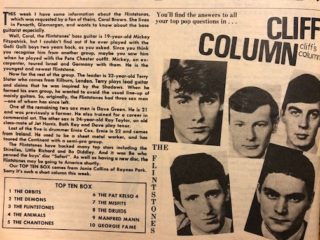
The Flintstones were formed in 1961 from the ashes of The Blue Men who included Collins, Freeman and Golding. Slater had previously been a member of The Cadillacs.
Marshall was the son of Jim Marshall, who ran the famous music shop in Hanwell, west London that became a meeting point for many notable Sixties musicians.
Tony Ross, who was called Rupert by the musicians, took over from Collins in early 1962 after playing in Peter Nelson & The Travellers.
According to Marshall, the band’s first recording was done with the legendary Joe Meek, who insisted that they record under the name The Stonehenge Men.
That summer singer Pete Fleerekker asked Terry Marshall to join his group, The Flee-rekkers and Tony Holley joined on tenor sax/vocals.
According to music writer David Else, Puddy left in November 1962 and formed The Night Sounds (featuring guitarist Albert Lee) and Ricky Marsh took over baritone saxophone.
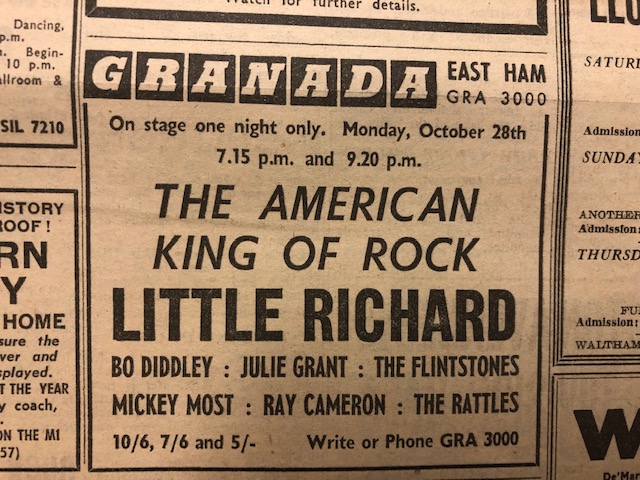
Else says that The Flintstones backed Little Richard on a British tour in September 1963. By this point, Ernie Cox had succeeded Dave Golding and Dave Green had replaced either Tony Holley or Tony Smith on tenor saxophone.
Photo: Walthamstow Guardian
After a second Little Richard tour in October-November 1963, Freeman left to form The Soul Messengers with Terry Marshall.
Not long afterwards, Tony Ross departed to join Carter Lewis & The Southerners.
Photo: Boyfriend Magazine, July 1964
In July 1964, Terry Slater revamped the band with the following musicians:
Terry Slater (lead guitar/vocals)
Mickey Fitzpatrick (bass) (ex-Pete Chester and Chris Ravel Ravers)
Dave Green (tenor saxophone)
Ray Taylor (tenor saxophone)
Ernie Cox (drums)
Not long afterwards, however, Cox and Green joined The John Barry Seven and the band split up.
According to David Else, Fitzpatrick subsequently worked with future Ferris Wheel member Mike Liston in Simon’s Triangle.
Terry Slater moved to the US and became part of The Everly Brothers Band.
Thanks to Terry Marshall and David Else for their help.
If you can add anything more to the band’s story, please get in contact via the comments section below.
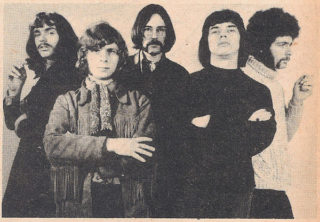
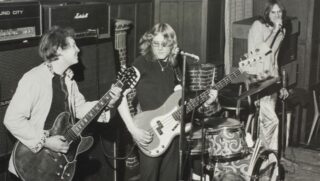
Fat Daughter, late 1969. Left to right: Ian Miller, Phil Hearn, Mike Reed (obscured), Pete Hicks and Dennis Lascelles. Photo: Ian Miller
Ray Edwards (lead vocals)
Ian Miller (lead guitar)
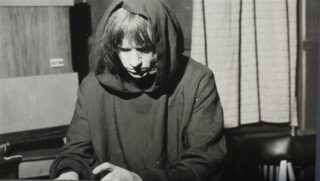
Dennis Lascelles (Hammond organ)
Steve Fields (bass)
Del Coverley (drums)
+
Pete Hicks (lead vocals)
Phil Hearn (bass/vocals)
Mike Reed (drums)
Formed around March/April 1969, this group from the Bexleyheath area of southeast London included some notable individuals in its ranks during its short tenure together.
Del Coverley had started out with school band The Millionaires in 1963 and then progressed on to The Scimitars before joining The Big Wheel in late 1965. After working in Switzerland with The Big Wheel, Coverley joined Carl Douglas & The Big Stampede in October 1966 but left in late July 1967 to join the final incarnation of The Fenmen, who gigged as Kindness (reuniting with keyboard player/singer Andy Clark from The Big Wheel).
When Kindness split in late 1967, Coverley reformed The Big Wheel with original members, Del Grace (guitar), Barry Nicholls (bass) and Mike Manners (keyboards) plus new singer Pete Hicks.
Photo: Melody Maker, December 1968
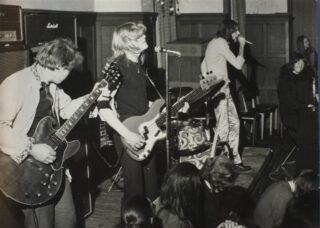
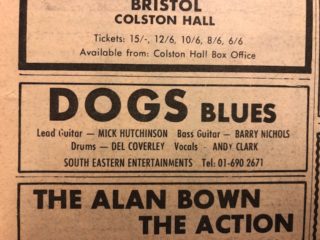
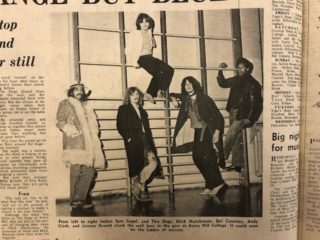
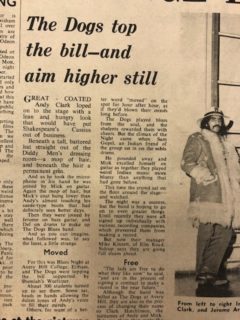
In late 1968, Coverley left The Big Wheel to reunite with Andy Clark and his new collaborator guitarist Mick Hutchinson (both ex-Sam Gopal Dream and Vamp) in the short-lived Dogs Blues. Barry Nicholls who’d recently worked briefly with Pete Hicks in Promise joined the outfit but in January 1969 he was replaced by American Jerome Arnold (ex-Paul Butterfield’s Blues Band) and guest tabla player Sam Gopal.
Photo: South East London Mercury. Dogs Blues, January 1969Dogs Blues featured in South East London Mercury, 28 January 1969
However, the group split in early February when Arnold formed his own group and Andy Clark and Mick Hutchinson decided to continue as a duo and record their debut LP.
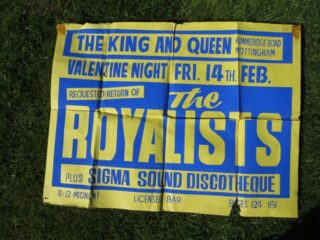
Coverley then joined a reformed version of The Royalists with guitarist Ian Miller, keyboard player Dennis Lascelles (who had briefly played with Del Grace in The Rifle) and bass player Steve Fields, who had previously worked with local bands The Kinetics and The Abstracts. The band’s singer was Lascelles’ cousin Ray Edwards.
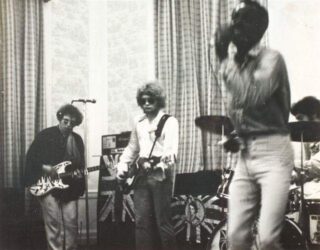
Herbie & The Royalists. Left to right: Ian Miller, Steve Fields, Herbie Hunte and Brian Cooper. Photo: Ian Miller
As Miller explains, The Royalists had started out as a soul band around 1966 with singer Herbie Hunte from Barbados. Originally known as Herbie & The Royalists, the group also included Dennis Lascelles, Steve Fields and drummer Brian Cooper. The band’s equipment was supplied by South Eastern Entertainments in Catford.
Herbie & The Royalists gig (1968). Photo: Ian Miller
Herbie & The Royalists released a rare LP Soul Of The Matter on Saga Records in 1968, which Miller says was recorded on four-track over two Sundays in a studio in Finchley. However, by the time the LP was released, Lascelles and Miller were pushing for a more progressive rock sound and so Herbie Hunte departed around December 1968. Lascelles brought in his cousin Ray Edwards as a replacement but by February 1969 Brian Cooper had also departed.
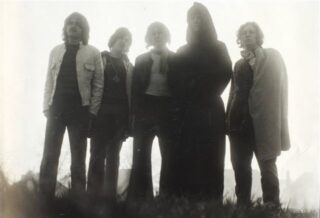
The reformed Royalists, circa March 1969. Left to right: Del Coverley, Ray Edwards, Steve Fields, Dennis Lascelles and Ian Miller. Photo: Ian MillerThe reformed Royalists gig (1969) shortly before becoming Fat Daughter. Photo: Ian Miller
With Del Coverley taking Cooper’s place, the band gigged as The Royalists before adopting the name Fat Daughter. However, not long after the band’s singer departed.
In Ray Edwards’s place, Del Coverley brought in singer Pete Hicks who had started out in 1965 fronting The Down & Outs. In 1966, he joined The South East London Blues Band who played a few times at Happening 44 in central London.
When that group split in 1968, Hicks worked with Coverley in Big Wheel (bringing in Alan Fuller from The Down and Outs to replace Mike Manners during the year) and then joined the band Promise.
During this period Miller remembers the band playing alongside Jon Hiseman’s Colosseum at Erith Polytechnic.
Promise with Pete Hicks (centre) and Barry Nicholls (far right)
Around early June 1969, Del Coverley and Steve Fields departed Fat Daughter and subsequently joined forces with Andy Clark and Mick Hutchinson in Clark-Hutchinson after they had cut their debut LP.
Before he hooked up with Clark-Hutchinson, Coverley briefly worked with Rust who had just recorded an LP in Germany called Come With Me. The only surviving member from the LP was John Thomas and other new members were guitarist Eric Lindsey and bass player Alex Alexander.
Miller remembers Coverley leaving Fat Daughter to help Carl Douglas on a tour, so this would have been his first job before playing with Rust.
Fields, who changed his name to Stephen Amazing, also spent a brief time with The Skatalites, which may have been just before Clark-Hutchinson. Amazing played in Upp (who featured Jeff Beck as guest guitarist on their LPs) in the Seventies but later died.
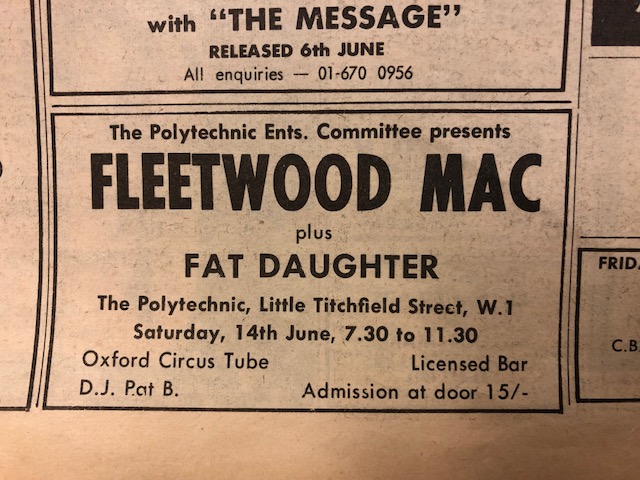
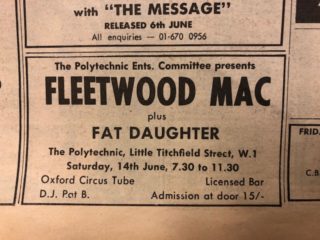
Bass player Phil Hearn, who had worked with Coverley in his early 1960s bands The Millionaires and The Scimitars, and drummer Mike Reed both joined at this point and their first gig was opening for Fleetwood Mac.
Photo: Melody Maker, 1969
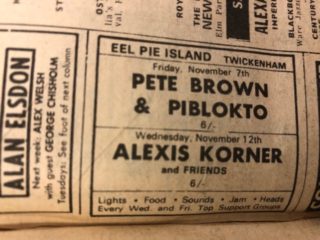
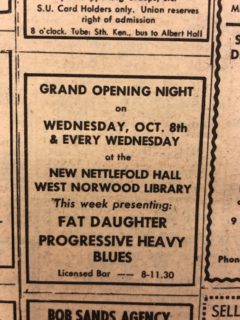
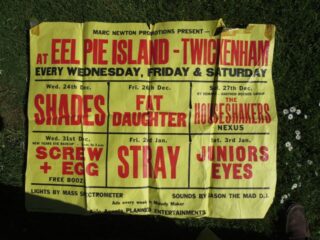
Later that year, the group opened for Alexis Korner (at Eel Pie Island) and Free (most likely Dartford Grammar School) among others.
Fat Daughter are uncredited for this support gig in late 1969. Photo: Melody MakerPhoto: Melody Maker, 1969
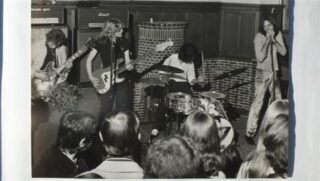
Miller says the band played at Eel Pie Island a few times. He also remembers gigs at the Scotch of St James in Mayfair, the Marquee on Wardour Street, central London and the Black Prince Hotel in Bexley.
Fat Daughter gig (1969). Photo: Ian Miller
He also recalls playing at Mildenhall USAF Airforce base with Kenny Ball & His Jazzmen, Avery Hill Teachers Training College with The Peddlers and Bromley College of Technology with Pink Floyd (most likely 26 April) where Syd Barrett joined his former band.
Fat Daughter, Black Prince Hotel, Bexley, late 1969. Left to right: Ian Miller, Phil Hearn, Mike Reed (obscured) and Pete Hicks. Photo: Ian Miller
Fat Daughter late 1969. Left to right: Ian Miller, Phil Hearn, Mike Reed and Pete Hicks. Photo: Ian MillerDennis Lascelles, late 1969. Photo: Ian Miller
When Hicks and Lascelles departed in early 1970, Hearn brought in a singer called John and a Hammond organist called Alan from his previous group Isis.
However, the new band didn’t last long and Phil Hearn and Mike Reed reunited with Pete Hicks in a new version of southeast London band Justin Thyme alongside guitarist Tony Pearman and organist Geoff Hurrell. That band’s original drummer Dave Neal went on to join Suzie Quatro.
Phil Hearn, who later moved to guitar, remained with Justin Thyme throughout the Seventies. He then became a sound engineer and worked with The Who, Aerosmith, Captain Beefheart, Crosby, Stills, Nash & Young and Michael Jackson among many others.
Original keyboard player Dennis Lascelles later became a noted artist and lives in Brighton. Mike Reed later ran his own entertainment agency named Mike Reed Promotions.
Thanks to Phil Hearn, Pete Hicks, Ian Miller and Del Coverley for information
When The Scimitars split in late 1965, Phil Hearn was invited to join another Bexleyheath area group, The James Set with the above line-up.
During 1966, Ian Mingham replaced the original drummer and keyboard player Derek Johnson succeeded Richard Holdaway. The band shortened their name to The James and played regularly in the local area with some gigs further afield.
Sometime around 1968, Phil Hearn left to form a group called Isis and later played with Fat Daughter.
This site is a work in progress on 1960s garage rock bands. All entries can be updated, corrected and expanded. If you have information on a band featured here, please let me know and I will update the site and credit you accordingly.
I am dedicated to making this site a center for research about '60s music scenes. Please consider donating archival materials such as photos, records, news clippings, scrapbooks or other material from the '60s. Please contact me at rchrisbishop@gmail.com if you can loan or donate original materials

 Briefly adopting the stage name Ron Spence, the guitarist next worked with The Revellos for six months or so before joining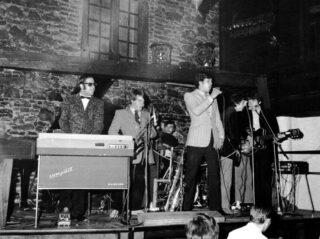
 Drawing largely on the material they played live, this included impressive takes of Otis Redding and Arthur Conley’s “Sweet Soul Music”; Mack Rice’s “Mustang Sally”; James Brown’s “Papa’s Got a Brand New Bag”; and Smokey Robinson and Ronald White’s “My Girl”.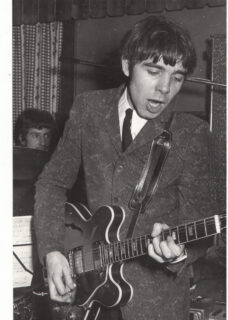
 With new drummer Wolfgang Paap (b. 1944, Danzig, Germany) behind the kit, the sessions for the LP took place in Basel on 16 and 17 April 1968 and included powerful covers of Allen Touissaint’s “Get Out of My Life Woman”, Wilson Pickett and Steve Cropper’s “In the Midnight Hour”, plus yet another re-recording of “Hold On, I’m Coming”.