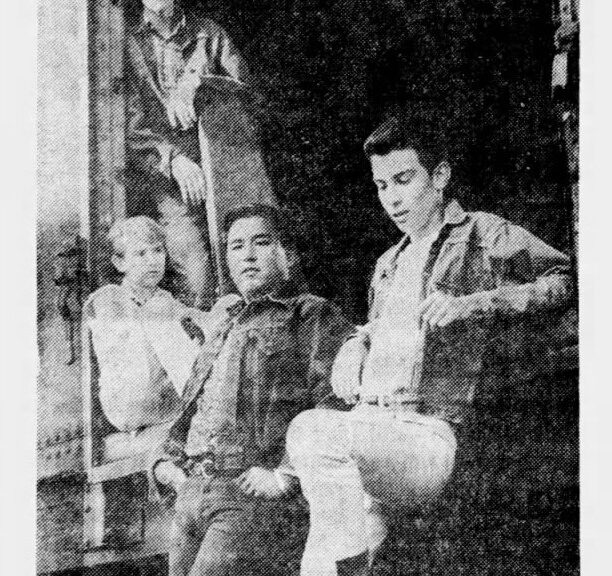
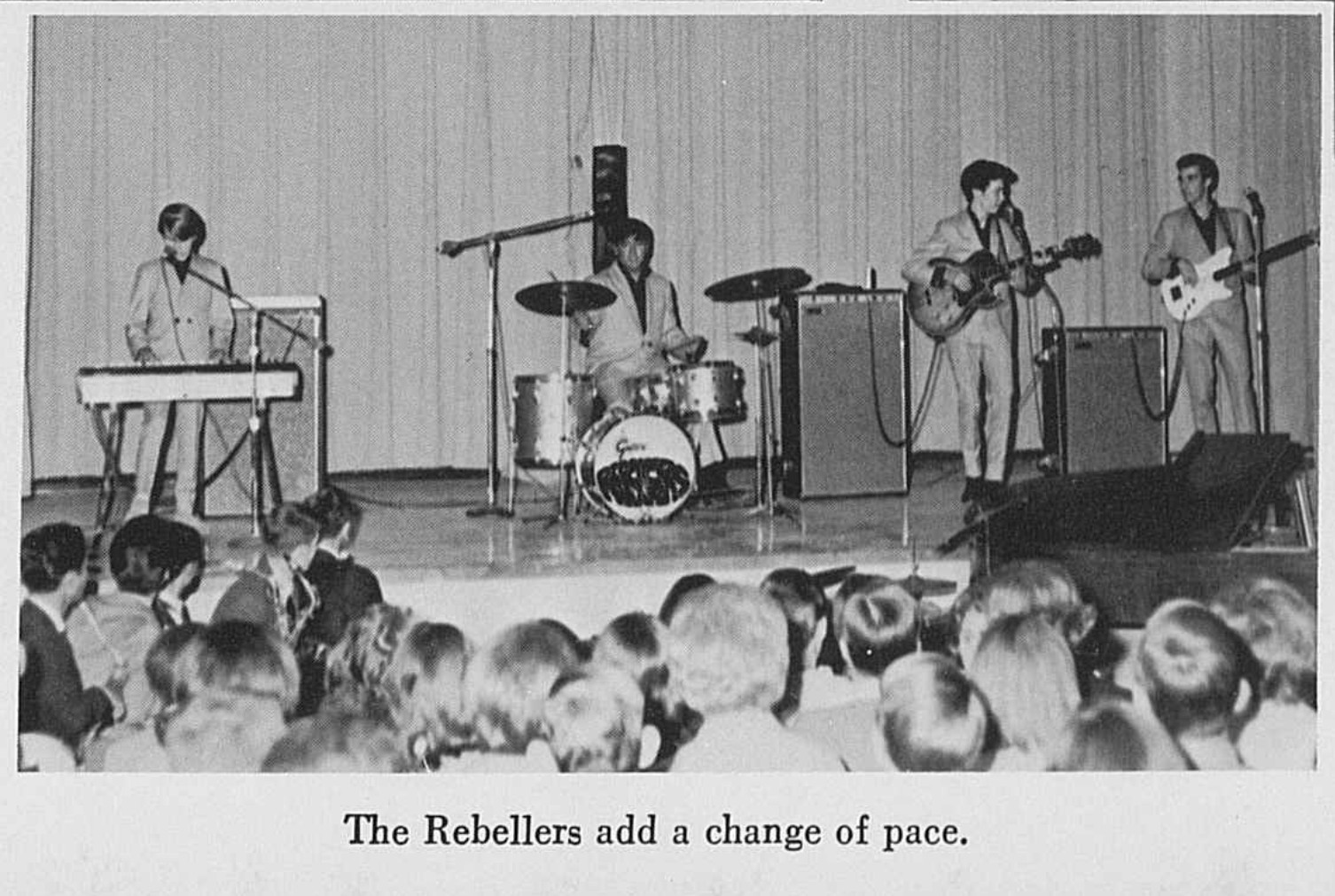
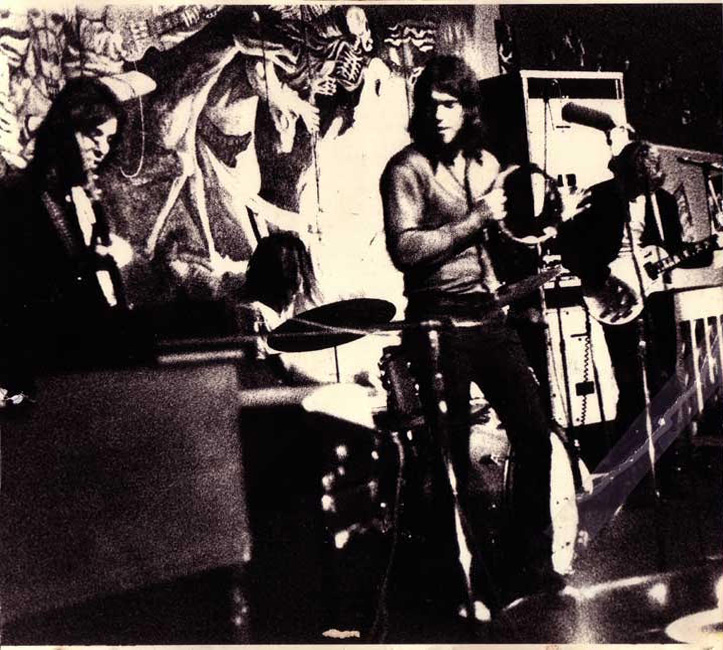
The Rebellers in the 1968 Milby High Valentines Varieties show, from that year’s yearbook. From left (please correct if these IDs are wrong): John Manlove, David Rodriguez, James Manlove and Jeff Gray
The Rebellers came from the Houston, Texas metro area, recording James Manlove’s original song “The New Generation” for Orbit Records 1114 in the summer of 1967.
Members included:
James Manlove – lead vocals, rhythm guitar John Manlove – keyboards and vocals Jeff Gray – bass guitar and vocals David Rodriguez – drums
The flip, “The Common People” was written as “Love of the Common People” by the prolific songwriting team, John Hurley and Ronnie Wilkins.
Early versions of the Cicadelic compilation Three O’Clock Merrian Webster Time included “The New Generation” mistakenly attributed to the Nomads but with the correct writing credit. This has led some website to include James Manlove as a member of the Nomads, which I believe is incorrect.
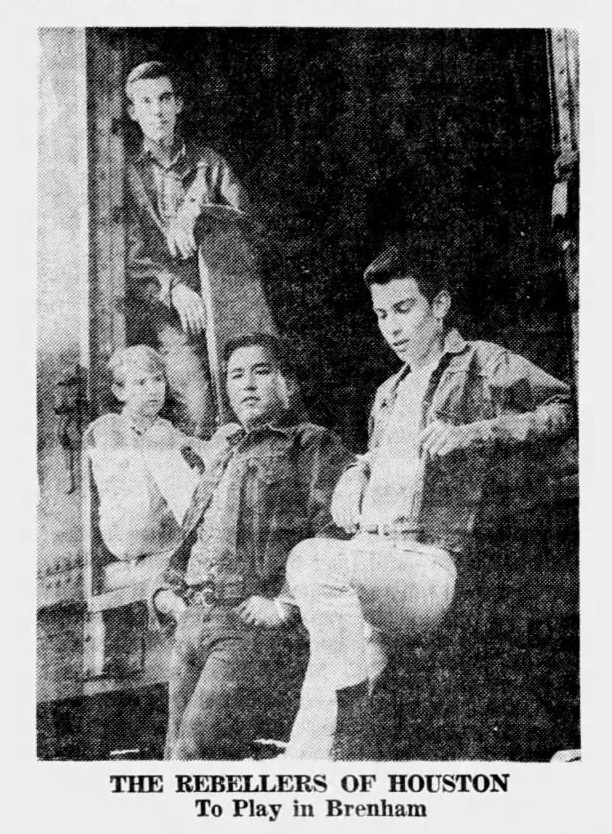
The Rebellers featured in the Houston Post nowsounds calendar, November 19, 1967
The November 19, 1967 Houston Post nowsounds calendar ran a photo of the Rebellers.
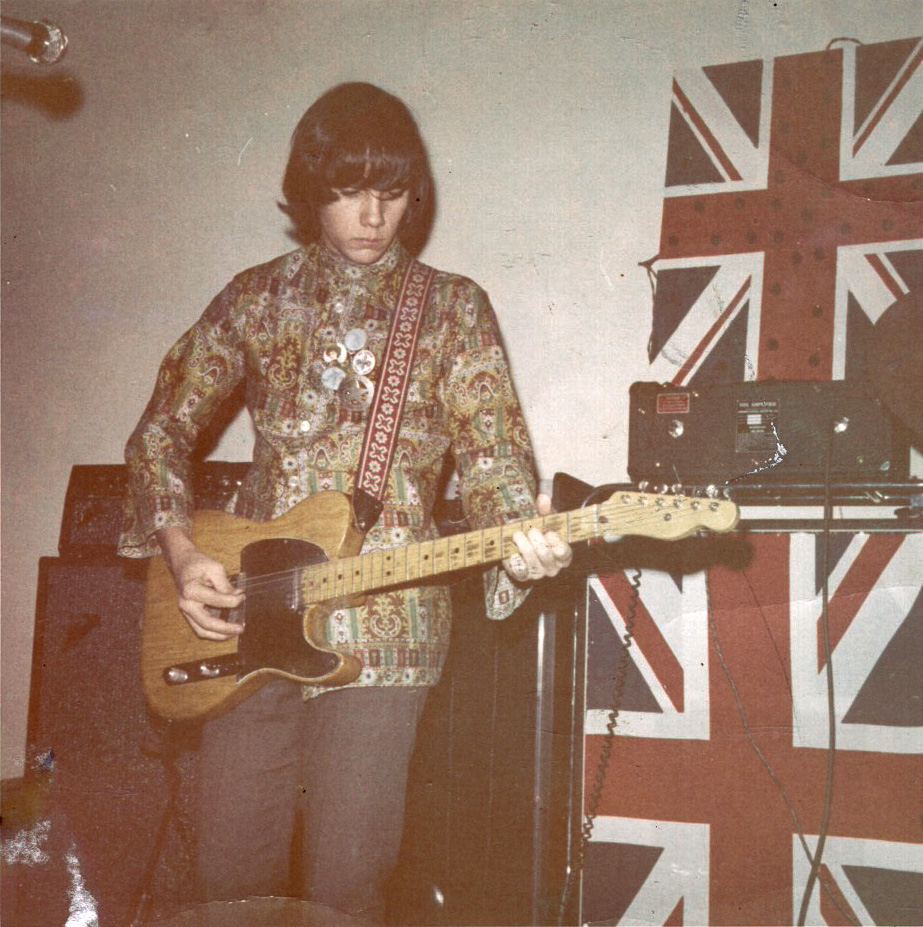
From a photo in the 1968 Milby High School Yearbook, the Rebellers played Milby High School’s Valentines Varieties show that year.
According to his Discogs profile, David Rodriguez was a member of the group, but a commentator on youtube listed the drummer as “Pete”.
Gig list compiled from the Houston Post nowsounds calendar and other news items:
September 20, 1966: there’s a notice of the Rebellers at a benefit with Jack Jones, Garry Mann, the Bachelors and Tommy Graham at the Gulfgate Cellar Club, but that may be a little early for this band, whose frequent gig listings start in May, 1967.
Friday, May 19, 1967: at Insight Au Go Go, 12826 Beaumont Highway 90 Friday, May 26 and Saturday May 27, 1967: at Lions Club Hall, Friendswood, Highway 518 Saturday, June 3, 1967: at Grand Prix, Bay City Tuesday, June 13, 1967: at Conroe Ballroom, Gladstell West off 45 Friday, June 16, 1967: at the Dungeon in Spring Saturday, June 17, 1967: at Sea Isle Teen Dance in Galveston Tuesday, June 20, 1967: at Love Street Light Circus Wednesday, June 21, 1967: at Hullabaloo Tuesday, June 27, 1967: at Conroe Ball Room Saturday, July 1, 1967: at Insight Au Go Go Saturday, July 15, 1967: at Sea Isle Teen Club, Galveston Saturday, July 22, 1967: at Buddy McGregor Saturday Show, Foley’s Town Hall Wednesday, July 26, 1967: at Fun Corral, 9801 Airline Saturday, July 29, 1967: with the Entire Thing at Sea Isle, Galveston Friday, August 18, 1967: at the Vault, Pasadena Saturday, August 19, 1967: at Deer Park Civic Center Wednesday, August 23, 1967: at Carousel Skating Rink, 9190 Old Katy Road Thursday, August 24, 1967: at KNUZ back-to-school festival at Sharpstown Center Friday, August 25, 1967: at Teen Hall, Bryan TX Saturday, August 26, 1967: at Ken Grant Show, Sharpstown Shopping Center 2 PM, and Insight Au Go Go, Beaumont Highway Friday, October 6, 1967: at Teen Hall, Bryan Friday, October 20, 1967: at Lodge Pokrok, 15th and Beall Saturday, November 4, 1967: at Lions Club, Pearland Saturday, November 11, 1967: at Kerwin High School, Galveston Friday, November 17, 1967: with Lemon Fog, Soul Searchers, Duke & the Kingsmen, and the Inquisitions at San Jacinto High School Soul Spectacular Saturday, November 18, 1967: with Audio Manifesto at Mount Carmel High Wednesday, November 22, 1967: at Brenham Hanger Club Friday, December 15, 1967: at the Vault, Pasadena Saturday, December 2, 1967: at Taylor Hall, Pasadena Saturday, December 23, 1967: at Nottingham Forest Country Club Friday, January 12, 1968: at Lodge Pokrok Saturday, January 27, 1968: at Milby High School Saturday, February 10, 1968: at Love Street Light Circus February ?, 1968: Milby High School’s Valentines Varieties show Friday, March 22, 1968: at the Vault, Pasadena Friday, April 19, 1968: at Teen Hall, Dickinson Saturday, May 4, 1968: with Ninth Street Bridge, Lemon Fog, Apollos at Taylor Hall, Pasadena Saturday, June 8, 1968: Jamaica Beach, Galveston Friday, June 21, 1968: at Lodge Pokrok Saturday, June 29, 1968: at Sea Isle, Galveston Saturday, July 20, 1968: at DERA Hall, Orange Friday, August 2, 1968: at the New Vault, Pasadena
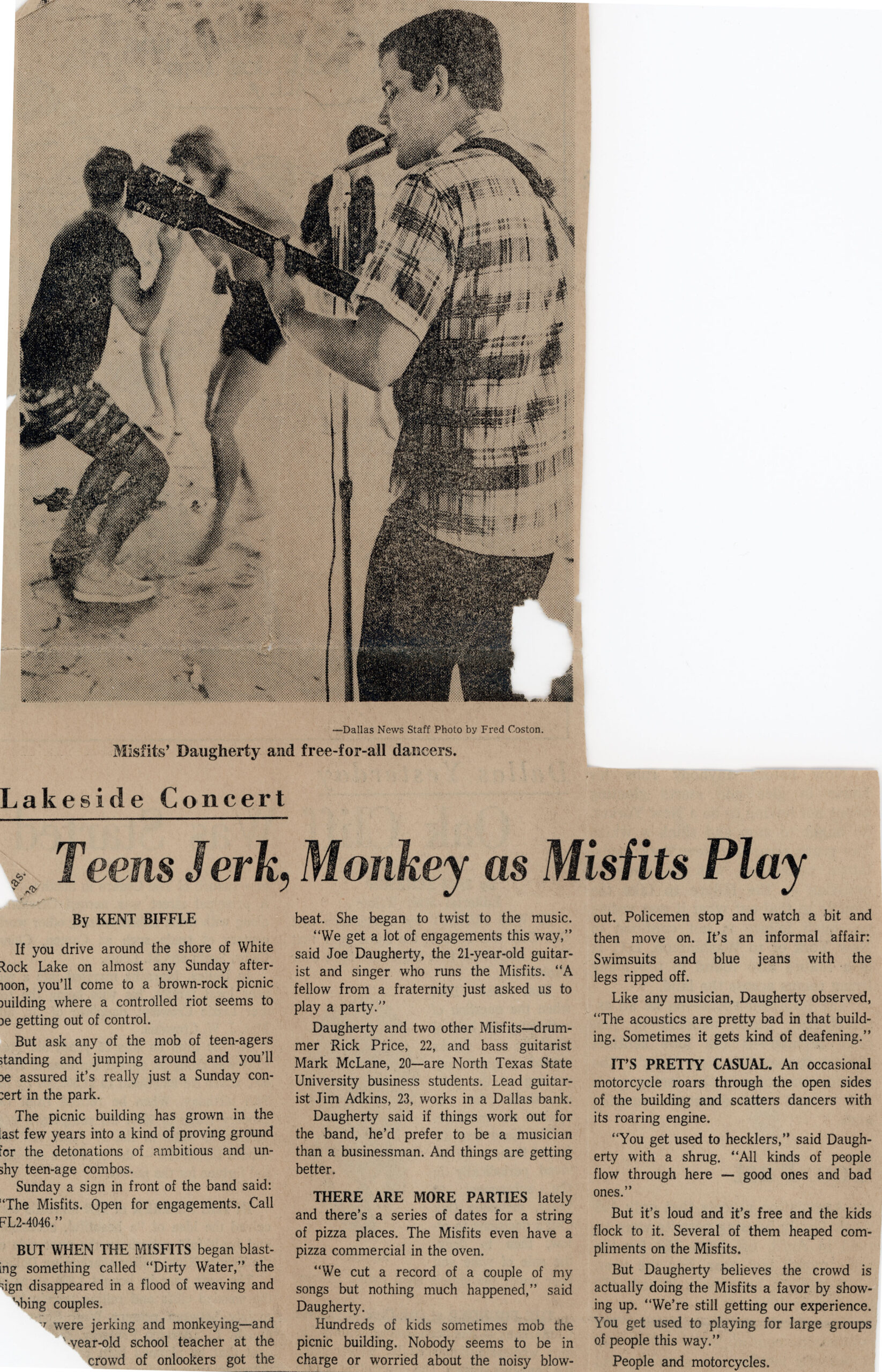
This group of Misfits came out of Dallas and North Texas State University in nearby Denton. They cut a fine original folk-rock song, “No One Else” backed with a good version of “Route 66” on Repent 520 in August, 1966.
This was not the same Misfits who became the Lost and Found. The Misfits who became Lost & Found were from Houston, and, according to an old interview with Jim Frost, never played in Dallas, and never recorded as the Misfits.
This news clipping shows all the members’ names are different than any in the Lost & Found.
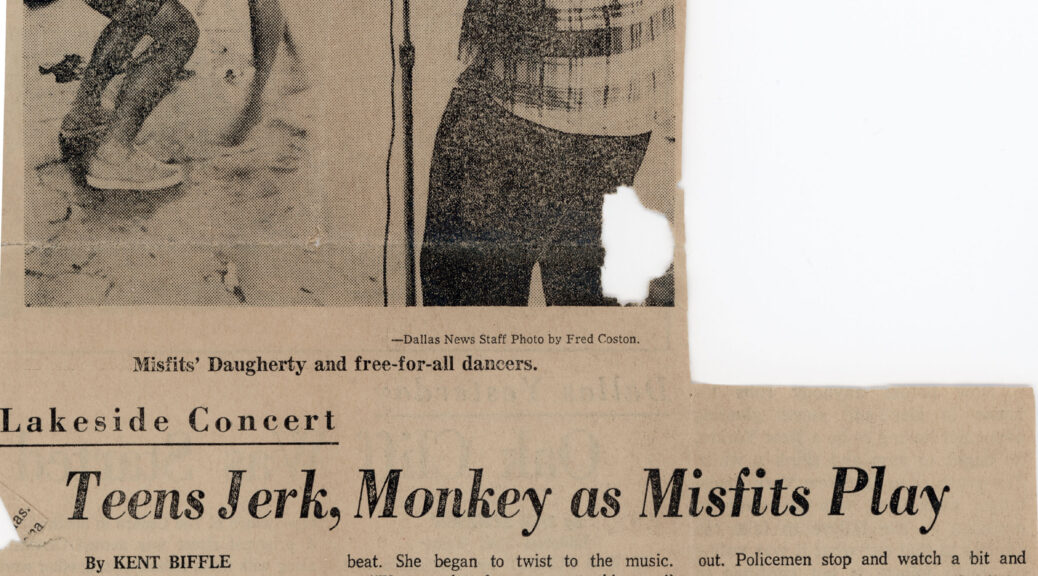
The Dallas News ran a photo of Joe Daughtery, the writer of “No One Else” performing with the Misfits and a short article on the group:
If you drive around the shore of White Rock Lake on almost any Sunday afternoon, you’ll come to a brown-rock picnic building where a controlled riot seems to be getting out of control.
But ask any of the mob of teen-agers standing and jumping around and you’ll be assured it’s really just a Sunday concert in the park.
The picnic building has grown in the last few years into a kind of proving ground for the detonations of ambitious and un-shy teen-age combos.
Sunday a sign in front of the band said: “The Misfits. Open for engagements. Call FL2-4046.”
But when the Misfits began blasting something called “Dirty Water,” the sign disappeared in a flood of weaving and bobbing couples.
…
“We get a lot of engagements this way,” said Joe Daugherty, the 21-year-old guitarists and singer who runs the Misfits. “A fellow from a fraternity just asked us to play a party.”
Daugherty and two other Misfits – drummer Rick Price, 22, and bass guitarist Mark McLane, 20 – are North Texas State University business students. Lead guitarist Jim Adkins, 23, works in a Dallas bank.
“We cut a record of a couple of my songs but nothing much happened,” said Daugherty.
Hundreds of kids sometimes mob the picnic building. Nobody seems to be in charge or worried about the noisy blowout. Policemen stop and watch a bit then move on …
Like any musician, Daugherty observed, “The acoustics are pretty bad in that building. Sometimes it gets kind of deafening.”
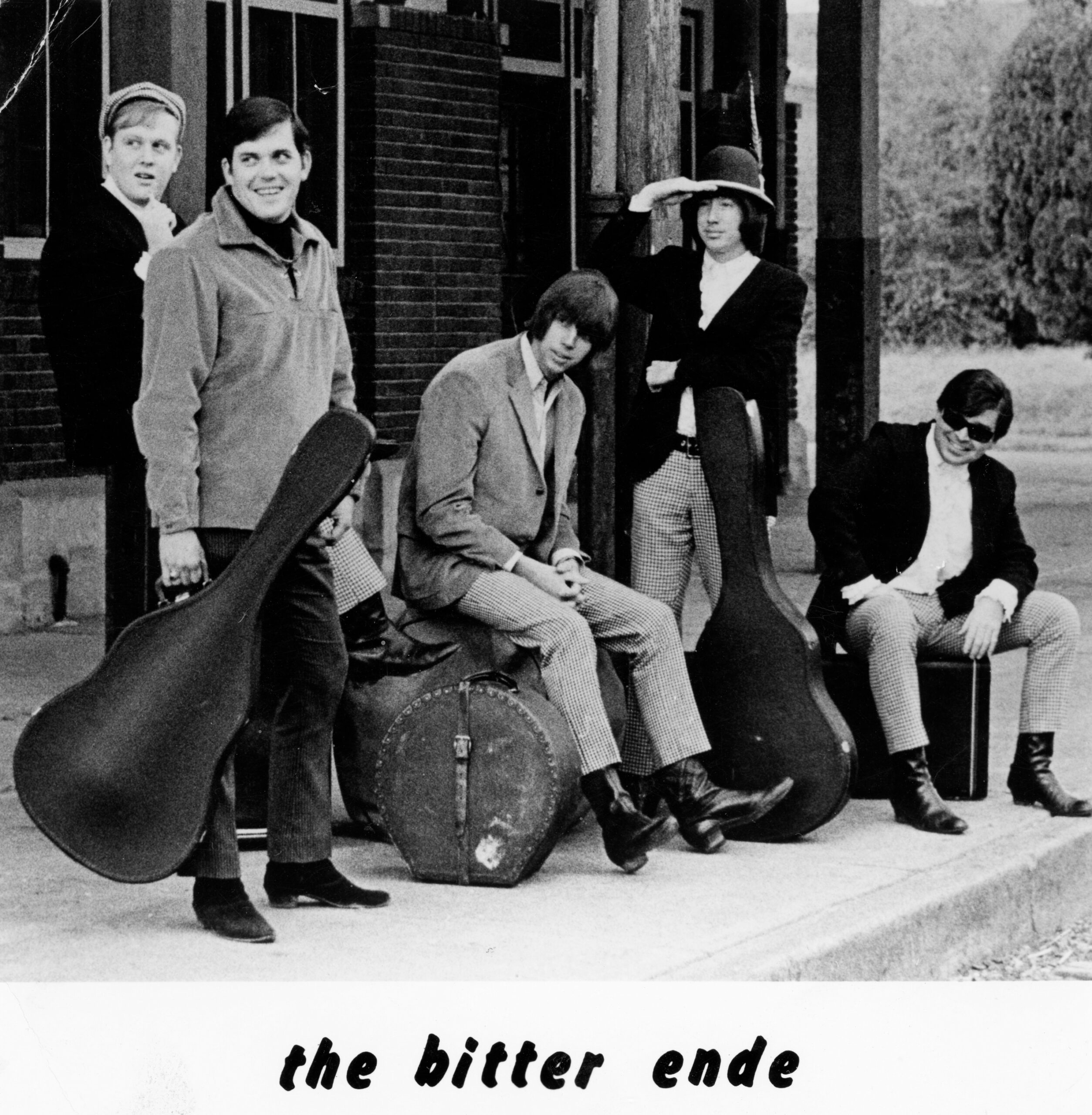
The Bitter Ende. Joe Daugherty holding guitar at left. Other members unknown – can anyone help with IDs?
The Bitter Ende to play at TCU Tech Stop, November 1967. Same group?Joe Daugherty formed another group called the Bitter Ende, but I don’t have any info on the membership of that group.
Thank you to Patrick Daugherty for contacting me about his father’s band, and sending in the news clipping and photo of the Bitter Ende.
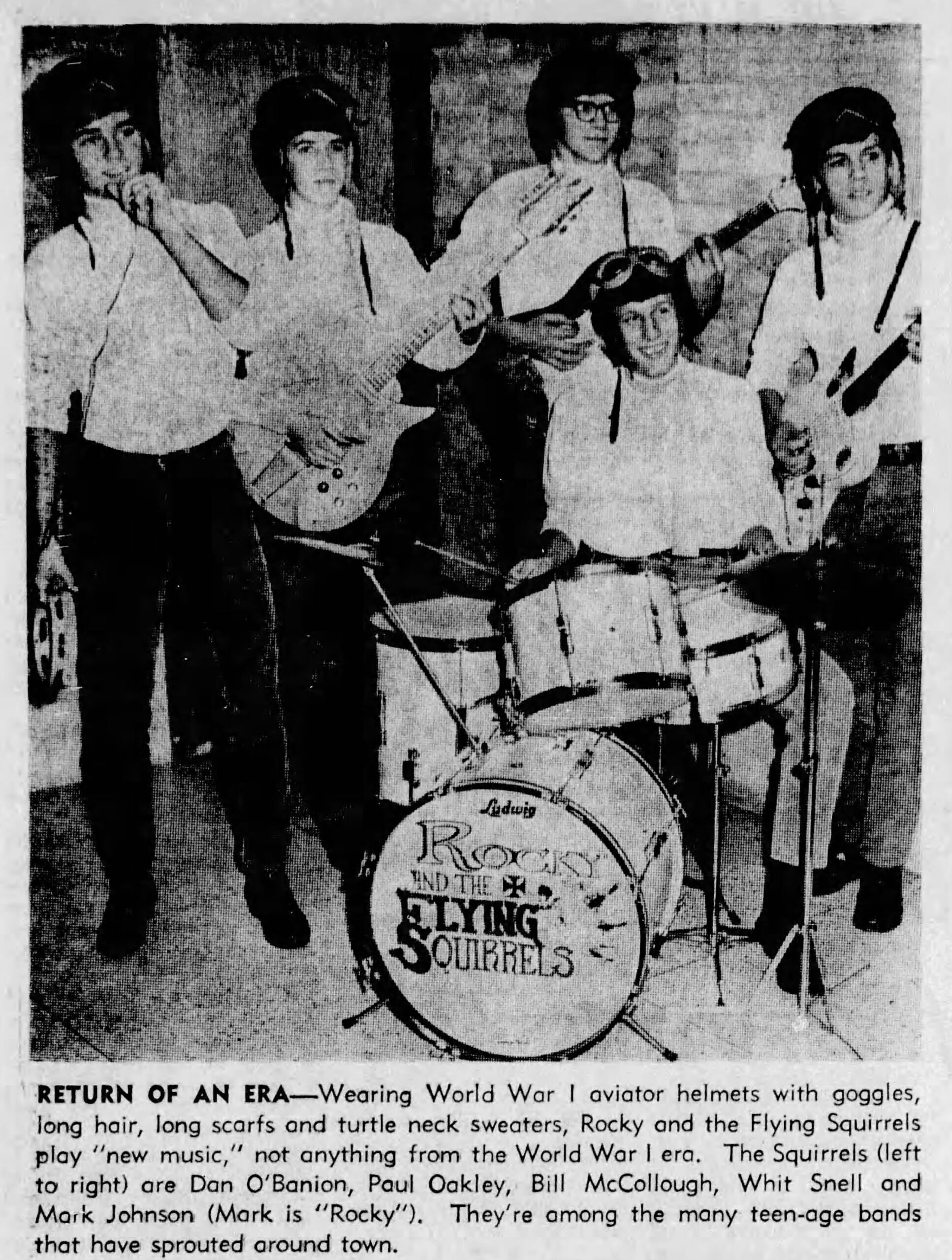
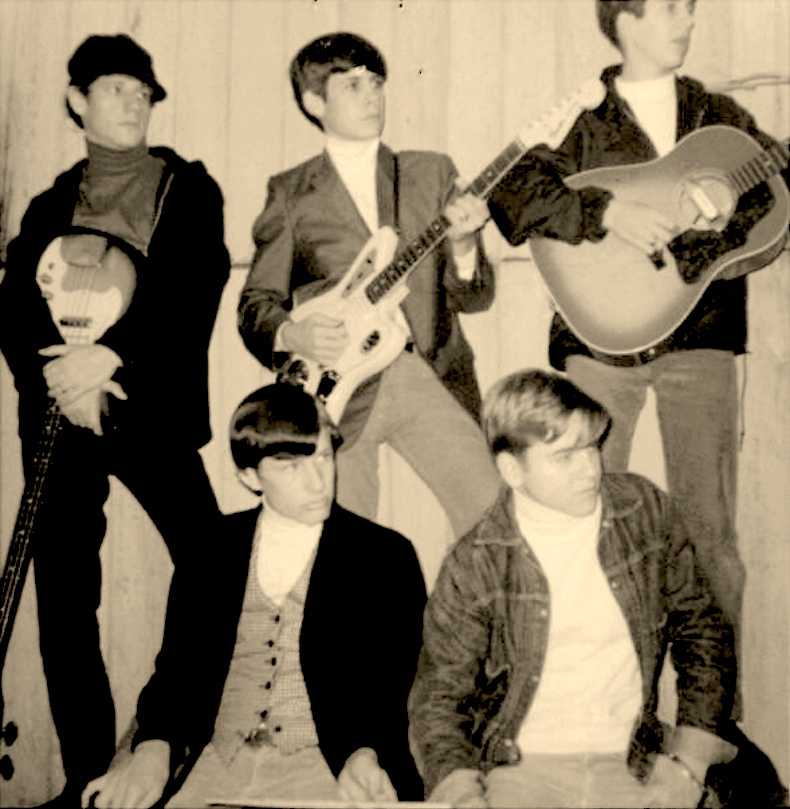
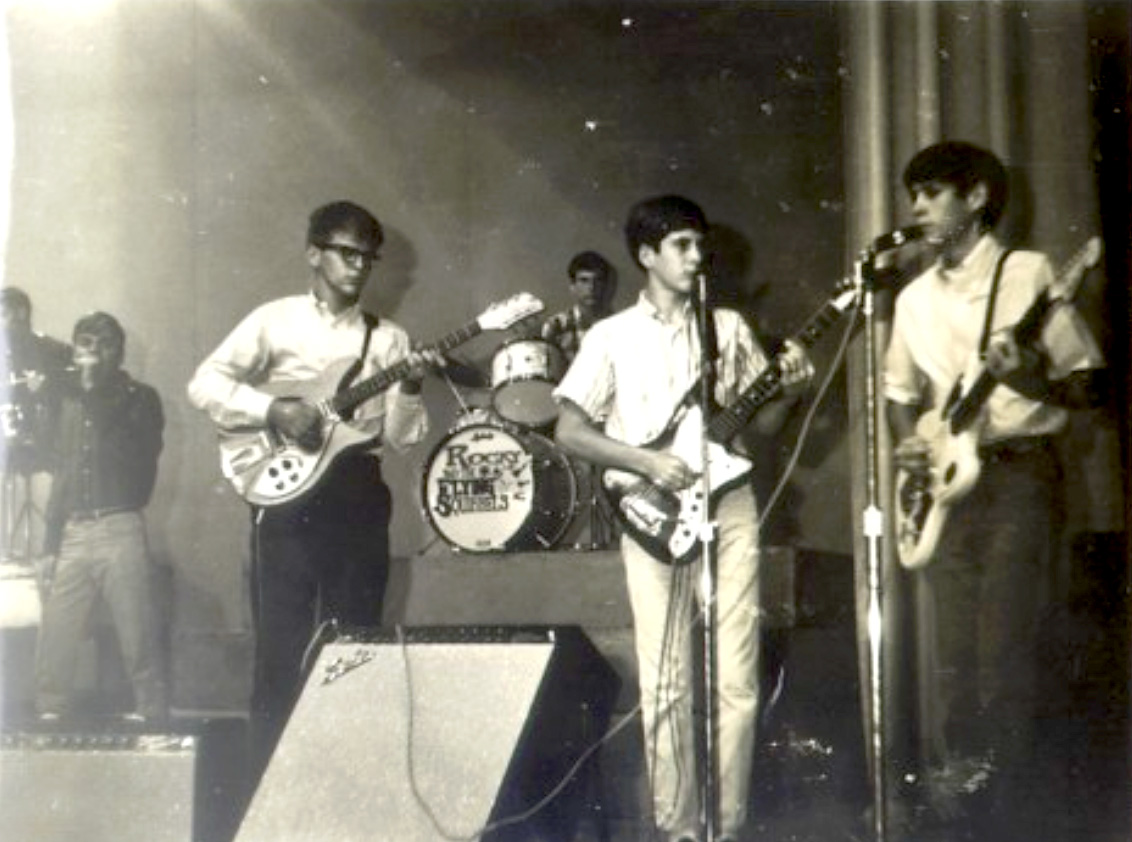
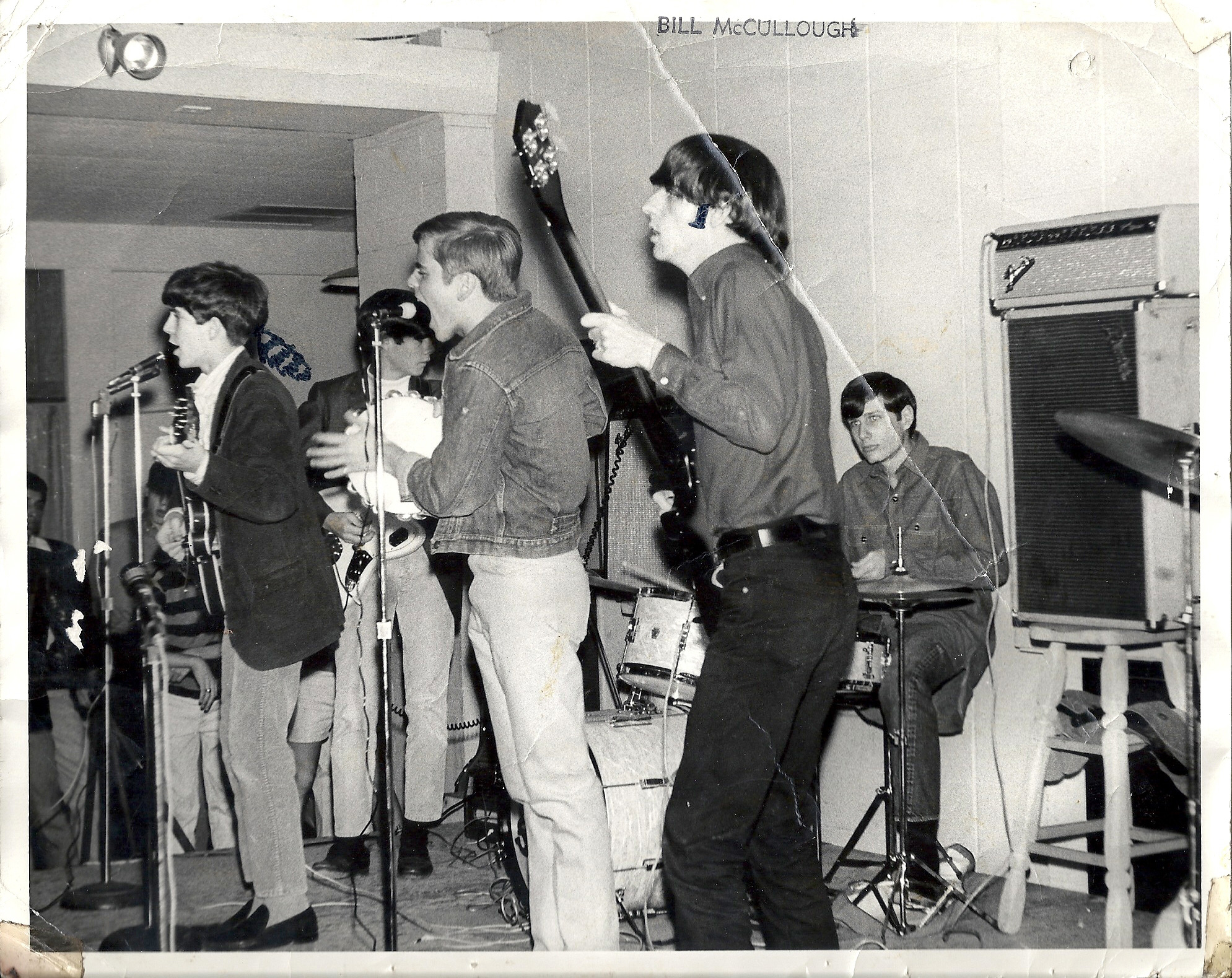
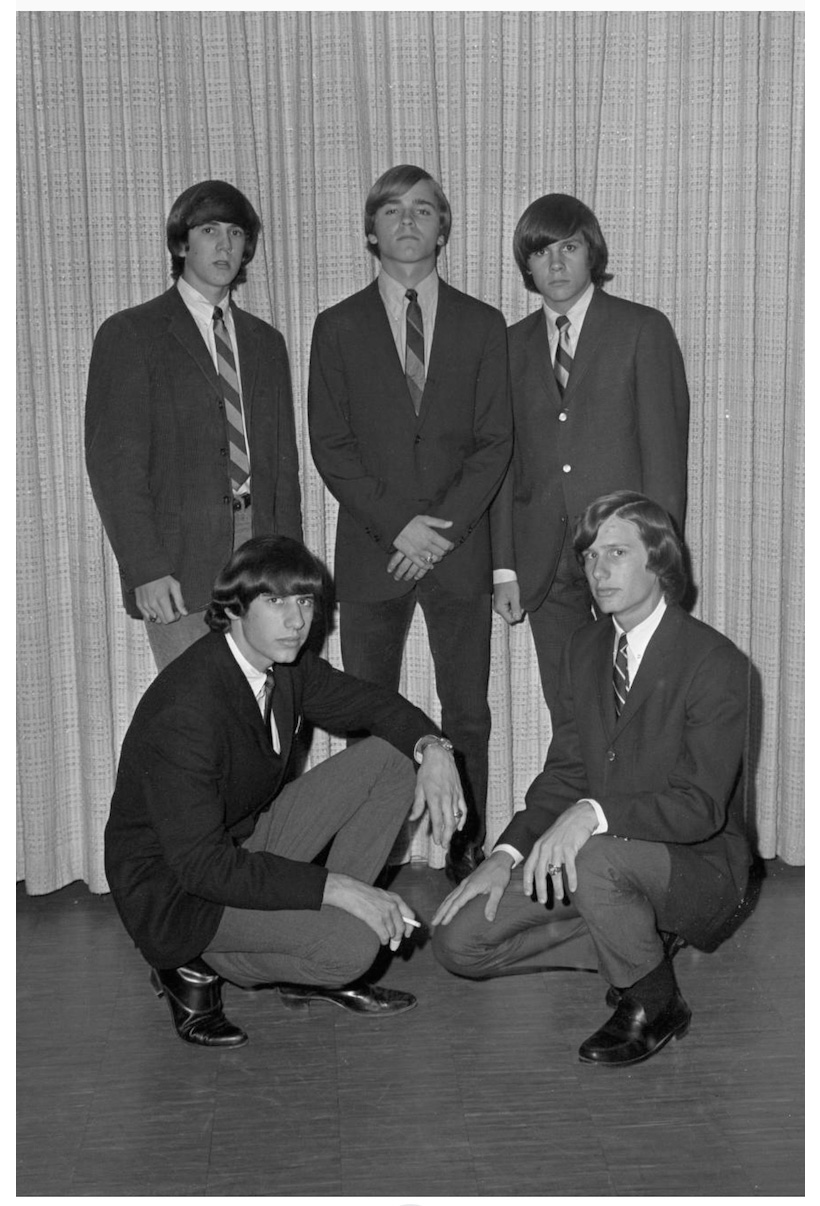
Rocky and the Flying Squirrels, published November 1965. The caption is incorrect. Should read from left to right: Mark Johnson (“Rocky”), Dan O’Banion, Paul Oakley, Bill McCollough (on drums), and Whit Snell.Rocky and the Flying Squirrels or earlier group. Top from left (I think): Paul Oakley with bass, Whit Snell, and Dan O’Banion; bottom from left: Bill McCullough and Mark Johnson. I would appreciate any help to confirm these IDs.
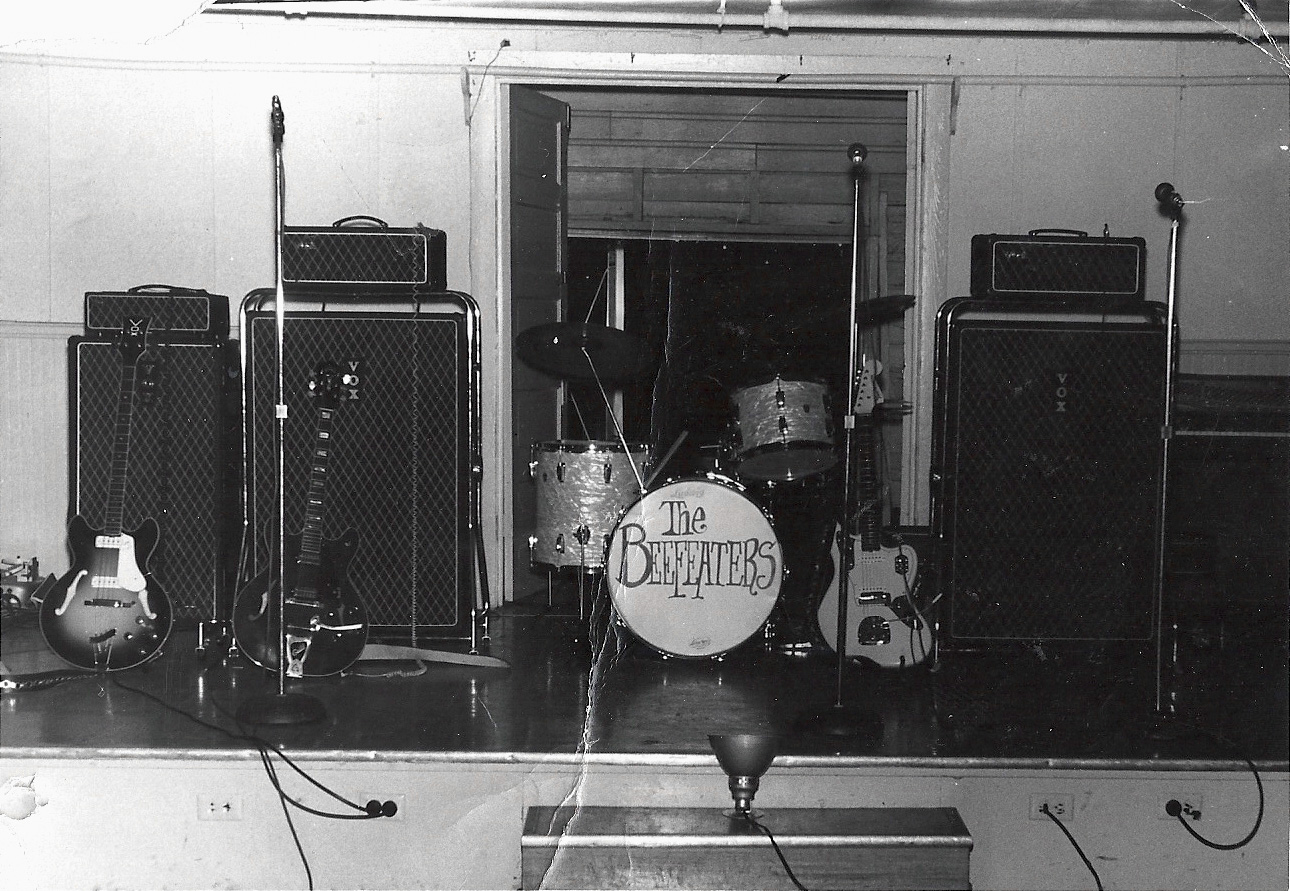
The Beefeaters were part of the North Texas State University (NTSU) scene which included the Chessmen, but their story starts out 300 miles away, in San Antonio. Five students at Alamo Heights High School formed Rocky and the Flying Squirrels, wearing World War I aviator helmets and goggles, scarves, and turtle-neck sweaters in honor of their animated namesake.
Members included: Mark Johnson on lead vocals, Whit Snell lead guitar, Dan O’Banion rhythm guitar, Paul Oakley on bass, and Bill McCullough playing drums.
Rocky and the Flying Squirrels, in white from left (I think): Dan O’Banion with the Rickenbacker guitar, Bill McCullough drums, Paul Oakley with bass and Whit Snell. At left, I think that is Mark Johnson with the microphone. I would appreciate any help to confirm these IDs.
They played live at Alamo Heights High School auditorium and the student-run Mule Barn teen club by the football stadium, but the band made plans for a bigger future.
Rocky and the Flying Squirrels, front left: Dan O’Banion with hand-drawn raccoon tail), Whit Snell, Mark Johnson with tambourine, Paul Oakley (or Cary surname?) on bass with added sideburns, and Bill McCullough. Photo courtesy of Bill McCullough, like many of the ones seen here.The Beefeaters 1966 promotional photo
From the Flying Squirrels to the Beefeaters
Graduating in May, 1966, all except Paul Oakley agreed to attend NTSU (now the University of North Texas) in Denton, northwest of Dallas. Bill McCullough’s older brother David, Jr. took over on bass to replace Paul. David had been guitarist in his own group in San Antonio, Spider and the Flies.
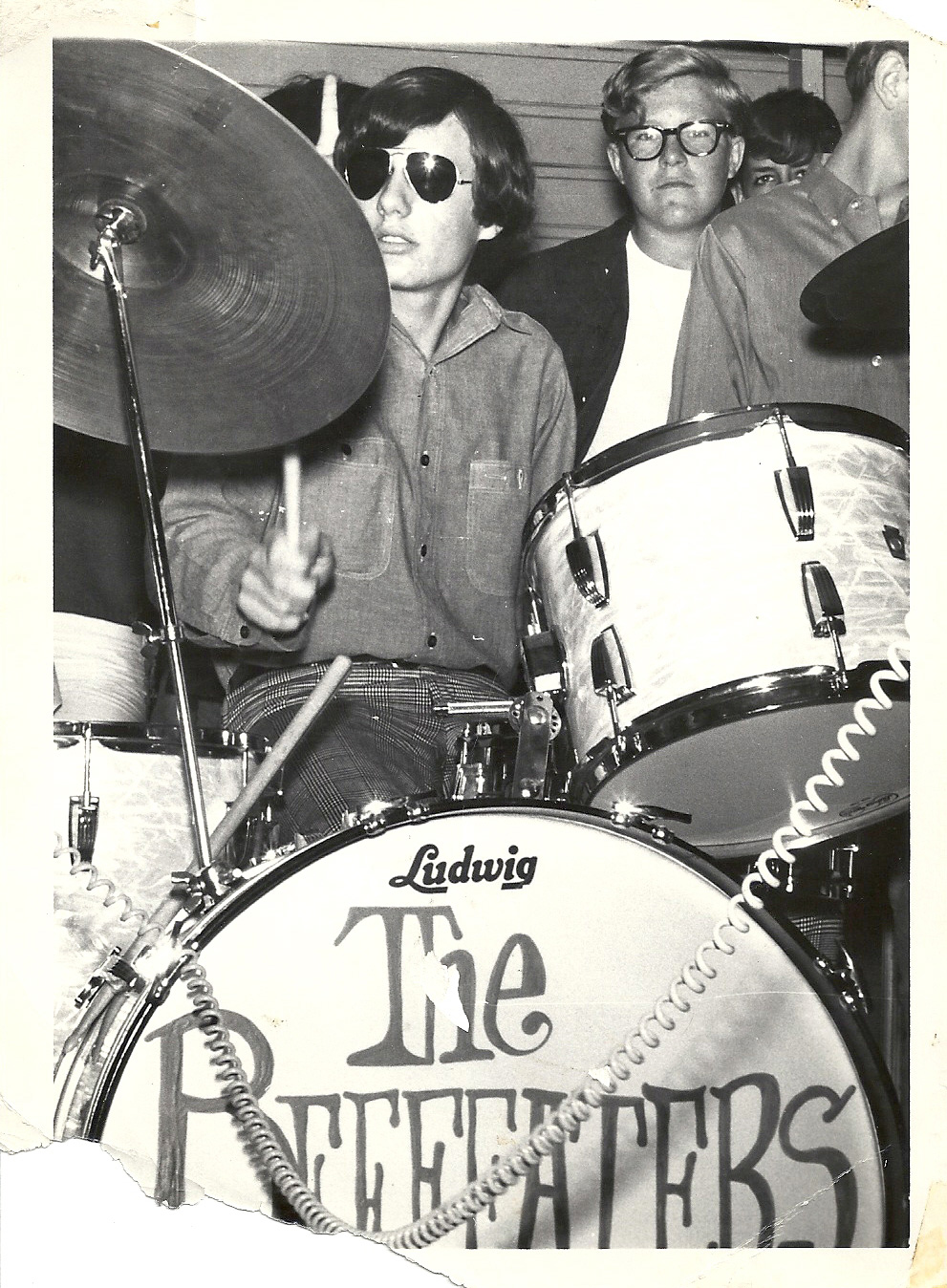
They cultivated the sound and “mod” looks of the English groups of the period, and took a new band moniker to fit the image: the Beefeaters.
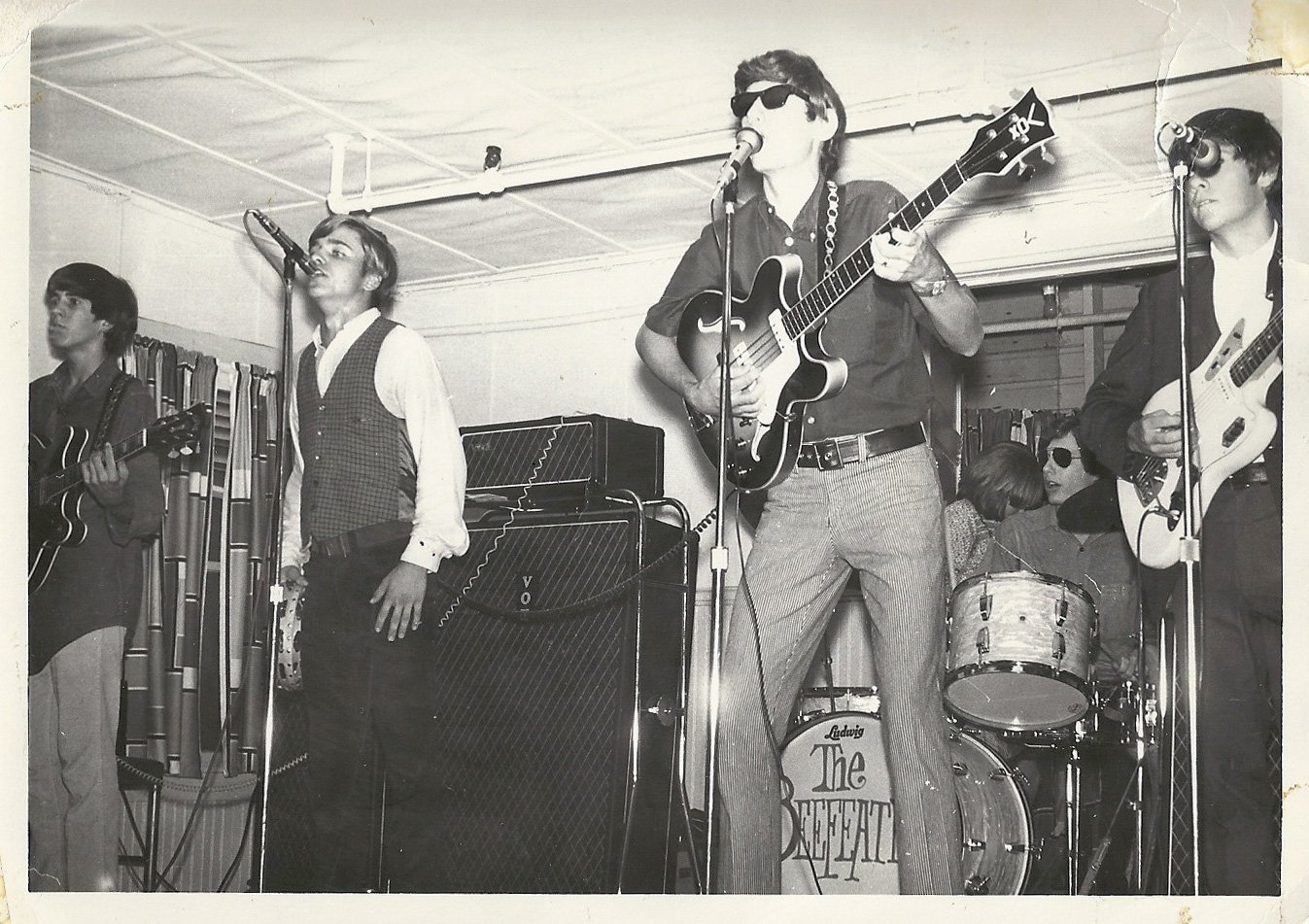
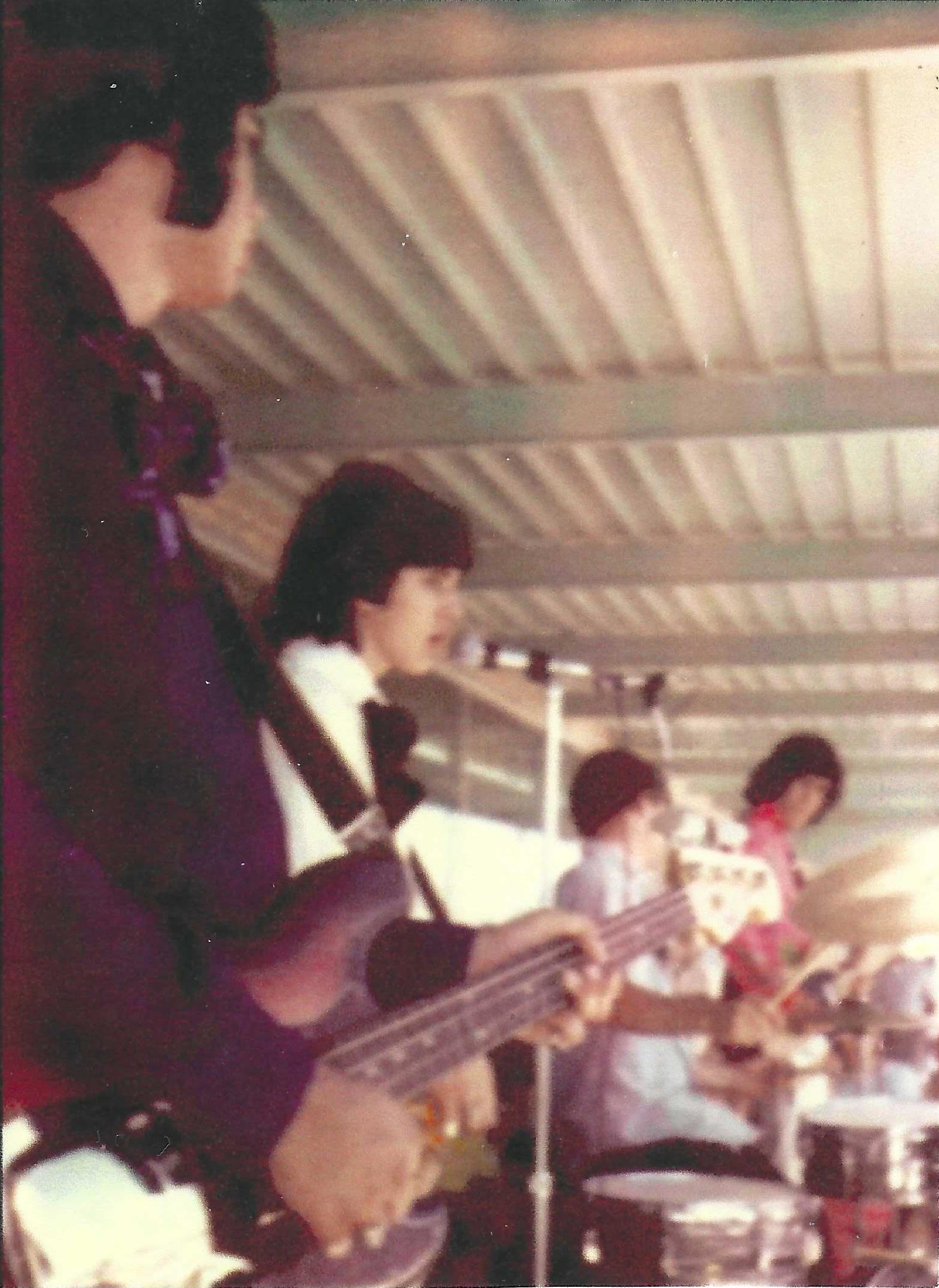
The Beefeaters on stage 1966: Rocky and the Flying Squirrels, front left: Dan O’Banion, Mark Johnson, David McCullough, Bill McCullough on drums and Whit Snell
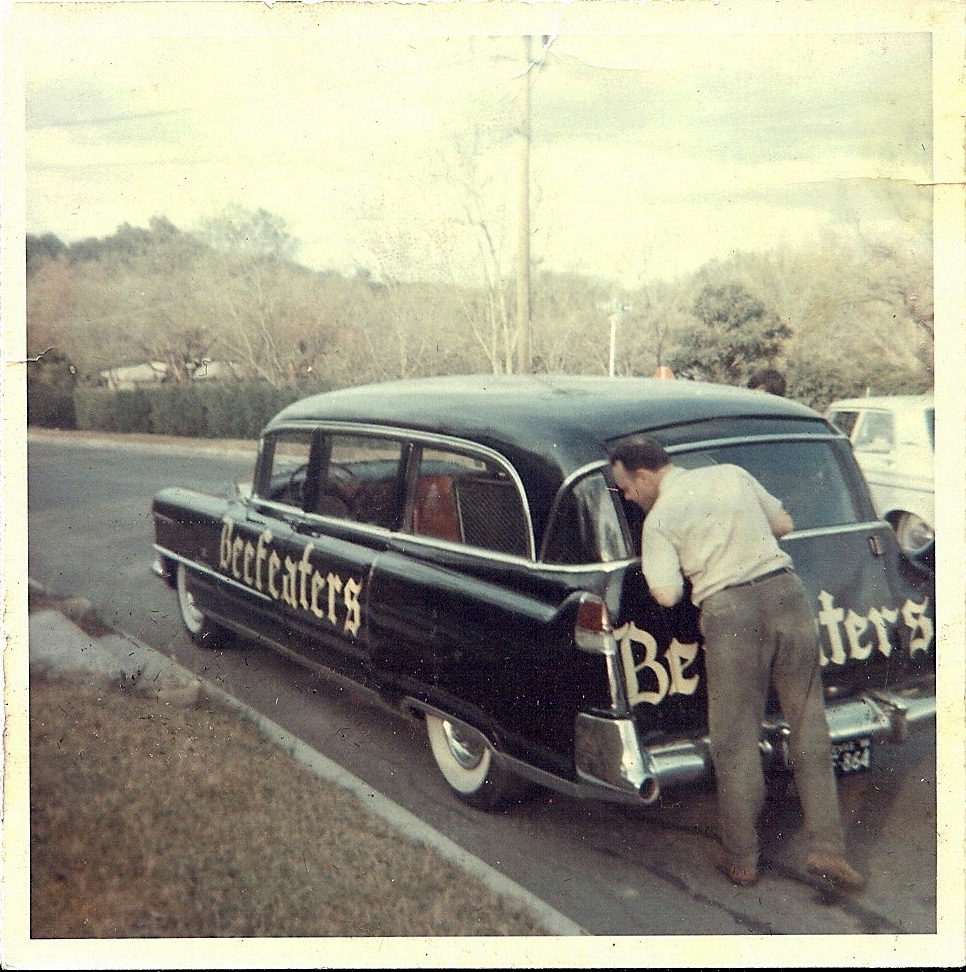
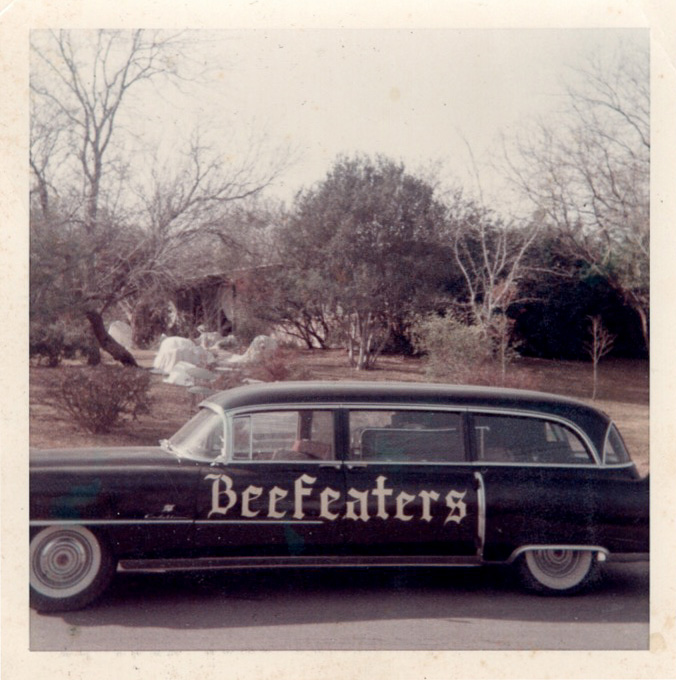
The Beefeaters’ first gig, on a flatbed truck on the commons by the NTSU student union, was a success and they started landing regular bookings at the Spinning Wheels skating rink and local frat parties. They bought a used ’56 Cadillac hearse, like other Denton groups, and adorned it with their band name and bumper stickers (“Eat More Beef” for one).
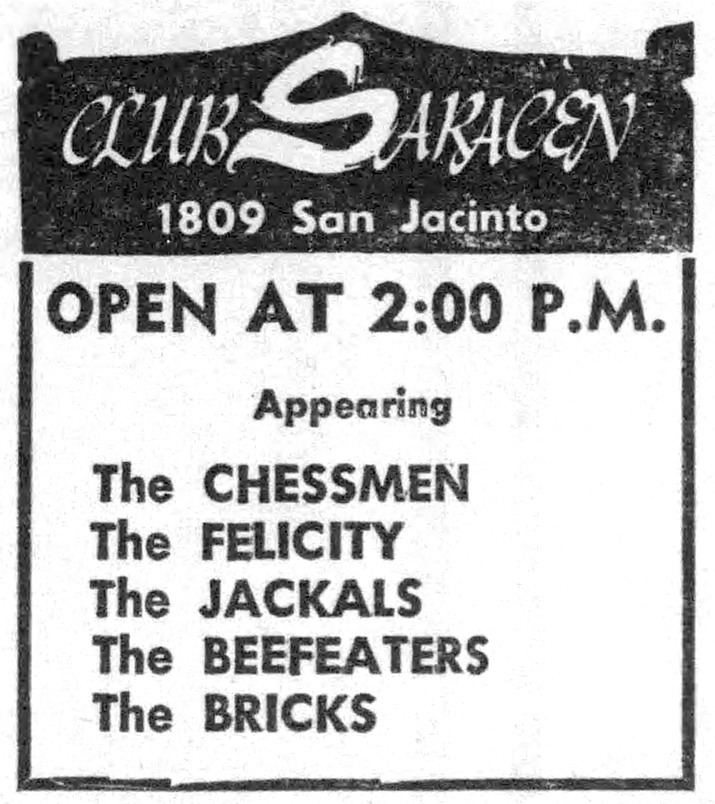
Who’s that pushing the hearse?!The Chessmen, Felicity, the Jackals, the Beefeaters and the Briks at Club Saracen on San Jacinto in Austin, Sunday, April 16, 1967
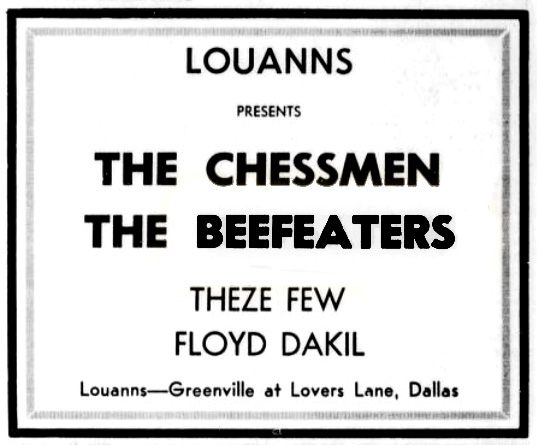
Within a short time, the manager of the Campus Theatre, George Rickrich, brought the Beefeaters into his Bismark Agency, which also represented the Briks, the Chessmen, Felicity, and the Jackals. Rickrich booked the bands for college parties throughout Texas and into Oklahoma, and clubs: including Louann’s, the Three Thieves, and the Cellar in Dallas; the Box in Ft. Worth; Club Saracen, the New Orleans Club, and the Jade Room in Austin where they also shopped for clothes at the Electric Rocking Horse.
Whit Snell remembers all the Bismark bands used to “caravan down to Austin in the hearses. Felicity had a Ford van, however … seven or eight weekends in a row. We had to cut class on Friday to make it to Friday’s gig.”
The Beefeaters provided entertainment on a day-long chartered train, the Santa Fe Big Chief, for a football game at Wichita State U. in Kansas. The Campus Chat covered the journey:
… North Texas won the game … the dance bands played well despite their precarious perch in a bucking, 9- by 70-foot baggage car, and the legal age for buying beer in Kansas is 18 …
The New Sound plugged in to one of the three baggage cars around 9 and, after 30 minutes of blow switches, was in full swing … Dancers, about 50 at a time, battled flailing elbows and a lurching floor in the cramped car …
… the Beefeaters struck up, and the dancers were once again making the most of their promised 20 hours of fun …
A promo sheet for the group lists Whitfield Snell, David McCullough as contact in Denton, and David Black in San Antonio.
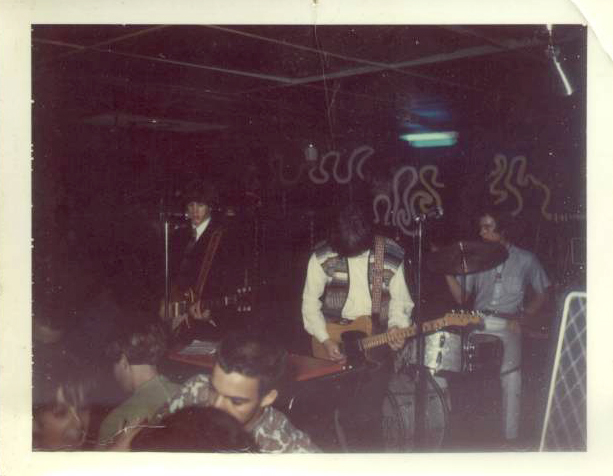
The Beefeaters, possibly at the Alpha Delta Pi sorority house, from left: Whit Snell, Mark Johnson (with jug), Bill McCullough (drums), Dan O’Banion, and David McCullough (bass)On stage at Club Saracen, Austin!
Towards the end of 1966, the Beefeaters entered a studio in Dallas to cut two originals by Whit Snell, “Don’t Hurt Me” / “Change My Mind”. The lineup that recorded these was: Mark Johnson, Whit Snell, Dan O’Banion, David McCullough, Jr., and Bill McCullough. Whit remembers Lee Hardesty of the Briks accompanying the band to the studio, and lending Whit his Vox fuzz pedal for “Don’t Hurt Me” and 12-string guitar for the “Change My Mind”.
Though satisfied with the recording, Whit thought the songs were not good enough, which may have been one reason why they didn’t see release on the Bismark label at the time. Tapes of the songs have circulated since, and they’re widely regarded as classics of the ’60s Texas teen sound.
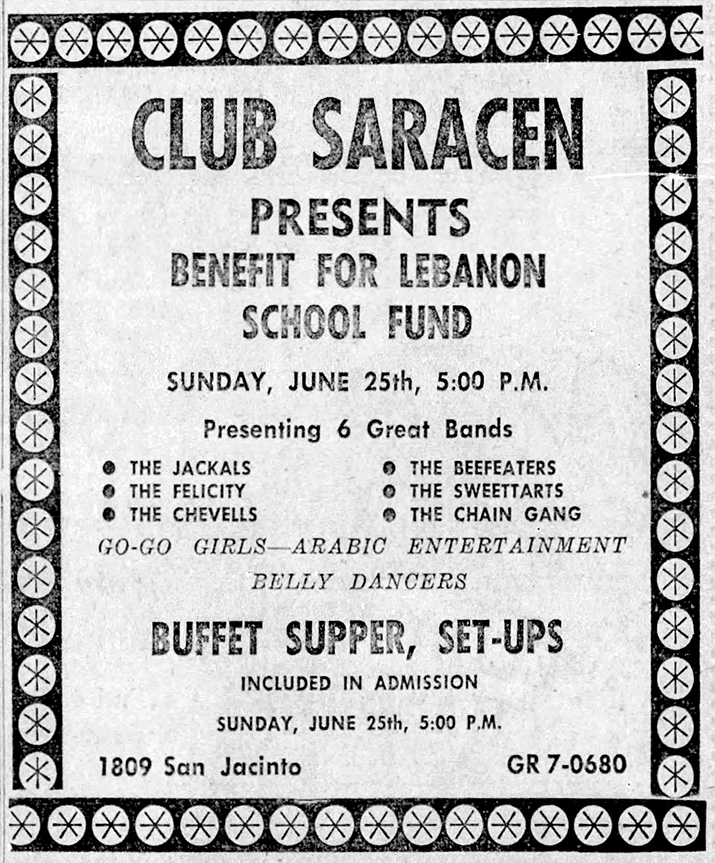
Whit Snell of the Beefeaters at the Pusi-Kat Club, San Antonio, 1967The Jackals, the Beefeaters, the Felicity with the Sweetarts, the Chevells and Chain Gang at Club Saracen on San Jacinto in Austin, Sunday, June 25, 1967. I’d like to know more about the Lebanon School Fund
During the Christmas holiday in 1966, the Beefeaters returned to San Antonio to play the Pusi-Kat club from December 26-30 with Lord August. When the band went back to Denton in January 1967, Mark Johnson had left the band and school to travel abroad.
That same January, the Denton Record-Chronicle reported the Beefeaters hearse was stolen from the NTSU campus, and they lost $4,000 worth of amplifiers, drums and guitars. Funny enough, the first report said it was the Chessmen’s hearse, but the paper corrected the story a few days later, and a later follow-up said the instruments were recovered in Gainesville.
The 1967 and ’68 school years saw the Beefeaters expand the scope of their gig territory: as far north as Amarillo, Wichita Falls, and Oklahoma City, east to Houston, Galveston and Fort Smith, Arkansas, and south to Corpus Christi, and Matamoros, Mexico.
By the summer of ’68, Dan O’Banion and Whit Snell were living at the Eagle Apartments in Dallas near Don Henley and other former Denton musicians, a musically rewarding time.
The military draft pulled any band members who left college, including David McCullough, who joined the Navy, became a Corpsman, and was assigned to the Marines. During the war he was stationed in the Philippines and served on a hospital ship. Members of other groups, such as Cecil Cotton and Steve Martin of the Briks, and Mike Neal of the Jackals had already joined the reserves and returned to the scene.
The Beefeaters on stage at Gibson’s Discount Center in Kerrville: from left: Jimmie Randall, Whit Snell, Roger Brooks or Doyle Bramhall on drums, and Dan O’Banion.The Beefeaters on stage at Gibson’s Discount Center, Whit Snell in foreground
Because of the draft taking David, and Bill McCullough leaving at about the same time, the Beefeaters went through a rotating cast of Dallas and Denton musicians filling in for short periods, including Jimmie Randall (of the Gentlemen) on bass; Roger Brooks, then Doyle Bramhall (of the Chessmen) on drums; John Talley (of the Jackals) on keyboards; and Lee Hardesty on guitar.
Roger Brooks or Doyle Bramhall, performing with the Beefeaters at Gibson’s in Kerrville
A series of photos taken onstage at Gibson’s Discount Center in Kerrville, TX show Jimmie Randall on bass and I believe either Roger Brooks or Doyle Brahmall on drums. Other later members include Ray Holland on bass and his brother Carl Holland on keyboards. Whit Snell told me Doyle only joined after Whit left Dallas in ’69.
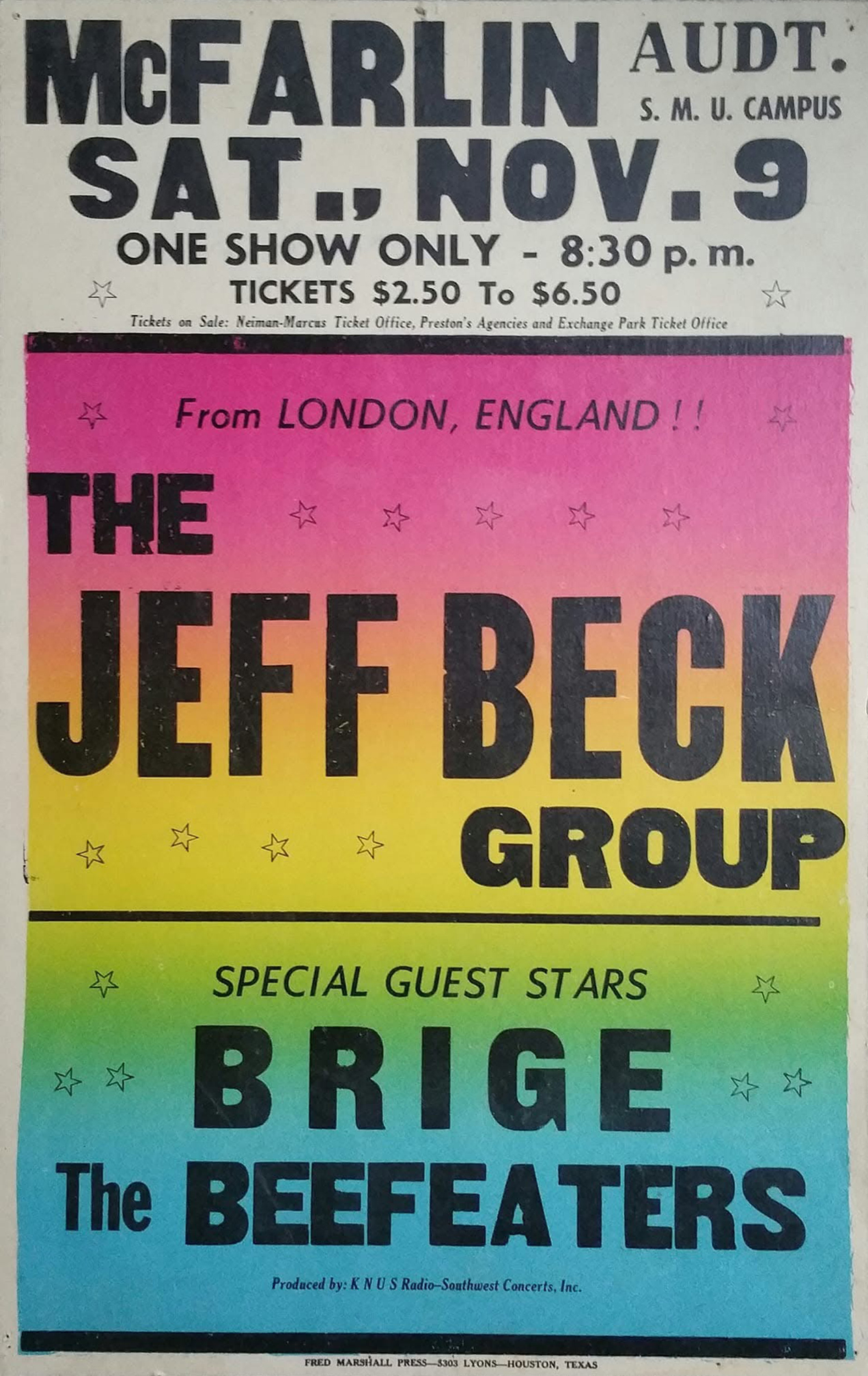
The Beefeaters played the Pusi-Kat in San Antonio frequently during the summer of ’68, as well as Love Street, and a show at the Teen Canteen in October, but their most notable gig was opening for the Jeff Beck Group at Southern Methodist University’s McFarlin Auditorium on Saturday, November 9, 1968. Whit recalls the Beefeaters also opened for the Jeff Beck Group in Oklahoma City on Sunday, November 10.
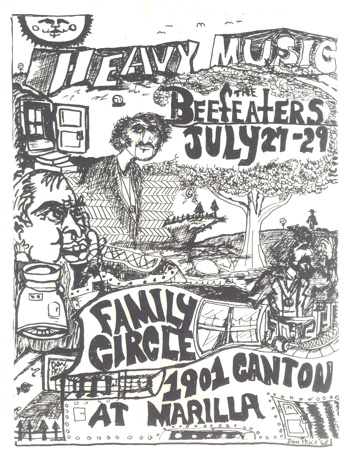
The Jeff Beck Group, Brige, and the Beefeaters at McFarlin Auditorium at SMU, November 9, 1968. I haven’t heard of Brige before.Flyer for one of their later shows at Family Circle, 1901 Canton at Marilla in Dallas
Whit Snell left the band and school in 1969, but various lineups continued gigging as the Beefeaters for another year or so.
Thank you to Whit Snell, Dan O’Banion, Bill McCullough, and Mark Johnson of the Beefeaters (RIP David McCullough); William Williams (Wm Wms) of the Jackals, Birdman Cantillo, Don Julio, Wm Wms and other contributors to the now defunct Big D ’60s yahoo group and Trinity River Music flickr group, and anyone else I’ve missed. Photos courtesy of Bill McCullough, Whit Snell and Wm Wms.
Bill McCullough and Dan O’Banion
A shorter version of these notes accompany the new remastered 7″ release of “Don’t Hurt Me” / “Change My Mind” now available on Mojo-Bone Rekkids.
Bill McCullough
As always, I’d appreciate more info on the group, and help correcting any errors.
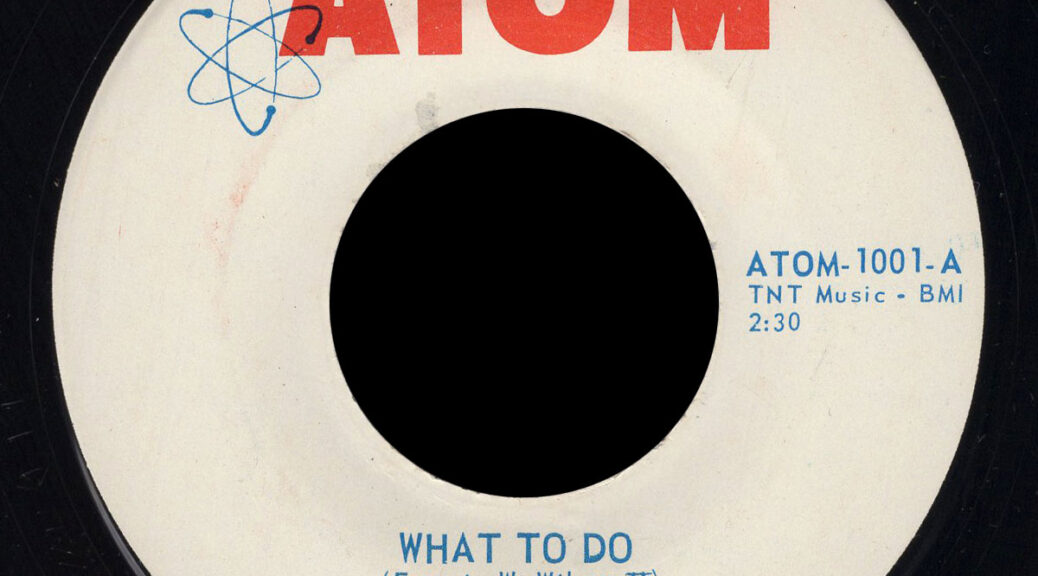
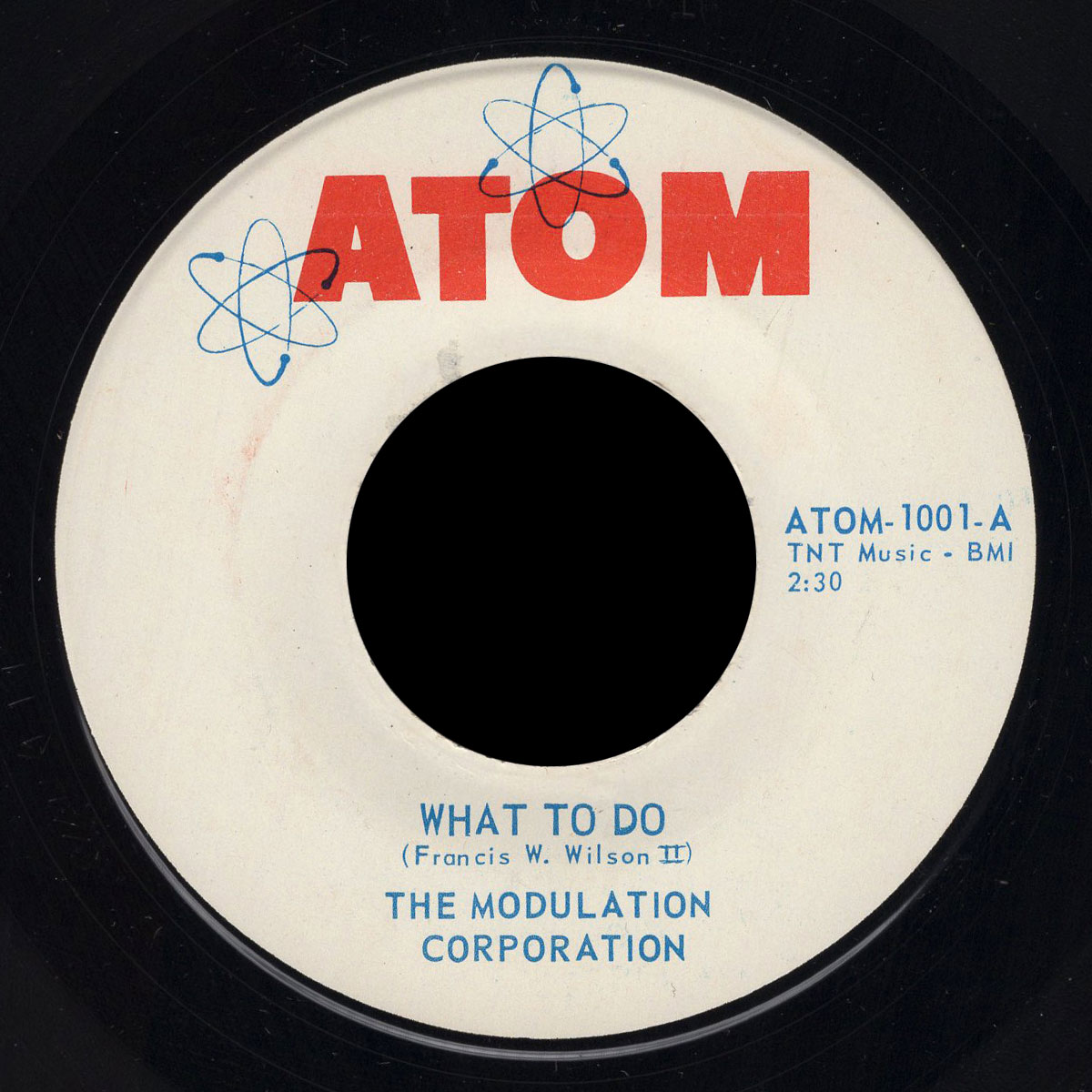
The Modulation Corporation made one 45 on Atom 1001 in November, 1967: the tough garage song “What to Do” b/w the bluesy “Worms”, both written by Francis W. Wilson II, and cut at Texas Sound Studios in San Antonio.
I don’t know the names of other members in the group. Francis Wilson seems to have been known as Billy Wilson. Covering the wedding of Jane Ellent Grant and William Eilers Jr. in Luling, TX, the Shiner Gazette on December 7, 1967 mentioned “An orchestra, Billy Wilson and the Modulation Corporation, provided music during the reception.”
The Modulation Corporation seem to have been together only during the fall of 1967. I’ve read the group was from San Marcos, about halfway between Austin and San Antonio, but most of the notices I’ve found are from two Austin venues, the Lake Austin Inn and the Pleasure Dome.
They had regular gigs at the Lake Austin Inn in September and October, 1967
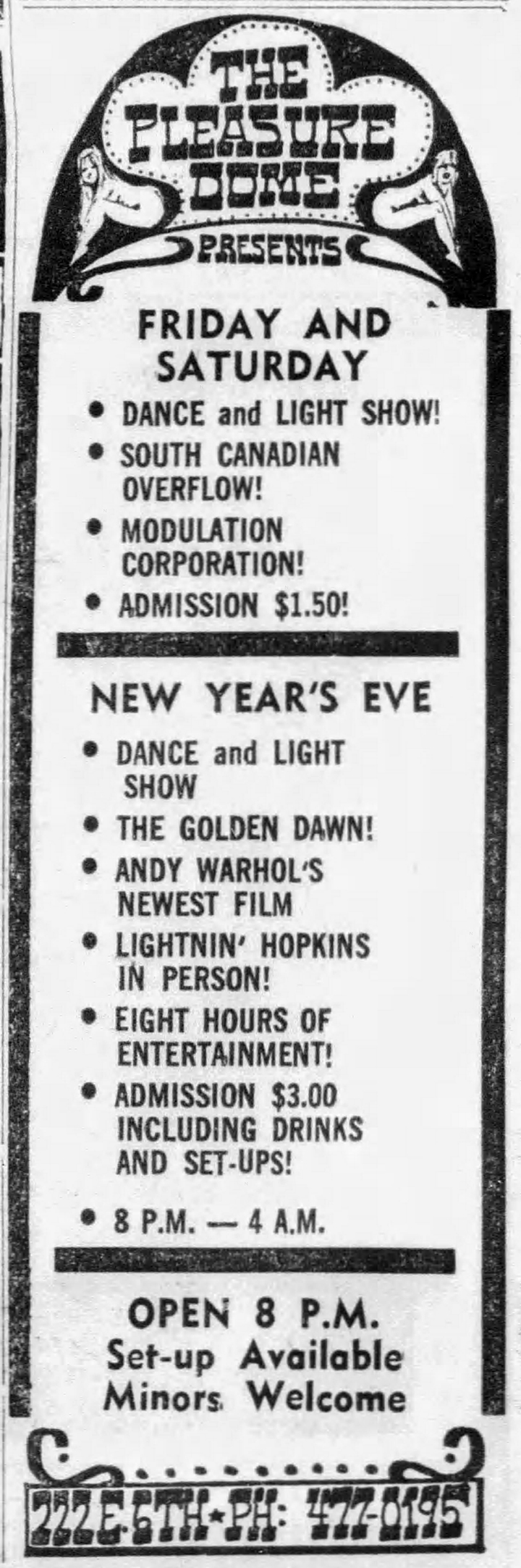
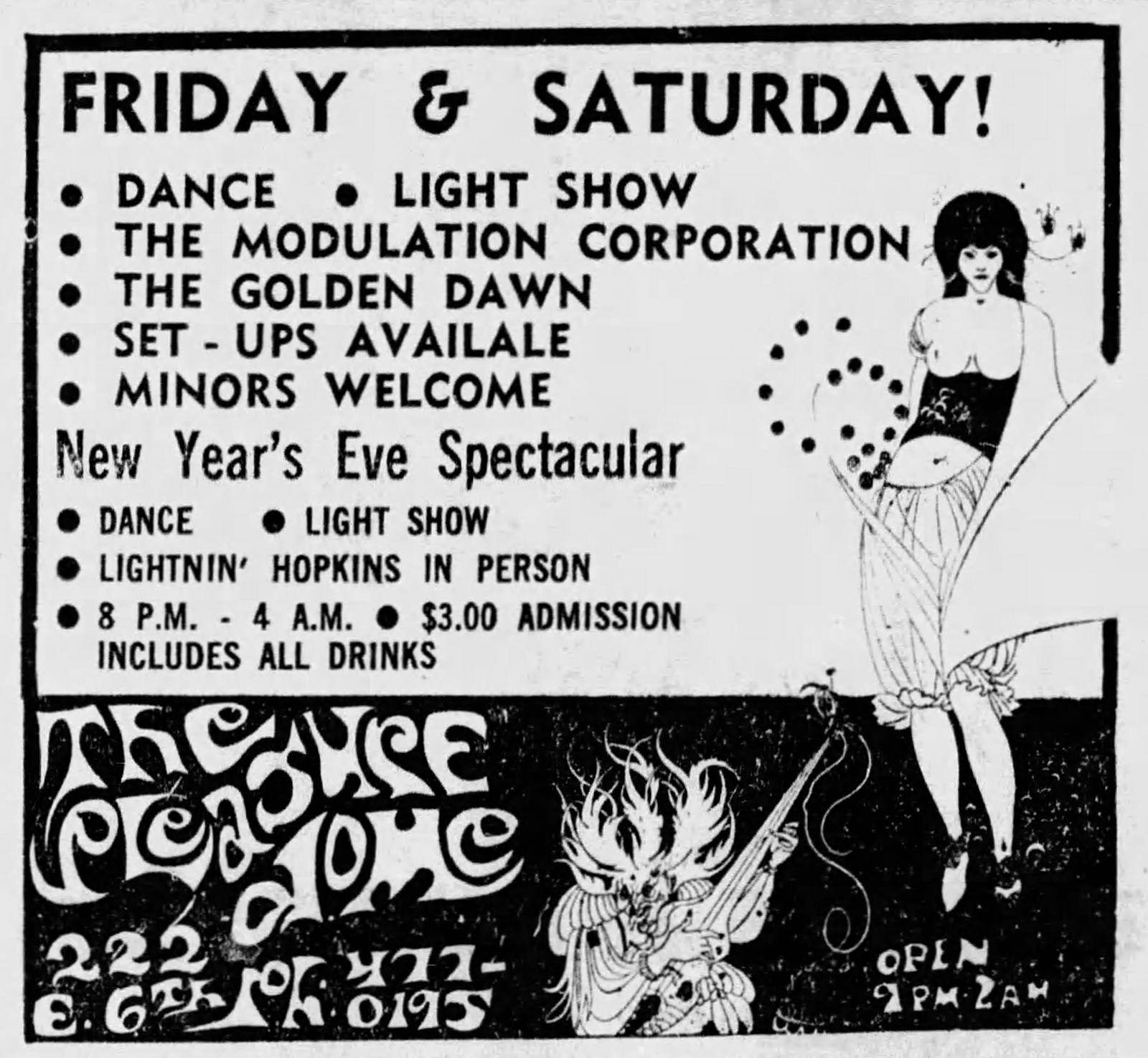
On December 29-30, 1967 the Modulation Corporation played two nights with the South Canadian Overflow at the Pleasure Dome, and may have been included in the New Year’s Eve show with the Golden Dawn, Lightnin’ Hopkins, and the Afro-Caravan.
Anyone have a photo of the group?
The Pleasure Dome
The Pleasure Dome opened on December 15, 1967 with the Thingies and underground films like Scorpio Rising. It was located at 222 E. 6th Street in what had been the Yank Theater building. Bill Simonson managed the club, with lighting by an unnamed person who had done lighting at the Electric Circus and the Cheetah in New York City. In progress off the lobby was the Sacred Mushroom Bar.
From notices in the American-Statesmen, the Pleasure Dome seems to have lasted only one month.
The first week of January the Pleasure Dome had the Thingies and South Canadian Overflow on Friday, the Strawberry Shoemaker and the Golden Dawn on Saturday, and the Golden Dawn and the Thingies on Sunday.
The following week featured the Thingies, the Starvation Army Band and the Vines. I have found no further notices after that.
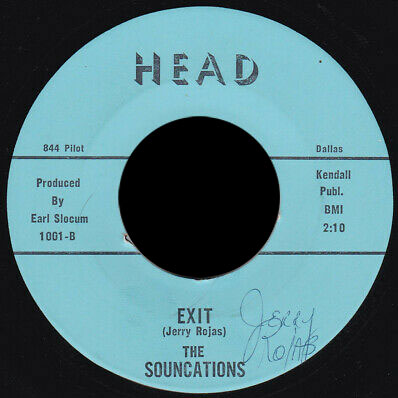
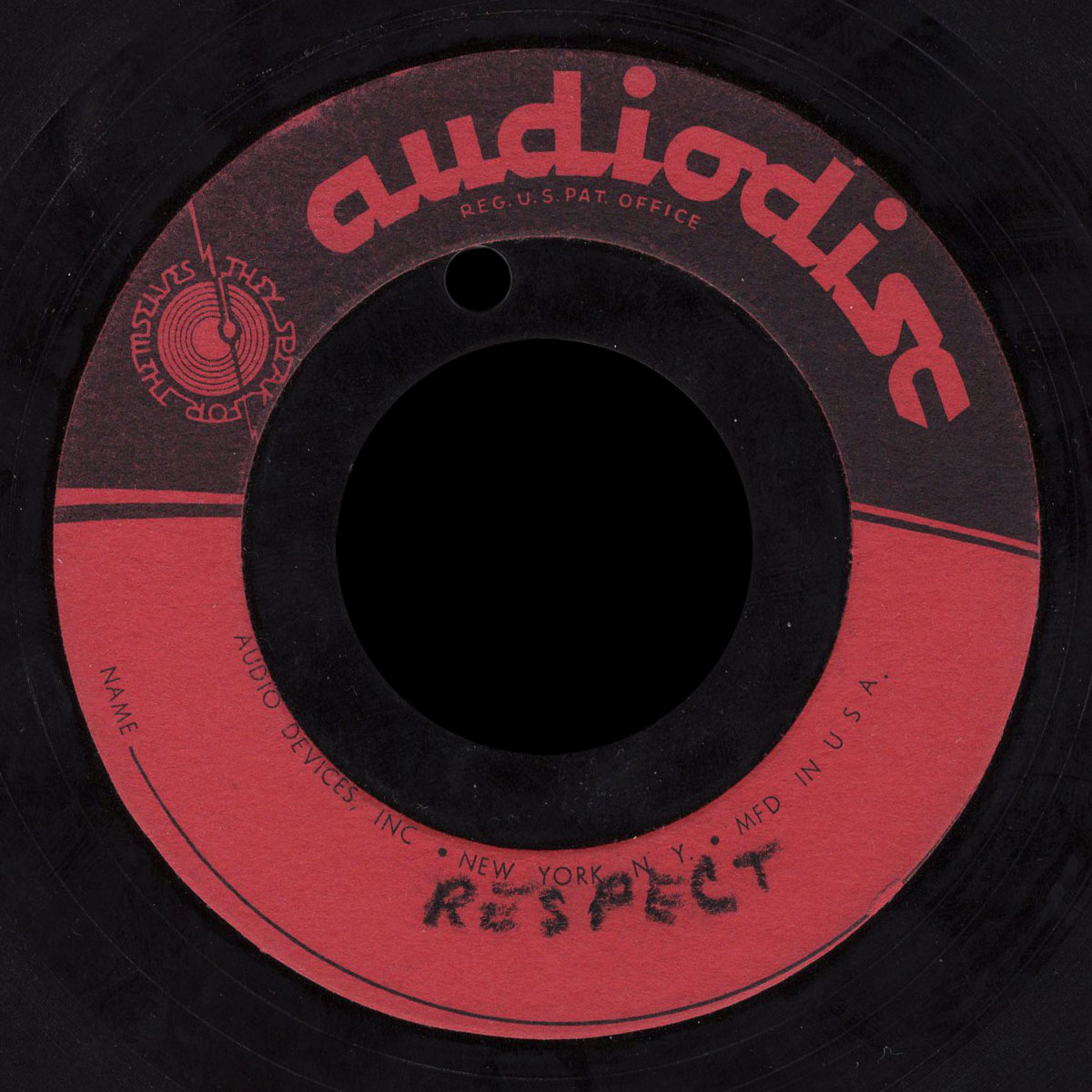
The Souncations made only one single, a version of “Respect” with a fine original song “Exit” by Jerry Rojas on the B-side, released on Head 1001 in 1967.
“Exit” features organ dominating the melody, but there’s a fine guitar solo and t he vocalist drawls his lines something like Jagger.
Earl Slocom produced, and the address 844 Pilot Dr, Dallas may have been his home. Usually spelled Earl Slocomb, he had been bassist with the Big Beats, who had cut instrumentals for Columbia, Liberty and other labels going back to 1957.
Despite the Kendall Pub. credit I cannot find a registration of copyright on “Exit”.
The origin of the Souncations is unknown, but I can find two notices on a guitarist named Jerry Rojas from Corsicana, TX, about 60 miles south of Dallas.
Both concern Navarro Junior College talent shows. The first show on December 2, 1965 is described:
Carol Kennermore was featured twice – singing … “Summertime,” and dancing to the strains of “Malaguena.”
Jerry Rojas on guitar, Danny Espedal on organ, and Roger Ballew on bass accompanied her song. The shaggy-maned Rojas himself later belted out a rock tune.
The second on March 24, 1966 notes:
Jerry Rojas, accompanying himself on his electric guitar, dipped into modern jazz for vocalizations of “Run for Your Life,” “Tombstone Blues” and “Ballad of a Thin Man.”
But so far I have no confirmation this is the same Jerry Rojas, or that the group actually came from Corsicana.
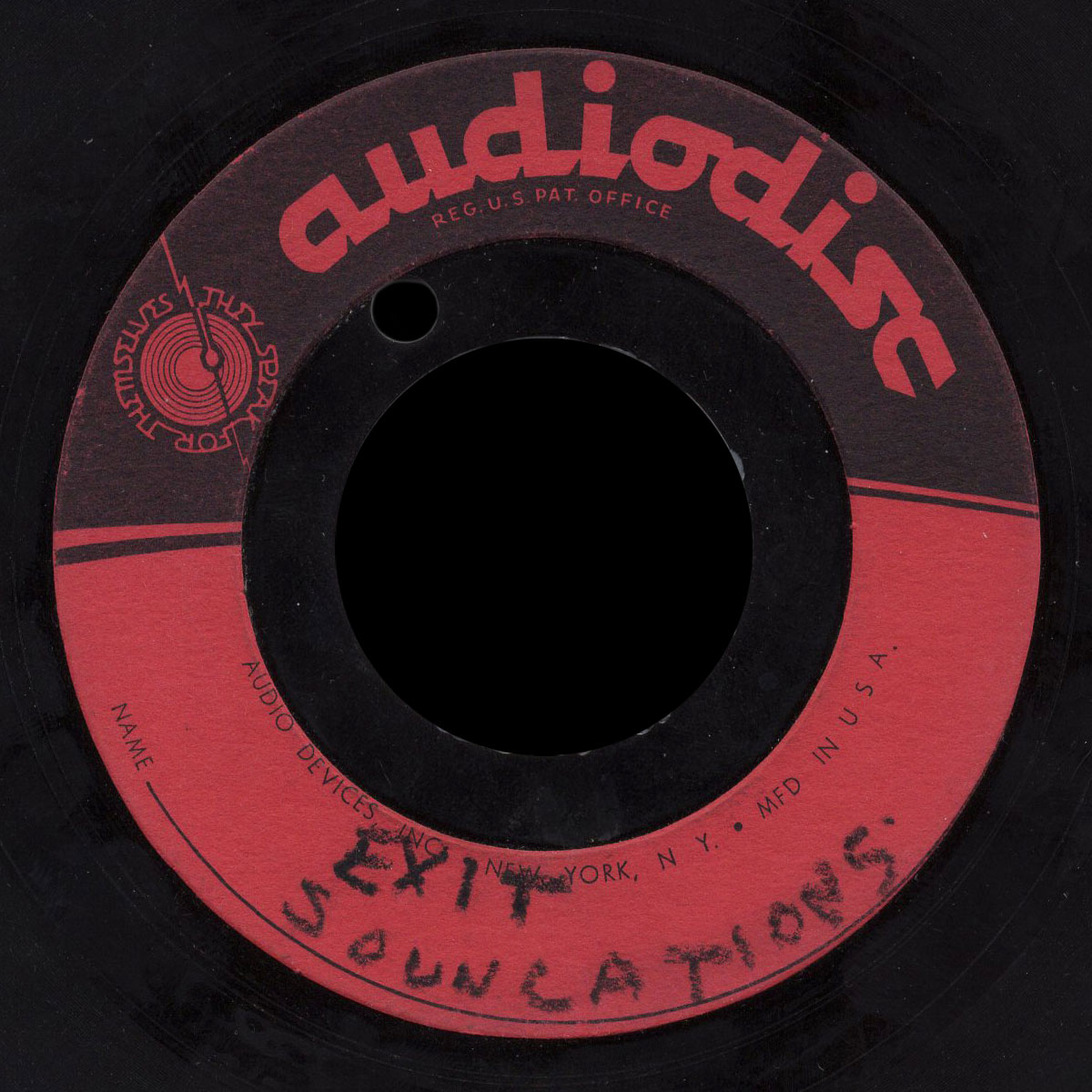
Thank you to Michael Robinson for alerting me to the Audiodisc acetate of the single.
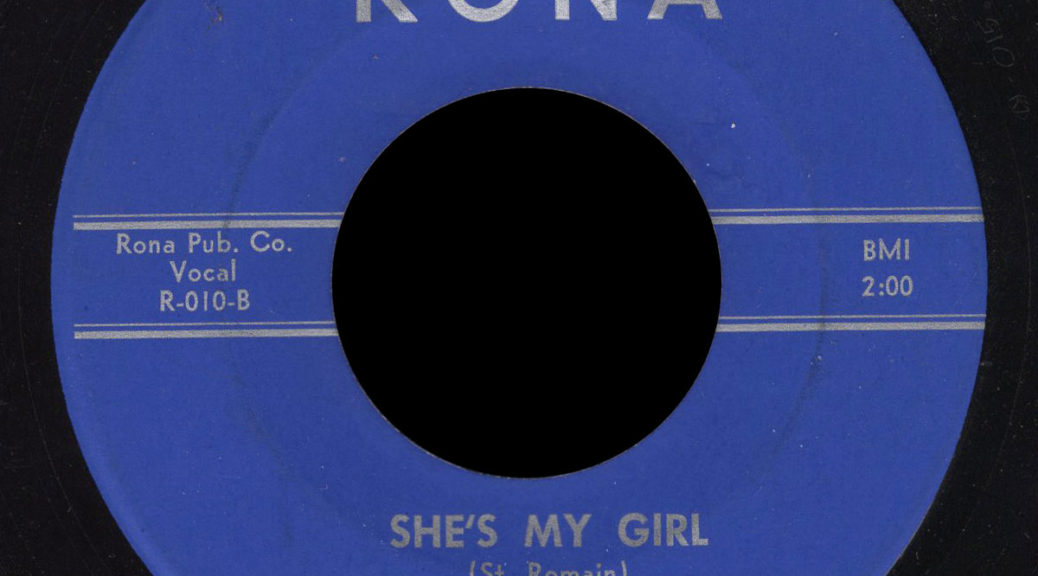
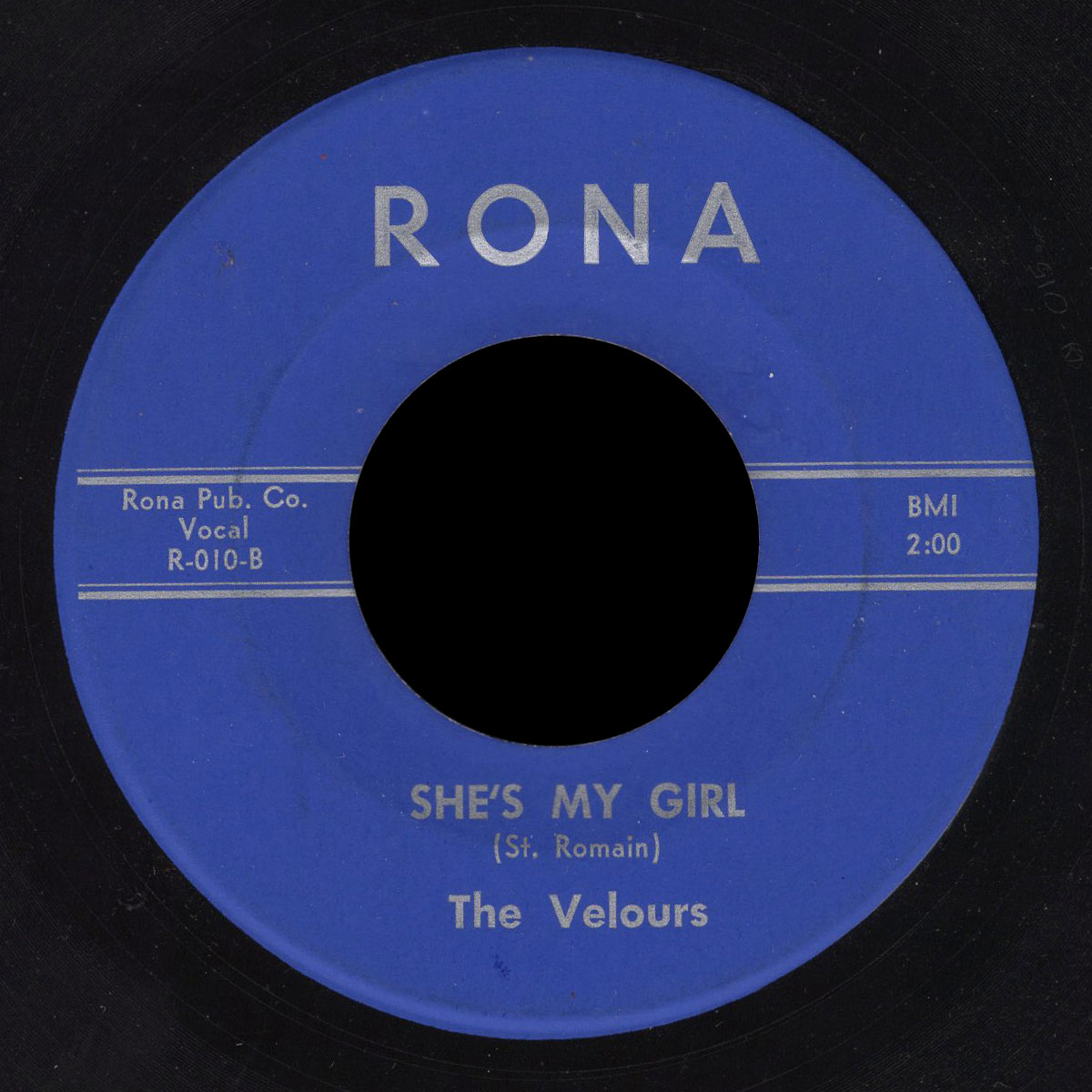
The Velours cut this one single, “She’s My Girl” / “Woman For Me” on Rona R-010. Both sides sound like they were recorded with a studio audience. “She’s My Girl” is uptempo r&b that only lacks a guitar break. I’d like to know who was the vocal group doing the background vocals, which really help the sound. I’ve seen December 1964 as the release date. The group was based in either Dallas or Fort Worth, Texas.
St. Romain wrote the songs, with Rona Pub. Co. handling the publishing. I believe this is Mike St. Romain, who was related to Kirby St. Romain, possibly his brother?
I can tie Michael St. Romain to the Velours from Jerry Zenick’s Disc ‘n’ Data column on November 23, 1972 in the Fort Worth Star-Telegram, which profiled the band Saint Romain:
Romain’s Club Style Is Conducive to Success
Formerly known as Quest, the group [Saint Romain] recently completed a stint at Dallas’ Club Climax, where the name switch was announced.
The new handle is very apropos because the driving force of the quintet is Mike St. Romain. A dynamic singer, forceful guitarist and consummate impersonator, the Dallas native has been a professional for over a decade. After touring with the Dick Caravan of Stars at 14, Romain formed his own group, The Velours. Long stints in the Virgin Islands and on the West Coast greatly widened and polished his style. After the unit disbanded in 1968, Romain put together Quest.
Present band members are bassist Phil James … drummer Gary Talbert, who played with the Human Beings when they released “Nobody Can”; pianist George Christopher, and side [sic] guitarist Michael Marchman, who handles the arranging tasks.
An early version of Quest included Darrel Howard of the Chants, and John Broberg and Neal St. John of the Upper Class.
This is not the same Velours as the group who cut singles on Onyx and Cub, among other labels.
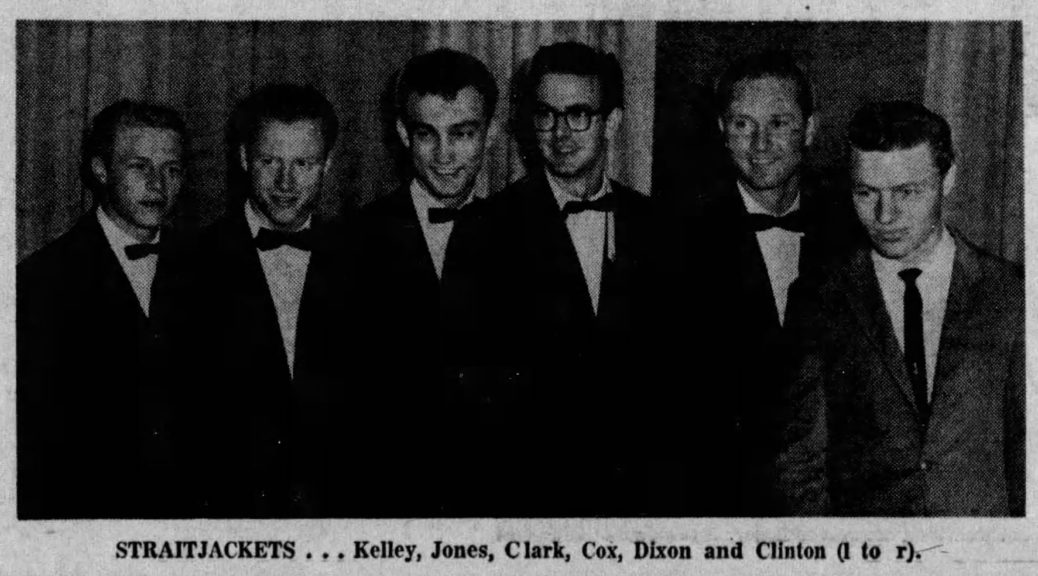
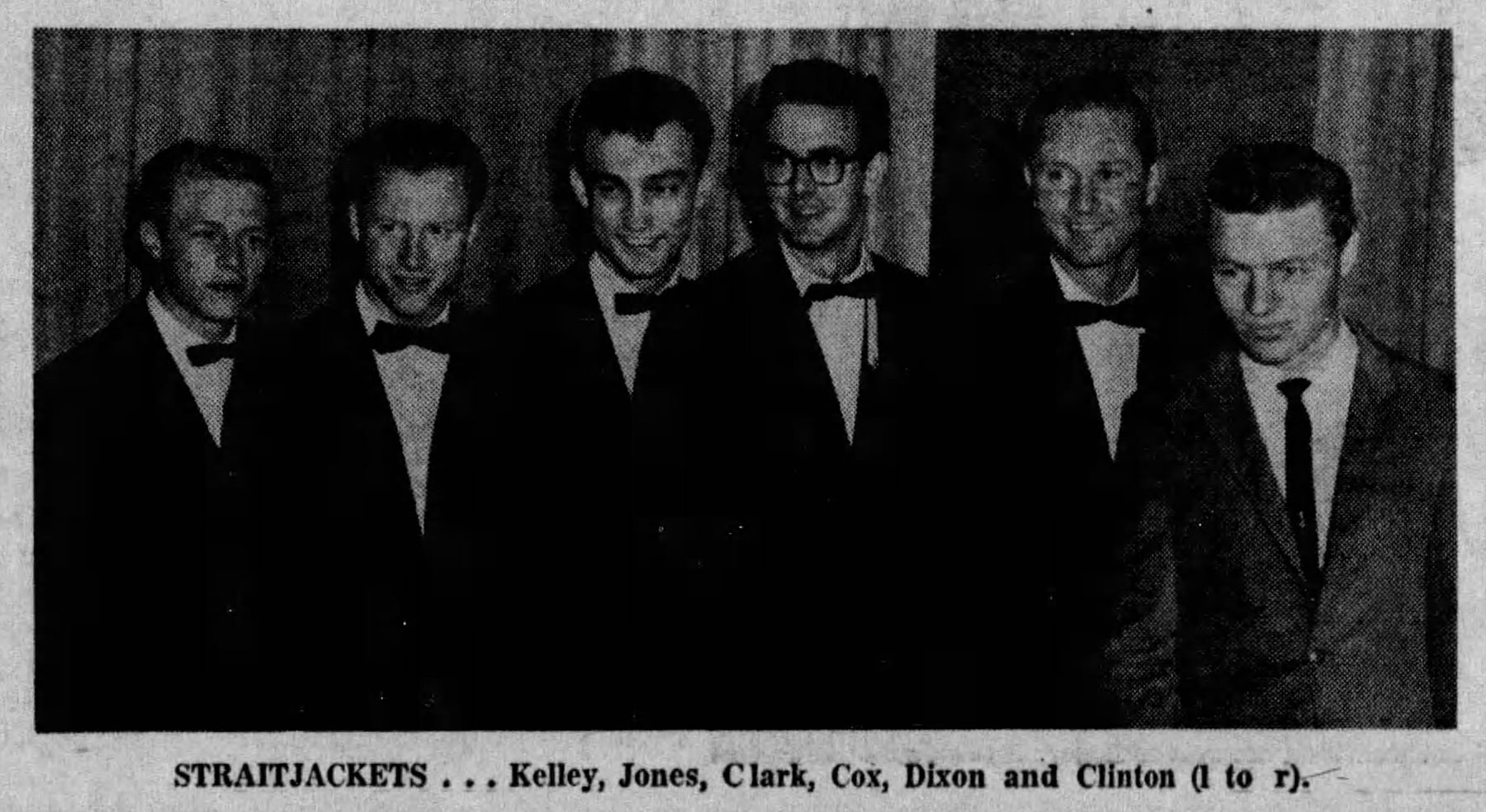
The Straitjackets in the Star-Telegram, February 10, 1961
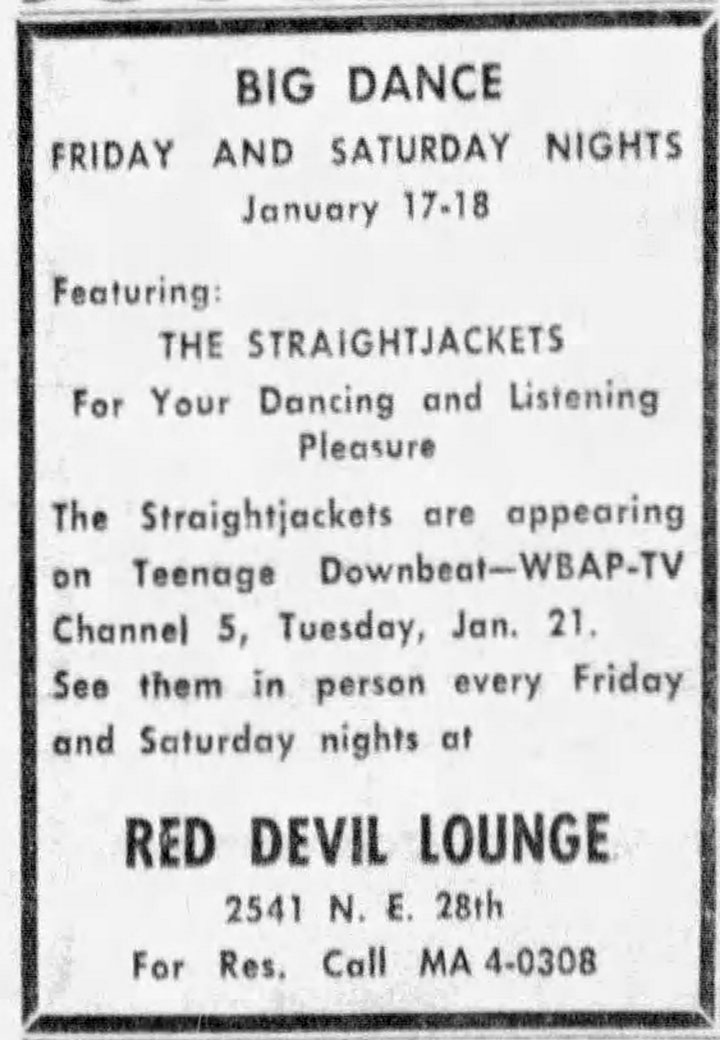
Straitjackets at the Red Devil Lounge, January 17, 1958Delbert McClinton formed the Straitjackets in sometime in 1957. Early members included Art Holland on lead guitar, Robert Harwell on guitar, Billy Cox on sax, Ralph Dixon on bass, and Ray Clark on drums.
The first printed notice I’ve found in the Fort Worth Star Telegram was from January 17, 1958, an ad for the group’s appearance at the Red Devil Lounge at 2541 N.E. 28th.
The ad also notes “The Straightjackets are appearing on Teenage Downbeat – WBAP-TV, Channel 5, Tuesday, Jan. 21.”
Another one on February 28, 1958 calls the group “recording stars” though I don’t believe they had made any records yet. Early ads through 1960 give a different spelling for the group, the Straightjackets, and sometimes list Delbert as featured vocalist. He had turned seventeen years old a few months before.
On February 25, 1960, the Straightjackets played a battle-of-the-bands with the Twisters at Crystal Springs Ballroom. They regularly played at Jack’s Place on Mansfield Road.
The Star Telegram ran items on March 26 and April 10, 1960 with the first lineup I can find for the group in print:
Talent Hunt Ends in Tie for 2 Combos
Two five-man combos, one from Fort Worth and the other from Victoria, finished in a tie for first in the area finals of the Talentsville, U.S.A. contest Saturday afternoon at Casa Manana.
The Fort Worth entry, “The Straitjackets,” was composed of Billy Cox, Delbert McClinton and Ronnie Kelly, Technical High School Students, Jim Dinsmore [Jimmy Densmore] of Arlington Heights and Bob Jones of Paschal.
The Victoria entry, billed as “Dads of Dixie” …
The two groups won trophies and the right to compete in the division finals in Houston May 7.
The Dads of Dixie would win the regionals in Houston along with the Blue Notes of Witchita, KS, winning spots for the finals in New York.
A short profile in the Star Telegram from February 10, 1961 announced their first record and included a photo of the band. Jim Densmore was no longer with the group, while Ray Clark and Ralph Dixon had joined. It also listed Delbert as “Mac Clinton”, a pseudonym that would appear on their first single, “Wake Up Baby” / “That Cat” on Le Cam Records 714.
Six graduates of Fort Worth high schools who work together as a band – The Straitjackets – this week have released their first record.
The disk presents a Straitjacket arrangement of “Wake Up, Baby,” a 1955 tune by Sonny Boy Williams.
On the reverse side, also arranged by the group, is “That Cat.” The release is on the Le Cam label.
“We think ‘Wake Up, Baby’ will sell readily,” said Mac Clinton, leader of the group and former Arlington Heights High School student.
The band was last year’s city competition winner in the Talentsville U.S.A. contest. However, the group was defeated in state competition.
Band members include Ronnie Kelley, Bob Jones and Ray Clark, who were graduated from Paschal High School; Ralph Dixon from Polytechnic, and Billy Cox from Heights.
On the Le Cam label, “That Cat” shows owner Major Bill Smith as writer. In 1962, “That Cat” would appear again on the flip side to versions of “Gigolo” / “I Ain’t Got Nobody” on United Artists UA 453, with the Straitjackets listed as the artist this time.
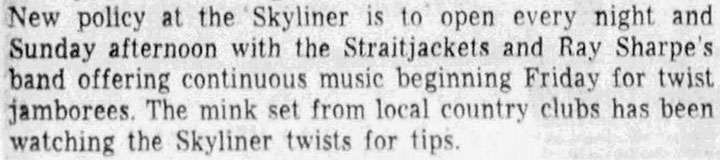
The Straitjackets and Ray Sharpe at the Skyliner, February 1962
The Straitjackets kept busy in 1962 with shows at the Skyliner Ballroom with Ray Sharpe and the Trebles, and a June 3 show at the Stork Club following the John Griffin, Jr. Band.
In June 1962, Del McClinton toured the UK with Bruce Channel, to reprise his harmonica playing on Channel’s smash “Hey! Baby”. There he famously met the Beatles.
While in London, Delbert cut four songs. “Dunkirk” / “Angel Eyes” came out only in the U.S. on London 45-LON 9544 with Del McClinton listed as the artist. “Hully Gully” / “Baby Heartbreak” came out in the UK on Decca F.11541, using his full name Delbert McClinton, with later issues in Italy and Greece. Earl Guest was music director, and Mike Smith did production.
By 1963, Delbert had formed the Ron-Dels with Ronnie Kelley, and would go on to cut a number of singles on Bill Smith’s labels like Shalimar, Brownfield, Le Cam and Shah, as well as a couple on Smash. Members of the Rondels would include Dahrell Norris on drums, Jimmie Rodgers on guitar and bass, and Billy Wade Sanders on guitar, piano and vocals.
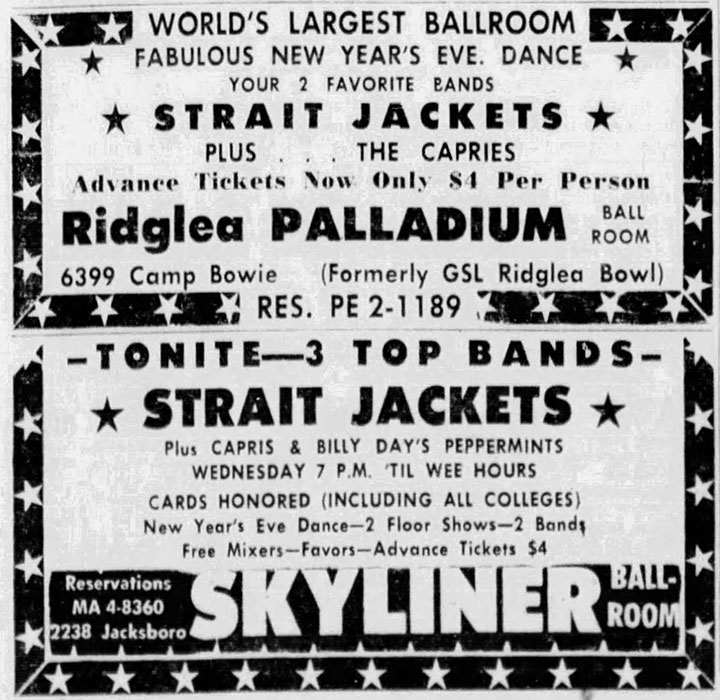
December 1962 shows with the Capris
The Straitjackets continued, possibly without Delbert. Ray Torres was drummer on “Hey! Baby” and mentioned being a drummer with the Straitjackets, but other than him, I don’t know who was in later lineups. They had shows at the Skyliner Ballroom in December 1962, and New Year’s Eve with the Capris at the Ridglea Palladium Ballroom.
I find two later notices, one for Sonny and the Straightjackets at the Stork Club in August 1966, and another for the Straight-Jackets at the Tropicana Club in January 1967, but these may be different groups altogether.
In the ’80s, Le Cam released two LPs released titled Very Early Delbert McClinton with the Ron-Dels that may contain some recordings done with the Straitjackets as early as 1960. (I would like to hear these records if anyone has them for a reasonable price.)
Further reading: Lee Cotten’s interviews with Delbert and Major Bill Smith in Discoveries October 1996 issue.
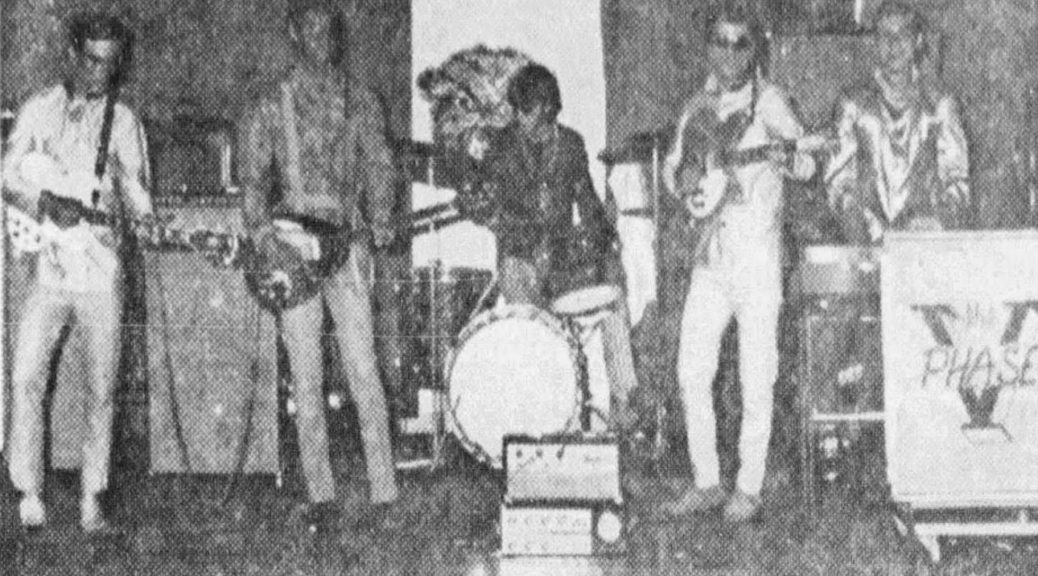
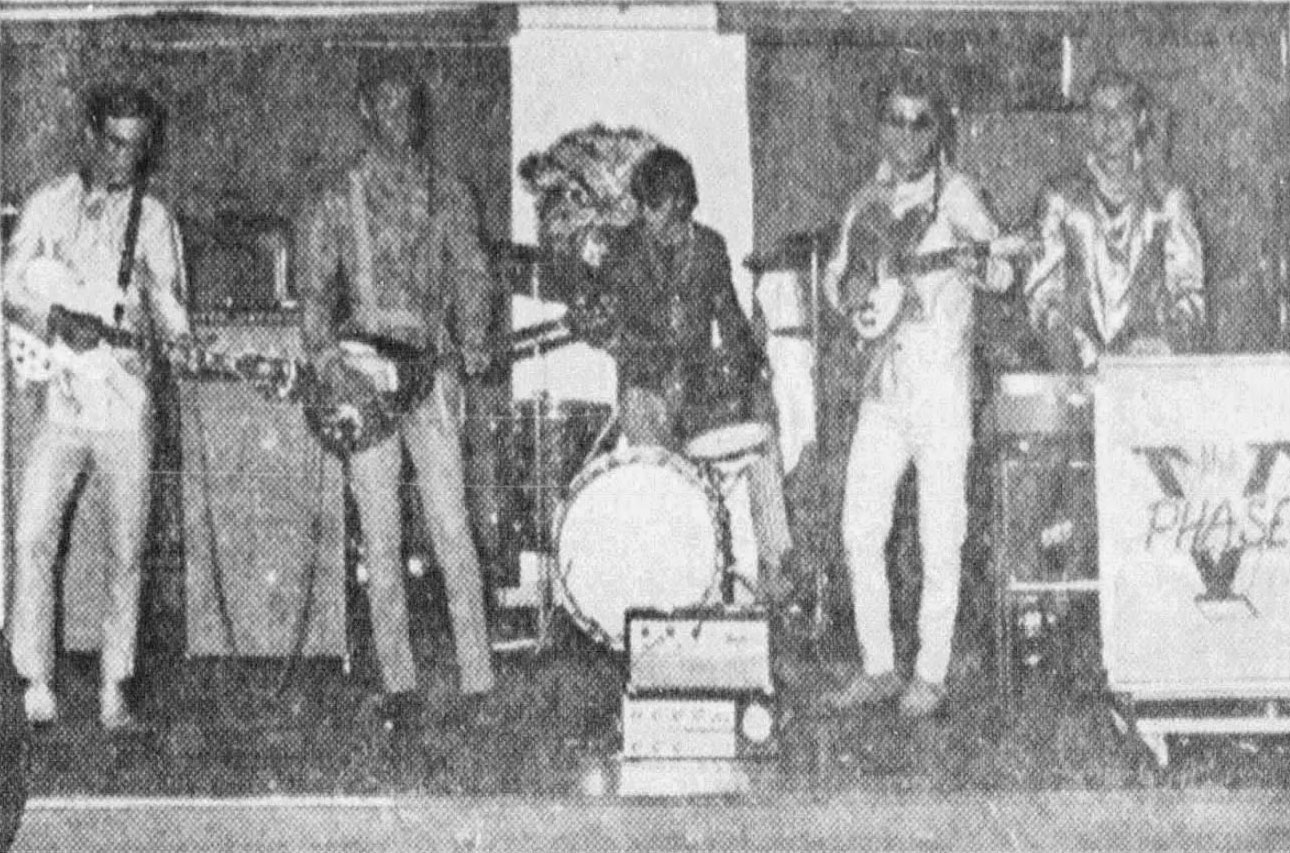
The Phase V, as featured in an ad for Stripling’s Campus Thing Fashion Show, August, 1968
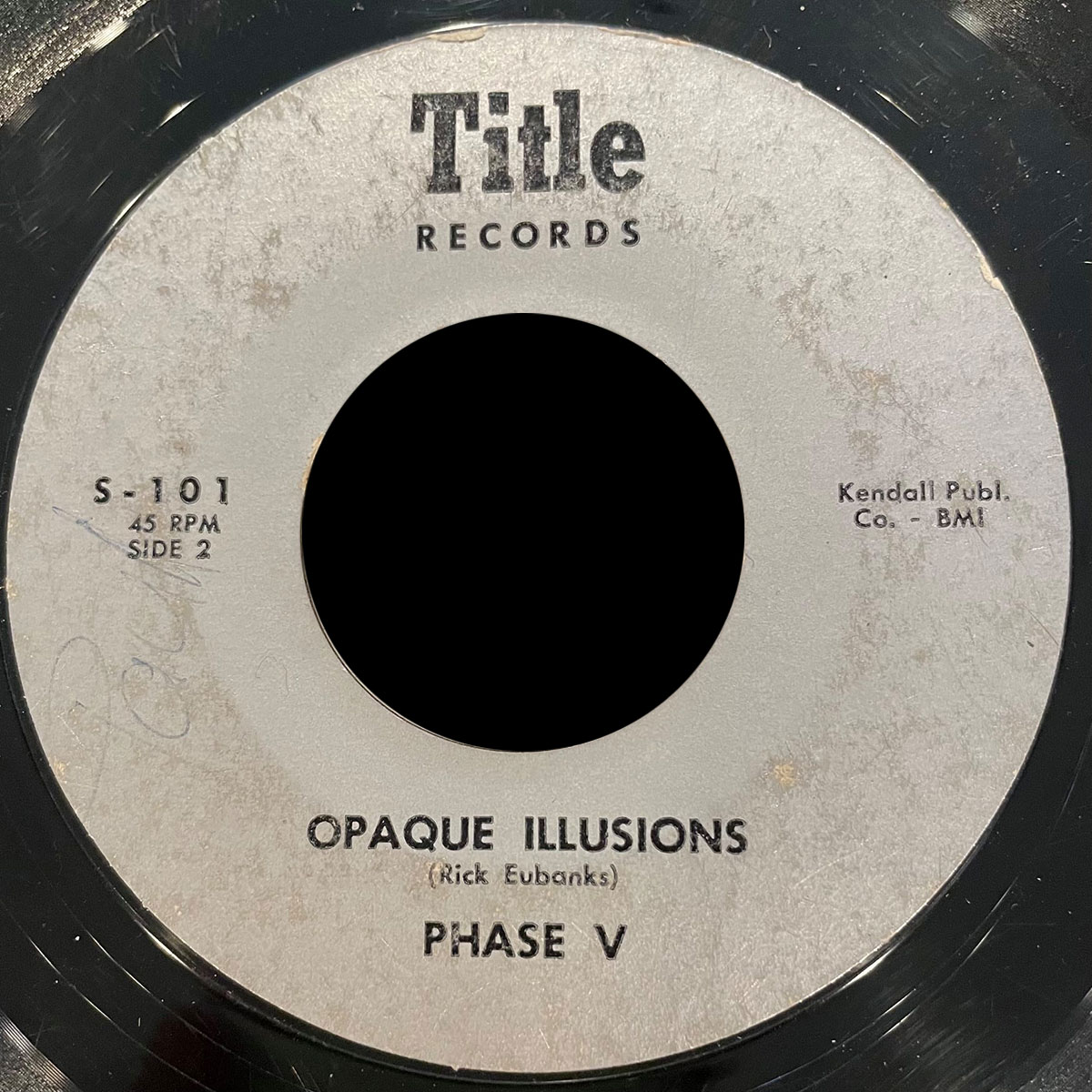
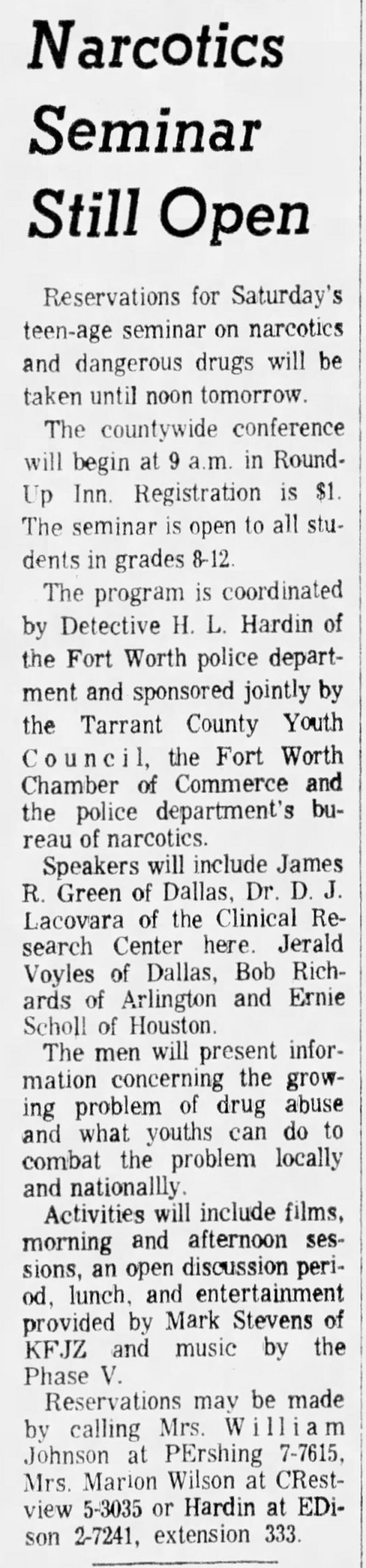
The Phase V came from Fort Worth, TX, and cut a rare single, “Opaque Illusions” / “The Promise I Keep” on Title Records S-101.
Members of the band were:
Steve Lamb – bass, vocals Mike Kersh – rhythm guitar, lead vocals on “The Promise I Keep” Monte Kersh – lead guitar, vocals Rick Eubanks – keyboards, lead vocals on “Opaque Illusions” Jim Cardwell – drums, vocals
Rick Eubanks wrote “Opaque Illusions”. Kendall Publ Co. is on the label but I can’t find any registration of copyright. I haven’t heard “The Promise I Keep” yet.
First mention I can find of the band is a notice of the group playing a back to school fashion show on August 12, 1967, sponsored by Penneys.
On Labor Day, September 4, 1967, the Phase V opened for the Doors at the KFJZ Teen Mardi Gras Pop Music Festival at the Round Up Inn in the Will Rogers Complex. The festival lasted for nine days and featured a different headliner each day and many local groups. Headliners included the Seeds, Box Tops, Standells, Electric Prunes, McCoys and Grass Roots.
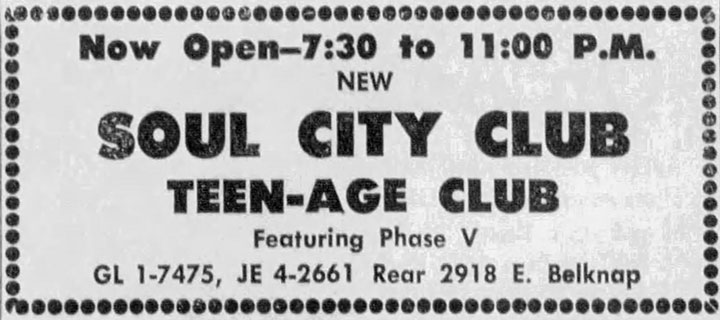
Also in September the Phase V played the new Soul City Club for teens at 2918 East Belknap.
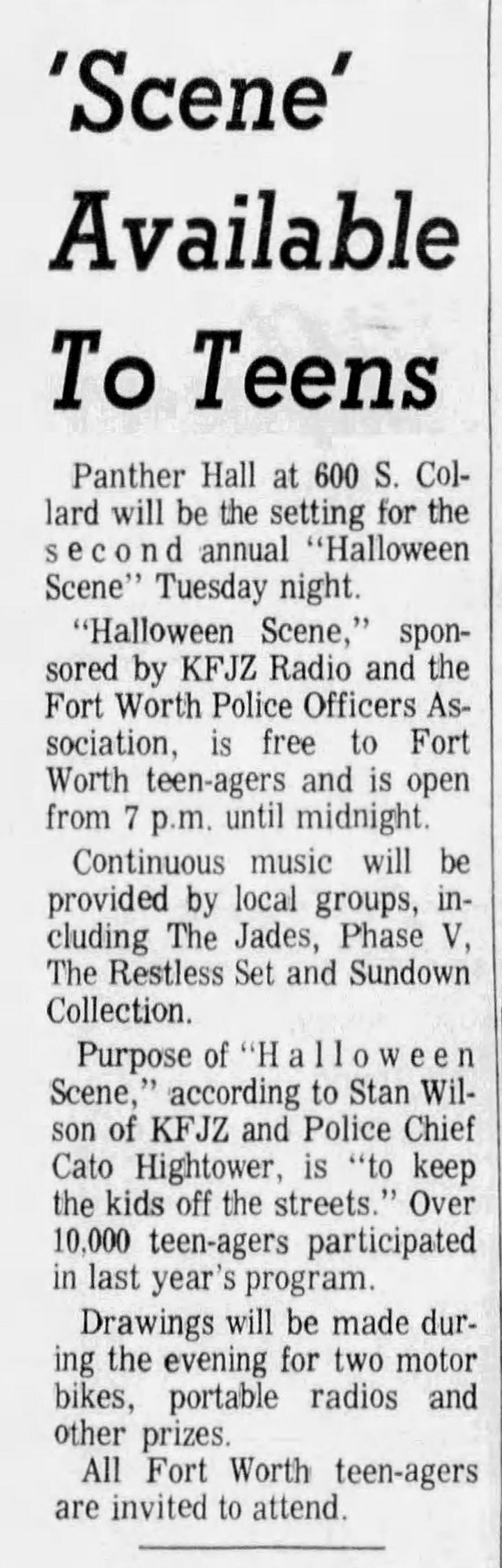
Panther Hall’s Halloween Scene, 1967 with Phase V, Jades, Restless Set, and Sundown Collection
On October 31, 1967 they played Panther Hall’s Halloween Scene with the Jades, the Restless Set and the Sundown Collection, emceed by KFJZ DJ Stan Wilson.
Half an hour of footage from Panther Hall exists, I believe from this Halloween show. Unfortunately there’s only about 30 seconds of the Phase V tearing through Love’s “Seven and Seven Is”. I can recognize the white Gibson SG guitar from their band photo. However, in this clip, the bassist is singing lead vocals, and there is a second guitarist, so the lineup above may need some correction.
In February 1968, the Phase V played the Irving Teen a Go Go at the National Armory with the Crowd + 1 (Ed Grundy, Dean Parks, Nick Taylor and drummer Jim Rutledge).
The group played Irving Teen-a-Go-Go on April 12 with the Tyme of Day, and appeared at a teen narcotics seminar the very next day.
July and November 1968 saw the Phase V playing at the White Settlement Youth Club and Jolly Time Skating Rink Teen Scene.
I’ve seen the band’s name rendered online as Phase Five or Phaze V, but it is Phase V in the photo and in all newspaper notices I’ve found.
I’d like to know more about the Phase V and this rare record.
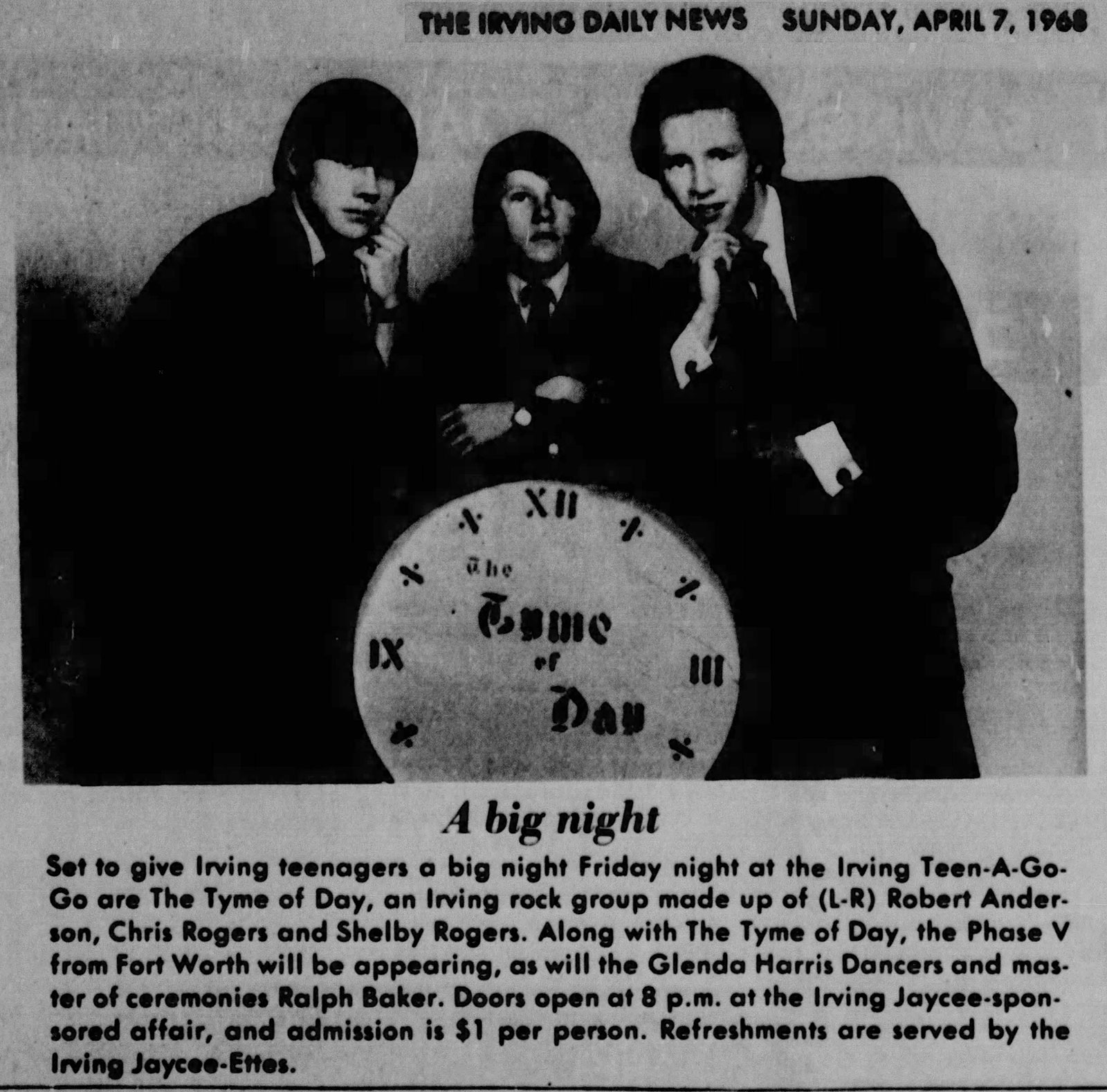
The Tyme of Day, from left: Robert Anderson, Chris Rogers and Shelby Rogers
The Tyme of Day came from Irving, Texas, northwest of Dallas.
Members were:
Shelby Rogers – lead vocals and guitar Bob Anderson – bass Chris Rogers – drums
I found this photo of the group in the April 7, 1968 Irving Daily News, announcing their appearance at the Irving Teen-a-Go-Go with the Phase V, the Glenda Harris Dancers and emcee Ralph Baker.
The group traveled to Norman Petty’s studio in Clovis, New Mexico several times, cutting Shelby’s original songs “I Wanna Know” and “Persuade Me” in March of 1968, In June they cut another original, “Listen to What Is Never Said”.
Norman Petty added keyboards, and “Listen to What Is Never Said” / “I Wanna Know” saw release on Mercury 72861 in November, 1968. Besides the Rogers brothers, session notes from https://www.norvajakmusic.com/t-v.html list Larry Shaw on bass, though it appears Robert Anderson played bass at some sessions.
The group made two further sessions at the Petty studio, cutting “Am I Really Me” / “The Word ‘Because'” in August, 1968, / “You Don’t Want Me” and “The Game” in March of 1969. All of these have remained unreleased.
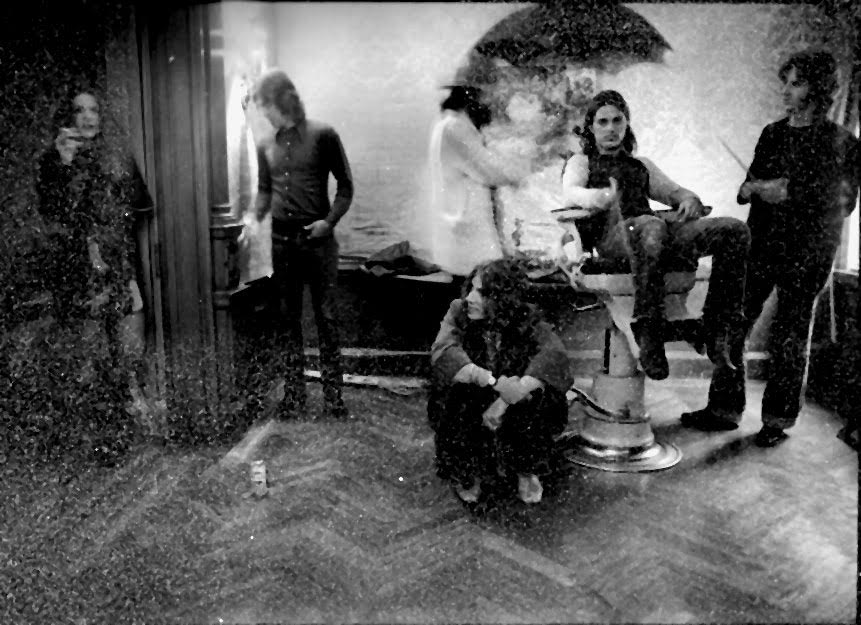
The Snakes, from left: unidentified woman, Cecil Cotten, unidentified man in white coat, Keith Ferguson (on floor), Steve Karnavas (seated in barber’s chair) and Benny Rowe
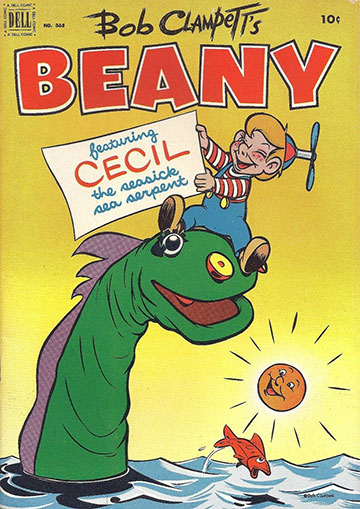
In 1969, four Texans formed a band in San Francisco known as Benny, Cecil and the Snakes. I believe the group’s name was a take on the popular cartoon, Beany and Cecil the Seasick Sea Serpent by Bob Clampett.
Members were:
Cecil Cotten of the Briks on vocals Benny Rowe of the Wig and a later lineup of the Jackals on lead guitar Steve Karnavas of the Chaparrals on drums Keith Ferguson – previously with Johnny Winter, and later with the Fabulous Thunderbirds, on bass
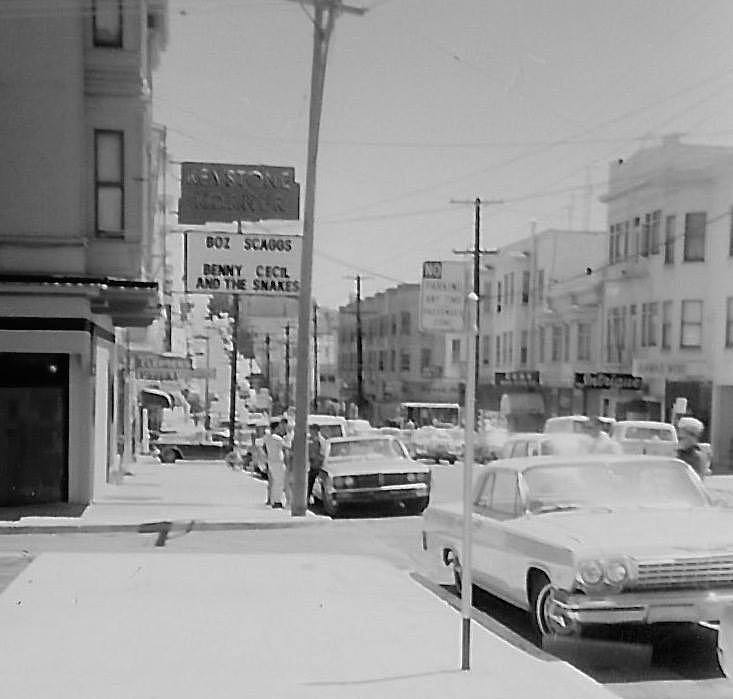
Keystone Korner, July 1970, photo taken by Fred King, used with permissionThey played parties for for the Rip Off Press and opened shows for Boz Scaggs, including at the Keystone Korner in July of 1970. Reese Wymans and George Raines of Boz’s band would sit in with the Snakes on occasion.
I found a few published notices for the band:
Benny, Cecil and the Snakes shared a bill on July 24, 1970 with Joy of Cooking at the New Orleans House on San Pablo in Berkeley.
They played for a Young Replublicans of Santa Clara event at the Ramada Inn on November 13, 1970!
July 1-4, 1971 they opened for Charlie Musselwhite at In Your Ear, 135 University Avenue in Palo Alto.
In a February 1971 feature in the San Francisco Examiner, Kathy Goss described the band playing a Bastille Day party at the Pacific Heights mansion she shared at 2300 Pacific before it was torn down. The photo at top was taken at this mansion, I believe; the unidentified man in the white coat was a tenant there. It’s worth quoting a small part of that article:
Maurice and Stanford, the owners of a shop that had recently moved from Union Street to upper Fillmore, had a gigantic French flag that they wanted us to hang outside the mansion for Bastille Day. And so we decided to have a Bastille Day party, and to invite not only our personal friends, but also people who we thought would enjoy having their minds blown by a beautiful, free, colorful party. The house was hung with banners of red felt and velvet, the tables were laden with food.
Benny, Cecil and the Snakes, a fine band and good friends of the house, began playing in the late afternoon. The rooms were filled with shifting images and colors of a light show, and we reveled in the blend of wildly costumed guests of all ages and pursuits who danced and talked and generally enjoyed themselves, sharing in the excitement and energy and splendor of the mansion.
I’ve heard four unreleased tapes of rehearsals and live shows that were kept by Keith Ferguson. One may have been recorded at the Pacific St. mansion as it’s labeled “Snakes PHR”. It contains ten songs, mostly hard rock and blues. There are two tapes labeled “Inverness” which would probably refer to the unincorporated community in northwest Marin County, CA, mostly blues, with lengthy guitar workouts, and even flute soloing, and another tape “Select Snakes” that includes some of the Inverness tape material.
Thank you to Wm. Lewis Wms for sending the photos that Cecil Cotten shared with him, and for much of the information in this post.
I’d appreciate more info on Benny, Cecil and the Snakes.
The Snakes, from left: Keith Ferguson, Steve Karnavas, Cecil Cotten and Benny Rowe
This site is a work in progress on 1960s garage rock bands. All entries can be updated, corrected and expanded. If you have information on a band featured here, please let me know and I will update the site and credit you accordingly.
I am dedicated to making this site a center for research about '60s music scenes. Please consider donating archival materials such as photos, records, news clippings, scrapbooks or other material from the '60s. Please contact me at rchrisbishop@gmail.com if you can loan or donate original materials