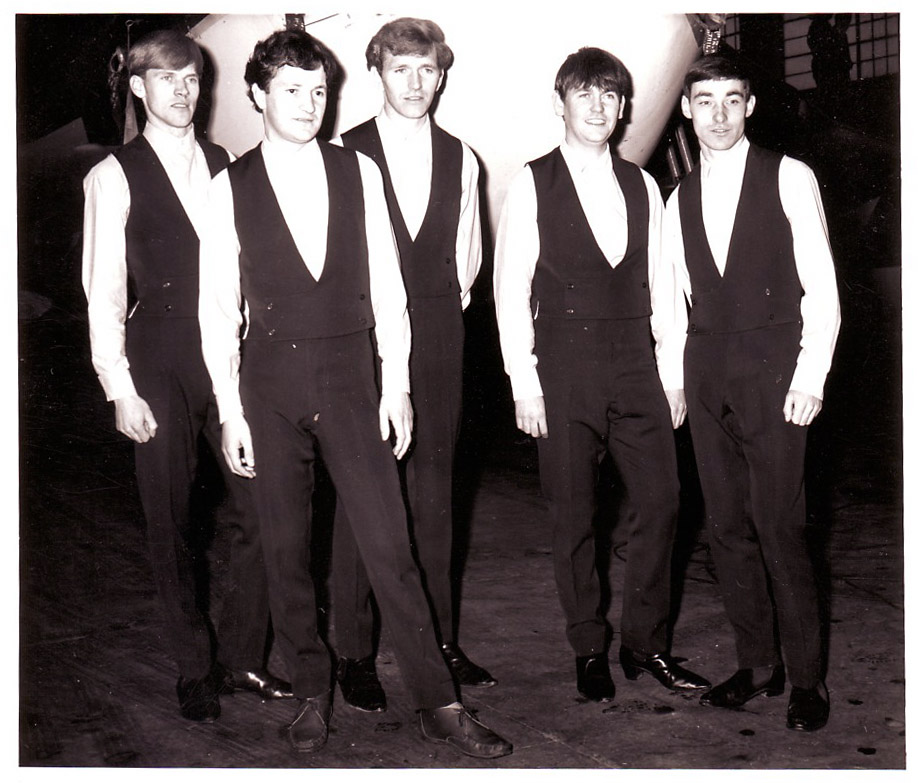
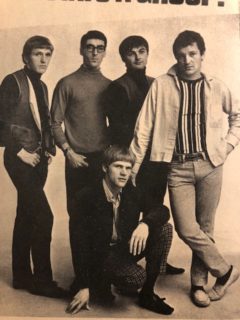
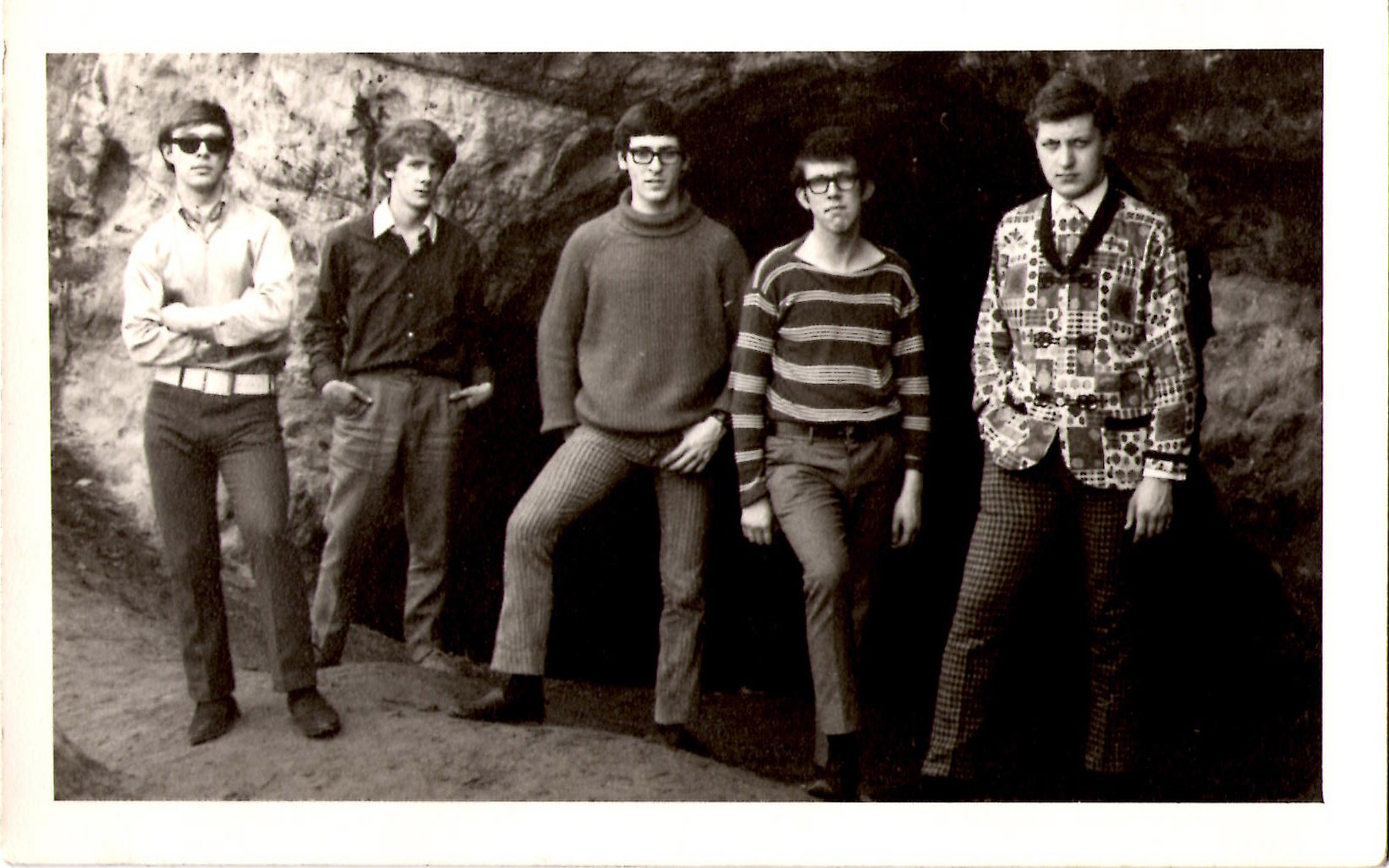
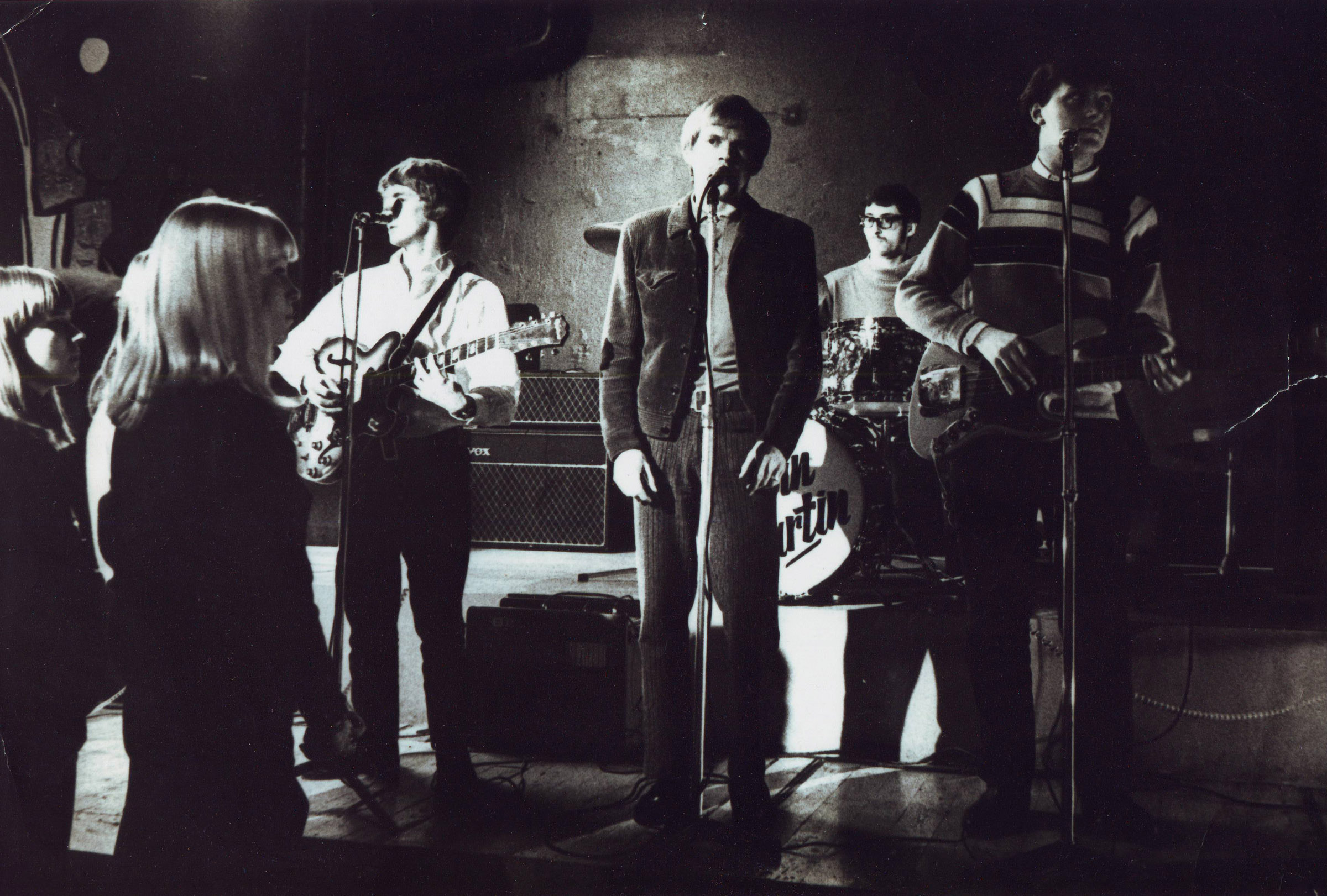
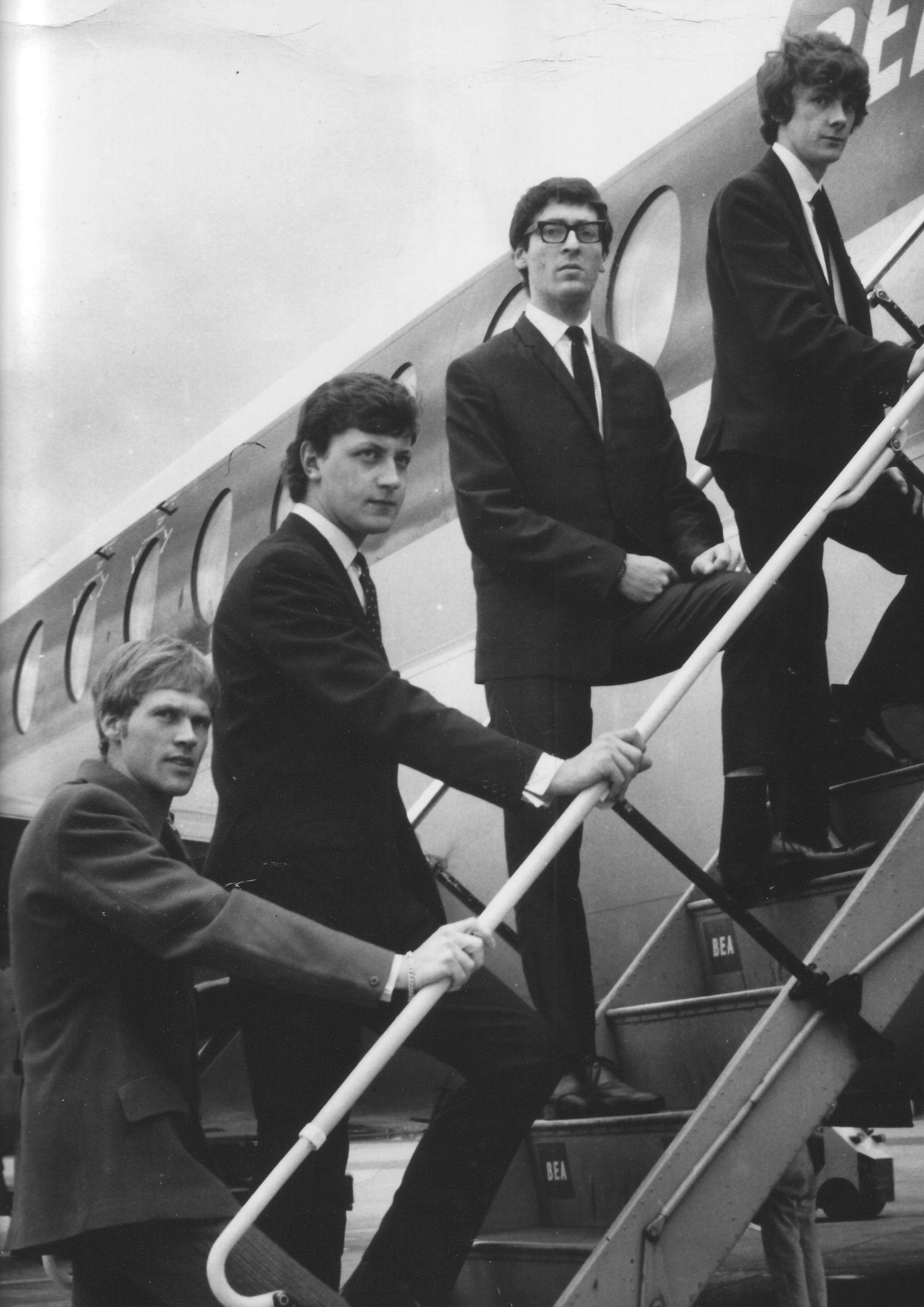
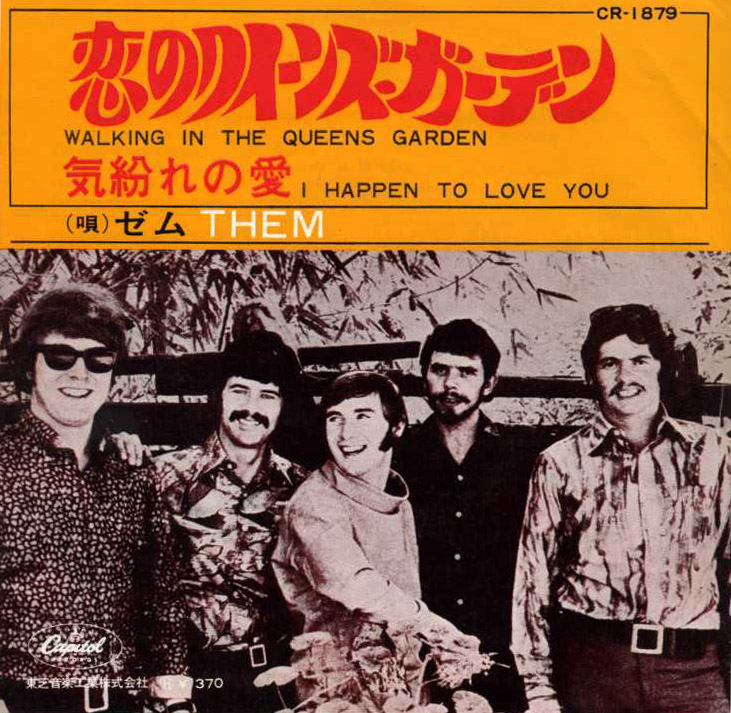
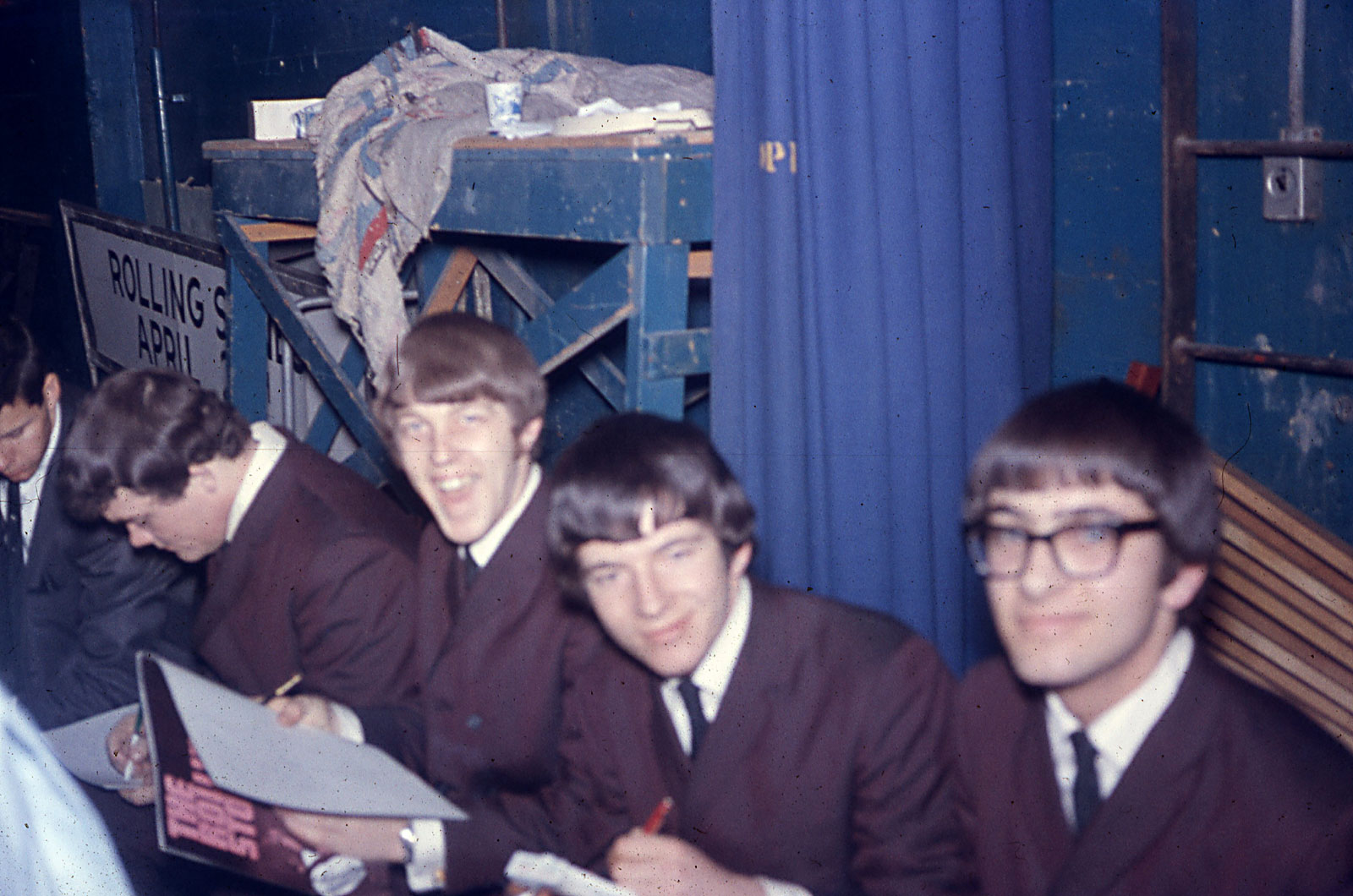
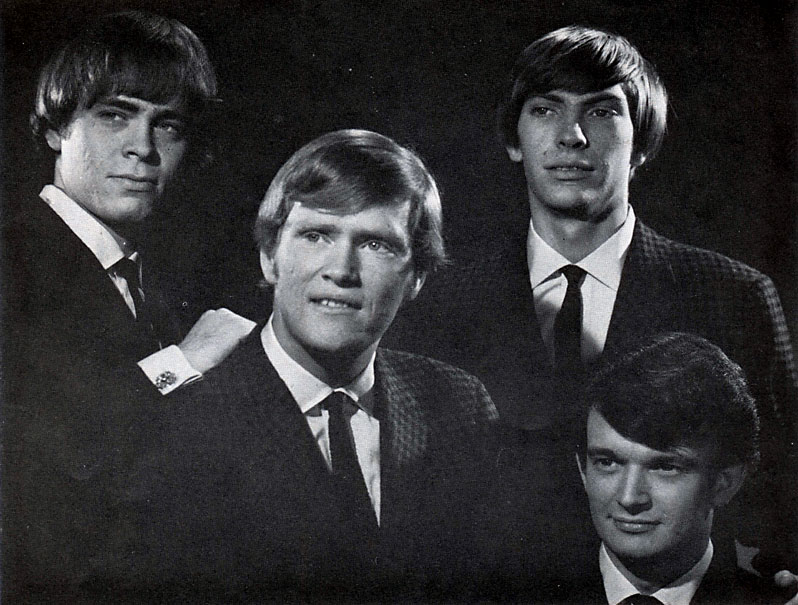
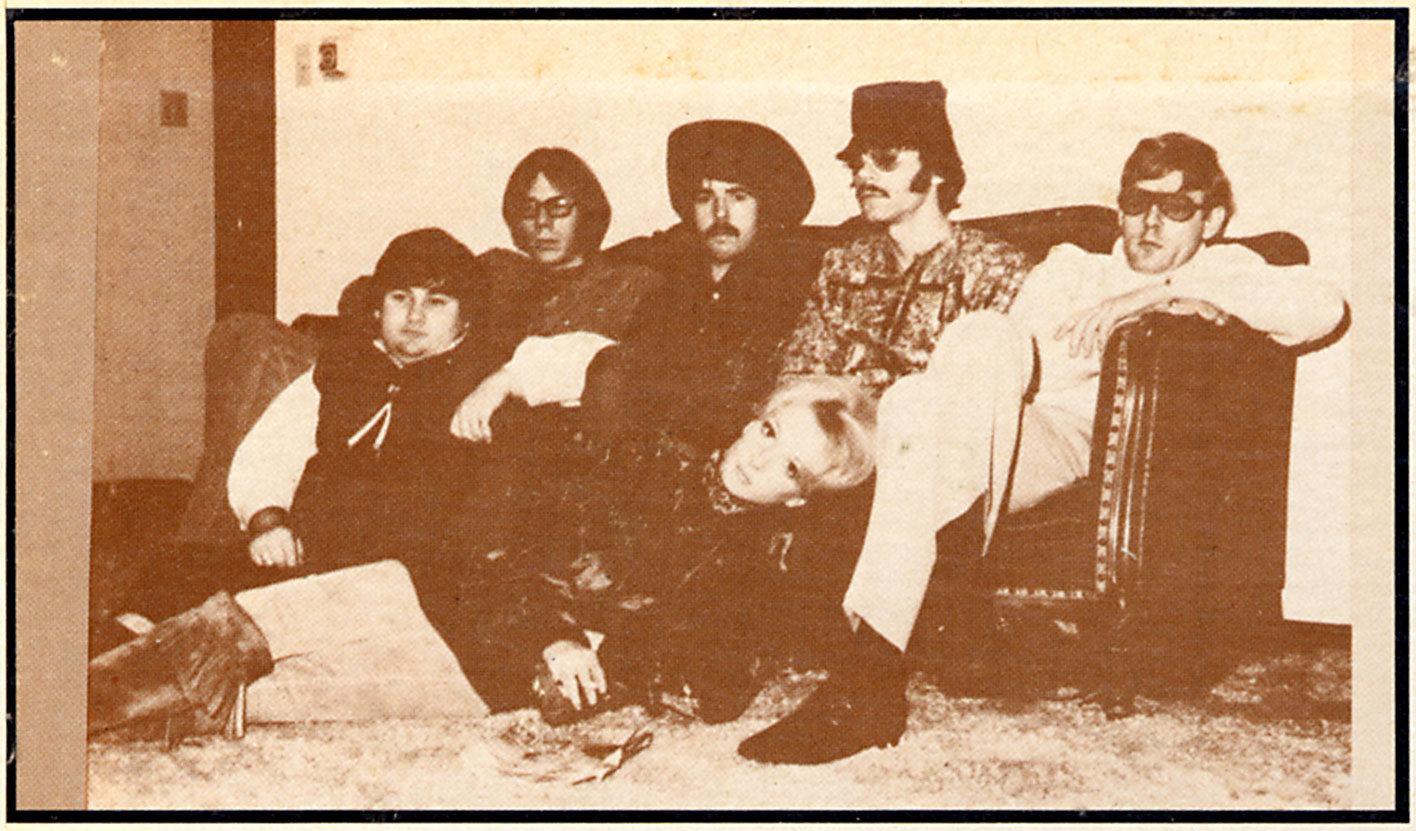
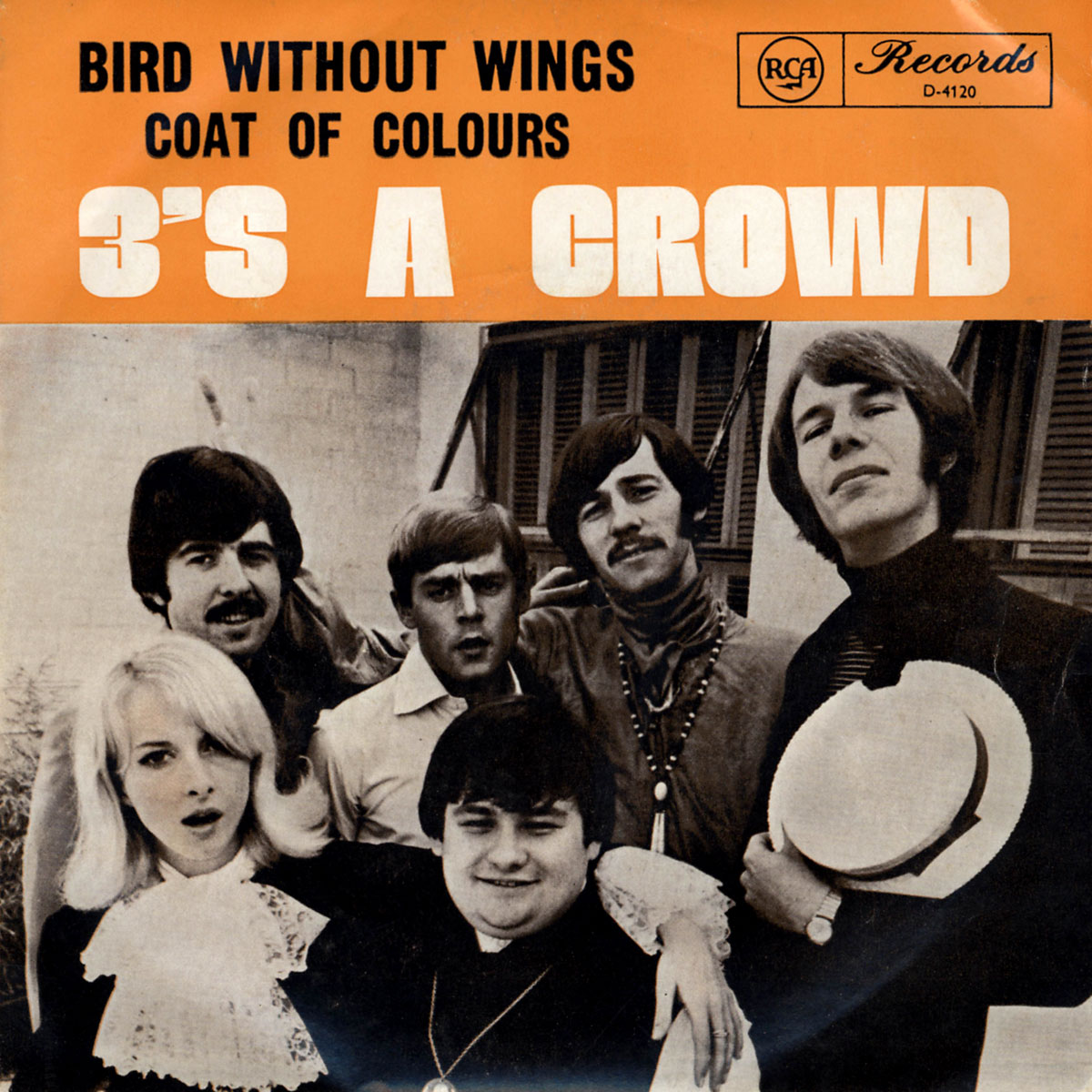
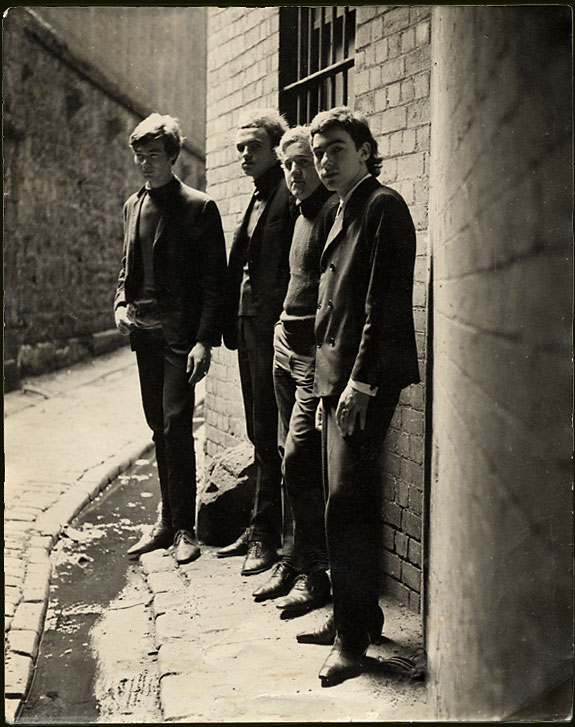
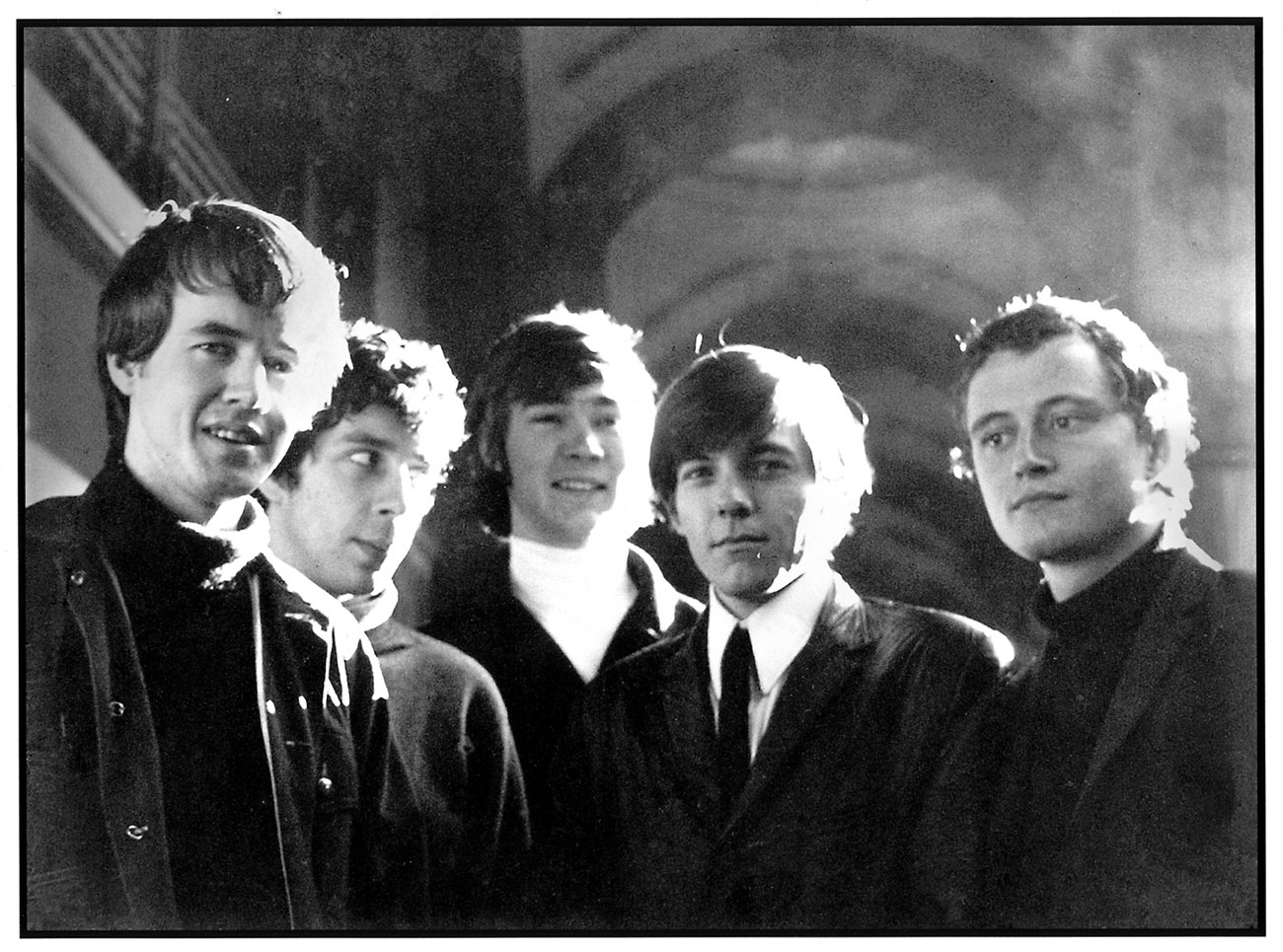
1965, from left: Mick Tinsley, Alan Laud, John Stewart, Ray Honeyball and Leslie Dash
Mike Tinsley (vocals) John Stewart (lead guitar, vocals) Tony Cockayne (rhythm guitar) Ray Honeyball (bass) Leslie Dash (drums)
1963
November Former Electrons lead singer Mike Tinsley (b. 16 December 1940, Portsmouth, Hants), guitarists John Stewart (b. 18 March 1941, Torphins, Kincardineshire, Scotland) and Tony Cockayne; bass player Ray Honeyball (b. 6 June 1941, Whickham, County Durham) and drummer Leslie Dash (b. 3 April 1943, Hillingdon, Middlesex) are all Royal Air Force ground crew based at RAF Wittering in Cambridgeshire, England. Captivated by the beat scene exploding in the UK, they decide to form a band, The Trendsetters. The quintet performs initially in the officers’ mess at RAF Wittering but then ventures out, debuting at the White Lion pub in Whittlesey, Cambridgeshire. After receiving a positive reception, they play at the Dorothy Ballroom and the Corn Exchange in Cambridge.
1964
The band changes its name to The Hedgehoppers; a nickname for the “V” bombers, which can fly a few hundred feet above the ground, under enemy radar to avoid detection and ground-to-air missiles. A local agent spots The Hedgehoppers playing the local pub scene and arranges live gigs to showcase the band at weekends. By June, The Hedgehoppers have opened for Unit Four Plus Two, The Hollies and The Kinks among others.
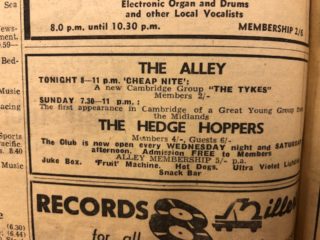
November (22) The Hedgehoppers make their first appearance in Cambridge, playing at the Alley.
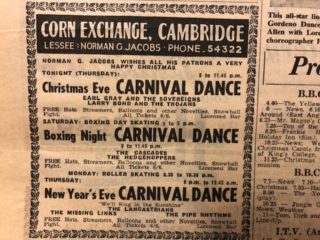
December (26) The band performs at the Corn Exchange, Cambridge with The Cascades.
1965
February (7) The Hedgehoppers play at the Alley Club in Cambridge.
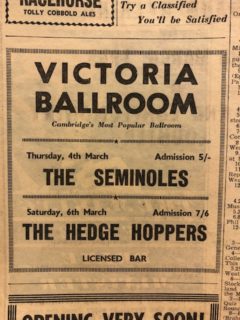
March (6) The Hedgehoppers appear at the Victoria Ballroom in Cambridge.
(14) The band returns to the Alley Club for another show.
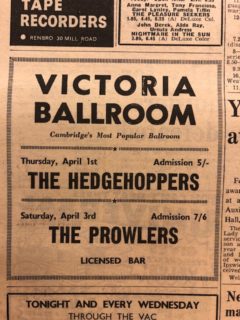
April(1) The group performs at the Victoria Ballroom in Cambridge.
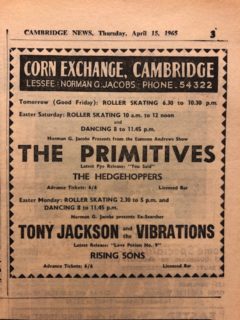
(17) The Hedgehoppers open for The Primitives at the Corn Exchange, Cambridge.
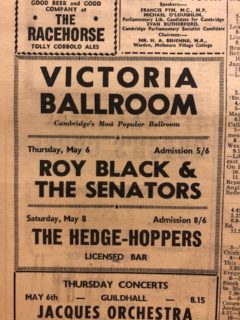
May (8) The group plays at the Victoria Ballroom, Cambridge.
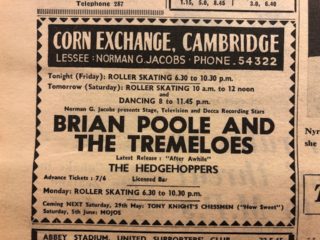
(22) The Hedgehoppers open for Brian Poole & The Tremeloes at the Corn Exchange, Cambridge.
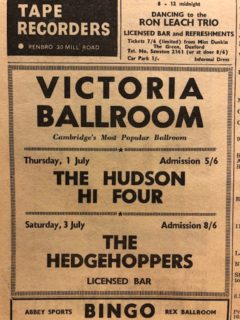
July (3) The band returns for another show at the Victoria Ballroom in Cambridge.
(17) The Hedgehoppers appear at the Dorothy Ballroom in Cambridge with Bob Ludman and His Orchestra, The Seminoles and Ben Elliot and The Klan. Alan Laud (b. 13 March 1946, Whittlesey, Cambridgeshire), who is a civilian living near the RAF base takes over from Cockayne on rhythm guitar after meeting the musicians in a local pub.
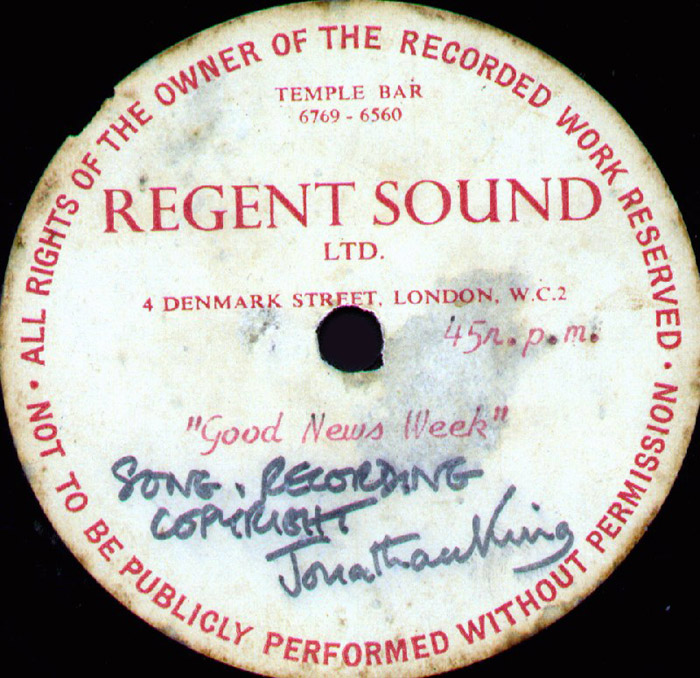
August The Hedgehoppers are playing at the Corn Exchange in Cambridge when they are spotted by Trinity College student Kenneth King (aka Jonathan King), who is working as a producer for Decca Records through his own company “Jonathan King Enterprises”. The aspiring producer is about to release the single “Everyone’s Gone To The Moon” under his recording name Jonathan King and approaches The Hedgehoppers to see if they will record another of his songs – “It’s Good News Week”. King, who is keener on becoming a producer than a singer, suggests that they add the Anonymous tag so that they can keep their fan base but protect their anonymity from the RAF, which is unaware of the recording. The band records “It’s Good News Week” under the musical direction of Arthur Greenslade, who adds session players, including guitarist “Big” Jim Sullivan, to back Tinsley on the track.
(6) The band appears at the Corby Civic Centre, Corby, Northamptonshire with The Rising Sons.
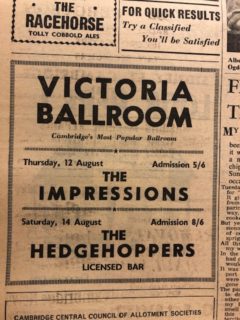
(14) Still billed as The Hedgehoppers, they play at the Victoria Ballroom in Cambridge.
September King’s tongue-in-cheek protest song, “It’s Good News Week” backed by “Afraid of Love” is released. The single’s success generates a huge amount of publicity but also creates problems with the RAF, which has not given the musicians the proper authority to find employment outside the Armed Forces. Hedgehoppers Anonymous make their debut TV appearance on ITV’s Ready Steady Go! They also appear on BBC TV’s Top of The Pops to plug the single.
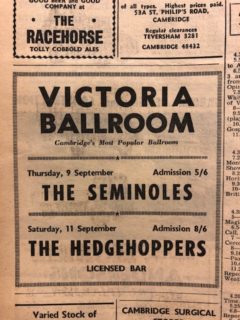
(11) Billed as The Hedgehoppers, they play at the Victoria Ballroom in Cambridge.
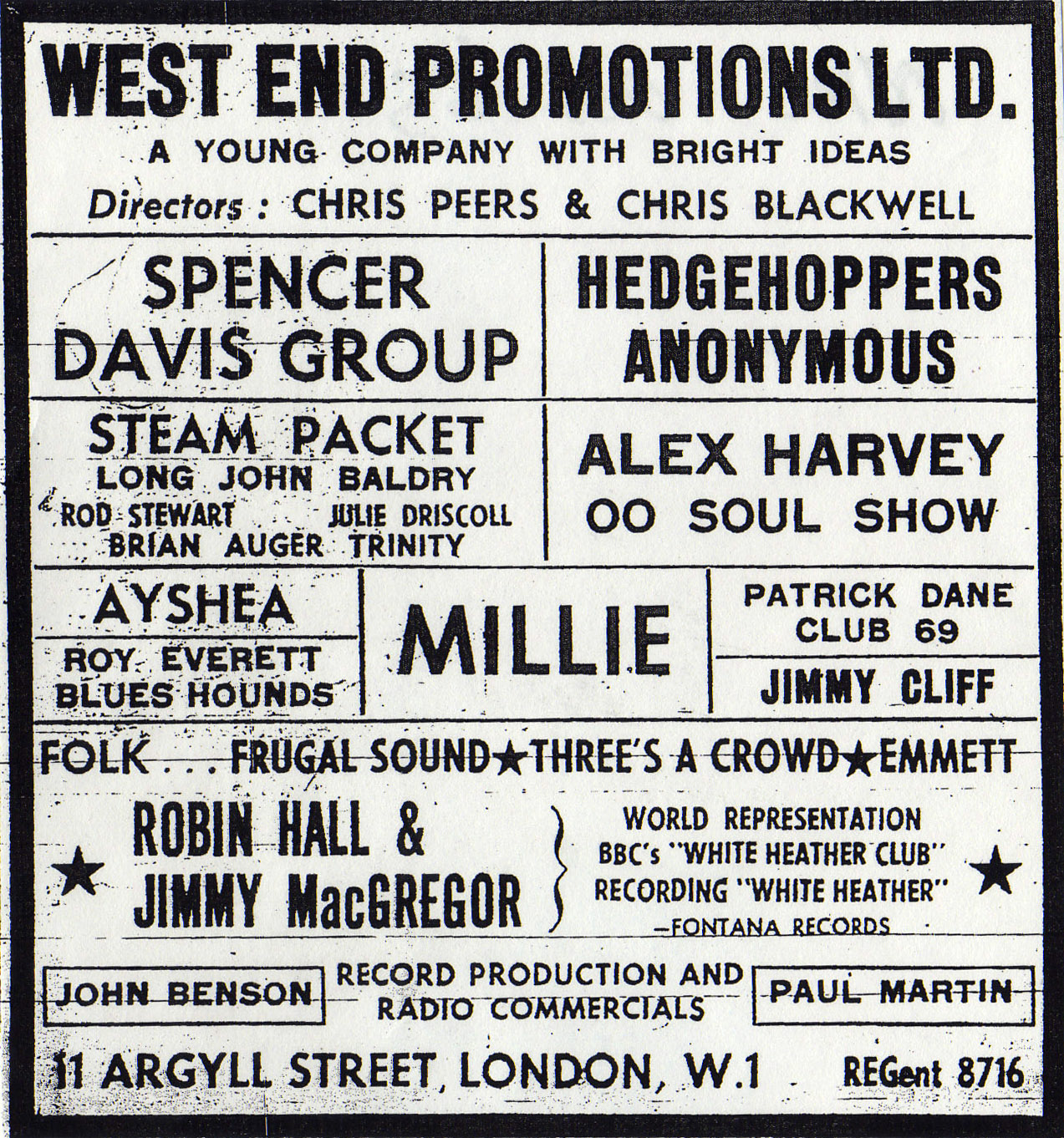
West End Promotion Ad, New Musical Express, October 1965
October Tinsley successfully submits an application to the RAF for a discharge.
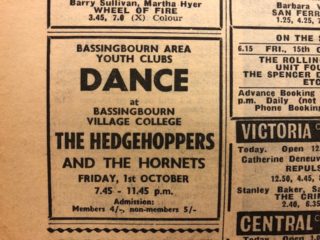
(1) Still billed as The Hedgehoppers, they appear at Bassingbourn Village College, Bassingbourn, Cambridgeshire with The Hornets.
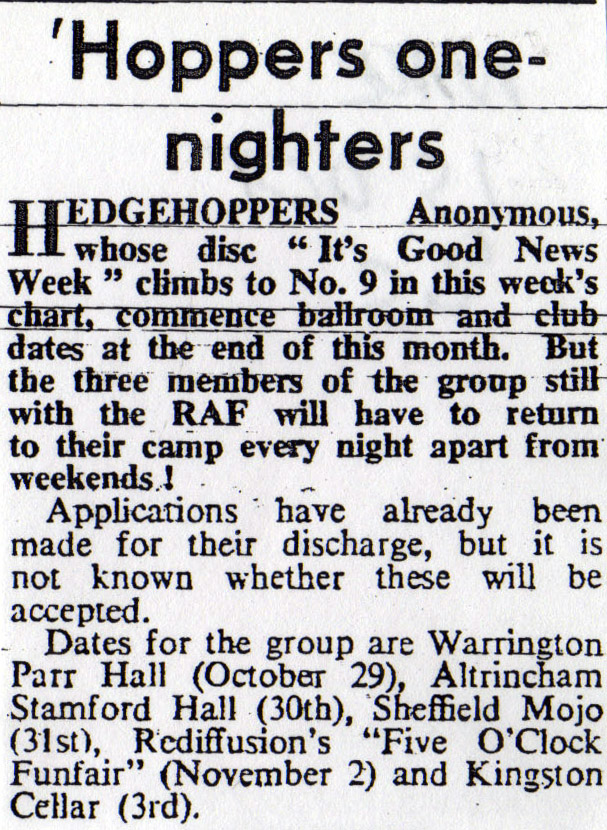
(15)NME reports that Dash, Honeyball and Stewart have applied to the RAF for a discharge but it is not known whether these will be accepted. Behind the scenes, London session musician Glenn Martin (b. 22 January 1946, Wembley Park, Middlesex), who is the resident drummer at the Ad-Lib club and has been playing with Ayshea Brough, takes over from Leslie Dash for live gigs while the drummer tries to gain a discharge.
Tour dates announced, New Musical Express, October 15, 1965
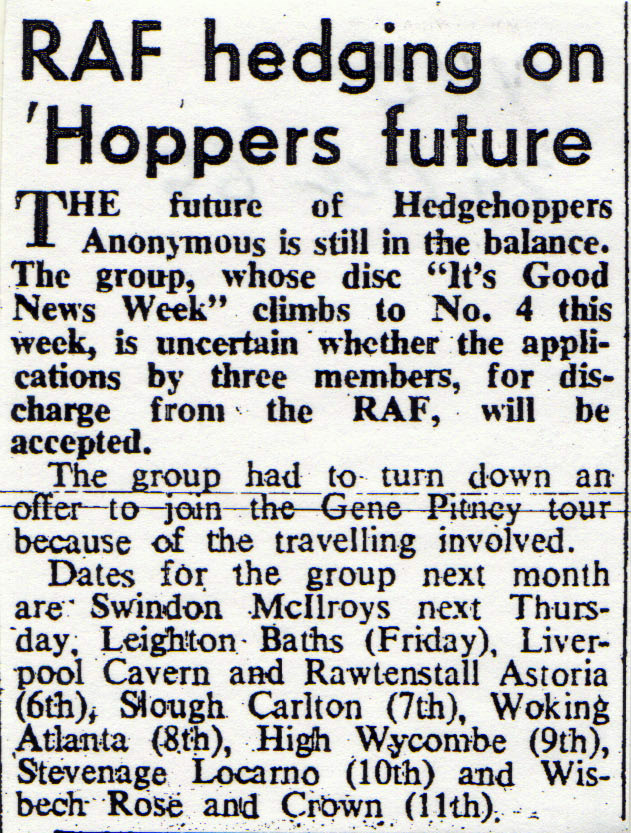
(29) With Martin onboard, the new line up plays at the YOR Club, Parr Hall, Warrington, Cheshire with The Boys in support . On the same day, NME reports that the future of Hedgehoppers Anonymous is still in the balance as it is uncertain whether Dash, Honeyball and Stewart’s applications will be accepted. Soon after, Stewart successfully gains a release from the RAF. Meanwhile, the group is forced to turn down an offer to join the Gene Pitney tour because of the travelling involved.
Opportunity to open for Gene Pitney lost New Musical Express, October 29, 1965
(30) Hedgehoppers Anonymous perform at Altrincham Stamford Hall in Altrincham, Greater Manchester.
(31) The group makes an appearance at Peter Stringfellow’s Sheffield Mojo club, Yorkshire.
November(2) The band performs on Rediffusion’s Five O’Clock Funfair.
(3) Hedgehoppers Anonymous play at the Kingston Cellar in Kingston-upon-Thames, Surrey.
(4) They perform at the Swindon Locarno Ballroom in Swindon, Wiltshire.
(5) Hedgehoppers Anonymous play at Leighton Baths, Leighton Buzzard, Bedfordshire.
(6) “It’s Good News Week” peaks at UK #5 and also reaches #48 in the US Billboard chart. On the same day, the band are billed to appear at Rawtenstall Astoria, Rawtenstall, Lancashire.
(7) Hedgehoppers Anonymous perform at the Carlton in Slough, Berkshire.
(8) The following day, the band plays at the Atalanta Ballroom in Woking, Surrey.
(10) Following a show at High Wycombe Town Hall the previous day, the group performs at the Stevenage Locarno in Stevenage, Hertfordshire.
(11) They perform at Wisbech Rose and Crown, Wisbech, Cambridgeshire.
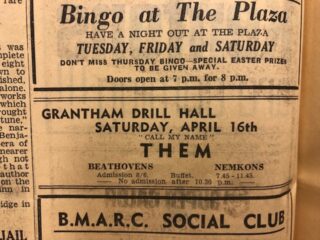
(13) The Grantham Journal lists the band appearing at Drill Hall, Grantham, Lincolnshire with Them Dogs and The Scene.
(16) Hedgehoppers Anonymous appear at an All-nighter session at the Cavern in Liverpool with The Baskerville Hounds, The Verbs, The Drifting Sands, The Richmond Group, The Dresdens, The Almost Blues, The Harpos, The Masterminds and The Fourmost.
(18) The band plays at the 100 Club in Oxford Street, London.
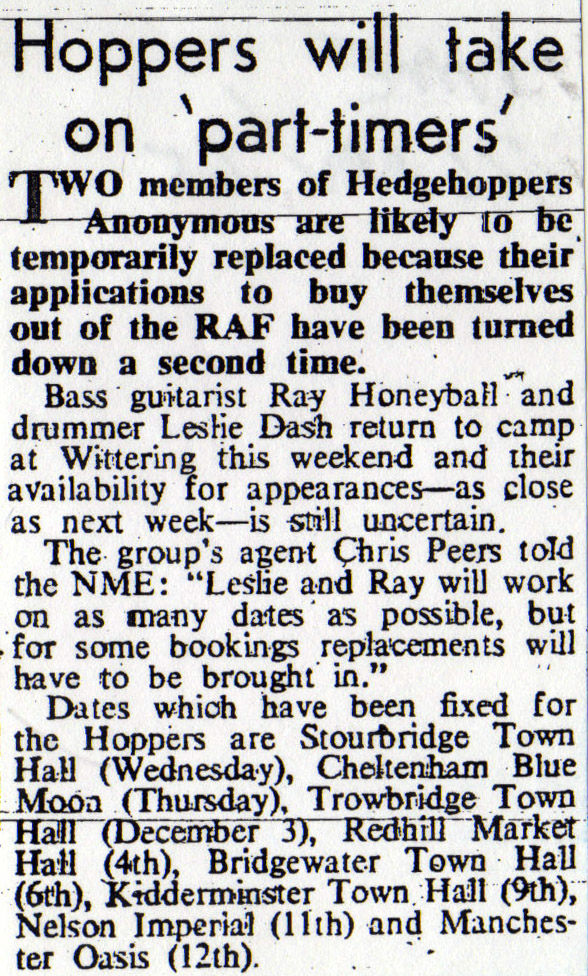
Leslie and Ray go “part-time”New Musical Express, November 26, 1965
(26)NME reports that Dash and Honeyball are likely to be temporarily replaced because their applications to buy themselves out of the RAF have been turned down a second time. The magazine goes on to say that Dash and Honeyball will return to RAF Wittering today and their availability for appearances – as close as next week – is still uncertain. The band’s agent Chris Peers tells NME that the two musicians will work on as many dates as possible, but for some bookings replacements will have to be brought in. Behind the scenes, however, Dash decides not to continue with the band and will later move out to South Africa where he currently resides. Glenn Martin takes over but will not be officially announced as Dash’s replacement until December. On the same day, the band appears Hillside Ballroom, Hereford with The Alan Walker Group .
1965, from left: Ray Honeyball, Alan Laud, Mick Tinsley, and John Stewart
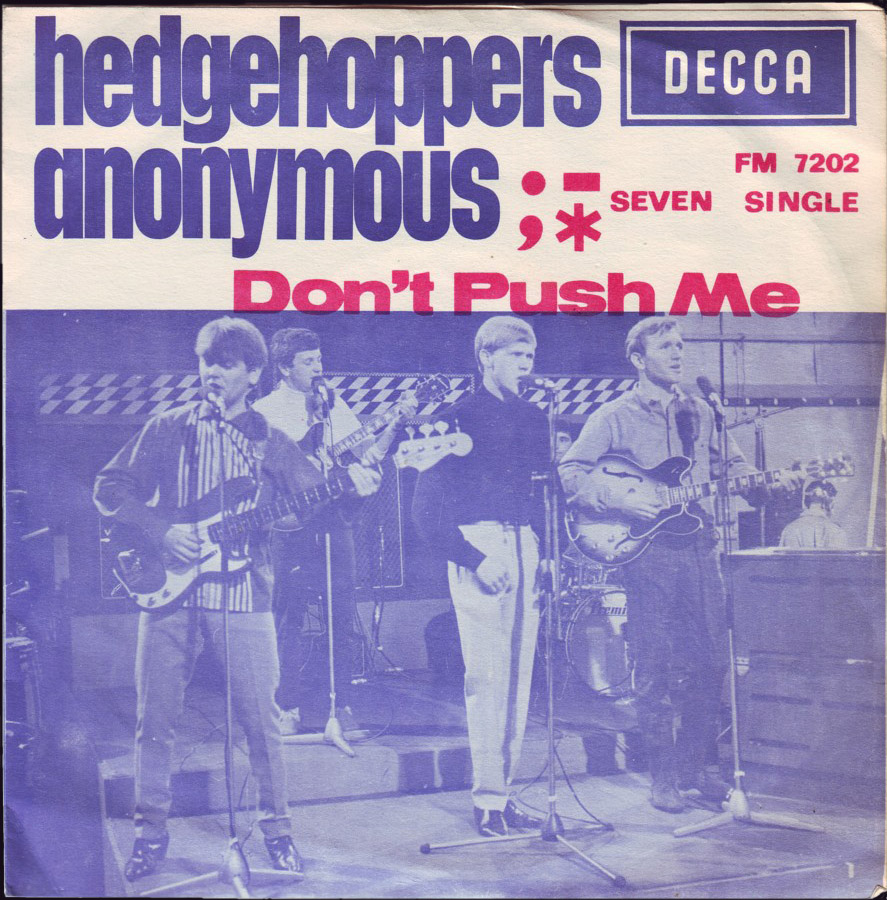
December Decca rush releases a second single to capitalise on the success of “It’s Good News Week” but the Kenneth King written “Don’t Push Me” c/w “Please Don’t Hurt Your Heart for Me” sells poorly. Like Dash, Ray Honeyball cannot get a release from the RAF. Former Von Dykes bass player Lee Jackson is brought in and put on a retainer. The idea is that he will fill in for Honeyball whenever the bass player cannot honour an engagement. While on a retainer, Jackson plays some shows with John Mayall’s Bluesbreakers.
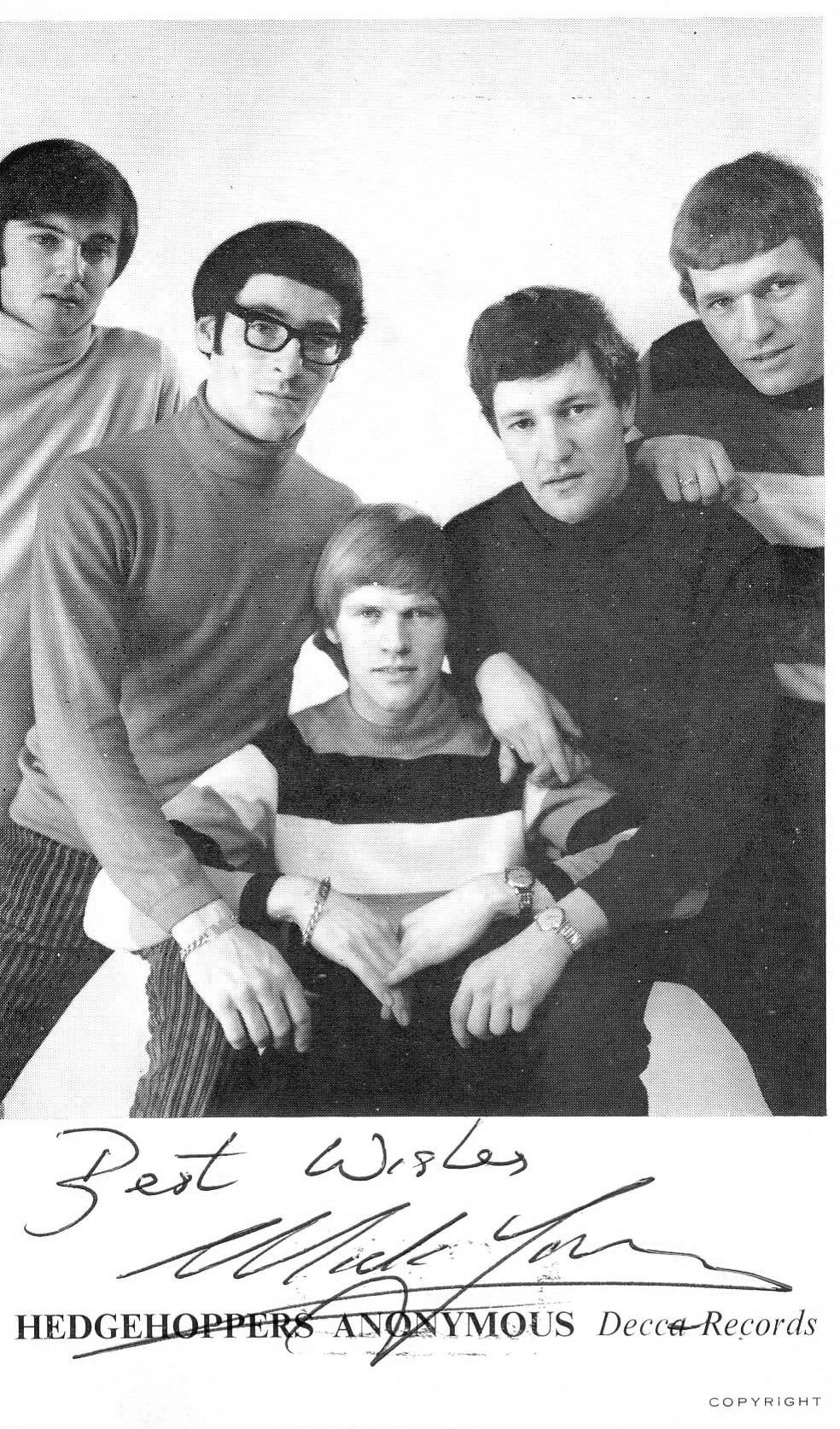
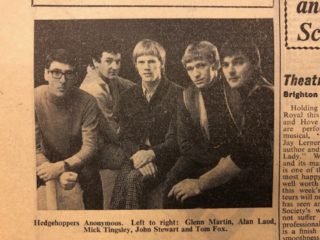
Lineup after late ’65, from left: Tom Fox, Glenn Martin, Mike Tinsley, Alan Laud and John Stewart
(1) The band plays at Stourbridge Town Hall, Stourbridge, West Midlands.
(2) Hedgehoppers Anonymous perform at the Blue Moon club in Cheltenham, Gloucestershire with The Alan Walker Group.
(3) They appear at Trowbridge Town Hall in Trowbridge, Wiltshire.
(4) The group plays Redhill Market Hall in Redhill, Surrey.
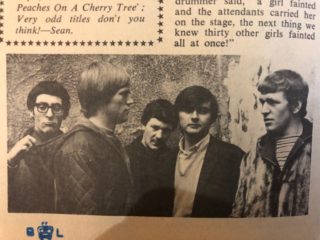
Photo: Boyfriend, 4 December 1965
(6) Hedgehoppers Anonymous appear at Bridgewater Town Hall, Bridgewater, Somerset.
(8) They play at Kidderminster Town Hall, Kidderminster, Worcestershire.
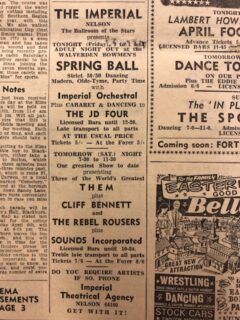
(11) Hedgehoppers Anonymous appear at Nelson Imperial in Nelson, Lancashire.
(12) The group plays a show at Manchester Oasis club.
(16) The band appears at the Pier Pavilion in Worthing, West Sussex.
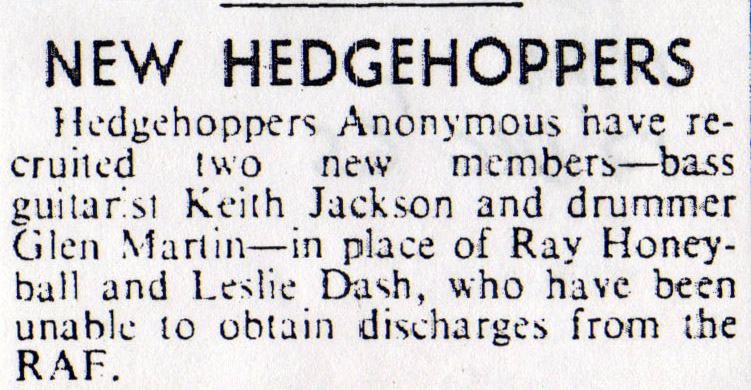
Keith Jackson and Glen Martin replace Ray Honeyball and Leslie Dash, New Musical Express, December 17, 1965
(17)NME announces that Keith Jackson and Glenn Martin have formally replaced Ray Honeyball and Leslie Dash who have been unable to obtain discharges from the RAF.
(22)Record Mirror announces the new line up, introducing Lee Jackson. However, Jackson only appears in a few publicity photos before finding work elsewhere. He subsequently joins Gary Farr & The T-Bones and then The Nice. Londoner Tom Fox takes over on bass from The Beat Boys and Barry Edwards and The Semi-Tones.
(27) The group plays at Bath Pavilion, according to Western Scene.
1966
January Having signed up to Chris Peers Promotions the previous year, the new line up starts to pick up steady work around the country.
(15) Boyfriend magazine lists the group appearing at the George Ballroom, Hinckley, Leicestershire.
(21-26) Boyfriend magazine reports that the band is touring Scotland.
(29)Boyfriend magazine has the group playing at the Town Hall in Bishop’s Stortford, Herts.
April Martin suggests that Hedgehoppers Anonymous cut a version of Chip Taylor’s “Wild Thing”, which is recorded and prepared for release. However, according to Martin, Kenneth King is not convinced about the song’s merit and persuades the musicians to record “Baby (You’re My Everything)” (a Little Jerry Williams ballad that Jonathan King had the rights to) instead. Shortly afterwards, The Troggs top the charts with their own version of “Wild Thing”, allegedly after hearing Hedgehoppers Anonymous’ unreleased version. However, Jonathan King relates “the demo of Wild Thing was first played to me by the publishers; I loved the song and allowed the guys to play on it but their version wasn’t even as good as the demo so I passed and the song was given to Larry Page who produced it with the Troggs.”
(3) The Rhyl & Prestayn Gazette advertises the group appearing at the Royal Lido in Prestayn with The Raynes.
(22) The Southend Standard lists the band playing at the Cricketers Inn, Westcliff, Southend, Essex with Bubbles & Co.
Photo: Mirabelle, 23 April 1966 issue
May Having appeared on ITV’s Ready Steady Go! Hedgehoppers Anonymous return with a third single, “Baby (You’re My Everything)” c/w “Remember”. The band’s poppy sound, however, increasingly sounds dated, and the single does not chart.
June(10) Hedgehoppers Anonymous play at the California Ballroom, Dunstable with The Felders.
(11)Melody Maker reports that Mick Tinsley has been ordered to rest for a week after being injured by fans at the Star Rink Ballroom, West Hartlepool last weekend. The band appears on BBC Radio’s Saturday Club this weekend.
July(23) They appear at St Mary’s Hall in Bognor Regis, West Sussex with Listen.
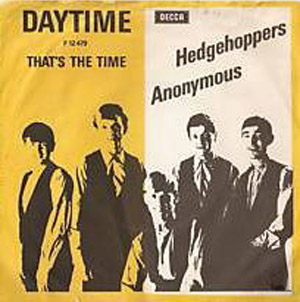
August(26) The band moves towards a more harder-edge rock sound, which culminates in the mod/freakbeat classic “Daytime” which is backed by “That’s The Time”. Unfortunately, the single is not a chart success. “Daytime” is an adaption of Les 5 Gentlemen’s “Dis-Nous Dylan” (originally co-written by Jean Fredenucci of Les 5 Gentlemen and T. Saunders) with English lyrics by John Stewart. Les 5 Gentlemen also record “Daytime” with Stewart’s lyrics for a release on the Major Minor label as Darwin’s Theory.
September(10) Hedgehoppers Anonymous record for BBC Radio’s Saturday Club with Dave Dee, Dozy, Beaky, Mick and Tich, The Fortunes and Glen Dale.
Photo: Mirabelle, 15 October 1966 issue
October The band plays at the Lyceum Ballroom in London on a bill that includes Tom Jones.
(8) They perform at Seaton Beat Club, Seaton Town Hall, Seaton, Devon with The Legends.
(12) Hedgehoppers Anonymous appear at Tiles nightclub on Oxford Street in central London with The Excels.
(15) The band plays at Leyton Baths Hall, Leyton, east London with The Plague.
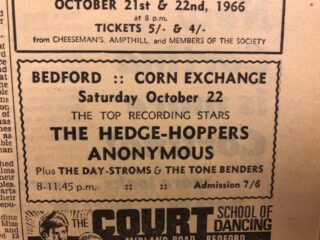
(22) Hedgehoppers Anonymous play at Bedford Corn Exchange, Bedford with The Day-Stroms and The Tone Benders.
November (4) Hedgehoppers Anonymous play at the Stardust, Victoria Hall, Dunblane, Scotland with The Senators.
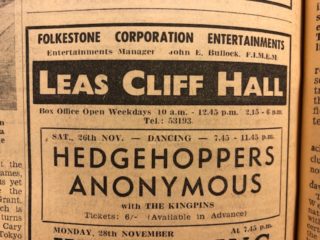
(26) The band appears at Leas Cliff Hall, Folkestone, Kent with The Kingpins.
December(9) Final single Alan Laud’s “Stop Press” c/w “Little Memories” is another chart failure.
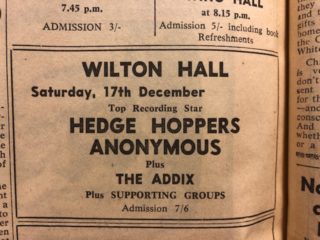
(17) Hedgehoppers Anoymous perform at Wilton Hall, Bletchley, Bucks with The Addix.
(23) The band appears Lewes Town Hall, Lewes, East Sussex with The Zombies and The Teen Team.
1967
January(6) The band plays at the Winter Gardens, Droitwich, Worcestershire.
(7) Hedgehoppers Anonymous appear at the Marine Ballroom, Morecambe Pier, Lancashire.
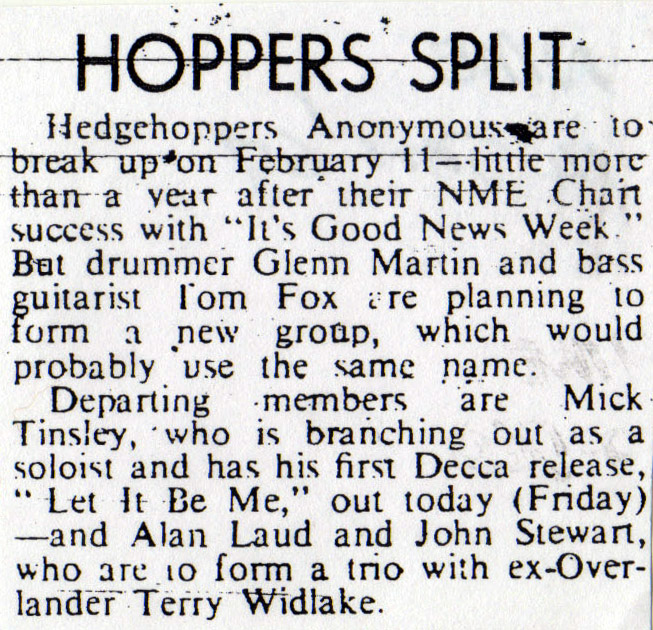
New Musical Express, January 14, 1967
(14)NME reports that the current Hedgehoppers Anonymous will split up on 11 February but that Martin and Fox are planning to form a new group, which will probably use the same name. On the same day, Mike Tinsley releases his debut solo single, “Let It Be Me”, produced by Kenneth King, on Decca. The publication also announces that Alan Laud and John Stewart will be forming a trio with ex-Overlanders’ member Terry Widlake but the collaboration never happens. Alan Laud later moves to Spain where he runs a bar in Torremolinos while John Stewart, who is intent on pursuing a career as a songwriter, subsequently relocates to the United States. He currently works in a recording studio in Tennessee. Rather than keep the Hedgehoppers Anonymous name going, Glenn Martin and Tom Fox get a job with blues singer Kenny Barnard, who is opening at the Bag O’Nails club after resident band The Peddlers have moved on.
(22) Martin (on his 21st birthday) and Fox back Kenny Barnard at the Bag O’Nails club. Soon after The Peddlers return to the Bag O’Nails and Barnard’s band finds itself without any work. The musicians go their separate ways. Tom Fox disappears from the music scene but allegedly commits suicide years later.
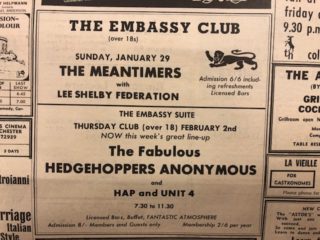
February (2) The band is advertised to play at the Embassy Suite, Thursday Club, Colchester, Essex with Hap and Unit 4.
(11) Hedgehoppers Anonymous officially disbands.
March Having moved to Halifax, West Yorkshire in February, Martin revives The Hedgehoppers Anonymous name and brings in lead guitarist Ian Atkinson from The Morton Fraser Harmonica Gang. Atkinson recommends his friend from Leeds, bass player Howard Livett. Keyboard player Vincent Crane joins for a few gigs but soon leaves to form The Crazy World of Arthur Brown. Atkinson contacts his friend organist/singer Chris Lazenby, who has previously worked with the guitarist in Bradford band, The Del Rio 4. They also recruit a second lead guitar player from Oldham. The new version mixes band originals – “It’s Good News Week”, “Don’t Push Me” and “Daytime” with covers material.
Hedgehoppers, summer 67 photo with Pete, Ian Atkinson, Glenn Martin, Chris Lazenby and Howard Livett
April The new line up embarks on a busy schedule of nation-wide gigs that takes in venues as far flung as Glasgow and Leicester.
May (29) The Rhyl & Prestayn Gazette lists the band playing at the Royal Lido in Prestayn with The Raynes.
June (23) The group performs at St Benedict’s Club, Sketty, Swansea, south Wales with The Outer Limits.
August Lazenby and the second lead guitarist depart when Martin convinces original singer Mick Tinsley to return to front the band. Lazenby joins the house band at Butlins in Minehead and reunites with Glenn Martin in 1970 when their band works the summer and winter seasons at the Butlins Hotels in Cliftonville near Margate, Kent.
(6) The band appears at New Las Vegas Discotheque in Dewsbury, West Yorkshire.
(18) With Tinsley back onboard, the group performs at the Carlton Club, Warrington, Cheshire with The Expressions.
(25) The band plays at the Boogaloo, Castleford, West Yorkshire with The Move.
September (16) Hedgehoppers Anonymous appear the Top Spot Ballroom, Ross-on-Wye, Herefordshire with The Knack .
Sweden, 1967, from left: Ian Atkinson, Mick Tinsley, Glenn Martin and Howard Livett
October Hedgehoppers Anonymous featuring Mick Tinsley, Glenn Martin, Howard Livett and Ian Atkinson embark on a short tour of Sweden and Lapland.
(6) While playing at the Cue Club in Gothenburg, Stoke-on-Trent band The Colour Supplement open the show. The band’s singer Phil Tunstall will join a new, completely unrelated, version of Hedgehoppers Anonymous in December 1968.
Swedish tour, 1967, from left: Mick Tinsley, Howard Livett, Glenn Martin and Ian Atkinson
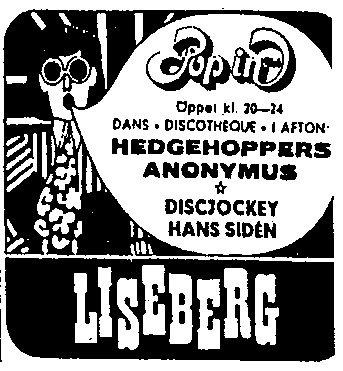
(18) Liseberg Pop In Club in Gothenburg.
November On their return to the UK, Tinsley resumes a solo career. He later becomes a co-writer for songs covered by Joe Dolan and Kelly Marie. In the late 1960s/early 1970s, Livett works on the Mecca scene with the band Huckleberry and spends over 10 years playing the Leeds City Varieties but passes away in August 2005. Martin joins Sandie Shaw’s backing group, The Streamliners, featuring Stoke-on-Trent musicians Tony Kaye (guitar), Dave Birkenhead (organ) and John Askey (bass). While with Sandie Shaw & The Streamliners, Martin will appear at the MIDEM Festival in Cannes in January 1968. When Martin leaves The Streamliners in February, Tony Kaye decides to use the Hedgehoppers Anonymous name for a new, completely unrelated, band, which with a modified line up will continue into the early 1970s, recording in South Africa as Hedgehoppers. Mick Tinsley sings “Wrap Me in Love” co-written with Peter Hawkins of Pickettywitch as a soloist for the UK at the Yamaha World Song Festival in Tokyo 1976. He co-writes songs with Peter Yellowstone for Joe Dolan and Kelly Marie.
2009
October Tinsley’s solo album My Surival is released on the British Academy Songwriters Composers Authors’ label. The album is produced by Tony Swain, who has previously worked with Spandau Ballet, Alison Moyet and Bananarma among others.
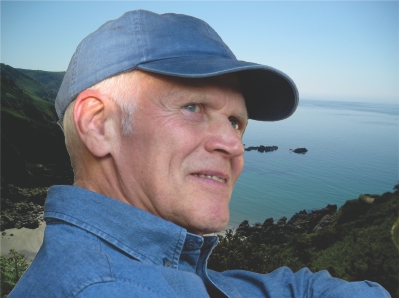
Mick Tinsley, May 2010
2010
June Prism Leisure Records re-release two CDs featuring Tinsley singing on the songs “Songs That Won The War” and “English Street Party” recorded in the 1990s. Glenn Martin, who has worked as a session drummer over the last 40 years is drum chair at the Surrey Jazz Orchestra.
December(4) Tinsley will be appearing at the Amersham Rock and Roll Club with Chris Farlowe, Vanity Fair, The Searchers and Honeybus.
Sources:
The Best of The Cellars – The Story of the Cavern Club by Phil Thompson, Tempus Publishing Limited, 2007. New Musical Express, 1 October 1965 (page 9), 15 October 1965 (pages 9 and 13), 29 October 1965 (pages 6, 9 and 10), 26 November 1965 (page 9), 17 December 1965 (page 6), 14 January 1967 (page 8).
Many thanks to Mick Tinsley, Glenn Martin, Jonathan King, Chris Lazenby, Mick Cockayne, Lee Jackson, Jenni Livett, Christopher Hjort, Tertius Louw, Paul Green and Tony Walter for providing further details. Thank you to Paul Tinsley for the photo of Mick Tinsley in May 2010. Thanks also to Samuel Coomans for one of the sleeve scans and to Hans Olof Gottfridsson.
Mike Tinsley’s “My Survival” is available on the BASCA Academy Recording Digital label and can be purchased on Amazon.
Newspapers including Cambridge News, Dewsbury Reporter, the Warrington Guardian and the South Wales Evening Post.
I have tried to ensure the accuracy of this article but I appreciate that there are likely to be errors and omissions. I would appreciate any feedback from anyone who can provide any additions or corrections. Email: Warchive@aol.com
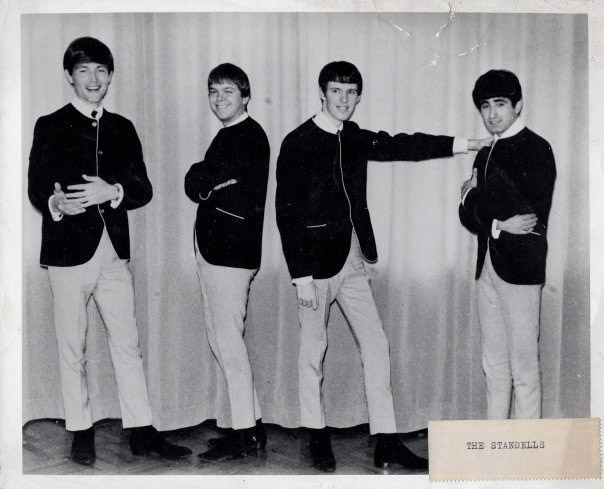
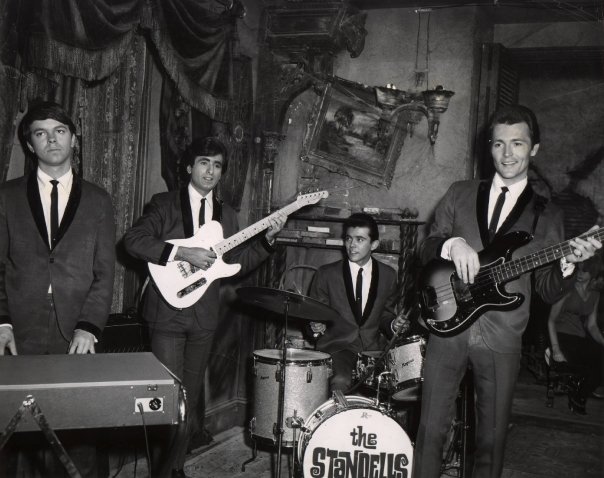
Early 1963, clockwise from left: Tony Valentino, Gary Lane, Larry Tamblyn and Gary Leeds
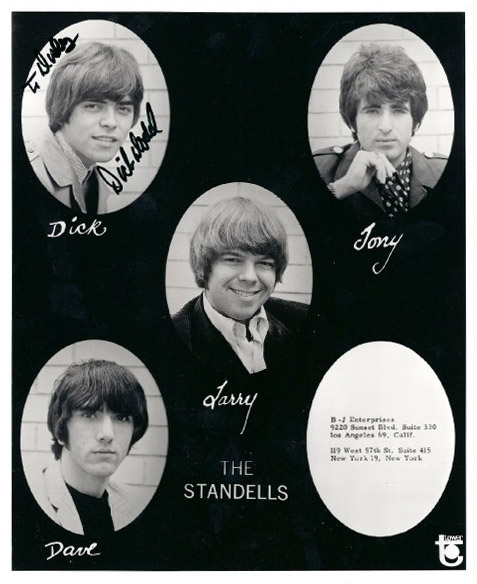
Larry Tamblyn (keyboards, vocals) Tony Valentino (lead guitar) Gary Lane (bass) Gary Leeds (drums)
1962
The group is formed in Los Angeles by Larry Tamblyn (b. February 5, 1943, Inglewood, California, US), (brother of actor Russ Tamblyn), and guitarist Tony Valentino (b. Emilio Tony Belilissimo, May 24, 1941, Longi, Italy), who arrived in the US in 1958. Tamblyn has previously recorded three singles for local label, Faro.
Tamblyn and Valentino form the original Standells with Jody Rich (bass) and Benny King (drums) and work in Hawaii at the Oasis club in Honolulu for several months. The group takes its name from the long hours spent hanging around record company offices awaiting an audition.
1963
January The Standells work at the Club Esquire in Eureka, California. Soon afterwards, former New York Aerospace Technology school student, Gary Leeds (b. September 3, 1944, Glendale, California, US) and bass player Gary Lane (b. Gary McMillan, September 18, 1940, St Paul, Minnesota, US) take over from King and Rich. The group’s first recording is the single, “The Shake”, which receives airplay on KFWB radio station. May The group plays at the Royal Room in West Los Angeles. August The Standells appear at Tykes in Pasadena, California. September The band performs at the Trophy Room in Sacramento, California and then becomes the house band at the Peppermint West in Hollywood. December The Standells’ debut single, “You’ll Be Mine Some Day” is released as Larry Tamblyn and The Standells on Faro’s subsidiary label, Linda Records.
Standells, early 1964: Gary Lane, Larry Tamblyn, Gary Leeds and Tony Valentino
1964
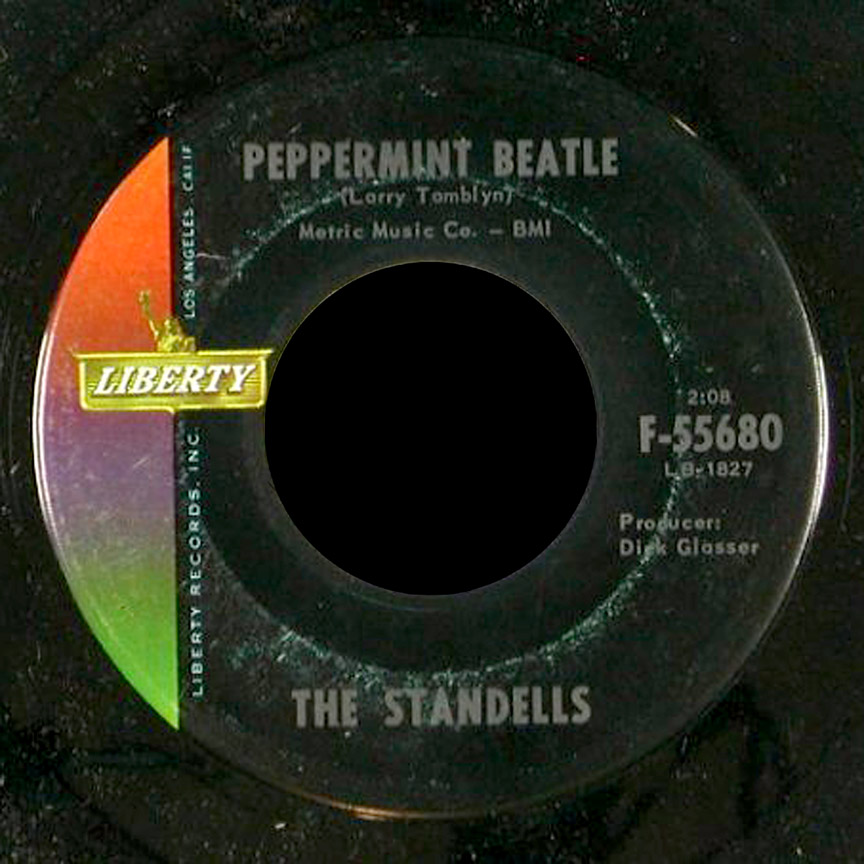
February (6) Tamblyn, Valentino, Lane and Leeds sign a record contract with Liberty Records. March The group plays at the Thunderbird Lounge in Las Vegas billed as America’s answer to The Beatles. May Gary Leeds leaves to join first Johnny Rivers and then P.J. Proby, before co-founding The Walker Brothers, and is replaced by Dick Dodd (b. October 27, 1943, Hermosa Beach, California, US) from surf band, Eddie & The Showmen. (Dodd has also been an original mouseketeer on the popular TV show, The Mickey Mouse Club). June The Standells land a residency at Hollywood’s illustrious nightclub, PJ’s (where they record an album) and also play at the Haunted House on Hollywood Boulevard. Liberty releases the single, “Peppermint Beatle”, in an attempt to cash-in on The Beatles’ recent US success, but the single flops. July A cover of James Brown’s “I’ll Go Crazy” is lifted from the forthcoming album and issued as a single but fails to chart. In The UK, b-side, “Help Yourself” is released as the single.
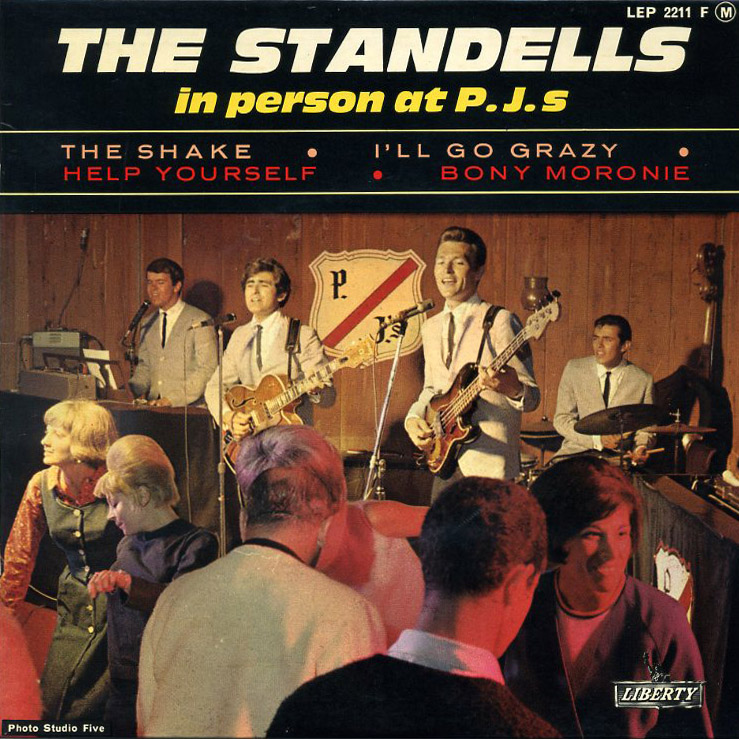
French EP taken from the Liberty album In Person at PJ’s
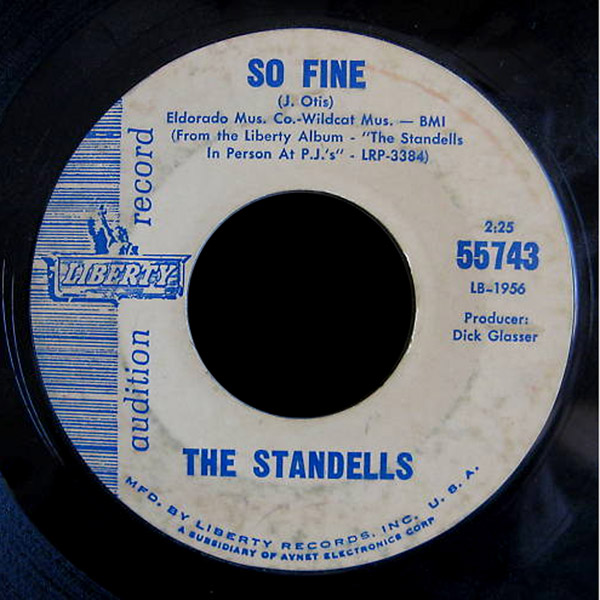
September Liberty releases debut album, The Standells In Person At PJ’s, a blatant cash-in on The Kingsmen’s recent live album, Louie Louie: The Kingsmen In Person. The record is released in the UK the following year; the only Standells album to be issued there. The Standells travel to Nicaragua for 12 days. October (17) A final Liberty single, a version of Johnny Otis’ “So Fine” is taken from the album but does not chart. The band signs a new deal with VJ Records. December (5) The Standells perform at Sammy Lee’s Westlake in Chatworth, California. (22) The band makes its third return to P J’s in Hollywood.
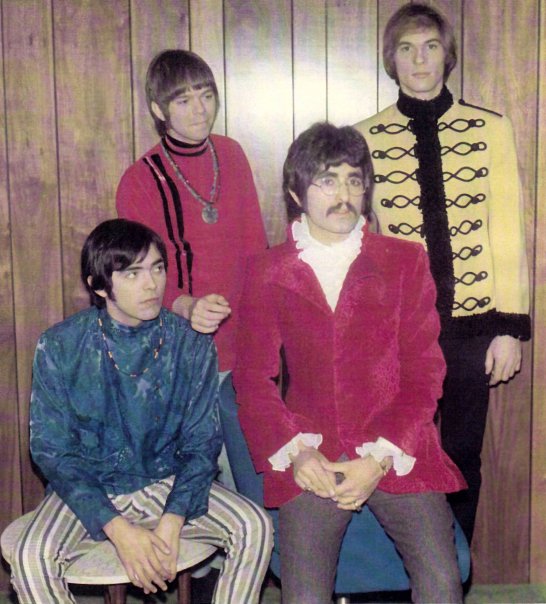
Larry Tamblyn, Tony Valentino, Dick Dodd and Gary Lane
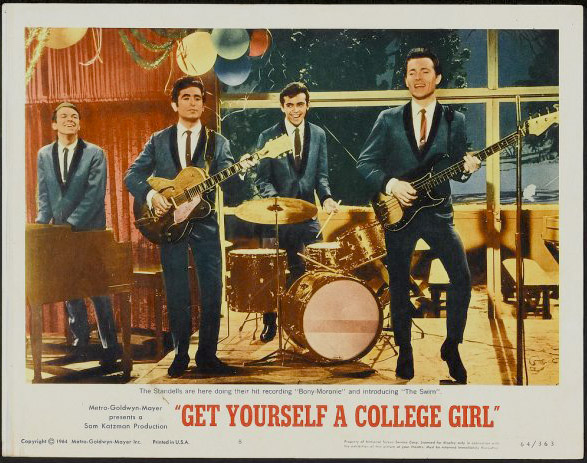
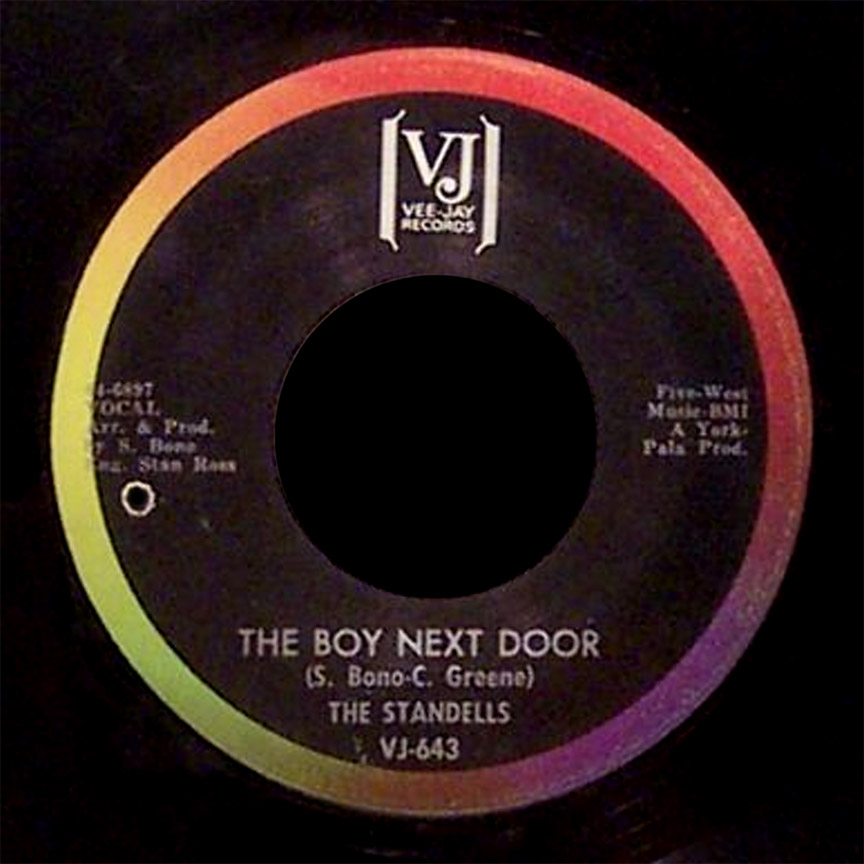
(26) Having signed a new recording deal with Vee-Jay Records, the band’s debut single for the label, “The Boy Next Door”, produced by Sonny Bono and featuring Cher on backing vocals, is released and eventually peaks at US #102. The single’s release comes on the heels of MGM film, “Get Yourself A College Girl”, where the band performs covers of “Bony Moronie” and “The Swim”. (31) The Standells appear on That Regis Philbin Show and perform a cover of The Beatles’ “I Want To Hold Your Hand” and one other song.
Standells, late 1964: Tony Valentino, Gary Leeds, Larry Tamblyn and Gary Lane
1965
January (7) The Standells open New Tiger A-Go-Go Room in the Hilton Hotel, San Francisco. (18) “Zebra In The Kitchen” is released as a single by MGM but is not a success.
March (18) The Standells appear in episode “Far Out Munsters” for the popular TV programme, The Munsters. After the initial success of “Help Yourself” as a single in Los Angeles, Dodd become the group’s principal lead singer. (20) The band appears on American Bandstand with Brenda Holloway. (25) The group appears on Shindig with Dick and Dee Dee, Shirley Ellis, Bobby Goldsboro, The Trade Winds and Glen Campbell.
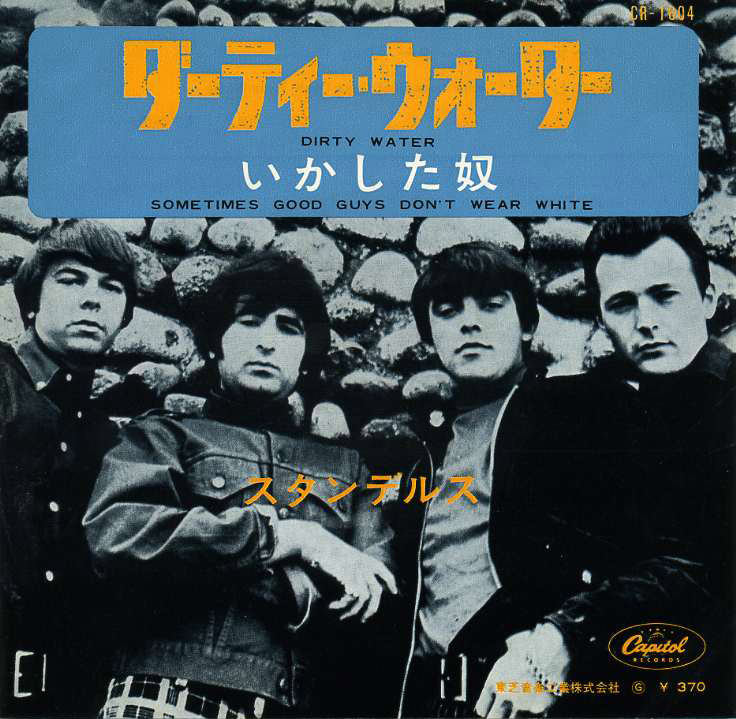
On the Munsters, from left: Larry, Tony, Dick and GaryLater Japanese release of “Dirty Water”
April The Standells return to the Tiger-A-Go-Go at San Francisco Hilton Hotel where they are advertised as the “return of the Wild Standells”. May(28) The band plays at the Gardon Grove’s Alamitos Intermediate School assembly. July(12) The Standells appear on Hollywood Discotechque TV show. August Final Vee-Jay single, “Don’t Say Goodbye”, backed by “Big Boss Man” is released but fails to chart. October The band is introduced to Ed Cobb, a former member of fifties vocal group, The Four Preps, who is currently working as a freelance producer and songwriter. Cobb is looking for a group to record one of his recent compositions, “Dirty Water”; a song written about a recent experience he had fighting off muggers, while walking with his girlfriend along the River Charles in Boston. He is suitably impressed with The Standells to use them on the track and offers his services to the group as a manager/producer. Shortly after, Cobb is approached by Tower Records (a subsidiary of Capitol), who are eager to obtain a record he has produced for Ketty Lester. Cobb proposes a deal, whereby Tower agree to sign The Standells in return for the Lester single. November “Dirty Water” is released as a single but is slow to sell. Dodd, who apparently hates the song, leaves the group and is replaced by former Sir Raleigh & The Cupons, drummer/vocalist, Dewey Martin (b. Dewayne Midkiff, September 30, 1940, Chesterville, Ontario, Canada; d. 31 January 2009). The group records a version of “Why Did You Hurt Me” with Martin on lead vocal but it is re-recorded when Dodd rejoins the band a few months later. December (5) The Standells perform at the Tiger-A-Go-Go in San Mateo, California.
Rare Tower promotional photo from 1966, featuring second bassist Dave Burke
1966
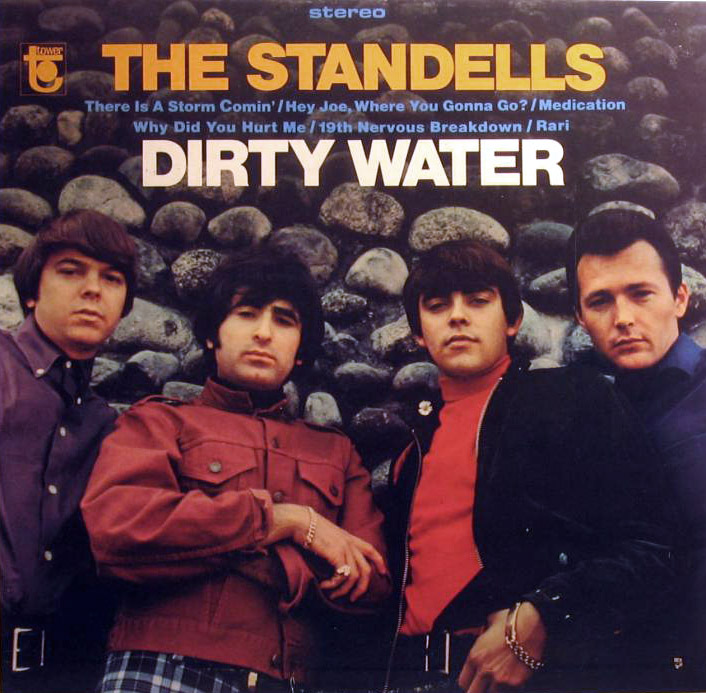
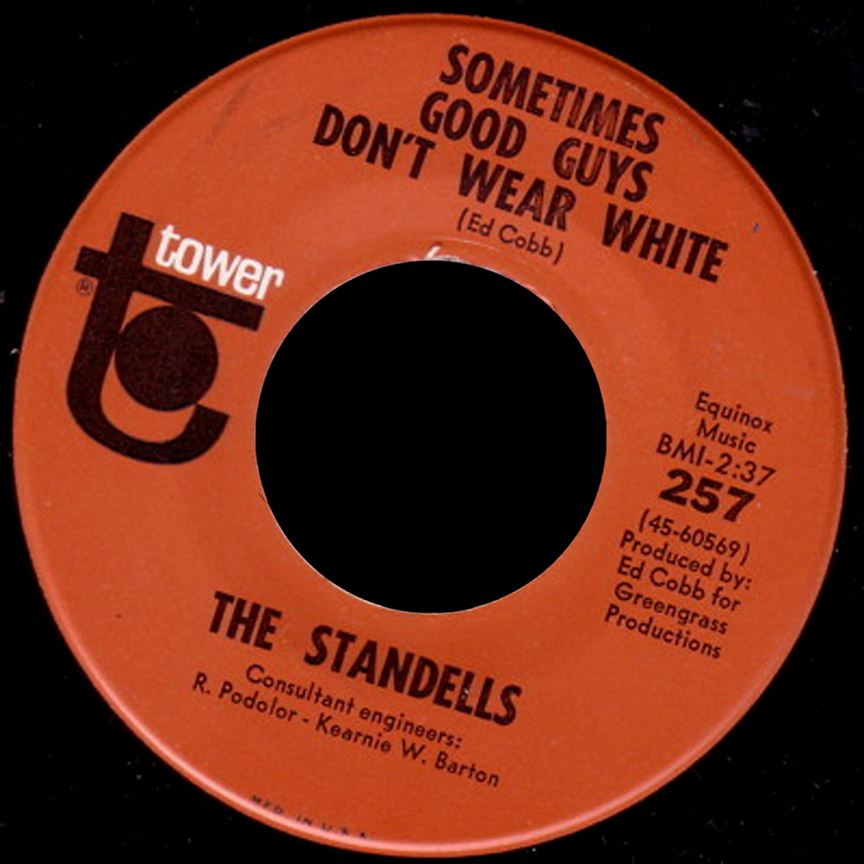
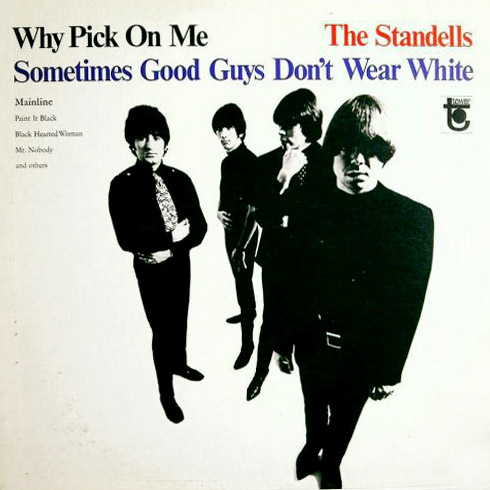
February Dodd rejoins the band while they are working San Jose (and after Cobb arranges a summer tour supporting The Rolling Stones). Martin, meanwhile, leaves to join The Dillards, before gaining greater acclaim with The Buffalo Springfield. May Bass player Gary Lane leaves the band during its first concert tour and is replaced in Florida by former member of the Tropics, Choir and Rush, Dave Burke. (20) The Standells appear at Birmingham High School, Van Nuys with The Jefferson Airplane, The Doors, The Sunshine Company and The Nitty Gritty Dirt Band. (20) The Standells perform “Dirty Water”, “There’s a Storm Comin'” and “Hey Joe” on the Mike Douglas Show. June (11) After a long climb “Dirty Water” breaks into the US charts at #31, the group’s biggest hit to date. Liberty Records, exploiting the success of “Dirty Water”, reissues The Standells’ debut album as Live And Out Of Sight, adding the “Peppermint Beatles” single to the track listing. A single, “Ooh Poo Pah Doo” is also issued, to tie in with the album’s release. Second Tower single, Cobb’s “Sometimes Good Guys Don’t Wear White”, reaches US #43, while debut Tower album, Dirty Water hits #52. (24) The Standells supports The Rolling Stones at the Manning Bowl, Lynn, Massachusetts on the opening date of The Stones’ US tour. Also on the bill is The McCoys and The Tradewinds. The crowd is subdued with tear gas, and the concert (even though it goes ahead) will be the last to be held at the venue until 1985. July “Dirty Water” is The Standells’ second and final single to be released in the UK, but doesn’t chart. (9) “Dirty Water” peaks at US #11, the band’s biggest hit. (22) The Standells open with The McCoys and other acts for The Rolling Stones at the Memorial Auditorium, Sacramento, California. (25) The group supports The Rolling Stones at The Hollywood Bowl alongside The Buffalo Springfield, The McCoys and The Trade Winds. August “Ooh Poo Pah Doo” is lifted from the earlier live album and released on Sunset but is not a chart success. September Second album, Why Pick On Me – Sometimes Good Guys Don’t Wear White is released but doesn’t chart. November Third album in six months, Hot Ones which is entirely comprised of covers of recent hits like The Lovin’ Spoonful’s “Summer In The City” and The Beatles’ “Eleanor Rigby” is released but is not a success. Burke leaves, later to join San Francisco band Indian Puddin’ and Pipe [note: it may have been a different Dave Burke who joined Indian Puddin’ & Pipe and West Coast Natural Gas] and is replaced by John Fleck (b. Johnny Fleckenstein, US), who had been an original member of Love, co-writing “Can’t Explain” on that band’s debut album.
(26) Cobb’s “Why Pick On Me?” stalls at US #54.
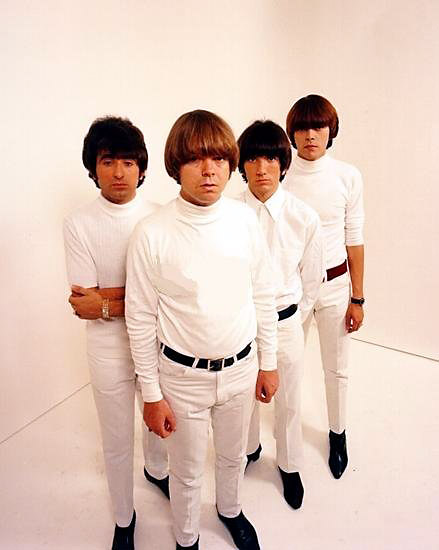
The Standells in 1967, from left: Larry Tamblyn, Dick Dodd, Tony Valentino and John Fleck
1967
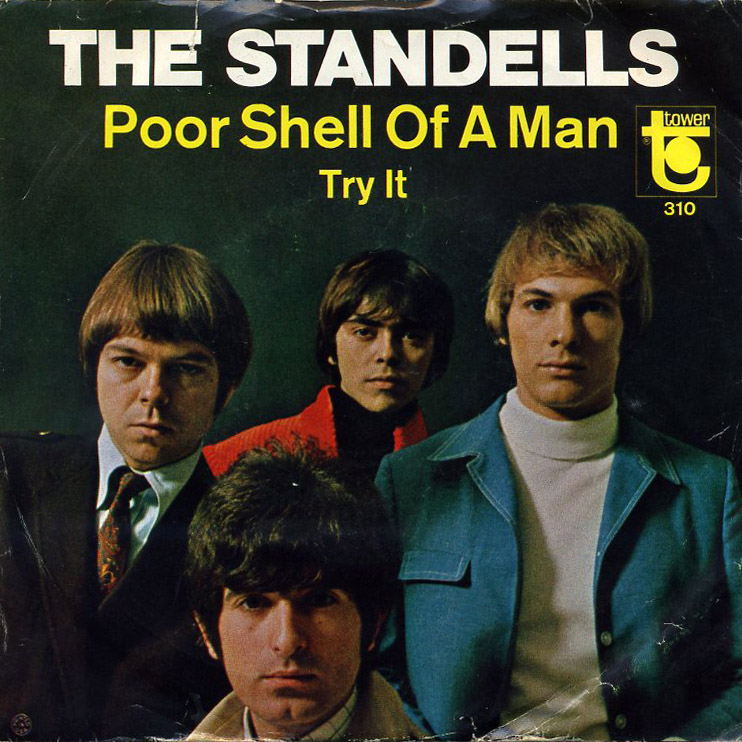
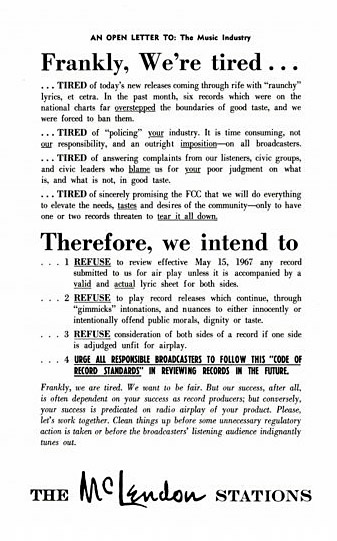
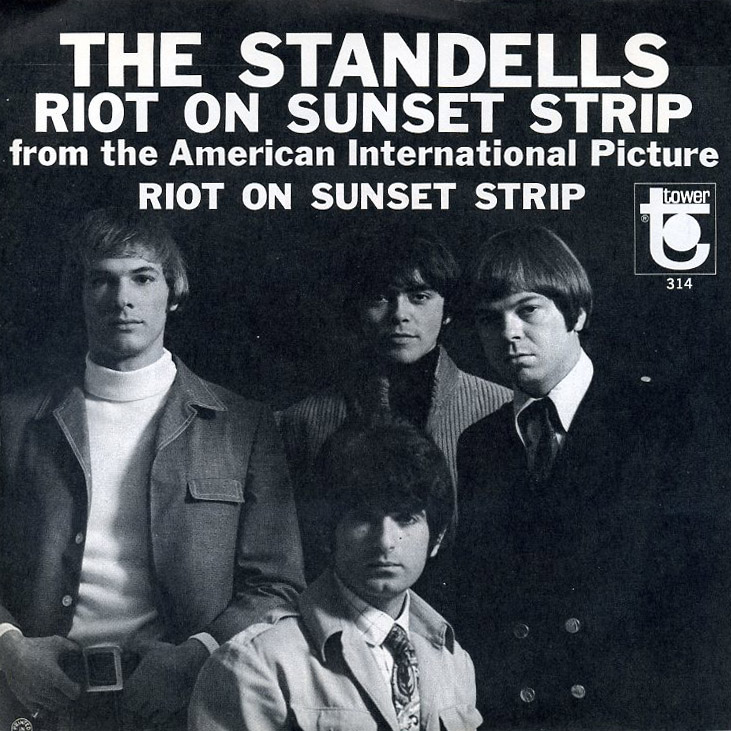
February The first single to feature Fleck on bass is “Try It”, arguably The Standells’ finest record. However, despite becoming an immediate hit in L.A., the record is soon banned by radio stations at the direction of rightwing moral majority radio mogul Gordon McLendon who argues that “Try It” is a blatant request for teenage girls to lose their virginity. (7-12) The band plays at the Ice House in Glendale, California. March The group releases the novelty tune, “Don’t Tell Me What To Do” under the name The Sllednats (The Standells backwards), but the single flops. (25) Valentino and Fleck’s “Riot On Sunset Strip” hits US #133. April Cobb is commissioned by Tower to come up with a soundtrack for a teenage protest film revolving around the disturbances on Sunset Strip 1966/67. The band is featured in the film, alongside label mates, The Chocolate Watchband.
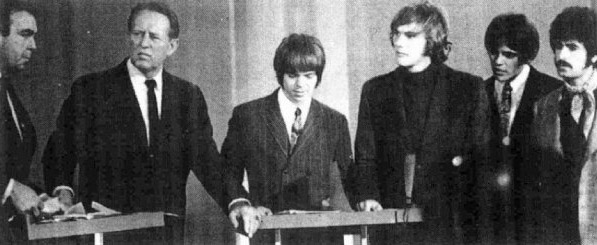
From left: Gordon McLendon, Art Linkletter, Larry Tamblyn, John Fleck, Dick Dodd and Tony Valentino
May (27) The Standellls appear on Art Linkletter’s TV show, Let’s Talk, debating radio mogul Gordon McLendon, who has been leading the campaign to ban music with “objectionable” lyrics. The Standells handily defeat him. However, after creative editing, it appears the debate was more evenly matched. July (5) The Standells support The Doors and The Coasters at Lowell High School Auditorium, La Habra, California. (23) The group appears on the Shebang TV show with Brenton Wood. August (26) – September (4) The band performs at the ‘Fort Worth Teen Fair & Mardi Gras Festival’, the Will Rogers Exhibit Building, Fort Worth, Texas. (5-12) The Standells play at the Ice House in Glendale. October The Standells’ next release, the R&B/soul single, “Can’t Help But Love You” is a minor hit, peaking at US #78. Tower releases The Standells’ fourth and final album Try It, which doesn’t sell. November (7) The group appears on the TV show Groovy with The Sunshine Company. (9) The Standells make a TV appearance on Pat Boone in Hollywood. December The group appears on the Joey Bishop Show. (8-9) The Standells perform at the Cheetah, Venice, California with The Hour Glass.
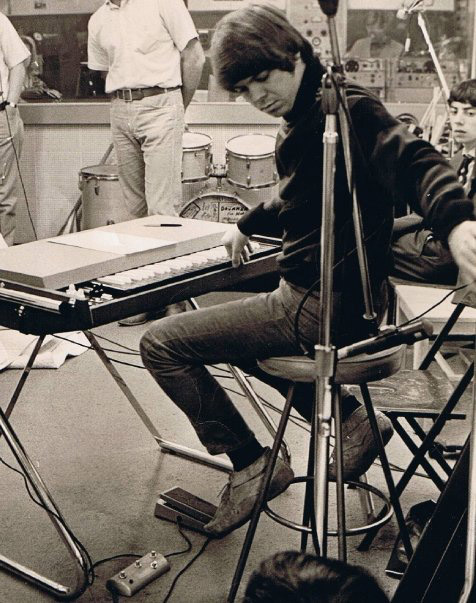
Larry Tamblyn, American Recording Studios, 1967
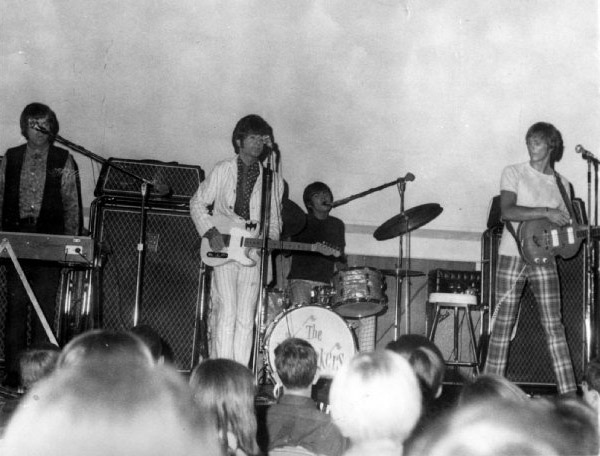
Live, 1967: Larry Tamblyn, Tony Valentino, Dick Dodd and John FleckLate 1967, just before Dick Dodd left the band for a solo career
1968
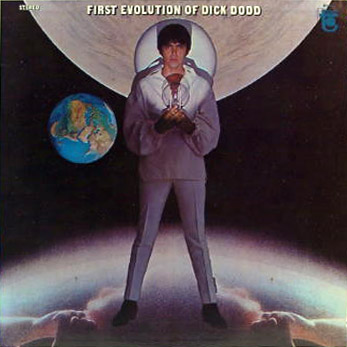
January (9-14) The Standells are billed to appear at the Ice House in Glendale, California but the shows are postponed until after playing at the Guitar Center in February. February (10) The group plays at the Guitar Center in Hollywood, California. April The band is eager to write and perform its own material and decides to split from Cobb, who continues to work with The Chocolate Watchband. Cobb is offered another film commission and decides to record Dodd as a solo artist without the rest of the group. Dodd records “Guilty” for the film, Square Root but problems arise over its distribution and the single flops. (9-14) The Standells return to the Ice House in Glendale for further shows. (19) The group plays at Bakersfield College, Bakersfield, California with The Illinois Speed Press. May Dodd joins Green Grass Productions as a solo artist. His place is taken by drummer Bill Daffern. June A final single, “Animal Girl” is released but is poorly received, despite being one of the group’s finest records. Featuring Tower producer Richie Podolor on sitar, and recorded before Dodd’s departure, the record is a radical departure in sound for the band and is lost in the media rush which follows. July A Larry Tamblyn’s solo single, the instrumental “Summer Clothes (Parts 1 &2)”, is released on the small Sunburst label. The one-year old track was recorded around the same time as “Can’t Help But Love You”. Dodd’s first solo single “Little Sister’ is released but fails to chart. August Fleck also drops out and moves into film work. He later becomes a top cinematographer with Jaws among his credits. The Standells recruit ex-Factory lead vocalist and guitarist Lowell George (b. April 13, 1945, Hollywood, California, US), but no recordings are made. September (3-15) The new line-up begins a series of dates at the Ice House, Glendale, California with Pipe Dream but they are never completed due to differences between Tamblyn and George. October Tower releases Dodd’s solo album, The First Evolution Of Dick Dodd but it doesn’t chart. (27) The Standells appear at the Artists and Models Ball at the Century Plaza with Taj Mahal and others. November George leaves to join Frank Zappa’s Mothers Of Invention (and later Little Feat). December Dodd’s final single “Fanny” is another chart failure and he quits the music business for the next few years. (7) A new version of The Standells supports Johnny Rivers at the College of Sante Fe with Blue Marble Faun in Sante Fe. Daffern and Tamblyn contribute material to The Electric Prunes’ final album, Just Good Old Rock and Roll.
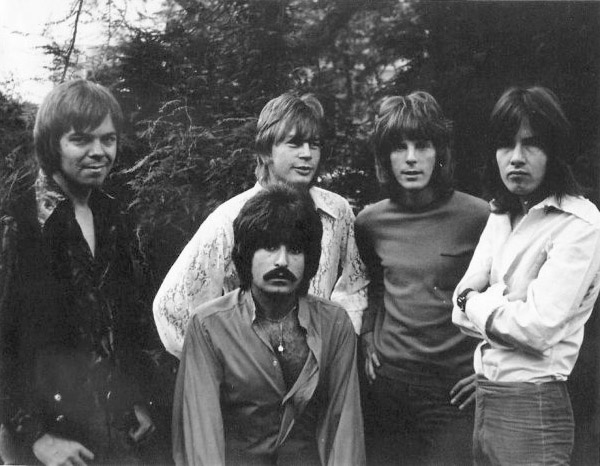
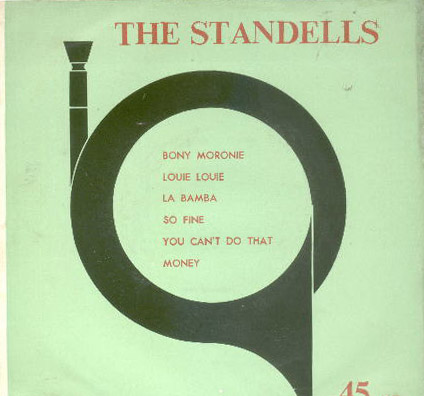
Standells 1969, from left: Larry Tamblyn, Tony Valentino (in front), Bill Daffern (Willie Dee), Tim Smyser, Paul DowningRare EP from Thailand that seems to include a version of “La Bamba” not heard anywhere else – anyone ever heard this version?
1969
Tamblyn and Daffern form Chakras with former Knack members Michael Kaplan and Larry Gould with Valentino acting as manager. Reprise releases the Charkras single, “City Buy” c/w “Agnes Vandalism”, both sides of which are written by Michael Kaplan. Daffern leaves and subsequently records with Hunger! and later records with Truk. Tamblyn and Valentino then reform The Standells with English guitarist Paul Downing. November (14-16) Billed as The Standells, the group appears at Pier 7 in Van Nuys, California. A photo circa this time includes new members Bill Daffern (Willie Dee) and Tim Smyser.
1970
July (7-12) The Standells play at the Beach House, California. September Dodd releases the single “Requim: 820 Latham”.
1975
Dodd emerges with Los Angeles group, Joshua, who release an album Willy And The Hand Jive (produced by Ed Cobb) for the independent AVI label.
1982
American indie label Rhino Records releases compilation album The Best Of The Standells. Around the same time Valentino cuts a number of solo demos (but is unable to attract a record deal), before joining Tamblyn and Dodd in a full-scale Standells reunion.
1983
August The Standells perform at the Club Lingerie in Hollywood, the Golden Bear in Huntington Beach, a weeklong engagement at Harrah’s in Reno, Nevada, supported by The Fleshtones.
1984
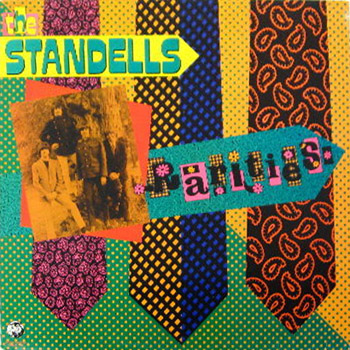
Rhino Records issues second album, Rarities, a collection of rare Standells tracks, including Dodd’s solo releases and the band’s pre-Tower Vee-Jay singles.
1986
Third Rhino release The Best Of The Standells is issued. July (19-20) The Standells appear at the Summerfest/Return to the Sixties at Glen Helen Regional Park, San Bernandino, California. Tamblyn, Valentino and Dodd reunite in 1999 for the Cavestomp Festival in New York. The group records a live CD, Ban THIS, a slam at Gordon McLendon.
2000
Gary Lane rejoins The Standells as they perform at the Las Vegas Grind, Las Vegas, Nevada.
2004
The Tamblyn/Valentino/Dodd/Lane line up play before the Game Two of the World Series.
2005
April (11) The Standells appear at Fenway Park. The band will return the following year for a show on September 8.
Many thanks to Larry Tamblyn for his personal contributions.
Sources:
Bronson, Harold. Sleeve notes to Rhino album, The Best Of The Standells. Burgess, Chuck and Nowlin, Bill. Love That Dirty Water! The Standells and The Improbable Red Sox Victory Anthem, Rounder Books, 2007. Doggett, Peter. ‘The Standells’. Record Collector, May 1991, #141. Grushkin, Paul D. Art Of Rock – Posters From Presley To Punk, Artabras, Cross River Press, Ltd, 1987. Hogg, Brian. ‘Little Feat’. Strange Things Are Happening, Vol 1, #3, July/August 1988. Joynson, Vernon. Fuzz, Acid And Flowers, Borderline Productions, 1993. Maclean, Hugh and Joynson, Vernon. An American Rock History – California The Golden State, Borderline Productions, 1985. Rees, Dafydd and Crampton, Luke. Book Of Rock Stars, 2nd Edition, Guinness Publications, 1994 Robertson, John. Neil Young – The Visual Documentary, Omnibus Press, 1994. Shaw, Greg. The Doors On The Road, Omnibus Press, 1997, pages 46 and 57. Whitburn, Joel. Billboard – USA Top 40 Hits, 3rd Edition, Guinness Publications, 1987. Whitburn, Joel. Joel Whitburn’s Pop Annual 1955-1994, Billboard Record Research Inc, 1995. Billboard, May 11, 1968, page 50. Billboard, September 7, 1968, page 3. Variety, September 2, 1970, page 60.
Another great resource is: www.newspaperarchive.com/
Some of the scans and photos seen here are on the Standells Facebook page. from the collections of Larry Tamblyn, Thomas Haaland and others.
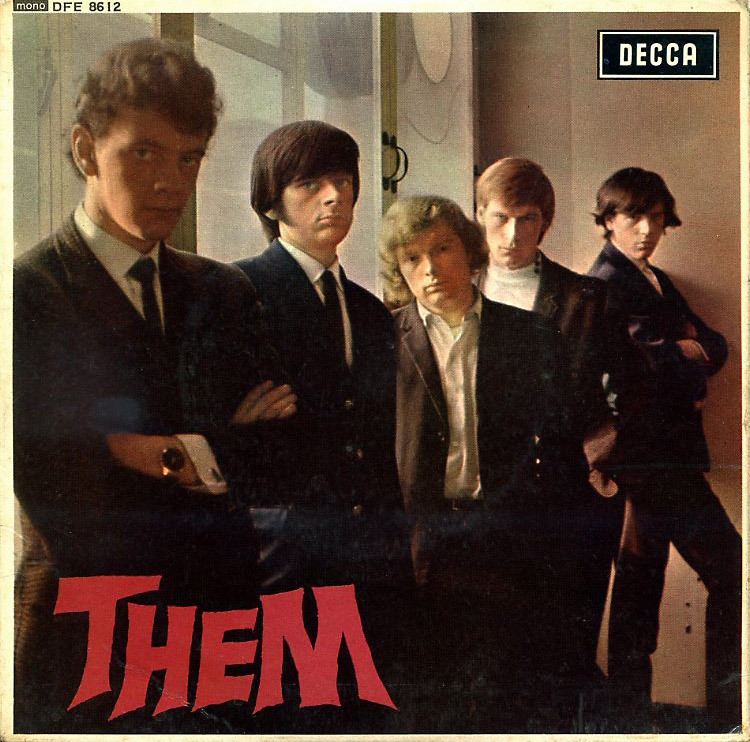
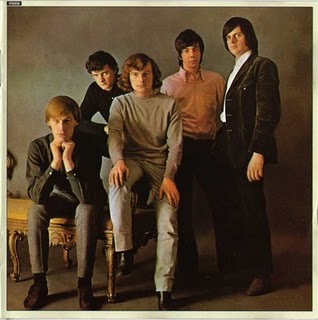
First UK EP showing lineup January 1965. From left: Alan Henderson, Pat McAuley, Van Morrison, Billy Harrison and Jackie McAuley
Van Morrison (harmonica, saxophone, vocals) Alan Henderson (bass) Billy Harrison (lead guitar) Eric Wrixon (keyboards) Ronnie Millings (drums)
1963
The group is formed in Belfast, Northern Ireland by Henderson (b. 26 November 1944, Belfast, N. Ireland), Harrison (b. 14 October 1942, Belfast, N. Ireland) and Millings (or Mellings), who have previously played in a local three-piece outfit, The Gamblers. The trio adds keyboard player Eric Wrixon (b. 29 June 1947, Belfast, N. Ireland) and a short while later completes the original line up with singer Morrison (b. George Ivan, 31 August 1945, Belfast, N. Ireland) from local band The Monarchs. Wrixon names the band after a 1950s B horror film.
1964
April (10) According to an article in Belfast weekly, Cityweek, dated 22 September 1966, Them had played their first ever gig at the Maritime Hotel in College Square North as a trio of Harrison, Henderson and Millings as Van Morrison was playing at the Plaza and had to give two weeks’ notice. The trio played in the break for The College Boys.
(17) One of the first R&B/beat group’s in the province, the Morrison fronted Them quickly build a reputation as a strong live act holding down a residency at the Maritime Hotel. The group’s repertoire includes a blistering 15-minute version of Bobby Bland’s “Turn On Your Love Light”, and a 20-minute improvisation of Morrison’s celebration of teenage lust, “Gloria”. (Although Morrison is credited for the song’s lyrics, Harrison and Henderson have contributed significantly on the musical side.)
(24) Them return for a show at the Maritime Hotel in Belfast.
May The band attracts the attention of manager Phil Solomon (currently working with Irish pop trio The Bachelors), who is greatly impressed by the band’s live performances (and Morrison in particular). Solomon encourages Decca’s Dick Rowe to see the band perform at the Maritime, and Rowe in turn arranges a session in London. (According to Cityweek‘s 22 September 1966 issue, the group had already recorded a three-track demo for local producer Peter Lloyd comprising “Stormy Monday”, “I Got My Mojo Working” and “Don’t Start Crying Now”.)
(1) Them play at the Martime Hotel, Belfast.
(8)The group appears at the Maritime Hotel, Belfast.
(15) Another show takes place at the Maritime Hotel, Belfast.
(22) The group returns for a show at the Maritime Hotel, Belfast.
(29) Them appear at the Martime Hotel, Belfast.
June Them relocate to London and a hotel in Portobello Road, where they hang out with their label mates The Poets.
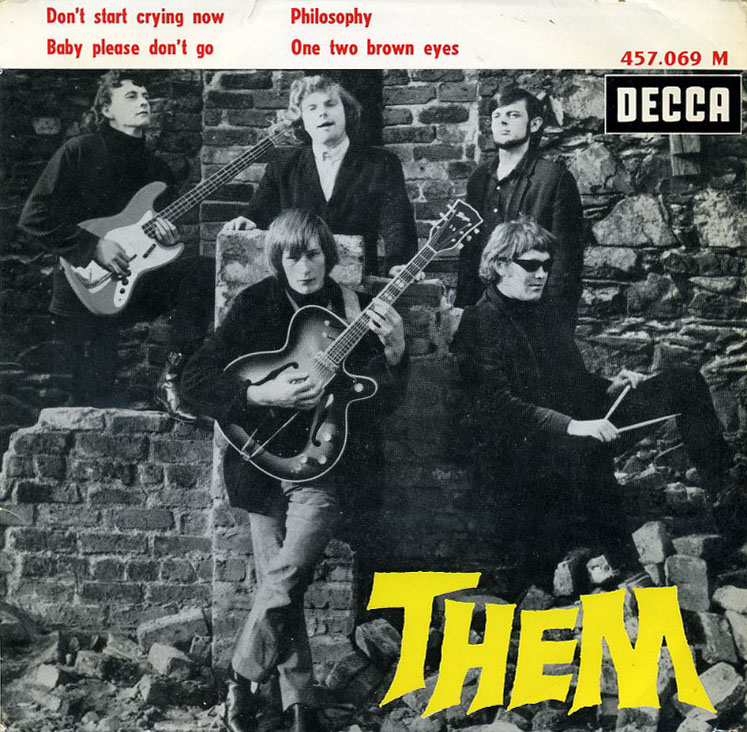
French EP showing original drummer Ronnie Millings (with shades)
July(5) The group enters Decca’s West Hampstead, London studios to begin recording, but the three-hour session is a stressful affair and Rowe decides to employ session musicians Arthur Greenslade (organ) and Bobby Graham (drums) to “fill out” the sound. Them records Slim Harpo’s “Don’t Come Crying Now” and Van Morrison’s “Gloria”, “One Two Brown Eyes” and “Philosophy”, which are all released over the next year. The band also records covers of “Groovin’”, “Turn On your Love Light” and “You Can’t Judge A Book By Its Cover” which are shelved. After the recordings, Wrixon is forced to leave (in part because his father objects to a disproportionate royalty split between the management and the group and in part because he is still at school and has ‘A’ levels to complete). Pat McAuley (b. 17 March 1944, Coleraine, N.Ireland) takes over the keyboard position.
September(4) The group’s debut single, “Don’t Start Crying Now” backed by “One Two Brown Eyes” is released but fails to chart.
October The group returns to the studio to record an electrifying version of Big Joe Williams’s blues classic “Baby Please Don’t Go”. Session guitarist Jimmy Page adds rhythm guitar to the recording (and does not play lead as some sources suggest).
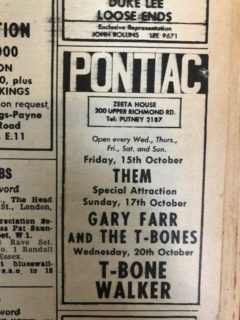
(15) Them are billed to perform at the Zeeta House, Putney, Surrey. However, there is another west London band with this name who soon become Themselves to avoid confusion with Van Morrison’s band so this may be that group.
November(6) “Baby Please Don’t Go” backed by Morrison’s “Gloria” is released. Millings leaves and Pat McAuley moves onto drums.
December The short-lived (yet well photographed) new line-up appears on the popular TV show Ready Steady Go!
1965
January Pat’s brother Jackie (aka John) (b. 14 December 1946, Coleraine, N. Ireland) is added on keyboards as the group begins work on its next single, a recording of their new producer, Bert Berns’s “Here Comes The Night”. Some sources maintain that organ player Phil Coulter and drummer Alan White are brought in to play the McAuley brothers’ parts, but this is disputed by the band members. (Berns, an American producer working in the UK is impressed with Morrison as a vocalist and will continue to work with the group over the next few months.)
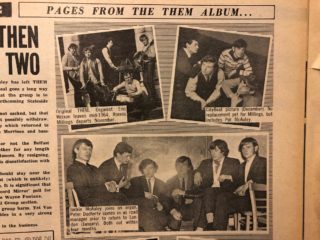
Photo: Cityweek
February Aided by TV appearances, “Baby Please Don’t Go” hits UK #10, while “Gloria” quickly becomes an anthem for the emerging US garage band generation. Decca releases an EP featuring both sides of Them’s debut single, the recent hit and Morrison’s “Philosophy” recorded during the July sessions.
(10) Western Scene lists the band playing at Bristol Corn Exchange.
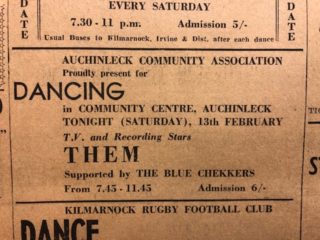
(13)The Kilmarnock Standard lists the band playing at the Community Centre, Auchinleck, Scotland with The Blue Chekkers.
(15) Western Scene lists the band playing at Bath Pavilion.
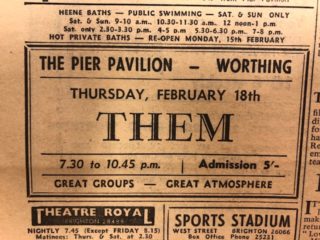
(18)According to the Worthing Herald, the band appears at the Pier Pavilion in Worthing, West Sussex.
(20)Them appear at the Club Noreik, Tottenham, north London.
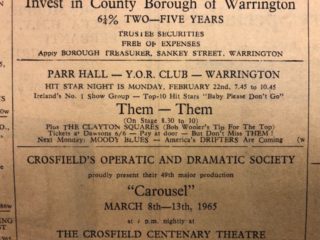
(22)The Warrington Guardian lists the group at the YOR Club, Parr Hall, Warrington, Cheshire with The Clayton Squares.
(25)The band performs at Swindon’s Locarno Ballroom with The Knives and Forks.
(26)Them plays at Woolwich Polytechnic in southeast London.
(27)The band appears at Manchester University.
March “Here Comes The Night” hits UK #2 and is the group’s most successful release. The band begins work on its debut album, but sessions are once again plagued with problems. Some sources suggest that the group’s three producers Bert Berns, Dick Rowe and Tommy Scott supplement the band with session players, although this is disputed by band members.
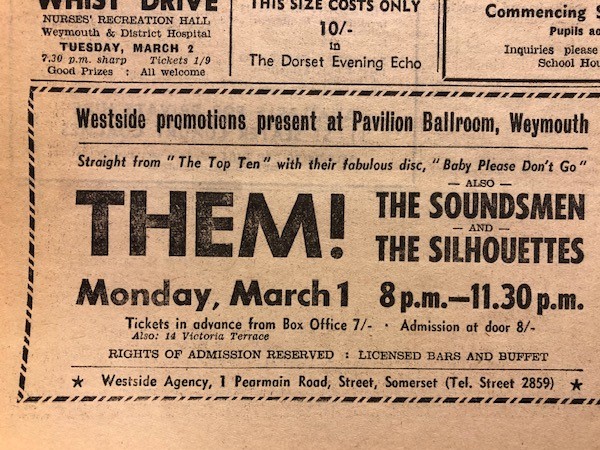
(1)The Dorset Evening Echo lists Them at the Pavilion Ballroom, Weymouth, Dorset with The Soundsmen and The Silhouttes.
(2)The band plays at Wallington Public Hall in Wallington, Surrey.
(3)Them perform at Stourbridge Town Hall in Worcestershire.
(4)The group appears at Kidderminster Town Hall in Worcestershire.
(9) The Yorkshire Evening Post lists the group performing at the Three Coins in Leeds, West Yorkshire.
(13) The Stockport County Express says Them appear at the Manor Lounge in Stockport with The Mersey Squares.
(14) The Birmingham Evening Mail reports that the band plays at the Brum Kavern Club, Small Heath, West Midlands with The King Bees.
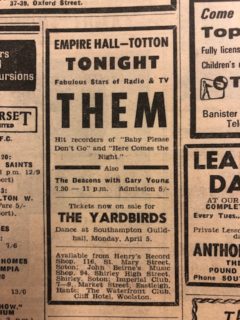
(16)The Southern Echo lists the band playing at the Empire Hall, Totton with Gary Young & The Deacons.
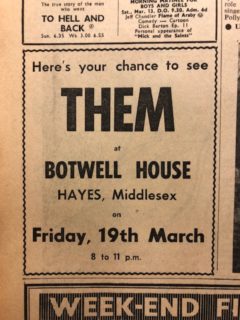
(19)The Ruislip & Northwood Gazette lists the group playing at Botwell House, Hayes, Middlesex.
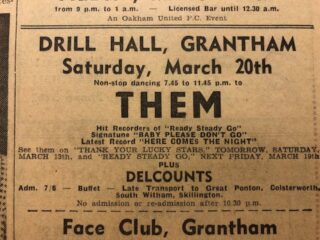
(20)The Grantham Journal has Them playing at Drill Hall, Grantham, Lincolnshire with The Delcounts.
(21)Them perform at the Pigalle in central London.
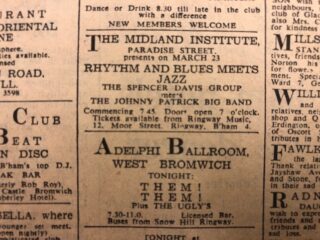
(22)The group plays at the Adelphi in West Bromwich, West Midlands with the Uglys.
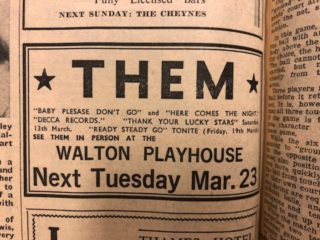
(23)The Woking Herald lists the band at Walton Playhouse.
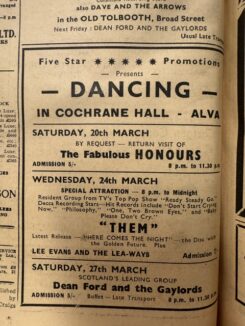
(24-28)Them takes part in a short tour of Scotland, according to Beat Instrumental. The Bridge of Allan Gazette newspaper lists a show at the Cochrane Hall, Alva, Scotland on 24 March with Lee Evans & The Lea-Ways.
(25)During the Scottish tour, the band appears at the Two Red Shoes in Elgin.
(29)Music Echo from Liverpool reports that Them appear at Silver Blades in Liverpool.
(30)Them play at the Floral Hall in Gorston-on-Sea, Norfolk with Ye Highwaymen.
April (1) The band returns to perform at the Manor Lounge, Stockport, Greater Manchester with The Mersey Squares.
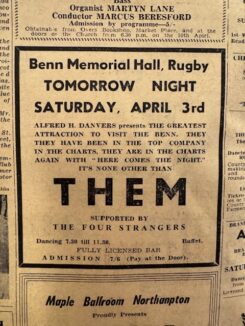
(3) Them appear at Benn Memorial Hall in Rugby, Warwickshire with The Four Strangers, according to the Rugby Advertiser.
Photo: Melody Maker, 3 April 1965
(4)Them appear at the Ritz in Birmingham.
Photo: Cityweek
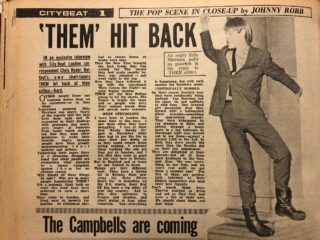
(9)The group plays at Leamington Town Hall in Warwickshire. On the same day, Billy Harrison responded to the band’s critics in an article entitled “‘Them’ Hit Back” in the Belfast publication Cityweek.
(10)Them performs at Dudley Town Hall in the West Midlands.
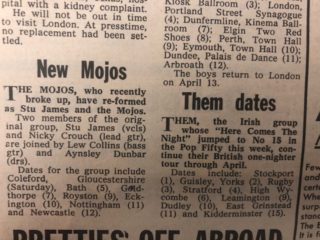
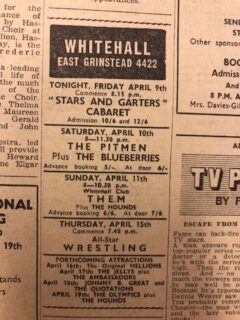
(11) Them perform at the New Musical Express Poll Winners Concert at the Empire Pool, Wembley, west London with many others. Beat Instrumental also has the band appearing at the Co-Op in Gravesend, Kent earlier during the day. It is not clear whether this happens as the Sussex Evening Express also lists the band appearing at the Whitehall in East Grinstead, West Sussex with The Hounds.
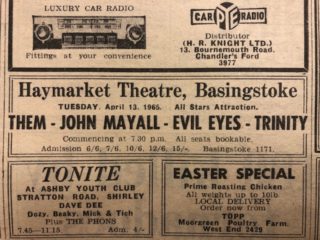
(13)The Southern Echo lists the band at Haymarket Theatre, Basingstoke, Hampshire with John Mayall’s Bluesbreakers, The Evil Eyes and The Trinity.
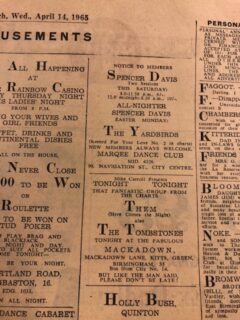
(14) The Birmingham Evening Mail reports that Them appear at the Mackadown, Kitts Green, West Midlands with The Tombstones.
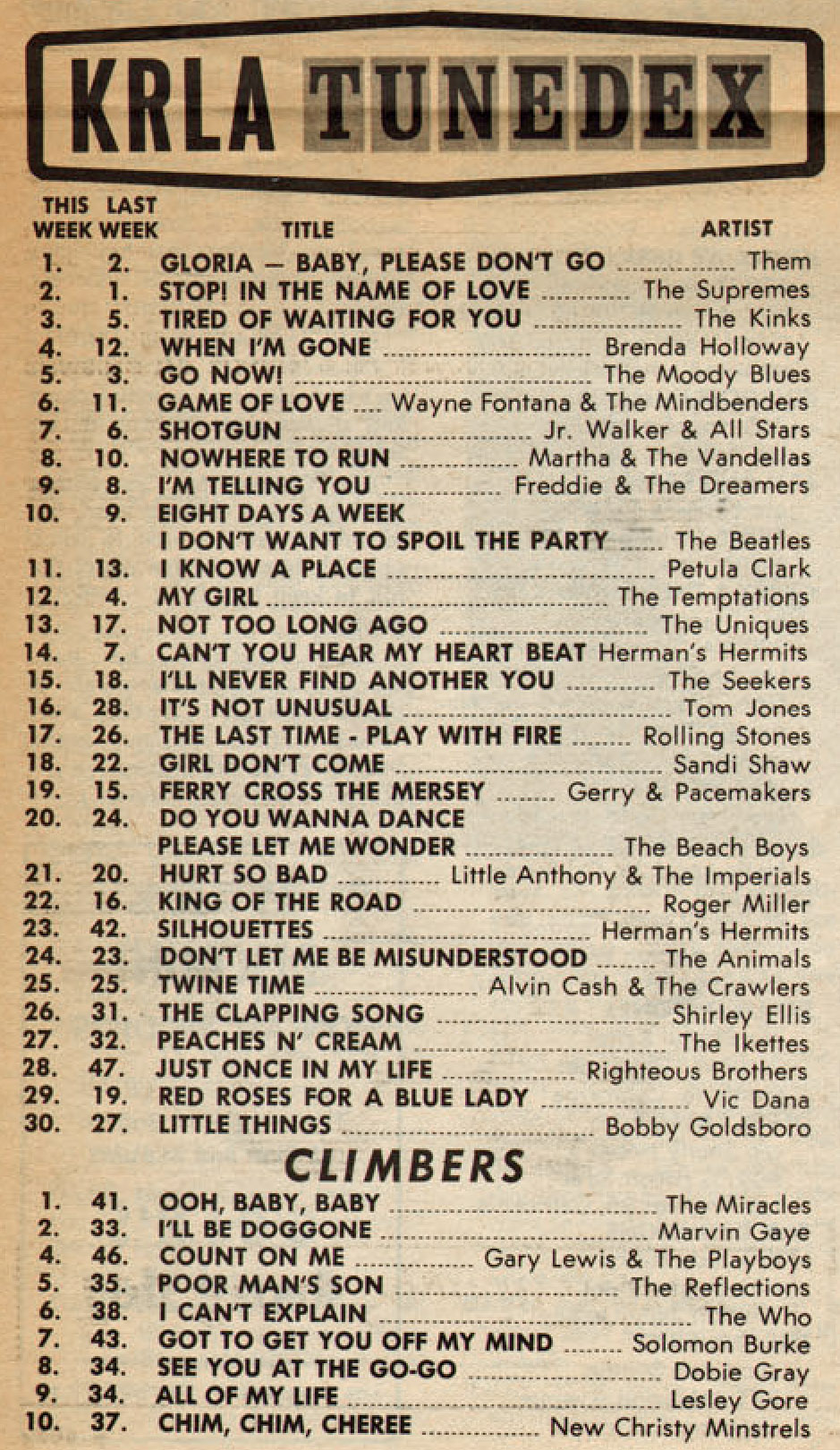
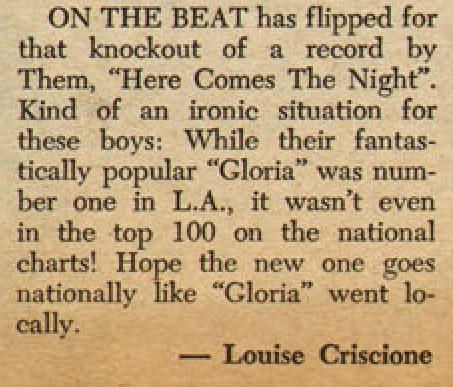
Gloria reaches #1 on KRLA, April 14, 1965Early US mention for band in KRLA’s Beat, May 19, 1965
(17)Beat Instrumental reports the band performing at the Market Hall in Redhill, Surrey.
(18)Beat Instrumental lists Them at the Oasis, Manchester.
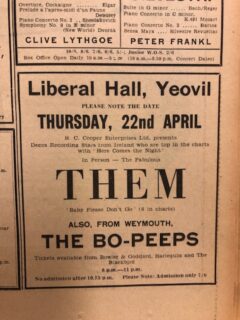
(22)The Western Gazette advertises the group appearing at the Liberal Hall, Yeovil, Somerset with The Bo-Peeps.
(23)Beat Instrumental reports that the band is performing another show in Gravesend, Kent but this is unlikely.
(24) Beat Instrumental lists Them playing in Kirkcaldy, Scotland but this is unlikely as the band headed back to Northern Ireland around this time. Unhappy with the band’s direction and his personal treatment, Jackie McAuley leaves after a show at St Columbana’s Parish Church in Ballyhome, Northern Ireland and is replaced by ex-Cheynes member Peter Bardens (b. 19 June 1944, Westminster, London, England; d. 22 January 2002).
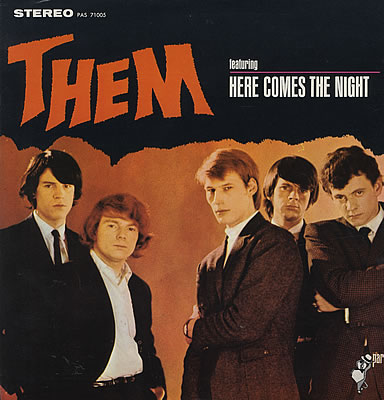
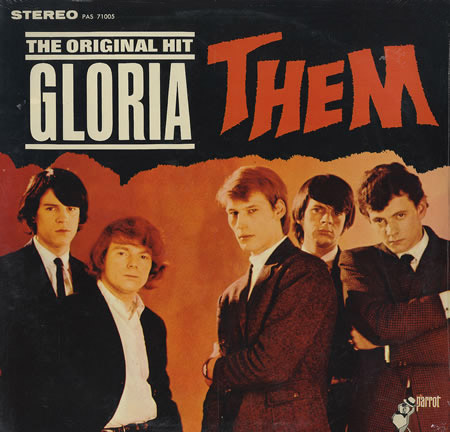
Them’s first UK LP, The Angry Young Them, Peter Bardens in pink shirt next to VanFirst U.S. issue, featuring “Here Comes the Night”Second U.S. cover to capitalize on “Gloria”
May “Gloria” charts for a week at US #93, selling mostly in California where it hits Top 10 in some major cities.
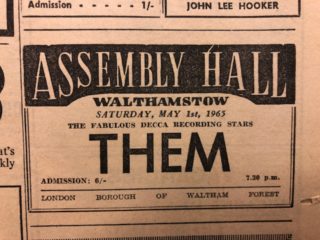
(1) The Walthamstow Guardian reports that Them play at Walthamstow Assembly Hall, Walthamstow, north London.
(7) Belfast publication, Cityweek reports that Them have been recording a lot in the past few days with new organist Peter Bardens.
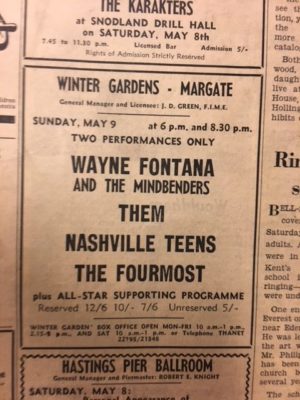
(9) Them perform at the Winter Gardens in Margate, Kent with Wayne Fontana & The Mindbenders, The Nashville Teens and The Fourmost.
(11) The band appears at Bristol Chinese R&B Club, Corn Exchange, Bristol, according to the Western Scene.
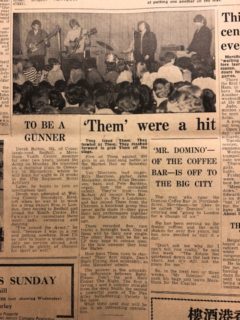
Photo: Surrey Mirror, 14 May 1965
(14) The Streatham News reports that Them appear Wimbledon Palais, southwest London.
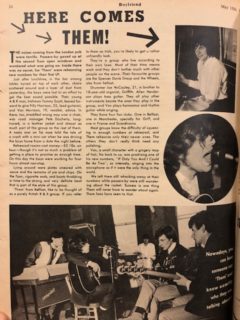
Photo: Boyfriend magazine, 15 May 1965
(17) The Enfield Gazette & Observer reports that Them perform at the Potter’s Bar Ritz in north London with The Zephyrs, Screaming Lord Sutch & The Savages and The Mark Four.
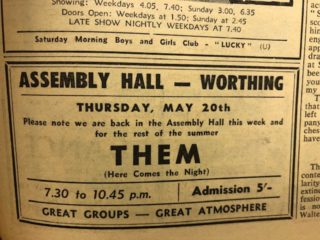
(20)The Worthing Herald lists the band playing at Worthing Assembly Hall.
(23) The Yorkshire Evening Gazette reports the band appearing at the Futurist Theatre, Scarborough, North Yorkshire with Wayne Fontana & The Mindbenders, The Rocking Berries, Dave Berry & The Cruisers, Sandra Barry and The Artwoods.
(25) Them appear at the Assembly Hall, Wallington, near Croydon, south London.
(26) The band performs at Stourbridge Town Hall in Worcestershire.
(28) Them play at Winchester Town Hall in Hampshire.
(29) The band appears at the Rhodes Centre in Bishop’s Stortford in Hertfordshire.
(30) The band plays at Elm Park in Hornchurch, east London.
June(1)Them begin a UK tour at Tunbridge Wells Public Hall. (The tour will end on 21 June at the Beachcombers, Leigh and Bolton). During this period, Pat McAuley is briefly replaced by former drummer Ronnie Millings before rejoining the group.
(2) Western Scene lists the band playing at Bristol Corn Exchange.
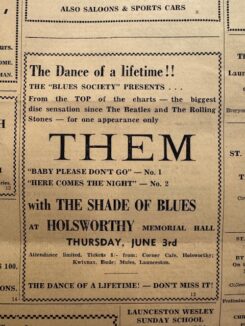
(3) The Cornish Post has the Morrison’s group playing at Holsworthy Memorial Hall in Holsworthy, Cornwall.
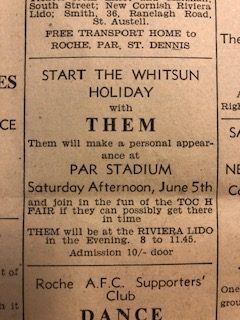
(5)The Cornish Guardian notes the band will play at the Par Stadium in St Austell before later appearing at the Riveria Lido in the evening.
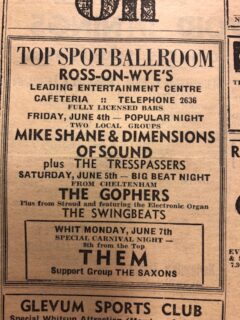
(7)The Gloucester Citizen reports the band appearing at the Top Spot, Ross-on-Wye, Herefordshire with The Saxons.
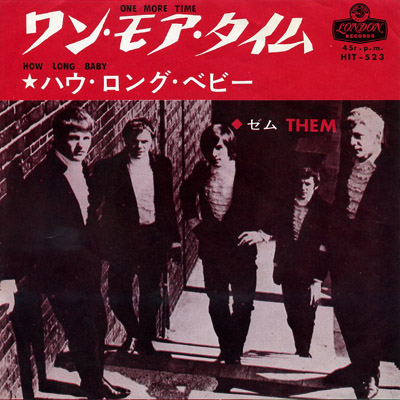
(11)The Morrison-penned “One More Time” fails to chart. Them’s debut album (The Angry Young) Them is released in the UK to coincide with the single but is another chart failure.
Thanks to Andy Neill for the photo
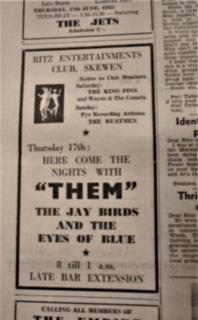
(17)Them perform at the Ritz Club, Skewen, south Wales with The Jay Birds and The Eyes of Blue.
(18) Belfast publication Cityweek reports that Jackie McAuley is back home and is helping to reform The Yaks. McAuley, however, soon moves to Dublin and learns to play guitar. He will rejoin his brother in a rival Them in late December 1965.
(19) Them play at Dudley Town Hall in the West Midlands.
(21) The band appears at the Beachcomber in Leigh.
(24) Them perform at Leeds University.
(25) The group appears at the Starlight Room, Boston Gliderdrome, Boston, Lincolnshire with Rodgers Lodgers.
(26) “Here Comes The Night” hits US #24. On the same day, the Lincolnshire Standard reports that Them play at the Starlight Ballroom, Boston Gliderdrome, Lincolnshire with Mike Sheridan & The Nightriders and Rodgers Lodgers.
July Original Them member, Eric Wrixon completes his studies.
(2) The Middlesbrough Evening Gazette reports that Them play at the Queen’s Rink Ballroom, Hartlepool with Russ & The Nickels and The Evergreens.
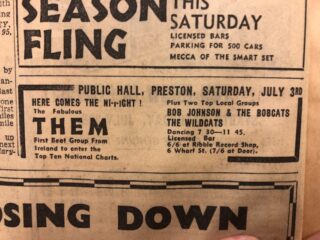
(3)The Lancashire Evening Post reports that Them appear at Public Hall, Preston, Lancashire with Bob Johnson & The Bobcats and The Wildcats.
Photo: Cityweek
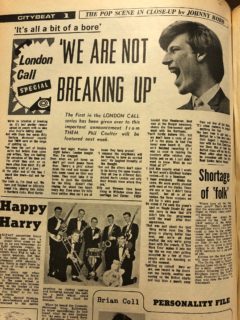
(9)Harrison responds to rumours that Them are breaking up in an article in Cityweek. In the article, entitled “We are not breaking up”, he insists the group has no intention of splitting.
(15)Them perform at Salisbury City Hall, Salisbury, Wiltshire. Around his time Billy Harrison is sacked and replaced by Scottish guitarist Joe Baldi (b. Joseph Baldi, 16 March 1943, La Spezia Italy), who has played with Bardens in Hamilton King’s Blues Messengers. Harrison will briefly return in mid-October.
Photo: Richard Gleave
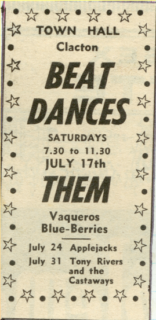
(17) Them appear at Clacton Town Hall, Clacton, Essex with The Vaqueros and The Blue-Berries.
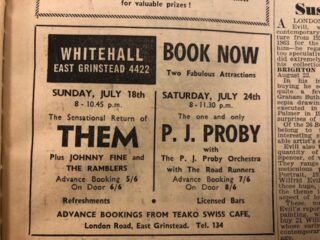
(18) The new line-up plays the Whitehall in East Grinstead, West Sussex backed by Johnny Fine & The Ramblers, according to the Sussex Evening Express.
(19) The Belfast Telegraph reports that Pat McAuley was sacked today. He is subsequently replaced by Englishman Terry Noon, who has previously worked with Gene Vincent.
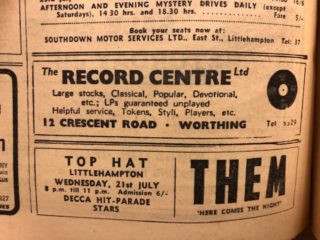
(21)The Littlehampton Gazette lists the band at the Top Hat in Littlehampton, West Sussex, possibly marking Noon’s debut.
Photo: Cityweek
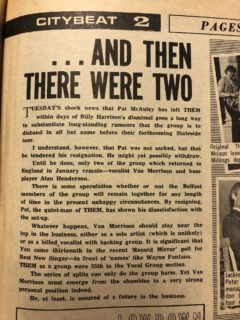
(23)Cityweek reports that Them now contains only Van Morrison and Alan Henderson in an article entitled “…And then there were two”. Peter Bardens, however, does remain with the band. The Belfast publication also notes that Pat McAuley resigned from the band rather than was sacked. On the same day, the Bridge of Allan Gazette newspaper lists Them playing at the Plaza in Stirling, Scotland with supporting groups.
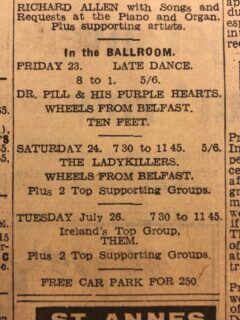
(26-27) Them’s new line up appears at the Queen’s Ballroom, Cleveleys, Lancashire with two supporting groups after playing in Scarborough on the 25th July.
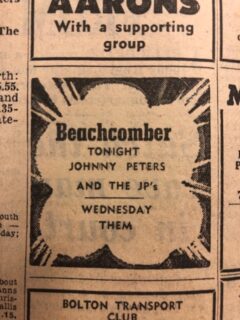
(28) The Bolton Evening News says the band performs at the Beachcomber, Bolton, Greater Manchester.
(29) Beat Instrumental reports that Them are appearing at the Pavilion Ballroom on the Isle of Man.
August A second Berns song, “(It Won’t Hurt) Half As Much” is released but doesn’t chart. In the US the single’s b-side “I’m Gonna Dress In Black”, written by producer Tommy Scott under the pseudonym ‘Gillon’, is released instead but is not a success.
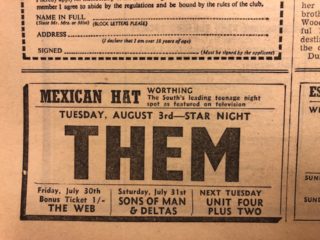
(3) Them play at the Mexican Hat, Worthing, West Sussex, according to the Worthing Gazette.
(4) The Camberley News reports that Them play at the Agincourt Ballroom in Camberley, Surrey.
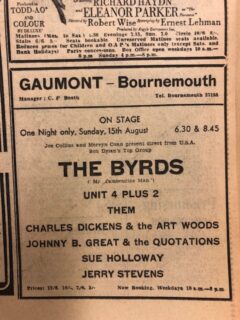
(15) The Western Gazette advertises the group appearing at the Gaumont, Bournemouth, Dorset with The Byrds, Unit 4 Plus 2, Charles Dickens & The Artwoods, Johnny B Great & The Quotations, Sue Holloway and Jerry Stevens .
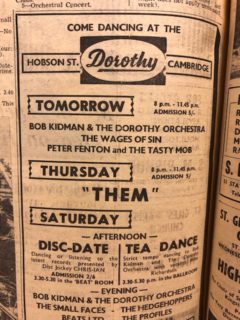
(23) The Cambridge News reports that Them play at the Dorothy Ballroom in Cambridge.
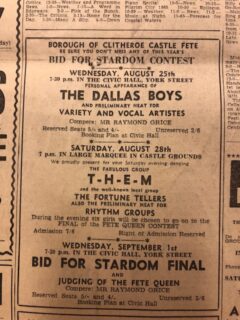
(28) The Lancashire Evening Post lists the band appearing in the Marquee in the grounds of Clitheroe Castle, Burnley, Lancashire with The Fortune Tellers.
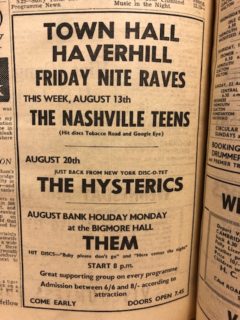
(30) The Cambridge News advertises the group appearing at Bigmore Hall in Cambridge.
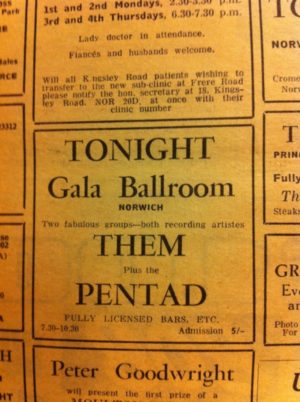
(31) The Eastern Evening News reports that Them appear at the Gala Ballroom in Norwich with Pentad.
September (1) Former members Billy Harrison and Pat McAuley (now on keyboards) announce their own version of Them in London on this day, which contains singer Nick Wymer (ex-Pink Faires), drummer Skip Alan (ex-Donovan) and bass player Mark Scott (ex-Adam Faith). The group is initially dubbed “Some of Them”.
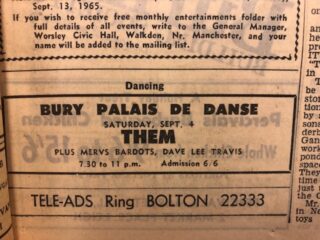
(4) The Bolton Evening News reports that Van Morrison’s Them play at Bury Palais De Danse, Bury, Greater Manchester. Soon afterwards, Baldi returns to Scotland. Bardens also departs and forms The Shotgun Express. He later moves into session work, records two solo albums for Transatlantic Records and then forms 1970s progressive/rock outfit, Camel. Terry Noon also leaves but will return briefly in mid-October.
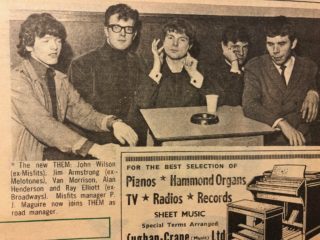
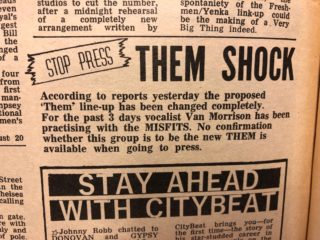
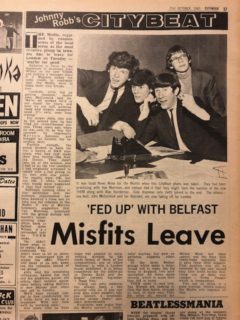
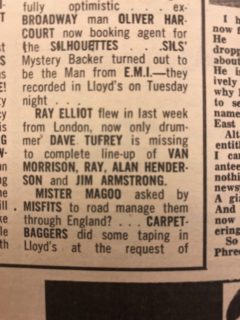
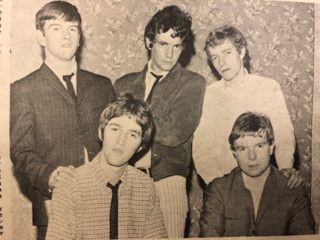
Back in Belfast, Morrison and Henderson have formed a new version of Them with lead guitarist Jim Armstrong (b. 24 July 1944, Belfast, N. Ireland) from The Melotones and keyboard/sax, flute player and vibes player Ray Elliott (b. 23 January 1944, Belfast, N. Ireland; d. June 1993, Toronto) from The Broadways. Apparently, original keyboard player Eric Wrixon fills in briefly but soon leaves to rejoin Portadown band, The People before Elliott joins. The new version of Them is completed with new drummer John Wilson (b. 6 November 1947, Belfast, N. Ireland) from The Misfits. The band rehearses at the Martime for two weeks before making its live debut in Lisburn on 24 September (see below). Belfast’s publication Cityweek had reported in its 23 September issue that Morrison rehearsed with Wilson’s band The Misfits as a potential new version of Them for three days before the new line up was agreed.
(24)The Manchester Evening News & Chronicle reports that Them play at the New Birch Park Club in Rusholme in Greater Manchester with The Corvettes. This must be the rival version led by Billy Harrison and Pat McAuley.
Photo: Cityweek
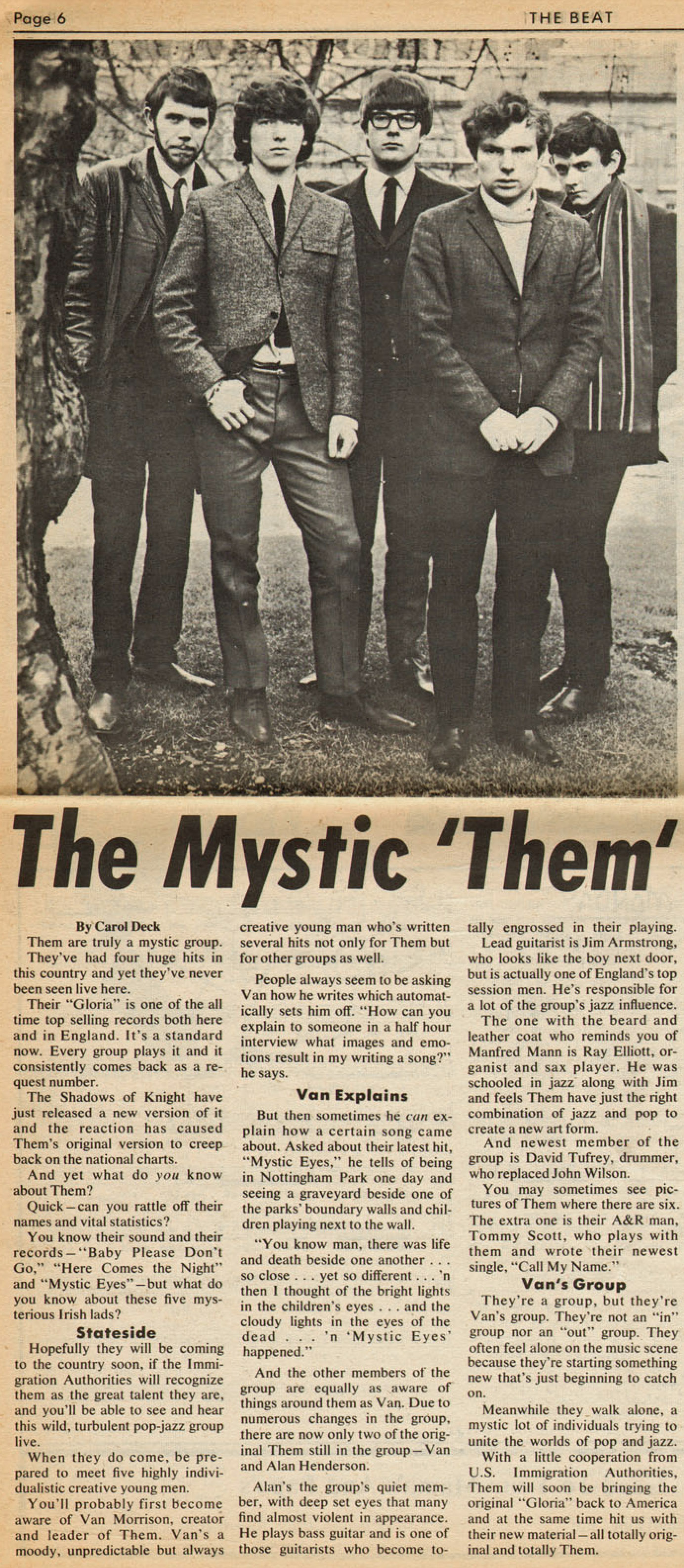
(24)Morrison’s new version of Them make their debut at the Top Hat club, Lisburn, Northern Ireland where they perform a 40-minute set. Shortly after a show at the Flamingo in Ballymena, Morrison’s band returns to London and resumes work on its second album. The group’s debut album is released in the US as Them and hits #54.
Photo: Cityweek
(30) Cityweek‘s 30 September issue features an article on the new formation entitled “The return of Them”.
October (4) The Middlesborough Evening Gazette reports that Them appear at the Astoria Ballroom in Middlesbrough.
(11) Morrison’s Them play at the Thorngate, Gosport, Hants.
Photo: Melody Maker
(15)Van Morrison’s Them play at Zeeta House, Putney, southwest London.
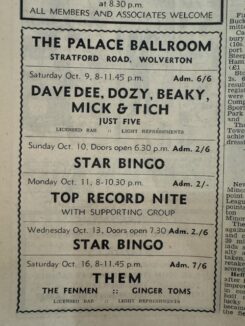
(16)The Wolverton Express lists Them playing at the Wolverton Palace in Bucks with The Fenmen and Ginger Toms. This could well be the rival version with Billy Harrison and Pat McAuley unless they played the gig below in Halifax.
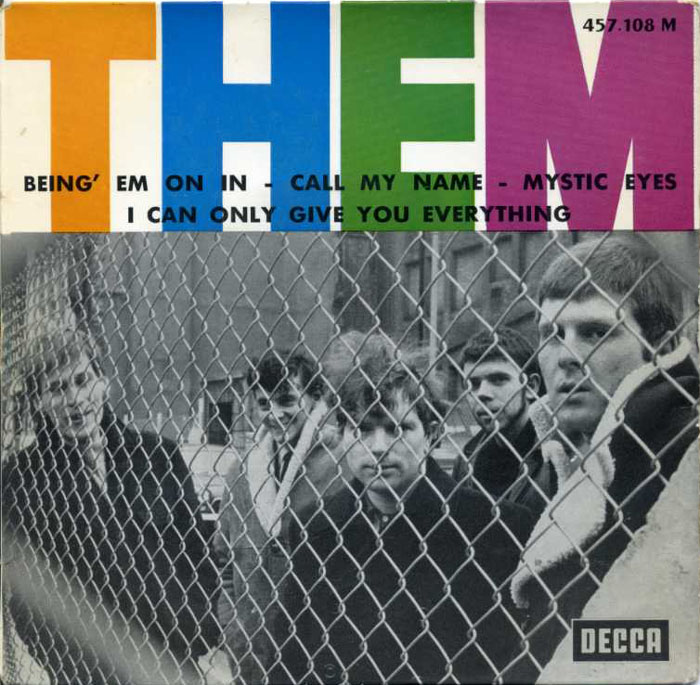
Rare French EP showing short-lived line up from October 1965, from left: Billy Harrison, Alan Henderson, Van Morrison, Ray Elliott and Terry Noon
(16) Them are billed to play at Big Daddy’s in Halifax, West Yorkshire with The Blues Set. Around this time, Jim Armstrong is forced to pull out of the band at short notice. Billy Harrison is drafted in to play some UK dates before joining the group for French and (in December) Scandinavian dates (see later).
(17) The Manchester Evening News & Chronicle reports Them appear at the Cavern in Manchester with Ivan’s Meads.
Photo: Cityweek
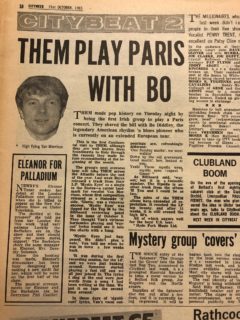
(19) Them (with Billy Harrison) appear at the Olympia in Paris, France with Bo Diddley. The gig is reported in Cityweek‘s 21 October issue. John Wilson, who is considered to be too young to travel, is replaced by former member Terry Noon. The group then travels to Scandinavia for more live dates (although this may be later in the year). Back in England later this month, Noon makes way for a returning John Wilson and joins The Yum Yum Band before moving into rock management, working initially with Honeybus.
(21) Belfast publication, Cityweek reports that John Wilson’s former band, reduced to a trio since he left, is moving to London.
(22)Streatham News reports that Them play at the Wimbledon Palais in southwest London. However, it is not clear whether this is the rival Them or Morrison’s group after returning from Paris but most likely the former.
(30) According to the Lincolnshire Echo, Them performs at the Raven Club, RAF Waddington, Lincolnshire with Pathfinder Five and Penny Farthings. Again, it’s not clear which version this is.
(31) The Eastern Evening News reports that Them appear at the Royal Hotel in Lowestoft, Suffolk with The Easi-beats.
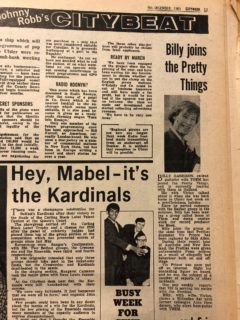
November Early in the month, Skip Alan leaves the Harrison/McAuley Them to replace Viv Prince in The Pretty Things, who soon takes up Skip Alan’s place for a few weeks. Harrison, who has briefly returned to the rival Them after Jim Armstrong resumes his place, departs when Skip Alan lands the job with The Pretty Things. Harrison does session work for producer Joe Meek.
(4)Pat McAuley’s rival Them registers the Them name. By now the group contains a new guitarist, known as Don, who has replaced Billy Harrison.
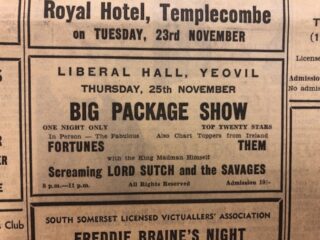
(25) The Western Gazette advertises the band (but not clear which version) appearing at Liberal Hall, Yeovil, Somerset with The Fortunes and Screaming Lord Sutch & The Savages.
December(2) When Viv Prince leaves Pat McAuley’s rival Them, his place is taken by Ken McLeod.
(4) “Mystic Eyes” fares better in the States where it reaches #33. On the same day, Boyfriend magazine notes that Them appear at Leeds College. This could be the rival version.
Photo: Cityweek
(9) Cityweek reports that Billy Harrison has joined The Pretty Things and is currently touring with that band in Holland. He also plays with The Pretty Things on a Scandinavian tour in early December. At the turn of the year, he also covers for Jim Armstrong in Them for their first Scandinavian shows. Harrison quits the music business in mid-1966 after playing with The Pretty Things in the Isle of Wight during March (this might have been in August 1965 instead) and joins the GPO. Original Them keyboard player Eric Wrixon meanwhile had joined The Kings showband in late November before re-joining The People, according to Cityweek.
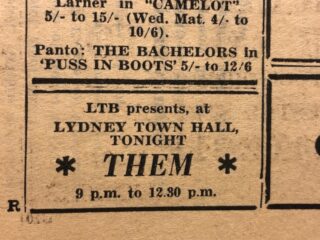
(10) The Gloucester Citizen reports that Them appear at Lydney Town Hall, Lydney, Gloucestershire, which might be a gig by the rival version of Them.
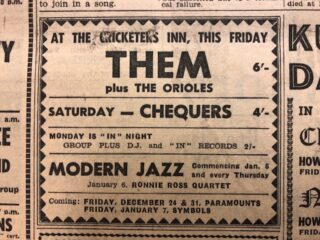
(17) The Southend Standard lists Them appearing at the Cricketers Inn, Westcliff, Southend, Essex with The Orioles.
Photo: Evening Sentinel. Wymer’s final gig with the rival Them
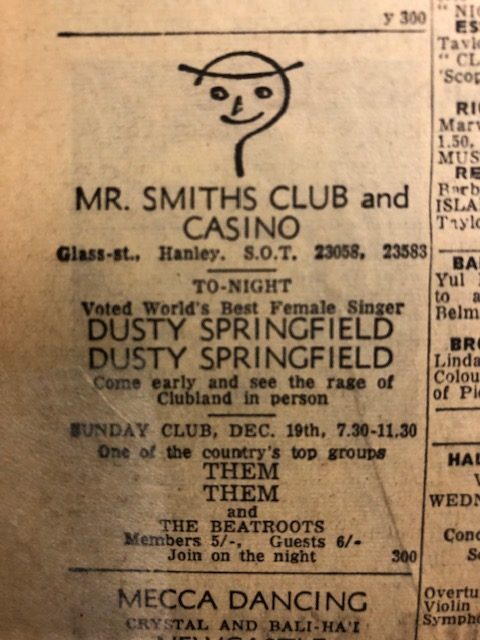
(19) Wymer leaves the rival Them after a gig in Stoke-on-Trent (this is Mr Smith’s in Hanley with The Beatroots). Soon afterwards, he is replaced by Pat’s brother Jackie McAuley on keyboards/vocals, who has been living in Dublin. Pat moves on to drums and Ken McLeod takes over guitar from Don who leaves in mid-January. On the same day, Them play at the nearby Majestic Ballroom in Shropshire, which could have been an earlier gig by the rival band. Around this time, Morrison’s group plays in Liverpool and after the show Armstrong collapses with a suspected perforated appendix. He spends Christmas in the emergency ward at Liverpool’s Southern Hospital, according to Cityweek‘s 6 January 1966 issue.
Photo: Cityweek
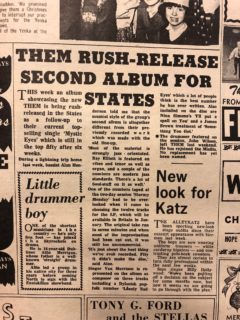
(23) Cityweek notes that John Wilson left Them last weekend but no replacement has been announced. The article entitled “Them rush-release second album for States” also profiles the forthcoming Them Again LP. Wilson rejoins The Misfits (until April 1967) and then works with Belfast groups, Derek & The Sounds and Cheese. In the late 1960s, he joins guitarist Rory Gallagher in Taste before forming Stud in the early 1970s.
Photo: Cityweek, 6 January 1966
(29) Cityweek‘s 6 January 1966 issue reports that Alan Henderson and Ray Elliott have flown to Stockholm to join the other Them members (Van Morrison and Billy Harrison) for two shows at the weekend of 31-December-2 January. The group is still without a permanent replacement for John Wilson. However, David Harvey (b. David Tufrey 29 July 1943, Bude, Cornwall, England) takes his place on the drums in January after the group use a succession of temporary fill ins.
(31) Boyfriend magazine reports that Them play at the Fender Club in Kenton, northwest London but it’s not clear which version this is. However, it is most likely the Pat McAuley version considering Morrison’s version play in Stockholm this weekend.
1966
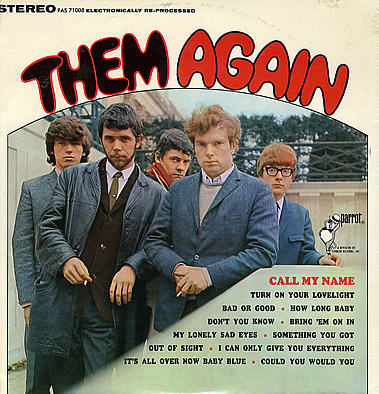
January Them’s second album Them Again fails to chart in the UK. It contains two of Morrison’s best songs: “Hey Girl” and “My Lonely Sad Eyes”, as well as an edited version of Bobby Bland’s “Turn On Your Love Light”. Original Them member Eric Wrixon leaves The People, who have relocated to Blackpool, and joins another expatriate Belfast band, The Wheels in February, who record two singles for Columbia.
Photo: Cityweek, 6 January 1966
(1) Jackie McAuley makes his debut with the rival Them in Peckham, southeast London. On the same day, Cityweek reports that Them make their first trip to Scandinavia this weekend, even though Armstrong hasn’t fully recovered from his hernia operation in late December. Billy Harrison takes Armstrong’s place.
(3) Them appear at the Shoreline club in Bognor Regis, West Sussex. This could be the McAuley brothers’ version.
(4) Them play at the Assembly Hall, Aylesbury, Bucks. Again, this could be the McAuley brothers’ version.
(6)Cityweek reports that Them will return to Paris’ Olympia next week and are also resident in the Club Locomotive for three days.
(10) Them appear at the Labour Hall, Bletchley, Bucks. This could be the McAuley brothers’ version.
(11) Them play at the Hut, Westcott, Surrey. Again, this could be the McAuley brothers’ version.
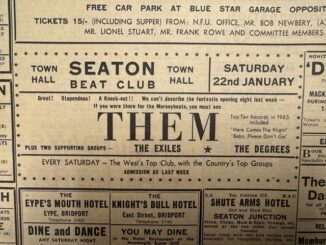
(22) The Coulsdon & Purley Advertiser reports that Them perform at the Club Nevada, West Croydon, south London. This is most likely Van Morrison’s version as on the same day another Them are billed to appear at the Seaton Beat Club at Seaton Town Hall, Seaton in Devon with The Exiles and The Degrees, according to Pulman’s Weekly News.
(27) Them appear at the Whitehall, East Grinstead, West Sussex. On the same day, Cityweek reports on the legal row over who is Them. Van Morrison’s version is currently on tour in Wales.
(29) Durham University’s student paper Palatine advertises a gig for Them (with Van Morrison) at Aidan’s on the university campus. The show is reviewed in the student newspaper’s 10 February issue, page 8.
(30) The North Herts Herald reports that Them perform at Newbury Plaza Ballroom in Berkshire with The Just Men.
February(4) The McAuley brothers’ Them record three tracks at a demo session: a cover of Graham Bond’s “I Want You”, a cover of Bob Dylan’s “It’s All Over Now Baby Blue” and Jackie McAuley’s “Movin’ Free”.
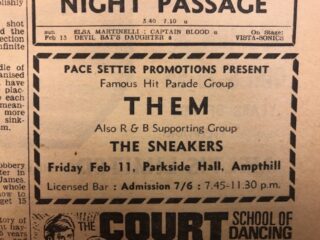
(11) The Luton News reports that Them appear at Parkside Ampthill, Bedfordshire with The Sneakers but it is not clear which version this is.
(12) The Manchester Evening News & Chronicle reports that Them play at the Faculty of Tech Union in Manchester with Five of a Kind. It’s not clear however if this is Morrison’s group or the rival version.
(15)The Coulsdon & Purely Advertiser reports that Van Morrison’s Them appear at Club Nevada, West Croydon, south London.
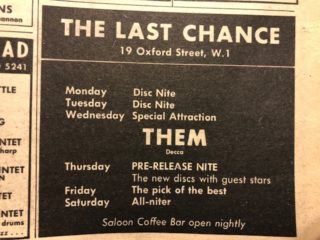
(16)Melody Maker lists the band playing at the Last Chance on Oxford Street, central London.
(18)The rival Them perform at the KB Hall, Copenhagen, Denmark with The Pretty Things.
(19)Van Morrison’s version appears at Floral Hall, Southport, Lancashire with The Cryin Shames.
Photo: Melody Maker
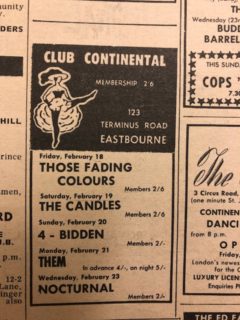
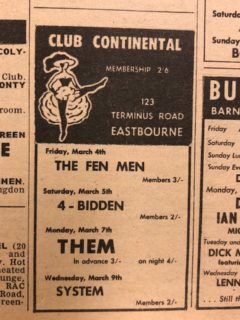
(21) According to Melody Maker, Them play at the Club Continental in Eastbourne.
(22)Chris Groom’s book Rockin’ and around Croydon lists Them at the Gun Tavern in Croydon, south London.
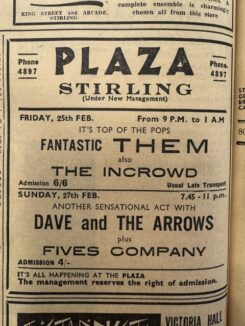
(25)The Bridge of Allan Gazette newspaper lists Them playing at the Plaza in Stirling, Scotland with The In Crowd.
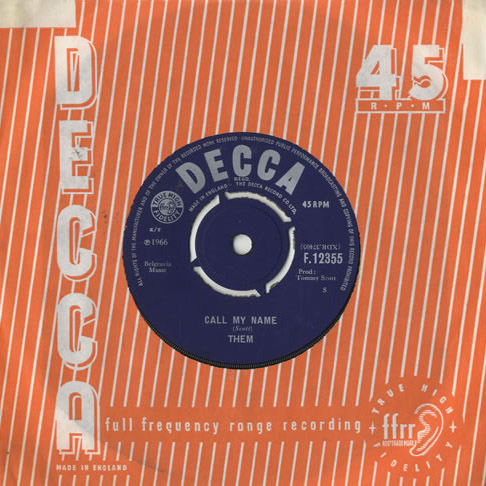
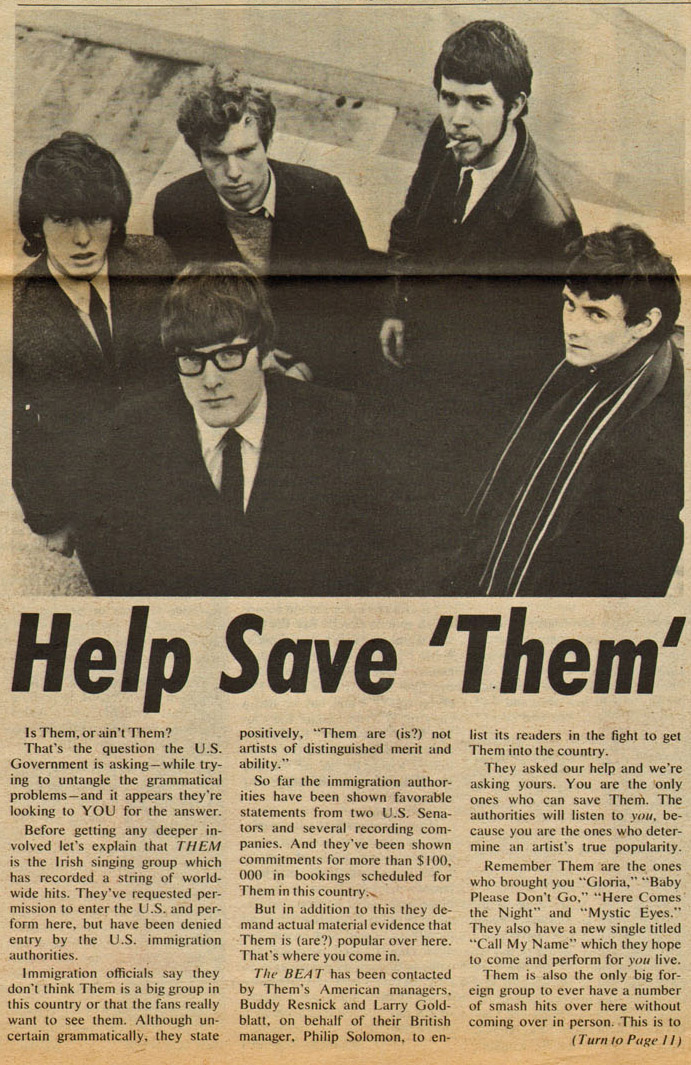
March Morrison’s version of Them’s cover of producer Tommy Scott’s “Call My Name” fails to chart.
(5) The Malvern Gazette reports that Them perform at the Malvern Winter Gardens in Worcestershire with Lighting Blues but it is not clear which version this is.
Photo: Melody Maker
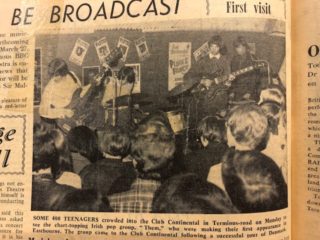
(7) The McAuley brothers’ Them appear at the Club Continental, Eastbourne.
Photo: Eastbourne Herald Chronicle
(9) The rival Them lose their court case and change name to “Some of Them”.
Photo: Melody Maker
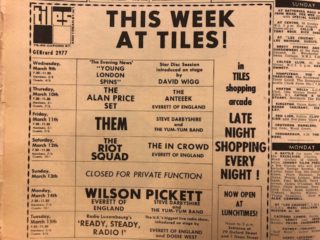
(11) Van Morrison’s version play at Tiles on Oxford Street, central London with Steve Darbyshire and The Yum Yum Band.
(26) The Warrington Guardian lists Them playing at the Mersey View Ballroom in Frodsham, Cheshire with The SOS but it’s not clear which version of the band this is.
Photo: Melody Maker
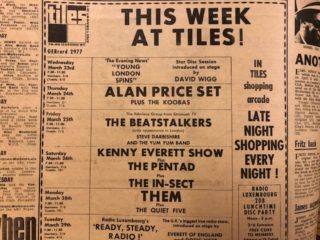
(28) Van’s version returns to Tiles for another show with The Quiet Five in support.
April Morrison’s Them’s final session produces a cover of Paul Simon’s “Richard Cory” and Morrison’s “Mighty Like A Rose”. “Gloria” is re-issued and climbs to US #71.
(2) The Nelson Leader reports that Them appear at the Imperial, Nelson, Lancashire with Cliff Bennett & The Rebel Rousers and Sounds Incorporated.
(9) Van Morrison’s version of Them appears at Torquay Town Hall in Devon with The Hunters and The Javelins, according to the Herald Express.
(16) The Shadows Of Knight’s version of “Gloria” hits US #10. On the same day, the Grantham Journal has Them playing at Drill Hall, Grantham, Lincolnshire with The Beathovens and The Nemkons.
From KRLA’s Beat, April 30, 1966. From left to right: Ray Elliott, John Wilson, Jim Armstrong, Van Morrison and Alan Henderson
KRLA’s Beat, April 23, 1966
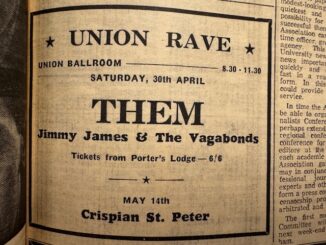
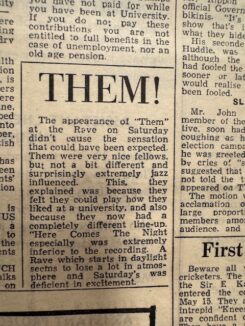
(30) Billed as Them, what looks like the rival version perform at Newcastle University’s Union Rave held in the Union Ballroom, on a bill with Jimmy James & The Vagabonds. The university’s student newspaper, The Courier, reviews the shows in its 4 May issue, page 3.
The Courier, Newcastle
May Paul Simon’s “Richard Cory” is the group’s last official single but is not a success. Morrison is particularly annoyed by its release, preferring his own song “Mighty Like A Rose” as a prospective single. In the US, Tommy Scott’s “I Can Only Give You Everything” is released as a final single and is quickly adopted by US garage bands like The MC5 as a punk anthem. Them Again reaches US #138.
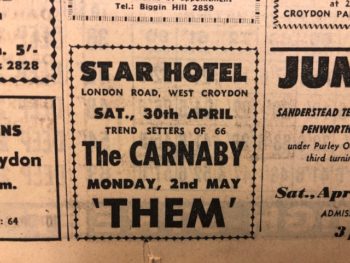
(2)The Coulsdon & Purley Advertiser reports that Them perform at the Star Hotel in Croydon, south London.
(7) The Luton News reports that Them appear at Harpenden Public Hall, Harpenden, Herts with The Fuzz Bugs but it is not clear which version this is.
(14) Them perform at Decca Entertainment Centre, Ashton-under-Lyne, Greater Manchester.
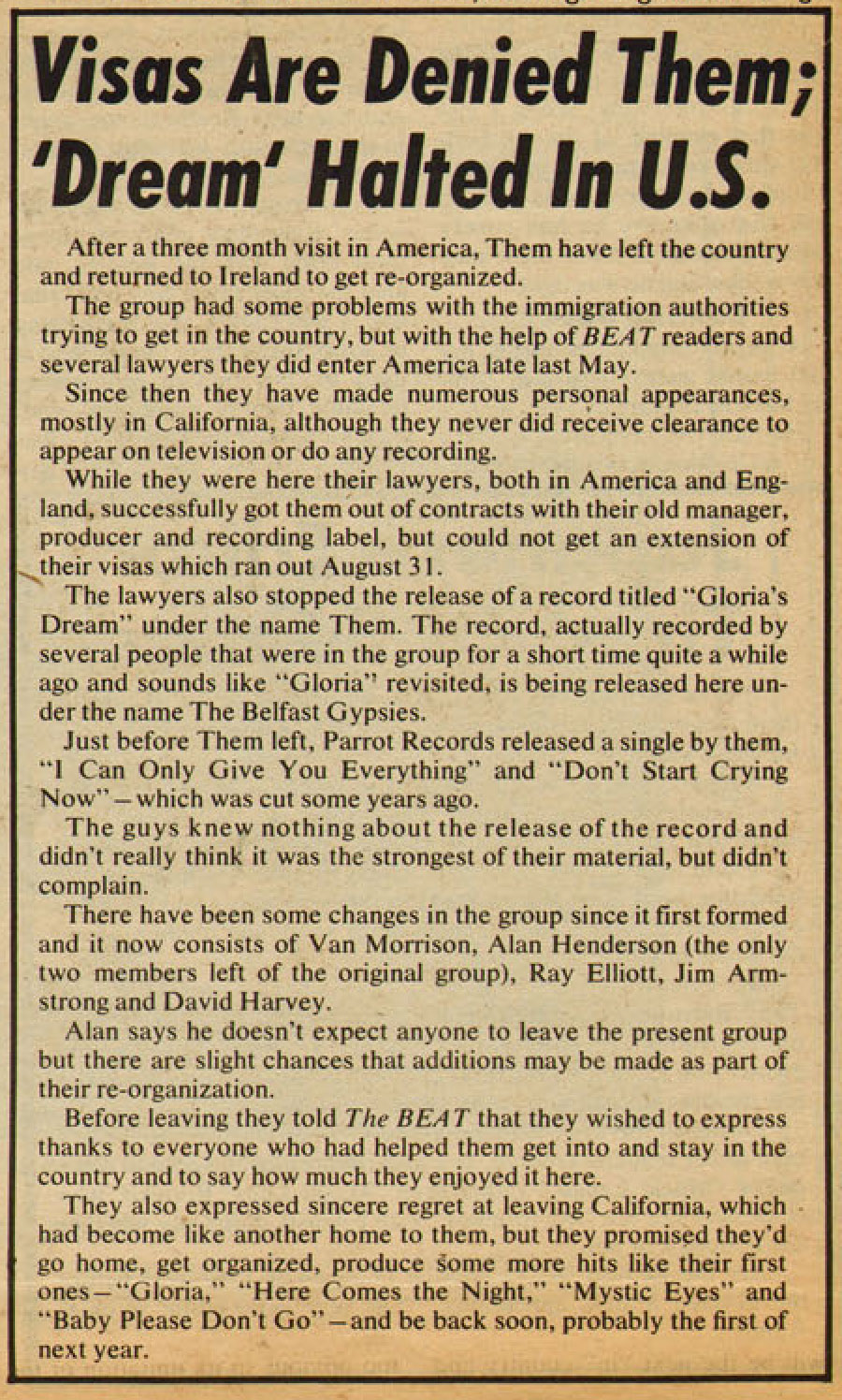
(21) The Malvern Gazette reports that Them perform at the Malvern Winter Gardens in Worcestershire with Group 66 but it is not clear which version this is. In late May, PACE magazine reports that Van Morrison’s version play at Crayford Town Hall in southeast London. Soon afterwards, Morrison’s version flies out to New York to begin its debut US tour, with the first show in Arizona.
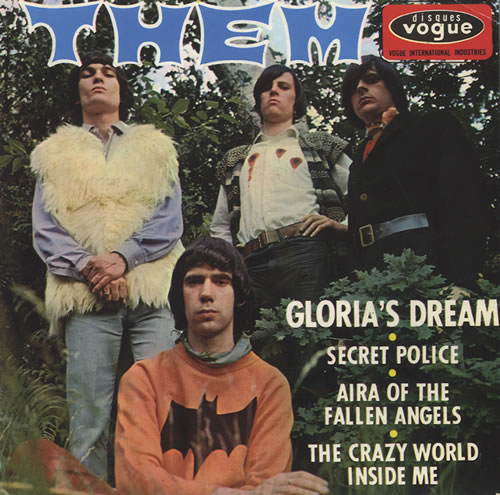
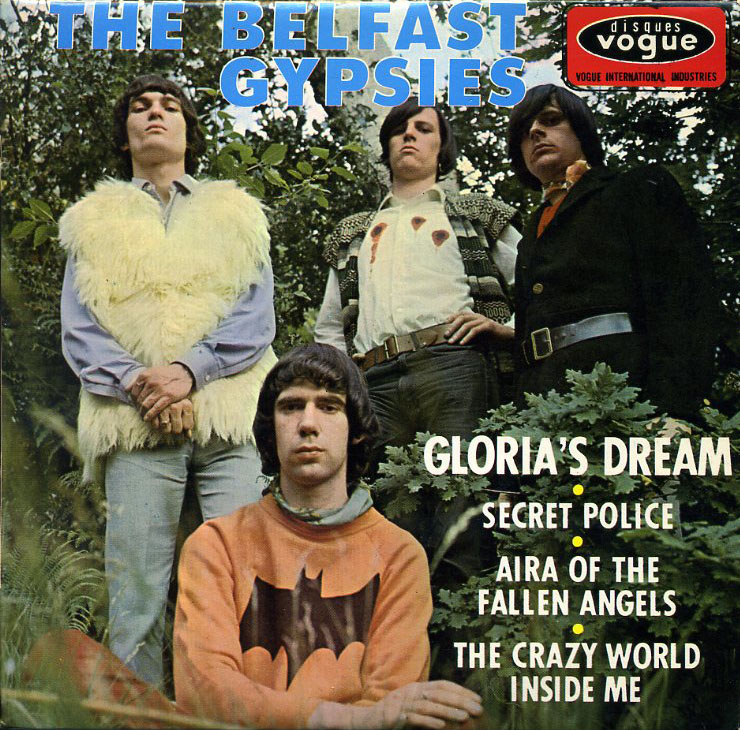
(27) Some of Them record two tracks with Kim Fowley – “Gloria’s Dream” and “Secret Police”. On the same day, Van Morrison’s Them appear at the Rollarena, San Leandro, California.
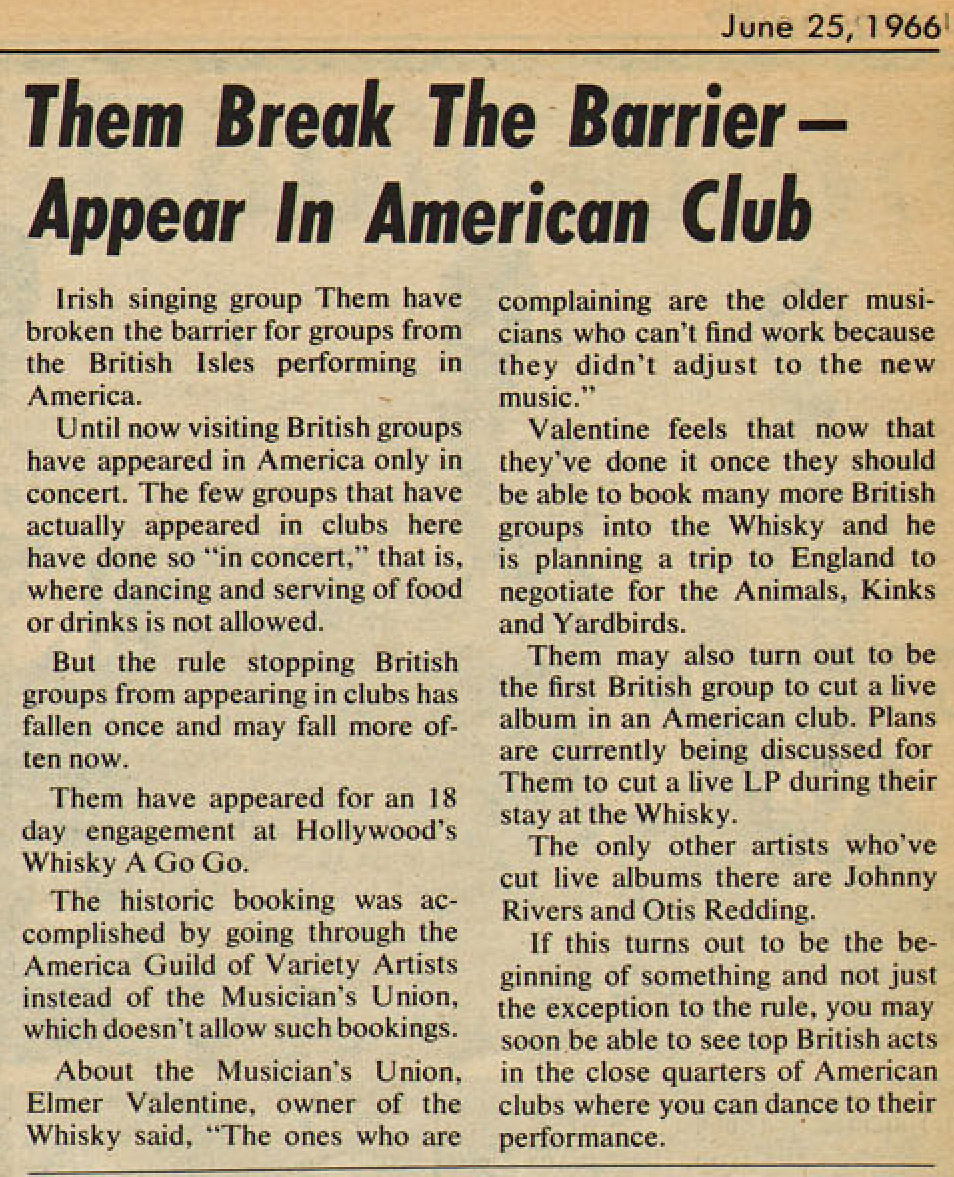
(30) Some of Them perform in Blackpool, Lancashire. On the same day, Van Morrison’s Them begins a residency at the Whisky-A-Go Go, West Hollywood, California.
May(31) – June (17)Morrison’s Them performs at the Whisky-A-Go-Go, West Hollywood, California, where they are sometimes supported by The Doors.
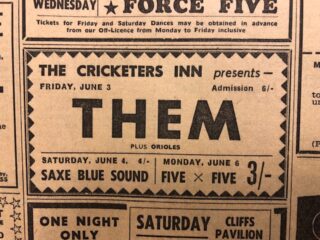
June (3) The rival version of Them performs at the Cricketers Inn, Westcliff, Southend, Essex with the Orioles, according to the Southend Standard.
(13 & 15)Some of Them record further tracks in London.
(18) On the last night at the Whisky, The Doors’ vocalist Jim Morrison joins Van Morrison’s group on stage for a 20-minute improvisation of “Gloria”.
(19)The band discovers that the club has been willing to pay the group $10,000 per week. However, due to their management deal with Phil Solomon (whereby they have agreed to play for $2,000 a week minus a 35% management fee and a guarantee), Them have received considerably less than they think they should. This causes a lot of bitterness between the group and Solomon, and as a result Them inform promoter Bill Graham that they will only play at their forthcoming Fillmore concert if they are paid in advance.
Photo: Cherwell
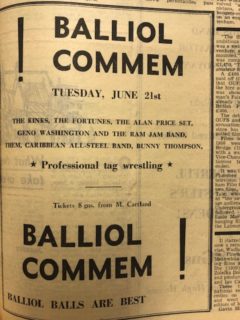
(21) Some of Them (billed as Them) appear at Balliol College, Oxford University alongside The Kinks, The Fortunes, The Alan Price Set, Geno Washington & The Ram Jam Band, The Caribbean All-Steer Band and Bunny Thompson.
(23) Morrison’s Them appear at San Francisco’s Fillmore Auditorium with The New Tweedy Brothers. After their performance, Morrison meets his future wife Janet Planet who accompanies the band on the rest of the tour. (She will be the inspiration for Morrison’s Astral Weeks.)
KRLA’s Beat, June 25, 1966
(26) Morrison’s group is supported by The Association at the Oakland Auditorium, Oakland, California.
(27-29)Some of Them move to Denmark where they perform as Them. The group performs three shows in Copenhagen and finish their final recordings. Over the next five months, the band gigs in Denmark, Sweden and Norway. In the last week of July, the band is briefly joined by former Them member Peter Bardens on keyboards, allowing Jackie McAuley to come up front as lead singer.
July(1-2) Morrison’s Them perform at the “Beat On The Beach”, Santa Monica, California with The New Generation.
(8-9)Them appear at the Waikiki Shell, Kapiolani Park, Honolulu, Hawaii.
(23) The band performs at the Strand Theater, Modesto, California.
(28) Morrison’s group is supported by The Doors and The Count Five at the Starlight Ballroom, Oxnard and (in the evening) the Earl Warren Showgrounds, Santa Barbara, California.
(29-30) Morrison’s Them is supported by The Sons Of Champlin at the Fillmore Auditorium, San Francisco.
August (9) The McAuley brothers’ Them play at the Complain-LA-Tour jazz festival in Belgium.
(19-21) Morrison’s group performs at the Losers North, San Jose, California.
(23-28) A further set of dates take place at the Losers North.
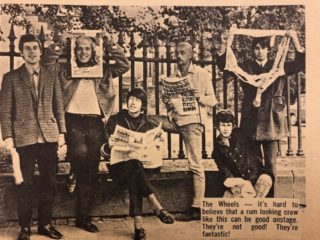
The Wheels with Eric Wrixon, September 1966
September (1) Belfast publication Cityweek reports that The Wheels are back in the city. The band will split soon after, however. In 1967, Eric Wrixon will move to West Germany with The Never Never Band and plays regularly at Hamburg’s Star club, supporting soul acts like Sam & Dave.
KRLA’s Beat, September 24, 1966
(2-3) Them performs at the Longshoreman’s Hall, San Francisco.
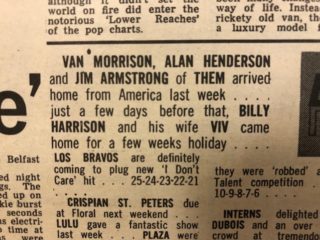
(8) Cityweek reports that Van Morrison, Alan Henderson and Jim Armstrong arrived home from America last week so it’s not clear whether the September US dates took place despite being advertised.
Photo: Cityweek
(9) They are billed to appear in Fresno, California. However, Morrison and Henderson may have already returned to London to sort out business matters with Solomon. Morrison continues to work on some new songs that will later comprise his masterpiece Astral Weeks.
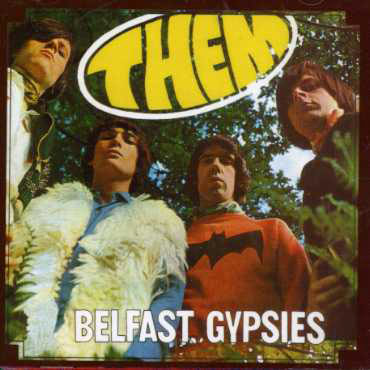
The Belfast Gypsies, released as ThemRare French EP with Belfast Gypsies listed
(17) The McAuley brothers’ group, now dubbed The Belfast Gypsies score a minor US hit when “Gloria’s Dream” hits #124.
(22) Morrison and Henderson are profiled in Cityweek‘s 22 September issue in an article entitled ‘Van and Co. back to “square one”‘.
Photo: Cityweek
(29) Cityweek reports that Ray Elliott flew in to Belfast last week.
October(2) The Weston Mercury reports that Them appear at the Winter Gardens, Weston-Super-Mare, Somerset. This would have been the McAuley brothers’ version. In Belfast, Morrison soon returns to occasional live work in a new outfit dubbed, Van Morrison and “Them Again”, which features former Castaways and Unit guitarist Eric Bell alongside former Alleykatz members Joe Hanratty (drums) and Mike Brown (bass). Alan Henderson doubles up on second bass.
Photo: Cityweek. Eric Bell (top right)
(13) Cityweek reports that Jim Armstrong has left Them to play with The Federals. Ray Elliott will also briefly join this outfit, according to the paper, a short while later.
Photo: Cityweek
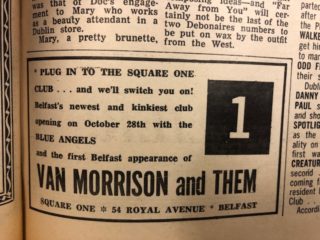
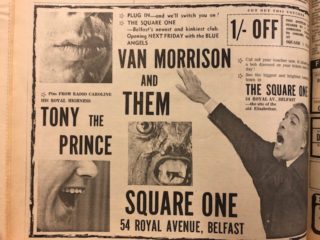
(28) The Belfast Telegraph reports that Van Morrison and Them play (their debut show) at the Square One Discotheque in Belfast with The Blue Angels.
Photo: Cityweek
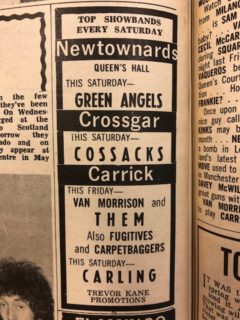
November(4) Cityweek‘s 3 November issue reports that Them appear at Carrickfergus Town Hall today with The Carpetbaggers and The Fugitives.
Photo: Cityweek
(5) The McAuley brothers’ Them play their final date in Stockholm.
(10) The Belfast Telegraph reports that Van Morrison & Them perform at Sammy Houston’s Jazz Club. When Eric Bell leaves immediately after the Queen’s University rag ball gig, the band implodes. Van Morrison concentrates on a solo career. Bell meanwhile moves to Glasgow and plays with The Bluebeats for two years.
Cityweek profile October 1965
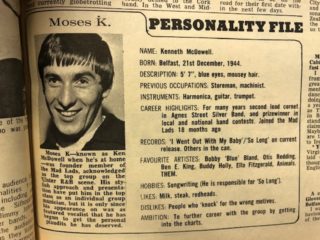
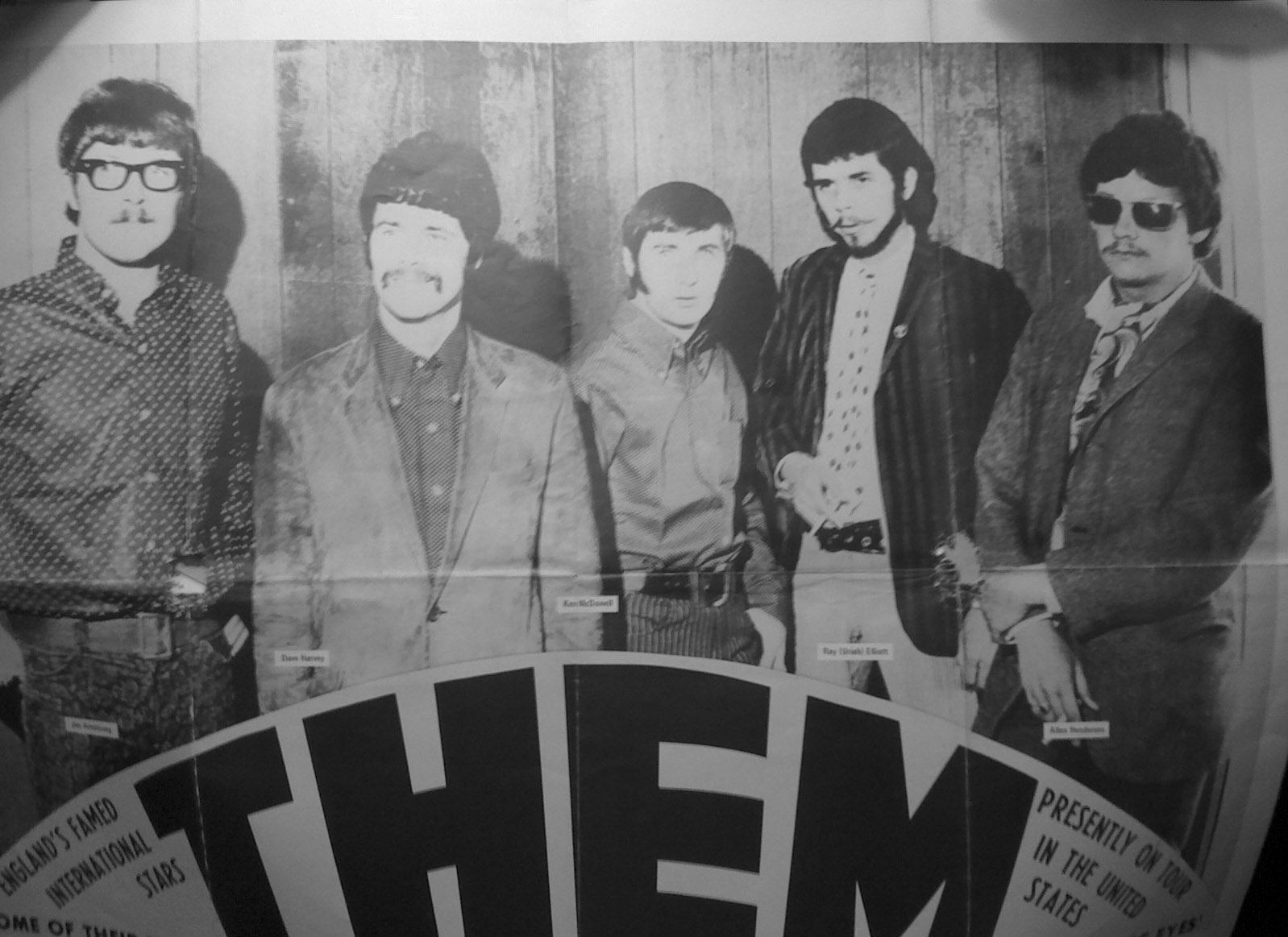
December Armstrong, Elliott, Harvey and Henderson decide to carry on with Them’s name, now that Morrison has abandoned the name and is pursuing a solo career. The group recruits a new vocalist Ken McDowell (b. 21 December 1944, Belfast, N. Ireland), previously a member of Belfast group The Mad Lads, who have recorded a number of singles for Decca Records, as well as a lone release “I Went Out With My Baby” as Moses K. & The Prophets. The new version of Them writes to Carol Deck, Californian editor of Flip magazine (who had given the band some encouraging reviews during its US tour) asking for help, and she in turn introduces them to Texan producer Ray Ruff, who has his own indie label, Ruff Records. The new version of Them moves out to Amarillo, Texas in June 1967.
1967
January Major Minor Records releases “Gloria”, backed by another Morrison song, the acoustic “Friday’s Child” as a UK single. The McAuley brothers’ Them implodes and Jackie McAuley returns to Dublin and forms Cult with singer/songwriter and guitarist Paul Brady.
March A second Major Minor single “The Story Of Them” is released. Morrison signs a solo contract with Bert Berns and travels to New York to record for his Bang label. This will result in an immediate US hit “Brown Eyed Girl”, which makes #10. After Berns’ death in December 1967, Morrison will sign with Warner Brothers and record the classic Astral Weeks, which proves to be the beginning of an illustrious career.
Photo: Cityweek
(4) The Belfast Telegraph reports that Van Morrison is one of the opening acts for The Stormsville Shakers at Queen’s University’s student union in Belfast together with The Interns.
June (30) The US-based Them appear at the Purple Onion Teen Club, Wichita Falls, Texas.
Them in Checkmate Studios, Amarillo, 1967, from left: Ray Elliott, Alan Henderson, Dave Harvey, Ken McDowell and Jim Armstrong. Photo from the collection of Tom McCarty
July (12) According to the Childress Index, Them appears at Fair Park Auditorium, Childress, Texas. The next day they also play a gig in Farmington, New Mexico. The newspaper says they will tour for five months and play 20 times in Texas.
KRLA’s Beat, May 6, 1967The McAuley brother’s group
August Nearly year after the band’s final performance, the McAuley brothers’ group The Belfast Gypsies have a belated album release on the Swedish label Sonet as Them Belfast Gypsies. Having relocated to Amarillo, Texas, Henderson’s Them release their debut single without Morrison, a cover of Tom Lane’s “Dirty Old Man (At The Age Of Sixteen)” / “Square Room” on Sully Records before a nation-wide distribution deal is struck with Tower Records.
(10) The Evening Sentinel reports that Eric Wrixon’s latest group, The Never Never Band appear at the Golden Torch in Tunstall, Staffordshire.
Above and below, first record by the Amarillo, Texas based Them
September Starting off in Amarillo, Henderson’s group kicks off a major tour. The gruelling 61-date tour takes the musicians across the US Midwest and then to Los Angeles, where Them begin work on its first album without Morrison. Santa Rosa, California-based newspaper, the Press Democrat notes in its 1 January 1968 issue that the LP is recorded in studios in Texas, Oklahoma and Hollywood, California.
November Henderson’s Them release a second 45, the band composition “Walking In The Queens Garden” b/w “I Happen to Love You” on Ruff Records.
December Tower issues two singles, one includes newly recorded versions of “Dirty Old Man (At The Age Of Sixteen)” and “Square Room” and the second reissues the Ruff 45.
(8-10) The band appears at the Whisky-A-Go-Go, West Hollywood, California with Love and Blue Cheer. Santa Rosa paper the Press Democrat, says they play at the Vets Building in Santa Rosa, California over the Christmas weekend.
Poster from Amarillo, 1967, from left: Jim Armstrong, Dave Harvey, Ken McDowell, Ray Elliott and Alan Henderson. Poster from the collection of Tom McCarty
1968
January A new album, Now And Them is released featuring Them’s reply to the Doors’ “The End”, the extended raga piece “Square Room”.
February Tower reissues the Ruff 45 of “Walking In The Queens Gardens” but its success is limited to the West Coast.
March (24) The Hamilton Spectator’s 22 March issue, page 30, notes Them are playing in Toronto and will appear at Carl’s in Hamilton, Ontario on this date with David Clayton-Thomas and Combine. The group’s incessant touring prompts Elliott to quit the band while Them are in New York. He returns to Belfast briefly before working with an Irish showband in Leeds alongside guitarist Eric Bell from “Them Again”. Bell soon returns to Belfast to replace guitarist Gary Moore in The Shades of Blue before working with the Dublin-based The Dream showband.
April “But It’s Alright”, an out-take from the album is released as a single but doesn’t sell.
(11) According to the Odessa American newspaper, Them plays at Ector County Coliseum, Odessa, Texas.
May(24-25) Henderson’s Them appear alongside The Incredible String Band at the Kaleidoscope, Hollywood, California.
July The title track from their forthcoming album Time Out For Time In is released but is not a success.
August(14-15) The band plays with Frank Zappa & The Mothers of Invention at the Electric Theatre, Chicago. Them also performs at the Baton Rouge Festival on a bill that features Freddie King.
November Them’s second album Time Out Time In For Them is released. It has been recorded at Los Angeles’ Gold Star studios in the wake of Elliott’s departure and features session drummer John Guerin on a number of tracks. A single “Waltz Of The Flies” is extracted but fails to chart.
1969
March Them’s final single, a cover of the traditional Corinna is released but fails to chart. Unhappy with Ruff’s management and production, Armstrong and McDowell leave and return to Belfast where they put together Sk’Boo with Ricky McCutcheon and Colm Connolly. Henderson, meanwhile, remains with Ruff in L.A. and continues with the Them name; using guitarist Jim Parker and drummer John Stark from Amarillo band, The Kitchen Cinq, he produces two further albums: Them (1969) and In Reality (1970) for the Chicago label Happy Tiger. David Harvey also stays behind in California but will leave the music business.
June After working briskly throughout Ireland and the British mainland, Armstrong and McDowell shelve Sk’Boo (after a farewell gig in Wolverhampton) and return to the US later that year. Based in Chicago, the duo recruit an American rhythm section comprising bassist Curt Bachman (ex-The Buckinghams) and drummer Reno Smith formerly of Baby Huey and The Babysitters in a new group called Truth, which becomes house band at Beavers. The Chicago Tribune‘s 2 November 1969 issue runs a spread on the newly formed group. The band tours extensively around the Chicago area for the next 18 months, and also contributes several songs to the soundtrack for Pat Mulcahy’s film Cum Laude Fraud (later released as College For Fun And Profit), before being offered a recording deal with Epic Records. Ex-Them member Ray Elliott rejoins the band during its lifespan but subsequently leaves after contributing to some recordings and returns to England.
July(26) Them and Truth* both appear at the Eugene Pop Festival, Hayward Field, University of Oregon, Eugene alongside Alice Cooper, The Doors and others.
* Neal Skok and I have been trying to find out for some time now what “Them” this was — there is a slim chance it was the Tower Records ensemble. But the “Truth” that is listed for this gig is most definitely not the Chicago-based Truth comprised of the ex-Them gents (whose CD Neal and I put out on his “Epilogue” label in ’94). This “Truth” was a NW teen rock band – and of course there were several Christian bands that used that name in the ’60s and later. – John Berg
October Having returned from Germany and joined The Trixons showband, original Them member Eric Wrixon joins guitarist Eric Bell from the short-lived “Them Again” in the original Thin Lizzy. He leaves in early 1970 and returns to Germany to play with Junior Walker, Junior Wells and Buddy Guy among others.
1970
January (21) Truth play at the New Cellar, Chicago alongside The Mauds.
March Having moved to Beirut in Lebanon with The League of Gentlemen the previous year, former Them member Jackie McAuley returns to England and forms Trader Horne with Judy Dyble, who has previously worked with the original Fairport Convention. The duo release the album, Morning Way, which features contributions from former Them member Ray Elliott. When Trader Horne split later in the year, McAuley forms the short-lived One with Rosko Gee and Adam Marsh before starting on a solo album.
Japanese sleeve with Alan Henderson’s Them
1971
February Truth return to Belfast for a working holiday before sessions in London begin later that month. Unfortunately, Epic Records undergoes a change in management and following a communication problem, Truth’s band members fall apart before they have a chance to enter the studio. Elliott subsequently moves to Canada (where he dies in June 1993 in Toronto), while Bachman and Smith return to the US. Armstrong and McDowell move back to Belfast where Armstrong joins the Civil Service and McDowell becomes a member of The College Boys. (Truth’s private recordings and studio sessions from Chicago are later released by Epilogue Records as The Truth Of Them And Other Tales in 1995.)
March Jackie McAuley releases his eponymous debut solo album on the small Dawn label, before later working with bands Wand and Mackeral Sky. He also spends four years working with Lonnie Donegan. Jackie’s brother Pat (who turns down an offer to play with Marc Bolan), sadly dies in a drowning accident in Donegal on 11 August 1984.
1972
August Compilation album Them Featuring Van Morrison hits US #154.
1973
After working with cabaret singer Roly Stewart, Jim Armstrong has rejoined Ken McDowell in The College Boys in the early 1970s. The pair then join Reunion before working with another former Them member John Wilson in Bronco. The pair also form the band Spike, which works at the Pound club in Belfast. Wilson subsequently becomes Northern Ireland’s top session drummer.
Deram double LP repackages their first two U.S. LPs minus two tracks each.
1974 Backtrackin’ released only in the U.S., featured obscure b-sides and songs not previously available in the U.S.: “Richard Cory”, “I Put a Spell on You”, “Just a Little Bit”, “I Gave My Love a Diamond”, “Half as Much”, “Baby Please Don’t Go”, “Hey Girl”, “Don’t Start Crying Now”, “All for Myself” and “Mighty Like a Rose”. All the tracks except the last, however, were in simulated stereo.
1978
Armstrong leaves Spike and forms his own band Light, who record an eponymous album on the small Mint label in Ireland only.
1979
Billy Harrison reforms Them with original keyboard player Eric Wrixon. Initially, Harrison intended to complete the group with John Wilson, who’d played drums on Them Again album, together with bass player Jackie Flavelle and singer Mel Austin but Wilson and Flavelle drop out prompting him to bring in drummer Billy Bell. He also brings back Henderson, who has spent several years working on his Connecticut farm. Them move to Germany where they hold down a residency in Hamburg. While there the group records the album Shut Your Mouth for Teldec/Decca before Jim Armstrong and Brian Scott from Light replace Harrison and Wrixon. However, after a brief tour of Germany the group splinters. Armstrong reunites with Ken McDowell in a new version of Sk’Boo, who release one single “It’s A Hard Road” for the small Cuecomber label.
From left: Joe Baldi, Terry Noon, Peter Bardens, Van Morrison and Alan Henderson from summer of 1965
1980
Harrison emerges with the solo album Billy Who? on the German Vagabond label. He then abandons a music career and become a marine electrician. Jackie McAuley spends most of the 1980s and 1990s working with Poor Mouth, who release a number of albums, including Gael Force. In 1982, he co-writes “Dear John”, which is a hit for Status Quo.
1989
Original member Eric Wrixon forms The Belfast Blues Band with another former Them member, John Wilson.
1994
Jackie McAuley emerges with a new solo album, Headspin. Guitarist Jim Armstrong meanwhile has formed The Belfast Blues Band with original Them member Eric Wrixon. His former band mate, Ken McDowell has continued to work with Sk’Boo and then plays with Hens Teeth before forming The Kenny McDowell/Ronnie Greer Band in the early 2000s.
1998
Jackie McAuley releases another solo release, Shadowboxing.
2000
Jackie McAuley puts out another solo release, Bad Day At Black Rock. McAuley subsequently joins The Harbour Band, who release the album Live In The Spirit Tour in 2003.
2003
The Ken McDowell/Ronnie Greer Band release the album, Live At The Island. Jim Armstrong leaves The Belfast Blues Band and reforms The Jim Armstrong Band.
Sources:
Clayson, Alan. Call Up The Groups – The Golden Age Of British Beat,
Blandford Press, 1985, pages 168-170.
Doggett, Peter. “Them”, Record Collector # 149, January 1992, pages 112-116
Du Noyer, Paul. “Heart & Soul Of Van Morrison”, Mojo Magazine, November 1993, page 84.
Gray, Michael. Mother – The Frank Zappa Story, Plexus, 1993.
Grushkin, Paul D. Art Of Rock – Posters From Presley To Punk, Artabras, Cross River Press Ltd, 1987.
Harper, Colin. Sleeve notes to CD Belfast Beat, 1998.
Harper, Colin and Hodgett, Trevor. Irish Folk, Trad & Blues – A Secret History, Cherry Red Books, 2004.
Hodgett, Trevor. “Them After Van Morrison”, Record Collector #89, pages 52-57.
Hogg, Brian. “Van Morrison & Them”, Strange Things Are Happening, Vol 1, #4, Sep/Oct 1988, Bam-Caruso Books, pages 6-14 and 20.
Housden, David Peter. The Castle, Love #9, December 1995, page 28 and 57.
Housden, David Peter. The Castle, Love #10, 1996, pages 6-7.
Rees, Dafydd and Crampton, Luke. Guinness Book Of Rock Stars, 2nd Edition, Guinness Publishing, 1991, page 528.
Rogan, Johnny. CSN&Y – The Visual Documentary, Omnibus Press, 1996, page 10.
Shaw, Greg. The Doors On The Road, Omnibus Press, 1997, pages 14 and 172.
Turner, Steve. Van Morrison – Too Late To Stop Now, Bloomsbury, 1993, pages 49 and 60.
Unterberger, Richie. “Belfast Gypsies” article in Ugly Things issue 23.
Whitburn, Joel. Bubbling Under Hot 100 1959-1985, Billboard Researchers Inc, 1985.
Sleeve notes to the Deram Anthology The Story Of Them – Featuring Van Morrison, 1997.
Sleeve notes to Epilogue CD, The Truth Of Them And Other Tales, 1995.
clockwise from left: Doug Lubahn, Bob Seal, Dallas Taylor, Michael Ney, Cliff De Young and Robbie Robisoncounter-clockwise from bottom left: Robbie Robison, Doug Lubahn, Bob Seal, Michael Ney and Dallas Taylor
Cliff De Young (vocals) Bob Seal (lead guitar, vocals) Doug Lubahn (bass) Ralph Schuckett (keyboards) Dallas Taylor (drums) Michael Ney (drums) Robbie Robison (guitar)1966
Georgia-born guitarist Bob Seal teams up with Dallas Taylor (b. 1948, Denver, Colorado, US) during the summer when they meet in Phoenix, Arizona as Seal is heading to California. Taylor has already tasted the Sunset Strip scene while drumming with Lowell George’s Factory some months earlier.
They arrive in Los Angeles and set up camp in Manhattan Beach where they meet up with Robbie Robison (real name: Clyde Edgar Robison) and Michael Ney at a Peanut Butter Conspiracy gig. Robison is the husband of Barbara Robison (aka Sandi Peanut Butter), the Peanut Butter Conspiracy’s lead singer – and had recorded an album in 1964 as Robbie the Werwolf – Live at the Waleback Club.
Deciding to make a go of forming a group with two drummers they recruit Wanda Watkins as an additional vocalist and name themselves The Garnerfield Sanitarium.
In late 1966, Doug Lubahn (b. Colorado, US), who has spotted Seal and Taylor on Fairfax Avenue wearing signs reading “Seeking singing, writing bass player” joins on bass. Lubahn had moved to Los Angeles a few months earlier from Aspen, Colorado where he was working as a ski instructor and playing with several local groups. He is spotted by Mama Cass of The Mamas & The Papas and she encourages him to relocate to the West Coast.
They acquire Bud Mathis as manager and change name to the Brain Train – a name given to them by the Peanut Butter Conspiracy’s Alan Brackett. In the process they lose Watkins, who will turn up in another Bud Mathis outfit, The Joint Effort. Mathis finances a recording session at the Electro Vox Studios and takes the resulting demo recordings of Wolfang Dios’ “Black Roses” and Lubahn and Mathis’s “Me” to Elektra Records.
1967
Elektra snaps the band up but persuades them to ditch Mathis and be taken under the wing of producer Paul Rothchild. The Brain Train moves into a large house on Franklin Avenue in the Los Feliz area of Los Angeles, which has previously been the home of WC Fields and begin reheasing material for their proposed album. March (26) Renamed Clear Light, the band plays at Los Angeles’ first “Love-In” at Griffith Park on the same bill as The Steve Miller Band, The Grateful Dead and The Other Half. April The recording sessions for the band’s debut album begins. Two of the first tracks completed are a reworking of “Black Roses” and a Robbie Robison composition titled, “She’s Ready To Be Free”. Around the same time, the group lands a cameo role in the movie, The President’s Analyst starring James Coburn. Soon after filming, Clear Light adds lead singer Cliff De Young (b. 12 February 1945, Los Angeles, California, US).
Scene from The President’s Analyst
Barry McGuire cast as their singer, for some reason.
from left to right, back row: Ralph Schuckett, Dallas Taylor, Michael Ney and Doug Lubahn front row from left: Bob Seal and Cliff De Young
(30) The group performs at the “Freedom of Expression Concert” at the Hullabaloo, Hollywood, alongside The Doors, Canned Heat, The Poor and many others. May Despite having put down most of the tracks for the album, Elektra decides that Robison’s acoustic approach is incompatible with the group’s new electric direction and he is dropped from the group, although he remains part of the entourage, operating his own light show, set up at the group’s live appearances. After auditioning many guitarists as possible replacements, including Doug Hastings (ex-Daily Flash and soon-to-be Buffalo Springfield) they eventually decide to go with keyboard wunderkind Ralph Schuckett. Schuckett overdubs keys to several of the tracks already in the can as well as collaborating with fellow newbie Cliff De Young. June (11) The new line up performs at Cheetah, Venice, California with Kaleidoscope. (30) The band performs at the Oracle Benefit at the Valley Music Theatre, Los Angeles with Kaleidoscope and The Fraternity of Man (the Byrds cancel – McGuinn was sick). After this Clear Light embark on a cross country tour driving non-stop to Philadelphia where the band goes on strike, forcing Elektra to fly them to New York. The group is met by Danny Fields, who checks the musicians into Albert’s Hotel. The band initially plays at Steve Paul’s Scene East in the Delmonico Hotel but on the first night Schuckett lambasts the crowd for not paying attention to the group’s performance and it is fired. The next day, Steve Paul places the group at his main club, The Scene. July (6-23) Clear Light play at Steve Paul’s Scene, New York. While there, the group jams with various guests including Tiny Tim, Howlin’ Wolf and The Candy Men, formerly members of The McCoys. The band plays further dates in Boston before returning to Los Angeles. August (31) – September (3) Clear Light performs at the Magic Mushroom, Los Angeles with Kaleidoscope. Soon afterwards, the band’s debut single, “Black Roses” c/w “She’s Ready To Be Free” is released. (25) Lubahn participates in the sessions for The Doors’ Strange Days album. (30) Clear Light appears at the Earl Warren Showgrounds, Santa Barbara with The Quicksilver Messenger Service, Van Morrison and Blue Cheer. October (20-22) The band plays at the Cheetah, Venice, California with The Electric Flag. (26-28) The group supports Lee Michaels and Pink Floyd at the Fillmore Auditorium, San Francisco. November The group’s eponymous debut album is released climbing to US #126. The band’s second single, “They Who Have Nothing” c/w “Ballad of Freddie & Larry” is issued to support the album. The debut longplayer is subsequently released in the UK, and although it is not a hit, it is greeted with interest, particularly on the underground scene. (Clear Light’s records are regularly featured on John Peel’s Top Gear). Bud Mathis licences The Brain Train demos to Titan Records in order to cash in on the release of the Elektra album. (8) Clear Light appears on Pat Boone’s weekly show Pat Boone in Hollywood. (17-19) They play at the Cheetah in Venice, California with The Nazz. (22) Clear Light performs at the Santa Monica Civic Auditorium, Santa Monica, California with The Peanut Butter Conspiracy, The Merry Go Round, The Hour Glass and others. (25) They appear at the Earl Warren Showgrounds in Santa Barbara, California with The Youngbloods, Canned Heat and The Merry Go Round. (30) – December (2) The band is joined by The Nitty Gritty Dirt Band for a series of shows at the Fillmore Auditorium. (8-9) They play at the Boston Tea Party, Boston with The Street Choir. (19-31) Clear Light perform at the Café Au Go Go in New York where they are joined by Tim Buckley on the 28th and 30th. After much behind the scenes manipulation and Svengali–ism by Rothchild, the band starts auditioning guitarists, including Kenny Pine and Jeff Jacobs, on the club’s stage to replace Bob Seal, who has come to blows with the producer. Danny Kortchmar, who has previously played with New York groups, The King Bees and The Flying Machine and recently returned from Los Angeles where he had tried out for Elektra’s project supergroup (later Rhinoceros) takes over lead guitar. Seal meanwhile relocates to the Bay area and, disillusioned with playing six string takes up the bass – gigging but not recording with Gale Garnett & The Gentle Reign. He later takes up the six string again, replacing the original guitarist in the Transatlantic Railroad. He subsequently teams up with former Salvation member Joe Tate in Redlegs, a popular Bay Area group.
1968
January (5-6) With Kortchmar on guitar, Clear Light play at the Grande Ballroom, Detroit with Gypsy and Children. February A third single, “Night Sounds Loud”, is only released in the UK, but is not a hit. (23-24) Clear Light support Jefferson Airplane at the Shrine Auditorium, Los Angeles with the Ceyleib People. (26 & 28) Kortchmar, Schuckett, Lubahn and Ney appear on the recording of The Monkees’ “The Porpoise Song”, produced by Russ Titelman and Gerry Goffin. Also on the session are Leon Russell and British jazz pianist, Victor Feldman. March (17) Clear Light plays at Pasadena Exhibition Hall, Pasadena, California with The Peanut Butter Conspiracy, Iron Butterfly, Steppenwolf, Procol Harum and many others. (24) The group joins The Buffalo Springfield, Jefferson Airplane, H.P. Lovecraft, The Quicksilver Messenger Service and various others at a benefit for the Radio Strike Fund for disc jockeys at KPPC Pasadena and KMPX San Francisco. (29-30) The band appears at the Kaleidoscope with Bo Diddley and The Peanut Butter Conspiracy. April (13) Clear Light appears at the Salt Lake Coliseum, Salt Lake City, Utah with Blue Cheer and Jerry Abrams. (18-23) Clear Light plays at the Cheetah, New York with Harvey and The 7 Sounds. (26-28) The band appears at the Trauma in Philadelphia with The Mandrake Memorial. May (3-4) The group performs at the Boston Tea Party with Butter and Tim Rose. The group then returns to New York and plays some shows at the Electric Circus with The Chambers Brothers and Circus Maximus where they are a huge hit. (25) Clear Light plays at the “McCarthy Happening” in Santa Clara County Showgrounds, San Jose, California with H.P Lovecraft, The Nitty Gritty Dirt Band, The Flamin’ Groovies, The Strawberry Alarm Clock, Crystal Syphon, Womb and others. (30) Kortchmar takes part in the recording of The Monkees’ “As We Go Along”. June (14-16) The band appears at San Francisco’s Avalon Ballroom with Frumius Bandersnatch and Buddy Guy. Sessions for a second album begin but after a few recordings Cliff De Young quits to return to college. He later pursues an acting career. Two tracks from the sessions survive – “Darkness of Day” (a Schuckett/De Young collaboration) and Kortchmar’s “What A Difference Love Makes”. August Kortchmar appears on The Fugs’ album, It Crawled Into My Hand Honest. September Clear Light unofficially splinters. Lubahn briefly becomes The Doors’ studio bassist, appearing on albums Waiting For The Sun and The Soft Parade before forming jazz/rock band, Dreams with ex-Blood, Sweat & Tears member Randy Brecker, while Schuckett and Ney (in the guise of Mike Stevens) join The Peanut Butter Conspiracy for a summer and winter tour of the Pacific Northwest. Schuckett also does session work for people like James Cotton. Dallas Taylor, who initially works with ex-Lovin’ Spoonful singer/guitarist John Sebastian is subsequently introduced to Stephen Stills. Around this time, Taylor, Lubahn and Schuckett do a recording session with Stills at TTG studio in Hollywood. Taylor strikes up a rapport with Stills and is chosen as drummer for Crosby, Stills & Nash. November Kortchmar and Ney join Carole King’s City, although the latter will soon be replaced by Jim Gordon.
1969
January Elektra’s news letter, Revelation announces that Clear Light have split up. February The City’s sole album, Now That Everything Has Been Said is released on Lou Adler’s Ode label. December Taylor appears on Essra Mohawk’s album, Primordial Lovers, released on Reprise Records.
1970
May (12) Taylor is sacked by Crosby, Stills, Nash & Young after a gig in Denver and rejoins John Sebastian’s backing band. September Schuckett and Kortchmar reunite in Jo Mama, which signs to Atlantic Records. November Lubahn’s group Dreams release their eponymous debut album.
1971
March Debut Jo Mama album, O Sole Mio is released. Schuckett also appears on Carole King’s Tapestry album and follows this with two US and one UK tour with James Taylor in support. September Taylor appears on John Sebastian’s Four Of Us, before joining Stephen Stills’s Manassas. November Second Jo Mama album J Is For Jump is released, but is not a success and the band splinters. Kortchmar works for David Crosby and Graham Nash, while Schuckett does sessions for Todd Rundgren amongst others.
1972
Lubahn appears on the Everly Brothers album Stories We Could Tell. May Manassass’ eponymous debut double album is released. October After doing a multitude of sessions for people like Crosby & Nash, Kortchmar forms The Section, who release their eponymous debut album on Warner Brothers.
1973
Cliff De Young stars in the TV film Sunshine and subsequently releases a soundtrack album featuring songs by John Denver on MCA. September A second Section album, Forward Motion is released but is not a success. Kortchmar leaves to record a solo set Kootch. May A second Manassas album Down The Road is issued, but the group splinters soon after and Taylor moves into session work, appearing on albums by people like Bill Wyman and Sammy Hagar, before rejoining Stephen Stills’s backing group.
1974
Cliff De Young releases an eponymously titled solo album on MCA. He continues to be in demand as a film and TV actor. December After doing various sessions for people like David Blue, Carole King and Todd Rundgren, Schuckett becomes part of the latter’s Utopia. He will remain with the band for two years appearing on the albums Todd Rungren’s Utopia, Initiation and Another Live.
1975
September Kortchmar joins Crosby & Nash’s backing band, The Mighty Jitters, and subsequently appears on their albums Wind On The Water, Whistle Down The Wire and Crosby/Nash Live.
1976
June Schuckett appears on a recording by Free Beer, who release the album Highway Robbery on RCA. July Kortchmar forms The Attitudes, releasing an eponymous debut on George Harrison’s Dark Horse label.
1977
March Schuckett appears on a second Free Beer album, Nouveau Chapeau. Lubahn forms new a group, Pierce Arrow, with ex-Dreams member Jeff Kent and ex-Compton & Batteau guitarist/vocalist Robin Batteau. Schuckett fills in for Jeff Kent when he recouperates from a serious injury in 1978. October Pierce Arrow issue an eponymous debut for CBS. A second Attitudes’ album Good News is also released, but is not a success and Kortchmar returns to session work.
1978
July A second Pierce Arrow album Pity The Rich is released, but is not a success and Lubahn leaves to pursue other projects.
1980
Schuckett joins Ellen Shipley’s backing group and continues to do session work for such notable artists as Cher. Lubahn writes Treat Me Right for Pat Benatar, which appears on her album, Crimes of Passion. August Kortchmar meanwhile, releases second solo album, Innuendo, on Asylum Records.
1981
Lubahn forms Riff Raff who release the album Vinyl Future for Atlantic. He subsequently joins the Billy Squier band.
1982
Lubahn appears on Billy Squiers’ Emotions in Motion. October Kortchmar appears on ex-Eagle Don Henley’s debut solo album I Can’t Stand Still, which he also co-produces and co-writes several songs on. The pair will strike up a rapport and Kortchmar will become an integral part of Henley’s backing band for the next ten years.
1984
Schuckett produces an album for Clarence Clemons for Columbia Records. He also co-produces two tracks with Bruce Springsteen. Lubahn apears on Ted Nugent’s Penetrator and Billy Squiers’ Signs of Life. He also writes Talk To Me – recorded by Patty Smyth and Scandal on their album Warrior (which features Schuckett).
1987
September British indie label, Edsel issues Clear Light’s album with the bonus cut “She’s Ready To Be Free”. In 1991, Lubahn sings background vocals on Billy Squier’s album, Creatures of Habit.
Sources:
Einarson, John and Furay, Richie. For What It’s Worth – The Story Of Buffalo Springfield. Quarry Press Inc, 1997. Grushkin, Paul D. Art Of Rock – Posters From Presley To Punk, Artabras, Cross River Press Ltd, 1987. Hogg, Brian. Sleeve notes to Edsel’s reissue of Clear Light, 1987. Hounsome, Terry. Rock Record #6, Record Researchers Publications, 1994. David Peter Housden. The Castle – Love #9, page 63. Joynson, Vernon. Fuzz, Acid & Flowers, 1993. Long, Pete. Ghosts On The Road – Neil Young In Concert, Old Homestead Press, 1996. Sandoval Andrew. Sleeve notes to Rhino’s reissue of The Monkees’ album Head, 1994. Shaw, Greg. The Doors On The Road, Omnibus Press, 1997, pages 35 and 64. Village Voice, July 6, 1967, page 26, December 14, 1967, page 52 and December 28, 1967, page 39.
Thanks to Gray Newell for his extensive help in piecing this story together. Many thanks too to Marc Skobac for research on some of the live dates. Huge thanks also to Ralph Schuckett for filling in many of the gaps and Doug Lubahn for his input. Thanks to Marc Skobac for his corrections.
Denny Laine (guitar, vocals) Michael Pinder (keyboards, vocals) Ray Thomas (harmonica, saxophone, flute, vocals) Clint Warwick (bass, vocals) Graeme Edge (drums)
1964
April The nucleus of the band is formed by Laine (b. Brian Frederick Hines, 29 October 1944, Tyseley, Birmingham, W. Midlands, UK), who has just disbanded his group Denny And The Diplomats, with Thomas (b. 29 December 1942, Stourport-on-Severn, Hereford & Worcs, UK.) and Pinder (b. 27 December 1941, Birmingham, W. Midlands, UK), who have both been playing in local outfits El Riot & The Rebels and The Krewcats, and have just returned from a year’s residence at Hamburg’s Top Ten club.
May (4) Rehearsals begin with the addition of drummer Edge (b. 30 March 1942, Rochester, Staffs, UK), who has previously been a member of Gerry Levene & The Avengers and bass player Clint Warwick (b. Albert Eccles, 25 June 1940, Birmingham, W. Midlands, UK), formerly a member of The Rainbows. The group quickly gains a residency at the Carlton Ballroom in Erdington, West Midlands, initially billed as The M&B Five, apparently in the hope of gaining sponsorship from local brewers Mitchell and Butler. Laine, who has pushed the band’s sound towards the blues and jazz of London based groups, decides soon afterwards to re-name the band after a Slim Harpo song titled “Moody Blue” and The M&B Five becomes The Moody Blues Five.
August The band attracts the attention of London manager Tony Secunda, who secures The Moody Blues (as they now call themselves), a residency at London’s Marquee club on Monday nights, where they replace Manfred Mann. Through their prestigious “live” work at the club, the band quickly attracts the attention of Decca Records which signs the group. Shortly afterwards The Moody Blues record their debut single, the Pinder-Laine composition “Lose Your Money” which the band performs on ITV’s Ready Steady Go!.
September (3) The group plays its first show at the Marquee in London.
(11) The Moody Blues appear at Birmingham’s Town Hall alongside The Spencer Davis Group and headliners Alexis Korner Incorporated.
Photo: Woking Herald
(14) The Moody Blues open the Moonlighter Club, held at Weybridge Hall in Weybridge, Surrey.
(28) The band returns for another show at the Moonlighter Club, Weybridge Hall in Weybridge, Surrey.
October (4) The band plays at the Marquee in London.
(30) The Moody Blues appear at the Crawdaddy club in Richmond, Surrey.
November After “Lose Your Money” fails to chart, the group records a cover of Bessie Banks’s US R&B hit, “Go Now”, which has been given to the band by New York disc-jockey B. Mitchell Reed during a visit to the UK.
(2) The Moody Blues perform again at the Moonlighter Club, held at Weybridge Hall in Weybridge, Surrey.
December (7) The group appears at the Marquee in London.
1965
January (8) The group begins a 24-date, twice-nightly tour with Chuck Berry at the Odeon Theatre, London, which will end 31 January at the Regal Theatre, Edmonton, London.
(28) “Go Now”, produced by Alex Murray, tops the UK chart.
February The band quickly releases “I Don’t Want To Go On Without You”, a revival of a Drifters’ b-side as a follow up single, but it only reaches UK #33. Part of the single’s failure can be attributed to the simultaneous release of identical covers by The Searchers and The Escorts. (The group is unhappy with the recording because Thomas’s flute solo has been inexplicably erased from the final pressing.)
March (8) The Moody Blues make their first live broadcast on BBC Radio’s Joe Loss Pop Show.
April “Go Now” holds down anchor position in a unique US Top 10 in which 9 of the singles are from the UK.
(11) The group takes part in the annual New Musical Express poll winners concert at the Empire Pool, London, with The Beatles, The Rolling Stones, The Kinks and The Animals among others.
May The band releases an EP, which features both sides of the group’s debut single plus the a-sides of the previous two releases.
(24) The Moody Blues take part in the British Song Festival at the Dome, Brighton, East Sussex.
June (5) The band guests on ITV’s Thank Your Lucky Stars, where it introduces its new single, the Pinder-Laine collaboration “From The Bottom Of My Heart”.
(15) The Moody Blues join The Rolling Stones for a 4-date tour of Scotland alongside The Hollies, The Cannon Brothers and The Checkmates. The tour begins at the Odean Theatre, Glasgow.
(16) The group performs at the Usher Hall, Edinburgh.
(17) The Moody Blues appear at the Caird Hall, Dundee.
(18) The final date takes place at the Capitol Theatre, Aberdeen. (While the Stones prepare for a short tour of Scandinavia, The Moody Blues return to London in order to fly to New York for their debut US appearance.)
(19) The group makes its US debut with The Kinks at the Academy of Music in New York.
July “From The Bottom Of My Heart” is released and climbs to UK #22 and US #93. The Moody Blues’ debut album Magnificent Moodies, which has been produced by Denny Cordell is released to coincide with the single but fails to chart. In the US the album is released as Go Now and features a different track listing.
(24) The band performs at the Birdcage in Portsmouth, Hants.
August (1) The Moody Blues perform at the London Palladium with The Rolling Stones, The Fourmost, Steampacket and others.
(6) The group plays on the opening day of the fifth annual National Jazz & Blues Festival at the Richmond Athletic Ground, Richmond, Surrey.
(29) The Moody Blues play at the Downs, Hassocks, West Sussex.
September (6) The band signs a management contract with NEMS.
(21) The Moody Blues participate in Pop From Britain concert at the Royal Albert Hall, London, with Cliff Bennett & The Rebel Rousers, Georgie Fame & The Blue Flames and The Fourmost.
(25) The group appears at the Birdcage in Portsmouth, Hants with St Louis Checks.
(30) The Moody Blues replace Unit 4 Plus 2 for 3 dates on The Rolling Stones UK tour. The first date takes place at the Gaumont Theatre, Hanley, Staffs. Also on the tour are The Spencer Davis Group, The End and The Habits.
October (1) The band appears at the ABC Theatre, Chester, Cheshire.
(2) The group’s final appearance takes place at the ABC Theatre, Wigan, Lancashire. Unit 4 Plus 2 return to the tour immediately afterwards.
November The Laine-Pinder composition “Everyday” only reaches UK #44, despite becoming a turntable hit on pirate radio.
December (3) The group supports The Beatles on their final UK tour, a 9-date twice-nightly package, which opens at Glasgow’s Odeon cinema and ends on December 12 at the Capitol Cinema, Cardiff, Wales.
(19) The Moody Blues appear on CBS TV’s Ed Sullivan Show.
1966
March (8) The group appears at the Montreux Golden Rose TV festival.
April Another Laine-Pinder track “Stop!” is lifted from the UK album and released as a US single, where it spends a week on the Hot 100 at #98. (The song incidentally, is later covered by singer Julie Grant but is not a success). Secunda leaves at this point to work with The Move and is replaced by The Beatles’ manager Brian Epstein. However, he fails to lift the group’s flagging career and as a result The Moody Blues are forced to “drastically reduce their engagement fees.”
(2) The Moody Blues appear at the Club Continental, Eastbourne, East Sussex.
May (1) The band performs at the Oasis in Manchester.
(28) The Moody Blues appear at Hertford Ball, Hertford College, Oxford University with Kenny Ball’s Jazzmen, Alexis Korner, Scott, Gould & Wood, Clem and John.
(30) The group plays at the Pavilion in Bath, Avon.
June (4)Melody Maker announces that the group has undertaken a short tour of Belgium, including a TV appearance from the Casino at Knokke. The magazine also reports that the band is due to appear at the Paris Olympia on 12 June.
(15) The Moody Blues perform at the Bromel club, the Bromley Court Hotel, Kent.
(24) The group plays at the Ram Jam club in Brixton in south London. Warwick, who is disillusioned by the band’s drop in fortunes, leaves the group and quits the music business.
(29) The Moody Blues appear at the Pavilion, Hemel Hempstead, Herts.
The Moody Blues with Rod Clark (far right)
July (9) Pinder and Laine’s “This Is My House (But Nobody Calls)” (the intended b-side of the band’s forthcoming UK single) is issued in the US hitting #119.
(14) After Klaus Voorman decides not to join, Rod Clark, a bass player from Great Yarmouth, who has played with Les Garcons takes Warwick’s place, although Pinder and Thomas’s former El Riot & The Rebels cohort John Lodge (b. 20 July 1943, Birmingham, W. Midlands, UK) is rumoured to have been offered the original slot. Clark debuts at the Villa Marina in Coventry.
Photo: Bridge of Allan Gazette
(22) The band, with Rod Clark, plays at The Stardust, Victoria Hall, Dunblane, Scotland with The Mode.
(30) The group appears at the Riverside Dance Club in Douglas, the Isle of Man.
August (6) The Moody Blues begin a 9-day tour of Denmark.
(20) The group appears at Town Hall, Clacton, Essex with Dave & The Strollers.
September (3) The band appears at the Black Prince in Tenbury Wells.
(10)Melody Maker reports that The Moody Blues fly to Holland for a TV show and then the next day perform in Brussels.
(15) The band plays at the Jaarbeurs in Utrecht, Holland.
(16) The Moody Blues perform at Midnight City in Birmingham with Cliff Bennett & The Rebel Rousers.
(23) The group appears at Cardiff Capitol Theatre on a bill that includes Cliff Bennett & The Rebel Rousers, The Scaffold and The Fourmost.
(28) The Moody Blues appear at the Flamingo in London in what is probably Denny Laine’s final show.
October Rod Clark leaves to join The Rockin’ Berries and John Lodge joins. Lodge, who has remained in higher education since the band’s split in February 1963, has subsequently played in local bands The Carpetbaggers and The John Bull Breed. Laine, meanwhile, anticipating Brian Wilson’s role in The Beach Boys decides to concentrate on writing and studio work.
Justin Hayward, Swindon Advertiser, September 1966
(8)Record Mirror reports that Laine has officially left The Moody Blues. He will quickly emerge with an amplified backing group The Electric String Band – a predecessor and major influence on The Electric Light Orchestra.
(12) Decca releases the group’s first single in over a year, the French-flavoured “Boulevard De La Madelaine”, written by Pinder and Laine but it isn’t a hit. On the same day, Melody Maker reports that the band appears at the Flamingo in London. To fill Laine’s position in the band, the group turns to Justin Hayward (b. David Justin Hayward, 14 October 1946, Swindon, Wilts, UK), who has played in a number of Swindon bands – The Riversiders, The Rebels, The Whispers, The Shots and All Things Bright before joining Marty Wilde’s Wildcats for two days. He then joins Marty Wilde and his wife in The Marty Wilde Three, who record the singles “Since You’ve Gone” and “I Cried” for Decca Records and on 8 April 1966 plays alongside Wilde at a charity show at the London Palladium. Hayward leaves to sign a solo deal with Pye A&R chief Alan Freeman and manager Lonnie Donegan. This results in a one-off single “London Is Behind Me”, before Hayward signs to Parlophone, which releases a second single “I Can’t Face The World Without You”. When both singles fail, Hayward writes to Eric Burdon to inquire about a position in his New Animals. Burdon, with his band already signed-up, passes Hayward’s name onto Mike Pinder. The Moody Blues move to Belgium in November to perform some gigs and to avoid the UK taxman. The band continues to perform its old R&B repertoire despite Laine’s departure and the recent changes in the UK “music scene”.
Possibly Justin Hayward and John Lodge’s debut show, 21 October 1966
December The group performs in France, where it’s still very popular.
1967
January (14) Decca releases another Pinder-Laine collaboration “Life’s Not Life”, which is withdrawn shortly afterwards.
February (18) The group appears at the Plaza Ballroom in Handsworth, West Midlands with The Traction and The Attack.
March (7) The Moody Blues play at Birmingham’s Ringway Club.
(18) The group performs at the Ritz Club, Skewen, south Wales with The King Bees and The Outer Limits.
(20) The band appears at the Broadway Club, Dudley Zoo.
(22) The Moody Blues play at Middle Earth in London.
(27) The band plays two shows in the West Midlands. The first is at the Mackadown, Kitts Green with The Monopoly. The second is at the Belfry, Wishaw with The Gods and Exception.
(30) The group drops the old repertoire (and suits) in favour of a new musical style. The band records Hayward’s “Fly Me High” and Pinder’s “Really Haven’t Got The Time” with new producer Tony Clarke as a prospective single.
April The band signs up (along with The Supremes and Ray Charles) to promote Coca-Cola in the teen market. The company’s $10 million campaign requires each artist to record a radio jingle in their own style but featuring the slogan Things Go Better With Coke. The band embarks on a gruelling tour of the Northern club circuit, including a spot at Newcastle’s Cavendish club.
(1) The band appears at the Royal Lido, Prestatyn, Clwyd, Wales with The Raynes.
(2) The Moody Blues play at the Cosmo in Carlisle, Cumbria with The Fix.
(14) Denny Laine releases his debut single with The Electric String Band “Say You Don’t Mind” which fails to chart; although ex-Zombies singer Colin Blunstone will later score a top 20 hit with it in 1972.
May (5) The Moody Blues release their first single with the new line-up, “Fly Me High” which is not a success despite being a popular radio hit. The band embarks on a brief tour of Scandinavia.
(19) The band shares a double bill with former group leader Denny Laine at London club, Tiles.
(27) Plans are unveiled for the group to appear on a US colour TV special as “Fly Me High” is given an American release.
(31) According to the Somerset County Gazette, the band performs at the TA Hall in Minehead, Somerset with The Witness Four.
June (10) They play the Fete and Donkey Derby in Sutton Coldfield, West Midlands with The Ugly’s and The Bobcats.
(12) The Moody Blues appear at Christ College, Cambridge with The Who and The Herd.
(22) The band appears at Middle Earth with Pink Floyd.
(29) The group records Hayward’s “Leave This Man Alone”.
July (9) The band plays at the Roundhouse with Pink Floyd and The Outer Limits.
(17) The Moody Blues record Pinder’s ambitious “Love & Beauty”, which is the first track to feature the band’s characteristic symphonic sound, created with the use of the mellotron. Shortly afterwards the band introduces its new style at the Glastonbury Festival and is an immediate success.
(28) The Moody Blues appear at the Clay Pigeon in Eastcote, northwest London.
(29) The group performs at the London club, the Upper Cut with The Maze.
August The Moody Blues embark on a “summer” tour of France. The group appears at the Midem Music Festival in Cannes performing most of the songs that will subsequently appear on its forthcoming album.
September (7) The group opens for The Pink Floyd at the Roundhouse, Chalk Farm, London.
(13) The band appears at the Catacombe in Eastbourne, East Sussex.
(22) The Moody Blues release Pinder’s “Love & Beauty” as a single, but it isn’t a hit.
October (8) Signed to Decca’s new progressive label, Deram, the band begins work on its first album in over two years, recording Hayward’s epic “Nights In White Satin”. The group were originally invited to record a stereo version of Dvorak’s New World Symphony with classical backing from The London Festival Orchestra, conducted by Peter Knight, but is allowed to record its stage show, loosely based around a day in the life of a fictional character, instead.
1968
January Extracted from the album, Hayward’s “Nights In White Satin” climbs to UK #19 as parent album reaches #27.
(12) Laine meanwhile, disbands The Electric String Band after his second solo single “Too Much In Love” and moves to Spain to study flamenco guitar.
(19) The Moody Blues play at the Punch Bowl, Lapworth, West Midlands.
(20) The group travels to France to appear at the Midem Music Festival in Cannes, later that week.
February (3) The Moody Blues begin a UK tour at the Nelson Imperial, Lancashire. The tour will conclude at Reading University on March 15.
(10) In the US “Nights In White Satin” only reaches #103.
March (13) The group appears at Birmingham Town Hall with The Spencer Davis Group, Manfred Mann, Don Partridge and Piccadilly Line.
(22) The Moody Blues perform at Middle Earth, Covent Garden, London.
May (4)Days Of Future Past enters the US chart at #3 and earns the group its first gold disk, during a chart run of 102 weeks.
June Hayward’s “Voices In The Sky” is lifted from the band’s forthcoming album and reaches UK #27.
(29) The Moody Blues make a rare concert appearance at London’s Queen Elizabeth Hall.
The Moody Blues appear near Canterbury on 1 August 1968
August The group’s third album, In Search Of The Lost Chord, another concept album, climbs to UK #5. (The band is performing in the former Czechoslovakia at the time and when the Russian army moves in are quickly asked to leave the country by the British Consulate.)
September Hayward’s “Tuesday Afternoon” is taken from Days Of Future Past and belatedly released as a US single, where it hits #24. In Search Of A Lost Chord, rises to US #23 and earns a second gold disk.
October (4) The Moody Blues play at the Corn Exchange, Braintree, Essex.
(11) The group records non-album track “A Simple Game”, written by Mike Pinder.
(21-24) The band is supported by Chicago at the Fillmore West, San Francisco.
(25-26) The group flies to New York City to appear at the Fillmore East with John Mayall’s Bluesbreakers and Rhinoceros.
November (1) Having supported Cream during their final US tour, the group appears at Madison Square Gardens, New York, for Cream’s final US date. “Ride My See Saw”, written by Lodge, is extracted from the new album and makes US #61.
December “Ride My See Saw” hits UK #42. The single’s b-side “A Simple Game” is later a UK #3 for The Four Tops with Clarke producing. (The Four Tops will also cover another Mike Pinder song, “So Deep Within You” from The Moody Blues’ next album). The band performs its last US dates in Vancouver, Canada.
1969
March (11) The group appears at the Grand Gala Du Disque, Amsterdam, Holland on a bill including Gladys Knight & The Pips.
April Hayward’s “Never Comes The Day” is released as a single but fails to chart.
MayOn The Threshold Of A Dream tops the UK chart for 2 weeks and climbs to US #20 during a 136-week chart run, the Moody Blues’ third gold disk.
(2) The band appears at Bridge Place Country Club, at Bridge near Canterbury, Kent.
July “Never Comes The Day” reaches US #91. Denny Laine meanwhile returns from Spain and joins ex-Move member Trevor Burton in Balls.
August (1) The band appears at Bridge Place Country Club, at Bridge near Canterbury, Kent.
(30) The Moody Blues play on the opening day of the Isle Of Wight Festival.
October Hayward and Thomas’s “Watching And Waiting” is the first single to be released on the group’s own Threshold label.
December The Moody Blues’ new album To Our Children’s Children’s Children hits UK #2 as the band moves to Cobham, Surrey to open the first Threshold record store.
(12) The band performs at the Royal Albert Hall, London, during a UK tour. The concert is recorded (and released as part of Caught Live Plus 5 in June 1977).
1970
January The group’s new album is released in the US and makes #14 becoming the band’s fourth gold disk
March (20-21) The band is supported by Argent and Lee Michaels at New York’s Fillmore East.
April (2/11)The Moody Blues are supported by Richie Havens at the Berkeley Community Theatre, California.
May Hayward’s dramatic “Question” hits UK #2, held from the top by the England World Cup Squad’s “Back Home”. Laine, who has recently joined Ginger Baker’s Airforce sings lead vocal on their cover of Bob Dylan’s “Man Of Constant Sorrow” which hits US #85 on 30 May.
June “Question” reaches US #21.
August The Moody Blues’ new album A Question Of Balance, written and recorded in 5 weeks, hits UK #1 for 3 weeks. (30) The group plays on the final day of the second Isle Of Wight Festival.
SeptemberA Question Of Balance makes US #3 and earns the band its fifth gold disk.
October (30) The band performs at London’s Royal Festival Hall.
December (3) The Moody Blues embark on a US tour making their Carnegie Hall, New York debut on 14 December.
1971
August Laine joins Paul McCartney’s Wings.
1974
February After two further albums, Every Good Boy Deserves Favour (1971) and Seventh Sojourn (1972), which both earn a gold disk, and a 9-month world tour, The Moody Blues decide to split for the time being to concentrate on solo projects. (Hayward’s solo career will be the most enduring and successful).
1978
June The band re-unites for a new album, Octave which hits UK #6 and US #13, and becomes the Moody Blues’ first platinum disk. However, during the recording of the album, producer Tony Clarke leaves followed soon afterwards by Mike Pinder; both have been closely identified with the development of the band’s symphonic sound. Pinder is replaced by ex-Refugee member Patrick Moraz, who remains with The Moody Blues into the 1980s, and helps them to become one of the top selling bands of the decade. Pinder meanwhile, remains in the US and emerges in 1995 with second solo effort Among The Stars.
Sources:
Portsmouth’s Birdcage dates by Dave Allen.
Time Machine, August 1965, by Johnny Black, Mojo Magazine, August 1995.
Call Up The Groups – The Golden Age Of British Beat (1962-1967), by Alan Clayson, Blandford Press, 1985.
Denny Laine, by Alan Clayson, Record Collector, #191, July 1995.
Time Machine, October 1966, by Fred Dellar, Mojo Magazine October 1996.
Collectable 45s of the Swinging ‘60s, by Pete Dickerson and Mike Gordon, The Vintage Record Centre, 1984.
Art Of Rock – Posters From Presley To Punk, by Paul D Grushkin, Artabras, Cross River Press Ltd, 1987.
The Castle – Love #2, by David Peter Housden, 1993.
The Castle – Love #9, by David Peter Housden, 1995.
The Moody Blues UK Singles & UK Albums, by Tim Joseph, Record Collector, #81 & 82, April & May 1986.
Karnbach, James and Bernson, Carol. The Complete Recording Guide To The Rolling Stones. Aurum Press, 1997, pages 111, 112 and 115. Pink Floyd In The Flesh book, page 43.
The Moody Blues, by John Reed, Record Collector, November 1996, #207, pages 64-71.
Book Of Rock Stars, 2nd Edition, by Dafydd Rees and Luke Crampton, Guinness Publishing Ltd, 1991.
Sleeve notes to album This Is The Moody Blues, by John Tracy, 1989.
Joel Whitburn’s Bubbling Under Hot 100 1959-1985, by Joel Whitburn, Billboard Record Research Inc, 1985.
Joel Whitburn’s Pop Annual 1955-1994, by Joel Whitburn, Billboard Record Research Inc, 1995.
Birmingham Evening Mail 1967-1968. Disc, May 27, 1967, page 4. Melody Maker, March 5, 1966, pages 5; April 2, 1966, page 13; June 4, 1966, page 5; June 11, 1966, page 13; June 25, 1966, page 13; May 20, 1967, page 5; July 29, 1967, page 12; January 6, 1968, page 3 and March 23, 1968, page 14. NME, week ending January 20, 1968.
Kerrilee Male (vocals) Michael Rosen (guitar, vocals, trumpet) Georg Hultgreen (guitar, vocals) Trevor Lucas (bass, vocals) Gerry Conway (drums)
1967
August Canadian singer/songwriter and guitarist Mike Rosen is living in London and meets Norwegian singer/songwriter and guitarist Georg Hultgreen (b. Prince Georg Johan Tchegodaieff, Trondheim, Norway) in a restaurant in Bayswater called Bangers, where he is playing Gordon Lightfoot songs on his 12-string guitar. Hultgreen is the son of Russian prince Pavel Tchegodaieff and Finnish sculptress Johanna Kajanus. They suggest forming a group and round up players from the folk-rock scene. Australian singer/guitarist Trevor Lucas (b. 25 December 1943, Melbourne, Australia; d. 4 February 1989) is recruited after the pair see him perform at the Cambridge Folk Festival and he recommends fellow Australian Kerrilee Male (Newsome) as a singer. Lucas has recorded several albums in Australia before moving the UK in 1965 while Male has previously been a member of Dave’s Place Group with Dave Guard from The Kingston Trio. The final piece in the jigsaw is English drummer Gerry Conway (b. 11 September 1947, King’s Lynn, Norfolk), who was previously a member of Alexis Korner’s backing group. Rosen’s friend, Joni Mitchell names the band, Eclection because in her words, they were such an eclectic bunch. October (16) Band members, Trevor Lucas and Kerrilee Male appear at the Royal Festival Hall for a folk festival, which features a number of artists, including future Eclection singer Dorris Henderson. December (1) Eclection appear at Middle Earth in London, opening for visiting US act, The Electric Prunes.
1968
April (30)Eclection appear on BBC Radio 1’s Top Gear performing Mark Time, In Her Mind, In The Early Days, Morning of Yesterday and Confusion, which is broadcast on 12 May. June Eclection hold a press reception at London’s Revolution club. (21) The group’s debut single, Rosen’s Nevertheless backed by the non-album single, Hultgreen’s Mark Time is released but does not chart. Around this time, Eclection appear at the Paradiso club in Amsterdam and appear on Dutch TV. (28) Eclection perform seven songs from their forthcoming album on BBC 2’s Colour Me Pop, including In The Early Days, Morning of Yesterday, Nevertheless, Mark Time and Another Time, Another Place. July (23) Eclection record a second John Peel session for BBC radio, recording Another Time, Another Place, Nevertheless, St Georg & The Dragon and Will You Be The Same? The show is broadcast on 28 July. August (24) The band joins Ten Years After, Family, Peter Sarstedt, Fleetwood Mac, Stefan Grossman, Roy Harper, Fairport Convention and The Deviants for a show in Hyde Park, London. (30) Eclection’s eponymous debut album, produced by Australian Ossie Byrne, is released in the UK to critical acclaim. September (1)The group appears on John Peel’s Top Gear with Tim Hardin, Fairport Convention and Fleetwood Mac. (4)The band makes its debut at the Marquee in London, supporting by Keef Hartley. (11) The Eclection return the following week to the Marquee with Gordon Smith the opening act. (15) The band plays at the Bird Cage, Harlow. (25) They appear at Eel Pie Island, Twickenham, Middlesex with Village in support. (29) The band performs at Fairfield Hall, Croydon, Surrey with Jethro Tull, David Ackles, The Alan Price Set, Spooky Tooth, The Nice and Julie Driscoll & The Brian Auger Trinity. October (5)Eclection travel to Birmingham and appear at Mothers with Ron Greesin. (11) The group’s second single, a cover of US folk-rock band, Kaleidoscope’s Please, which is another non-album track, is released but fails to chart. The group plays a show at the Factory in Birmingham. (12)They appear at Brunel University, Uxbridge, Middlesex with Proteus. (16) The band is guest group on BBC 1’s Friday Play where they perform their latest single. American singer Dorris Henderson (b. 1933, Lakeland, Florida; d. 3 March 2005) replaces Kerrilee Male, who leaves after recording their second single. Male holidays in Rome, Italy while trying to decide on her future plans and eventually returns to Australia. (23) Eclection play at the Marquee in London supported by Pegasus. November Eclection’s latest single Please is re-released with Dorris Henderson’s lead vocal replacing Male’s. (6) The band appears at the Marquee in London, supported by East of Eden. (8) The group performs at the Student’s Union, Battersea, London. (19) Eclection record a John Peel session with producer Bernie Andrews at the BBC’s Piccadilly Studio 1, which comprises Please and three new songs: If I Love Her, Days Left Behind and Time For Love. The session log lists Kerry Male as female singer rather than Dorris Henderson and the show is broadcast on 18 December. December (1) The Beach Boys kick off a 10-day UK tour at the London Palladium with Eclection in support. (8) As part of the tour, they appear at the Astoria, Finsbury Park, London. (14) Eclection appear at Mothers in Birmingham with Ron Greesin. (28) The band plays at Leyton Baths Hall, Leyton, Essex.
1969
January (23) Eclection play at the Speakeasy in London. (25)The group performs at Lanchester Arts Festival in Coventry with Family. (28) The band is supported by Milkwood at Klook’s Kleek, West Hampstead. February (7)Eclection play at Mothers in Birmingham. (28) The band appears at the Fishmonger’s Arms, Wood Green. April (6) After Eclection shares the bill with Fairport Convention at Mothers in Birmingham, Mike Rosen leaves. The remaining members recruit top jazz guitarist Gary Boyle (b. 24 November 1941, Patna, Behar, India) from The Brian Auger Trinity and vibes player John “Poli” Palmer (b. 25 May 1943, Evesham, Worcestershire), formely a member of Blossom Toes. (21) Eclection’s new line up records another BBC John Peel session with producer Bernie Andrews at the Playhouse Theatre. The session comprises a cover of Joni Mitchell’s Both Sides Now, three new numbers written by Hultgreen: Earth, Restitution and Put On Your Face and the uncredited Charity. The show is broadcast on 27 April. (23)The revised line up appears at the Pavilion in Hemel Hempstead. (25)The group returns to Birmingham to play a show at Mothers. (26) Eclection perform at Portsmouth College of Education with Harmony Grass. May (11) Eclection play at Mothers in Birmingham with Fairport Convention. (14) The band appears at East Ham Town Hall with The Gods. (20) The group plays at the Speakeasy in London. (29) Sharing the bill with Yes, King Crimson, Bridget St John and Principal Edwards, Eclection appear at the Van Dyke Club in Plymouth, Devon. When Julie Driscoll leaves his band, Brian Auger contacts Gary Boyle and asks him to rejoin. The guitarist leaves just before a prestigious show at the Albert Hall the following week. June (5)Stripped down to a quintet, Eclection appear at the Albert Hall supporting American singer/songwriter Richie Havens. A third single, Rosen’s Confusion, taken from the band’s album is set for release and then delayed. July (6) Eclection play at Mothers in Birmingham with Fairport Convention. (7)The band returns to the Marquee in London supported by Grail. (21) The group plays another show at the Marquee, once again supported by Grail. (25) Eclection join Roy Harper and The Liverpool Scene for a show at the Lyceum on the Strand in London. (26)The band appears alongside Family at the Dunstable Civic Hall. August (3)The group plays at the Country Club in Belsize Park, London. (4) The band performs at the Marquee in London, supported by Cressida. (17) They play at the Nottingham Boat Club. (24) Eclection appear at the Roundhouse, Chalk Farm, London with Quintessence, Stray and Mariupilami. (25)The group performs another show at the Marquee in London. (29-31)Eclection appear at the Isle of Wight Festival, which features The Pretty Things, Mighty Baby, Bonzo Dog Doo Dah Band, The Nice, Gypsy, Blonde on Blonde, Blodwyn Pig, Edgar Broughton Band, Aynsley Dunbar, Marsha Hunt and White Trash, Family, Free, The Who, Fat Matress, Joe Cocker, The Moody Blues, The Liverpool Scene, Third Ear Band, Indo Jazz Fusions, Gary Farr, Tom Paxton, Pentangle, Julie Felix, Richie Havens, The Band and Bob Dylan. Soon after their appearance, Hultgreen leaves the band. He subsequently adopts his mother’s maiden name Kajanus and forms the group, Sailor, which scores with a UK #2 hit with A Glass of Champagne in 1975 and a UK #7 hit with Girls, Girls, Girls in 1977, both penned by Kajanus. SeptemberAfter getting married and visiting his wife’s parents in New York, sailing on the QE2, former member Mike Rosen returns to the UK and joins James Litherland’s Brotherhood, which later changes name to Mogul Thrash. (6) Eclection make an appearance at the Dunstable Music Festival in Queensbury Hall, Dunstable, Bedfordshire with Fleetwood Mac, Junior Eyes and Eire Apparent. (12)The band plays at the Fishmongers Arms, Wood Green, London. (17)Eclection appear at the Railway Hotel, Bishop Stortford. (20)They play at Dudley Town Hall, Dudley. (23)The group performs at the Speakeasy in London. (26) Travelling to Birmingham, they appear at Mothers. (27) Eclection play at Philippa Fawcett College, Streatham, London. (28)The group performs at Redcar Coatham Hotel with The Third Ear Band. (29) The band makes its final Marquee appearance supported by Gypsy. October (3)The group joins Blodwyn Pig and Aynsley Dunbar for a show at University College, London. (4) Eclection play at St Mary’s College, Strawberry Hill, Twickenham. (16)They appear at Green’s Playhouse, Glasgow with Fleetwood Mac and The Sleaz Band. (25) The band plays Barking College in Dagenham, Essex. November (2)Eclection appear at the Country Club, Belsize Park, London. (8) The group performs at Essex University in Colchester with East of Eden also on the bill. (9) Eclection play at the Wake Arms in Loughton. (21)The band appears at King’s College on the Strand with Shape of The Rain. (23) They are due to appear at the Nottingham Boat Club but the show is cancelled and Clouds take their place. (29) Eclection, The John Dummer Blues Group and Gracious appear at Chelsea College, London. December (5)The group plays one of its final shows at Goldsmith’s College in New Cross, London with Tech-Neek and The Night People. Palmer leaves to join Family while Lucas and Conway form Fotheringay with Lucas’s girlfriend, Sandy Denny from Fairport Convention. Henderson returns to a solo career but later revives the band’s name with new players.
Sources:
Down at the Boat: The bands that played at the Nottingham Boat Club by Keith and Juliet Atkinson and Tony James. London Live by Tony Bacon, Balafron Press, 1999. Mothers 1968-1971 by Kevin Duffy, Birmingham City Council, 1997. Peel Sessions by Ken Gardner, BBC Books, 2007. Revelation, Elektra Records’ newsletter Strange Brew – Eric Clapton & The British Blues Boom 1965-1970, by Christopher Hjort, Jawbone Press, 2007 Time Out magazine, 1968-1969 Richie Unterberger’s liner notes to Eclection CD re-issue on Collector’s Choice Music Valentine, 2 November 1968
Thank you to Georg Kajanus and Gary Boyle for their input in this article.
I would particularly like to acknowledge Mike Capewell’s exhaustive site for material: www.marmalade-skies.co.uk/
I have tried to ensure the accuracy of this article but I appreciate that there are likely to be errors and omissions. I would appreciate any feedback from anyone who can provide any additions or corrections. Email: Warchive@aol.com
The Monterey International Pop Festival in June 1967 should have been The Paupers’ launch pad to international fame. Only four months earlier, the Canadian folk-rock band had seemed destined for the top when Bob Dylan’s manager Albert Grossman bought their contract and began hyping them as the next biggest thing since The Beatles. A month prior to the festival, the group had showcased its talent at a string of well received shows at the Fillmore Auditorium in San Francisco, and had spent two solid weeks working up a suitable set list for the forthcoming festival. As Canadian rock journalist, Nicholas Jennings notes in his excellent book, Before The Goldrush, the opportunity to “blow away the competition looked good when the band was scheduled to follow mellow popsters The Association.”
But from the minute The Paupers launched into their set, everything that could go wrong did, and in the subsequent media frenzy, the group’s performance was all but ignored. Within six months, the group once hyped to surpass The Beatles, had lost not only its most inspirational member but was facing mounting debts.
The disappointment of Monterey must have seemed a million miles away from New York’s Café Au Go Go, where, on a freezing cold evening in March 1967, The Paupers proceeded to demolish the headlining act, Jefferson Airplane, then making its East Coast debut. Performing in front of a media and record industry-packed audience that included The Beatles’ Brian Epstein and Albert Grossman, The Paupers couldn’t have picked a better time to make an impression.
While the band became the first Canadian rock band to snare a high profile American manager and a lucrative American recording contract, The Paupers never received the adulation and fame that they deserved. Along the way however, the group produced some of the finest music to emerge from Canada during the ‘60s, and live were arguably one of the most colourful, dynamic and electrifying groups on the North American stage.
The driving force throughout much of The Paupers’ career was drummer Ronn (Skip) Prokop (b. 13 December 1943, Hamilton, Ontario). An accomplished musician, Prokop had been playing music in his hometown since the age of eight when he picked up the accordion. Deserting music for two years, he took up drums at 13 after joining the Preston Scout House Drum Corps. Such was Prokop’s prowess that, according to an article in the music magazine The Canadian, he ended up becoming an instructor and worked throughout Ontario. Prokop also won the national individual rudimental championships two years in a row and composed a percussion quartet that grabbed another national award.
Boredom crept in and Prokop subsequently took up guitar. In early 1964, he formed a folk trio, The Riverside Three, but this was ditched after six months in favour of playing in a local dance band. He then formed another folk trio, but soon found himself out of work when the local hotel he was playing at discovered he was underage and passed the word around. When The Beatles and Rolling Stones-led British Invasion landed on North American shores, Prokop realised that rock was where “it” was at and moved up to Toronto to start his own band.
In an interview for Canada Music Quarterly, Prokop told journalist Joey Cee that the decision to form The Paupers was driven by his desire to put together a band that used electric 12-string guitars. The Riverside Three had toyed with the idea, but somehow had never got round to realising Prokop’s dream. Perhaps for this reason, the first person that Prokop approached to join his new project was his former cohort, singer/guitarist Bill Marion (real name: Bill Misener).
The Paupers 1965, from left: Denny Gerrard, Skip Prokop, Chuck Beal, Bill Marion. Photo courtesy of Bev Davies.
Prokop and Marion immediately got to work looking for suitable players to join their fledging group. Next to join was guitarist Chuck Beal (b. 6 April 1944, Scarborough, Ontario), who was recruited via the Toronto Musicians’ Association’s notice board. Working at Larry Sykes music in Scarborough during the day and playing the bars along Toronto’s Yonge Street strip at night, Beal was intrigued by Prokop’s concept and duly accepted the offer. Equally important, he introduced his friend, Denny Gerrard (b. 28 February 1947, Scarborough, Ontario), a self-taught guitarist, who had apparently purchased his first bass from Beal.
With Beal and Gerrard on board, and initially dubbed The Spats, the group spent two weeks rehearsing material in Beal’s basement, before venturing into Hallmark Recording Studios to lay down three Prokop originals – “Never Send You Flowers”, “Sooner Than Soon” and “Free As A Bird”. “Never Send You Flowers” duly attracted the attention of CHUM disc jockey Duff Roman, who, impressed by the song, offered to manage the band. With Roman calling the shots, “Never Send You Flowers” was released as the group’s debut single in early 1965. The single found its way to Glen Walters aka Big G Walters, a disc jockey at CKEY, and following popular demand, became the station’s top hit.
The Paupers at the Maple Leaf Gardens, April 25, 1965. Photo courtesy of Bev Davies.
According to Beal, the sudden interest took the group by surprise. In The Canadian, he remarked: “We had all sorts of bookings coming in…and we only knew three songs. We rehearsed for another four months so we could play a show.” The band’s persistence paid off and on 25 April 1965, The Paupers (as they were now called) made only their third public performance supporting The Rolling Stones at Maple Leaf Gardens.
The decision to change the name had been thrust on the band at an early stage when another outfit in the US was found operating as The Spats. Apparently, the new name emerged on the way down to a local restaurant. “We had 50 cents among us,” Prokop told The Canadian. “Bill said, ‘Why don’t we call ourselves The Paupers’?” The name seemed rather fitting. Despite the Maple Leaf Gardens show, and regular appearances at the under 21 club in the Canadian National Exhibition during the summer, the group was virtually broke.Nevertheless, The Paupers persevered and in the autumn followed up “Never Send You Flowers” with a new single, the blues-inflected “If I Told My Baby”, which like its predecessor was issued on the local Red Leaf label.
Red Leaf Records Promo, 1966, photo courtesy of Bev Davies.
“As I recall, Red Leaf Records was formed by Duff Roman, Stan Klease (Big Town Boys’ producer), Walt Greelis (founder of RPMmagazine and what became the Juno awards) and probably some other chaps that I never met,” says Beal. “The idea was to have a nationally distributed Canadian record label that was promoted through a network of key radio stations. Canada does not have national radio stations other than the CBC and at that time, music videos were just somebody’s dream. This means that unless a bunch of radio stations across the country jump on the same record at the same time, national exposure for Canadian artists by radio was then and still is impossible. Red Leaf was a good idea but with limited financing, could not live up to the hopes of those involved.
”Not surprisingly then, “If I Told My Baby”, despite its undoubted chart potential, and a great lead vocal by Bill Marion, fell on deaf ears. The Paupers responded with the sultry “For What I Am”, which was issued on Duff Roman’s own label, Roman Records in December 1965. The song’s moody undercurrent hinted at a growing maturity in the fledging Prokop/Marion song-writing partnership, but like its predecessor it failed to chart. Perhaps for this reason, the group opted to issue a cover, “Long Tall Sally” as a follow up, but once again the Canadian record buying public stayed away.
“Sooner Than Soon” was used as a b-side to both “Never Send You Flowers” on Red Leaf and “Long Tall Sally” on Roman.Nevertheless, The Paupers had begun to pick up more steady work, most notably at the El Patio in Toronto’s hip Yorkville district. It was here that the group’s luck changed courtesy of Bernie Finklestein (later singer/songwriter Bruce Cockburn’s longstanding manager).
Finkelstein was an interesting character who first dabbled with managing a band while at school. Over the next few years he drifted from job to job – there are rumours that he slept in hot dog stands and laundromats, and at one point got by working as a caretaker in a local theatre. Somehow he ended up at the El Patio, making expresso coffees during the evenings, and cleaning the premises during the day. It was during an afternoon shift that he first caught The Paupers, who at the time were rehearsing for their debut weeklong engagement. Finkelstein was suitably impressed. Not one for mincing his words, he boldly told the group that the best acts around were those writing original material and immediately offered his services as a manager.
Up to this point, the group had been handling most of its affairs; apart from producing the band, Roman had little input other than acting as its publisher. However, as Prokop recalled to Ritchie Yorke in his book Axes, Chops & Hot Licks, “there had been a lot of hassles and uptightness”, and when Finkelstein arrived “with a lot of flashy ideas”, the group decided to dispense with Roman’s services.
Finkelstein’s fast-talking finesse soon got results when Arc Records offered to record the band that summer. The label, it seems, may even have got as far as putting a recording on tape. According to the Toronto Telegram’s After Four section on Thursday, 14 July, The Paupers were due to perform at the North Toronto Memorial Arena the following Tuesday where fans would get the opportunity to hear the group’s latest recording – “Heart Walking Blues”.
Whether any such recording actually made it on to the market is not entirely clear. No-one in the band seems to recall anything about this particular recording and bearing in mind that The Paupers’ were about to undergo a major upheaval in their line up, it is likely that the recording was quickly ditched with very few, if any, copies being pressed.
The Paupers, late 1967. Left to right: Denny Gerrard, Chuck Beal, Skip Prokop and Adam Mitchell
Notice in Billboard, March 25, 1967Five days after the North Toronto Memorial Arena show, The Paupers played a one-off date at the El Patio shortly after which Marion, who had become increasingly unhappy about his role, handed in his notice. The group’s lead singer cited “hassles regarding his song-writing” as his reason for leaving. Prokop adds that Marion also had a real desire to sing R&B, and was unable to find an outlet for this in The Paupers.
Marion subsequently embarked on a brief solo career, recording a lone single, “Flower Girl” for the Nimbus label in 1967. He then hooked up with The Last Words for a few months before forming the music production company, Cranberry Roadhouse Productions. In 1969, he reverted to his former name, Bill Misener and became a staff producer and manager for RCA’s Sun Bar Productions, later writing for and producing the Quebec group, The Morse Code Transmission. Resuming a solo career in the early ‘70s, he recorded a string of albums for the Grit, CTL and Polydor labels, and enjoyed a sizeable national hit in January 1972 with the single “Little O’l Rock ‘N’ Roll Band”. He subsequently became a successful jingle writer and sang on TV commercials.
Marion’s departure scuttled the Arc deal, but Finkelstein simply walked across the road to the Mousehole folk club and asked singer/songwriter and guitarist Adam Mitchell (b. 24 November 1944, Glasgow, Scotland) to join. The young Scotsman, who’d moved to Toronto at the age of 12, would prove to be the catalyst in raising The Paupers’ profile. Not only did he forge a prolific song-writing partnership with Prokop, but he was also blessed with a distinctive voice.
Candid live shot of Denny Gerrard on bass and Chuck Beal on tambourine. Photo courtesy of Mr. Segment.Growing up in Bolton, Ontario, Mitchell initially played drums but at the age of 17 switched to guitar with the advent of the folk boom. He briefly played in two folk groups, including the CommonFolk, before working solo in local venues like the Riverboat and the Mousehole. Mitchell had caught the band earlier in the year and was impressed. “I couldn’t believe it. I thought they were really out of sight,” he told The Canadian. “I talked to Skip and we became close friends”. The afternoon Marion walked out, Mitchell was with the band the same day, rehearsing. (In an interesting side note, Mitchell was attending the University of Toronto during this period and majoring in French, but subsequently left before completing his arts degree.)
With Mitchell on board, The Paupers embarked on mammoth rehearsals at the Hawk’s Nest, practising for no less than 13 hours a day! Following Ronnie Hawkins’ example with The Hawks (later The Band), Prokop adopted a taskmaster role and “cracked the whip” during rehearsals while Finkelstein charged band members for infractions. The strict regime had an immediate effect as The Paupers quickly developed a tight stage act. “When we came out,” says Prokop, “the group was completely changed. We had a lot of funky, good-time material.”
Debuting at the Broom and Stone in Scarborough (most likely on 14 August), The Paupers were an instant success, and the following month landed an important slot at the highly publicised 14-hour pop show, sponsored by CHUM radio, and held at Toronto’s Maple Leaf Gardens alongside 14 top local bands.
Over the next few months, the group became one of the biggest draws in Yorkville village, performing at notable venues like the Night Owl, the Hawk’s Nest and Boris’ Red Gas Room. By this stage, the band had developed a captivating stage show, which according to Nicholas Jennings, was “built around earth-shaking drums, a wailing guitar and Denny Gerrard’s mind-boggling bass.”
Gerrard was indeed fast becoming a local legend. Donning his trade-mark Sluggo cap, the inspirational musician would later be voted best bass player two years in a row by US critic Ralph Gleason in Playboy magazine’s annual jazz poll. Beal’s guitar playing was also enthralling, as Nicholas Jennings notes, “it was like an early version of U2’s Edge, full of repeating, tape-looped notes and weird effects.” Overnight, The Paupers had become big fish in a small pond. The more lucrative American market beckoned.
Canadian Teen, courtesy of Ivan Amirault
L.A. Times, July 1967Fortunately, the band didn’t have long to wait for such an opportunity. Opening for The Lovin’ Spoonful at Maple Leaf Gardens on 11 December, Finkelstein ran in to Harvey Glatt, promoter and owner of Ottawa’s Le Hibou coffeehouse, who suggested that he should approach MGM Records in New York.
Armed with a four-song demo, Finkelstein flew to the Big Apple early in the new year and to his surprise, MGM agreed to sign the band to its subsidiary, Verve Forecast; a first for a Canadian band. Buoyed by the response, Finkelstein headed over to Greenwich Village and looked up Howard Soloman, the owner of the Café Au Go Go, who offered the band a gig opening for Jefferson Airplane in early March. Finkelstein accepted the booking and headed back to Toronto where The Paupers were riding high with “If I Call You By Some Name”, the group’s debut single with Mitchell. Having peaked at #6 on the CHUM chart on 16 January, the single eventually sold around 35,000 copies.
The stage was set for the group’s debut US appearance at the Café Au Go Go. As those witnessing concur, from the opening bars of “Think I Care”, The Paupers were in their element. By the time they were done, the place was theirs, and critics were not slow in showering the band with praise. Writing in the Village Voice, Richard Goldstein exclaimed: “They have a power and a discipline I’ve never seen before in a performance.”
Following the show, Albert Grossman came back stage to visit the band. As Prokop told The Canadian, “We saw this cat with long, white hair down to his shoulders and Ben Franklin glasses and we didn’t know who he was. About four days later, he approached Bernie and we had a meeting and signed contracts.”
Finkelstein, who had been made a lucrative offer to co-manage the band, subsequently sold his rights to the group for $20,000 and used the money to set up his next project, the experimental folk-rock outfit, Kensington Market. One of Grossman’s first moves as manager meanwhile was to renegotiate the group’s contract with Verve Forecast, which allegedly had been signed for no front money!
Following the success of the New York show, The Paupers released a new single, the bluesy “Simple Deed”, and while it didn’t quite sell as much as its predecessor, still managed to climb to a respectable #23 on the CHUM chart on 27 March.
The group then returned to New York to cut its debut album with producer Rick Shorter. During this time, band members also found time to moonlight on other projects, most notably on Peter, Paul and Mary single “I Dig Rock And Roll”.
With the album in the can, The Paupers flew to San Francisco in early May to play three sets of shows at the Fillmore Auditorium. Opening twice for local acidheads, The Grateful Dead and concluding with a support slot for soul sisters, Martha & The Vandellas, The Paupers’ breezy folk-rock and sunny melodies went over well with the San Francisco audiences.
That same month, Verve Forecast issued a new single, “One Rainy Day”, which apparently sold so poorly that the group pulled it out of the marketplace themselves. Despite the chart failure, the positive reception to the band’s live shows on the West Coast bode well for the up and coming Monterey festival and anticipation was running high.
Notice in Billboard, August 19, 1967“While in California we learned ahead of time that we were to play a fairly short set at the festival,” remembers Beal. “So, we decided to put together a non stop medley of several cuts from our first album, ending with Denny’s bass solo. We got it together and at the sound check everything went well. Actually, several of the promoters and musicians took the time to complement us on our arrangement and performance.”
Introduced by Byrds guitarist David Crosby, who hyped the band to the 30,000-strong crowd, The Paupers duly took to the stage on the evening of 16 June, and immediately ran into problems. According to some sources, Gerrard had dropped some acid before the show, which may account for why his bass playing seemed out of sync with the rest of the group. Technical problems also afflicted the group as Beal’s amp crackled on and off. Ralph Gleason, who had championed Gerrard in Playboy earlier in the year, later said that the band was one of the festival’s real disappointments.
Beal has his own take on events. “The tightness of the band was not only one of our strong points, but turned out to be our undoing at Monterey,” he explains. “That night when things went wrong, rather than stop playing, regroup and chat with the audience till things got fixed, we just damned the torpedoes and kept going full speed ahead. As a result, we wound up sinking our own ship. That performance at Monterey, although we didn’t realise it at the time, was the beginning of the end.”
Despite the setback, The Paupers’ live shows continued to attract positive reviews. Writing about a gig at West Hollywood’s Whisky-A-Go-Go in July, journalist Bill Kerby reported in the L.A Free Press: “It is joyfully unnerving to see a group bound together by other than mutual regard for dope, stardom, pedestrian ideas of musical mediocrity, and vague dreams of overnight billions.”
Following Monterey, the group had been sent on a $40,000 promotional tour covering 40 cities, and taking in venues like the Grande Ballroom in Detroit, the Boston Tea Party and the Café Au Go Go in New York. At the last venue in late September, it was the turn of The Paupers to be upstaged, on this occasion by visiting British dignitaries Cream.
Despite the tight touring schedule, The Paupers still found time to “live it up” on the road. Speaking to Ritchie Yorke, Prokop remembers one particularly memorable incident in Las Vegas. “Denny Gerrard made $3,500 on the poker machines, but the next day he lost it all, and his shirt as well. Really, he arrived back at the hotel one morning with no shirt on.” Apparently, the bass player had walked two miles from a casino because he’d lost all his money!
Left to right: Skip, Adam, Chuck and Denny
Teenset, December 1967Grossman meanwhile was beginning to lose patience – the band was spending a huge amount of money on the road but had no hit records to justify the expenditure. According to the band’s drummer, Grossman seriously considered dropping The Paupers at one stage, but was persuaded to give the band a second chance. Faced with mounting debts, the group went on a money-saving spree, travelling to gigs in Prokop’s station wagon.
If the group’s declining fortunes weren’t enough to worry about, Gerrard’s behaviour was becoming increasingly more erratic as his consumption of psychedelic drugs reached crisis point.
Adam Mitchell remembers a number of amusing incidents during this period, including a rehearsal at the Night Owl club on Avenue Road in Toronto. “We had just been given the first cordless remote for guitar and we had Denny try it on his bass. In the interest of seeing how far away from the amp you could get and still have signal strength, we had Denny walk to the front of the club and then eventually outside. After he’d been outside a while, the signal faded as expected. So did Denny! We went outside and of course there was no sign of him anywhere. We abandoned the rehearsal and spread out in different directions looking for him. As I was heading south on Avenue Road, a rather perplexed fan approached me. ‘Man…I just saw Denny walking down the street playing his bass!’ Never did find him that day or several days after. Such was life with Denny.”
Another incident took place following the group’s performance at the Trauma club in Philadelphia. “Denny never made the plane,” remembers Mitchell. “Several days later I got a call at my place on Hazelton Avenue in Yorkville. ‘Adam, it’s Denny…where am I?’ After having him look out the window and read a few licence plates, we determined he was probably still in Philadelphia. How or when he eventually made it back to Toronto, I don’t remember.”
The Trauma gig also has an interesting side note, says Mitchell. “Two young kids brought a Les Paul for me to autograph, then ran beside the car practically all the way back to the hotel, where they permanently encamped in the lobby. Fast forward to 1988 – Gene Simmons, his girlfriend Shannon Tweed and I had been out for dinner in LA and had to stop off at a film distributors’ conference on the way home so that Shannon could make an appearance. As we entered the room, some guy started yelling, ‘Adam, Adam!’ I had no idea who he was until he introduced himself and told me he was one of those two young kids in Philadelphia. His name was Frank Stallone. The other kid was his brother, Sylvester Stallone.”
By early 1968, the group had lost patience with Gerrard’s behaviour and reluctantly asked him to leave. However, as Beal admitted to Nicholas Jennings, the group was a lesser force without their inspired bass player. “Denny did for the bass what Hendrix was doing for the guitar. Nobody had seen anything like this.” Mitchell agrees. “He was absolutely brilliant as a player. His bass solo, I believe was the most electrifying thing in music I’ve ever seen.”
Brad Campbell (far left) joins The Paupers.
Brad Campbell with The Last Words (back right)Gerrard’s replacement, Brad Campbell, was recruited from local band, The Last Words, who interestingly had recently appeared on the same bill as The Paupers at York University on 12 January. (The show, incidentally, also featured The Magic Circus, who also contained a number of future Paupers members). The Last Words had released three singles between late 1965 and early 1967, but only one, “I Symbolise You” issued on Columbia, had seriously troubled the charts, and no doubt Campbell was delighted to be offered the job. At the same time, The Paupers expanded the line-up by bringing in keyboard player Peter Sterbach, formerly a member of The BTB 4 (Big Town Boys 4).
Amid all this activity, the band’s debut album Magic People, which had been released back in June just prior to the Monterey festival, had slowly crept up the Billboard charts and finally peaked at a rather disappointing #178. Despite the poor placing, the album has some strong moments, most notably in its kaleidoscopic drum-driving title track. Other highlights include the infectious folk-rocker “You and Me”, the haunting “My Love Hides Your View” and the angst-ridden “Think I Care”, generally considered to be The Paupers’ definitive song. The track was lifted as a single in early 1968, but flopped.
While The Paupers failed to make any headway in the charts, they continued to live up to their reputation as a live act. On 24 February, the group returned to Toronto and played a memorable set at the Canadian National Exhibition supporting The Jimi Hendrix Experience and The Soft Machine.
Nevertheless, the pressures of travelling on a tight budget were beginning to take its toll, with each man reduced to living off $2. First to crack was newcomer Peter Sterbach who dropped out sometime in early 1968. Skip Prokop, who also entertained thoughts of leaving the band during this period, apparently changed his mind when the label agreed to do a second album.
Taking time off the road, the group stopped in Nashville to record three tracks – “All About Me”, “Words I Say” and “See Yourself” but according to Beal the sessions did not go well and the recordings were shelved. Despite the failure to complete any tracks towards a new album, Beal says the Nashville trip did have its perks. “For me the highlights included meeting Tex Ritter, listening to Flatt and Scruggs record, watching one of the Jordinaires get so rapped up in a game of ping pong, he forgot that he left his car with the engine running and it ran out of gas, and above all having Floyd Cramer play on our session. It was nuts, we just called his answering service and within 15 minutes, he was there.”
Travelling to New York in early May, the group’s new producer Elliot Mazer hooked The Paupers up with keyboard player Al Kooper, who had recently been ousted from his group, Blood, Sweat & Tears. Turning his creative energies to The Paupers, Kooper’s contributions complement the group’s performances brilliantly and the resulting album, Ellis Island, recorded at Columbia Studios over several months, remains a hidden gem of late ’60s rock.
Lacking the consistency of the group’s debut outing, the record’s strength lies in its individual tracks. These range from extended hard-rock workouts like “South Down Road” and “Numbers” (featuring Brad Campbell on lead vocal), to more reflective pieces such as Prokop’s “Oh That She Might”, with a rare vocal outing from the drummer. Adam Mitchell emerges as the dominant writing force and his “Cairo Hotel”, apparently written about a hotel in Washington DC where most of the tenants were down and outs, is particularly poignant.
Another noticeable difference on the album, compared to his predecessor, is the group’s experimentation with exotic sounds – one particular track, “Ask Her Again”, features Prokop on the koto, a Japanese stringed instrument (a present given to the drummer by Peter, Paul & Mary after a Japanese tour).
The Paupers, late 1968. Left to right: Chuck Beal, Denny Gerrard, Adam Mitchell, Roz Parks and John Ord. Photo courtesy of Jonn Ord.
With the album in the can, the band realised that it needed to reproduce Kooper’s keyboard parts in a live format, and duly recruited former Fraser Loveman Group member Jonn (aka John) Ord (b. 3 April 1945, London, England) during late July. As Ord recalls, “I had a little trio called The Nuclear Tricycle that was playing in a bar on Yonge Street. It was a summer job for me and I was at university. Skip heard about me and came in to see me. I went out to Brad Campbell’s house in Oakville to meet the band and they played me the album. I was able to play off the keyboard parts pretty fast and they thought it would be a good fit.”
The quintet quickly reconvened to Ord’s parents’ farm in Fenwick, in the Niagara peninsula. Rehearsing intensively for a week in a nearby farmhouse, the new Paupers line-up soon launched in to a small tour. The band’s debut show at the Grande Ballroom in Detroit on 2-4 August proved memorable, not least because the club still had bullet holes in it from the race riots earlier in the year.
During this period, some of the band members flew to New York between dates to do studio work. Ord, who was involved in the session work alongside Campbell and Prokop remembers working with Richie Havens on his album Richard P Havens, 1983, and also providing support for a female singer called Leonda. The sessions, as Ord points out, appear to have soured relations between band members and ultimately may have sown the seeds that led to the group’s collapse the following month. “I found out that the band was in a state of conflict and frustration, perhaps partially because some musicians were recording and the others were stuck on the road. In the end, the band broke up and everyone went home to Toronto.”
Things had come to ahead when Prokop announced his decision to leave the band after The Paupers’ engagement at the Electric Circus in New York, which ran from 29 August to 1 September. Although he would subsequently form his own outfit, the big band Lighthouse, Prokop nearly joined Janis Joplin’s new group, soon to become better known as The Kozmic Blues Band, but declined her offer.
The offer had been made during the Richie Havens sessions as Ord recalls. “Janis dropped into the sessions and we had some jams with her. Our mutual manager Albert Grossman was looking for musicians for her new band from among his own musicians. Harvey Brooks from The Electric Flag came in with her at one point and he was also looking for musicians for her.”
Prokop confirms that a number of tracks, including a version of “Hey Joe”, and some Aretha Franklin covers were recorded in the studio with Joplin and have yet to see the light of day. Joplin’s insistence on retaining Sam Andrews from Big Brother & The Holding Company for her new band project however, ultimately led Prokop to back out. Following an appearance on Al Kooper and Mike Bloomfield’s Live Adventures album and supporting Mama Cass at Caesar’s Palace in Las Vegas, Prokop pieced together Lighthouse.
Brad Campbell meanwhile landed on his feet. After briefly gigging with the Pozo Seco Singers, he took up the offer from Janis Joplin. He would remain with the troubled singer until her untimely death, appearing in both The Kozmic Blues Band, and its successor, the Canadian-dominated Full Tilt Boogie Band. According to Pete Frame, he would often work under the pseudonym Keith Cherry. Campbell currently lives in Milton, Ontario and plays with a reformed Last Words.
With Prokop and Campbell out of the picture but with debts of $40,000, the remaining members decided to carry on. “I recall advocating that we reform The Paupers in Toronto as the band was well known and we could probably do well with a change of members,” says Ord. The Paupers quickly recruited local drummer Roz Parks (b. 15 April 1945, Picton, Ontario) from The Creeps and Magic Circus fame and perhaps more importantly, in terms of credibility, brought original bass player Denny Gerrard back in to the fold. Though Gerrard had spent most of 1968 recovering from his drug exploits, he had recently returned to studio and live work with Toronto’s highly rated blues combo, McKenna Mendelson and was in fighting form.
The group soon returned to the local club scene, debuting at the Night Owl on 26-27 October. Journalist Ritchie Yorke writing that November in the local RPM magazine, reviewed the show and captured perfectly the new line-up’s potential. “They emerged as a tight, cohesive musical unit, devoid of pseudo-hippiness and brimming over with confidence.”
True the group may have found a new confidence, but this was soon shattered by Gerrard’s inability to keep on the straight and narrow. As Ord recalls, “we did well for a while getting quite a bit of work and playing a lot. Then Denny started to lose it again…missing rehearsals and eventually not showing up for an important concert. The other band members said they had been through this already and that nothing worked. Roz and I were very fond of Denny and tried everything to make things work, but in the end we had to fire him and found a new bass player.”
As Jonn Ord notes, Gerrard’s departure proved a catalyst for Mitchell’s own exit from the group in April 1969. “Adam became discouraged and decided to leave also, so we replaced him with James Houston who had worked with Roz in The Magic Circus.”
Adam Mitchell subsequently embarked on a brief solo career, before moving into production work for the likes of McKenna Mendelson Mainline and McKendree Spring (who covered his song “Cairo Hotel”). In 1970, he became Linda Ronstadt’s musical director, the fruits of which turned up on Silk Purse. Mitchell also emerged as a successful songwriter, and during the ‘70s and ‘80s saw his compositions covered by John Waite, Olivia Newton-John, Art Garfunkel and Kiss to name a few. A long-awaited solo album, Red Head In Trouble, finally appeared in 1979. Mitchell currently lives in San Miguel de Allende, Mexico and Santa Monica, California and continues to produce, write and perform in the US and Canada.
The Paupers ploughed on with new members James Houston (b. 25 May 1946, Belfast, Northern Ireland) and Mel O’Brien (who had previously played with The Proverbs, The Five D and The Five Shy) but, despite some notable shows at the Night Owl during August 1969, soon ran out of steam as Beal recalls.
“James was a member of The Creeps and a friend of Roz Parks. He was a pretty good singer/songwriter… The bass player was Mel O’Brien [who] was really talented but a bit of a loose canon. We did a bunch of local dates with Mel but it was clear that the band was going nowhere real fast. We knew we needed a record deal and booked some time into the RCA studios in Toronto to do some demos of Jaime’s tunes. Mel didn’t show up for the session and that was it for him. After that none of us had the energy or the desire to start over again so, we packed it in. A sorry end to what was once a pretty good band.”
From the ashes of the group, James Houston (who now goes by the name John Peel) formed his own group, Houston, which issued a lone single “Sally Bumper” and eponymous album for Tuesday Records during 1970.
Jonn Ord, whose band backed Chuck Berry at Toronto’s Electric Circus in the summer of 1969, later acquired a music degree from York University and currently plays in Ontario’s Georgian Bay area.
Roz Parks meanwhile worked with Edward Bear and Tranquillity Base (where he was joined by Houston) among others before changing his name to Ron. A few years ago, he issued his debut solo album Golden Rocket.
While The Paupers’ potential was never fully realised, the degree of talent within the band can be gleaned from the band’s best work, and the subsequent achievements of group’s members, Brad Campbell, Adam Mitchell and Skip Prokop.
Following a successful career with Lighthouse, Prokop leant his talents to a diverse range of projects, including working with street kids, running an advertising agency and doing jingles. Like Mitchell, he also issued a solo album, All Growed Up, in 1979 and in recent years has played in a reformed Lighthouse. Living in London, Ontario, he is currently writing his autobiography.
Denny Gerrard continued to make sporadic appearances on record throughout the late ‘60s and ’70s, most notably on Jericho’s superb eponymous album for Bearsville Records in 1971, and in his work with Rick James’s pre-Motown bands, Heaven and Earth and Great White Cane. Still revered by his contemporaries, Gerrard remains a local legend. In 1997, after years of inactivity, he made a rare appearance on record, playing with Mike McKenna’s blues band Slidewinder.
Chuck Beal briefly worked as a music producer, promoter and manager for Canadian bands. Later he worked at the Canadian National Institute For The Blind, producing the talking books series and also did some writing and research for CBC radio in Toronto. He is currently a computer consultant and has his own website.
Looking back, Mitchell is philosophical about the band’s premature demise. “As incredible as the band truly was, we were victims of just plain bad luck,” he says. “Bad luck, not only that Denny did too many drugs at Monterey and Chuck had a bad guitar chord. But perhaps more importantly, bad luck that we had the wrong record producer, the wrong studio and the wrong label. We were young, the business was new and we didn’t know any better.”
Magic People and Ellis Island are now available for the first time on CD from Pacemaker Records. Each release includes bonus tracks.
Advertised gigs
April 25 1965 – Maple Leaf Gardens with Rolling Stones, Jon and Lee & The Checkmates and others July 29 1965 – “Red Cross Blood Donor Clinic”, Varsity Arena, Toronto with Jon and Lee & The Checkmates, The Big Town Boys and J B & The Playboys August 26 1965 – Canadian National Exhibition, under 21 club, Toronto with David Clayton-Thomas & The Shays December 3-4 1965 – El Patio, Toronto December 11 1965 – Gogue Inn, Toronto January 28 1966 – Gogue Inn, Toronto with Dunc & The Deacons, The Lively Set with Dean Curtis February 4 1966 – Jubilee Auditorium, Oshawa, Ontario February 18 1966 – Gogue Inn, Toronto with Jack Hardin & The Silhouettes and The Lively Set February 24-25 1966 – El Patio, Toronto March 11 1966 – North Toronto Memorial Arena, Toronto (March 24 advert for new singer) April 1 1966 – Gogue Inn, Toronto with The Twilights and Dean Curtis & The Lively Set April 8-9 1966 – El Patio, Toronto April 15-16 1966 – El Patio, Toronto April 22 1966 – North Toronto Memorial Arena, Toronto June 10 1966 – North Toronto Memorial Arena, Toronto June 20-25 1966 – El Patio, Toronto July 7-10 1966 – El Patio, Toronto July 10 1966 – Jubilee Auditorium, Oshawa, Ontario July 19 1966 – North Toronto Memorial Arena, Toronto with The Shays and Dee & The Yeomen July 24 1966 – El Patio, Toronto August 14 1966 – Broom and Stone, Scarborough, Ontario with Little Caesar & The Consults and The Knaves August 24 1966 – Don Mills Curling, Don Mills, Ontario with The Spasstiks, The Del-Tones and The Fugitives August 31 1966 – Broom and Stone, Scarborough, Ontario with The Marksmen September 9 1966 – El Patio, Toronto September 24 1966 – Maple Leaf Gardens with Luke & The Apostles, The Ugly Ducklings, The Tripp, The Last Words, Bobby Kris & The Imperials, The Stitch In Tyme, The Spasstiks, R K & The Associates, Little Caesar & The Consuls, The Big Town Boys and others October 2 1966 – Club Kingsway, Toronto with Wilson Pickett and Dee & Lee & The Roulettes October 10-14 1966 – The Night Owl, Toronto October 15 1966 – Club 888, Toronto with A Passing Fancy October 27 1966 – The Night Owl, Toronto October 29-30 1966 – The Night Owl, Toronto November 5 1966 – Gogue Inn, Toronto with Associates, The Wyldfyre and others November 11 1966 – Boris’, Toronto November 12 1966 – The Hawk’s Nest, Toronto November 18-20 1966 – Red Gas Room, Toronto November 27 1966 – Red Gas Room, Toronto December 3-4 1966 – Red Gas Room, Toronto December 10 1966 – The Hawk’s Nest, Toronto with Dee & The Yeomen, The Manx, The Evil December 11 1966 – Maple Leaf Gardens, Toronto with The Lovin’ Spoonful and The Children December 23 1966- Club 888 Toronto December 24-27 1966 – Boris’, Toronto with Luke & The Apostles December 29-1 January 1967 – Boris’, Toronto with Luke & The Apostles January 22 1967 – Boris’ Red Gas Room, Toronto February 10 1967 – West Hill Collegiate, Toronto February 12 1967 – Boris’ Red Gas Room, Toronto with Luke & The Apostles February 21-March 5 – Café Au Go Go, New York with Jefferson Airplane and Richie Havens (replaced by B B King) March 11 1967 – Boris’, Toronto with Simon Caine & The Catch (next two may not have happened) March 12 1967 – Boris’, Toronto with The Ugly Ducklings March 17 1967 – Wexford Collegiate, Scarborough, Ontario March 18 1967 – Boris’ Red Gas Room, Toronto April 28-30 1967-Cafe A Go Go, NY May 5-6 1967 – Fillmore Auditorium, San Francisco with Grateful Dead May 12-14 1967 – Fillmore Auditorium, San Francisco with Grateful Dead May 19-20 1967 – Fillmore Auditorium, San Francisco with Martha & The Vandellas June 16 1967 – Monterey International Pop Festival, Monterey, California July 14 1967 – Whisky A Go Go, West Hollywood with The Youngbloods July 14-19 1967– Whisky Au Go-Go Los Angeles July 1967 – Whisky A Go Go, West Hollywood with Johnny Rivers. July 28-29 1967 – Boston Tea Party, Boston with Bagatelle August 1967 – MGM sends them on a 9 city tour of parties for press and deejays starting in Seattle, San Francisco, Los Angeles, Dallas, Houston, Chicago, Philadelphia, Boston and Detroit. August 20-26 1967 – Garden of Stars, Montreal with The Munks August 30 – September 3 1967 – Ambassador Theater, Washington, DC September 15-17 1967 – The Flick, Toronto September 18 1967 – Maple Leaf Gardens, Toronto September 28-October 1 1967 – Café Au Go Go, New York with Cream (cut short due to faulty equipment) October 20 1967 – Hunter’s College, New York with Jefferson Airplane November 3-5 1967 – Grande Ballroom, Detroit with MC5 December 8 1967 – Aurora Community Arena, Aurora, Ontario December 27-30 1967 – The Flick, Toronto January 12 1968 – York University, Toronto with The Last Words and The Magic Circus January 27 1968 – North Toronto Memorial Hall, Toronto February 24 1968 – CNE Coliseum, Toronto with The Jimi Hendrix Experience and The Soft Machine February 29-March 3 1968 – The Flick, Toronto March 12-24 1968 – Electric Circus, New York April 1968 – Ottawa Coliseum with Colleen Peterson, The Eye of Dawn and The Five D April 2-4 1968 – Kinetic Playground, Chicago April 17 1968 – Westbury Music Fair, Westbury, New York with Neil Diamond and The Lemon Pipers May 21-22 1968 – The Night Owl, Toronto June 15 1968 – Broom and Stone, Scarborough, Ontario with The Dynamics June 29-30 1968 – The Night Owl, Toronto with The Rockshow of The Yeomen August 2-4 1968 – Grande Ballroom, Detroit August 29-September 1 1968 – Electric Circus, New York October 26-27 1968 – The Night Owl, Toronto with The Rockshow of The Yeomen October 30 – November 3 1968 – The Night Owl, Toronto with The Rockshow of The Yeomen November 9-10 1968 – The Night Owl, Toronto November 16-17 1968 – The Night Owl, Toronto November 23 1968 – Neil McNeil’s High School, Toronto December 26-27 1968 – El Patio, Toronto December 29 1968 – January 1 1969 – El Patio, Toronto June 29 1969 – The Cove, Gravenshurst, Ontario with The Night People July 2 1969 – Kingsmen Centre, Oshawa, Ontario August 7-8 1969 – The Night Owl, Toronto August 11-15 1969 – The Night Owl, Toronto
Many thanks to Skip Prokop, Adam Mitchell, Chuck Beal, Jonn Ord, Denny Gerrard, Ron Parks, James Houston, Brad Campbell, Bill Munson, Stan Endersby, Nicholas Jennings, Martin Melhuish, Joey Cee, Ritchie Yorke, Peter Goddard and Philip Kamin, Carny Corbett, Bev Davies and Mike Paxman. The Toronto Telegram’s After Four section on Thursdays has also been really handy as a resource for live dates. Thanks to Marc Skobac for additional dates, and to Ivan Amirault for scans from RPM magazine.
RPM, January 31, 1966Verve-Folkways promotional photo, reproduced in RPM Starline Photo Album, November 21, 1966RPM, December 7, 1966RPM, March 25, 1967RPM, October 2, 1967
John Parker Compton talks to Nick Warburton about Appaloosa, Compton & Batteau and his early solo career.
Am I right that you are a native of Boston? Tell me about your early musical influences and what prompted you to take up the guitar and write such brilliantly observational songs?
I grew up in Cambridge, MA across the river from Boston. It was a ten-minute walk from my house to Harvard Square and the infamous Club 47. As a young and impressionable teenager I got to see many great performers like Joan Baez, Tim Hardin, Paul Butterfield Blues Band, Richard & Mimi Farina, and Jim Kweskin Jug Band. Club 47 was a small and intimate club and all these shows were mind blowing. Boston also had some fantastic folk clubs at the bottom of Beacon Hill, like the Sword in the Stone Coffeehouse and the Turk’s Head Coffeehouse and also two great jazz and blues clubs on Newbury Street called Paul’s Mall and the Jazz Workshop that featured acts like Chuck Berry, Pharoah Sanders, John Hammond and Mose Alison.
The Beatles’ “Michelle” was a worldwide hit in 1964 and it really made a huge impression on me and helped me to understand that the violin and guitar should be right next to the singer in the mix. Gordon Lightfoot’s “If You Could Read My Mind” and Donovan’s “Jennifer Juniper” really set the stage for the era of mellow folk rock. The two records that had the most influence on me at that time and still today are the amazing Tim Hardin I and Tim Hardin II recordings. The production is so beautiful and Tim’s poetry and vocal delivery are just too much. I used to listen to these records non-stop. I’ll never forget the first time I heard Tim Hardin’s “Misty Roses” on the radio late one night. It totally blew my mind. Tim Hardin I & II are un-like any other records except for George Moustaki’s French masterpiece recorded in 1969 that features his hit songs “Il Est Trop Tard” and “Ma Solitude” that my wife introduced me to.
What prompted me to take up the guitar was listening to the delicate double-octave guitar style of Peter, Paul & Mary, where one guitar is playing in C and the second guitar is playing in G with a capo on the 6th fret creating a rich harmonic symphony. After hearing their music I quickly ended my classical guitar lessons and moved over to folk music.
When I was sixteen I attended a small boarding school in farm country in upstate New York and was fortunate to have a great English teacher who taught poetry brilliantly. I wrote the lyrics to “Tulu Rogers” and “Pascal’s Paradox” first as poems for a poetry homework assignment and soon turned them into songs.
John Compton, 1972. Photo copyright Frank Siteman.
You began playing as a solo artist in folk clubs in Boston when you were only seventeen. I believe you ran into Van Morrison during 1968 when you were only a year older and he critiqued your early songs. That must have been quite an experience?
Paul McNeil who I will always think of as the “Gordon Lightfoot of New England” helped me get my first job at the Sword in the Stone Coffeehouse and from there at the tender age of seventeen I started playing the folk circuit as a solo performer.
I remember in 12th grade coming home for vacation from boarding school and hearing that Van Morrison had just moved to Cambridge. I didn’t believe it at first. Then I heard that my friend John Sheldon who was 16 at the time was playing lead guitar in Van’s new band! This was just too much and sounded like some unreal movie plot. I didn’t believe it until a second friend confirmed the story.
One evening I rode my bicycle over to John’s parents house and lo and behold, as I walked into John’s basement there was Van Morrison singing “Rosie” backed by an electric trio. The intensity and power of Van’s vocal delivery was incredible. It knocked me out. After attending Van’s rehearsals, I got up the courage to walk up to and talk to Van and ask him if I could play one of my songs for him sometime. Much to my amazement Van replied in his thick accent, “Sure, stop by his house sometime.”
Standing on Van’s porch a few weeks later, excited and nervous, I rang his doorbell. Van’s wife Janet Planet opened the door and invited me in and showed me into their kitchen as Van’s children ran around their small house. Van came downstairs and I handed him a reel-to-reel tape of my recordings and he threaded them onto a Wollensak tape recorder sitting on his kitchen table. He listened to my song “Subway” and a few others and then he replied, “I like your songs.” That was a meeting that I will always cherish.
In 1975, I tracked down Van’s production company in England and sent him an “Appaloosa” LP and the Compton & Batteau “In California” LP. A year later, Van played a concert at the Harvard Square Theater in Cambridge and I ran into him walking in front of the theater just before his concert. I asked Van if he ever received the LPs that I sent to him, to which he replied in his strong accent, “Yeah John, thanks, I put them on cassette.” I couldn’t believe it.
Soon after this encounter, you started working with David Batteau, who introduced you to his brother Robin, a violin virtuoso. What were your first impressions of your soon-to-be collaborator and what attracted you to him in terms of working together?
David Batteau and I were former schoolmates, so one day I invited David (who later wrote many hit songs like Robert Palmer’s “Addicted to Love” and a great song called “Tell Her She’s Lovely”) to play cello at one of my early gigs in Boston. One afternoon while practicing at David’s house his brother Robin walked in with his violin and it just clicked. Robin intuitively played each song perfectly the first time, after only listening to it for a minute.
One weekend I invited Robin to a gig that I played every Sunday afternoon at Christ Church’s Outdoor Concerts Series hosted by Bob Gordon on the Cambridge Common. We were the only acoustic folk act and people liked us. From that point on we performed there every weekend during the next two summers.
One of your shows as a duo – a gig at the Turk’s Head Coffeehouse – was captured on tape and released by MC Records in 2006. How did they stumble across the tapes?
I found the tapes a few years ago and sent them to Audio-Resorations.com – not knowing how many songs were on them. The tapes had been in storage for 35 years but amazingly they sounded fine. The recordings really highlight Robin’s unique violin live performance style. I released the songs on my VMC label. (I highly recommend Mark Lyons at Audio-Restorations.com. He does an incredible job restoring tapes and also transferring LPs to CD).
Among the seven tracks from this show are a couple of songs – “Subway” and “Green Brown Sound” – that were not used by your subsequent project, Appaloosa. How come?
When we first met Al Kooper, he booked a demo recording session at Columbia Studios and we recorded twenty-two songs. Al picked eleven of the twenty-two songs for our LP.
The remainder of the tracks on the VMC CD “John Parker Compton – Live at the Turk’s Head Coffeehouse” were sourced from a recording at WHRB studios in Cambridge and a home reel-to-reel tape machine. Tell me about these recordings because once again there are a handful of songs that you didn’t revisit such as “Loving Her Makes Today” and “We Can Forget.”
It was customary after playing a radio show in those days to get a reel-to-reel tape of the radio broadcast. The home recordings were done at boarding school and at Robin’s house on a Wollensak tape recorder.
It’s fascinating listening to these live recordings because the songs that turned up on the Appaloosa album sound pretty well formed and this was only months away from you demoing them for Al Kooper. Can you reveal some of the inspirations behind these songs?
Robin and I had played the songs at coffeehouses for about a year before we recorded “Appaloosa.” I wrote most of the songs for “Appaloosa” for my girlfriend at boarding school. The inspiration for “Pascal’s Paradox” came about in a chemistry class while having the theory of Pascal’s Paradox explained and drawn on the blackboard. I wrote “Thoughts of Polly” for my stepbrother’s girlfriend and soon to be wife Polly. The song is in open D tuning. ”Rosalie” is another girlfriend song and in open G tuning. The song “Glossolalia” came about in a funny way. We got a gig a Gordon College in a town north of Boston. We didn’t know until we arrived at the college that it was a religious institution. Our concert was held in the college chapel and while standing on the steps of the stone church waiting to go in, I noticed a service schedule on the side of the door that mentioned the word “Glossolalia.” I had never seen the word before but I liked the way it sounded and used it for a girl’s name.
How did you meet the other musicians that made up Appaloosa and where did the name come from?
David Reiser and I were former schoolmates. Eugene Rosov was easy to find: he was living at the Batteau’s house and going to Harvard and rounded out our sound perfectly. Prior to recording our “Appaloosa” LP, Robin and I recorded two of my songs, “Rosalie” and “Downtown Row” at Intermedia Sound in Boston. It was a beautiful studio. We asked David to play Fender bass for the session. David was only 16 but a real pro bassist and played with several bands at many of Boston’s jazz clubs. The recording session went so well that the owner of the studio offered to print us a hundred 45s. I remember that we got them added to some jukeboxes at various locations around town. David suggested the name “Appaloosa” for the band.
Can you tell me about the recording of Appaloosa’s album? Did you record as a band and then Al Kooper brought in members of Blood, Sweat & Tears and other side players to complete the tracks or did you record together?
We recorded all of the songs as a live band, doing several takes and picking the best one. Bobby Columby (BS&T drummer) recorded with us on songs like “Feathers”, “Yesterday’s Roads”, “Rosalie” “Thoughts of Polly” and “Georgia Street.” It was such a thrill to watch Bobby play in his theatrical drumming style. Bobby’s timing was always perfect and he really put his heart and soul into each song. He was a super funny guy and also telling us jokes in between sessions and this really helped relax us since it was our first time in New York.
Fred Lipsius added the great saxophone part on “Thoughts of Polly” as an add-on track. He recorded it in the control as we all sat there and then Al said, “Let’s play the saxophone track backwards”. That’s why his part sounds so mysterious.
We recorded “Now That I Want You” and “Bi-Weekly” live in CBS’ larger studio in the center of Manhattan with a horn section. Al brought in Charlie Calello (Laura Nyro’s producer/arranger) to do the horn arrangements. Al also asked Laura Nyro’s guitar player to the session and he added the nice Glen Campbell-ish lead guitar on “Bi-Weekly.” Kooper was also super kind to us. I remember one evening he invited us to apartment to meet his wife and they both made us popcorn.
“Now That I Want You” screamed to be released as a single and I am sure would have been a hit. How well do you think the label promoted you as an act and got behind the album?
“Now That I Want You” was our signature song at live shows. Robin’s violin lead allows wowed the audience and me everytime. His double-string violin technique is really something else. I fondly remember how Clive Davis, Columbia’s president at the time, was such a gentleman to us and was super-friendly and supportive. Unfortunately, we didn’t have a manager so we had no one to talk to Columbia. We were just teenagers and so naive and amazed to be in a big city.
Are there any memorable live dates from this period that you performed as a group?
Playing the Filmore East was exciting. We opened for the Allman Brothers. I remember Gregg Allman saying to us when we walked past their dressing room, “Hey, where are your groupies?” and Eugene Rosov our cellist held up and pointed to a book by Francis Bacon that he was carrying from one of his courses at Harvard. I’d love to find a tape of that show. We also opened for the Young Rascals at Harvard Stadium on a beautiful autumn day and we opened for Van Morrison in Boston. Earlier, in 1968, Robin and I opened for Tim Hardin for his weeklong gig at the Jazz Workshop. I was scared to meet Tim Hardin in person, having personally seen him when I was younger throw a glass ashtray at someone in the audience after he asked everyone to be quiet. But Tim Hardin was a gentleman and invited us all out to dinner with him after the concerts.
Appaloosa performed on two television shows, one on PBS Television for Boston and also on “Steve Paul’s Scene” a music show in New York City. I tried unsuccessfully to find the tapes of the broadcasts.
You penned all of the songs for the Appaloosa album. Did the others see it as a democratic band or really your musical baby? What prompted Eugene Rosov and David Reiser to leave?
I came with the songs and Robin, Eugene and David added the arrangements. Eugene Rosov went back to Harvard University and David joined a jazz band.
With the group dead in the water, you and Robin decided to head for California. What made you decide to relocate to the West Coast?
Robin’s wife at the time was attending one of the Pomona College’s outside of Los Angeles so I convinced a friend of mine to drive out to California and visit them. As soon as we arrived, Robin and I drove into Hollywood and met an A&R guy at Columbia named Eddie Mathews and he signed us to do our second Columbia record.
Like “Appaloosa” I am a huge fan of Compton and Batteau’s “In California”. Even though you dominate the songwriting, it seems to be more of a partnership with Robin now singing and writing a couple of tracks, one of which I believe was issued as a single.
Robin asked to add two songs. Robin’s song “California” is a great song and really has an AM radio vibe. The song was released as a single.
How did the “In California” album come about? Did you write the songs for it once you’d got out to Los Angeles or were some written prior to moving?
We got signed to Columbia the first week I arrived and we immediately started working with our producer Abner Spector (no relation to Phil Spector). I wrote some of the songs prior to the trip west and rest of the songs in California while living there.
The support group features keyboard player Bill Elliott who also turns up on your debut solo album. How did you find him?
Bill grew up in a town next to Cambridge where I lived. The first time I heard Bill play was with Lorin Rowan and I was knocked out. He’s like a modern day Mozart and really looked the part back then. So I called Bill and invited him out to record with us in California. Bill is one of the most gifted keyboard players I know. He’s right up there with Al Kooper. Like Robin, Bill only needs to hear a song once and he already knows it perfectly. Bill’s piano playing adds so much to my songs. I remember we went to a musical rental store and rented a harpsichord for my song “Essa Vanessa.” And of course the studio was well stocked with beautiful grand pianos and Hammond B3 organs. I miss those days when you had to spend an hour setting up the microphones around a piano. Now pianos are recorded using computer chips.
Who was responsible for bringing in Poco members Jim Messina and Rusty Young and Rick Nelson sidemen Randy Meisner and Pat Shanahan? What do you think these musicians added compared to the musicians that Al drafted in on the Appaloosa album?
Poco was recording in the studio across the hall from us at CBS in Hollywood. One day in between sessions I saw Jim Messina sitting playing electric guitar wearing bright red cowboy boots. What a thrill to have Jim offer to record with us. His lead guitar work on “Honeysuckle” is so upbeat. And having Randy and Pat record live with us on songs like “Homesick Kid” was a dream come true. We recorded the songs as a live band.
Did you go out and play any live gigs as a duo once you hit the West Coast? Any notable shows?
We played at the University of Ohio for a week and recorded all the shows. I had the tapes for years but one day they disappeared. We also performed at the Anti-Vietnam War Concert in Washington, D.C. in 1971 to a crowd of 50,000 people and the following day to a similar crowd at an outdoor concert in Boston at the Boston Commons.
Am I right that while you were recording “In California”, Sly & The Family Stone were recording next door?
Yes. Everyday we would see Sly arriving in his Winnebego mobile home wearing these knee-high fur boots. It was quite a sight. One of my all-time favorite records is Sly & the Family Stone’s masterpiece “Fresh.” What an amazing record.
There are some absolutely brilliant songs on this record like “Laughter Turns to Blue”, “Proposition” and “Homesick Kid” – what prompted you to write this new batch of material?
“Laughter Turns to Blue” was inspired by the great lyric imagery in the Christmas song “Good King Wenceslas.” I wrote “Propositions” as my response to the U.S. army draft and being ordered down the U.S. Army barracks in Boston to take a physical. Living through the days of the Vietnam War was so intense. I wrote the song because at least I lived. I wrote “Homesick Kid” for a girl that I met in Berkley, CA.
There was a three-year gap between “In California” and “To Luna”. How did you keep yourself busy?
I bought a farm built outside of Cambridge and played at various clubs in the area.
I always think your image on the cover of “To Luna” reminds me of Beck twenty years later. Where was that shot taken?
A photographer named Frank Siteman (www.franksiteman.com) who was a friend of Robin’s and mine offered to take the album cover for the “To Luna” LP. I showed up at Frank’s place having no idea what to expect for the photo session. We drove out to a nearby beach where Frank took the album cover photo with the lunar-looking landscape. The Muslim clothing that he brought for the session adds a unique look. Frank also took the B&W photos that I feature on my You Tube video for “Feathers” (Live at the Turk’s Head Coffeehouse) on www.youtube.com/appaloosa1969.
“Polinate The Blue” ventures into new territory for you – a sort of bluesy, funk stew. Did you feel as a solo artist you were freed up to experiment in a heavier material?
That song and also the songs “Lookout”, “Maker” and “Ona Find Me Home” are the result of me listening to a record that really influenced me: Dr. John’s Cajun-stew funk classic recording “Dr. John the Night Tripper.” Gris-Gris Gumbo Yah! (I later used the female back up singers influence on my second solo recording “Mother of Mercy” CD in 1995.) Dr. John’s grumbly lead vocal set against the female back up singers and wild percussion and lead guitar creates such an incredible atmosphere. I wonder if his classic song “Walk On Guilded Splinters” has ever been used as a movie picture soundtrack?
Harvey Brooks and Billy Mundi were regulars up in Bearsville but where did Roland Dufault, who adds some sparkingly lead guitar, David Mowry and Stu come from?
First, I want to say that recording with Harvey Brooks and Billy Mundi was an unbelievable experience. They were like a high performance engine in the studio. Roland Dufault went to my boarding school in upstate New York. I met David Mowry at the Cambridge Common concerts. David’s vocal delivery in those days sounded exactly like Richie Havens. When you were walking up to the concert from a distance you would swear that it was Richie Havens singing on stage. David plays guitar like an acoustic Carlos Santana and is an incredible live performer. Both Roland and David really added a great vibe to my “To Luna” LP.
How did you get to record up at Bearsville, most famous being the Band’s home patch?
It was a fluke. Robin and I were driving somewhere and Robin’s VW broke down just outside of Woodstock, NY on a cold winter night. I worked on the engine in the cold but there was one part that wouldn’t budge. We hitchhiked into Woodstock and we ended up at a bar named the Bear Cafe. We had our instruments with us and someone yelled out, “Hey, play us a song!” Peter Edminston was in the audience and called me a year later and offered to produce my “To Luna” LP.
What is the intriguingly titled “Leave My Casos in Laos” about?
It’s about the insane wars that America waged in Southeast Asia in the late 1960s and early 1970s. I wrote the song in the spirit of someone who had been drafted into the army and killed in action and who left a note saying that they would like to be buried in the foreign land.
My personal favorite on the album is the hypnotic “Shortlands” which features Bill Elliot, first heard on “In California” providing some heart rendering piano work. What inspired this song?
I wrote the song about my girlfriend at the time, as a way to say that we had plenty but in actually we had nothing. The guitar is a variation of an open D tuning. I was planning to record the song with just vocal and acoustic guitar.
After playing the song once in the studio, Bill Elliott said over the studio intercom system, “Hey John, I’d like to come in and try something.” Mark Harmon our engineer miked the grand piano with stereo microphones to get the full rich piano sound. We recorded the song in a few takes. Bill’s piano playing really is theatrical.
“Verandas” harks back to Appaloosa and Compton and Batteau in style. Was this an old song that you rediscovered? It has a really beautiful feel about it.
I play the song in regular tuning and made up the two opening chords to sound like the guitar is in open tuning. Bill Elliot’s piano playing is spectacular. I wrote the song inspired by the old farm that I bought and restored. Nick it’s been a pleasure talking with you.
1967, l-r: Trevor Veitch, David Wiffen, Brent Titcomb, Donna Warner, Richard Patterson and Ken Koblun
The vibrant music scene that existed in Canada during the ‘60s has rarely been given the exposure it merits. Undoubtedly, the Canadian music industry must shoulder much of the blame. Not only did it actively discourage the flowering of homegrown acts, but the fact that American-based, Canadian artists like Neil Young, Joni Mitchell and The Band have proven they are the equal of their American and British contemporaries, underlines what can be achieved with industry support. For those who chose not to base themselves in the US, the prospect of international acclaim was slight, which may explain why the folk-rock outfit 3’s a Crowd have remained an obscurity outside Canada.The original 3’s a Crowd line-up was formed in Vancouver in the summer of 1964, when folk singer, guitarist and comedian Brent Titcomb (b. 10 August 1940, Vancouver, British Columbia) joined forces with singer Donna Warner (b. 23 May 1946, Edmonton, Alberta).
Of the two, Titcomb had the more established career, having spent the best part of the early ‘60s frequenting the city’s folk clubs, where he combined traditional folk songs with a comedy routine. (On several occasions he would book himself at two clubs on the same night; after performing as a folk singer at the first, he would then drive to the next to perform as a comedian, often under the names “Uncle Roy Plain” and “Dr Mezner”.)
Titcomb’s stage act soon attracted the attention of performer Oscar Brand, and in early 1964 he was invited to perform at the world famous Calgary Stampede, which is where he befriended Donna Warner, currently singing with The Kopala Trio. Warner’s musical accomplishments were somewhat different to Titcomb’s, having spent much of her youth singing in a number of choirs in her native Edmonton. (Her grandfather incidentally, had been a choirmaster in Glasgow.) The pair nevertheless, had a lot in common (a mutual love of folk music and a “very quirky sense of humour”) and made arrangements to meet up in Vancouver once Warner had finished high school that summer.
The Calgary gathering proved to be notable in more ways than one, however. During a visit to the city’s premier folk den, the Depression, Titcomb and Warner were introduced to singer/songwriter David Wiffen (b. 11 March 1942, Sydenham, Kent, England), who would feature prominently in 3’s a Crowd’s story in later years. A love of folk music again provided a common bond but their paths ultimately diverged as Titcomb and Warner duly headed west to Vancouver.
Once there, the pair quickly became regulars at Les Stork’s Bunkhouse, a coffeehouse where Warner worked as a waitress and performed on “open mike” nights with Titcomb. On a number of occasions, guitarist Trevor Veitch (b. 19 May 1946, Vancouver, British Columbia) joined in, and his proficiency on the instrument so impressed them that the three of them decided to form a group. They also took part in after-hours get-togethers with local and visiting musicians in what were essentially “kitchen jams”.
The newly established trio quickly set about grooming their act, which mixed comic routines with the folk songs of the day. Around January of the following year, the group officially debuted at the Bunkhouse coffeehouse under the oddly titled moniker, The Bill Schwartz Quartet. Apparently the name was Titcomb’s idea – the group apologised all weekend for Bill’s absence until the very last song of the last set on the last night when Titcomb’s high school buddy “King Anderson” showed up on stage wearing an eye patch and joined in on harmonica.
Understandably the club owners were not amused, after all they had been led to believe that a quartet would be playing and had paid for one accordingly. A new name was deemed necessary, and on hearing the group’s conversation, Anderson pitched in: “Two’s company and three’s a crowd.” The band adopted the name immediately.
The first reference to the trio’s new name appears to have been in June 1965, when the group was pictured on the front of the local TV Times. The band’s sudden rise to fame was no doubt due to a series of shows at the Ark two months earlier, where it had performed with local jazz double bass player Danny Schultz. (The group’s performance caused quite a stir and was impressive enough in fact for the organisers to record some of the shows.)
The next logical step was to move lock, stock and barrel to Toronto, the epicentre of the Canadian music scene, and in a propitious move, the group sent a demo tape to Sid Dolgay, formerly a member of Canada’s premier folk group The Travellers. Dolgay had recently formed his own management company, Universal Performing Artists (UPA), and was on the lookout for new talent. Suitably impressed by the group’s tape, he invited them to Toronto to perform some engagements and shortly afterwards signed the trio.
Although they didn’t know it at the time, Toronto would become 3’s a Crowd’s home for the next three years. While there the group would become a regular fixture at the city’s renowned Riverboat club and a popular live attraction on the folk circuit.
The best part of late 1965/early 1966 was spent touring the length and breadth of the country, largely as a trio (the group could rarely afford the luxury to pay supporting musicians). Nevertheless on a few occasions, former Bad Seeds bass player Brian Ahern (later Emmylou Harris’s producer and second husband) joined the band to add a little muscle.
By the spring of 1966, however, 3’s a Crowd’s following was such that a full-time bass player was a distinct possibility. The scene was changing too, and the impact of The Byrds and Bob Dylan’s new brand of “electric folk” couldn’t be ignored.
Consequently, the group enlisted the services of bass player Kenny Koblun (b. 7 May 1946, Winnipeg, Manitoba) during early March. A former member of Neil Young’s high school band The Squires (and later Four To Go), Koblun would prove to be a transient musician in the 3’s a Crowd story. His various comings and goings were marked by personal problems, and in many ways his relationship with the band was not that dissimilar to his contemporary in Buffalo Springfield, Bruce Palmer.
The Buffalo Springfield in fact provided a useful link. Koblun’s relationship with that band would remain close, and within a month of joining 3’s a Crowd, he was tempted away by an offer to join Stephen Stills and Richie Furay in an embryonic version of that band. (Koblun and Young had befriended Stills the previous year, when Stills’s group The Company shared the bill with The Squires.)
As Koblun told rock historian John Einarson: “Stills called me and told me that I should come down to California to join his band.” Which is what Koblun did, but the arrangement proved to be brief: “I spent a week with Stills and Furay but nothing was happening. I had to make a decision. I had twenty dollars in my pocket. Either spend it on food and stay with Stills in California, or spend it on a taxi fare to LA airport and the manager from 3’s a Crowd was going to pay for my ticket back to Toronto. So that was what I did.” (Unknown to everyone concerned, Young and Palmer were on their way to LA to meet up with Stills and Furay as Koblun was on his way out.)
Back with 3’s a Crowd, Koblun lasted long enough to appear with the group for a taping of the highly-rated TV programme The Juliette Show, before dropping out after an engagement at the Raven’s Gallery in Detroit in mid-April.
In his place the group enlisted bass player Comrie Smith (b. 29 September 1945, Toronto, Ontario), who ironically also shared a Neil Young connection. Smith and Young had in fact been high school friends at Lawrence Park Collegiate Institute in Toronto from 1959-1961.
When The Squires relocated to Toronto in mid-1965, they spent a brief period playing together and made some rough demos of Young’s songs in Smith’s attic. After Young moved on, Smith took some of his songs to Arc Records but nothing came of it at the time. However, some of these songs, including “Casting Me Away From You”, “Hello Lonely Woman” and “There Goes My Babe” have finally surfaced on the first installment of Neil Young’s Archives series.
Smith’s enlistment brought stability to 3’s a Crowd and in the latter half of 1966 the band was awarded its first Juno (the Canadian equivalent of the Grammy) for best folk group of the year, a distinction it would also enjoy the following year.
The Juno award undoubtedly raised the group’s profile and in September of that year 3’s a Crowd won a short-term deal with Epic Records in New York. Initially, the label promised to record four singles but in the event only one was completed at the first session with Toronto producer Ben McPeek and New Yorker Bob Morgan. Drums, bass and a horn section were added later to fill out the sound.
The Pacers promotional card
Bruce Cockburn with The Flying Circus, November 1967Bruce Cockburn, early 1968
The result was the catchy folk-rocker “Bound To Fly” written by black American songwriter Len Chandler, coupled with a cover of Gordon Lightfoot’s “Steel Rail Blues”. The single was given a Canadian release on 24 October, and (according to Billboardin January 1967) was even issued in Britain, making it the band’s sole UK outing and a rarity at that. (The single finally peaked at #34 on the Canadian RPM chart and proved to be the group’s biggest hit.)By the time the single appeared Koblun was back in the fold, having played with American singer Carolyn Hester in the interim. His second stint, however, barely lasted out the year. On this occasion it was a desperate call from his old friend Neil Young, which led to his third departure in less than a year.
In early January, while Buffalo Springfield were performing in New York, Canadian Bruce Palmer had been arrested on marijuana charges and summarily deported. The others headed back to LA but with tour dates to honour, an immediate replacement was required. Young naturally suggested his former cohort – and it certainly helped that Koblun was familiar with Stills and Furay. It seemed a perfect arrangement and yet perhaps predictably, Koblun’s tenure with the group proved to be short-lived. While Koblun was under the impression that he was joining the band, the others merely thought he was “filling in”, until Palmer sorted out his problems and returned. After only three weeks, Koblun was asked to leave and returned somewhat despondently to Toronto.
3’s a Crowd meanwhile, re-enlisted Comrie Smith, who appears to have acted as a sort of “all-utility man” for whenever Koblun was absent. Amid all this activity, the band returned to New York to record a follow-up single with A&R man Ted Cooper. The result, the comedy single “Honey Machine” c/w “When The Sun Goes Down”, was quickly disowned by the trio, who fell out with Epic over the label’s marketing of the band. (The label saw the group as a sort of novelty/comedy act, which was not the image the trio wanted to project.) In the end, 3’s a Crowd severed their ties with Epic and the single thankfully died a quick death.
Back in Canada, 3’s a Crowd resumed gigging and at Ottawa’s Le Hibou coffeehouse (most likely for shows between 28 March-2 April) reunited with David Wiffen, who was singing in a local group called The Children.
His next move was to join a local beat group called The Pacers, who were soon offered a recording deal in Montreal. Trekking east, the group soon discovered that the promise of a deal had been a smokescreen; the company merely looking for an excuse to milk the group for all its worth. Wiffen and the others were subsequently obliged to slog it out on the local club scene, which at the time was very exhausting (8pm-3am, seven nights a week!). A lone single on RCA Victor – “I Want You Back” c/w “Windjammer”, turned up in late 1965 but it’s not clear whether Wiffen appears on it.
The others soon lost heart and returned home, while Wiffen moved to Ottawa, after hearing about the folk scene based around the Le Hibou coffeehouse. Before long he was invited to join the city’s premier folk-rock group, The Children, which at that time featured aspiring singer/songwriter Bruce Cockburn (b. 25 May 1945, Ottawa, Ontario) and drummer Richard Patterson (b. 20 September 1944, Ottawa, Ontario), both of whom would feature greatly throughout his career. Wiffen and Patterson struck up a rapport and when 3’s a Crowd enquired about Wiffen’s services, he was keen to champion Patterson as a drummer.
His erstwhile colleague’s background was also distinguished. During the early ‘60s Patterson had played in Canada’s answer to Cliff Richard & The Shadows, The Esquires, who incidentally were one of Neil Young’s favourite groups. The Esquires had cut a number of singles for EMI/Capitol Records during the early to mid-‘60s. The Esquires had also produced Canada’s first professional music video and been voted Top Pop Vocal & Instrumental Group of 1964.
The addition of Wiffen and Patterson in April 1967 was to all intents, the turning point in the band’s career. Patterson’s solid drumming strengthened the group’s overall sound, while Wiffen’s attractive baritone (not dissimilar to Fred Neil’s), provided an interesting counterpoint to Warner’s voice and boosted the group’s overall appeal immeasurably. They also brought with them much of The Children’s material, which by the standards of the day was excellent.
With Wiffen and Patterson aboard, the “expanded” group made its debut on the popular afternoon show Take 30 where, according to Patterson, host Paul Soales spent most of the interview asking Wiffen and himself why they had joined an established act instead of forming a new band of their own.
The exposure generated by the show nonetheless helped 3’s a Crowd to break out of the Canadian market. An important engagement at Steve Paul’s prestigious New York club, the Scene from 15-21 May was quickly arranged, while the band also made regular visits to the Back Porch Club in Columbus, Ohio. Another important showcase from that period was the annual Mariposa Folk Festival (Canada’s answer to Newport), held at Innis Lake near Toronto on 11-13 August.
The festival, featuring the cream of Canada’s folk community, reached a watershed in its history that year; 1967 was not only the last year before the festival moved to its present location on Toronto Island, but was also the first to feature electric instruments. The inclusion of local groups 3’s a Crowd and Kensington Market reflected this growing acceptance of “electric folk”, and was an acknowledgement of the folk-rock scene emerging in Canada.
As important as Mariposa was, however, it would be eclipsed that summer by the world famous Expo Exhibition being staged in Montreal. 3’s a Crowd had been spotted performing at the Riverboat by one of the entertainment co-ordinators for the Ontario Pavilion and were subsequently allocated a slot at the Pavillion in late August and early September.
Prior to this, the group concluded a two-week engagement at the Le Hibou coffeehouse (27 July-6 August), after which Smith left to make way for a returning Ken Koblun, who no doubt was in a better frame of mind. In the intervening months since leaving Buffalo Springfield, Koblun had been playing with Elyse Wienberg’s O.D Bodkins and Company, but was eager to re-establish his position in his former group. For 3’s a Crowd, Montreal’s Expo ’67 was the premier event of the summer and the one that ultimately bagged the all-important record deal.
3’s a Crowd at Mama Cass’s house, l-r: Richard, Ken, Trevor, Brent and David. Donna on the floor
In a fortuitous twist of fate, a friend in LA had asked Warner’s boyfriend (at that time one of the promoters of Toronto’s first mini outdoor music festival) to accompany Cass Elliot and Denny Doherty of The Mamas and the Papas on a visit to Expo. What’s more, he also asked him to make sure they had everything they desired. Warner’s man not only kept his word, but also ensured that Elliot and Doherty were escorted to the Pavilion as 3’s a Crowd took the stage.Though Doherty clearly enjoyed his old friend’s group, it was Elliot, who, according to Patterson “saw a possible career opportunity for herself as a producer” for 3’s a Crowd. Enthused by their performance, she contacted Jay Lasker, President of ABC Dunhill, to rave about her new find and Lasker asked for a demo tape to be forwarded to him immediately.
For the purposes of recording the demo, Harvey Glatt (who Patterson says “owned most of the publishing of the new songs the group was performing” and had managed The Esquires and The Children) hired out Bell Studios in New York in mid-September. He also commissioned his friend Rick Shorter (The Paupers’s debut album being among his credits) to produce the three songs. While in New York, the band continued to work showcase dates, before returning to play at the Canadian Pavilion Feature stage at Expo ‘67.
Then finally, after what seemed a lifetime, a call came through to Sid Dolgay that the group was expected in Los Angeles as soon as possible to sign a deal and begin recording. Abetted by David McLeod, previously the talent co-ordinator and liaison for the Ontario Pavilion, and now acting as the band’s road manager, 3’s a Crowd flew out to LA for a month’s work in mid-October.
For Patterson in particular the group’s arrival in LA brings back fond memories: “Dunhill sent a couple of limos direct to the plane’s staircase and a photographer covered the arrival for the record label. As a matter of fact part of the arrival was…a photo shoot where we had to parade up and down the staircase a couple of times, and cavort around the tarmac waving our hands to the then non-existent cheering fans.”
The group was then driven to a small but comfortable Beverly Hills hotel round the corner from Dunhill’s offices, which according to Patterson “had a wonderful in-house restaurant where we non-suntanned northerners could order a large glass of freshly squeezed orange juice for a mere fifty cents.”
Sessions began soon afterwards at Studio 3, Western Recorders on Sunset Boulevard with engineer Chuck Britz assisting Elliot. However, as Patterson recalls, after a week in the studio, “Cass lost interest in the every day of it” and by end of the week, Dunhill staff producer Steve Barri (PF Sloan’s writing partner) was in charge. (When the album came out though Elliot was credited as co-producer, perhaps in recognition of the fact that she had discovered the band.)
The first week was also notable for the presence of top session drummer Hal Blaine, who was brought in, according to Patterson, to “size my talent up”. Patterson didn’t know it but in those days the majority of sessions with bands included the use of top studio drummers sitting in with the group. Patterson needn’t have worried though; Blaine was bowled over by his playing and offered the use of his equipment stored in the studio’s basement! As the sessions progressed, the band also found time to play a few local dates including a performance at the student union, UCLA on 20 October; a photo of which found its way onto the back cover of their album later in the year.
Photographs from 3’s a Crowd’s arrival at the airport plus a group visit to Western Costume Company were also slated for the album’s cover and inside collage. In the latter case the band spent a morning looking at various catalogues of photos in the company’s inventory before choosing their favourites. In the end, Veitch decided on a white set of tails once worn by Fred Astaire, while Warner picked one of Maid Marion’s dresses from a Robin Hood film. Titcomb’s choice was a First World War fighter pilot’s uniform. Koblun, on the other hand, dressed in an old policeman’s outfit, while Patterson chose a 1930s full-piece bathing outfit and Wiffen dressed as a New York Irish boxing coach! A final photo taken at Elliot’s house (with 3’s a Crowd decked out on her sofa) after a dinner party held for the band one evening was also picked out for use.
Back in Toronto, the band embarked on a frenzy of activity, the highlight of which, was a television special for the CBC (Canadian Broadcasting Company) called Our Kind Of Crowd. The show, aired from coast to coast, boosted the group’s credentials and also provided a platform for their chosen guests, comedian Richard Pryor and up and coming singer/songwriter Joni Mitchell; both relatively unknown at the time but soon destined for greater things.
Unfortunately, the same could not be said about 3’s a Crowd; although the TV show was clearly a great success and bode well for the future, the group’s career was about to grind to an unwelcomed halt.
Ironically, the recent success proved to be the group’s ultimate undoing. The pressures of touring were as Patterson concedes “taking its toll on both Donna and Kenny”, and following a stint at the Riverboat during December, Koblun quit for the fourth and final time, suffering from nervous exhaustion.
He subsequently returned to Winnipeg and enrolled on a computer course at the city’s university. In the early ‘70s he briefly ventured back into music, playing with a few local groups, before trading in his bass for a career in computers. He currently lives in San Francisco.
In his place 3’s a Crowd recruited bass player Wayne Davis (b. 28 April 1946, Toronto, Ontario) from R&B outfit Bobby Kris and The Imperials, and before that Just Us.
As Patterson reveals, however, Koblun was not the only member to succumb to the pressures on the road. Donna Warner also struggled to cope with the heavy workload and on a number of occasions was too ill to perform. During the group’s Expo stint the previous summer, Ottawa-based singer Colleen Peterson (b. 14 November 1950, Peterborough, Ontario) had ably covered for Warner and would continue to do so at intervals throughout early 1968. In this way Peterson’s role bore an uncanny resemblance to Comrie Smith’s earlier in the year.
Peterson, another of Harvey Glatt’s protégés was a respected singer on the folk circuit and in 1967 had won a Juno award for most promising new vocalist. More importantly, she was well acquainted with the band’s repertoire, having been closely associated with The Children. She was, as Patterson points out, “a natural choice”.
A rare Australian pressing!
3’s a Crowd in early 1969. Clockwise from front: Colleen, Dennis, Richard, Bruce and David.
3’s a Crowd spent most of early 1968 showcasing the album, which had yet to be given a Canadian release. The “expanded” group’s debut single, a cover of Bruce Cockburn’s catchy “Bird Without Wings” was issued in early February (and even gained an Australian release!). Its relative success (peaking at #61 on the RPM chart) coincided with a tour of Western Canada, featuring memorable dates at the Simon Fraser University on 28 February and the Retinal Circus in Vancouver from 1-2 March.The band then headed back to the US West Coast for a series of dates at the Ice House in Glendale from 5-17 March supported by folk singer couple Jim & Jean. Patterson remembers Neil Young showing up in his Austin Mini Cooper one afternoon, perhaps hoping to catch his old buddy Ken Koblun. Young subsequently invited the group to an informal jam at Stephen Stills’s girlfriend’s house in Topanga Canyon a few days later, and the events that followed were to become the stuff of legend.
As Patterson recalls the car (containing Jim & Jean, Titcomb, Warner and himself) was stopped by the police on route to the party and its occupants presented with a fait accompli; either reverse and go home or carry on and be arrested with the other party goes at the house. (The police had just raided the house and in the ensuing drama three members of the Buffalo Springfield and Eric Clapton had been arrested on suspected drug charges.) Patterson and company returned home, narrowly avoiding one of rock music’s most famous drug busts.
In retrospect the Topanga Canyon episode signaled the end of The Buffalo Springfield, and 3’s a Crowd’s career was about to take a similar path. Back in Canada, the group was joined by members of the Toronto Symphony Orchestra for a memorable performance at Massey Hall, where the group debuted the album in its entirety with full orchestration, an act never to be repeated. However, Warner’s declining health could not be ignored and following some final dates at Toronto’s Friars Tavern in early May, she left the group just as the album Christopher’s Movie Matinee hit the shops.
The record, though far from being a long lost classic, is still a wonderful collection, which holds up surprisingly well today. The highlights include the sprightly folk-rockers “Drive You Away”, (penned by Wiffen), and “Bird Without Wings”, plus the melancholic ballad “Cotton Candy Man”, the latter also emanating from Bruce Cockburn, who contributed two other songs to the collection. The album’s real gem (as far as this listener is concerned), however, is the band’s haunting version of Bill Hawkins’s (of The Children) “Gnostic Serenade”, which shows how gifted a singer Wiffen is.
At the time, the record was largely ignored, although Billboard did run a brief review earlier in the year: “The music is good, alive and invigorating. It won’t take long for this group to make a solid dent on the best seller charts.”
Review of Electrocution of the Word, inexplicably referred to as “Explosion of the Universe” in this review, Ottawa Journal, August 30, 1968.
And perhaps it would have had there been a group to support it, but as Patterson points out, when Warner left, Titcomb and Veitch lost interest in the band and were not prepared to put things on hold while she recuperated.But if Titcomb and Veitch were no longer in the picture, there were still commitments to be honoured; Sid Dolgay’s two investors in the group – Harvey Glatt and Toronto film producer Sid Banks were intent on pushing the band. (There was outstanding debt to be paid off and a recently issued album to promote.)
As a result a new version of the band was formed in Ottawa during the summer comprising David Wiffen and Richard Patterson alongside some old and familiar faces.
Former Children members Bruce Cockburn and Sandy Crawley (b. 7 December 1947, Ottawa, Ontario), the son of independent filmmaker Budge Crawley, who made the rock documentary Janis, were drafted in alongside Colleen Peterson.
The new group was completed with bass player Dennis Pendrith (b. 13 September 1949, Toronto, Ontario), who had been in Cockburn’s last band Olivus, and before that had played with Simon Caine & The Catch, Luke & The Apostles and the short-lived group Livingstone’s Journey.
In the midst of all these changes, RCA Victor belatedly released a second single from the album, a cover of Dino Valenti’s “Let’s Get Together” backed by “Drive You Away”, which stalled at #70 on the RPM charts.
The new line-up quickly returned to the road, spending the best part of the summer supporting The Turtles and Gary Puckett & The Union Gap on their Canadian dates.
During this period 3’s a Crowd found time to record a recent Bruce Cockburn composition “Electrocution of The Word”, and Glatt subsequently produced a video to accompany it, which ran at Ottawa’s Teen Pavilion as part of the Canada Exhibition.
Amid all this activity, 3’s a Crowd were hired by Sid Banks to provide the youth element to a new TV series that he had been commissioned to produce called One More Time, hosted by Broadway actor/singer Gilbert Price. Twenty-six episodes were recorded for the first series during the late summer and the band were asked to perform two/three songs per show. (The majority of the music on the show was Broadway hits and guest slots by a few other pop groups, but it was one way for Banks to recoup some of his investment in the band.)
The series was a reasonable success and was renewed for another season with a second batch of taping in the winter. Banks, however, felt that the group’s songs were, according to Patterson, “too alternative for the audience” and pitched the idea of “putting a pop arrangement to some of the top Broadway tunes”. 3’s a Crowd were understandably reticent about such an undertaking but in the end came up with some rather unusual renditions of songs such as “Mack The Knife”.
Donna Warner (middle) singing on Jay Telfer’s Perch album sessions, spring 1969
After the TV series ended in early 1969, the band was offered a spring tour of the US college and university circuit. Crawley, who was more intent on pursuing an acting career opted out leaving the others to fulfil what essentially were 3’s a Crowd’s final dates.The last engagement at Columbia in South Carolina was a low-key affair and summed up the group’s career in a nutshell. They had never been a highly touted band and yet the degree of talent within the group, when looked at retrospectively, would suggest that they deserved a lot more recognition than they did.
Since the group’s final split, the band’s members have, collectively, produced a remarkable body of work. Cockburn undoubtedly has maintained the most visible profile; with close to thirty albums, and a top thirty US hit in “Wondering Where The Lions Are” to his credit, he has produced a wealth of material that surpasses many of his (better-known) ‘60s contemporaries.
Titcomb also emerged as a solo artist (producing three albums for small Canadian labels), but is perhaps best known for his songwriting skills. Canada’s popular country singer Anne Murray recorded many of his songs, including “Sing High, Sing Low” and “I Still Wish The Very Best For You”. Besides this, Titcomb has also made a habit of cropping up in the most unlikely places. He made a cameo appearance in the popular TV series Due South, and has also done voice-overs for cartoon programmes The Care Bears and Clifford The Dog. If that weren’t enough he has produced song jingles for radio and television, appeared in a TV commercial for Canadian Tire and been featured on a commemorative postage stamp acknowledging the corporation’s 75th Anniversary! His son Liam Titcomb has also established himself as a singer/songwriter of note.
Peterson, who died of cancer in October 1996, also found success after leaving 3’s a Crowd. Her first notable recording was with the New York group Taking Care of Business, who released a lone album, Open For Business on Traffic Records in 1969. In the mid-‘70s she became a popular country singer in Nashville and recorded a string of albums for Capitol. She later returned to Canada and enjoyed a hit with a cover of Patsy Cline’s “Crazy”. Shortly before she died Peterson was involved in the first LP by Sylvia Tyson’s band The Quartette.
Her predecessor Donna Warner kept a low profile but did make a guest appearance on Jay Telfer’s unreleased album Perch in mid-1969, singing backing vocals. She subsequently appeared on an album with Tommy Banks Century II productions in the early ‘70s and currently resides in Edmonton where she sings in a local choir at a local cancer care facility.
Veitch, like his erstwhile colleagues also found belated success. For a while, he became American singer/songwriter Tom Rush’s right-hand man, but when the duo parted in the mid-‘70s he headed for LA where he has lived ever since. Veitch is perhaps the most unlikely member of the group to find success as a songwriter, and yet no one could quite have foreseen the level of success that was generated from Laura Brannigan’s “Gloria” and Toni Basil’s “Mickey”, both co-penned by Veitch. He has also found a niche for himself as a session player, appearing on albums by artists as diverse as Pink Floyd, Madonna, Frank Sinatra and Luther Vandross. And then there is also his work on film soundtracks, such as Pretty Woman and Top Gun.
Dennis Pendrith also followed the session path. One of Canada’s top session musicians, he also plays with The Bebop Cowboys, while Patterson recorded a lone single with Canada Goose, a cover of Jackie Wilson’s hit “Higher and Higher” for the New York based Tonsil Records, which reached #44 on the RPM charts. He subsequently joined forces with Tom Rush and Ian and Sylvia Tyson’s Great Speckled Bird before working for The Canadian Broadcasting Company for 16 years.And finally there is David Wiffen, who, despite a loyal following in Canada, has remained something of an obscurity elsewhere. That is a huge injustice as his solo work is easily comparable to many of his oft-cited contemporaries. Like Nick Drake and David Ackles, Wiffen has only produced a handful of recordings, yet that has not prevented his songs from being widely covered by many highly respected artists.
Following the break up of 3’s a Crowd, Wiffen paid his way down to Oakland, California to record his second solo album after bagging a recording deal with Fantasy Records. The label – best known for Credence Clearwater Revival – arranged for Wiffen to work with former Youngbloods guitarist Jerry Corbitt, and although Wiffen was able to invite along Sandy Crawley, most of the players were unfamiliar to him. This caused some problems as the record was later finished without his involvement and the master tapes were reportedly damaged. Not only that but only promotional copies were made available in the US. The record did see a Canadian release, but copies are now extremely scarce, and the record has only been re-issued (by Italian label Comet Records’ subsidiary Akarma Records), despite containing his best known songs “Drivin’ Wheel”, “More Often Than Not” and “Mr Wiffen”.
The distribution problems in the US were certainly frustrating but at least Wiffen had the consolation that his work was being covered by the likes of Tom Rush, Roger McGuinn, Ian & Sylvia Tyson, Jerry Jeff Walker, Eric Anderson and Harry Belafonte.
Wiffen’s influence also is evident in more contemporary artists; “Drivin’ Wheel” has become an integral part of The Cowboy Junkies’ live sets. This renewed interest in his work has led to the recording of his first solo album since 1973’s highly acclaimed Coast To Coast Fever album which saw Wiffen collaborate with former 3’s a Crowd members Bruce Cockburn and Dennis Pendrith. His latest album, which is entitled South of Somewhere, includes a number of reworked versions of Wiffen’s “classic” songs plus some new material.
3’s a Crowd’s career meanwhile may finally receive the recognition that it deserves. Richard Patterson has been busy working on a compilation album mixing the band’s album and early singles with later live material, which has previously been unreleased. The CD compilation has yet to see the light of day.
Nevertheless, the respect given to group members Bruce Cockburn and David Wiffen mean that the band will always be held with affection by those who witnessed the group play in Canada during the mid-late ‘60s.
Christopher’s Movie Matinee Canadian mono RCA Victor LPUS stereo promo LP on Dunhill
Recordings
45 Bound To Fly/Steel Rail Blues (Epic 5-10073) 1966 45 Honey Machine/When The Sun Goes Down (Epic 5-10151) 1967 45 Bird Without Wings/Coat of Colours (RCA Victor 4120) 1967 45 Bird Without Wings/Coat of Colours (Dunhill D-4120) 1968 (US release) 45 Let’s Get Together/Drive You Away (RCA Victor 4131) 1968 45 Let’s Get Together/Drive You Away (Dunhill D-4131) 1968(US release) LP Christopher’s Movie Matinee (RCA Victor DS-50030) 1968 (Canadian ‘mono’ copy) LP Christopher’s Movie Matinee (Dunhill DS-50030) 1968 (US release)Advertised gigs
November 14-20 1965 – 4-D, Regina, Saskatchwan November 21-December 4 1965 – Esquire Club, Saskatoon December 12-23 1965 – Guiseppe’s, Edmonton January 6-19 1966 – Brass Rail, Halifax, Nova Scotia March 1-6 1966 – Le Hibou, Ottawa March 17-20 1966 – 4-D, Regina March 29 1966 – Riverboat, Toronto April 5-10 1966 – Riverboat, Toronto April 19-21 1966 – Raven’s Gallery, Detroit April 23-28 1966 – Riverboat, Toronto February 24-26 1967 – Le Hibou, Ottawa February 28-March 5 1967 – Le Hibou, Ottawa March 28-April 2 1967 – Le Hibou, Ottawa May 15-21 1967 – Steve Paul’s The Scene with Dianne Brooks, Eric Mercury and The Soul Searchers July 27-30 1967 – Le Hibou, Ottawa August 1-6 1967 – Le Hibou, Ottawa August 11-13 1967 – Mariposa Folk Festival, Toronto August 17-September 8 1967 – Expo ’67 Exhibition, Ontario Pavilion, Montreal September 1967 – Steve Paul’s The Scene, New York with Lothar & The Hand People October 2-9 1967 – Canadian Pavilion, Expo ‘67 Montreal October 20 1967 – Student union, UCLA, Los Angeles November 11 1967 – Neil McNeil’s High School, Toronto November 13-25 1967 – Granny’s, Walker House Hotel, Toronto December 2 1967 – Ohio State University, Columbus, Ohio December 19-24 1967 – Riverboat, Toronto January 1968 – Lawrence Park Collegiate, Toronto February 28 1968 – Simon Fraser University, Vancouver March 1-2 1968 – Retinal Circus, Vancouver March 5-17 1968 – Ice House, Glendale, California with Jim & Jean March 29 1968 – Massey Hall, Toronto April 22-May 4 1968 – Friars Tavern, Toronto May 14-18 1968 – Le Hibou, Ottawa November 19-24 1968 – Le Hibou, Ottawa January 16-18 1969 – Pornographic Onion, Toronto
The article would not have been possible without the generous help of John Einarson and particularly Richard Patterson, who interviewed the band members. Thanks also to Graham Wiffen, Donna Warner, Sandy Crawley, Brent Titcomb and Trevor Veitch for their input. Thank you to Ivan Amirault for the scans from RPM.
The Wild Cherries, 1965, left-right: Malcolm McGee, John Bastow, Les Gilbert and Keith Barber
Isolated geographically in the southern Pacific Ocean, Australian rock musicians may as well have been plying their trade on another planet as far as North American, British and European audiences were concerned. Indeed, in terms of rock music per se, only the Bee Gees (who were primarily pop) and the Easybeats made any headway internationally, and only then once they’d relocated to the mother country.
Yet despite its vast distance from the all-important American and British markets, Australia gave birth to vibrant music scenes that delved deep into beat, R&B, punk and psychedelia. Many of the recordings from this period have found their way on to compilations over the years, most notably Raven Records’ superb Ugly Things aand the noteworthy Sixties Downunder series. Thanks to the dedicated and exhaustive work of respected Australian music archivist Glenn A Baker, mastermind behind Raven Records, these priceless gems have provided a handy introduction to Oz legends like the Missing Links, the Purple Hearts and the Master’s Apprentices.
Less celebrated than many of their Australian contemporaries but arguably more significant in the creative stakes was Melbourne’s Wild Cherries. Where most Oz bands during those halcyon days blatantly wore their influences on their sleeves, the Wild Cherries were uniquely original and uncompromising in their delivery and execution. “Exciting, revolutionary excursions into a musical void with no concessions to commercial demands” is how Australian rock journalist Ian McFarlane describes the band’s music in his superb Encyclopedia of Australian Rock and Pop.
Given that the Wild Cherries contained Australia’s first guitar hero, Lobby Loyde, it’s perhaps not surprising that they are revered by many as such a pivotal band. Apparently a significant influence on such notables as Kurt Cobain, Pavement’s Stephen Malkmus and Henry Rollins, Loyde took the guitar in to uncharted territory on the Australian rock music landscape.
And yet if the truth be told, the Wild Cherries’ real strength lay in the sum of its individual parts, which gave the band an enviable power and kudos. If there’s anyone who deserves credit for being the underlying creative force in the Wild Cherries though, it’s undoubtedly founding member, Les Gilbert (b. 10 January 1946, Melbourne, Australia), today a successful composer and leading exponent of sound and multimedia installations. Perhaps more than anything, it was Gilbert’s interest in sound that enabled the Wild Cherries to delve headlong into their innovative and uncompromising musical excursions.
Having studied classical piano with noted pianist Leslie Miers from the age of six and playing in competitions across the city, Gilbert later became a modern jazz enthusiast, although he never got to play in any bands. Says Gilbert: “I briefly contemplated a career in classical music but became much more interested in art and wanted to become a painter. When I won a scholarship to university I studied architecture because I thought it would further my training as an artist. I dropped out of university after two and a bit years to play in the Wild Cherries as a full-time occupation.”
Gilbert formed the original Wild Cherries sometime in late 1964/early 1965 with several friends from the architecture school at Melbourne University. The founding members of the group comprised John Bastow on vocals and harmonica and Rob Lovett (b. 11 November 1944, Melbourne, Australia) on rhythm guitar and vocals. Interestingly, while he was primarily a pianist, Gilbert initially played bass.
“To start the band, we didn’t really have any equipment,” says Gilbert. “Rob Lovett had his own guitar and a 15-watt Goldentone amplifier. I had made a bass guitar from a broken cello. I had cut the cello down with a saw and glued it back together with a bass guitar neck made by a carpenter friend of my father’s. I found some electric pickups and bass guitar strings in a music shop.”
With the nucleus of the group complete, the musicians started to discuss a suitable moniker for the band. “The name ‘Wild Cherries’ came from an afternoon when we were rehearsing in my bedroom and we were bandying names around,” says Gilbert. “It came from a word game with a corruption of Chuck Berry, which became Buck Cherry, which became Black Cherries, which became Wild Cherries.”
Soon afterwards, Malcolm McGee (b. 1 November 1945, Melbourne, Australia) was added to the line up on lead guitar and vocals. “Malcolm was from the blues scene and had been playing acoustic guitar and singing blues in folk music venues,” says Gilbert. “He made the transition to electric guitar pretty effortlessly. The original drummer came from the medical school at the university, although he didn’t actually make a public performance.”
From the outset, Gilbert was the motivating force in the Wild Cherries and was instrumental in putting together the amplification for the rest of the band. “Another friend of my father’s was a radio engineer and he built me a 30-watt valve amplifier with four input channels,” remembers Gilbert. “I made two speaker boxes, each with a 12” speaker. We somehow found a couple of microphones and we were ready. This one amp with two speakers was for the mics, bass and lead guitar with a speaker box on either side of the stage – and people thought we were loud!”
The Wild Cherries’ debut performance took place at Melbourne’s first discotheque, the Fat Black Pussycat, which was located in Toorak Road, in the South Yarra district. During the ‘50s and early ‘60s, Melbourne had enjoyed a vibrant jazz scene but by early 1965, this scene was in steady decline. Says Gilbert: “The Fat Black Pussycat had been a jazz venue and was run by an American guy called Ali Sugarman – very much along the lines of a New York jazz club. With declining audiences he decided to change the music to stay in business and for some reason I can’t really remember, we were asked to perform the first night of its conversion from jazz to…I struggle with finding a word for what we called our music at the time. We didn’t think of it as ‘rock’ or ‘pop’. We were more serious than that – probably thought of it as ‘electric blues’.”
On the night of the band’s big performance, the musicians turned up only to learn that the drummer was absent. “His mother wouldn’t let him come, so we had to play the whole night without drums,” explains Gilbert. “John Bastow furiously shook maracas and banged a tambourine. Our repertoire came from a mixture of old blues songs, Bo Diddley, Chuck Berry, etc and we probably knew about a dozen songs we could play – which we just kept repeating for the night. We were the only band. There weren’t many around.”
Despite the drummer’s absence, the evening was a great success and the band was asked to play at the club for five nights a week. In a fortuitous turn of events, the group found a replacement drummer straight away. “Kevin Murphy had been playing in a modern jazz trio which now didn’t have any work and he joined us,” says Gilbert. “He was a big man with an incredibly powerful technique. He sat very low and used huge drumsticks. Totally out of the ordinary at the time, although it soon became the norm. We expanded the repertoire and very often featured extended solos for all of us – straight out of the modern jazz tradition. Songs would involve a lot of improvisation and would last up to 20 minutes – Kevin Murphy’s drum solos would sometimes go on for 20 minutes on their own!”
The new line up soon got the opportunity to record, albeit crudely, when Gilbert’s friend Lloyd Carrick recorded the band’s rendition of Manfred Mann’s “Without You” in his parents’ sitting room on a 1/4” Tandberg recorder! John Bastow was absent on this occasion and it was left to Malcolm McGee to provide the song’s gutsy lead vocal.
As multi-talented as it was however, a group comprised of such disparate personalities and musical tastes was never likely to have much longevity and in October 1965, Rob Lovett accepted an offer to join the newly formed Loved Ones, fronted by the incomparable Gerry Humphreys.
Reduced to a quartet, the Wild Cherries continued to perform regularly at the Fat Black Pussycat. On one occasion, possibly during a rehearsal or after hours, Gilbert can’t remember exactly, three tracks: a cover of J D Loudermilk’s “Tobacco Road” and two blues standards, “Worried Blues” and “You Don’t’ Love Me” were recorded by Carrick. Using only a simple four-channel mixer and a Tandberg reel-to-reel tape deck to record the tracks, the three songs provide a fascinating insight into the early group’s raw energy.
A short while later however, Kevin Murphy also departed for pastures new, later joining Billy Thorpe’s seminal band, the Aztecs; his vacant drum chair filled by Keith Barber (b. 17 April 1947, Kilburn, Middlesex, England).
Barber, whose family had migrated to Melbourne around Christmas, 1958, took up drums at the age of 17 after visiting the Fat Black Pussycat. Inspired by the jazz players, Barber bought a drum kit, urged on by another musician at the printing school where he had begun his apprenticeship. Having learnt the basics, Barber, abetted by the other musician, performed at the printing school’s apprentice of the year award and, to their surprise, the pair were favourably received and both won awards.
As Barber recalls, his entry into the Wild Cherries was largely fortuitous: “I was with my mates who appreciated modern jazz and we had a flat in Chapel Street in Prahran, a Chelsea-type district in Melbourne. Les, Malcolm and John must have been walking past and heard me playing and they came in and asked me if I’d like to join.”
At Barber’s instigation, the group started to become more style conscious and the whole band had double-breasted suits tailored to wear on stage. Around the same time, the Wild Cherries were presented with an opportunity to record a couple of tracks for a prospective single.
The recordings comprised an original composition entitled, “Get out of My Life” coupled with a cover of Sonny Boy Williamson’s “Bye Bye Bird”, which had recently appeared on the Moody Blues’ Magnificent Moodies album. For some inexplicable reason, no one picked up on these fine recordings and tracks remained unreleased – until 2007.
On 19 February 1966, the group made its final appearance at the Fat Black Pussycat. Lloyd Carrick was again on hand to record the gig. By now he was using a Nagra recorder with professional quality mics and a mixer. The recording resurfaced in December 2006 and appears on Half A Cow’s CD compilation (more of which later).
By June 1966 however, the original Wild Cherries had pretty much run their natural course. “The group got to play places like the Thumpin’ Tum and the Fat Black Pussycat, which was our dream,” says Barber but “the next thing was it drifted into this sort of half awake sort of life where nothing happened and I think Les got ill. Malcolm moved on to become lead singer in Python Lee Jackson and John, I think, decided to reinvestigate his academic career.”
Python Lee Jackson, 1966, Malcolm McGee is centre
Adds Gilbert: “I had bought a little Italian electric piano and this led me to have ambitions for a Hammond organ. Somehow I managed to buy one and I now switched instruments.”
The decision to buy a Hammond had coincided with a Bob Dylan concert that Barber and Gilbert had attended back in April. This pivotal event, explains Barber, was to have a significant bearing on the Wild Cherries’ future musical direction. “We were looking up on stage and we saw this Leslie speaker. Les went home and built one and turned up with it at rehearsal four days later. You can actually hear it on the [Festival] recordings. It’s not the full Leslie effect; it doesn’t have the attack. Les Gilbert’s Leslie. We used to call it the ‘fairy floss machine’.”
Having weathered the loss of Bastow and McGee, and keen to re-establish the band with a more contemporary blues-rock approach, Gilbert and Barber began the task of recruiting a new singer. Soon enough they found their perfect front man in former Weird Mob bass player and vocalist Danny Robinson (b. 15 March 1947, Warrnambool, Victoria, Australia).
Blessed with a fabulous soulful voice that displayed tremendous power and drive, Robinson had begun his career in the early ‘60s playing urban blues at folk clubs in Melbourne, where he mixed solo spots with dates that he performed with friends. In the summer of 1966, Robinson accepted an offer to join the final incarnation of the Weird Mob on bass, which is where he befriended lead guitarist, Peter Eddey (b. 11 August 1947, Melbourne, Australia).
Unlike Robinson, Eddey had not been active on the local scene for very long. Even so, he had been playing music for a number of years, having first learnt the piano at the age of eight. Six years later, Eddey took up the guitar and at high school played lead guitar in several bands. His first notable outing however, was the Weird Mob, which he formed with some school friends.
The band had already been through several incarnations by the time Robinson joined and, as Eddey recalls, the singer immediately made his presence felt: “We played the local suburban venues, and with Dan we moved into a kind of Motown, bluesy feel. Dan had a great voice.”
According to Eddey, Robinson was one of a handful of musicians that were approached to audition for the new version of the Wild Cherries. Eddey was next to join the fledging line up, but as he readily admits, his inclusion was guided more by practical considerations. “They didn’t have a bass player in mind, so I went with Dan and played bass for the first time. They really wanted Dan and I happened to be Dan’s friend who could get by on bass – that’s how I came to be in the group.”
Wild Cherries, 1967, left to right: Les, Peter, Danny, Keith and Lobby. Photo courtesy Glenn A. Baker
The new line up then spent several months rehearsing while looking for a suitable guitar player. In January 1967, the final piece fell into place with the addition of recently departed Purple Hearts guitarist Lobby Loyde (b. John Baslington Lyde, 18 May 1941, Longreach, Queensland, Australia).
Having studied classical piano as a child, Loyde took up the electric guitar during his late teens. Says Loyde: “I guess I had been playing six weeks when I joined Errol Romain and the Remains. I learnt the guitar by ear. I didn’t sit down and learn the damn thing… a la translating what I knew on the piano to the guitar because that’s not what I wanted to play anyway. I wanted to play rock ‘n’ roll and to play rock ‘n’ roll you had to learn on the job because it was a new music.”
From the Remains, Loyde moved onto another instrumental band, Bobby Sharpe and the Stilettos, who, like his previous outfit, were heavily influenced by Cliff Richard and the Shadows. As Loyde points out, however, “I was also playing in other bands at the time. I was playing in the blues clubs playing dobro and acoustic with any blues player I could get my hands on. That’s why I jumped at the chance to the join the Purple Hearts who were then called the Impacts. It was my kind of band. They had a really rich flavour to their blues and went at it from their own angle.”
Like the Bee Gees and the Easybeats, Brisbane’s finest exponents of R&B, the ferocious Purple Hearts were largely comprised of expatriate Brits. Singer Mick Hadley and bass player Bob Dames had both witnessed the burgeoning R&B scene in London before emigrating in the early ‘60s, while latter-day drummer (and future Easybeat) Tony Cahill, had briefly beaten the skins for Screaming Lord Sutch.
Barber, in particular, remembers vividly the devastating impact the Purple Hearts had on the local scene when they first arrived from Brisbane. “When the Purple Hearts came down from Queensland and hit Melbourne practically every band realised, ‘shit, we can’t play, these guys can play’. They were very, very good. They were the real thing, a travelling band.”
The powerhouse in the Purple Hearts, however, was undoubtedly the band’s lone Australian, Lobby Loyde. Loyde’s incisive, incendiary playing propelled such Purple Hearts classics as “Of Hopes and Dreams and Tombstones” and “Early in the Morning”, but by early 1967, Loyde was looking for a more experimental outlet for his increasingly wild and innovative style. “While the Purple Hearts were a great band to play with…when you start to lose that edge and energy thing and… I felt it was time to move on,” says Loyde.
While everyone was obviously in awe of Loyde’s playing, according to Eddey, Loyde was equally knocked out by Danny and Les, and immediately jumped at the chance to complete the line up. The group desperately needed somewhere to rehearse their act and soon stumbled across an old property in south Melbourne that had no power or hot water. “Myself and Lobby had nowhere to live so we lived there,” remembers Barber. “We used to hose each other down in the backyard with an old kitchen oven turned on its side, full of paper, with copper pipes through it, and run the water through that way so that it wasn’t freezing. We lived and rehearsed in that house for three months before we put that version of the band on the road.”
Initially, the Wild Cherries played the blues with a peppering of soul covers (Wilson Pickett, Otis Redding, Solomon Burke) and then adopted a heavier approach, incorporating Graham Bond and Jimi Hendrix-type material with some psychedelic undercurrents. “We were on the edge I think – well ahead of most other bands at the time,” claims Eddey, “but then we had some seriously good musicians in Les and Lobby.”
Within a month of Loyde’s arrival, the group aroused the interest of Stan Rofe, the local DJ king on 3KZ, one of the city’s radio stations. Impressed by the band’s originality and verve, he approached Festival Records and convinced the label to sign the band to a record deal. As Loyde notes however, despite signing with the label in Melbourne, where there were four-track facilities, Festival insisted that the band should record all of its material in Sydney on mono equipment. (Gilbert remembers things somewhat differently and says that the recording studio in Sydney was four track!)
Before any recordings commenced, the label booked a weeklong stand at Here disco in North Sydney during early February where the group covered for absent local group, Jeff St John & the Id. During their initial foray into the Sydney rock scene, harp player Shayne Duckham joined the group on stage for a couple of shows. Recalls Robinson: “I first ran into Shayne when I began drinking at the local Push pub in Melbourne back in 1963. He was an interesting bohemian character who played very good blues harmonica and was a bit of a guru. He never got into a recording situation, but you’ll find a hell of a lot of musicians out there that would claim to have been steered in the right direction by Shayne. He would arrive on the doorstep and hand you a whole clutch of 45s that you’d never heard of but they would turn out to be totally seminal material. He ended up getting stabbed to death on a prawn boat around 1982.”
Despite their short time together, the Wild Cherries made an instant impression on the local scene. Writing in the Sydney Morning Herald in late February, under its Pop Scene section, Craig McGregor raved about the band, which he dubbed “Wild Indian Cherries”. “What makes the group so distinctive is its loose, underivative, free-flowing style, which often seems close to jazz in approach, though the sound is in the usual pop-soul idiom,” remarked McGregor. “Like a good jazz group, the Wild Cherries improvise all the time and they can subtly alter the focus of the music from chorus to chorus; they are one of the few groups which have got something going all the time and retain the capacity to surprise.”
McGregor singled out Loyde’s playing, observing that he had “absorbed more of Indian classical music into his phrasing and melodic ideas than any other pop guitarist I know.” McGregor went on to applaud Loyde’s authenticity, exclaiming: “Loyde seems to have mastered the idiom so well it has become part of his natural style, and on his own, ‘Sitar Blues’ he can take off on a wailing 10-minute improvisation which would make the hair of many a raga-conscious jazz musician stand on end!”
While journalists were knocked out by the band’s performance, Festival really didn’t know what to make of the band. When representatives from the label attended the band’s shows, they were in for a shock, as Loyde recalls: “We went up and played a gig and they came and listened and went, ‘Whoa, Jesus, none of that is recordable’ – they thought it was pretty crazy stuff. We went back to Melbourne and sat down and had a bit of a write around, and next time we went back we had some tunes they could cope with.”
Wild Cherries and Python Lee Jackson at the Catcher in Melbourne
Back home in Melbourne, the group started picking up regular gigs on the local club scene, debuting at the Catcher in mid-February. Later that month, the group appeared at the Biting Eye on 25 February and the following night, appeared at the Thumpin’ Tum.
The group returned to the Catcher on 4 March for a show alongside the Clefs, Mind Excursions and the Chelsea Set. The following week, on 8-9 March, the group held down a two-night stand at Sebastians and then, a few days later, the Wild Cherries returned to the Catcher on 12 March for a show with the Loved Ones, the Chants, the Chelsea Set and the Adderly Smith Blues Band.
December, 1967
Returning to Sydney in April for an extended engagement at Here disco, the group once again drew a positive reception from the press. Teen magazine, Go-Set, published a beaming piece about the group under the intriguing header, “Wild Cherries – Filling the gap left by the Easys?” Claiming that the pop scene was full of surprises, journalist Wal McCall exclaimed, the “…biggest surprise to me, and to anyone who has ever heard the Cherries, is that they’re not the biggest name group in Australia.”
Reviewing the Wild Cherries’ return to Here disco, Go-Set marvelled at their undoubted talent: “…when the new Cherries formed back in February they were more than just very good…But now, only two months later, their progress both musically and as entertainers has to be seen to be believed.”
Comparing Dan Robinson to local singer Jeff St. John, Go-Set praised his singing commenting “[Robinson] is one of the few singers around capable of singing as well as St. John. Their styles in some ways are similar, but Danny, like Jeff, has his own highly personal style of vocal dynamics. His ability to get the best out of good songs marks him down as a member of the magic circle of bluesy singers.”
Like the Sydney Morning Herald, Go-Set also heaped praise on Loyde’s playing, stating: “He’s the type of guitarist that is easily recognised by true blues and R&B fans as outstanding. He plays like Bloomfield and Clapton, but even that’s not completely true – he plays like Lobby Loyde and his long, wailing notes give the Wild Cherries a lot of guts.”
Go-Setwas not the only Sydney publication to recognise the Wild Cherries undoubted potential. In an unaccredited article entitled, “the Wild Cherries – the Id challenged”, the unnamed author describes the band’s performance as “an overpowering experience”, adding, “the Id will certainly need to put on their best to keep up the standard!”
As with other reviews from this period, the piece singles out Robinson and Loyde’s contributions. Particular praise however, is saved for Les Gilbert. “Les plays excellent organ but, unlike a lot of organ players, does not try to dominate the whole group. The group drives all the more because of this.” Concluding, the author says the band should prove to be a great force in the future. “It is not often that, at the finish of a number, the audience just stands and cheers, particularly in Sydney’s more sophisticated licensed discotheques.”
While playing Here disco in April, the Wild Cherries entered Festival’s studios and laid down several tracks for a prospective single. Three completed tracks were nailed in the session, all Lobby Loyde compositions. These comprised the soul-inflected ballads, “Try Me (I’m Not As Bad As You Think)”, and “Everything I Do Is Wrong” (which graced the b-side of the Wild Cherries’ debut 45), and the single’s a-side, the curiously titled “Krome Plated Yabby”, which has a slight Move influence. (In an interesting side note, Barber says the group also recorded a demo of Otis Redding’s “Fa-Fa-Fa” at the first session, but it was never completed.)
Recalling the session, Loyde says: “The engineer that recorded that stuff was dressed in a suit with short back and sides. He kind of looked like a cost clerk for Dunlop rubber; he certainly didn’t expect to go down and sit at the desk and be creative because to be creative wasn’t in this guy’s agenda. He questioned everything. But the producer, Pat Aulton, was interesting because he was a singer, so he kind of got into it. He ended up taking over the engineering himself and threw the engineer out in the end. While some of the records sound a bit hollow at least he was a music enthusiast and at least he tried really hard to capture what we were doing. Because it was mono, we had to record it live and that was a challenge.” (Pat Aulton, incidentally sang harmony on “Everything I Do Is Wrong”.)
Loyde continues: “In those days recording mediums weren’t that portable, so there was very little live material being done in Australia. When everyone in England was using four track we were still in mono and then when everyone in England went on to eight and 16 track we got four track. It was old technology, half the decks were home made and recording was quite primitive. And the Australian recording industry never took itself professionally and never had much respect for the local stuff. It was a very strong live scene but a very poor recording scene.”
While Loyde claims his songwriting was somewhat influenced by the San Francisco acid rock scene, he also maintains that the band was a bit insular and a lot of his ideas stemmed from listening to the group itself. Indeed, with Robinson’s penchant for soul music, the Wild Cherries’ were able to stretch out artistically into several directions. Says Loyde: “As well as a psychedelic edge, we had a sort of poppy psychedelic edge. And as you can tell by the flip side, the lead singer always wanted to be Otis Redding anyway. That’s why I used to write soul songs for him.”
As for the single’s oddly titled a-side that, according to Loyde, was the soundman’s idea. “He was pretty psychedelically enhanced and our producer turned to him and said, ‘What would you call this song?’ and he said, ‘It sounds like a Krome Plated Yabby to me, man!’. We thought, why not?”
Gilbert has a different take on events: “I thought the title came in a free-flowing conversation with our roadie, Mark Allenson – as a deliberate attempt at an ‘Australianisation’ of the Ken Kesey acid scene, but I might be wrong.”
“Krome Plated Yabby” was duly issued in June 1967 but failed to make any headway on the local charts. Considering the single’s advanced nature, this was perhaps not very surprising. As Australian music journalist Paul Culnane, points out: “Driven by Lloyd’s [sic] feedback guitar pyrotechnics and the evil vocal inflections of Robinson, this emotive and dynamic tune sounded like nothing else on the airwaves during ’67…”
That’s undeniably true. Artistically and creatively speaking, the Wild Cherries were incomparable as a live act and this was the underlying problem when it came to achieving commercial success. Everyone in the band was writing material (much of it highly ambitious) and, as Loyde readily admits, it was practical considerations that resulted in his compositions being recorded for potential singles.
“It was a time constraint. We had to go up to Sydney and knock up a couple of singles and I had written some tunes that were purposely written to be singles. The guys played them a few times and we kind of knew it. But if we’d gone on to make an album, we would have heard a whole pile of different flavours. Some of the stuff that went unrecorded was bloody mighty. But there was no way we were going to cut some of the great stuff down from six or seven minutes to a three-minute single.”
Undeterred by “Krome Plated Yabby”’s failure to bother the charts, the Wild Cherries returned to Sydney to record a fresh batch of material in the summer. At the second session, they recorded two more Loyde compositions: the phase-drenched rave up, “That’s Life”, and the soul-flavoured ballad, “Time Killer”.
The recordings complete, the Wild Cherries returned to Melbourne, where they continued to draw a fanatical following, performing regularly at such venues as the Thumpin’ Tum, Sebastians, Berties and the Catcher. “There was so much live music happening in Melbourne,” says Robinson, “that all of the bands that ever had anything going for them pretty much had full-time employment. When we had a record out, we’d do up to five gigs on a Saturday night. We’d do a spot at each of three suburban dances, with perhaps a couple thousand kids at them and then we’d go do a midnight show at the Thumpin’ Tum and then a 3 am show at the Catcher.”
“The music in the underground scene was very, very interesting,” adds Loyde. “People were playing for the right reasons because there was no bucks in it and playing because they loved it. Gigs tended to be long drawn out things. We used to play from eight at night to two in the morning.”
When the band wasn’t gigging incessantly on the local scene, it also managed to travel as far a field as Brisbane and Adelaide to play a few dates. Unfortunately, unlike many of their Australian contemporaries, the Wild Cherries never got the opportunity to do a national tour.
The Wild Cherries’ uncompromising approach to their music did hurt the band in some areas. Although the press had been largely supportive, the group found dealing with the television stations more problematic, particularly as the members were never really interested in miming. “We always insisted on playing live which really pissed off the guys at TV stations, and Lobby can’t put a guitar around his neck without a cigarette in his mouth,” chuckles Barber.
“We did one performance, the excerpt from the ‘Carnival of the Animals’ by Saint-Saens that directly relates to the elephant with Danny playing double bass. Lobby actually had his head in my bass drum with smoke coming out and they told us to cut, and we wouldn’t cut and went into something else, so our TV career was blighted so to speak.”
TV career or no TV career, the Wild Cherries continued to impress artistically. Festival duly issued the band’s second 45, “That’s Life” c/w “Try Me (I’m Not As Bad As You Think)” in November 1967. One of the most adventurous singles to emerge on the Australian charts during the ‘60s, it somewhat surprisingly became a minor hit on the Melbourne chart, peaking at #38.
By the time “That’s Life” appeared however, Peter Eddey had left the band; his place filled by John Phillips from rival Melbourne group, the Running Jumping Standing Still. As Eddey recalls: “I decided to leave and move to Sydney in late 1967. I was very young at the time…had a lot of pressure on me from my family, and got called up for Vietnam. Anyway, I went to university and did not have to go to Nam. I have been in the education business ever since.”
With John Phillips’ arrival, the Wild Cherries undoubtedly stepped up a gear musically. Besides his dexterity on the bass, it also didn’t hurt that the newcomer was working with an Australian amplifier and speaker company during the day.
Throughout December, the new line up played regularly on the Melbourne scene, appearing at the Catcher on 1-2 December with a number of local groups, including the James Taylor Move and the Groove. A few weeks later, the group returned to the club for three all nighter and early morning shows on 15-17 December.
On a more important note, the Wild Cherries participated in the Velodrome concert, held in Melbourne’s Olympic Park with the Twilights, Lynne Randell, the Groop, the Groove, Jeff St John & the Yama and many others on 17 December. Then, early in the new year, the group returned to Sydney to complete a new single and fulfil a handful of local dates.
Coming up with a worthy successor to “That’s Life” was never going to be easy, but the Wild Cherries pulled out all the stops with the marvellous “Gotta Stop Lying” c/w “Time Killer”, issued in April 1968. Propelled by a kick-ass rhythm; ignited by piercing stabs of incendiary guitar, which culminated in a gut wrenching guitar solo, and topped off by Robinson’s intense, pleading vocals, “Gotta Stop Lying” was (as far as this listener is concerned) the Wild Cherries’ finest outing on disc.“Gotta Stop Lying” was also another advance in sound for the Wild Cherries and is notable for a rather unusual drum effect. Says Barber: “What it was, was an intricate bass drum pattern that somehow has got a click on it.”
The flip side, meanwhile, like its predecessors, stood in stark contrast to the a-side and continued the tradition of Wild Cherries singles by treading a soul path. Interestingly, according to Loyde, “Gotta Stop Lying” was the song the band wanted to put out after “Krome Plated Yabby”, but the recording “got screwed” and had to be redone later. “That’s Life”, which was recorded at the same session, was given the nod instead.
Despite its undoubted potential, “Gotta Stop Lying” was a chart failure. Loyde lays most of the blame at the door of the radio stations, which he claims were not interested in promoting the band, although he does maintain that had “Gotta Stop Lying” come out after “Krome Plated Yabby” it may have been given an airing. “We were never the darlings of the music industry,” says Loyde. “We were those loud bastards, we just filled the room with sound.”
Throughout the summer, the group continued to play regularly on the Melbourne scene, appearing, for instance, at the Thumpin’ Tum on 6 June, the Catcher on 7 June (sharing the bill with the Master’s Apprentices and the Chelsea Set) and Berties on 10 June, alongside Max Merritt and the Compulsion.
Eager to progress artistically, the Wild Cherries returned to the studios in the summer to record perhaps their most ambitious material to date. The fruits of the sessions were issued in September on what would become the group’s final single, “I Don’t Care” c/w “Theme for a Merry Go Round”. As a departure in sound from the previous releases, “I Don’t Care” took a “wall of sound” approach, complete with echo effects and an ambitious string arrangement that was charted by Robinson. “Theme for a Merry Go Round” meanwhile, with its jazzy slant, featured another superb Robinson vocal.
Go Set, September 11, 1968
“I Don’t Care” may have been the group’s crowning achievement on a creative level, but as the single reached the shops, the group faced a mass exodus. The first to leave was Les Gilbert in late August.
“…After a while I started to lose interest,” admits the keyboard player. “We were working very hard, playing the same songs each night and a lot of the spontaneity of the earlier iterations of the band had gone. It really seemed to me to become a repetition of the same thing night after night and for this and other reasons I finally left. I completely left the scene and went to live in the hills with a wife and new baby (at the ripe old age of 22!).”
While the remaining quartet stuck together to play a few live shows, including one at Berties in early September, Keith Barber, Dan Robinson and John Phillips all departed soon after Gilbert. “As much as I enjoyed the Wild Cherries, I always thought more commitment could have been given to the stage craft,” reflects Barber.
Recalling the events leading up to his exit, Barber remembers travelling to a show in Sydney with New Zealand bands, the La De Das and Max Merritt & the Meteors. “I ended up in the audience with a guy called John ‘Yuk’ Harrison, who was the bass player in Max Merritt’s band. We were sitting there watching the La De Das and he said, ‘what do you think’ and I said, ‘I reckon they’re great’. He nudged me in the side and said, ‘you could be playing drums with that band if you want to’. I didn’t think anything more of it, but went back to the hotel where all the bands were staying in King’s Cross. One morning the La De Das walked in minus their drummer and asked me if I’d like to join. I had a sense that the Cherries were fragmenting and that I wasn’t going to cause the split by leaving… I really admired the La De Das, so I accepted the offer.”
The La De Das travelled to the UK in April 1969, but the trip was an unmitigated disaster. “We got involved with Peter Grant of Led Zeppelin…but he was just ripping us off,” says Barber. “He was taking Led Zeppelin’s equipment that was warehoused and making out that he was helping us out but in fact the La De Das were paying through the teeth [sic] for this equipment.”
The group ended up on Parlophone Records where it recorded a version of the Beatles’ “Come Together”, credited to the La De Da Band. Says Barber: “We were given all of the Abbey Road songs before they were released and told that we could record one of these songs. We listened to the whole album and the only thing we could see the way clear to making a decent single out of was ‘Come Together’. We recorded at Abbey Road and then went on a tour of France.”
“Come Together” failed to dent the charts and shortly afterwards the group unravelled with most members returning to Australia. Barber continued to play with the La De Das until 1975 before dropping out of the music scene.
The Virgil Brothers with Danny Robinson
Robinson meanwhile accepted a job with the vocal trio, the Virgil Brothers, replacing former Wild Cherries and Python Lee Jackson member Malcolm McGee. “The story of my life, at least for my first few years in the rock music industry, was I got offered jobs and I just jumped aboard without thinking about it too much,” says Robinson. “The Cherries had done their dash and even at the time, it wasn’t much of a dash.”
The Virgil Brothers with Mal McGee
The Virgil Brothers, who featured yet another former Wild Cherry and ex-Loved Ones, Rob Lovett alongside singer Peter Doyle, also moved to England where they worked with Peter Gormley Associates and were managed by Bruce Welch of the Shadows. Robinson subsequently sang on the UK (and re-recorded) version of the Virgil Brothers’ debut Australian single, “Temptation’s About To Get Me”, and its follow up, “When You Walk Away” but found the whole experience a huge disappointment.
From the outset, there was a complete mismatch in terms of what the trio and EMI expected from the project on a musical level. Comprised of “R&B freaks”, the group had little input or say in the material that was recorded; the Eurovision-type songs EMI foisted on the band were chosen by the A&R men and as Robinson concedes, the trio was not passionate about this. It also didn’t help that the whole set up bore an uncomfortably close resemblance to the far more successful Walker Brothers. After passing on an offer to join the New Seekers (Peter Doyle took his place), Robinson returned to Australia in 1970.
Back in Melbourne, Robinson went to university and studied for a Bachelor in Music, majoring in composition. During the ‘70s, he played and recorded with a succession of groups, including Duck, Hit and Run, Champions and Rite on the Nite. Teaching himself wood skills in the ‘80s, Robinson moved to northwest Tasmania where he eventually established his own business as a novel musical instrument maker. He continues to perform occasionally and is currently based in Anakie, Victoria.
In October 1968, Loyde recruited new singer Matt Taylor from local band, the Bay City Union and three former members of Brisbane blues group, Thursday’s Children, but the soul of the group had effectively been ripped out. The following month, Loyde handed in his notice.
He landed on his feet immediately and was instrumental in reviving Billy Thorpe’s career, teaching the Australian rock legend how to play rock ‘n’ roll guitar and becoming an integral member of Thorpe’s highly touted Aztecs between 1968-1970.
The Wild Cherries soldiered on, but effectively it was another group in everything but name. Bedevilled by a succession of personnel changes, the band finally imploded in April 1969. Interestingly, Loyde chose to resurrect the Wild Cherries’ name with new musicians in 1971, but the line up’s lone single, the heavy rock extravaganza, “I Am the Sea”, bore no resemblance to the four classic singles issued between 1967-1968.
Throughout the ‘70s, Loyde pursued a series of intriguing projects. In 1971, he recorded his debut solo album, Plays With George Guitar, which Ian McFarlane describes as “a progressive rock milestone, one of the most remarkable heavy guitar records of the period.” He then recorded three albums with the highly revered Coloured Balls, which was followed by a second solo set, Obsecration, in 1976.
Loyde next travelled to the UK and hung out and sat in on recording sessions with Siouxsie and the Banshees, among others. Returning to Australia in 1979, he joined Rose Tattoo on bass. The group relocated to Los Angeles to record an album, but it was never released. Back in Australia, he moved into production and live sound mixing but occasionally ventured back in to live work, most notably with the bands, Dirt and Fish Tree Mother. In October 2002, he was inducted into the Australian Blues Foundation Hall of Fame.
Of Loyde’s former colleagues, Peter Eddey currently manages postgraduate business programmes at Sydney’s Macquarie University. Despite leaving the music business in the ‘60s, Eddey plays a few gigs a month with a band.
The group’s founder, Les Gilbert, meanwhile, returned to university in 1975 to study music, majoring in composition. He then played on the city’s avant garde music scene until the early ‘80s. “I particularly became interested in making recordings of the natural environment and also in creating multi-media installations,” says Gilbert. “This gradually morphed into the work I do today with my partner, Gillian Chaplin. We have a company called Magian Design Studio and we create media installations for museums and other similar institutions.” Gilbert has created sound and multimedia installations for the Osaka Aquarium in Japan, the National Geographic Society in Washington DC and the Kakadu National Park, among others.
With each of the Wild Cherries forging careers in widely diverse areas, the group’s story could have ended there. However, the legend surrounding the band has grown over the years and for Australia Day 2002, a special one-off reunion show was put on at the Corner Hotel in Richmond, Victoria, featuring Dan Robinson, Lobby Loyde and Keith Barber, abetted by bass player Gavin Carroll and keyboard player John O’Brien. Les Gilbert was unable to make the date, as he was working in Japan.
For the occasion, the Wild Cherries performed all eight of the group’s recordings –not only the first time that all of the band’s recordings had been performed live but also the first time that some of the tracks had been given a public airing. The Cherries’ set was recorded for posterity but despite the stellar performances, Robinson has mixed feelings about the event. “The concert was appallingly marketed, they could have done a lot more. We had a large, very enthusiastic crowd but it could have been huge. It was about as badly managed as the Wild Cherries had been back in their heyday.”
In spite of the warm reception, Robinson also has his doubts regarding any future reunions. “They came up with the notion of doing it again the following year, but Keith decided that doing it once was enough and that if he did anything at all, he’d rather do something new, and I think I went along with that.”
The prospect of any future reunions was dealt a cruel blow when Keith Barber sadly passed away on 30 May 2005. The timing of his death is particularly poignant as Australia collectors’ label Half a Cow Records was in the process of putting together the first ever compilation of the band’s work, which finally emerged in April 2007. Its release coincided with the death of another Wild Cherry, Lobby Loyde on 21 April.
Perhaps if the group had got the opportunity to record an album during its heyday things would have been different but as Robinson points out, “We were considered to be too uncommercial by the record company at the time. We were just totally out of step with the people who ‘called the shots’ commercially.”
Loyde agrees: “It was pretty hard in our day because we were way more experimental and way more psychedelic and we had to condense it down and knock it out on a few singles… I wish we could have recorded it live because it used to go to some really strange places. We could play three or four hours and knock over eight or 10 tunes. It was quite exotic live. It would have just been great to have made an album because people talk about how great it was being there. Trouble is when you are there and it’s happening, you just wish someone had documented it because it was pretty exciting live.”
Robinson, however, remains philosophical about the band’s legendary status. “There seems to be this feeling that we were musically important but at the time we didn’t seem to be a hell of a lot more than just a Melbourne club band. That’s the way I saw it. I never regarded us as being part of a national pop scene. Like all legendary things it’s a lot bigger in retrospect than it was at the time.”
Thanks to the following people for their generous help Keith Barber, Peter Eddey, Les Gilbert, Lobby Loyde, Dan Robinson, Glenn A Baker, Peter Culnane, Ian McFarlane, Mike Paxman and Ben Whitten.
This site is a work in progress on 1960s garage rock bands. All entries can be updated, corrected and expanded. If you have information on a band featured here, please let me know and I will update the site and credit you accordingly.
I am dedicated to making this site a center for research about '60s music scenes. Please consider donating archival materials such as photos, records, news clippings, scrapbooks or other material from the '60s. Please contact me at rchrisbishop@gmail.com if you can loan or donate original materials