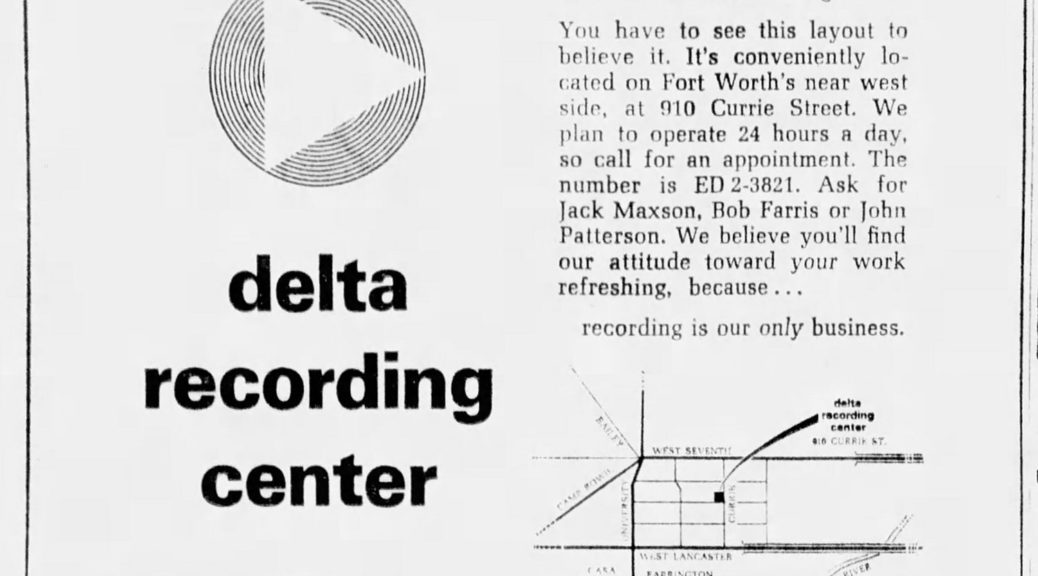
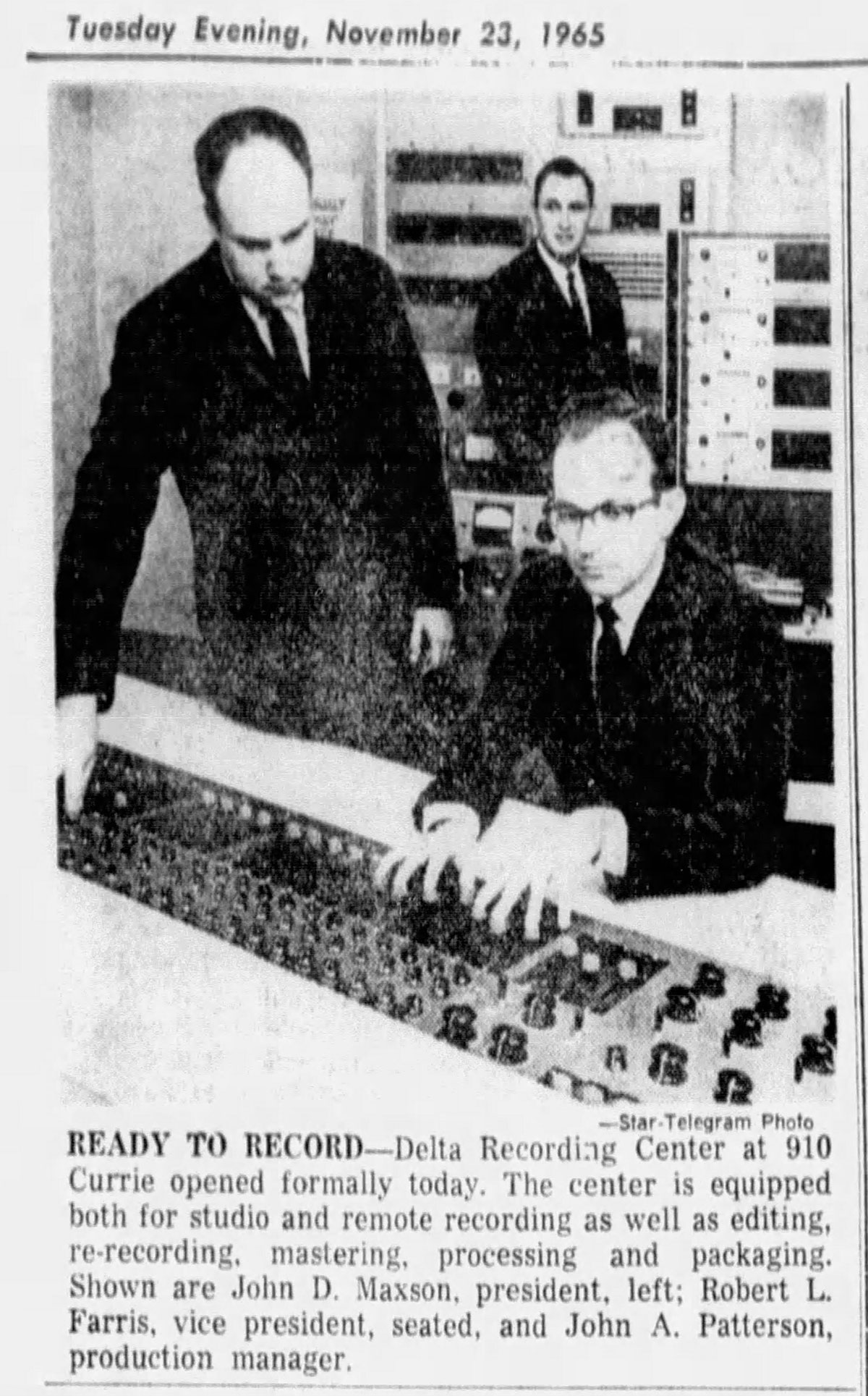
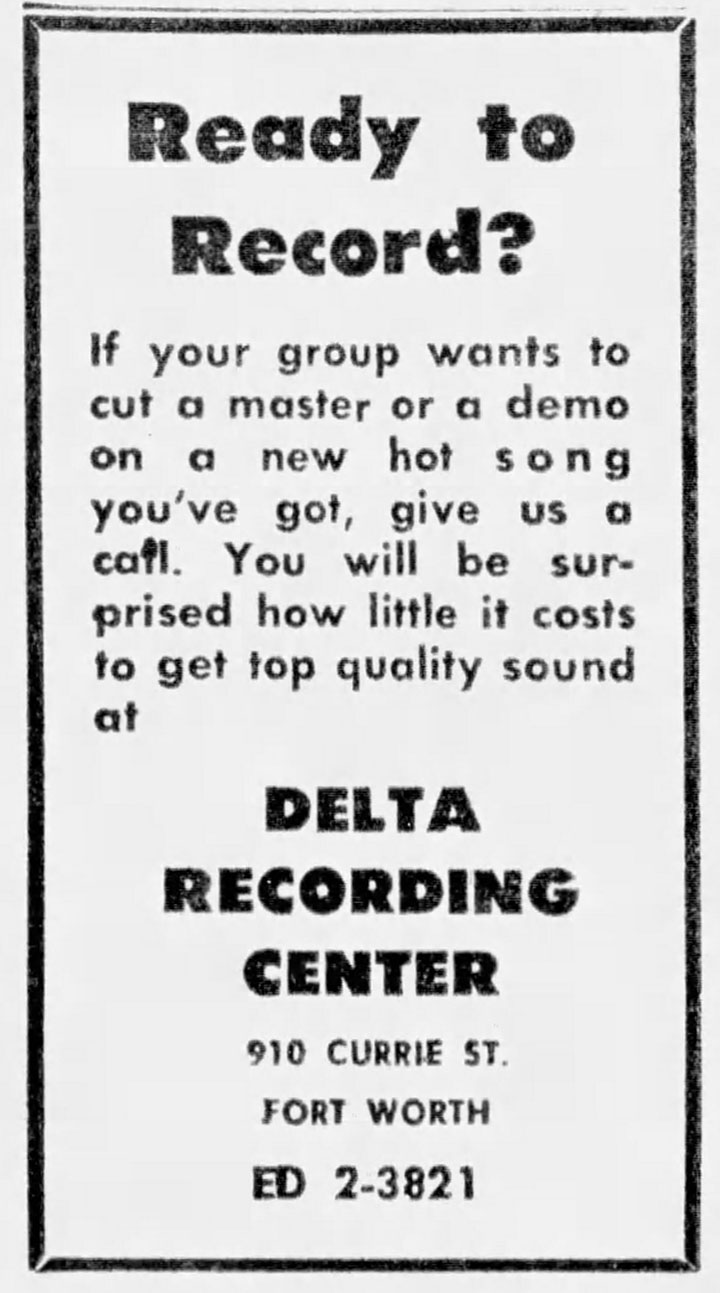
Delta Recording Center, aka Delta Studio, Fort Worth, 1965Opening announcement, Nov 23, 1965
Delta Recording Center opened in November 1965 at 910 Currie. It was one of a handful of Fort Worth recording studios in the mid-’60s, including Clifford Herring, Sound City, and Bluebonnet Recording Studios.
Garage rock was only a small part of their business, which would have included much gospel, country and other types of music.
I’m sure there were many other rock singles cut at Delta, but these seem to be definite:
Charay Records C-17 – The Elite – “One Potato” / “Two Potato” Charay Records C-31 – The Elite – “My Confusion” / “I’ll Come to You”
Ector Records 101 – The Jades – “I’m Alright” / “Till I Die” (Prod. & Eng. by Jesse Smith)
Sound Track ST-2000 – The Reasons Why – “Don’t Be That Way” / “Melinda”
November 1966 adJohn D. Maxson from Dallas was owner and engineer, Robert L. Farris, vice president, and John A. Patterson, production manager. It is often referred to as Delta Studio or Delta Recording Studio instead of Delta Recording Center.
Maxson was also part owner of Spot Productions, Inc, at 2831 Bledsoe, which produced TV and radio jingles, breaks, and programming.
Johnny Patterson, guitarist with Bob Wills’ Texas Playboys and other groups, bought the studio in 1969.
By 1973 it was running ads that boasted:
“Ampex and Scully mono, two, four and EIGHT TRACK recorders. When you record at Delta you receive a custom service … from mastering and processing, to labels, album covers, cassettes and cartridges.
In February, 1974 the Star-Telegram announced:
Lawton Williams is the new manager of Delta Recording Center, owned by Rick Snow and Jim Shadle. Johnny Patterson, formerly with the Bob Wills band is chief engineer and directs the house band.
Demos / acetates from Delta Recording:
The Tracks- “Rain in My Eyes” (?) / “Don’t Cut My Hair”
Louis Howard – “You Can Do as You Please” / “Comin’ Home to You”
Louis had a 45 on Impact Records I-4074 with the Red Hearts, “You’re Too Much” / “I’ve Got the Feeling”.
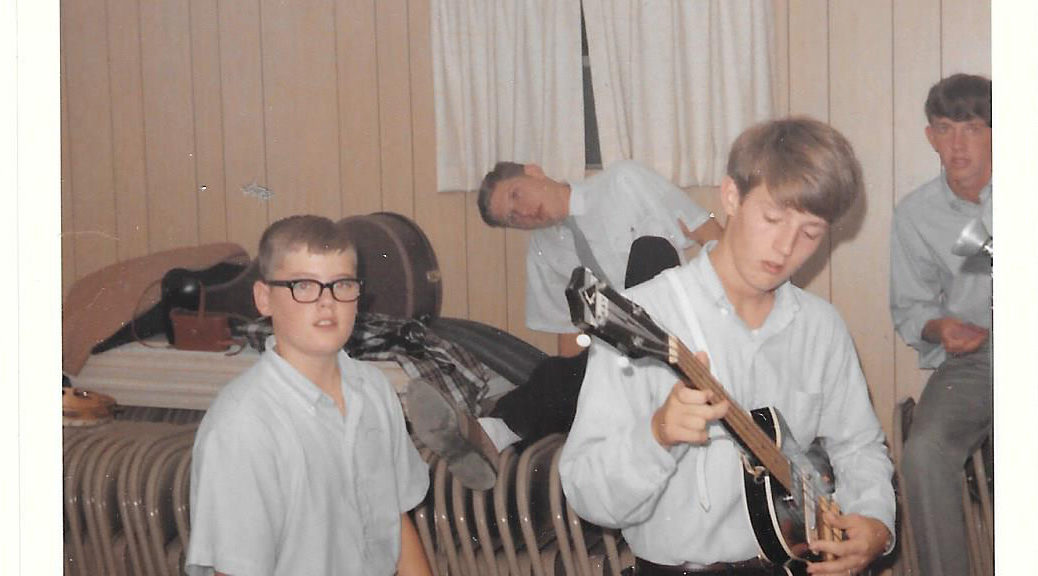
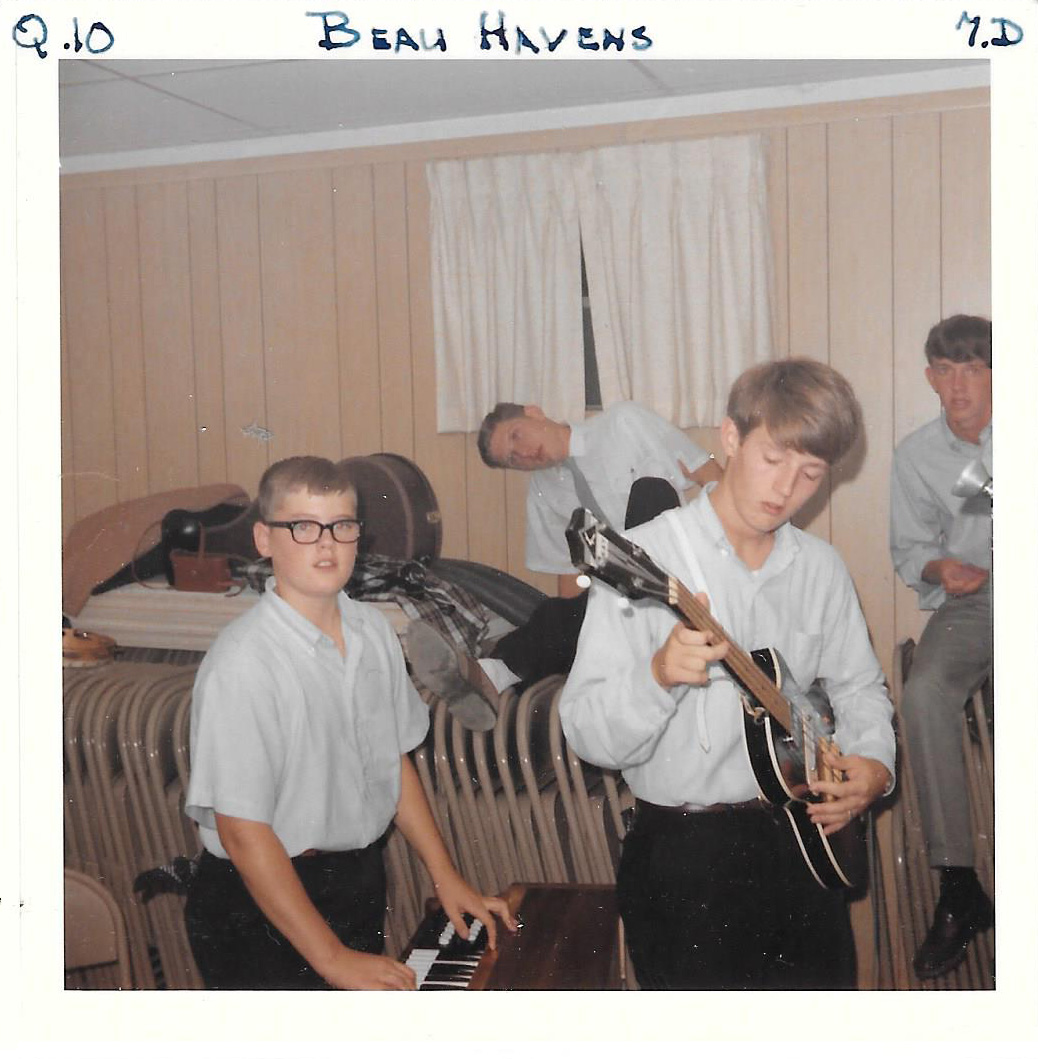
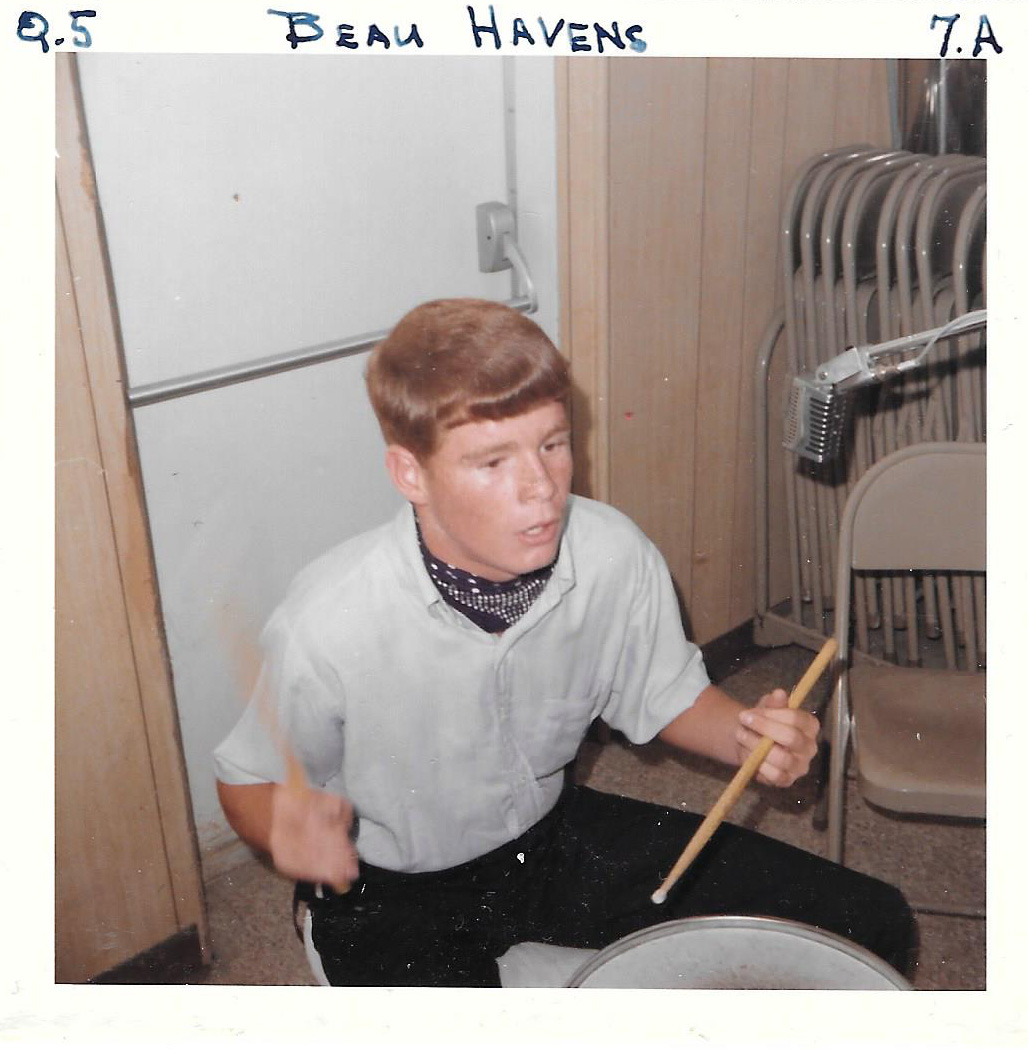
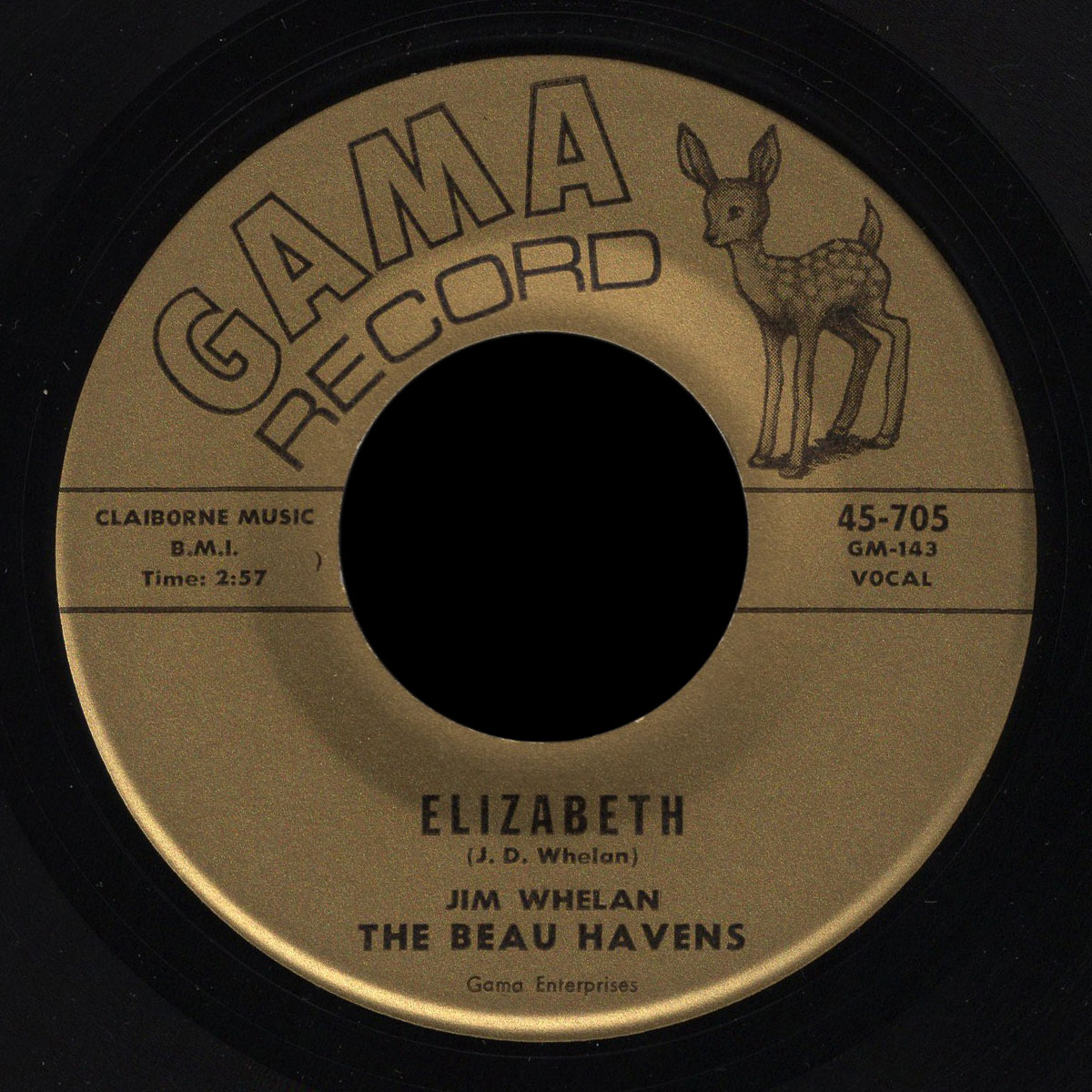
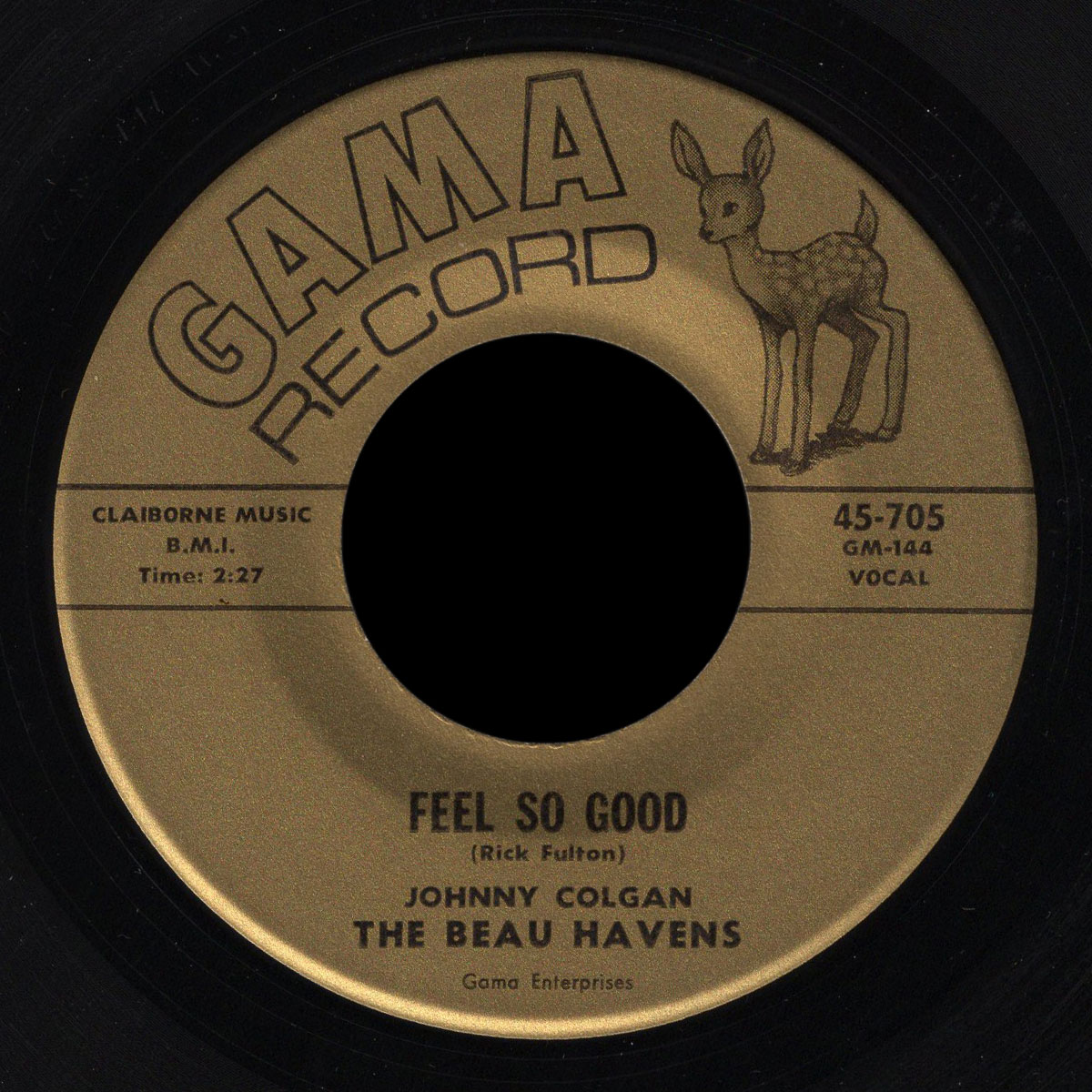
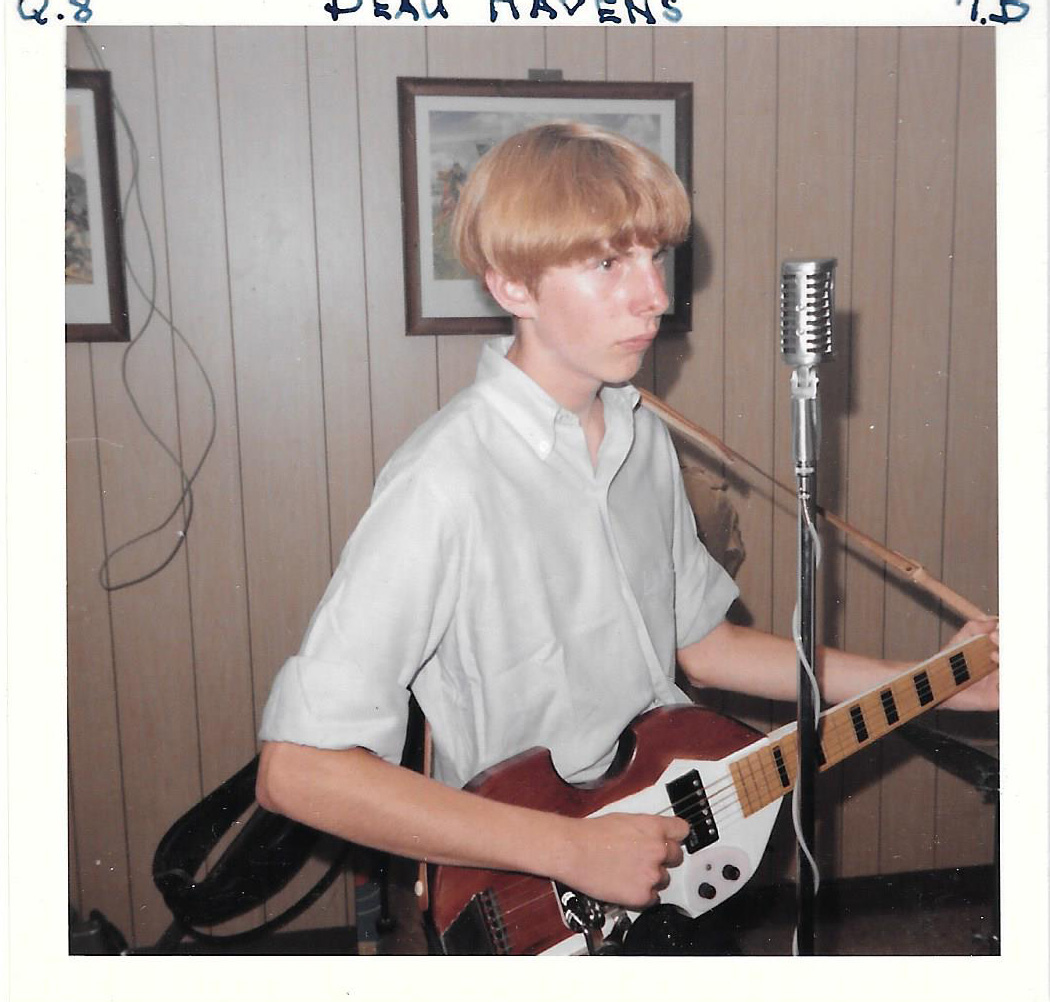
The Beau Havens had one record, the fantastic “Elizabeth” / “Feel So Good” on Gama Records 45-705 from September, 1966. The photos seen here were taken about a year earlier, in 1965.
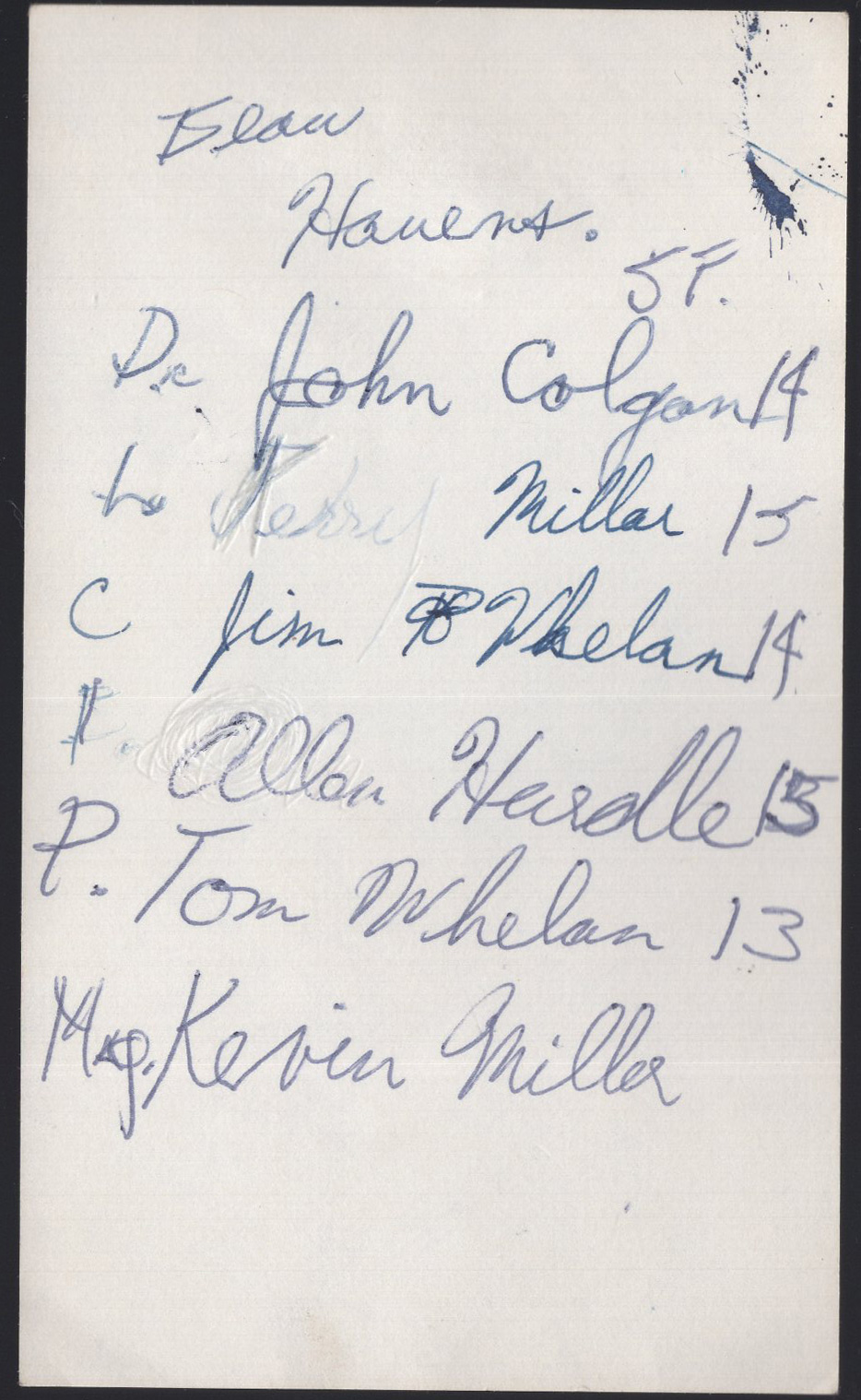
I’m trying to decipher the hand-writing on this card, so members’ names may not be spelled correctly. Any help would be appreciated:
John Colgan – drums, vocals on “Feel So Good” Kerry Miller – lead guitar Jim Whelan – lead vocal on “Elizabeth” Allan Hurdle (or is it Allen Hurdle?) – guitar Tom Whelan – piano
Kevin Miller – manager
The group were all young teenagers in ’65.
Belle Haven, VA has been listed as their town of origin, however that eastern shore town is nearly four hours drive from the Springfield, Virginia American Legion Hall where these photos were taken.
The Beau Havens were actually from the Belle Haven subdivision south of Alexandria, VA, in Fairfax County (tip of the hat to Chris Farrell for pointing out the correct Belle Haven).
A neighborhood newsletter, the Belle Haven Tribune, from May 7, 1965 featured the group. The newsletter spells the brothers names as Tom Whealen and Jim Whealen.
A Pi Alpha Gamma banner appears behind the group, and it’s likely the Beau Havens shared the bill with the Londoners and the Roaches.
This should be Johnny Colgan on drumsPhoto of the Beau Havens – the drummer lacks his cravat
Jim Whelan wrote and, I think, sang lead on “Elizabeth”.
Rick Fulton wrote “Feel So Good”. I’m not sure if Rick was a later member of the band or simply a friend. Johnny Colgan appears to have sang lead on this side.
Both songs likely were cut at Edgewood Recording Studio at 1627 K Street, N.W. in Washington D.C. A couple of Edgewood acetates of the single exist. On one the song has the title “She Makes Me Feel So Good”, corrected in pen to “She Makes Me Feel Right”.
Doesn’t sound like the Beau Havens had a keyboard player on the record. Claiborne Music published both songs.
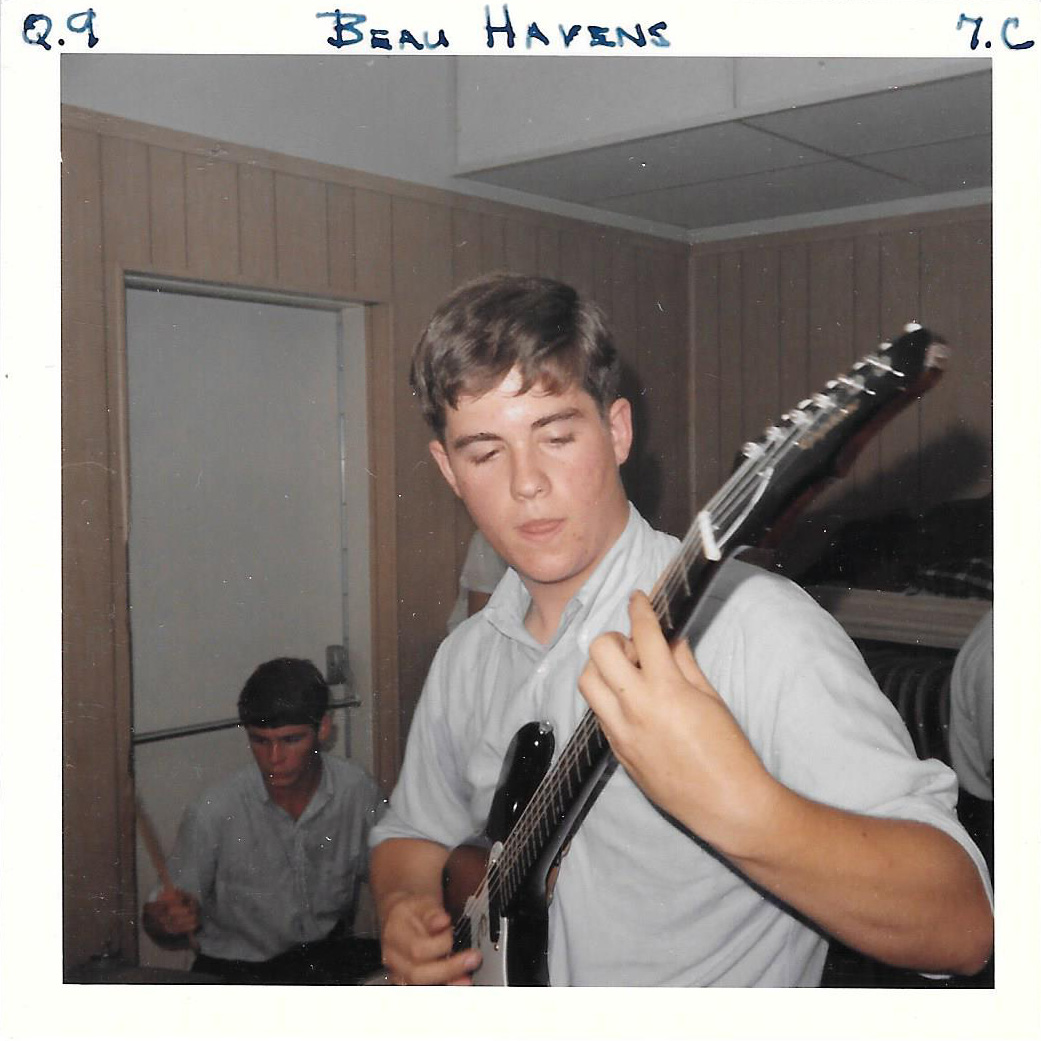
I believe this is Kerry Miller of the Beau Havens
More info on the Beau Havens would be appreciated.
Update May, 2022:
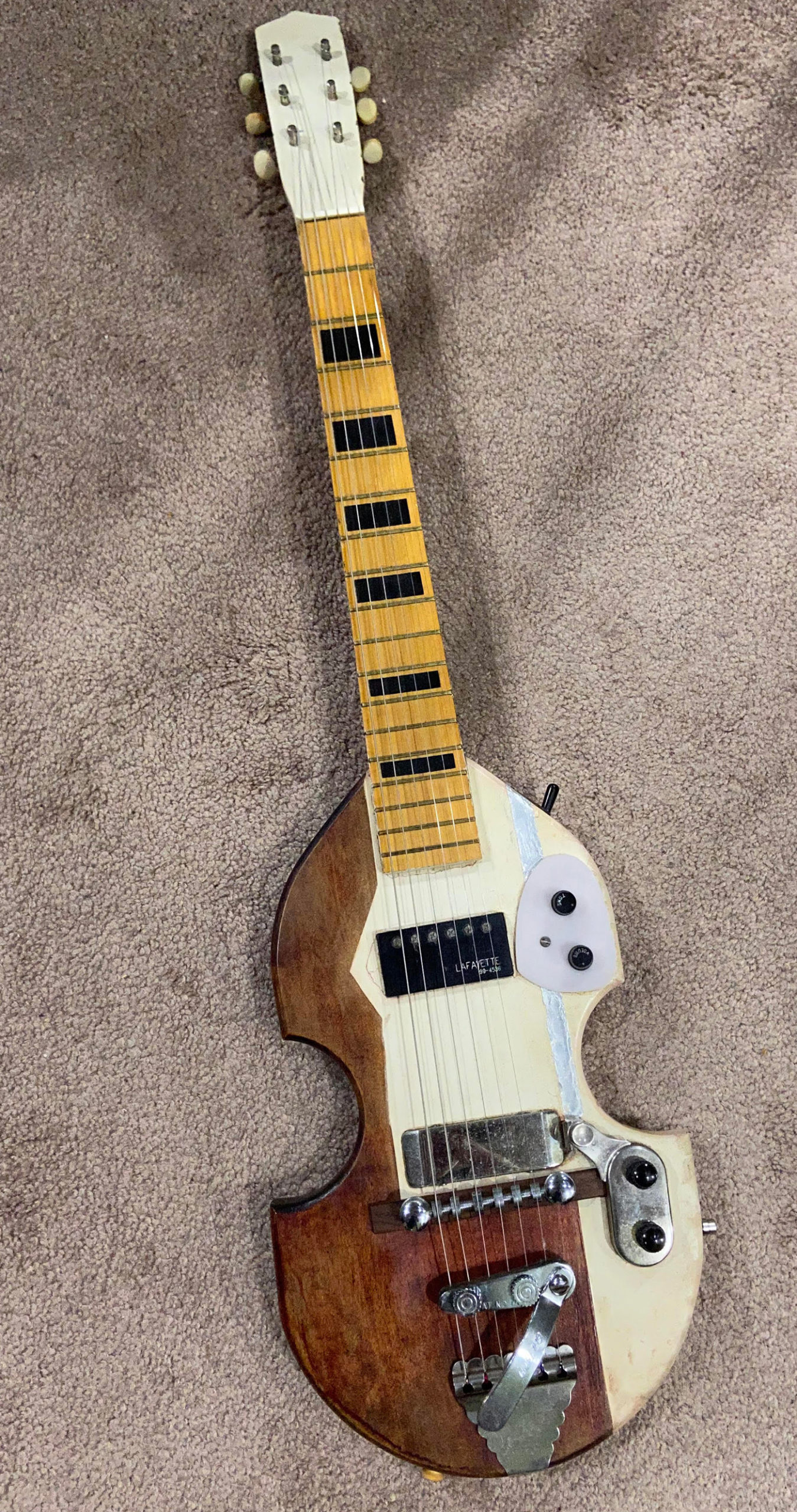
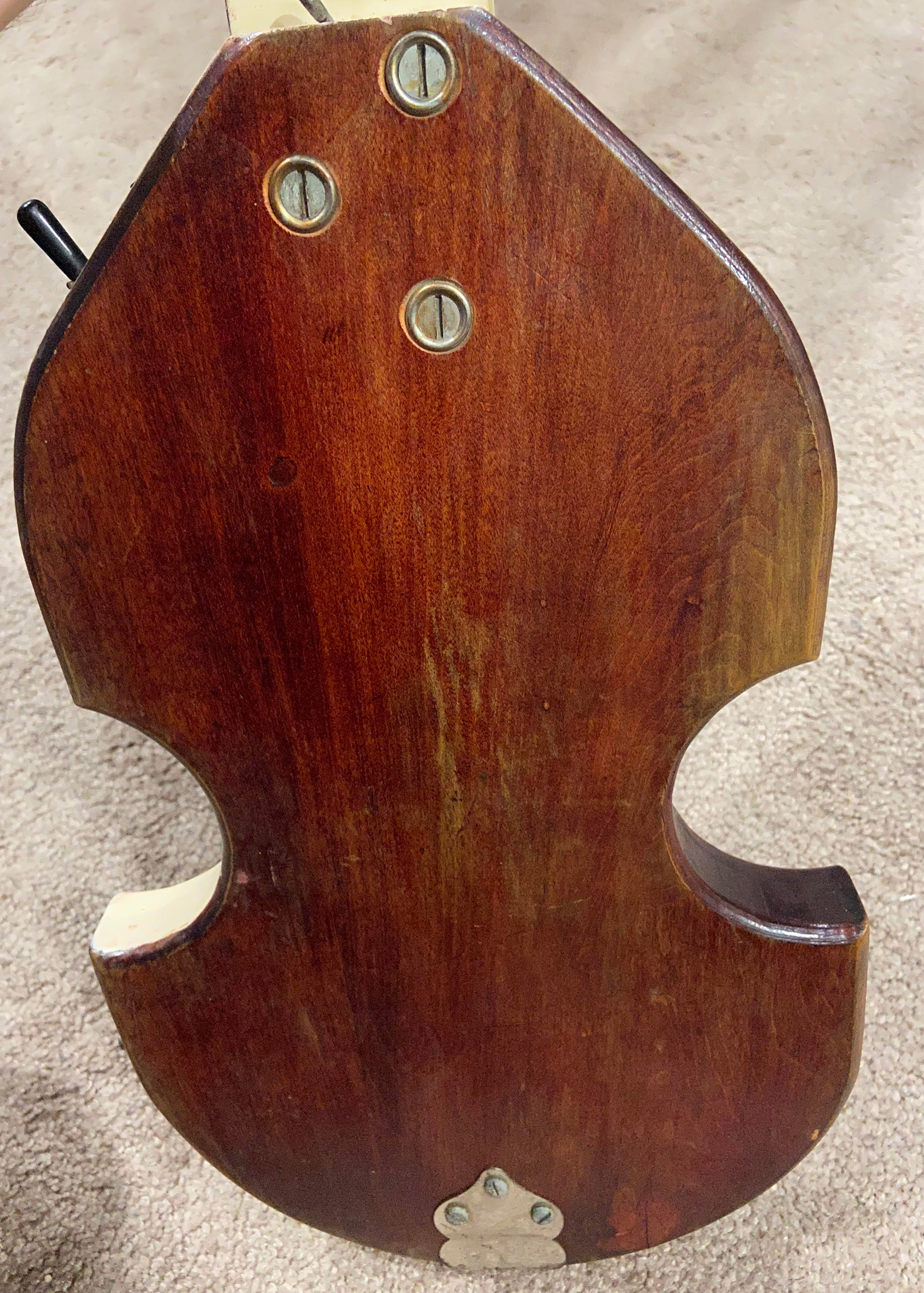
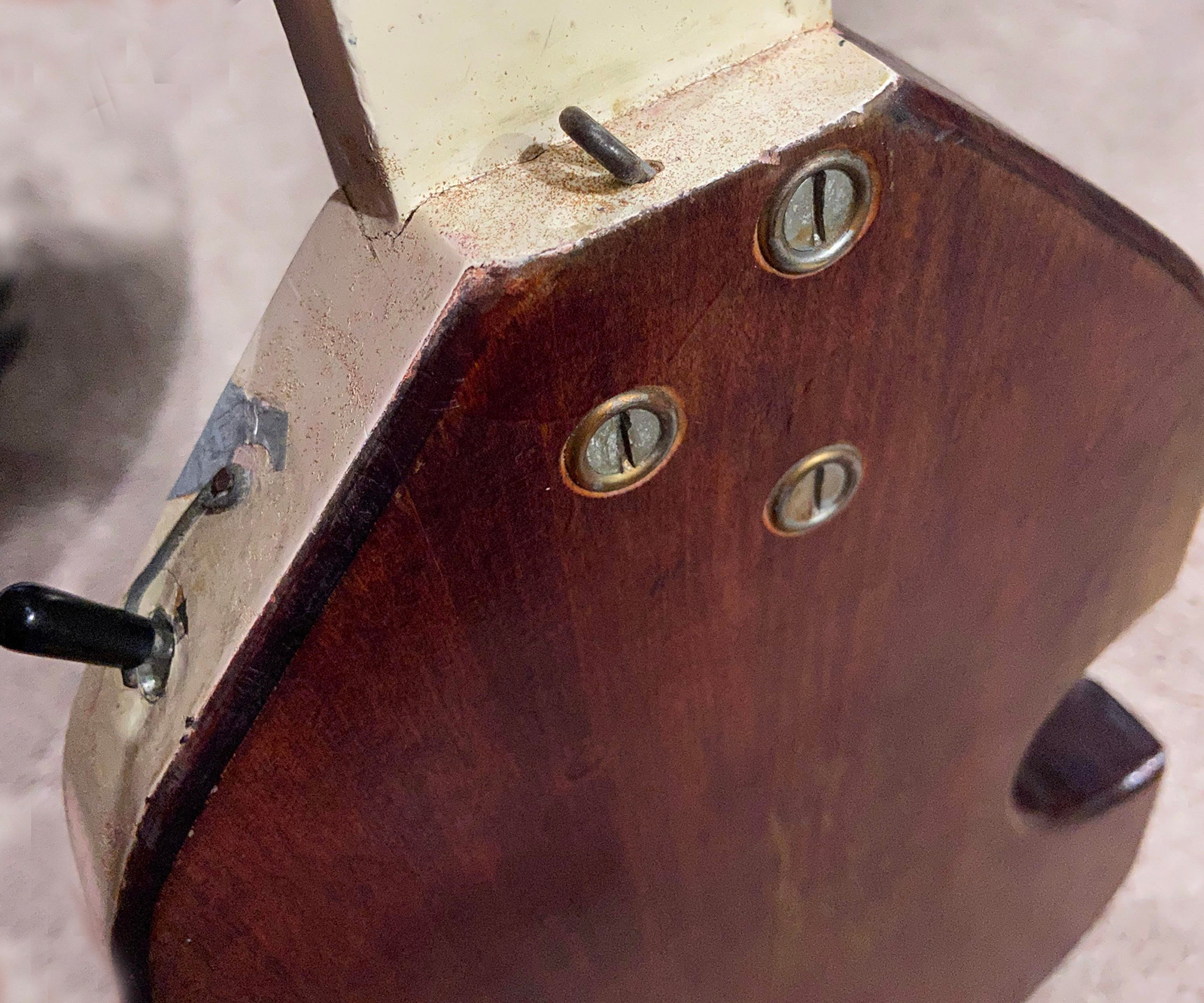
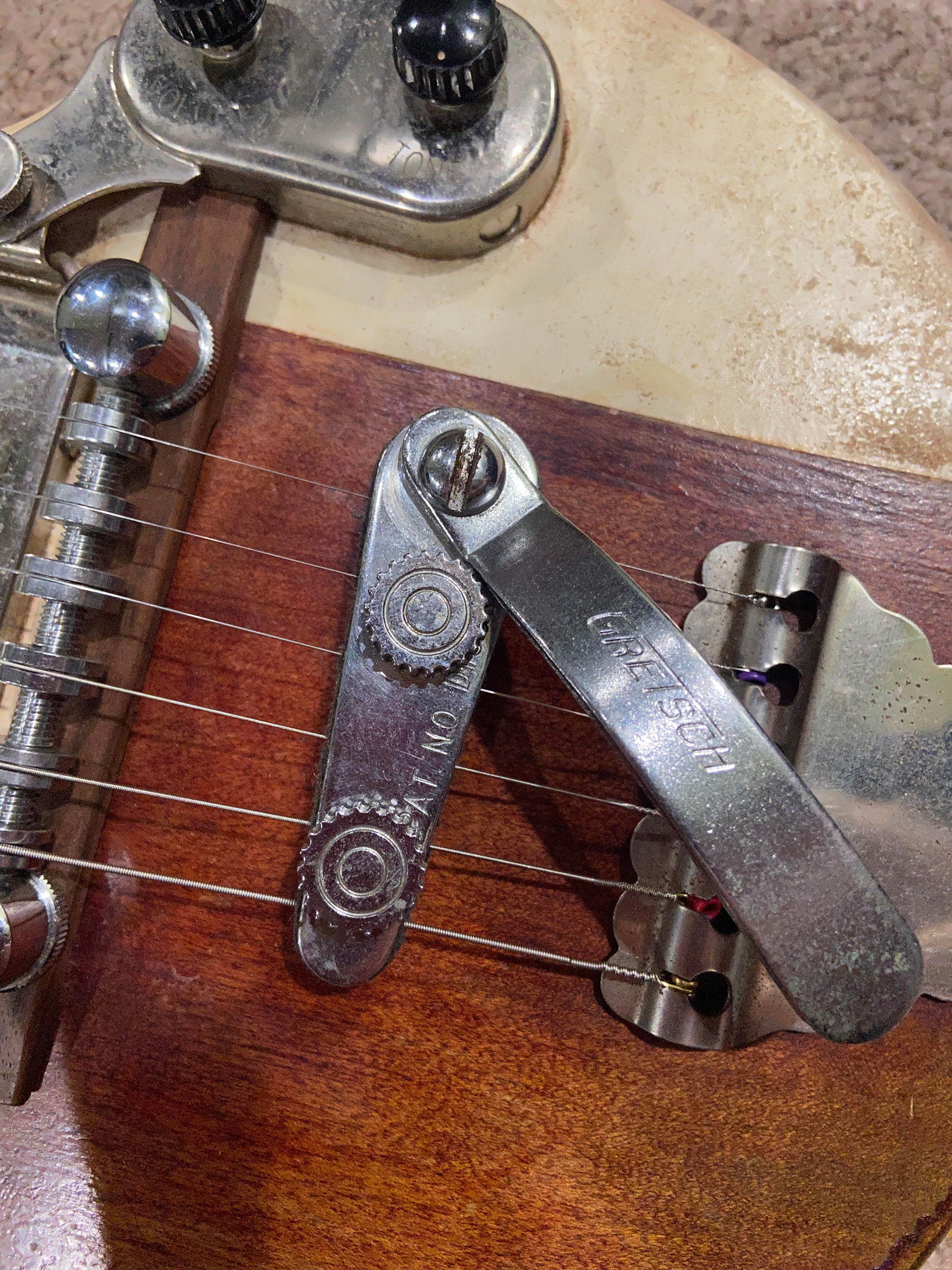
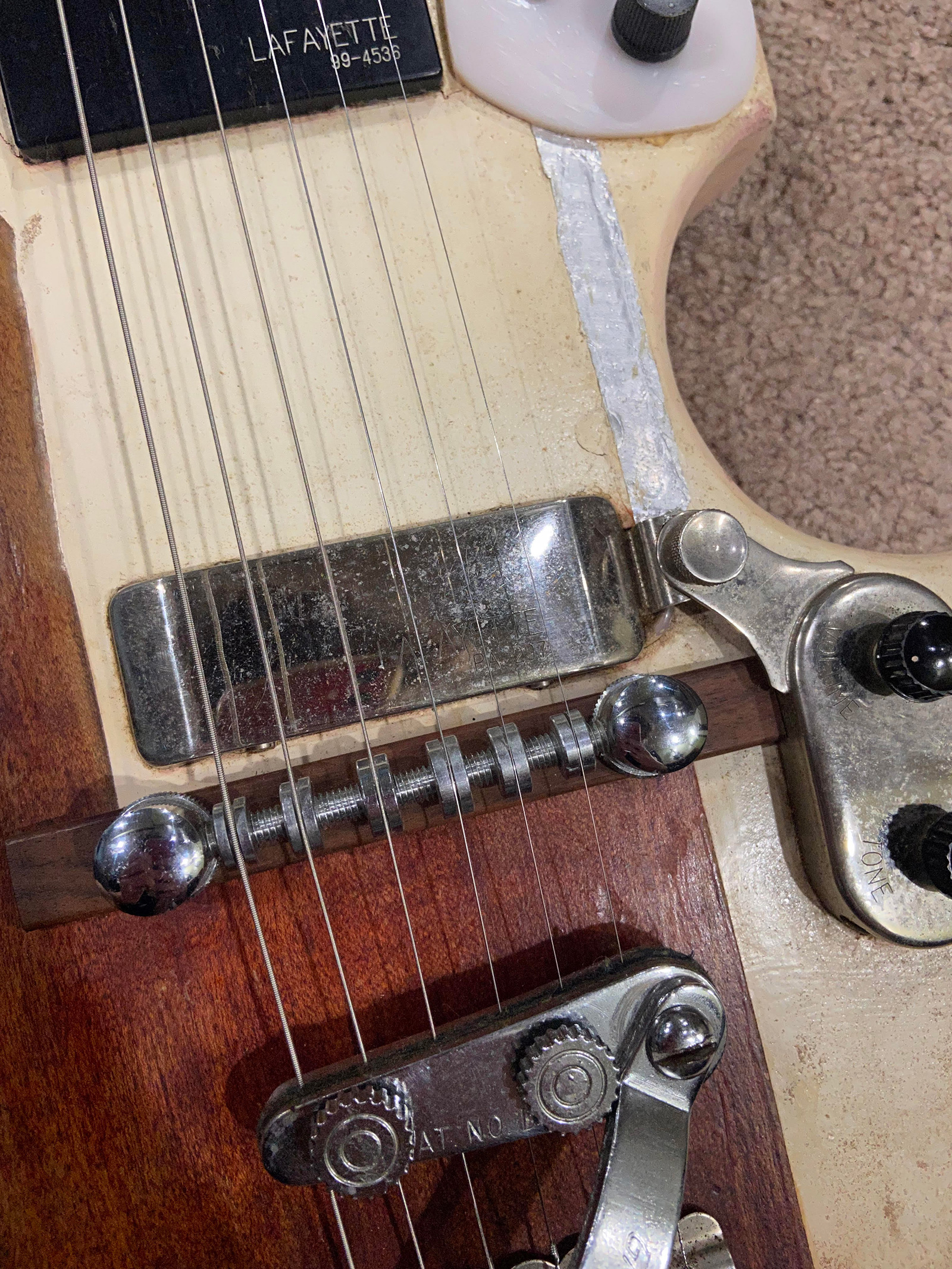
Danny G purchased a guitar in the D.C. area and the name on the case helped him trace it to this post, where it is clearly the guitar in the last photo above. Below are some interesting photos of this custom-made guitar provided by Danny along with his description:
Kerry Miller’s custom-made guitar
Likely a neck taken from an unbranded Kay guitar and put onto a solid chunk of mahogany (?). The white paint was to emulate the pickguard on a Höfner bass.
The guitar uses two Lafayette pickups, a 99-4536 in the neck which is a screw on pickup made for jazz arch top guitars and a PA-297 acoustic soundhole pickup in the bridge. The guitar has a really unique sound because of the odd choice of pickups, and that’s part of the reason I bought it.
The bridge pickup came with an RCA input and he simply repurposed it as the main input.
Kerry’s guitar – one hook to keep the pickup selector in place, and an eye for the guitar strapGretsch Tone-Twister palm vibratoLafayette pickups
Receipt from Clifford Herring Sound Equipment for the Motovators session
Clifford Herring and Sound City were two separate recording studios at the same address, 1705 W. 7th St. at the corner of Fournier St. in Fort Worth.
Clifford Herring opened his studio in the 1930s or early ’40s, a large room that could fit an orchestra or big band. Herring recorded many country, rockabilly and pop records, most famously Bruce Channel’s “Hey! Baby” and Paul and Paula’s “Hey Paula”, both produced by Major Bill Smith.
Besides the recording studio, Clifford Herring Sound Equipment Co. sold, rented and installed film, dictating and sound equipment, and also had a Muzak business.
The Motovators recorded a demo there on March 4, 1965, one of the last artists to use Herring’s studio.
On April 2, 1965, the Star-Telegram reported:
Radio station KXOL has purchased Clifford Herring Sound Equipment Co. for more than $200,000, The purchase includes the Herring firm’s recording studio and sound equipment operation said Wendel Mayes Sr. of Brownwood, president of the broadcasting station.
Earle Fletcher, the station’s vice president and general manager announced Thursday. Extensive remodeling of the Herring building at 1705 W. 7th will begin immediately with occupancy expected about June 1. The building will house the station’s AM and FM broadcasting studios, news facilities, sales offices and other departments.
Fletcher said remodeling of the Herring building will give the station more than double its present space at 3004 W. Lancaster.
KXOL renamed the Herring business Sound City, Inc. I believe Herring’s large recording room was converted into KXOL’s studios or office. The new Sound City Recording Studios opened in the basement below KXOL’s studios.
KXOL sold off the equipment and rental parts of the business to Thomas Electronics at the end of 1965. I’m not sure when KXOL sold the basement studio, but I’ve read the owners were Jim Rutledge and, apparently, T-Bone Burnett (Joseph Henry Burnett III) though he was only 17 in 1965.
Phil York became a house engineer at Sound City. York had worked with Dewey Groom at Echo Sound in Mesquite and would go on to work at Autumn Sound in Garland. While at Sound City he cut his own demo as Philip & the Yorkshires, “Once Again” / “Someone To Love You”, that was not released to my knowledge. York’s name appears in many classified ads run in 1966 and 1967 trying to drum up business for the studio.
A November 27, 1968 article notes that the studio was “recently sold to Don Schafer Promotions of Dallas”. Frank Henderson was another engineer at the studio about this time.
Perhaps the biggest hits recorded at Sound City were by the Van Dykes, such as “Never Let Me Go”, “No Man Is an Island”, “I’ve Got to Go On Without You”, and “You Need Confidence”, all produced by Charles Stewart and released on Mala.
T-Bone Burnett was usually referred to as Jon T. Bone on record labels during his Sound City time.
The Loose Ends included Burnett, Don McGilvray and David Graves, their singles “Free Soul” / “He’s a Nobody” (produced by Stan Rieck) and “Dead End Kid” / “Verses” were released on Mala, with co-producer credits to Burnett and Charles Stewart.
It would be interesting to assemble a discography of releases made at Sound City, but it’s an impossible task without documentation. Besides the ones mentioned above, it would include:
Brownfield BF-33 – The Rondels – “I Lost My Love” / “Crying Over You” Brownfield BF-1034 – Arthur Noiel - “It’ll Make You Holler” / “She Don’t Love Me” Brownfield BF-1035 – The Barons – “Don’t Burn It” / “I Hope I Please You” Brownfield BF-1037 – The Rondels – “You Made Me Cry” / “I Cry Cause I Care” Brownfield BF-1038 – Bruce Channel - “Don’t Go” / “The Actor” Brownfield BF-1040 – Jerry Williams & the Epics – “Whatever You Do” / “Tell Me What You See”
Cee Three – The Mods – “Days Mind the Time” / “It’s for You”
Cherry 101 – Charles Christy and the Crystals – “Cherry Pie” / “Will I Find Her”
Emcee Records - E-014 – The Gnats – “That’s All Right” / “The Girl”
Fat 12966 – Little Joe and the Gentlemen - “This Land” / “Stagger Lee”
Hue 375 – The Musical Training School – “Don’t You Fret” / “I’ll Go” (arranged by Jon T. Bone, produced by Charles Stewart) Hue 377 – James Mays – “Nothing’s Bad as Being Lonely” / “Gotta Make A Move”
Jan-Gi T-91 – The Trycerz – “Almost There” / “Taxman”
Psycho-Suave’ - PS-1033 – The Legendary Stardust Cowboy – “Paralyzed” / “Who’s Knocking at My Door” (picked up by Mercury)
Soft S-1008 – Roman Chariot - “Five Sensations” (arranged by John T-Bone) / “Cool” Soft S-1033 – Johnny Nitzinger – “Plastic Window” / “Life of John Doe” (produced by John Burnett and Charles Carey)
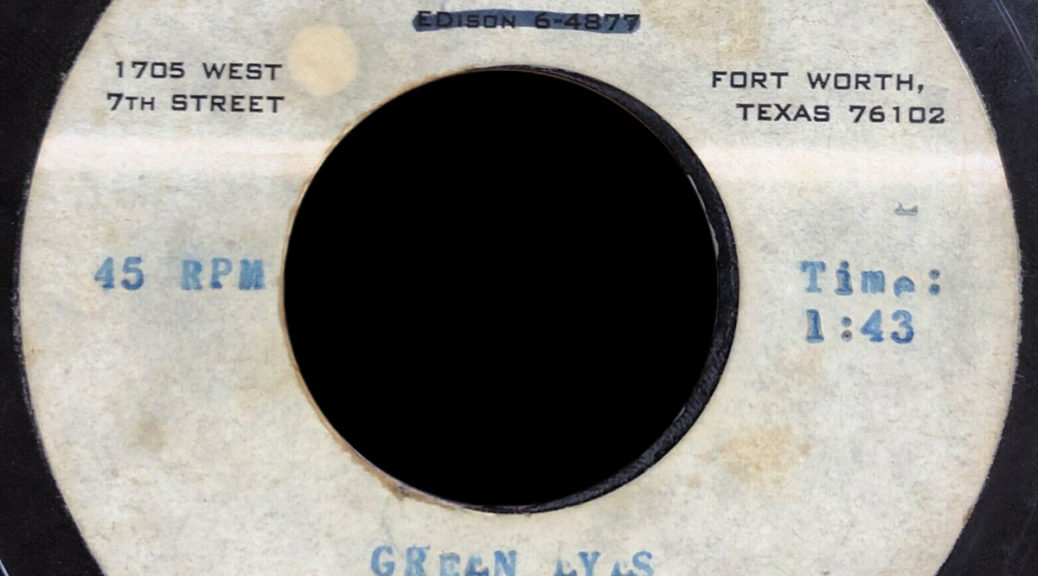
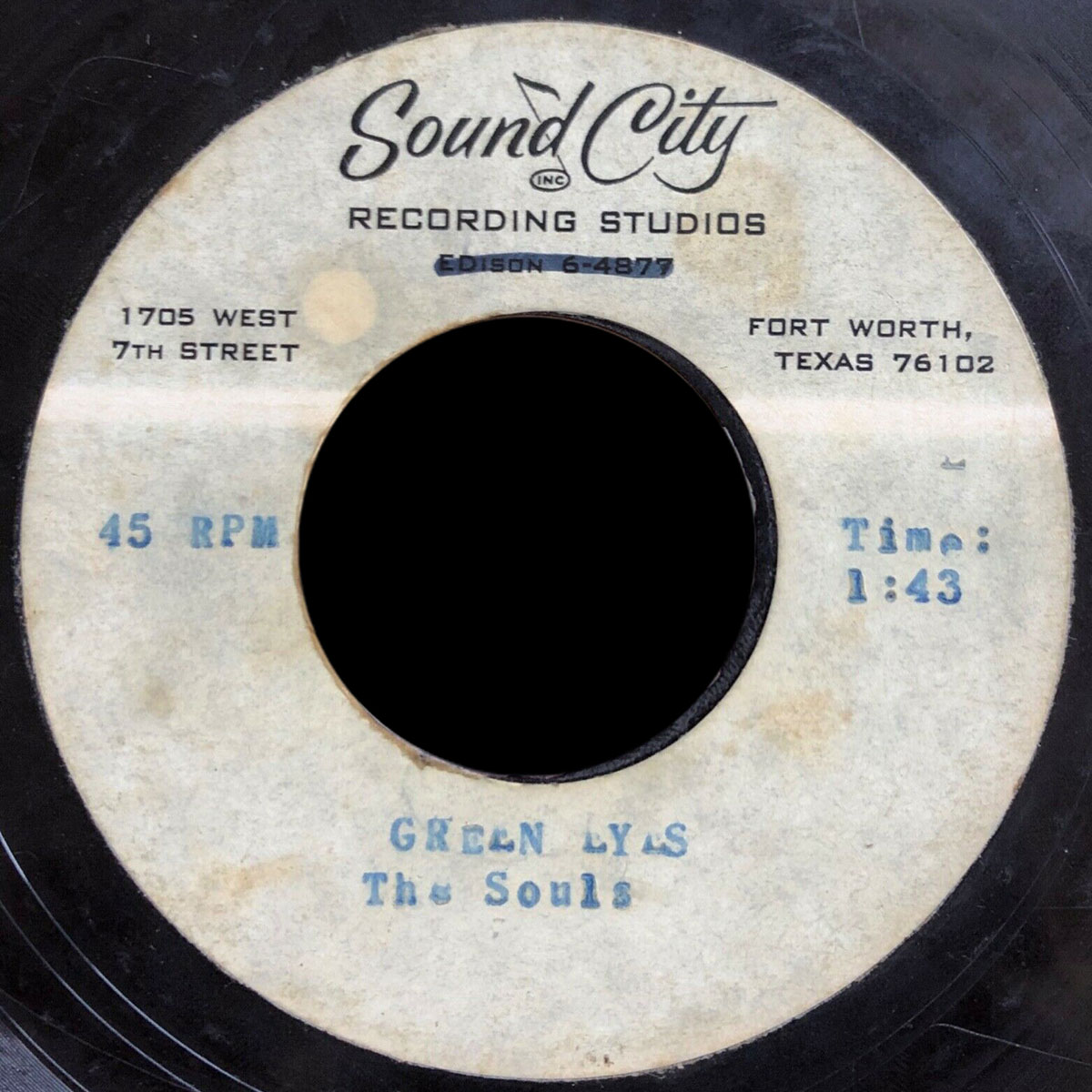
Unknown group the “Souls”
Sound City acetates or tapes:
Charles Christy & the Crystals – various titles (info to come)
The Cynics – “I’ll Go” / “Don’t You Fret”
Jackie Layne (with the Pathfinders) – “Give a Little, Take a Little” / The Galaxies – “Someone To Love You”
Larry & the Blue Notes – “In and Out” (early version) Larry & the Blue Notes – “Train Kept a Rollin'”
The Mods – “Evil Hearted You”
Rising Suns – “I’m Blue” / “Little Latin Lupe Lu” + two other cuts
Some tracks on the Galaxies CD collection Think About The Good Times were cut at Sound City, but I don’t have that release on hand.
LPs:
The Abstracts on Pompeii
The Yellow Payees cut one song from their Volume 1 album, “Never Put Away My Love For You” at Sound City.
Whistler, Chaucer, Detroit, and Greenhill – The Unwritten Works of Geoffrey, etc. , a Sound City studio group of two former members of the Mods, Scott Fraser and Edd Lively, with Phil White, David Bullock and John Carrick. Produced by Burnett.
Thank you to George Gimarc for help with this article.
Sources included: Frank Gutch, Jr., “Lost in Space: The Epic Saga of Fort Worth’s Space Opera” from the No Depression site is an excellent read with detailed information about later Sound City sessions.
David Campbell and Larry Harrison – notes to Fort Worth Teen Scene! volumes 1-3 on Norton Records.
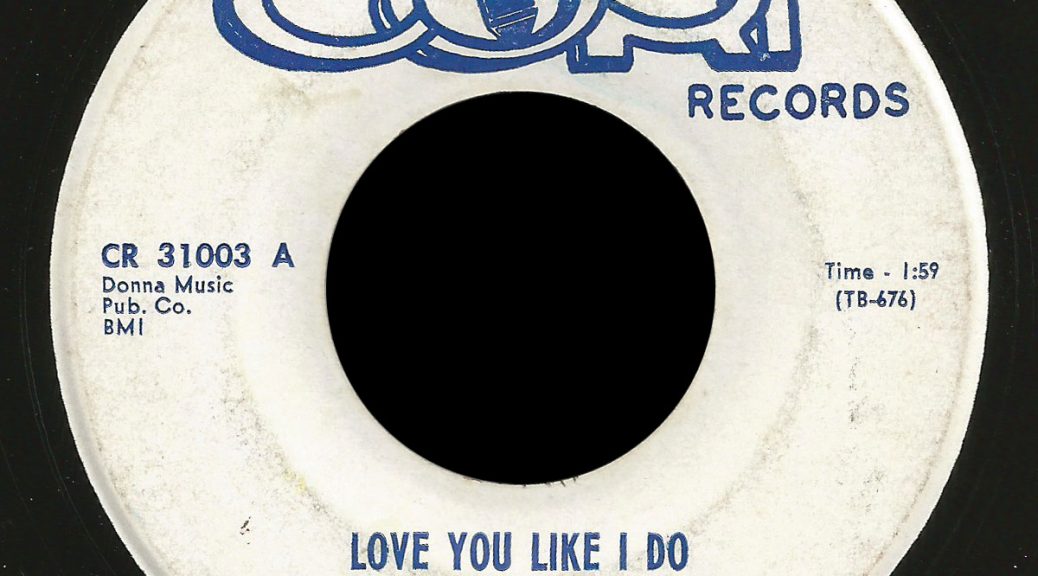
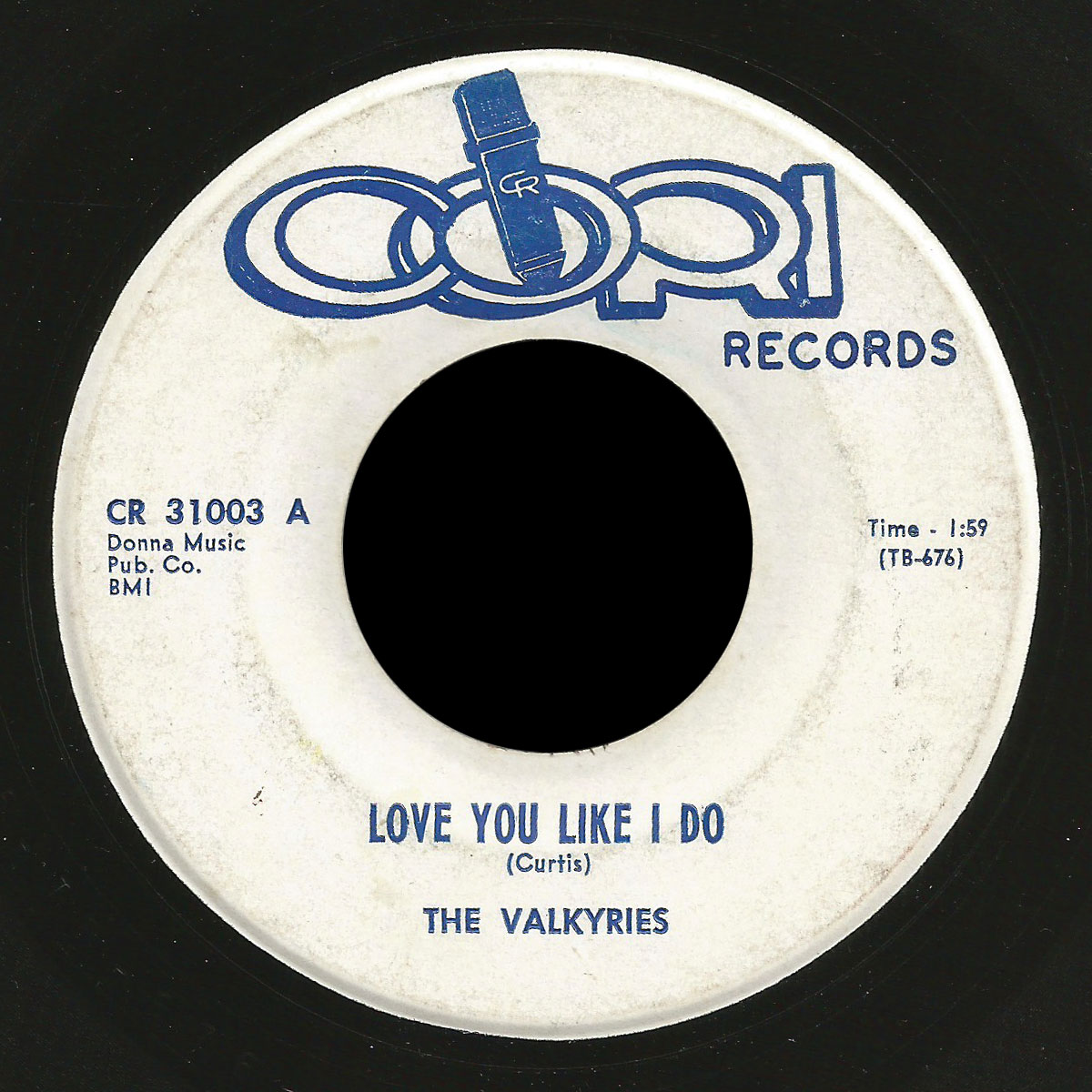
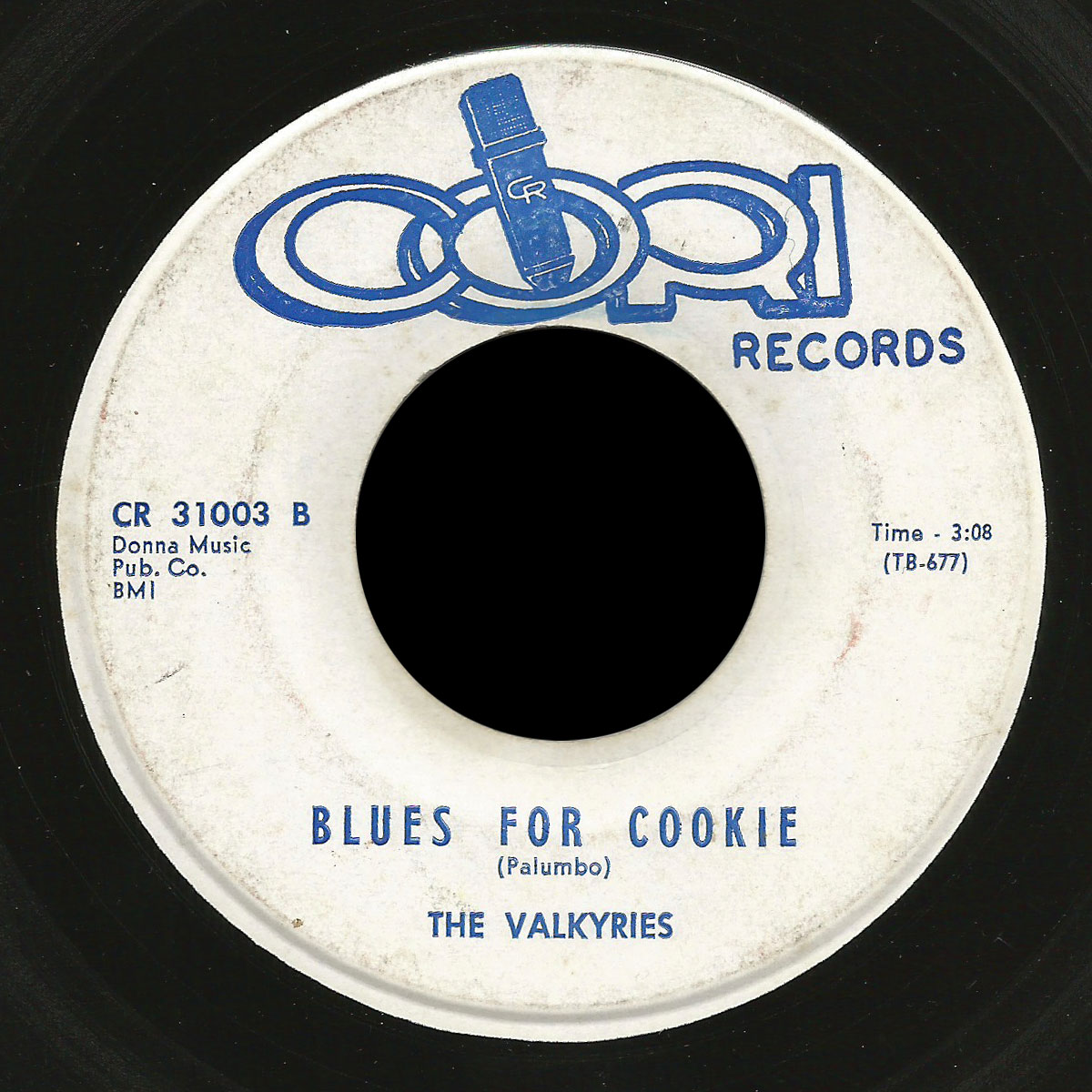
The Valkryies recorded one single at Continental Recordings in Framingham, released on Cori Records CR 31003. “Love You Like I Do” is excellent garage rock, with sharp drumming and good guitar and sax solos. “Blues for Cookie” is a slow saxophone instrumental.
Members included:
Frank Curtis – lead guitar and vocals Steve Thorp – rhythm guitar and backing vocals; bass guitar on the single Domenic Palumbo – tenor sax and bass guitar Stan Baker – drums and backing vocals
Until Steve Thorp commented, I had no info on the group other than two song writer names: Francis Curtis (Francis Wesley Curtis, Jr.) and Domenic Palumbo. F. Curtis, Jr. registered “(That’s Why) I Love You Like I Do” on September 29, 1965. Domenic C. Palumbo registered “Blues for Cookie” on August 9, 1965. Donna Music BMI published both songs.
Steve sent in the photos and answered my questions about the Valkyries:
The Valkyries (also known as the New Valkyries) were active in the suburban Boston, Massachusetts area between 1965 and 1967.
The Valkyries in Medford MA, November 1965
Location and Personnel: The members of the band came from several small towns about 25 miles southwest of Boston. Frank “Snuffy” Curtis, the leader of the band, lived in Medway, Massachusetts. Curtis was a veteran of the local rock and roll/garage band scene and had fronted an earlier version of the Valkyries. He was 23 years old in 1965.
Stan Baker and Steve Thorp were from Medfield, Massachusetts, about 6 miles from Medway. Baker and Thorp had met in high school. Baker played drums in the school band and Thorp had been playing guitar for four years on his own and in a few small folk groups and rock bands.
Thorp and Baker shared a mutual love of rock and roll and R&B. The two started jamming together in 1964 at Baker’s house. Baker and Thorp met Curtis through the local music scene, probably at a house party, and the three started playing together. Curtis then invited Baker and Thorp to form a new version of the Valks in early 1965.
Curtis knew a lot of people from the local music scene and brought in various musicians to play in the band from time to time. Domenic “Gitch” Palumbo was a tenor sax player and a friend of Curtis. Palumbo may have been from Franklin, MA, a small nearby city. Palumbo was the same age as Curtis, and, like Curtis, had a lot of experience in the local music scene.
By mid-summer the line-up was set: Curtis on lead guitar and vocals, Palumbo on sax, Thorp on rhythm guitar and back-up vocals, Baker on drums and back-up vocals. A succession of bass players came and went through the band.
Instrumentation and styles: The band played late 1950’s/early 1960’s American pop style: up tempo, guitar driven rock, with lots of reverb and a heavy emphasis on beat. Palumbo’s sax playing added touches of rockabilly and surf rock. Curtis’s singing reflected earlier singers like Gene Vincent and Eddie Cochrane. Although the band played mostly covers, Curtis was a talented songwriter who contributed several originals to the repertoire.
Where the band played: mostly high school dances and house parties. The band’s choice of venues was limited because Baker and Thorp were both underage and couldn’t work in bars and night clubs. Nevertheless, the group worked regularly and by 1966 was working bigger venues. The group’s biggest gig was opening for Sam the Sham and the Pharaohs in either late 1965 or mid 1966 at the Lake Pearl ballroom in Wrentham, MA (Palumbo had left the group, which now had a regular bass player). The group began to play small bars and clubs in the Boston area. Thorp left the group by the fall of 1966. The band continued to play as the “New Valkyries” until 1967.
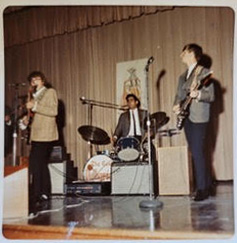
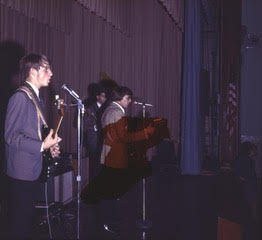
The Valkyries in Medford MA, November 1965
Two photos show the group in action at a high school dance in Medfield, MA, in November 1965. Curtis, in the plaid sport jacket, is at center mic. The bass player partially shown in one of the photos may be Palumbo. Thorp is shown taking the lead vocal in one photograph.How the recording came about: Curtis and Palumbo came up with the idea of recording in late 1965. Palumbo located Continental Recording Studios in Framingham MA, about 10 miles north of Medway, and he agreed to front the costs of recording and pressing the discs.
The band arrived at Continental’s studios, probably in mid-September, well-rehearsed and ready to play. The group didn’t have a bass player at the time, so Thorp played a borrowed electric bass on both tracks. The band recorded both tracks over a few hours, needing only a couple of takes on each track. “Love You Like I Do” was a Curtis original. “Blues for Cookie” was a slow, doo-wop instrumental featuring Palumbo, an acknowledgment of his fronting the recording and pressing costs.
The recording system was simple but effective. Both Curtis’s guitar solo and the harmony vocals were double-tracked, using an eight-track recorder.
The follow-up: although the record got a little air play on local radio stations, it never really went anywhere. The Valkyries continued on with different personnel throughout 1966 and 1967.
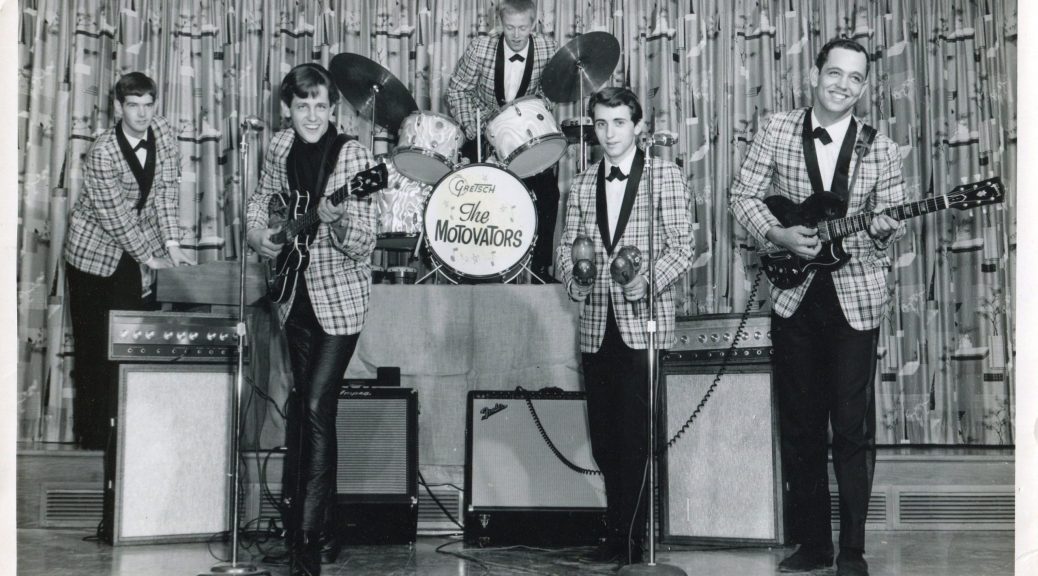
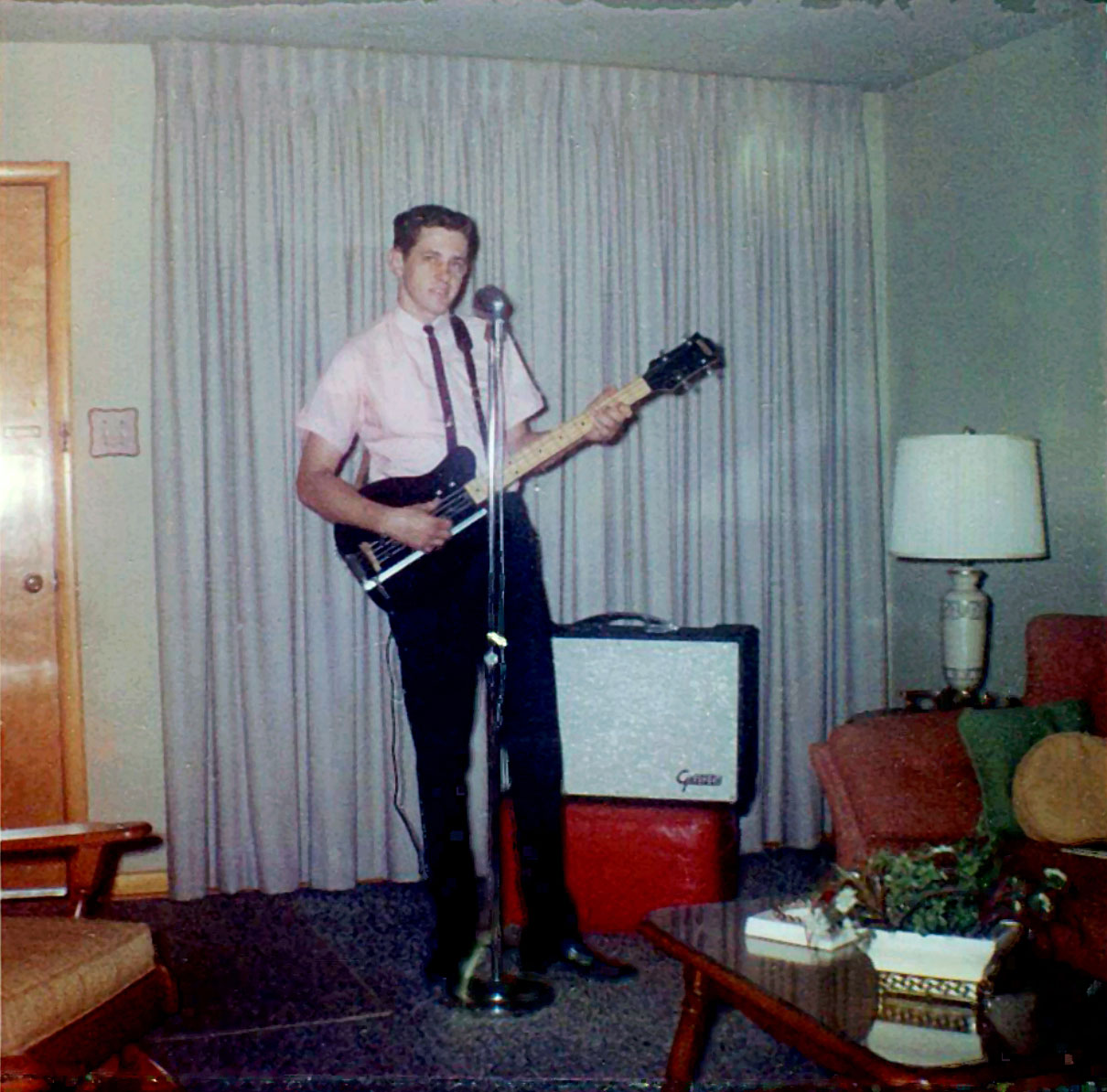
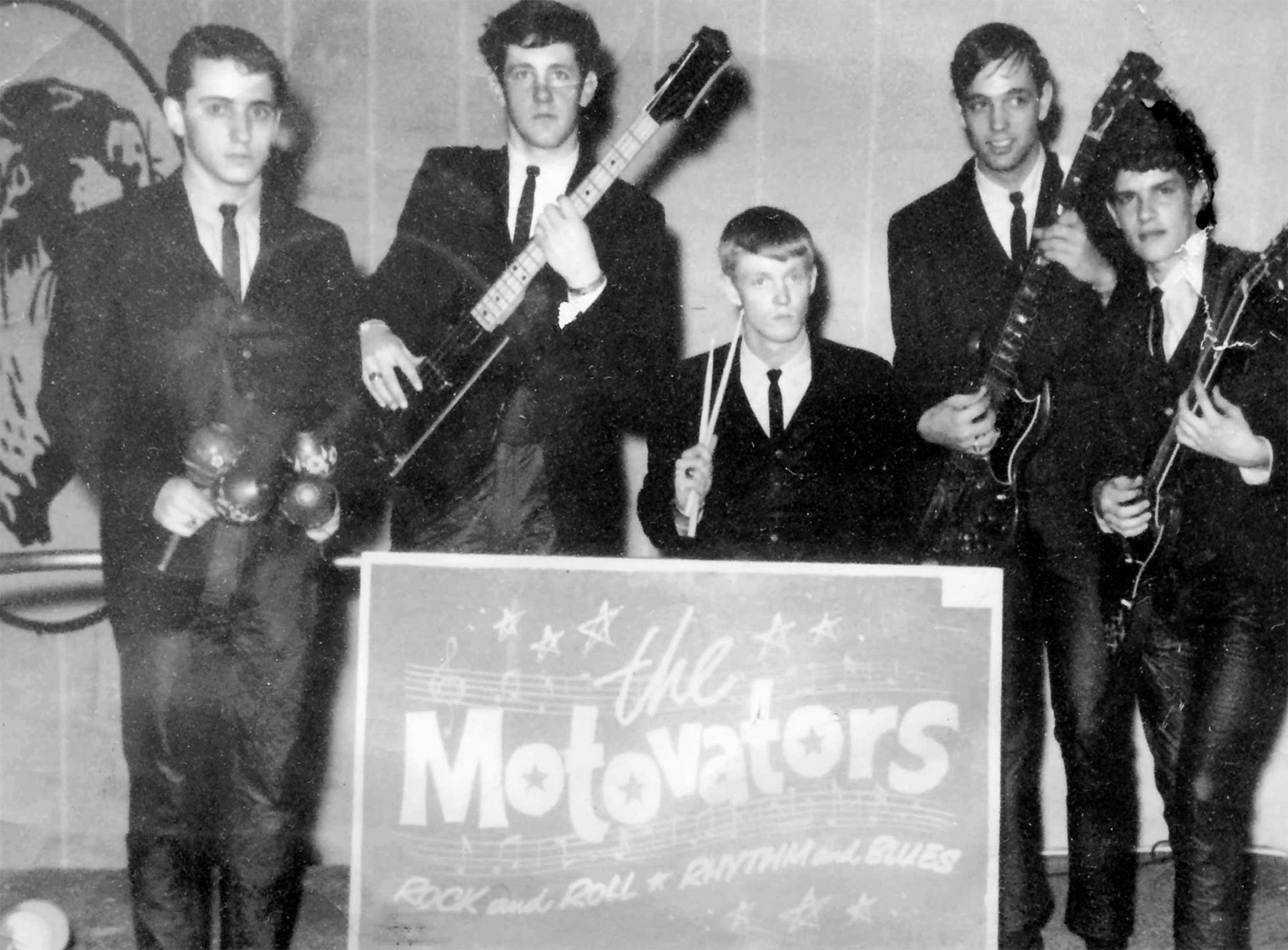
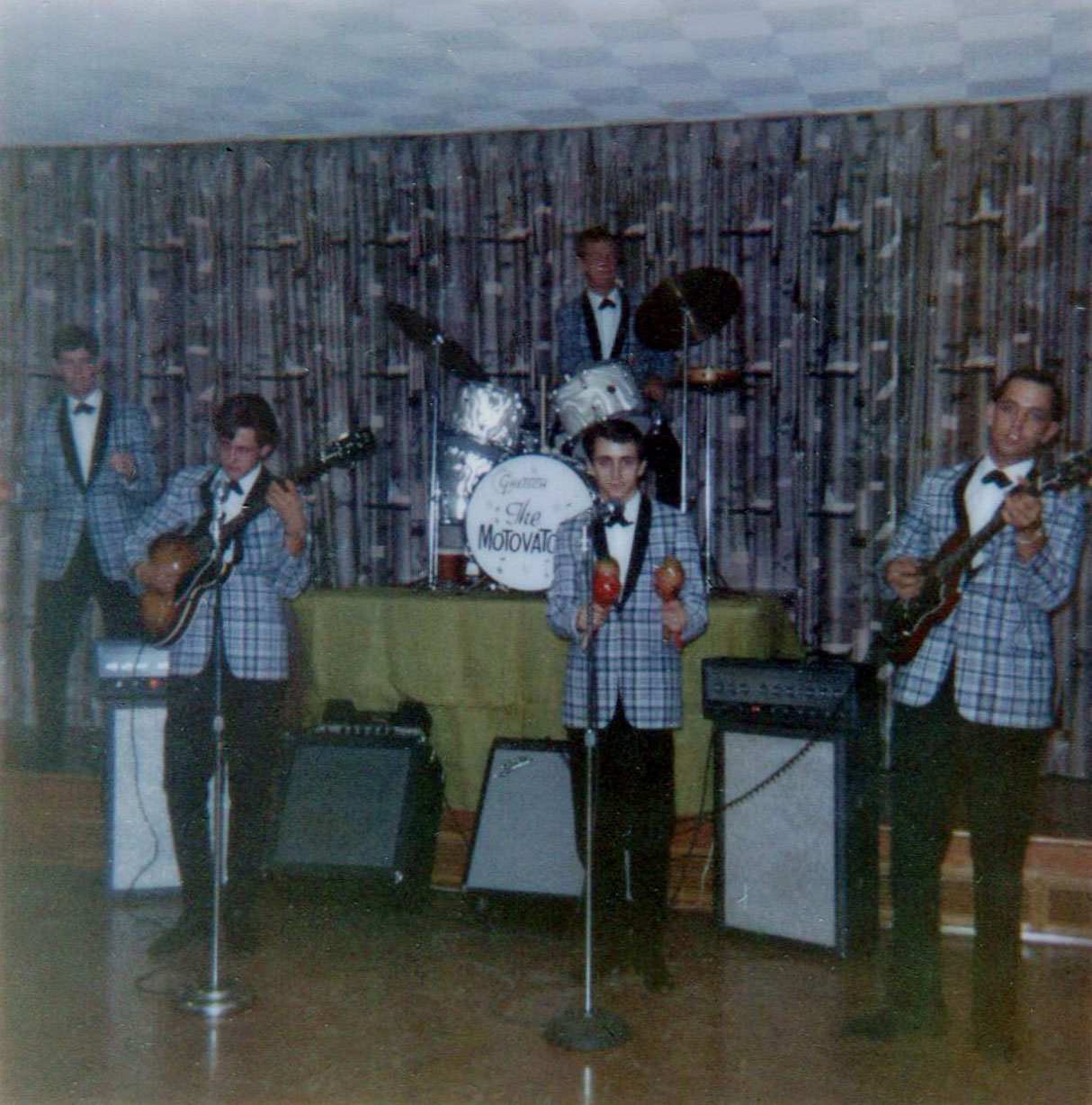
July 31, 1965, from left: Jimmy Smith, Terry Lee Hungerford, Roger Young on drums, Mike Langston, and Phil ReeceTerry Lee Hungerford with Gretsch guitar and amp, June, 1964
The Motovators formed in the spring of 1964 in Haltom City, just northeast of Fort Worth, Texas. The original lineup was:
Terry Lee Hungerford – bass and vocals Roger Young – drums Terry Fagan – lead and rhythm guitar Jimmy Nobles – rhythm guitar
Terry Lee Hungerford (b. June 28, 1947) and Roger Young played in all iterations of the group.
At least six other musicians would be in the group before their breakup in August of 1965:
Jimmy Moore – guitar Mike Langston – vocals and maracas Dale Morgan – lead guitar David Morris – lead and rhythm guitar Phil Reece – lead guitar Jimmy Smith – keyboards
The Motovators recorded two songs in March, 1965, but only two demo acetates were made and the record was never released.
Terry Lee Hungerford’s mother Blanche kept an excellent scrapbook of photos and clippings. She also kept a detailed log of the Motovators’ live shows, beginning with a steak house in Whitewright, TX, and notable events in the history of the band. Thanks to her work, and the help of Wm. Lewis Wms., I can present this detailed history of the Motovators and the Fort Worth scene in 1964-66.
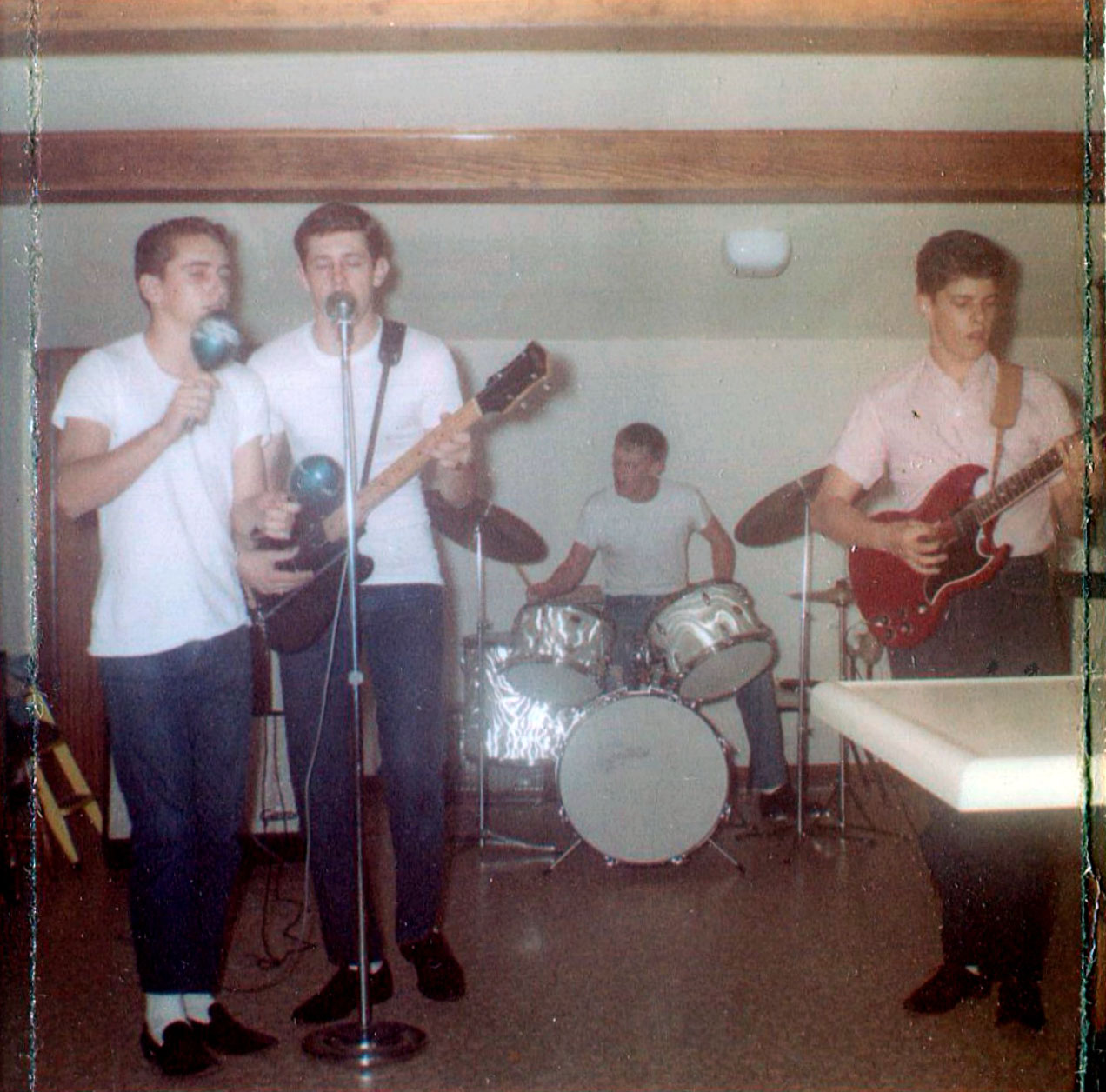
Motorvators practice photo, 1964, from left: Mike Langston, Terry Lee Hungerford, Roger Young and Terry Fagan
May, 1964 – The Joker Club – Terry, Roger, Fagan, Jimmy (first paying gig)
In June of 1964, Jimmy Nobles moved out of state and was replaced by Jimmy Moore. That summer Mike Langston joined on vocals and maracas.
Motovators lineup at this time was:
Mike Langston – vocals and maracas Terry Fagan – lead and rhythm guitar Jimmy Moore – guitar Terry Lee Hungerford – bass and vocals Roger Young – drums
December 5, 1964 to January 1, 1965 – ten shows at the Hi-De-Ho Club
December 24, 1964 – Jimmy Moore leaves band, replaced by Dale Morgan on lead, and Terry Fagan moves to rhythm guitar.
Lineup December 24, 1964 – March 5, 1965
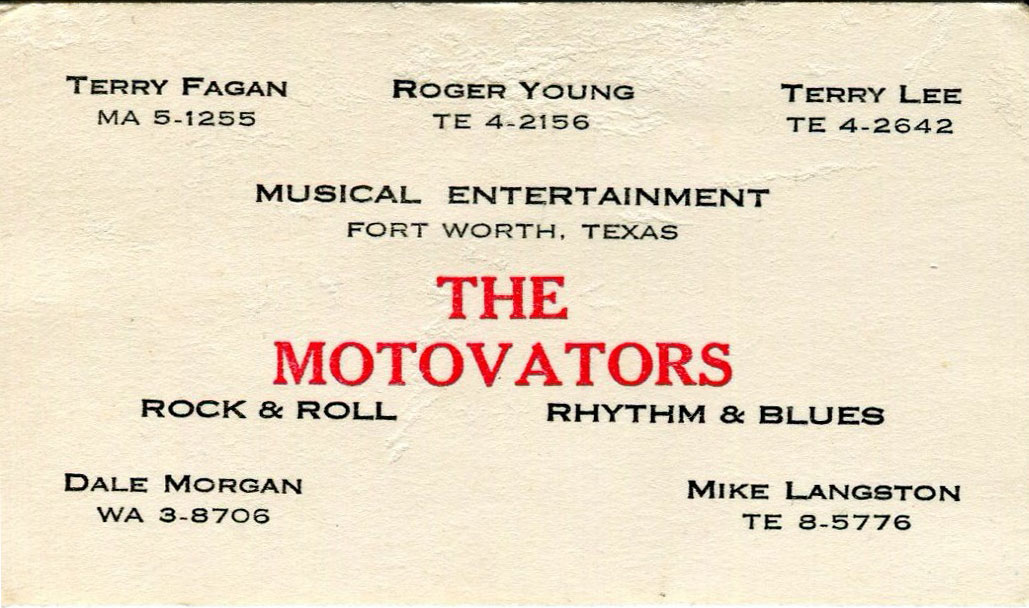
Motovators business card January or February 1965
Mike Langston – vocals and maracas Dale Morgan – guitar Terry Fagan – rhythm guitar Terry Lee Hungerford – bass and vocals Roger Young – drums
January 8, 9, 15, 16, 1965 – Club Contempo, 609 Riverside Drive (billed as Terry and the Motovators”
January 23, 1965 – Holiday Skating Rink ‘Battle-of-the-Bands” with the United Sounds, the Jades (2nd place), the Barons (1st place), the Coachmen and the Images, emcee is Mark Stevens WFJZ DJ.
February 6, 1965 – The Inn’s Tavern, 3132 East Lancaster
February 13, 1965 – Holiday Skating Rink – Valentine Dance “Holiday Hop” with the Images
February 20, 1965 – Jolly Time Skating Rink audition with KXOL DJ Bob Allen and rink manager Mr. Goodwin
March 1, 1965 – Panther Hall audition with KCUL DJ Ron McCoy
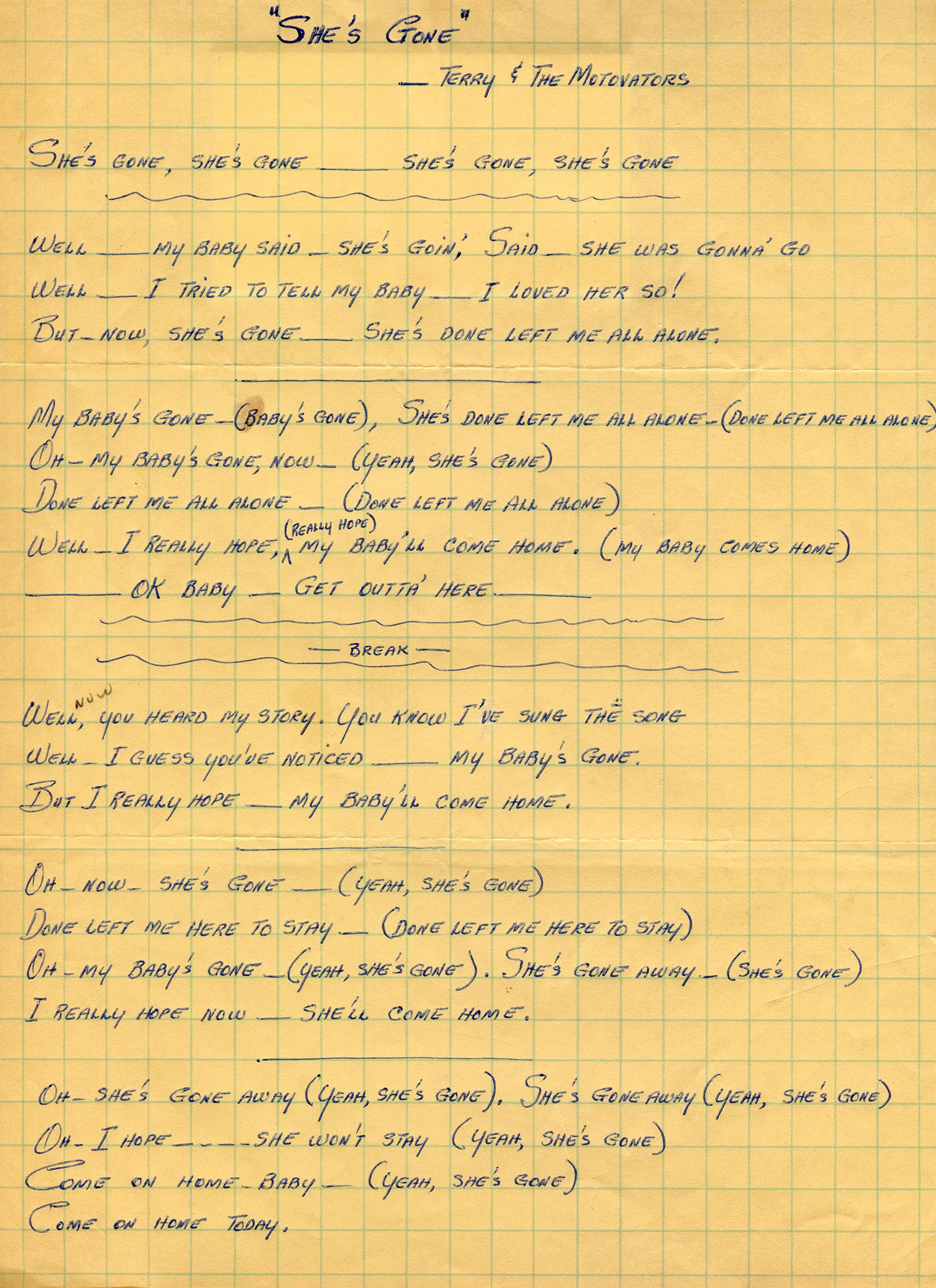
The Motivators, spring of 1965, from left: Mike Langston, Terry Lee Hungerford, Roger Young, Phil Reece (correct ID?), and Terry FaganReceipt from Clifford Herring Sound Equipment: 1 hour studio time, 1 1/4″ tape and 2 acetate 45s for $28.05Terry Lee Hungerford’s lyrics for “She’s Gone”
March 4, 1965 – Clifford Herring Recording Studio, “She’s Gone” by Terry Hungerford and “Darling, Don’t Go”, 1 hour of studio time, tape and two acetate demos $28.05. (Clifford Herring’s studio shared an address with the Sound City studio.)
March 5 – Dale Morgan quits band to join Bobby Crown’s band. Phil Reece joins on lead guitar.
Mike Langston – vocals and maracas Phil Reece – lead guitar Terry Fagan – rhythm guitar Terry Lee Hungerford – bass and vocals Roger Young – drums
March 5 – Cowtown Bowling Palace with the Barons and KXOL DJ Bill Warren
March 6, 1965 – Holiday Skating Rink with the Barons
March 8, 1965 – Panther Hall audition with KCUL DJ Ron McCoy and hall owner Bill Kuykendall. Other bands at the audition were the Chantones and the Images
March 10, 1965 – Panther Hall rehearsal for “Panther-a-Go-Go”
March 12, 1965 – Panther-a-Go-Go with the Images and the Sounds Unlimited. Host Ron McCoy, with Kay Harris and go-go-dancers. The Motovators on top stage with the Images and the Sounds Unlimited on the sides. Robin Hood Brians & His Merry Men were the main attraction. Outline of show
March 13, 1965 – Jolly Time Skating Rink with the Kasuals. The Motovators play “She’s Gone”. Phil Reece announces on Monday that he’s joining Bobby Crown’s band. However, it seems that Phil would rejoin the Motovators for in late April.
March 26, 1965 – Motovators turn down Panther-a-Go-Go show with the Images and Jerry Lee Lewis.
March 27, 1965 – The Inn’s Tavern
March 29, 1965 – band buys new striped coats and yellow shirts from Foreman & Clark, $13.84 each.
April 2, 1965 – National Hall Battle-of-the-Bands with the Capris, the United Sounds, and Charlie Christy & the Crystals. Emcees Bob Allen and Bill Warren of KXOL. The Crystals won the battle for 30% of the door.
April 3, 1965 – Holiday Skating Rink with the Barons. Photos bay Donnie Fisher
April 5, 1965 – The Teragon Club audition with the Coachmen, but lost the job to Jerry Williams & the Epics
April 10, 1965 – Terry & Roger made two trips to Dallas to see Marvin Montgomery about releasing their record, but he was out both times.
April 16 & 17, 1965 – The Inn’s Tavern
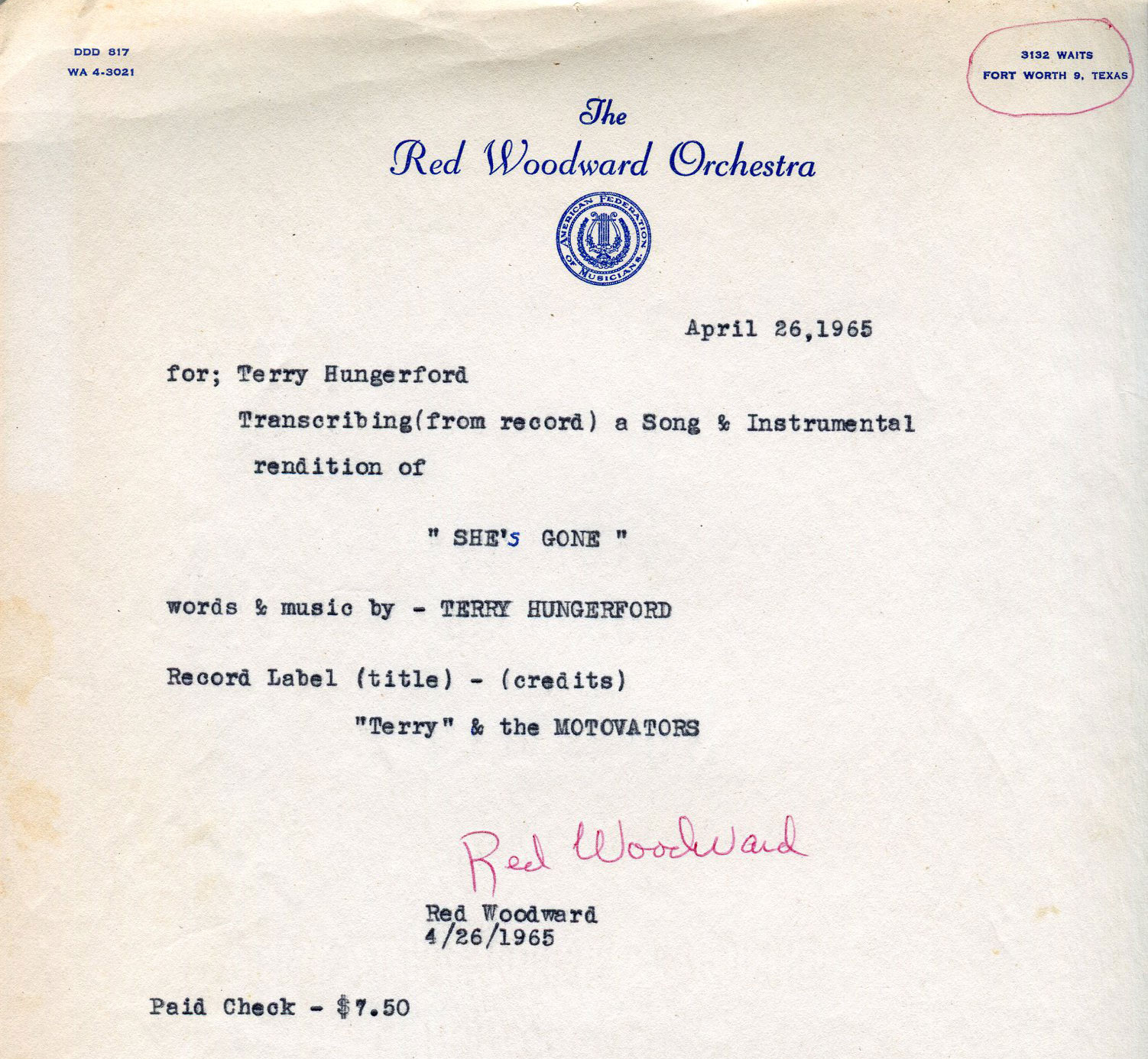
Transcription of “She’s Gone”, a necessary step for copyright registration
April 19, 1965 – Terry & Roger went to see Red Woodward at 3132 Waits to have lead sheet made of their song for $7.50. Filled out form Copy E to register with Library of Congress for a $4 fee
April 20, 1965 – Fagan leaves band, and Phil Reece rejoins on lead. David plays rhythm
Mike Langston – vocals and maracas Phil Reece – lead guitar David Morris – rhythm guitar Terry Lee Hungerford – bass and vocals Roger Young – drums
April 23, 1965 – The Teragon Club, lineup was Terry, Roger, Mike, David and Phil.
April 24, 1965 – Jolly Time Skating Rink, one band, 10 til midnight, $8 per person
April 30, 1965 – Colonial Country Club for the Lake Worth High School Senior banquet
May 1, 1965 – audition at the Pit in Dallas was cancelled, but the group auditions for Louann’s Club. $80 a night if booked.
May 5, 1965 – police called for loud practice at 11 PM.
May 7 & 8 – Safari Club at 3535 E. Belknap (private club)
May 13-15, 1965 – booked to play Jacque’s Lounge in Roswell, New Mexico for $125 per night, but cancelled when the owner found out the group was underage.
May 14, 1965 – Skyliner Ballroom lineup was Terry, Roger, Mike and Phil with David Morris, car stolen. Last show with David Morris.
May 15, 1965 – Jolly Time Skating Rink with the Coachmen (“one of the Coachmen played as 5th member of Motovators”)
May 16, 1965 – “Jimmy Smith joined band – playing the organ”
Mike Langston – vocals and maracas Phil Reece – lead guitar Jimmy Smith – organ Terry Lee Hungerford – bass and vocals Roger Young – drums
May 19, 1965 – practice in Terry’s garage is broken up by police at 9:30
May 21, 1965 – Panther-a-Go-Go (TV broadcast on May 23 on Channel 11) with Lady Wild & the Warlocks, the Velvateens from Lubbock/Texas Tech), Cecil Lang McCullough, and the Warlocks, plus Panther-a-Go-Go drummer Al Breaux. Kay Harris was one of the dancers.
May 21, 1965 – Louann’s Club, for two hours after playing Panther Hall
May 27, 1965 – Kenney’s Club – Terry played with Tommy Skagg’s band.
May 28, 1965 – Skyliner Ballroom
May 29, 1965 – Jolly Time Skating Rink
June 1, 1965 – Ft. Hood Crossroads Club, lineup with Terry, Roger, Mike, Phil and Jimmy, with Tommy Skaggs and Patti Myers joining on vocals. $170
June 2, 1965 – Roger has his hair cut short
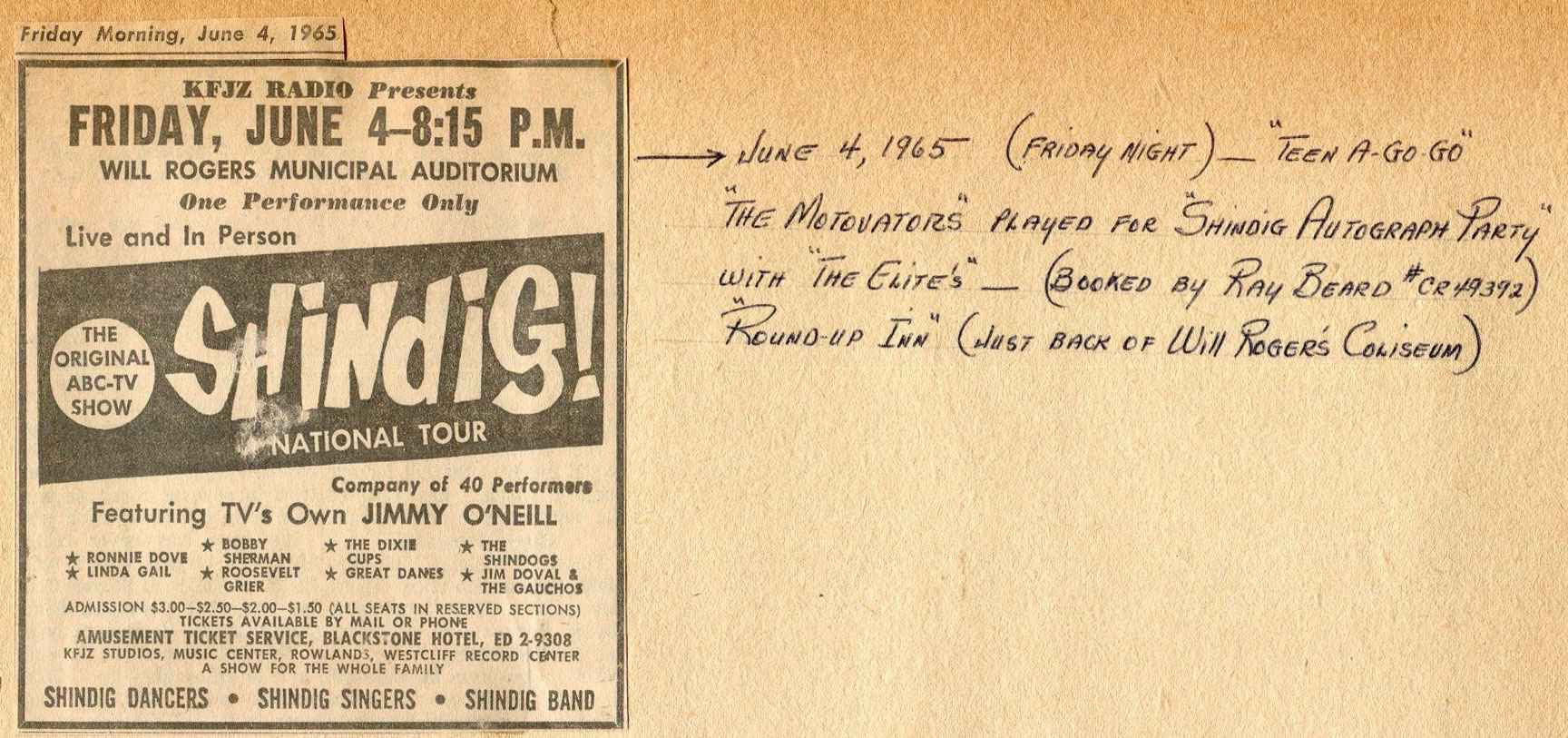
Ad for the Shindig autograph party where the Motovators and the Elites played live, June 4, 1965
June 4, 1965 – Motovators and the Elites booked by Ray Beard for Shindig! autograph party at Round-Up Inn behind Will Roger’s Coliseum, with DJ Mark Stevens.
June 5, 1965 – appointment for audition at Studio Club in Dallas
June 5, 1965 – Ft. Hood N.C.O club, lineup with Terry, Roger, Mike, Phil and Jimmy, with Tommy Skaggs and Patti Myers joining on vocals. $170
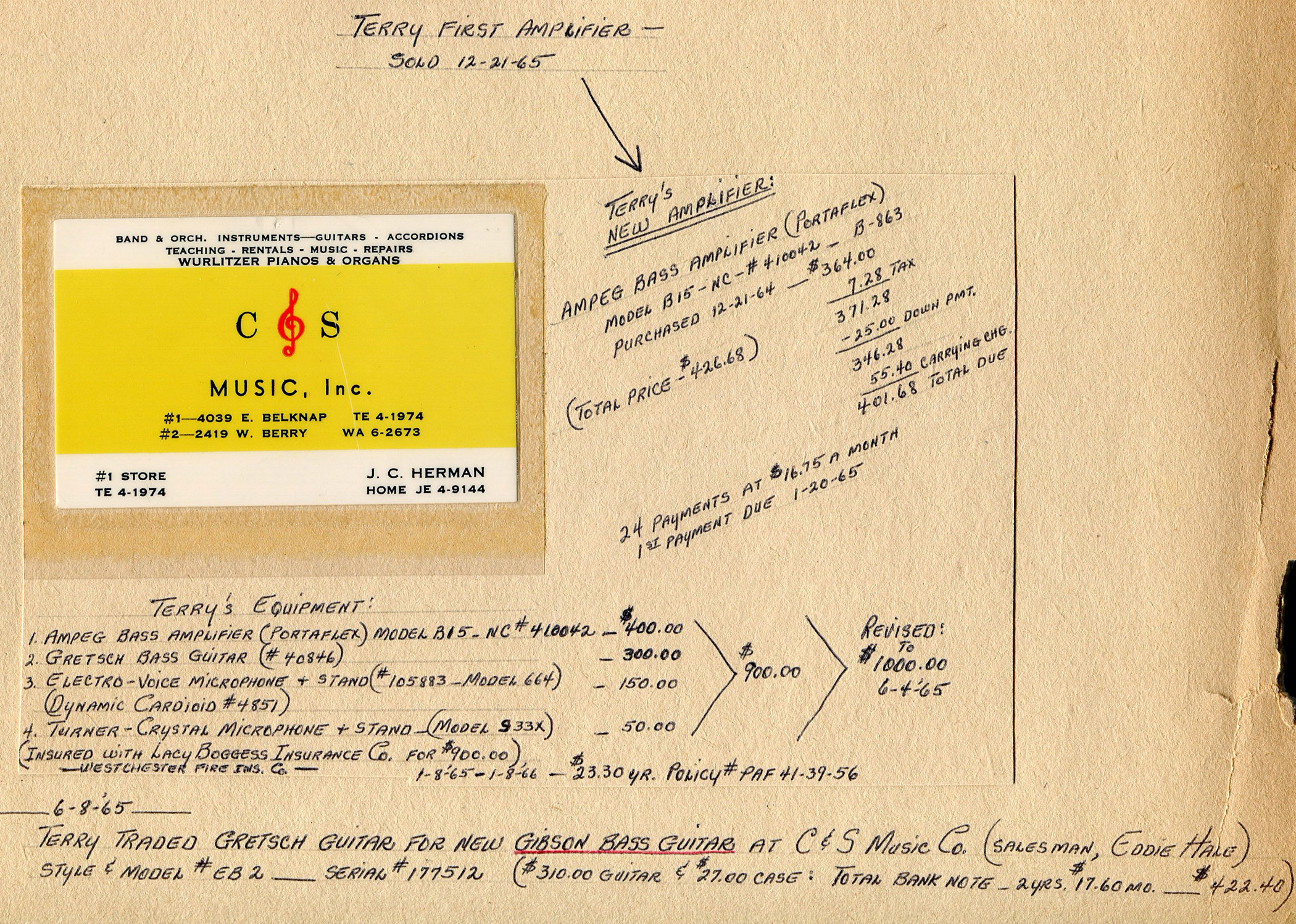
Terry trades his original Gretsch “bikini” bass for a new Gibson at C&S Music, salesman Eddie Hale, June 8, 1965
June 11, 1965 – Teen a-Go-Go at Round-Up Inn
June 12, 1965 – Ft. Hood poolside party with Tommy Skaggs
June 17, 1965 – with Sandy Black at the Coronado Club, 3203 Holtzer St.
June 18, 1965 – New coats, blue plaid with black satin lapels from Al’s Formal Wear at $32.64 each
June 18, 1965 – National Hall Battle-of-the-Bands.
June 19, 1965 – Coronado Club
June 25, 1965 – Skyliner Ballroom
June 26, 1965 – Jolly Time Skating Rink -after the show Terry, Roger and Donnie left to Villa Acuna, Mexico at 4:15 AM, returned later than they expected on Monday causing Donnie to lose his job. This Monday was also Terry’s 18th birthday.
July 1, 1965 – audition at the Party Line Club
July 2, 1965 – National Hall with DJ Bill Warren for 25% of door
July 3, 1965 – Jolly Time Skating Rink with DJ Bob Allen
July 5, 1965 – Mike Langston leaves the group, which will continue as a four-piece: Terry, Roger, Phil and Jimmy
July 9, 1965 – Phil buys a new Fender amp, Jimmy a Sears amp
July 9, 1965 – Jolly Time Skating Rink
July 10, 1965 – Holiday a-Go-Go with the Blue Notes and DJ Mark Stevens. The Blue Notes ask Terry to join them for a three-day tour, but turns it down because of the Motovators bookings
July 13, 1965 – Mike Langston back in band
July 16, 1965 – Panther-a-Go-Go with Johnny Green & the Greenmen, Van Johnson, the TrenTones, Larry & Don. Joe Knapp taped the Motovators show and Terry Guinn took photos.
Terry turns down offer to join the Greenmen to finish education.
July 17, 1965 – Jolly Time Skating Rink with Bob Allen
July 18, 1965 – broadcast of Panther-A-Go-Go taped on July 16
July 24, 1965 – Caravan of Stars at Arlington Recreation Hall with KFJZ DJ Khan Hamon
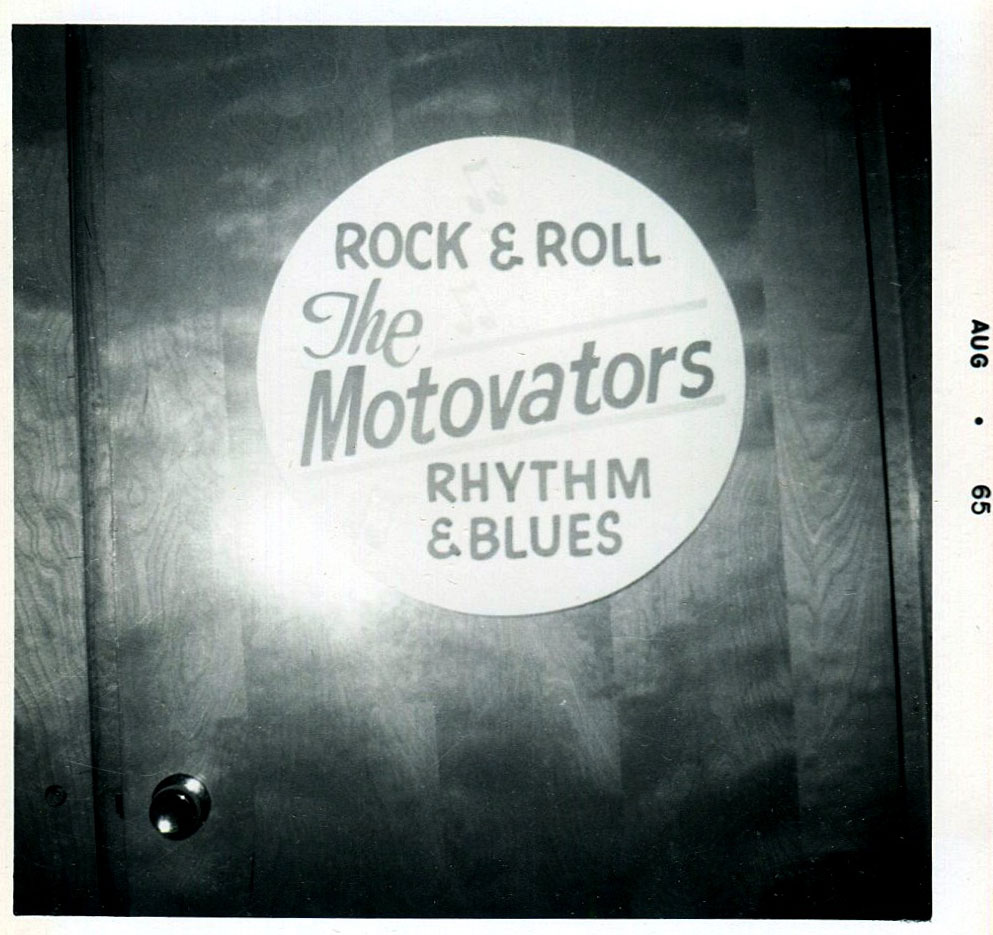
Motovators drum head
July 25, 1965 – “sign made for Roger’s drums. Art shop on Commerce St.”
July 25, 1965 – Panther-a-Go-Go “Battle-of-the-Rock N Roll Bands” with Larry & the Blue Notes, the Jades, the Images, the Kasuals, the Visions, the Naturals, the Barons, Chas Christy & the Crystals, Jack & the Rippers and the Coachmen. Emcee was Bill Warren of WXOL, show host was Mr. Fred Slater.
1st place – Charles Christy & the Crystals 2nd place – Larry and the Blue Notes 3rd place – The Images
Prizes were a trip to the West Coast, 1 year of guaranteed bookings, and opening slot with the Righteous Brothers at Will Rogers Coliseum.
July 31, 1965 – professional photos taken of band at L.S.G.C. Auditorium by Bill Wood
July 31, 1965 – Jolly Time Skating Rink, Bob Allen DJ
August 1, 1965 – Panther-A-Go-Go rerun on TV with the Motovators doing “Walkin’ the Dog”
August 19, 1965 – KXOL DJ Bill Warren wants to manage the Motovators.
August 19, 1965 – Band offered to play six nights a week at Suite 225 club at 3520 Camp Bowie, but had to turn down because of Jolly Time booking on August 21.
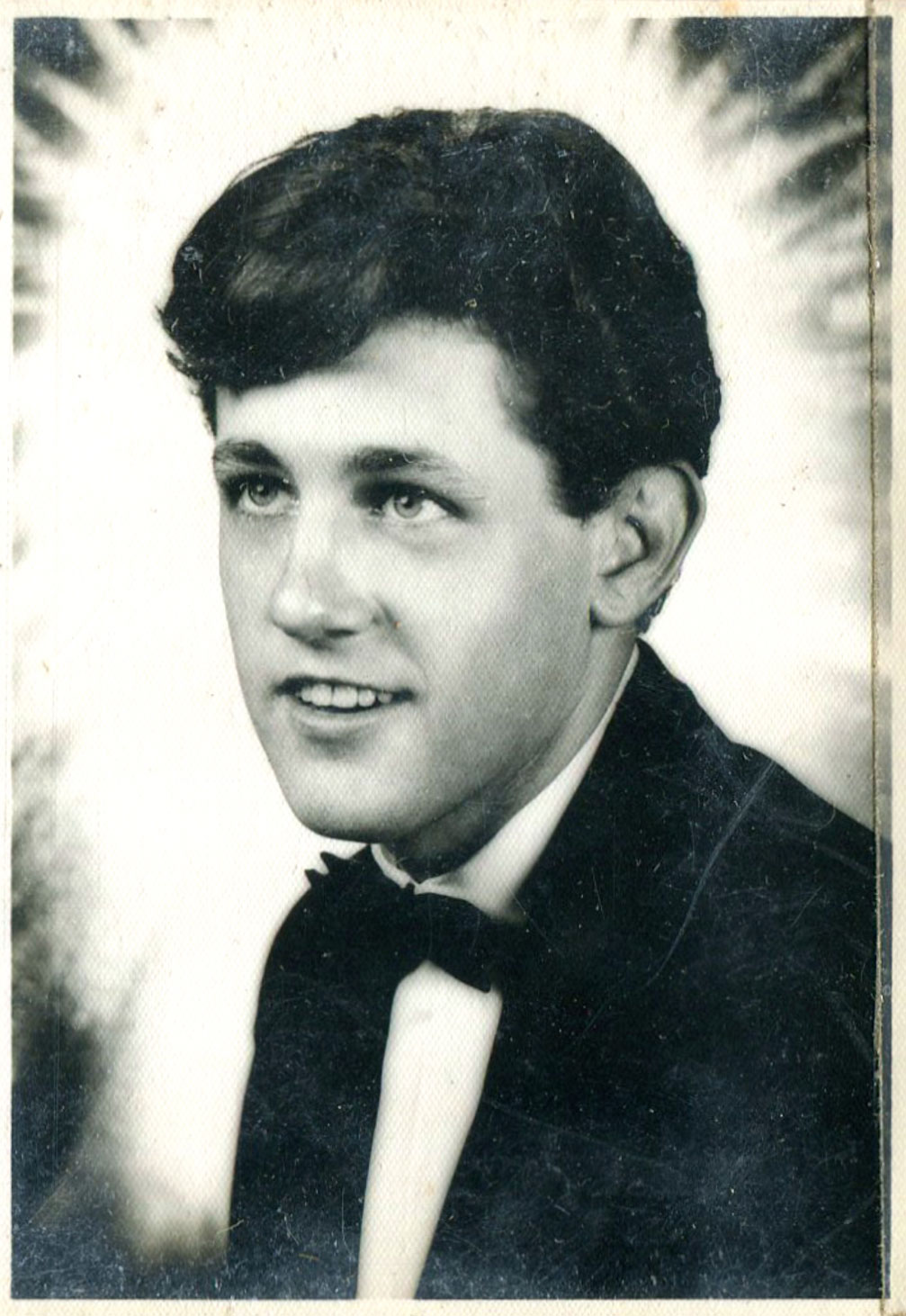
Terry Lee Hungerford portrait (front page of scrapbook)
Terry Lee Hungerford would join Jerry Williams & the Epics in 1966. Starting in the 1970s he would be part of several bands including Ripe Chops, the Freedom Band, the Other Brothers Band, No Respect, Road Crew, and the Terry Hungerford Blues Band. He worked for Pacific Bell and even opened his own BBQ restaurant, Hungerford’s Finest in Watsonville.
Terry passed away on February 20, 2019.
All the posts based on Terry Hungerford’s scrapbook can be viewed at this tag link.
Special thank you to Andellyn Purvis-Hungerford for sharing this material.
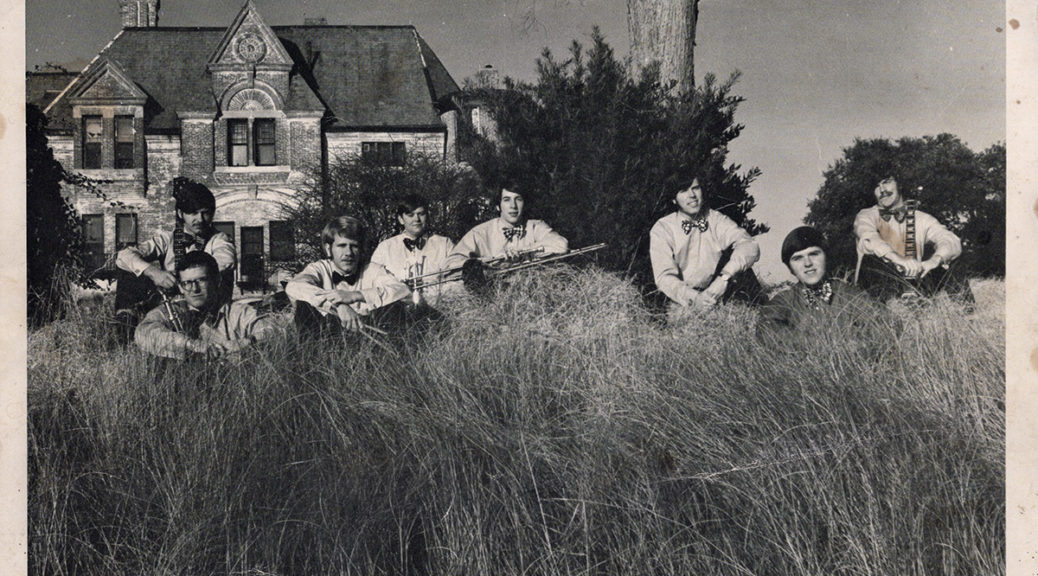
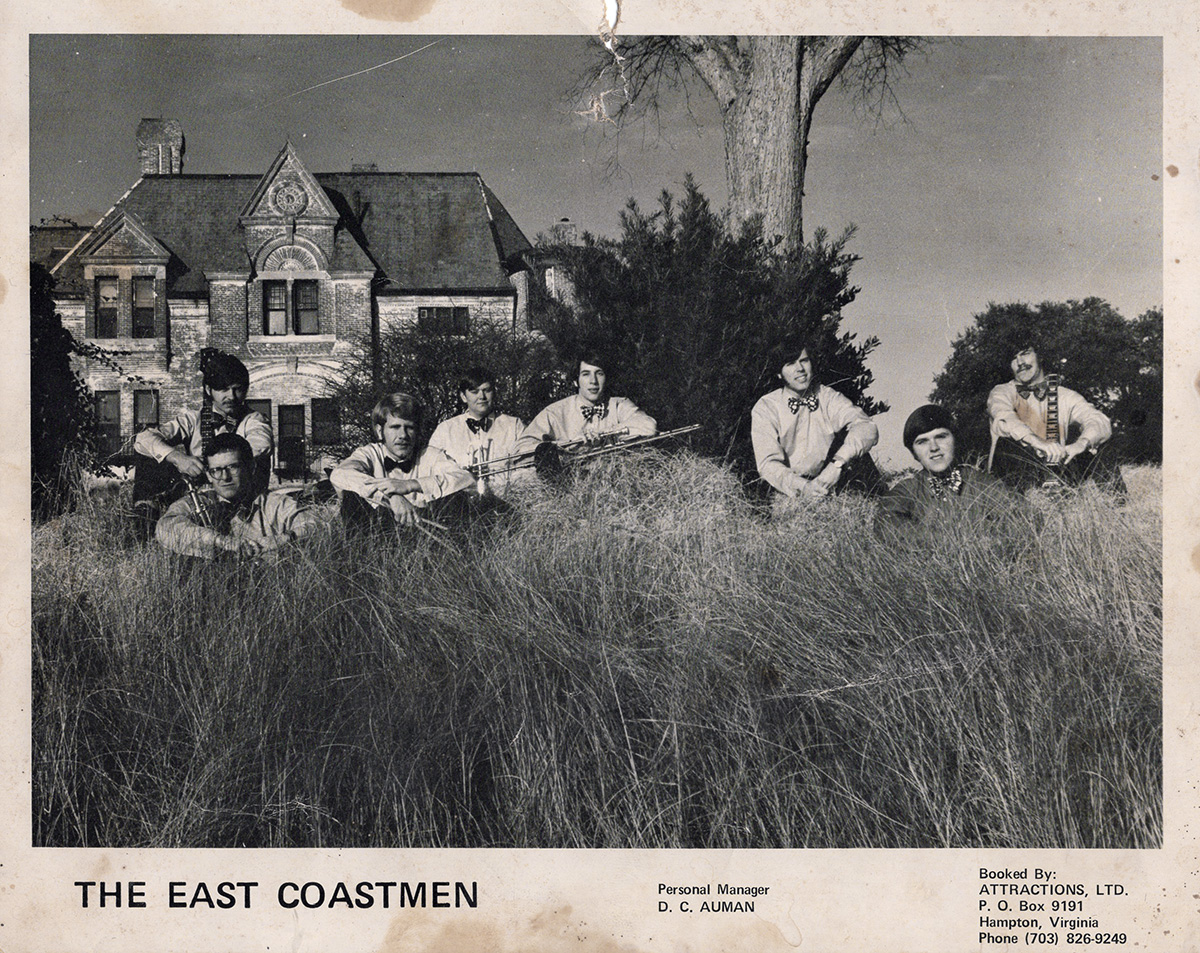
The East Coastmen, from left: Don Newsome, Mike (surname unknown), Alan Partin, Spiller Anderson, Charlie Harbrook, Thom Clement, Dave Herndon, and Bob Kerwin. Photo submitted by the estate of Joanne Tluchak, Virginia Beach
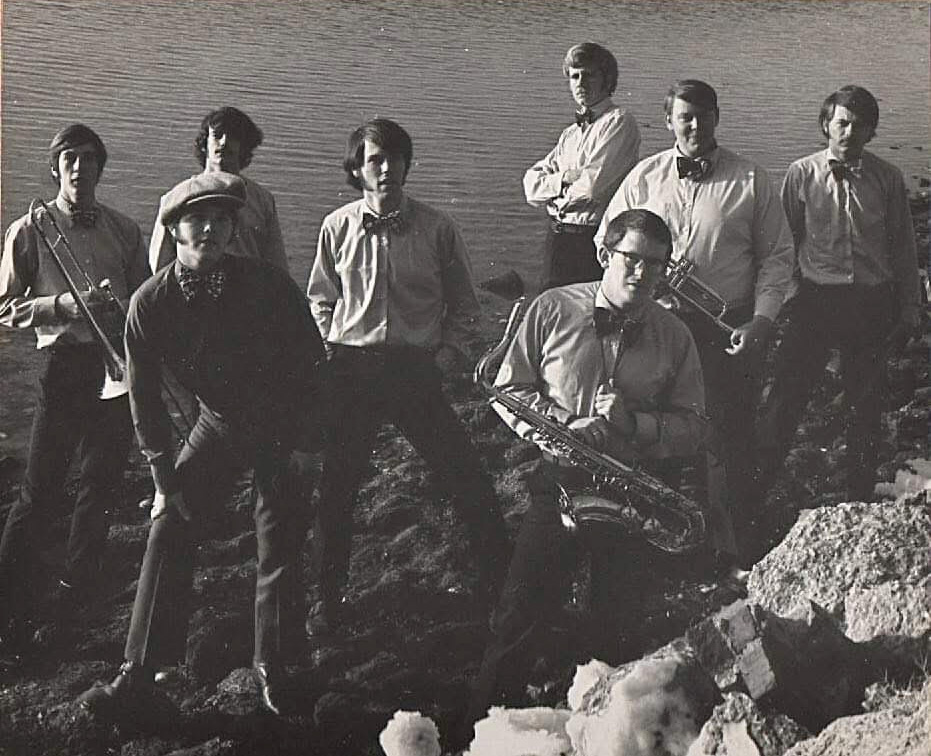
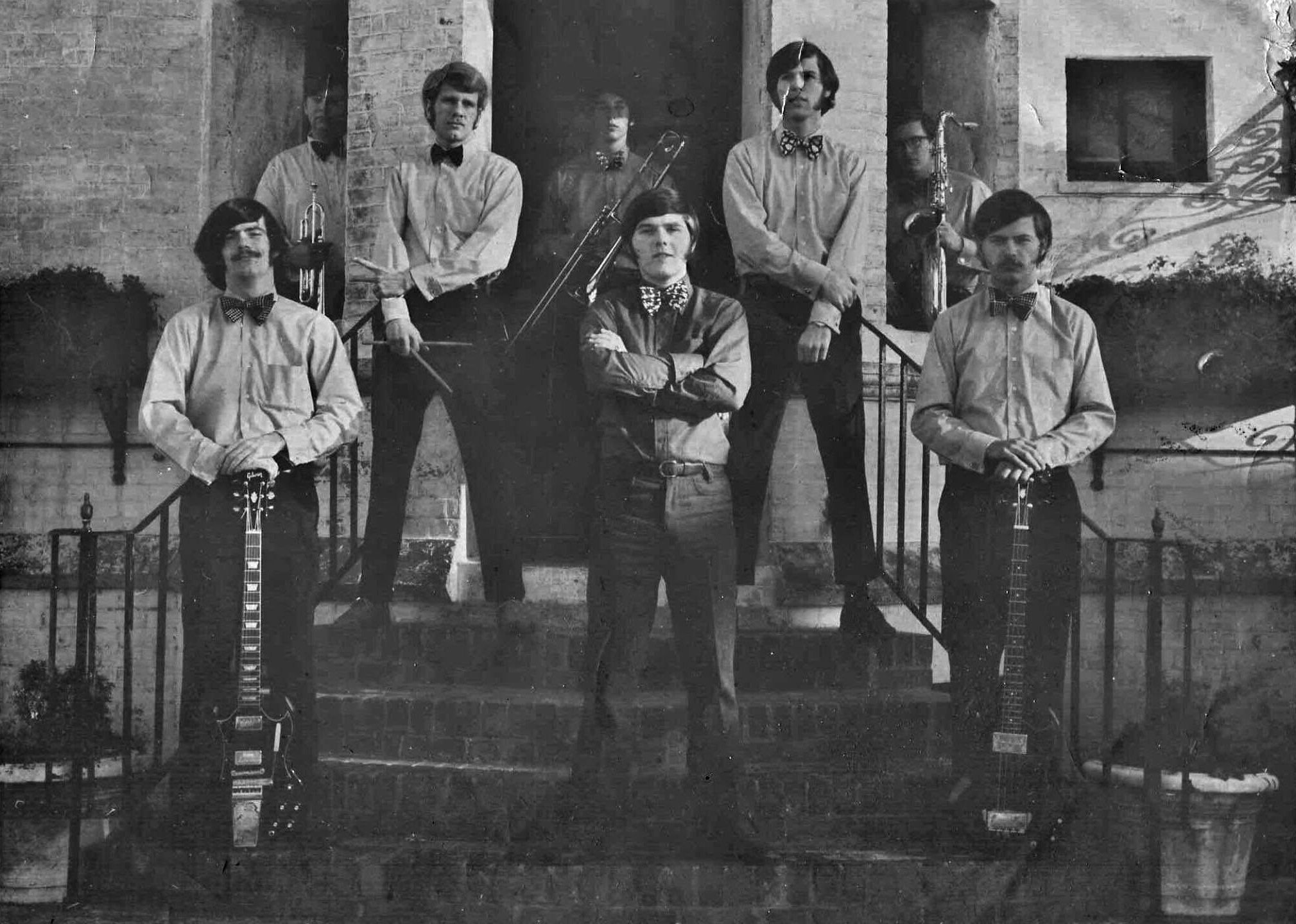
The East Coastmen were not a garage band, but a revue or pop group with horns, listed in Billboard’s Campus Attractions issue of 1971.
Don Newsome commented with the names of the members, so I’ll add them here:
Don Newsome – Bass Mike (surname unknown) – Sax Alan Partin – Drums Spiller Anderson – Trumpet Charlie Harbrook – Trombone Thom Clement – Keyboards Dave Herndon – Frontman, lead singer Bob Kerwin – Lead guitar Gary Ricks – Trumpet, trombone
Personal Manager was D.C. Auman. They were booked by Attractions Ltd in Hampton.
Bob Kerwin sent in songs cut on a two track machine at D’Arcy Studios on 21st St in Norfolk, version of Ollie & The Nightingales “Girl You Make My Heart Sing” and Robert Parker’s “Barefootin’.
The East Coastmen, from left: Charlie Harbrook, Dave Herdon (wearing hat), Bob Kerwin, Thom Clement, Alan Partin, Mike (unknown last name), Spiller Anderson, and Don Newsome. Missing is Gary Ricks, trumpetThe East Coastmen, from left: Bob Kerwin, Spiller Anderson, Alan Partin, Charlie Harbrook, Dave Herdon, Thom Clement, Mike (unknown last name), and Don Newsome. Missing is Gary Ricks, trumpet
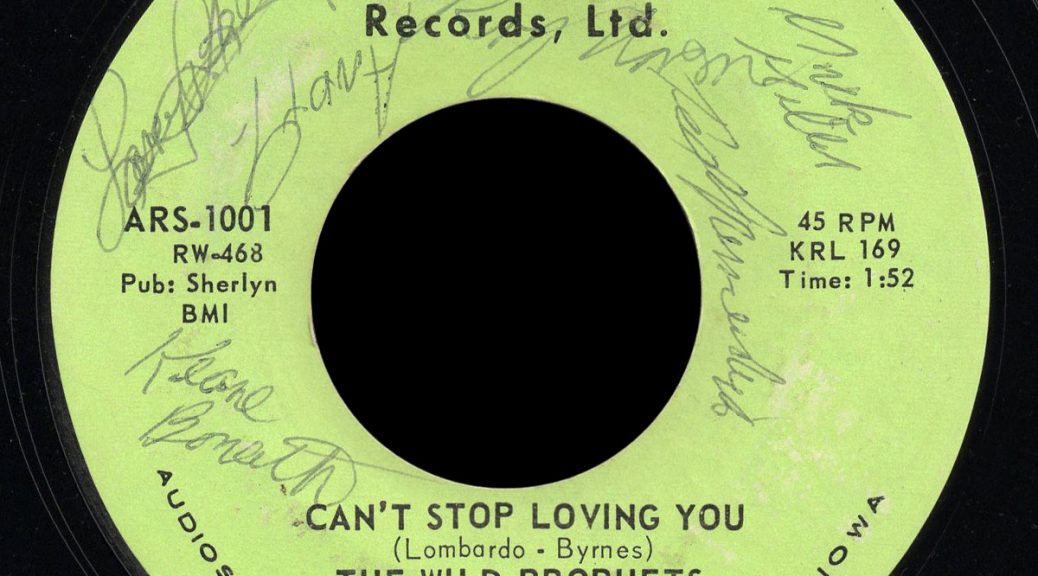
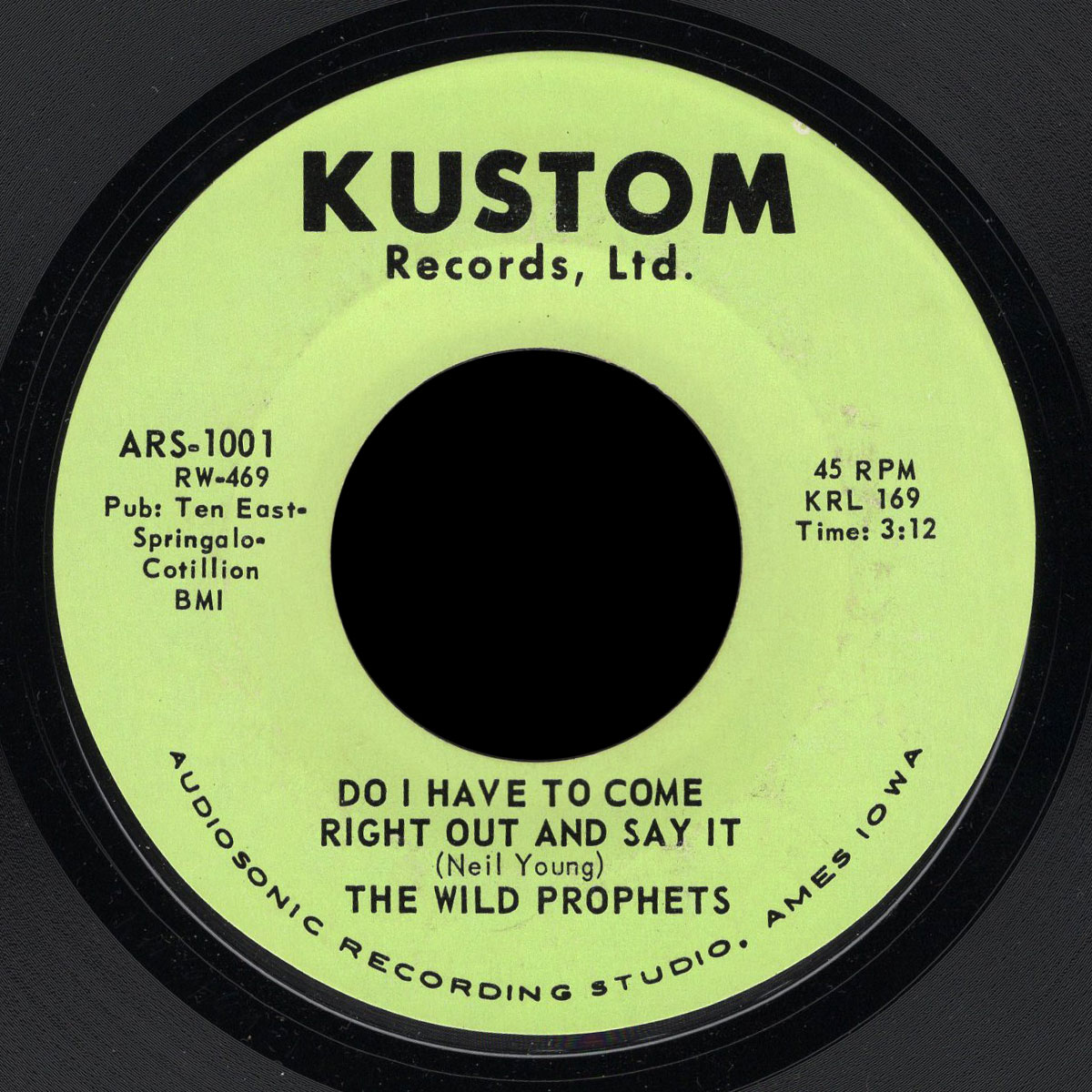
The Wild Prophets came from Ames, Iowa, about 35 miles north of Des Moines. They recorded one single on Kustom Records, Ltd ARS-1001, an energetic version of the Last Word’s “Can’t Stop Loving You” backed with “Do I Have to Come Right Out and Say It”, a Neil Young original with the Buffalo Springfield.
The lineup at the time of the record was:
Ted Nunemaker – vocals Keane Bonath – sax Ken Wood – guitar Roy Aasen – keyboard Larry Kelley – bass and vocals Andy Gielbelstein – drums
Mark Miller signed the label of the record, but he replaced Ken Wood on guitar after the record was made.
Earlier members included Jacque Furman and Ralph Stevens on drums, Ray West on keys.
Later members included Ron Arends on keys and Scott Erickson.
Larry Kelly wrote to me:
I had a few groups in high school. My first band I joined was the Mystics – the first combo at Boone High School. I left that group and started my own band called the Tel-Stars. In ’65 I left that band and got married.
In ’66 I started organizing a new band and we came up with the name The Wild Prophets – Ken Wood, Ray West, Jacque Furman and I. We did things like play guitar/bass behind our heads, lay down on the floor playing, etc. That’s where the ‘wild’ came from in the name. We went thru various other musicians when Ray left. Jacque left and Ralph Stevens played drums. He left in time and Andy took over. When Andy left, Randy Stultz took over on drums.
The recording came about with Ken, Keane Bonath, Ted Nunemaker (both Keane and Ted were ISU students at the time), Andy on drums, and Roy Aaesen played keys. We found the two songs we wanted to do and Ted sang lead on the slow song, me on “Can’t Stop Loving You” which was a Buffalo Springfield flip-side song from their hit, “For What It’s Worth”. But “Can’t Stop” was too slow so we sped it up a bit!
We had a school bus we fixed up to travel in along with the name of the band on each side in big letters. In ’69, we bought over $10,000 worth of new band equipment which today would be more like $80-100k. So many stories, too numerous to tell.
The Wild Prophets recorded at Audiosonic Recording Studio in Ames, and the record saw release in 1969.
According to the informative Boone Rock website, the band played “in Mason City. The Cellar in Ames was a favorite with a good crowd in attendance every time. Other venues they performed at include the Starlite in Carroll, the Pla-Mor in Fort Dodge, the Dance-Mor in Swisher, RJ’s Lounge in Marion.”
The Wild Prophets broke up in 1973. Jacque Furman continued in music, but I have few details other than playing with Cris Williamson and Glen Yarborough.
Ted Nunemaker died on Dec. 14, 2008.
Thank you to Larry Kelley for correcting the spelling of names.
Some information from http://members.iowatelecom.net/thx1136/pages/prophets.html (currently offline).
I can find a few other Audiosonic Recording Studio credits, such as:
Ted Hart – “Down in the Mine” / “I Don’t Need You Anymore” (both by Don Taft and J.T. Schreiner), produced by J.T. Schreiner on Leslie LR 72068 from 1968.
Syndrum of Soul - “Lost and Found” (Gary French, Floyd Brown) / “Do You Care” on SOS 100, produced by M. Harper, from 1970.
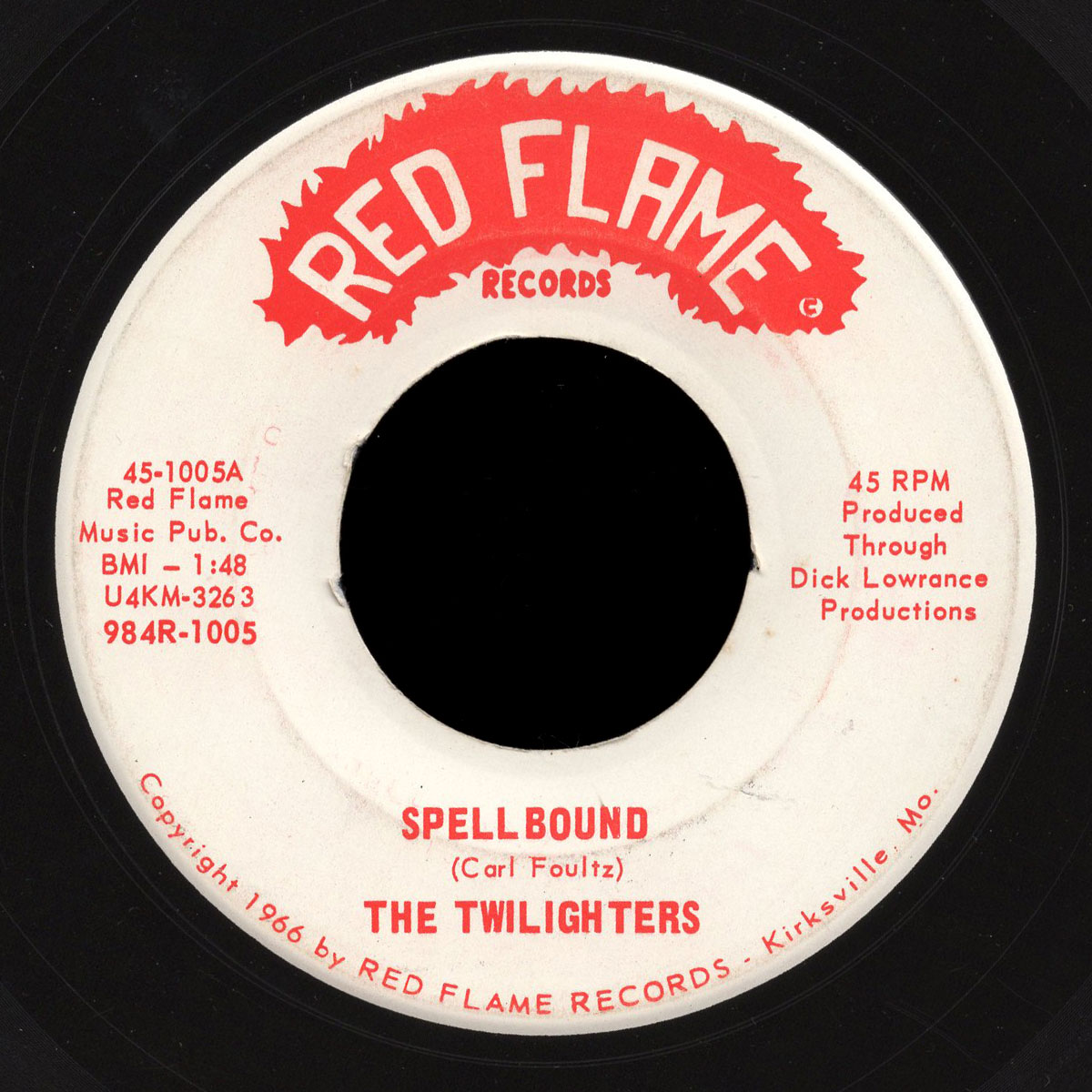
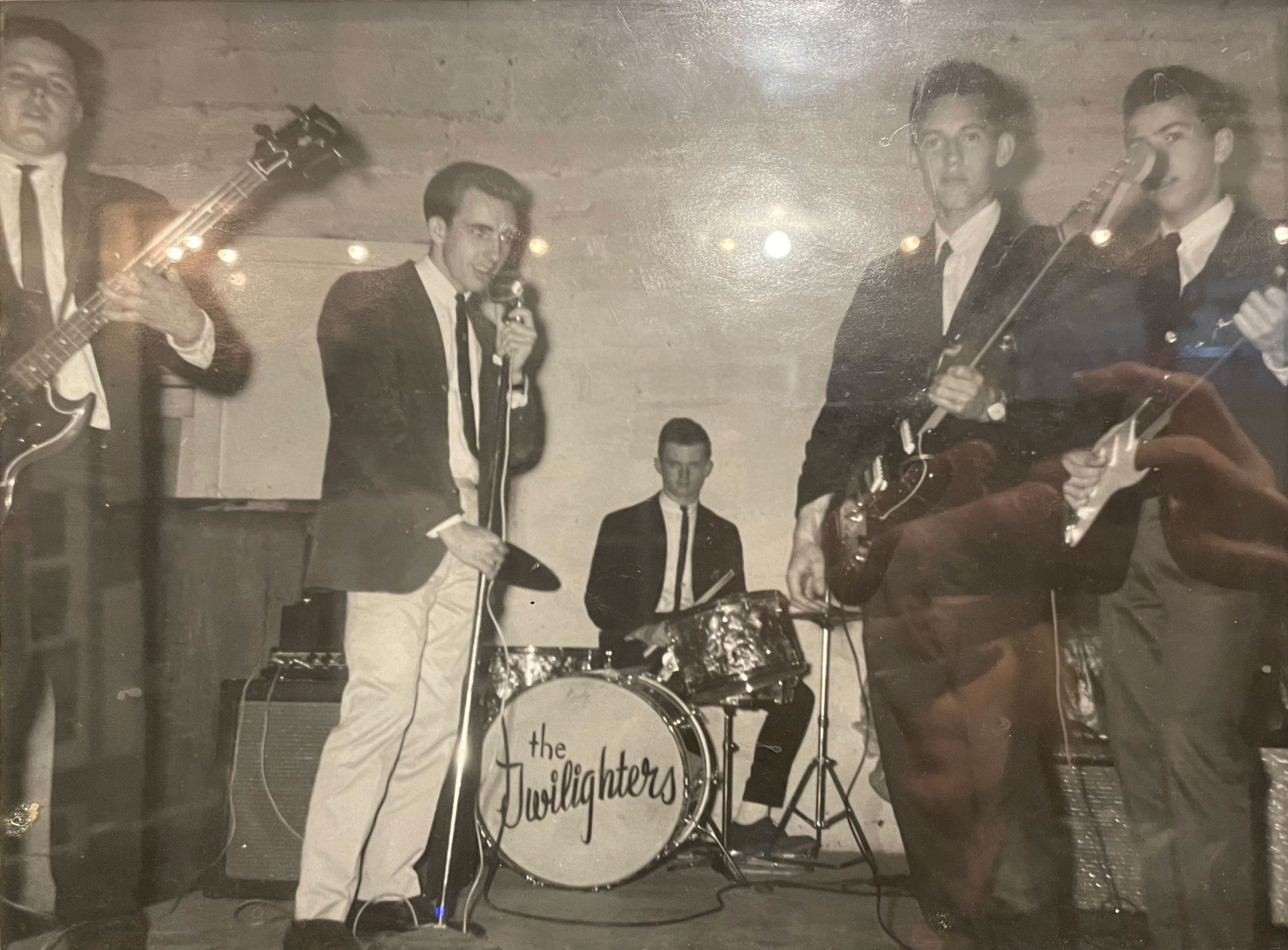
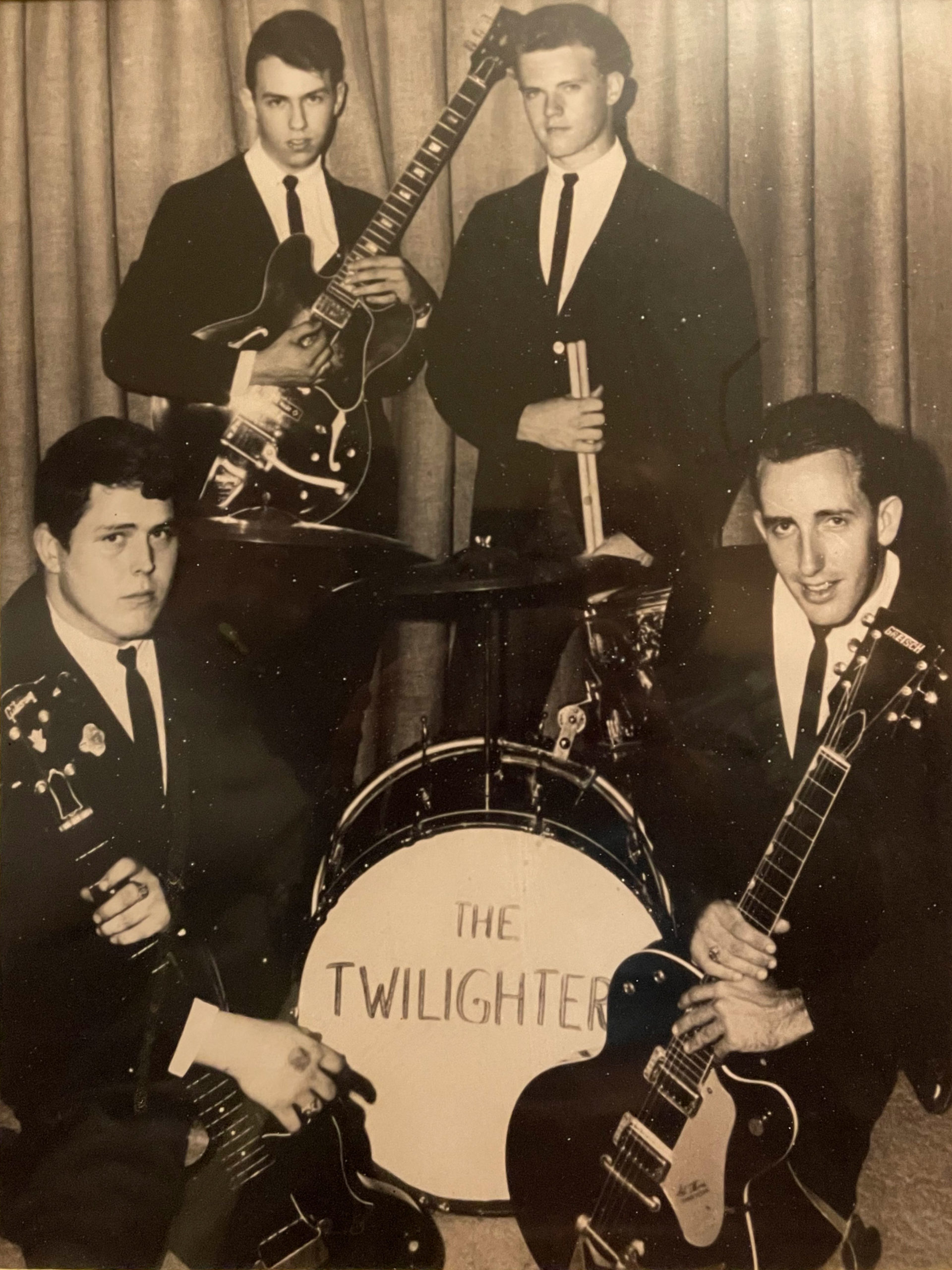
The Twilighters came from Kirksville, Missouri, a small city about 165 miles from Kansas City and 200 miles from St. Louis. In 1967 they cut two originals, “Spellbound” / “My Little Angel” at Technisonic Studios in St. Louis.
“Spellbound” is a fast-paced rocker, driven by Dave Daniels’s fantastic drumming. There’s a great guitar break and a double-time ending, and it’s over in less than two minutes.
The chant of “Spellbound” has a distinctive sound that may come from some other song but if so, I can’t think of it. It reminds me of a later cut, Steve Miller Band’s “Living in the U.S.A.” where the group chants “Stand Back”. I’d be interested if anyone has heard something very similar in another song from the era.
The B-side, “My Little Angel” is a ballad with fine vocals, and good recording production.
Released on Red Flame Records 45-1005, the labels show a 1966 copyright date, but the U4KM indicates a pressing date in the first half of 1967.
The Twilighters, from left: Everett Cassidy, Gary Blurton, David Daniels on drums, Bob Harbur, and Randy Elmore. Photo courtesy of David Daniels.
David Daniels wrote to me:
The Twilighters band began in 1963 with Gary Blurton (rhythm guitar and vocals), David Daniels (drums), Everett Cassidy (bass), and Bob Harbur (lead guitar). Randy Elmore joined the band in 1964 because Gary was leaving to join the National Guard and the band would be needing a lead vocalist. Randy played lead guitar as well.
Eventually Bob moved to the St Louis area and Everett also moved away from the Kirksville area. At that point Richard Hudson, also a local boy and friend of Randy and David, came on to play rhythm guitar.
The Twilighters, from left: Everett Cassidy on bass, Randy Elmore on guitar, David Daniels with drumsticks, and Gary Blurton, guitar. Photo courtesy of David Daniels.
This configuration of The Twilighters (Randy, David, and Richard) placed an ad in the local paper seeking a keyboard player, to which Carl Foultz responded and that was the group that made the record “Spellbound” / “My Little Angel”. Carl Foultz was the song writer and organ player, and the bass was covered by the bass pedals on the organ.
Randy Elmore – lead guitar and lead vocal Richard Hudson – rhythm guitar Carl Foultz – organ (and bass pedals) David Daniels – drums (background vocals for “My Little Angel”)
There were no headphones to monitor in the recording room and “Spellbound” was recorded in one live take. The band could not hear the vocal work at all until listening to the playback in the control room. Likewise for “My Little Angel.” It was the first recording the band had made and their first experience in a recording studio.
Randy, Richard, and David were local boys, born and raised in the Kirksville area. Carl was from Pennsylvania and came to Kirksville to attend university at Northeast Missouri Teachers College (now Truman State University).
The band members changed off and on over subsequent years with a total of about 20 different players having done some time with The Twilighters during their run (1963 – 1971).
Randy and David continued to play in many other bands in the NE Missouri area from 1971 – 2011, often times together, other times not, under the names: Country Flavor, Fox, Survival, Loose Louie, Twilighter’s Rockin’ Reunion, BJ Allen Band, and Blue Voodoo.
These photos are of the original players. There are no pics with Richard or Carl, so neither of these are the exact group of players that were on the recording.
David went on to buy Circle M Music in Kirksville in 1974 and operated the music store and built his own recording studio where he recorded many local musicians and vocal groups. David mentored many young kids over the years, sharing his love of music and recording. He retired in 2014 after serving the NE Missouri music community for 42 years. As an honor to his Grandpa David, Black Daniels & The Bears did a cover of “Spellbound” live at David’s retirement party in 2014, the 3rd generation of musicians in the Daniels family, carrying on the tradition.
Randy retired from SW Bell and now lives in Columbia, MO.
Richard did not continue with music but went on to other employment, was a private business owner, and has retired to Lake of the Ozarks.
Carl graduated from NE Missouri Teachers College and moved away, the other band members having lost touch with him.
Gary is retired from local employment in the Kirksville area.
Bob and Everett are now both deceased.
Dick Lawrence (deceased) was owner of Red Flame Records and was an avid music promoter throughout the NE Missouri area his entire life.
Carl Foultz was also a member of an r&b group called the Del-Fis or Del-Phis with Ed Corte, Frank Gantt, T.J. Jackson, Mac Pendelton, Nick Romanetz and Gary Smyth, some of whom were students at Northeast Missouri State Teachers College (now known as Truman State University).
After Carl Foultz left the Twilighters, Bill Daniels joined on guitar and Ray Beets on bass, as Ray states in his comment below.
Dick Lowrance owned Red Flame Records which released three singles by the group he was a member of, the Red Blazers, usually with Ike Haley as leader.
In 1966 Lowrance released a single by Friar Tuck and the Merrymen’s “Peanut Butter” / “Try Me” (Mike Barger) on his Sherwood Forest Records subsidiary. That band may have been from western Illinois though I’m not sure which town. I’ve found newspaper ads for a “new Friar Tuck and the Merrymen” playing at the Wayside Inn in Moberly, Missouri, about an hour south of Kirksville; not sure if this is the same group.
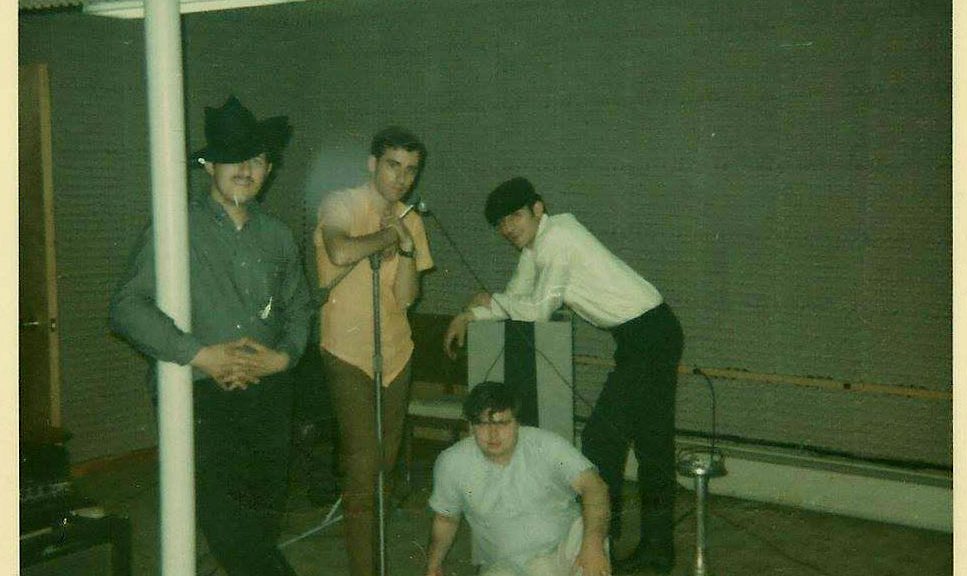
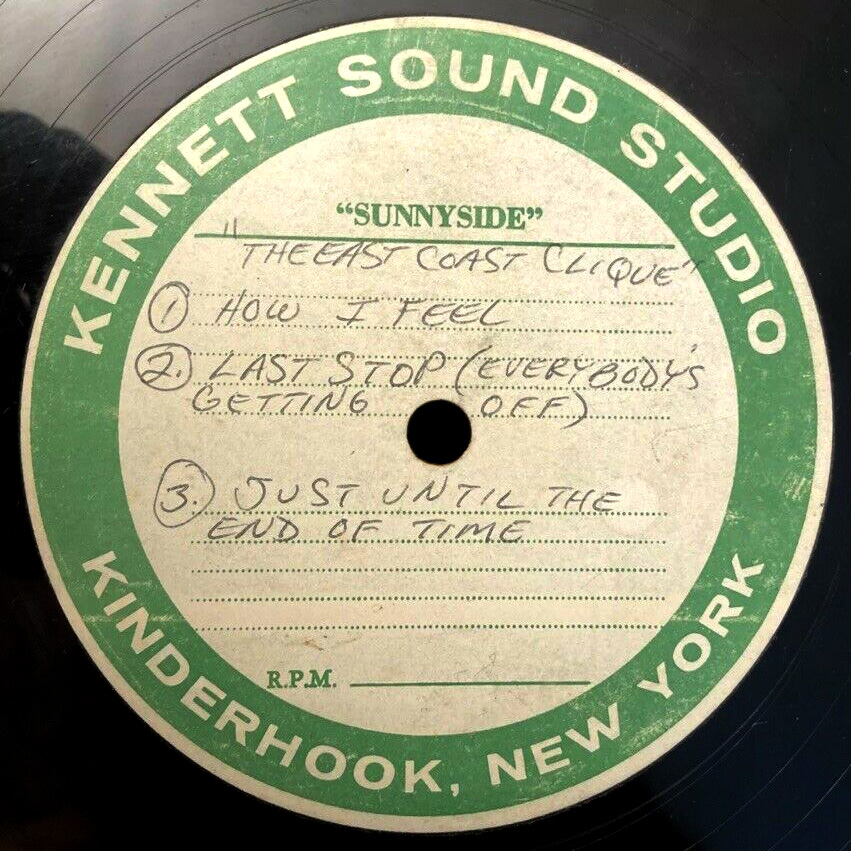
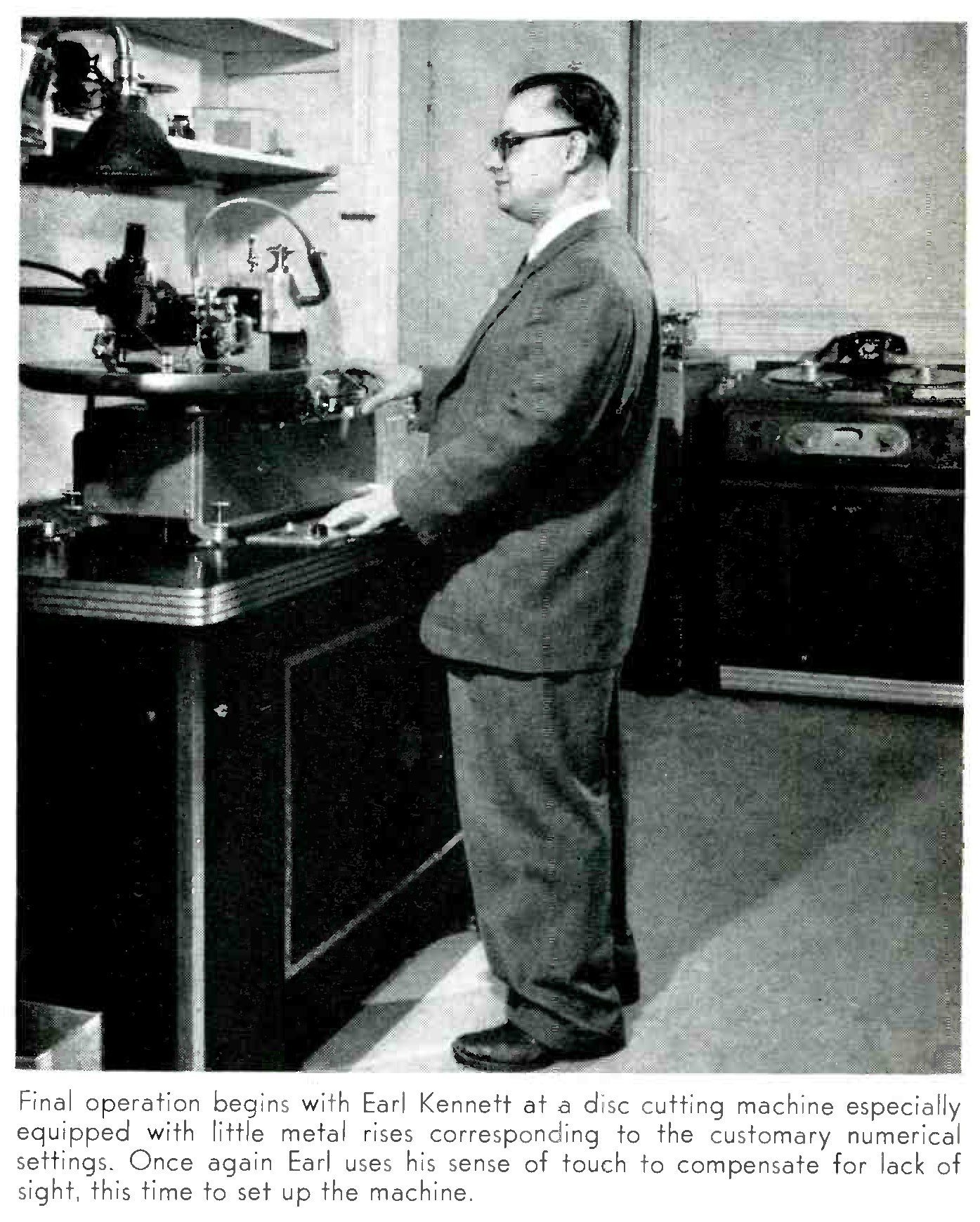
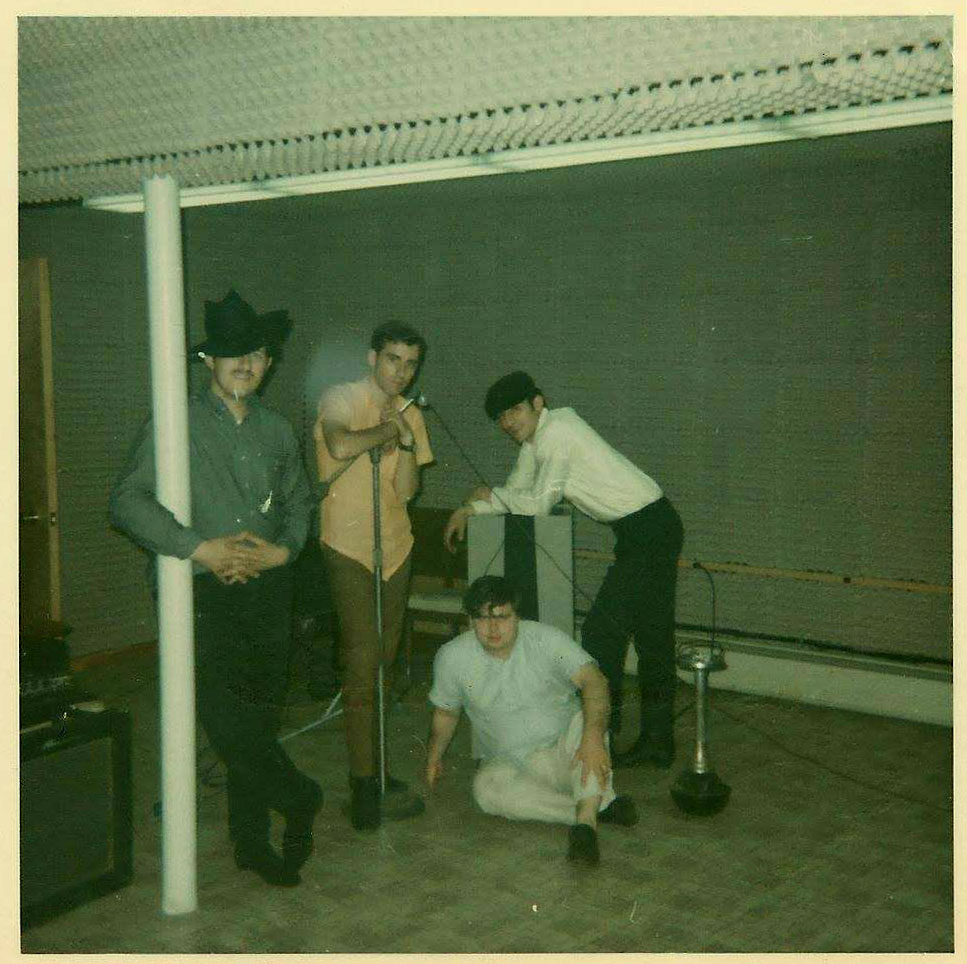
Earl Kennett, left with members of Love Minus Zero inside the Sunnyside studio, January 8, 1967. Photo courtesy of the Kennett family.Kennett Sound Studio acetate of three songs by the East Coast Clique (previously known as the Cleaners), photo courtesy of Mike Dugo
Earl Kennett was born in 1912 in Augusta, Kansas. He attended the Kansas State Institute for the Blind and the Horner-Kansas City Conservatory of Music.
He established some reputation as a touring pianist in the 1940s, including at the Blue Note at 56 West Madison in Chicago, the Rainbow Room in Oklahoma City, and the Casablanca Supper Club at 101 May Avenue in, I believe, Oklahoma City.
On March 1, 1945 Down Beat published a review:
Jazz Concert Given in Minneapolis
From 3 to 5 Sunday afternoon, February 11, Doc Evans conducted the first in a series of jazz concerts held in station WCCO’s auditorium studio.
… on piano was Earl Kennett, a solo fixture at the Casablanca …
… Song Of The Wanderer, the final tune, developed into an all-out jam-session … Pianist Kennett drew a tremendous, spontaneous ovation from the audience with his three sensational choruses on this closing number.
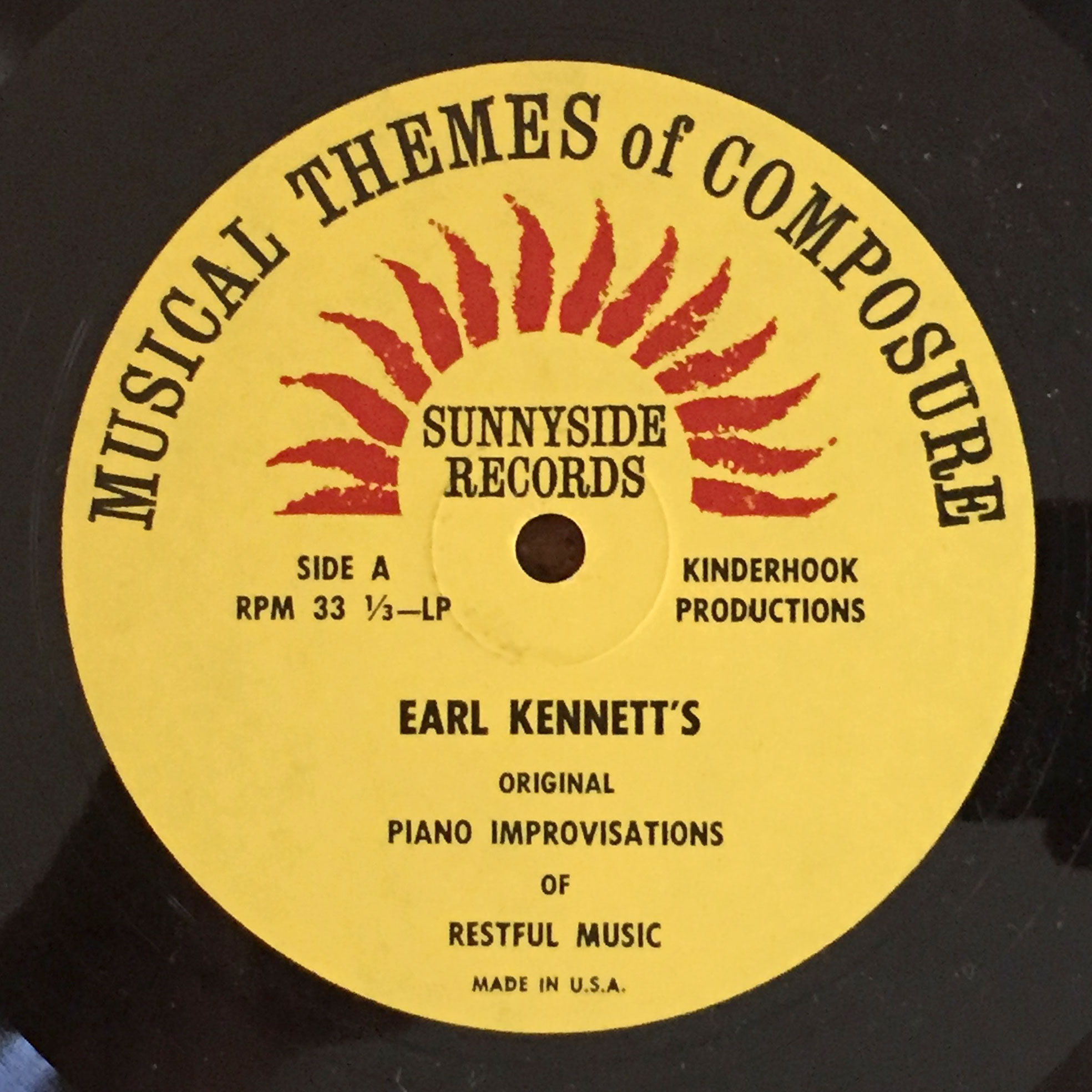
In the 1960s he sometimes played with the Original Berkshireland Jazz Band in Williamstown, MA. I have not yet found any recordings with Earl prior to his own album Musical Themes of Composure: Earl Kennett’s Original Piano Improvisations of Restful Music from circa 1967.
Though blind, he received training in audio recording. A 1957 LP on ABC-Paramount, Vinnie Burke’s String Jazz Quartet credits Earl Kennett as recording engineer.
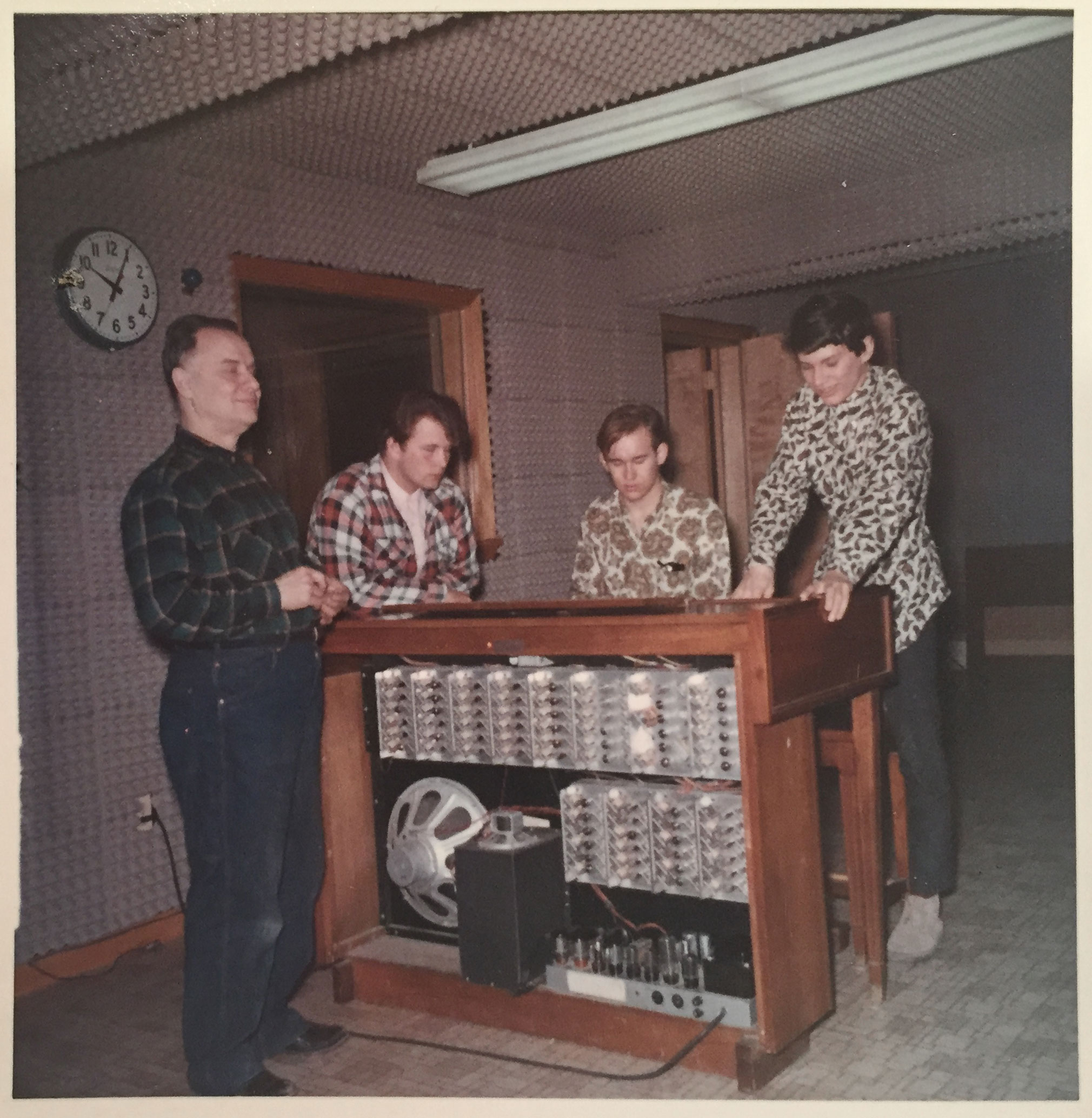
Earl Kennett in the Carnegie Hall studio, May 1959
I believe his first studio was located at 115 West 49th Street, New York City. In January 1958, he moved the studio to rented space in Carnegie Hall. The May 1959 issue of Broadcast Engineering had a three page feature on Earl with detailed information about the studio construction materials made by the Johns-Manville company, with a console built by Fred C. Roberts.
Facing Earl are saw-tooth-shaped Imperial Transitone movable walls for accurate sound reflection. Next to the piano not in use is an even-finish movable wall, also for sound reflection, and a sound-absorbing perforated Transite acoustical panel. The floor is covered with quiet-under-foot Terraflex vinyl asbestos tile and the ceiling with Permacoustic, a sound-absorbing fissured acoustical tile.
In early 1964 Earl moved his studio for a brief time to Mountain View Road in Nevis, a small town near Bard College in Tivoli.
In 1965, Earl and his wife bought Sunnyside farm in Kinderhook, New York, about 20 miles southeast of Albany. Earl converted an old dairy barn on the property into a recording studio, substituting egg cartons for the pricey asbestos baffles.
The first recording from his studio I can find is the Kynds single “So If Someone Sends You Flowers Babe” / “Find Me Gone”. Pressed through RCA in September, 1966, there is no indication of where it was recorded on the labels, but drummer Jerry Porreca recalled making the single at Kennett’s studio.
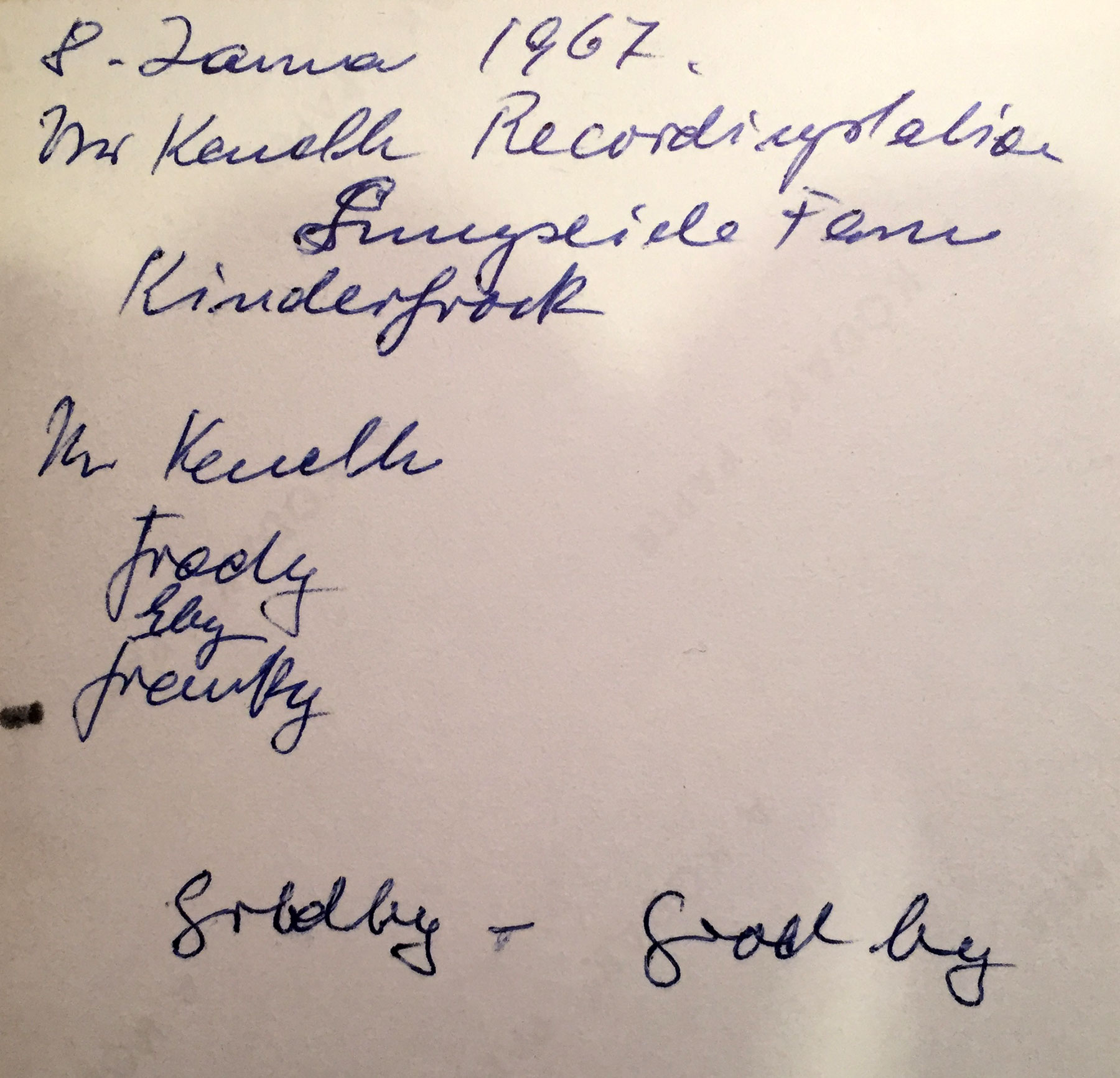
Back of Love Minus Zero photo at top. What are these names in the middle? Freely, Freddy, Eby, Franky ??
On January 8, 1967, a group called Love Minus Zero did a session at the studio and sent a photo to Earl. The group came from Albany, and I may have their recordings on an unlabeled lacquer acetate. It’s difficult to make out the names of the group – but luckily I found a lineup in Al Quaglieri’s The Old Band Chronicle #4, a list of Capital District bands compiled in 1990.
Love Minus Zero were:
Gary Siegel – vocals Eberhard Kobryn – guitar Fred Everhart – bass Frank Herec – drums
I believe Everhard Kobryn passed away in 2012. Later lineups added Jack Reilly on organ, replaced by Mark Rabinow. Eventually Fred Everhart was the only original member of the group, with Steve Fuld on guitar, Gary Gardner on vocals, and Stanley ? on drums.
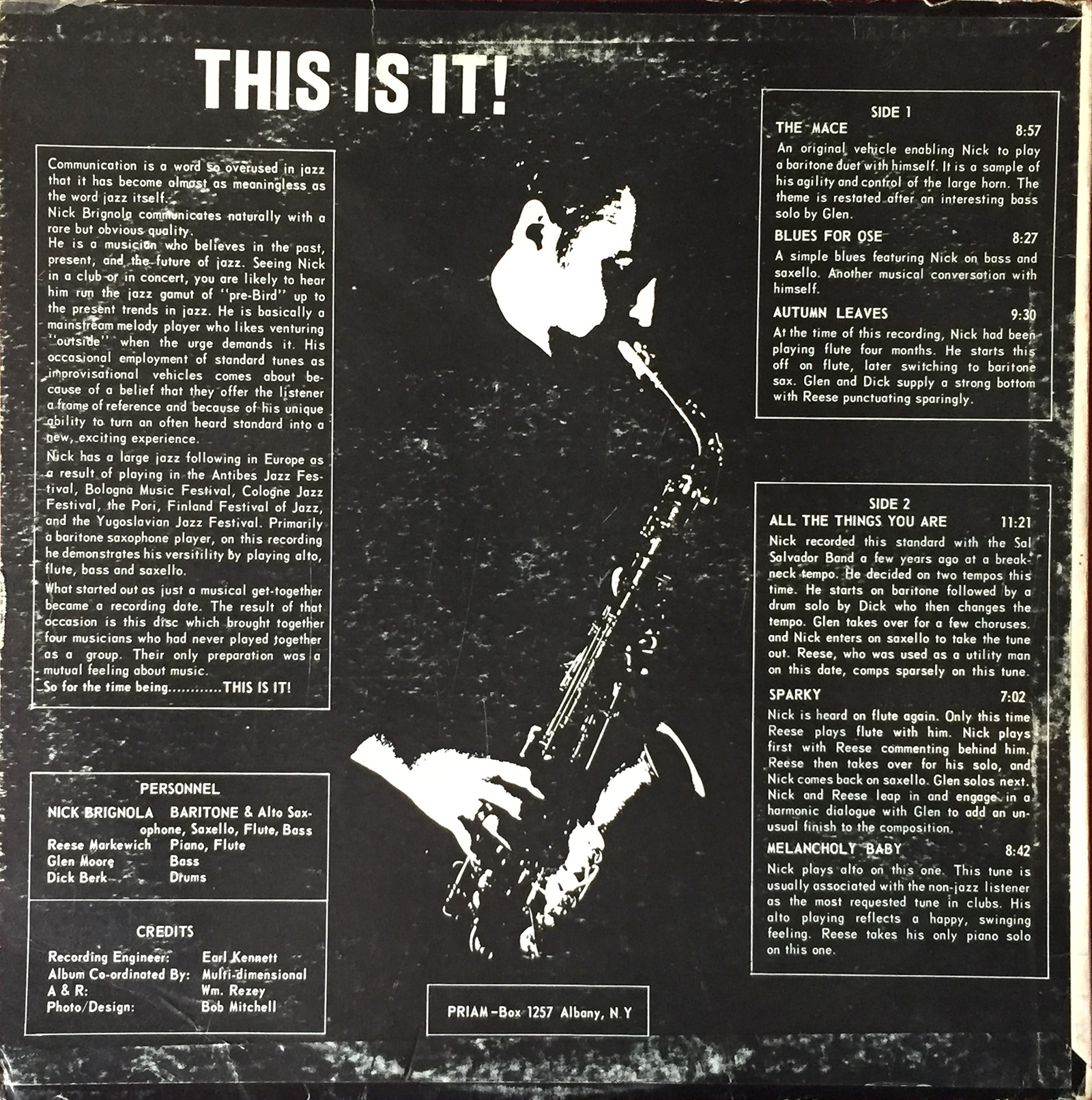
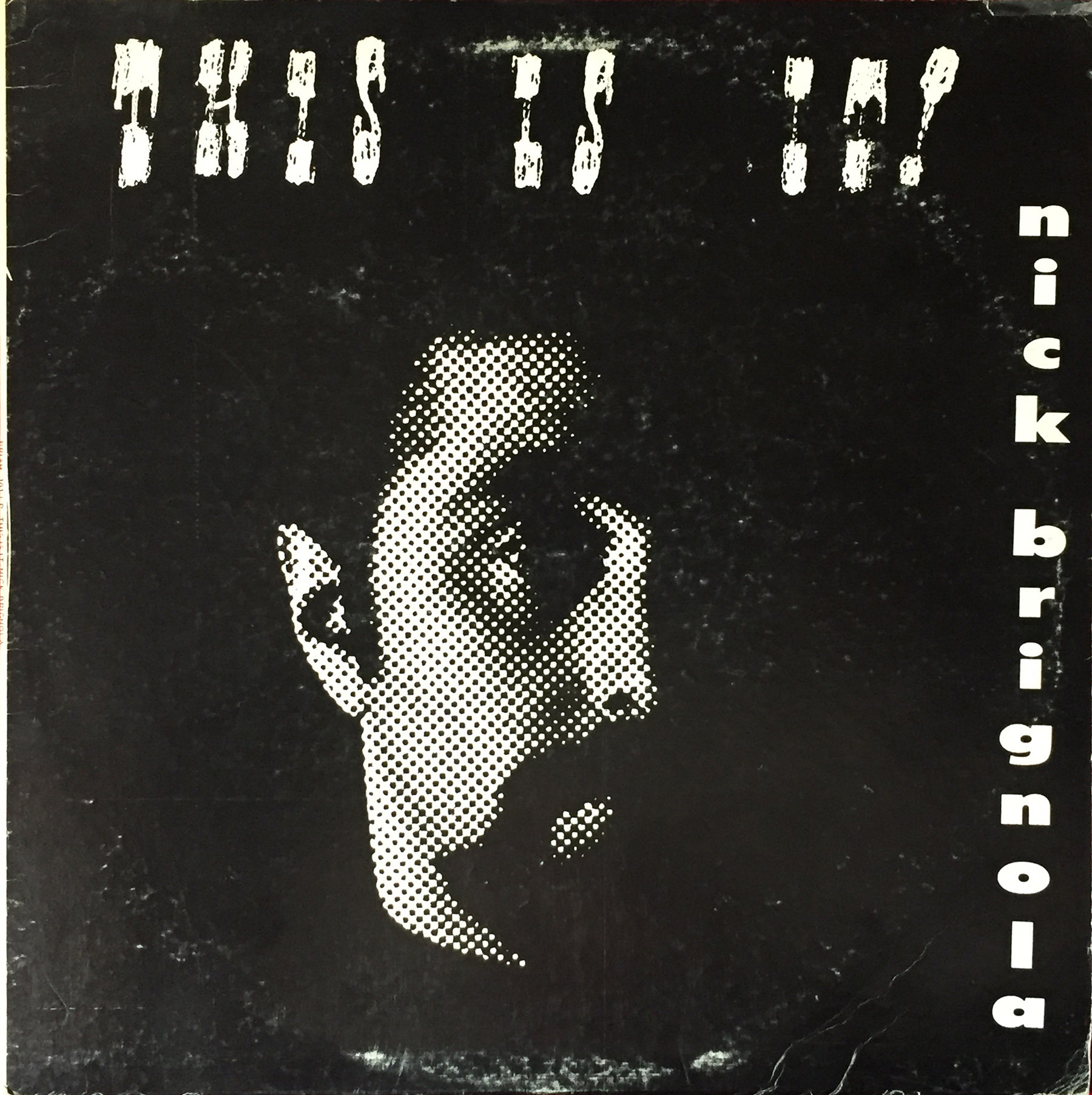
In 1967, Kennett engineered Nick Brignola’s first LP, This Is It! on Priam P-101M. Musicians were Nick Brignola, Reese Markewich, Glen Moore and Dick Berk, A&R by William Rezey, photography by Bob Mitchell.
Another single I can confirm was recorded at Kennett is Riccardo and the 4 Most “There’s a Reason” (written and sung by Bill White) / “Bare Footin'” (featuring Ricardo Wright) Foremost Records U4KM-0937.
The Jelly Bean Bandits at Kennett Sound Studios in Kinderhook, from left: Mike Raab, Jack Dougherty, Joe Scalfari and Billy Donald on the floor – photo taken by bass player Fred Buck.
The Jelly Bean Bandits made their first demo at Kennett Sound Studio, never released to my knowledge. Mike Raab wrote:
The Goodtimes had done some recording there and when we decided to lay down tracks Dave Kennedy suggested Earl’s place … We really didn’t know what we wanted to do or could do. We cut two demo songs: “Poor Precious Dreams” an original song that ushered us into the psychedelic music era; and “Hard, Hard Year” a beautiful b-side from The Hollies that we managed to brutalize.
I have found an acetate of this early version of “Poor Precious Dreams”. The duration is about thirty seconds longer than the version on their Mainstream album.
In 1967 Earl Kennett began offering pressing services through Decca’s plant in Gloversville. Some releases have “Kennett” at the bottom of the labels, but all have a distinctive four-digit release number, beginning with “00”.
There were at least twenty-three 45 rpm singles and one LP released through Kennett’s studio with this numbering system. The last release I can find dates to 1973.
In addition, I know of a number of unreleased lacquer acetates by the Cleaners, the Chain Reactions, and others:
If you or someone you know recorded at Kennett, please contact me.
Discography of Kennett Sound Studio (possibly incomplete):
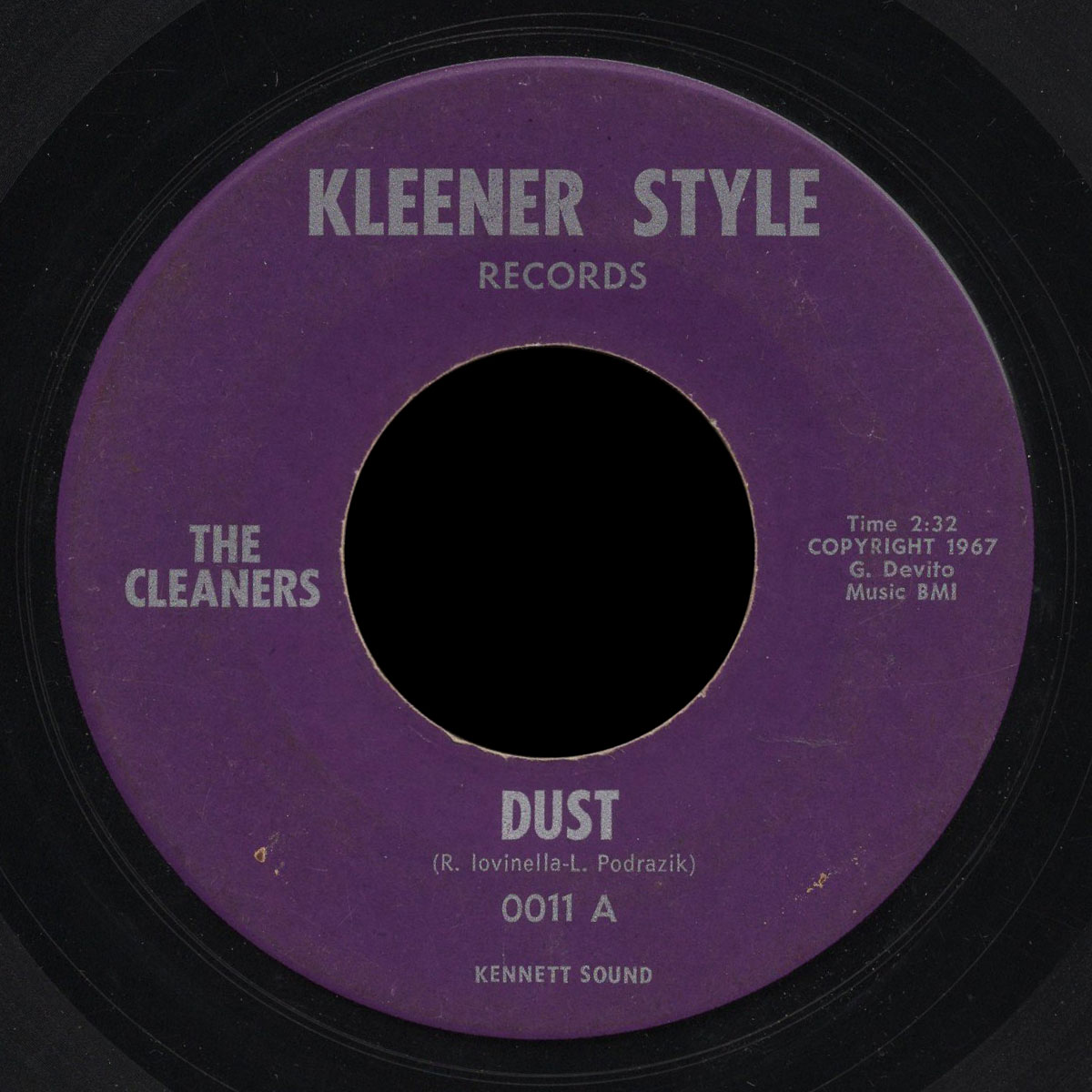
Kleener Style Records 0011 – The Cleaners – “Dust” / “Hold Me, Thrill Me, Kiss Me”
Sunnyside Records 0012 – Musical Themes of Composure: Earl Kennett’s Original Piano Improvisations of Restful Music (12″ album)
0013 – ?
Sunny-Side Records 0014 – Psychedelic Sound – “Sorry Baby = Goodbye” / “Stars Cease To Shine” produced by M. Rizzi. Tina was the drummer for the band, and (I believe) one of the vocalists.
0015 – ?
Charter Records 0016 – The East Coast Clique – “Dust” / “Last Stop (Everybody’s Getting Off)”
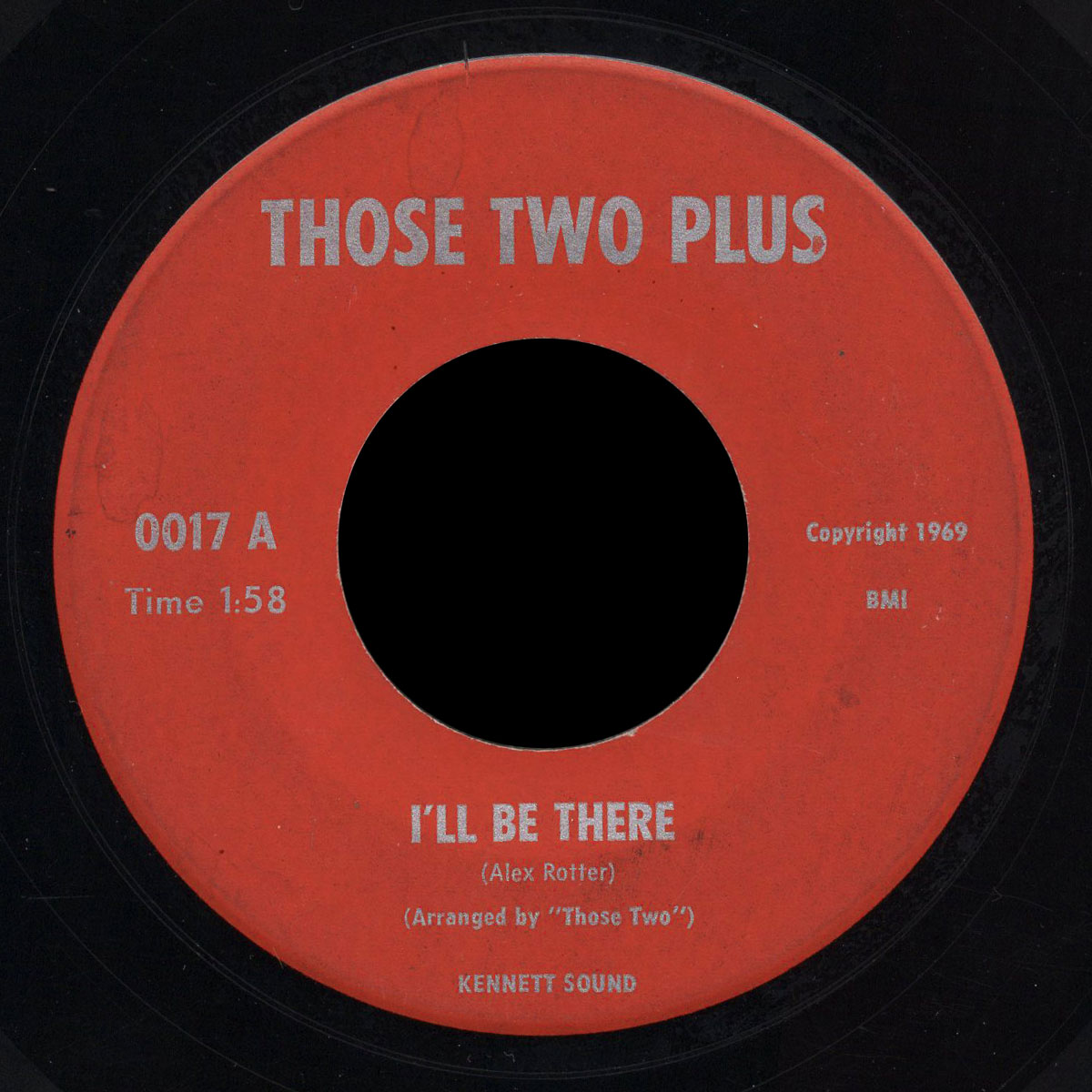
0017 – Those Two Plus – “I’ll Be There” / “It’s Rainin’ (Where I’m Bound)” (both by Alex Rotter, arranged by “Those Two”) Kennett Sound, 1969
0018 – The Villagers – “Wishes and Memories” / “Cry On” (Chuck Petit)
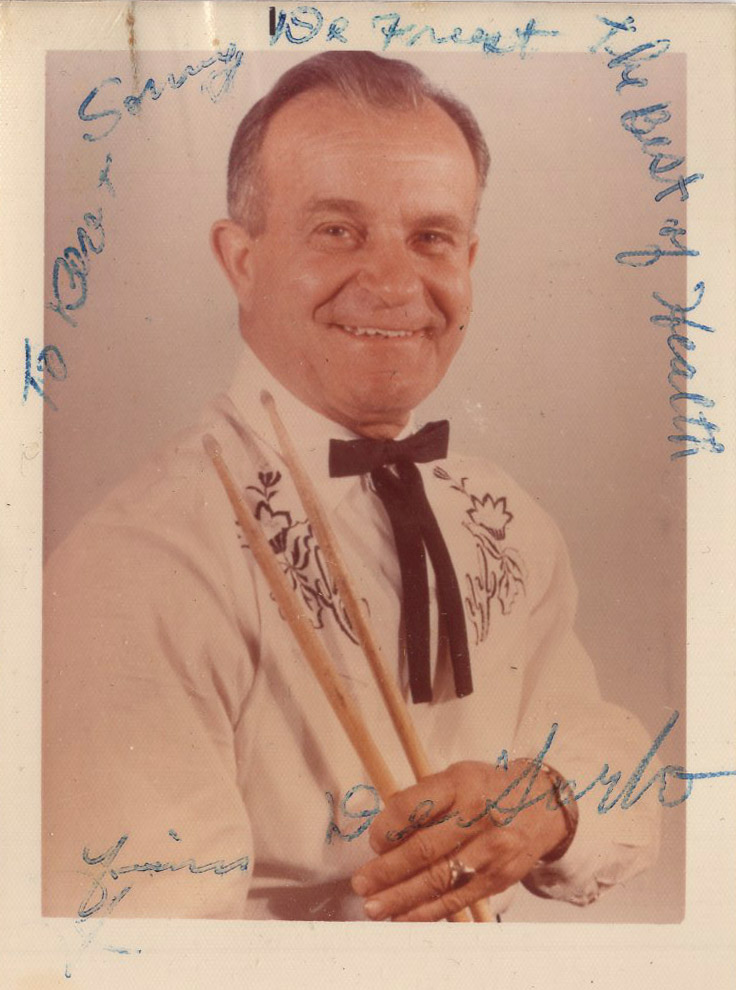
Jim De Sorbo photo found with his recordScan courtesy of Brian Kirschenbaum
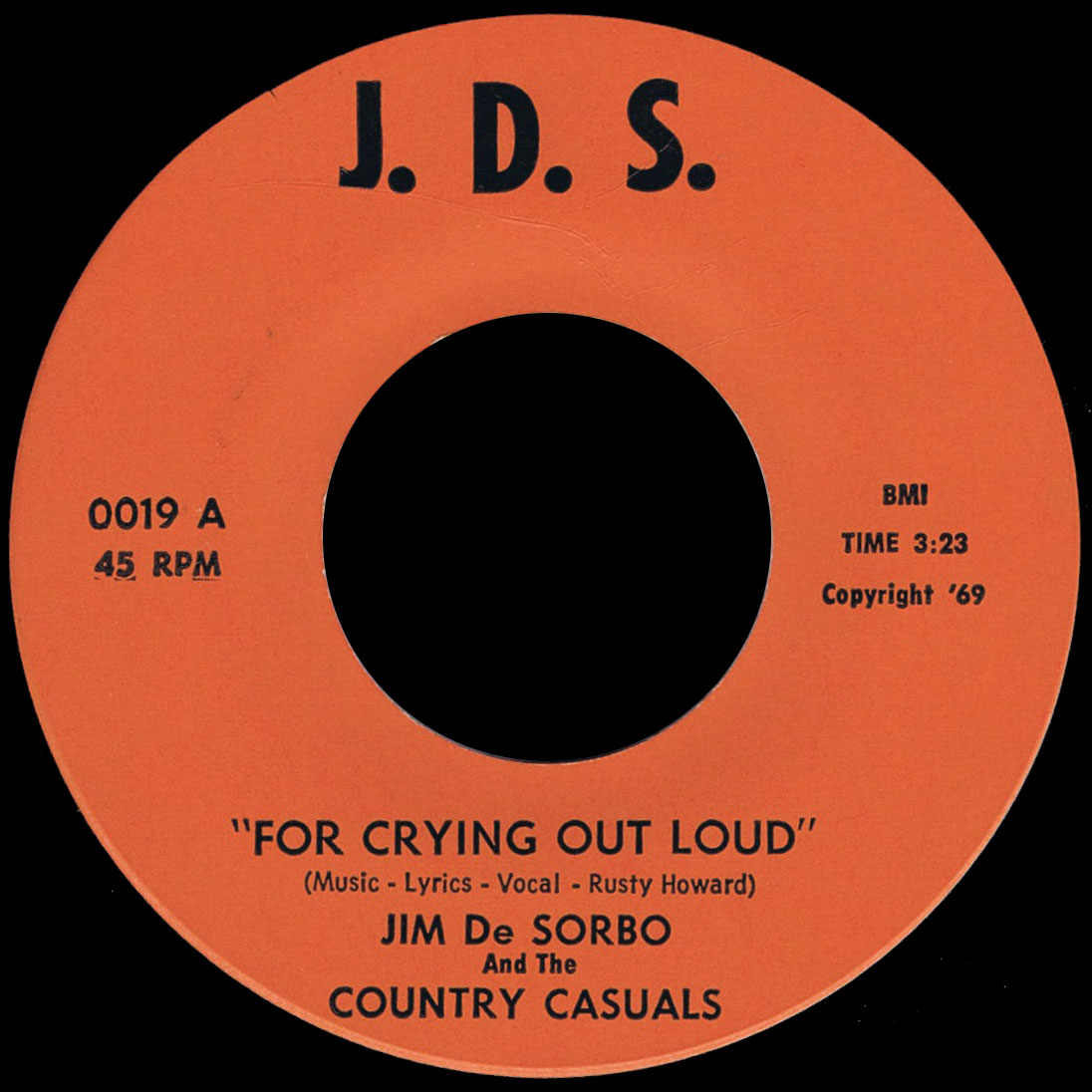
J.D.S. 0019 – Jim DeSorbo and the Country Casuals – “For Crying Out Loud” (Music, lyrics, vocal – Rusty Howard) / “I’ve Had All I Can Take from You” copyright ’69 BMI
The Gallery 0020 – The Gallery / Peter Dean – “Forever Sunshine” (Sal Costanzo) / “Our Man Jack” (Edward Duggan), Kennett Sound, Mlester Pub. BMI. The Gallery – label name or group?
0021 – ?
S Bar S Records 0022 – Slim Skellett & the Slim Skellett Trio – “Ghost Riders in the Sky” / “Wanderers of the Wasteland” (Brad Husson guitar, banjo; Bob Skellett bass)
S Bar S Records 0023 – Slim Skellett & the Slim Skellett Trio – “Strawberry Roan” / “Billy Richardson’s Last Ride” (Brad Husson guitar, banjo; Bob Skellett bass)
King Town 0024 – Coming Generation – “Tell Me Now” (Jim Du Bois) / “This Troubled Life” (Ed Barnhart) copyright ’69
0025 – ? 0026 – ?
Third Wave 0027 – Morning After – “I Don’t Need You Today” / “Dream” (Tate, Talbott, Kearney) Copyright 70 Dyad Music BMI, Prod. by Lance Naylor, group from Lake Latrine area
0028 – ? 0029 – ? 0030 – ? 0031 – ? 0032 – ?
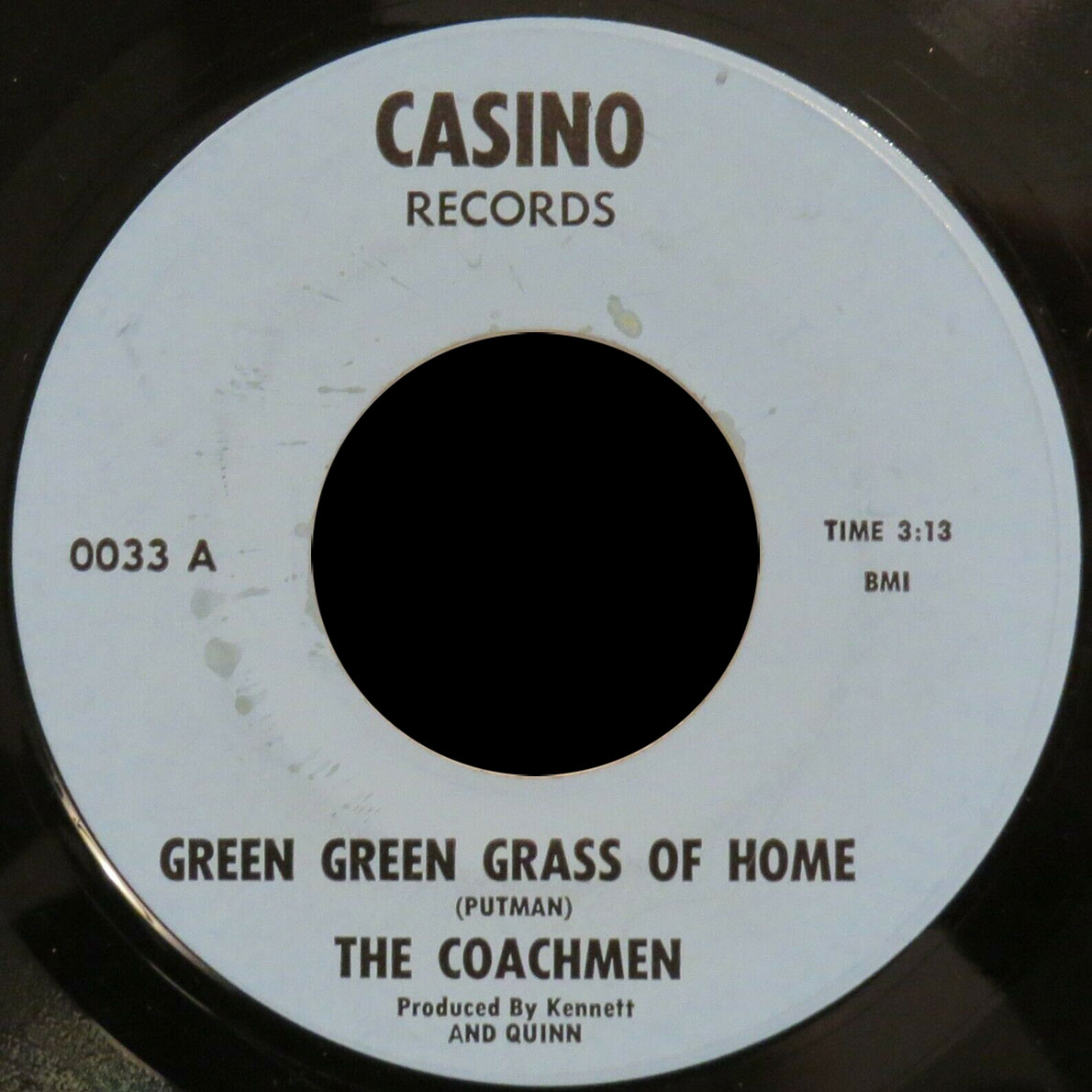
Casino 0033 – The Coachmen – “Green Green Grass of Home” / “Hang Up Your Rock and Roll Shoes” Produced by Kennett AND QUINN
from the collection of Brian Kirschenbaum
Ranch Bar Records 0034 – Billy D. Hunter with the Santa Fe Riders – “I Still Belong to You” (Grace Hamilton, Billy D. Hunter) / “Will You Remember Me” (Gorden Bainbridge, Billy D. Hunter) – Waterford, NY
Drift 0035 – Denny and the Drifters – “Mountain of Love” (Harold Dorman) / “It’s Only Make Believe” (Twitty – Nance)
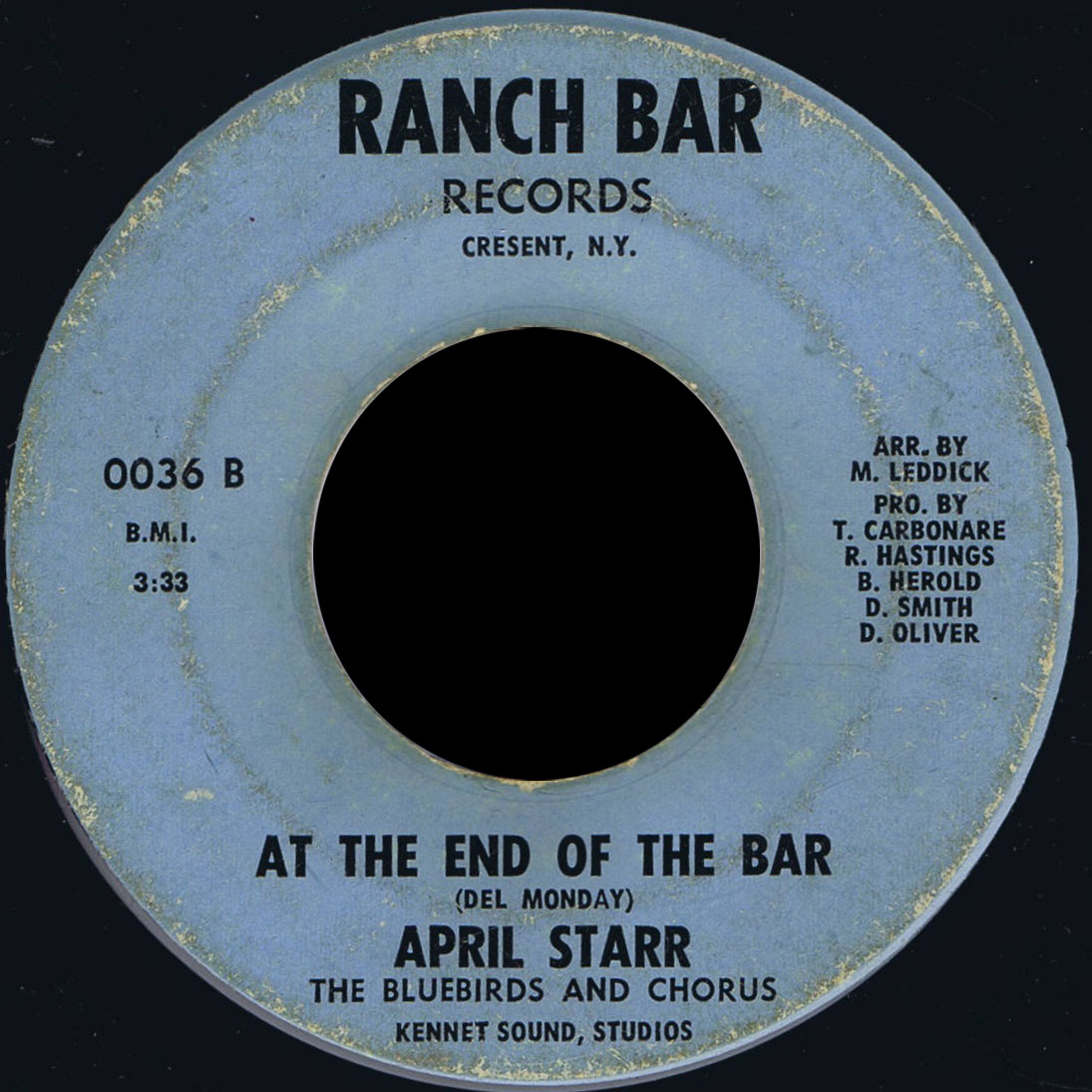
Ranch Bar Records OO36 – April Starr the Bluebirds and Chorus – “Lonely Heart” / “At the End of the Bar” (Del Monday) – arranged by M. Leddick’ produced by T. Carbonare, R. Hastings, B. Herold, D. Smith, and D. Oliver, from Crescent, NY.
Drift 0037 – Denny and the Drifters – “Broken Hearted Dreamer” (Ted Craver and Denny Haughney) / “Why Do I Love You” (Kenny White, Paul Desroches) produced by Kennett
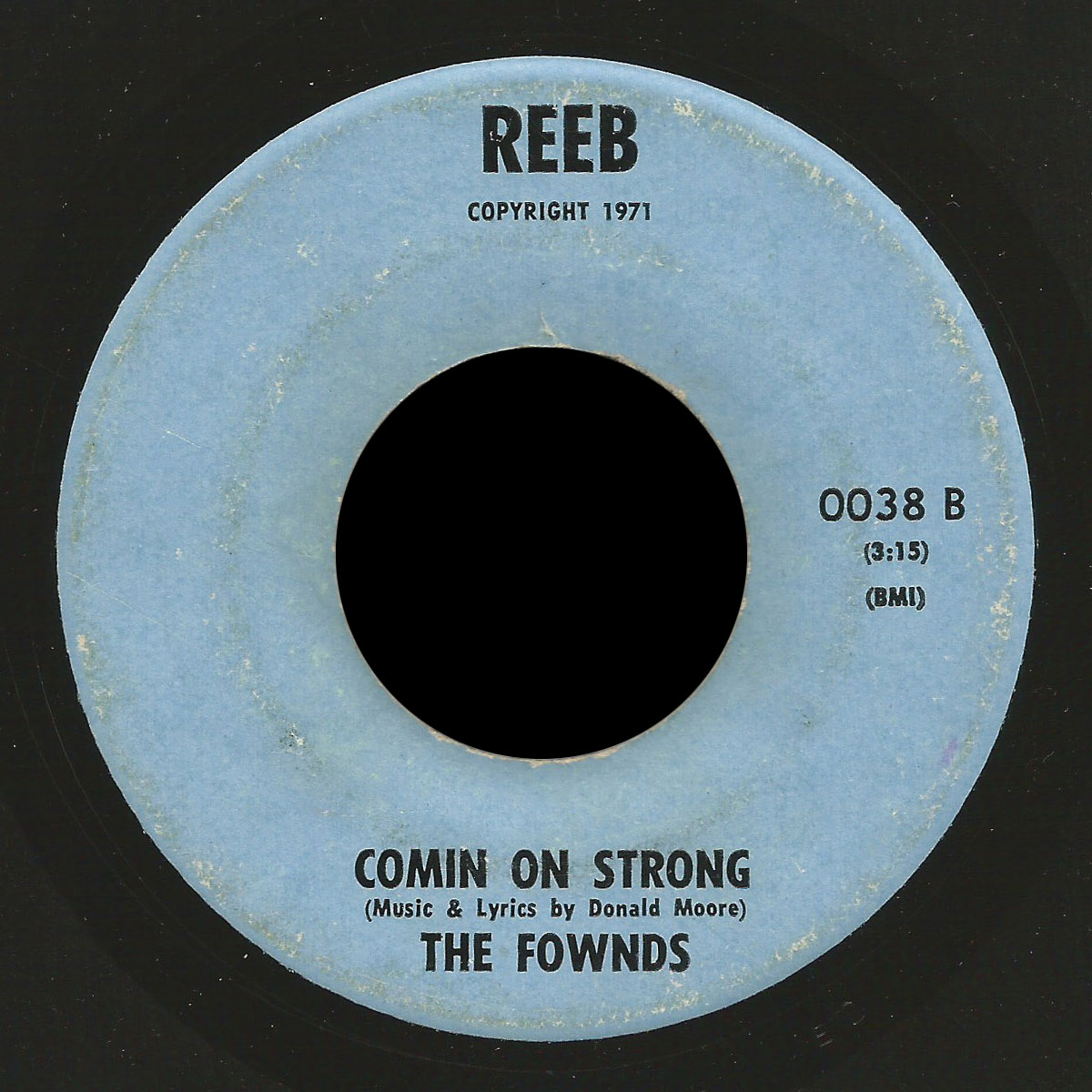
Reeb 0038 – The Fownds – “Rosalin” (Sal Gambino) / “Comin On Strong” (Donald Moore) (1971)
0039 – ? 0040 – ?
Mojo 0041 – Exit 19 – “Angel of the Morning” / “To Be Alone” (written by Joe Cashara who also did lead vocal) produced by Lanse Dowdell, 1972
Quellthom 0042 – Bob Thomas – “It’s Just Not Fair” / “I’m Walkin’” / “Hello Mary Lou” (1973)
Parker 0043 – Country Express – “Trying to Quit” / “Ode to a $164 Plane Ticket” (both songs by D.B. Boucher, vocal by Frenchie La Shay) 1970
Reeb 0044 – The Founds – “Wheels” / “Remember” – vocal by Roy Jackson, both songs by Donald Moore, 1973
Ranch Bar 0045 – Jimmy DeSorbo and the Country Casual’s – “Listen to the Mocking Bird” / “Let the Rest of the World Go By” (Dolly McIntyre – producer)
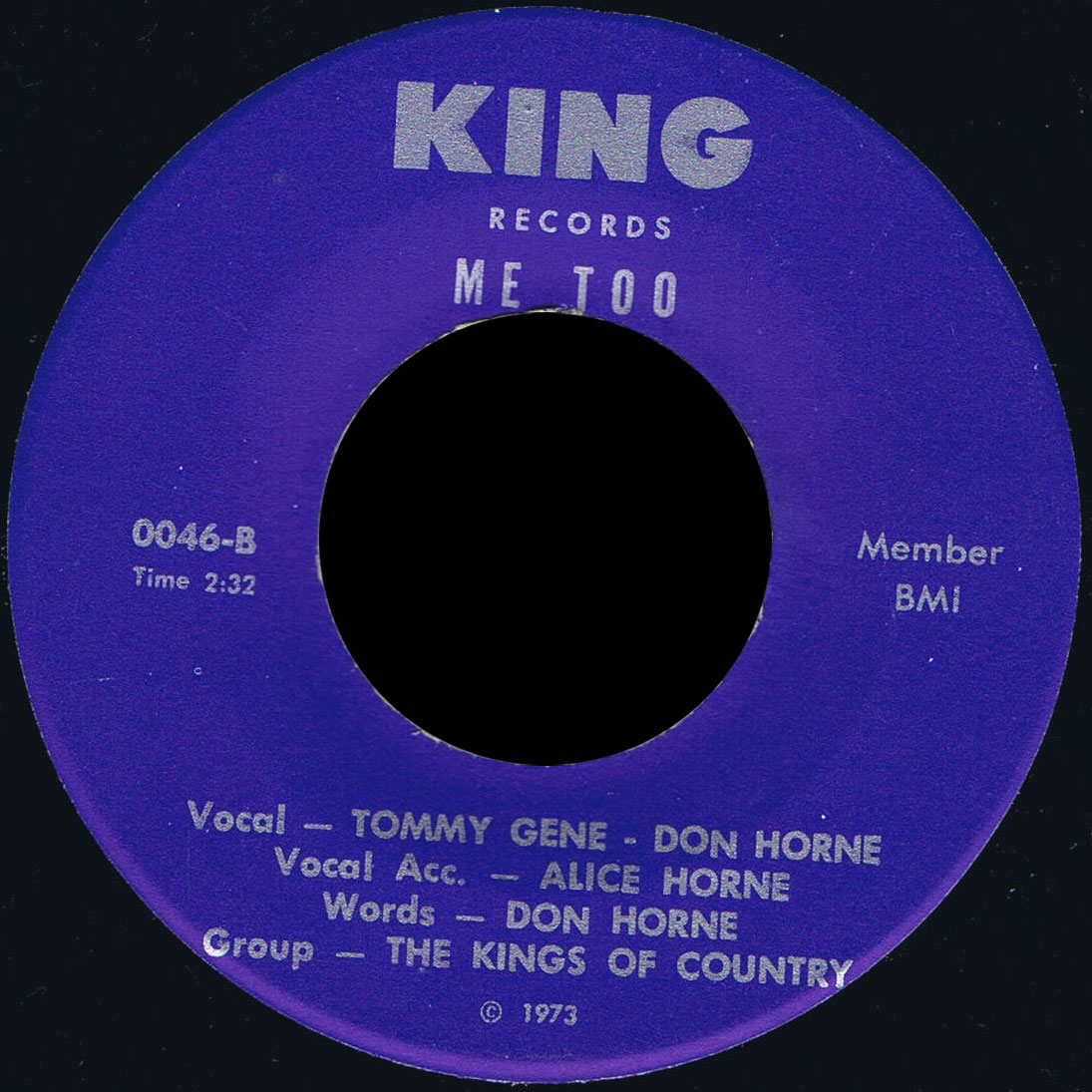
King Records 0046 – Tommy Gene with the Kings of Country – “Somewhere U.S.A.” (words by Carol Curtis, music by Tommy Gene) / Tommy Gene and Don Horne – “Me Too” (accompanied by Alice Horn, words by Don Horne). A-side has 1968 copyright while B-side has 1973 copyright.
——————
Any help with additional releases, photos or memories of the Kennett Sound Studio would be appreciated.
The Gallery (formerly the Gayblades) included Sal Costanzo (organ), Peter Dean (drums, vocals), Holly Gregg, John Dean, Bob Dean, and Robbie Howard, though I am not sure exactly who played on their single “Forever Sunshine”.
Note: there was a Kennett Sound Studios operating out of Kennett, Missouri recording mostly country music, 1,100 miles away and unrelated to this studio.
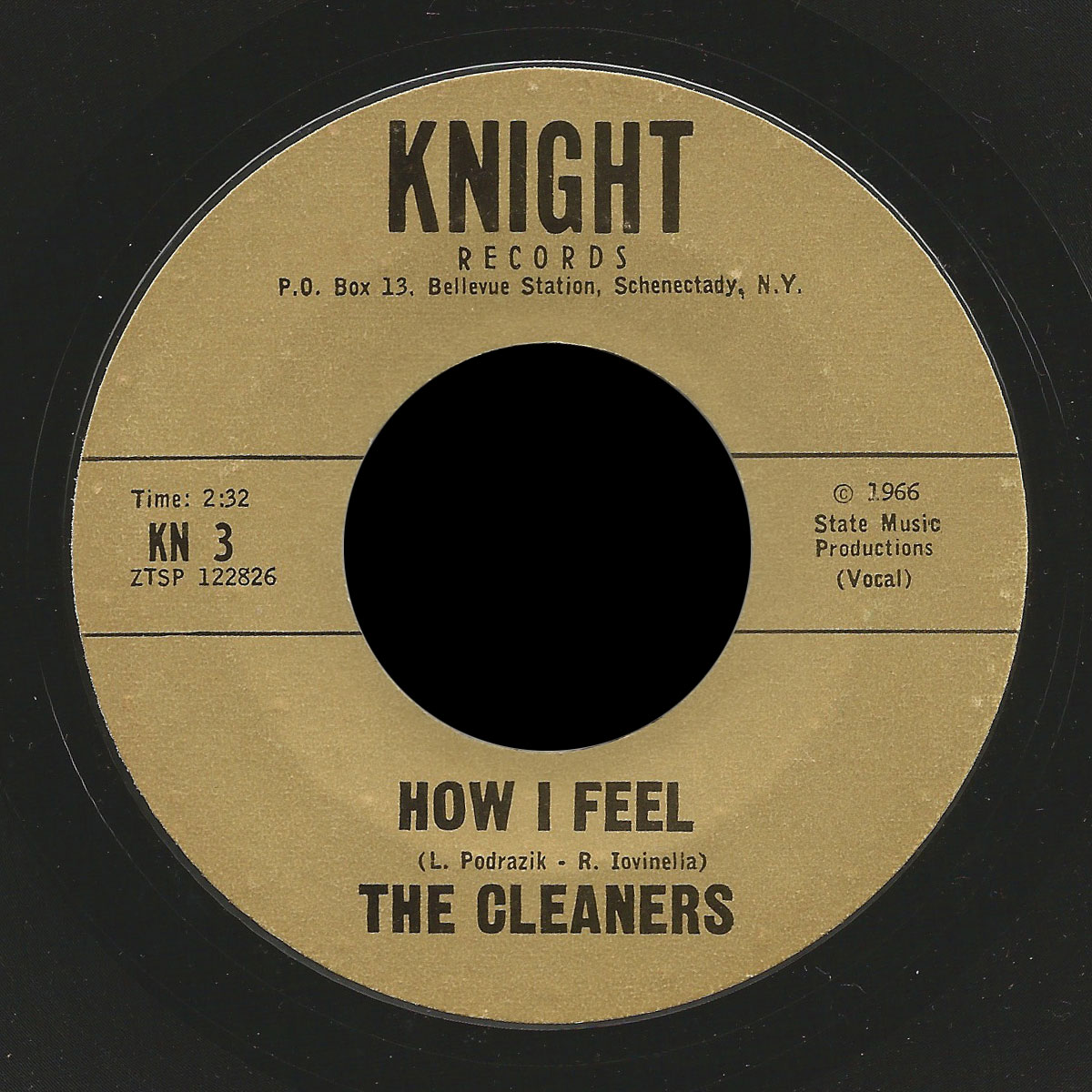
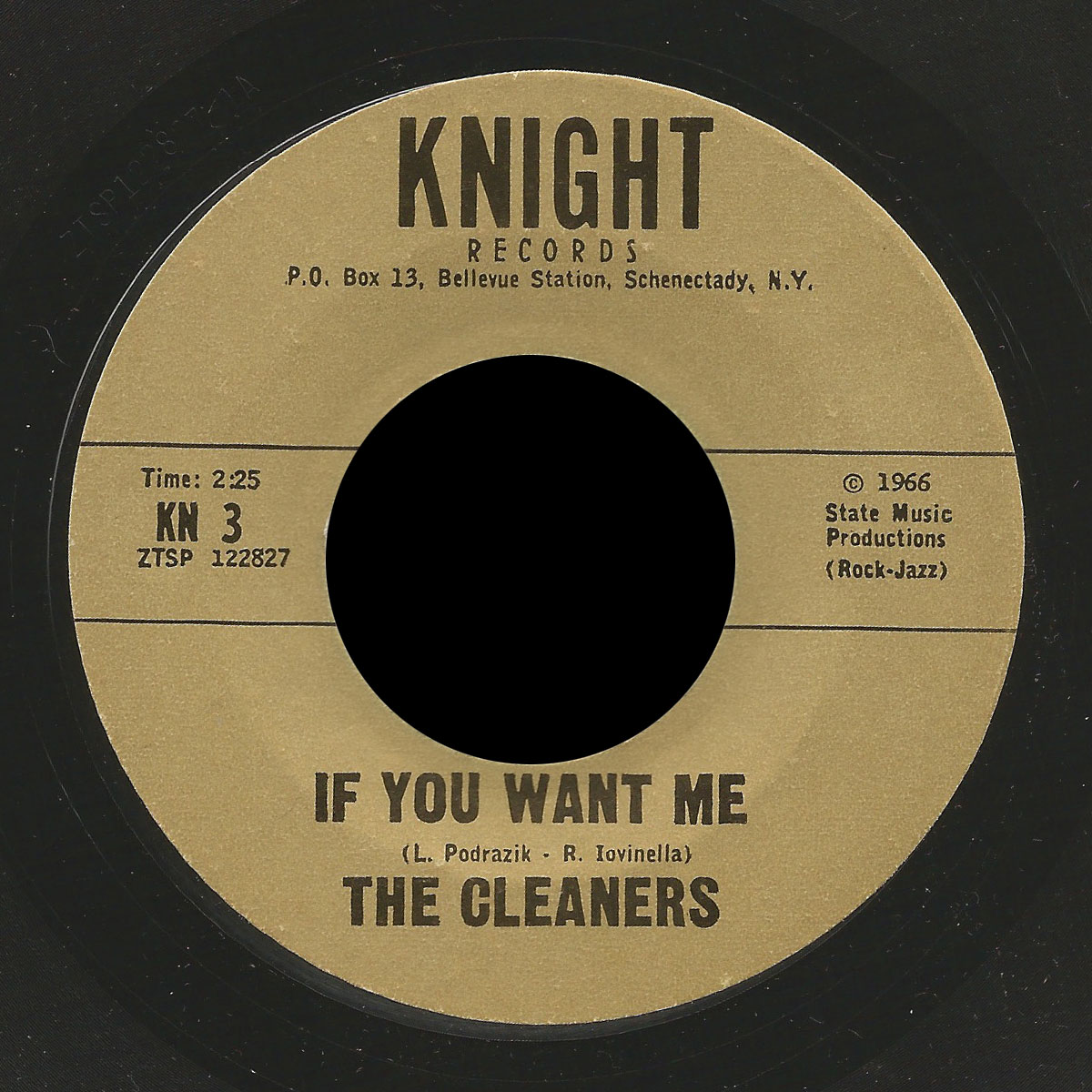
The Cleaners came from Schenectady, New York, releasing two singles in 1966 and 1967.
Members included Larry Parks (listed in songwriting credits as Larry Podrazik), Bob Ives (Robert Iovinella), Bob Sands and Jay Camp.
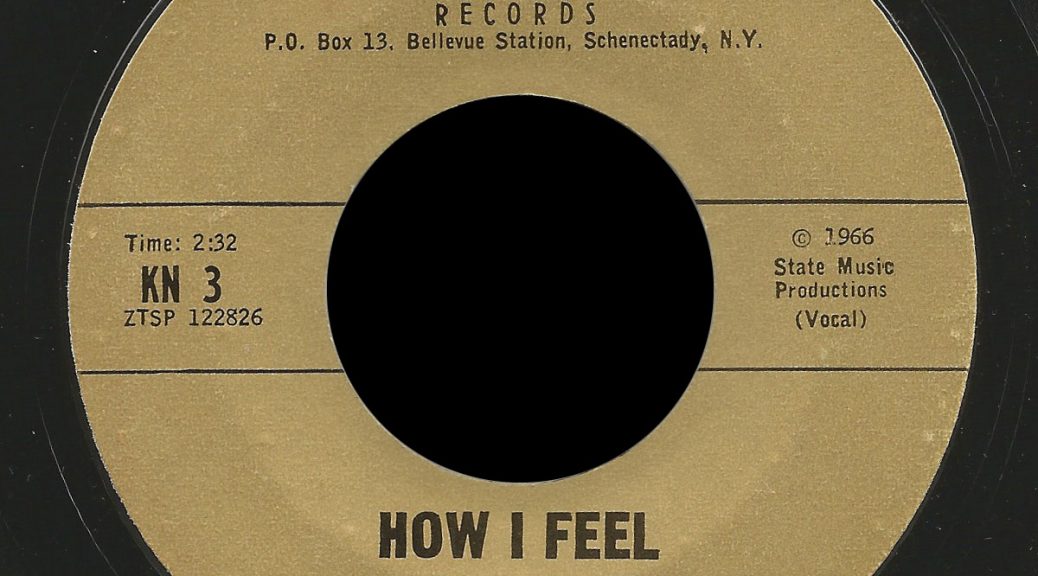
The Cleaners’ first single was the super-soulful “How I Feel” b/w “If You Want Me” (described on the label as Rock-Jazz), both originals by Podrazik and Iovinella. A comment below mentions booking manager George DeVito recording the songs in his home studio. However, I have a 8″ laquer acetate of both songs from Earl Kennett’s studio. The sound of the bass, and the echo of the hand claps on “If You Want Me” suggests Earl’s studio rather than a home recording.
It was issued on Knight Records KN 3, of Bellevue Station, Schenectady, with a State Music Productions credit; the ZTSP 122826/7 codes indicate a Columbia custom issue, a styrene 45.
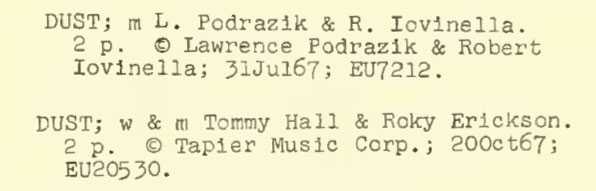
Podrazik and Iovinella copyrighted the songs in April and May of 1966, along with another original, “Just Until the End of Time” that was not released but would remain part of their live set.
In July of 1967 Podrazik and Iovinella registered another original song, “Dust”. The Cleaners cut it at Kennett Sound Studio in Kinderhook, NY, along with a cover of “Hold Me, Thrill Me, Kiss Me”, released on their own Kleener Style Records 0011.
These were among the earliest singles issued out of Earl Kennett’s studio, which would go on to record and release over twenty 45s into the 1970s.
From the 1967 index of copyright registration
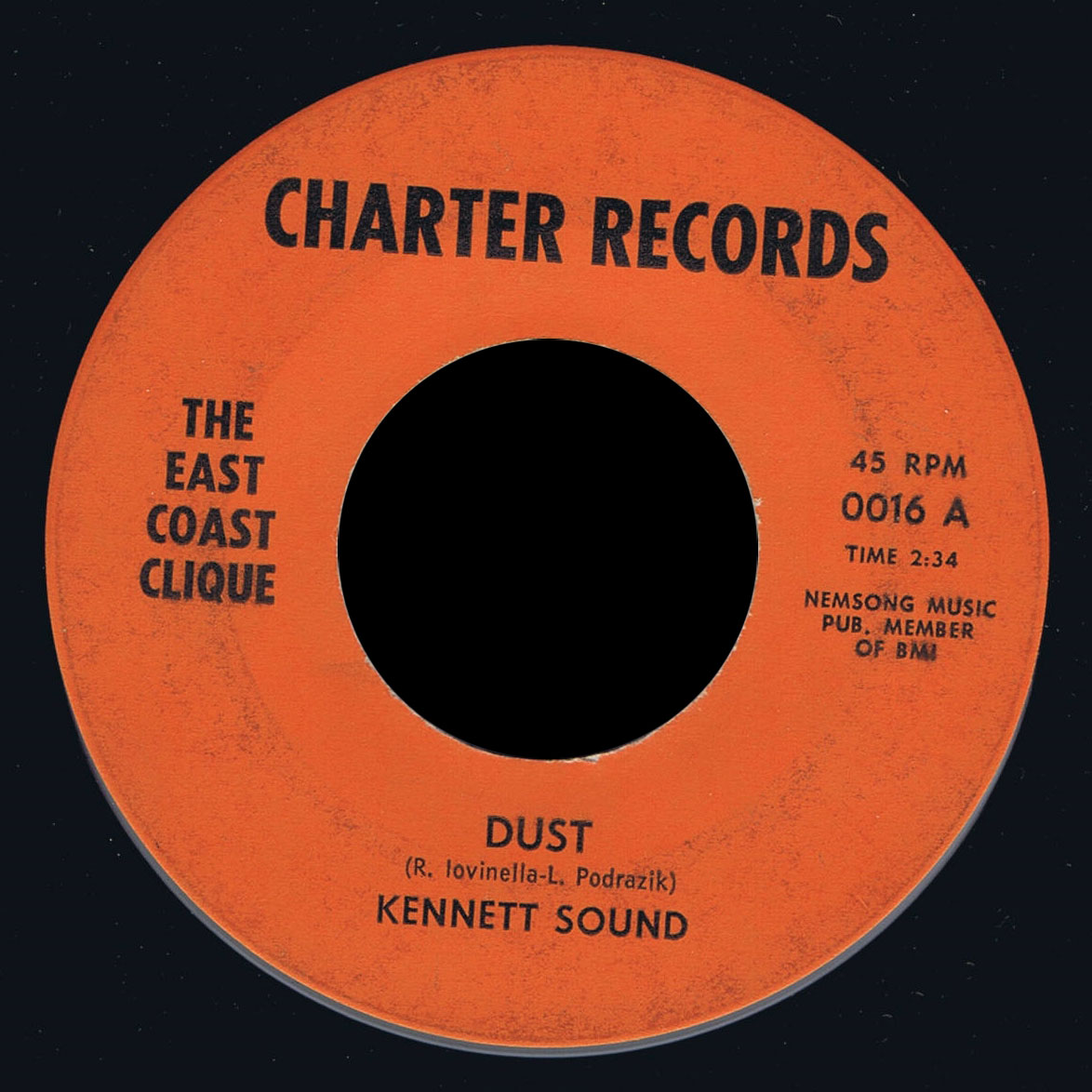
Not long after, the East Coast Clique recorded “Dust” backed with another Podrazik/Iovinella original, “Last Stop (Everybody’s Getting Off)”, both with NemSong publishing. Released as Charter Records 0016, the Kennett Sound credit at the bottom indicates the studio, as does the 00 prefix on the release number 0016. The production on this version is fuller, with the drums more prominent and danceable.
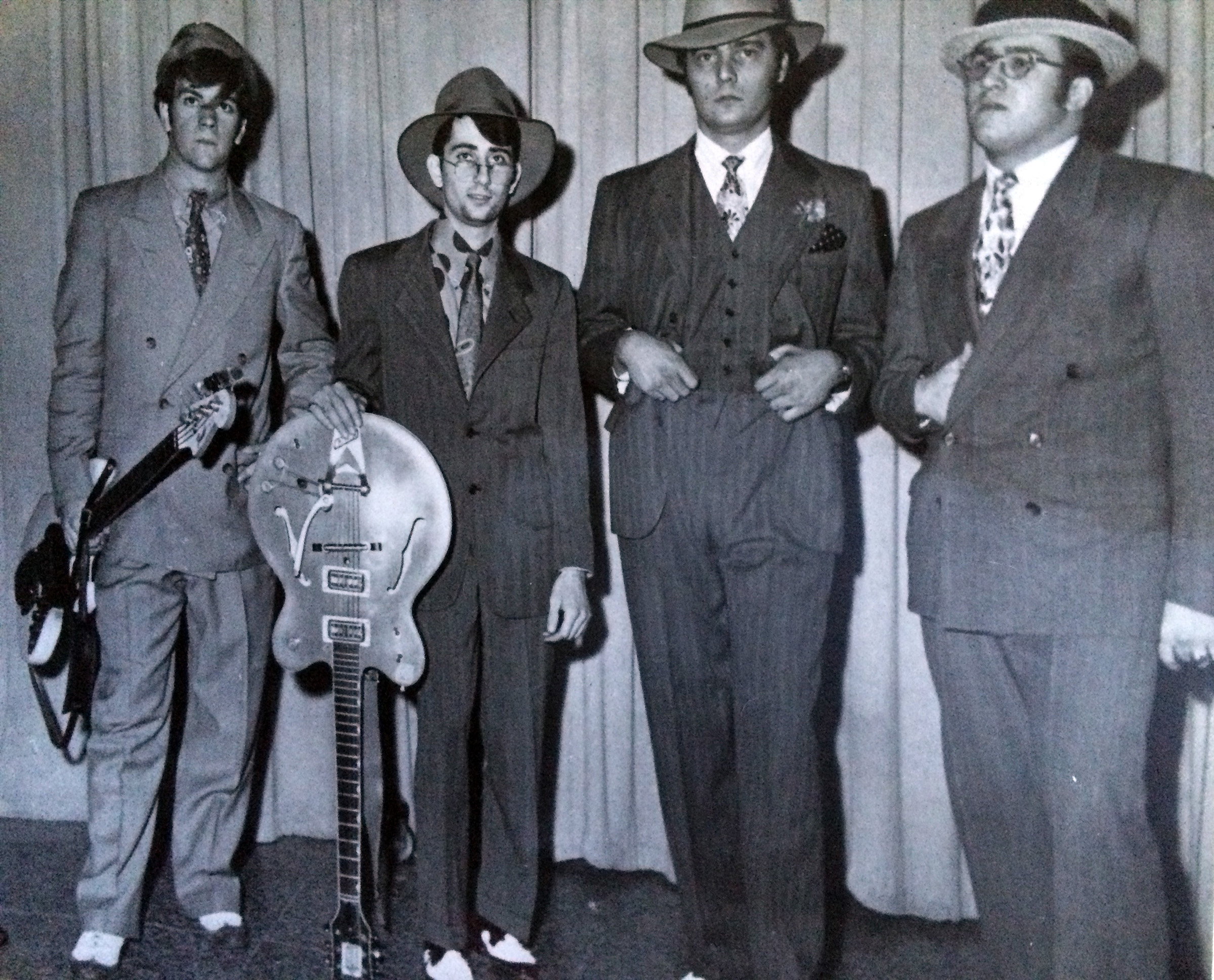
The East Coast Clique, including at least two members of the Cleaners
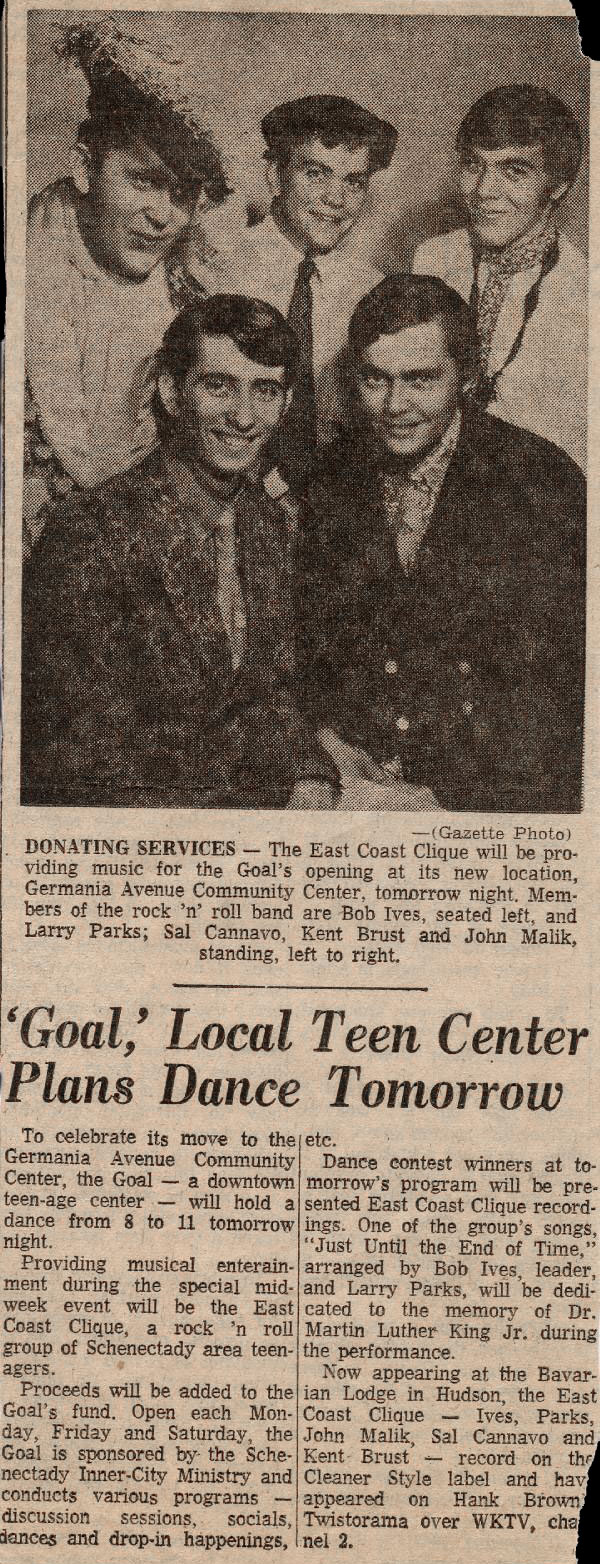
A Schenectady news clipping about the East Coast Clique mentions a single on the “Cleaner Style” label, so the Clique were a continuation of the Cleaners with a new band name, and some different members. Larry Parks and Bob Ives had been in the Cleaners, and the East Coast Clique’s other members included Sal Cannavo, Kent Brust and John Malik.
The article states:
One of the group’s songs, “Just Until the End of Time,” arranged by Bob Ives, leader, and Larry Parks, will be dedicated to the memory of Dr. Martin Luther King Jr. during the performance.
Now appearing at the Bavarian Lodge in Hudson, the East Coast Clique … record on the Cleaner Style label and have appeared on Hank Brown’s Twistorama over WKTV, channel 2.
There is an 12″ acetate from Kennett Sound Studio of three songs by the East Coast Clique: a later version of “How I Feel”, “Last Stop (Everybody’s Getting Off)” and “Just Until the End of Time”. The second song was issued as the B-side to their single on Charter Records, “Dust” but I am not sure if this is the same version.
Podrazik and Iovinella registered two additional songs in 1968: “Captain Miller’s Flying Circus”, and “Sleepy Boy” (this last one shows Earl Kennett contributing to the music arrangement).
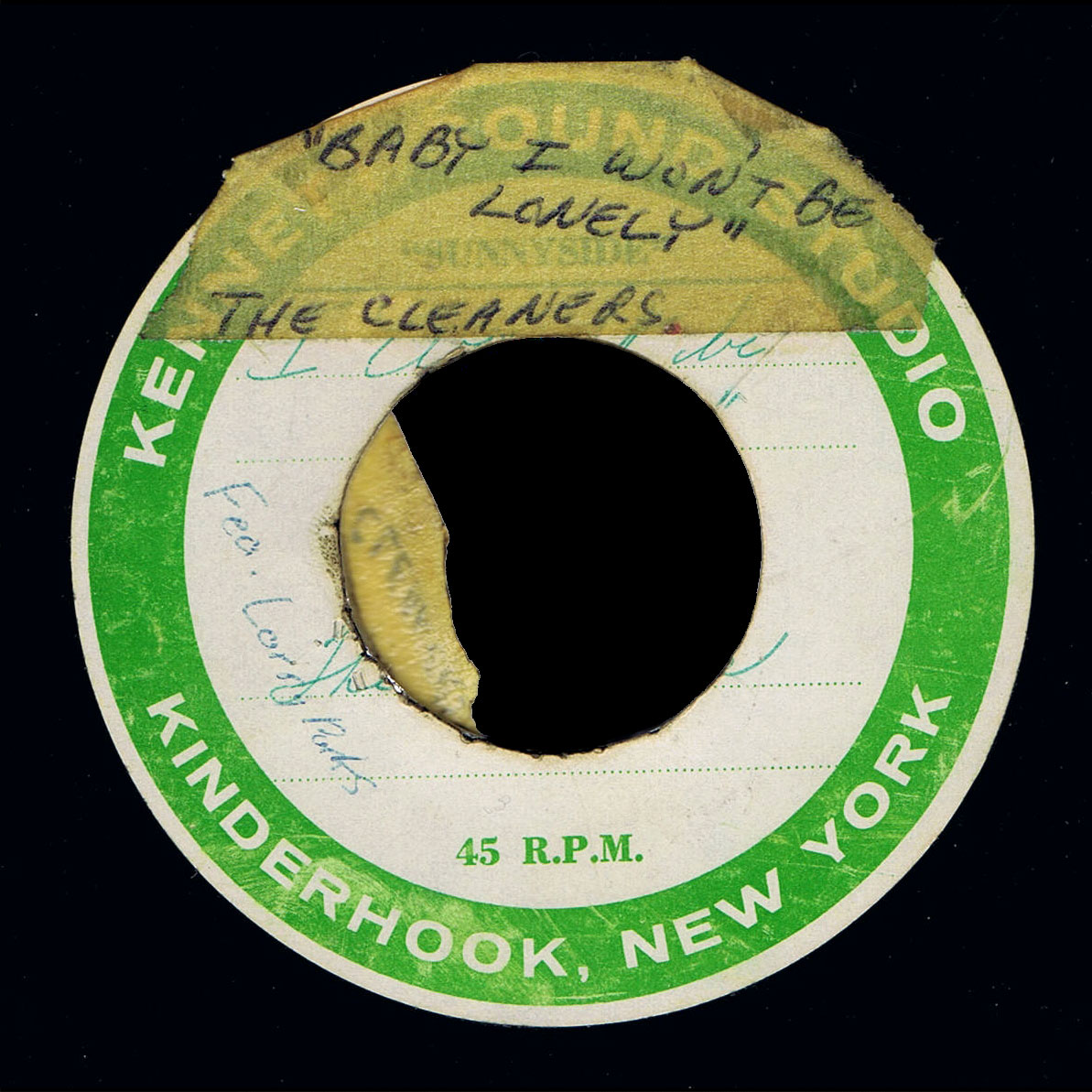
Kennett Sound Studio acetate for the Cleaners “Baby I Won’t Be Lonely”, from 1969. Scan courtesy of Brian Kirschenbaum
In January 1969, they registered “Baby, I Won’t Be Lonely”, which exists on a Kennett demo acetate as by the Cleaners, so it may have been considered for release.
Later copyrights include “I’m So Happy” (October 1969, with words by Brummer).
Al Quaglieri wrote a profile of Bob Iovinella for the March 8-14, 1990 issue of Metroland. He describes how Iovinella and Larry Parks had a five-year publishing contract by Nat Weiss, but only two songs saw publication in that time.
In 1970, Larry Parks had a solo composition “Pay Day” (using the name Adam Parks) recorded by Sha Na Na.
Starting in 1980, Iovinella and Parks would work together again as partners in Hendi-Parksives Productions.
Thank you to Brian Kirschenbaum for scans of the East Coast Clique 45 and the Cleaners acetate. Thank you to Bobby Iovinella for the photo at top and to Mikael for the news clipping.
This site is a work in progress on 1960s garage rock bands. All entries can be updated, corrected and expanded. If you have information on a band featured here, please let me know and I will update the site and credit you accordingly.
I am dedicated to making this site a center for research about '60s music scenes. Please consider donating archival materials such as photos, records, news clippings, scrapbooks or other material from the '60s. Please contact me at rchrisbishop@gmail.com if you can loan or donate original materials