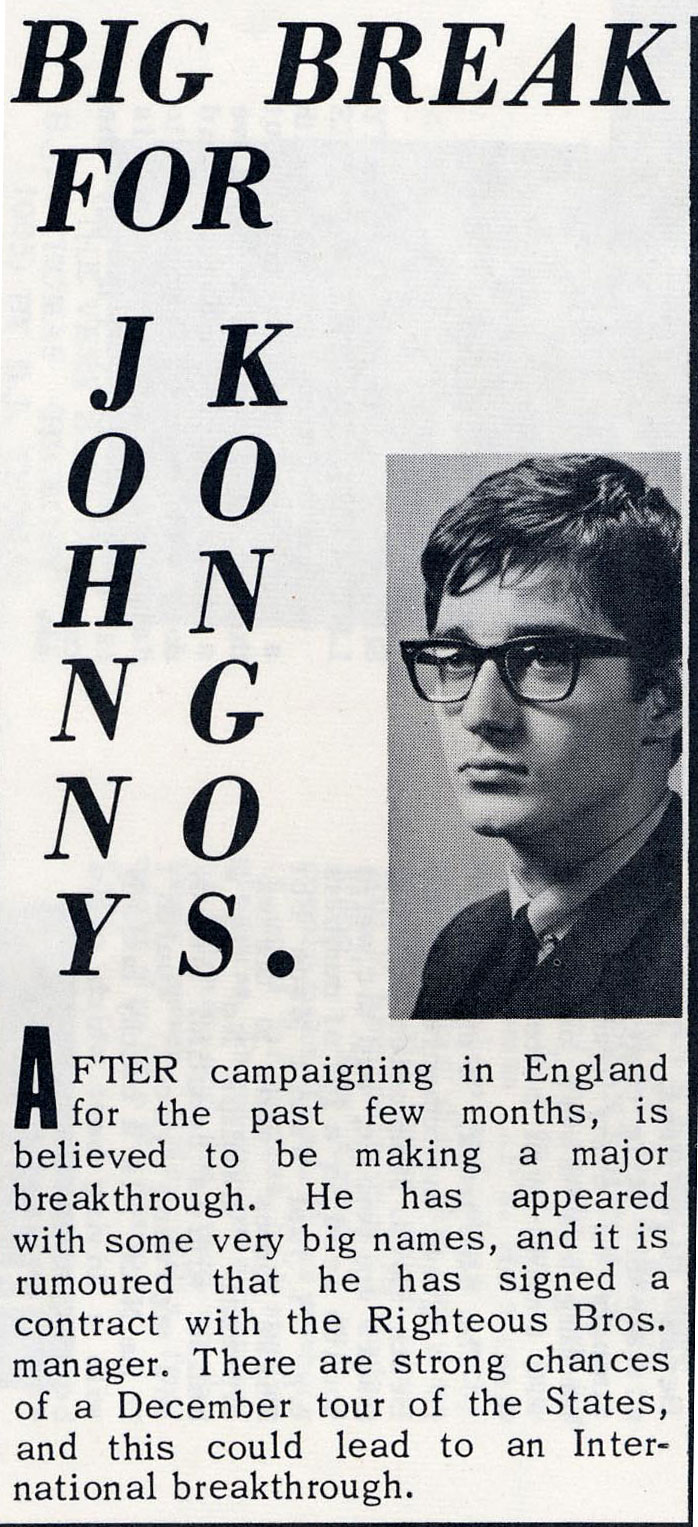
Buried in the welter of superlative singles issued in September 1967 was an intriguing release by an Anglo-South African group with a suitably ‘flower power’ name, Floribunda Rose. A forgotten gem, ‘One Way Street’ c/w ‘Linda Loves Linda’, should have been a resounding hit but despite being plugged incessantly by several notable radio stations, it barely made a ripple. Floribunda Rose may have been lost to a bygone age but its lead singer and principal songwriter remains one of South Africa’s most successful exports and would years later become synonymous with one of Brit Pop’s most enduring anthems, The Happy Monday’s ‘He’s Gonna Step On You Again’.
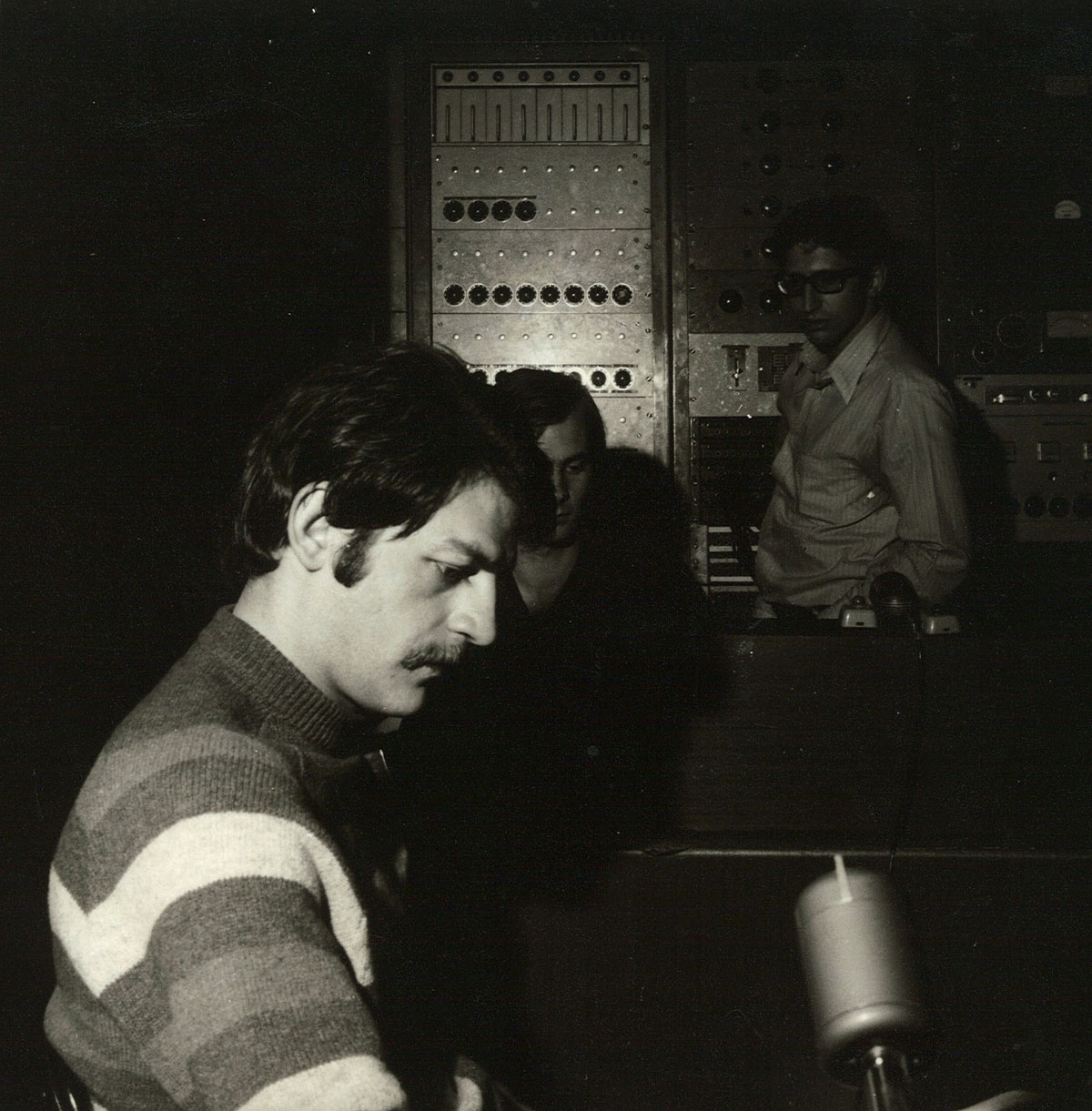
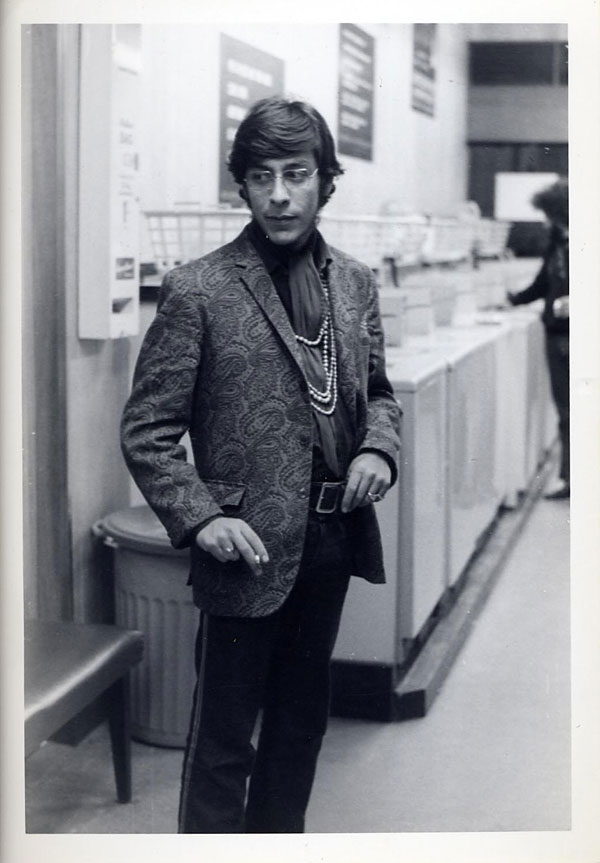
Johnny Kongos
Born in Jo’burg on 6 August 1945 to Greek parents, aspiring singer/songwriter and guitarist Johnny Kongos had formed his first group, The Dukes, when he was 15 years old and began carving out a local following playing at his mother’s club, the Fireplace in Boksburg.
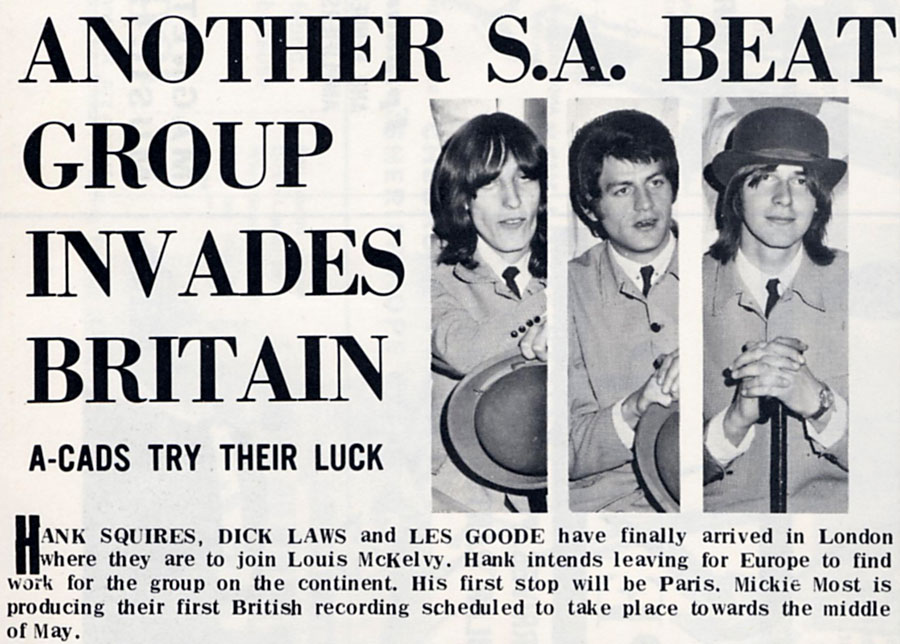
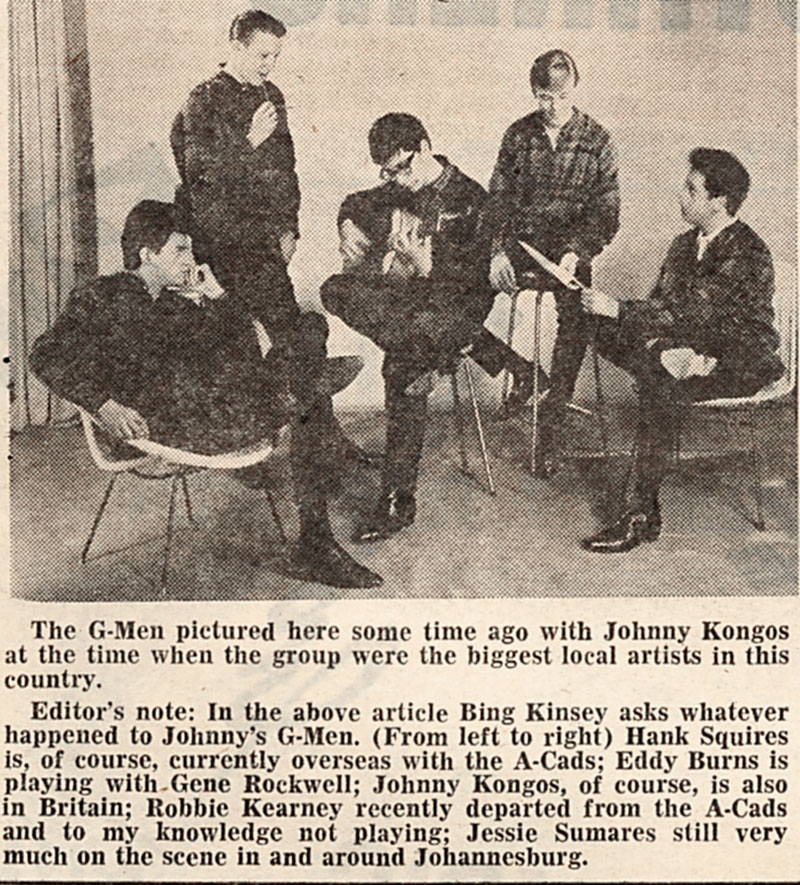
Joined by former Mickie Most & The Playboys guitarist Hank Squires in 1962, the group morphed into Johnny Kongos & The G-Men and over the next three years released nearly twenty singles and half a dozen albums for the Teal and RCA labels.
In late 1963, Kongos made his first exploratory visit to the UK but despite auditioning for a couple of major labels, and running into Hank Squires’s former band leader, Mickie Most, now a fledgling producer, Kongos failed to make an impact.
Empty handed, he returned to Jo’burg and reformed The G-Men. Plans to consolidate his earlier successes, however, were soon thrown in the air when the singer was called up for national defence training in late 1964.
Returning to civilian life six months later, Kongos picked up where he’d left off and recorded a final single with The G-Men, ‘Until It’s Time For You To Go’, which secured a release on Teal, the South African distributor for the Pye label.
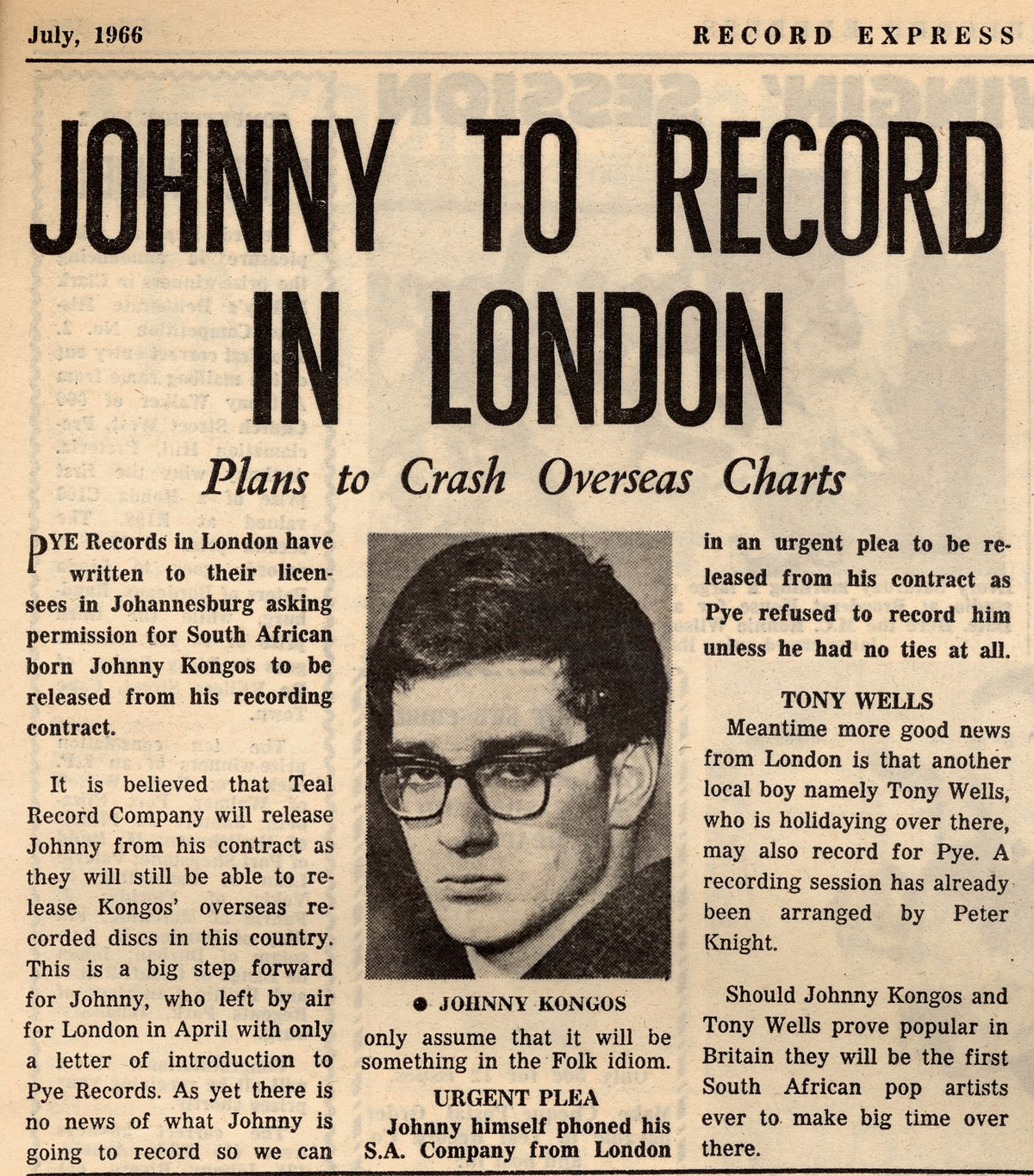
Thanks to these connections, Kongos elected to return to the UK in April 1966, where he befriended Pye’s manager/producer John Schroeder. Sufficiently impressed by Kongos’s audition tape, Schroeder secured a solo deal with Pye’s subsidiary label, Piccadilly.
The fruits of the ensuing sessions turned up on the singer’s debut UK single – the folky, self penned ‘I Love Mary’, backed with the poppy Kongos/Leroy number, ‘Good Time Party Companion’, released that September. Credited to John T Kongos, the single was well received but did nothing chart-wise.
004
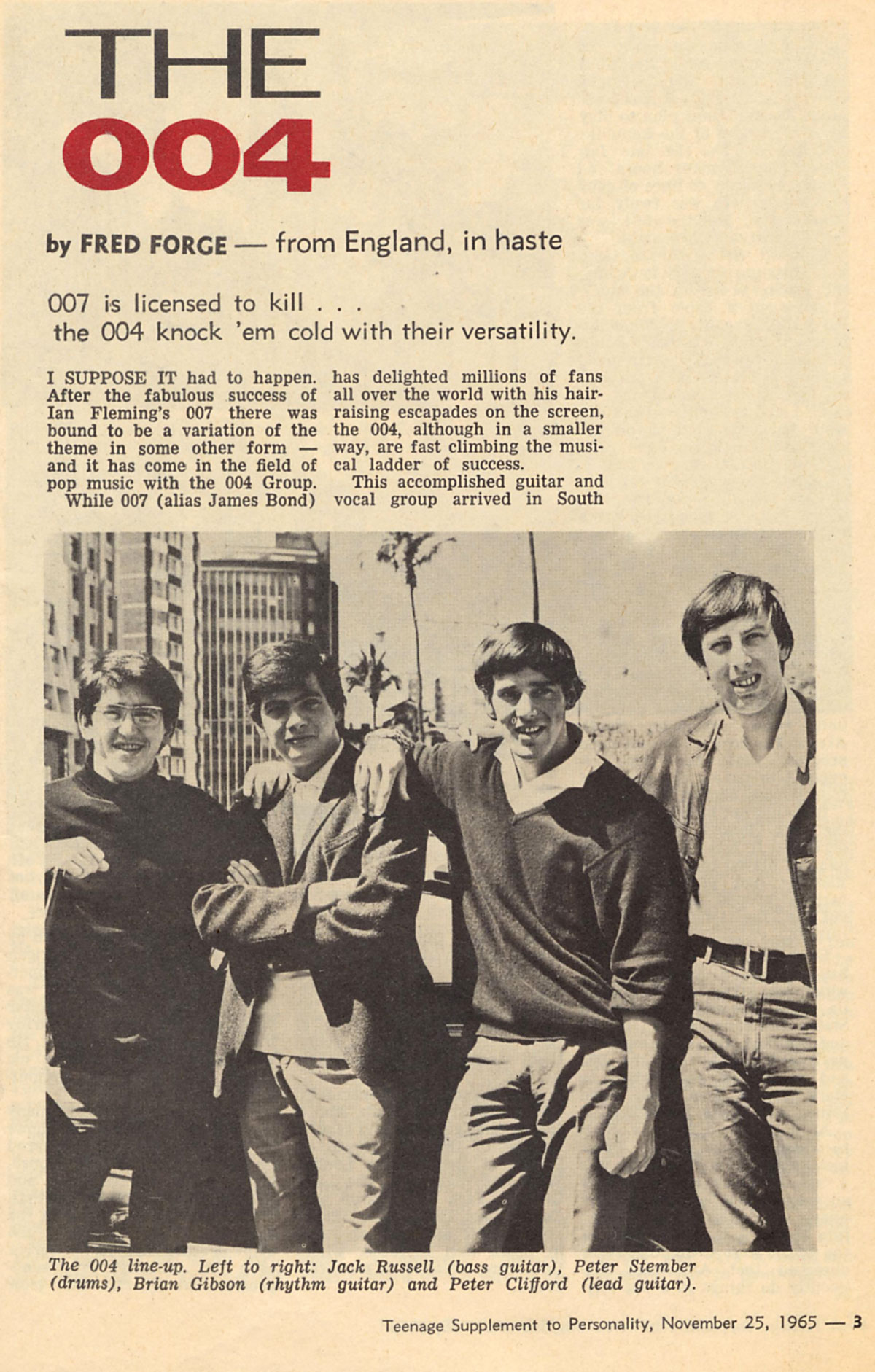
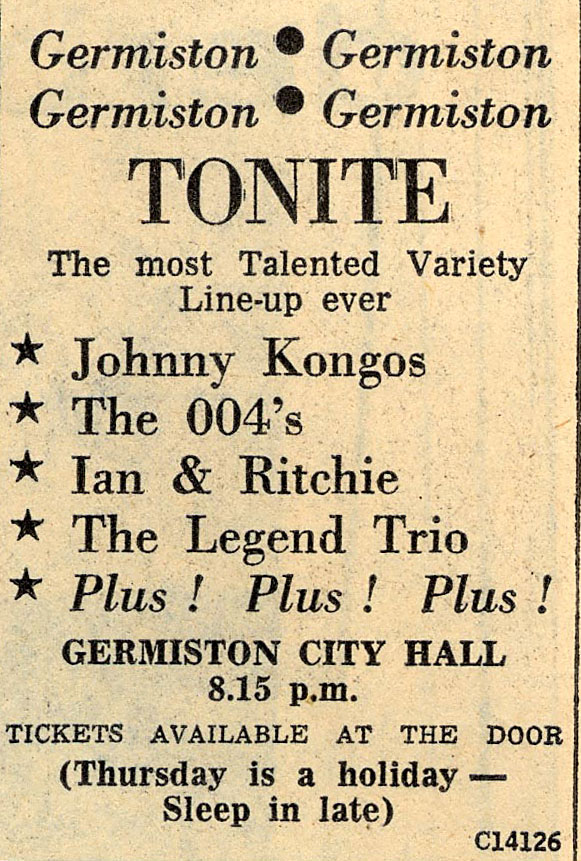
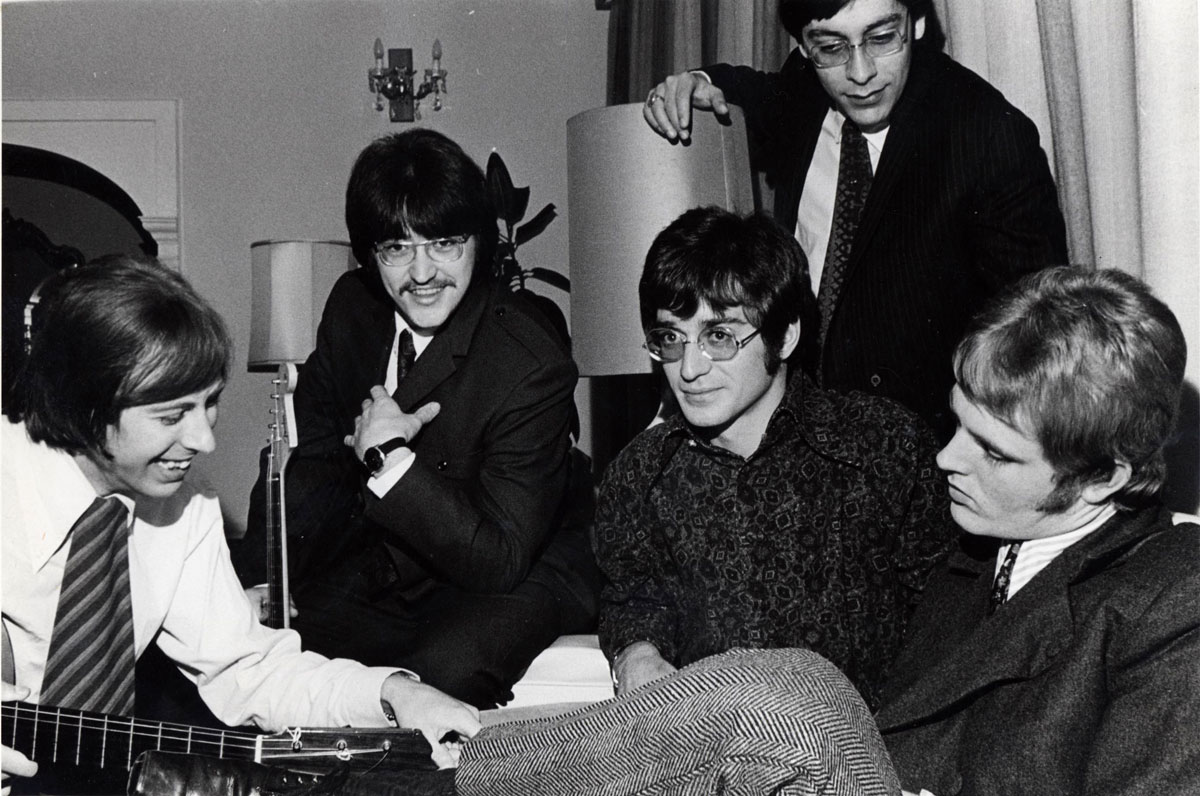
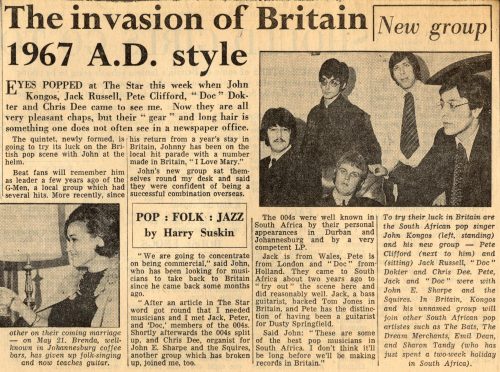
Soon after the single’s release, Kongos was back in South Africa beginning work on a fresh clutch of songs with the intention of recording an album. One night in April 1967, he dropped into the 505 club in Jo’burg’s trendy Hillbrow district and caught British group, The 004 entertaining the crowds (see The 004 page for a closer inspection of this fascinating group). Suitably impressed, he approached the band members after they’d finished their set and asked them to help him cut the planned album as paid musicians.
A hugely popular live act, The 004 had arrived in South Africa by boat in July 1965 on the back of a contract offered to the group’s lead guitarist, Pete Clifford (b. 10 May 1943, Whetstone, London). A former member of Dusty Springfield’s backing group, The Echoes, Clifford had first visited South Africa during 1964 and participated in the singer’s infamous tour where she was deported for refusing to play to segregated audiences.
While the tour had been a PR disaster, Clifford had been promised some lucrative work by Trevor Boswell, husband of South African 1950s star, Eve Boswell, and co-owner of the Keleti Artist Agency, if he could return from London with a new group.
Clifford sought around for suitable musicians and quickly recruited Welsh rhythm guitarist and singer Brian Gibson from The Laurie Jay Combo, who in turn recommended fellow countryman, bass player and singer Jack Russell (b. 29 April 1944, Caerleon, Wales).
Gibson and Russell had known each other for years, having first worked together in The Victors, resident band at the Latin Quarter, one of London’s top theatre restaurants.
“I had a call on the Monday from Brian,” remembers Russell, who was working as a manager for Vox in Dartford at the time. “He asked me if I fancied joining him in a band that was going to South Africa. I said, ‘Yes’ and asked, ‘When do we go?’ He said, ‘Thursday!’”
With Londoner Peter Stember (today a successful US-based photographer) completing the line up on drums, The 004 sailed for Durban and soon shot to local fame as one of the top groups working the clubs, so much so that they landed jobs supporting Gene Vincent and The Ivy League.
During 1966, the band released a handful of singles for CBS, including ‘The In Crowd’ and a decent album, It’s Alright, before Stember returned to the UK in August.
In his place, The 004s recruited Dutch-born, South African raised drummer Nick ‘Doc’ Dokter (b. 24 July 1945, Kampen, Overijsel, The Netherlands), who possessed an impressive musical CV, including a stint with The Leemen Limited alongside South African guitar legend, the late Ken E Henson.
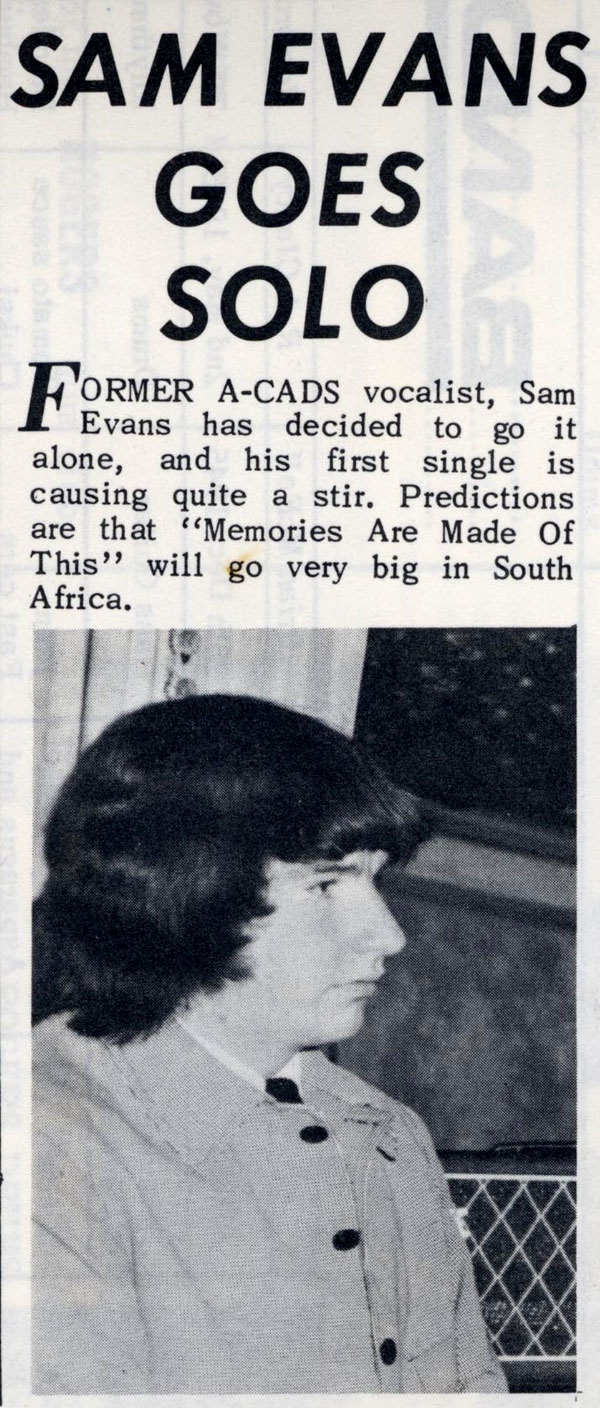
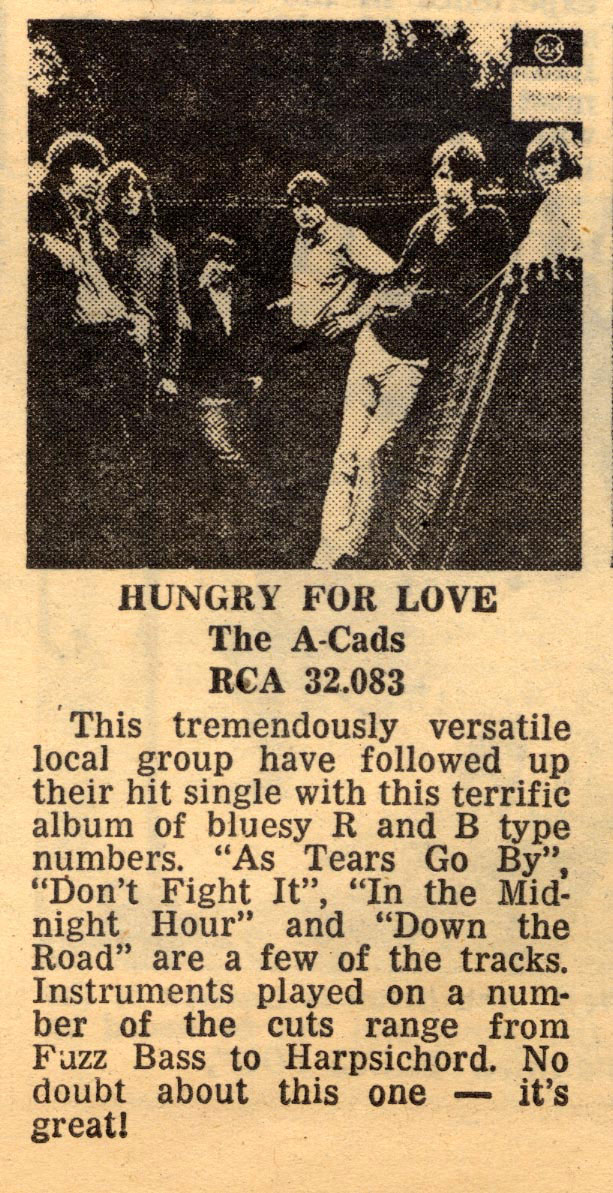
Originally a bass player, Dokter moved to drums early his career after the sticksman in the garage band he was playing in gave up music for a regular job. Working with future A-Cads singer Sammy Evans in a factory making boilers, the pair struck up a friendship and in an interesting turn of events both ended up joining Johnny Kongos’ group The G-Men after the singer was called up for military service.
“We all went and played at John’s place, the Fireplace,” recalls Dokter. “From there I met Kenny Henson, who needed a drummer, so I moved to Durban to join Leemen Limited.”
After two rare singles on the Continental label, including a great version of ‘In The Midnight Hour’ backed by John Mayall’s ‘Heartaches’, it was time to move on again.
“I was just hanging around and Pete Clifford approached me. Peter Stember was leaving The 004 and he just said, ‘Why don’t you just come out and play with us?’ I was really a young kid and I had no experience of playing big clubs. They kinda took me under their wing.”
With Dokter filling the vacant drum stool, The 004 spent the remainder of 1966 consolidating their live reputation. When Gibson handed in his notice in early 1967 (later joining progressive rock band, Abstract Truth, alongside Henson), The 004 briefly recruited guitarist Barry Mitchell from rival band, The In Crowd, but the line up never gelled and when Kongos dropped into the 505, the group had been stripped to a trio.
“John originally offered a job to Jack and Pete,” says Dokter. “I wasn’t included in this. Eve Boswell’s son was originally going to be the drummer. He did some demos with Pete and Jack but it didn’t work out. I happened to be in one of the sessions and just took over.”
As Kongos recalls, he always intended to employ a Farfisa organ sound on his album so when Clifford, Dokter and Russell took up the offer to record with him, they were joined in the studio by a fifth member, Chris Demetriou (more commonly known as Chris Dee).
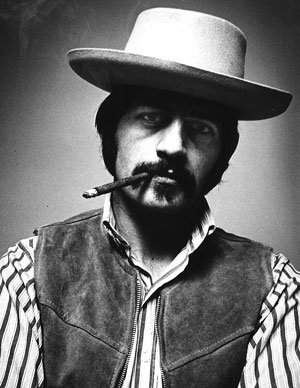
Chris Demetriou
Former keyboard player with Johannesburg’s finest R&B group, John E Sharpe & The Squires (see the Chris Demetriou interview page for more information on this band), Cyprus-born Demetriou had appeared on all of The Squires’ classic singles, including covers of The Kinks’ ‘Stop Your Sobbing’ and Paul Simon’s ‘I Am A Rock’, as well as the highly sought after Maybelline album.
“John located me through the Jo’burg Greek club,” remembers Demetriou. “I was invited to his house and the next thing I knew we were planning to leave the country and seek fame and fortune in London.”
As Kongos relates, his plan had always been to return to the UK with a band as soon as possible and use the recordings to secure further work. Looking back on the sessions, he dismisses most of the material as forgettable.
“I had written a bunch of songs and I basically wanted to do demos. I went into the studio with all of the guys and wound up taking that ‘album’ of demos to the UK.”
As events panned out, the band got half way through the recording when Kongos made a proposition: rather than pay the musicians for the sessions, he would cover everyone’s fares to UK.
Floribunda Rose
According to Russell, it made sense to return home and crack the British market, especially when Kongos had connections in the music industry. “He would have been a fool not to do that,” he says. “He had a contract in his back pocket with Pye and a contract with Maurice King who ran the Walker Brothers among others; it was a stable worth getting into.”
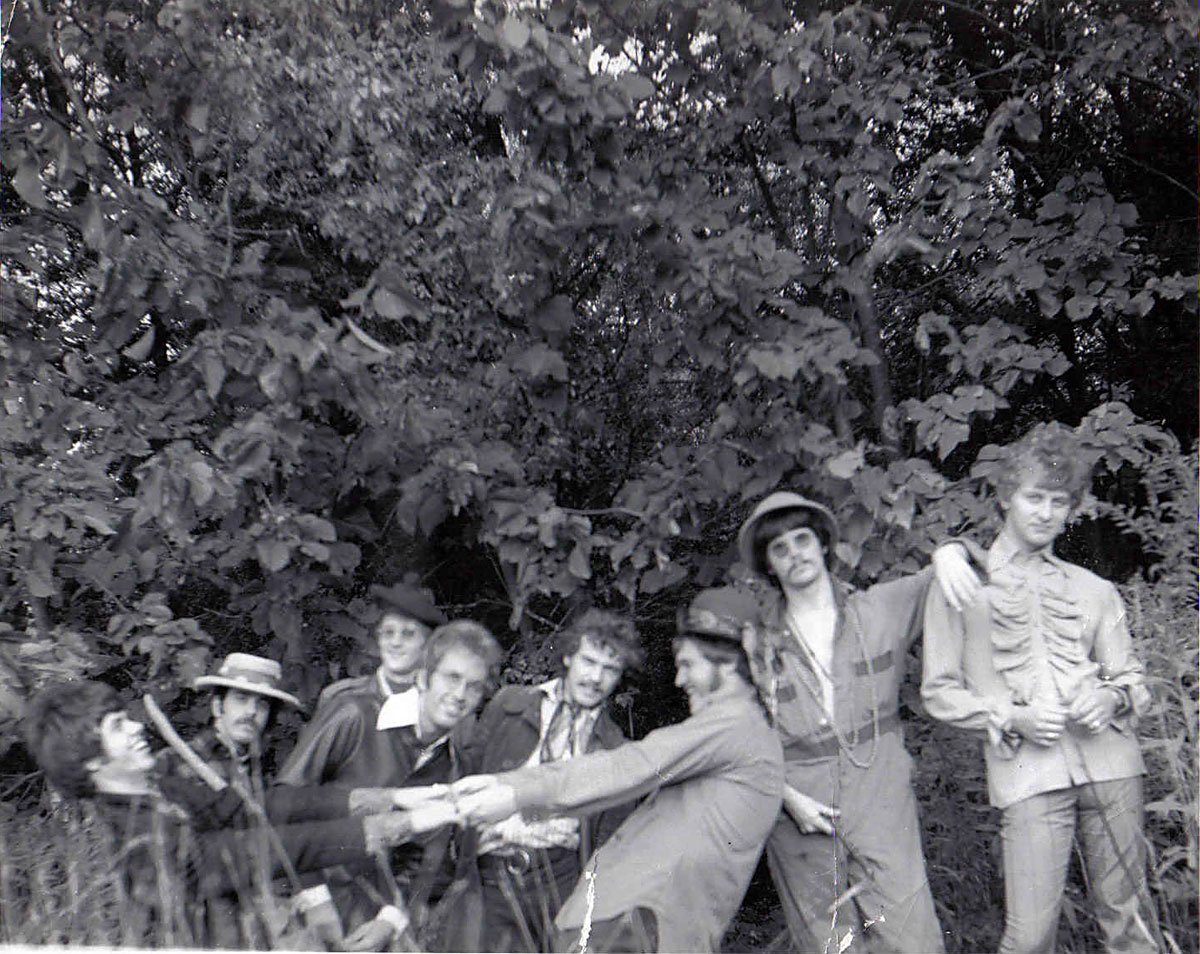
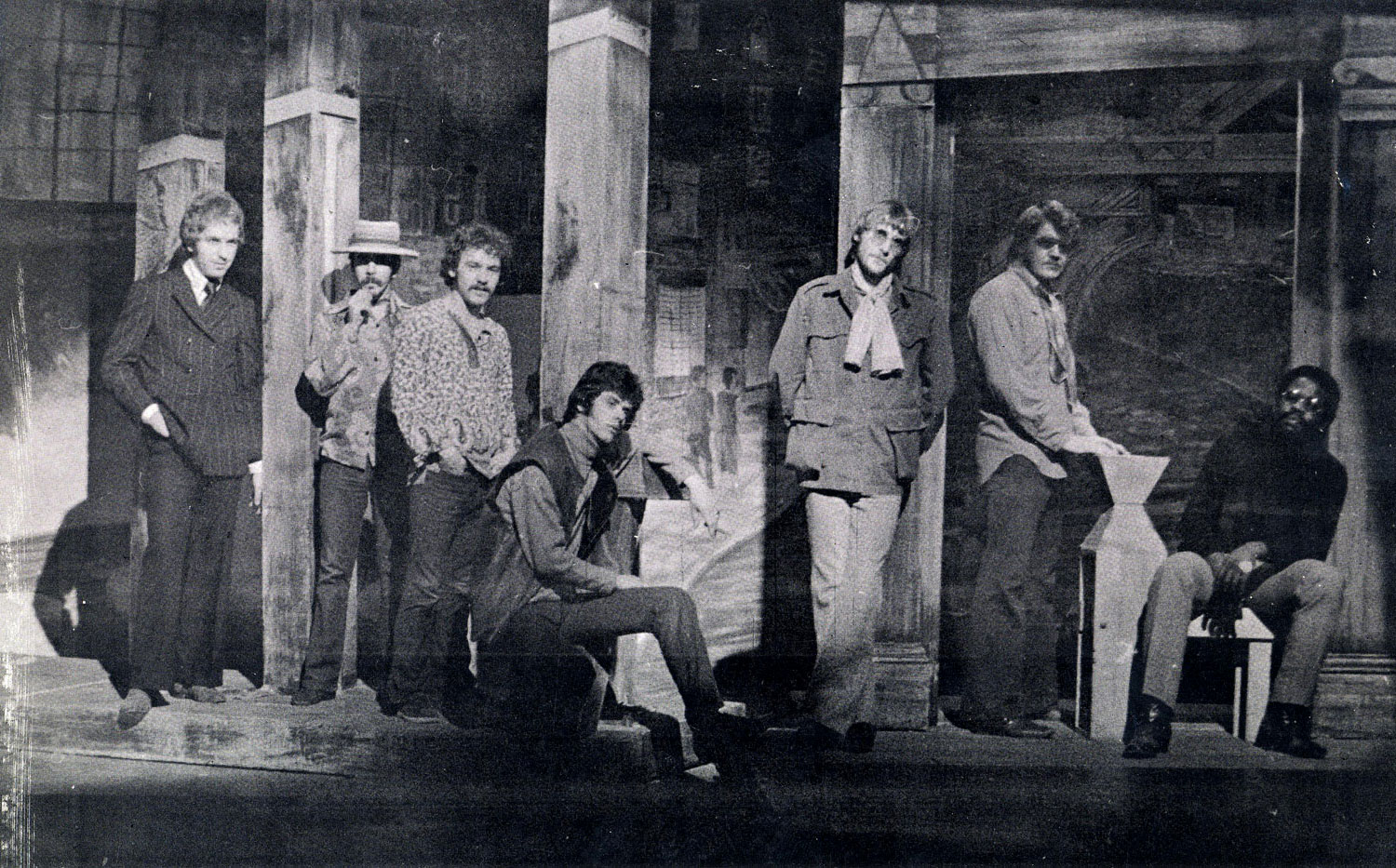
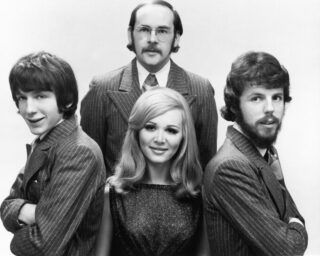
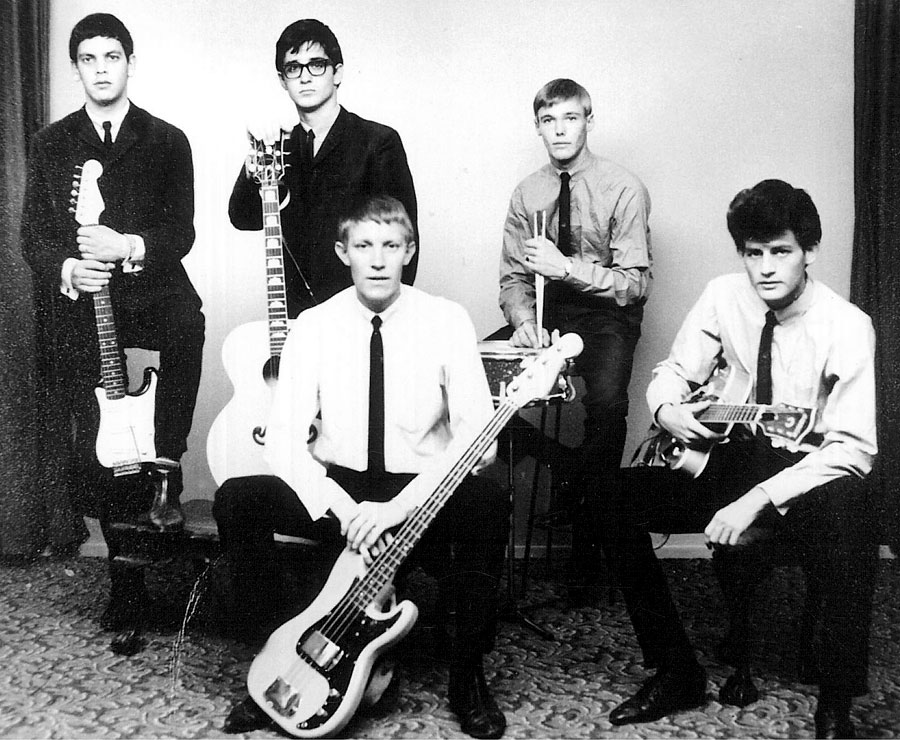
Before setting off by boat in May 1967, the newly formed group posed for some publicity photos in Kongos’s Jo’burg house. Then, a few days’ later, set sail for England, writing and rehearsing material, including the Kongos-Russell collaboration, ‘Linda Loves Linda’, in preparing for the assault on the British market.
Throughout the long journey the group struggled to come up with a suitable name. “I wanted to call it Kongos’s Magic Dragon but [John] wouldn’t have it,” says Russell.
In fact, as the bass player explains, the musicians only agreed on Floribunda Rose on the way to their first gig! Having arrived at Maurice King’s office during their first week in London, the manager calmly informed the musicians that they had a gig the next day and studio time booked a few weeks later.
A second hand camper van was hastily purchased in Earl’s Court and the band set off for its debut gig – a small club in Castleford, West Yorkshire on 14 July, stopping off in central London on route to pick the elusive name.
“John and I walked across the street in Baker Street to a book shop, desperate to find a name for the band,” recalls Russell. “Flower power was at its zenith, so we plumped for Floribunda Rose. A bloody daft name but that was where people were at.”
After a handful of gigs in the north and the midlands, including shows in Tadcaster, Burnley and Tamworth, Floribunda Rose made their London debut at Tiles on Oxford Street on 19 August.
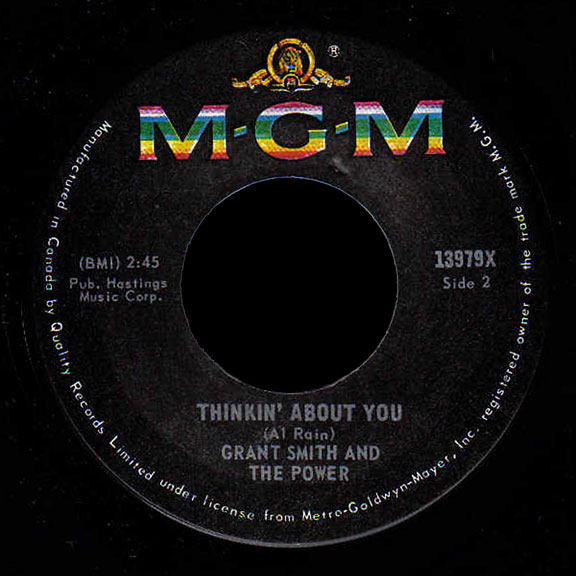
Around this time, the group also cut its debut single under Schroeder’s watchful eye – the poppy ‘Linda Loves Linda’ – supposedly a tale of female narcissism, backed by Kongos’s infectious, and rather Beatlesque, ‘One Way Street’. The plug side, with its ‘Everyone is Loving Everywhere’ lyric, ‘fairground’ organ and free-form ending, chimes perfectly with the ‘peace, love vibe’.
Released in September 1967 on Pye’s Piccadilly subsidiary and the same week that Radio 1 aired, ‘Linda Loves Linda’ benefited from its publicity and was heavily plugged by Tony Blackburn and Pete Murray.
“We were very lucky,” says Russell. “Maurice King was an operator. He knew his stuff and employed a plugger who would go round the BBC with new releases.”
“In those days you had to get on the BBC play-list. We were on the first week of Radio 1. Only three singles a week out of the 80 releases used to get on that, which was fantastic.”
To coincide with the station’s launch, the group recorded a BBC Radio 1 session with Brian Matthews on 25 September for a show that was replacing Saturday Club, cutting new versions of ‘Linda Loves Linda’ and ‘One Way Street’, along with covers of Paul Simon’s ‘Bright Green Pleasure Machine’ and ‘59th Bridge Street Song’. None of the tracks have been released and remain buried somewhere in the BBC archive.
Yet despite getting on to the new play list, recording a live session and having a Juke Box Jury appearance as ‘mystery band’ (on 8 September) and being voted a hit, the single stiffed.
The group returned to the daily grind of touring, often travelling hundreds of miles to play small clubs and sharing the bill with the likes of The Zombies, Dave Berry and Lonnie Donegan to name a few.
“Most of our gigs were up and down the M1 at less prestigious venues,” recalls Demetriou. “We did play some university events and supported more well known acts.”
“There are lots of little funny things that happened with Floribunda Rose,” adds Kongos. “It was really corny actually – attempting to jump on the ‘Flower Power’ bandwagon. We did dumb things like throw out flowers to the crowd at the end of a the gig [which] went down really well in Workingmen’s clubs (not!)
“I think the best thing about the band was that we did really intricate medleys of known songs – a little like Vanilla Fudge, in the sense that the versions were very different.”
Book-ending the year, Floribunda Rose spent a month playing at the Top Ten in Hamburg, grafting for six hours a night to a largely unappreciative crowd. While there, Dokter remembers rubbing shoulders with the musicians that would later go on to form the nucleus of heavy rock band, Deep Purple.
Exhausted, the group drove home non-stop, heading straight for the Scottish Highlands in the first week of January where the first cracks in the band’s precarious line up surfaced.
“We did one [10-day] tour of Scotland [and] that was the last thing I did with them,” remembers Clifford, who left after the final gig on 14 January. “I then flew out from the freezing cold to the humid heat of Durban and nearly died. I had a pair of leather jack boots and a Scottish hiking jacket!”
Pete Clifford returns to South Africa and joins the Bats
Back in South Africa, the guitarist joined The Bats, appearing on the highly sought after Image album (which includes the superb ‘Money Ain’t Worth a Dang’) and also playing numerous sessions, most notably providing bouzouki on Freedom Children’s debut album, Battle Hymn of The Broken Hearted Horde. During the late 1960s and 1970s, he became one of South Africa’s most respected guitarists and continues to tour with The Bats.
“[Pete] and John just butted like rams,” explains Russell on the guitarist’s dramatic exit. “Pete was very experienced. He had worked with some major people. He knew his stuff and was a good guitar player but basically John didn’t want a lead guitarist.”
“Pete Clifford was an incredible guitar player and so was John,” adds Dokter. “They were both very talented. It was good for Pete to actually go on his own and work with The Bats and John had the freedom to do what he wanted to do.”
Kongos has the last word: “Pete was not satisfied with the lack of progress in the band – it wasn’t easy travelling hundreds of miles to little gigs and winding up almost out of pocket at the end of the day. Musically too, it was not satisfying for us because we had different ideas. We got on each others’ nerves and could have been the model for Spinal Tap if we’d made it.”
Nick Dokter departs
With Clifford gone and Kongos assuming lead guitar duties, it wasn’t long before Dokter also bailed. “Nick was married and his wife was getting bored with the difficulties of not making money,” explains Kongos on the drummer’s departure in late February after a 10-day stand at the Nova club in Kensington, West London.
A qualified boilermaker, Dokter briefly returned to South Africa where he worked a day job while playing with various local groups. In the late 1960s, he moved to his country of birth, Holland, and returned to school to study engineering. Turning down an offer to join The Golden Earring, he subsequently emigrated to Canada in 1969.
During the early 1970s, he got back into playing and recorded an unreleased album with 5 Man Cargo, which later morphed in Cross Town Bus. Through this group he met promoter Bruce Allan and ended up working for his agency for nearly two decades, although Dokter did make occasion trips back to South Africa where he played with his old buddy Kenny Henson in his duo, Finch & Henson among other projects.
“Needless to say, being on the road for 20 years, six-to-nine months at a time, took its toll and I became a studio/session drummer,” says Dokter, who retired from playing full-time in 1989 and currently lives in Vancouver. In the summer of 2009, he plans to visit the UK and catch up with Jack Russell, who he hasn’t seen since early 1968.
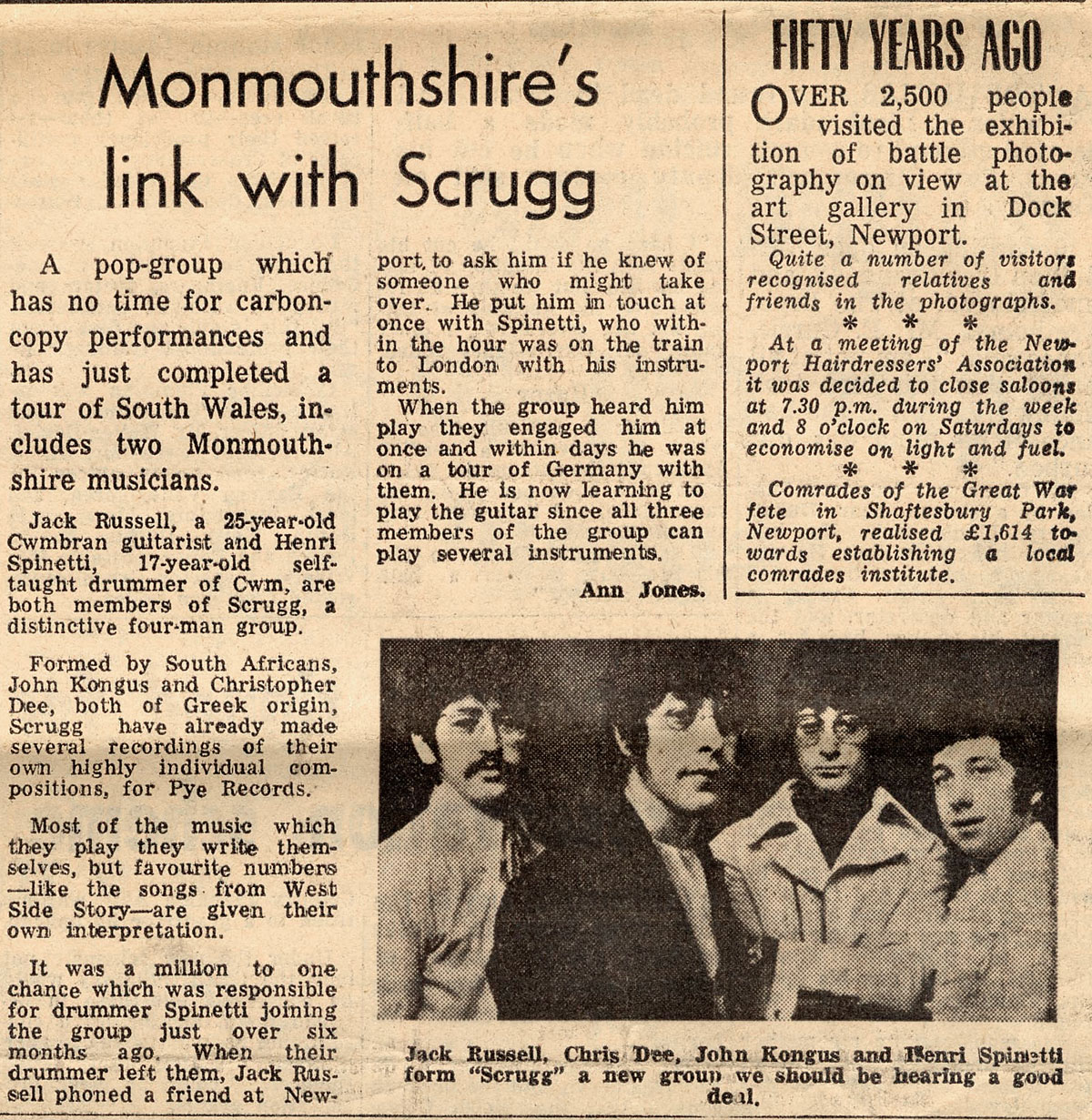
 Scrugg
With Dokter out of the picture, the remaining members returned to London where Russell and Demetriou found themselves caught up in a police raid at their shared flat. “Unbeknown to us, while we were away in Germany and Scotland our road manager had been renting our rooms out,” says Russell, recalling the tragic event.
“People had been using our place as a doss house and these guys had been dealing. We hadn’t a clue the police had been watching the place and we arrived back the morning they hit the place. We were fitted up and forced to plead guilty. We were fined £50 and got front page of The Sun.” (Ed. the incident was reported the Marylebone & Paddington Mercury on its 9 February 1968 issue, page 11).
Putting the loss of Dokter behind them, Russell returned to the Welsh valleys and brought back 16-year-old wonder kid, Henry Spinetti (b. 31 March 1951, Cwm, Wales), younger brother of Victor Spinetti and today Katie Melua’s drummer.
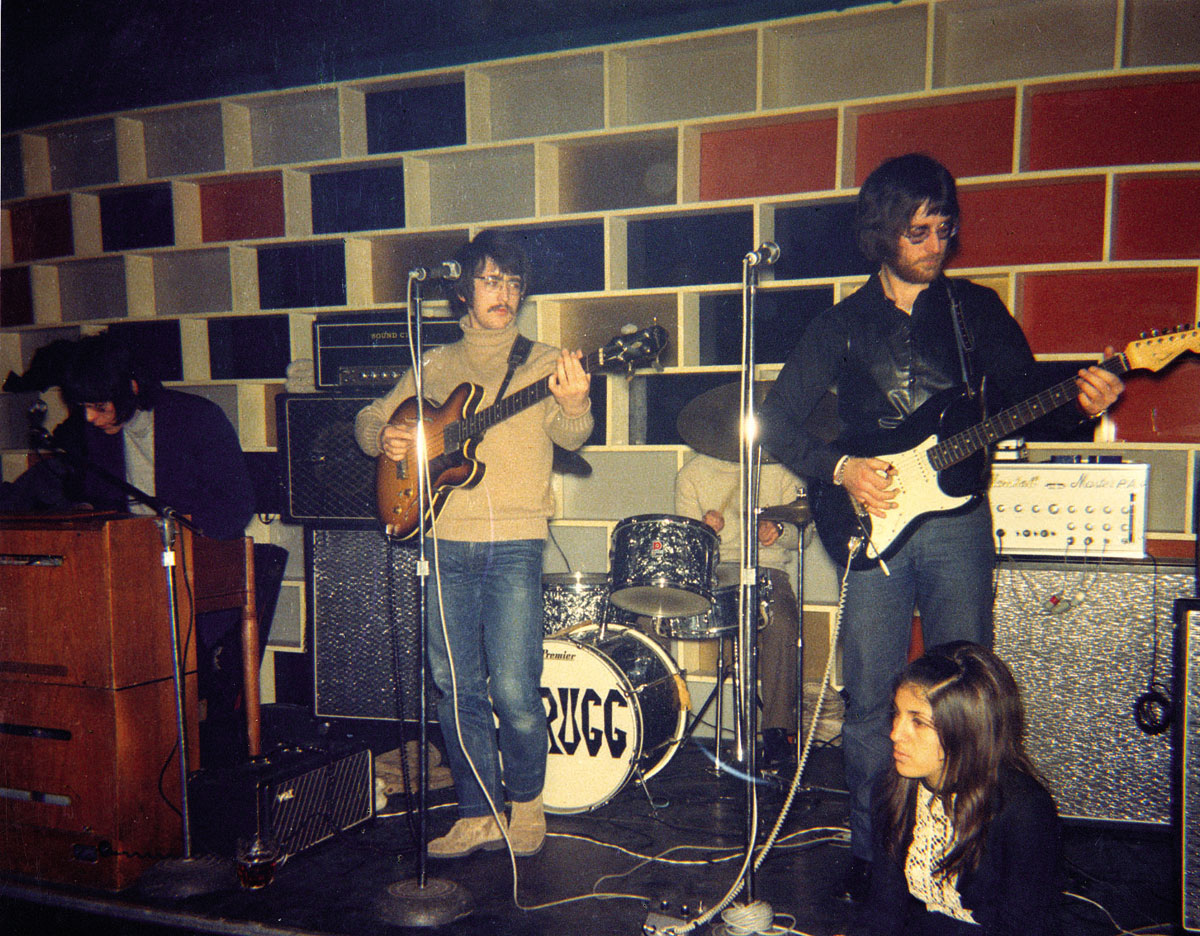
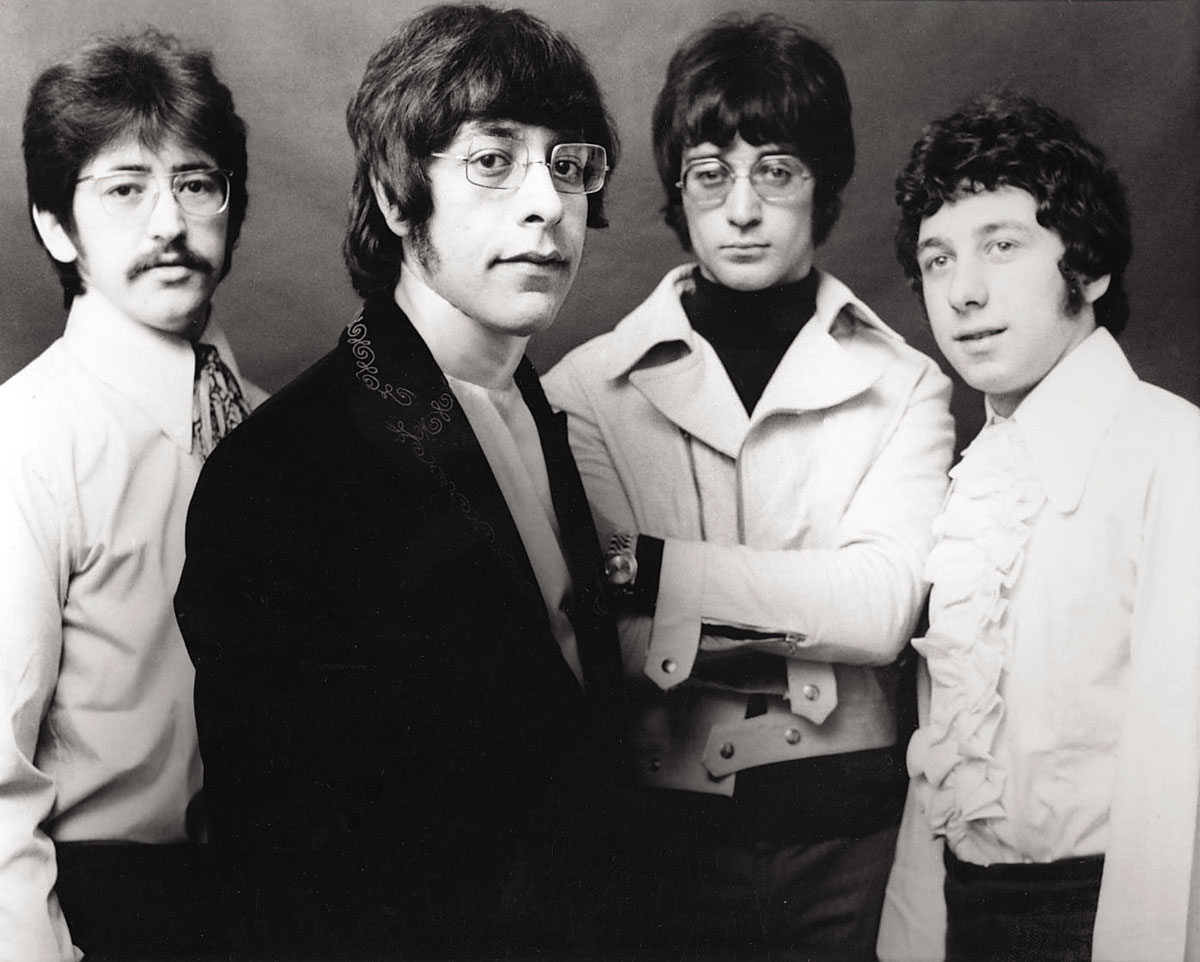
With two weeks’ work lined up at the Top Ten in Hamburg, kicking off on 1 March, the group headed for the continent bearing a new name – Scrugg. “I chose the name because we wanted a more earthy image and I was a fan of Earl Scruggs the banjo player,” admits Russell.
“That was a suggestion that we all made,” chips in Clifford, who believes the name was discussed while he was still a member. “We were all trying to think of a new image and I think I left on the verge of Scrugg because I’ve got a picture of Floribunda Rose and then in brackets it says ‘Scrugg’.”
Under its new guise, Scrugg returned to the studios with John Schroeder to work on the first of three classic singles, which, as David Wells rightly points out in the liners for the John Kongos’s compilation album, Lavender Popcorn, “remain exquisite examples of the psychedelic pop sound.”
Scrugg’s debut outing, released on Pye in April 1968, coupled two John Kongos numbers – ‘Everyone Can See’ backed with ‘I Wish I Was Five’. The latter is undoubtedly the stronger of the two and is notable for Lew Warburton’s stirring string arrangement (based directly on Russell’s bass line) and Demetriou’s moody organ playing, which heightens the tension, building to a dramatic climax. A yearning for the innocence and honesty of youth, ‘I Wish I Was Five’ should have been the side to plug and perhaps not surprisingly the single went nowhere.
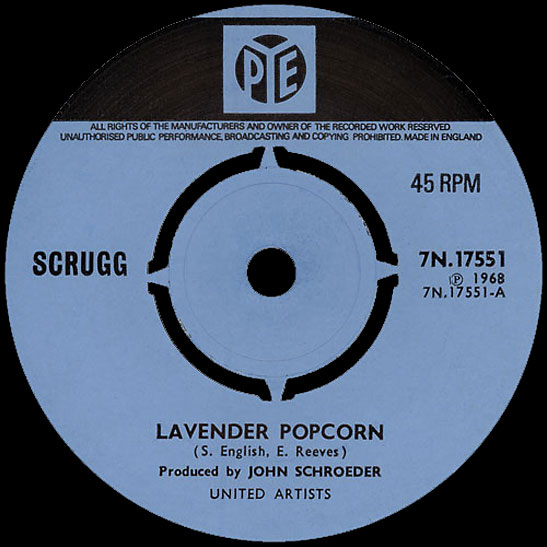
Two months later, Pye rushed out a follow up, a cover of Scott English’s poppy ‘Lavender Popcorn’, backed by the Kongos penned ‘Sandwich Board Man’, which the singer says was inspired by said character who he used to see regularly on Oxford Street.
A noted songwriter, English, had serious pop credentials and had scored hits with covers of ‘Hi Ho Silver Lining’ and ‘Bend Me Shape Me’, but the group was uncomfortable recording such a blatant teeny-bopper, bubblegum track. The band’s producer, however, overruled any objections and even contributed to the recording by playing piano with a plectrum! “John Schroeder said, ‘You’re doing it’,” remembers Russell. “‘You’ve had two of your own and you’re doing one of mine now, so shut up!’”
Tailor-made for the pop market, ‘Lavender Popcorn’ should have been Scrugg’s commercial breakthrough but like its predecessors faded into obscurity.
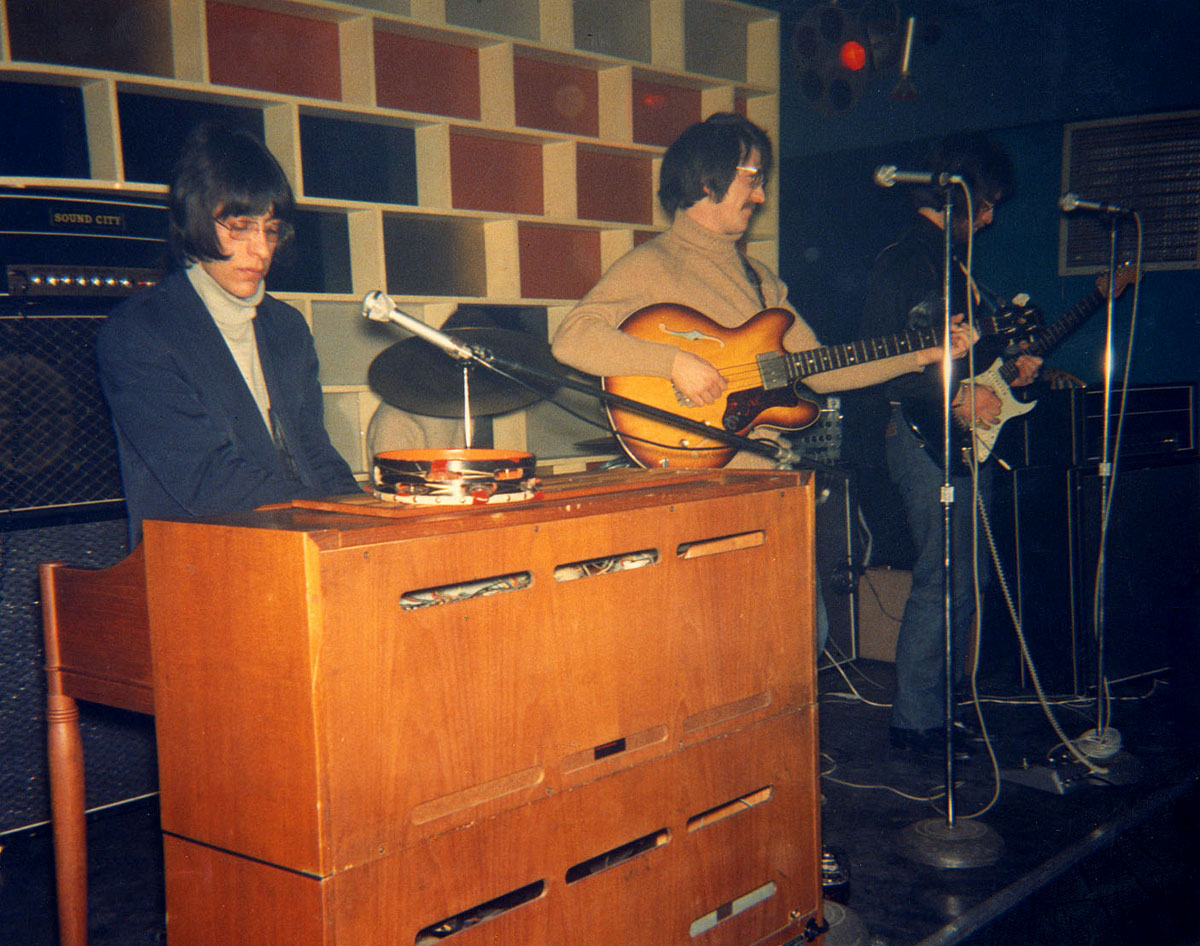
Forced to make a living on the road, Scrugg resumed their busy touring schedule travelling the length and breadth of the country and taking in towns as far as field as Newcastle, Birmingham and Penzance. Debuting on 3 August 1968, the band also became regulars at London’s renowned nightclub, Scotch of St James, returning again for shows on 7 and 14 September and culminating with a two-night stand on 27-28 September. During this hectic period of touring, Scrugg participated in a historic moment in rock history, opening for a “mystery” band of superstars at a show at Sheffield University on 23 November.
“We opened for them and then watched their show,” says Kongos. “We all agreed that these guys would probably not make it because ‘who needed another Cream?’ so we gave them the thumbs down. They were called Led Zeppelin!”
With Zeppelin’s star in the ascent and Scrugg’s future looking bleak, the end was in sight.
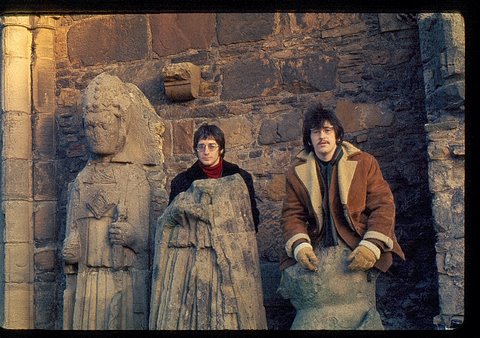
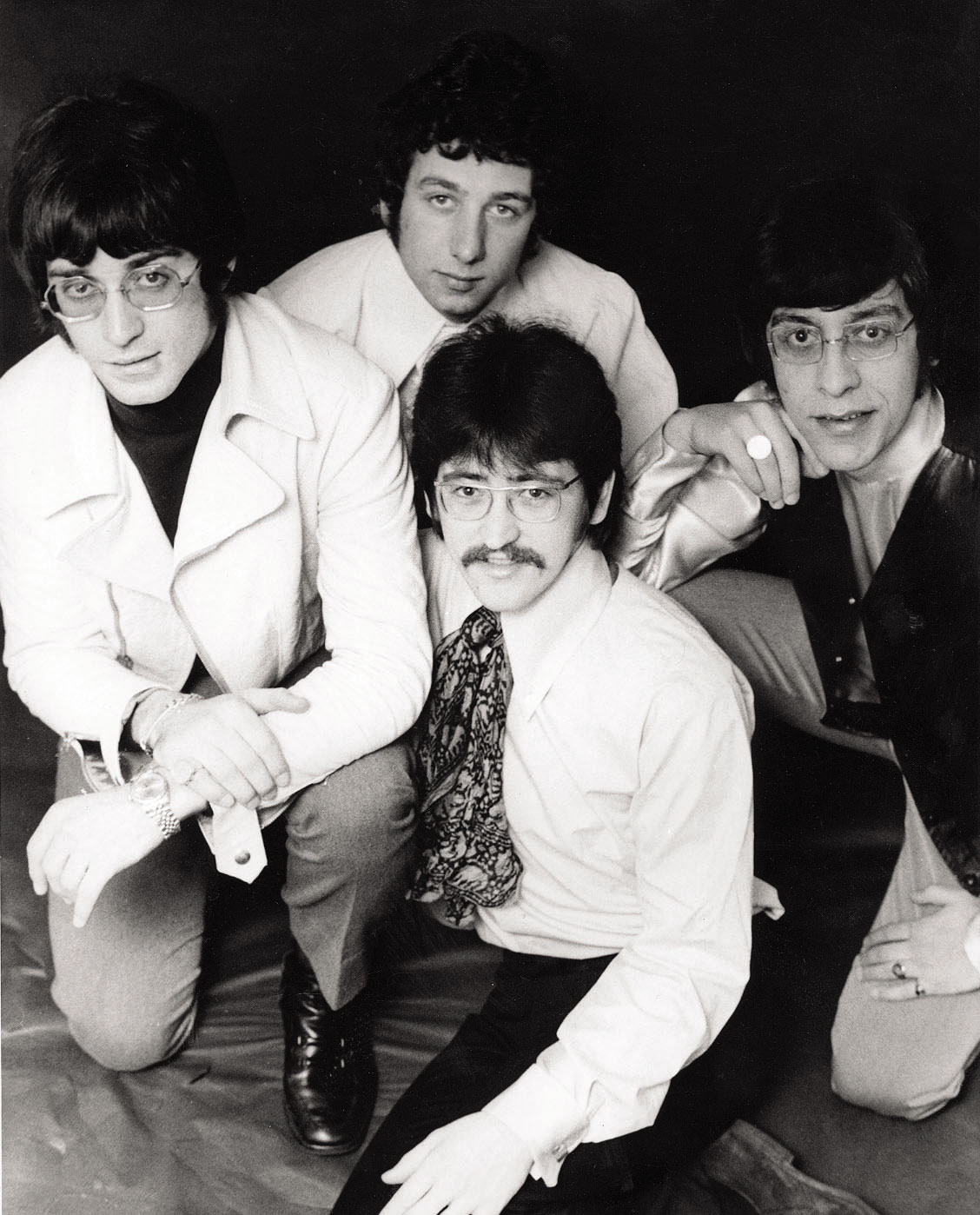
In early January, Scrugg’s final single was released and coupled the Kongos’s rave up, ‘Will The Real Geraldine Please Stand Up and Be Counted’ (a song originally recorded for the album session in Jo’burg in 1967), with the singer’s ‘Only George’, a kitchen sink tale about break-up and divorce, introduced by Russell’s freakily distorted vocal.DJ John Peel remained a huge fan and opened his show numerous times during its first week of release but despite the publicity, it failed to chart. Dispirited, the musicians decided to call it a day, bowing out with a two-night stand in Margate, Kent on 18-19 January.
In the aftermath of Scrugg’s split, Kongos went on to establish a successful solo career in the early Seventies, scoring hits with ‘He’s Gonna Step On You Again’ (co-written with Demetriou) and ‘Tokoloshe Man’. He currently resides in Arizona and is preparing material for a new album.
The others meanwhile maintained a less visible, albeit rewarding careers. Spinetti became a top session drummer, working with the likes of Roger Chapman, Bill Wyman and Eric Clapton while Demetriou co-wrote several songs for Kongos’s debut album, Confusions of a Goldfish, and later oversaw recordings for Mike D’Abo and Cat Stevens among others. He currently lives in Esher, Surrey and is a pastor in a local church.
Russell, who gave up playing music in 1969, later ran a successful specialist advertising agency before retiring in 2005. Aside from a brief reunion with Pete Clifford and Brian Gibson where they played at a theatre in Hampton Hill, Middlesex to celebrate Russell’s 6oth birthday, he currently plays solo sets at the Rising Sun pub in Twickenham.
Aficionados can expect to pay hefty prices for Floribunda Rose and Scrugg singles. Mercifully, Castle compiled an excellent CD in 2001 called Lavender Popcorn, pulling together all of the recordings, including the previously unreleased Scrugg track, ‘Patriotic’, although regrettably the BBC radio sessions were omitted.
Despite that small oversight, the CD is recommended to anyone who feels the urge to savour some of the most exquisitely recorded British psychedelic pop.
A huge thanks goes to Jack Russell for his generous assistance in pulling the story together and for offering the use of his private photo collection and live gig list. Thanks also to John Kongos for his insights into the group, Chris Demetriou, Nick Dokter, Pete Clifford and David Wells.
Copyright © Nick Warburton. All Rights Reserved. No part of this article may be reproduced or transmitted in any from or by any means, without prior permission from the author.
Releases:
Floribunda Rose:
Linda Loves Linda / One Way Street, Picadilly 7N.35408
Scrugg:
Everyone Can See / I Wish I Was Five, Pye 7N.17492
Lavender Popcorn / Sandwichboard Man, Pye 7N.17551
Will the Real Geraldine Please Stand Up and Be Counted / Only George, Pye 7N.17656
Floribunda Rose gigs (thanks to Jack Russell for diary dates):
14 July 1967 – Crystal Ballroom, Castleford , West Yorkshire
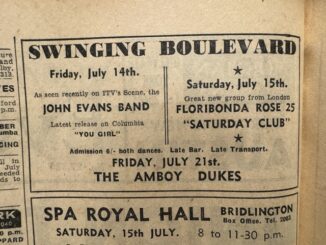
15 July 1967 – Boulevard, Tadcaster, North Yorkshire
18 July 1967 – Burnley, Lancashire (no venue listed)
22 July 1967 – Brierfield, Lancashire (no venue listed)
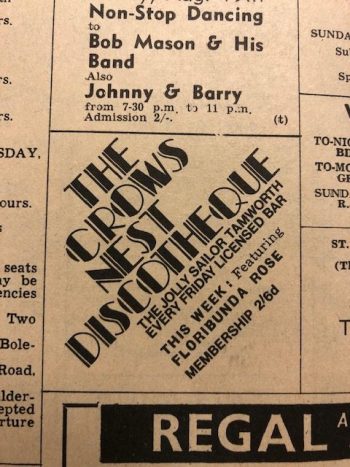
4 August 1967 – Crow’s Nest, Tamworth, Staffordshire
19 August 1967 – Tiles, Oxford Street, London
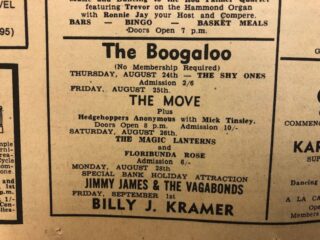
26 August 1967 – The Boogaloo, Crystal Ballroom, Castleford, West Yorkshire (according to the Sheffield Star and Wakefield Express this was with The Magic Lanterns)
29 August 1967 – Luton, Bedfordshire (no venue listed)
2 September 1967 – The Rover, Solihull, Warwickshire
3 September 1967 – Cromer, Norfolk (most likely Olympia Ballroom)
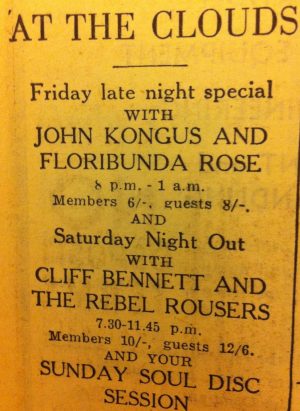
8 September 1967 – Clouds, Derby, Derbyshire
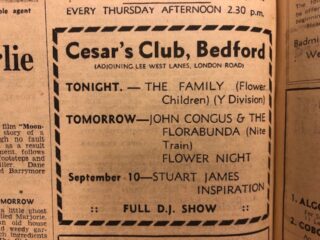
9 September 1967 – Cesar’s Club, Bedford, Bedfordshire (according to the Bedfordshire Times)
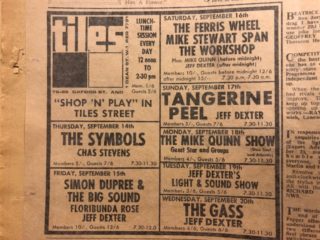
15 September 1967 – Tiles, Oxford Street, central London with Simon Dupree & The Big Sound
22 September 1967 – Crystal Ballroom, Castleford, West Yorkshire
23 September 1967 – Majestic Ballroom, Wellington, Shropshire with The Opp Art (Shropshire Journal)
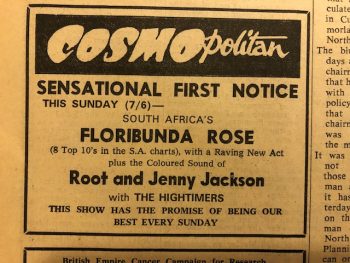
24 September 1967 – Cosmo, Carlisle, Cumbria with Root and Jenny Jackson and The Hightimers
25 September 1967 – Radio 1 recording
29 September 1967 – Wigton Rugby Club, Wigton, Cumbria with Zora Floy’s Machine (Cumberland News)
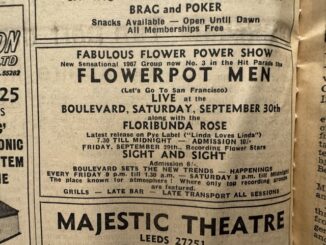
30 September 1967 – Boulevard, Tadcaster, North Yorkshire (according to the Yorkshire Evening Post and Yorkshire Evening Press, this was with The Flowerpot Men)
1 October 1967 – Clayton Lodge Hotel, Newcastle-under-Lyme, Staffordshire with The Pink Variety
7 October 1967 – Cleveland Arms, Wolverhampton, West Midlands (according to Express & Star)
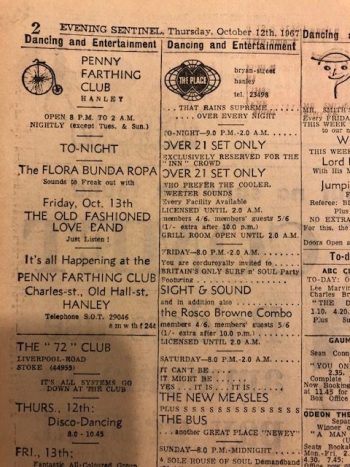
12 October 1967 – Penny Farthing, Hanley, Staffordshire
12 October 1967 – Crystal Ballroom, Newcastle Under Lyme, Staffordshire
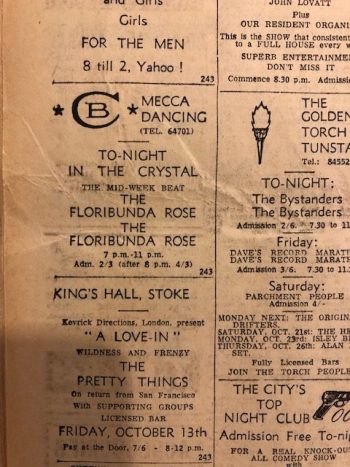
13 October 1967 – St Helens, Lancashire (possibly The Co-Op)
14 October 1967 – Leicester University, Leicester, Leicestershire
20 October 1967 – Kendall Town Hall, Kendall, Cumbria
21 October 1967 – Royal Ballroom, Ripley, North Yorkshire
22 October 1967 – Cofton Country Club, Birmingham (listed in Fabulous 208 but not in Jack’s gig list)
28 October 1967 – Public Hall, Barrow, Cumbria (The Mail – Millom and South Copeland ed)
29 October 1967 – New Tredegar, Wales (no venue listed)
2 November 1967 – Nottingham (no venue listed)
5 November 1967 – Sutton in Ashfield, Nottinghamshire (possibly The Revolution)
7-13 November 1967 – Birmingham, West Midlands area gigs (booked through the Astra Agency) (see below)
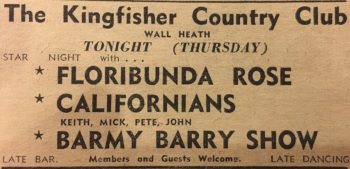
9 November 1967 – Kingfisher Country Club, Wall Health, West Midlands with The Californians and The Barmy Barry Show (according to Express & Star)
10 November 1967 – Waggon and Horses, Wall Health, West Midlands (according to Express & Star)
15 November 1967 – Hucknall, Nottinghamshire (no venue listed)
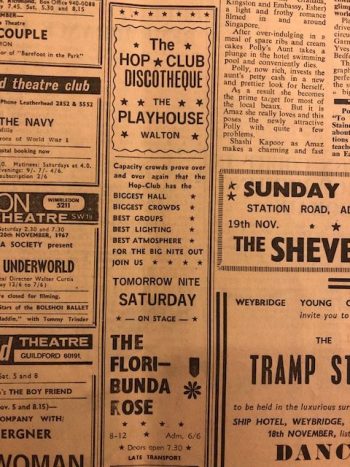
18 November 1967 – Walton Playhouse, Walton-on-Thames, Surrey
December 1967 – Month in Hamburg, West Germany (Top Ten Club on Reeperbahn)
5-14 January 1968 – Ten-day trip to Scotland (see below)
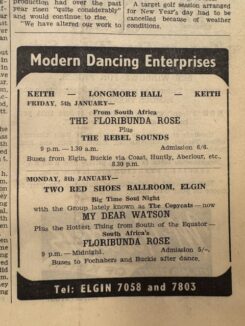
5 January 1968 – Longmore Hall, Keith, Scotland with The Rebel Sounds (Banffshire Herald)
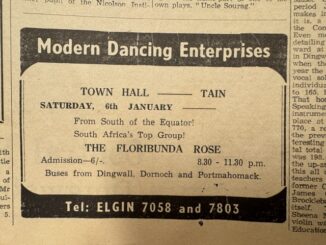
6 January 1968 – Tain Town Hall, Tain, Scotland (Ross-Shire Journal & General Advertiser)
8 January 1968 – Two Red Shoes Ballroom, Elgin, Scotland with My Dear Watson (Banffshire Herald)
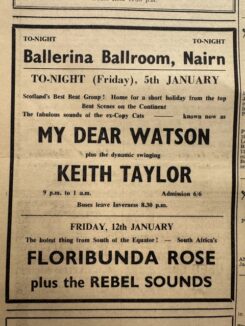
12 January 1968 – Ballerina Ballroom, Nairn, Scotland with The Rebel Sounds
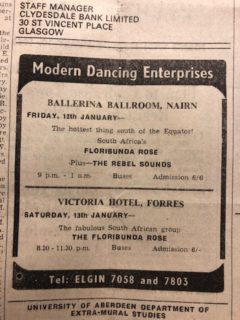
13 January 1968 – Victoria Hotel, Forres, Scotland (Forres Elgin & Nairn Gazette) This is missing from Jack Russell’s gigs
Peter Clifford left Floribunda Rose in Scotland after the final gig and flew to Durban, South Africa to join The Bats
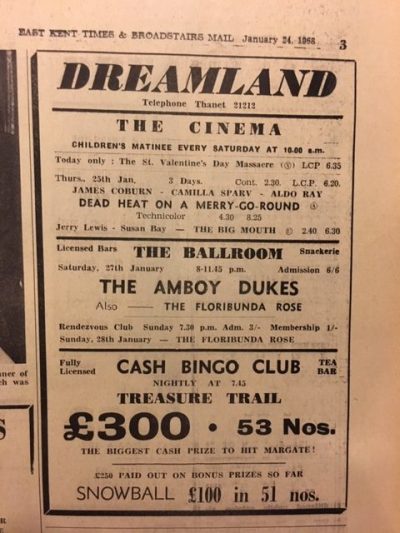
27 January 1968 – Dreamland Ballroom, Margate, Kent with The Amboy Dukes (Russell has this as 20 January but must be mistake)
28 January 1968 – Rendezvous Club, Margate, Kent (Thanet Times) This is missing from Russell’s diary
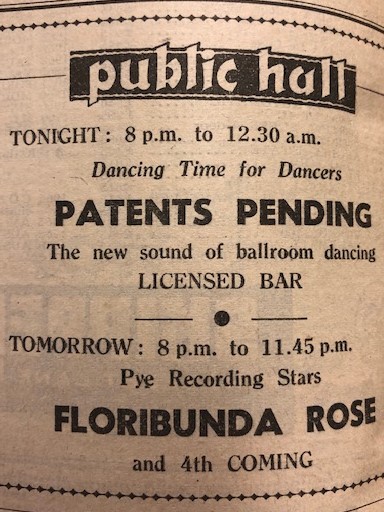
3 February 1968 – Barrow Public Hall, Barrow, Cumbria with 4th Coming
16-25 February 1968 – Nova Club, Kensington, London
Nick Dokter left immediately afterwards and the musicians brought in Henry Spinetti. At some point the group changed name to Scrugg but did also continue to be billed as Floribunda Rose for some shows.
1-15 March 1968 – Top Ten, Hamburg, Germany
31 March 1968 – Sunderland, Tyne & Wear (no venue listed)
1-6 April 1968 – Sunderland, Tyne & Wear (possibly gigs at various clubs in the area)
7-13 April 1968 – Wolverhampton, West Midlands area gigs (see below)
The following are confirmed from the Express & Star newspaper (and billed as Floribunda Rose):
7 April 1968 – Albrighton WMC, Albrighton, West Midlands
8 April 1968 – Civic Hall, Wolverhampton, West Midlands with The News
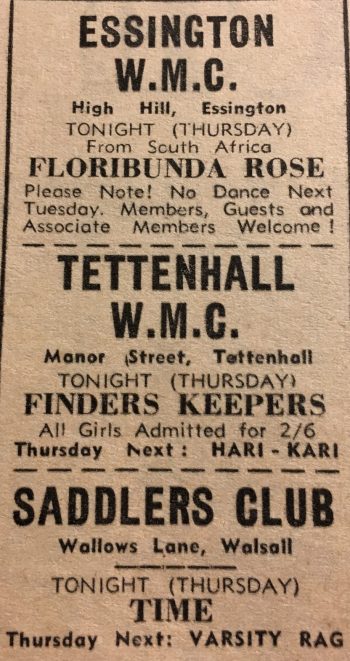
11 April 1968 – Essington WMC, Essington, West Midlands
12 April 1968 – Oasis Club, Wolverhampton, West Midlands with The Dunes
13 April 1968 – 3 Men in a Boat, Walsall, West Midlands
20 April 1968 – Mr Smith’s Club, Winsford, Cheshire with T Bunkum Band and The Hideaways (billed as Floribunda Rose)
21 April 1968 – Coventry (no venue listed)
Around about now, they change name to Scrugg
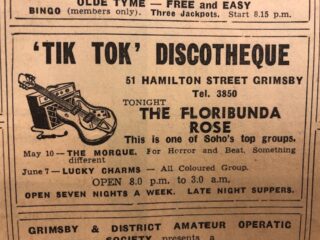
3 May 1968 – ‘Tik Tok’ Discotheque, Grimsby (billed as Floribunda Rose) (according to Grimsby Evening Telegraph) There is another listing in this paper from 10 May that has the group returning to this venue on 12 July, which is missing from Russell’s diary
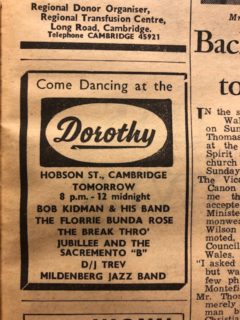
4 May 1968 – Dorothy Ballroom, Cambridge with Bob Kidman & His Band, The Break Thro’, Jubilee & The Sacremento “B”, Mildenberg Jazz Band (billed as Floribunda Rose)
10-19 May 1968 – Elgin area gigs in Scotland (see below)
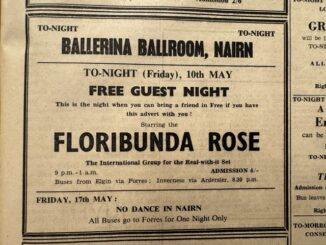
10 May 1968 – Ballerina Ballroom, Nairn, Scotland (Forres Elgin & Nairn Gazette/Inverness Courier)
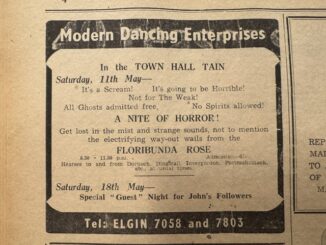
11 May 1968 – Tain Town Hall, Tain, Scotland (Ross-Shire Journal & General Advertiser)
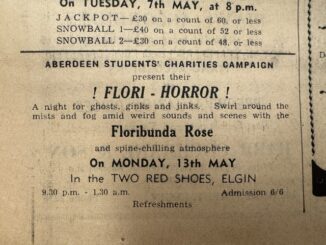
13 May 1968 – Two Red Shoes Ballroom, Elgin, Scotland (Northern Scot, Moray & Nairn Express)
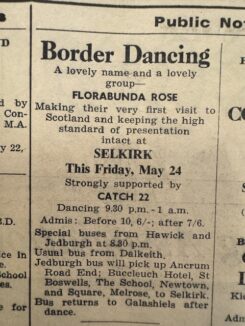
24 May 1968 – Victoria Hall, Selkirk, Scotland with Catch 22 (Border Telegraph Galashiels)
25 May 1968 – Miners Wallace Institute, Kirkonnell, Scotland
27 May 1968 – Wall City Jazz Club, Quaintways, Chester, Cheshire with Peter & The Alphabet, The Morockans and The Wall City Jazzmen (Chester Chronicle) This is not in Russell’s gig list
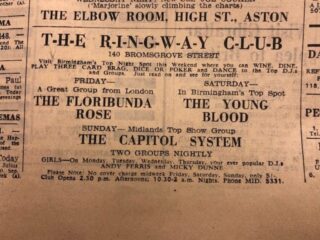
31 May 1968 – Ringway, Birmingham, West Midlands
1 June 1968 – Sheffield, South Yorkshire (no venue listed)
2 June 1968 – Club Cedar, Birmingham, West Midlands
14 June 1968 – Milnthorpe, Cumbria (no venue listed)
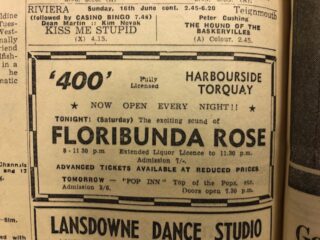
15 June 1968 – 400 Ballroom, Torquay, Devon (Herald Express)
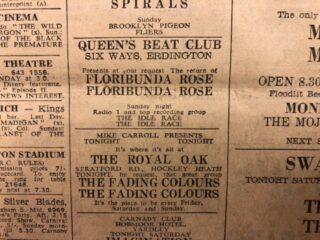
16 June 1968 – Jack’s diary says Birmingham 6 Ways but confirmed as Queen’s Beat Club, Six Ways, Erdington, West Midlands (billed as Floribunda Rose; see below too)
21 June 1968 – Eastbourne, East Sussex (no venue listed)
25 June 1968 – Oxford (no venue listed)
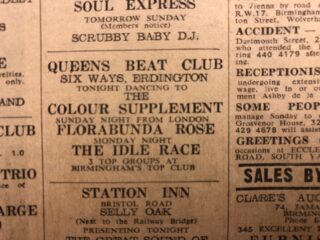
29 June 1968 – Queen’s Beat Club, Six Ways, Erdington, West Midlands (billed as Floribunda Rose)
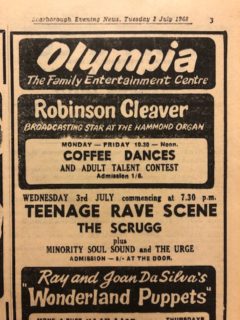
3 July 1968 – Olympia, Scarborough, North Yorkshire with The Minority Soul Sound and The Urge
26 July 1968 – Sunderland, Tyne & Wear (not sure this happened as I have found Scrugg billed to play Steering Wheel, Weymouth on this day)
27 July 1968 – Newcastle (no venue listed)
1 August 1968 – Cromwellian Club, Bolton, Lancashire (Bolton News)
2 August 1968 – Reading, Berkshire (no venue listed)
3 August 1968 – Scotch of St James, Mayfair, London
5 August 1968 – Club Cedar, Birmingham (Birmingham Evening Mail)
10 August 1968 – Sibyllas, Swallow Street, London
11 August 1968 – Abercarn, Wales (no venue listed)
16 August 1968 – Lon Crom (most likely Cromwellian, South Kensington, London)
17 August 1968 – 6 Ways (most likely Queen’s Beat Club, Erdington, West Midlands)
18 August 1968 – Sutton in Ashfield, Nottinghamshire (no venue listed)
24 August 1968 – Crom Lon (most likely Cromwellian, South Kensington, London)
7 September 1968 – Scotch of St James, Mayfair, London
8 September 1968 – Ilford, London (possibly The Angel)
14 September 1968 – Scotch of St James, Mayfair, London
15 September 1968 – Playboy, Hyde Park Corner, London
16-18 September 1968 – Wales gigs TBA
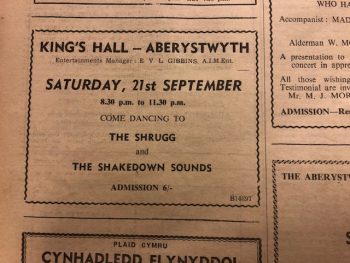
21 September 1968 – King’s Hall, Aberystwyth, Wales with The Shakedown Sounds (this is missing from Jack’s gigs and comes from the Cambrian Times but may not be the same band)
26 September 1968 – Cromwellian Club, Bolton, Lancashire with Barbed Wire Soup (Bolton News)
27-28 September 1968 – Scotch of St James, Mayfair, London
29-30 September 1968 – Wales gigs
1-4 October 1968 – Wales gigs
5 October 1968 – Sutton in Ashfield, Nottinghamshire (no venue listed)
10 October 1968 – Commall Hebton (not sure this is correct)
11 October 1968 – Penzance, Cornwall (possibly Winter Gardens)
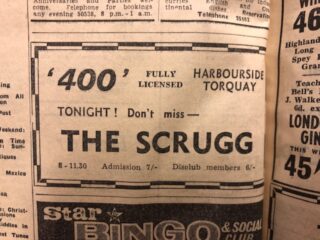
12 October 1968 – 400 Ballroom, Torquay, Devon (Herald Express) It is missing from Jack’s diary but they also play here on 19 October
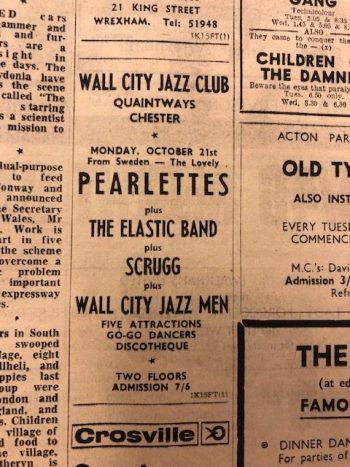
21 October 1968 – Quaintways, Chester, Cheshire with The Pearlettes, The Elastic Band and Wall City Jazz Men
2 November 1968 – Ilford, London (possibly The Angel)
4 November 1968 – Sibs London (most likely Sibyllas, Swallow Street)
15-17 November 1968 – Scotland dates
23 November 1968 – Sheffield University, Sheffield, South Yorkshire with Led Zeppelin
7 December 1968 – Ilford, London (possibly The Angel)
14 December 1968 – Rotherham (no venue listed)
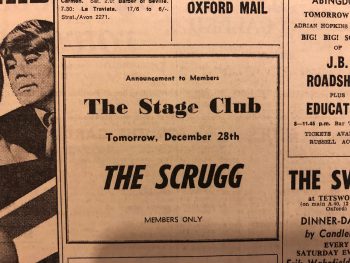
28 December 1968 – Stage Club, Oxford
18-19 January 1969 – Margate, Kent (most likely the Dreamland Ballroom)
The gig list cuts off here so not sure if there are any others