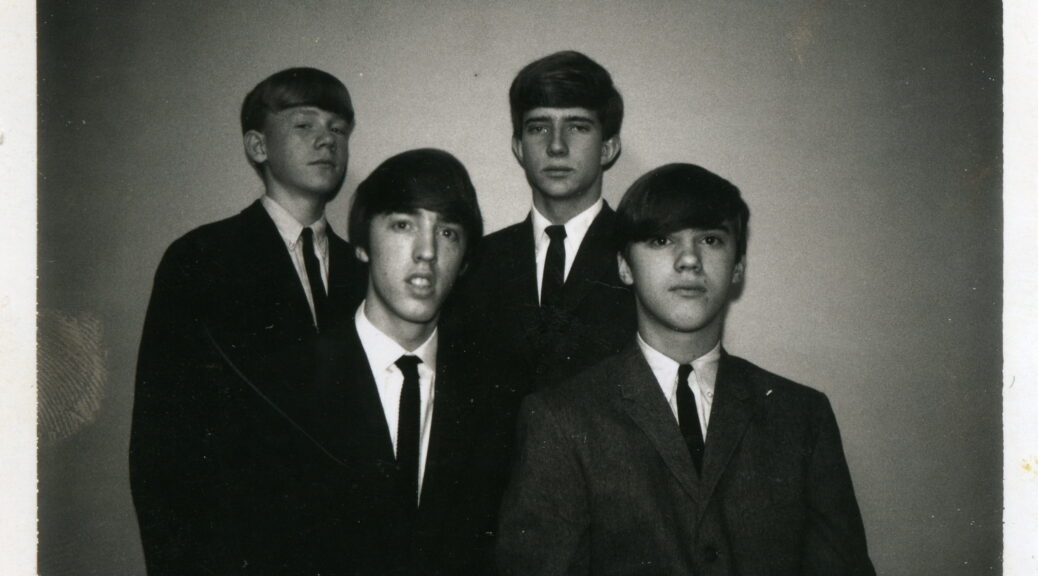
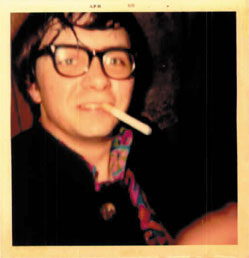
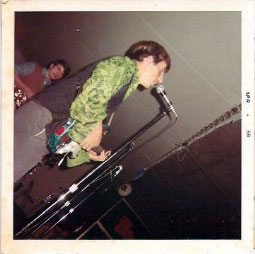
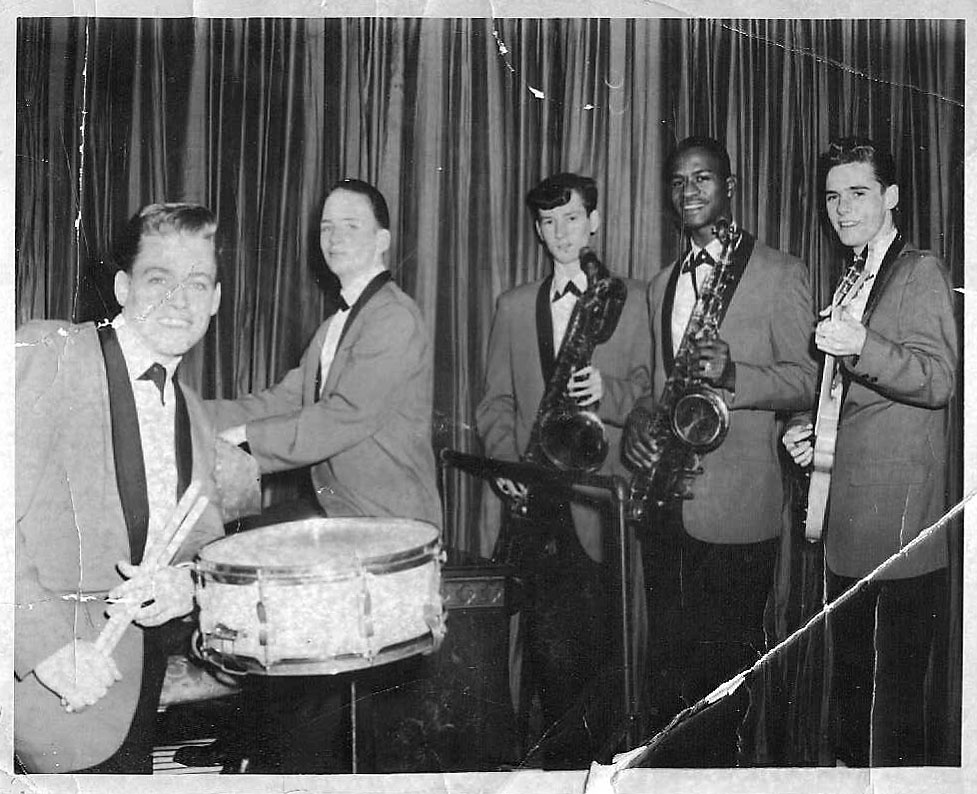
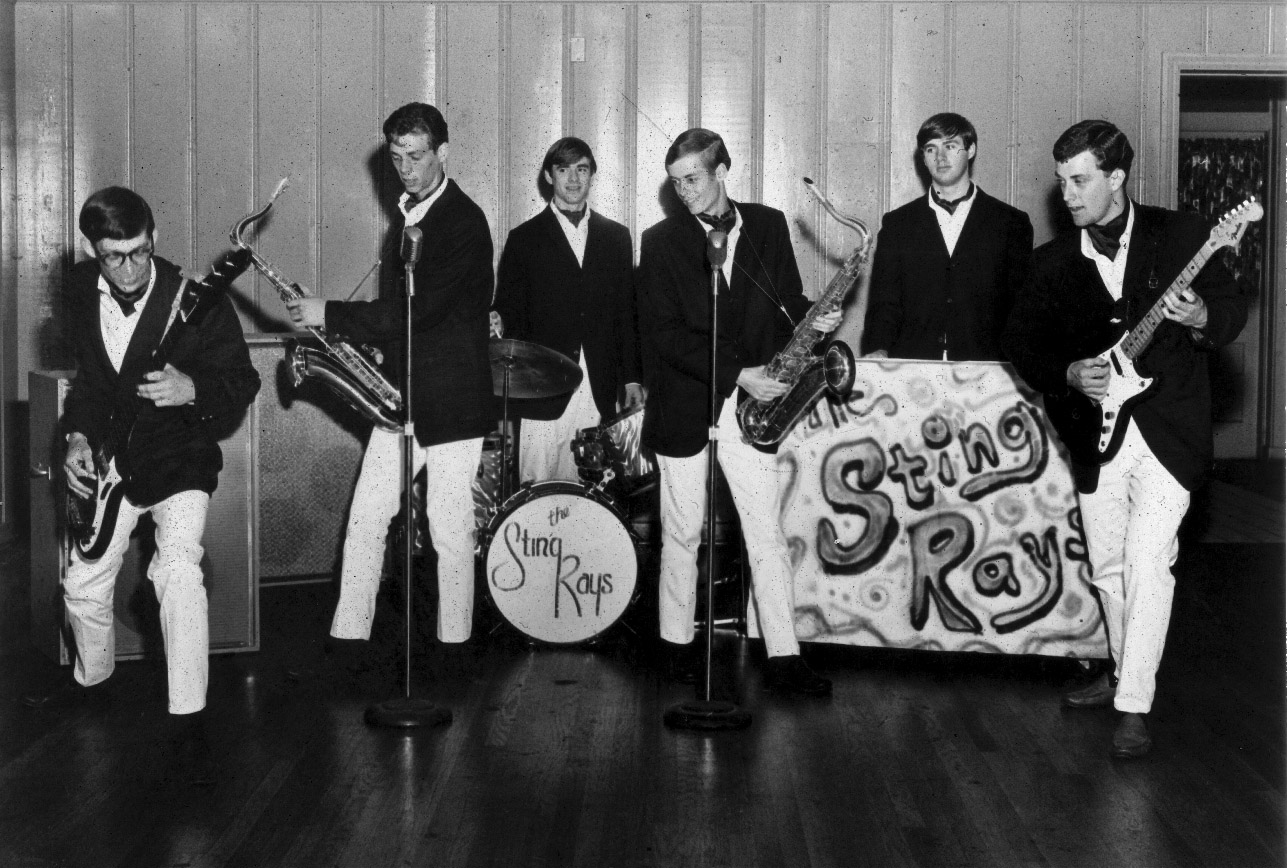
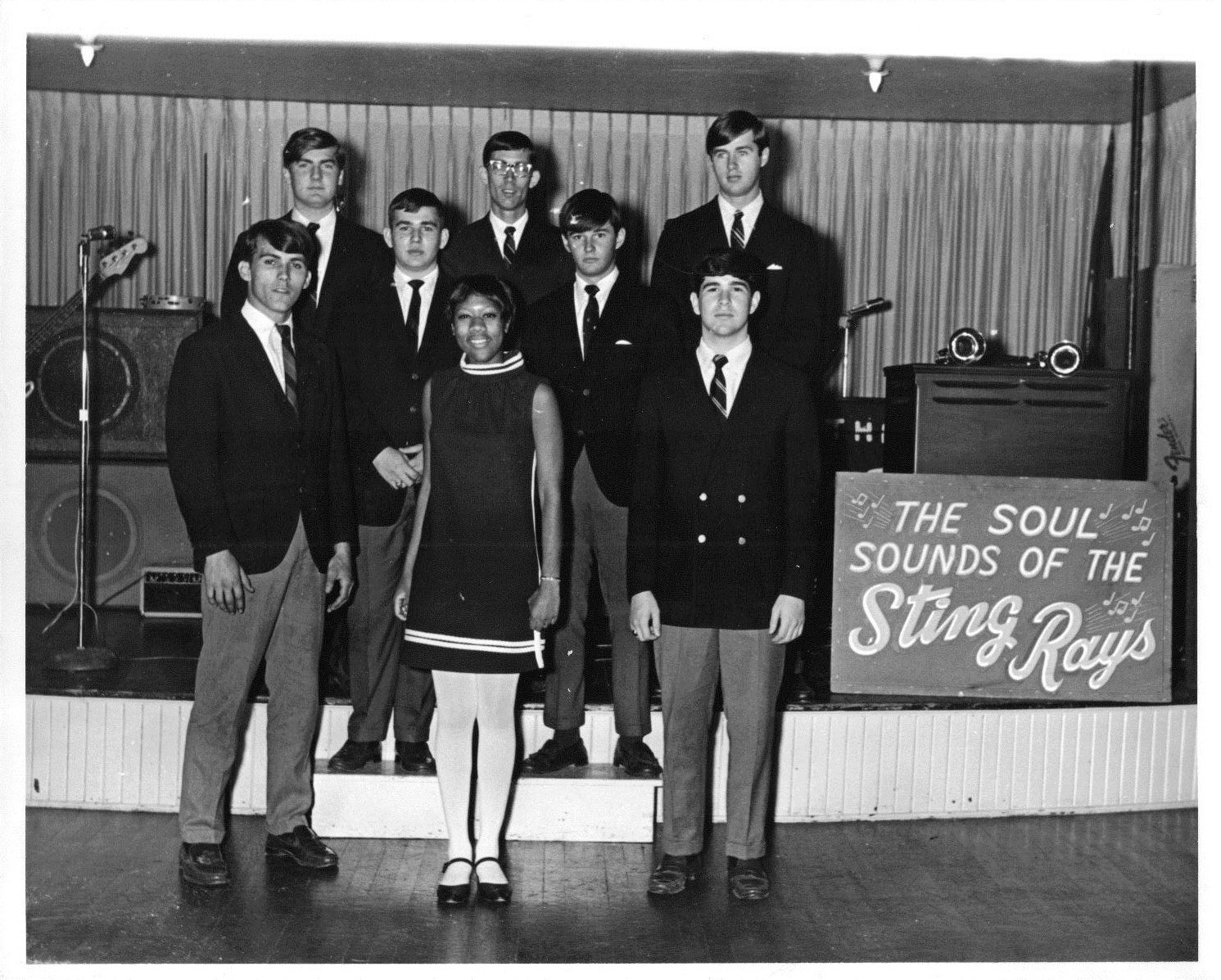
“A picture of the Sting Rays when we were at the top of our game.” From left: Cecil DeHart, Tom Pittman, “Butch” Schodt, Randy Vaughn, Tom Parker and Vince Screeney
For the 500th story I’ve done on US artists and labels since starting this site, I’m featuring a couple records that are very obscure and rarely heard, but both excellent examples of the sound of bands in the Tidewater region in the mid-60s.
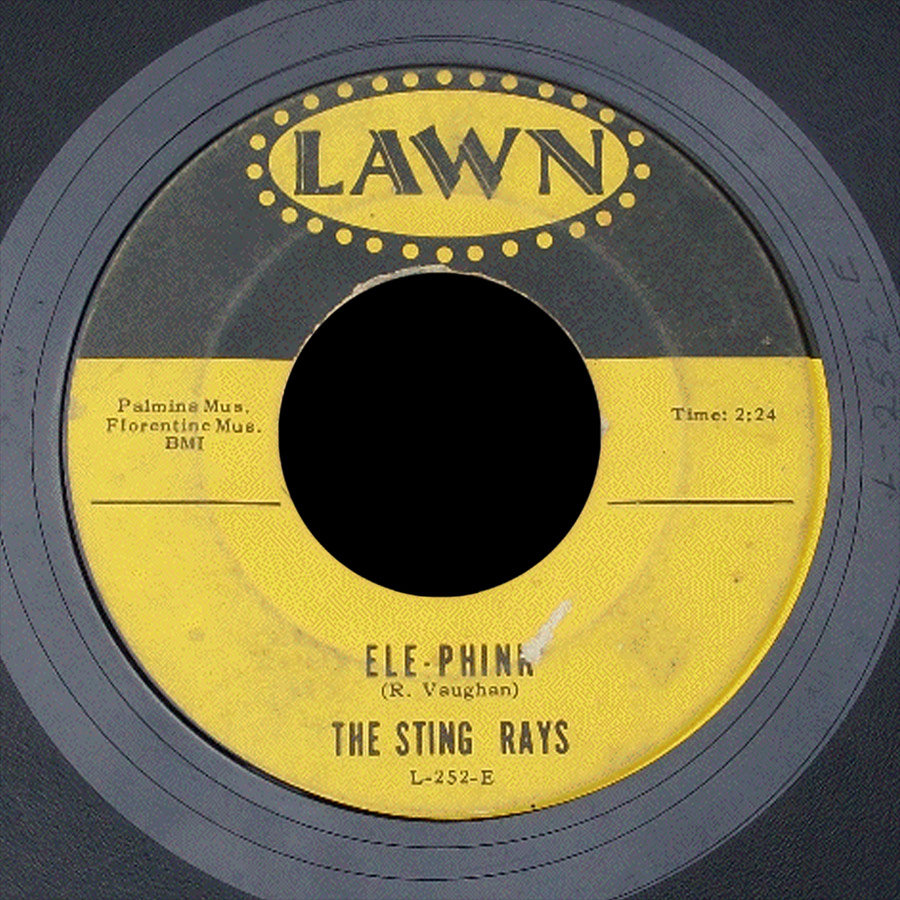
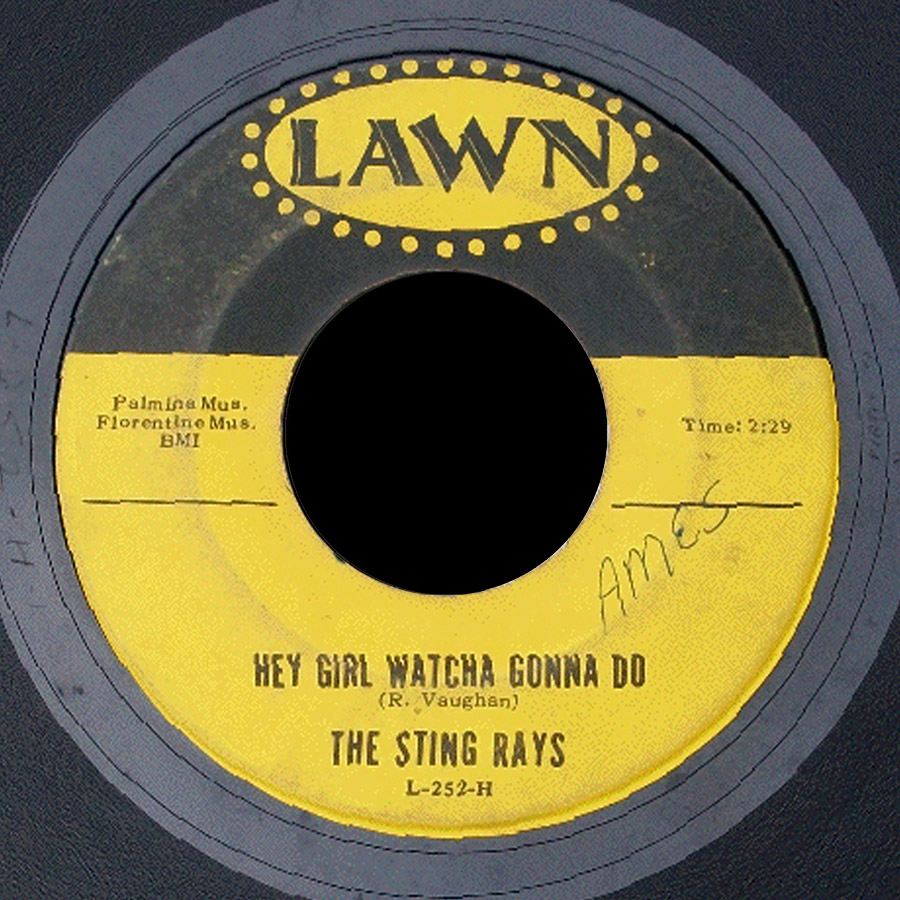
The Sting Rays came from Portsmouth, Virginia. They had two 45s, one on Lawn and another on Vermillion. Both 45s feature an r&b influenced vocal number on one side, and an instrumental on the other.
Their first record is quite a rocker, featuring the swinging horn-led instro “Ele-Phink” backed with the fine, tough vocal “Hey Girl, Watcha Gonna Do” on the flip. Both songs written by R. Vaughn and published through Palmina Music and Florentine, BMI.
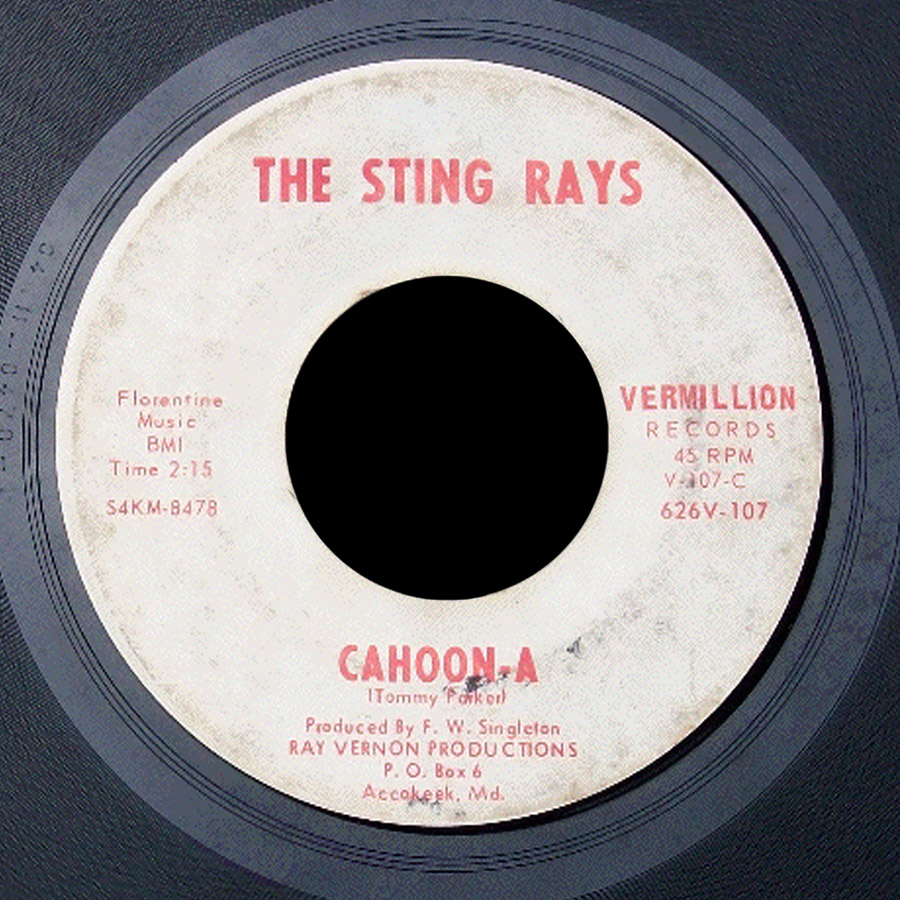
“I Need Her”, the vocal side of their second 45 might be their best track. The soulful singing is strong and the horns work perfectly with the driving rhythm section. “Calhoon-a”, the instrumental side, featured piano with bursts of horns (sorry about the warbled sound on this transfer). “Cahoon-A” was written by Tommy Parker, while “I Need Her” was by Tommy Pitman. Both sides produced by F.W. Singleton and published by Florentine Music, BMI. Released on Vermillion 107, the RCA custom press number S4KM-8478/9 indicates that this was pressed in the first half of 1965.
Their lead guitarist Vince Screeney took over on bass for the Swinging Machine when Evan Pierce was in the army.
Vince wrote to me that his time with the Machine, as he calls them, “started with me playing lead guitar for a rival band, The Sting Rays.” Vince gave me some background on the group and sent in the photo at top:
The Sting Rays were:
Cecil DeHart – bass Tom Pittman – lead sax and vocals “Butch” Schodt – drums Randy Vaughn – sax, vocals Tom Parker – organ Vince Screeney – guitar, vocals
These were the members in the group that made the records and we were in top form before we had to break up so that three of our guys could go to college. This is the same group that shared the stage and alternated sets and jam sessions with the Rhondels at the Top Hat club in Virginia Beach.
We certainly weren’t any slouches and recorded twice at a studio in Accokeek, MD. It’s hard to read on the Vermillion label but if you look closely you’ll see that they were recorded by Ray Vernon Productions. His real name was Vernon Ray and he was the brother of Link Wray. Yes, he spelled it differently and I guess he had his reasons. He joked with us that he called his little basement studio “Ray’s Three Track Chicken Shack”. We got to meet Link Wray at our final recording session and I can tell you it was a real charge for me to meet the rockabilly legend.
The Sting Rays had a manager, a retired Portsmouth cop named Woody Singleton who was responsible for getting us recorded. I believe he must have met Vernon during the time Vernon was driving taxis in Portsmouth.
By the way, in case you’re curious, those were yellow shirts, white pants, burgundy jackets and ascots! and of course… Weejuns!
Sadly, we lost Randy on Dec. 23, 2010. The rest of us are hoping for a reunion soon. Thanks to all who remember us and wish us well.
Vince Screeney
I’m sorry to report Vince Screeney passed away on May 25, 2013. Last time I heard from Vince in 2011 he said the remaining Sting Rays were planning a reunion. Vince helped me put this page on the Sting Rays together, and also wrote to me about his next group, the Swinging Machine. He lived in a golden age for music generally and Portsmouth especially.
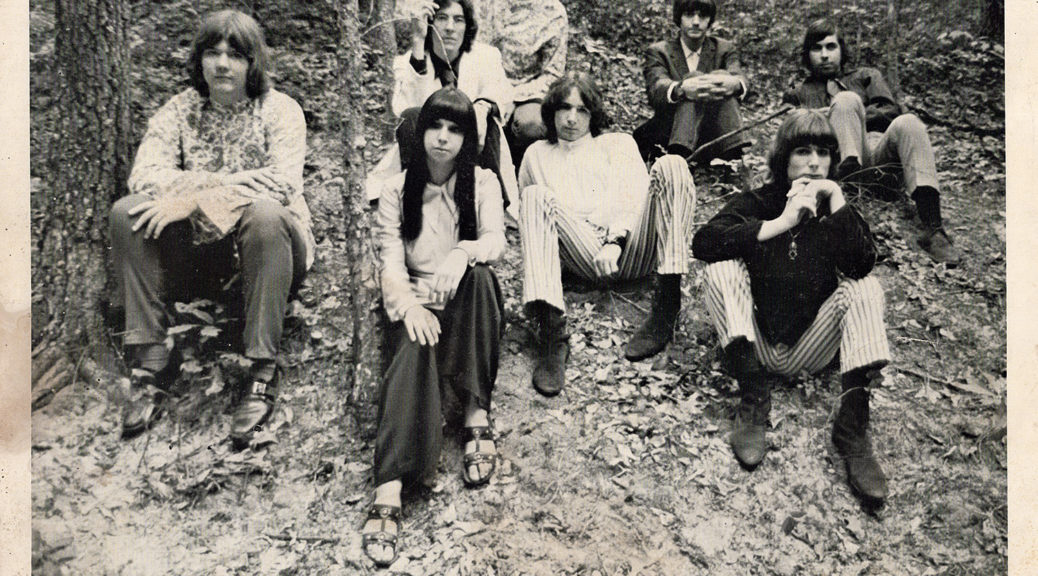
The Sting Rays with Elsie Strong top row, L-R: Brent Brower, Cecil Dehart, Tommy Parker Middle row, L-R: Bob Watkins, Randy Boone Bottom row, L-R: Roger Thacker, Elsie Strong, Terry Legum
Randy Boone sent in the photo above with a later lineup of the Sting Rays that included:
Elsie Strong – lead vocals Roger Thacker – lead vocals Terry Legum – lead guitar Cecil Dehart – bass Tommy Parker – Hammond organ Randy Boone – drums Brent Brower – horns David Todd – horns Bob Watkins – trumpet
Thank you to Vince Screeney for the scans of both records and the photo of the group, to Chris Beisel for help with an ID in the second photo, and to Mop Top Mike.
Vermillion (Ver-Million, get it?) had some cool 45s, most notably the Executioners “You Won’t Find Me” / “Haunting My Mind”, the top side of which is a fantastic garage number with a cool guitar intro. The band is still something of a mystery, so if anyone hears of an Executioners from Virginia, Maryland or even PA, please let me know!
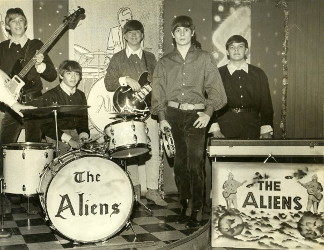
The Aliens, 1966, from left: Bill Gaunce, Conrad Dedacatoria, John Davis, Robbie House and Rick Hudson
Original bassist Bill Gaunce sent me this early photo of the Aliens. I love the illustration painted on the organ. A couple years after this photo they recorded two 45s, “Love Someone” / “Tobacco Road” on the Telastar label, and “Come Fly with Me” / “Season of the Witch” on the Son of a Witch label. Hear “Love Someone” on the excellent CD, Aliens, Psychos & Wild Things vol. 1.
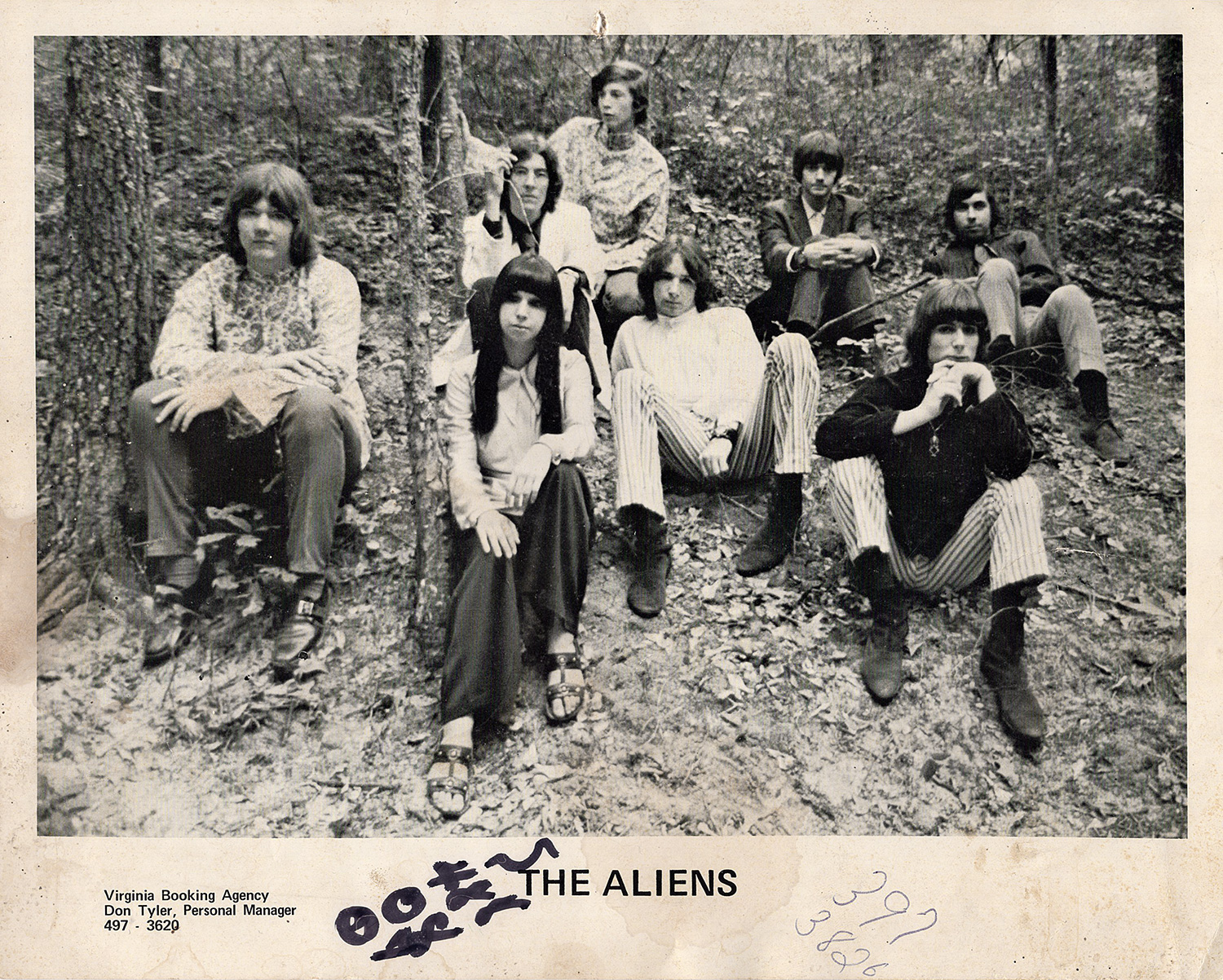
Here’s the first official band photo taken of The Aliens from Norfolk, Virginia. This picture appeared in Norfolk paper, The Ledger Star, when the Aliens became the house band at the Four Seasons club. We’re all 15-16 years in this pic.
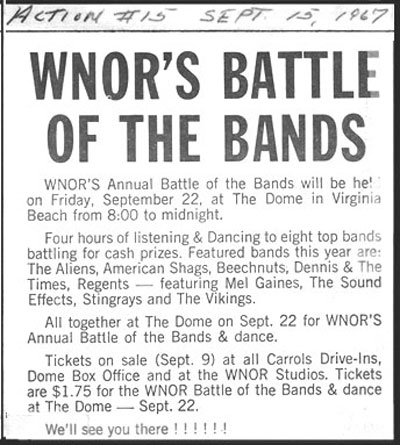
The Aliens played in the 1967 WNOR battle of the bands. There was also an Aliens from Hampton, Virginia which prompted a battle of the bands challenge at Mercury Roller Rink in Norfolk to determine who would keep the name. The Aliens from Norfolk won the battle, but from then on were known as The Norfolk Aliens which had been originally adopted just for the battle of the bands.
The lineup changed in the next few years, this photo is of the original members. Pictured from left to right:
Bill Gaunce on bass Conrad Dedicatoria on drums John Davis guitar Robbie House (front with tambourine) Rick Hudson keyboards
Rick and Conrad asked me to join the band they were forming. Conrad and I “auditioned” Robby House (without his knowledge!) when he was in a band called The Royal Wellingtons. We asked him to join and he did. The Aliens were in a battle of the bands with the Corduroys; Steve Green was the singer/gutarist and really impressed us so we ask him to join. Byrd was a high school friend who basically hung around and sat in enough to eventually be “absorbed” into the band.
Rick Hudson was replaced by Steve Green (guitar/vocals) shortly after this picture and Bill/Claire Sechman (aka Byrd) was added shortly after that. We played at the Four Seasons with this lineup and then I left and formed a band called Quagmire (me on bass, Steve Wilson vocals, Nick Kepics guitar, and Russell Scarborough drums). In ’68-’69 we were a fixture in downtown Norfolk’s seedy bars, most notably The Jamaican Room where we were house band for a short time.
The Aliens expanded their lineup to include Nick Bonis (keys) and PooNeil [Gayle Hollowman] on vocals. With Doug Coward on bass they had their recording lineup. Doug has passed away, Nick Bonus still plays and is the bass player in a band called Big Fun, which coincidentally had Quagmire’s old drummer Russell Scarborough playing with them until just recently. Robbie House still gigs around town doing acoustic stuff, Steve Green is playing bass and guitar in Nashville.
I played live until 2004. Now I write and record my own stuff & I’ve put out a few CDS with my music. I’m getting ready to release a cd of Americana flavored music & the songs are scattered about on my site at www.billgaunce.com.
Bill Gaunce
Later photo of the Aliens, from left: John Davis (Spazz), Pooniel (Georgia Randall or Randell … not sure about spelling), Steve Greene behind Pooniel, Doug Cowert in back (not sure about spelling R.I.P), Morgan Hampton (previously Conrad), Byrd (William Sechman R.I.P), Nick Bonis, and Robbie House. Submitted by the estate of Joanne Tluchak, Virginia Beach
This photo was found with another by the East Coastmen – could there be any connection between the two?
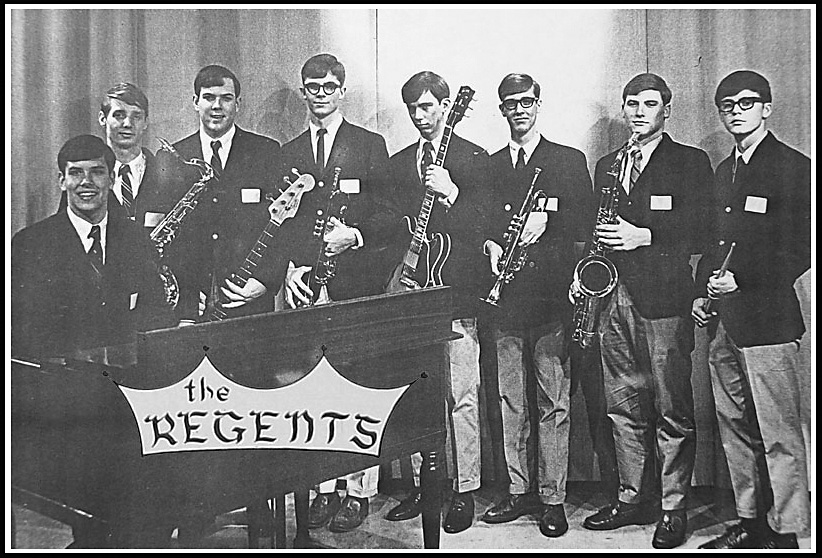
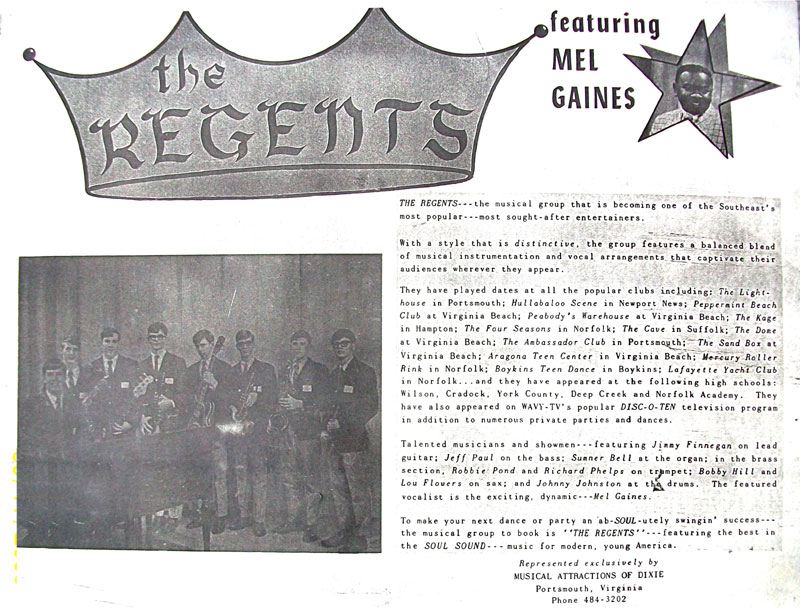
The Regents from left: Sumner Bell, Bobby Hill, Jeff Paul, Robbie Pond, Jimmy Finnegan, Richard Phelps, Lou Flowers and Johnny Johnston. Not pictured: lead vocalist Mel Gaines
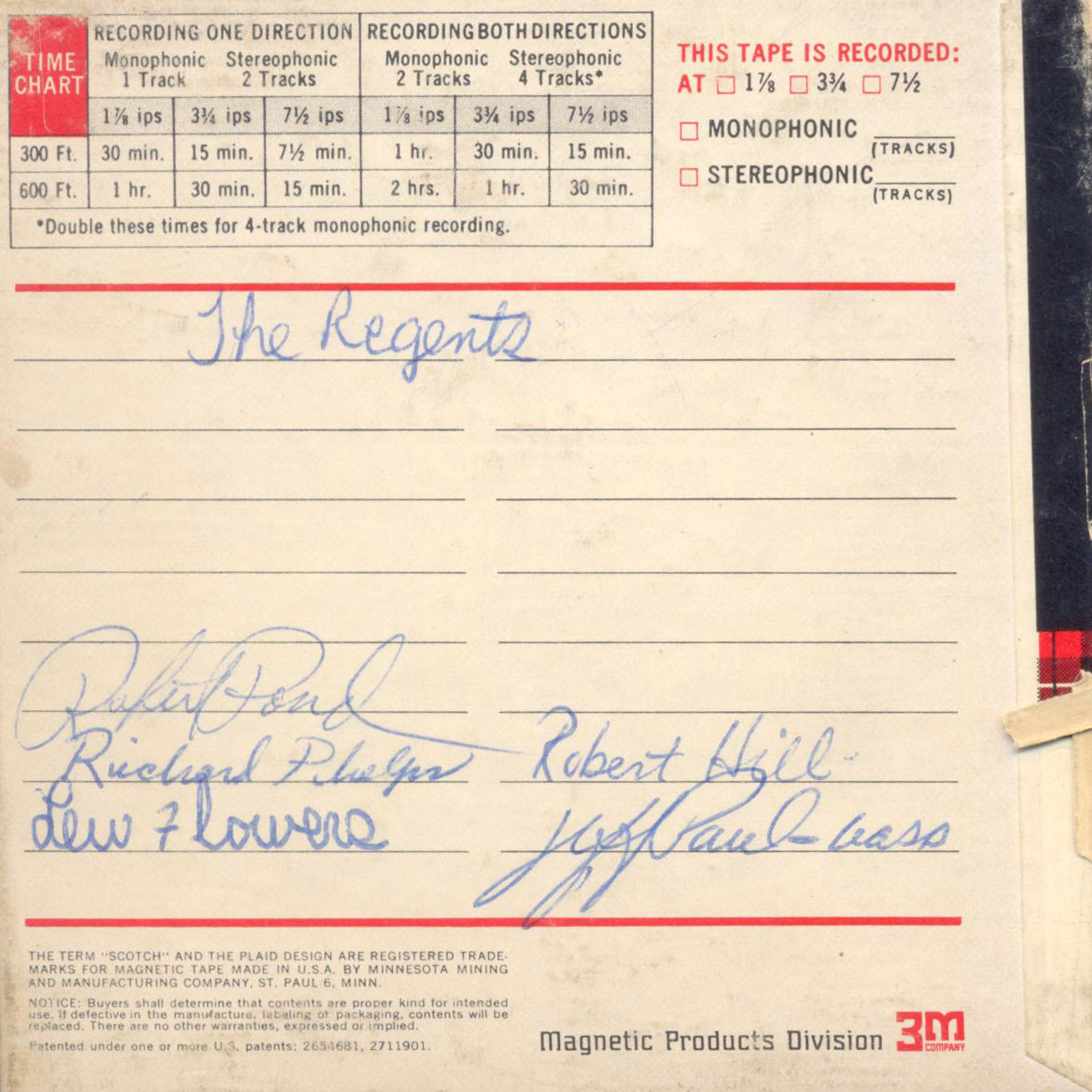
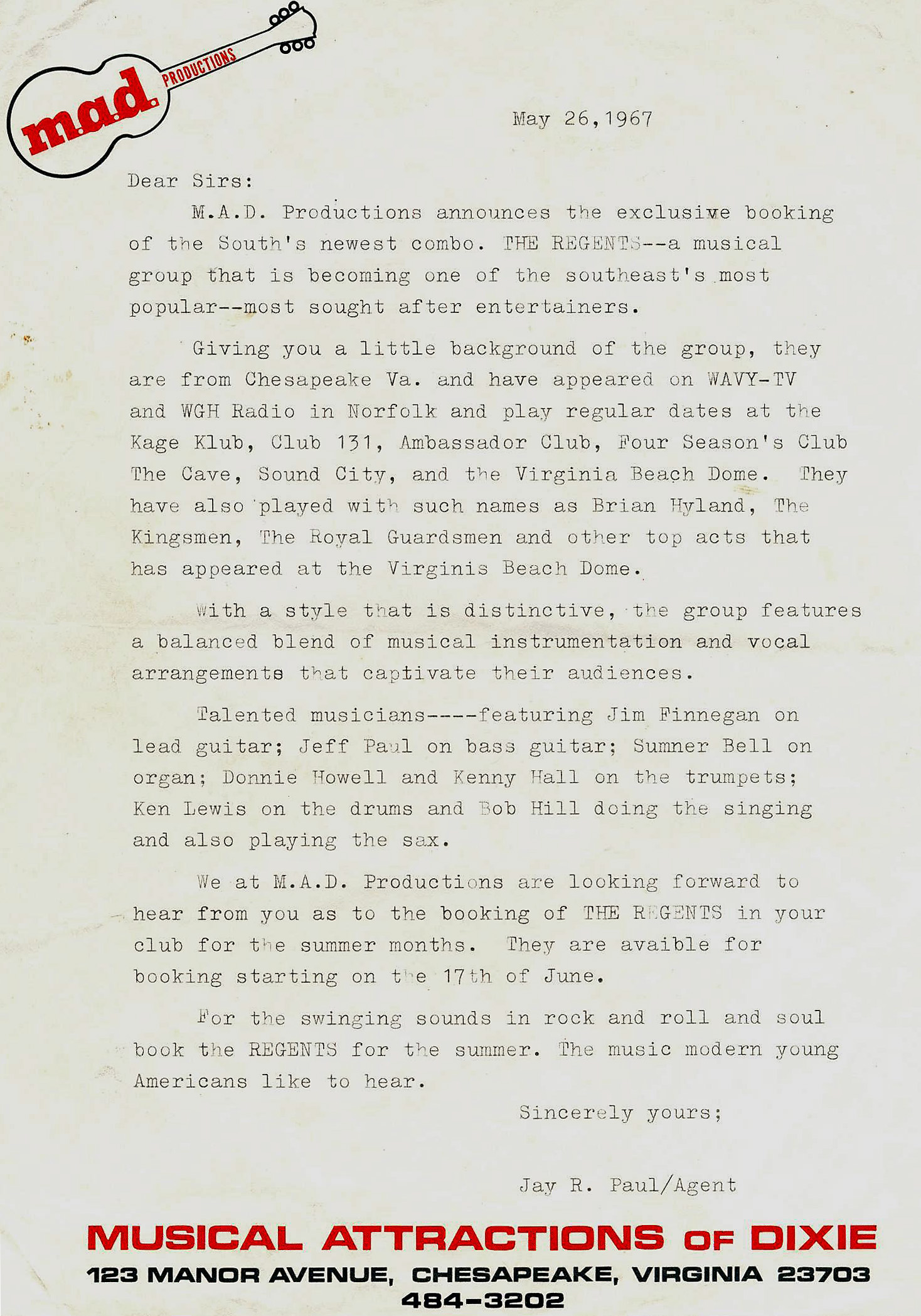
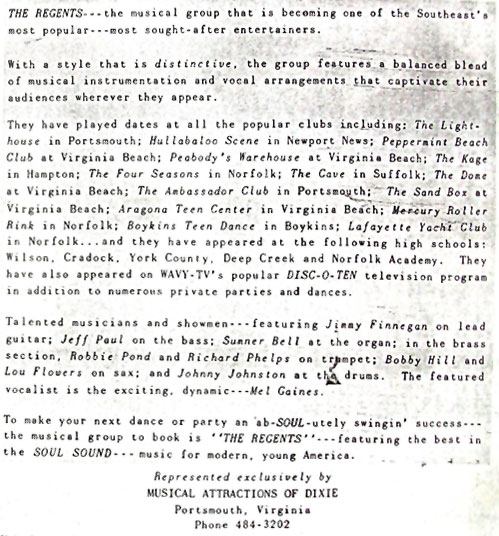
Mel Gaines – lead vocals Jimmy Finnegan – lead guitar Jeff Paul – bass guitar Sumner Bell – organ Robbie Pond – trumpet Richard Phelps – trumpet Bobby Hill – saxophone/lead Lou Flowers – saxophone Ken Lewis – drums Johnny Johnston – drums
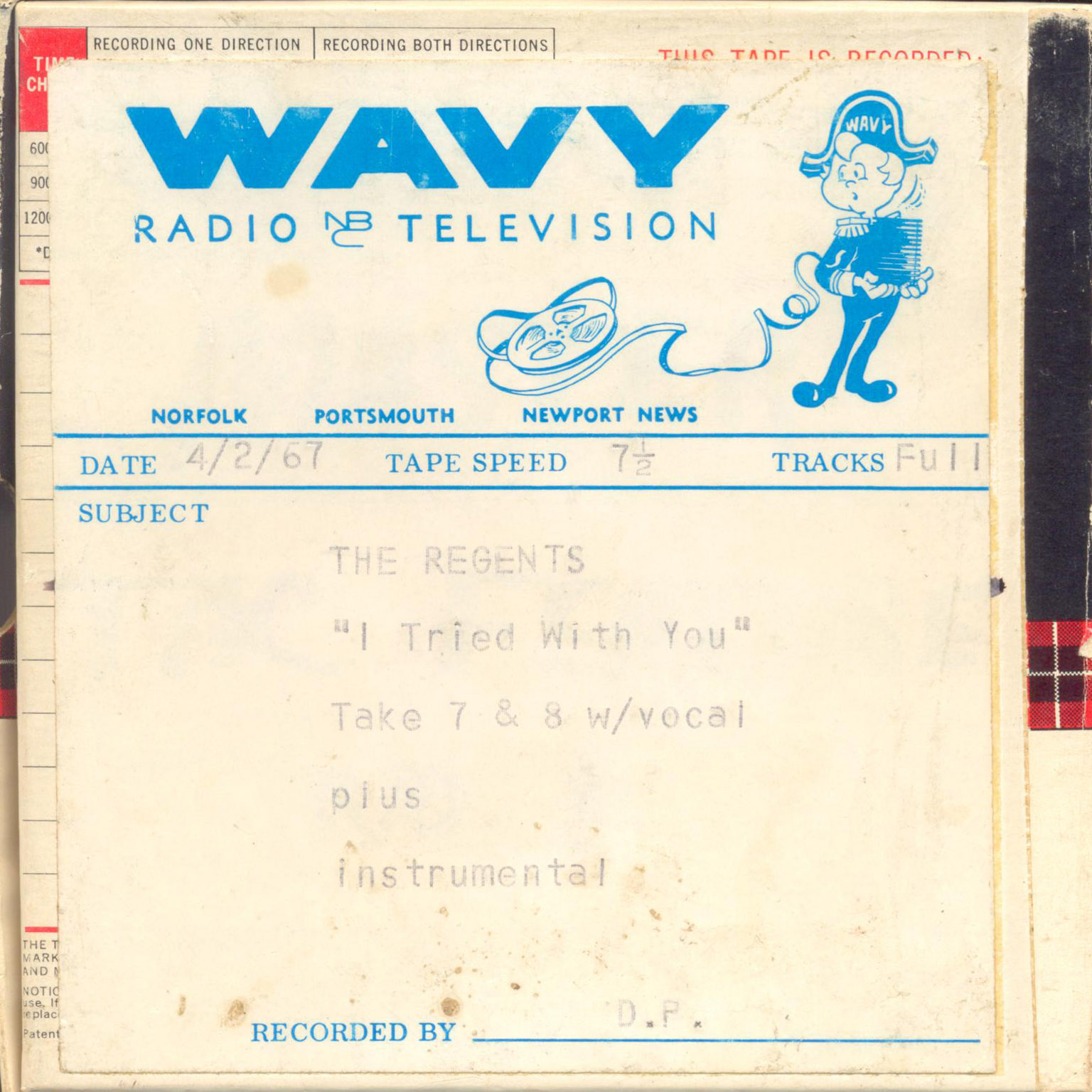
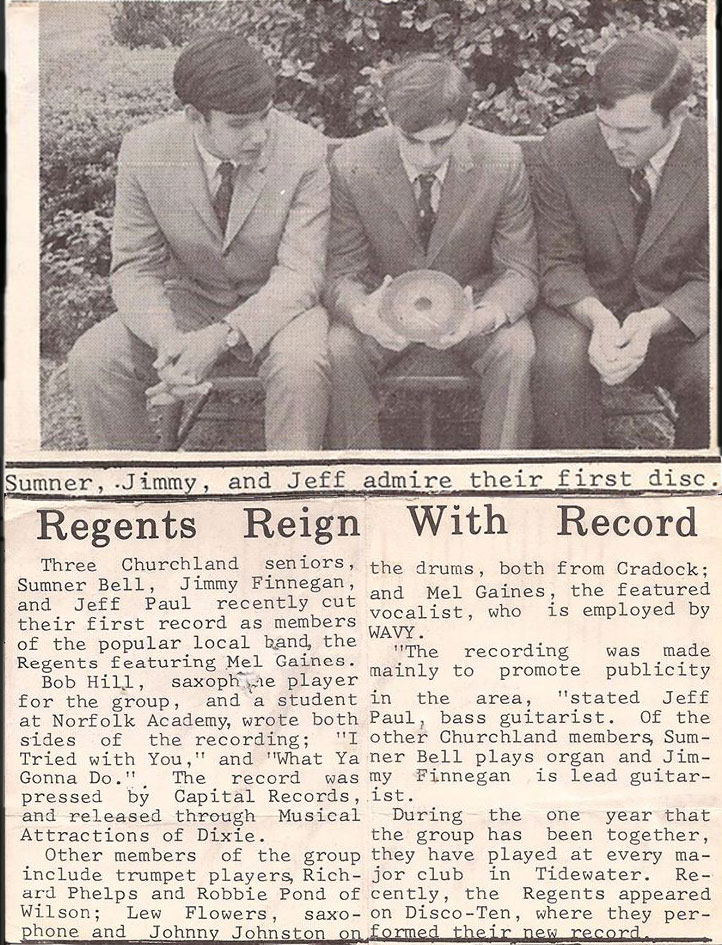
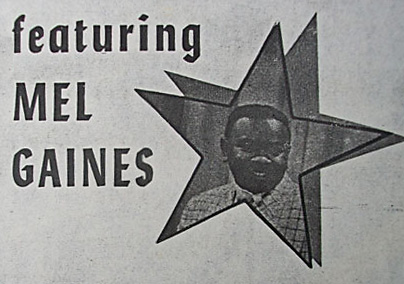
The Regents started in Portsmouth, VA in 1967. Looking for a vocalist, they met Mel Gaines in 1967, who was a co-worker of bassist Jeff Paul’s father at WAVY-TV 10. For a group of eight white high-school students to have a lead singer who was African-American and already 21 years old might seem an unlikely pairing, but the band found considerable live success.
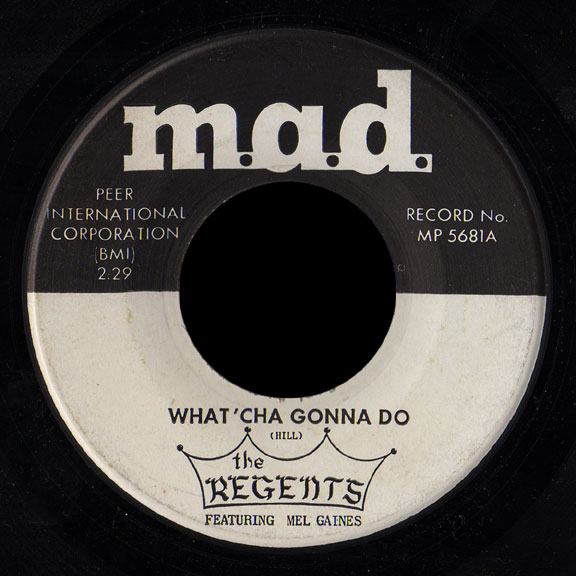
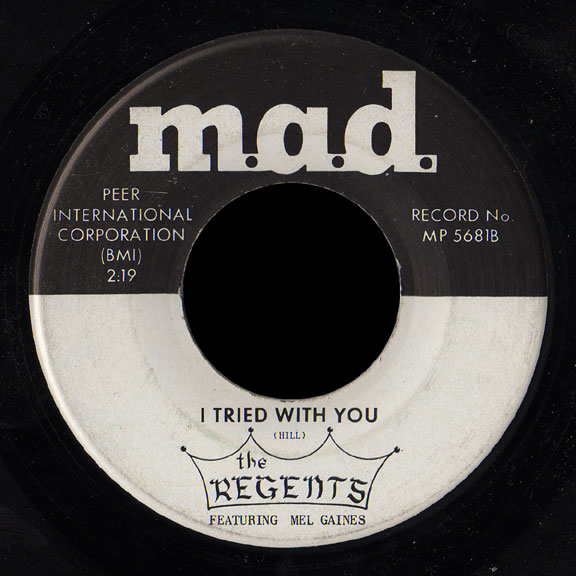
Their record on the Mad label shows the band working seamlessly with Mel, as each song features Jimmy Finnegan’s sharp rhythm on guitar, solid drumming from Johnny Johnston and memorable horn arrangements. “What’cha Gonna Do” has been a long-time favorite of mine. The band provides plenty of momentum and gritty backing vocals for Mel’s soaring voice.
“I Tried With You” starts off solidly but really picks up in the second verse as staccato bursts from the horns precede Mel’s pleas, segueing to an smooth, affecting chorus. Bobby Hill wrote both sides of their only 45, recorded at Norfolk’s D’Arcy Studios in 1968.
Mel Gaines passed away on November 18, 2009, two days short of his 63rd birthday.
Below are the stories of drummer Johnny Johnston and organist Sumner Bell in their own words.
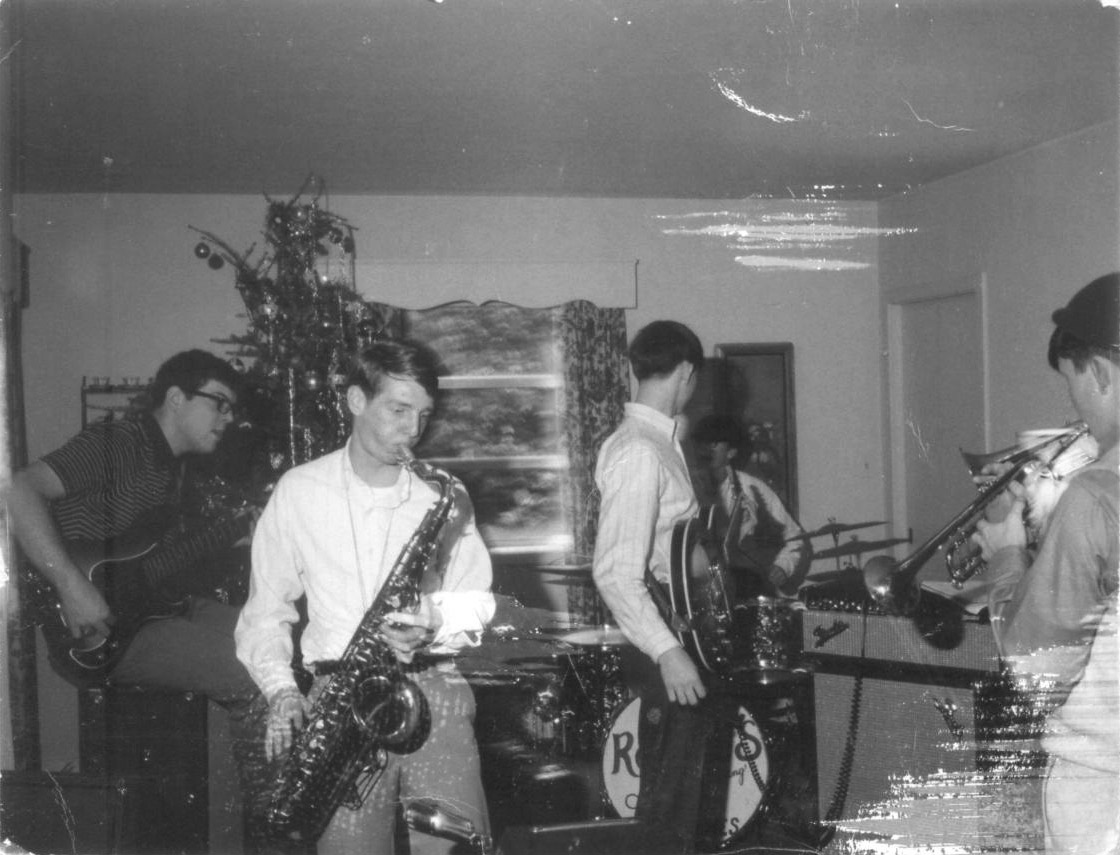
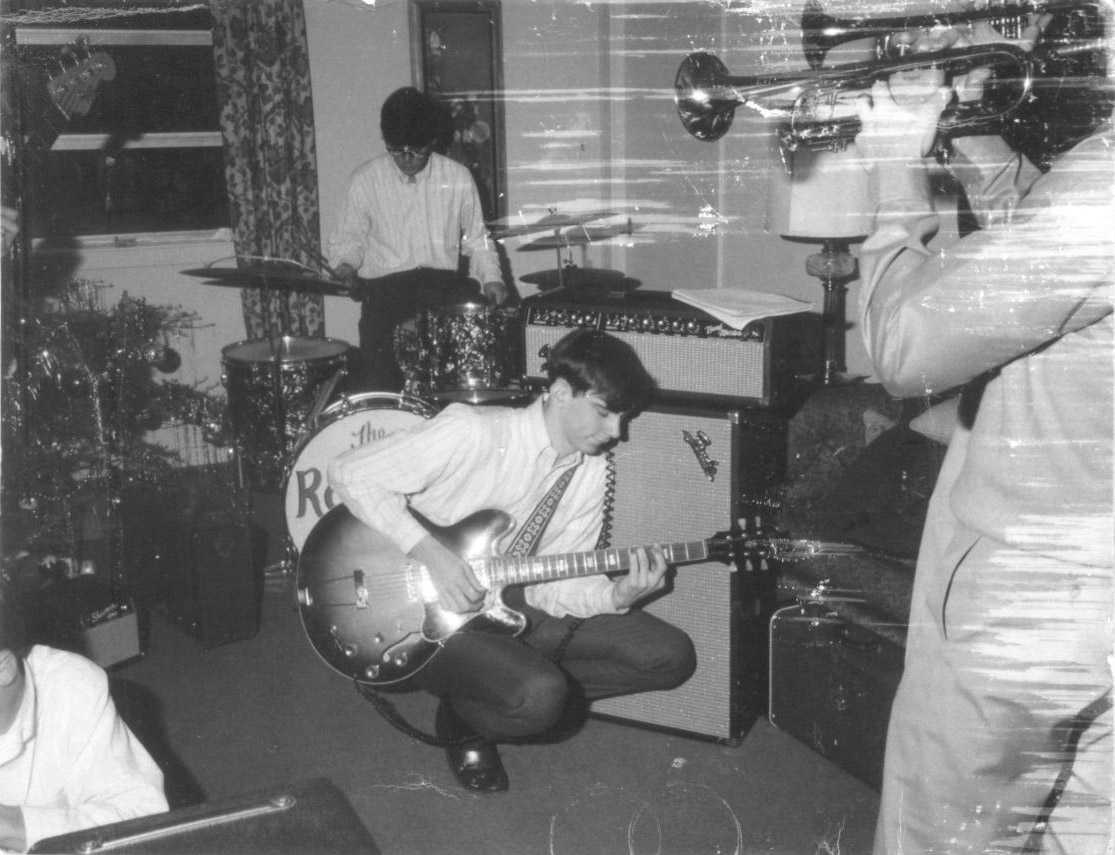
Practicing at Bobby Hill’s parents house around 1967. From left: Jeff Paul, Bobby Hill, Jimmy Finnegan and Johnny Johnson on drumsJimmy Finnegan on lead guitar and Johnny Johnson on drums
The Regents featuring Mel Gaines, 1967-1968 as remembered by Johnny Johnston
The Regents Featuring Mel Gaines was a popular soul band established in Portsmouth, Virginia around 1968. The first memory I have of the group is my audition for the band as a drummer in the spring of 1967.Rusty Gibbs, an old high school buddy of mine, told me the group was auditioning drummers at Jeff Paul’s house in the Churchland area of Portsmouth. Jeff played bass with the group and actually liked how I played, and to my surprise the group asked me to join them. I was a junior at Cradock High School in 1967 and was trying to determine if I should continue to play sports or follow my heart’s desire and become a drummer in a dance band.
I had taught myself how to play drums by watching all of the local bands. I especially studied and copied Fat Ammon of Bill Deal and the Rhondels and also The Swinging Machine’s Dickie Bocock. I loved their styles and really became accustomed to the beat and timing they both had. This was when dancing at teen clubs, dances halls, high school dances such as the Ambassadors Club (or AB Club as we called to it) and The Lighthouse in Portsmouth were both at their all time high.
The other band members were especially talented and we were blessed by having a great black singer by the name of Mel Gaines, who resided in Suffolk’s Pughesville area. Mel was a very talented and blessed singer of our group. He was the person our fan base came to see. I remember playing at a dance at Cradock High School in 1967 and when his name was announced the crowd exploded and rushed the stage to sing and dance as he sang.
Johnny Johnston
Soul music was the big sound of our day and we really had a powerful brass section. Robbie Pond and Richard Phelps were on trumpets, Bobby Hill and Lew Flowers on saxophones. Bobby Hill was the driving force of the horn section, and the great horn sound heard on our record. Jimmy Finnegan was the best lead guitar around, and is still playing guitar for a group called El Kabong in the Tidewater area. Jeff Paul was our outstanding bass player and mostly the one responsible for motivating us to perform at our top level of showmanship. I did not realize how good they all were until years later when listening again to our record. Our rhythm section was also capped off by Sumner Bell who played Hammond organ. During the high mark of our short career, all of our members were juniors or seniors in local high schools and on the brink of following college careers.
The short career of our band was topped off when we decided to go into the studio and record “What’cha Gonna Do” which was Side A and “I Tried with You”, was the B Side. As my memory would have me believe we recorded both songs at D’Arcy Studios in Norfolk in four hours. Of course our horn section was pretty tired after playing Side A about twenty five times in a row. At $25.00 per hour for studio time we wanted to get our money’s worth. We made about 300 copies and started selling them for a buck apiece. I think I made about twenty five dollars. We actually made it to the Billboard chart and made the playlist at local radio station WGH.
Just as with all the other local bands we played all the local places such as The Lighthouse in Portsmouth, Ambassador Club, Peabody’s Warehouse in Virginia Beach, The Peppermint Beach Club, The Kage in Hampton, The Four Seasons in Norfolk, The Dome in Virginia Beach, The Sand Box and local high schools such as Wilson, Cradock, Deep Creek and Norfolk Academy.
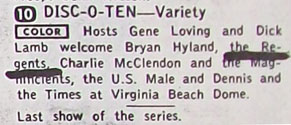
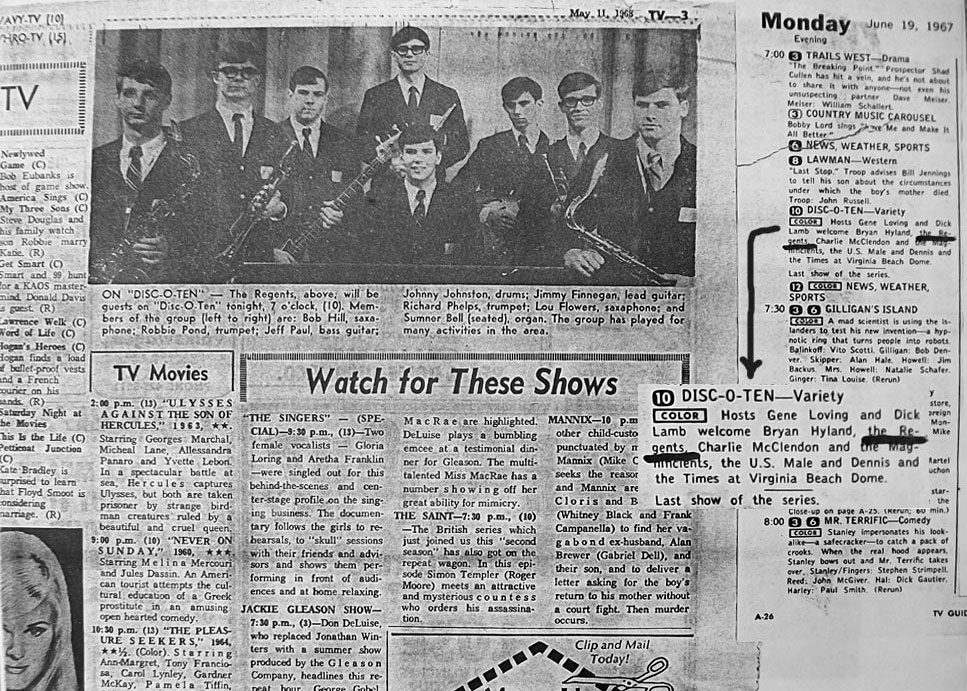
My favorite place to perform was the Glenshellah Woman’s Club in Portsmouth. It proved to be the best venue for live bands and we could get close to the dance floor. The next best place was the Knights of Columbus Hall in Portsmouth. The dance floor was on the second floor and I remember having a great time. All who attended these dances have fond memories of the music and the people we hung out with. We also appeared on the WAVY-TV DISCO-TEN television program, which highlighted local area high school dance scenes in addition to private parties and other local dances.
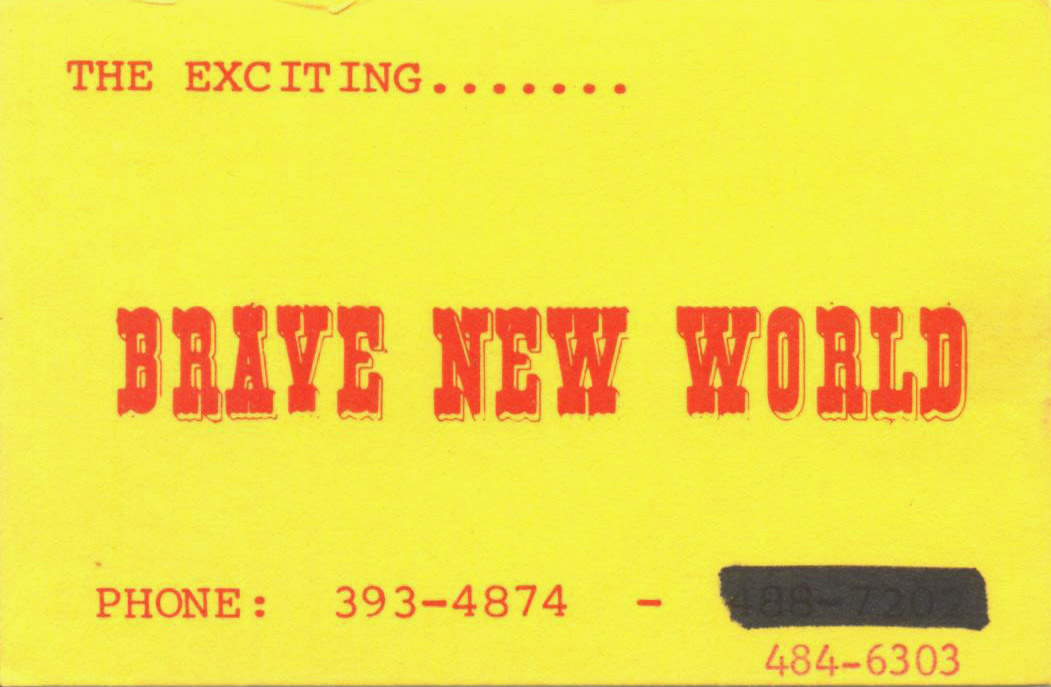
Just when we started to really get a following and some momentum, we had finished our senior years in high school and off to colleges we all went. One last ditch effort to try and stay in the music world was when we started a new group called Brave New World. That group was way ahead of its time though and never really caught on, due mostly to our impending college departures.
I am not sure where all the members have gone but I am trying to trace them and would like to see them again if at all possible. Members of our group moved on to other careers. I must say that all of them made my life much richer by playing a big part of my musical career. I still enjoy playing our record and remember all the places we played. Some of the clubs are still in existence after 40 years. And yes, I still have the fire to play thanks to them.
Many thanks to my “way back when” neighborhood friend Len Hamilton who encouraged me to play drums and was instrumental in getting me started in local bands.
Johnny Johnston Cradock High School, Class of 1968 Portsmouth VA
Announcement of Disc-O-Ten show, May 11, 1968, from left: Bob Hill, Robbie Pond, Jeff Paul, Johnny Johnston (with drumsticks), Sumner Bell (at the organ), Jimmy Finnegan, Richard Phelps and Lou Flowers.
The Regents Featuring Mel Gaines’ by Dr. Sumner Bell
Portsmouth, Virginia. AM Radio covers the hits. WRAP. Vinyl 45s. Segregated Schools. Protestant – Catholic. Camelot President. Black – White…..”The times they were a changin”Fast forward to the Fall of 2001: A road trip with my college aged son, Joe, on a Friday night jogged some memories. ‘Invisible Downtown’ packs up its gear in a car in Boston heading for a 9:30 pm gig at the Yale University Women’s Center. Unlike my early band days, the car is driven by the lead guitar player and not one of the fathers. But it seems just like old times, I am with the band in the back seat wondering what the first set will be.
But, times have changed. My son Joe, the rhythm guitar and song writer is riding shotgun. This is no cover band – only original stuff. I’m along for the ride in the back seat, trying to remember what it was that got me interested in bands. We unload and ‘Invisible Downtown’ plays the set. One thing catches my eye as I exit the Yale Women’s Center for the last time carrying an amp and snare drum to repack for the early am drive back to Boston, and it is not what I recall from my days as an XL or Regent — a basket of condoms by the door. Not one of those band members had a bulging wallet.
“Satisfaction” – times have changed, but small bands still ride together and pack their stuff in the trunk. It seemed that I was back where I had been 35 years before; my ears were ringing all the way back to Boston.
Jimmy Finnegan, Bobby Hill and I had been friends thru elementary school. My Dad and Jimmy’s father worked together and Bobby and I went to Monumental Methodist Church; Jimmy went to St. Paul’s. Our families interacted in a variety of settings and encouraged our socialization and many developmentally rich experiences together included after school sports, Boy Scouts, trick or treating, and church before deciding on music as a shared interest and experiment. Little did we or our parents know where our shared interests would lead the boys.
I can remember playing “rock music” in 1963 or ’64 sitting at a upright piano in Jimmy Finnegan’s living room with Jimmy on a guitar…not even sure if it was electrified. Perhaps this was the only time that the keys could be heard above the guitars and soon to be added bass and drums. I think Bobby Hill next came over and may have had a guitar that he reversed the strings on so he could play left handed. Jimmy’s mom Frankie was “quietly” encouraging us. We needed a bass guitar player and Bobby took on a project — to not only learn to play the bass, but also to make one. Ken Lewis (a fellow Trucker and Methodist) subsequently joined us on drums and Andy Copley (a student at Portsmouth Catholic and natural, fantastic musician and ear) took on the bass (something he continued as a professional career across the country).
But, Jimmy loved the music and was the driving force in getting us going as the XL’s. Jimmy’s musical flame has always burned brightest. Jimmy played the St Paul’s Catholic card and we were booked at the Knight’s of Columbus with a microphone stuck inside an upright piano and plugged into one of the first little Fender amps. After our first gig I received a letter from a female fan, a first (I was hooked) and last (what went wrong?)! Eventually, we went on to play “The AB – Ambassador’s Club”, Churchland Teenage at the VFW, and many private parties.
The XL’s were authentic, but an average white band. Jimmy had a Fuzz Tone and we could play “Satisfaction”, the words being distinct enough to be heard across the Elizabeth River by Bobby’s dad Stoney. All of us were too young to drive and when Dr. Hill picked us up in his Rambler Ambassador Station wagon from Portsmouth City Park he wanted to know what WE knew about satisfaction! Not much, but we all were interested in learning as quickly and often as possible. The amps got bigger, as the boys grew to young men, got driver’s licenses and hormones.
The drama that ended the XL’s is lost to me. I think Andy Copley went on to play with a “cooler”, bigger and better band. The bitterness spurred the survivors to retool ourselves. Bobby once again stepped up to learn how to play another new instrument, the saxophone! This time he didn’t make his new found instrument but purchased it.
Retail shoppers for musical instruments visited Portsmouth Music, we haunted the pawn shops on High Street. Jeff Paul came on as our new bass player and with him we enjoyed the contacts of his dad the general manager of TV 10 and his brother Jay who served as our booking agent. I think the addition of Jeff introduced modern marketing to the guys.
Bobby was very interested in the regal sounding name, The Regents, and after some discussion of alternatives the name stuck, usually to our blue blazers, the iconic adhesive pocket logo. R&B, soul music, and beach music were the popular dance bands in southeastern Virginia. So a very practical decision was made to play what the market wanted and would pay for. Jimmy packed away his Fuzz Tone, and saved up lots of musical ideas for his future. One minor weakness that had hampered the potential of the XL’s and subsequently, The Regents, was the lack of an exceptional singer. Mel Gaines filled that need and became the “featured act” of the ever so regal “The Regents, Featuring Mel Gaines”.
Ken Lewis was the first of the original band members to graduate from high school and leave the area for college. Ken was red headed, high energy, and enjoyed swirling those drum sticks between swats at the snare. Johnny Johnston’s transition to the band as our new drummer was seamless. What a quick study!
Johnny’s good nature, sleepy smile, and steady beat assured he fit right in and quickly proved to be a valuable asset. He brought new fans and exposure to the group. The Regents didn’t miss a beat.
Bobby organized the horns into a coalition of harmonies that were extraordinary. Robbie Pond and Richard Phelps were on trumpet and Bobby and Lou Flowers played sax. They swayed and stepped to the music usually prodded by Jeff Paul’s big “axe”.
As lead singer, Mel Gaines was a few years older than the high school instrumentalists, but what we lacked in maturity he covered ever so well. Mel had patience, talent and soul and propelled The Regents from gig to gig as we developed a reputation and following from the Virginia Beach oceanfront to Capron.
Mel Gaines took the stage in a humble way usually dressed in a suit that belied his coming performance. By the end of the second set, Mel had removed his suit coat, sweat was streaming from his face and soaking his shirt, damp handkerchief clutched in his hand and singing with an intensity that was matched by the enjoyment of the listeners and dancers whom he had whipped into a frenzy.
Mr. Gaines was an unassuming man who was always dependable, hard working and on key. Mel only asked for one thing that I recall and that was for “The Regents, Featuring Mel Gaines” to play at a small club in Pughsville that was owned or managed by his relative. Mel wanted to play for his family and friends in his neighborhood and so, we did.
A talented singer, interested and competent management, receptive audiences, and teenage swagger resulted in excellent music. We all came to understand the meaning of Satisfaction and the importance of music, organization, practice, and teamwork in our lives. And, hearing your own band on the radio with Mel’s amazing voice as you traveled home as a senior in high school was way cool! Almost as cool as going on a road trip band gig with my son.
Johnny, thanks for putting this together. It has been fun for me to reminisce.
Sumner
Special thanks to Johnny Johnston for his help with this page, to Jimmy Finnegan for the clipping about the record release, and to Jeff Paul for the video link.
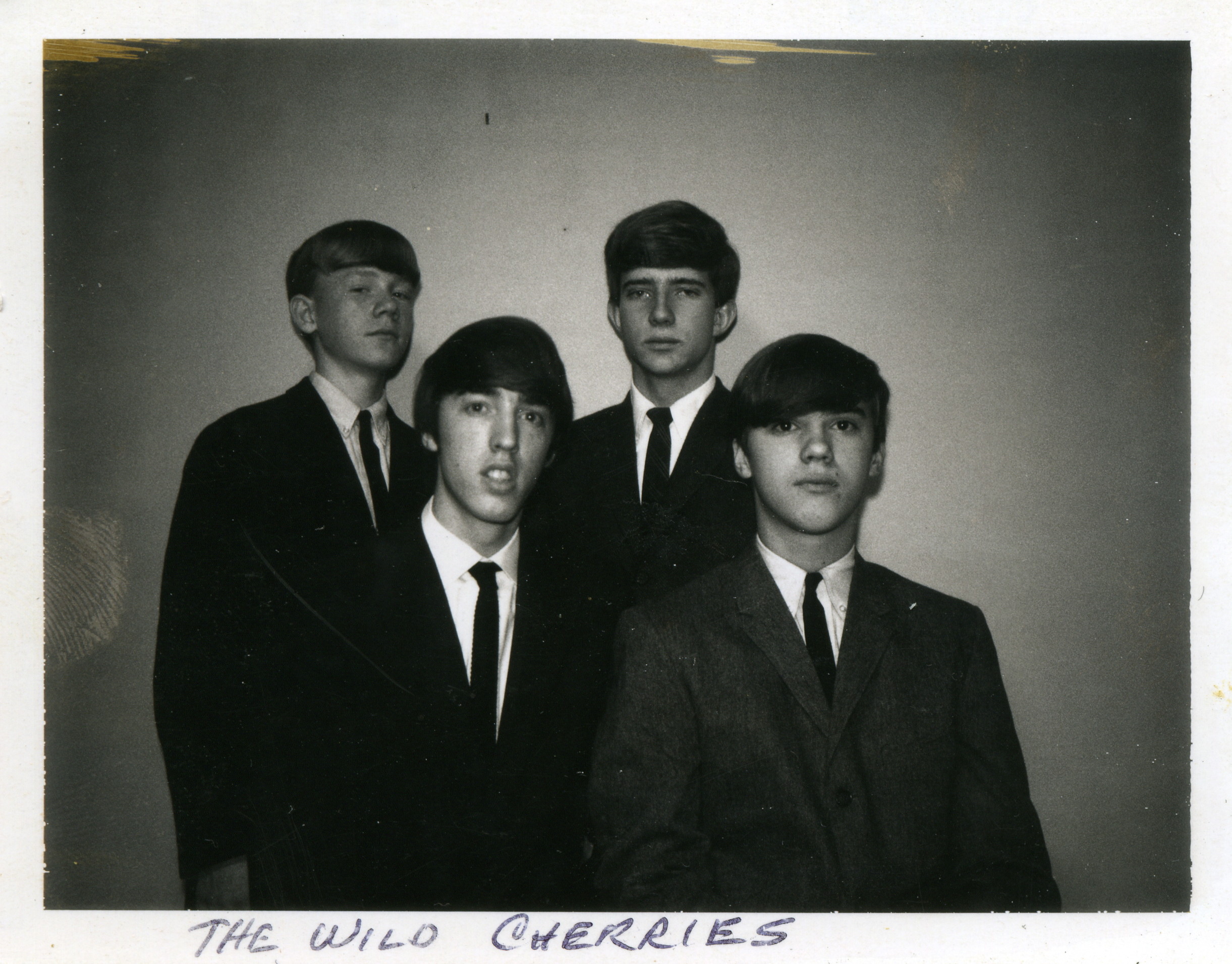
The Wild Cherries, from left: Dennis Jenkins, Harold Souders, Carl Moore and Wayne Dale. Photo courtesy of Carl Moore
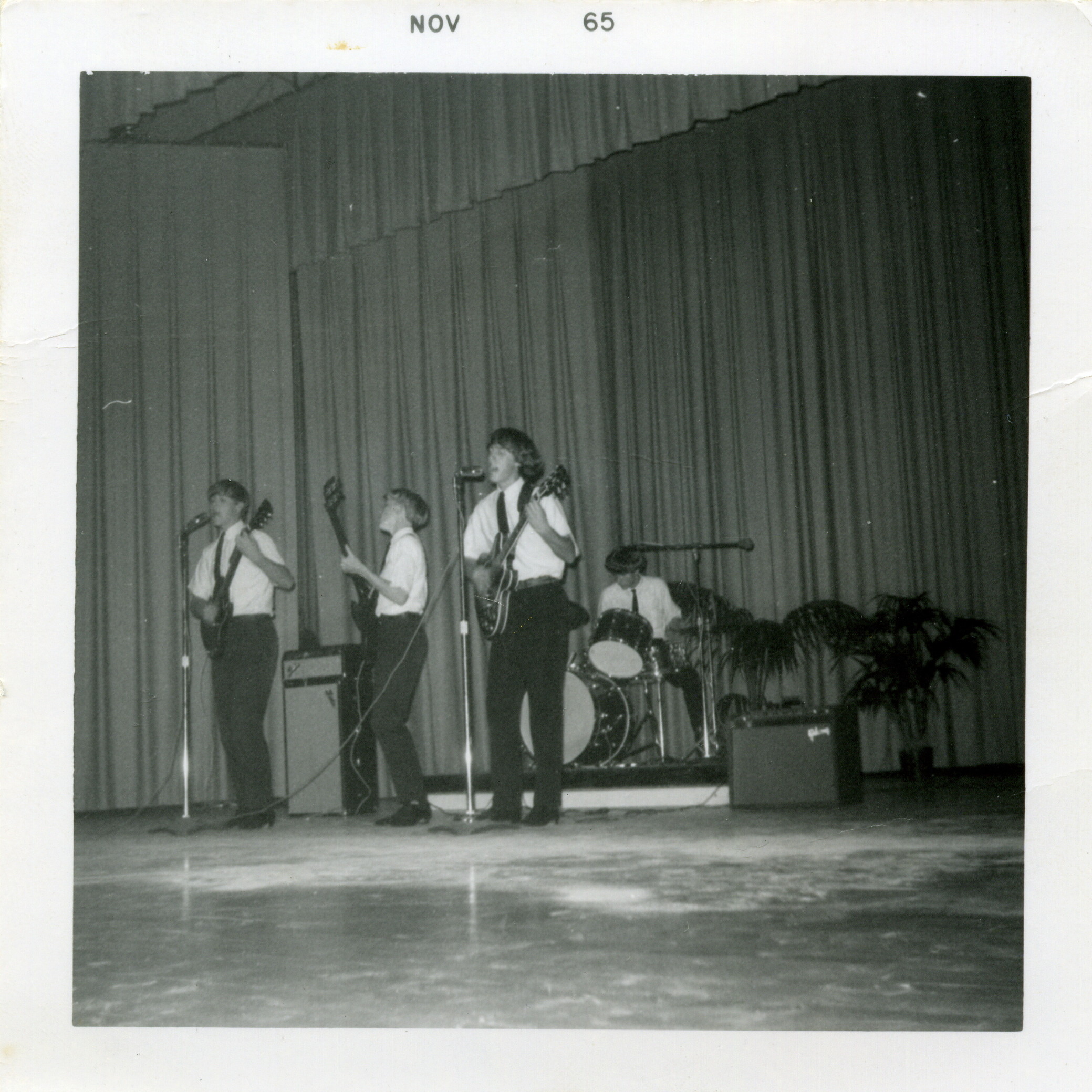
These Wild Cherries were a Hampton, VA band known for their ability to cover Beatles songs.
Members were:
Harold Souders (vocals, lead guitar, electric piano) Carl Moore (vocals, guitar) Dennis Jenkins (bass) Wayne Dale (drums)
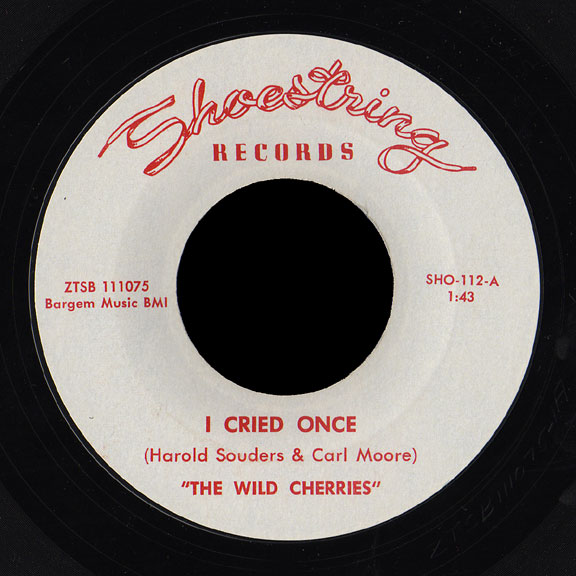
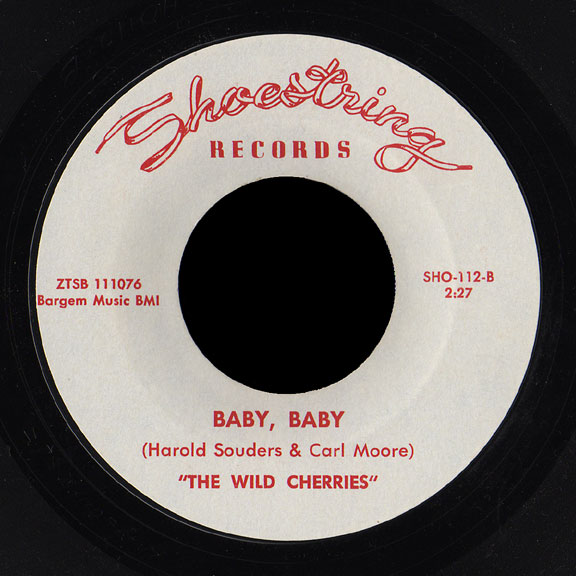
Hal Souders and Carl Moore were cousins, and composed both songs on this 45. In December of ’65 the band went to Richmond Sound Stages to cut their only recording, “I Cried Once” / “Baby Baby”.
“I Cried Once” begins with jarring guitar chords, and continues at an urgent pace through verse and chorus and a beautiful and very brief reverbed guitar solo until the ringing chords at the finish. Hal Souders’ syncopated piano overdub is a nice touch.
The tender “Baby, Baby” on the flip begins with nicely articulated notes cutting to a drum and bass break before the verse begins. The singer confesses “all the lies I told to you, not a one was true.”
To me this is one of the most successful of all teen 45s of the ’60s, sincere original songs flawlessly performed and superbly recorded. The upbeat “I Cried Once” balances the sedate “Baby, Baby”. The instruments and harmonies create an atmosphere akin to the Dovers great recordings.
The band released the songs on the Richmond based Shoestring label, which also had 45s by the Fugitives and Panics. Publishing was by Bargem Music.
The record had some play on WGH 1310 AM in Newport News, though it didn’t make any charts that I know of. The band broke up by the time Hal Souders started college in the fall of ’66.
Thank you for Carl Moore for the photos seen here.
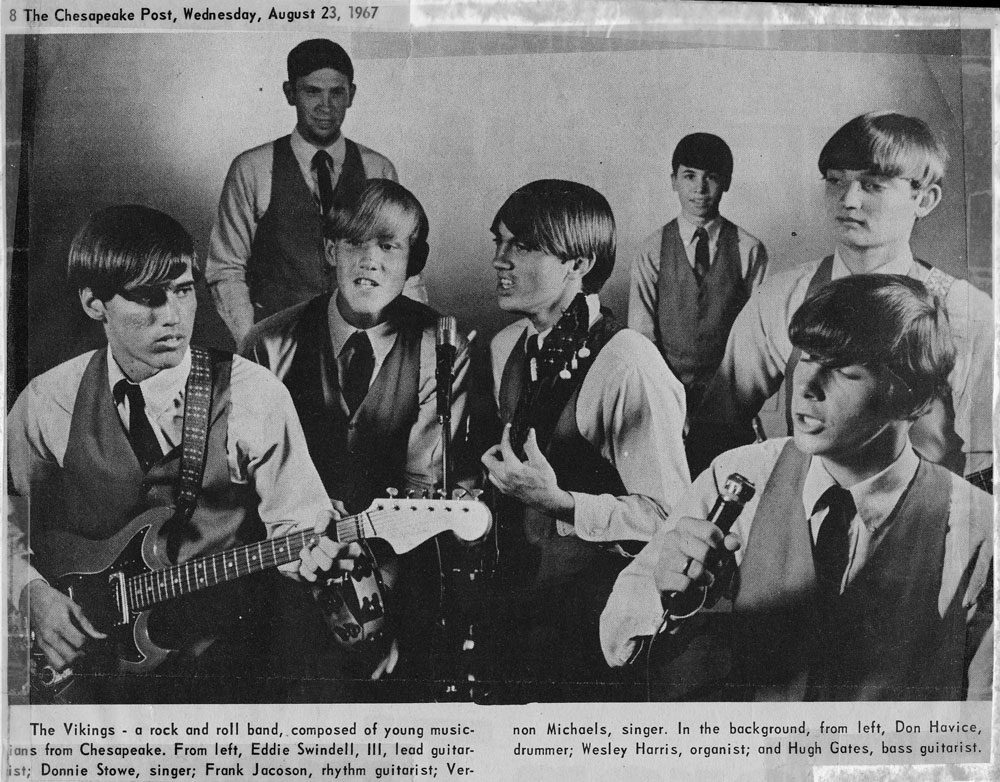
The Vikings started at Oscar Smith High School in South Norfolk. Members were Vernon Michael and Donnie Stowe on vocals, Eddie Swindell lead guitar, Frank Jackson rhythm guitar, Wesley Harris organ, Huey Gates bass guitar, and Don Havice drums. Mike Ruggles and Tom Burlage were in the band about a year until they went to college.
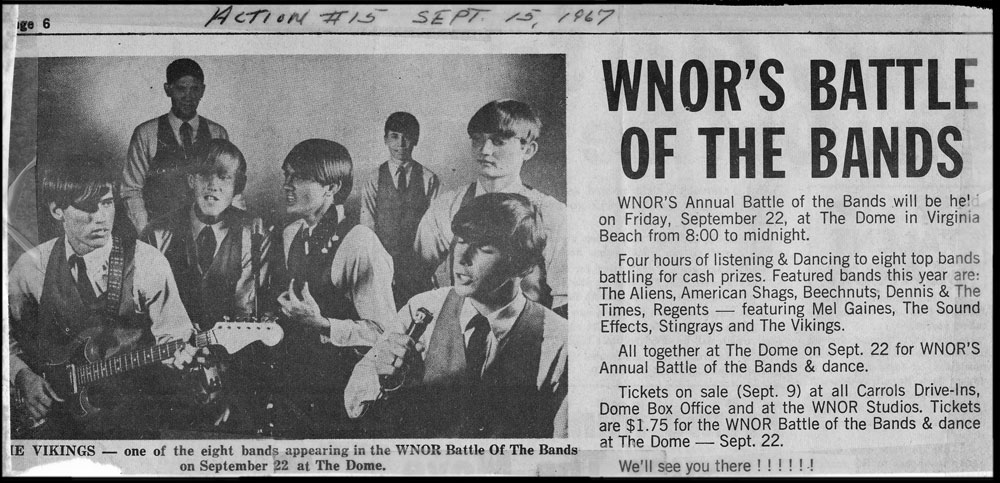
They won a Battle of the Bands in Feb. 1967 at the Ponie Teen Club on Godwin Ave, then known as the Portlock Au Go Go. They also participated in WNOR’s Battle of the Bands on Sept. 22, 1967, at the Dome in Virginia Beach, competing against the Aliens, American Shags, Beechnuts, Denis & the Times, Regents with Mel Gaines, the Sound Effects, and the Stingrays.
Although an article in the Chesapeake Post on Aug. 23, ’67 states that the band will soon be recording their first song, “Why Did You Lie,” an original by Eddie Swindell and Donnie Stowe, the band never did record. Their set list included dozens of songs, both rock and soul.
Eddie Swindell says “Donnie and Vern sang both rock and soul and harmonized together like Sam & Dave. I knew members of the Swinging Machine, Barracudas, Bill Deal and the Rhondels most of the bands in the area. Some of us are still performing. I also played in a band in the 70’s with Dickey Harrell the drummer from Gene Vincent and the Blue Caps I see him around occasionally. I have a scrap book with articles and pictures of local bands listing dates and places they were gigging.”
The Vikings reunited in 1989, and again in 2007 for a benefit concert.
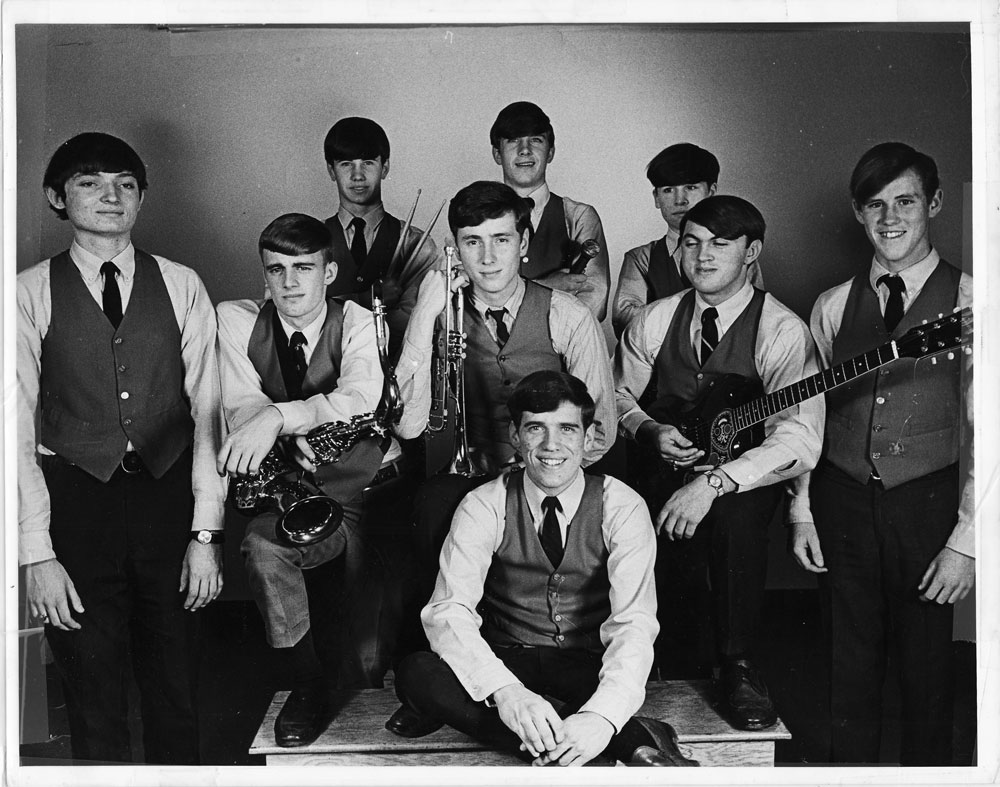
1st row sitting Eddie Swindell. 2nd row left to right: Hue Gates, Mike Ruggles, Tom Burlage, Frank Jackson, Donnie Stowe. Back row: Marty Rogers, Vern Michaels, Wes Harris.
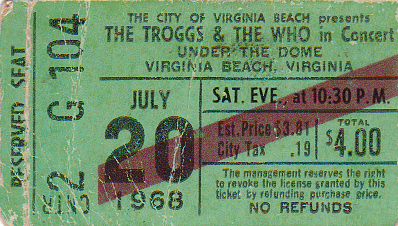
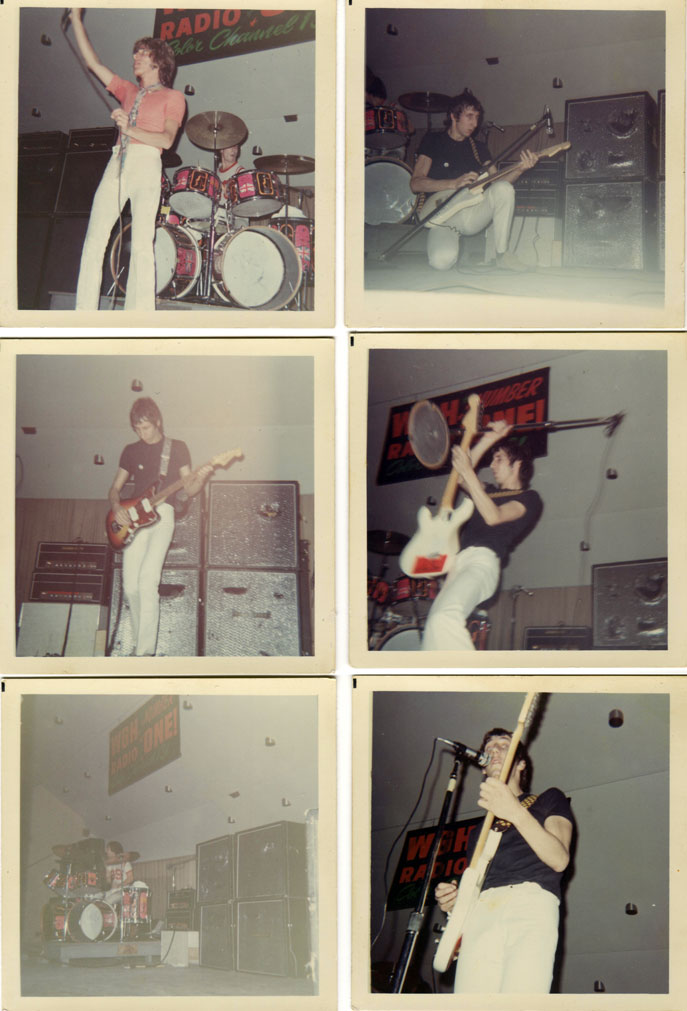
One more in the series of photos from Bill Stokley of Virginia Beach Dome shows. Excellent shots of Townshend, Daltrey and Moon’s drumkit, from July 20, 1968. I love photos like these – it’s just the band and their gear on stage. Townshend’s amps are shredded! Tickets cost $4…
Ticket stub for the Troggs and the Who at Virginia Beach Dome, July 20, 1968
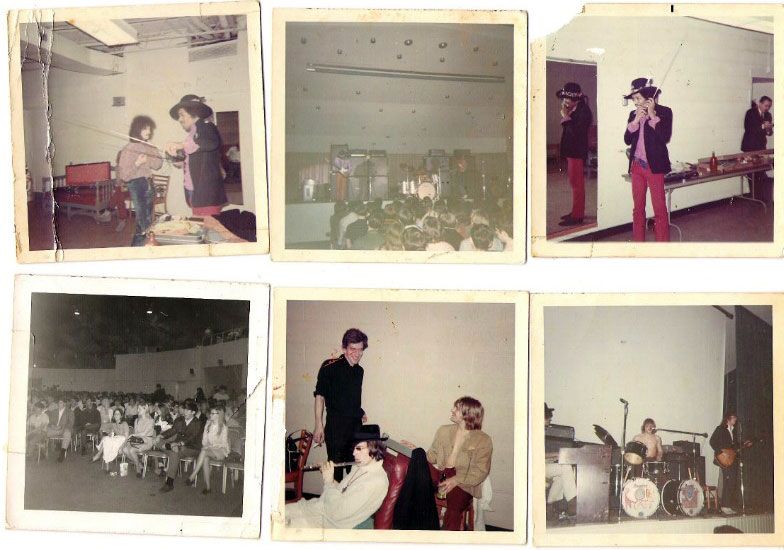
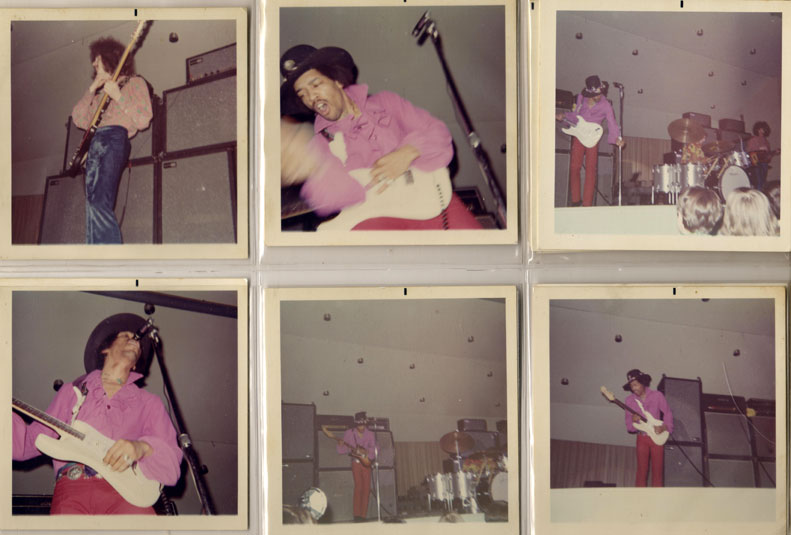
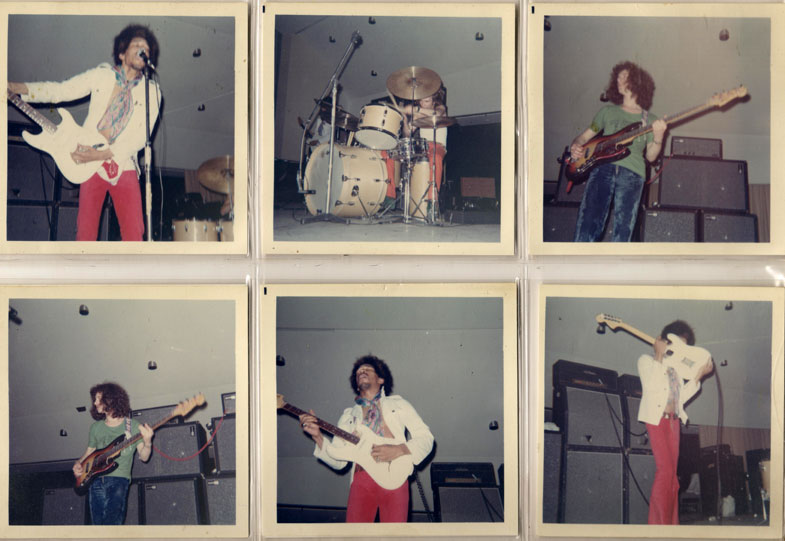
Jimi Hendrix and the Soft Machine at the Virginia Beach Dome, April 3, 1968. Photos courtesy of Diane.Jimi Hendrix and the Soft Machine at the Virginia Beach Dome, April 3, 1968. Photos courtesy of Diane.
Bill Stokley writes:
The Virginia Beach Dome seated about 1000 people. I was 16 and got to drive to the show myself!!! What a show! Jimi blew the doors off the place. You could walk right up to the stage and take pics. Got one of Jimi sliding down the neck during Foxy Lady.
I remember using a little camera that was my moms. The negatives were stolen back in high school.
Bill Stokely’s ticket stub
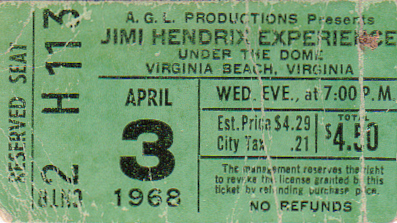
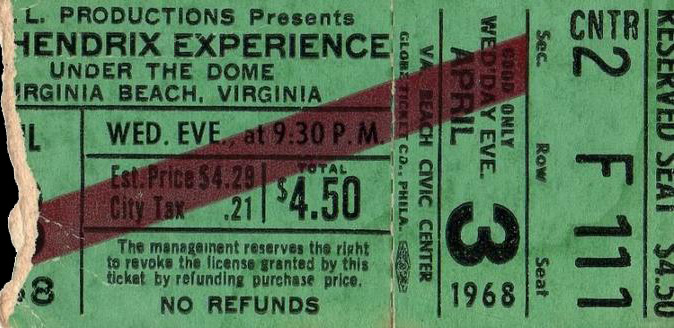
Steven S.’s ticket stub for the Jimi Hendrix Experience at the Virginia Beach Dome, April 3, 1968
Update, February 2012
As the ticket stub above clearly shows, the first Hendrix show was on April 3, 1968, not the 4th as I had posted before. The 4th was the day Dr. Martin Luther King was assassinated in Memphis. Thanks to James for bringing this to my attention.
However, some Hendrix references state the concert took place on the 4th (source seems to be Noel Redding’s diary). One commenter below remembers the news about Martin Luther King’s assassination spreading during the concert, which would indicate the 4th. Was the date changed from the 3rd to the 4th?
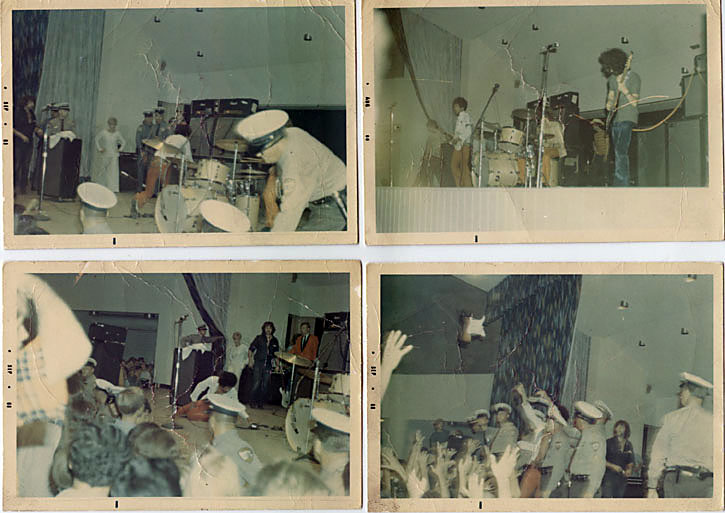
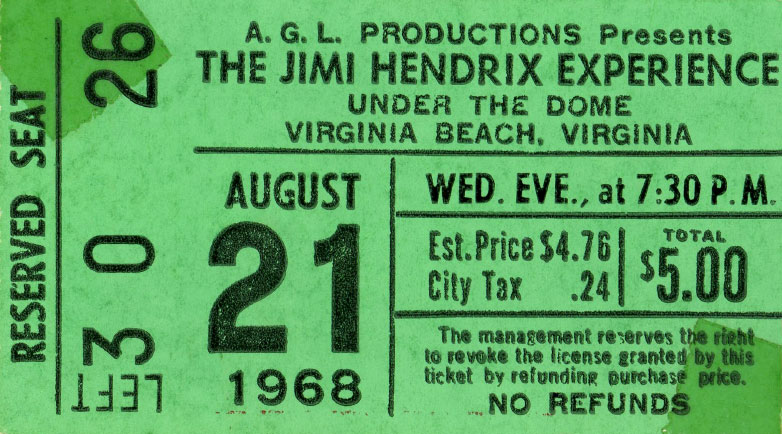
Jimi Hendrix at the Virginia Beach Dome, August 21, 1968. Bill Stokley: “I remember he wasn’t that good at this show and didn’t play very long.” Photos by Bill Stokley
Eon sent in the following set of photos from the same show. Jimi may not have played very long, but the ending was spectacular:
Here’s a description of the August 21 show from Chuck Taylor, General Manager of WTJU-FM Charlottesville, VA.
I played drums (poorly) in High School at Virginia Beach but still really liked to hear a good drummer. In 1968 I had a picture in my bedroom of Robert Wyatt playing drums for Soft Machine right next to my Peace Poster bought a shop on Eden Alley. Eden Alley hosted a series of hippy paraphernalia stores from an alley just off Virginia Beach Blvd. between Atlantic and Pacific Avenues.
That summer of 1968 I begged my parents to let me go to my first concert…to see the Soft Machine at the Virginia Beach Dome, August 21, 1968. Soft Machine was opening for a guitarist-led trio that was also getting a bit of press at the time. I had just turned 16 in May and so I had only recently gotten my drivers license and they were reluctant to let me go.
There were two shows that night. Because of my age my folks finally capitulated and said I could go to the first show…not the second. I argued with my mother over what to wear to a “concert”. She said you need to dress up (suit & tie!) for a concert. She was unconvinced that this “concert” would be different and refused to let me leave the house without at least loafers, nice pants and a collared shirt. I smuggled some blue jeans, tennis shoes and a t-shirt into the car and changed my clothes on the way. (I went to this concert by myself but cannot remember why)
That summer evening I drove the 6 miles from my house in Kings Grant (subdivision) to the Virginia Beach Dome. When I pulled into the parking lot I had one of those “we’re not in Kansas anymore” reactions as I quickly saw that my attempt at “casual hipness” missed in ways that I could have never imagined. Jeez there were lots of strange looking people in the parking lot! The show was introduced by a local goofy WGH-AM radio host Gene Loving, who couldn’t turn off the “AM radio” approach.
Once I was inside and seated (I actually had an excellent view if I remember correctly) the first band Eire Apparent performed a mildly psychedelic set that was pretty cool but not particularly memorable.
Next up, The Soft Machine (Cuneiform Records is doing an excellent job releasing many Soft Machine rarities). This version of the band was three musicians: Robert Wyatt, Kevin Ayers, & Michael Ratledge. The bass player left the tour about one month before they arrived at Virginia Beach. His name was Andy Summers (yep, the very same bassist later to be in the Police).
As for the set: an extremely intense and loud set ensued featuring music from the first and second Soft Machine records. At the end of the set, Ratledge pushed his organ off the stage causing such severe feedback that my ears are still suffering! Gene Loving attempted his AM stage patter over the raging feedback but quickly gave up. Finally, they shut down the power in the entire building to quiet the feedback but of course, plunging the whole place into darkness. About 20 minutes later the Jimi Hendrix Experience took the floor…
Though Hendrix performed and did various acrobatic stunts he left his guitar intact by the end of the first show. I cannot remember ANY details of the performance other than I came out the other side with a new religion! The general thought was that the destruction of Ratledge’s organ was a “gift” to those expecting destruction from Hendrix. According to friends who attended the second set, Hendrix burned his guitar. As result of that action Hendrix became the first of two hard rock bands in the 60s to be banned forever from the state of Virginia. The second band was the MC5 who played at a small club in Hampton and incited attendees to riot during their show.
This is my ticket stub with tape marks: In the late 60s I kept a scrapbook of the developing music and political scene.
Chuck’s ticket stub to Hendrix, Soft Machine, & Eire Apparent
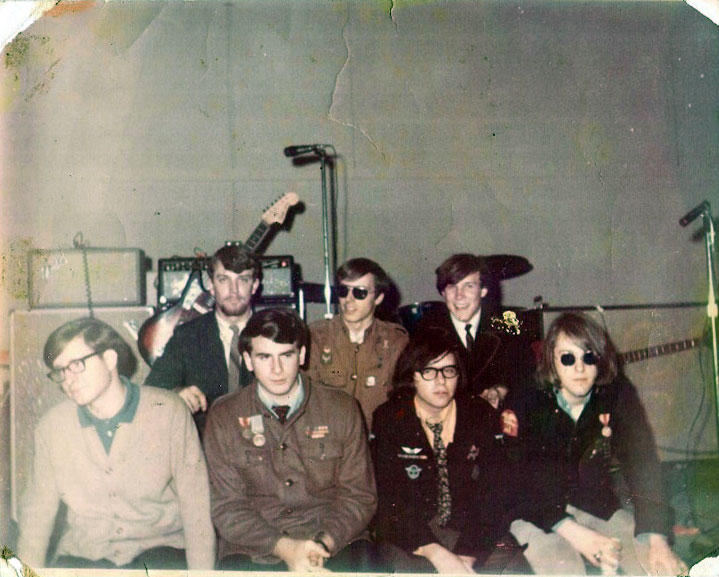
The Swinging Machine at the South Norfolk Armory, from left: Wayne Richardson, Vince Screeney, Bobby Fisher, Lee Caraway, Dicky Bocock, Bobby Weaver and Gary Richardson
I’ve read many accounts that consider the Swinging Machine the best of all local bands in the Tidewater area back in its day.
In 1963 three friends from Oscar F. Smith High School in South Norfolk formed the Chevelles. The group included Evan Pierce, Jr. (lead guitar), Richard Bocock (drums) and Steven Curling (saxophone). At Old Dominion University they met Esdras ben Lubin who took over on lead guitar and vocals, and suggested the band change their name from the Chevelles to the Swingin’ Machine. The addition of fifteen-year-old Billy Gene Stallings on organ helped their musical acuity considerably.
Esdras left the band and the group found Gary Richardson and Lee Caraway from the Villagers (out of Churchland High School in Portsmouth). Steve Curling left for college and was replaced by Bob Fisher, though Steve would occasionally sit in with the group.
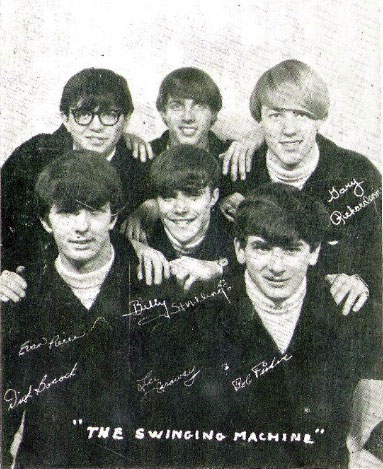
At the time of the release of their 45 the band consisted of:
Gary Richardson (vocals) Lee Caraway (guitar) Billy Stallings (organ) Bob Fisher (sax) Evan Pierce (bass) Dick Bocock (drums)
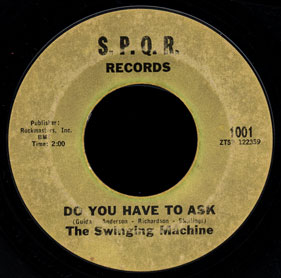
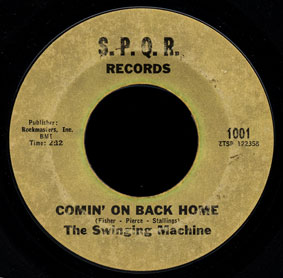
According to Evan Pierce, the band fought with their producer Frank Guida and was disappointed in the record. However, fans of the mid-60s band sound really love this 45, with “Do You Have to Ask” being especially tough and original. Frank Guida who was also owner of S.P.Q.R., is listed as one of the songwriters. “Do You Have to Ask” was recorded in the fall of 1965, “Comin’ On Back Home” five or six months later.
“Comin’ On Back Home” reached #39 on a Syracuse, NY AM radio station, WOLF 1490 in early June, 1966. How it reached the charts so far away from their base is a mystery.
Besides the 45 there is an early version of “Do You Have to Ask” and a simply amazing rocker, “Brother Look Out” that were unreleased at the time. They’re both now available on the Aliens, Psychos and Wild Things series.
There is also a tape of ten cover songs recorded in a studio, probably made as a demo to get live gigs. The songs include versions of “Tell Mama”, “Ain’t Too Proud to Beg”, “Fire”, “Spooky”, “Get Ready”, “Wrap It Up”, “Sunshine of Your Love”, “Rock and Roll Woman”, “To Love Somebody” and “Dear Eloise”.
I would love to hear a live recording of the band – if anyone has a tape, please get in touch.
In 1967 Wayne Richardson joined on trumpet. Bob Weaver was a later member as well. Vince Screeney from the Sting Rays replaced Evan Pierce while he was in the army. Rocky Cantrell filled in on occasion.
Gary Richardson died tragically from a drug accident in July of 1968. The Swinging Machine continued for a short time with William “Rocky” Smith on vocals, but soon disbanded. Dick Bocock and Bob Weaver formed a new group, the Machine.
Producer Frank Guida passed away on May 19, 2007.
I want to say thank you to Diane for sending in these rarely seen photos of the band. Diane and Lee Caraway were married until he passed away in 1979.
Diane had this to say about the photos:
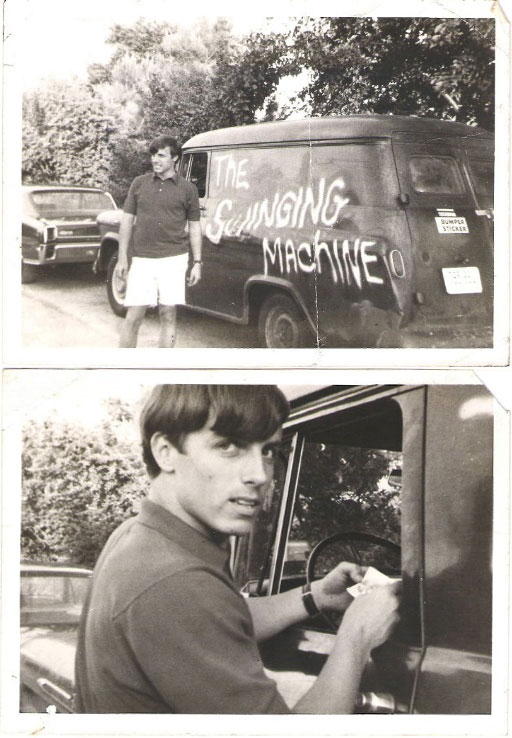
Anyone who hung out with the band will know the panel truck. That was their equipment truck for many years.
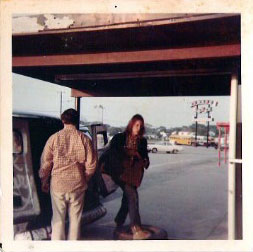
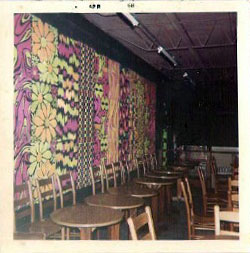
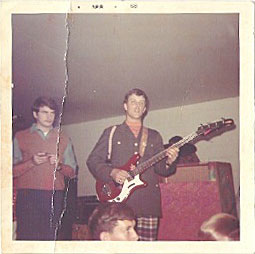
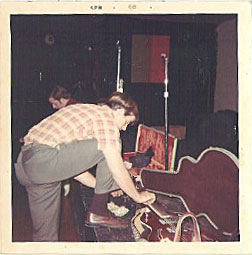
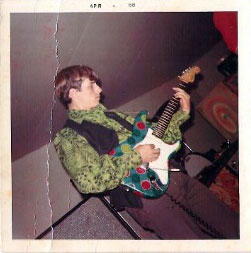
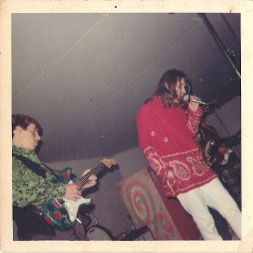
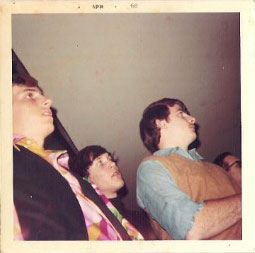
The Lighthouse pics show them unloading the equipment and setting up for the dance that night. The pics of them on stage don’t do it justice because the camera won’t pick up all the colors and psychedelics flashing on the stage background, the lights in that place were hooked into the sound system.
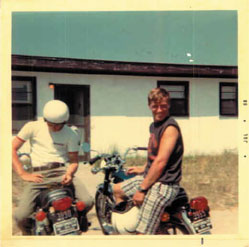
One pic is Gary and Wayne Richardson standing in front of a cottage the band was staying in at Nags Head when they were playing at the Casino.
Steve Curling wrote to me with his recollections of the band:
I will give you a brief history of the band as I saw it.
The band originally was called “The Chevelles” which consisted of Evan Pierce on bass, Dickie Bocock on drums, Bobby Fisher and myself on sax (I doubled on trumpet) and several different lead guitar players but the one I remember most was Eris Ben Lubin [Esdras ben Lubin] who was older and taught us the ropes. We didn’t have an established keyboard player until Billy Stallings came along.
The band centered around Dickie’s home. Dickie’s father was a prominent doctor in South Norfolk and financed most of the equipment for the band. I loved hanging out at Dickey’s because he lived on the Elizabeth River on about 4 acres with a pool and a 85 foot yacht named the Blue Haven which we spent many days and nights, plus he had all the toys including speed boats and a 1967 Olds 442 which Dickie and I decided to total one night coming back from the old Ambassor’s club in Portsmouth.
I remember playing at several of the clubs on the Naval Base, the Ambassor’s Club which we called the AB Club, the lighthouse and the casino at Nags Head. We realized that we needed a steady lead guitarist and a lead singer. While interviewing Gary Richardson for lead guitar we discovered he was a much better singer than guitar player plus his friend Lee Caraway came with him and he turned out to be a great lead guitarist and Gary stuck with singing. So the band was formed as the Swinging Machine and it really took off.
There was a battle of the bands and several groups entered the competition. Most of the people voted for their own local favorites. Since Gary and Lee were from Portsmouth and the rest of us were from South Norfolk we had the inside track on the voting from both Portsmouth and South Norfolk.
After we won the battle of the bands, things really started to happen but I had to make a decision on whether to stay with the band on continue with school. I left the group and headed to Roanoke College where I played on the weekends with several bands including Ricky and the Romans, a local Roanoke band consisting of 8 members.
During this period Evan joined the Army and only played when he had leave. In his absence, Vince Screeny filled in and did a great job. After Evan’s Army service he returned to the group. I would occasionally play with the group but by this time they had become established with one sax and I mostly just filled in when needed on sax, bass and trumpet.
I don’t recall the band ever going to California but I do remember talking about it since I was dating a girl from Los Angeles at the time and she was looking into renting a house for us in the Santa Monica area but it never happened. Instead we rented an old 2 story house off Indian River road and most of us hung out there to party, sleep and practice.
It was in this house that Gary died. He actually died on his own vomit. Bobby Fisher tried CPR but was unsuccessful. The band was scheduled to play at the Peppermint Beach Club and canceled. The band continued on for a while but disbanded shortly afterwards.
Lee decided to go into the ministry and rented a house from my uncle, Herman Johnson in the Great Bridge area off Cedar Grove Road. I saw him a couple of times with his Church bus but he had changed. Later I found out that he had a brain tumor which he succumbed 4 years later.
Bobby Fisher went on to play with Bill Deal and the Rhondels but by far the most talented member of the group was Billy Stallings, who was trained at Juilliard School of Music in New York. Billy practiced 6 to 8 hours everyday for years. His father owned the Triangle Billiards in South Norfolk. Needless to say, Billy could play anything. As soon as a new song would come out, Billy had already learned all the parts including the lead guitar, bass and the brass parts.
Billy was never a healthy person and the life of a musician was a hard one. Later Billy moved to Baltimore and I saw him one time at Evan’s home years ago. I understand he passed away a couple of years ago.
After the band broke up Dickie lived alone in the home his father had built on the river. His father had a heart attack and died after the band was established. He has two brothers, Tom and Harry. I always thought is was funny that they was known as Tom, Dick and Harry Bocock. I would visit Dickie when I was in town and we would sit and reminisce the band.
I recently retired from USAirways and live on Lake Norman, North of Charlotte, NC. Evan Pierce owns an appraisal business in Norfolk. I hope this gives you an insight of the Swinging Machine as I lived it. It was a part of my life I will never forget.
Lee Caraway with the Swinging Machine van
Photos below from the Lighthouse, April 1968
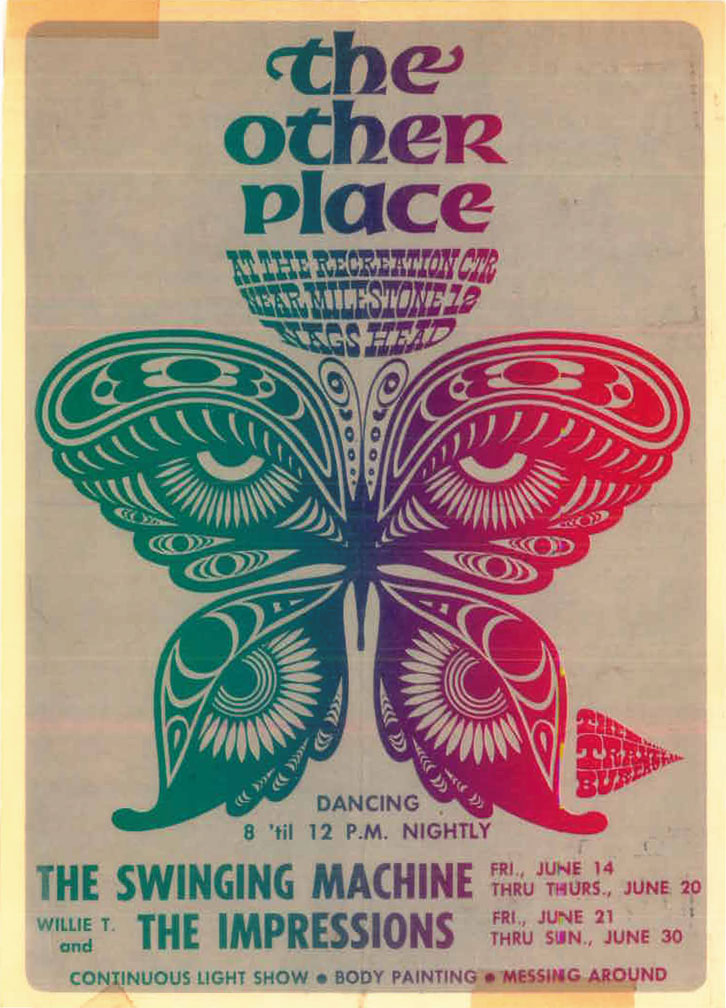
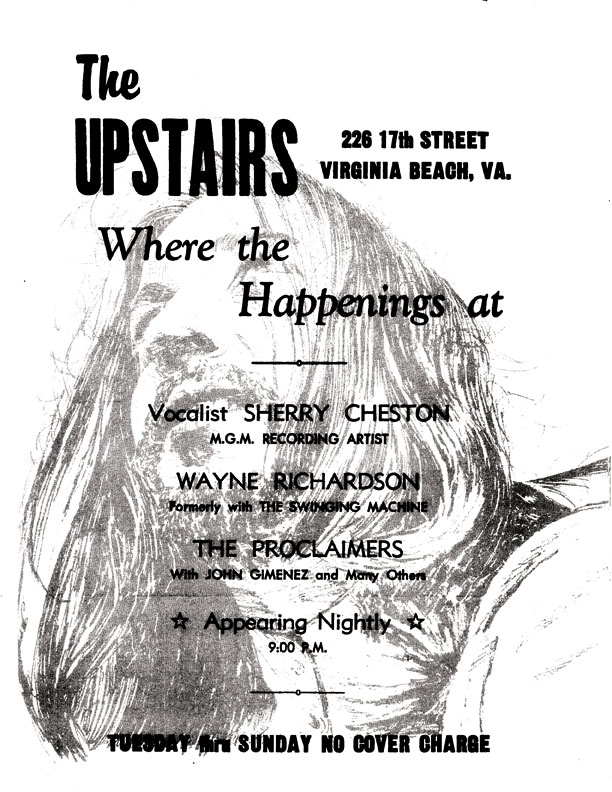
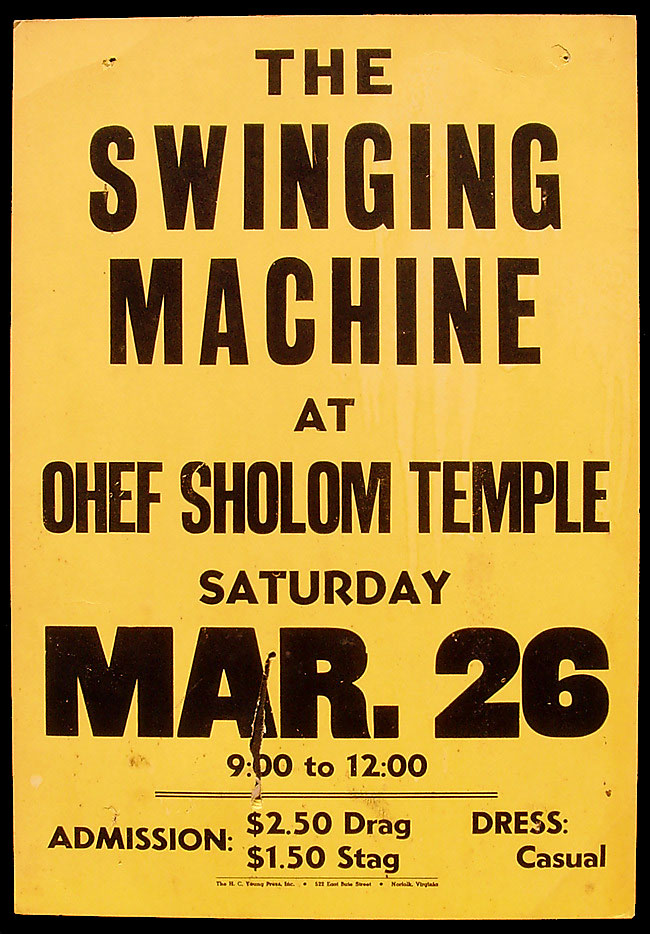
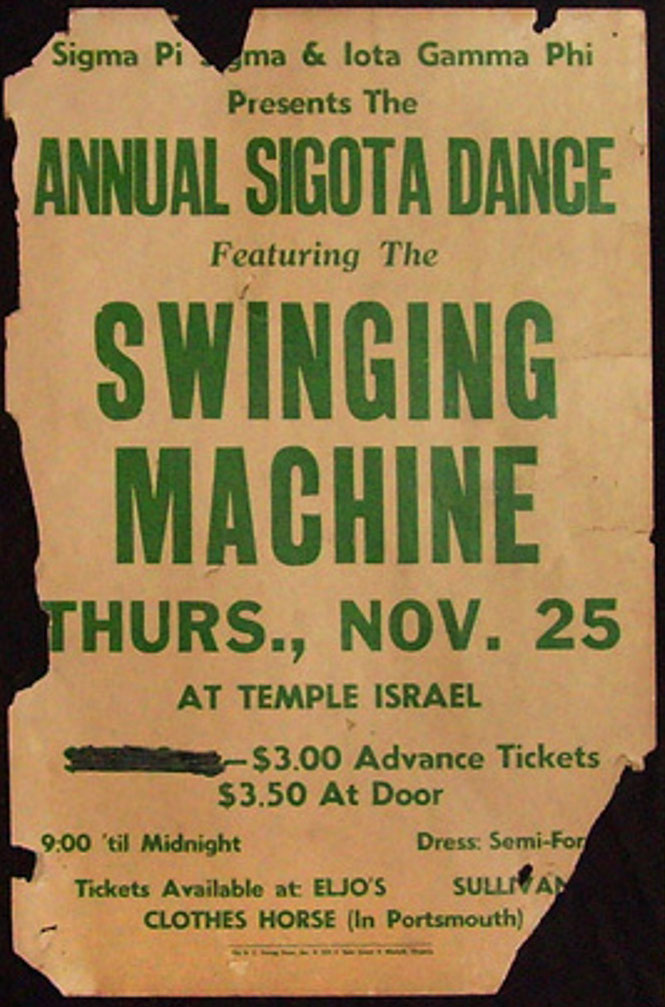
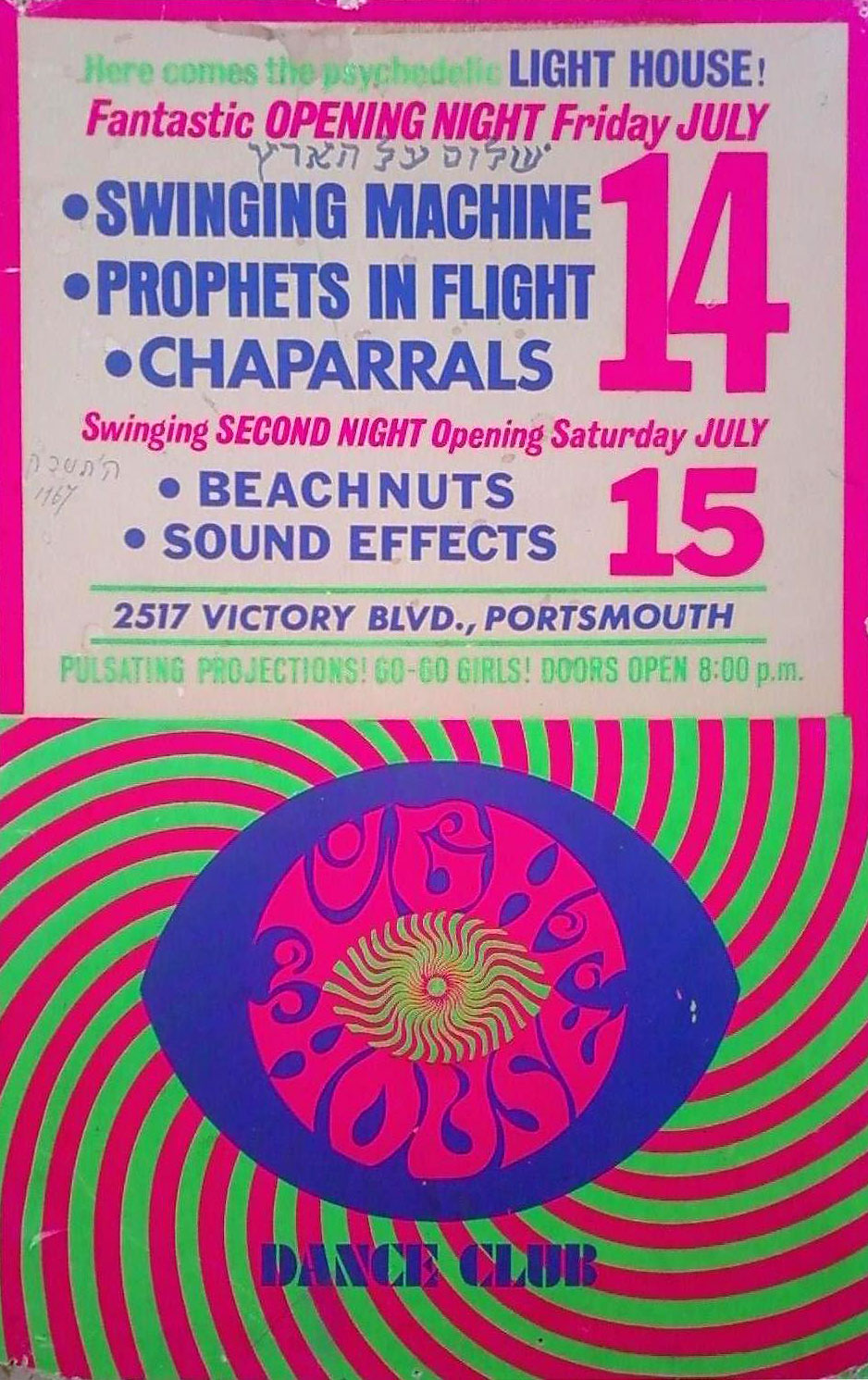
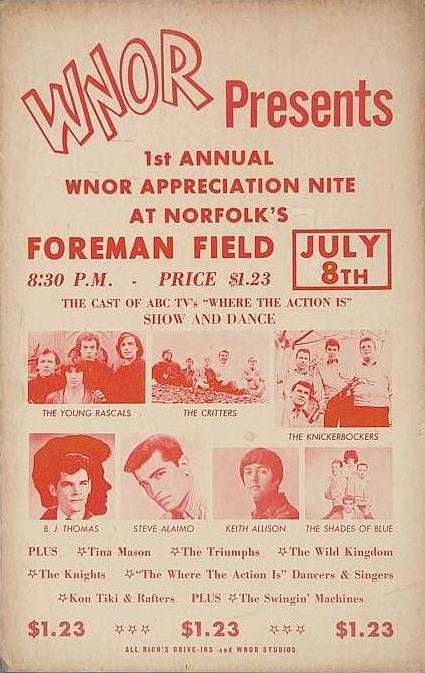
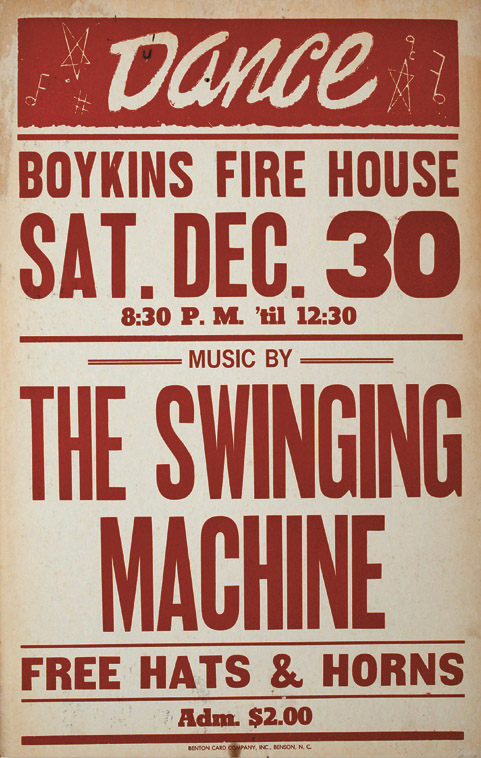
Setting up at the LighthouseInterior of the LighthouseBobby Fisher and Vince ScreeneyLee Caraway and Wayne RichardsonLee CarawayLee Caraway and Gary RichardsonBobby Fisher on rightDickie BocockBilly Stallings at the LighthouseLee Caraway at the LighthouseGary and Wayne at Nags Head – July ’68Bob Spain and Lee Caraway – July ’68The Swinging Machine and Willie T. & the Impressions at The Other PlaceWayne Richardson, Sherry Cheston and the Proclaimers at the Upstairs, Virginia BeachThe Swinging Machine at Ohef Sholom TempleThe Swinging Machine at Sigota Dance, Temple IsraelOpening weekend at the Light House, July 1967! Other groups include the Prophets in Flight, the Chaparrals, Beachnuts and Sound Effects.The “Swingin’ Machines” opening a WNOR show for acts from Where the Action Is at Norfolk’s Foreman Field along with lesser known groups like the Wild Kingdom, the Triumphs, the Knights and Kon Tiki and the Rafters.At Boykins Fire House, December 30, 1967
All photos and poster scans courtesy of Diane except the Boykins Fire House poster (sent by Jay Jenkins of SouthernSoul.com), and the Ohef Sholom, Sigota Dance and Light House opening posters, which were sent in by Kelly Miltier. The Ohef Sholom, Sigota Dance and Foreman Field posters are from the collection of Billy ‘Hurricane’ Harrell.
Evan Pierce, Jr. has written a substantial history of the band that I recommend – look for Swinging Machine on Facebook.
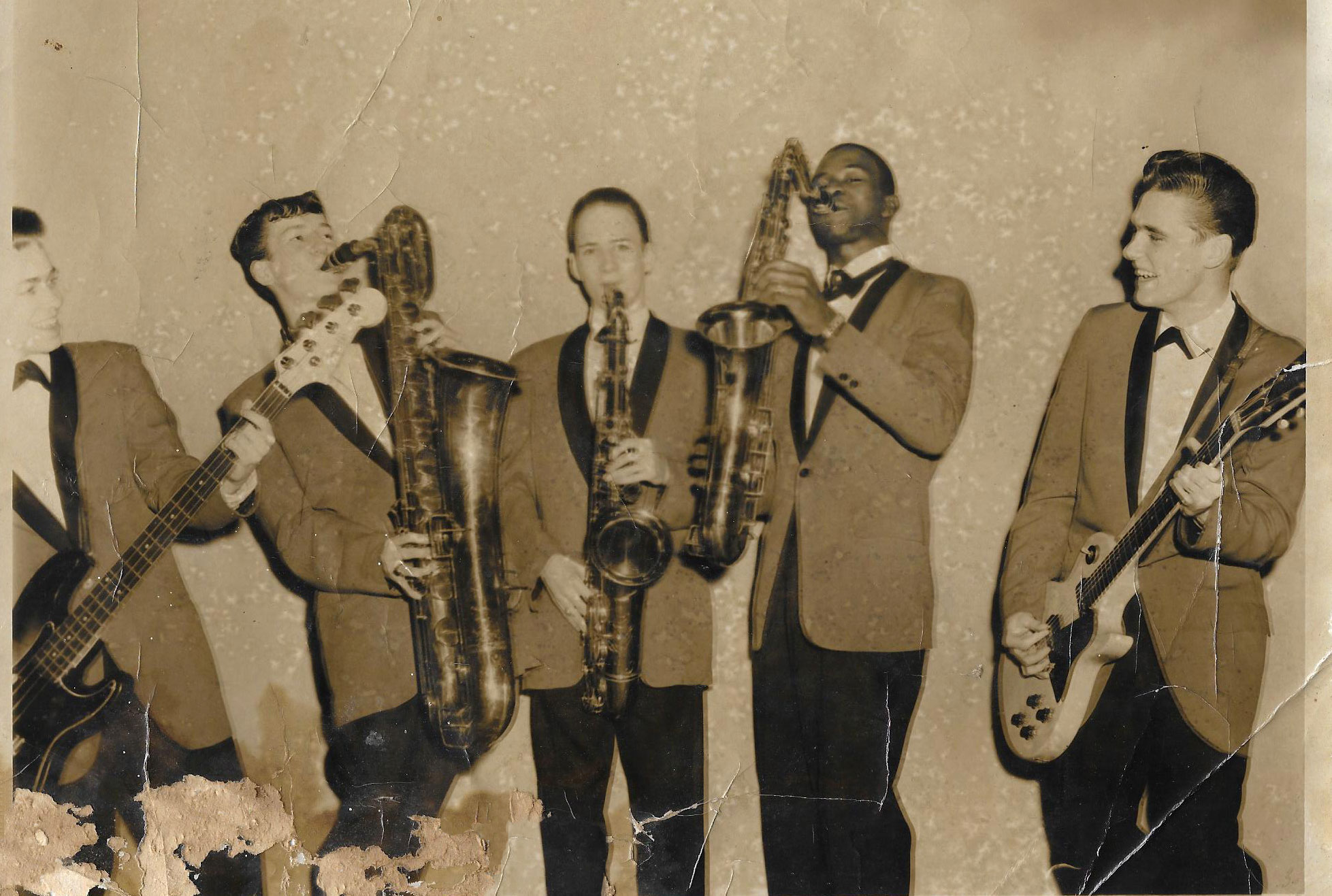
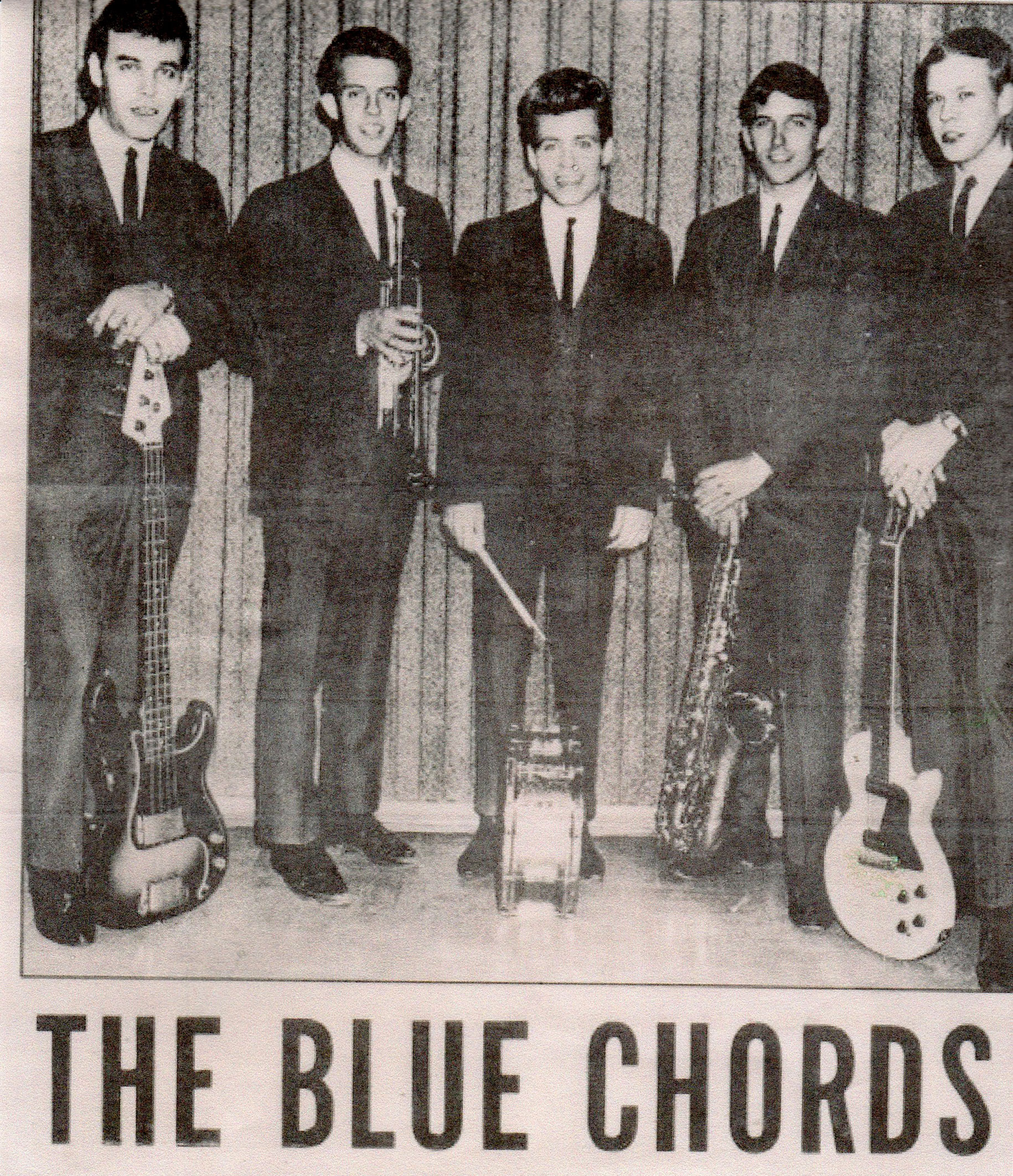
The Blue Chords circa 1960-61 at a TV studio in Bluefield, W. VA. From left; Steve Epperly (drums), David Epperly (keyboard /tenor sax), John Laughter (tenor & bari sax), Bluefield College student Alfred Thompson (tenor sax) and Roger Bailey (guitar). John Laughter writes, “Arnold Smith played bass but was unable to make it in time for the photo. He presently performs with The Emeralds.”
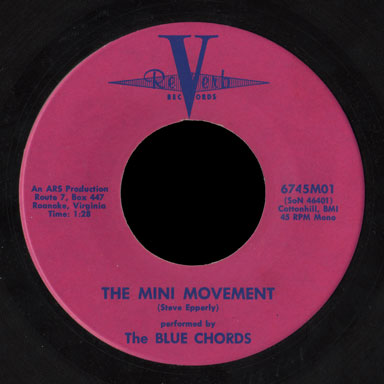
The Blue Chords released only one record, “So Far Away”, a very well-played and recorded ballad b/w this cool bit of soul-garage with horns “The Mini Movement. The Reverb Records label of Roanoke released the single as 6745M01, with no writer credit on “So Far Away”.
Steve Epperly wrote “The Mini Movement”, which runs all of 1:28! Since first posting about the band, Steve Epperly wrote to me:
The Blue Chords were from the Bluefield, VA area, and played from 1958 to 1978.
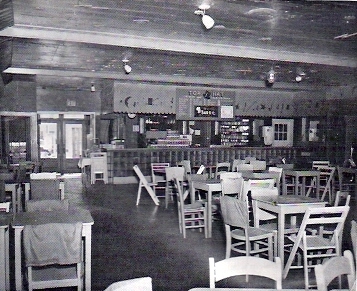
The Blue Chords were especially known in the Virginia Beach-Norfolk area where they played in The Top Hat and other club venues from 1959-1962. The Blue Chords opened for many nationally known artists including but not limited to The Del Vikings, The Gladiolas (later known as Maurice Williams and the Zodiacs), Jerry Lee Lewis, Fats Domino, Ricky Nelson, Art Neville, The Delfonics, Percy Sledge, Bill Deal and the Rhondells, and The Okaysions.
The Blue Chords recorded “So Far Away” and “The Mini Movement” in May, 1967 in the basement recording studio of James E. Parcell who owned Associated Recording Service in Roanoke, VA. The musicians were Arnold Smith who played bass and provided lead vocal on “So Far Away”; Larry Frost and Ron Sagady on horns: Jack McCormick – guitarist; David Epperly – organist, vibes, and saxophone; and Steve Epperly – drums and lead vocalist on “The Mini Movement”. The Blue Chords made other recordings in that studio, but “So Far Away” and “The Mini Movement” were the only ones ever pressed.
The Blue Chords, left to right; Steve Epperly (drums but holding a bass), John Laughter (bari sax), David Epperly (tenor sax), Alford Thompson (tenor sax), Roger Bailey (guitar). Missing from photo, the late Arnold Smith (electric bass)
John Laughter sent in the great photos of the band seen here. His comment about Blue Chords around 1960 is worth repeating here in the main article:
I was fortunate to have played sax with the “Fabulous Blue Chords” for about two years before moving to Florida. I recall 1959-1960 or maybe it was 1960-1961. We played in various dance halls and frat houses in and around the Bluefield, West Virginia and Virginia area.
But the real good times were spent during the summer months at Virginia Beach in the Top Hat Club. The club had two stages and two bands six nights a week so when we kicked into our break song the other band picked it up to keep the music going. On an hour, off an hour.
The door next to our stage opened onto the boardwalk where a lot of the underage college kids would stand or dance. When the club was packed some of the patrons would dance on the table tops after consuming the 3.2 beer. And those summer night were HOT! We would sweat and play the new hits of the day.
I remember a drummer with one of the guest bands, “T & T” Braggs. What he could do with only a bass, snare, hi-hat and ride cymbal was fantastic! Another band was from Philly. They also brought down the house.
We would visit the local music store on Saturday and pick up the latest 45 rpm’s to learn on Sunday. Then to the Neptune restaurant at the corner for First Street and Atlantic Blvd. for a seafood dinner in the 56 two tone green Ford station wagon with the band’s name on the side.
One of the apartments that we lived in was on the south end of town next to an all night doughnut/coffee house. I would go down and listen to the jukebox until the hours of the morning. And as with several of the other members, we are still rockin’ to this day!
Update 2015: James Shott of the Sinsations writes that Arnold Smith and David Epperly have passed away.
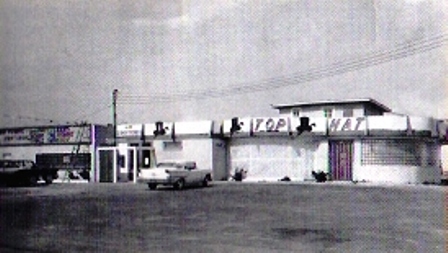
The Top Hat Nightclub, Virginia BeachTop Hat interior
Top Hat photos taken from the Bill Deal website, now defunct.
The Blue Chords, from left: Arnold Smith, Smokey Shott (?), Steve Epperly, Larry Frost and Jack McCormick
Update, January 2026 with three more photos:
My name is Jack McCormick and I go back a ways with the Blue Chords Band. I was the guitar player with the Blue Chords on the Reverb recording we made in a basement recording studio in Roanoke Va. on May 2, 1967. A-side “So Far Away” featuring ARNOLD SMITH vocal AND B-side, “Mini Movement” featuring STEVE EPPERLY vocal. The musicians on this recording are as follows: RON SAGADY (the best I ever knew) tenor sax, LARRY FROST tenor sax, STEVE EPPERLY drums, ARNOLD SMITH (deceased) world class singer and bass player, DAVID EPPERLY (deceased) world class musician vibes/Hammond B3 organ player and respectively JACK MCCORMICK guitar.
Our original mode of travel was a 1952 Caddy hearse. We later expanded and acquired a old Greyhound bus that was customized for band travel.
David Epperly left the “Blue Chords Band” to join a world famous circus in 1967. The band was reorganized/reformed. The musicians were as follows: Arnold Smith lead vocalist / bass, Steve Epperly vocalist / drums (super syncopated “fatback” style), Ron Sagady and Larry “Frosty” Frost on tenor sax, and Jack McCormick guitar. We regularly played several clubs in Roanoke VA, as well as Charleston WV and others in WV, Va, NC AND SC.
I am pleased to say I have played with Arnold since 1965 until his death in 2013 and Ron Sagady thru 2015. Over the years, Arnold and I worked with several bands, namely “WOODEN HORSE”.,”LEGACY” AND “THE EMERALDS” until 2013 (Arnold’s passing). In addition to the above mentioned Blue Chord members, I would like to name John Laughter Sax, Petie Belcher, electric piano, Roger Bailey guitar, Lonnie Woodall guitar, Jim Marino sax, Smokey Shott trumpet, all great musicians that I know, knew and made music with them all.
Jack McCormick
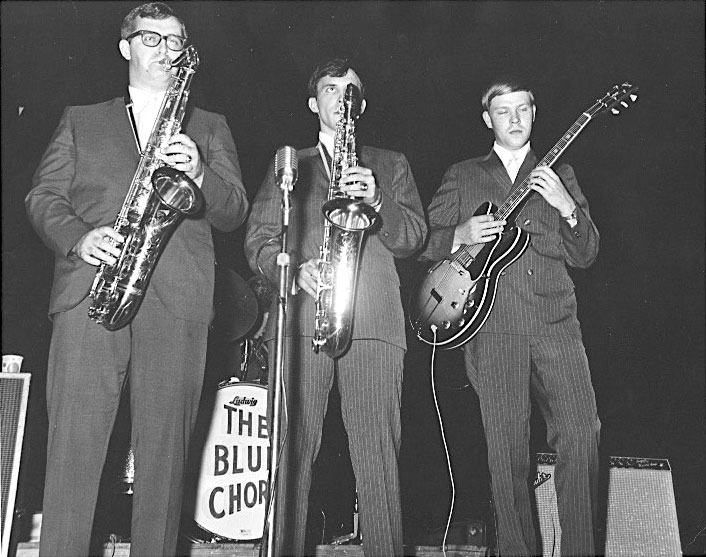
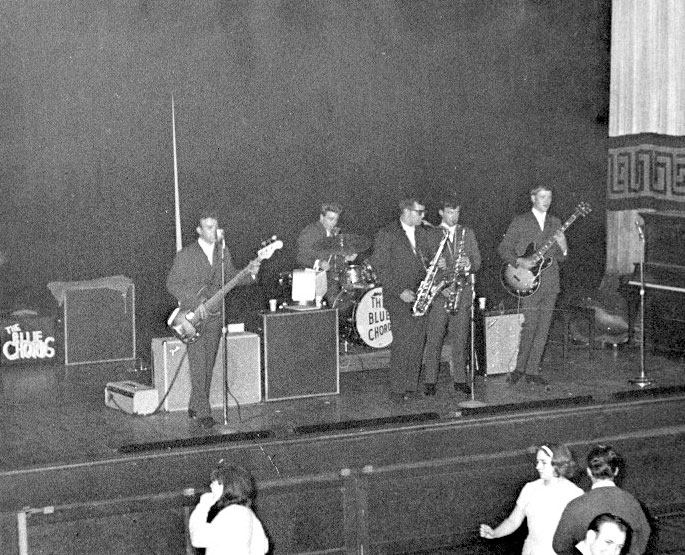
The Blue Chords on stage, from left: Ron Sagady, Larry Frost and Jack McCormickThe Blue Chords on stage, from left: Arnold Smith, Steve Epperly (drums), Ron Sagady, Larry Frost and Jack McCormick
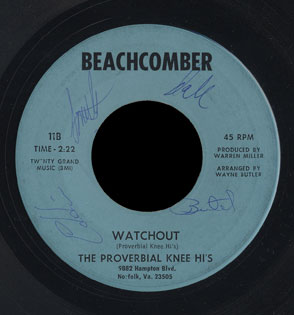
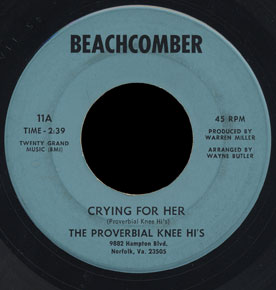
The Proverbial Knee Hi’s were Charles Smith guitar, Dale Pate electric piano and organ, Butch Powell bass and Eddie Hall drums. They had a vocalist, Willie T., who was out of the band by the time they recorded their only 45.
They group started in 1966, and played the chain of Beachcomber clubs along the east coast which were owned by their manager, Buddy Eisen. They even had a fan club based in New Jersey.
The band went into D’Arcy Sound Studios in Norfolk and recorded two original songs, released on Eisen’s Beachcomber label in the fall of 1967.
“Watchout” is a great upbeat number with some garbled singing. There’s a neat instrumental break before a short recited verse. Eddie Hall really pounds the drums, and I like how Dale Pate moves between Wurlitzer and electric piano.
“Crying For Her” is an epic ballad, really dramatic, but I dig both the intro and the closing moments of the song.
The 45 was produced by Warren Miller and arranged by Wayne Butler. D’Arcy Studio also was where The Regents featuring Mel Gaines recorded their great 45 on M.A.D. “What’cha Gonna Do” / “I Tried With Her”.
This site is a work in progress on 1960s garage rock bands. All entries can be updated, corrected and expanded. If you have information on a band featured here, please let me know and I will update the site and credit you accordingly.
I am dedicated to making this site a center for research about '60s music scenes. Please consider donating archival materials such as photos, records, news clippings, scrapbooks or other material from the '60s. Please contact me at rchrisbishop@gmail.com if you can loan or donate original materials

 For the 500th story I’ve done on US artists and labels since starting this site, I’m featuring a couple records that are very obscure and rarely heard, but both excellent examples of the sound of bands in the Tidewater region in the mid-60s.
 “I Need Her”, the vocal side of their second 45 might be their best track. The soulful singing is strong and the horns work perfectly with the driving rhythm section. “Calhoon-a”, the instrumental side, featured piano with bursts of horns (sorry about the warbled sound on this transfer). “Cahoon-A” was written by Tommy Parker, while “I Need Her” was by Tommy Pitman. Both sides produced by F.W. Singleton and published by Florentine Music, BMI. Released on Vermillion 107, the RCA custom press number S4KM-8478/9 indicates that this was pressed in the first half of 1965.
We certainly weren’t any slouches and recorded twice at a studio in Accokeek, MD. It’s hard to read on the Vermillion label but if you look closely you’ll see that they were recorded by Ray Vernon Productions. His real name was Vernon Ray and he was the brother of Link Wray. Yes, he spelled it differently and I guess he had his reasons. He joked with us that he called his little basement studio “Ray’s Three Track Chicken Shack”. We got to meet Link Wray at our final recording session and I can tell you it was a real charge for me to meet the rockabilly legend.
 The Regents Featuring Mel Gaines was a popular soul band established in Portsmouth, Virginia around 1968. The first memory I have of the group is my audition for the band as a drummer in the spring of 1967.Rusty Gibbs, an old high school buddy of mine, told me the group was auditioning drummers at Jeff Paul’s house in the Churchland area of Portsmouth. Jeff played bass with the group and actually liked how I played, and to my surprise the group asked me to join them. I was a junior at Cradock High School in 1967 and was trying to determine if I should continue to play sports or follow my heart’s desire and become a drummer in a dance band.
 I had taught myself how to play drums by watching all of the local bands. I especially studied and copied Fat Ammon of Bill Deal and the Rhondels and also The Swinging Machine’s Dickie Bocock. I loved their styles and really became accustomed to the beat and timing they both had. This was when dancing at teen clubs, dances halls, high school dances such as the Ambassadors Club (or AB Club as we called to it) and The Lighthouse in Portsmouth were both at their all time high.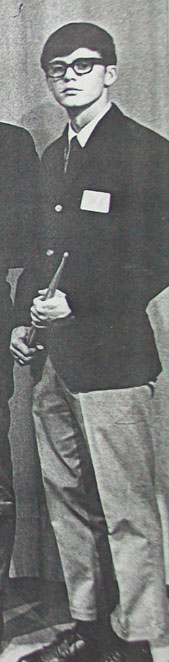
 Special thanks to Johnny Johnston for his help with this page, to Jimmy Finnegan for the clipping about the record release, and to Jeff Paul for the video link.