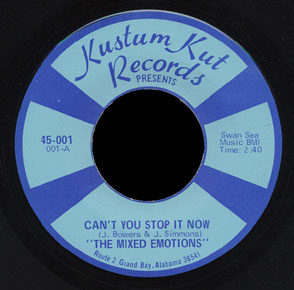
The Mixed Emotions were from the town of Coden, on the Gulf in Alabama. Members were:
Ronnie Ghetti – lead vocals Jerry Simmons – lead guitar Wendell Herrington – keyboards Tim Hayes – bass Rodney Linder – drums
The highlight is the great “Can’t You Stop It Now”, featuring a bass player who hits all the right notes, a singer who’s halfway between being hurt and not caring a bit (I like how he tosses off the line “I need a little peace!”), and a guitarist with an ill-sounding fuzz tone. “Go Jerry, do it,” says the singer right before the solo.
The flip is a mellow, bluesy original, “I’ll Fade Away”. This was released in the summer of ’68 on the Kustom Kut label out of nearby Grand Bay, and as it turns out, was recorded at Sun Studios in Memphis.
Jerry Simmons wrote both songs with the bands manager, James Bowers.
Jerry Simmons wrote to me about the group:
Making the record was my idea. We met a fellow that had connections with Sun Records in Memphis so naturally I wanted to go there and record some original material.
The bass player, Timmy Hayes and the drummer Rodney Linder and I played together in a couple of more bands in the 60s. I also cut a record in about 1973. As of late I wrote and produced a Christmas album for singer Malcolm Slater.
Our lead singer, Ronnie Ghetti moved to Georgia shortly after we made our record. Our keyboard player, Wendell Herrington didn’t play much anymore.
String & the Beans have this one fine record from 1966. The reverb-laden ballad “Come Back To Me” reaches its peak with the guitar solo that takes the song out. On the flip is the upbeat “When I Get That Feeling”.
Both songs were written by Craig Fulford and Robert Robinson (a mistake – it should have been Robert Robertson) according to the label credits.
For some time there was confusion as to whether the band was from Alabama, or Georgia (the base for Lyresong publishing) or even Minnesota, as this 45 was pressed at Minneapolis’ Kaybank studios (indicated by the number 6-6130, a type of indexing which was used on other 45s recorded there, notably records released on Kaybank’s Studio City label).
Since writing this post, I heard from the band’s drummer, Louis Gigis. Louis wrote this history of the group:
I was the drummer for String and the Beans aka The Showmen from Birmingham.
In 1962 there were seven members of The Showmen Band. Louis Gigis drummer, Craig Fulford lead guitar, Sam McDavid rhythm guitar, Chuck Butterworth bass, Kent Donovan keyboards, Bill Burns lead vocals and Robby Robertson back up vocals. I went to Woodlawn High School in Birmingham and everybody else went to Shades Valley except Bill Burns, he went to Ramsey. We all had other groups that we were playing in and would go around town to hear other bands play when we weren’t playing. That is how we got to know each other and pieced together the band and called it The Showmen because we each each put on pretty good shows in our other bands.
We were an instant hit among the high schools in Alabama. In 1962 we were making $100 each for a night of playing, that was like $1,000 now. We were so popular that when we played at Sidney Lanier High School in Montgomery, Alabama we couln’t get off the stage withour being mobbed. We must haved played Louie Louie by the Kingsmen twenty times. We also played at high schools, sock hops and the college circuit, where the kids said we looked like a new band from England called The Beatles. Well, we had the same hair cuts before we even knew who the Beatles were.
After a while we had a few changes in the band, Bill Burns left for the Navy and Robby Robertson took over as lead singer and Craig and Sam did harmony. There was a time when we called ourselves The Showmen + 6, we had six singers out front doing shows like James Brown, The Temps and Tops and others but we were really getting the cost up, so we went back to Robby alone.
We all wrote songs and decided on two songs that we liked the most to try and record. Those were “Come Back to Me” and “When I Get That Feeling” on the flip side. We had heard of a recording studio in Atlanta named Master Sound Recording which later was changed to Lowery Studios owned by Bill Lowery (now departed). We could record our music there for $35 per hour with Bill Lowery being the producer. When we got in the studio to record the songs our keyboard man Kent didn’t show, he was sick. Instead of cancelling the session Bill Lowery called a piano player, she was about as old as our grandmothers but she could play a hell of a piano. She didn’t have to rehearse the songs but once. and we recorded the songs in about three takes including some dubbing.
Our name came about when we recorded the record and there was already a band called the Showmen. In the studio that day was Billy Joe Royal and Joe South, they came up with the name because Robby Robertson was really tall and skinny. We came up with the name Fat City Records from when we played in Fat City which the real name is Metarie, outside of New Orleans.
Our record came out at the same time “Double Shot” by the Swinging Medallions came out and outsold them in Alabama by 2 to 1, but we didn’t get picked up by a major label because we had beat up on local DJ Dave Roddy after we didn’t get paid for a gig that we played in that included the Medallions, Chambrays and Markees [Marquees]. That was a mistake, he was a pretty big man on the radio circuit.
Bill Lowery liked our band so much that he wanted to sign us to a contract and give us free studio time. Bill had already made hits of The Tams, Joe South, Billy Joe Royal and a few others. So we went back to Atlanta and recorded some more original stuff. All the songs were sent back to us in Birmingham on reel to reel and had horns, strings and back up singers dubbed in, man what a sound, we were on our way.
One day I was laying out by the pool at some apartments and heard one of our songs on the radio but it wasn’t us playing it. I called Craig and told him about it and he called Lowery. Bill said that he let a new singer named Ronnie Prophet record it since he was under a previous contract. Lowery said he owned our music and could do that.
We didn’t like that too much so we cancelled our contract and signed with Hit Attractions from Charlotte N.C. Most of our jobs were being the back up band for The Tams. We did that for a year and got bored with each other and decided to go our separate ways. We still lliked each other and still do, but we were growing up and had wives and kids; I was 21.
I kept playing for about six more years and played with acts like Steve Alaimo in Tampa, Billy Joe Royal, Steve Purdy, The Premiers.
Louis Gigis
Robbie Robertson added:
I was co author of “Come Back to Me” with Craig Fulford. The misspelled record label was not redone and corrected because typically teenage thinking was to hurry up and get this out! The label name of Fat City was chosen because we were booking through Ted Hall at Hit Attractions out of Charlotte, NC. Charlotte was called the Fat City at the time.
I have the original master tape and have actually thought about recutting the lead vocal to change a few lyrics. I was lead singer of the group and find that an interesting idea.
I sang lead on our later cut, “Talk Don’t Bother Me” which Craig and I also wrote.
The Shadows, from left: Frank Cannon, Curtis Goodman, Donnie Walker, Stanley Fowler, Jack Bigham and Roger YoungPhotos from Facebook
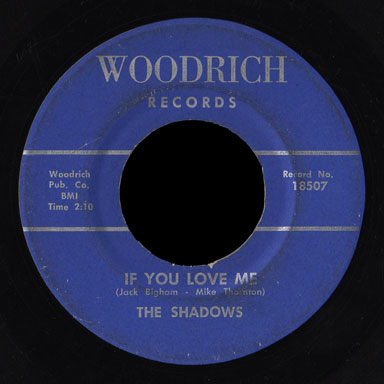
Here’s a great 45 by the Shadows, a group from Northport, Alabama, across the Black Warrior River from Tuscaloosa.
I recently spoke to guitarist and lead singer Mike Thornton, who helped me straighten out the history of the band. He was only 14 when he joined and the other members were just a little older, mostly students at Tuscaloosa County High School. I believe he replaced their original singer Curtis Goodman.
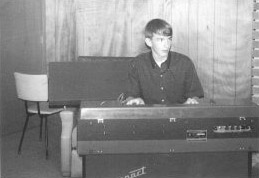
Along with Mike, Frank Cannon and Jack Bigham played guitars, Stan Fowler played bass and Donnie Walker the drums. Roger Young played keyboards, but he wasn’t present at the recording session so Mike Thornton filled in that day.
The band played semi-professionally for about three years, playing on weekends and when school was out. A rival band was the Misfits from Tuscaloosa, featuring Chuck Leavell and Ronnie Brown.
“If You Love Me” is classic garage with a good performance all around, notable for the repeated distorted guitar riffs and a fine solo, excellent drumming, and good vocals. It was written by Jack Bigham and Mike Thornton.
“The Big Mess” is a sharp take on Watermelon Man, credited to the whole group. Mike Thornton moved from organ to piano for this song.
Does anyone have better-quality photos of the group?
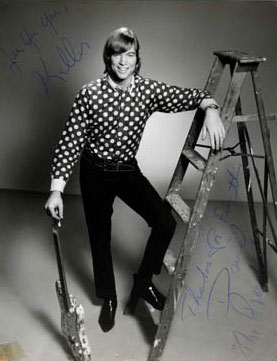
Roger YoungAfter the Shadows, Mike Thornton joined The Omen and Their Luv with Bruce Hopper, Billy McLain, Tommy Stuart, Gary Barry and others. That band had a great 45 on David Keller’s Daisy label, “Maybe Later” / “Need Some Sunshine” (both songs written by Tommy Stewart). David Keller himself was in the Preachers. The Omen and Their Luv with Thornton later became Tommy Stuart and the Rubber Band.
For a long time it was believed the band was from Tennessee or northern Alabama, as the Woodrich label was based in the northern Alabama towns of Rogersville then Lexington, both near Huntsville and Decatur. Mike isn’t sure why the band went so far to record when there were studios nearby in Birmingham, but thinks one of their managers set the deal up.
I had also heard that most of the Woodrich label’s recordings were made in Nashville, about 120 miles away, but K.S. in a comment below, says that owner Woody Richardson did most of the recording in his home studio. Woodrich released mainly pop sides by Buddy Hughey, Patsy Penn, the Campbell Trio, the Light House Gospel Singers, the Rocks, and Aaron & Sue Wilburn.
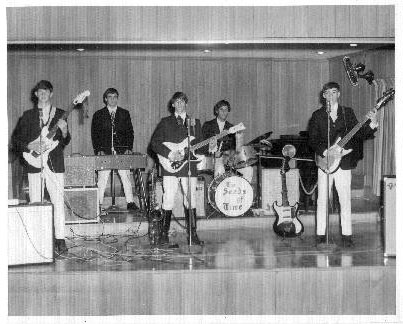
Mike Lewis and Craig Weidenheimer had been playing with a largely instrumental group at their high school in Monroeville, Alabama, a town about halfway between Mobile and Montgomery. Mike was lead guitarist and Craig played bass and sang. When the older members graduated, Mike and Craig brought in friends Lee Howington (keyboards), Jim Harper (rhythm guitar and sax), and Mike McMillon (drums) and started playing Beatles-influenced rock, first as Robin and His hoods and then as the Seeds of Time.
At shows they played alongside the Rubber Band, the K-Otics, the Phaetons and the Rockin’ Gibralters. Although they gigged regularly, without a manager or and ties to promoters, the band never had a footing in radio or large club bookings. In an interview with Mike Dugo, Craig Weidenheimer spoke about live shows: “We played fraternity parties, bars (even though we were under age), and school dances but mostly we went from town to town with our record and paid the local DJ’s to play our record. To get them to do it sometimes we would go in and play live to help promote the record. It was something to get on the radio and then everyone wanted to hear live bands. So we would rent an Armory or VFW hall and put up posters that we were coming to town (like the circus) and sometimes we could get large crowds. There was not much else to do. We were referred to as The Seeds by most people, so when the band called The Seeds came out with ‘Pushin’ Too Hard’ there was some confusion. We actually played the song, so as not to disappoint.”
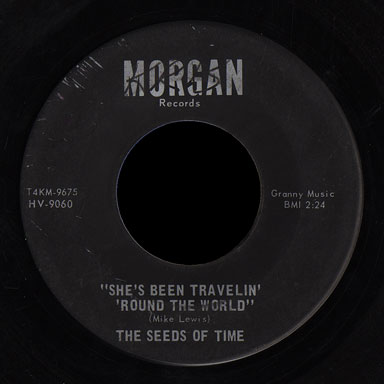
In 1966 they went into a studio in Montgomery usually used for recording jingles. The band cut two original songs by Mike Lewis, recording live with two vocal mics and doing about three takes for each song. The sound is primitive but each instrument can be heard, if distantly and with some distortion on the vocals. “She’s Been Travelin’ ‘Round the World” is the standout due to Mike McMillon’s quick drum beats, thumping bass playing from Craig, Mike Lewis frantically bending the guitar strings into odd note combinations, and a queasy organ sound. Shouting the lyrics in unison, the vocals drive the needles into the red and make it hard to decipher the lyrics.
The flip, “Gina” has a melancholy quality from the organ and the distant vocals that has grown on me. The next year the band recorded a second 45 at a studio in New Orleans that I haven’t heard: “Twelfth’s Night Indication” / “Shadow In My Mind”, two more originals by Mike Lewis. Other demos cut at Fame Studios in Muscle Shoals have been lost. By this time they had added Mike Tatum on trumpet.
With members going to college the Seeds of Time broke up. Craig Weidenheimer and Mike McMillon had a college band called Mfinger with Jere Ellis of the Rubber Band. Mike Lewis stayed in the music business for good. After college he moved to Atlanta and formed Brick Wall, with one 45 on Capitol, “Poor Mary Has Drowned,” then joined the Devil’s Brigade (one 45 on Mainstream) and moved to LA. Dick Dodd asked him to form a band to tour as the Standells opening for the Grassroots. When that ended, the band, without Dodd evolved into Joshua (an LP on AVI). He started subbing for Nicky Hopkins in Quicksilver Messenger Service, joining the band full time in 1972. Later on he produced successful disco records and soundtracks.
Sources include: Photos and info from Mike Dugo’s interview with Craig Weidenheimer, and John Barthel’s interview with Michael Lewis.
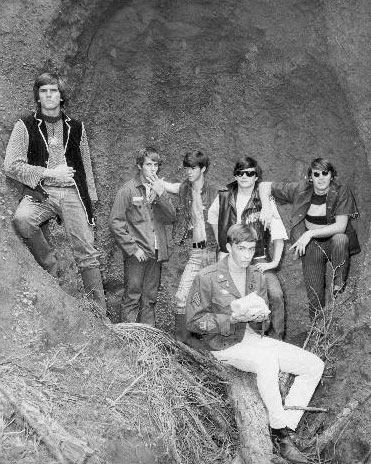
The Wild Vybrashons, from left: Chuck Terpo, Vern Reeves, Harford Capps, Al Lovoy and Mark Papisan
Revised June, 2010
The original Wild Vybrashons were Charles Terpo, Vernon Reeves, Hartford Capps and Mark Papisan, along with a female singer who was replaced by Al Lovoy, who had been in two prior bands, the Swingin’ Lamp Liters and the Royal Carousels.
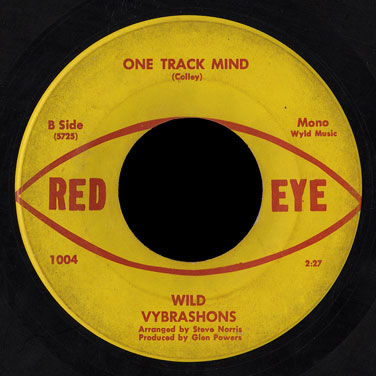
They released one 45, with a version of “A Place in the Sun” as the A-side. I much prefer their update of “One Track Mind”, a song that had been recorded previously by Gary Lewis & the Playboys and the Knickerbockers.
The record was arranged by Steve Norris and produced by Glen Powers, two popular DJs on Birmingham radio station WSGN. Not surprisingly, the record hit that station’s charts, with “A Place in the Sun” reaching #1 on April 24, 1969.
After the single the group shuffled members, adding another former member of the Lamp Liters, Gary Swatzell.
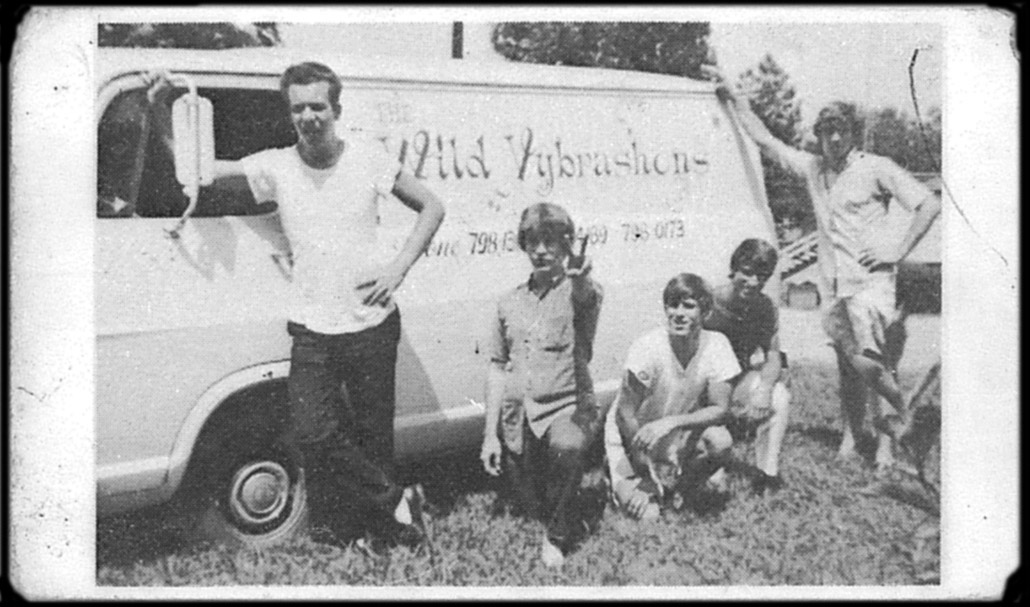
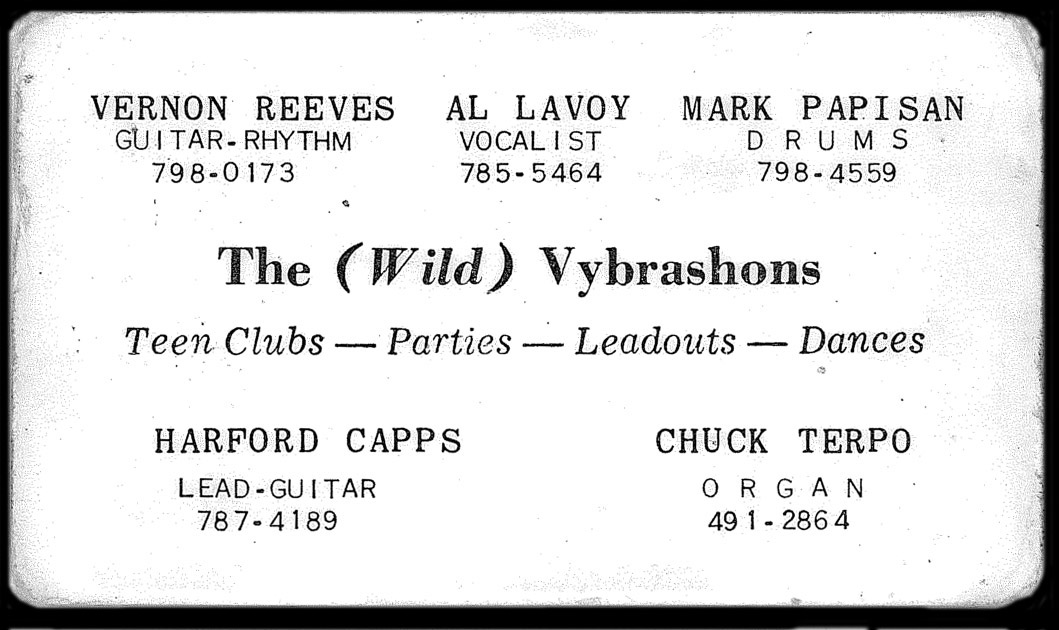
Thanks to Diana Lovoy for sending the scan of the photo and business card and to Al Lovoy for correcting the band lineup in his comment below.
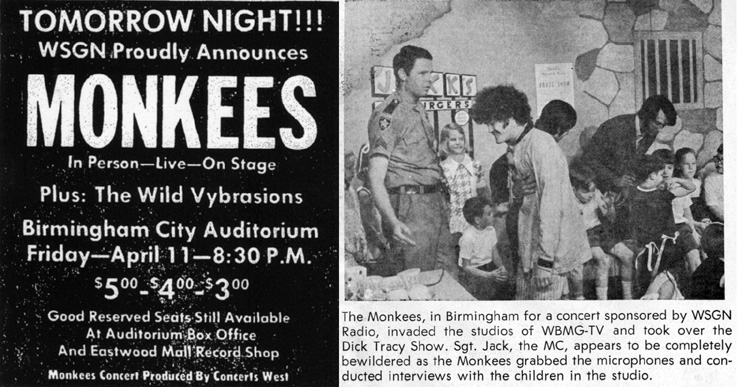
Business card with Al’s name misspelled as Al LavoyCool ad and article on the Monkees coming to Birmingham City Auditorium, with the ‘Wild Vybrasions’ opening. Not surprisingly the band’s name is often spelled differently, like Wyld Vibrations, Wild Vibrashons, Vybrashuns, etc.
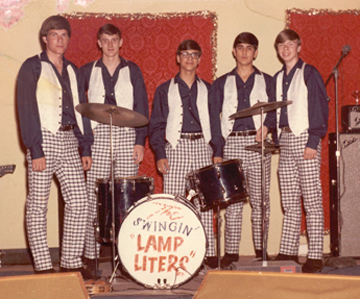
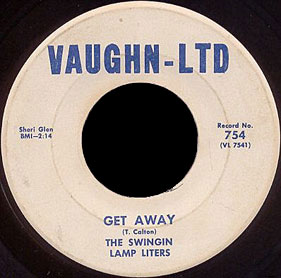
One of the finest records on the Vaughn Ltd. label is the Swingin’ Lamp Liters’ “Get Away”. Members at the time of recording were Al Lovoy on vocals, Tommy Calton guitar, Jesse Warth bass and Gary Swatzell on organ. Charles Carbonie was band leader and drummer.
The record was cut in 1967, featuring Tommy Calton’s original “Get Away” backed with a cover of “Little Latin Lupe Lu”.
Other members of the band at one time or another included Frankie Parrish rhythm guitar, Greg Sheffield bass (actually bass lines on a 6-string guitar!), Steve Burkes on organ and three lead vocalists: Jimmy Whitt, George Tobias and Larry McMeekin.
Charles Carbonie formed the Lamp Liters in January of ’64 and continued playing live shows until early 1969.
After cutting the single, Tommy Calton, Al Lovoy and Gary Swatzell left the band to form the Royal Carousel with Jimmy Whitt on bass and Al Pettinato on drums. The Royal Carousel played current sunny pop songs like the Merry Go Round’s “Live”, but only lasted a few months, when Tommy and Gary returned to the Lamp Liters.
Al Lovoy went into the Wild Vybrashons, who cut a good fuzz version of the Knickerbockers’ “One Track Mind”, produced by two WSGN DJs, Steve Norris and Glen Powers.
Tommy Calton formed bands including the Brass Button, Wooden Music and Hotel, and still plays music professionally. The photo and much of the information here is from his (now-replaced) website www.tommycalton.com.
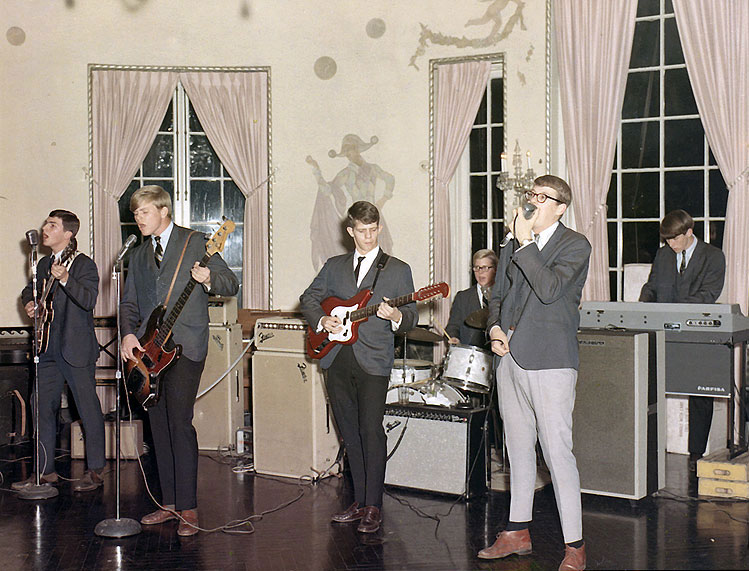
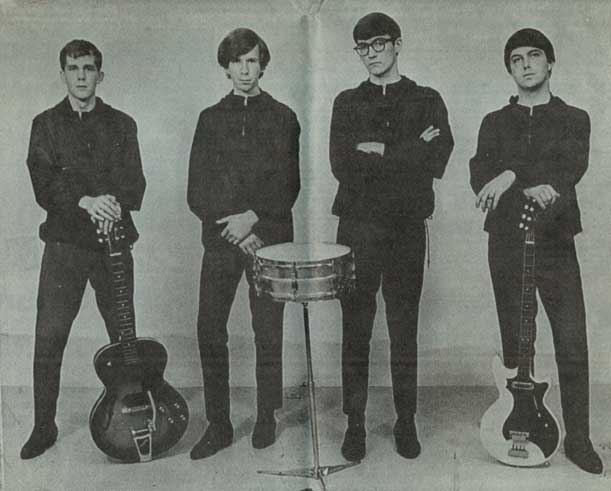
The Church Keys (Bassmen) playing live in Birmingham circa 1965
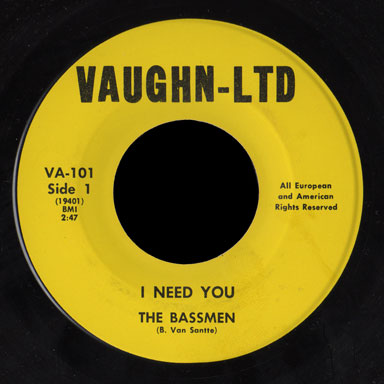
The Bassmen have the very first 45 released on the Vaughn-Ltd label, the excellent original song “I Need You”.
The Bassmen originally formed as the Church Keys in 1962 while in the ninth grade in Birmingham. Original members were Rob Hackney guitar, Chuck Butterworth keyboards, Mike Easter on bass and Tom Allison on drums. Over the next year they added Charlie Feldman as lead singer and Vaughn Rives on rhythm guitar, and Steve Gilmer replaced Butterworth on keyboards.
By 1965 they had changed their name to the Bassmen, and they went into Ed Boutwell’s studio in English Village to record their 45, “I Need You” / “Leigh Anne”, the first release on the Vaughn-Ltd label. Both songs are credited to B. Van Santte, perhaps a fictitious name as it doesn’t match any of the band members.
The single garnered the Bassmen appearances at shows produced by local DJs Papa Don Schroeder and Duke Rumore, and the band toured colleges in the area as well.
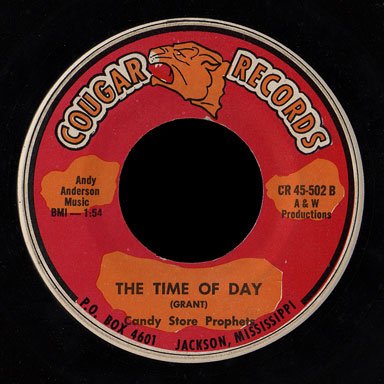
At the start of college in 1966, singer Charlie Feldman, bassist Mike Easter and drummer Tom Allison found new members Jamie Grant and Tommy Johnson. They renamed the band the Candystore Prophets and released one very fine Beatles-esque 45 on Andy Anderson’s Cougar label of Jackson, Mississippi, “The Time of Day” b/w “You’re a Teaser” (both written by Jamie Grant).
Note, this is not the same Candy Store Prophets led by Boyce and Hart who wrote and recorded the backing tracks for all the early songs of the Monkees.
Source: Info for this story and the photo at top are taken from the Bassmen’s site. Check it to see more photos and updates on the band.
From left: Ned Bibb, Bobby Marlin, Zac Zachery and Robert Alexander (thanks to Dale Aston for the correction)
From the Ensley Highlands section of Birmingham, Robert Alexander (bass), Ned Bibb (vocals and guitar), and Bobby Marlin (drums) started playing in high school in 1962, rehearsing in Robert Alexander’s basement.
In 1965-66 they backed Travis Wammack, then took the name The Distortions from his record “Distortion pt. 1”. They added Zack Zackery on keyboards, and recorded their first three 45s on Sea Records. These included an interesting Ned Bibb original, “Can You Tell”, which was backed by a slow, loopy take on “Hound Dog”; and a raging version of Howlin’ Wolf’s “Smokestack Lightning”.
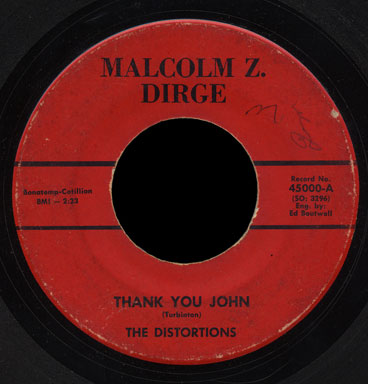
The band added Eddie Rice on guitar in 1966 and switched to the Malcolm Z. Dirge label for their next release, “Thank You John”, which reached the charts on WSGN in town. On the flip they recorded a fine version of the Rascals’ oft-covered “I Ain’t Gonna Eat Out My Heart Anymore”.
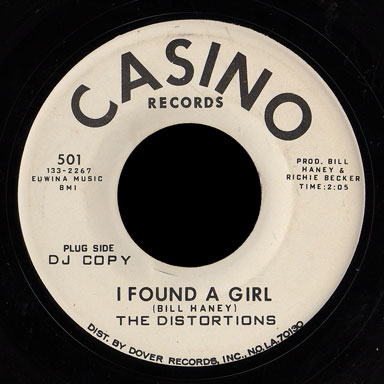
When their next 45, “Behind My Wall” was picked up for national distribution by Smash, they had their biggest hit, selling 10-15,000 copies according to their producer Ed Boutwell. Their penultimate 45 was a good Bill Haney original, “I Found a Girl”, with a version of “I Don’t Really Like You”, originally done by Baton-Rouge’s Canebreak Singers on Montel and written by Mike Crespo. It was produced by Haney and Richie Becker and released on Casino, a subsidiary of the Dover Records company of New Orleans.
In ’67 the Distortions added Roy Alexander on saxophone.
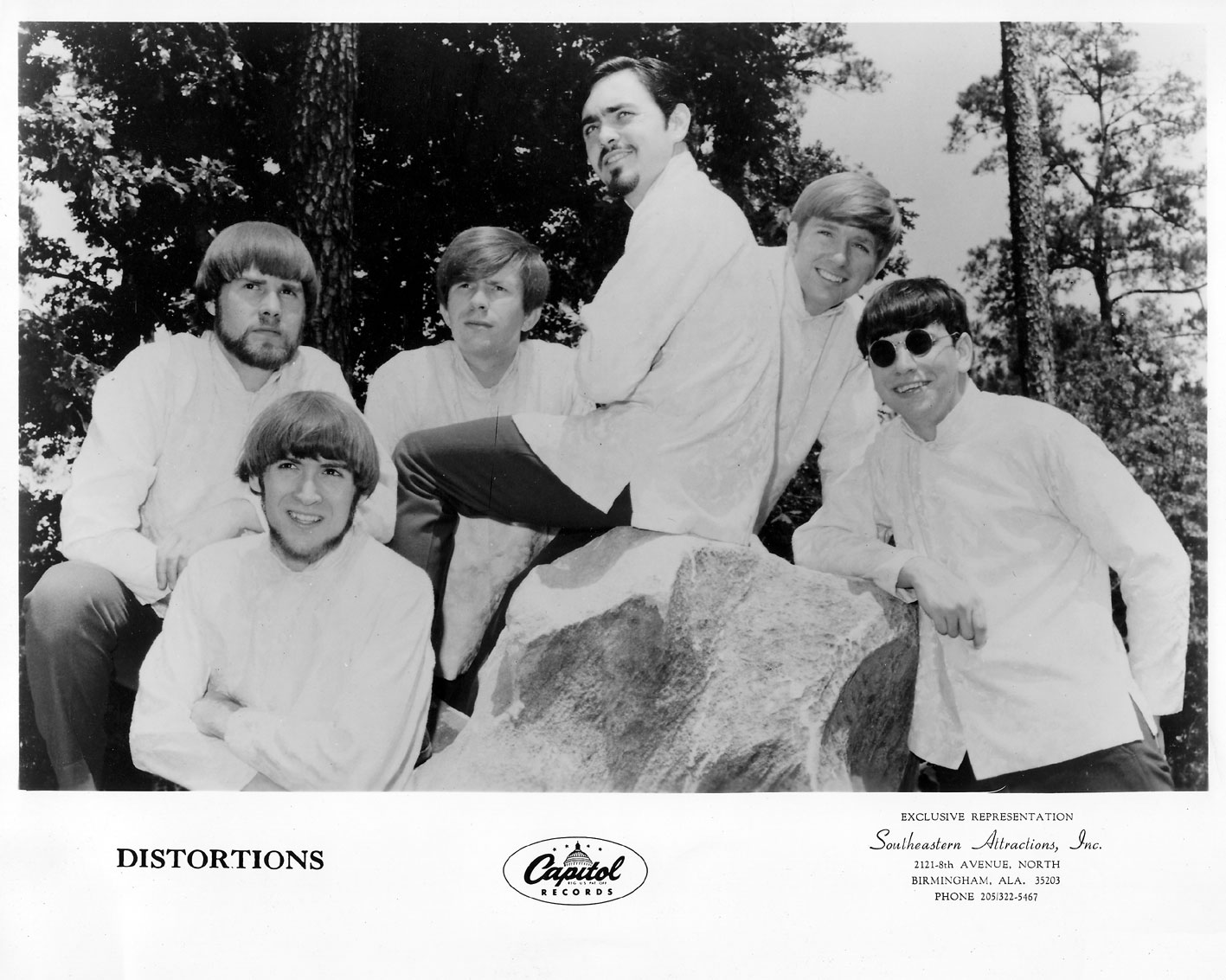
Capitol promo shot, 1968, from left: Roy Alexander, Roy Zachary, Bobby Marlin, Steve Salord, Dale Aston and George Landman
Dale Aston of the Torquays sent in the photo above and writes about his time with the band:
I played guitar with the band. Steve Salord and I had just left The Torquays and joined with The Distortions for a brief period. We recorded “Let’s Spend Some Time Together” at Boutwell Studios in Mountain Brook, AL.
As I recall Ed Boutwell had a hand in getting Capital Records to pick up “Let’s Spend Some Time Together”. The other labels were homegrown and produced by the band for local distribution only.
Their last release was a cleaned-up version of the Stone’s “Let’s Spend the Night Together”, retitled “Let’s Spend Some Time Together”. This was picked up by Capitol but didn’t sell particularly well.
Henry Lavoy took over on drums during the late 1960’s.
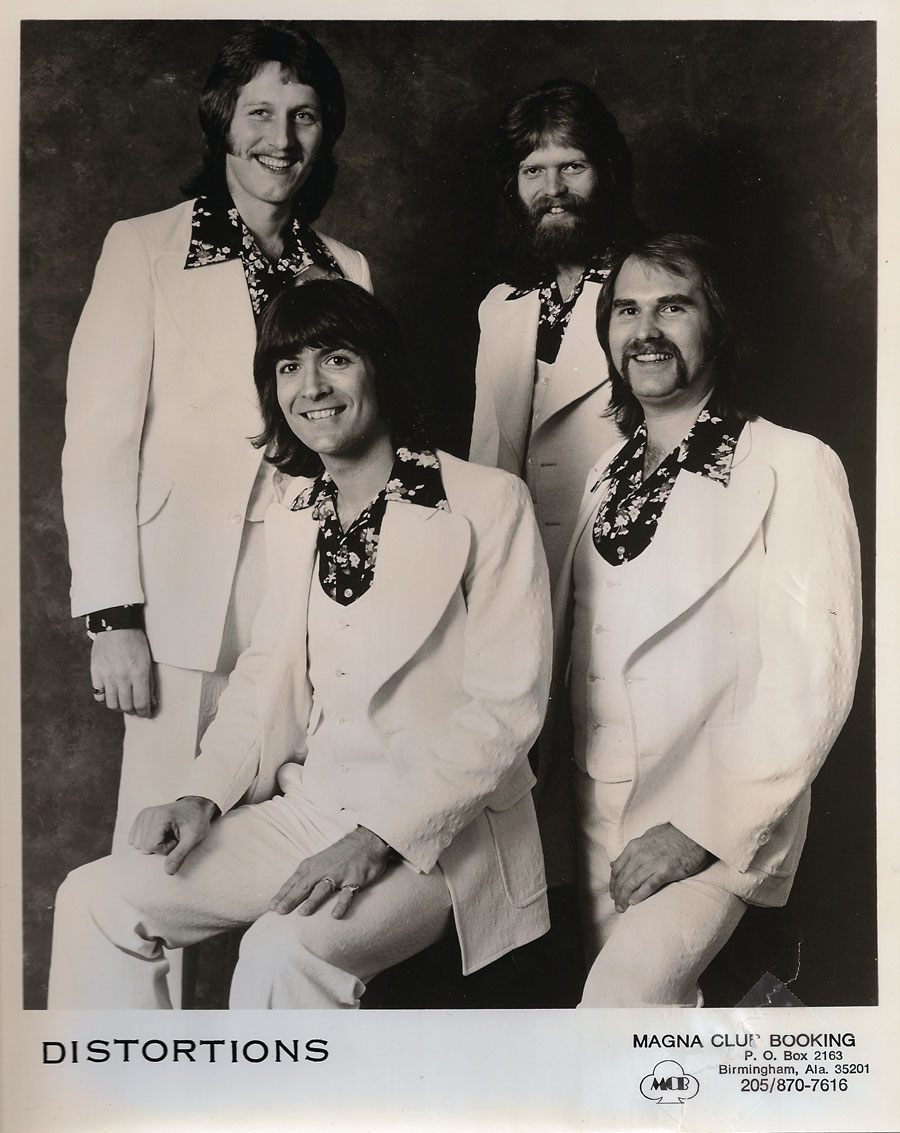
The band split up in 1969, but Zack Zachery and Roy Alexander played college and club shows as the Distortions into the ’70s, with Clif Payne on drums and Ed Finn.
Clif Payne sent in the photo of the group from the 1970’s as well as four unreleased songs from 1975 in a polished, commercial sound the band developed later on, something akin to the Average White Band. See Clif’s comment below for more information about that band at this time.
Roy Alexander and Bobby Marlin are now deceased.
45 releases:
Hound Dog / Can You Tell – Sea 100 Take This Ring / You Know I’m On My Way – Sea 101 Smokestack Lightning / Hot Cha – Sea 102 I Ain’t Gonna Eat Out My Heart Anymore / Thank You John – Malcolm Z. Dirge 45000 Smokestack Lightning / Behind My Wall – Malcolm Z. Dirge 45002 A Love That Loves You / Behind My Wall – Smash S-2068 I Don’t Really Like You / I Found A Girl – Casino 501 Let’s Spend Some Time Together / Gimme Some Lovin’ – Malcolm Z. Dirge 45008 and Capitol 2223
Sources: Reunion of the Sons and Daughters of the Sixties program, May 8th, 1987; Birmingham News. April 30, 1987, Birmingham Weekly, vol. 10.
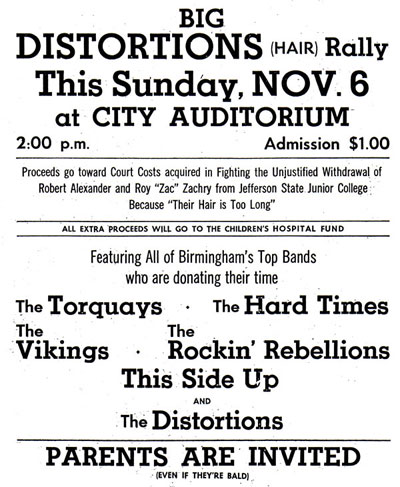
Thank you to Mike Pair for loaning me the Birmingham News article, “Hair” Rally notice and Reunion program.
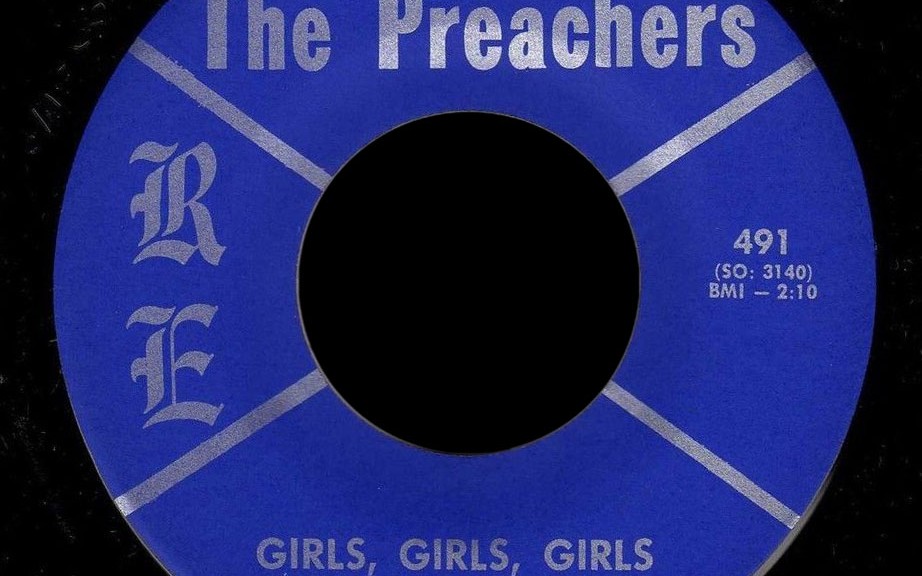
The Preachers were from Tuscaloosa, but other than David Keller, I don’t know who the members were. Keller seems to have been running the show along with producer and co-writer Steve Norris.
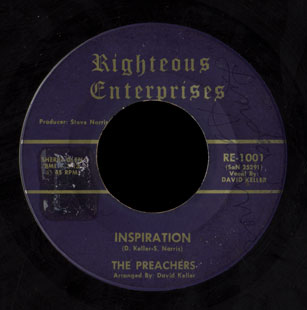
“Inspiration” shows a heavy Dylan influence, but though I’ve listened to it a dozen times in the last two days, I still can’t make out what he’s saying.
It was released twice on the Righteous Enterprises label out of Birmingham. The first release on RE-1001 had “Who’s That Hiding in the Closet” on the B-side, a good horn-driven instrumental.
The second release of “Inspiration” on RE-1003, backed the eerie “Hallowed Ground”, it made it all the way to #7 on WGNE in Panama City, Florida on Sept. 9, ’66, where Keller had a club called the Head Shop.
“Hallowed Ground” was also released twice, once with “What’s Happ’nin Pussy Cat” on the flip, as RE-1002.
There was a long-standing rumor that this label was run by the Righteous Brothers, but this seems to be completely wrong, and I can’t confirm any connection. It seems unlikely – the “Brothers” were from California, not Alabama anyway.
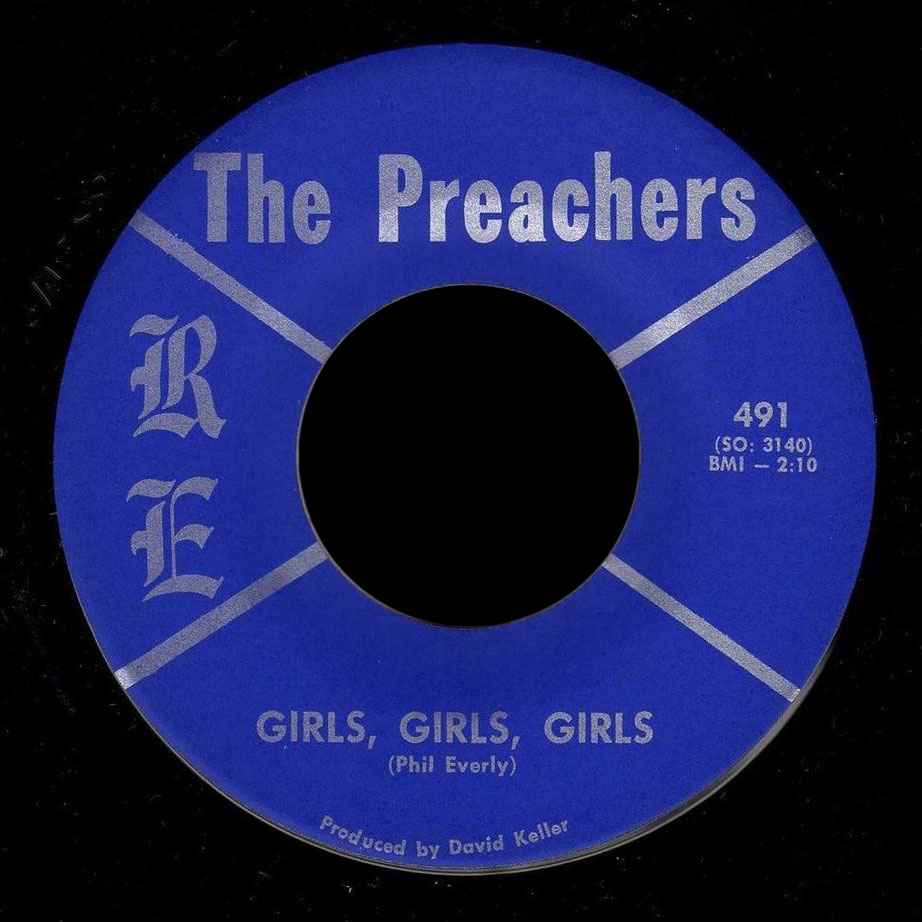
The Preachers had a fourth 45, a cover of the Everly Brothers “Girls, Girls, Girls” b/w “Dedicated”, from April 1966.
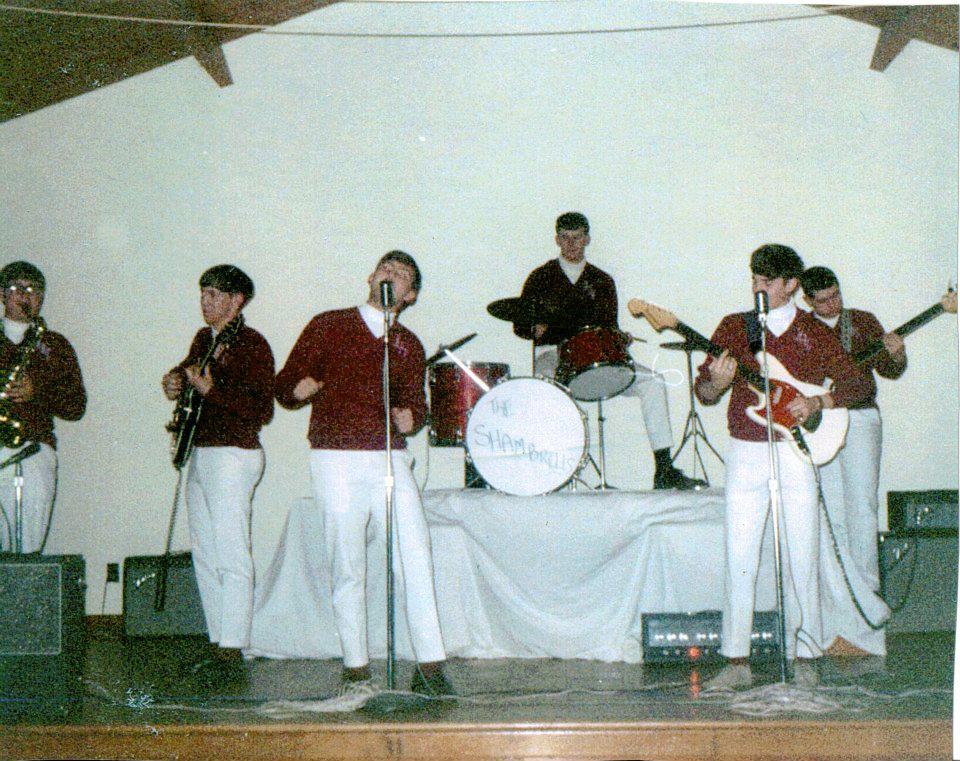
The Shambrels, 1965, from left: Bruce Corvin on sax, Danny Sterling, Ronnie Bailey, Bob Gordon on drums, Don Skipper, and Danny Bradley
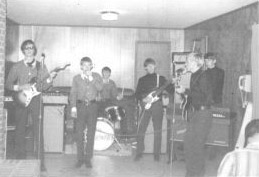
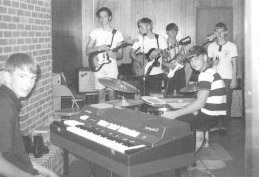
The Shambrels came from Oneonta, Alabama, about 35 miles northeast of Birmingham. I knew nothing about the group until Jerry Yancy commented below, so I’ve added his info to this post.
Members included:
Bruce Corvin – sax Danny Sterling – lead guitar Ronnie Bailey – lead vocals Bob Gordon – rhythm guitar and vocals Don Skipper – bass Danny Bradley – drums
Bob Gordon added these other members, not pictured in the photo:
Larry Coker – keyboard Dee Decker – drums
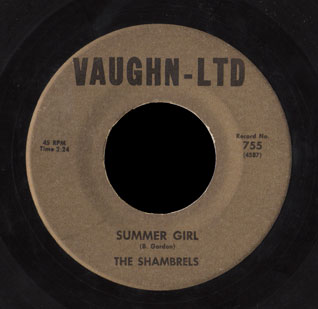
“Summer Girl” is the flip of the more pop-oriented “Girl, I’m Glad”. Both songs were written by Bob Gordon.
The Vaughn-Ltd label released at least eight garage 45s that I know of, including good records by the Bassmen and the Rockin’ Rebellions. Most bands on that label were from Birmingham.
The Shambrels were one of the last released on Vaughn-Ltd.
This site is a work in progress on 1960s garage rock bands. All entries can be updated, corrected and expanded. If you have information on a band featured here, please let me know and I will update the site and credit you accordingly.
I am dedicated to making this site a center for research about '60s music scenes. Please consider donating archival materials such as photos, records, news clippings, scrapbooks or other material from the '60s. Please contact me at rchrisbishop@gmail.com if you can loan or donate original materials

 The Mixed Emotions were from the town of Coden, on the Gulf in Alabama. Members were: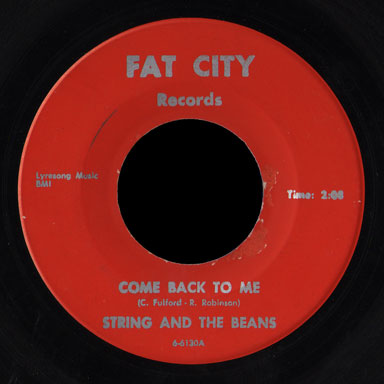


 The Shambrels came from Oneonta, Alabama, about 35 miles northeast of Birmingham. I knew nothing about the group until Jerry Yancy commented below, so I’ve added his info to this post.