Category Archives: Alabama

The Illusions

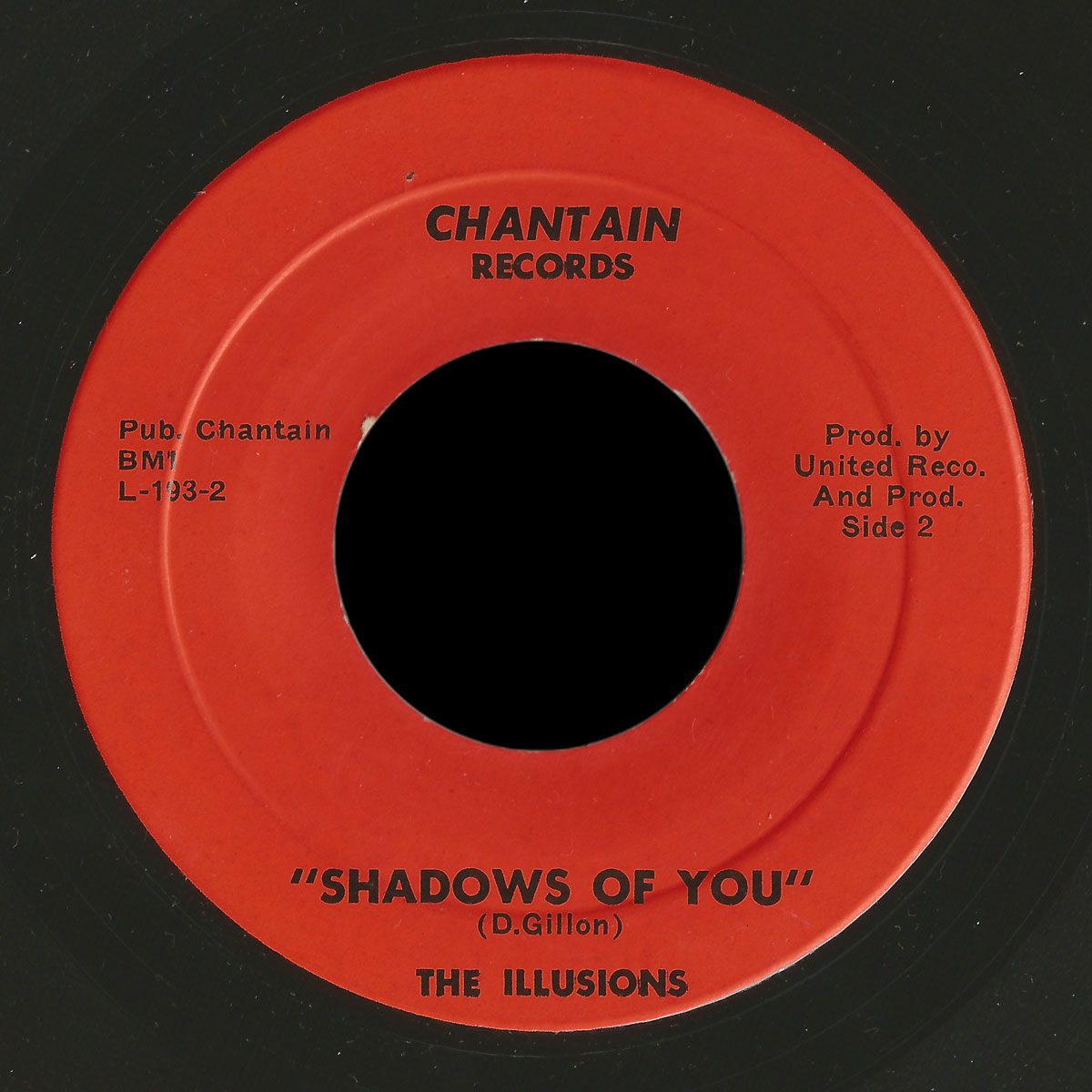
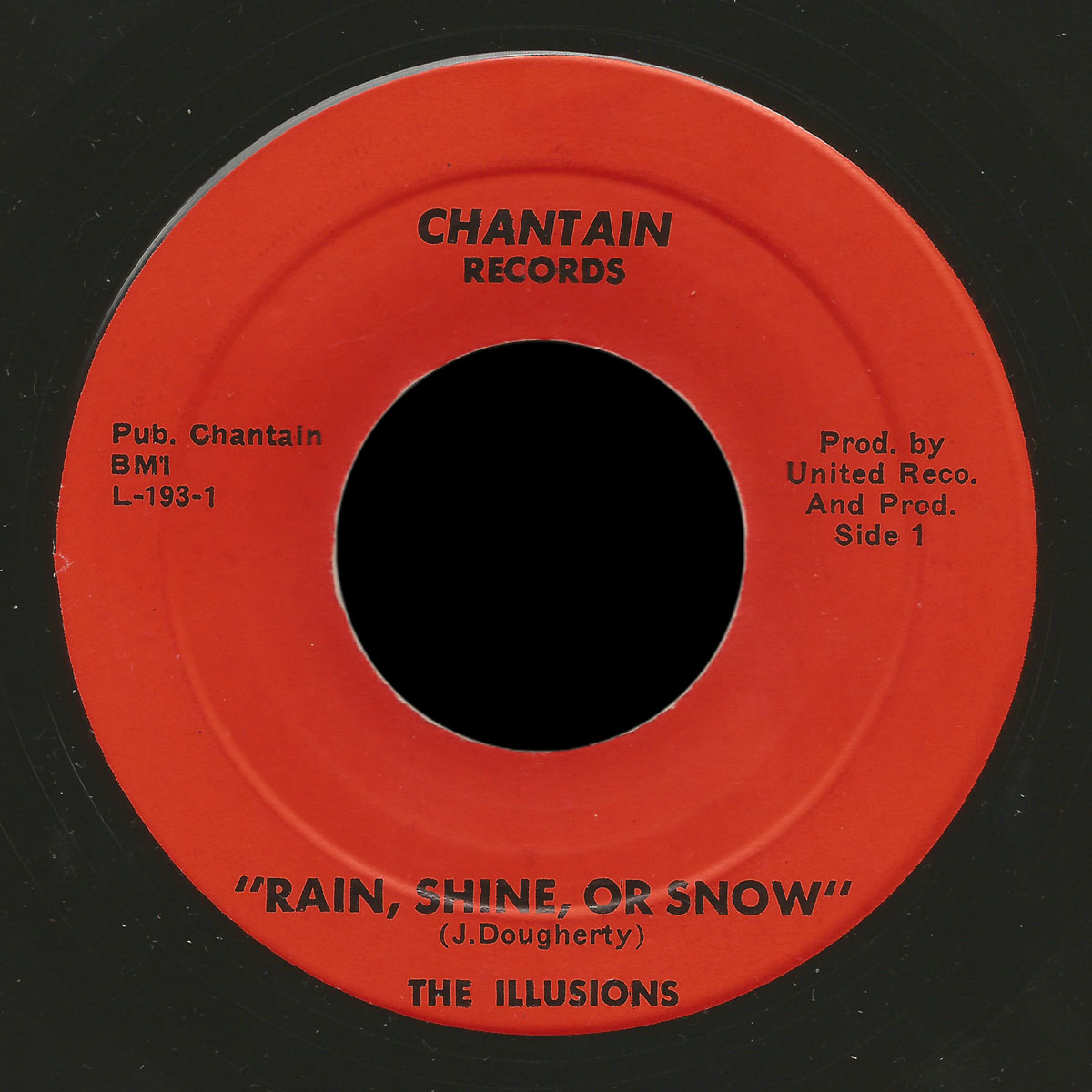
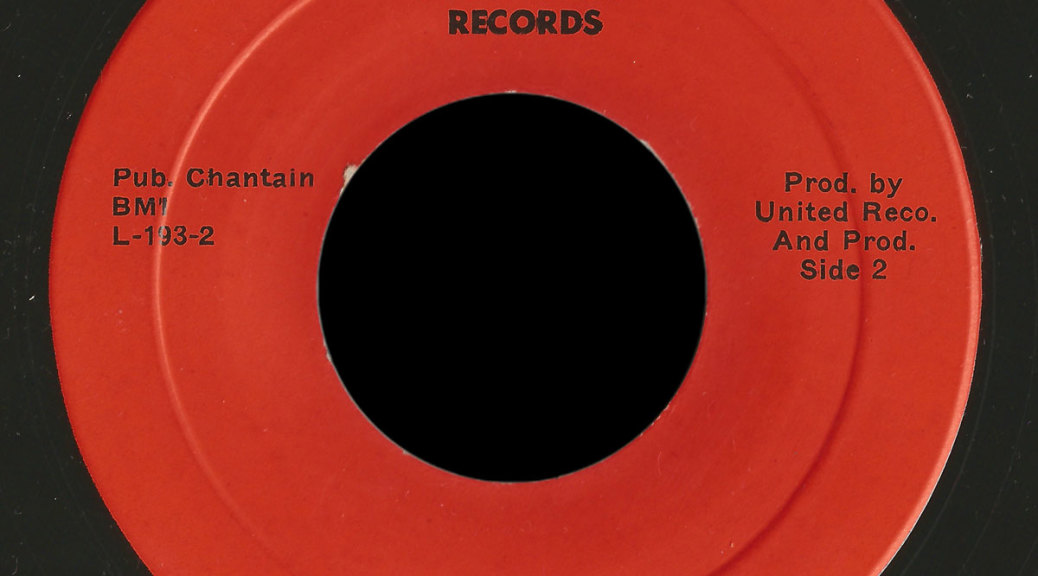
Illusions Chantain 45 Shadows Of YouOne of many groups called the Illusions, this group cut only one 45 featuring the great “Shadows of You” by D. Gillon, which was originally the B-side. The A-side is the more pop “Rain, Shine, or Snow” by J. Dougherty.

Members were Jim Posey – lead vocals, Robert Thames – lead guitar and vocals, David Gillon – rhythm guitar and vocals, Joe Dougherty – bass guitar and vocals and Paul Morrow – drums and vocals. The band had an earlier 45 under Jim Posey’s name, a version of “Double Shot (of My Baby’s Love)” b/w “That Boy” on Bahama Records out of Florence, Alabama.

United Recording and Production was incorporated in Birmingham, Alabama on May 20, 1968. The Chantain BMI credit doesn’t show up in BMI’s current database. Although it looks something like a Rite pressing, it is not, with etched deadwax simply “L-193-1/2”. Maybe someone can comment with the likely pressing plant for this record.

Chantain had at least three other releases, a soul 45 by Roy Smith “Don’t Go Away” (R. Smith, B. Walker) / “The Pain Lingers On” (Chantain CH-0014, reissued on Ascot AS 2239), the Regular Size doing a ballad called “Down In Texas” b/w “Richmond”, and a release by Jerry Woodward.

Thank you to Max Waller for information on the band.

Illusions Chantain 45 Rain, Shine or Snow

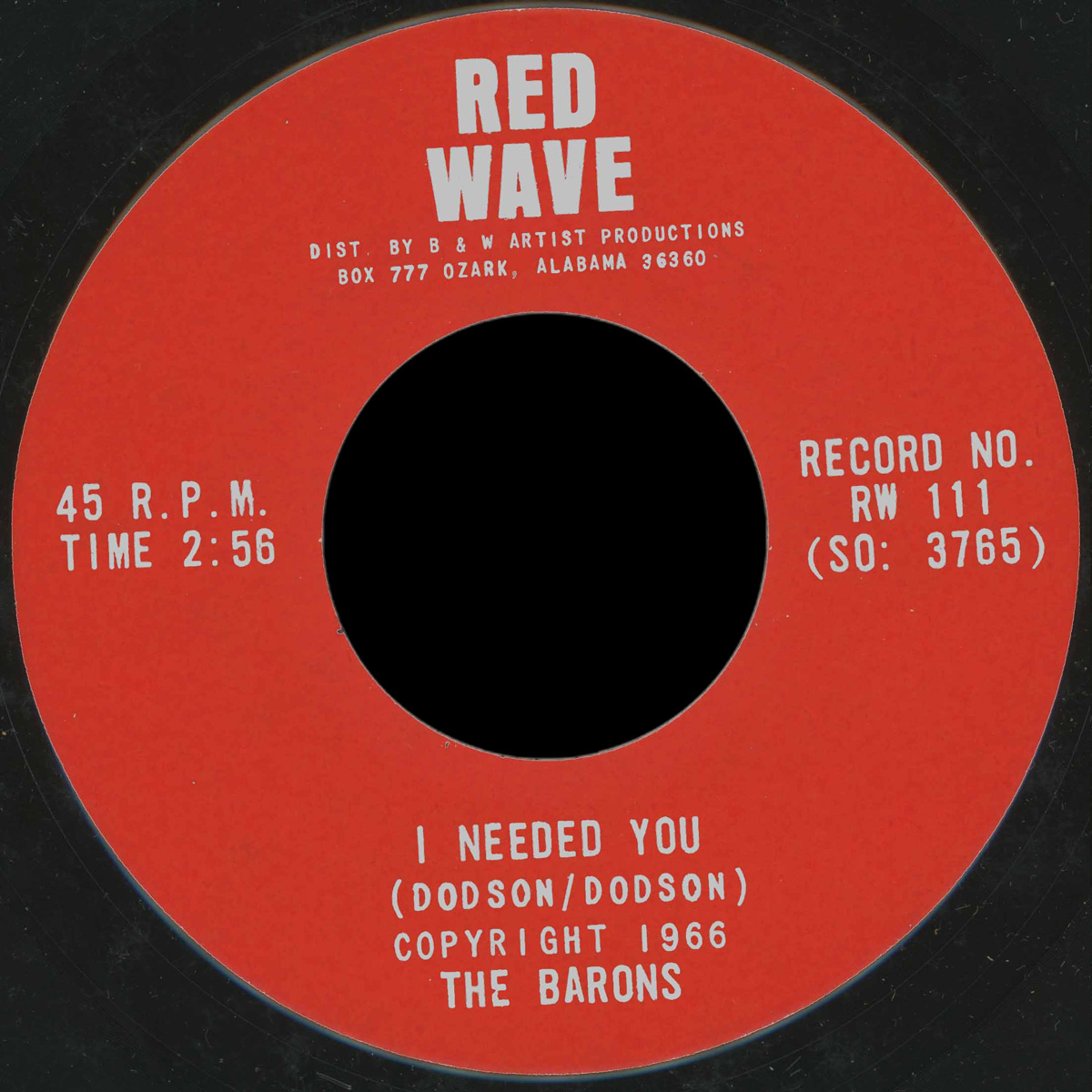
The Barons (Ozark, Alabama) – “I’m The One Who Cares” / “I Needed You” on Red Wave

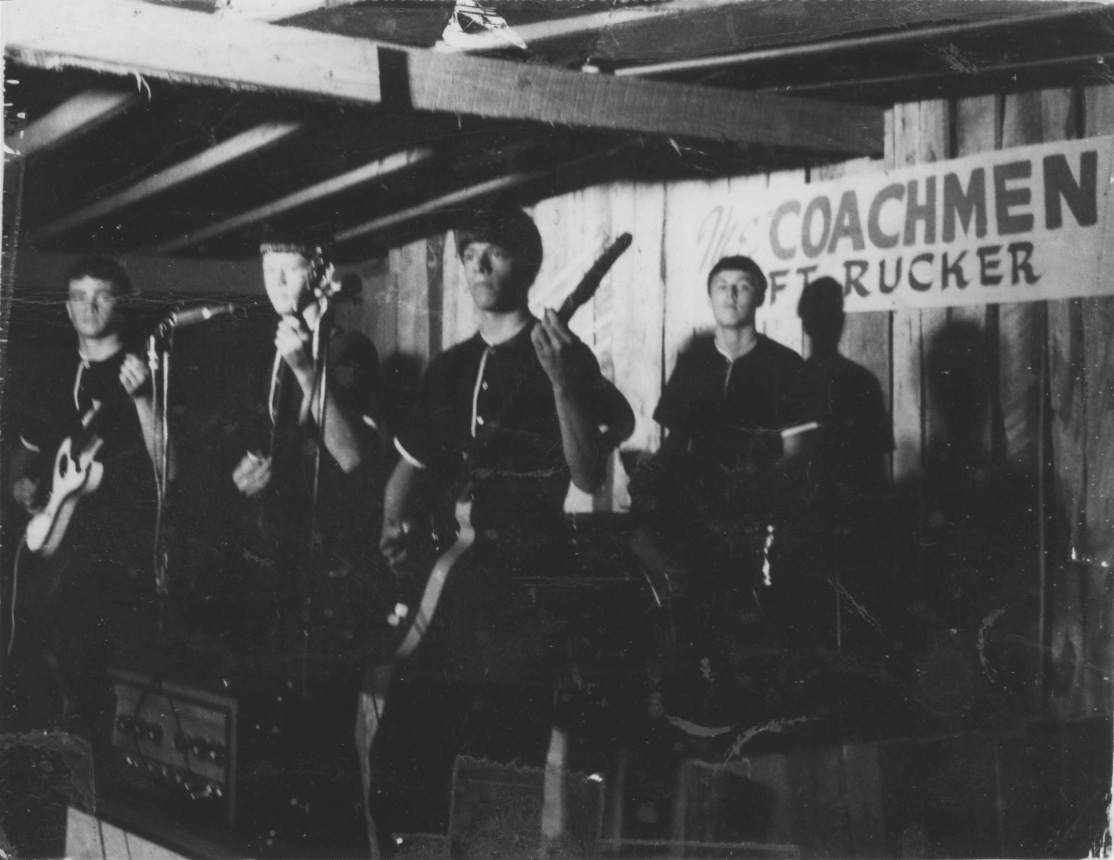
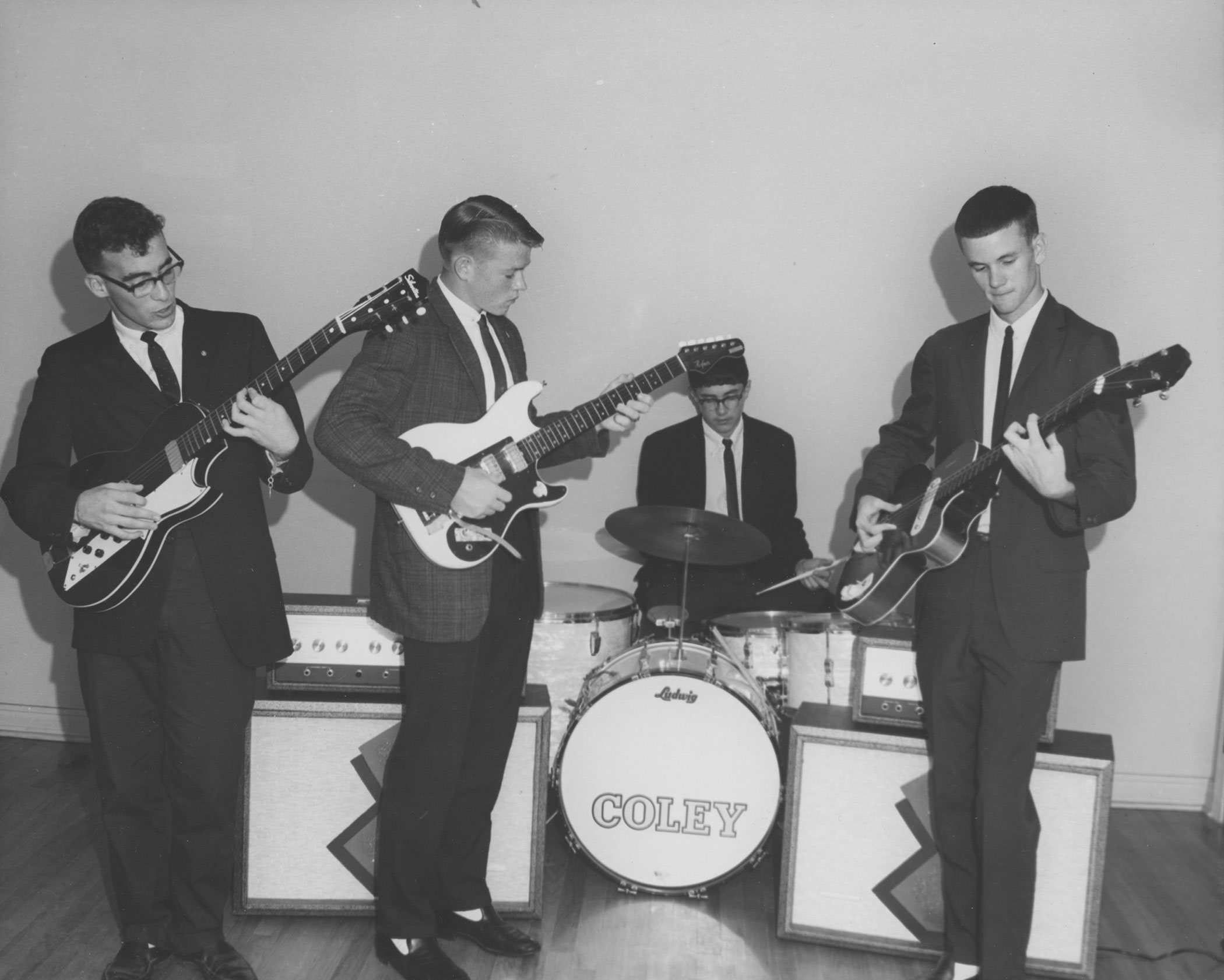
The Coachmen at Grannys Teen Club, Opp, Alabama, 1965
The Coachmen at Grannys Teen Club, Opp, Alabama, 1965. L-R: Steve Folmar, Paul Williams, Gordon Dodson & Ron Sims
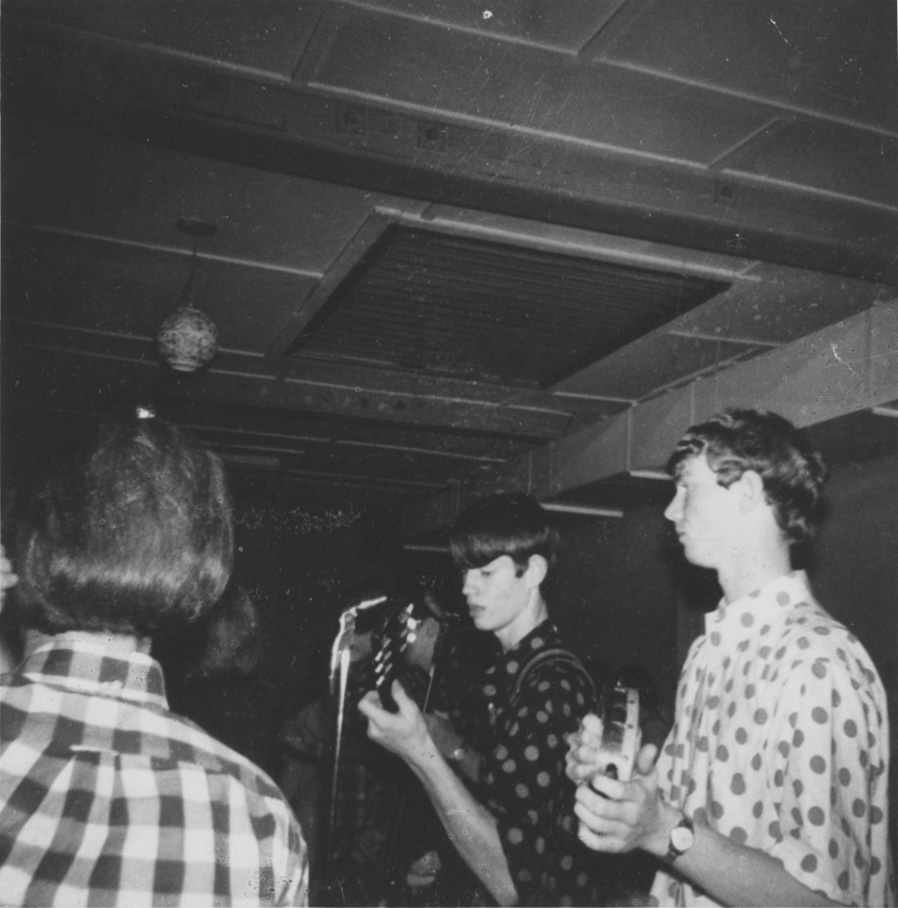
The Coachmen - Grannys Teen Club, Opp, Alabama 1965
The Coachmen at Grannys Teen Club, Opp, Alabama 1965, L-R: Ron Sims, Gordon Dodson, Bill Saunders & Steve Folmar

Rodney Dodson – lead vocals / rhythm guitar
Gordon Dodson – lead guitar / vocals
Bill Saunders – bass guitar / vocals
Coley Sullivan – drums
John Runkle – organ
Billy Scott – lead vocals

The Barons, formerly The Coachmen, from Ozark, Alabama, were formed in 1964 by guitarist Gordon Dodson and bassist Bill Saunders. The Coachmen soon added school friends guitarist Ron Sims, vocalist Paul Williams, and drummer, Steve Folmar.

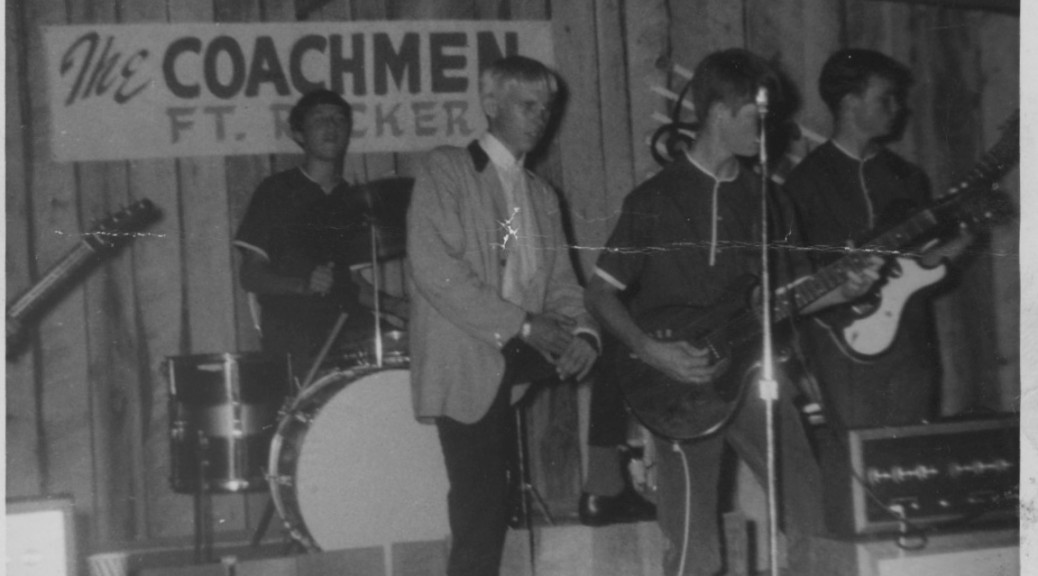
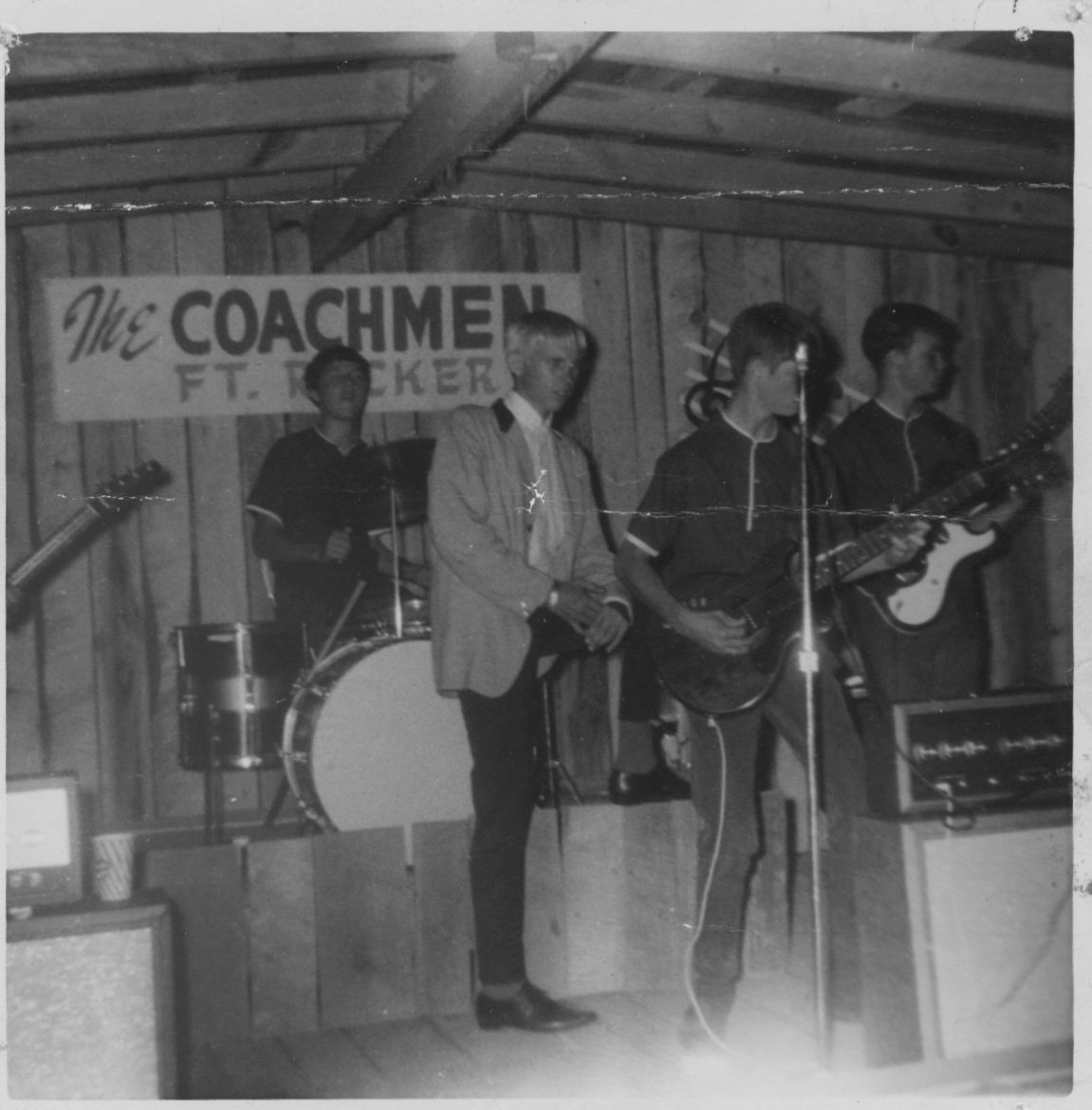
Gordon Dodson & Billy Scott of The Coachmen, Fort Rucker, Alabama, 1965

By early 1965, The Coachmen were playing the popular Opp, Alabama Teen Club known as Granny’s and the Ft. Rucker, Alabama Teen Club. 1965 also saw the first change of band members.  James Childers replaced Steve Folmar on drums and Billy Scott replaced Paul Williams on vocals.

1966 saw additional member changes as Coley Sullivan replaced drummer James Childers. Rodney Dodson, Gordon’s brother, replaced guitarist Ron Sims. John Runkle was added as the organist.

The Coachmen were renamed The Barons. The Barons played local teen clubs and recreation centers, as well as the Officers and Enlisted Clubs at Fort Rucker, Alabama and several fraternity parties at Troy State University.

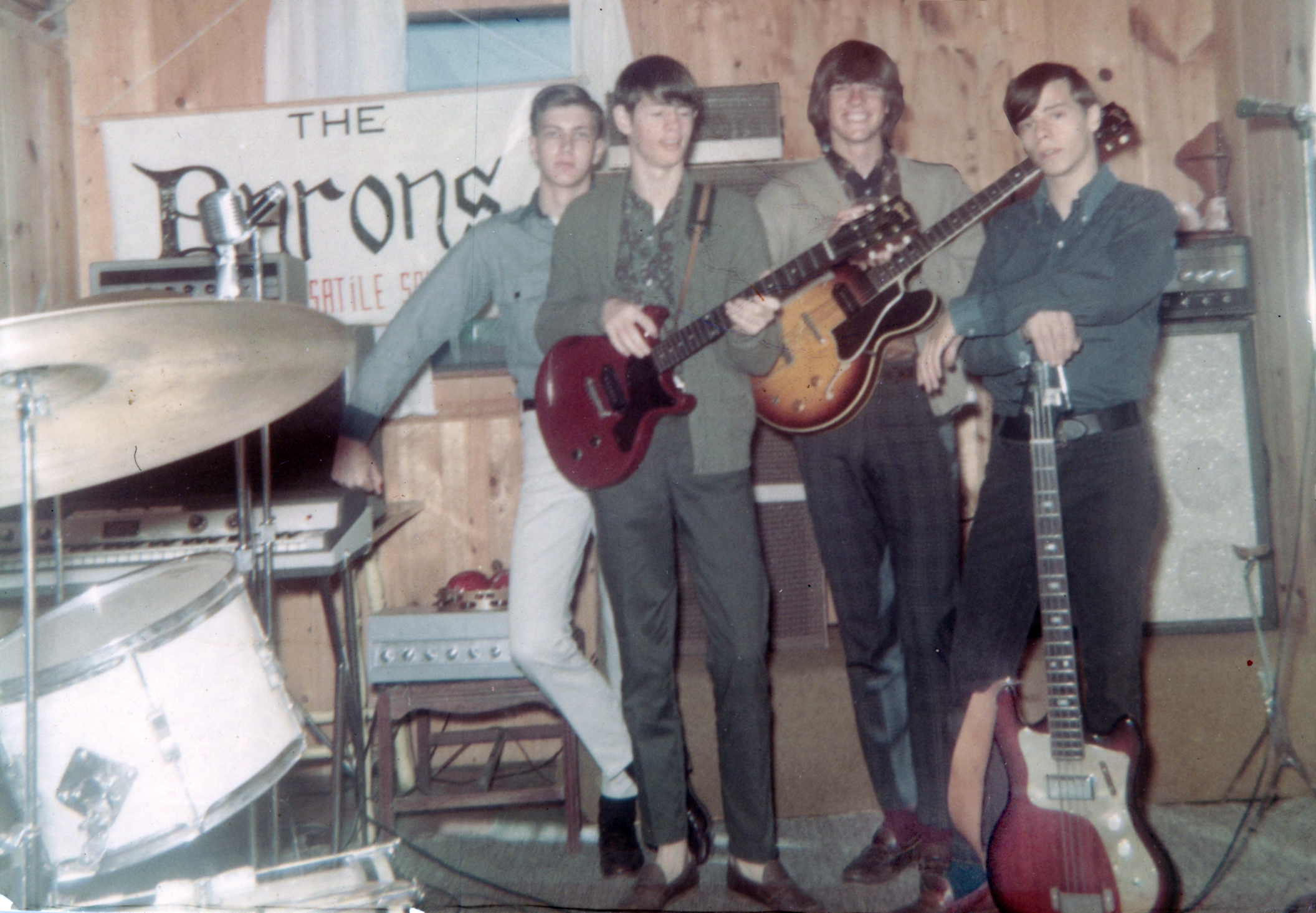
Barons Ozark Photo 1
The Barons L-R: John Runkle, Gordon Dodson, Rodney Dodson & Bill Saunders. Coley Sullivan and Billy Scott are not shown.

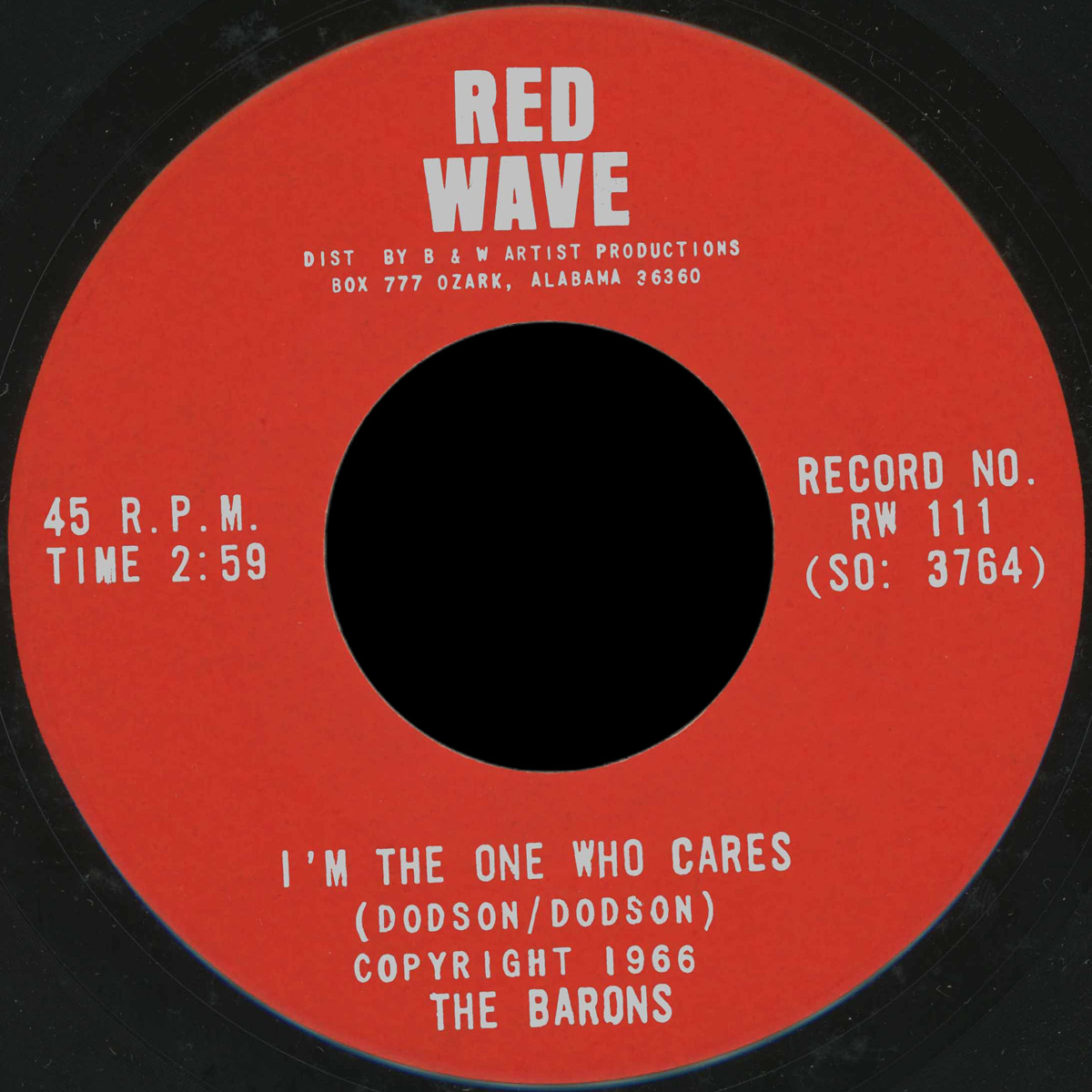
The Barons Red Wave 45 I'm the One Who CaresDuring the summer of 1966, The Barons recorded their only single 45rpm record at WOOF Radio Station in Dothan, Alabama. “I’m The One Who Cares” and “I Needed You”, were written and sung by The Barons’ lead singer, Rodney Dodson with his brother Gordon singing harmony. Bassist Bill Saunders, composed the keyboard introduction and lead break on “I’m The One Who Cares”.

The recording was done with one microphone hanging in the center of a sound proof room using a two track reel to reel recorder; no overdubs. The recording “engineer” unfortunately kept the recording level in the red, distorting the overall sound quality. The high volume playbacks sounded good in the studio, so the master tape was sent to the pressing company. Because of limited funds, only 250 records were pressed. The label name, Red Wave, was taken from the local Troy State University Trojans football team, which was known at that time as, The Red Wave. The record sleeve was a stock light brown paper.

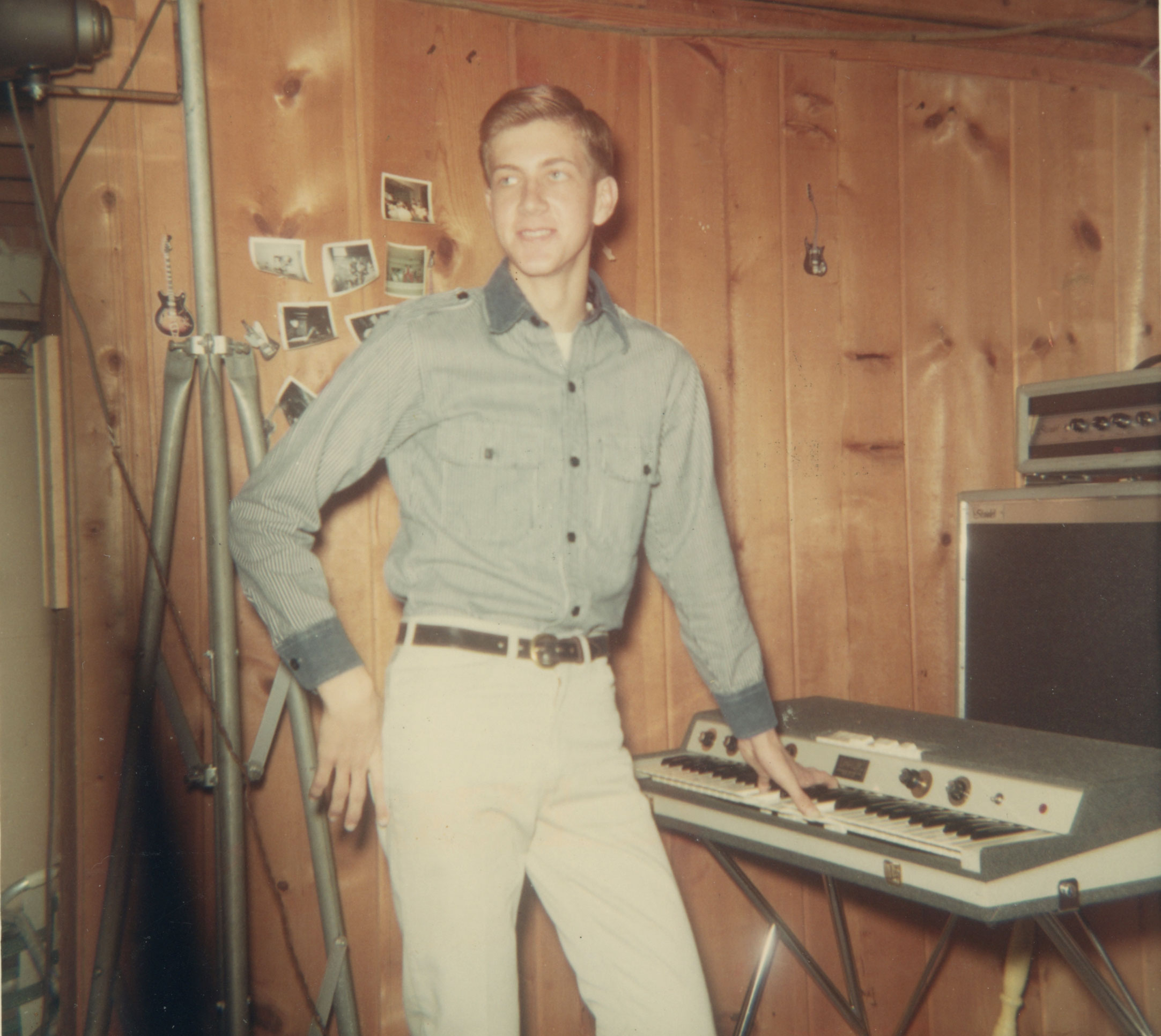
John Runkle Barons Ozark Photo
John Runkle
John Belcher and Jerry Williams of Ozark distributed the record through John’s dad’s appliance and record store.  The record was also placed on a few local jukeboxes.  Although the record received a fair amount of play from the jukebox distribution, it was seldom heard on radio due to the poor sound quality. The Barons disband near the end of 1967 due to the Vietnam war. All Baron members served in the military with three serving in Vietnam. The remaining boxes of records, were unfortunately, used as clay pigeon substitutes during an afternoon of target practice by the two Dodson brothers and their older brother, Claude.

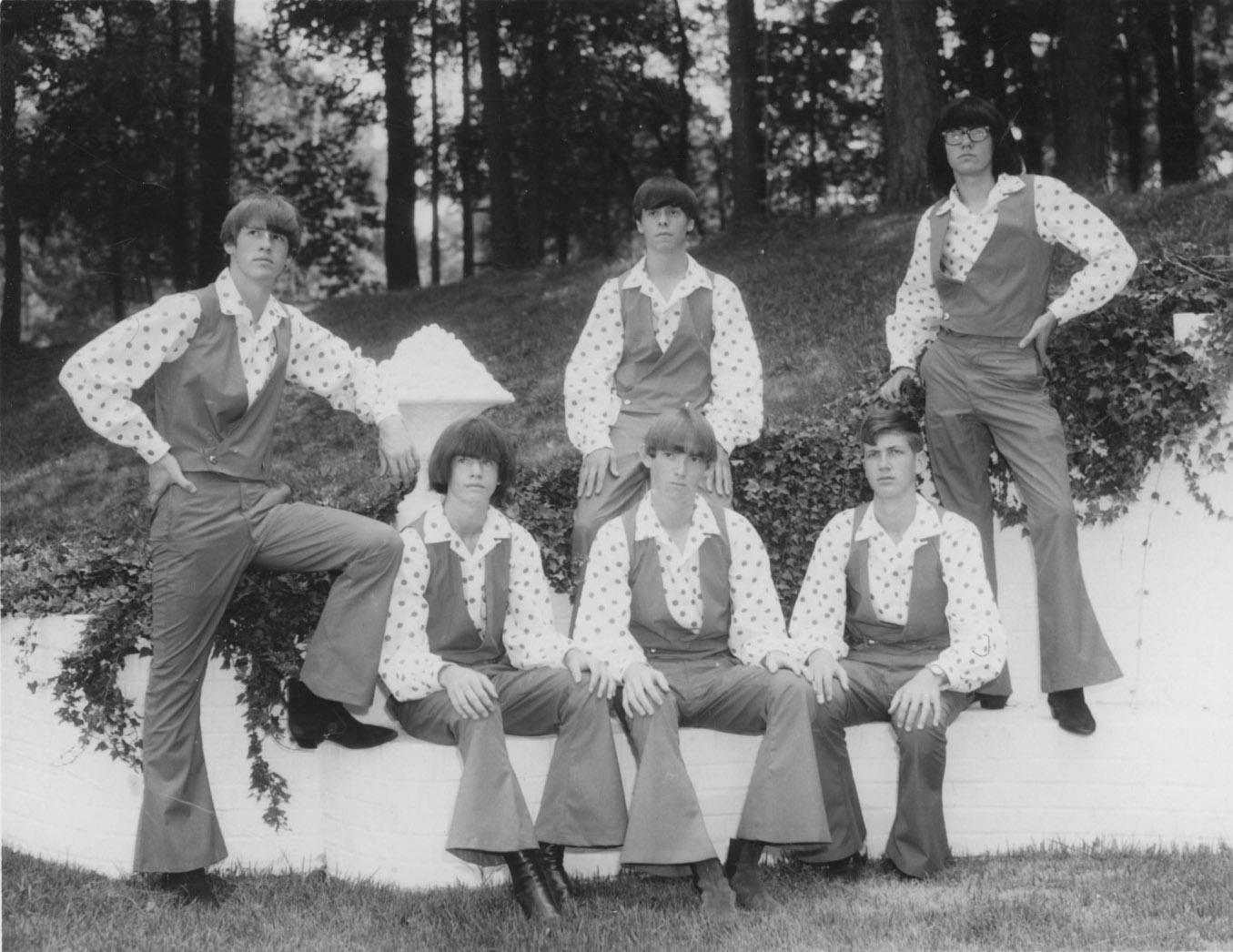
The Barons of Ozark, Alabama
The Barons of Ozark, Alabama. Standing L-R: Rodney Dodson, Bill Saunders, Coley Sullivan. Seated L-R: Gordon Dodson, Billy Scott, John Runkle

Baron members known to have stayed musically active are:

Rodney Dodson was the founding member of the popular 1980’s southeast Alabama band, The Fairlanes.  A school teacher by trade, Rodney once invited his friend and fellow musician, Sara Evans, to perform at his school.  Rodney put together a small group of musicians, including himself, brother Gordon, and sister Celia to accompany Sara.  Sara went on to become the 2005 Academy of Country Music’s Female Vocalist of the Year.Barons Red Wave 45 I Needed You

Gordon Dodson played guitar with the late 1970’s southeast Alabama band, Kingfish, which included notable saxophonist, Jay Scott.  (Jay played the saxophone on Lynard Skynard’s recording of “What’s Your Name”, as well as Alicia Bridges, “I Like The Night Life”.)  Gordon is listed in the Alabama Steel Guitar Hall of Fame as the 2010 recipient of the Bill Simmons Horizon Award.  Gordon taught guitar in the southeast Alabama Junior College system for many years.

Coley Sullivan played drums with the early 1960’s instrumental combo, The Ecstatics, one of Ozark, Alabama’s first rock and roll bands. The Ecstatics, also included lead guitar player, Ron Hilburn, who eventually became the lead guitarist for the 1960’s band, The Chains, referred to as, The Beatles of El Paso.  The Chains are known for their version of “I Ain’t Gonna Eat My Heart Out Any More”.  Coley also played briefly in the 1960’s popular southeast Alabama bands, The Webs, The Puppets, The K- Otics and The Disciples of Blue from Panama City, Florida.

The Ecstatics, Ozark, Alabama
The Ecstatics, Ozark, Alabama, L-R: Pete Bonnasso (rhythm guitar), Ron Hilburn (lead guitar), Coley Sullivan (drums) and Frank Kingsley (bass)

Johnny Christian, friend and fellow musician, though not a member of the Barons, played the woodblocks on “I’m The One Who Cares”.  Johnny retired as Band Director from Dothan, Alabama’s, Northview High School. His son, Wynn Christian, guitarist and vocalist of the popular blues band, Spoonful James, composed “Seven Mile Breakdown”, recorded by the 2006 American Idol Winner, Taylor Hicks.

Gordon Dodson
2014

The Barons, Doug Tew Recreation Center, Dothan, Alabama
The Barons, Doug Tew Recreation Center, Dothan, AL. From left: Rodney Dodson, Billy Scott, Gordon Dodson, Coley Sullivan, Bill Saunders & John Runkle
James Childers, drummer for the Coachmen of Ozark, AL
The Coachmen, Fort Rucker, Alabama, 1965
The Coachmen, Fort Rucker, Alabama, 1965, L-R: Ron Sims, Billy Scott, Gordon Dodson & Bill Saunders

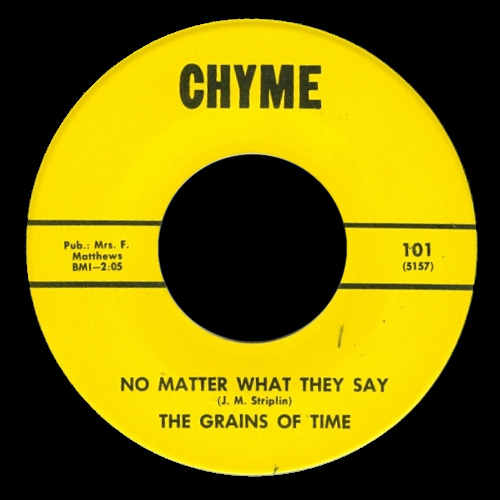
The Grains of Time

Someone I know is looking for this 45 by the Grains of Time on the Chyme label (if anyone has a copy for sale please get in touch). I realized I haven’t seen any detailed info on the band, so I’m posting here looking for their story.

TeenBeat Mayhem gives the release date as May of 1968, and the band coming from Albertville, Alabama, a small city near Guntersville Lake, northeast of Birmingham.Johnny Striplin (J. M. Striplin) wrote the fine “No Matter What They Say”.The flip, “This Little Girl” is equally good and has a great overdriven solo. It was written by Johnny Striplin and Cecil Matthews. Both songs were published by Mrs. F. Matthews, BMI.

The Ramblers

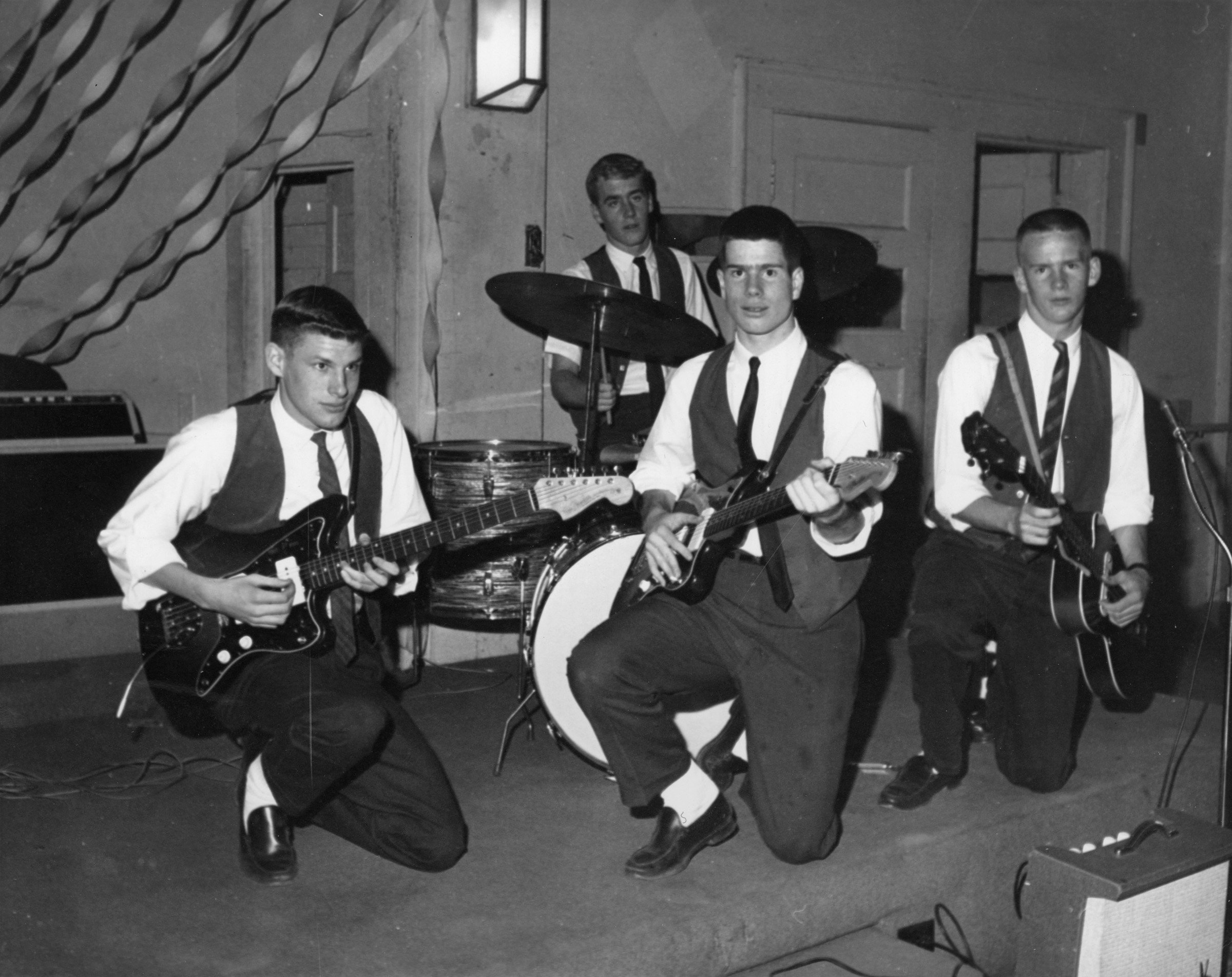
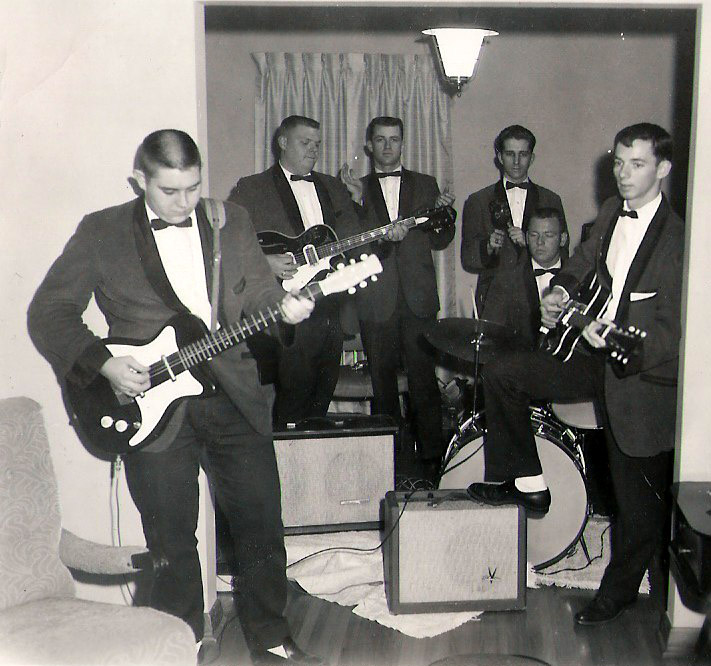
The Ramblers of Birmingham, Highland County Club, December 1961. Van Veenschoten, Tommy Terrell and Eddie Terrell; in back Johnny Robinson on drums
Early photo of the Ramblers of Birmingham, Highland County Club, December 1961. Left to right in front: Van Veenschoten, Tommy Terrell and Eddie Terrell; in back Johnny Robinson on drums

Bob Ellis from the Alabama Record Collectors Association sent me this history of the Ramblers of Birmingham, written by Chip Sanders.

Back in 1961, the guitar playing Terrell brothers, Tommy and Eddie along with classmate Chris Covey found a junior high school drummer, Johnny Robinson, to play music. It was decided that the eldest brother, Eddie, would be the bass player, and Tommy would play rhythm guitar. Fellow Ramsey High School classmate, Van Veenschoten joined in to round out the group and play lead guitar. The group named themselves The Ramblers, and began playing for high school functions and fraternities and sororities in the Birmingham area. When Eddie Terrell received a tennis scholarship and headed to The University of Alabama, The Ramblers had no trouble in convincing Chris Convey, with the unusual nickname “The Spook,” to take over on the bass.

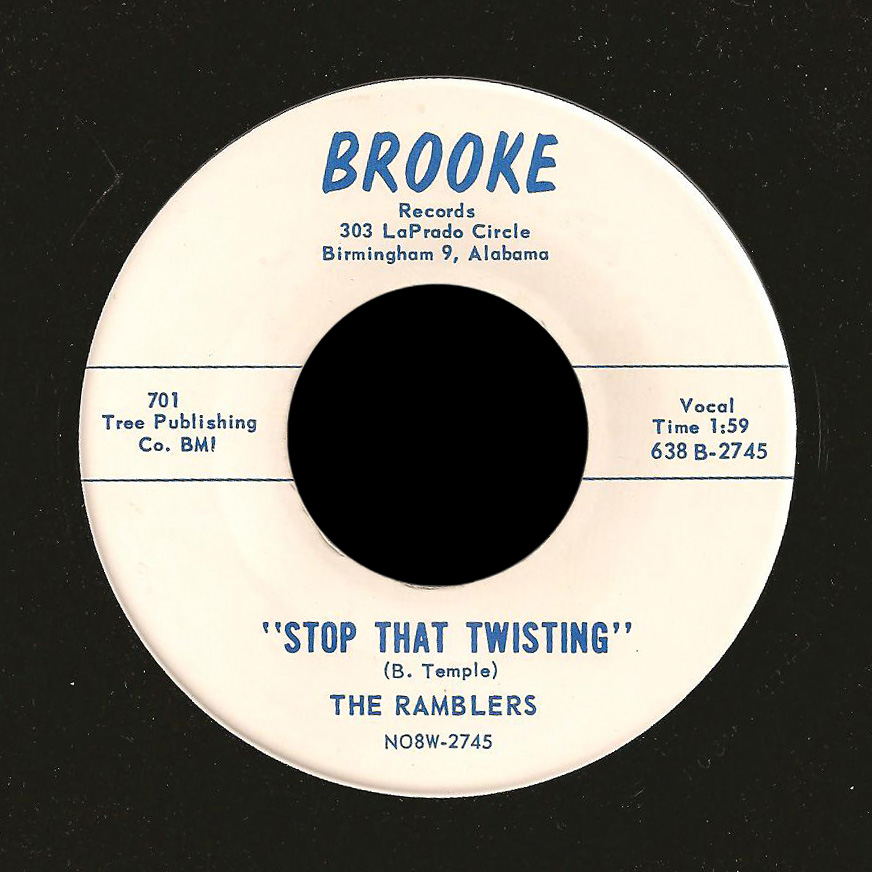
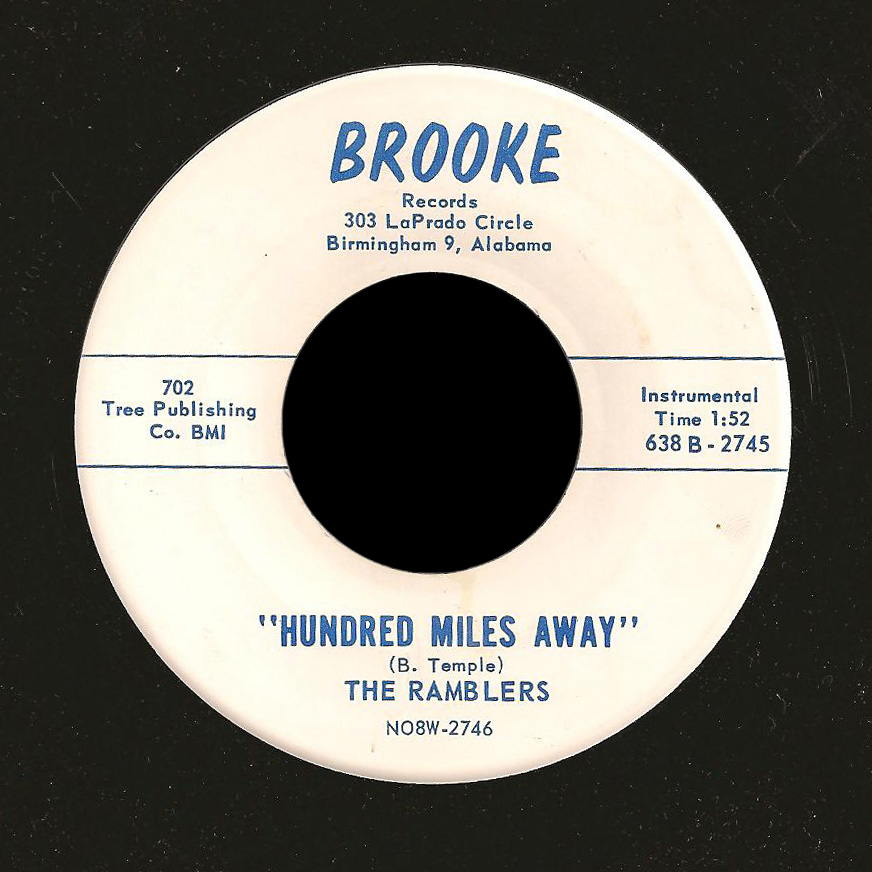
By mid-1962, The Ramblers were playing weekends regularly in and around Birmingham and cut their first record, “Stop That Twisting” / “Hundred Miles Away”, at Boutwell Recording Studio in Birmingham. Shortly thereafter, guitar player Van Veenschoten met Chip Sanders, a junior at neighboring Shades Valley High School, who was a piano player. The Ramblers auditioned Chip on a Sunday afternoon at Van’s parents home in Mountain Brook, and the nucleus of the group, that would become synonymous with “party band” was established.

An important early performance by The Ramblers at a state-wide Alabama high school Key Club Convention gave the group name recognition throughout the state, and soon The Ramblers of Birmingham were playing in Alabama cities and towns from Huntsville to Mobile. Practicing in a store room in the back of Johnny Robinson’s garage in Mountain Brook, Alabama, or in the basement of the Sanders’ home in Vestavia, The Ramblers were truly the proverbial garage band.

By fall of 1963, it was time for more of The Ramblers to make a decision, music or college! They decided on both, and as Tommy and Spook headed off to the University of Alabama and Johnny and Chip still in high school, the group began playing college fraternity parties at the University of Alabama.

By 1965-1966, The Ramblers were working regularly, primarily at Fraternity Parties around the southeast. Eddie, Tommy, Spook, and Chip had all become members of Pi Kappa Alpha fraternity at The University of Alabama, while Van was at Samford University and Johnny at the University of Montevallo. No longer rehearsing on a regular basis, the guys would meet up whenever and wherever the group might be playing.

Ramblers Brooke 45 Stop That Twisting

Ramblers Brooke 45 Hundred Miles Away

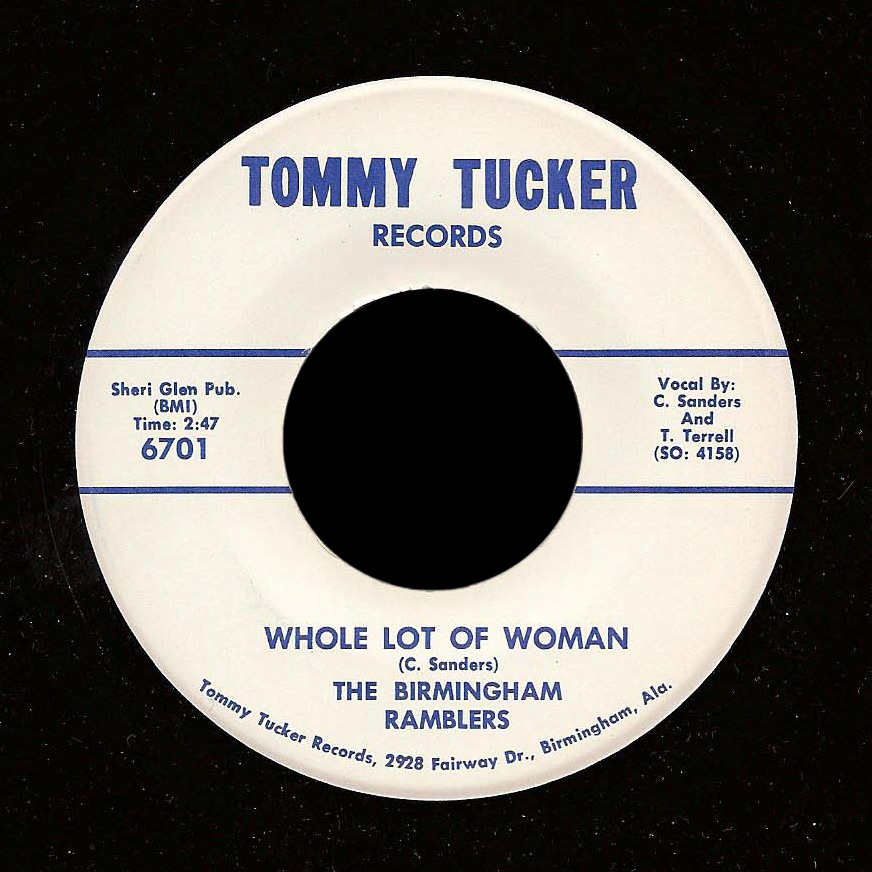
Birmingham Ramblers Tommy Tucker 45 Whole Lot of Woman

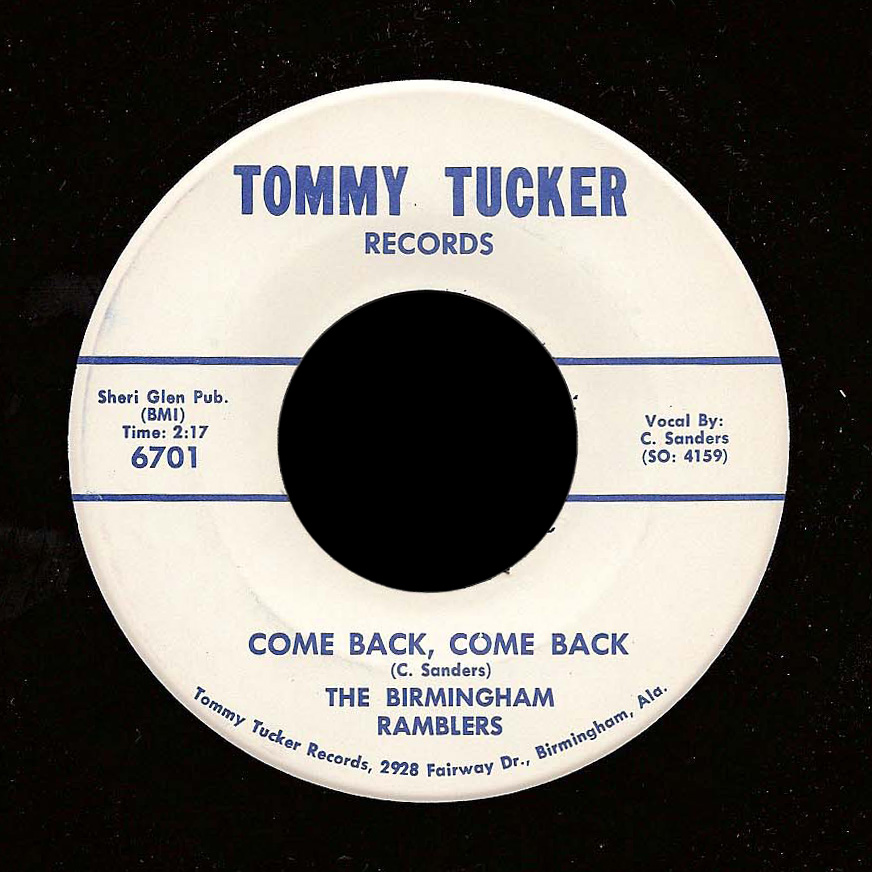
Birmingham Ramblers Tommy Tucker 45 Come Back, Come BackIn 1967, the group recorded another record at Boutwell Recording Studio, “Come Back, Come Back” / “Whole Lot Of Woman” written by keyboardist, Chip Sanders. The record experienced moderate success in the Alabama area, but college priorities prevented the group from properly promoting the record. Ed Boutwell, Birmingham recording pioneer, continued to use The Ramblers as back up musicians on many recording sessions at his studio.

Throughout this period, local radio station “sock hops” gained popularity amongst the Birmingham teenage population, and The Ramblers worked with local personality Duke Rumore of WYDE radio at Duke’s sock hop at the Ensley National Guard Armory, as well as Dave Roddy, from WSGN Radio at the Aporto Armory, across town. Also during this period the Ramblers were the backup band of choice for singers passing through Birmingham like Bobby Goldsboro or Billy Joe Royal.

As a “special added attraction” The Ramblers added a new set, featuring “Little John,” Chip’s kid brother, 11-year-old John Lee Sanders, who sang and played harmonica. John Lee Sanders, is now a successful song writer, performer and composer in the Bay Area of California. For the last 20 years he has worked with Long John Baldry, Starship, Paul Williams, Linda Arnold, and other popular entertainers.

As 1966-1967 came along, the world was quickly changing and The Rambler’s music began to change as well. Inspired by the psychedelic sounds coming out of the west coast, The Ramblers found a new sound with a young female vocalist, Vicki Hallman. Covers of the Jefferson Airplane, Linda Ronstadt and other female artists were added to their repertoire. After a brief marriage to drummer Johnny Robinson, Vicki continued her career in Nashville as a member of Buck Owens and the Buckaroos group and as a permanent cast member of the long running TV series, Hee-Haw.

With the Viet Nam War continuing to escalate in the late sixties, members of the group began to worry about the draft. This was definitely not the time to quit school and loose a student deferment to become a rock ‘n roll star. At various times during the next few years, Tommy joined George Bush in the Alabama Air National Guard, Chris joined the Coast Guard Reserve, Chip got in the Army National Guard three days before his draft notice, and Johnny became a reluctant member of the Talladega National Guard.

During their respective intermittent absences the group stayed together, with Terrell brother, Eddie, rejoining the group, along with a variety of substitute and fill-in players. As the sixties came to a close, one by one, the group began to graduate from college, get married and begin careers other than music. All the members of the group initially took jobs in Birmingham so that the band was able to stay together, but soon, the pressures of new careers, new wives, and even children began to put a strain on the group. “I don’t remember us ever officially deciding to break up. I just recall playing in a little town somewhere in South Alabama. We all brought our wives. It was a fun weekend. I remember staying in some ‘Bates Motel’ place and we all went swimming in their pool. That’s the last band job I can recall, but there may have been others,” said Sanders.

Johnny Robinson, who had tried to hold things together began touring with a new group, The Homestead Act, and subsequently moved to California to help his new wife start a music career. Chris moved away to seek his fortune, Chip moved near Memphis to start an insurance agency, and Tommy became a bank examiner for the Treasury Department.

The Ramblers were history, or so they thought. They stayed in touch with one another and by 1978 all of the remaining members of the group were thinking the same thing. They wanted to play again.

In 1979, the band regrouped as The Rambler Reunion Band adding Jim Burford on lead guitar to replace Van who died in a motorcycle accident in 1972. Chip moved out of state and was replaced by John Livingston on keyboards. Eddie rejoined the band to replace Chris who resides in Treasure Island, Florida. During the 80’s and 90’s the band continued working around the southeast entertaining at events with their 60’s music. Currently the RRB entertains at wedding receptions, reunion parties, company parties, club dances, and most any event that requires authentic 60’s rock and roll music.

Chip Sanders, 2011

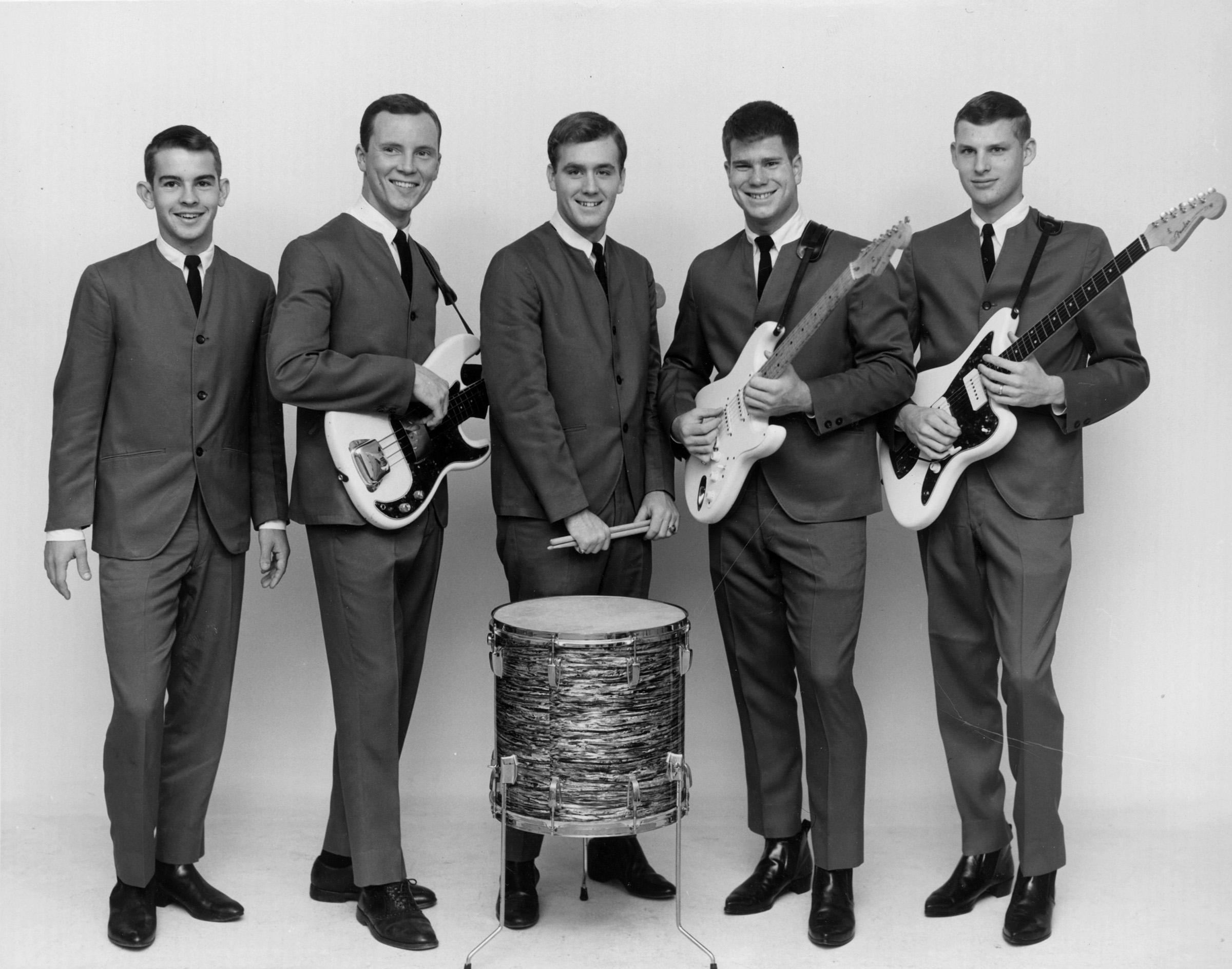
 The Ramblers, left to right: Chip Sanders, Chris Convey, Johnny Robinson, Tommy Terrell, Van Veenschoten
The Ramblers, left to right: Chip Sanders, Chris Convey, Johnny Robinson, Tommy Terrell, Van Veenschoten

Johnny Robinson answered some follow-up questions I had about the photos and recording sessions.

The picture of the four of us [top of page] was taken at Highland County Club in December 1961. Van played lead guitar, Tommy rhythm guitar, Eddie bass. At this time we had very few vocals. That one mike and the small guitar amp (lower right corner) was our PA system. We bought the vests at Pizitz downtown.

The two professional photos were taken by Ken Ives at his studio in English Village down the street from Boutwell Recording Studio, where we recorded “100 Miles Away”. Chris Convey replaced Eddie on bass when Eddie left for college on a tennis scholarship. We have tons of other pictures through the years.

B.Temple is Brook Temple. He went to Shades Valley High School. We met him through Lee Shook, a mutual friend. Brook wrote “100 Miles away” with words about a girl he dated in Montgomery (100 miles from Birmingham) and asked us to record it. His mother paid for the recording session and the cost of the records. We did not like the words to the song, so we made it an instrumemtal. He also wrote “Stop That Twisting”. The Brook record label is his name. After all his mother paid for everything.

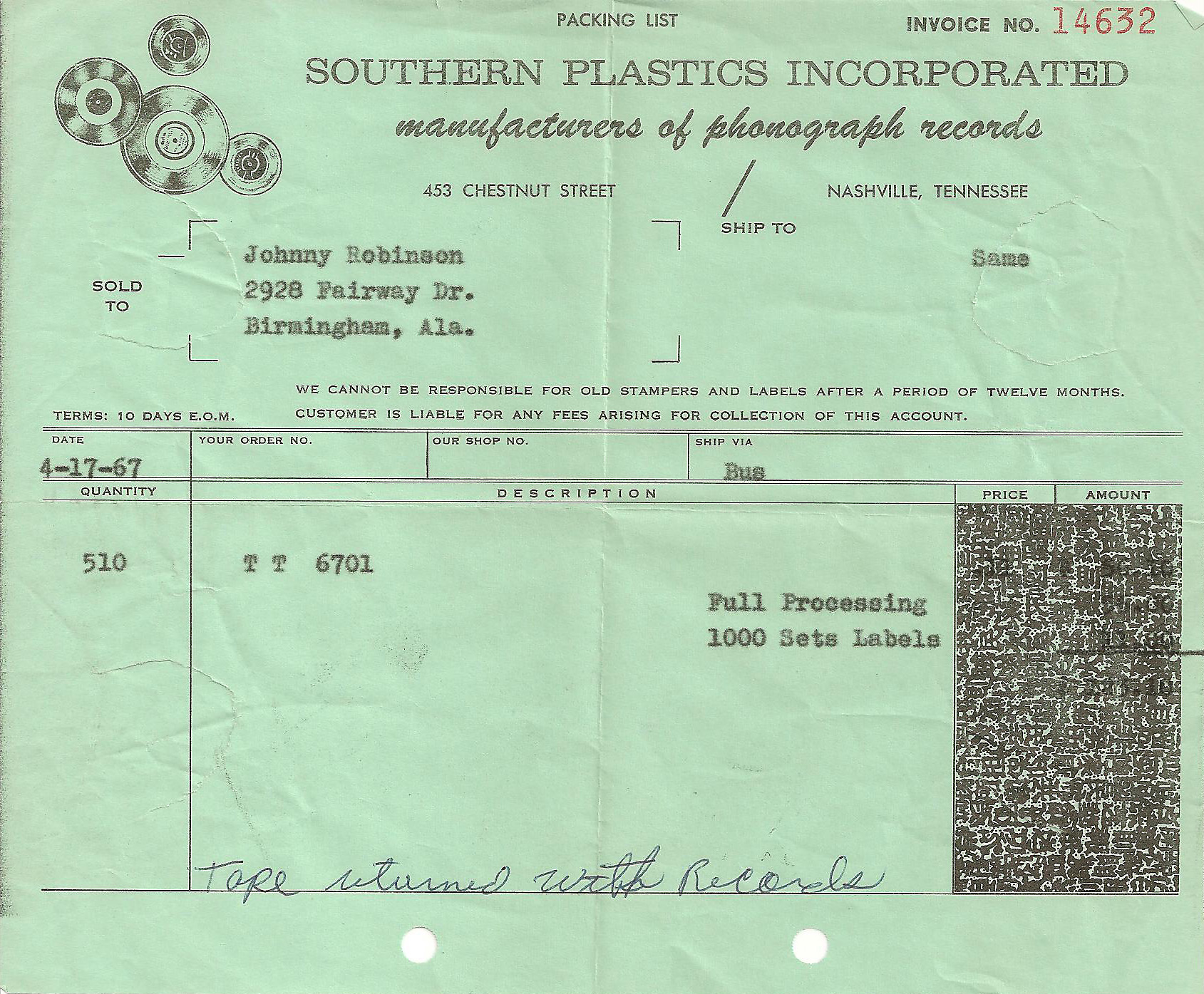
The second record, “Come Back, Come Back” was made in April 1967. The total for the packing slip was $123.10 for 510 records. That made them 24 cents each. The studio time was $300 as I remember. That made the total cost 83 cents each. Of course we did not made the records to make money, we gave most of them away to try and book more jobs. We have other studio recordings and live recordings.

The music scene in Birmingham was very active at this time – 1961 to 1968. The Distortions, Sammy Salvo, Willum Fowler, The Tremolos, Larry Parker, The Nomads, The Strangers, The Reflections, The Brood, and The Gents are just some of the local bands that recorded and released records on labels like Jo-Jo, Vibrato, Vesta, Lemon, Gold Master, Modern Enterprises, Malone, Vaughn-LTD, Malcolm Z. Dirge. There were many more. The ones I listed are part of my 45 collection. Others we were friends with: The Bassmen, Larry and the Loafers, The Kingsmen (not the famous ones), Daze of the Week, and Circus.

Packing list for the Ramblers 45  “Whole Lot Of Woman” / “Come Back, Come Back”
Packing list for the Ramblers 45 “Whole Lot Of Woman” / “Come Back, Come Back”
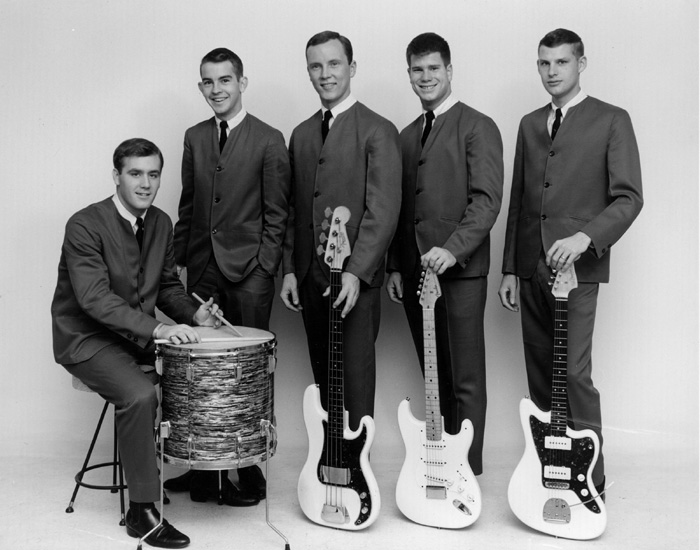
 The Ramblers, left to right: Johnny Robinson (seated), Chip Sanders, Chris Convey, Tommy Terrell and Van Veenschoten
The Ramblers, left to right: Johnny Robinson (seated), Chip Sanders, Chris Convey, Tommy Terrell and Van Veenschoten

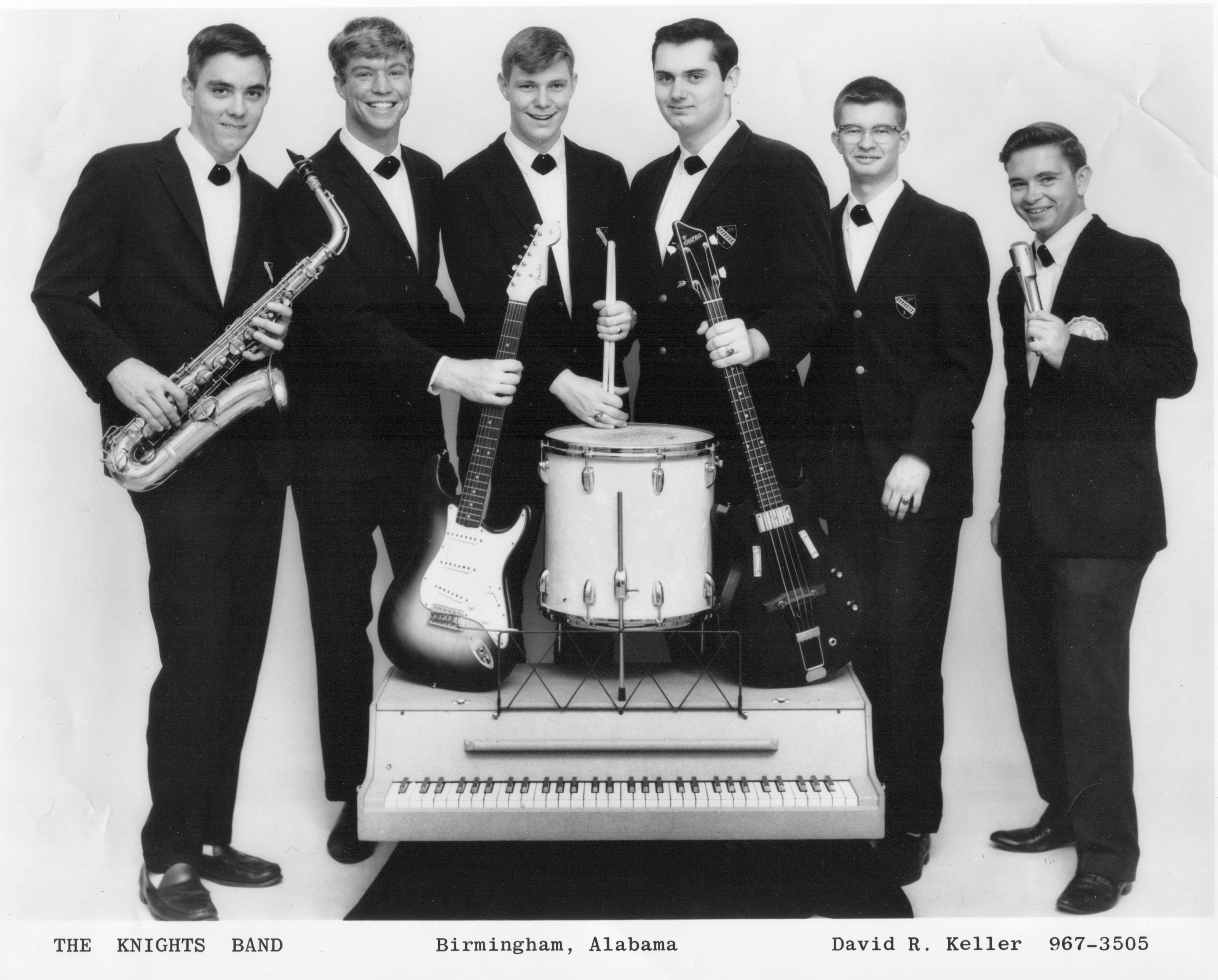
The Knights Band – The Original Knights

The Knights Band, from left: Bill Ashton, David Keller, Bick Mitchell, Carson Hood, Dudley Parker (?), and Ray Edwards

The Knights Band were Ray Edwards (vocals), Dudley Parker (keyboards), Carson Hood (bass), Bill Ashton (sax), Bick Mitchell (drums) and Dave Keller (lead guitar).Vocalist and DJ Ray Edwards sent in the early photo of David Keller’s first band, the Knights and gives some background, below.

The Preachers was David’s third band. In Shades Valley High School in Birmingham in the early 60’s, David played lead guitar for The Knights. I was the singer (little guy on the end) and “booking manager.” Other members were Bill Ashton (sax), Carson Hood (bass), Dudley Parker (keyboards), and Bic Mitchell (drums).

I graduated in 1963 and after a year at UAB in Birmingham headed to Tuscaloosa and a job 5 nights a week as a DJ at WJRD in Tuscaloosa. I was “invited” to drop out of the group. David took over lead vocals and sort of manager. They changed their name to The Original Knights and put out a 45 record to promote the band.

In the late 60’s I ran into David. He had just bought the convertible and told he he was making great money promoting bands. He said he had paid 21 $100 bills for the car. This was in Panama City where he had the club. The next thing I heard was that he was about to be drafted and had headed for Canada.

I have caught up with Bill Ashton, he is in sales and gets to Alabama from time to time. I met Dudley Parker at a wedding I was Djing for. (DJ company is Alabama Entertainment – alaentertainment.com) I talked with Bic who was filling in with a band playing at The Club. Carson died some time after we were in the band.

I have often wondered what happened to David. He was always “Crazy David” even when we had Saturday Morning band practice in his parents garage on Dolly Ridge Road in what became Vestavia Hills.

Ray Edwards

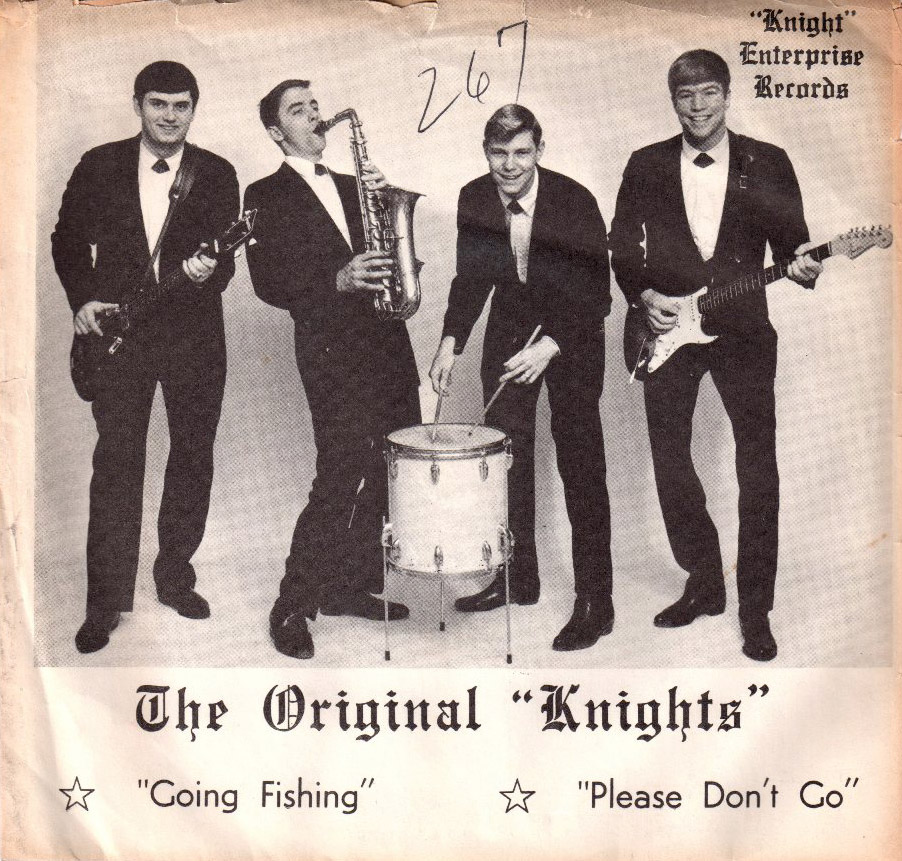
 The Original Knights, from left: Carson Hood, Bill Ashton, Bick Mitchell and Dave Keller
The Original Knights, from left: Carson Hood, Bill Ashton, Bick Mitchell and Dave Keller

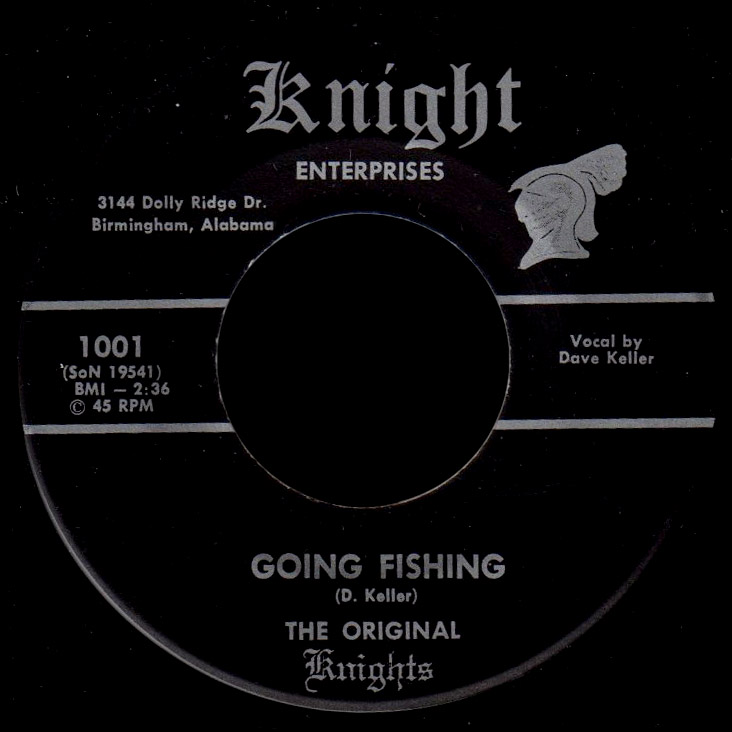
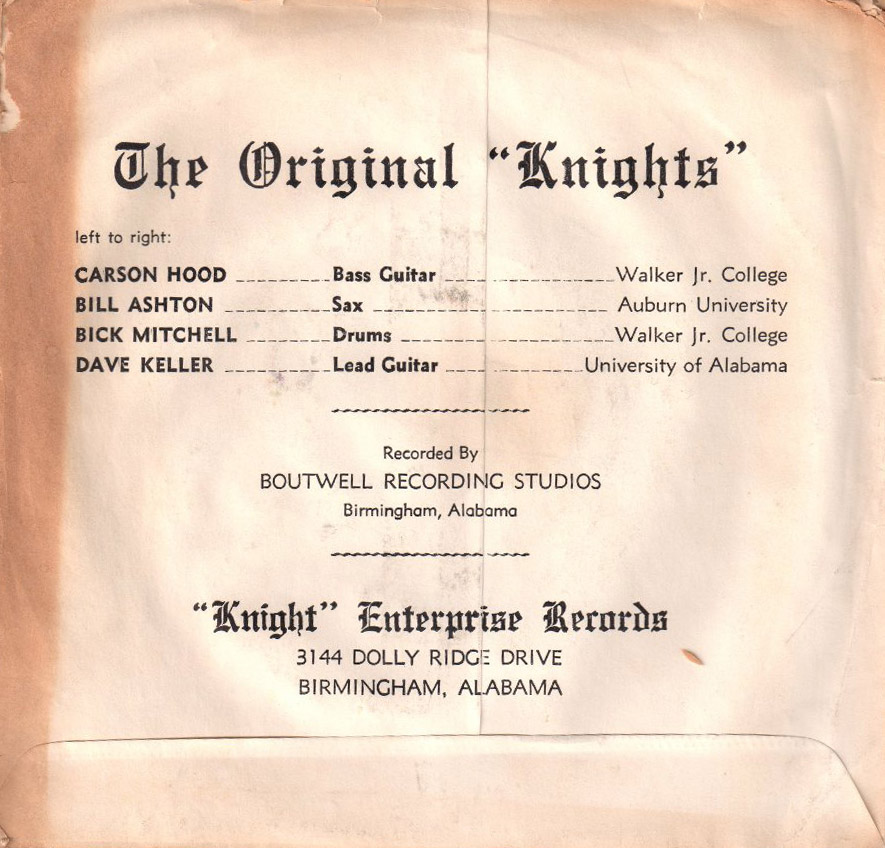
Original Knights Knight Enterprises 45 Going FishingWhen Edwards and Parker left, the band became a quartet, now calling themselves the Original Knights. This group released one 45 on their own Knight Enterprise Records recorded at Boutwell Recording Studios in Birmingham. David Keller wrote both songs, “Going Fishing” and “Please Don’t Go”, which has vocals credited to Keller and Carson Hood.According to the sleeve, Keller attended University of Alabama in Birmingham while Hood and Mitchell were students at Walker Jr. College (now Bevill State I believe) in Sumiton, 25 miles to the northwest. Bill Ashton is listed as attending the more distant Auburn University.

For further info on David Keller, check out the page on the Preachers.

Thanks to Ray Edwards for the photo and info about the Knights Band, and also to Jeff Lemlich for the scans and transfers of the 45 as the Original “Knights”.

Original Knights PS back

The Movement of Hemphill Recording

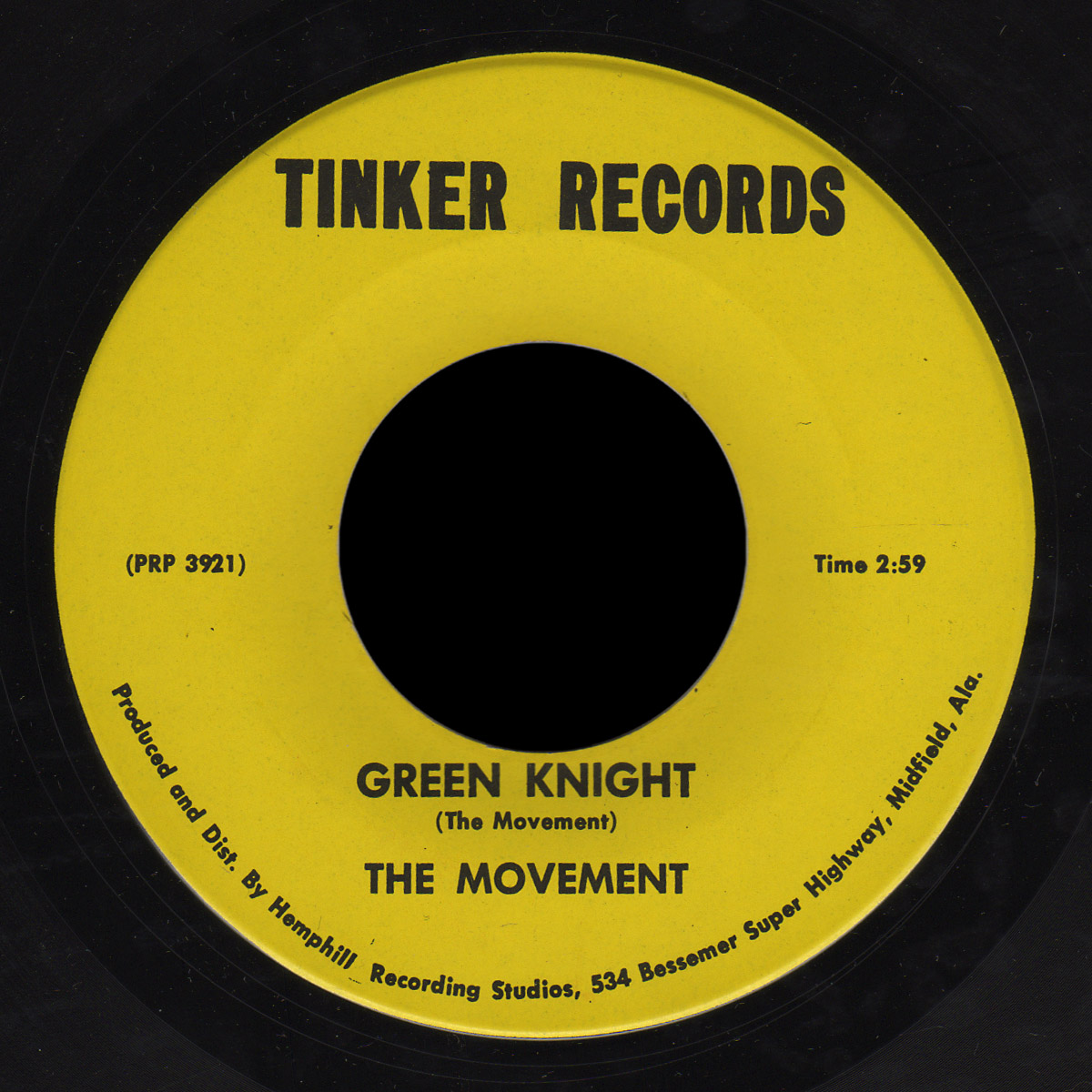
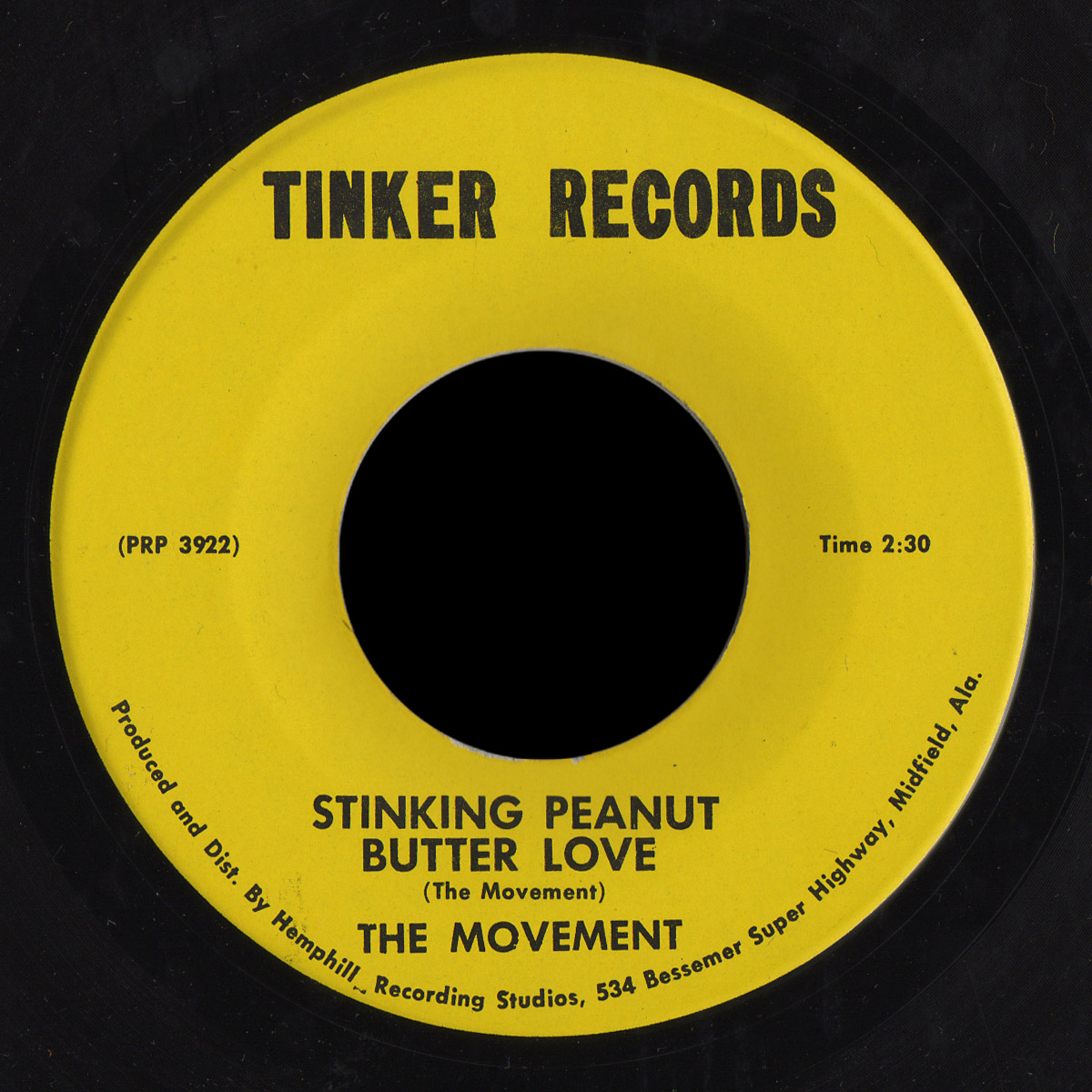
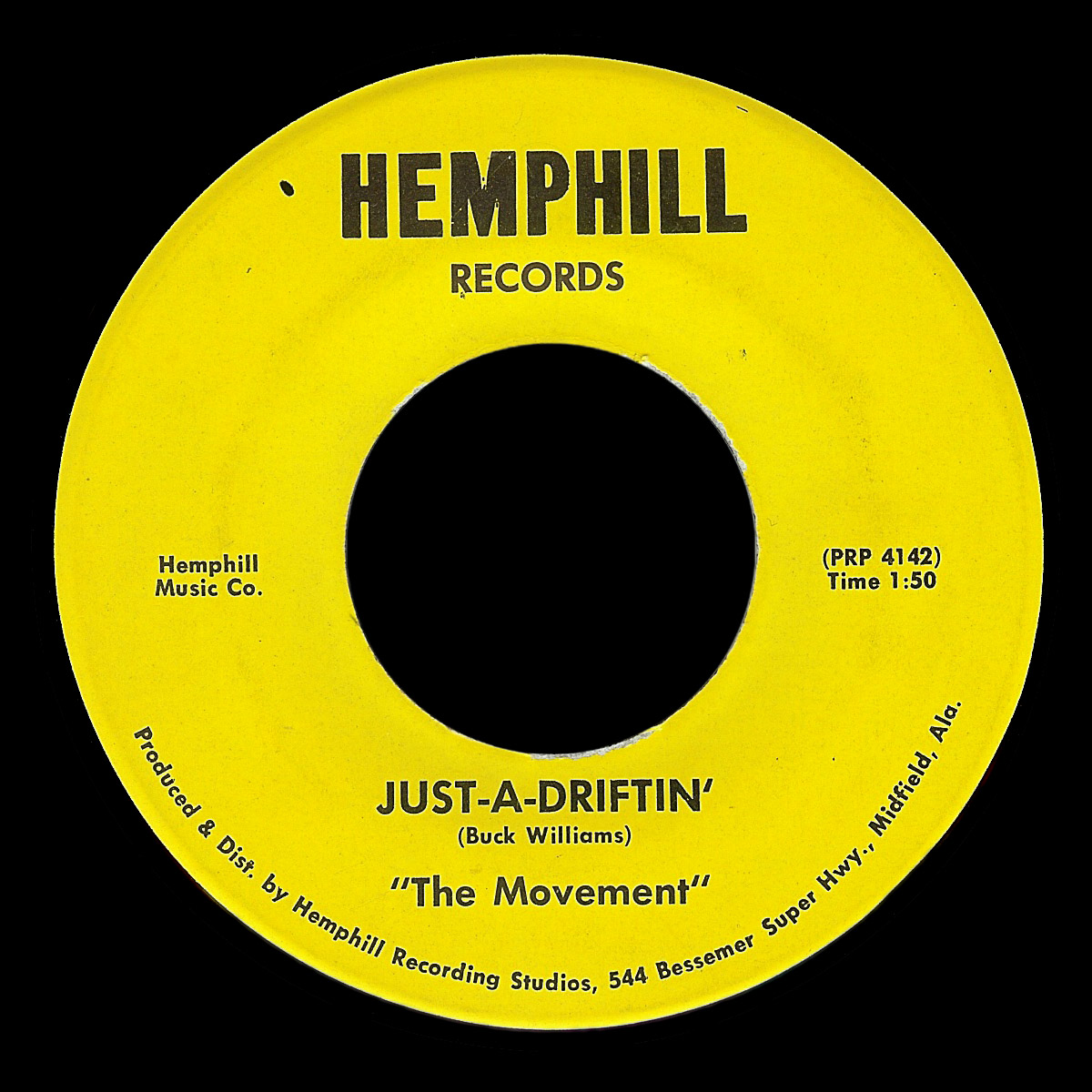
The Movement recorded two 45s at Hemphill Recording Studios in Midfield, Alabama, just southwest of Birmingham. The two singles were released within two months of each other, in July and August, 1968.

The first 45, “Green Knight” is a solid garage number with a good organ sound and rhythm section. The vocalist’s sputtering, garbled delivery as he says “I can’t keep from crying in the green night” is classic. There’s a fine harmonica break and a buzzing guitar solo takes the song to the fade-out.

It’s a shame that every copy of the 45 has a serious tape glitch (or mastering error) about 30 seconds into the song. The sound warbles just for a split-second, but it’s very noticeable.

The flip, “Stinking Peanut Butter Love” is one of the better nonsense b-sides I’ve heard, a parody of hippie Love-In chants with mantras like “tallyanna meat loaf”, repetitive piano, random drumming and a flushing toilet. It has it’s own minor mastering problem, a sudden rise in volume at the start of the song.

Both sides written by the Movement. There are no names on this Tinker Records label, but their second 45, released on Hemphill Studio’s own label gives Buck Williams as the writer of both sides. I don’t know who else was in the band.

“Just-a-Driftin'” has an echoing lead vocal over acoustic guitar, piano and organ, with whistling instead of harmonica. This doesn’t sound like a promising formula, but the results are good and lightly psychedelic. I haven’t heard the flip, “Dear Abby” but I’ve been told it’s a ballad.

Neal Hemphill owned Hemphill Studios, also known as the Sound of Birmingham, operating from 1966-1985. Hemphill released a couple 45s by the Mishaps, “Under My Thumb” / “One Too Many Mornings” and “Come On Up”, produced by Frank Lewis. A two-volume set, The Birmingham Sound: The Soul of Neal Hemphill compiles the soul and funk sounds of the studio.

Thank you to Rich Strauss for the scan of “Just-a-Driftin'”.

The Ramrods

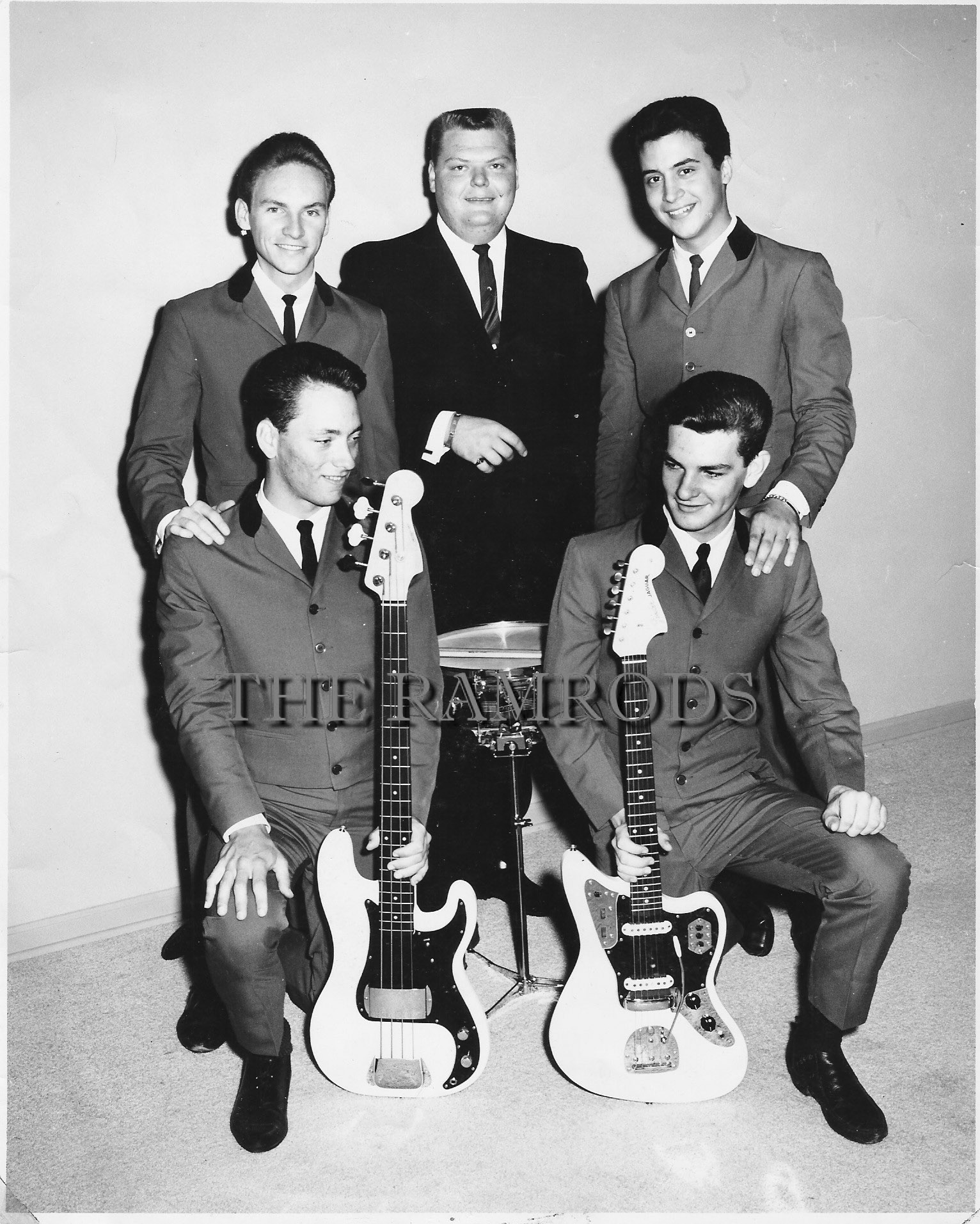
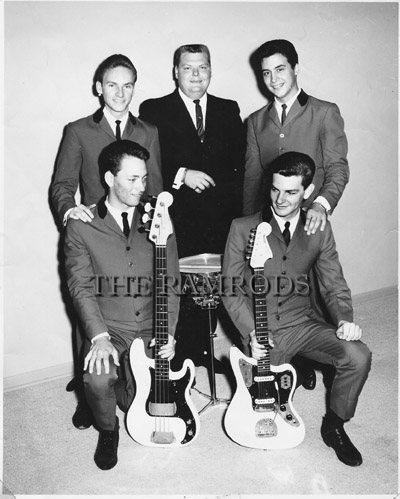
Ramrods band, Birmingham, Alabama

Jon Adair of the Ramrods and Mike from the Alabama Record Collectors Association wrote this history of the band, reprinted with permission. If anyone has a good scan of the Queen 45 or transfers of missing songs, please contact us.

The year was 1959. Five guys from Woodlawn High School in Birmingham, Joe Lackey (lead guitar and vocals) Butch Fadely (piano), Jim McCulla (drums) and Larry Wooten (rhythm guitar) had gotten together and decided to form a band of their own. Jon Adair, who was a friend of Joe’s, had already been in two bands, ‘The Teen Beats’ and the ‘The Ray Royster Combo.’ None of the other guys had ever played in bands. Of course, all of them were in their mid-teens, 13 to 15 years old.

Joe asked Jon to come and sit in with them at a practice, which he did, playing rhythm guitar. Later, Joe and the other guys went to Jon’s house and asked him to join the band. When Jon joined, the rhythm guitar player, Wooten, was sick and couldn’t make the first gig, so Jon played rhythm alone. When Wooten returned, both he and Jon played rhythm, which the band really didn’t need two of, but the band had no bass player, which it did need, so they asked Jon to play the bass. He knew nothing about the bass and told them he definitely could not afford to buy another guitar, but wanting to be in the band, Jon compromised. He removed the two high strings from his 6-string electric and tuned the remaining four strings down one octave. It worked well enough to get by. In fact, this is what was used later on their first record, “Fire Tower.” This is how they played until Wooten left the band and Jon moved permanently to rhythm. It was also about this time that Butch Fadely left the band to join the Army.
The band took the name, the Ramrods, from the Duane Eddy tune and even adopted that song as their opening number on every show.

There were not many local bands around at this time. The Roulettes, the Premiers, The Epics and now the Ramrods were just a very few. That, of course, would soon change, especially after the Beatles hit America in 1964. Bands began to pop up everywhere, but, for now, the Ramrods and these other few had a corner on the market.

Many member changes would soon take place in the Ramrods, including adding Paul Newman on vocals. The Ramrods also decided to add a saxophone player, so Ronnie Eades joined the band. Ronnie would later move to Muscle Shoals and become a prominent member of the Muscle Shoals Sound as a session musician.

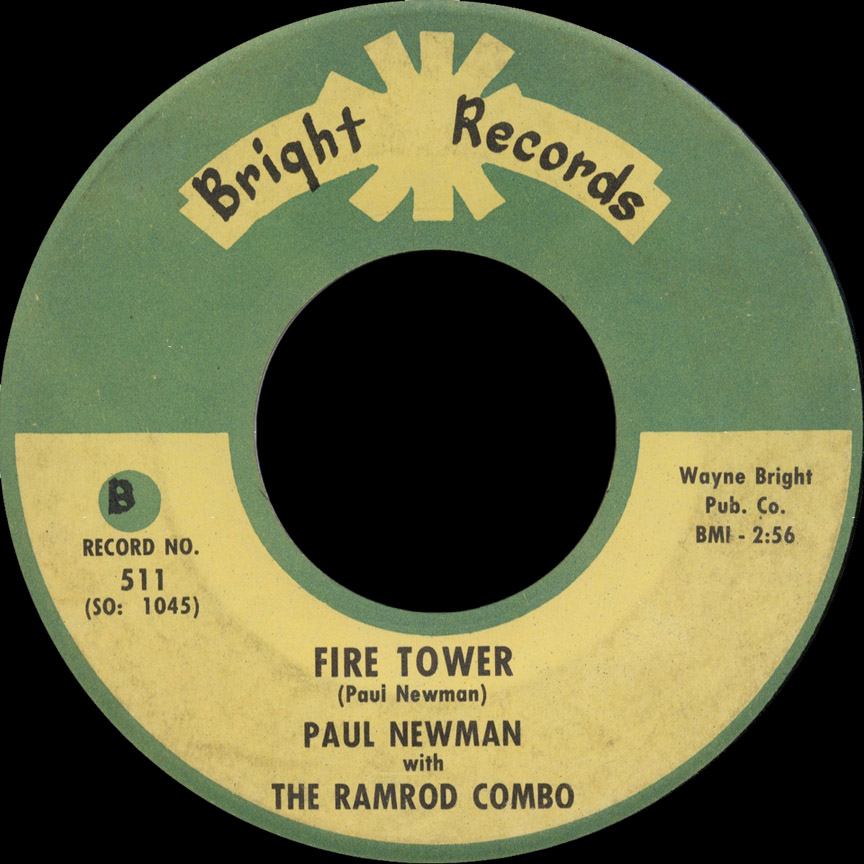
In 1961, a friend of a friend of a friend, met the Ramrods and wanted to record them. He, Wayne Bright, owned a recording studio in Muscle Shoals, “Bright Records.” The band agreed and laid down two tracks, “Fire Tower,” written by Paul Newman and “Sittin’ Alone,” written by Jon Adair. When the record was pressed, it had mistakenly listed the band as ‘Paul Newman and the Ramrod Combo’ instead of ‘The Ramrods.’
They soon followed with their second record, “Slee-zee,” b/w “Slouch-ee,” both written by Joe Lackey. These were recorded at Homer Milan’s studio at 1st Avenue and 20th Street in Birmingham in 1962. It was released on Queen Records, which was a subsidiary of King Records.

Member changes continued with the addition of Fred Guarino on drums, Johnny Mulkey on lead guitar, Frank Bethea on bass, Bubba Lathem on piano, Durwood Bright on sax and Dwight Anderson on sax. Bright would later play with the Townsmen and Anderson with the Tikis.

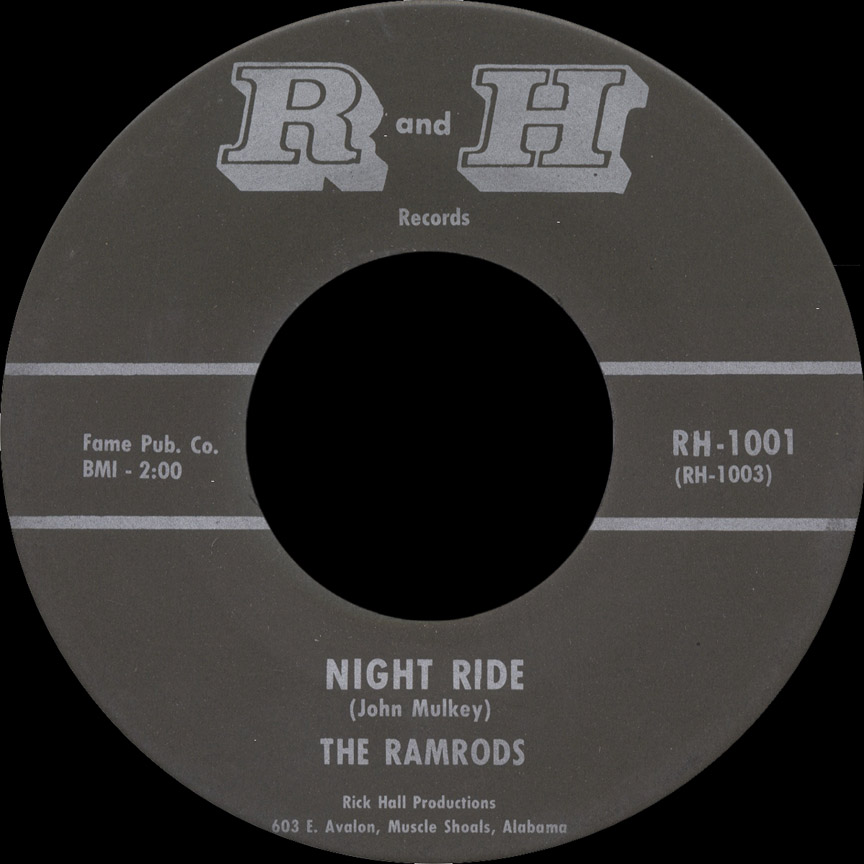
In 1963, the Ramrods went into Baldwin Recording Studio in Woodlawn, which they did quite often after shows to record various tunes. On this trip, they recorded two original songs, written by John Mulkey, “Night Ride” and “Moonlight Surf,” both surf sounding instrumentals. They took the tracks to Rick Hall, who ran Fame Recording Studio in Muscle Shoals. He liked them and agreed to press the songs. The band had thought that their songs would be on the Fame label, which, although still a local label, was fairly well known. However, Rick was starting a new label, R and H, and released the Ramrods on it. Theirs was the first record on this label, the label number being RH-1001. This was an obvious disappointment to the band not to have been on Fame, but Hall had done a good job of mixing and producing the record and the band was happy with the result.

“Night Ride” started as a ‘Pick Hit’ on WSGN in Birmingham in 1963, but soon made it to WSGN’s Top 40 where it remained for thirteen weeks, reaching as high as #5.

During the band’s tenure, they toured all over the southeast, playing the college circuit and other venues and either opened for or backed up major national artists. A short list includes Del Shannon, the Four Seasons, Arthur Alexander, Tommy Roe, Chris Montez, Roy Orbison and Charlie Rich, but there were many, many more.

Also during this time, they had played shows with another Alabama band, the Webs, from Dothan. One member of the Webs was a guy named Bobby Goldsboro. By 1963, the Webs were traveling with Roy Orbison as his backing band, which had been arranged by another Dothan guy, Buddy Buie. Of course, Buddy was becoming a well-known songwriter and record producer. He had also become Orbison’s tour manager as a bonus for getting the Webs with Roy.

Jon Adair remembers fondly one concert both groups played together at the Cloud Room (Cascade Plunge) in Birmingham. After the show was over and the band was putting their instruments in the car, Bobby took out his acoustic guitar, sat on the hood of a car and told the guys that he was working on a song which he hoped to record as a solo.

He played “See the Funny Little Clown,” written by Bobby. A short time later, it became Bobby’s break-out solo hit and reached #9 on Billboard in early 1964. Bobby was now a solo artist with many hits to follow.

By the time 1964 rolled around, the Ramrods had been together for almost five years. Only Jon Adair and Joe Lackey remained as the nucleus of the original band from 1959. Jon had joined the Navy on a deferred enlistment program as a senor in high school and when he graduated in 1963 had to go straight to boot camp. However, when he completed it, he returned home where he rejoined the band. In April of 1964, the Navy called him to active duty. It was only a few months later that the Ramrods decided to disband.

What had actually happened was that the Webs, minus Bobby Goldsboro, were now touring with Roy Orbison as his backing band. Roy renamed them the Candymen, after his song title, “Candy Man.” The Candymen would later form the nucleus of the Classics IV and then the Atlanta Rhythm Section. In late 1964, Buddy Buie, who was Roy’s tour manager, was itching to form a new band, one to help showcase his songs. He took three members of the Ramrods (Guarino, Mulkey and Latham) and members of the Webs, including Wilbur Walton and Jimmy Dean and formed the James Gang. They made several records, mostly written by Buddy, but their biggest song was “Georgia Pines,” co-written by Buie. This song was also recorded by the Candymen. Their version peaked at #81 on Billboard, but the James Gang version received more regional airplay.

As for the remaining members of the Ramrods, after finishing his stint in the Navy, Jon went into the business world, as did Joe Lackey and Frank Bethea. Other members, as already mentioned, played in various local bands for a while.

Sadly, we have lost a few of these guys over the years, Joe Lackey, Harry Looney and Fred Guarino. Who knows, maybe one day there will be a reunion of the remaining members.

The Ramrods can really be considered one of the pioneer bands in the Birmingham area, one who inspired many other young musicians who also began to form bands and become prominent artists in their own right.

The Omen & Their Luv

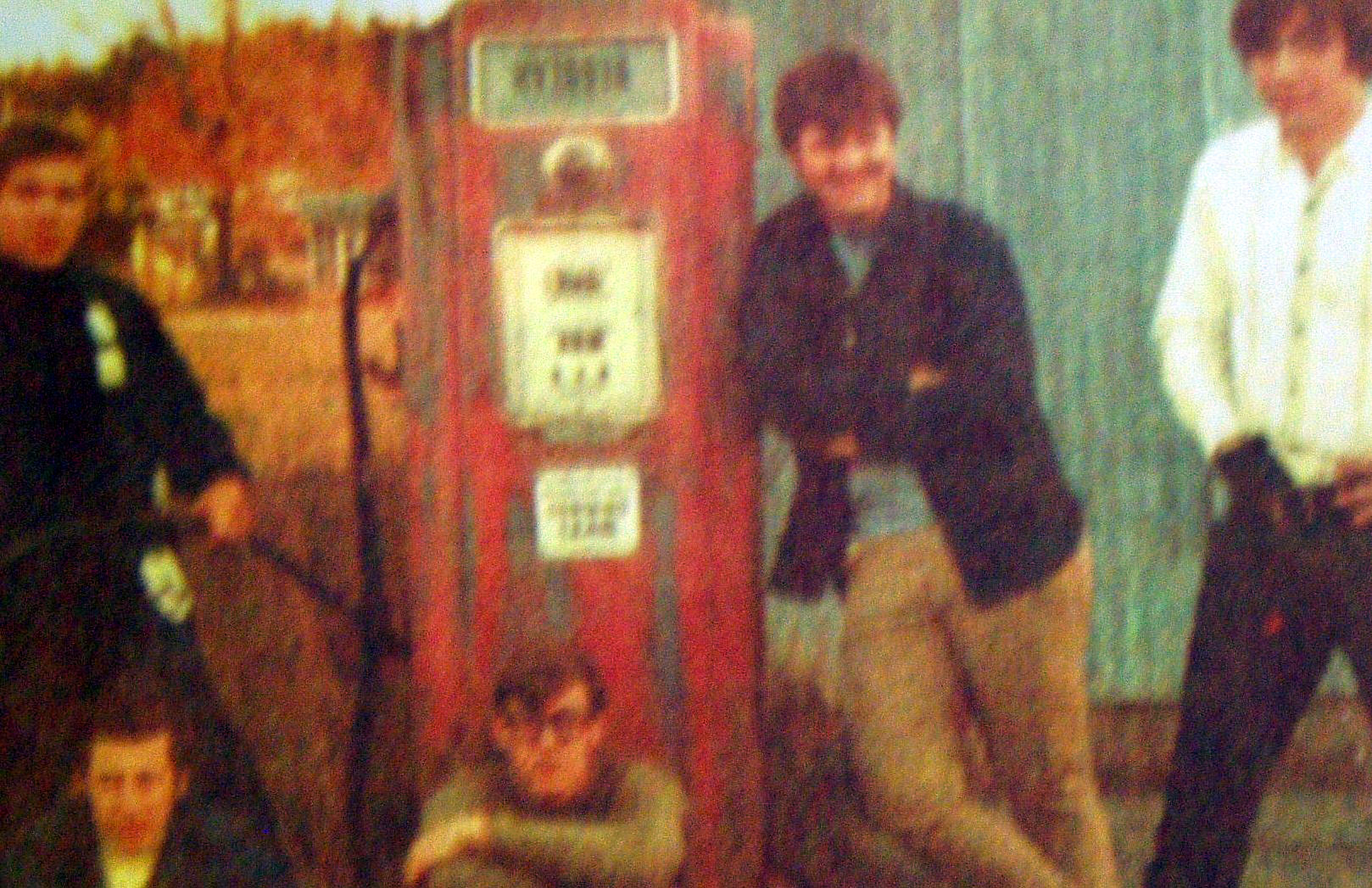
The Omen and Their Luv, 1967: Don McGlamery and Jeff Neighbors, Bill McClain, Bruce Hopper and Tommy Stuart
“We kicked out the horn players and went psychedelic” – The Omen and Their Luv, 1967
Front: Don McGlamery and Jeff Neighbors, back: Bill McClain, Bruce Hopper and Tommy Stuart

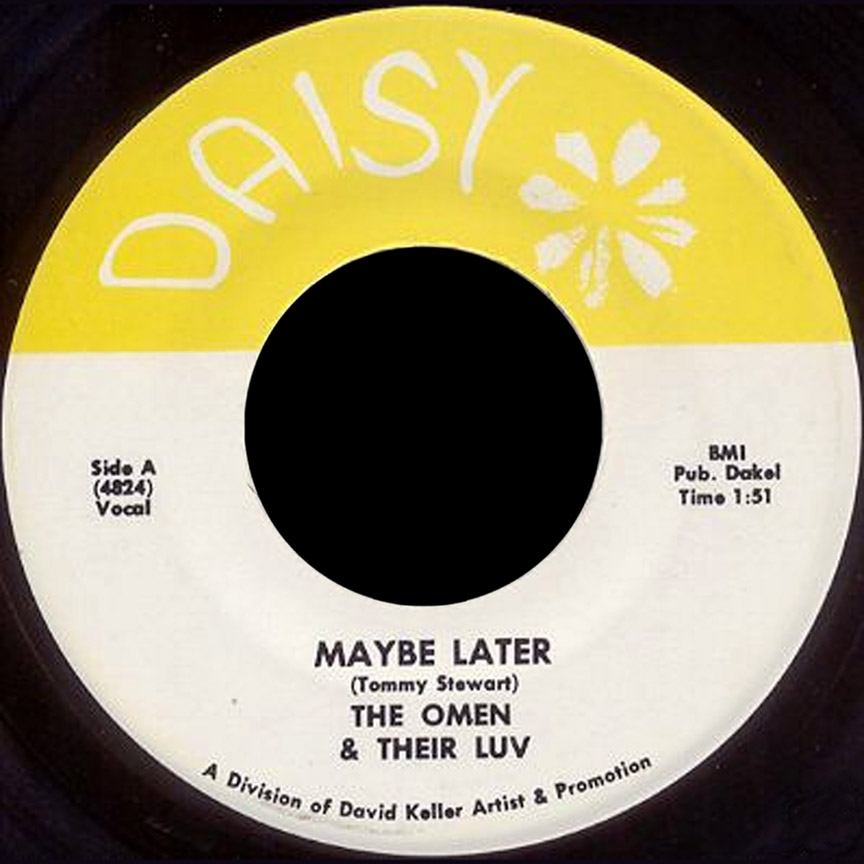
Omen and Their Luv released one of the best singles from Alabama during the ’60s. “Maybe Later” sounds fantastic – Tippy Armstrong’s buzzing guitar is all over the song while Tommy Stuart sings his too-cool-for-you lyrics. I especially dig the way he wails the end of each chorus:

Ain’t gonna get me in church
You try all you like, but it ain’t gonna work.
Not gonna go downtown
I’m staying out here where no pictures around

Gotta know you better baby,
And if I like you, well, maybe later!

Won’t thread the needle baby
Don’t wear your shoes and I think you’re crazy
Gonna be a cold day in June
Leave me alone I’m going to finish my tune

Need to know you better baby,
And if I like you, well, maybe later!

Need some time to think about it baby
And if I think real hard, well, maybe later!

Won’t pick flowers in the rain
Leave me alone and I’ll go back where I came,
I see a lot of things I need
And I need your love, but just as long as it’s free

Need some time to think about it baby
And if I think real hard, well, maybe later!

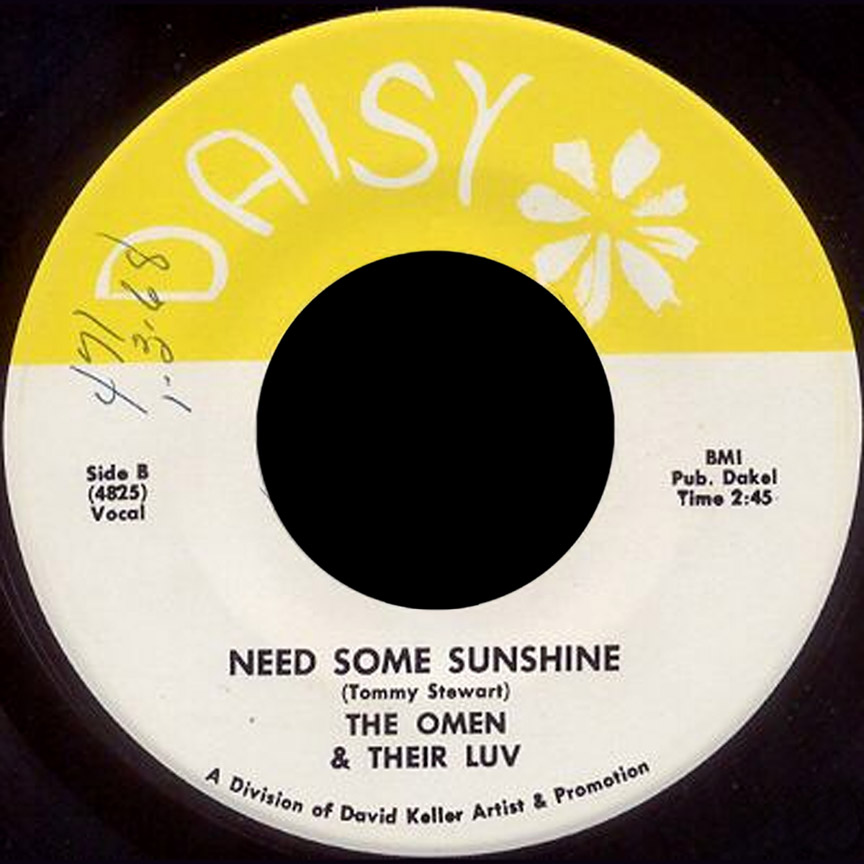
If “Need Some Sunshine” doesn’t catch you at first, wait until 1:22 into the song, when it shifts into a different time signature and, thanks to some eerie backing vocals, a whole other realm.

Bruce Hopper wrote to me about the group, and also sent some unreleased songs, including the fantastic “Another Girl” from the same sessions that produced “Maybe Later”. I’m including an excerpt of the songs here, in the hope that they can receive a proper release at some time in the near future.

I am the founder and former bass player for the Omen and Their Luv. I formed the O-men in 1966 with Fred Deloach. We were originally a 60’s white soul group with horns. The original lineup was myself on bass, Fred Deloach vocals and sax, Mike Hatchett on drums, David Popp on trumpet, Billy McClain on guitar and John Purdue on keyboards.

Omen & Their Luv Daisy 45 Maybe Later
Labels spell Tommy’s name “Tommy Stewart”

We went into the studio in the fall of ’66 and cut a six song demo tape: “Hold on I’m Coming”, “Hungry”, “Steppin’ Stone”, “Wooly Bully” (we were the opening act for Sam the Sham when he played Tuscaloosa), also two originals, “You” and “Hurry on Back” written by me and Fred Deloach. This tape was done at Boutwell’s “church” studio with Ed Boutwell doing the engineering. Boutwell Studios located in Birmingham was the only decent studio in central Alabama that recorded rock’n’roll. This tape I presented to Duane Allman (who liked it) and to Steve Caldwell of the Swinging Medallions / Pieces of Eight, whose dad, Earl Caldwell owned several clubs in Panama City Beach, Fl. This demo landed us a gig in Panama City working for Earl.The O-men would play a jam session at the Beach Party every day from 2-4. We would then open for the “Pieces of Eight ” at 8pm and do a set. They did a set and we would come back on at 10 for a set. Then we had one hour off to get down beach to the Cork & Bottle Club (later renamed the Red Rooster) for our regular gig of playing from midnight to 5am! This was our work schedule seven days a week for two months straight.

We added Tommy Stuart right before we started this gig. He had just left the Rubber Band after they had a hit with “Let Love Come Between Us” that Johnny Wyker wrote (later with Sail Cat). Tommy played sax, sang and played keyboards. Due to band stress, Fred left the band half way through the summer.

Omen & Their Luv Daisy 45 Need Some SunshineWhen we got back to Tuscaloosa, Mike brought Jimi Hendrix’s first album to practice and that changed everything. We switched from white soul to psychedelic rock. David Popp left on trumpet.

Because of the change to harder rock, we changed the name to The Omen and Their Luv. Hatchet moved to Atlanta and we brought in Jeff Neighbors on drums. We also added Don McGlamery on rhythm guitar and sax. This was the lineup in the pic by the gas pump.

We went into the studio in the fall of 1967 to record four of Tommy’s songs. Again we recorded at Boutwell’s Studio. Tommy Stuart wrote “Maybe Later” and sang lead vocals. We snuck some young girls in to sing backup, but their parents would never let them tour with us.

We brought in Tippy Armstong (later a studio musician in Muscle Shoals) to play lead guitar on all four songs. Since Tippy came to the session, Eddie Hinton (Muscle Shoals session man) showed up to visit and started telling Ed Boutwell how to mix. Boutwell got pissed and told Eddie to mix it. So “Maybe Later” ended up with some top notch studio guys helping us out.

I met David Keller when he was playing with The Preachers in 1967. After the Preachers, David had a booking agency that he ran out of Montevallo where he had attended college. He was wanting to expand into booking and producing and club ownership. He liked our tape and we were the first band he booked onto his Daisy label. “Maybe Later” was the A side and “Need Some Sunshine” was the B side. The record sales had minimal success, but the airplay led to great crowds at gigs promoted by Keller.

“Good Man” which was to be our next single, but it never happened under David Keller. “Another Girl” was to be the “B” side of our next release.

The Omen & Their Luv – Good Man (excerpt)
The Omen & Their Luv – Another Girl (excerpt)

He had a group of bands that included the Omen, The Outer Mongolian Herd and W.C. Doan and Co. that he booked. For a short while he opened a recording studio on 15th St. in Tuscaloosa where some of his bands recorded. He also started a club in Panama City in June of 1968 called the Head Shop. We were the opening act. For two weeks we played as The Omen and Their Luv, then we would play for two weeks as the Preachers doing their hit song “Inspiration”. Fun times.

David countined to book us across the South for at least a year. He also had the Shingaling Club in Selma, AL. We played there every Saturday night for at least six months until one night we let some black musicians sit in with us. The next Saturday we showed up and the Sheriff had put a pad lock on the door with a sign reading “Closed until further notice by order of the Sheriff of Dallas County”. Selma 1968!

 Omen and Their Luv, 1968, from left: Tommy Stuart, Mike Thornton, Jeff Neighbors and Bruce Hopper
Omen and Their Luv, 1968, from left: Tommy Stuart, Mike Thornton, Jeff Neighbors and Bruce Hopper
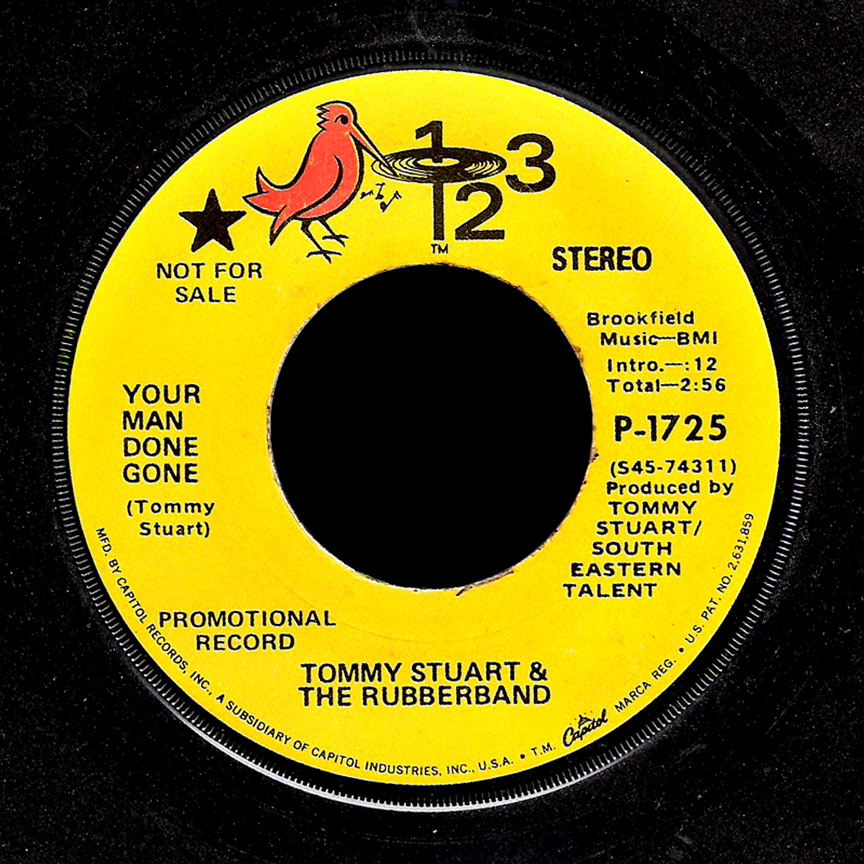
 The Rubber Band 45 "Your Man Done Gone" from 1970 featuring the last Omen lineup of Tommy Stuart, Mike Thornton, Bruce Hopper and Asa Gaston
The Rubber Band 45 from 1970 featuring the last Omen lineup of Tommy Stuart, Mike Thornton, Bruce Hopper and Asa Gaston

Billy left and was replaced by Mike Thornton from the Shadows. By 1969 we were down to a 4 piece as shown in the other photo. Bill Stewart (Allman Brothers Band) replaced Jeff for about six months and then Asa Gaston (Locust Fork Band) came in on drums.

The four piece of Stuart, Hopper, Thornton, and Gaston went on to re-aquire the name Rubber Band which Stuart owned the copyright on (Tommy later sued and won a copy right infringement case against Bootsy’s Rubberband). We recorded on 1 2 3 Records [“Your Man Done Gone” / “Peeking Through Your Window”] with Tommy playing keyboards, flute, sax and doing the lead vocals. Unfortunately our song had the exact same rhythm and chord changes as “Spirit in the Sky” which was released one week before our song.

We did an east coast tour the summer of 1970. Things were falling apart by that time. Mike Thorton left and was replaced by Tommy Joe White. Asa didn’t want to do the tour because he just got married, so we added a session drummer from Colorado for the tour. I left the group after the tour.

Asa and I later formed another local band with Jim Coleman (check out his website) and Jimmy Butts. We were known as Mr. Wizard and recorded a one hour special for Alabama PBS. More bands in the 70’s. Owned the Chukker in Tuscaloosa in the 80’s and promoted music for years. Now I back up Carroline Shines, the daughter of blues legend Johnny Shines.

Mike Hatchett later went on to play with the Brick Wall out of Atlanta and worked as a roadie for Little Feat and George Jones and many others including Kiss, Ronnie Milsap, Blue Oyster Cult, etc. Billy McClain died of cancer after a succesful photography career. Don McGlamery later moved to Norway and was a succesful street muscian there. [ChasKit: Don passed away in January, 2006].

I have been listening to our body of work with the Omen, Omen & Their Luv and the Rubber Band and am going to talk with Tommy about doing a retrospective CD of all the material from the ’60’s and 1970.

Bruce Hopper

In a comment on the post about the Preachers, Tommy Stuart added:

We’d recorded it on our own but a disc jockey from Northport knew David & that’s how all of that happened. He had a big teen dance place in Panama City in about 1968 & we played there as The Preachers, & also a one nighter or two that way. It was a little weird but we learned their record “Hallowed Ground” & got up there & I sang it like it was mine. Later, I bought Dave’s screaming white Hammond M2 organ he’d used in the Preachers.

Tommy Stuart has a new group called O-Men and Their Luv, with a CD No Twin.

Thank you to Bruce Hopper for sending in the photos and song transfers and for patiently answering my questions.

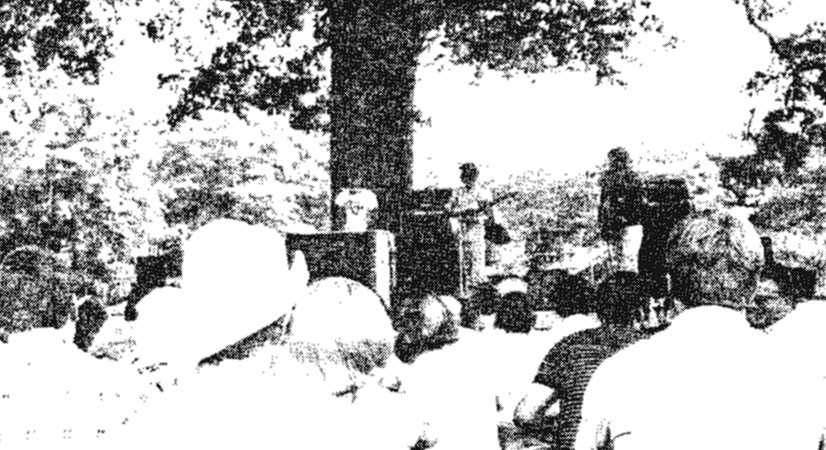
Omen & Their Luv on the Quad at the University of Alabama: Tommy Stuart, Mike Thornton, Asa Gaston and Bruce Hopper.
On the Quad at the University of Alabama. From left: Tommy Stuart, Mike Thornton, Asa Gaston and Bruce Hopper.

The Versatiles

The Versatiles were from Mobile, Alabama. They played at The Happening and the Stork Club, among other venues. Members were:
Daryl Huffman – lead guitar, keyboards
Jerry Smith – guitar
David Smith – bass
P.J. Johnston – drums

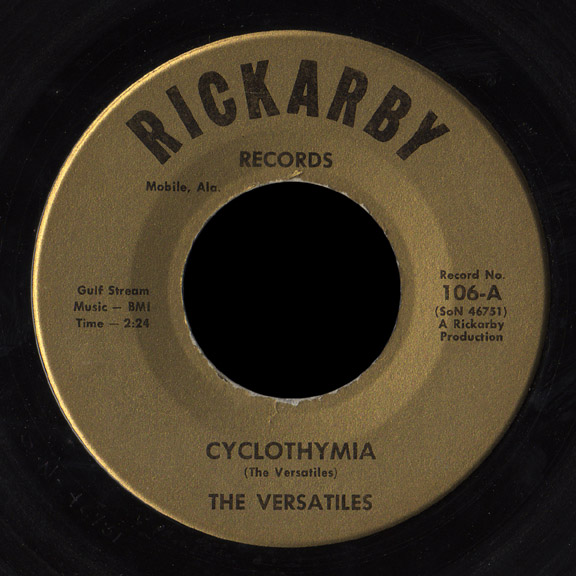
Darryl Huffman’s distorted tone and wailing lead distinguishes the top side of their first record, “Cyclothymia”. The title refers to a mild form of manic-depression, with lyrics to match.

If released as I’ve read in September 1967, then it was a heavy sound for its time. Of the four songs they released, this was the only one written by the group. The flip is a cover of Brian Wilson’s “Farmers Daughter”.

One unusual aspect about the band is that there seems to be no real lead singer, as they sing all four songs from their singles in unison, both verse and chorus.

Their second 45 on Rickarby, “Somethin’ Like A Man” starts out like “Cyclothymia” with intense drumming and riffing. Huffman plays leads behind the verses, while the lyrics (excerpted below) could be described as anti-war, but seem to me to be more ambiguous:

What is a man?
Does he knows what’s happening when he sees,
The world and all its atrocities?
Yes he does.
Now ain’t that something like a man?
He only does what he has to, when he can.

What does he do when the world is tilting right?
Picks up his gun and he runs to join the fight.
Does he know which side he’s fighting for,
Or is it just an excuse to join the war?
Don’t you agree that he’s something like a man?

Does he know just what to say?
Does he get down on his knees and pray?
Is he aware of the life that he’ll have to take,
To protect his home for his family’s sake?
Yes he is.
Now ain’t that something like a man?
He only does what he has to, when he can.

“Warm In The Rain” has a lighter sound, with ringing guitar notes. Both of the songs on their second 45 were written by Clarence Previto (Tony Previto).

The Torquays

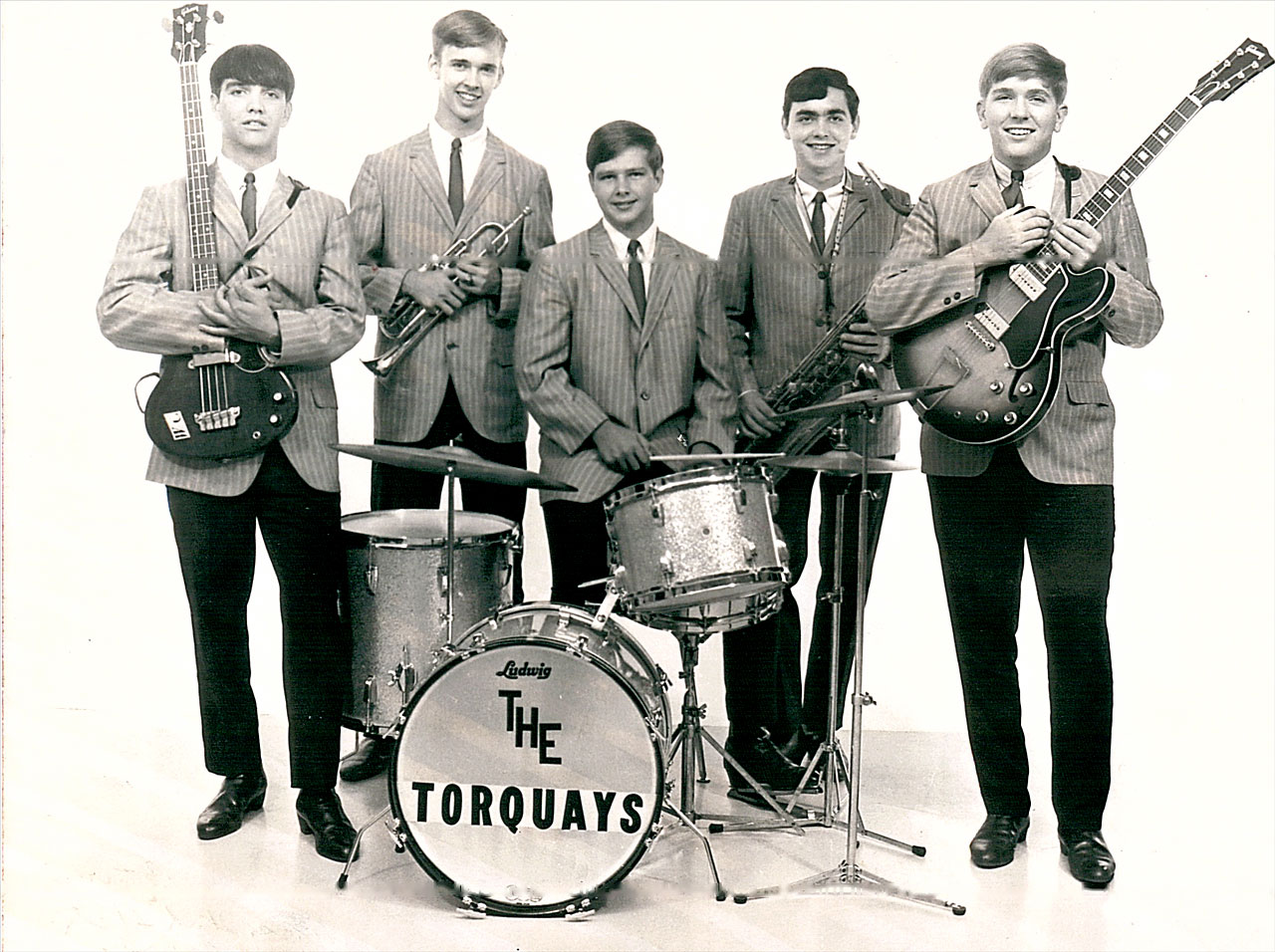
The Torquays, from left: Wendell Colbert, Barry Bicknell, Eugene Hayes, Steve Salord and Dale Aston

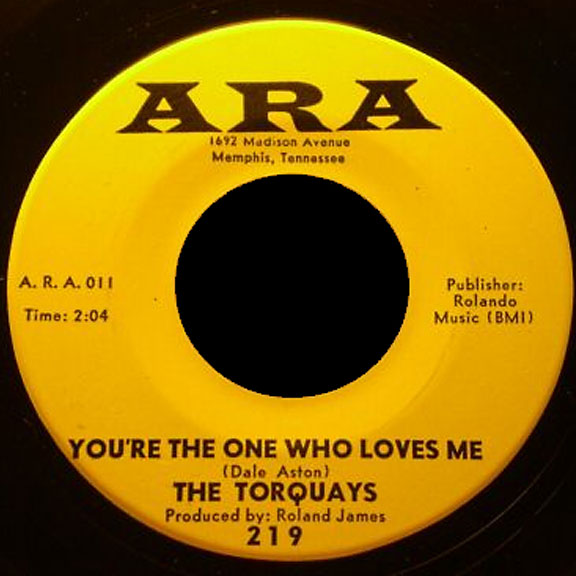
Torquays ARA 45 You're the One Who Loves MeThe Birmingham, Alabama based Torquays were formed in 1963 by two friends, Dale Aston and Wendell Colbert. Influenced by early rock and roll, Dale taught himself to play the guitar. Wendell also played guitar. They took the band’s name Torquays after a town in England and a song by The Ventures of that name. The initial band had several members, but eventually dwindled down to five, Dale on guitar and lead vocals, Wendell on bass, Barry Bicknell on trumpet, Eugene Hayes on drums and Steve Salord on sax.

The Torquays made two records. The first, “While I’m Away” was written by Aston backed by a great doo wop sounding “Pineapple Moon”. These were recorded in Muscle Shoals at Fame Studios and released on the Holly label. Both sides got significant air play in the Birmingham area. The second record, “You’re The One Who Loves Me” (also written by Aston) was recorded in Memphis. They played steadily all throughout the southeast, but disbanded in 1968. Dale and Steve went on to play with the Distortions, another popular Birmingham band.

The introduction above is from the Alabama Record Collectors Association, who suggested I cover the Torquays and put me in touch with guitarist, lead vocalist and songwriter Dale Aston. It’s notable that the Ara 45 was produced by Roland Janes, probably recorded at his Sonic Sound studio where he also produced sides by Travis Wammack. Dale kindly answered my questions about the band:

Dale Aston and Wendell Colbert were 14 years old and their fathers worked at US Steel together in Birmingham. Both were starting to take guitar lessons and began practicing together. After a while they added a drummer (Eddie Rice) and bass player (Gary Quattlebaum). From there the band grew to a six piece dance group playing Motown and other R&B Top Forty hits of the day.

We played the Sock Hop circuit around Alabama which included National Guard Armories and Rec Centers in Birmingham, Sylacauga, Childersburg, Guntersville, Lanett, Huntsville, Montgomery and Columbus, GA. We played the Boutwell Auditorium in Birmingham, many fraternity and soroities at University of Alabama, Auburn, University of Georgia as well as private parties for large companies and organizations. Around Alabama we were a back up band for acts like Billie Joe Royal; Chuck Berry; Bobby Goldsboro; Freddie Cannon and Travis Wammack.

We were best friends with the Distortions and competed with all of Birminghams’ many local area bands like the Rockin Rebellions, The Counts, The Premiers and others.

Dale Aston wrote and produced the original material (“While I’m Away”; “The One Who Loves Me”) and the songs were recorded at Fame Studios in Muscle Shoals, Alabama and at studios in Memphis, TN. We also used Boutwell Studios in Birmingham.

We were introduced to Roland Janes by Travis Wammack. We had been backing Travis a number of times and we became friends. He had a tune or two he had written and wanted us to record so he invited us to Memphis and provided the studio time because we were recording his songs. This was just after the Boxtops hit #1 with “The Letter” and I think Roland and Travis were searching for new talent. They produced the record “You’re the One Who Loves Me” on ARA but I never knew how much distribution it received.

“While I’m Away” received good airplay in the Birmingham area and reach the #1 requested song on a radio station in Jacksonville, Florida. Our other records received some airplay in Birmingham due to our local fan following. In those days bands did not sell records at their live performances but through local record stores like Rumore Records in Birmingham. I guess we were too busy setting up, playing and loading the equipment for the next gig.

Once The Chartbusters came to Birmingham for a concert at WSGN radio for Dave Roddy. Their lead guitar player had to quit the tour unexpedtedly leaving the band without a guitarist for the remainder of the tour. Dave Roddy set up auditions for a few local guitarists for the job. I was offered the position but had to make a career decision since I had been accepted at the University of Alabama for the Fall semester whether to go on the road with The Chartbusters or go to college. I finally decided to go to college and have never regreted it. However, I often wonder what my life would have been like had I chosen to go on tour!

We became burned out after practicing and working together virtually every weekend for four years. Eugene Hayes (drummer) quit music. Barry Bicknell graduated with a degree in music from University of Alabama and became a high school band director. Steve Salord went to the University of North Texas and earned a Masters degree in music theory. Wendell Colbert continued palying with other bands and still palys today. I graduated from the University of Alabama with a BA in Commerce and Business Administration and went into the National Guard. After active duty I formed a small three piece group (The Brood) to play occasionally. I got married and started a career in Consumer Electronics sales and management.

I am still involved in music as a hobby at home and love to record on my PC. I use Sonar software. Here’s a link to some of my recordings.

Dale Aston

Special thanks to the Alabama Record Collectors Association