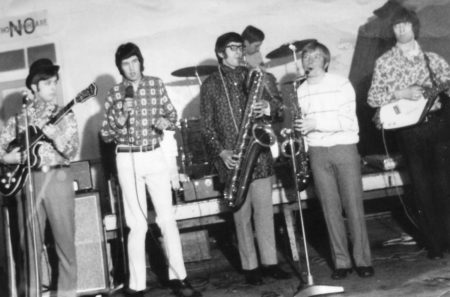
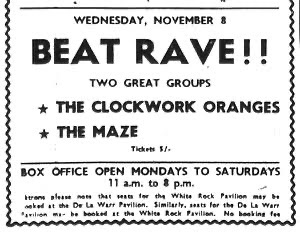
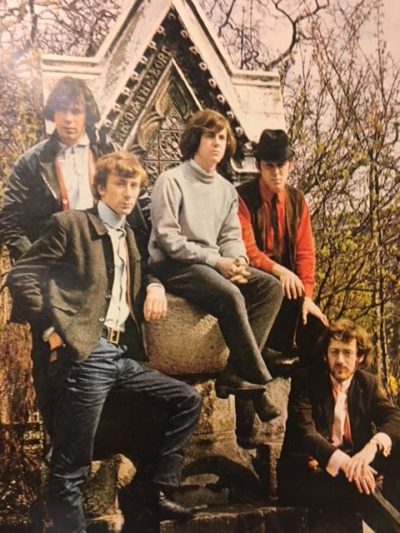
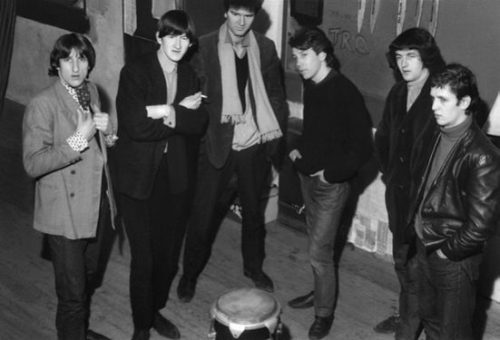
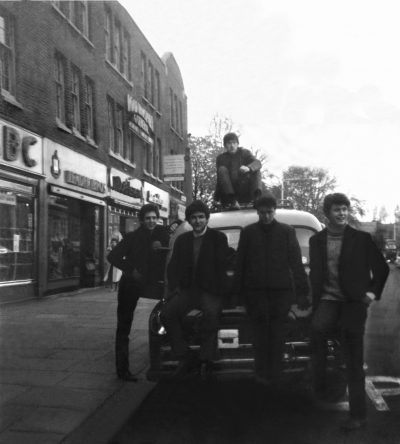
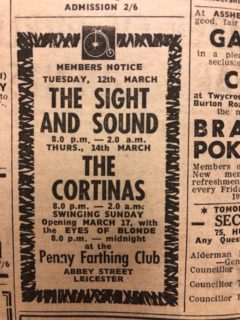
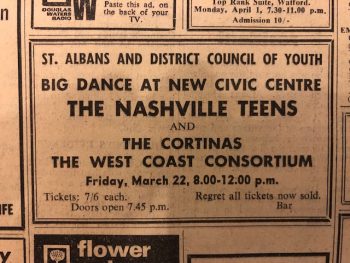
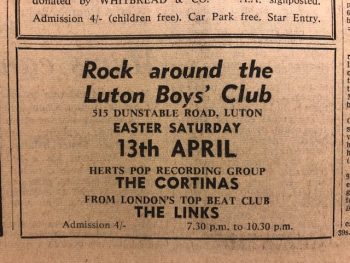
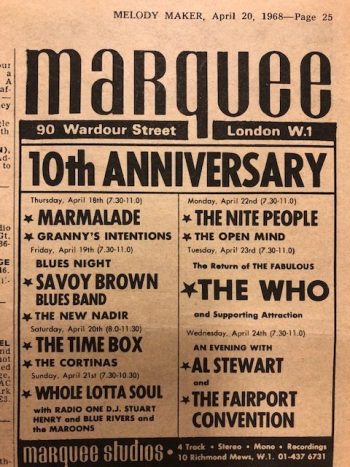
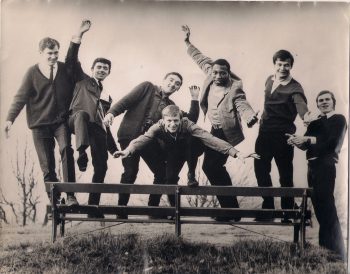
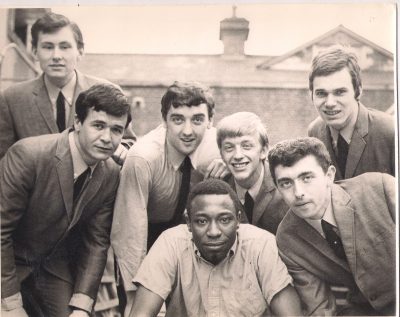
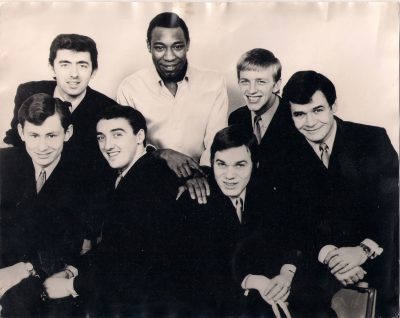
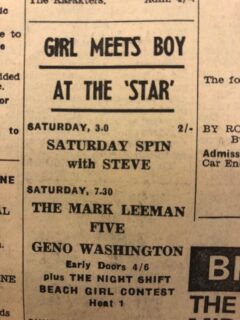
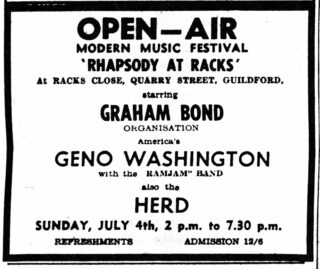
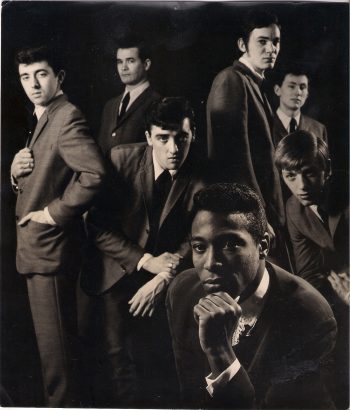
Formed by Valentine and Parish in early 1968 when The Clockwork Oranges broke up, Brian Brockie had previously played with The Honey Band. The group played at the Witchdoctor in Catford and on one occasion (most likely 17 February), they supported Marmalade.
Thanks to Robert Valentine for the photo and history
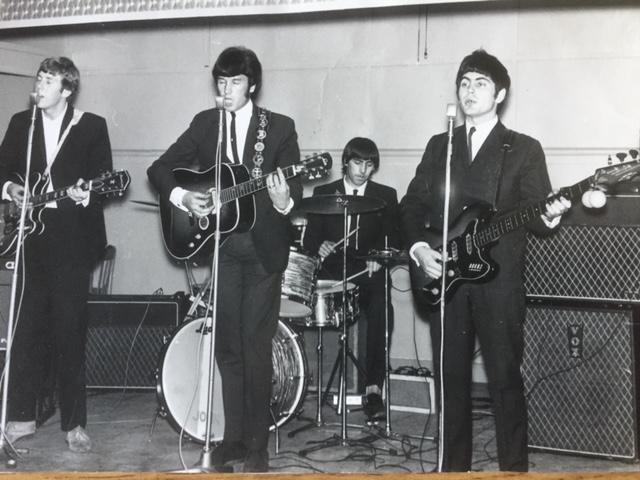
Roger Cotton (lead guitar/keyboards/vocals), Robert Valentine (rhythm guitar/vocals), John Parish (drums) and Harry Blakey (bass/vocals). Thanks to Robert for the photo.
Robert Valentine (rhythm guitar/vocals)
Roger Cotton (lead guitar/keyboards/vocals)
Harry Blakey (bass/vocals)
John Parish (drums)
The Clockwork Oranges were formed in early 1964 and were based in southeast England, playing various ballrooms, clubs and dances. When the band split up in 1967, Roger Cotton went on to join Johnny Johnson’s Bandwagon, Brothers Grimm, Peter Green’s Splinter Group, and Buddy Whittington, playing keyboards. Robert Valentine and John Parish formed The Button Hole Band. Cotton passed away in 2016 but the remaining three are still around and Valentine continues to perform.
Late 1967 gig in Hastings, East Sussex. Thanks to Robert Valentine
Many thanks to Robert for providing information about the band
Welcome to another posting of a series of gig listings for 1960s bands. None of these lists is exhaustive and my idea is to add to them in the comments section below over time. They are here for future researchers to draw on. I have also added a few interesting bits of information and will add images in time.
I’d like to encourage band members to get in touch to share memories, or for anyone to send corrections/clarifications to my email: Warchive@aol.com
Equally important, if you attended any of the gigs below or played in the support band, please do leave your memories below in the comments section for future historians to use. If you know of any missing gigs, please add them too, if possible, with the sources.
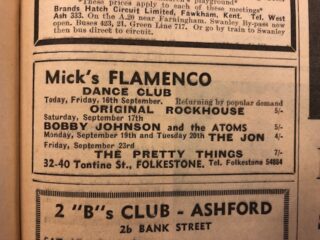
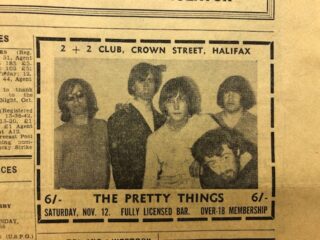
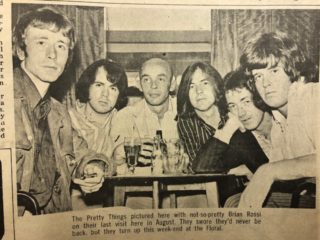
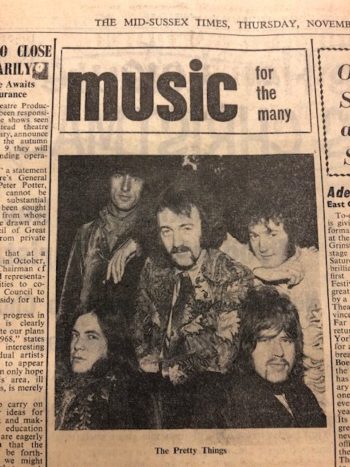
Photo may be subject to copyright. The Pretty Things, spring 1965
Formed in September 1963, The Pretty Things’ original line up comprised:
Phil May (lead vocals)
Dick Taylor (lead guitar)
Brian Pendelton (rhythm guitar)
John Stax (bass/harmonica)
Pete Kirtley (drums)
Around November 1963, Viv Andrews (aka Viv Broughton), who’d been working with David Bowie in The Hooker Brothers replaced Kirtley.
1964
3 January 1964 – 100 Club, Oxford Street, central London with The Mike Cotton Band (Rieks Korte’s research)
7 January 1964 – 100 Club, Oxford Street, central London with Acker Bilk, Kenny Walsh & Walsh Band (Rieks Korte’s research)
9 January 1964 – 100 Club, Oxford Street, central London with The Mike Cotton Band (Rieks Korte’s research)
14 January 1964 – 100 Club, Oxford Street, central London with Douggie Richford’s London Jazzmen (Rieks Korte’s research)
16 January 1964 – 100 Club, Oxford Street, central London with Bob Wallis’ Storeyville Jazzmen (Rieks Korte’s research)
21 January 1964 – 100 Club, Oxford Street, central London with Monty Sunshine’s Jazz Band (Rieks Korte’s research)
23 January 1964 – 100 Club, Oxford Street, central London with The Animals and Jimmy Powell & The Dimensions (Rieks Korte’s research)
28 January 1964 – 100 Club, Oxford Street, central London with Georgie Fame & The Blue Flames, Manfred Mann, Alexis Korner, Jimmy Powell, John Mayall’s Bluesbreakers, Zoot Money, Long John Baldry & The Hoochie Coochie Men, The Animals, The Yardbirds and others (Rieks Korte’s research) Cyril Davies benefit concert
30 January 1964 – 100 Club, Oxford Street, central London with Jimmy Powell & The Five Dimensions and The Wes Minster 5 (Rieks Korte’s research)
4 February 1964 – 100 Club, Oxford Street, central London with Graham Bond’s R&B Quartet and The Art Wood Combo (Rieks Korte’s research)
6 February 1964 – 100 Club, Oxford Street, central London with Alex Harvey’s Soul Band and John Lee & The Groundhogs (Rieks Korte’s research)
11 February 1964 – 100 Club, Oxford Street, central London Graham Bond’s R&B Quartet and The Art Wood Combo (Rieks Korte’s research)
13 February 1964 – 100 Club, Oxford Street, central London with Jimmy Powell & The Five Dimensions and The Wes Minster 5 (Rieks Korte’s research)
18 February 1964 – 100 Club, Oxford Street, central London with The Animals and The Wes Minster 5 (Rieks Korte’s research)
20 February 1964 – 100 Club, Oxford Street, central London with Jimmy Powell & The Five Dimensions and John Lee & The Groundhogs (Rieks Korte’s research)
21 February 1964 – Ricky Tick, Star & Garter, Windsor, Berkshire (Ricky Tick website: https://www.rickytick.com/)
25 February 1964 – 100 Club, Oxford Street, central London with The Animals and The Art Wood Combo (Rieks Korte’s research)
27 February 1964 – 100 Club, Oxford Street, central London with Jimmy Powell & The Five Dimensions and John Lee & The Groundhogs (Record Mirror)
Photo may be subject to copyright
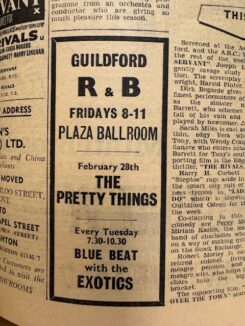
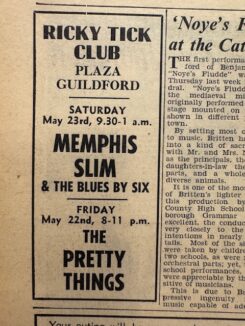
28 February 1964 – Ricky Tick, Plaza Ballroom, Guildford, Surrey (Ricky Tick website: https://www.rickytick.com/)
3 March 1964 – 100 Club, Oxford Street, central London with The Animals and John Lee & The Groundhogs (Rieks Korte’s research)
5 March 1964 – 100 Club, Oxford Street, central London with The Alex Harvey Soul Band and The Wes Minster Five (Rieks Korte’s research)
12 March 1964 – 100 Club, Oxford Street, central London with Graham Bond’s R&B Quartet and Gene Latter & The Cousins (Record Mirror)
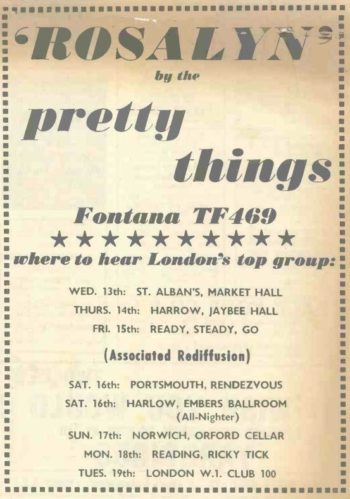
17 March 1964 – 100 Club, Oxford Street, central London with The Animals and John Lee & The Groundhogs (Rieks Korte’s research)
Photo may be subject to copyright
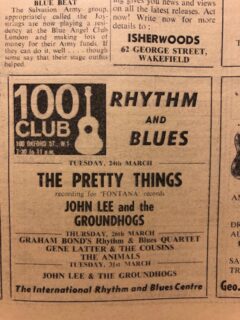
24 March 1964 – 100 Club, Oxford Street, central London with John Lee and The Groundhogs (Record Mirror/Clapham News)
Photo may be subject to copyright
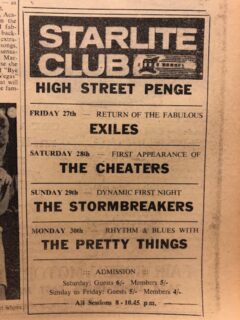
30 March 1964 – Starlite Club, Penge, Kent (Clapham Advertiser)
31 March 1964 – 100 Club, Oxford Street, central London with The Animals and John Lee & The Groundhogs (Record Mirror)
7 April 1964 – 100 Club, Oxford Street, central London with The Falling Leaves (Record Mirror)
Photo may be subject to copyright
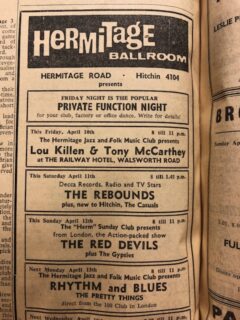
13 April 1964 – Hermitage Ballroom, Hitchin, Hertfordshire (Hertfordshire Express)
14 April 1964 – 100 Club, Oxford Street, central London with The Mark Leeman Five and The Tridents (Record Mirror)
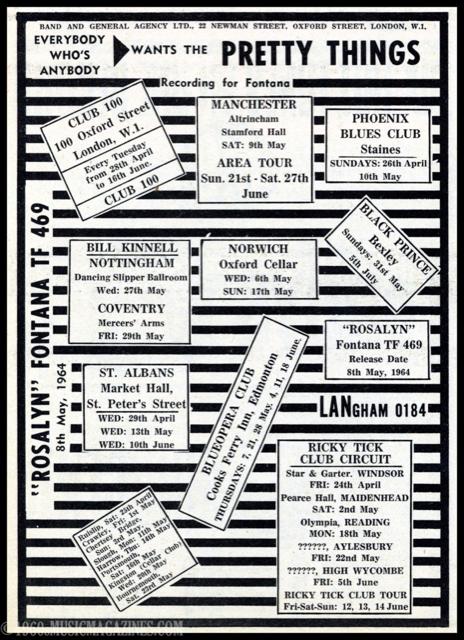
15 April 1964 – Market Hall, St Albans, Herts (Record Mirror)
19 April 1964 – Phoenix Blues Club, Staines, Middlesex (Record Mirror)
Record Mirror’s 18 April issue, page 8 has a picture of the Viv Andrews’ line up
21 April 1964 – 100 Club, Oxford Street, central London with The Art Wood Combo and The Impacts (Record Mirror)
24 April 1964 – Ricky Ticky, Star & Garter, Windsor, Berkshire (Record Mirror)
25 April 1964 – Gig in Ruislip, Middlesex (Record Mirror)
26 April 1964 – Phoenix Blues Club, Staines, Middlesex (Record Mirror)
Thanks to John Warburg for sending. Source: Record Mirror. Photo may be subject to copyright
Record Mirror reported that The Pretty Things played at the 100 Club every Tuesday from 28 April to 16 June
Towards the end of April 1964, Viv Prince took over from Viv Andrews on drums
28 April 1964 – 100 Club, Oxford Street, central London with The Art Wood Combo and The Muleskinners (Rieks Korte’s research)
29 April 1964 – Market Hall, St Albans, Herts (Record Mirror)
30 April 1964 – ABC Croydon, Croydon, Surrey with Billy Fury, Dave Berry & The Cruisers, Brian Poole & The Tremeloes, The John Barry 7 and The Zephyrs (Chris Broom book: Rockin’ and Around Croydon)
1 May 1964 – Gig in Crawley, West Sussex (possibly Starlight Ballroom) (Record Mirror)
Record Mirror reported in its 2 May issue that Viv Prince was on drums but the picture shows Viv Andrews
26 May 1964 – 100 Club, Oxford Street, central London with The Harps (Rieks Korte’s research)
27 May 1964 – Dancing Slipper, Nottingham (Beat Monthly)
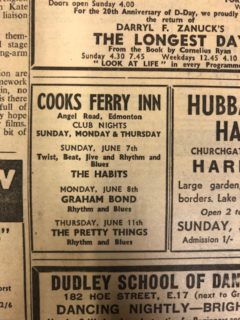
28 May 1964 – Blue Opera Club, Cooks Ferry Inn, Edmonton, Middlesex (Leyton and Leytonstone Guardian/Walthamstow Guardian)
29 May 1964 – Mercers Arms, Coventry (Coventry Evening Telegraph)
30 May 1964 – Rivieria, St Austell, Cornwall (Beat Monthly) This seems implausible considering the geographical distance from Coventry and then to Bexley the next day
31 May 1964 – Black Prince Hotel, Bexley, Kent (Record Mirror)
Photo may be subject to copyright
1 June 1964 – Hermitage Ballroom, Hitchin, Hertfordshire (Hertfordshire Express)
2 June 1964 – 100 Club, Oxford Street, central London with The Art Wood Combo (Rieks Korte’s research)
3 June 1964 – Forum, Oxford (Beat Monthly)
4 June 1964 – Blue Opera Club, Cooks Ferry Inn, Edmonton, Middlesex (Leyton and Leytonstone Guardian/Walthamstow Guardian)
5 June 1964 – Ricky Ticky, High Wycombe Town Hall, High Wycombe, Bucks (Bucks Free Press/Ricky Tick website: https://www.rickytick.com/)
6 June 1964 – Rhodes Centre, Bishop’s Stortford, Herts with Johnny & The Starliners (Steve Ingless book: The Day Before Yesterday)
8 June 1964 – Assembly Hall, Walthamstow, north London (Beat Monthly)
9 June 1964 – 100 Club, Oxford Street, central London with The Art Wood Combo (Rieks Korte’s research)
10 June 1964 – Market Hall, St Albans, Herts (Record Mirror)
Photo may be subject to copyright
11 June 1964 – Blue Opera Club, Cooks Ferry Inn, Edmonton, Middlesex (Leyton and Leytonstone Guardian/Walthamstow Guardian)
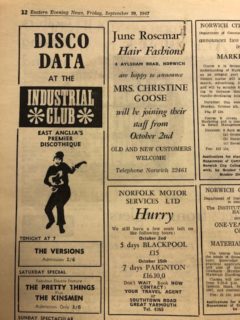
3 July 1964 – Hoveton, Wroxham, Norfolk with Rod Harvey & The Drifting Strangers (Eastern Evening News) Beat Monthly has a gig in Wrexham, north Wales on this date
4 July 1964 – Gig in Rawtenstall (Beat Monthly)
5 July 1964 – Black Prince Hotel, Bexley, Kent (Record Mirror)
6 July 1964 – Gig in Harrow, Middlesex (most likely Big Beat Club) (Beat Monthly)
7 July 1964 – 100 Club, Oxford Street, central London with The Farinas (Rieks Korte’s research)
8 July 1964 – Gig in Norwich, Norfolk (Beat Instrumental)
9 July 1964 – Gig in Southsea, Hants (Beat Instrumental)
10 July 1964 – Gig in Plymouth, Devon (Beat Instrumental)
11 July 1964 – Berkeley Grill Crawdaddy Club, Coventry with The Sorrows (Coventry Evening Telegraph)
16 July 1964 – Majestic, Hanley, Staffordshire (Beat Monthly)
17 July 1964 – Winchester Lido, Winchester, Hampshire with The Missing Links (Hampshire & Berkshire Gazette)
18 July 1964 – Assembly, Manchester (Beat Monthly)
19 July 1964 – Southall Community Centre, Southall, Middlesex (Beat Monthly)
20 July 1964 – Big Beat Club, Harrow, Middlesex (Beat Monthly)
21 July 1964 – 100 Club, Oxford Street, central London with The Farinas (Rieks Korte’s research)
24 July 1964 – Majestic, Crewe, Cheshire (Rieks Korte’s research)
25 July 1964 – Caribbean Club, Radcaster, Leeds, West Yorkshire (Rieks Korte’s research)
26 July 1964 – Belle Vue, Manchester (Rieks Korte’s research) Beat Monthly has the band playing at the Bromley Court Hotel in Bromley, Kent on this date
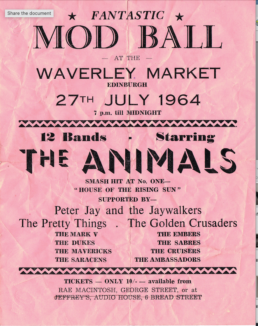
Photo from William Nisbeth
27 July 1964 – Mod Ball, Waverley Market, Edinburgh, Scotland with The Animals, Peter Jay & The Jaywalkers and nine local bands (William Nisbeth recollections/poster) Nisbeth, who was a member of one of the support groups says The Animals didn’t turn up for the show and that the crowd tried to storm the stage when The Pretty Things were playing
28 July 1964 – Public Hall, Wallington, Surrey (Rieks Korte’s research)
30 July 1964 – Dreamland Ballroom, Margate, Kent with Rockin Henri & The Hayseeds (East Kent Times & Mail)
31 July 1964 – Trentham Gardens, Stoke-on-Trent, Staffordshire with Reg Bassett & His Orchestra and Singers (Crewe Chronicle)
31 July 1964 – Royal Hotel, Lowestoft, Suffolk (Rieks Korte’s research)
2 August 1964 – Gig in Ryde, Isle of Wight (probably Disco Blue) (Rieks Korte’s research)
3 August 1964 – Public Hall, Heacham, Norfolk (Rieks Korte’s research)
6 August 1964 – El Toro, Swiss Cottage, central London (Rieks Korte’s research)
7 August 1964 – California Ballroom, Dunstable, Bedfordshire with Johnny Kaye & The Kossacks and Brent Peters & The Chessmen (website: www.california-ballroom.info/gigs/)
Photo may be subject to copyright
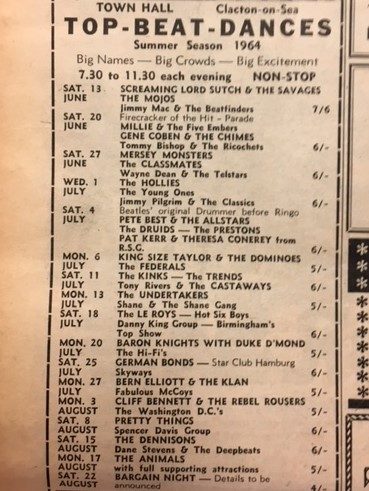
8 August 1964 – Clacton Town Hall, Clacton, Essex with The Federals (Essex County Standard)
9 August 1964 – Gig in Manchester (Rieks Korte’s research)
11 August 1964 – 100 Club, Oxford Street, central London with Brian Knight’s Blues by Six (Rieks Korte’s research)
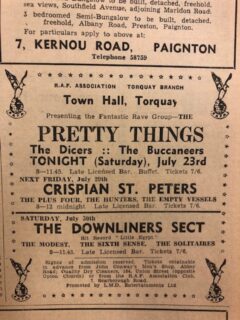
12 August 1964 – Town Hall, Torquay, Devon with The Bluesounds and Mel Fear & The Fantastic Phantoms (Torbay Express and South Devon Echo)
13 August 1964 – Gig in Peterborough, Cambridgeshire (Rieks Korte’s research)
14 August 1964 – Gig in Bradford, West Yorkshire (Rieks Korte’s research)
15 August 1964 – Wilton Hall, Bletchley, Bucks (Bletchley District Gazette)
16 August 1964 – Bromley Court Hotel, Bromley, Kent (Beat Monthly) Viv Andrews returned for a one-off gig covering for Viv Prince at this venue but it may not have been on this date
18 August 1964 – 100 Club, Oxford Street, London with Brian Knight’s Blues by Six (Rieks Korte’s research)
19 August 1964 – Mayfair Ballroom, Newcastle upon Tyne, Tyne & Wear (Newcastle Evening Chronicle) First visit to Newcastle
21 August 1964 – Town Hall, Trowbridge, Wiltshire (Rieks Korte’s research)
22 August 1964 – Town Hall, Chippenham, Wiltshire (Rieks Korte’s research)
23 August 1964 – Cavern, Manchester (Beat Monthly)
Photo may be subject to copyright
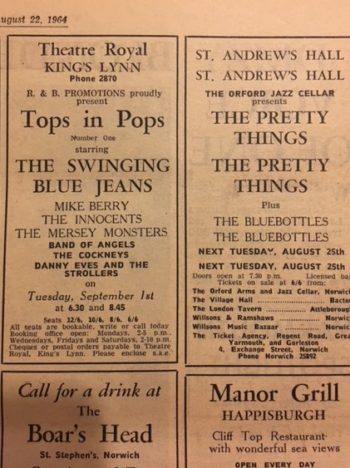
25 August 1964 – Orford Jazz Cellar, St Andrew’s Hall, Norwich, Norfolk with The Bluebottles (with Mike Patto) (Eastern Evening News) Beat Monthly has the band playing in Southampton on this date
26 August 1964 – Bromley Court Hotel, Bromley, Kent (Beat Monthly)
Photo may be subject to copyright
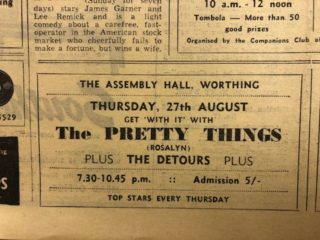
27 August 1964 – Assembly Hall, Worthing, West Sussex with The Detours (Worthing Gazette)
28 August 1964 – Winter Gardens, Morecambe, Lancashire (Beat Monthly)
Photo may be subject to copyright
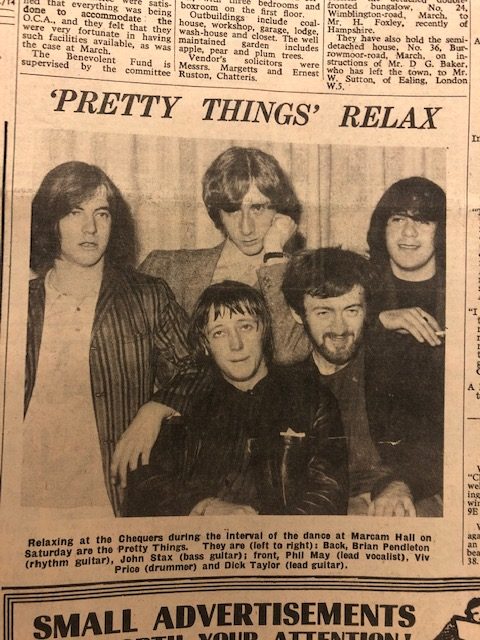
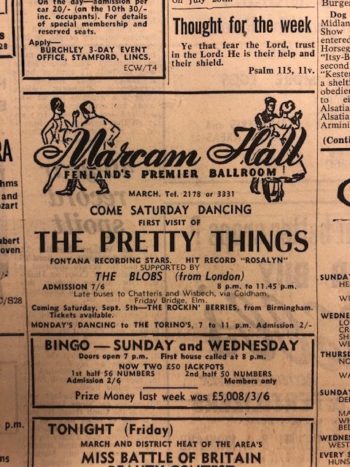
29 August 1964 – Marcam Hall, March, Cambridgeshire with The Blobs (Cambridgeshire Times)
30 August 1964 – The Scene, Florida Room, Brighton, Sussex with The Beat Merchants (Evening Argus)
Photo may be subject to copyright
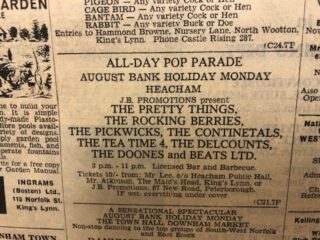
31 August 1964 – Public Hall, Heacham, Norfolk with The Rocking Berries, The Pickwicks, The Continentals, The Tea Time Four, The Delcounts, The Doones and Beats Limited (Lynn News)
1 September 1964 – 100 Club, Oxford Street, central London with Brian Knight’s Blues by Six (Rieks Korte’s research)
4 September 1964 – Floral Hall, Morecambe, Lancashire (Beat Monthly) Thanks to John Warburg and a picture taken from the Morecambe Visitor newspaper, this is confirmed
7 September 1964 – Mojo Club, Sheffield, South Yorkshire (Rieks Korte’s research)
8 September 1964 – 100 Club, Oxford Street, central London with Brian Knight’s Blues by Six (Rieks Korte’s research)
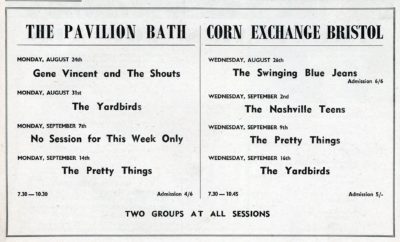
Thanks to Rolf Hannet for providing. Source: Western Scene. Photo may be subject to copyright
9 September 1964 – Corn Exchange, Bristol (Western Scene)
Photo may be subject to copyright
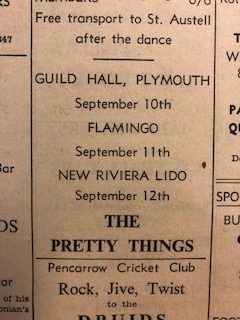
10 September 1964 – Guildhall, Plymouth, Devon (Cornish Guardian)
Photo may be subject to copyright
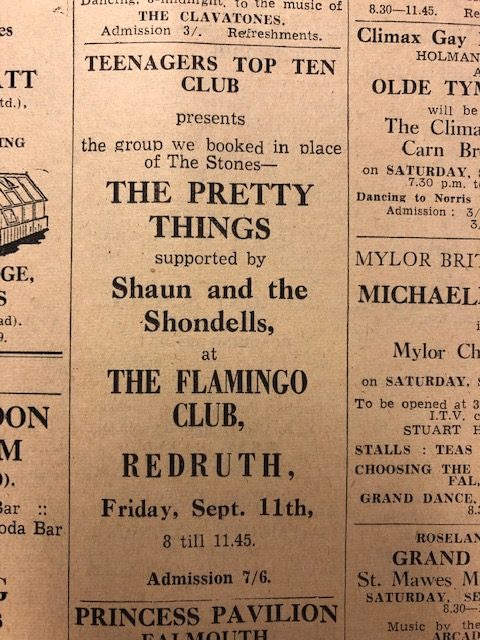
11 September 1964 – Top Ten Club, Flamingo, Redruth, Cornwall with Shaun & The Shondells (West Briton & Royal Cornwall Gazette)
Photo may be subject to copyright
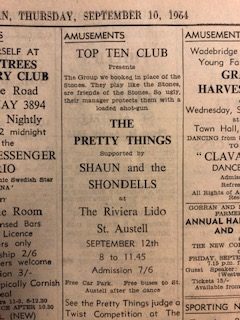
12 September 1964 – Top Ten Club, New Cornish Riveria Lido, St Austell, Cornwall with Shaun & The Shondells (Cornish Guardian)
13 September 1964 – Gig in Clacton, Essex (Beat Monthly)
14 September 1964 – Bath Pavilion, Bath (Western Scene)
Photo may be subject to copyright
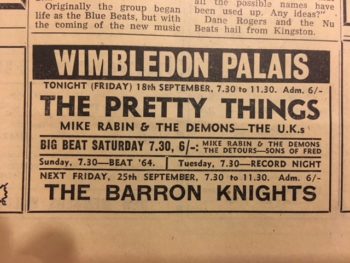
18 September 1964 – Wimbledon Palais, Wimbledon, Surrey with Mike Rabin & The Demons and The UKs (Kingston & Malden Borough News)
26 September 1964 – Gig in Lincoln (Beat Instrumental)
27 September 1964 – Bromley Court Hotel, Bromley, Kent (Rieks Korte’s research)
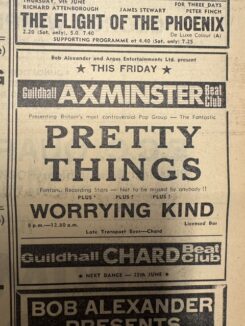
29 September 1964 – High Wycombe Town Hall, High Wycombe, Bucks (Bucks Free Press)
30 September 1964 – Gig in Leicester (Beat Instrumental)
1 October 1964 –Beat City, central London (Beat Instrumental)
2 October 1964 – Queen’s, Leeds, West Yorkshire (Beat Instrumental)
3 October 1964 – Gig in Hinckley, Leicestershire (Beat Instrumental)
Photo may be subject to copyright
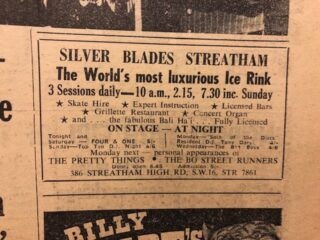
5 October 1964 – Silver Blades, Streatham, southwest London with The Bo Street Runners (Clapham Advertiser)
6 October 1964 – 100 Club, Oxford Street, central London with Blues by Six (Record Mirror)
13 October 1964 – 100 Club, Oxford Street, central London with Blues by Six (Rieks Korte’s research)
15-19 October 1964 – Tour of Scotland (Beat Instrumental)
23 October 1964 – Gig in Milford Haven, Wales (Beat Instrumental)
27 October 1964 – 100 Club, Oxford Street, central London with Blues by Six (Rieks Korte’s research)
29 October 1964 – Majestic Ballroom, Luton, Bedfordshire with Bracer Ball (Luton News)
30 October 1964 – Co-op Hall, Peckham, south London (Rieks Korte’s research)
Photo may be subject to copyright
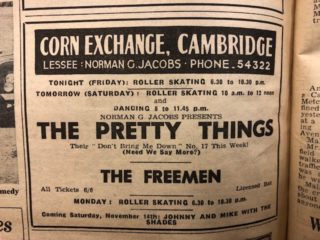
31 October 1964 – Corn Exchange, Cambridge with The Freemen (Beat Instrumental/Cambridge News)
3 November 1964 – 100 Club, Oxford Street, central London with Brian Knight’s Blues by Six (Record Mirror)
Photo may be subject to copyright
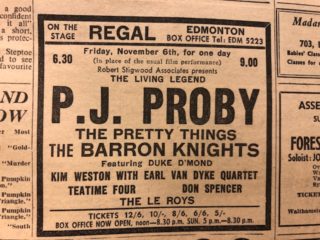
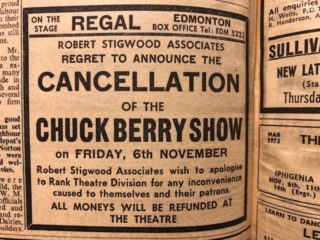
6 November 1964 – Regal, Edmonton, Middlesex with Chuck Berry, The Barron Knight’s featuring Duke D’Mond, Kim Weston with The Earl Van Dyke Quartet, Teatime Four and The Leroys (Tottenham Weekly Herald) (cancelled)
Photo may be subject to copyright
Chuck Berry replaced P J Proby who cancelled according to Rieks Korte. However, Julien Brice Mansencal says the entire tour was subsequently cancelled as Berry couldn’t get out of existing commitments.
6 November 1964 – Tower Ballroom, New Brighton (Beat Instrumental)
7 November 1964 – Granada, Slough, Berkshire with Chuck Berry, The Barron Knight’s featuring Duke D’Mond, Kim Weston with The Earl Van Dyke Quartet, Teatime Four and The Leroys (Rieks Korte’s research) (cancelled)
7 November 1964 – Palais, Peterborough, Cambridgeshire (Beat Instrumental)
8 November 1964 – Hippodrome, Birmingham Chuck Berry, The Barron Knight’s featuring Duke D’Mond, Kim Weston with The Earl Van Dyke Quartet, Teatime Four and The Leroys (Rieks Korte’s research) (cancelled)
9 November 1964 – Royal Albert Hall, Kensington, central London (Beat Instrumental)
10 November 1964 – Odeon, Leicester with Chuck Berry, The Barron Knight’s featuring Duke D’Mond, Kim Weston with The Earl Van Dyke Quartet, Teatime Four and The Leroys (Rieks Korte’s research) (cancelled)
11 November 1964 – Rialto York, North Yorkshire with Chuck Berry, The Barron Knight’s featuring Duke D’Mond, Kim Weston with The Earl Van Dyke Quartet, Teatime Four and The Leroys (Rieks Korte’s research) (cancelled)
12 November 1964 – Odeon Bolton, Bolton, Greater Manchester with Chuck Berry, The Barron Knight’s featuring Duke D’Mond, Kim Weston with The Earl Van Dyke Quartet, Teatime Four and The Leroys (Rieks Korte’s research) (cancelled)
13 November 1964 – Odeon Newcaste, Newcastle upon Tyne with Chuck Berry, The Barron Knight’s featuring Duke D’Mond, Kim Weston with The Earl Van Dyke Quartet, Teatime Four and The Leroys (Rieks Korte’s research) (cancelled)
13 November 1964 – Wimbledon Palais, southwest London (Beat Instrumental)
15 November 1964 – Palace, Manchester with Chuck Berry, The Barron Knight’s featuring Duke D’Mond, Kim Weston with The Earl Van Dyke Quartet, Teatime Four and The Leroys (Rieks Korte’s research) (cancelled)
16 November 1964 – Granada, Rugby, Warwickshire with Chuck Berry, The Barron Knight’s featuring Duke D’Mond, Kim Weston with The Earl Van Dyke Quartet, Teatime Four and The Leroys (Rieks Korte’s research) (cancelled)
17 November 1964 – Gaumont, Wolverhampton, West Midlands with Chuck Berry, The Barron Knight’s featuring Duke D’Mond, Kim Weston with The Earl Van Dyke Quartet, Teatime Four and The Leroys (Rieks Korte’s research) (cancelled)
18 November 1964 – Odeon, Liverpool with Chuck Berry, The Barron Knight’s featuring Duke D’Mond, Kim Weston with The Earl Van Dyke Quartet, Teatime Four and The Leroys (Rieks Korte’s research) (cancelled)
19 November 1964 – 100 Club, Oxford Street, central London with The Hell-Raisers (Rieks Korte’s research) Beat Instrumental lists Olympia, Reading, Berkshire on this date
20 November 1964 – Gaumont, Sheffield, South Yorkshire with Chuck Berry, The Barron Knight’s featuring Duke D’Mond, Kim Weston with The Earl Van Dyke Quartet, Teatime Four and The Leroys (Rieks Korte’s research) (cancelled)
Photo may be subject to copyright
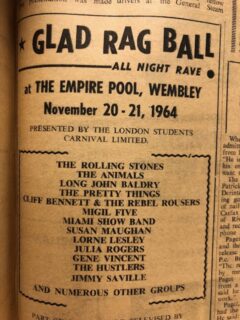
20-21 November 1964 – Empire Pool, Wembley, Middlesex with The Rolling Stones, The Animals, Cliff Bennett & The Rebel Rousers, The Migil Five, The Miami Show Band, Susan Maughan, Lorne Lesley, Julia Rogers, Gene Vincent and The Hustlers (Clapham Advertiser)
21 November 1964 – Town Hall, Loughborough (Beat Instrumental)
22 November 1964 – Winter Gardens, Morecambe, Lancashire with Chuck Berry, The Barron Knight’s featuring Duke D’Mond, Kim Weston with The Earl Van Dyke Quartet, Teatime Four and The Leroys (Rieks Korte’s research) (cancelled)
Advert for concert that was cancelled. Photo may be subject to copyright
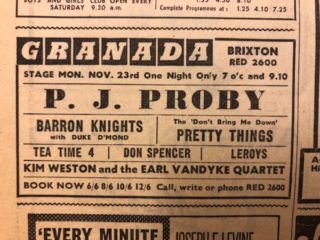
23 November 1964 – Brixton Granada, Brixton, south London with Chuck Berry, The Barron Knights, Tea Time 4, Don Spencer, The Leroys, Kim Weston and Earl Van Dyke Quartet (South East London Mercury) (cancelled)
24 November 1964 – Gauount, Bournmouth, Dorset with Chuck Berry, The Barron Knight’s featuring Duke D’Mond, Kim Weston with The Earl Van Dyke Quartet, Teatime Four and The Leroys (Rieks Korte’s research) (cancelled)
24 November 1964 – Floral Hall, Gorleston, Norfolk with The Magic Moments (Yarmouth Mercury)
25 November 1964 – Gaumont State, Kilburn, north London with Chuck Berry, The Barron Knight’s featuring Duke D’Mond, Kim Weston with The Earl Van Dyke Quartet, Teatime Four and The Leroys (Rieks Korte’s research) (cancelled)
27 November 1964 – Odeon, Romford, Essex with Chuck Berry, The Barron Knight’s featuring Duke D’Mond, Kim Weston with The Earl Van Dyke Quartet, Teatime Four and The Leroys (Rieks Korte’s research) (cancelled)
28 November 1964 – Odeon, Lewisham, southeast London with Chuck Berry, The Barron Knight’s featuring Duke D’Mond, Kim Weston with The Earl Van Dyke Quartet, Teatime Four and The Leroys (Rieks Korte’s research) (cancelled)
29 November 1964 – Hippodrome, Brighton, Sussex with Chuck Berry, The Barron Knight’s featuring Duke D’Mond, Kim Weston with The Earl Van Dyke Quartet, Teatime Four and The Leroys (Rieks Korte’s research) (cancelled)
1 December 1964 – 100 Club, Oxford Street, central London with Brothers Grimm (Rieks Korte’s research)
2-7 December 1964 – Tour of Scotland (Beat Instrumental)
10 December 1964 – 100 Club, Oxford Street, central London with The Westsiders (Rieks Korte’s research)
11 December 1964 – Leicester University (Beat Instrumental)
14 December 1964 – The Tower Ballroom, New Brighton with The Others (Liverpool Echo)
15 December 1964 – Newcastle City Hall, Newcastle upon Tyne with The Rockin’ Berries, Julie Rodgers and The Poets (Newcastle Evening Echo)
17 December 1964 – Olympia, Reading, Berkshire (Beat Instrumental)
Photo may be subject to copyright
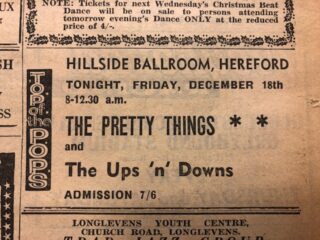
18 December 1964 – Hillside Ballroom, Hereford with The Ups ‘N’ Downs (Gloucester Citizen)
19 December 1964 – 100 Club, Oxford Street, central London with The Westsiders (Record Mirror)
22 December 1964 – 100 Club, Oxford Street, central London with Blues by Knight (Record Mirror)
29 December 1964 – 100 Club, Oxford Street, central London with Blues by Knight (Record Mirror)
31 December 1964 – Northwich Memorial Hall, Northwich, Cheshire (Record Mirror)
Photo may be subject to copyright. The Pretty Things, spring 1965
1965
5 January 1965 – 100 Club, Oxford Street, central London with Brothers Grimm (Record Mirror)
Photo may be subject to copyright
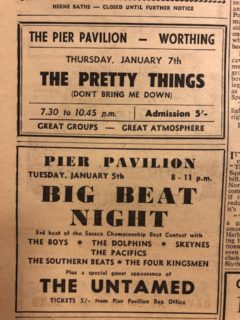
7 January 1965 – Pier Pavilion, Worthing, West Sussex with The Teenbeats (Worthing Herald/Worthing Gazette)
8 January 1965 – Co-operative Hall, Nuneaton, Warwickshire (Evening Tribune)
Photo may be subject to copyright
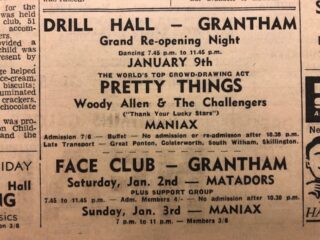
9 January 1965 – Drill Hall, Grantham, Lincolnshire with Woody Allen & The Challengers and Maniax (Grantham Journal)
Photo may be subject to copyright
12 January 1965 – 100 Club, Oxford Street, central London with Brothers Grimm (Record Mirror)
Photo may be subject to copyright
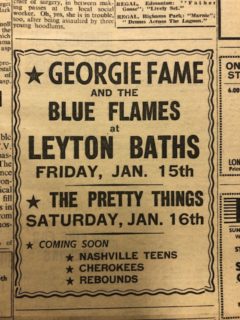
16 January 1965 – Leyton Baths, Leyton, Essex (Walthamstow Guardian)
19 January 1965 – 100 Club, Oxford Street, central London with The Crescents (Record Mirror)
20 January 1965 – Bristol Corn Exchange, Bristol (Western Scene)
21 January 1965 – Bath Pavilion, Bath (Western Scene)
26 January 1965 – 100 Club, Oxford Street, central London (Beat Instrumental)
27 January 1965 – High Wycombe Town Hall, High Wycombe, Bucks (Bucks Free Press)
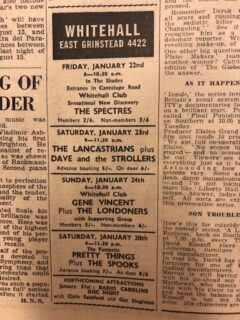
30 January 1965 – Whitehall, East Grinstead, West Sussex with The Spooks (Sussex Evening Express)
31 January 1965 – Granada Woolwich, Woolwich, southeast London with The Rockin Berries, The Merseybeats and Julie Rogers (Bexley Heath & Welling Observer and Kentish Times)
1 February 1965 – Parr Hall, Warrington, Cheshire (Beat Instrumental)
Photo may be subject to copyright
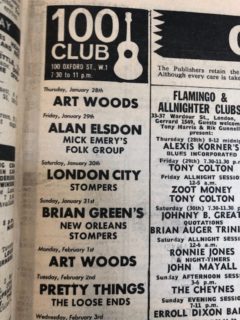
2 February 1965 – 100 Club, Oxford Street, central London with The Loose Ends (Melody Maker)
3 February 1965 – Majestic Hull, Hull (Record Mirror) According to Beat Instrumental, the band toured Ireland from 3-7 February but this seems unlikely
5 February 1965 – Bolton Boneyard, Bolton, Greater Manchester (Record Mirror)
6 February 1965 – New Century Hall, Manchester with Black Velvets (Manchester Evening News & Chronicle)
7 February 1965 – Wembley Starlite, Wembley, west London (Record Mirror)
8 February 1965 – Newcastle Majestic, Newcastle upon Tyne, Tyne & Wear (Record Mirror)
9 February 1965 – Stamford Hall, Altrincham, Greater Manchester (Beat Instrumental)
Photo may be subject to copyright
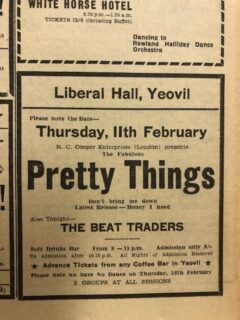
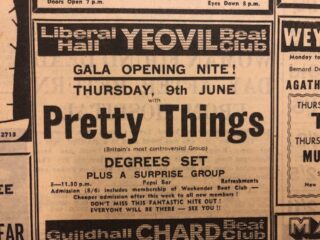
11 February 1965 – Liberal Hall, Yeovil, Somerset with The Beat Traders (Western Gazette)
11 February 1965 – Gig in Dunstable, Bedfordshire (may not be California Ballroom) (Beat Instrumental) This seems unlikely
13 February 1965 – Gig in Scarborough (Beat Instrumental)
19 February 1965 – Gig in Tiverley, the Mumbles, south Wales (Beat Instrumental)
20 February 1965 – St George’s Ballroom, Hinckley, Leicestershire with The Blackhawks (Evening Tribune)
Photo may be subject to copyright
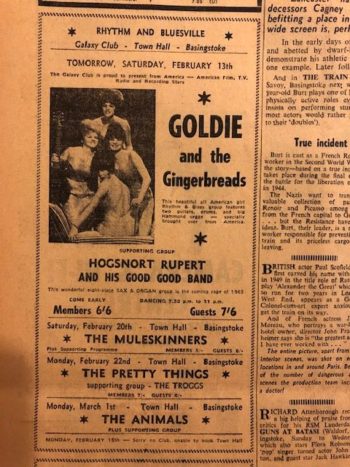
22 February 1965 – Galaxy Club, Town Hall, Basingstoke, Berkshire with The Troggs (Hampshire & Berkshire Gazette) Beat Instrumental has the Baths, Eltham, Kent but this is very unlikely with these two gigs
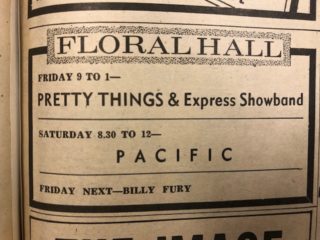
23 February 1965 – Floral Hall, Gorleston, Norfolk with The Seafarers (Yarmouth Mercury)
Photo may be subject to copyright
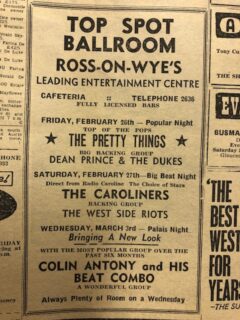
26 February 1965 – Top Spot, Ross-on-Wye, Herefordshire with Dean Prince & The Dukes (Gloucester Citizen)
Photo may be subject to copyright
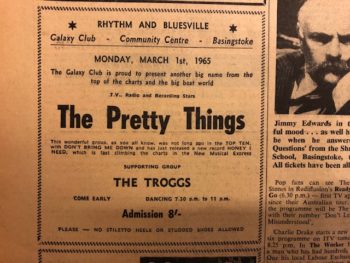
1 March 1965 – Galaxy Club, Community Centre, Basingstoke, Hampshire with The Troggs (Hampshire & Berkshire Gazette)
2 March 1965 – High Wycombe Town Hall, High Wycombe, Bucks (Bucks Free Press)
Photo may be subject to copyright
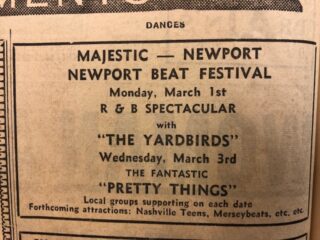
3 March 1965 – Majestic Ballroom, Newport, south Wales (South Wales Echo)
6 March 1965 – Florida Rooms, Brighton, Sussex with The Who, The-Bones and Johnny B Great (Evening Argus)
6 March 1965 – Mersey View Ballroom, Frodsham, Cheshire with The Spidermen, The Squad and Rita (Cheshire Observer/Warrington Guardian)
Photo may be subject to copyright
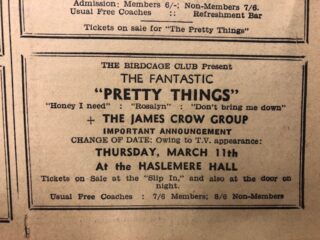
11 March 1965 – Haslemere Hall, Haslemere, Surrey with The James Crow Group (Farnham Herald)
Photo may be subject to copyright
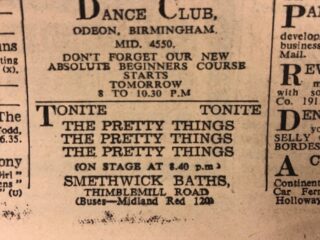
18 March 1965 – Smethwick Baths, Smethwick, West Midlands (Birmingham Evening Mail)
Photo may be subject to copyright
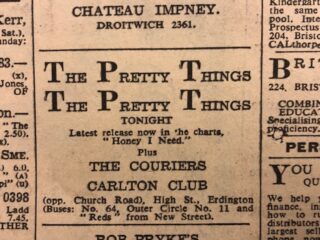
18 March 1965 – Carlton Club, Erdington, West Midlands with The Couriers (Birmingham Evening Mail)
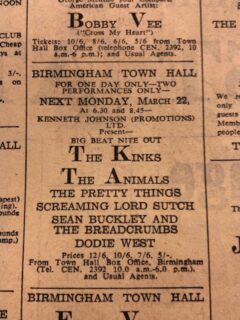
19 March 1965 – Big Beat Nite Out, Fairfield Hall, Croydon, Surrey with The Kinks, The Animals, The Caravelles, Dodie West and Sean Buckley & The Breadcrumbs (Chris Broom book: Rockin’ and Around Croydon)
21 March 1965 – Empire Pool, Wembley, northwest London with Dave Berry & The Cruisers, The Searchers, Kenny Lynch, Elkie Brooks, The Four Pennies, Long John Baldry & The Hoochie Coochie Men, Them, Billy J Kramer & The Dakotas, Tommy Quickly, The Fourmost, Lulu & The Luvvers, The Merseybeats, PJ Proby, The Zombies and Kenny Ball (Rieks Korte’s research)
Photo may be subject to copyright
22 March 1965 – Birmingham Town Hall, Birmingham with The Kinks, The Animals, Screaming Lord Sutch, Sean Buckley & The Breadcrumbs and Dodie West (Birmingham Evening Mail)
2 April 1965 – Heaven & Hell, Manchester (Rieks Korte’s research)
3 April 1965 – Corn Exchnage, Cambridge (Rieks Korte’s research)
Photo may be subject to copyright
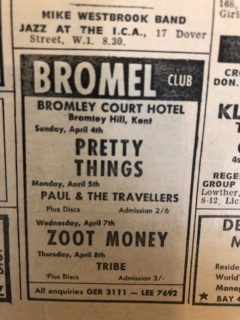
4 April 1965 – Bromley Court Hotel, Bromley, Kent (Melody Maker)
7 April 1965 – Gig in Rochdale, Greater Manchester (Rieks Korte’s research)
8 April 1965 – Manor Lounge, Stockport, Greater Manchester with Just Four Men (Stockport County Express)
Photo may be subject to copyright
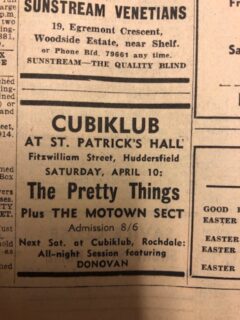
10 April 1965 – Cubiklub, St Patrick’s Hall, Huddersfield, West Yorkshire with The Motown Set (Halifax Daily Courier & Guardian)
10 April 1965 – Gig in Wigan, Greater Manchester (Rieks Korte’s research)
11 April 1965 – New Theatre, Oxford with Wayne Fontana & The Mindbenders, The Artwoods, The Ivy League, Elkie Brooks, Syd & George, The Chapters and The Guards (Oxford Mail) This looks like a tour so the other artists may also have been on the rest of the tour with The Pretty Things and Wayne Fontana & The Mindbenders
17 April 1965 – Spalding Ballroom, Spalding, Lincolnshire with Wayne Fontana & The Mindbenders (Rieks Korte’s research)
Photo may be subject to copyright
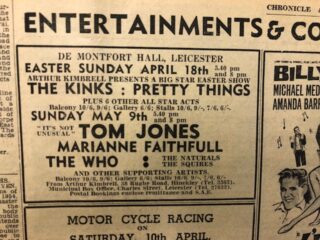
18 April 1965 – De Montfort Hall, Leicester with The Kinks and six other acts (Northampton Chronicle)
19 April 1965 – Gig in Scarborough, North Yorkshire with Wayne Fontana & The Mindbenders (Rieks Korte’s research) Unlikely this took place as they were in the Netherlands
19 April 1965 – Blokker Festival, the Netherlands, broadcasted on Dutch Television (Robert Gerretsen research)
24 April 1965 – Gig in Gloucester, Gloucestershire with Billy Fury & The Gamblers, Dave Berry & The Cruisers, Brian Poole & The Tremeloes, John Barry Seven, The Kestrels and The Zephyrs (Rieks Korte’s research/The Stage)
25 April 1965 – ABC Northampton, Northampton with Billy Fury & The Gamblers, John Barry Seven, The Kestrels, Dave Berry & The Cruisers, Brian Poole & The Tremeloes and The Zephyrs (Rieks Korte’s research/The Stage)
27 April 1965 – ABC Plymouth, Plymouth, Devon with Billy Fury & The Gamblers, Dave Berry & The Cruisers, Brian Poole & The Tremeloes, John Barry Seven, The Kestrels and The Zephyrs (Rieks Korte’s research/The Stage)
28 April 1965 – Savoy, Exeter, Devon with Billy Fury & The Gamblers, Dave Berry & The Cruisers, Brian Poole & The Tremeloes, John Barry Seven, The Kestrels and The Zephyrs (Rieks Korte’s research/The Stage)
Photo may be subject to copyright
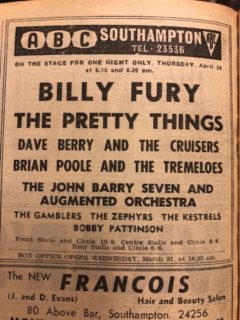
29 April 1965 – ABC Southampton, Southampton Hampshire with Billy Fury & The Gamblers, Dave Berry & The Cruisers, Brian Poole & The Tremeloes, John Barry Seven, The Kestrels and The Zephyrs (Rieks Korte’s research/The Stage/Southern Echo)
30 April 1965 – ABC Croydon, Croydon, south London with Billy Fury & The Gamblers, Dave Berry & The Cruisers, Brian Poole & The Tremeloes, John Barry Seven, The Kestrels and The Zephyrs (Rieks Korte’s research/The Stage)
1 May 1965 – ABC Dover, Dover, Kent with Billy Fury & The Gamblers, Dave Berry & The Cruisers, Brian Poole & The Tremeloes, John Barry Seven, The Kestrels and The Zephyrs (Rieks Korte’s research/The Stage)
2 May 1965 – ABC Harrow, Harrow, west London with Billy Fury & The Gamblers, Dave Berry & The Cruisers, Brian Poole & The Tremeloes and The Zephyrs (Rieks Korte’s research)
4 May 1965 – ABC Hull, Hull with Billy Fury & The Gamblers, Dave Berry & The Cruisers, Brian Poole & The Tremeloes and The Zephyrs (Rieks Korte’s research)
5 May 1965 – Gig in Stockton-on-Tees, Teesside with Billy Fury & The Gamblers, Dave Berry & The Cruisers, Brian Poole & The Tremeloes and The Zephyrs (Rieks Korte’s research)
6 May 1965 – ABC Carlisle, Carlisle, Cumbria with Billy Fury & The Gamblers, Dave Berry & The Cruisers, Brian Poole & The Tremeloes and The Zephyrs (Rieks Korte’s research)
8 May 1965 – Theatre Royal, Norwich, Norfolk with Billy Fury & The Gamblers, Dave Berry & The Cruisers, Brian Poole & The Tremeloes and The Zephyrs (Rieks Korte’s research)
9 May 1965 – Colston Hall, Bristol with Billy Fury & The Gamblers, Dave Berry & The Cruisers, Brian Poole & The Tremeloes and The Zephyrs (Rieks Korte’s research)
13 May 1965 – Marquee, Ashton-under-Lyne, Greater Manchester (Rieks Korte’s research)
Photo may be subject to copyright
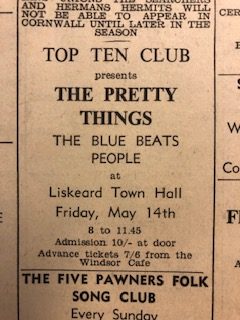
14 May 1965 – Top Ten Club, Town Hall, Liskeard, Cornwall with The Blue Beats and People (Cornish Guardian)
Photo may be subject to copyright
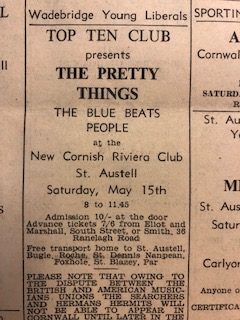
15 May 1965 – Top Ten Club, New Cornish Riveria Lido, St Austell, Cornwall with The Blue Beats and People (Cornish Guardian)
Photo may be subject to copyright
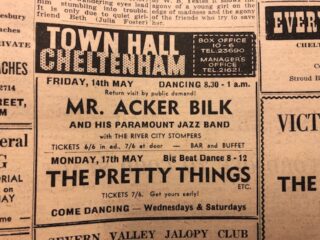
17 May 1965 – Town Hall, Cheltenham, Gloucestershire (Gloucester Citizen)
18 May 1965 – Majestic, Newport, Wales (Rieks Korte’s research)
19 May 1965 – Gig in Porthcawl, Wales (Rieks Korte’s research)
20 May 1965 – City Hall, Sheffield, South Yorkshire with Donovan (Rieks Korte’s research) Donovan’s drummer was Skip Alan who would replace Viv Prince in November. The 23 May date suggests there were other artists on the tour
21 May 1965 – Central Pier, Morecambe, Lancashire with Donovan (Rieks Korte’s research)
Photo may be subject to copyright
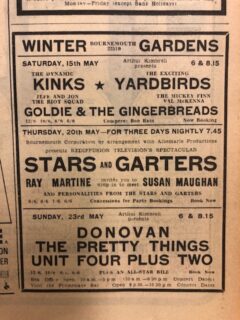
23 May 1965 – Winter Gardens, Bournemouth, Dorset with Donovan, The New Faces, Unit 4 Plus 2, John L Watson & The Hummelflugs and Chris Carlson (website: https://bournemouthbeatboom.wordpress.com/) Western Gazette just has Donovan and Unit 4 Plus 2
23 May 1965 – Guildhall, Portsmouth, Hampshire with Donovan (Rieks Korte’s research)
Photo may be subject to copyright
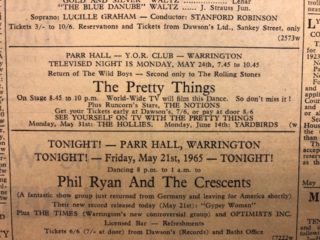
24 May 1965 – YOR Club, Parr Hall, Warrington, Cheshire with The Notions (Warrington Guardian)
25 May 1965 – Stamford Hall, Altrincham, Greater Manchester (Beat Instrumental)
26 May 1965 – City Hall, Salisbury, Wiltshire (Beat Instrumental)
27 May 1965 – McKilroys, Swindon, Wiltshire (Beat Instrumental)
30 May 1965 – Granaada, Brixton, south London (Beat Instrumental)
3 June 1965 – Gig in Munich, West Germany (Rieks Korte’s research)
4 June 1965 – Gig in Munich, West Germany (Rieks Korte’s research)
5 June 1965 – Gig in Hamburg, West Germany (possibly Star Club) (Rieks Korte’s research)
6 June 1965 – Gig in Hamburg, West Germany (possibly Star Club) (Rieks Korte’s research)
7 June 1965 – Gig in Hamburg, West Germany (possibly Star Club) (Rieks Korte’s research)
11 June 1965 – Ricky Tick, Guildford Civic Hall, Guildford, Surrey with Blues Syndicate (Ricky Tick website: https://www.rickytick.com/)
12 June 1965 – Probably gig in Stamford Hill, north London (Rieks Korte’s research)
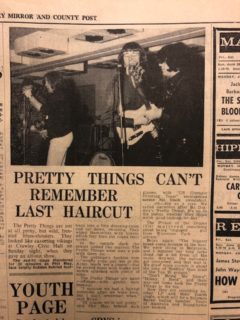
Surrey Mirror, 18 June 1965. Photo may be subject to copyright
18 June 1965 – Wimbledon Palais, Wimbledon, southwest London (Beat Instrumental)
19 June 1965 – Drill Hall, Scunthorpe (Beat Instrumental)
20 June 1965 – HMS Daffodil, Portsmouth, Hants (Beat Instrumental)
21 June 1965 – Oxford University, Oxford (Beat Instrumental)
25 June 1965 – New Restaurant, Aere Harwell, Oxfordshire with Candy ‘N’ Cookies, Ricky & The Gamblers and The Outcrowd (Oxford Mail) Rieks Korte has the band performing at Harwell Atomic Energy Establishment on this date and looks like same venue
27 June 1965 – Embassy, Burslem (Beat Instrumental)
28 June 1965 – Adelphi Ballroom, West Bromwich, West Midlands (Birmingham Evening Mail)
3 July 1965 – Cavern, Leicester Square, central London (Beat Instrumental)
Photo may be subject to copyright
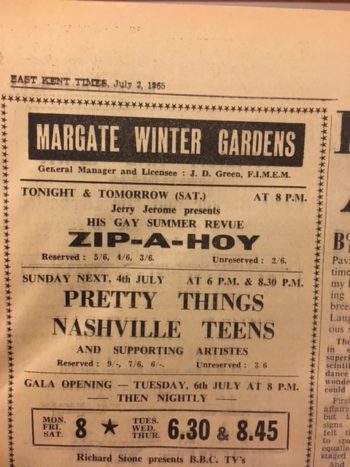
4 July 1965 – Margate Winter Gardens, Margate, Kent with The Nashville Teens and support (East Kent Times & Mail) Rieks Korte also has Screaming Jay Hawkins and The Clayton Squares
9 July 1965 – Embassy, Burslem (Beat Instrumental)
10 July 1965 – Town Hall, Leek (Beat Instrumental)
11-17 July 1965 – Scottish tour (Beat Instrumental)
18 July 1965 – Gig in Blackpool, Lancashire (Beat Instrumental)
23 July 1965 – 32 Club, Harlesden, north London (Hammersmith & Shepherds Bush Gazette)
24 July 1965 – Witham Public Hall, Witham, Essex with Cops ‘N’ Robbers and The Senates (Essex County Standard)
28 July 1965 – Pool Ballroom, Rhos-on-Sea, Wales with The Motown Sect and The Panzies (North Wales Weekly News)
31 July 1965 – Cavern, Manchester (Manchester Evening News & Chronicle)
2 August 1965 – Galaxy Club, Town Hall, Basingstoke, Hampshire with support (Hampshire & Berkshire Gazette)
3 August 1965 – High Wycombe Town Hall, High Wycombe, Bucks (Bucks Free Press)
4 August 1965 – Bristol Corn Exchange, Bristol with support (Western Scene)
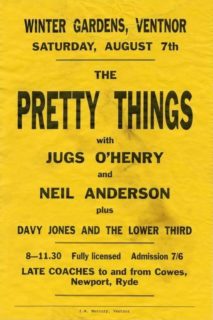
7 August 1965 – Winter Gardens, Ventnor, Isle of Wight with Jugs O’Henry and Neil Anderson and Davy Jones & The Lower Third (Poster) This is the gig that Billy Harrison, formerly of Them, covers for Dick Taylor
Photo: David Else. Photo may be subject to copyright
The Daily Mirror’s 16 August edition noted that The Pretty Things flew off for their New Zealand tour on Sunday, 15 August after a farewell gig in London (the Ad-Lib Club)
19-30 August 1965 – New Zealand tour with Sandie Shaw, Eden Kane, Tommy Adderley, The Chicks and The Mike Perjanik Showband (Defecting Grey website: http://sfsorrow.fr/index.php/1965-2/)
31 August-1 September 1965 – Top 20 Club, Auckland, New Zealand with Larry’s Rebels and The Dark Ages (Defecting Grey website: http://sfsorrow.fr/index.php/1965-2/)
Photo may be subject to copyright
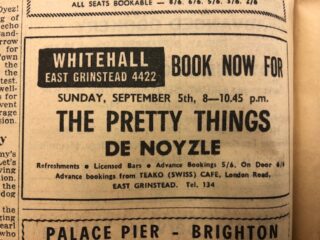
5 September 1965 – Whitehall, East Grinstead, West Sussex with De Noyzle (Sussex Evening Express)
6 September 1965 – Astoria Ballroom, Middlesbrough with The Caveman Capers (Middlesbrough Evening Gazette)
10 September 1965 – Lucky Stars Club, Staines, Middlesex (Staines and Egham News)
14 October 1965 – Gig in Chesterfield (Beat Instrumental)
15 October 1965 – Gig in Wolverhampton, West Midlands (Beat Instrumental)
Photo may be subject to copyright
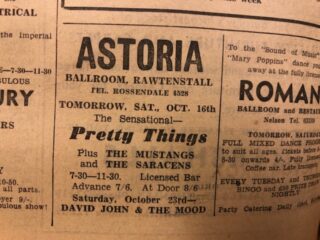
16 October 1965 – Astoria Ballroom, Rawtenstall, Lancashire with The Mustangs and The Saracens (Burnley Express and News)
17 October 1965 – Gig in Doncaster (Beat Instrumental)
18-19 October 1965 – Scottish dates (Beat Instrumental)
Photo may be subject to copyright
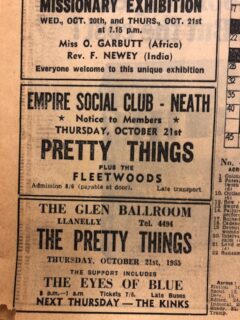
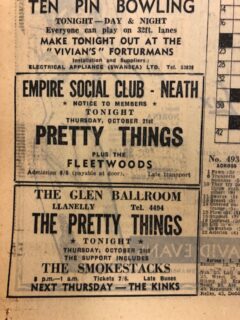
21 October 1965 – Empire Social Club, Neath, south Wales with The Fleetwoods (South Wales Evening Post) This was cancelled when two members fell ill
Photo may be subject to copyright
21 October 1965 – Glen Ballroom, Llanelly, south Wales with The Smokestacks and The Eyes of Blue (South Wales Evening Post) This was cancelled when two members fell ill
23 October 1965 – Gig in Peterborough, Cambridgeshire (Beat Instrumental)
24 October 1965 – Gig in Southall, west London (most likely Community Centre) (Beat Instrumental)
28 October 1965 – Zars Club, York (Beat Instrumental)
29 October 1965 – Students’ Union, Oxford University (Beat Instrumental)
Photo may be subject to copyright
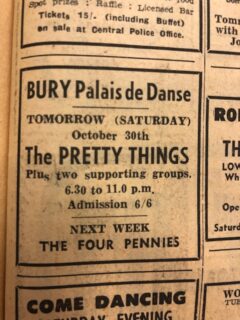
30 October 1965 – Bury Palais de Danse, Bury, Greater Manchester plus two supporting groups (Bolton Evening News)
31 October 1965 – Top Ten Club, Manchester (Manchester Evening News & Chronicle)
1 November 1965 – Grand Pavilion, Porthcawl, Wales (Beat Instrumental)
3 November 1965 – Bruce Grove Ballroom, Tottenham, north London (Beat Instrumental)
4 November 1965 – City Hall, Salisbury, Wiltshire (Beat Instrumental)
5 November 1965 – Gig in Gravesend, Kent (Beat Instrumental)
6 November 1965 – Florida Rooms, Brighton, East Sussex (Brighton Evening Argus)
Photo may be subject to copyright
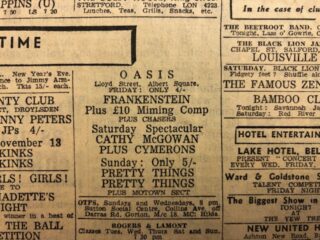
7 November 1965 – Oasis, Manchester with The Motown Set (Manchester Evening News & Chronicle)
Skip Alan subbed for Viv Prince on a Scottish tour in November so this seems the most likely date when he took over unless it was the Brighton gig above
8 November 1965 – Town Hall, Iveraray, Scotland (Rieks Korte’s research)
9 November 1965 – Bobby Jones, Ayr, Scotland (Rieks Korte’s research)
12 November 1965 – Town Hall, Falkirk, Scotland (Rieks Korte’s research)
13 November 1965 – Baths Hall, Sheffield, South Yorkshire (Beat Instrumental)
Photo may be subject to copyright
14 November 1965 – Jungfrau, Manchester (Manchester Evening News & Chronicle)
Photo may be subject to copyright
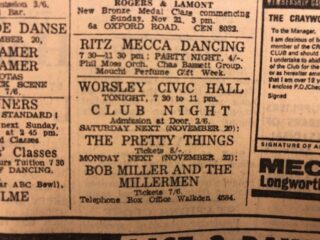
20 November 1965 – Worsley Civic Hall, Walkden, Worsley, Greater Manchester with Wynder K Frog and The Fendermen (Bolton Evening News)
22 November 1965 – High Wycombe Town Hall, High Wycombe, Bucks (Bucks Free Press)
23 November 1965 – 100 Club, Oxford Street, central London with The Artwoods (Melody Maker)
Beat Instrumental reports that the band starts a Welsh tour on 25 November
New Musical Express’ 26 November issue reported that Viv Prince had told the music paper that he’d been asked to leave the group. The Pretty Things were on a Scottish tour with a deputy drummer (Skip Alan)
27 November 1965 – Coronation Hall, Ramsgate, Kent (Rieks Korte’s research) East Kent Times & Mail reports that this was rescheduled
New Musical Express’ 3 December issue reported that Viv Prince had agreed to leave. Skip Alan (ex-Them) who had subbed on the recent Scottish tour, was now a permanent member and on tour with the band in Scandinavia.
Billy Harrison, formerly of Them, covered for Dick Taylor when The Pretty Things played in Scandinavia, which may have been this same tour as he flew into Copenhagen.
Photo: Cityweek. Photo may be subject to copyright
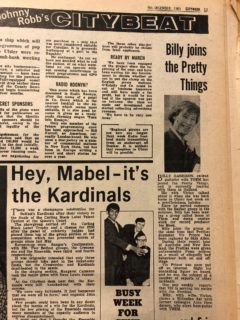
Belfast paper, Cityweek, ran an article on former Them guitarist Billy Harrison in its 9 December 1965 issue, page 17 and notes that he has joined The Pretty Things. It adds that he’s currently on tour with them in Holland.
4 December 1965 – British Legion Hall, Coleford, Somerset with David & Jonathan (Somerset Guardian/Western Scene) Six miles from Frome
Photo may be subject to copyright
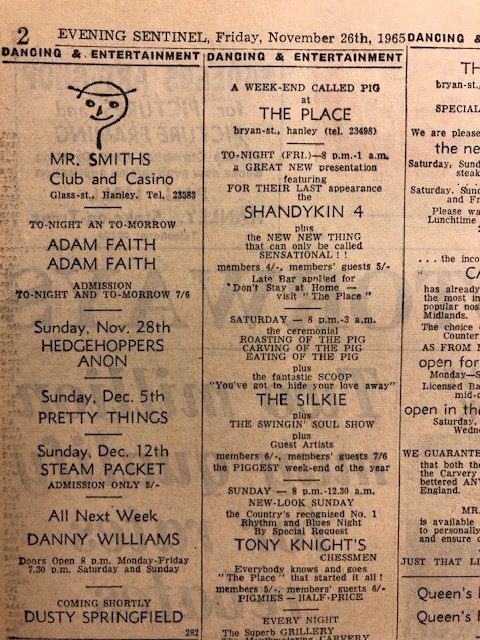
5 December 1965 – Mr Smith’s, Hanley, Staffordshire (Evening Sentinel)
11 December 1965 – Coronation Ballroom, Ramsgate, Kent with The System (East Kent Times & Mail)
Photo may be subject to copyright
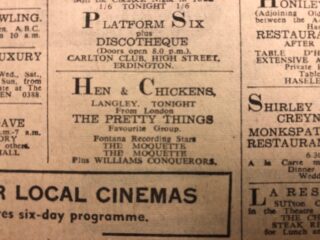
14 December 1965 – Hen & Chickens, Langley, West Midlands (Birmingham Evening Mail)
17 December 1965 – Farnborough Technical College, Farnborough, Hampshire with The Carnaby and The Generation (Aldershot News)
Photo may be subject to copyright
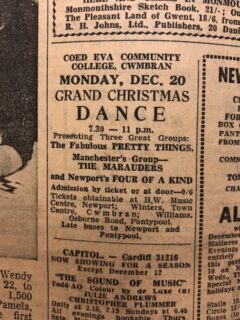
20 December 1965 – Coed Eva Community College, Cwmbran, south Wales with The Marauders and Four of a Kind (South Wales Argus)
21 December 1965 – 100 Club, Oxford Street, central London with The Artwoods (Melody Maker)
22 December 1965 – Bristol Corn Exchange, Bristol (Western Scene)
31 December 1965 – Matrix Hall, Coventry with The Fairies and The Playboys (Coventry Evening Telegraph)
1966
Photo may be subject to copyright
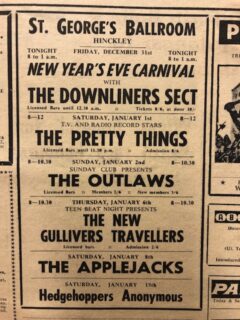
1 January 1966 – St George’s Ballroom, Hinckley, Leicestershire (Evening Tribune)
Photo may be subject to copyright
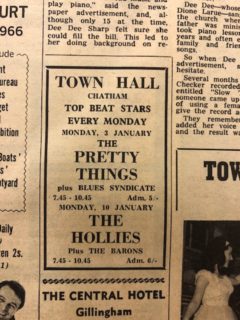
3 January 1966 – Chatham Town Hall, Chatham, Kent with Blues Syndicate (Chatham, Rochester & Gillingham News)
Photo may be subject to copyright
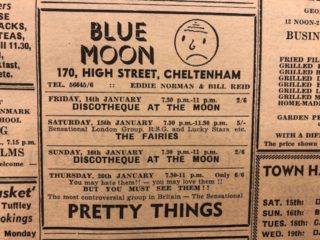
20 January 1966 – Blue Moon, Cheltenham, Gloucestershire (Gloucester Citizen)
21 January 1966 – Wimbledon Palais, Wimbledon, southwest London (Balham & Tooting News and Mercury)
Photo may be subject to copyright
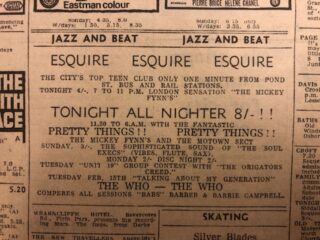
22 January 1966 – Esquire Club, Sheffield, South Yorkshire with Micky Finn’s and Motown Sect (The Star)
25 January 1966 – High Wycombe Town Hall, High Wycombe, Bucks (Bucks Free Press)
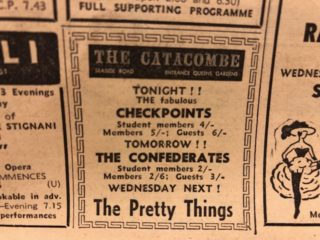
16 February 1966 – The Catacombe, Eastbourne, East Sussex (Eastbourne Herald Chronicle)
18-19 February 1966 – Danish dates (for more information, visit Defecting Grey website: http://sfsorrow.fr/index.php/1966-2/) ThePretty Things played with The Red Squares and Them (the McAuley brothers’ rival version) on 19 February, so it’s possible that this was when Billy Harrison subbed for Dick Taylor (unless it was late 1965)
21 February 1966 – Wimbledon Palais, Wimbledon, southwest London (Melody Maker)
23 February 1966 – Bromley Court Hotel, Bromley, southeast London (Melody Maker)
Photo may be subject to copyright
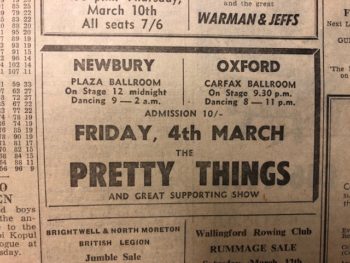
4 March 1966 – Ricky Tick, Plaza Ballroom, Newbury, Berkshire (Andover Advertiser/Ricky Tick website: https://www.rickytick.com/)
4 March 1966 – Carfax Ballroom, Oxford (North Berks Herald)
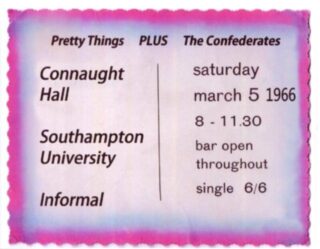
5 March 1966 – Connaught Hall, Southampton University, Southampton, Hampshire with The Confederates (Poster from John Warburg)
Photo may be subject to copyright
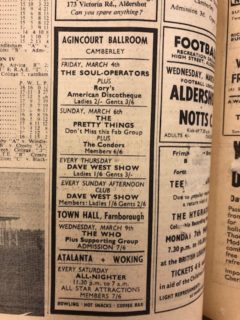
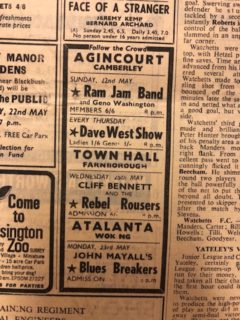
6 March 1966 – Agincourt Ballroom, Camberley, Surrey with The Condors (Aldershot News/Camberley News)
9 March 1966 – Tower Ballroom, Great Yarmouth, Norfolk with The John Lofty Sounds (Yarmouth Mercury)
11 March 1966 – Regency Ballroom, Bath with Chet & The Triumphs (Western Scene)
Photo may be subject to copyright
13 March 1966 – Pavilion Ballroom, Buxton, Derbyshire with Hickory Stix (North Cheshire Standard)
Photo may be subject to copyright
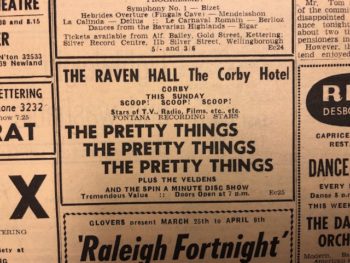
27 March 1966 – Raven Hall, Corby Hotel, Corby, Northamptonshire with The Veldens (Northamptonshire Evening Telegraph)
8 April 1966 – Wimbledon Palais, Wimbledon, southwest London (Balham & Tooting News and Mercury)
12 April 1966 – 100 Club, Oxford Street, central London with Jo Jo Gunne (Melody Maker)
16-17 April 1966 – Star Club, Hamburg, West Germany (Star Club book by Manfred Weissleder and Siegfried E Loch)
21 April 1966 – Mayfair Ballroom, Newcastle upon Tyne, Tyne & Wear with The Junco Partners, The Jazz Board and Hilton K’s (Newcastle Evening Chronicle)
23 April 1966 – Palace Ballroom, Wolverton, Bucks with Ricky Wilson Threequarters (Wolverton Express)
6 May 1966 – Chislehurst Caves, Chislehurst, southeast London (Melody Maker)
7 May 1966 – St George’s Ballroom, Hinckley, Leicestershire (Nuneaton Evening Tribune)
Photo may be subject to copyright
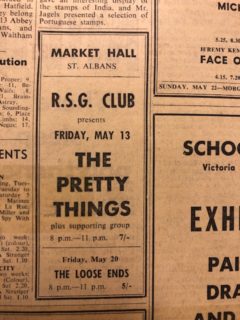
13 May 1966 – Ready Steady Go Club, Market Hall, St Albans, Herts (Welwyn Advertiser)
14 May 1966 – Rhodes Centre, Bishop’s Stortford, Herts with The Prowlers (Steve Ingless book: The Day Before Yesterday)
Photo may be subject to copyright
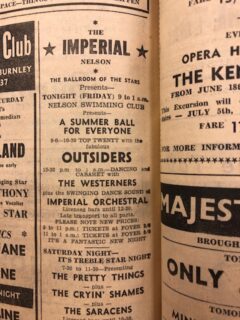
21 May 1966 – Imperial Ballroom, Nelson, Lancashire with The Cryin Shames and The Saracens (Burnley Express & News)
Photo may be subject to copyright
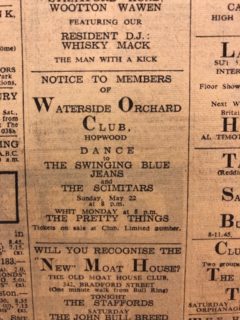
30 May 1966 – Waterside Orchard Club, Hopwood, West Midlands (Birmingham Evening Mail)
1 June 1966 – Target’s Paul Row, High Wycombe, Bucks (Bucks Free Press)
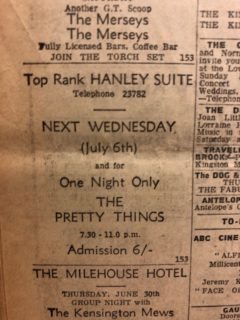
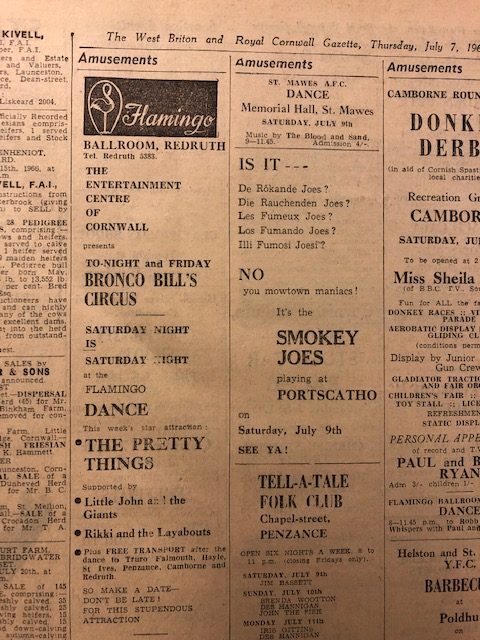
9 July 1966 – Flamingo Ballroom, Redruth, Cornwall with Little John & The Giants and Rikki and The Layabouts (West Briton & The Royal Cornwall Gazette)
10 July 1966 – Khyber Club, Taunton, Somerset with The Germs (Somerset County Gazette)
13 July 1966 – Town Hall, Stourbridge, West Midlands (Rieks Korte’s research)
14 July 1966 – Blue Lagoon, Kimbells, Southsea, Hampshire (Portsmouth News)
15 July 1966 – Town Hall, Welshpool, Wales (Rieks Korte’s research)
16 July 1966 – Haggers Cinema, Pembroke, Wales (Rieks Korte’s research)
19 July 1966 – 100 Club, Oxford Street, central London (Rieks Korte’s research)
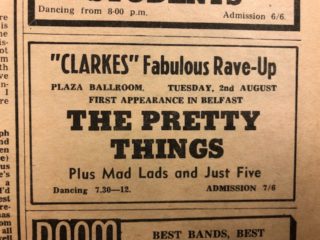
2 August 1966 – Plaza Ballroom, Belfast, Northern Ireland with The Mad Lads and Just Five (Belfast Telegraph/Cityweek) The Pretty Things’ first appearance in Belfast
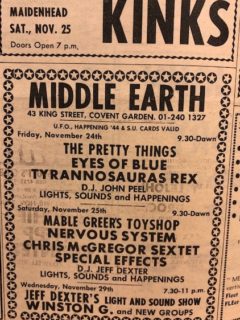
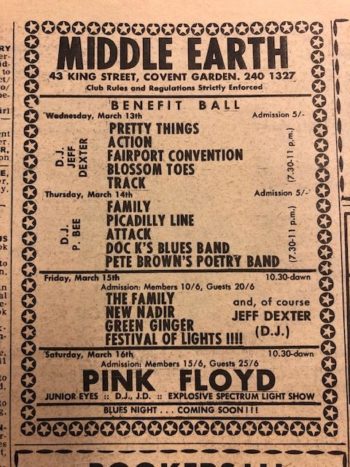
13 March 1968 – Middle Earth, Covent Garden, central London with The Action, Fairport Convention, Blossom Toes and The Track (Melody Maker)
Photo may be subject to copyright
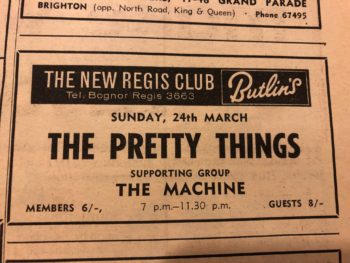
24 March 1968 – New Regis Club, Bognor Regis, West Sussex with The Machine (Brighton Evening Argus)
Photo may be subject to copyright
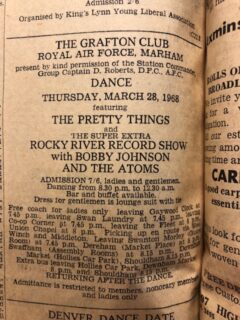
28 March 1968 – Grafton Club, RAF Marham with Bobby Johnson & The Atoms (Lynn News)
11-13 April 1968 – Piper Club, Rome, Italy (Defecting Grey website: http://sfsorrow.fr/index.php/1968-2/) These may have been Twink’s debut shows with the band
Melody Maker‘s 13 April issue reported that Twink had taken over from Skip Alan on drums.
18 April 1968 – Dundee Students’ Charities Campaign, Palais, Dundee, Scotland with The Californians (Dundee Evening Telegraph & Post)
27 April 1968 – Middle Earth, Covent Garden, central London with Coconut Mushroom (Melody Maker)
11 May 1968 – Grand Pavilion, Matlock Bath, Derbyshire with The Luddy Sammes Soul Packet (Derbyshire Times/Derbyshire Evening Telegraph)
1 June 1968 – Whit Spectacular, Seagull Ballrooms, Ryde Pier Head, Ryde, Isle of Wight with The Action, Blossom Toes, Helcyon Order and Johnny Farlow (Isle of Wight County Press)
Photo may be subject to copyright
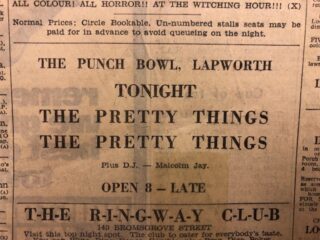
21 June 1968 – Punch Bowl, Lapworth, West Midlands (Birmingham Evening Mail)
21 June 1968 – The First Holiness Kitschgarden for the Liberation of Love & Peace in Colors, Houtrusthallen, La Hague, the Netherlands (Defecting Grey website: http://sfsorrow.fr/index.php/1968-2/) Robert Gerretsen says that The Pretty Things didn’t appear in the end
22 June 1968 – Middle Earth, Covent Garden, central London with July and Juniors Eyes (Melody Maker)
Photo may be subject to copyright
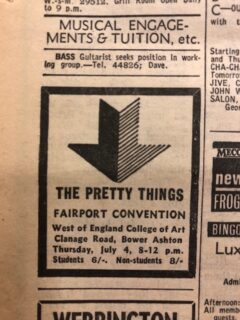
4 July 1968 – West of England College of Art, Ashton, Avon with Fairport Convention (Bristol Evening Post)
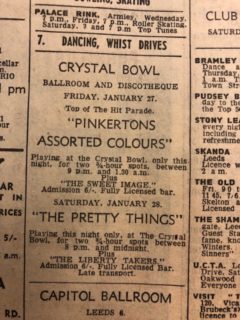
6 July 1968 – St Thomas Hall, Brentwood, Essex with Pinkerton’s Colours (Essex Chronicle)
Photo may be subject to copyright
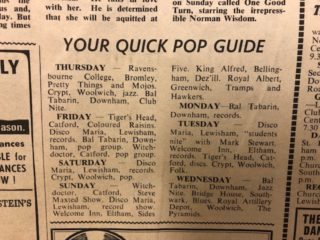
11 July 1968 – Ravensbourne College, Bromley, southeast London with The Mojos (South East London Mercury)
27 July 1968 – The Cockpit, Hyde Park, central London (Rieks Korte’s research)
1 August 1968 – Tetbury Show Carnival Week, Marquee, Recreation Ground, Tetbury, Gloucestershire with Johnny Carr & The Cadillacs (Stroud News)
2 August 1968 – Bournemouth Pavilion, Bournemouth, Dorset with Bruce Channel and Dr Marigold’s Prescription (Bournemouth Evening Echo)
3 August 1968 – Torbay Blues and Beat Festival, Torquay Town Hall, Torquay, Devon with Invisible Fish and Flavour (Herald Express)
23 August 1968 – Jazz Bilzen festival, Bilzen, Belgium with The Action, Tyrannosaurus Rex, The Move and Simon Dupree Big Sound (Defecting Grey website: http://sfsorrow.fr/index.php/1968-2/)
Photo: Rudolf Kaes
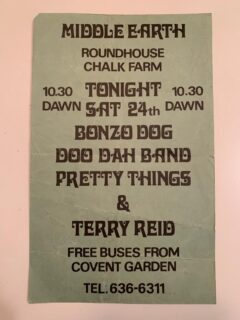
24 August 1968 – Middle Earth, Covent Garden, central London with Bonzo Dog Doo Dah Band and Terry Reid (Melody Maker/Poster from Rudolf Kaes)
31 August 1968 – Great South Coast Bank Holiday Pop Festivity All-nighter, Hall Field, Ford Farm, Isle of Wight with Jefferson Airplane, The Move, The Crazy World of Arthur Brown, Fairport Convention, T-Rex, Mirage, The Smile, The Cherokees and others (Portsmouth News)
7 September 1968 – Sport Hotel Spiero, Nieuwkoop, the Netherlands (Robert Gerretsen research)
Source: Journal du Jura number 213
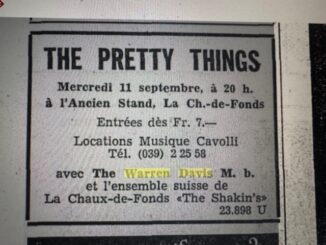
11 September 1968 – Ancien Stand, La Chaux-de-Fonds, Switzerland with The Warren Davis Monday Band and The Shakins (Defecting Grey website: http://sfsorrow.fr/index.php/1968-2/)
18 September 1968 – Country Club, Belsize Park, north London (Melody Maker)
19 September 1968 – Cellar Club, Newcastle upon Tyne, Tyne & Wear (Newcastle Evening Chronicle)
27 September 1968 – Van Dike, Plymouth, Devon with The Fire Brigade (Jonathan Hill’s book Van Dike: The Life & Times of a Plymouth Club 1968-1972)
8 October 1968 – Kew Boat House, Kew, west London (Time Out)
Photo may be subject to copyright
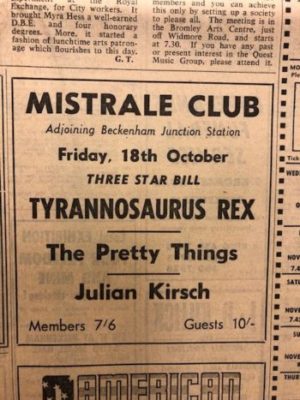
18 October 1968 – Mistrale Club, Beckenham Junction, London with T-Rex and Julian Hirsch (Coulson & Purley Advertiser/Poster)
8 November 1968 – Kew Boat House, Kew, west London (Richmond & Twickenham Times)
15 November 1968 – Fishmonger’s Arms, Wood Green, London with Downliners Sect (Melody Maker)
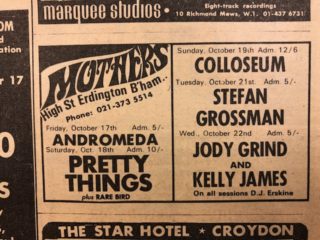
29 November 1968 – Mothers, Erdington, West Midlands (Melody Maker)
30 November 1968 – Middle Earth, Covent Garden, central London with Aurieal and The End (Melody Maker)
5 December 1968 – Somerset College of Art, Arts Ball, Country Ballroom, Taunton, Someset with Savoy Brown and Copper-Pot Band (Newcastle Evening Chronicle)
12 December 1968 – Walthamstow Assembly Hall, Waltham Forest Tech College and School of Art with The Bonzo Dog Doo Dah Band and Jimmy James & The Vagabonds (Melody Maker)
Photo may be subject to copyright
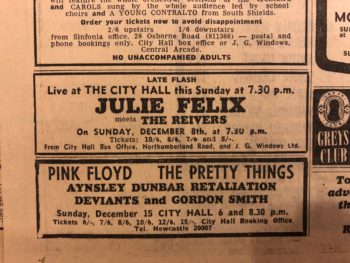
15 December 1968 – City Hall, Newcastle upon Tyne, Tyne & Wear with Pink Floyd, Aynsley Dunbar Retaliation, Deviants and Gordon Smith (Newcastle Evening Chronicle)
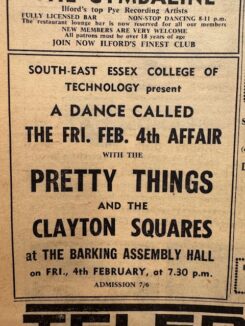
19 December 1968 – College of Technology, Maidstone, Kent (Rieks Korte’s research)
22 December 1968 – Country Club, Belsize Park, north London (Melody Maker)
27 December 1968 – Mistrale Club, Beckenham Junction, south London (Rieks Korte’s research)
29 December 1968 – Festival Flight to Lowlands II, Utrecht, the Netherlands with others (Robert Gerretsen research)
1969
Photo may be subject to copyright
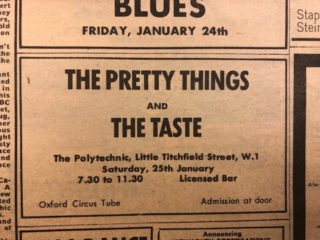
25 January 1969 – Polytechnic, Little Titchfield, central London with Taste (Melody Maker)
25 January 1969 – Middle Earth, Covent Garden, central London with The Egg, Melanie, Glass Menagerie and Dave Brock and Pete Judd (Melody Maker)
Photo may be subject to copyright
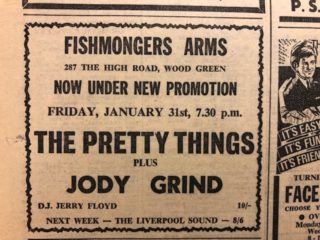
31 January 1969 – Fishmonger’s Arms, Wood Green, north London with Jody Grind (Melody Maker/Wood Green & Southgate Weekly Herald)
5 March 1969 – Rag Ball, Lanchester College, Coventry with Julie Driscoll and The Brian Auger Trinity, The Deviants and Blossom Toes (Coventry Evening Telegraph)
Photo may be subject to copyright
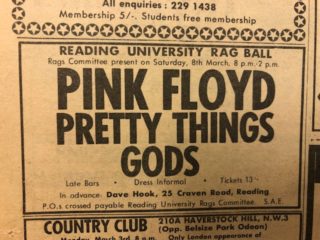
8 March 1969 – Reading University Rag, Reading, Berkshire with Pink Floyd and The Gods (Melody Maker)
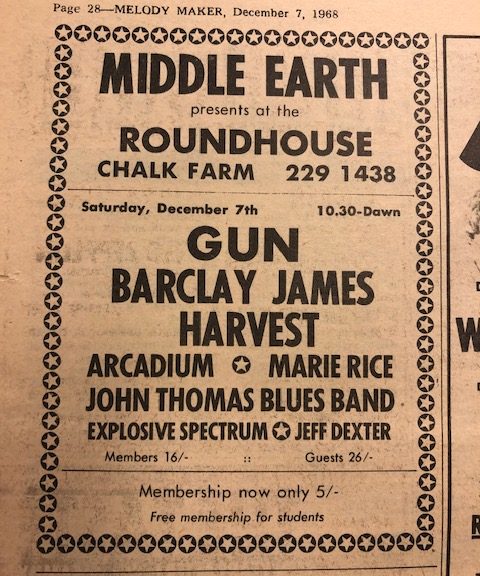
15 March 1969 – Chelsea College of Science and Technology, southwest London with Barclay James Harvest and Steamhammer (Melody Maker)
16 March 1969 – Blaises, Imperial Hotel, Queen’s Gate, Kensington, west London (Time Out)
29 March 1969 – Paradiso, Amsterdam, the Netherlands. Broadcasted by VPRO Radio (Robert Gerretsen research)
Photo may be subject to copyright
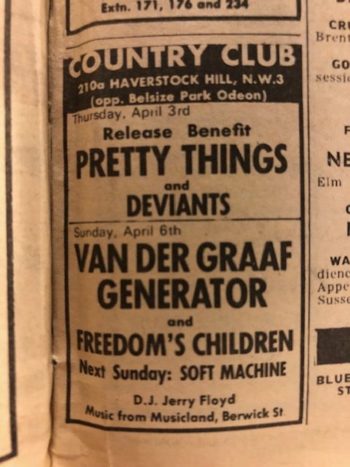
3 April 1969 – Country Club, Belsize Park, north London with Deviants (Melody Maker)
26 April 1969 – Kee Club, Bridgend, Wales (Rieks Korte’s research)
9 May 1969 – Parliament Hill Fields, north London (Rieks Korte’s research)
11 May 1969 – Country Club, Belsize Park, north London (Time Out)
23 May 1969 – Fishmongers Arms, Wood Green, north London (Time Out)
31 May 1969 – Van Dike, Plymouth, Devon with The Fire Brigade (Jonathan Hill’s book Van Dike: The Life & Times of a Plymouth Club 1968-1972)
Photo may be subject to copyright
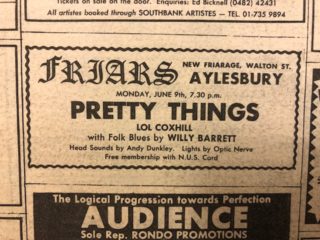
9 June 1969 – Friars, Aylesbury, Bucks with Lol Coxhill and Willy Barrett (Melody Maker)
13 June 1969 – North west Poly, Prince of Wales Road, northwest London (Time Out)
27 June 1969 – Avery Hill College Summer Ball, Avery Hill, Eltham, southeast London with The Kinks, Spencer Washboard Kings, The Coloured Raisins and The Derek Cross Dance Band (South East London Mercury)
Photo may be subject to copyright
1 August 1969 – Lyceum, Strand, central London with Marsha Hunt & White Trash and Hard Meat (Melody Maker)
23 August 1969 – Mothers, Erdington, West Midlands (Melody Maker)
30 August 1969 – Isle of Wight Pop Festival, Ryde, Isle of Wight with many others (Rieks Korte’s research)
3 October 1969 – Acton Town Hall, Acton, west London (Time Out)
4 October 1969 – Regional College, Barking, east London with Barclay James Harvest and Wild Mouth (Melody Maker)
Photo may be subject to copyright
18 October 1969 – Mothers, Erdington, West Midlands with Rare Bird (Melody Maker)
Photo may be subject to copyright
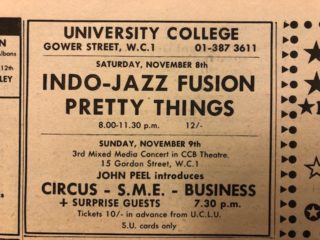
8 November 1969 – University College, Gower Street, central London with Indo-Jazz Fusion (Melody Maker)
24 January 1970 – Queen’s Hall, Narbeth, west Wales with Harveson Apricot (Pembroke & West Wales Guardian)
Many thanks to Mike Stax for passing on Rieks Korte’s incomplete gig list, which he shared with Stax in the early 2000s. Thanks to Rieks for getting in touch allowing his research. Also, thanks to Rolf Hannet in Germany for providing Beat Monthly and Beat Instrumental gigs.
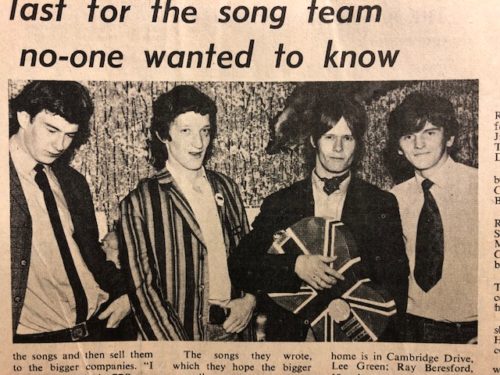
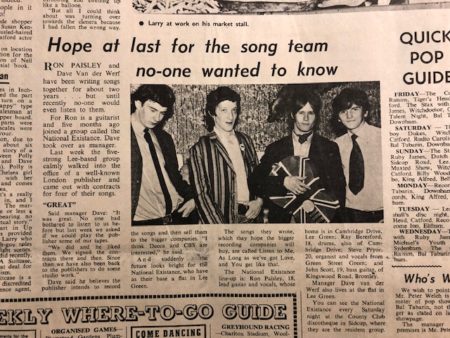
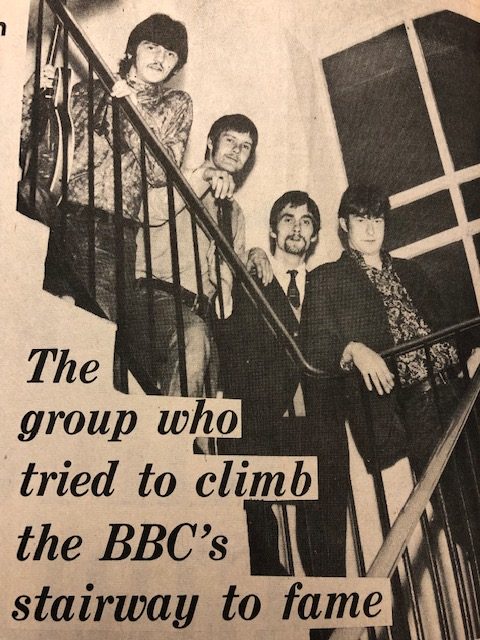
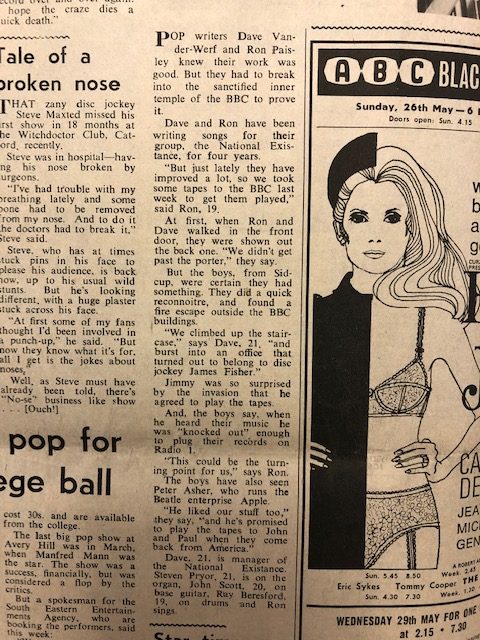
Ron Paisley – guitar/vocals John Scott – bass Steve Pryor – organ Ray Beresford – drums
Formed in February 1967, The National Existence was a R&B band from southeast London who featured former Carl Douglas drummer Ray Beresford. According to the South East London Mercury they played every Saturday at the Country Club in Sidcup.
The newspaper reported that the group was still working locally in May 1968 and with the same formation (see below).
We’d be interested to hear any more about this band and can also include photos.
Source: South East London MercuryPhoto: South East London Mercury, 23 May 1968South East London Mercury, 23 May 1968
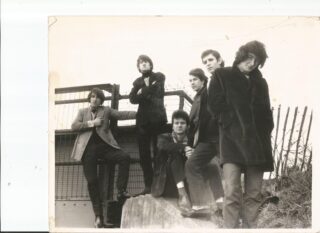
Photo Patrick Campbell-Lyons. The Second Thoughts, spring 1964 outside the Ealing Club. Left to right: Mickey Holmes, Patrick Campbell-Lyons, Vic Griffiths (on van roof), Tony Duhig and Bill Hope.
Patrick Campbell-Lyons (lead vocals)
Tony Duhig (lead guitar)
Mickey Holmes (bass)
Bill Hope (drums)
Ealing, Middlesex band, The Second Thoughts were formed around February 1963 and gave birth to a number of notable bands in the late 1960s – Thunderclap Newman, Nirvana, July and Jade Warrior.
Lead singer Patrick Campbell-Lyons (b. 13 July 1943, Lismore, County Waterford, Ireland) had been active on the local scene for several years with The Teenbeats after arriving in the area from Ireland in the summer of 1961.
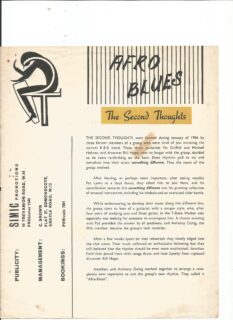
Campbell-Lyons made plans to form a new group after running into lead guitarist Tony Duhig (b. 18 September 1941, Acton, Middlesex; d. 11 November 1990), drummer Bill Hope and lead guitarist turned bass player Mickey Holmes in January 1963 (see story below from manager Cyril Brown, which erroneously says 1964).
Holmes had previously been a member of The Krewsaders alongside future Fleetwood Mac bass player John McVie and Holmes’ cousin, rhythm guitarist Peter Carney, who went on to play with Geno Washington’s Ram Jam Band among others.
Named by Holmes, one of The Second Thoughts’ first gigs was opening for The Rolling Stones at their farewell gig at the Ealing Club on 2 March 1963.
Thanks to Cyril Brown, their manager
Basing themselves on The Big Three and The High Numbers (aka The Who), the trio’s blues-rock required a harmonica player and Campbell-Lyons recruited his friend from Brentford, Middlesex, Vic Griffiths, who doubled up on rhythm guitar, around Christmas 1963.
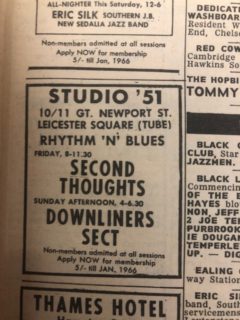
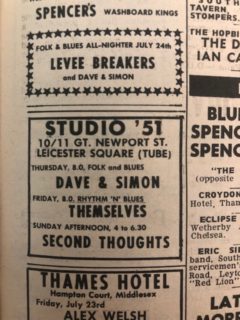
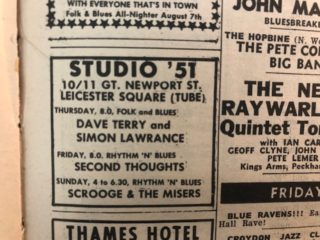
The Second Thoughts would play at the Ealing Club regularly and from spring to summer 1964 would hold down a Sunday residency before landing another house gig in central London at the Studio ’51 Club in Leicester Square.
Photo: Cyril Brown
Around July 1964, the band expanded the line up by adding Duhig’s friend, and the band’s roadie, Jon Field (b. 5 July 1940, Harrow, Middlesex) on organ and congas.
Meanwhile Holmes brought in his former band mate from The Krewsaders, drummer John “Speedy” Keen (b. 29 March 1945, Ealing, Middlesex; d. 12 March 2002) to replace Bill Hope.
Photo: Patrick Campbell-Lyons. Left to right: Speedy Keen, Vic Griffiths, Tony Duhig, Jon Field, Patrick Campbell-Lyons and Mickey Holmes.
That summer, the band played four gigs on the Isle of Wight with Jimmy James & The Vagabonds.
Not long after, The Second Thoughts went into the studios twice. On one occasion, the band recorded tracks at a studio near Denham in Buckinghamshire. The other session took place in a studio in north London. The group covered the T J Arnall’s “Cocaine” at one of the sessions.
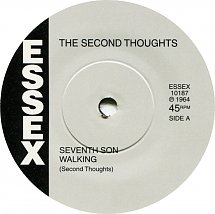
Four tracks were cut – “Seventh Son”, “Walking”, “You Gotta Help (Help Me)” and “Looking For My Baby” at one session.
Shelved at the time, the Essex label dug out the recordings for a rare EP in 1997.
The tracks have more recently appeared on The Tomcats’ CD, Running at Shadows: The Spanish Recordings 1965-1966, which was issued on RPM in 2016.
During spring 1965, the band cut more unreleased tracks at RG Jones studio in Morden, near Wimbledon – the Wilbur Harrison classic “Let’s Get Together” and a second version of “Cocaine”.
They also started to play more widely across the Southeast. This included playing US airforce bases in Oxfordshire with Percy Sledge, John Lee Hooker and Jimmy James & The Vagabonds.
The Second Thoughts also made their first trip to Hamburg around March 1965 to perform at the Star Club where they shared the bill with Rory Storm & The Hurricanes and Duane Eddy (Ed. This might have been 1963 not 1965).
The group was performing at Beat City (or 100 Club) on Oxford Street when the musicians were approached by French singer Teddy Raye, who wanted to hire a British backing group for a month initially in Madrid.
The Frenchman, however, didn’t want Patrick Campbell-Lyons, Jon Field or Vic Griffiths for the trip.
Renamed The Gatos Salvaje (The Savage Cats), the band proved to be the main attraction rather than Raye and, buoyed by the response, the musicians made plans to return on their own that summer.
Back in England in May, the musicians brought back Jon Field and recruited singer/guitarist Tom Newman from rival Ealing band The Tomcats.
Performing their final gig at Ealing Town Hall (it’s not clear under what name), the new formation discovered that Keen did not want to return to Spain.
With Keen subsequently moving to Italy in July to join another Ealing band, The Rocking Eccentrics (replacing John Kerrison) with whom he stayed until January 1966, the group recruited drummer Chris Jackson from The Tomcats as his replacement.
Returning to Spain (and renamed Los Tomcats) in June 1965, the band played northern cities like Oviedo and also returned to Madrid but Holmes soon grew tired of living out of a suitcase and came back to the UK. Another former Tomcat, bass player Alan James stepped into his shoes.
Los Tomcats continued working in Spain for a year before returning to England in early 1967 and changing name to July. Duhig and Field would subsequently leave the band and form Jade Warrior in the late 1960s.
Remaining members, Patrick Campbell-Lyons and Vic Griffiths meanwhile formed a new version of The Second Thoughts in late March 1965.
According to the article “Return of the Second Thoughts will delight fans”, published in the Middlesex County Times & West Middlesex Gazette, dated 9 April 1965, page 13, the new members were Mick Taylor (lead guitar); Chris Thomas (bass); and Keith Reynolds (drums).
The article says the band were due to embark on a US tour but this seems very unlikely. However, it does say that the group recorded six tracks at Soho’s Maximum Sound studios on Sunday, 4 April, which may or may not be the tracks listed above. It adds that these tracks will not be released in Britain but only in the US.
The article, which notes that the other original members are currently in Madrid backing Teddy Raye, notes that the new version will play at Ealing Town Hall, Cardinal Wiseman School in Greenford and Brunel College, Acton.
They were subsequently joined by a returning Mickey Holmes who took over from Chris Thomas but when the band was offered work at the Star Club in Hamburg in November, Holmes left to move into session work and Thomas returned for the German gigs.
Out in West Germany, The Second Thoughts gigged until spring 1966 before finally splitting.
Patrick Campbell-Lyons remained in Hamburg and worked with Swedish band, Lucifer & The Angels, which took him to Sweden. In Stockholm, he then joined local group, The Merrymen (who’d earlier featured Boz Scaggs) but became ill.
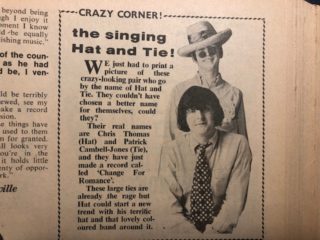
Photo: Mirabelle, 1 October 1966 issue
Returning to England in August 1966, he joined forces with former member Chris Thomas in the duo Hat & Tie. The pair recorded a lone single before splitting soon after and Campbell-Lyons went on to form Nirvana.
Two former members of The Second Thoughts found huge success after the band finally split – Chris Thomas became a noted producer, working with The Beatles and Pink Floyd among others, while John “Speedy” Keen formed Thunderclap Newman and scored an international hit with “Something In The Air”.
Notable gigs:
25 May 1963 – Ealing Club, Ealing, Middlesex (support The Rolling Stones on their last gig at this venue)
19 April 1964 – Ealing Club, Ealing, Middlesex (Sunday residency)
26 April 1964 – Ealing Club, Ealing, Middlesex (Sunday residency)
3 May 1964 – Ealing Club, Ealing, Middlesex (Sunday residency)
10 May 1964 – Ealing Club, Ealing, Middlesex (Sunday residency)
17 May 1964 – Ealing Club, Ealing, Middlesex (Sunday residency)
24 May 1964 – Ealing Club, Ealing, Middlesex (Sunday residency)
31 May 1964 – Ealing Club, Ealing, Middlesex (Sunday residency)
7 June 1964 – Ealing Club, Ealing, Middlesex (Sunday residency)
14 June 1964 – Ealing Club, Ealing, Middlesex (Sunday residency)
21 June 1964 – Ealing Club, Ealing, Middlesex (Sunday residency)
28 June 1964 – Ealing Club, Ealing, Middlesex (Sunday residency)
5 July 1964 – Ealing Club, Ealing, Middlesex (Sunday residency)
10 July 1964 – Attic, Hounslow, Middlesex with Erky Grant & The Tonetts and The Tempests
11 July 1964 – YWCA Hall, Ealing, Middlesex
12 July 1964 – Ealing Club, Ealing, Middlesex (Sunday residency)
19 July 1964 – Ealing Club, Ealing, Middlesex (Sunday residency)
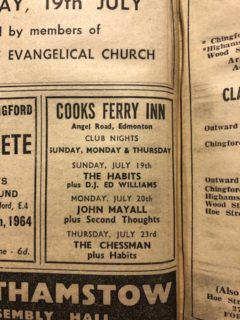
20 July 1964 – Cooks Ferry Inn, Edmonton, Middlesex with John Mayall’s Bluesbreakers
25 July 1964 – YWCA Hall, Ealing, Middlesex
25 July 1964 – Ealing Club, Ealing, Middlesex (played both weekend nights)
26 July 1964 – Ealing Club, Ealing, Middlesex (Sunday residency)
29 July 1964 – Bedsitter Club, Holland Park, west London
9 August 1964 – Beat City, Oxford Street, central London with The Tomcats
15 August 1964 – YWCA Hall, Ealing, Middlesex
22 August 1964 – YWCA Hall, Ealing, Middlesex
22 August 1964 – Studio ’51 Club, Leicester Square, central London with The Tridents
23 August 1964 – Beat City, Oxford Street, central London with The Tomcats
8 September 1964 – Nurses Club, Jolly Gardeners, Isleworth, Middlesex
9 September 1964 – Bedsitter Club, Holland Park, west London
12 September 1964 – Bedsitter Club, Holland Park, west London
16 September 1964 – YWCA Hall, Ealing, Middlesex
16 September 1964 – Bedsitter Club, Holland Park, west London
18 September 1964 – Studio ’51 Club, Leicester Square, west London
19 September 1964 – YWCA Hall, Ealing, Middlesex
20 September 1964 – Studio ’51 Club, Leicester Square, west London
22 September 1964 – Klooks Kleek, West Hampstead, north London with Dave Davani & The D-Men with Beryl
23 September 1964 – Bedsitter Club, Holland Park, west London
3 October 1964 – YWCA Hall, Ealing, Middlesex
8 October 1964 – Ealing Town Hall, Ealing, Middlesex with The Flexmen
10 October 1964 – 100 Club, Oxford Street, central London with The Tridents
12 October 1964 – Klooks Kleek, West Hampstead, north London with John Lee Hooker
16 October 1964 – Studio ’51 Club, Leicester Square, central London
17 October 1964 – Witchdoctor, Hastings, East Sussex with Four Plus 1
18 October 1964 – Watford Trade Hall, Watford, Hertfordshire
19 October 1964 – Marquee, Wardour Street, Soho, central London
20 October 1964 – 100 Club, Oxford Street, central London with The Tridents
22 October 1964 – Ealing Town Hall, Ealing, Middlesex with The Challengers, Liverpool Lads and Bob Harvey
23 October 1964 – Eel Pie Island, Twickenham, Middlesex
23 October 1964 – Ealing Technical College, Ealing, Middlesex
24 October 1964 – Fratton Hall, Portsmouth, Hants
24 October 1964 – Studio ’51 Club, Leicester Square, central London with The Impacts (All Nighter)
31 October 1964 – Twyford School, Acton, Middlesex
5 November 1964 – 100 Club, Oxford Street, central London with The Graham Bond Organisation
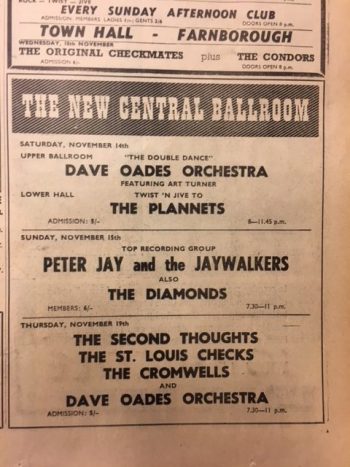
19 November 1964 – New Central Ballroom, Aldershot, Hampshire with St Louis Checks, The Cromwells and Dave Oades Orchestra
22 November 1964 – Studio ’51 Club, Leicester Square, central London
26 November 1964 – Ealing Town Hall, Ealing, Middlesex with Frankie Reid & The Casuals
13 December 1964 – Studio ’51 Club, Leicester Square, central London
29 December 1964 – Klooks Kleek, West Hampstead, north London with Alexis Korner
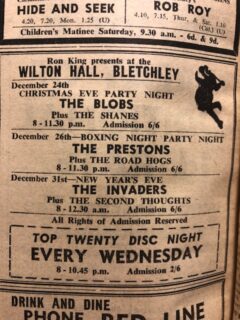
31 December 1964 – Wilton Hall, Bletchley, Bucks with The Invaders (Bletchley District Gazette)
1 January 1965 – Studio ’51 Club, Leicester Square, central London
2 January 1965 – Egham Literary Institute, Egham, Surrey
3 January 1965 – New Central Ballroom, Aldershot, Hants with The Leeways with Belinda
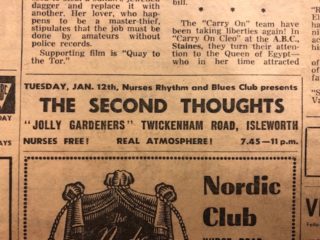
12 January 1965 – Nurses Club, Jolly Gardeners, Isleworth, Middlesex
22 January 1965 – Studio ’51 Club, Leicester Square, central London
31 January 1965 – Studio ’51 Club, Leicester Square, central London
11 February 1965 – Bromel Club, Bromley, Kent
26 February 1965 – Studio ’51 Club, Leicester Square, central London
4 March 1965 – Ealing Town Hall, Ealing, Middlesex (final gig before the original group split?)
24 July 1965 – Egham Hythe Social Centre, Egham, Surrey with Bern Elliott & The Klan
25 July 1965 – Studio ’51 Club, Leicester Square, central London
30 July 1965 – Studio ’51 Club, Leicester Square, central London
15 August 1965 – Studio ’51 Club, Leicester Square, central London
4 September 1965 – Egham Hythe Social Centre, Egham, Surrey with Just Five
24 September 1965 – Ealing Town Hall, Ealing, west London with Bob Grant
21 October 1965 – New Central Ballroom, Aldershot, Hampshire with The Southern Valley Four
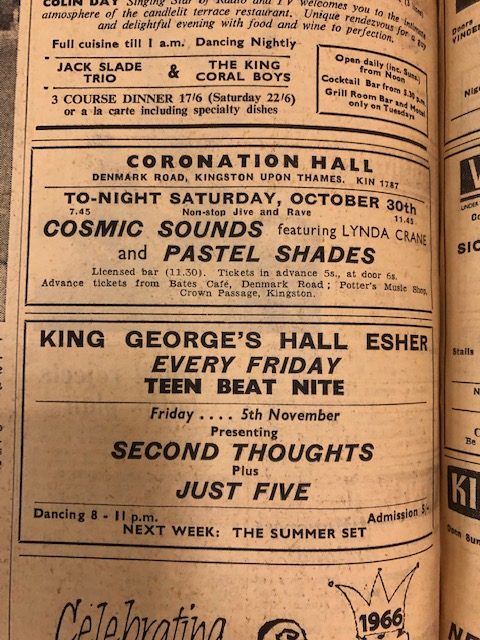
5 November 1965 – King George’s Hall, Esher, Surrey with Just Five
6 November 1965 – New Central Ballroom, Aldershot, Hampshire
Gigs taken from many sources including Middlesex County Times & West Middlesex Gazette, Camberley News and Bagshot Observer,, Kingston & Malden Borough News, Record Mirror, Surrey Comet and Melody Maker. Thanks to Mickey Holmes, Tom Newman and Patrick Campbell-Lyons.
This article originally appeared on the Strange Brew website. I’ve updated it and provided more information since but would like to thank Jason Barnard for posting it on his excellent site.
I have tried to ensure the accuracy of this article but I appreciate that there are likely to be errors and omissions. I would appreciate any feedback from anyone who can provide any additions or corrections. Email: Warchive@aol.com
Welcome to another posting of a series of gig listings for 1960s bands. None of these lists is exhaustive and my idea is to add to them in the comments section below over time. They are here for future researchers to draw on. I have also added a few interesting bits of information and will add images in time.
I’d like to encourage band members to get in touch to share memories, or for anyone to send corrections/clarifications to my email: Warchive@aol.com
Equally important, if you attended any of the gigs below or played in the support band, please do leave your memories below in the comments section for future historians to use. If you know of any missing gigs, please add them too, if possible, with the sources.
Photo: Mirabelle, 29 July 1967 issue. Image may be subject to copyright
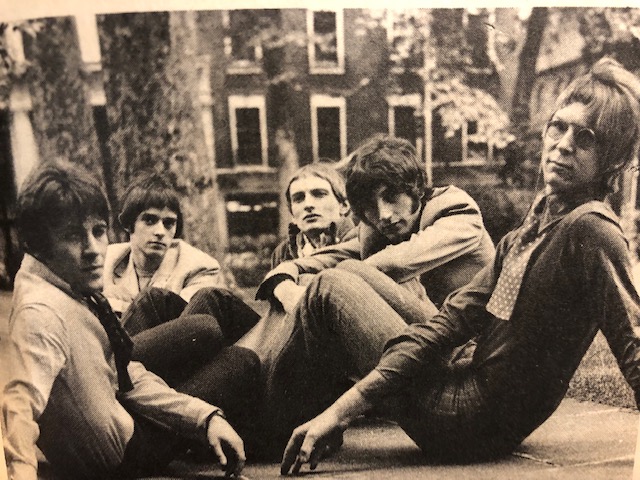
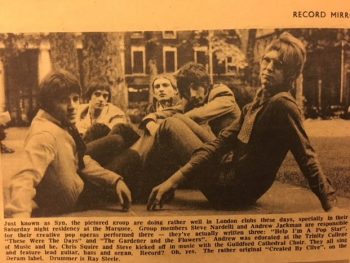
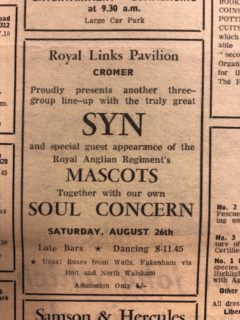
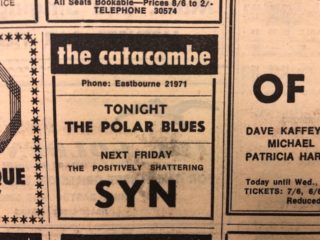
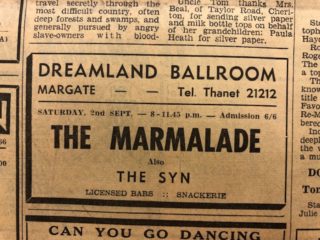
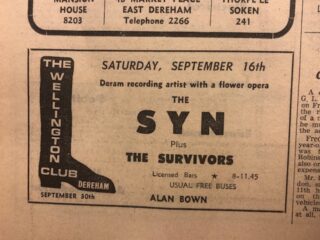
The Syn evolved out of north London R&B group High Court, which featured guitarist turned lead singer Steve Nardelli and guitarist John Painter.
They changed name to The Syn in late 1965 but soon after brought in three members from rival north London R&B band The Selfs – Chris Squire (bass), Andrew Jackman (keyboards) and Martyn Adelman (drums).
By late 1965, The Syn comprised:
Steve Nardelli (lead vocals)
John Painter (lead guitar)
Chris Squire (bass/vocals)
Andrew Jackman (keyboards)
Martyn Adelman (drums)
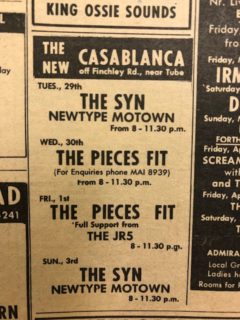
29 March 1966 – London Cavern, Holland Park, west London (Melody Maker)
29 March 1966 – The New Casablanca Club, Finchley, north London (Melody Maker)
3 April 1966 – London Cavern, Holland Park, west London (Melody Maker)
Image may be subject to copyright
3 April 1966 – The New Casablanca Club, Finchley, north London (Melody Maker)
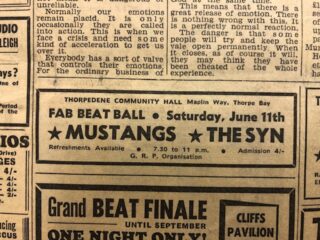
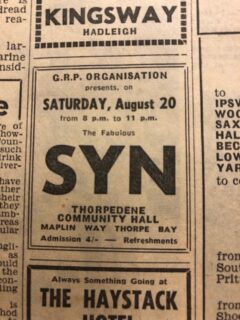
11 June 1966 – Thorpedene Community Hall, Thorpe Bay, Essex with The Mustangs (Southend Standard) Is this gig possible with one above?
2 July 1966 – Thorpedene Community Hall, Thorpe Bay, Essex (Southend Standard)
2 July 1966 – Witham Public Hall, House of Aden, Witham, Essex with The Cymbaline (Essex County Standard)
Icelandic drummer Gunner Jokull Hakanarsson joined at this point when Martyn Adelman left. The band went to play the Valbonne near Cannes in the south of France for three weeks during the summer.
6 August 1966 – Salisbury City Hall, Salisbury, Wiltshire with The Shakedown Sound (Frogg Moody and Richard Nash’s book Hold Tight!)
Image may be subject to copyright
20 August 1966 – Thorpedene Community Hall, Thorpe Bay, Essex (Southend Standard)
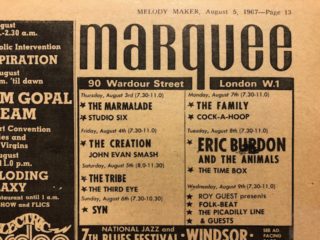
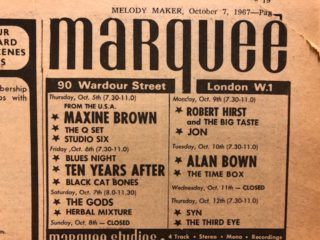
26 August 1966 – Marquee, Wardour Street, Soho, central London with The Gary Farr & The T-Bones (Tony Bacon’s book: London Live)
27 August 1966 – Cad-Lac Club, Brighton, West Sussex (Evening Argus)
12 September 1966 – Marquee, Wardour Street, Soho, central London with The VIPs (Tony Bacon’s book: London Live)
Image may be subject to copyright
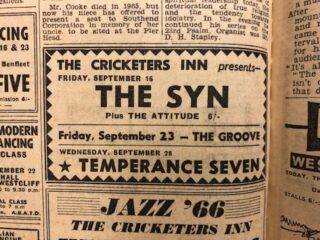
16 September 1966 – Cricketers Inn, Southend, Essex with The Attitude (Southend Standard)
21 October 1967 – Hagger’s Ballroom, Pembroke, Wales (Fabulous 208)
Image may be subject to copyright
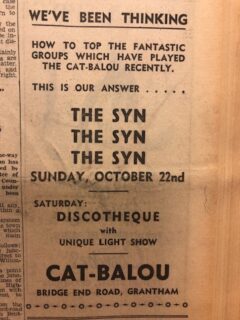
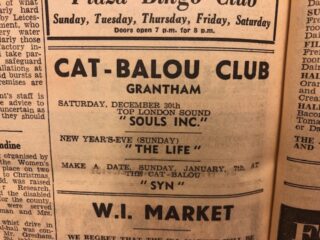
22 October 1967 – Cat-Balou, Grantham, Lincolnshire (Grantham Journal)
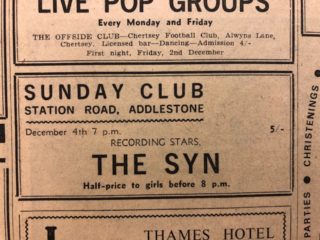
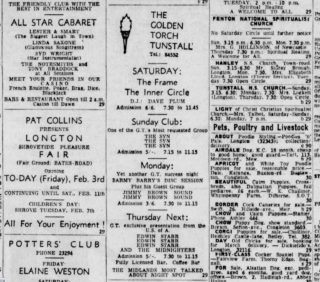
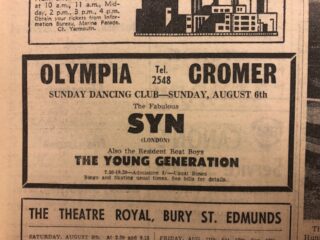
25 October 1967 – Club A Go Go, Newcastle upon Tyne, Tyne & Wear (Newcastle Evening Chronicle) Billed as The Sin
28 October 1967 – Sussex University, Brighton, West Sussex (Fabulous 208)
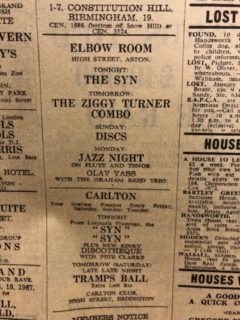
2 November 1967 – Marquee, Wardour Street, Soho, central London with The Quik (Tony Bacon’s book: London Live)
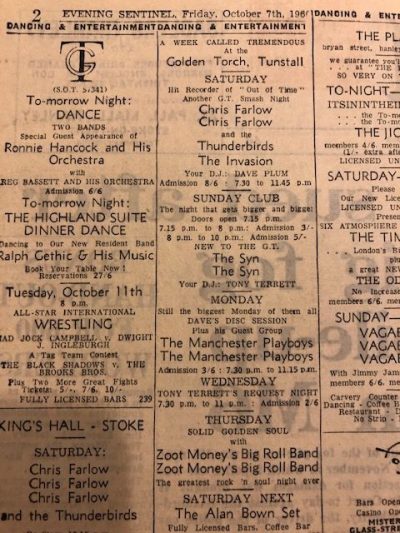
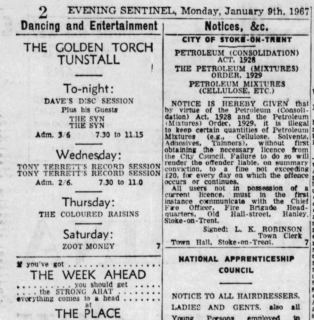
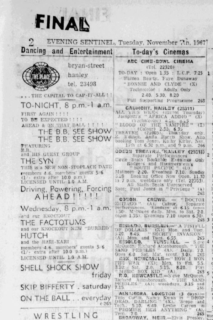
7 November 1967 – The Place, Hanley, Staffordshire (Evening Sentinel) Thanks to Geoffrey Mason for photo and source
10 November 1967 – Fiesta Hall, Andover, Hampshire (Andover Advertiser) The Syn were booked to play but One in a Million replaced them
16 November 1967 – Marquee, Wardour Street, Soho, central London with The Love Affair (Tony Bacon’s book: London Live)
The band played a three residency at the Op Palladium in Toulon, south of France followed by a short stint at the Bilboquet in St Germain, Paris and this seems the most likely time period.
9 December 1967 – Ritz, Bournemouth, Dorset with The Latest Soul (Bournemouth Echo)
15 December 1967 – West End, Rushden, Northamptonshire (Northamptonshire Evening Telegraph)
Image may be subject to copyright
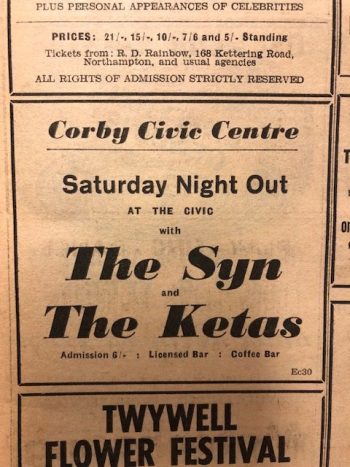
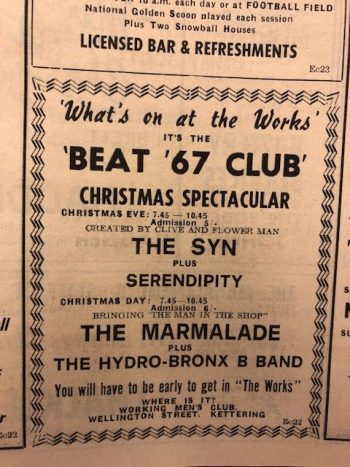
24 December 1967 – Kettering Working Men’s Club, Kettering, Northamptonshire with Serendipity (Northamptonshire Evening Telegraph)
Image may be subject to copyright
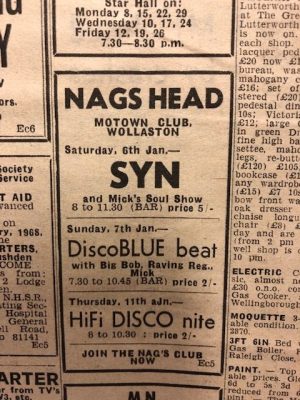
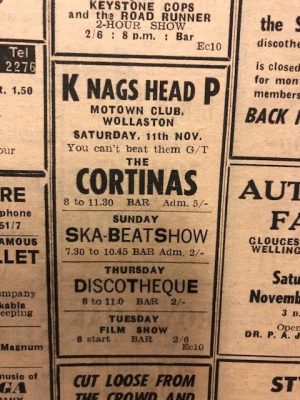
6 January 1968 – Nags Head, Motown Club, Wollaston, Northamptonshire with Mick’s Soul Show (Northamptonshire Evening Telegraph)
Image may be subject to copyright
7 January 1968 – Cat-Balou, Grantham, Lincolnshire (Grantham Journal) This was the band’s final gig
22 March 1964 – The Hilltop, Hatfield, Hertfordshire (Paul Griggs’ book: Diary of a Musician)
18 June 1964 – Breaks Youth Club, Hatfield, Hertfordshire with Tony Rivers & The Castaways (Paul Griggs’ book: Diary of a Musician)
27 June 1964 – ‘Beat Competition’, Westminster Lodge, St Albans, Hertfordshire with The Trekkas and The King Bees (Paul Griggs’ book: Diary of a Musician)
10 July 1964 – Willows, London Colney, Herts (Welwyn & Hatfield Advertiser)
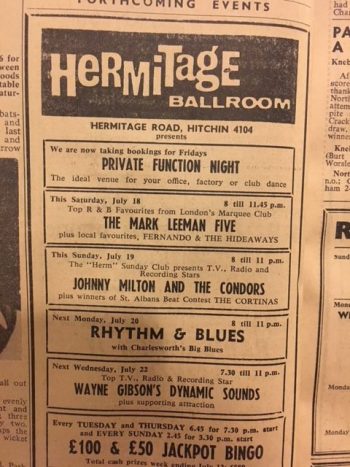
19 July 1964 – Hermitage Ballroom, Hitchin, Herts with Johnny Milton & The Condors (Hertfordshire Express)
22 August 1964 – Hermitage Ballroom, Hitchin, Herts with Mark Douglas & The Prowlers (Hertfordshire Express)
11 October 1964 – The Hilltop, Hatfield, Hertfordshire (Paul Griggs’ book: Diary of a Musician)
19 December 1964 – Hermitage Ballroom, Hitchin, Hertfordshire with Steve Marriot’s Moments (Paul Griggs’ book: Diary of a Musician) Hertforshire Express lists this as The Stormsville Shakers
1965
30 January 1965 – The Hop, Welwyn Garden City, Hertfordshire (Paul Griggs’ book: Diary of a Musician)
1 February 1965 – The Hop, Welwyn Garden City, Hertfordshire with Tony Rivers & The Castaways (Paul Griggs’ book: Diary of a Musician)
12-13 February 1965 – Battersea College, London with Georgie Fame & The Blue Flames (Paul Griggs’ book: Diary of a Musician)
Paul Crowland announced he was leaving on 11 March but stayed until replacement Cliff Franklyn had rehearsed sufficiently to take over.
29 March 1965 – Hermitage Ballroom, Hitchin, Hertfordshire with Screaming Lord Sutch & The Savages (Paul Griggs’ book: Diary of a Musician/Hertfordshire Express)
12 April 1965 – The Hop, Welwyn Garden City, Hertfordshire with Tony Rivers & The Castaways (Paul Griggs’ book: Diary of a Musician) This was Cliff Franklyn’s debut show
2 May 1965 – Melody Maker Beat Competition Heat, Wimbledon Palais, Wimbledon, southwest London (Paul Griggs’ book: Diary of a Musician)
15 May 1965 – Porchester Hall, Bayswater, west London with Billy J Kramer & The Dakotas (Paul Griggs’ book: Diary of a Musician)
12 June 1965 – Hermitage Ballroom, Hitchin, Hertfordshire with The Five Sons of Adam (Hertfordshire Express)
15 August 1965 – Melody Maker Beat Competition Final, Wimbledon Palais, Wimbledon, south west London with St Louis Union, The Tudors, The Carolines and others (Paul Griggs’ book: Diary of a Musician)
28 August 1965 – Rhodes Centre, Bishop’s Stortford, Herts with The Paramounts (Steve Ingless book: The Day Before Yesterday)
25 September 1965 – Rhodes Centre, Bishop’s Stortford, Herts with Dave Curtiss & The Tremors (Steve Ingless book: The Day Before Yesterday)
12 October 1965 – New Greens Youth Club, St Albans, Herts (Welwyn & Hatfield Advertiser)
6 November 1965 – Rhodes Centre, Bishop’s Stortford, Herts with Force Five (Steve Ingless book: The Day Before Yesterday)
1966
29 January 1966 – California Ballroom, Dunstable, Bedfordshire with Chris Andrews and The Roscoe Brown Combination (website: www.california-ballroom.info/gigs/)
Cliff Franklyn announced he was leaving on 3 February 1966. Mick King took his place as rhythm guitarist.
12 March 1966 – Rhodes Centre, Bishop’s Stortford, Herts with Dave Dee, Dozy, Beaky, Mick and Titch (Steve Ingless book: The Day Before Yesterday) This was Mick King’s debut show
18 April 1966 – Barn Cellar, St Albans, Hertfordshire (Paul Griggs’ book: Diary of a Musician)
30 May 1966 – Victoria Ballroom, Cambridge with Desmonde Mode (Cambridge News)
11-12 June 1966 – Supreme Ballroom, Ramsgate, Kent (Paul Griggs’ book: Diary of a Musician)
13 June 1966 – Supreme Ballroom, Ramsgate, Kent with The Alan Price Set (Paul Griggs’ book: Diary of a Musician)
21 June 1966 – Sandridge Youth Club, near St Albans, Hertfordshire (Paul Griggs’ book: Diary of a Musician)
Roger Cook announced he was leaving but agreed to stay until replacement Dave Cooper (ex-Op Scene) was ready to take over.
22 July 1966 – Bees Club, Brentford FC, west London (Paul Griggs’ book: Diary of a Musician) This was Dave Cooper’s debut show
Mick King announced he was leaving in mid-August to join The Trespassers. Paul Griggs’ friends, guitarists Alan Shacklock (from Harlem Shuffle) and Mick Taylor (ex-Juniors) agreed to fill in until a replacement was found.
23 October 1966 – California Ballroom, Dunstable, Bedfordshire with Billy Fury and The Gamblers (Paul Griggs’ book: Diary of a Musician)
2 November 1966 – Hemel Hempstead Pavilion, Hemel Hempstead, Hertfordshire with Cream (Paul Griggs’ book: Diary of a Musician)
Rick Williams from The In-Sect took over on rhythm guitar, joining in late November.
17 December 1966 – Rhodes Centre, Bishop’s Stortford, Herts with Billy Fury & The Gamblers (Steve Ingless book: The Day Before Yesterday)
14 March 1968 – Penny Farthing Club, Leicester with The Eyes of Blonde (Leicester Mercury)
21 March 1968 – Whisky A Go Go, Wardour Street, Soho, central London (Melody Maker)
22 March 1968 – St Albans Hall, St Albans, Hertfordshire with The Nashville Teens and West Coast Consortium (Paul Griggs’ book: Diary of a Musician/Welwyn and Hatfield Advertiser) Debut at the venue
18 April 1968 – Whisky A Go Go, Wardour Street, Soho, central London (Melody Maker)
20 April 1968 – Marquee, Wardour Street, Soho, central London with Timebox (Tony Bacon’s book: London Live)
23 April 1968 – Penny Farthing, Leicester (Leicester Mercury)
26 April 1968 – Cooks Ferry Inn, Edmonton, north London (Paul Griggs’ diary)
27 April 1968 – Starlight Ballroom, Boston Gliderdrome, Boston, Lincolnshire with Tony Bishop’s Rock and Soul and Fanny Flicker’s Show (Lincolnshire Standard)
28 April 1968 – Whisky A Go Go, Wardour Street, Soho, central London (Melody Maker)
13 July 1968 – Starlight Room, Boston, Lincolnshire with The Paberback Edition (Nottingham Evening Post)
23 July 1968 – Marquee, Wardour Street, Soho, central London with Tony Rivers & The Castaways (Paul Griggs’ diary)
24 July 1968 – Blaises, Imperial Hotel, Queen’s Gate, west London (Paul Griggs’ book: Diary of a Musician) This was a 1am show so the band arrived on 23 July
29 July 1968 – Rhodes Centre, Bishop’s Stortford, Herts (Steve Ingless book: The Day Before Yesterday)
10 August 1968 – White Tiles, Swindon, Wiltshire (Swindon Evening Advertiser)
11 August 1968 – Whisky A Go Go, Wardour Street, Soho, central London (Paul Griggs’ diary)
12 August 1968 – Dreamland Ballroom, Margate, Kent with The Delroy Williams Show (East Kent Times & Mail)
18 August 1968 – Cat-Balou, Grantham, Lincolnshire (Grantham Journal)
19 August 1968 – Marquee, Wardour Street, Soho, central London with Nite People (Tony Bacon’s book: London Live)
24 August 1968 – High Wycombe Town Hall, High Wycombe, Bucks (Bucks Free Press)
24 August 1968 – The Barn Ballroom, Little Bardfield Hall, Little Bardfield, Essex (Steve Ingless book: The Day Before Yesterday)
2 September 1968 – Ford Cortina Day, Mallory Park, Race Track, Leicester (Paul Griggs’ book: Diary of a Musician)
7 September 1968 – Marquee, Wardour Street, Soho, central London with Spice (Tony Bacon’s book: London Live)
8 September 1968 – Whisky A Go Go, Wardour Street, Soho, central London (Paul Griggs’ diary)
13 September 1968 – Cooks Ferry Inn, Edmonton,north London (Paul Griggs’ diary)
16 September 1968 – Dunstable Civic Hall, Dunstable, Bedforshire with Sly & The Family Stone (who didn’t turn up) (Luton News)
27 September 1968 – Cooks Ferry Inn, Edmonton, north London (Paul Griggs’ diary)
6 October 1968 – Whisky A Go Go, Wardour Street, Soho, central London (Paul Griggs’ diary)
12 October 1968 – High Wycombe Town Hall, High Wycombe, Bucks (Bucks Free Press)
25 October 1968 – Cooks Ferry Inn, Edmonton, north London (Paul Griggs’ diary)
6 November 1968 – St Albans City Hall, St Albans, Hertfordshire with Status Quo and Nerve (Paul Griggs’ book: Diary of a Musician/Welwyn and Hatfield Advertiser)
9 November 1968 – Marquee, Wardour Street, Soho, central London with Dream Police (Tony Bacon’s book: London Live)
10 November 1968 – Whisky A Go Go, Wardour Street, Soho, central London (Paul Griggs’ diary)
15 November 1968 – Nottingham University, Nottingham with Marmalade and The Nashville Teens (Paul Griggs’ book: Diary of a Musician)
23 November 1968 – Rhodes Centre, Bishop’s Stortford, Herts (Steve Ingless book: The Day Before Yesterday)
Octopus’ select gigs:
21 November 1968 – Baldock Workingmen’s Club, Baldock, Hertfordshire (Paul Griggs’ book: Diary of a Musician) Debut as Octopus
30 November 1968 – Marquee, Wardour Street, Soho, central London with Dream Police (Tony Bacon’s book: London Live)
18 December 1968 – Gig in Sutton in Ashfield, Nottinghamshire (Paul Griggs’ book: Diary of a Musician)
20 December 1968 – Cooks Ferry Inn, Edmonton, north London (Paul Griggs’ diary)
21 December 1968 – RAF Benson, Oxfordshire with Plastic Penny (Paul Griggs’ book: Diary of a Musician)
29 December 1968 – Whisky A Go Go, Wardour Street, Soho, central London (Paul Griggs’ diary)
31 December 1968 – Gig in Dunstable, Bedfordshire (Paul Griggs’ book: Diary of a Musician)
1969
1 January 1969 – Marquee, Wardour Street, Soho, central London with Yes (Tony Bacon’s book: London Live)
4-5 January 1969 – Stella Ballroom, Mount Merion, Republic of Ireland (Paul Griggs’ book: Diary of a Musician)
18 January 1969 – Marquee, Wardour Street, Soho, central London with Spice (Tony Bacon’s book: London Live)
8 February 1969 – Rhodes Centre, Bishop’s Stortford, Herts (Steve Ingless book: The Day Before Yesterday)
12 February 1969 – Marquee, Wardour Street, Soho, central London with Yes (Tony Bacon’s book: London Live)
15 February 1969 – Marquee, Wardour Street, Soho, central London with Spice (Tony Bacon’s book: London Live)
6-7 April 1969 (check) – Stella Ballroom, Mount Merion, Republic of Ireland (Paul Griggs’ book: Diary of a Musician)
12 April 1969 – Marquee, Wardour Street, Soho, central London with Procession (Tony Bacon’s book: London Live)
4 May 1969 – Tiffany’s, central London (Paul Griggs’ diary)
Gary Whinyates announced he was leaving on 22 May but stayed until late July.
8 June 1969 – Tiffany’s, central London (Paul Griggs’ diary)
28 June 1969 – Marquee, Wardour Street, Soho, central London with Procession (Tony Bacon’s book: London Live)
20 July 1969 – Shire Green Working Men’s Club, Sheffield, South Yorkshire (Paul Griggs’ book: Diary of a Musician)
21 July 1969 – Black Swan, Sheffield, South Yorkshire (Paul Griggs’ book: Diary of a Musician) This was Nigel Whinyates’ final show
Brian Glascock joined on drums at this point
19 August 1969 – Lyceum, Strand, central London (Paul Griggs’ book: Diary of a Musician)
29 August 1969 – St Albans City Hall, St Albans, Hertfordshire with Desmond Dekker (Paul Griggs’ book: Diary of a Musician) This was the band’s final gig at this venue
14 September 1969 – Tiffany’s, central London (Paul Griggs’ diary)
27 November 1969 – Baldock Working Men’s Club, Baldock, Hertfordshire (Paul Griggs’ book: Diary of a Musician)
24 December 1969 – Cooks Ferry Inn, Edmonton, north London (Paul Griggs’ diary)
31 December 1969 – Mansfield Palais, Mansfield, Nottinghamshire (Paul Griggs’ book: Diary of a Musician)
1970
31 May 1970 – Tiffany’s, central London (Paul Griggs’ diary)
After this gig, Rick Williams and Brian Glascock both left, the latter joining Toe Fat.
In early July, John Cook from The Mixed Bag joined on keyboards and Malcolm Green came in on drums. The new line-up debuted on 17 July 1970.
Brian Glascock briefly replaced Malcolm Green in early 1971 before Tim Reeves from The Fox took over in late April. However, Octopus split in mid-January 1972.
Paul Griggs’ book (noted above) provided a wealth of information on the comings and goings and is definitely worth purchasing.
Jon was formed around October 1966 (possibly even early September) after Stuart Cowell left Gass. He’d previously worked with Ralph Denyer in The Rockhouse Band.
Tom Tierney had been a member of Lulu’s backing band, The Luvvers while Jim Toomey had been in The Arthur Brown Union and The Union (with Brown’s replacement Dave Terry) and finally The Uptown Band.
Image may be subject to copyright
Chris Simmons was the band’s original lead singer but he’s not pictured in either of the adverts featured in Melody Maker, to promote the release of Jon’s debut 45, which was issued in June 1967.
A second 45 appeared in August before Simmons departed and Stuart Cowell assumed lead vocals.
Notable gigs:
19-20 September 1966 – Mick’s Flamenco, Folkestone, Kent (Kentish Express)
Image may be subject to copyright
11 November 1966 – Mick’s Flamenco, Folkestone, Kent (Folkestone, Hythe & District Herald)
14 January 1967 – Flamingo, Wardour Street, Soho, London with The Amboy Dukes (Melody Maker)
27 January 1967 – Harvest Moon, Guildford, Surrey with The Great Expectations and Mood Indigo (West Surrey Advertiser)
23 February 1967 – Witchdoctor, Catford, southeast London (South East London Mercury)
Image may be subject to copyright
13 April 1967 – Upper Cut, Forest Gate, London with Episode Six (Melody Maker)
20 May 1967 – Marine Ballroom, Central Pier, Morecambe, Lancashire with backing group and Five of a Kind (Morecambe Visitor) Is this the same band?
2 June 1967 – Dolphin, Marine Court, St Leonards, East Sussex (Hastings & St Leonards Observer) Billed as John
10 June 1967 – Big ‘L’ Speakeasy, Ryde Pier Head, Ryde, Isle of Wight with The Action (Isle of Wight Country Press)
14 June 1967 – Disco Blue, Ryde, Isle of Wight with John Lee Hooker and Savoy Brown Blues Band (Isle of Wight County Press)
15 June 1967 – Disco Blue, Ryde, Isle of Wight (Isle of Wight County Press)
Image may be subject to copyright
23 June 1967 – Witchdoctor, Catford, southeast London plus supporting group (South East London Mercury)
Advert in Melody Maker. Image may be subject to copyright
8 July 1967 – Central R&B Club, Central Hotel, Gillingham, Kent (Chatham, Rochester & Gillingham News)
An article in the Westminster & Pimlico News, dated 25 August 1967, says the group is nine months old and are residents at the Cafe des Artistes in Fulham
22 September 1967 – New Trades Club, Kettering, Northamptonshire (Northamptonshire Evening Telegraph)
Image may be subject to copyright
24 September 1967 – Whisky A Go Go, Wardour Street, Soho, central London (Melody Maker) Billed as John
Image may be subject to copyright
7 October 1967 – Silver Blades, Streatham, London (Coulson & Purley Advertiser)
Image may be subject to copyright
9 October 1967 – Marquee, Wardour Street, Soho, London with Robert Hirst & The Big Taste (Melody Maker)
Image may be subject to copyright
11 November 1967 – The Catacombe, Eastbourne, East Sussex (Eastbourne Herald Chronicle)
11 December 1967 – Marquee, Wardour Street, Soho, London with Simon Dupree & The Big Sound (Melody Maker)
6 January 1968 – Luton Boys Club, Luton, Bedfordshire with Canal Street Philharmonic (Luton News)
23 January 1968 – North Park Club, Kettering, Northamptonshire (Northamptonshire Evening Telegraph)
1 February 1968 – Marquee, Wardour Street, Soho, London with Marmalade (Melody Maker)
Jon featured in The Kettering Leader, 2 February 1968, page 4
10 February 1968 – Sixty Nine Club, Royal York Hotel, Ryde, Isle of Wight (Isle of Wight County Press) Billed as Still Life
Image may be subject to copyright
17 February 1968 – Walton Playhouse, Walton-on-Thames, Surrey (Woking Herald)
24 February 1968 – Luton Boys Club, Luton, Bedfordshire with The Favourite Sounds with Bruce Benson (Hemel Hempstead Evening Post)
Image may be subject to copyright
In late February, the band changed name to Still Life
After changing name, the group released a lone 45 as Still Life in February 1968 before Tierney switched over to rhythm guitar and Con Byrne joined on bass.
Image may be subject to copyright
2 March 1968 – Hastings Pier, Hastings, East Sussex with Thackery (Hastings & St Leonards Observer)
9 March 1968 – Marquee, Wardour Street, Soho, London with The Open Mind (Melody Maker)
On 25 March, Still Life performed at the Marquee (supporting The Nice) where they were spotted by singer Warren Davis, who invited the band to joined forces with him in a new version of The Warren Davis Monday Band soon after.
1 April 1968 – Top Rank Suite, Watford, Herts with The Foundations (Harrow Observer & Gazette) This may have been under The Warren Davis Monday Band performing under this name
Although the gig below was billed as Still Life, this was in fact performed by The Warren Davis Monday Band.
Image may be subject to copyright
20 April 1968 – Hastings Pier, Hastings, East Sussex with Web Foundation (Hastings & St Leonards Observer)
When Dexys Midnight Runners’ topped the UK charts in 1981 with their “Geno” tribute, a new generation of fans discovered American soul singer Geno Washington, who had fronted British R&B/soul outfit The Ram Jam Band from 1965-1970 and enjoyed moderate chart success.
Originally the brainchild of lead guitarist Pete Gage, who now lives in Australia, this period covers the original formation before Geno Washington restructured the group in April 1967.
I have tried to list all of the gig sources at the end of this article.
Geno Washington & Les Blues
24 October 1964 – Town Hall, Clacton, Essex with Georgie Fame & The Blue Flames and The Limelighters
Photo courtesy of Buddy Beadle. Left to right: Geoff, Lionel, Herb, Geno, Pete, John and Buddy
Geno Washington & The Ram Jam Band #1
(March 1965-July 1966)
Geno Washington – lead vocals
Pete Gage – lead guitar, vocals
Geoff Pullum (aka Jeff Wright) – organ, vocals
John Roberts – bass
Lionel ‘Rocky’ Kingham – tenor saxophone
Buddy Beadle – baritone saxophone
Herb Prestidge – drums
Guitarist Pete Gage (b. 31 August 1947, Lewisham) had been playing with Dalston, London group, The Zephyrs in late 1964, and had penned the A-side of their single, “She’s Lost You” (released in February 1965), when he ran into Geno Washington in Southend while moonlighting with R&B outfit, The Fairies.
At the time Geno Washington was fronted Les Blues, a band that he had formed in 1963 while working as a US airman, based at USAF Bentwaters, near Woodbridge, Suffolk. The group comprised pianist Koll Patterson, bass player Tony Coe, guitarist Morton Lewis and drummer Gerry Gillings.
Pete Gage had met Washington at USAF Bentwaters on several occasions over the past year and encouraged the American to become a professional singer.
Together with his school friend Jeff Wright (b. Geoffrey Keith Pullum, 8 March 1945, Irving, Scotland), Gage considered the option of “buying” Washington out of the US Armed Forces and then constructing a backing group around the singer.
In early 1965, Pullum introduced Nuneaton-born drummer Herb Prestidge and his friend, Coventry-born bass player John Roberts, who’d both previously worked with the keyboardist in Germany in Sonny Stewart & The Dynamos.
Prestidge had started out with Nuneaton band, The Barracudas around 1961 before playing with Max Hollyman & The Demons for two years, where he met John Roberts. They both met Geoff Pullum while playing with Sonny Stewart & The Dynamos in 1964.
After extensive auditions, Gage and Pullum recruited tenor sax player, Calcutta, India-born Lionel ‘Rocky’ Kingham and baritone sax player Buddy Beadle (b. 27 March 1947, Clapham, south London) to complete their Ram Jam Band, named after an old coaching inn at Stretton near Oakham on the A1 in Rutland.
The idea was to create a UK-based Stax-style soul outfit (with an African-American singer and a backing group like Booker T & The MGs with an added horn section) that British audiences could experience live.
Geno Washington, however, remained unavailable in early 1965, and so The Ram Jam Band tried out singer Kenny Bernard (whom Gage had previously recorded with) but he was more pop that soul. The musicians next tried singer Kenrick Des Etages (aka Ebony Keyes) whose vocals were a perfect match for the band. However, Keyes was more Caribbean than Stax-soul and so the musicians next performed three gigs with singer John Holder before linking with Jamaican singer Errol Dixon.
Together with Dixon, the band cut a lone single “Shake Shake Senora” c/w “Akinia”. Also, through the Jamaican’s contacts with Rik and John Gunnell and their Soho club, the Flamingo on Wardour Street, the musicians landed their first gigs at the prestigious venue around March 1965.
By this point, Geno Washington had demobbed from the US Armed Forces and was due to return to Indiana in the United States. Gage bought the singer a return ticket to the UK on condition that he would come back and replace Errol Dixon as front man.
In the meantime, Gage approached the Gunnell brothers with the proposition that Washington would take over from Dixon. When the American returned in mid-April, the group auditioned for the siblings and were immediately booked to play at the Flamingo.
Photo courtesy of Buddy Beadle. Clockwise from top: Geno, Pete, Lionel, Buddy, Herb, Geoff and John
The original line up was responsible for recording three singles – “Water” c/w “Understanding” (Piccadilly 7N 35312) in April 1966 (the group’s biggest hit, climbing to #39 in the UK charts); “Hi! Hi! Hazel” c/w “Beach Bash” (Piccadilly 7N 35329) in July 1966 (a UK #45 hit) and “Que Sera Sera” c/w “All I Need” (Piccadilly 7N 35346) in September 1966 (a UK #43 hit).
Two tracks also appeared on an EP, “Hi!” (Piccadilly NEP 34054) released in January 1967 and comprising the A-sides of the first two singles plus later recordings.
Selected gigs:
24 April 1965 – Flamingo, Wardour Street, Soho, central London with The Checkmates (first listing at Soho club)
25 April 1965 – Flamingo, Wardour Street, Soho, central London with Herbie Goins & The Night Timers
4 May 1965 – Flamingo, Wardour Street, Soho, central London with The Shevells
8 May 1965 – Flamingo, Wardour Street, Soho, central London with Tony Knight’s Chessmen
9 May 1965 – Riverside Club, Cricketers Hotel, Chertsey, Surrey
15 May 1965 – Flamingo, Wardour Street, Soho, central London with Georgie Fame & The Blue Flames
16 May 1965 – Flamingo, Wardour Street, Soho, central London with John Mayall’s Bluesbreakers
22 May 1965 – Witchdoctor Club, St Leonards-on-Sea, East Sussex
23 May 1965 – Royal Star Ballroom, Maidstone, Kent
28-29 May 1965 – Flamingo, Wardour Street, Soho, central London with The Soul Sisters and Brian Auger Trinity
30 May 1965 – Blue Moon, Hayes, west London
7 June 1965 – Flamingo, Wardour Street, Soho, central London with Chris Farlowe & The Thunderbirds
11-12 June 1965 – Flamingo, Wardour Street, Soho, central London with Doris Troy and Chris Farlowe & The Thunderbirds
13 June 1965 – Flamingo, Wardour Street, Soho, central London
15 June 1965 – Flamingo, Wardour Street, Soho, central London
18 June 1965 – Ricky Tick, Guildford Civic Hall, Guildford, Surrey (David Else says they replaced Errol Dixon)
18 June 1965 – Flamingo, Wardour Street, Soho, central London with Solomon Burke and The Mike Cotton Sound
19 June 1965 – Royal Star Ballroom, Maidstone, Kent with The Mark Leeman Five
19 June 1965 – Flamingo, Wardour Street, Soho, central London with Chris Farlowe & The Thunderbirds
20 June 1965 – Witchdoctor Club, St Leonards-on-Sea, East Sussex
23 June 1965 – Le Disque A Go Go, Bournemouth, Dorset
25 June 1965 – Flamingo, Wardour Street, Soho, central London with Herbie Goins & The Night Timers
27 June 1965 – Flamingo, Wardour Street, Soho, central London
3 July 1965 – Flamingo, Wardour Street, Soho, central London with Herbie Goins & The Night Timers
Photo from Ian Woodward. Source: Surrey Advertiser and County Times
4 July 1965 – ‘Rhapsody at Racks’, Guildford, Surrey with The Graham Bond Organisation and The Herd
6 July 1965 – Klook’s Kleek, West Hampstead, north London with Dedicated Men’s Jug Band
9 July 1965 – Flamingo, Wardour Street, Soho, central London with Inez & Charlie Foxx and Tony Knight’s Chessmen
12 July 1965 – The Cavern, Liverpool with Richmond Group and Exit
16 July 1965 – Flamingo, Wardour Street, Soho, central London with Inez & Charlie Foxx and John Mayall’s Bluesbreakers (billed without Geno)
18 July 1965 – Bromel Club, Bromley Court Hotel, Bromley, southeast London with Inez & Charlie Foxx (billed without Geno)
18 July 1965 – Flamingo, Wardour Street, Soho, central London with Inez & Charlie Foxx (billed without Geno)
21 July 1965 – Flamingo, Wardour Street, Soho, central London (billed without Geno)
Photo from Ian Woodward. Source: Port Talbot Guardian
29 July 1965 – Ritz Club, Skewen, Wales with The Eyes of Blue and The Iveys
31 July 1965 – New Georgia, Uxbridge, west London
31 July 1965 – Flamingo, Wardour Street, Soho, central London with Tony Colton & Big Boss Band
1 August 1965 – Blue Moon, Hayes, west London
1 August 1965 – Flamingo, Wardour Street, Soho, central London
6 August 1965 – Flamingo, Wardour Street, Soho, central London with The Byrds
7 August 1965 – Royal Star Ballroom, Maidstone, Kent
8 August 1965 – Witchdoctor Club, St Leonards-on-Sea, East Sussex
11 August 1965 – Manor House, north London
20 August 1965 – Dungeon Club, Nottingham
25 August 1965 – Flamingo, Wardour Street, Soho, central London with Cliff Bennett & The Rebel Rousers
26 August 1965 – Klook’s Kleek, West Hampstead, north London
27 August 1965 – Flamingo, Wardour Street, Soho, central London with The Shevells
29 August 1965 – Flamingo, Wardour Street, Soho, central London
4 September 1965 – Flamingo, Wardour Street, Soho, central London with Chris Farlowe & The Thunderbirds
5 September 1965 – Flamingo, Wardour Street, Soho, central London
8 September 1965 – Flamingo, Wardour Street, Soho, central London
10 September 1965 – Flamingo, Wardour Street, Soho, central London with Lou Johnson
15 September 1965 – Manor House, north London
18 September 1965 – Flamingo, Wardour Street, Soho, central London with The Peddlers
19 September 1965 – Bromel Club, Bromley, southeast London (billed without Geno)
21 September 1965 – Gala Ballroom, Norwich, Norfolk
22 September 1965 – Manor House, north London
25 September 1965 – Flamingo, Wardour Street, Soho, central London with Zoot Money Big Roll Band
30 September 1965 – Ritz Club, Skewen, Wales with Cops ‘N’ Robbers and The Kingpins
3 October 1965 – Kirklevington Country Club, Kirklevington, North Yorkshire with Gary Farr & The T-Bones
Photo courtesy of Buddy Beadle
10 October 1965 – Nottingham Boat Club, Nottingham
Photo from Ian Woodward. Source: Aldershot News
17 October 1965 – Agincourt Ballroom, Camberley, Surrey
23 October 1965 – Flamingo, Wardour Street, Soho, central London with Geno Washington & The Ram Jam Band with Beryl Marsden, Steve Aldo & The Crew Cats
24 October 1965 – Orford Cellar, Norwich, Norfolk
28 October 1965 – Klook’s Kleek, West Hampstead, north London
31 October 1965 – Ricky Tick, Plaza, Guildford, Surrey
4 November 1965 – Klook’s Kleek, West Hampstead, north London
6 November 1965 – Zambesi Club, Hounslow, west London
8 November 1965 – Basingstoke Town Hall, Basingstoke, Hants
12 November 1965 – Orford Cellar, Norwich, Norfolk
18 November 1965 – Klook’s Kleek, West Hampstead, north London
21 November 1965 – Sunshine Floor, Tavern Club, Dereham, Norfolk with Beat Ltd
25 November 1965 – Klook’s Kleek, West Hampstead, north London
26 November 1965 – Club A Go Go, Newcastle Upon Tyne
28 November 1965 – The Dungeon, Nottingham
29 November 1965 – Cooks Ferry Inn, Edmonton, north London
2 December 1965 – Bird Cage, Eastney, Hants
Photo from Ian Woodward. Source: Nottingham Evening Post and News
12 December 1965 – Beachcomber, Nottingham (cancelled)
16 December 1965 – Klook’s Kleek, West Hampstead, north London
18 December 1965 – Orford Cellar, Norwich, Norfolk
18 December 1965 – Goldhawk Social Club, Shepherd’s Bush, west London
20 December 1965 – Atalanta Ballroom, Woking, Surrey
23 December 1965 – Ritz Club, Skewen, south Wales with The Eyes of Blue and The Iveys
29 December 1965 – Farnborough Town Hall, Farnborough, Hants with support
Photo courtesy of Buddy Beadle
1966
6 January 1966 – Klook’s Kleek, West Hampstead, north London
8 January 1966 – King Mojo, Sheffield, South Yorkshire
9 January 1966 – Tavern Club, Dereham, Norfolk with Little Mick’s Mode
13 January 1966 – Klook’s Kleek, West Hampstead, north London
15 January 1966 – Twisted Wheel, Manchester with The Drifters
27 January 1966 – Klook’s Kleek, West Hampstead, north London
30 January 1966 – Agincourt Ballroom, Camberley, Surrey
1 February 1966 – Bird Cage, Eastney, Hants
3 February 1966 – Klook’s Kleek, West Hampstead, north London
5 February 1966 – Mr McCoys, Middlesbrough
9 February 1966 – Orford Cellar, Norwich, Norfolk
10 February 1966 – Klook’s Kleek, West Hampstead, north London
11 February 1966 – Rialto, Derby
20 February 1966 – King Mojo, Sheffield, South Yorkshire
26 February 1966 – Club A Go Go, Newcastle Upon Tyne with The Downbeats
2 March 1966 – Farnborough Town Hall, Farnborough, Hants with The Emerlads
3 March 1966 – Blue Triangle, Ealing, west London (Billed as Ram Jam Band)
4 March 1966 – Bluesville, Ipswich, Suffolk
6 March 1966 – Nottingham Boat Club, Nottingham
12 March 1966 – Ram Jam, Brixton, south London with The Peter B’s
16 March 1966 – Orford Cellar, Norwich, Norfolk
2 April 1966 – Bird Cage, Eastney, Hants
4 April 1966 – Dereham Tavern, Dereham, Norfolk with The Sullivan James Band
7 April 1966 – Ricky Tick, Harvest Moon, Guildford, Surrey with The Mark Barry 5
8 April 1966 – Flamingo, Wardour Street, Soho, central London with The Peter B’s and Georgie Fame & The Blue Flames
8 April 1966 – Ram Jam, Brixton, south London
9 April 1966 – Assembly Hall, Barking, east London with Long John Baldry & The Steam Packet and John Mayall’s Bluesbreakers
14 April 1966 – Mister McCoys, Middlesbrough
17 April 1966 – Black Prince Hotel, Bexley, southeast London
19 April 1966 – Klook’s Kleek, West Hampstead, north London
20 April 1966 – Target Paul’s Row, High Wycombe, Bucks
21 April 1966 – Starlight Ballroom, Crawley, West Sussex with The Fleur De Lys
23 April 1966 – King Mojo, Sheffield, South Yorkshire with The Vibrations and Jackie Williams & The Excitements
27 April 1966 – Orford Cellar, Norwich, Norfolk
The band in 1965. Photo courtesy of Buddy Beadle
1 May 1966 – Bluesville, Ipswich, Suffolk
5 May 1966 – Ricky Tick, Southampton Guildhall, Hampshire
11 May 1966 – Tower Ballroom, (Great Yarmouth?) with Ye Highwaymen
16 May 1966 – Atlanta Ballroom, Woking, Surrey with support
17 May 1966 – Gala Ballroom, Norwich, Norfolk
21 May 1966 – Ricky Tick, Newbury Plaza, Berkshire (They may have played at Toft’s in Folkestone on this day)
22 May 1966 – Agincourt Ballroom, Camberley, Surrey
29 May 1966 – Central R&B Club, Central Hotel, Gillingham, Kent
29 May 1966 – Mister McCoys, Middlesbrough
30 May 1966 – Blues Festival, Quebec Park, East Dereham, Norfolk with Zoot Money & The Big Roll Band, Jimmy James & The Vagabonds, The Sullivan James Band and Sounds Reformed
6 June 1966 – Beachcomber, Preston, Lancashire
7 June 1966 – Klook’s Kleek, West Hampstead, north London
15 June 1966 – Farnborough Town Hall, Farnborough, Hampshire
16 June 1966 – The Beachcomber, Preston, Lancashire
20 June 1966 – Atlanta Ballroom, Woking, Surrey
21 June 1966 – Balliol Commem, Balliol College, Oxford University with The Kinks, The Fortunes, The Alan Price Set, Them, Caribbean All-Steer Band and Bunny Thompson
25 June 1966 – Ram Jam, Brixton, south London
26 June 1966 – Beachcomber, Nottingham
27 June 1966 – The Hop, Woodhall Community Centre, Welwyn Garden City, Hertfordshire
28 June 1966 – Civic Hall, Grays, Essex
29 June 1966 – Orford Cellar, Norwich, Norfolk
30 June 1966 – Club a Go Go, Newcastle upon Tyne, Tyne & Wear
Photo courtesy of Buddy Beadle
1 July 1966 – Corn Exchange, Newbury, Berkshire
2 July 1966 – Marcam Hall, March, Cambridgeshire
3 July 1966 – Black Prince Hotel, Bexley, southeast London
5 July 1966 – Odeon Ballroom, Holywell Cross, Chesterfield
6 July 1966 – Corn Exchange, King’s Lynn, Norfolk
7 July 1966 – Civic Hall, Guildford, Surrey
8 July 1966 – Ram Jam, Brixton, south London and Flamingo, Wardour Street, Soho, central London
9 July 1966 – Burton’s, Uxbridge, west London
10 July 1966 – Iron Curtain, St Mary’s Cray, southeast London
11 July 1966 – Court Youth Centre, South Ockendon
12 July 1966 – Bristol University, Bristol
14 July 1966 – Ricky Tick, Windsor, Berkshire
15 July 1966 – California Ballroom, Dunstable, Bedfordshire with The Mark Barry Group
16 July 1966 – Flamingo, Wardour Street, Soho, central London with 5 Proud Walkers
17 July 1966 – Dereham Tavern Club, Dereham, Norfolk with The Style
Geno Washington & The Ram Jam Band #2
(July 1966-August 1966)
Geno Washington – lead vocals
Peter Gage – lead guitar, vocals
Geoff Pullum (aka Jeff Wright) – organ, vocals
Rick Parsons – bass
Lionel ‘Rocky’ Kingham – tenor saxophone
Buddy Beadle – baritone saxophone
Herb Prestidge – drums
The short-lived line-up with Rick Parsons (striped shirt), Fabulous 208, 20 August 1966 issue
John Roberts (aka Robbo to the group) had contracted TB earlier in the year and had spent six months in a clinic in Warwick. During his absence, Gage asked his friend John Baldwin (aka John Paul Jones) to cover initially on condition that Roberts would regain his place when he was better.
Melody Maker, 16 July 1966, page 4
Rick Parsons, who had previously played with The Noise, was announced as the new bass player in the music press on 16 July but did not stay long. He joined after seeing an advert in Melody Maker and had also been a member of The Pitmen from West London.
When Parsons’s replacement Peter Carney (see later entry) proved to be an excellent bass player, it became clear that John Roberts would not re-join and he went on to play with Jimmy James & The Vagabonds where he reunited with Herb Prestidge and Lionel Kingham.
Selected gigs:
18 July 1966 – Atlanta Ballroom, Woking, Surrey (billed as Ram Jam Band)
19 July 1966 – Town Hall, High Wycombe, Bucks
21 July 1966 – Ricky Tick, Stoke Hotel, Guildford, Surrey
22 July 1966 – Youth Centre, Stanford-Le-Hope, Essex
23 July 1966 – Toft’s, Folkestone, Kent
24 July 1966 – Agincourt Ballroom, Camberley, Surrey (billed as Ram Jam Band)
26 July 1966 – Civic Hall, Grays, Essex
25 July 1966 – Majestic Ballroom, Reading, Berkshire
26 July 1966 – Klooks Kleek, West Hampstead, north London
28 July 1966 – Ricky Tick, Harpenden Town Hall, Herts
West Londoner Peter Carney had a long pedigree, having started out with Ealing band, The Krewsaders in 1962. After played with The Flexmen and touring Poland with The London Beats, he joined Tony Knight’s Chessmen in late 1965.
The new bass player remembers that his first outing with the band was a live radio session at BBC Radio 1 with Herman’s Hermits at the Playhouse Theatre in central London.
This line up was responsible for recording (albeit it with a studio bass player) a lone single, “Michael (The Lover)” backed by arguably the group’s best outing, the Pete Gage/Geno Washington co-write “(I Gotta) Hold On To My Love” (Piccadilly 7N 35359) in January 1967 (a UK #39 hit).
Geno Washington & The Ram Jam Band also cut two tracks – “Always” and Pete Gage’s “If I Knew”, which appeared on the EP “Hi!” (Piccadilly NEP 34054), also released in January 1967.
For the “If I Knew” session, Geno Washington learnt the song from a demo sung by Ebony Keyes (aka Kenrick Des Etages). Gage says that the group may have also cut “Never Like This Before” at the same session and that they definitely recorded two songs – “Tell It Like It Is” and “Girl I Want To Marry You”, which were held back and later released as a single (Piccadilly 7N 35403) during September 1967.
While producer John Schroeder preferred to use a session bass player for the studio sessions, Peter Carney did feature on the band’s live recordings and he appears on the debut LP Hand Clappin’, Foot Stompin’, Funky Butt…Live! recorded live at Pye’s Marble Arch Studios with an invited studio audience. The LP broke the UK Top 5 and stayed on the charts for 38 weeks.
Photo courtesy of Buddy Beadle
Selected gigs:
6 August 1966 – Ram Jam, Brixton, south London with The Gass
7 August 1966 – Winter Gardens, Bournemouth, Dorset with Georgie Fame & The Blue Flames, Chris Farlowe & The Thunderbirds, Zoot Money’s Big Roll Band, The Alan Price Set and The Train (Moon’s Train?)
8 August 1966 – The Hop, Woodhall Community Centre, Welwyn Garden City, Hertfordshire
12 August 1966 – Club A Go Go, Newcastle Upon Tyne
13 August 1966 – Elizabeth Club, Glasgow, Scotland
14 August 1966 – Carousel Club, 1 Camp Road, Farnborough, Hants. Beat Instrumental has the band in Scotland on this date
16 August 1966 – Blue Lagoon, Newquay, Cornwall
17 August 1966 – Falcon Hotel, Eltham, Kent
18 August 1966 – Ricky Tick, Stoke Hotel, Guildford, Surrey
21 August 1966 – Mojo Club, Sheffield, South Yorkshire
24 August 1966 – Carousel Club, Farnborough, Hants
25 August 1966 – Ricky Tick, Harpenden Town Hall, Harpenden, Hertfordshire
26 August 1966 – Ricky Tick, Hounslow, west London
26 August 1966 – Ram Jam, Brixton, south London (needs confirmation)
27 August 1966 – Ricky Tick, Windsor, Berkshire
28 August 1966 – Flamingo, Wardour Street, Soho, central London
29 August 1966 – ABC Promotions, Heacham Festival, Norfolk with The Birds, The Small Faces, The Herd, The Versions and The Breed
29 August 1966 – Ram Jam, Brixton, south London (needs confirmation)
30 August 1966 – Burton’s, Uxbridge, west London
2 September 1966 – Il Rondo, Leicester
3 September 1966 – Sunshine Floor, Dereham Tavern, East Dereham, Norfolk
4 September 1966 – Country Club, Kirklevington, North Yorkshire
5 September 1966 – Majestic Ballroom, Reading, Berkshire
6 September 1966 – Civic Hall, Grays, Essex
7 September 1966 – Bromel Club, Bromley Court Hotel, Bromley, southeast London
8 September 1966 – Public Hall, Epping, Essex
9 September 1966 – Beat Festival, Scunthorpe United Football Ground, Scunthorpe, North Lincolnshire with Georgie Fame & The Blue Flames, Chris Farlowe & The Thunderbirds, Cliff Bennett & The Rebel Rousers, Billy J Kramer & The Dakotas, The Troggs, The Creation, The Mindbenders and The Fenmen
9 September 1966 – Tiles, Oxford Street, central London with The Equals
18 October 1966 – Public Hall, Harpenden, Hertfordshire
Image may be subject to copyright
20 October 1966 – Finsbury Park, north London with The New Animals, Georgie Fame & The Blue Flames, Paul Butterfield Blues Band, Chris Farlowe & The Thunderbirds, Eyes of Blue
21 October 1966 – Odeon, Birmingham with The New Animals, Georgie Fame & The Blue Flames, Paul Butterfield Blues Band, Chris Farlowe & The Thunderbirds, Eyes of Blue
22 October 1966 – Odeon, Leeds, West Yorkshire with The New Animals, Georgie Fame & The Blue Flames, Paul Butterfield Blues Band, Chris Farlowe & The Thunderbirds, Eyes of Blue
23 October 1966 – Gaumont, Doncaster, South Yorkshire with The New Animals, Georgie Fame & The Blue Flames, Paul Butterfield Blues Band, Chris Farlowe & The Thunderbirds, Eyes of Blue
25 October 1966 – Odeon, Manchester with The New Animals, Georgie Fame & The Blue Flames, Paul Butterfield Blues Band, Chris Farlowe & The Thunderbirds, Eyes of Blue
26 October 1966 – Odeon, Liverpool with The New Animals, Georgie Fame & The Blue Flames, Paul Butterfield Blues Band, Chris Farlowe & The Thunderbirds, Eyes of Blue
27 October 1966 – Gaumont, Sheffield, South Yorkshire with The New Animals, Georgie Fame & The Blue Flames, Paul Butterfield Blues Band, Chris Farlowe & The Thunderbirds, Eyes of Blue
28 October 1966 – Colston Hall, Bristol with The New Animals, Georgie Fame & The Blue Flames, Paul Butterfield Blues Band, Chris Farlowe & The Thunderbirds, Eyes of Blue
29 October 1966 – Odeon, Cheltenham, Gloucestershire with The New Animals, Georgie Fame & The Blue Flames, Paul Butterfield Blues Band, Chris Farlowe & The Thunderbirds, Eyes of Blue
31 October 1966 – Gaumont, Southampton, Hants with The New Animals, Georgie Fame & The Blue Flames, Paul Butterfield Blues Band, Chris Farlowe & The Thunderbirds, Eyes of Blue
1 November 1966 – Odeon, Bolton, Greater Manchester with The New Animals, Georgie Fame & The Blue Flames, Paul Butterfield Blues Band, Chris Farlowe & The Thunderbirds, Eyes of Blue
2 November 1966 – ABC, Carlisle, Cumbria with The New Animals, Georgie Fame & The Blue Flames, Paul Butterfield Blues Band, Chris Farlowe & The Thunderbirds, Eyes of Blue
3 November 1966 – Odeon, Glasgow, Scotland with The New Animals, Georgie Fame & The Blue Flames, Paul Butterfield Blues Band, Chris Farlowe & The Thunderbirds, Eyes of Blue
4 November 1966 – Odeon, Newcastle upon Tyne with The New Animals, Georgie Fame & The Blue Flames, Paul Butterfield Blues Band, Chris Farlowe & The Thunderbirds, Eyes of Blue
5 November 1966 – Gaumont, Hanley, Staffordshire with The New Animals, Georgie Fame & The Blue Flames, Paul Butterfield Blues Band, Chris Farlowe & The Thunderbirds, Eyes of Blue
6 November 1966 – Odeon, Leicester with The New Animals, Georgie Fame & The Blue Flames, Paul Butterfield Blues Band, Chris Farlowe & The Thunderbirds, Eyes of Blue
10 November 1966 – New Yorker Discotheque, Swindon, Wiltshire
11 November 1966 – Ricky Tick, Windsor, Berkshire
12 November 1966 – Toft’s, Folkestone, Kent
13 November 1966 – Starlite, Greenford, west London
18 November 1966 – Ricky Tick, Hounslow, west London
24 November 1966 – Bowes Lyon House, Stevenage, Herts with John Mayall’s Bluesbreakers and Mood Indigo
25 November 1966 – Ram Jam, Brixton, south London
26 November 1966 – Personal appearance by the band at Record Wise, Windsor, Berkshire
26 November 1966 – College of Technology, Loughborough
26-27 November 1966 – King Mojo, Sheffield, South Yorkshire
30 November 1966 – Orford Cellar, Norwich, Norfolk
1 December 1966 – Links International Club, Maxwell Park Youth Centre, Borehamwood, Herts (Simon Gee research)
2 December 1966 – Clouds, Derby with Cassie, Sandy & Sindy and The Makin’ Sounds
4 December 1966 – Ram Jam, Brixton, south London
6 December 1966 – College of Technology, Headington, Oxfordshire
7 December 1966 – ABC Promotions, Public Hall, Heacham, Norfolk with The Versions
8 December 1966 – Club A-Go-Go, Newcastle Upon Tyne
9 December 1966 – Dunhelm House, Durham University, Durham with Jimmy James & The Vagabonds (also billed to play Chelmsford this day)
9 December 1966 – Chelmsford Corn Exchange, Chelmsford, Essex with The Mooch
10 December 1966 – Ricky Tick, Windsor, Berkshire
12 December 1966 – Majestic Ballroom, Reading, Berkshire
13 December 1966 – Top Rank, Watford, Hertfordshire
14 December 1966 – Farnborough Town Hall, Farnborough, Hants
15 December 1966 – Reading University, Reading, Berkshire with Zoot Money’s Big Roll Band
16 December 1966 – Tiles, Oxford Street, central London
17 December 1966 – Ricky Tick, Hounslow, west London
Image may be subject to copyright
18 December 1966 – Saville Theatre, Shaftsbury Avenue, central London with Creation and Sounds Incorporated
20 December 1966 – Burton’s, Uxbridge, west London
21 December 1966 – Town Hall, High Wycombe, Bucks
22 December 1966 – Ricky Tick, Guildhall, Southampton, Hants with Jimmy James & The Vagabonds
23 December 1966 – Flamingo, Wardour Street, Soho, central London
24 December 1966 – Ricky Tick, Newbury Plaza, Berkshire
26 December 1966 – Tavern Club, Dereham, Norfolk with The Summer Set and The Eyes of Blonde
30 December 1966 – Ricky Rick, Windsor, Berkshire
30 December 1966 – Roundhouse, Chalk Farm, north London with Cream and The Alan Bown Set
31 December 1966 – Glenlyn Ballroom, Forest Hill, southeast London
1 January 1967 – Ritz, Bournemouth, Dorset
2 January 1967 – Bluesville, Ipswich, Suffolk
3 January 1967 – Ricky Tick, Bedford, Bedfordshire
4 January 1967 – Club Cedar, Birmingham
6 January 1967 – Bluesville ’67, Manor House, north London
7 January 1967 – Burton’s, Uxbridge, west London
14 January 1967 – Starlight Ballroom, Boston Gliderdrome, Boston, Lincolnshire with The Symbols, The Nightbeats, Ray Bones and Frank & Keith
17 January 1967 – Winter Gardens, Malvern, Worcestershire
19 January 1967 – Birdcage, Eastney, Portsmouth, Hants
20 January 1967 – California Ballroom, Dunstable, Bedfordshire with Force Four
21 January 1967 – Twisted Wheel, Manchester
24 January 1967 – Aberystwyth University, Aberystwyth, Wales
25 January 1967 – Ricky Tick, Newbury, Berks (also have Borough Assembly Hall, Aylesbury, Bucks today)
26 January 1967 – Ricky Tick, Guildhall, Southampton, Hants
27 January 1967 – Ram Jam, Brixton, south London
28 January 1967 – Gaeity, Ramsey, Cambridgeshire with The Sect and The Legal Matter
29 January 1967 – Ricky Tick, Hounslow, west London
3 February 1967 – Leicester University, Leicester
4 February 1967 – Winter Gardens, Weston-Super-Mare, Somerset
5 February 1967 – Starlite Ballroom, Greenford, west London
5 February 1967 – Ram Jam, Brixton, south London
6 February 1967 – St Andrew’s Hall, Norwich, Norfolk
7 February 1967 – Town Hall, High Wycombe, Bucks
10 February 1967 – Dancing Slipper, Nottingham
10 February 1967 – Orford Cellar, Norwich, Norfolk
11 February 1967 – Ricky Tick, Thames Hotel, Windsor, Berkshire
12 February 1967 – Blue Moon, Hayes, west London
14 February 1967 – Ritz Ballroom, Bournemouth, Dorset with The Living Trust
16 February 1967 – Ricky Tick, Newbury Plaza, Berkshire
17 February 1967 – Crystal Bowl Ballroom, Castleford, West Yorkshire with Root & Jenny Jackson & The High Timers and The Screen
17 February 1967 – Boulevard, Tadcaster, North Yorkshire with Ellisons Hog Line and The Screen
18 February 1967 – Twisted Wheel, Manchester
19 February 1967 – Clouds, Derby, Derbyshire
20 February 1967 – New Cellar Club, South Shields, Tyne & Wear
23 February 1967 – New Yorker Discotheque, Swindon, Wiltshire
24 February 1967 – Ram Jam, Brixton, south London
25 February 1967 – University College, Gower Street, central London
26 February 1967 – Dereham Tavern, Dereham, Norfolk with The Rubber Band
1 March 1967 – Blue Moon, Cheltenham, Gloucestershire
3 March 1967 – Bluesville ’67, Manor House, north London
4 March 1967 – Ricky Tick, Hounslow, west London
5 March 1967 – Starlite Ballroom, Greenford, west London
Geno Washington & The Ram Jam Band #4
(March 1967-April 1967)
Geno Washington – lead vocals
Peter Gage – lead guitar, vocals
Geoff Pullum (aka Jeff Wright) – organ, vocals
Peter Carney – bass, vocals
Lionel ‘Rocky’ Kingham – tenor saxophone
Clive Burrows – baritone saxophone
Herb Prestidge – drums
Pete Gage had been looking to improve the band and had started discussions with Eddie Thornton from Georgie Fame & The Blue Flames about getting a really punchy brass section together. He also planned to use Clive Burrows from The Alan Price Set to arrange the songs instead of writing all of the arrangements himself.
Unhappy about the current situation, Buddy Beadle left to join The Amboy Dukes but would return in June 1968.
Clive Burrows (b. 14 July 1939; d. 7 January 2005), who’d started out with The Wes Minister Five, and had gone to work with Zoot Money’s Big Roll Band before joining The Alan Price Set in 1965, came on-board after a show at Klooks Kleek on 7 March.
The new line up started to cut some live recordings, which appeared on the band’s second LP, Hipsters, Flipsters, Finger-Poppin’ Daddies! (Piccadilly NPL/NSPL 38032). Released in September 1967, the album also featured live tracks by the next version of The Ram Jam Band, and peaked at #8 on the UK charts.
Selected gigs:
9 March 1967 – Winter Gardens, Weston-Super-Mare, Somerset
10 March 1967 – Albany Institute, Deptford, Kent with The Bonzo Dog Doo Dah Band and The Lee Hawkins Group
10 March 1967 – Goldsmith College, New Cross, south east London
11 March 1967 – Toft’s, Folkestone, Kent
11 March 1967 – ‘Beat Club’ German TV with The Smoke, The Jimi Hendrix Experience, The Who and Cliff Bennett & The Rebel Rousers. This must have been recorded earlier than this date
12 March 1967 – Ricky Tick, Hounslow, west London
14 March 1967 – Burton’s, Uxbridge, west London
Photo: Hillingdon Mirror
The Hillingdon Mirror ran a pull out spread with photos in its 14 March 1967 issue
16 March 1967 – Community Centre, Southall, west London
16 March 1967 – Ealing Tech at Seymour Hall, Marble Arch, central London
17 March 1967 – Ricky Tick, Newbury, Berks
21 March 1967 – Burton’s, Uxbridge, west London
21 March 1967 – Goldsmiths College, New Cross, southeast London with The Bonzo Dog Doo Dah Band and The Drovers (possibly the Tuesday evening)
22 March 1967 – Bromel Club, Downham, southeast London
23 March 1967 – Sutton Baths, Sutton-in-Ashfield, Nottinghamshire
23 March 1967 – Chelmsford Corn Exchange, Chelmsford, Essex and The Coletrane Union
24 March 1967 – Night Owl, Leicestershire
25 March 1967 – Chelmsford Corn Exchange, Chelmsford, Essex
26 March 1967 – Ram Jam, Brixton, south London
27 March 1967 – Baths Hall, Ipswich, Suffolk
28 March 1967 – The Marquee, Wardour Street, Soho, central London with The Amboy Dukes
31 March 1967 – Gaeity Ballroom, Grimsby
1 April 1967 – Dreamland, Margate, Kent with Waygood Ellis Zone
2 April 1967 – Bretts Sunday Club, Bretts, Russell Acotts Taphouse, Oxford
3 April 1967 – Majestic Ballroom, Reading, Berkshire (According to Reading Evening Post, this was cancelled as Geno collapsed on stage at the Dreamland)
5 April 1967 – Locarno, Stevenage, Hertfordshire
6 April 1967 – Club A Go Go, Newcastle Upon Tyne
7 April 1967 – California Ballroom, Dunstable, Bedfordshire with Stacey’s Circle
8 April 1967 – Bird Cage, Eastney, Hants
11 April 1967 – Town Hall, High Wycombe, Bucks (billed to be in Paris this same day)
11 April 1967 – Paris Olympia, Paris, France with The Rolling Stones, The Move and The Clan
13 April 1967 – Ricky Tick, Windsor, Berkshire
14 April 1967 – Brighton Arts Festival, Brighton, West Sussex with Paul Jones, The Move, Cliff Bennett & The Rebel Rousers, Jimmy James & The Vagabonds, Mike Stuart Span and others
15 April 1967 – King Mojo, Sheffield, South Yorkshire
16 April 1967 – Daily Express Record Star Show, Empire Pool, Wembley, west London with Cream, The Move, The Alan Price Set, The Kinks, Chris Farlowe & The Thunderbirds, The Troggs, Cliff Bennett & The Rebel Rousers and many others
Unhappy about the way the Gunnell brothers were treating the band, Pete Gage challenged the group’s management.
Rik Gunnell took Geno Washington to Paris (most likely on the weekend of 15-16 April) where he encouraged the singer to recruit new musicians to replace the guitarist, Geoff Pullum and Herb Prestidge.
The 16 April gig was most likely Gage, Pullum and Prestidge’s final show (although Disc & Music Echo’s 22 April issue does talk about the band being in France and Georgie Fame coming out to watch).
Gage and Pullum saw a lawyer to see how they could keep The Ram Jam Band name that they had created. However, they soon realised that they could not afford legal representation, especially one that could hope to match the Gunnells’ financial clout.
Herb Prestidge reunited with John Roberts in Jimmy James & The Vagabonds. Geoff Pullum moved into academia and is currently professor of general linguistics and head of linguistics and English language at Edinburgh University.
Pete Gage did production work (including Joe E Young & The Tonicks) initially before playing with Jimmy James & The Vagabonds in 1969. The following year, he formed and ran Dada and then formed and ran Vinegar Joe, recording with both acts.
After doing sessions for artists as diverse as Joan Armatrading, Elkie Brooks and Keef Hartley, he put another version of The Ram Jam Band together in the 1980s before moving into production. He currently resides in Australia.
Sources:
South East London Mercury, Bucks Free Press, Derby Evening Telegraph, Eastern Evening News, Evening Star (Ipswich), Guildford Advertiser, Hayes Gazette, Kent Messenger, Melody Maker, NME, Middlesbrough Evening Gazette, Newcastle Evening Chronicle, Nottingham Evening Post, Dave Allen (Bird Cage gigs), Spencer Leigh (The Cavern, Liverpool), Fabulous 208, Wood Green and Southgate Weekly Herald, Lincolnshire Standard, Essex Chronicle, Crawley Advertiser and Newham, West Ham & East Ham, Barking and Stratford Express, Lynn News, Oxford Mail, Windsor, Slough & Eton Express, Record Retailer, Newcastle University paper The Courier and Durham University paper Palatine.
Huge thanks to Pete Gage, Geoff Pullum, Peter Carney and Tony Coe for helping with the band history. Thanks to Buddy Beadle for the amazing photos.
This is a much updated version of the original article which appeared on Strange Brew. Thank you so much Jason for first publishing the article on your site.
This site is a work in progress on 1960s garage rock bands. All entries can be updated, corrected and expanded. If you have information on a band featured here, please let me know and I will update the site and credit you accordingly.
I am dedicated to making this site a center for research about '60s music scenes. Please consider donating archival materials such as photos, records, news clippings, scrapbooks or other material from the '60s. Please contact me at rchrisbishop@gmail.com if you can loan or donate original materials