All posts by Chris Bishop

The Brotherhood of Soul

Brotherhood of Soul Goldbug 45 Save Me“Save Me” is a slow and intense psychedelic 45 featuring the anguished vocal of Richy Pecchio over the Brotherhood of Soul’s repetitive vamp. The flip is a shorter instrumental version of “Save Me”, retitled “The Morning After” with the bass guitar right up at the edge of the red on the meters.

The Brotherhood of Soul – Save Me
The Brotherhood of Soul – The Morning After

Released on the Goldbug label, the RCA custom press number ‘UK4M’ indicates this was released in 1967. Both sides were written by Rich Pecchio and B. Sell. The 45 was produced by Ron Gittman, who was the agent that brought the Magnificent Men to Capitol Records.

This session was engineered by Abe Steinberg at Abtone Recording Studio. Abtone was located at 1733 Broadway in New York City, and in 1966 had been the site of some sessions featuring Lonnie Youngblood, Jimi Hendrix, Lee Moses and Herman Hitson, as well as other r&b artists like Ronnie Forte.

I couldn’t find any further info on this record until Richard Pecchio himself contacted me:

I was recruited by an ex-DJ turned manager when he saw me singing at a nightclub. He was or still is the owner of a trucking company in Manhattan, New York, his name is Lonnie Kaufman. He eventually got me signed to a record label called Kip Records in ’61. At that time I did not write songs, so we went with a cover for fast results: “Dream Lover” a cover of Bobby Darin’s hit record. The other side was a song called “Cherrie” by Bobby Rydell.

Richie Sings Dream Lover KIP Records sleeveHe also signed Nate Bouknight, also known as “Little Nat” from the Shells. Their hit song was “Baby Oh Baby” (late 50’s fame). Nate wrote a real good song called “Do This Do That,” that made some noise. Certainly I learned a lot from him.

I also went on a tour and performed on television programs, one called Boston Ballroom – the other guest was Brenda Lee. Being only 17, I was thrilled. Our make-up was put on in the same room. Lonnie Kaufman also managed Tony Darryl, who was on the Ed Sullivan show. It was a great start to my recording career.

[For the next] four years I was with various different genre bands trying to find a fit for what type of music I wanted to sing: City Magic – “Going Back to Florida” [b/w] a slow cover of the Loving Spoonful’s “Do You Believe in Magic”, and the Minutemen “A Little Too Much.”

The Brotherhood of Soul was started by a Stan Summers, (real name of group: Stan Summers and the Unsual) who was in a group (don’t remember the name) that did the backups for Dion on “The Wanderer” and “Ruby Baby”.

I don’t remember my group’s last names, but I believe I remember their first names: another Richard: a B3 Hammond Organ player; Andre: bass & sax player, tenor vocals; Steve was the drummer; Stan just sang; finally, I played rhythm guitar, and sang lead and harmonies.

We played our first job on Long Island, NY, we only knew 13 songs at the start, needless to say, we played each song for a very long time. We progressed and the sax player’s father was a policeman who introduced the band to a club owner named Charlie Bates who owned clubs in Manhattan and Westhampton Bay, NY. The club owner liked our music and hired us in 1967 to play the total summer on the shore of Westhampton Bay.

He supplied the band with a large home to stay at, it was part of the package; it was called “Captain’s Lodge.” It was a sweet deal. The name of the club we played at was called “Charlie Bates”. The prior summer the Young Rascals came to fame at a club called The Barge. We played adjacent to a club called The Eye who was featuring the soon to be famous Leslie West. The crowds were enormous throughout the summer; needless to say it was a very successful summer and one to remember.

After that we went searching for “fame” and meet Ron Gitman, who produced the song (“Save Me”) and managed the band. Our tours were great, of course it all went down-hill after that. I still sing & write every so often, here is a link of a song that is on Youtube, called: “The Mojito Song”, also known as “Idle” www.youtube.com/user/rpecchio

PS: this was a long time ago, some of the facts might not be accurate.

Richard Pecchio

Sources: Info on Abtone Studios from Soul Source.

John Harrison & the Hustlers, Ideal Records discography

John Harrison & the Hustlers Ideal 45 Don't Ask Why“Don’t Ask Why” is a solid garage number from John Harrison & the Hustlers, with a nice scream before the guitar break. “You Don’t Want That” is a lighter number for fans of that sound. Both sides were written by Johnny Harrison and Jim McMillen (or Jim McMillan) and produced by George Goodman.

I didn’t know anything about the group until Lloyd Stamy left his comment below, which I’ll repeat here in the main article for its useful information:

An outstanding and very popular mid-Sixties band from Fox Chapel, a suburb of Pittsburgh, that could “cover” any Beatles tune better than the Fab Four itself, The Hustlers comprised four guys who attended Shady Side Academy: John Harrison (lead singer and bass guitar), Jim “Bugsy” McMillen (lead guitar), Doug Harrison (drums and John’s younger brother), and Bill Bickerstaff (rhythm guitar).

Incomplete Ideal discography:

Vibra-Sonics – “Thunder Storm” / “Drag Race” (1964)
Four Challengers – “Love Me When You Can” / “Rayburn Street” (Ideal 11111, 1965)
7 Dwarfs – “Stop Girl” / “One By One” (the Blues Magoos tune) (Ideal 1168)
John Harrison & the Hustlers – “Don’t Ask Why” / “You Don’t Want That” (Ideal IR 10)
Al’s Dynamics – “Breakdown” / “Disappointed in You” (Ideal IR 20)

Augie Bernardi owned the Ideal label, it was located in Sharpsburg, PA

Bink Curti wrote to me:

The Four Challangers were from Kittanning, PA and included brothers Dale & Gary Bowser on rhythm and lead guitar respectively.

Thanks to Lloyd for the helpful info and to Robin for contributing to the Ideal discography.

The Disillusioned Younger Generation

Here’s an obscurity by the Disillusioned Younger Generation from Eagle Rock, California, in the hills of northeast Los Angeles, near Pasadena. Band members were:

Dennis Moore – vocals and lead guitar
Dave Lobrano – rhythm guitar
John McMullen – bass
Greg Lobrano – drums

The songs were recorded at Custom Fidelity Studios in Pasadena and released on the custom DYG label. The great track here is “Who Do You Think You’re Foolin'” while the flip “A Man” is good but drags a bit.

Rhythm guitarist Dave Lobrano wrote to me:

I started playing guitar in 1964 at the tender age of 14. About 2 years later, my brother Greg got interested in music and started banging on the drums. We would spend many hours together practicing and having fun.

In 1966, my sister’s husband John decided to try his hand at playing the bass guitar. Soon we formed a three-man band calling ourselves “The Stubs”. We played at parties and had a lot of fun. Then one day we got a call from a guy about our band. We met up with him and found out that he played guitar and would like to join us. He was a pretty good guitar player and he liked to sing. So, we continued to play at parties, dances, and for anyone who wanted to hear us play.

Dennis was a talented guy and wrote several songs. We decided to change the name of the band. We were contacted by a nice lady and her husband. They really liked the band, and asked us if we would be interested in someone to help promote our music. Well, we agreed to it and together they got us several gigs to play. They really liked the song “Who Do You Think You’re Foolin'” and set us up for a recording session. That was in 1967. The record was released somewhere in Texas. I guess it never really took off. A few months after the recording, the band broke up. Greg and I never heard from Dennis again, he moved away. I continued to play but only at home and with friends. I still enjoy guitar playing all these years later.

A blog called CoInside has a good story about finding 28 copies of this record for $5 and selling them off for a small fortune.

Dave tells me John McMullen has passed away.

The MD’s

The MD's LP Brain Damage
The MD's Surgeon LP Side OneAwright, this isn’t ’60s at all, nevertheless, the MD’s album on their own Surgeon Records label is a fine example of DIY rock released in 1981. It’s a record so obscure there’s literally not a word of info about it on the internet.

They sing, “School teacher, fucking preacher, why don’t you leave us alone?” – but they’re not really pissed off kids. Is “Senior Power” a mocking tribute to elderly citizens? Nope, it’s about how cool it is to be in the graduating class.

Ricky Rivera was the lead guitarist shredding those solos, Richy lead vocalist (R. D’Lima in the song credits?), Rey Rivera played keyboards, Tatico Requeña rhythm guitar, Rene Cardona bass, Rigo drums and back up vocalists were Maria Luisa Pagan and Silvia Rico.

Looking at the LP I thought the MDs were a bunch of pre-med students out of a university in San Juan, Puerto Rico, as the credits mention the Copeyville School, but someone named Mike wrote to me and pointed out the were really high school seniors from the private Cupeyville School. Mike added “they were a hit in the local scene and an FM radio station played their song ‘1981’ a lot.”

The MD's Surgeon LP Brain Damage back cover

The Missing Links “You’ve Got Your Rosies On” / “They Say You Lie” on Discovery

The Missing Links have this one excellent 45 on Discovery Records, released possibly in October, 1965. The band is unknown. This record was erroneously listed as from Texas, but California is much more likely, as the Discovery label was from the Los Angeles area.

On the top side is “You’ve Got Your Rosies On”, a nicely produced tune where the singer makes it clear his girl shouldn’t expect much of him, while the girl’s voice chimes in asides like “too bad.” It was written by R. Jarrard and James Hilton and arranged by James Hilton, and published by Jarhill Pub. Co., BMI.

I never thought I’d make a record babe, but look at Sonny and Cher,
They had something to say, now I’ve got something to say to you,
Babe, you’re expecting too much, so take off your rose-colored glasses,
See me as I really am.

You’ve got your rosies on …

Spend all day writing songs, changing worlds, righting wrongs,
Everyday it’s ‘get a job’, but I can’t see this working hard,
Ain’t me babe, that ain’t me babe..

Wear those funny way-out clothes, my girl says ‘what are those?’
What I am, no I explain, cause your ideas can’t make me change
It’s me babe, ah it’s me babe.

Expecting things from a guy like me, causes problems can’t you see,
Wear my hair mighty long, need that hair to sing this song to you babe,
Just to you babe, oh yeah,

What I’m saying in this song, is maybe I’m right, maybe you’re wrong
And just because my pockets are bare, that don’t mean I ain’t going nowhere.
I’m going somewhere, oh yeah, I’m goin’ somewhere …

If you don’t want me you don’t have to come at all,
But if you want me, you better take off your glasses babe,
See me as I really am…

“They Say You Lie” is the opposite of the light-hearted top side. It’s a brooding song, with slashing guitar chords, pounding toms and self-pitying vocals that rise for the chorus “but they say … you lie, you lie”. The guitar solo has a matching intensity. It was written by D. Abrahamsen and N. Nissenson. Both sides were produced by James Becht.

The Fellowship

Here’s an obscure 45 by the Fellowship, one side a version of Dylan’s “Just Like a Woman” with a full band, the other a more fanciful number with only acoustic instruments backing the vocals. “Palace of the King” was written by J. Treese, possibly Jack Treese, an american musician who had a long career in France.

One notable thing about this release is it’s on the Miramar label, most famous for releases by the Dovers. See the separate article on Miramar for more info.

Tony Cary produced all the Dovers 45s as well as the Road Runners, Nick Hoffman and Fellowship records on Miramar. He went on to produce the Alexander’s Timeless Bloozband Lp on UNI, released 1968 and Charles Lamont’s solo LP from 1969, A Legend In His Own Time.

This 45 came from a collection of 45s owned by Bob Buchanan, who co-authored “Hickory Wind” with Gram Parsons and played in the New Christy Minstrels for some time, as well as the International Submarine Band. Perhaps he played on this session? The other 45s in the collection were by the New Christy Minstrels, Brewer and Brewer, and Mike McGinnis.

Max Waller suggests there may be a connection to another Fellowship 45, “You Laughed At Me” / ? on Film Town 6169 from July 1969.

Thank you to Jason Sweitzer for help with information about Tony Cary.

Sanz, Incorporated on Skoop

Sanz, Incorporated
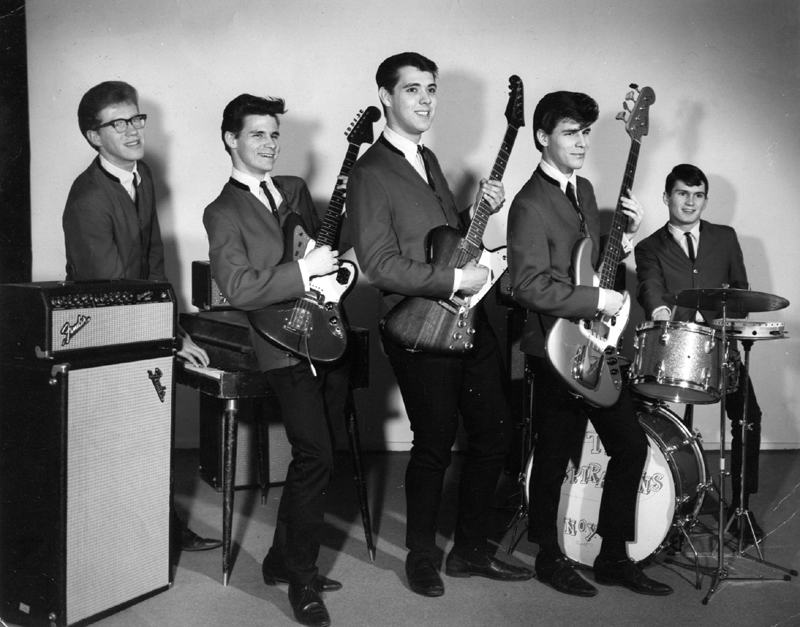
Left to right: Dave Adams (16), Larry Adams (14) (brothers), Steve Ficklin (16), Ron Hale (17) and Bob Ficklin (14). Not pictured; Steve and Bob Ficklin’s younger brother, Brent (13) who joined the group shortly after.

Sanz, Inc released two 45s on the Skoop label, “My Baby’s Eyes” / “I’m Gonna Leave You” in December of 1966 and “I Just Want You” / “I’ll Never Forget” in May of 1967.

“I’m Gonna Leave You” starts with a catchy bass and drum rhythm, then the vocals and organ combine for a haunting effect. A fast organ sequence and a howling guitar riff open “I Just Want You”, which features a busy, popping rhythm. “I’ll Never Forget” is a slow ballad, very much an early ’60s doo wop vocal style.

Members were:

Steve Ficklin, vocals
Bob Ficklin, keyboards
Brent Ficklin, vocals
Dave Adams, guitar
Larry Adams, bass guitar
Ron Hale, drums

Keyboard player Bob Ficklin wrote to me about the band and sent in the great photos you see here:

I was part of a band called Sanz, Inc. from Petersburg, Indiana. Sanz, Inc. was a popular group that performed in the tri-state area (IN, KY & IL).

We all attended the same high school (Petersburg High). The name Sanz was derived as a word play on the Sands Hotel in Vegas. The “Inc.” was added later.

We played many local street dances and teen centers in the area. Some other venues were a prom at the Sheraton Hotel in French Lick, IN; area county fairs; a political rally in Princeton, IN; Chieftain Restaurant, Lawrenceville, IL; several gigs at Lake Lawrence, also in Lawrenceville, IL; Teen Center in Morganfield, KY; among others. We usually played top 40 hits of the day and original material. Although there were a few other area groups, we were not acquainted with them and were never in competition.

“My Baby’s Eyes”/”I’m Gonna Leave You” was recorded in Santa Claus, IN, home of the first theme park in the U.S. (Santa Claus Land, now known as “Holiday World”) in 1966. Santa Claus, being about one hour away was the best opportunity for recording. “I Just Want You”/”I’ll Never Forget” was recorded on the same label in 1967.

On the way to record “I Just Want You”, we didn’t have “I’ll Never Forget” completed. So, we finished it in the car and recorded it on the flip side. All four songs were written by Bob and Steve Ficklin.

When recording “I Just Want You” and “I’ll Never Forget”, after the music and vocals (Bob and Steve Ficklin) were completed on the first track, Bob and Steve also added background vocal parts. We paid for the session times and the records that were pressed. Both projects were completed in a very short period of time (a matter of a few hours).

The records were played on several area stations in surrounding counties. “My Baby’s Eyes” received air play on WLS/Chicago. We did sell records at performances, at school and at a local retailer.

As older members of the band graduated the band dissolved. Larry Adams played bass with another area group for a time. Steve Ficklin sang with various gospel groups through the years and continues today. While in the Air Force, I sang with a couple of bands. In recent years I have sung with a local group and continue singing with a duet partner. Thanks for keeping the memories alive; it was a great era.

Bob Ficklin

Thank you to Bob Ficklin for sharing his photos and history of Sanz, Inc.

Dave Adams (left, playing guitar), brother Larry Adams (center, playing bass guitar), Ron Hale on drums
Left-right: Steve Ficklin and Bob Ficklin
Left-right: Dave Adams, Larry Adams, Ron Hale
Ron Hale (drummer in background), Brent Ficklin singing, Bob Ficklin playing keyboard
Left-right: Dave Adams and Larry Adams
Steve Ficklin

The Fourgathering “You’re Mean to Me”

The Fourgathering Thor Records 45 You're Mean to MeThe Fourgathering were from the Chicago area, maybe from Wilmette, a suburb just north of Evanston.

“You’re Mean to Me” flies by in just over two minutes. From the opening chords the pace never lets up, with unrelenting drumming and a twangy rhythm on the guitar. The singer moves from one chorus and verse to the next, pausing only for a very brief solo from the guitarist. The fine background vocals are a nice touch. It was written by A. Gilmore and J. Mayfield.

On the flip, the band gives an energetic performance on the more ordinary blues standard, “Betty and Dupree”. It’s credited as public domain, and arranged by Dan Brown.

The RCA pressing code TK3M-6240 indicates this was most likely a mid-late 1966 release, recorded at RCA’s studios in Chicago.

Thor Records also released the War Lords’ stomping “Real Fine Lady”/ “I’ve Got It Bad” (written by T. Jacobs, J. Papelka).

Thank you to Chris Gilbert for the scans of the white-label promo copy of this 45, seen below.

The Fourgathering Thor Records 45 You're Mean to Me white label promo

The Fourgathering Thor Records 45 Betty and Dupree white label promo

Live webcast on East Village Radio Tuesday 8:00 PM

This time it’s definitely on! I will be deejaying live on East Village Radio with Marty Key – garage, soul, gospel and brazilian and whatever else we feel like spinning.

Tuesday, September 23
8:00 – 10:00 PM Eastern time here in NY.

Tune in through your computer. It’s very easy to do from the East Village Radio site:

www.eastvillageradio.com – click on Listen Live or Tune In in the upper right hand corner of the site.

Songs about Vietnam and the Draft

Following the Beatles appearance on Ed Sullivan in February of ’64 there was an explosion of bands across the U.S. The next few years would see thousands of singles released by individual bands, professional and amateur, which we now consider to have the ‘garage’ sound.

These prime years for teen bands closely coincide with the beginning of America’s war in Vietnam. In August of ’64, Congress passed the Gulf of Tonkin Resolution, which gave President Johnson authority to use military force in Vietnam. The Resolution responded to attacks on U.S. ships stationed near North Vietnam, but these supposed attacks are now known to be bogus. (Check the Gulf of Tonkin Incident entry in Wikipedia to read how the truth was distorted to justify military action.)

In March of 1965 Operation Rolling Thunder began the bombing campaigns on North Vietnam. Initially only a few thousand troops were stationed in Vietnam to support the bombers, but this number grew to 200,000 by the end of ‘65. Troop levels increased to 500,000 in 1967. The Tet Offensive occurred in January of 1968, marking a turning point in the war and U.S. public opinion.

As teenaged boys started bands in the wake of the Beatles, they were facing the possibility of being drafted within the next few years. Most had more immediate concerns – girls, school, cars, and the number of songs about Vietnam or the draft are a tiny minority of all teen beat songs from the period. It was easier to write lyrics that imitated the relationship-oriented pop songs of the era than to sing about political opinions and personal fears.

For those that did, their lyrics display their ethical dilemmas – feeling a duty to serve but ambivalent about whether the war is right; being afraid of dying; not wanting to be told what to do either by the government, society or the anti-war front. These lyrics range from idealistic to cynical. Early on there were very dogmatic patriot songs, but as the draft widened and sentiment turned against the war the imagery became more violent and the jingoism subsided.

Stylistically they had few models to draw from in 1965, as most major U.S. and British Invasion acts weren’t writing political lyrics yet. Some groups would draw from the folk styles of Bob Dylan and Barry McGuire. Others could look to a long tradition in country and pop of making novelty adaptions of hit songs. An example of this would be the Beach Bums’ “The Ballad of the Yellow Beret”, or the Midnight Sons rewrite of “Summertime Blues” to show chagrin at the draft.

At least as far back as the Civil War there had been an industry of professional songwriting and production teams to craft songs about war for the public. (See the Civil War Preservation Trust’s article Patriotic Songs of the War to read about the professional origins of the most-well known songs of the era.)

The Vietnam War would be a different case, as by 1965 young bands were the lifeblood of the music industry. For the first time in modern history, the generation actually serving in the war became the primary voice of the conflict.

I: Shutup the Folksingers

In 1965 Bob Dylan was just starting to make inroads on pop radio with “Like a Rolling Stone”. Earlier protest songs like “Masters of War” were rarely heard on commercial radio but their influence was an intellectual force behind the anti-war movement: a voice that had to be answered by those in favor of the war.

Teenagers in bands may have been unaware of the anti-war songs of Bob Dylan or Phil Ochs in 1965, but they certainly couldn’t miss Barry McGuire’s #1 single “Eve of Destruction” on the radio during that summer and fall. This anti-war, pro-civil rights, anti-nuclear song provoked answer songs and parodies, most not sympathetic to McGuire’s sentiments.

There was plenty in “Eve of Destruction” to upset the mainstream: comparing America’s failure on civil rights to a communist totalitarian state (“Think of all the hate there is in Red China / Then take a look around to Selma, Alabama”) and equating anti-Christian values to hypocritical religiousness (“Hate your next-door neighbor, but don’t forget to say grace”) are but two examples!

There’s a sting of truth to lines like these which would put people on the defensive. Most grating of all was the singer’s repeated dissatisfaction with the state of affairs in the country. Love it or leave it pal!

An early rebuke to McGuire is “The Prophet” from 1965. One thing that’s striking is the sheer belligerence of the singer as he rants!

There’s a prophet of doom, spreading his gloom
Shouting misery and hate.
Saying this world is a tomb, yeah and there ain’t no room
For dreams ’cause it’s too late.
He calls you his friend, says it’s the end
Destruction is near, but wait …

Hey Prophet, take a look around,
Yeah Prophet, there’s still hope around / … /

Hey Prophet
It’s awful easy for you to talk about it …
Tell me something what are you doin’ about it?
Yeah Prophet, WHAT ARE YOU DOING ABOUT IT?! / … /

There’s guys just like me who like what they see,
And they want to be free because they like it that way
They don’t care what you say
They’ll fight to keep it that way too!

Fight for their right to be free … of conscience!

Sure there’s things to be found in this land that’s free that don’t seem right to me
But there’s hope in the air because there’s people who care,
There not filled with despair like you!

This is the classic turnaround – the one exposing the problems is accused of doing nothing positive to help the situation, of being cynical and emphasizing the negative. The patriotic citizen has ‘hope’ and faith that things are getting better.

A straightfoward inversion of Barry McGuire’s song is the Jayhawkers’ “Dawn of Instruction”. The attitude of the lyrics is similar to The Prophet, with lines like “Step aside, Mister Doom Peddler” and “[we’re] not old enough to vote, but ain’t young enough for runnin'”.

“Eve of Destruction” was an easy target for some of its over-the-top lyrics (“even the Jordan River has bodies floatin’” or “my blood’s so mad feels like coagulatin’”), and the Jayhawkers made the most of these exaggerations.

Billy Carr’s “What’s Come Over This World” saw release on Colpix, and is obviously a professional songwriting and studio effort. Lyrically it is a flag-waving message, with plenty of disdain for the dissenting elements of the younger generation. The production co-opts more than a little of Dylan’s style, and not in parody either, a sure sign that the old guard was desperate to keep relevant. Dylan-esque harmonica shows up on so many of these answer songs, whether mocking him or in sincere imitation, that his influence must have been inescapable.

What’s become of this nation and the songs that they sing?
Everybody’s protesting, what’s it all gonna bring?
We sang the Star Spangled Banner, forever in peace may it wave,
And now some rock ‘n roll singer is knocking the Home of the Brave

What’s come over this world?
I’ve thought it over and I can’t get over
What’s come over this world?

There’s an army of cowards, see them marching in line
While the country’s in danger, they just carry a sign
Look at them burning their draft cards and refusing to fight
While they talk about freedom, they’re dimming liberty’s light

My brother fought in Korea, my daddy in World War II
Now there’s a war in Viet-nam and there’s a job we must do
What can you do for your country, his words were written in blood
Those who forgot what he died for, are dragging the flag through the mud.

More nuanced (and much better music) is “So the Prophets Say”, released in April 1965 by a group in their late teens the Centurys of Lebanon, Pennsylvania. The echo engulfing the tom-tom drums, dense guitars and eerie organ creates a doom-laden atmosphere, but lyrically the song repeats anti-communist propaganda. More than anything, though, it stresses individual choice against conformity. “So the Prophets Say” was written by lead guitarist Billy Beard, who passed away this past July 31, 2008.

They’ll tell you that they’re wise, and that they’ll analyze your situation.
They can tell you what’s gonna come and how certain things will be done,
They’re your salvation.

Will the world end today, like it did yesterday, or will we have to wait till tomorrow?
will tell you when it comes, you’ll hear those rocking drums,
you’ll just repent, you know your sorrow

These men of wealth? and men so poor?
These prophets of peace and prophets of war – are they getting you?

Then they tell you to make a big sound about getting out of Vietnam,
You know you’ve got a right to your convictions!
But will they warn you of a coming day, when your placards might be thrown away, and they’ll say “now you’ve got a few restrictions.”

You may not like it if they hand you a gun, before you turn 21 and say “now you’ve got to be a man!”
But when your freedom’s bells stop ringing, and a Red slave song you’re singing,
You’ll wish you had a gun in your hand!

These men so good and men so bad
These prophets so sane and prophets so mad – they get you!

Why don’t you let it be known, you’ve got a mind of your own,
And you can tell right from wrong from day to day,
And that you l… because they know you care,
And so you’ll beware of what the prophets say!

In early 1966 Sgt. Barry Sadler had a #1 hit with that paen to the american soldier, “Ballad of the Green Beret.” The Beach Bums (actually Bob Seger singing when he was with Doug Brown and the Omens) adapted it for their “protest against protesters”, “The Ballad of the Yellow Beret.” It’s not really a parody of the Sadler song as a straight up mocking of draft-dodgers.

This is a protest against protesters:

Fearless cowards of the U.S.A.
Bravely here at home they stay
They watch their friends get shipped away
The draft dodgers of the Yellow Beret

Yellow streaks up and down their spines
Men who gladly stay behind
They won’t fight for the U.S.A.
They fought hard for the yellow beret

Men who faint at the sight of blood
Their high heeled boots weren’t meant for mud
The draft board will hear their sob stories today
Only the best the yellow beret

Back at home a young wife waits
Her yellow beret has met his fate
He’s been drafted for marching in a protest
Leaving her his last request

Put a yellow streak down my sons back
Make sure that he never ever fights back
At his physical have him say he’s gay
Have him win the yellow beret.

Next installment: Democracy and the Draft

Thank you to Bernard Watts (Scratuglia) and to Pete Sofinski for the label scan. Thanks also to portofranco and Justin for the Billy Carr scan.