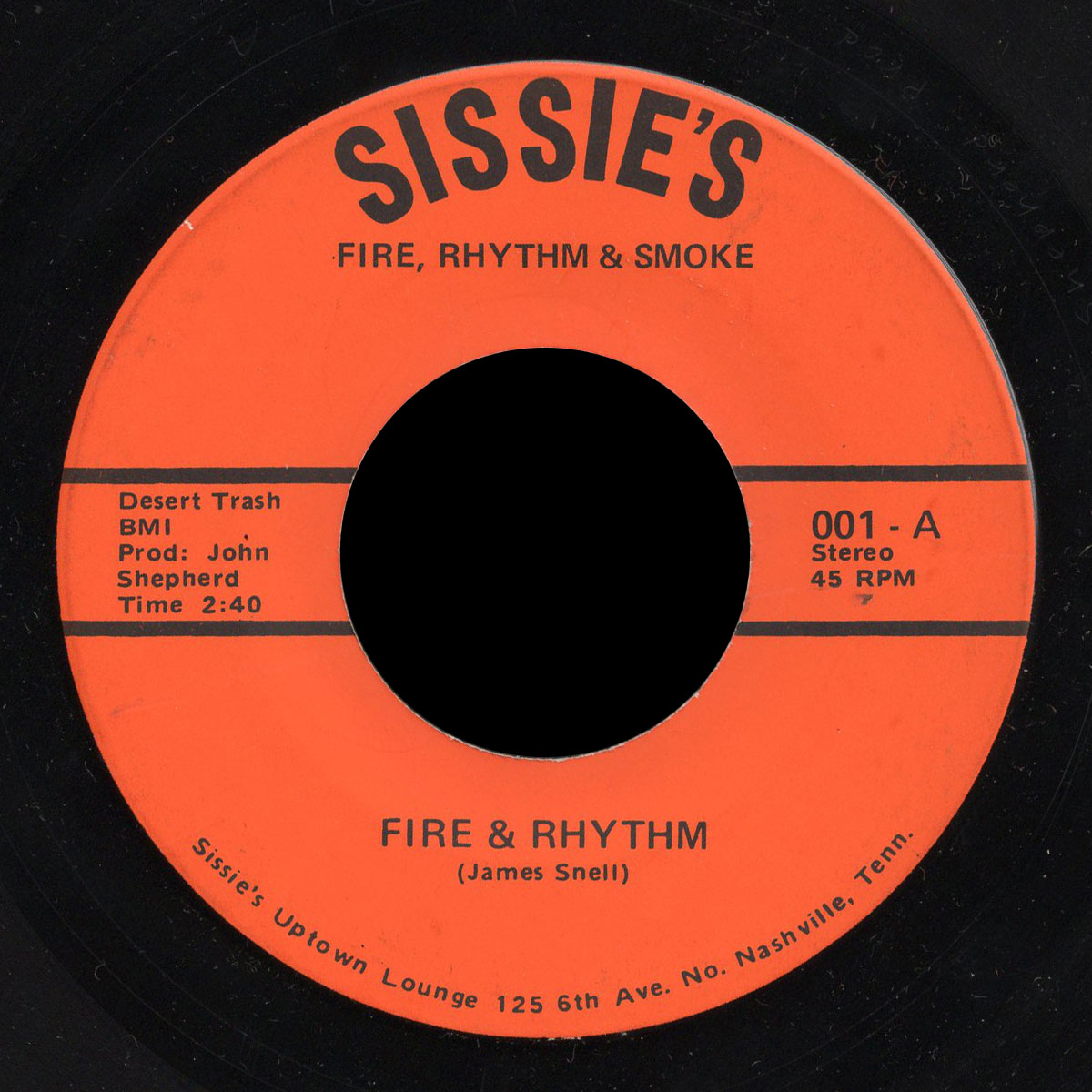
Here’s an obscure one out of Nashville, from the early-70s I would guess. Fire, Rhythm and Smoke do a good hard rock number called “Fire & Rhythm” with very gravely vocals, released on Sissie’s 001.
The flip is “Sissie’s Place”, kind of a ’60s Sam the Sham sound to advertise Sissie’s Uptown Lounge on 125 6th Ave N in Nashville. I can’t find any mention of that lounge in news archives or on the web, and the site may be a parking lot now. For decades it was the address of Rock City Amusement Co. which advertised jukeboxes and pinball machines in Cash Box.
James Snell gets song writing credit on both labels, but BMI lists Dave Sunderland and Gary Turner on both songs, as well as Snell.
Desert Trash published both songs. The only other songs in their catalog are “Lay Me Down By Your Side” & “Cheatin’ on Him” by Ellen Daley, but I can’t find a recording of those.
John Shepherd produced and has his name etched in the runout.
That’s all I can find out. Surely these musicians had some roots in earlier groups.
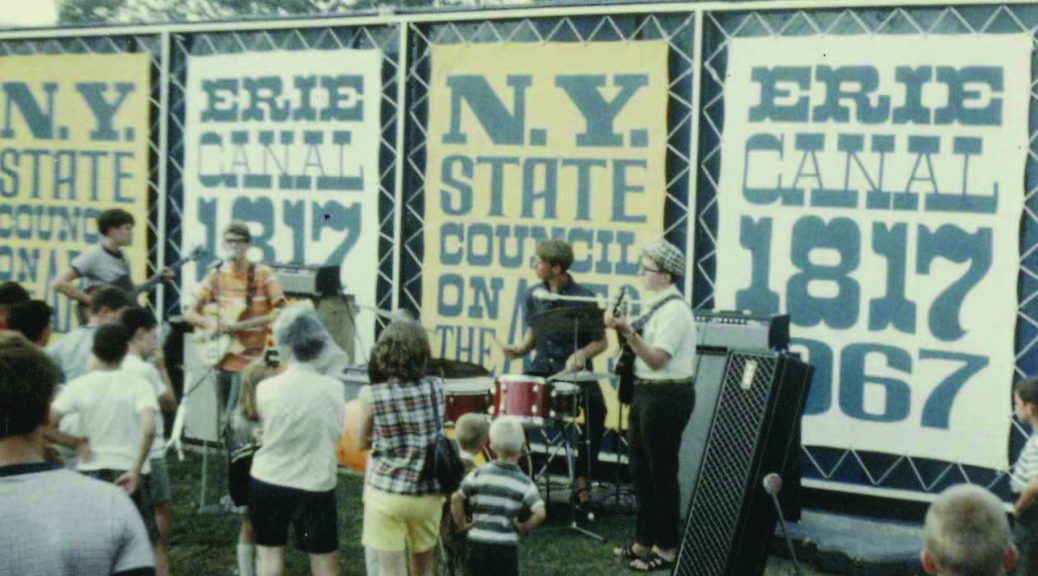
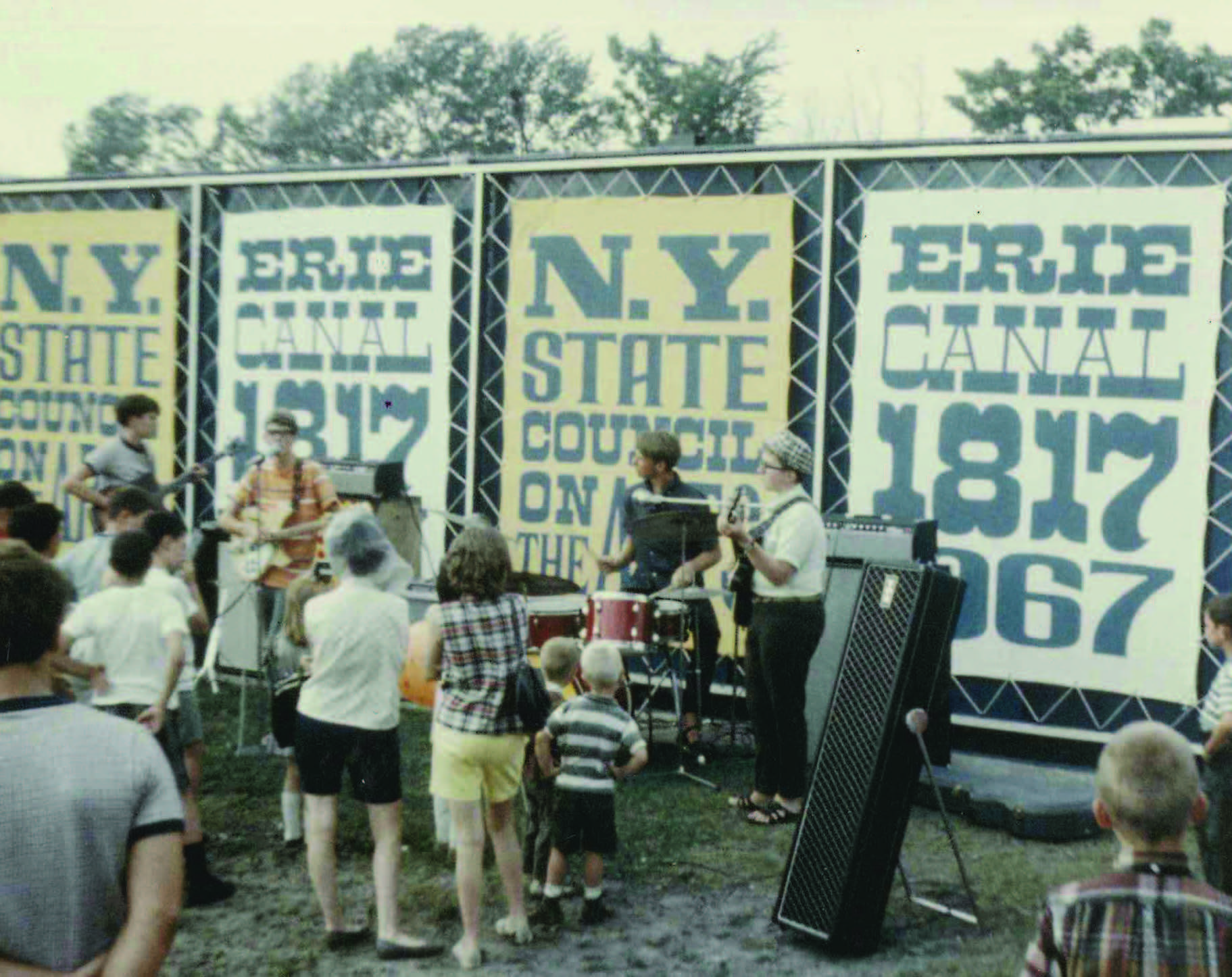
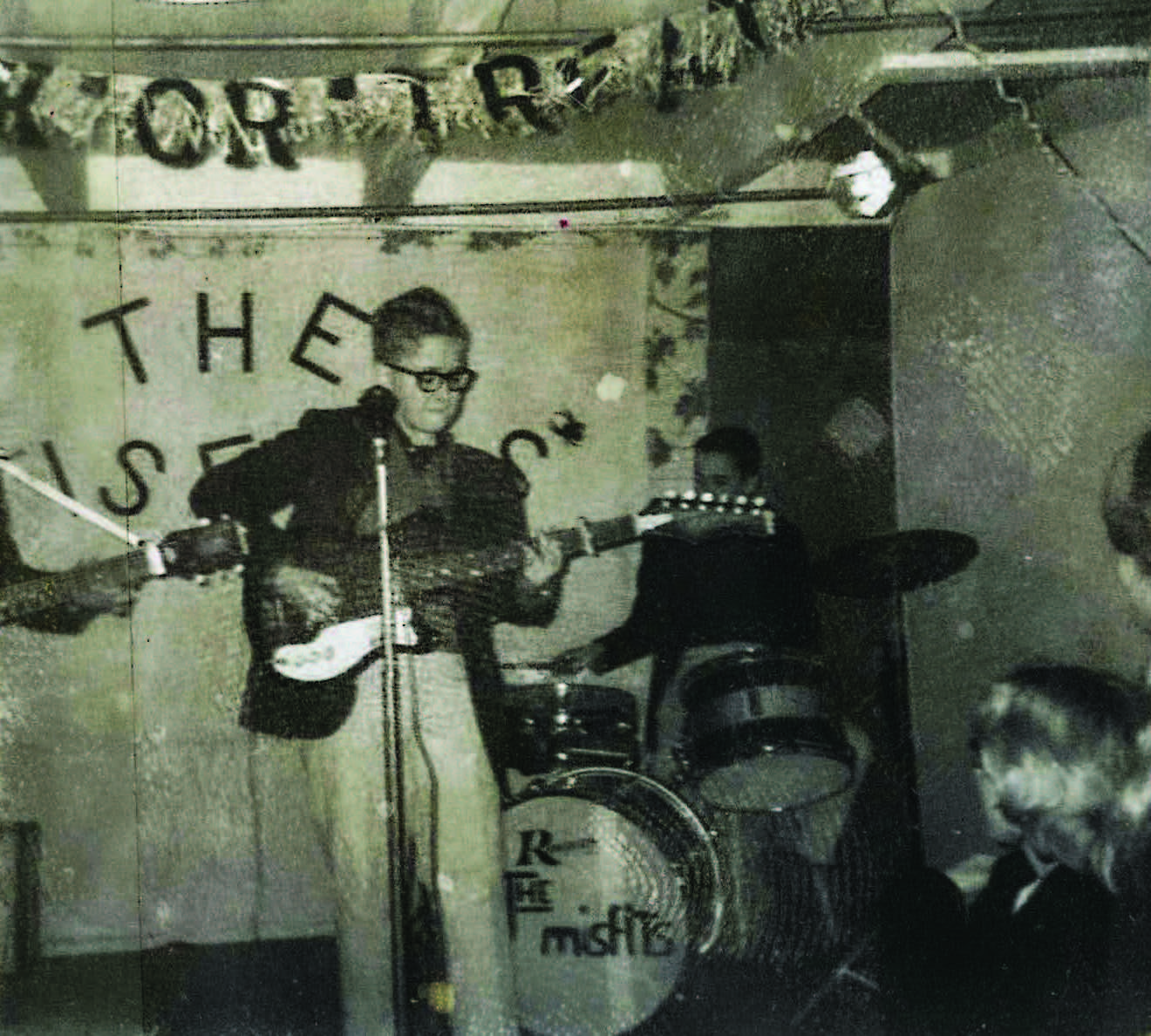
Thee Illusion at the Erie Canal Fest, August 1967, from left: Alan, Tommy, Jim and SlateMisfits photo with Slate Raymond on guitar and Alan Farnsworth on drums
Jim Kriss compiled an amazing history of Thee Illusion (later known as Thee Illusion and Brass). There are dozens of great photos, a detailed history, and info on other groups from the area like the Humans and the Cult.
The PDF is available at the link below – a fairly large file, 22 MB.
Below is Jim’s list of musicians in the Misfits and Thee Illusion and Brass:
Tom McNall – (original member of the Misfits and Thee Illusion – Rhythm/Lead guitar and vocals T. Slate Raymond – (original member of the Misfits and Thee Illusion) – Lead Guitar Alan Farnsworth – (original member of the Misfits and Thee Illusion – Drums, Bass Guitar and Vocals Jim Kriss – (original member of Thee Illusion) – Drums and Vocals Mark Heard – (second generation member of Thee Illusion) – Keyboards Ray Colonna – (second generation member of Thee Illusion and Brass) – Percussion and Roadie Steve Rustay – (first generation member of Thee Illusion and Brass) – Trumpet and Percussion Bob Mathes – (first generation, former member of Thee Illusion and Brass) – Trumpet Chuck Lafferty – (second generation member of Thee Illusion and Brass) – Trumpet and Percussion
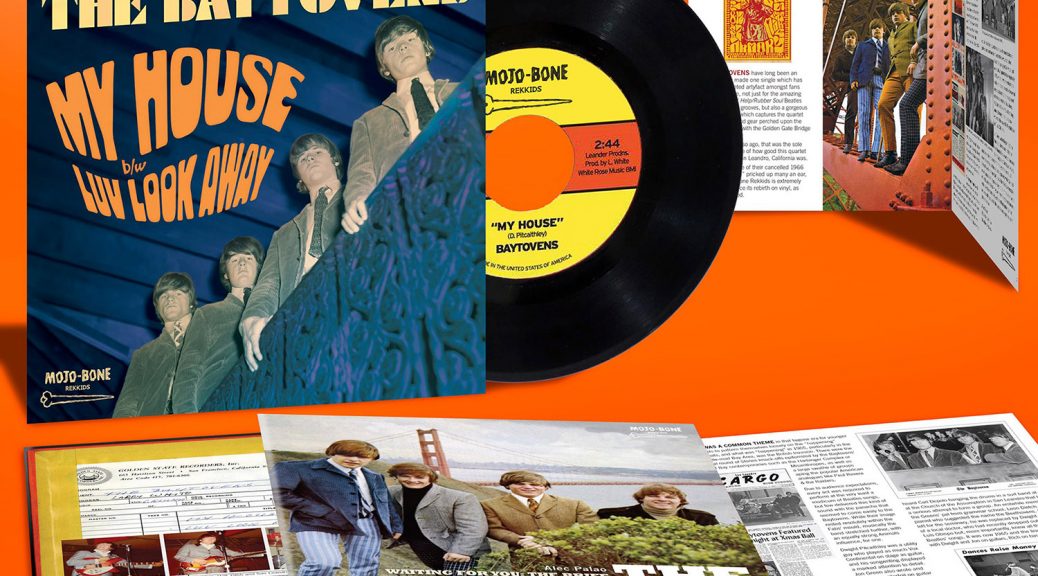
The Baytovens “My House” / “Luv Look Away” went unreleased until the 2007 CD You Got Yours! (East Bay Garage 1965-1967) from Big Beat Records. This marks the first vinyl release for either song. 8-page color booklet includes the group’s full story.
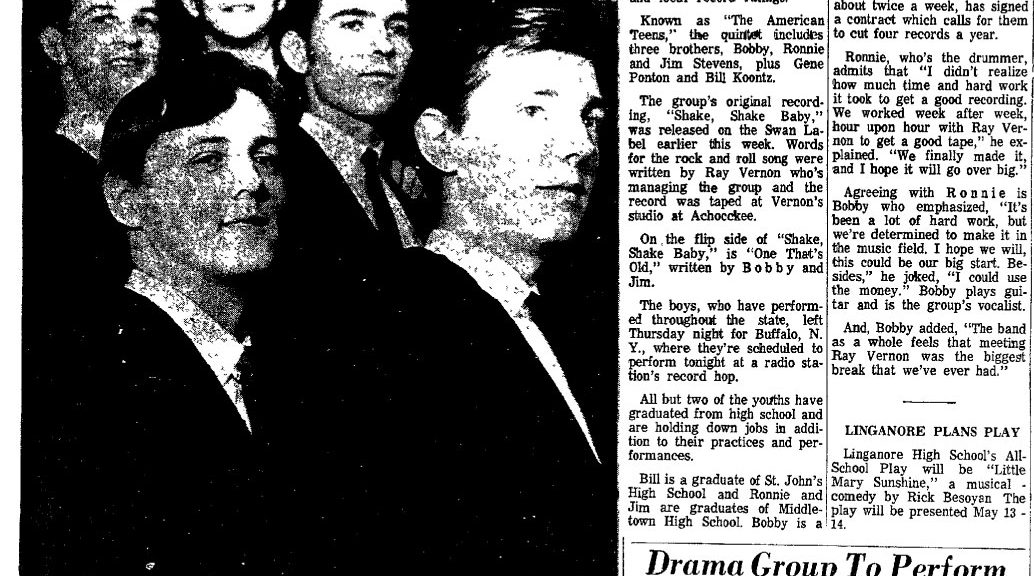
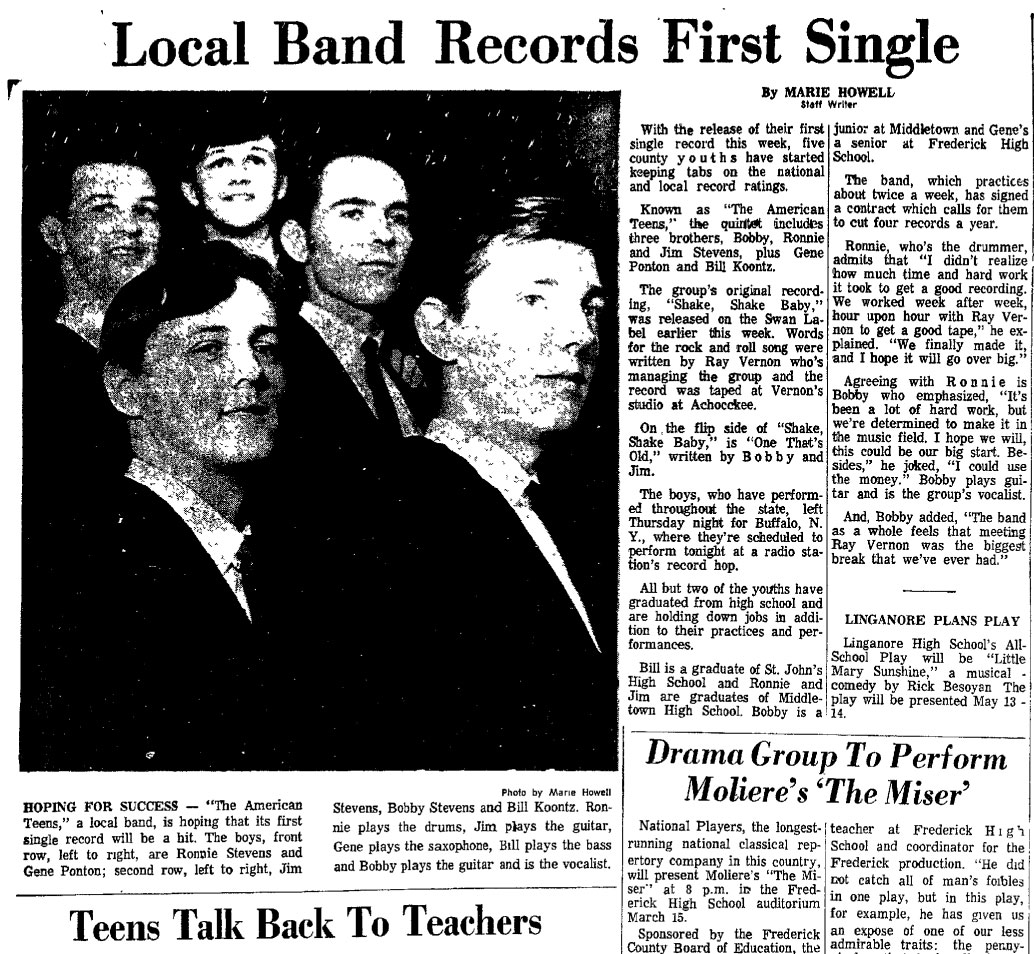
March 5. 1966. The American Teens, from left, front row: Ronnie Stevens and Gene Ponton; back: Jim Stevens, Bobby Stevens and Bill Koontz.
The American Teens came from Frederick, Maryland, about an hour’s drive northwest of Washington, DC. The members were:
Bobby Stevens – guitar and vocals Jim Stevens – guitar Gene Ponton – saxophone Bill Koontz – bass guitar Ronnie Stevens – drums
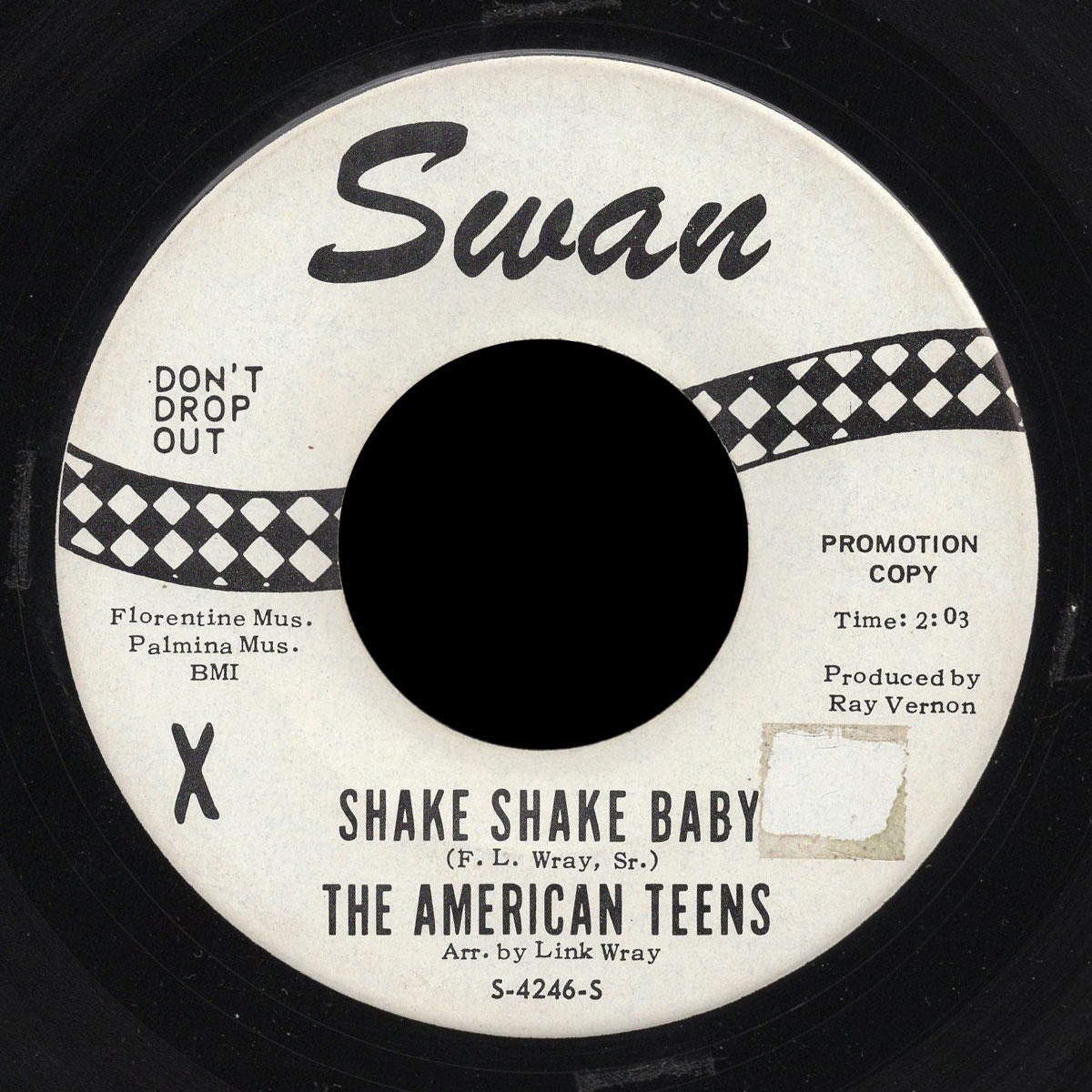
Ray Vernon signed the band to Swan Records and produced this great single at his studio in Accokeek, Wray’s Shack Three Track.
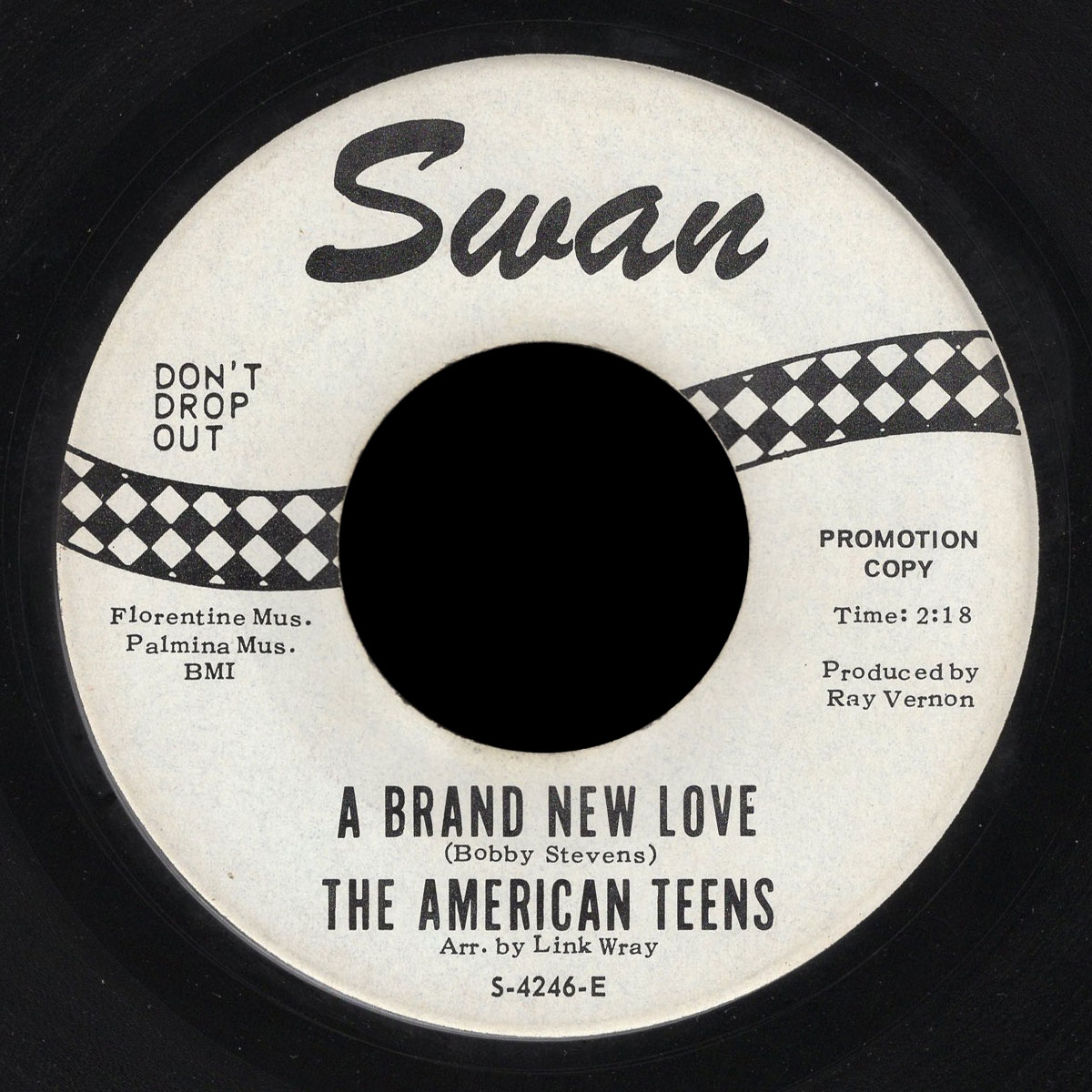
“Shake Shake Baby” is a danceable original written and arranged by Ray Vernon’s brother, Link Wray (using his common pseudonym, F.L. Wray Sr). I actually prefer the flip, “A Brand New Love”, credited to Bobby Stevens.
The labels list Florentine Music and Palmina Music as publisher of both songs, but I don’t see either in the BMI database or Library of Congress registrations.
The Frederick News-Post covered the band twice. The first article on March 5, 1966 had the most extensive profile of the band:
Local Band Records First Single by Marie Howell
With the release of their first single record this week, five county youths have started keeping tabs on the national and local record ratings.
Known as “The American Teens.” the quintet includes three brothers, Bobby, Ronnie and Jim Stevens, plus Gene Ponton and Bill Koontz.
The group’s original recording, “Shake, Shake Baby,” was released on the Swan Label earlier this week. Words for the rock and roll song were written by Ray Vernon who’s managing the group and the record was taped at Vernon’s studio at Achocokee [Accokeek].
On the flip side of is “One That’s Old,” [sic] written by Bobby and Jim.
The boys, who have performed throughout the state, left Thursday night for Buffalo, N.Y., where they’re scheduled to perform tonight at a radio station’s record hop.
All but two of the youths have graduated from high school and are holding down jobs in addition to their practices and performances.
Bill is a graduate of St. John’s High School and Ronnie and Jim are graduates of Middletown High School. Bobby is a junior at Middletown and Gene’s a senior at Frederick High School.
The band, which practices about twice a week, has signed a contract which calls for them to cut four records a year.
Ronnie, who’s the drummer, admits that “I didn’t realize how much time and hard work it took to get a good recording. We worked week after week, hour upon hour with Ray Vernon to get a good tape,” he explained. “We finally made it and I hope it will go over big.”
… Bobby plays guitar and is the group’s vocalist.
And, Bobby added, “The band as a whole feels that meeting Ray Vernon was the biggest break that we’ve ever had.”
I wonder if the record made any headway in Buffalo. It’s a rare item now.
Ronnie Stevens of the American Teens, June 30, 1966
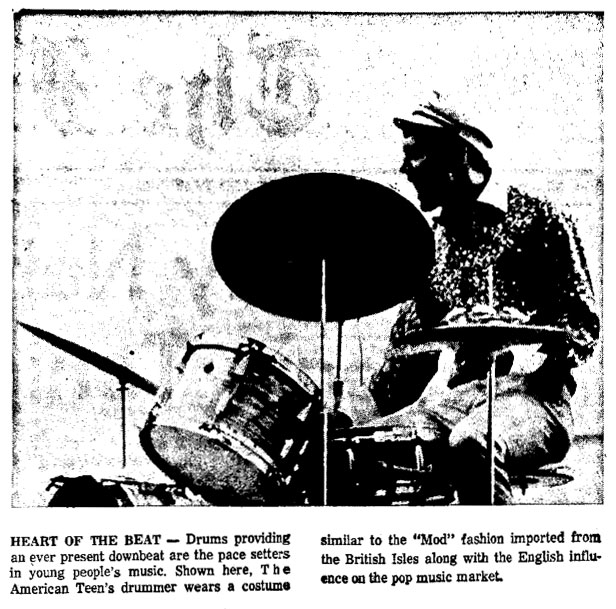
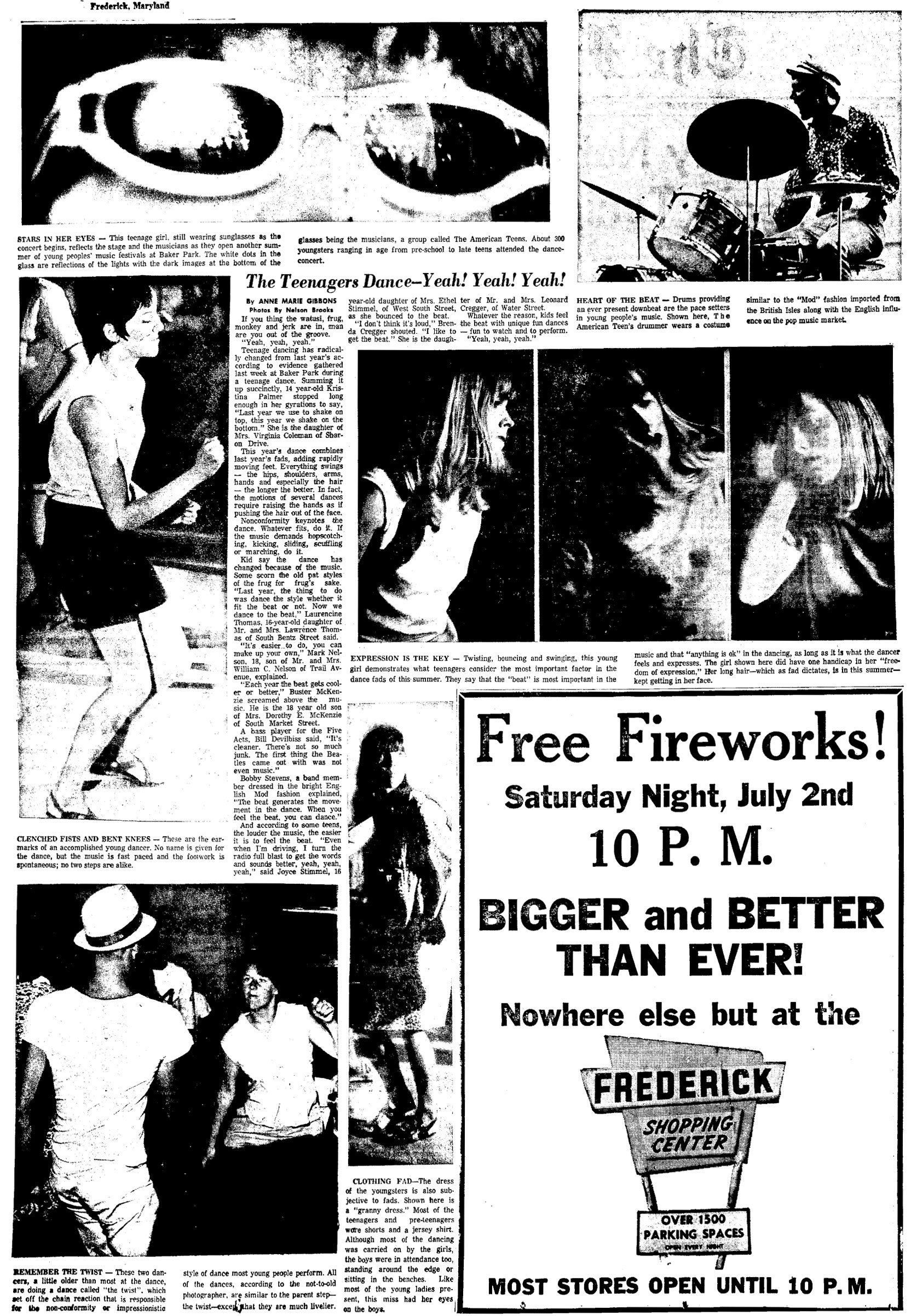
On June 30, a full page of photos from a Baker Park concert discusses teen trends of the day, with quotes from Kristina Parker, Laurencine Thomas, Mark Nelson, Buster McKenzie, Joyce Stimmel, Brenda Cregger, and also Bill Devilbiss, bassist for the Five Acts, a group I know nothing about. There is also a good photo of Ronnie Stevens on drums.
For whatever reason, the band didn’t last, but their single showed promise, and I hope there are a few unreleased recordings out there.
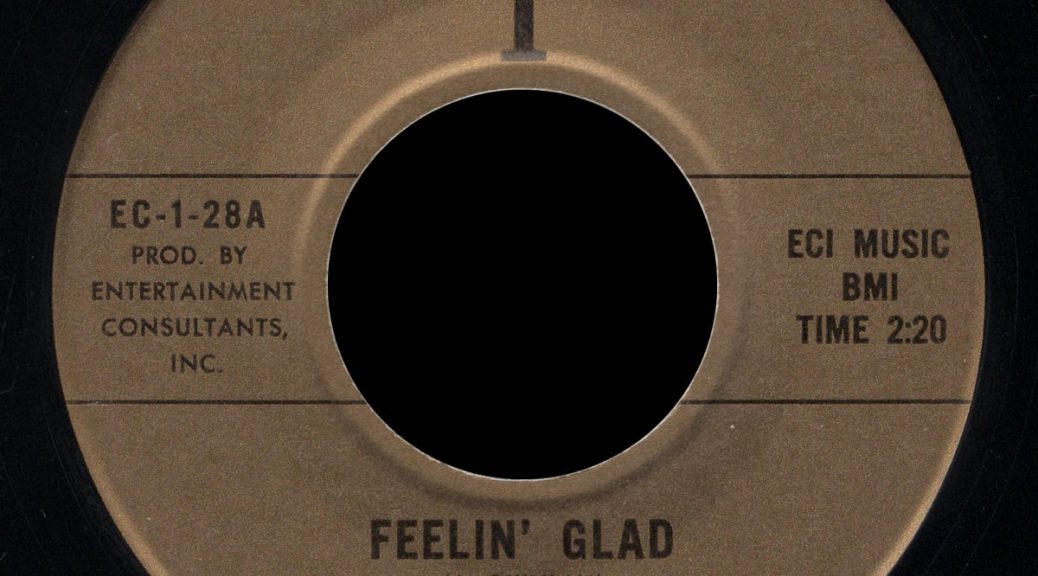
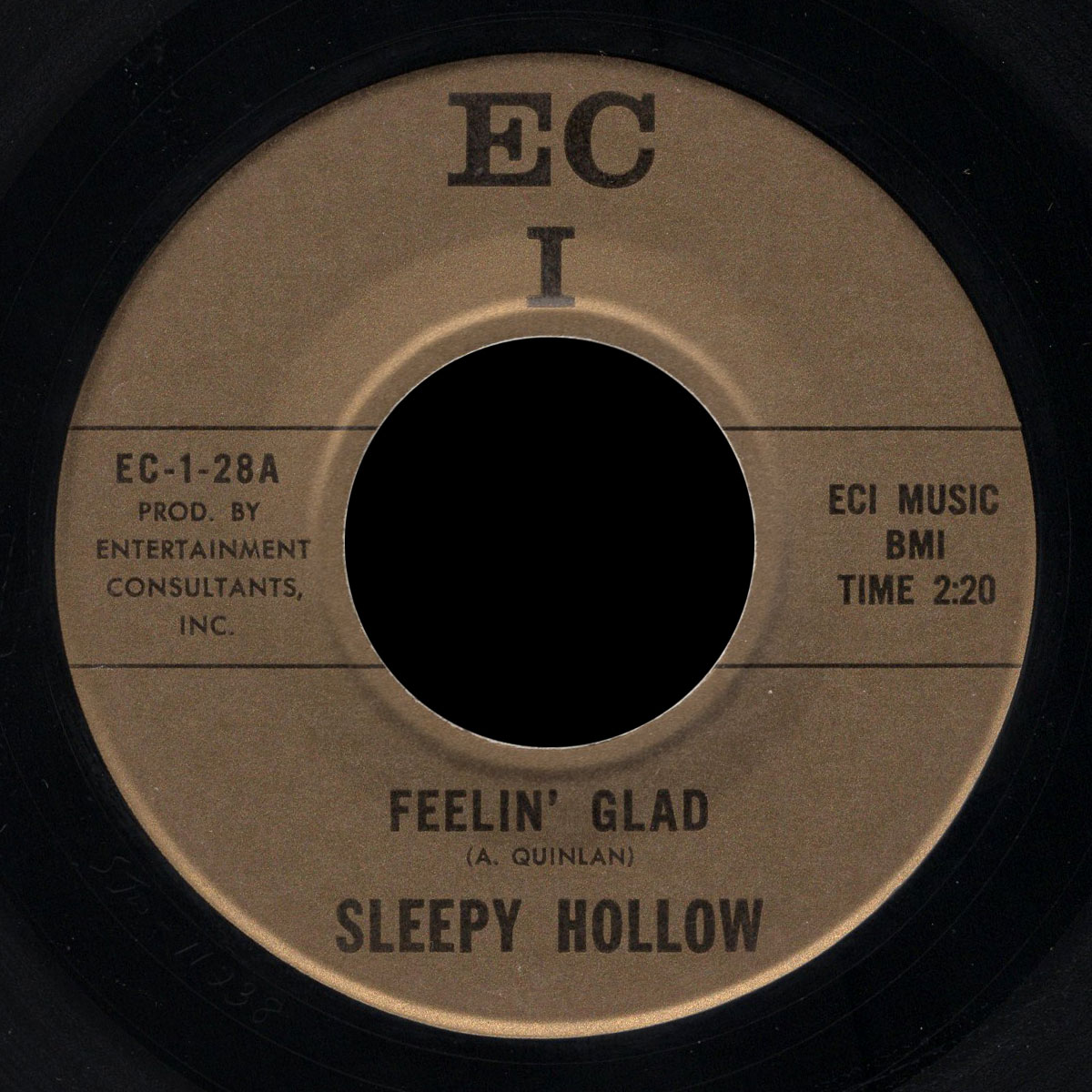
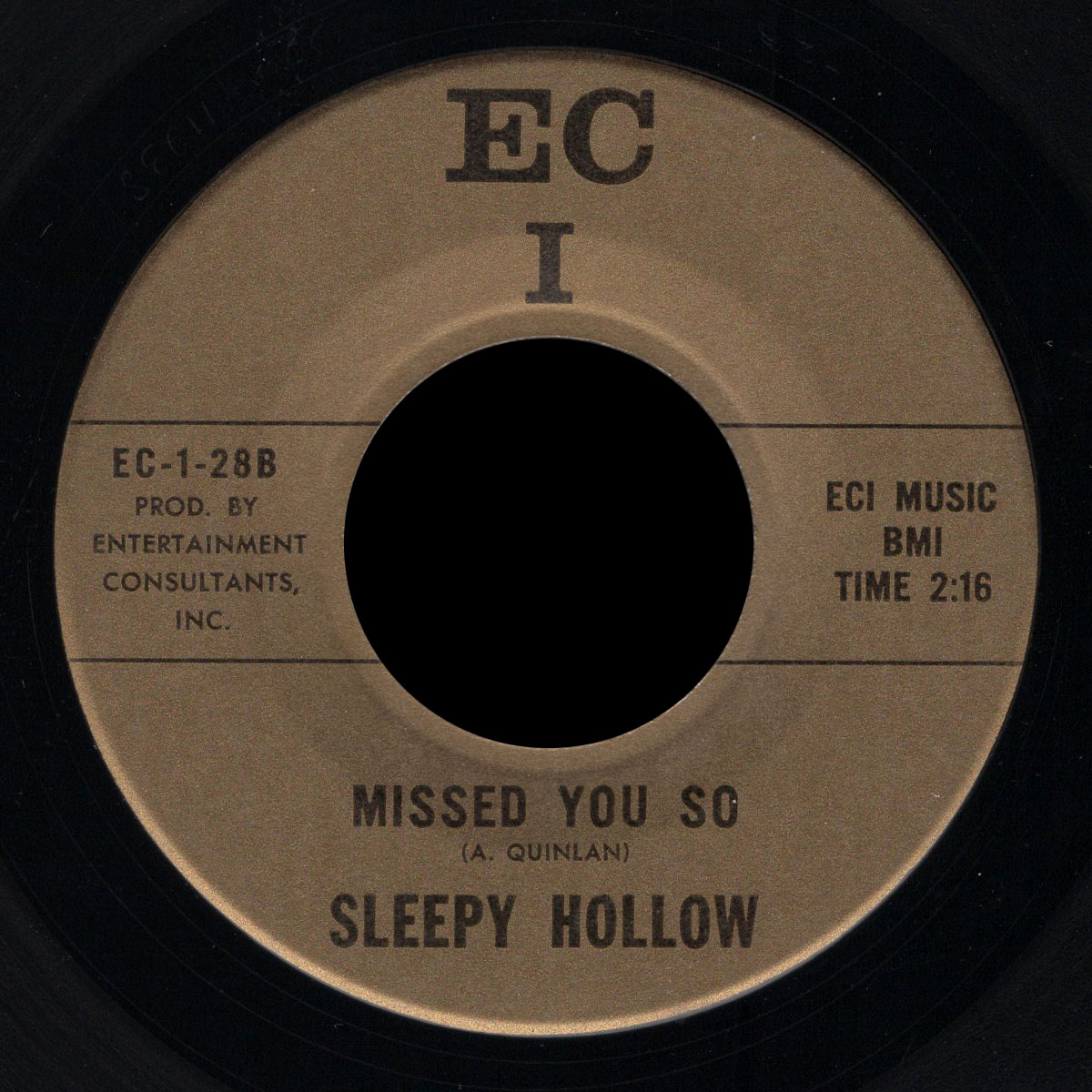
Sleepy Hollow released their only single on ECI (Entertainment Consultants Inc.), probably in 1969. “Feelin’ Glad” / “Missed You So” are originals by Alan Quinlan. Both sides are good rock performances with commercial pop touches.
The single is a Wakefield pressing, SJW-11238. Alan Quinlan registered these songs with the Library of Congress in February, 1969, using his full name, William Alan Quinlan.
Sleepy Hollow included at least one member of the Pheonix group Thackeray Rocke, bassist Al Quinlan.
Thackeray Rocke included:
Frank Lacey – lead vocals Mike Kessler – lead guitar (spelled Keslar on copyright registration) Sheldon Skinkle (aka Bunker Huddle/Jr. Ellis) – guitar Al Quinlan – bass and vocals Paul Buys – drums and vocals Vince Welnick – keyboards
Quinlan co-wrote “Bawling” with lead guitarist Michael Keslar, recorded by Thackeray Rocke on Castalia Productions ARA 10671, and “Can’t You See” with Paul Buys, released on Castalia Prod., ARA 268. Both of those were cut at Audio Recorders in Phoenix and produced by Michael Wood, and Renda Music, Inc shows up in the publishing.
I suppose Thackeray Rocke split and some of the members continued as Sleepy Hollow.
Alan Quinlan has a number of other registered copyrights. From May of 1969, there are “It’s Wonderful to Love Her”, “Miss Merriwether”, and “Puzzles”, then “Good John” registered in November. In October, 1970 he registered an album’s worth of songs, including “Bottle of Wine”, “Gilted Quean” (sic – also registered as “Jilted Queen (Have You Seen My Love?)”, “Merry-Go-Round” and “Seasons”, among other titles. As far as I can tell, none of these songs saw release; perhaps demos still exist.
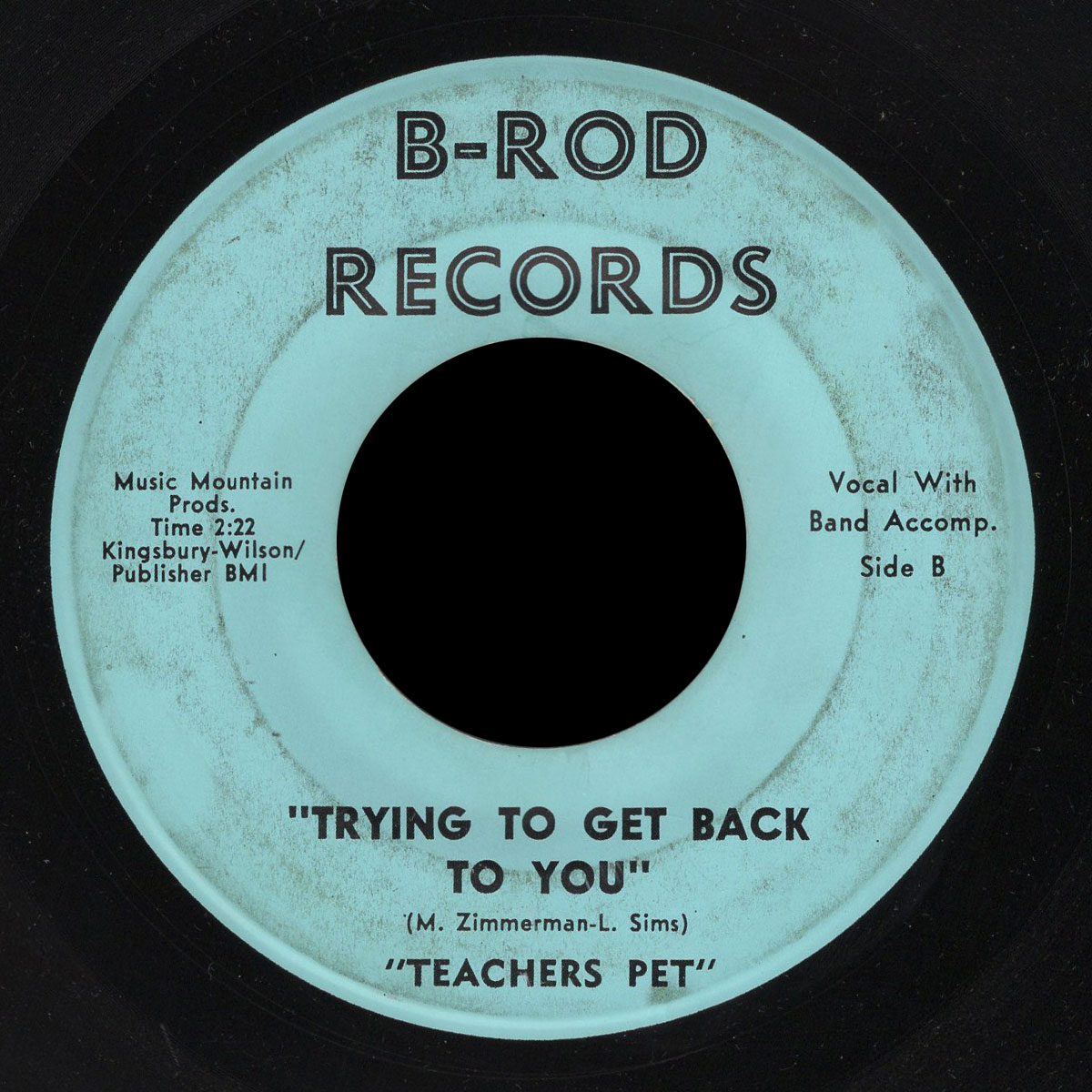
The obscure group Teachers Pet cut this one single on the equally obscure B-Rod Records. “Trying to Get Back to You” is crude swampy boogie. The A-side was the comparatively sleepy “Say You Love Me”. Both songs were originals by Larry Sims and Mike Zimmerman.
BMI lists Sims’ full name as Larry Clifton Sims, but it may be confusing him with the bassist and vocalist with the Sunshine Company and Loggins & Messina. BMI also lists two other original songs by the duo, “Seven Days a Week” and “Yes I Do”. I’m not sure either song was recorded.
Kingsbury-Wilson published the songs, now listed as Kingsbury-Wilson Enterprise of Louisville in BMI’s database. Mountain Music did the production. Released on B-Rod Records, without a catalog number on the label. The runout has “1269 – 1948”, I suspect the 1269 could mean December of 1969, but it’s just a guess.
I know of two other releases on B-Rod Records. Don Woolett’s “Rock to Kentucky” / “Ballad of Abraham Lincoln” is on a blue label similar to the Teachers Pet single, released in May, 1971.
A different red label design has Robin Kay Waggoner’s “We’ve Got to Try” / “Your Friend”, with “product of MMP in Lebanon Junction, KY”. Music Mountain Productions also recorded the Sound of the Zounds 45, covered previously on Garage Hangover.
Teachers Pet may have been from Lebanon Junction, Kentucky, or possibly Louisville, a half-hour’s drive north.
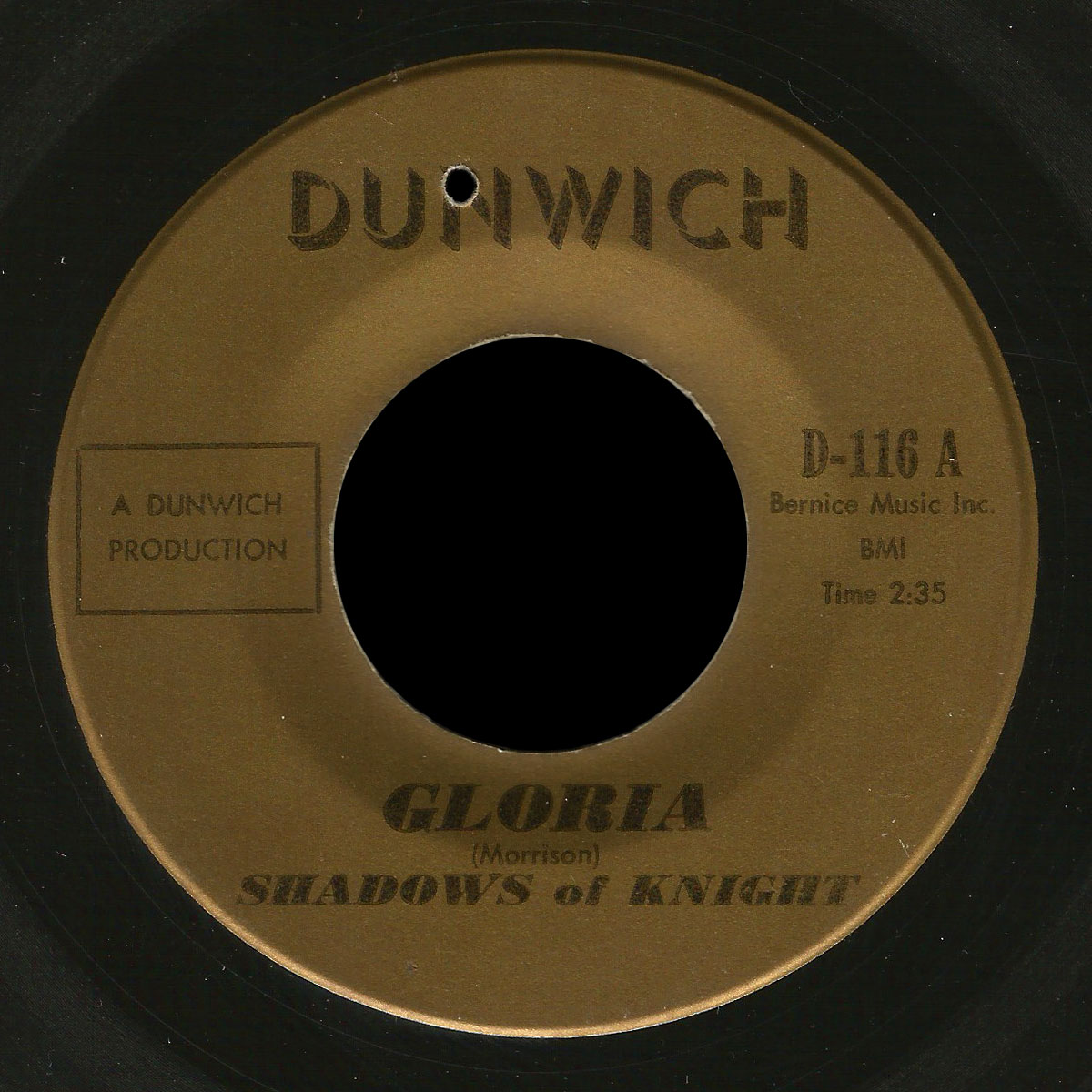
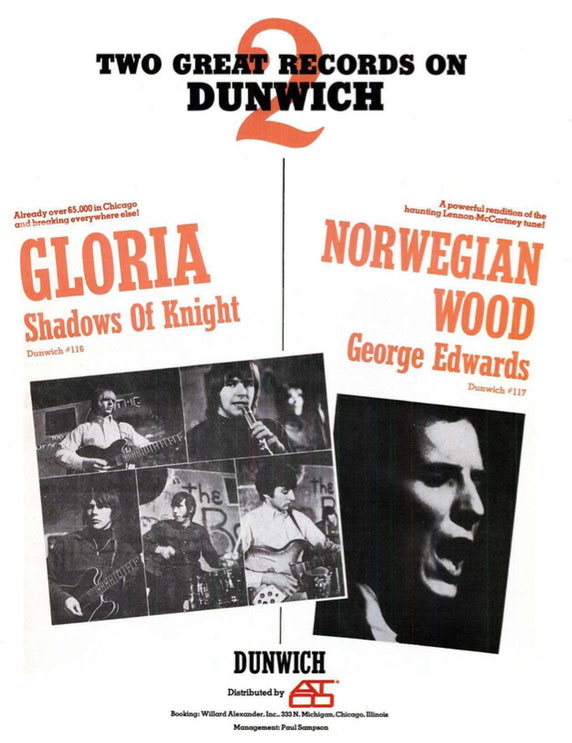
Gold label, no Atco distribution, D-116 AOne of the most famous ‘garage’ singles has to be the Shadows of Knight’s version of “Gloria”. As a national hit distributed by Atlantic Records (Atco), the 45 rpm single exists in over 15 U.S. variations pressed at plants around the country.
My post today concerns two of those, the original pressings on Dunwich from January and February 1966, without any Atco credit on the labels.
General agreement is that the first release has a gold label with the outlined lettering, a box around “A Dunwich Production” and “D-116”.
Teen Beat Mayhem notes that total quantity pressed is only several hundred. This pressing quantity has been repeated in online sources, but I feel it is incorrect. A pressing of a few hundred would have quickly sold out, and been worn out, but I’ve found two VG+ copies without much effort or expense.
The liner notes to If You’re Ready! The Best Of Dunwich Records…Volume 2 state that Bill Traut put together that first gold label design and ordered 4000 copies. He also used the cheapest local pressing plant he could find. Thank you to Jeff Jarema for looking that up for me. I suspect that the initial order may have been for less, and that 4,000 was the total pressed at that small plant over the first couple weeks of release. The Dunwich lettering is similar to other Chicago releases.
Yellow label, no Atco credit, DX-116 AThe first yellow label without Atco has the same credits as the gold, but a different label design, and has the release code DX-116, a number which would be used on most of the subsequent national releases. Since the small unknown Chicago plant couldn’t do the quantity needed, Traut ordered from Plastic Products in Nashville.
I asked people on the Chicago Rock Bands 1960s and 1970s Facebook group which label they had first, and by far most remembered the yellow label version. Later gold and yellow label versions exist that include Atco distribution credit, so this survey is not definitive.
I constructed this early 1966 timeline for “Gloria”:
February 18: 1st appearance on the WLS “Silver Dollar Survey. Chicago’s Official Radio Record Survey” at #18, having been played for three weeks on the station, which would put its first WLS airplay in very late January or early February.
February 25: reaches #7 on WLS
March 4: reaches #6 on WLS
March 5: Billboard reviews it and lists it as a breakout single. Enters Billboard’s Chicago singles chart at #15
March 12: rises to #8 in Billboard’s Chicago singles chart. Billboard notes 40,000 sold in Chicago and additional sales in other cities. “Kent Beauchamp acted as a kind of co-ordinator in getting the first record out and has been handling local distribution.” [ Kent Beauchamp owned Big Town Distributors and, along with Ed Yalowitz, Royal Disc Distributing.] Cash Box reports that it is “a recent master purchase” by Atlantic”. Dunwich co-owner George Badonsky had been working for Atlantic and Atco as a Midwest sales and promotion rep since February, 1965, which may explain the connection with Atlantic.
March 19: rises to #4 in Billboard’s Chicago singles chart and enters Billboard’s Hot 100 national chart at #78. In a detailed article, Billboard reported:
… the single has sold 60,000 legitimately in Chicago to date …
Local distribution by Royal Disc Distributing …
The group is managed by suburban record store and teen nightclub owner Paul Sampson, who found the quintet singing in a Veterans of Foreign Wars Club. He installed the group in his own spot, The Cellar, where they were heard by Royal Disc’s Kent Beauchamp, who recommended them to Dunwich Records.
The group is comprised of Joe Kelley, lead guitar; Gerald McGeorge, rhythm guitar; Warren Rogers, bass guitar; Tom Schiffour, drums, and lead singer Jim Sohns.
“Gloria” is getting played and starting to sell in Milwaukee, Detroit, Cleveland, St. Louis, Cincinnati and Atlanta …
“They are a super-tight group,” said Sampson. “They have everything live they have on record and they are competent musicians.”
March 26: rises to #2 in Billboard’s Chicago singles chart and #10 in Detroit. Full page ad (shared with George Edwards) in Billboard on page 7.
April 1: reaches #1 on WLS
May 7: “Gloria” reaches its peak Billboard national chart position at #10. It would remain at 10 the following week before dropping off.
High-quality scans of WLS surveys can be found here.
Greene County towns of Athens, Cairo, Catskill, Coxsackie, Durham, Greenville, Hunter, New Baltimore etc
Columbia County city of Hudson, towns Austerlitz, Canaan, Claverack, Clermont, Germantown, Ghent, Greenport, Hillsdale, Kinderhook, Livingston, Stuyvesant, Valatie, and more
Albany County towns of Berne, Bethlehem, Coeymans, Colonie, Guilderland, Knox, New Scotland, Voorheesville, Ravena, Rensselaerville, Westerlo, etc.
Ulster County towns of Esopus, Hurley, Kingston, Lloyd, Marbletown, New Paltz, Olive, Plattekill, Rochester, Rosendale, Saugerties, Shandaken, Woodstock, etc
Dutchess County towns of Red Hook, Rhinebeck, Milan, Clinton, Hyde Park, etc
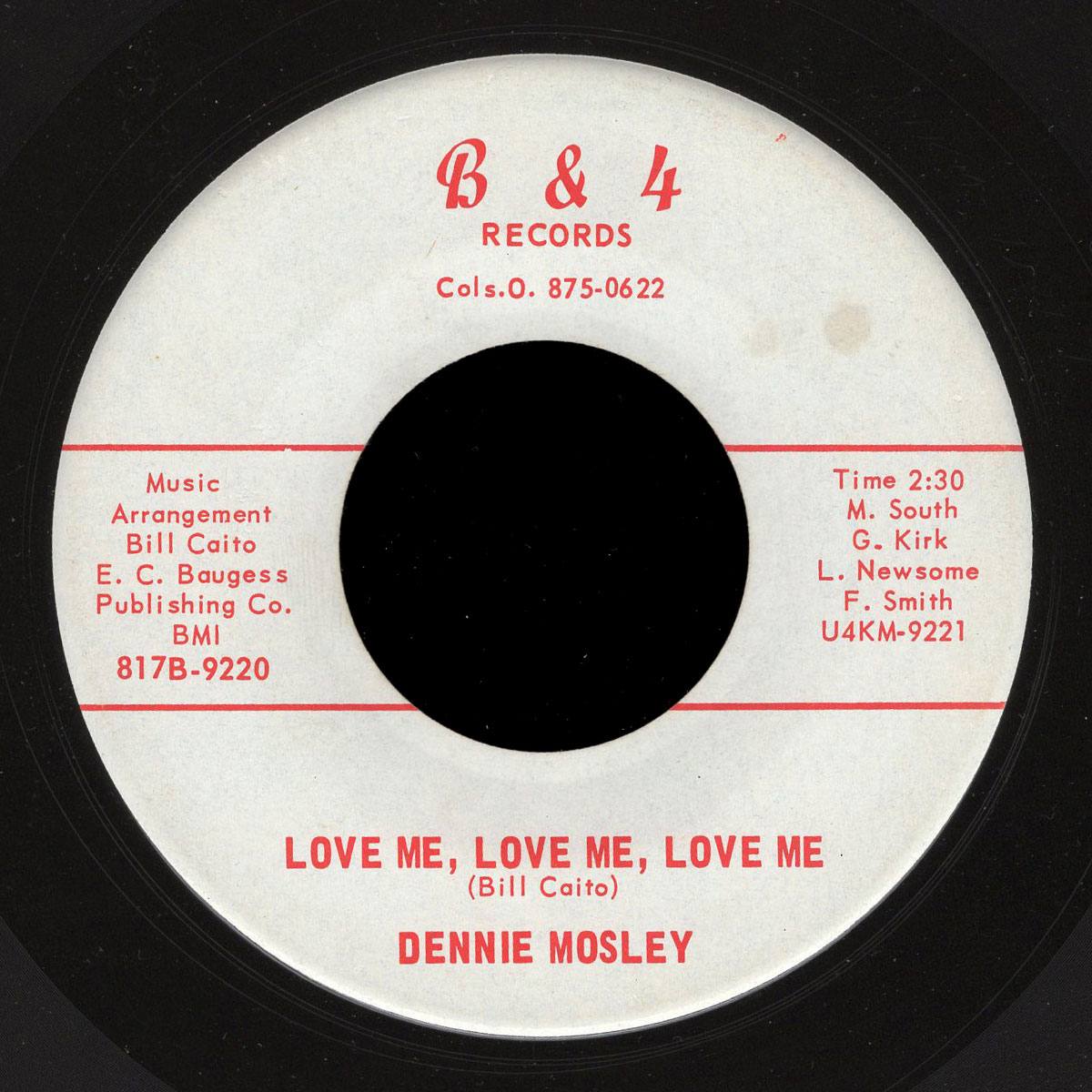
Dennie Mosley seems to have only cut this one single, the cool rockabilly “Love Me, Love Me, Love Me” backed with the pleading lament, “I Tried”. It’s not really a garage style record, but the late recording date and crude quality of the production gives it something of a garage feel. The guitar break on “Love Me” is excellent.
The RCA custom pressing code, U4KM-9220/1 indicates an early 1967 pressing.
Released on B & 4 Records out of Columbus, Ohio. Bill Caito wrote “Love Me, Love Me, Love Me” and arranged that side, while Dennie Mosley wrote and arranged “I Tried”.
Other names on the label include M. South, G. Kirk, L. Newsome and F. Smith who must be the backing musicians. B&4 Records typically list the singer of the group as the artist, so it is possible they had a group name not listed on these labels. Any further info would be appreciated.
Publishing by E.C. Baugess Publishing Co.
Chad Baugess ran a home studio and owned the B & 4 Records label. Buckeye Beat has a list of other records on the label, but not this one.
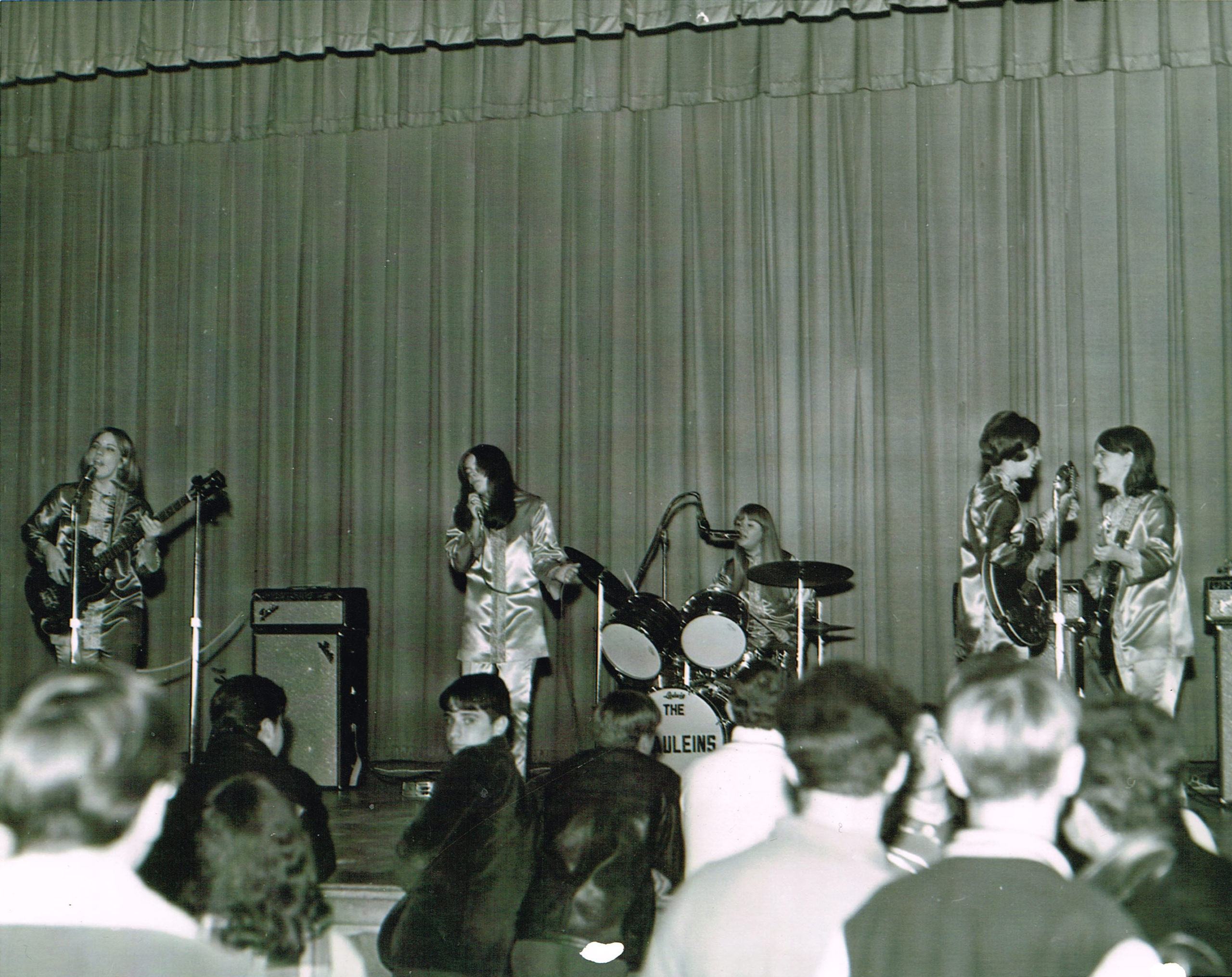
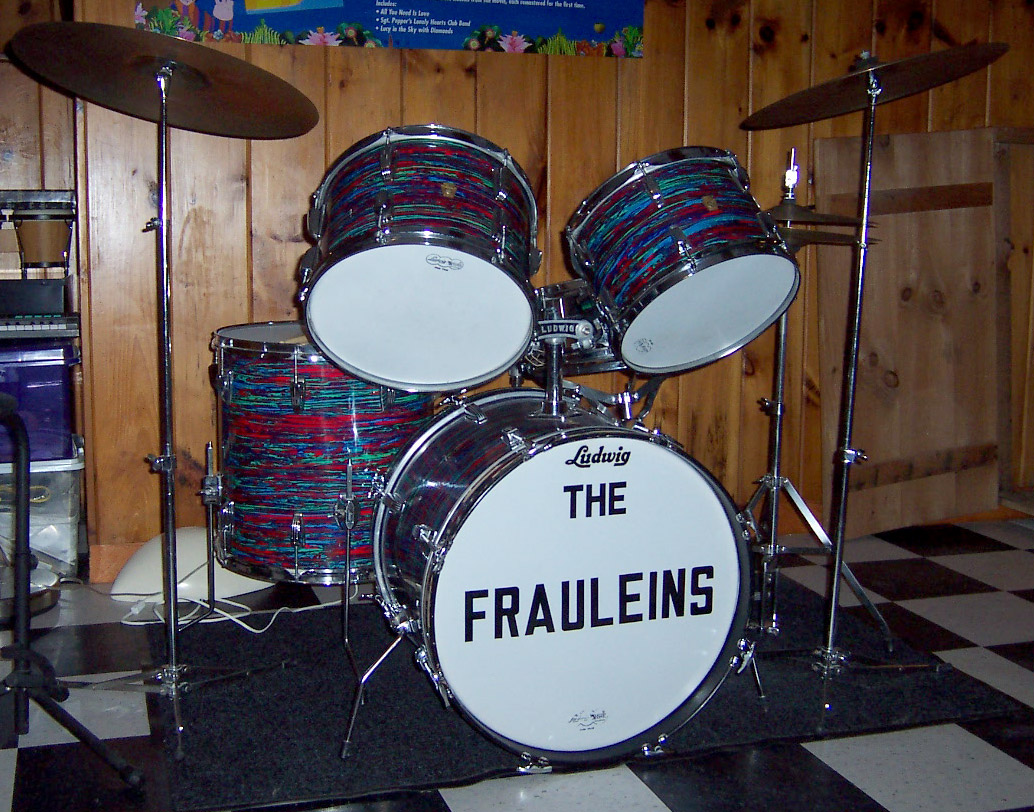
The Frauleins on stage, from left: Ann Duquette, Michelle Fereira, Lynda MacLeish, Linda Murphy and Linda Duquette
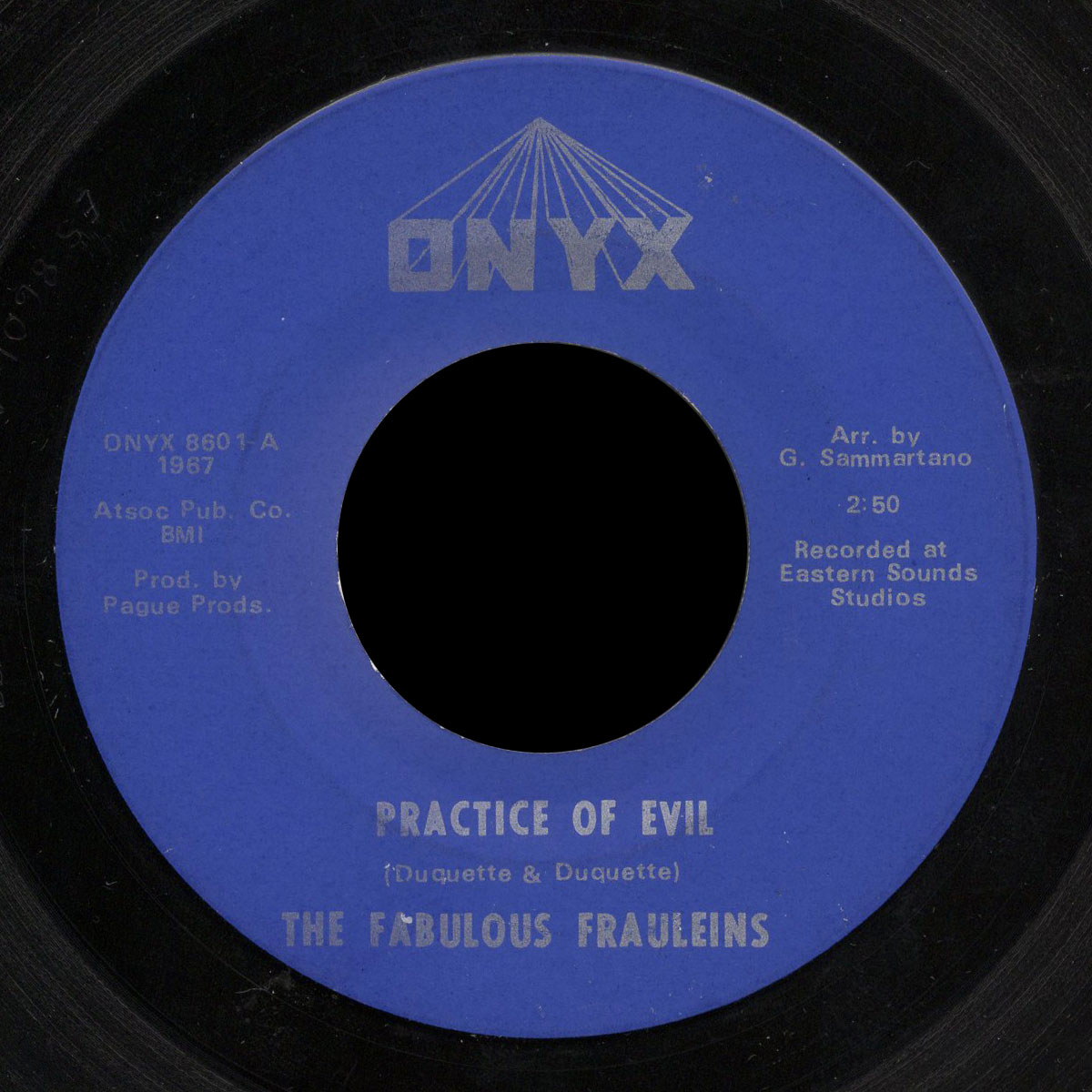
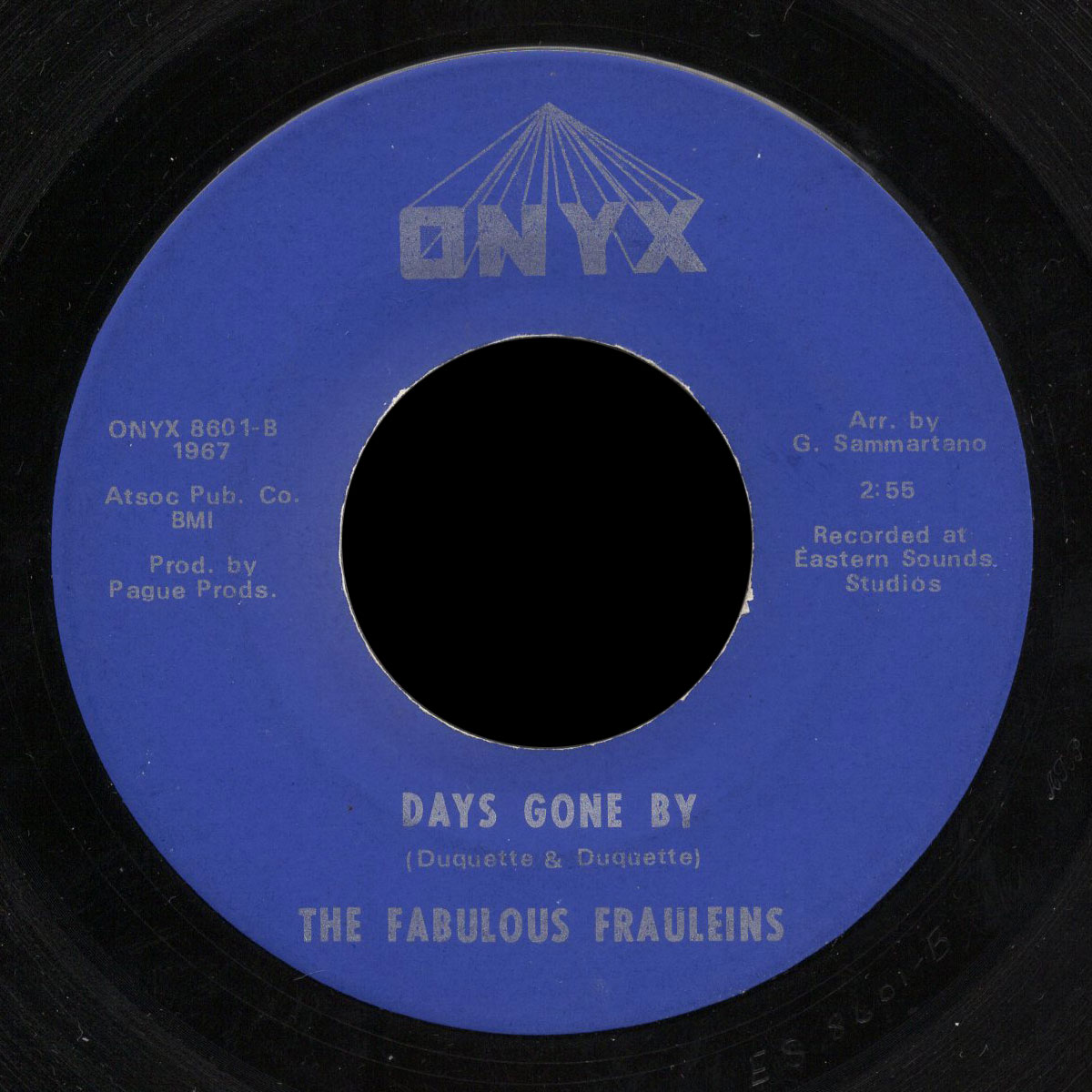
The Fabulous Frauleins only recorded this one single in 1967, “Practice of Evil” / “Days Gone By”. Both are original songs by Duquette and Duquette, two sisters who were members of the group.
Members were:
Michelle Fereira – lead vocals Linda Duquette – guitar Linda Murphy – guitar Ann Duquette – bass Lynda MacLeish – drums
“Practice of Evil” concerns the Salem witch trials. Bill Borelli from WCCM 800 radio did the voice of the judge in the middle part of the song. “Days Gone By” is slower but also a very good original.
Lynda MacLeish was from Andover, MA where she attended Andover High School. I’m not sure where the other members of the group came from, but Andover or the Lawrence / Methuen / Salem area are likely.
The Frauleins recorded at Eastern Sound Studios in Metheun, Massachusetts. Onyx Studios at the time was located in the basement of the label owner’s home at 33 Taylor St.
Guy Sammartano arranged both sides, with production by Pague Prods. Other staff at Onyx at this time included Pat Costa, Rom Messina, Jim Manganno, Sally Giaquinta, Angela Blatti and Jim Minchello.
Publishing through Atsoc Pub. Co., but I can’t find any record of copyright registration or a listing in BMI’s database for the company or the songs. Someone named Lon Duquette copyrighted a song called “Back Bay Blue” in 1969, but I have no idea if he was connected to the Frauleins.
In 1968, “Practice of Evil” was chosen to be on a Pepsi flexi giveaway, with the band called simply “The Frauleins”. A live recording of the group may exist.
The Frauleins broke up after a final show in Derry, New Hampshire around 1968. Though they kept in contact through the years, the band never reunited on stage.
Michelle Fereira married and became Michelle Barrow.
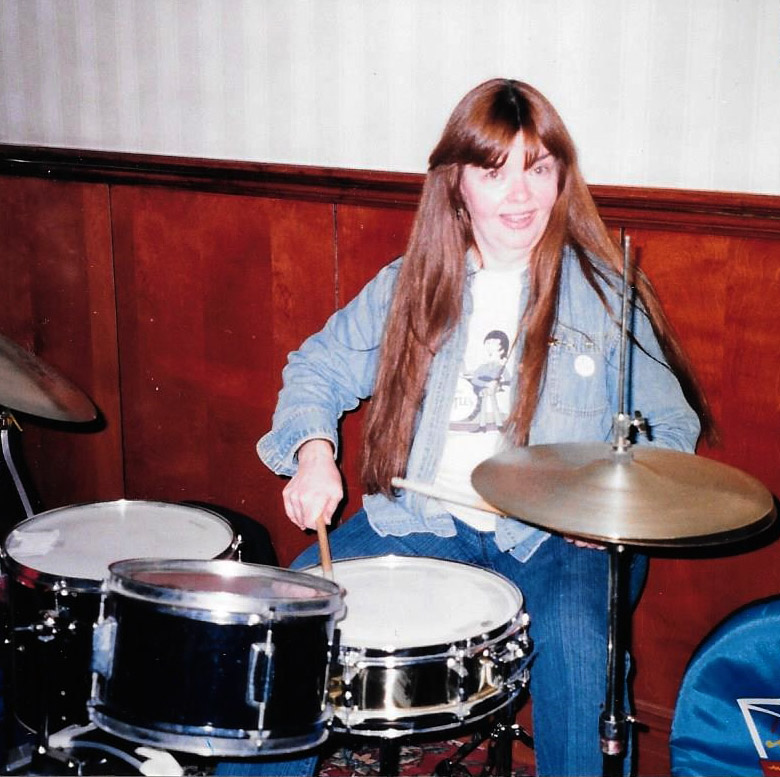
Lynda Murphy at Beatlefest, 2005 Lynda MacLeish married and became Lynda Murphy, not to be confused with Fraulein guitarist Linda Murphy! Lynda was a huge Beatles fan, having attended one of their US shows as a teen. She became a chapter president of the Rascals fan club, and long-time friend of Felix Cavaliere. Lynda never joined another group, but sat with other musicians including Pete Best, who was also a friend of hers. Lynda passed away on July 28, 2017.
Thank you to John Van Horn for the photos and information seen in this article. John and his wife were friends of Lynda Murphy (MacLeish).
This site is a work in progress on 1960s garage rock bands. All entries can be updated, corrected and expanded. If you have information on a band featured here, please let me know and I will update the site and credit you accordingly.
I am dedicated to making this site a center for research about '60s music scenes. Please consider donating archival materials such as photos, records, news clippings, scrapbooks or other material from the '60s. Please contact me at rchrisbishop@gmail.com if you can loan or donate original materials

 Here’s an obscure one out of Nashville, from the early-70s I would guess. Fire, Rhythm and Smoke do a good hard rock number called “Fire & Rhythm” with very gravely vocals, released on Sissie’s 001.