Tag Archives: Tommy Hunt Band

One

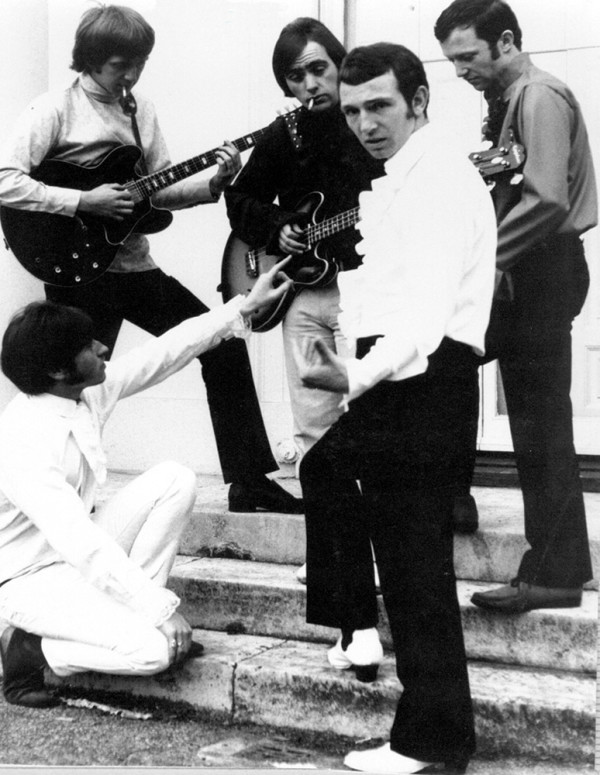
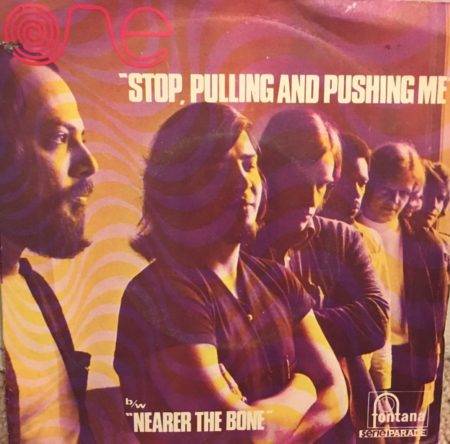
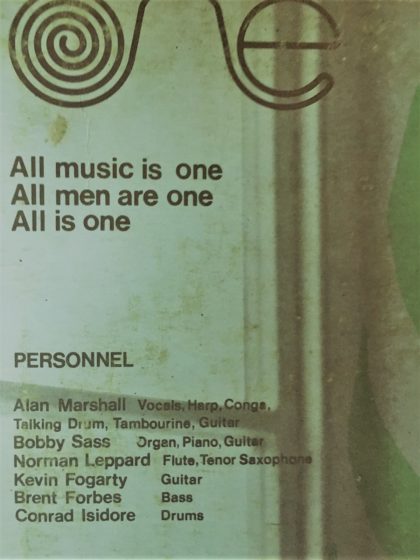
One 1969. Left to right: Alan Marshall, Bobby Sass, Kevin Fogerty, Conrad Isidore, Brent Forbes and Norman Leppard

Alan Marshall – lead vocals/guitar

Bobby Sass – keyboards

Kevin Fogerty – lead guitar

Brent Forbes – bass

Norman Leppard – horns

Conrad Isidore – drums

In late 1969/early 1970, a motley crew of London-based musicians entered Trident Studios in the heart of Soho to record a lone, rare album for Fontana Records. Helmed by Indian-born musicians and childhood friends, singer Alan Marshall and keyboard player Bobby Sass, One had initially formed in early 1969 after a series of jam sessions at Marshall’s studio flat, located at 6 Denmark Street which he shared with manager Roger Burrow, a friend of Graham Nash’s.

Born in Lahore, Alan Marshall had quite the musical pedigree. Starting out with Bexley Heath, Kent R&B outfit The Loose Ends in the early 1960s, Marshall had cut two excellent singles on Decca before the original formation splintered in October 1966. Forming a new version with members of Croydon band The Subjects and another Bexley Heath area aggregation, Bob ‘N’ All, the new-look Loose Ends landed a short residency at the Bang Bang Club in Milan during January-February 1967.

When the musicians returned to London that March, they were spotted by Otis Redding at the Scotch of St James (or Speakeasy depending on who you speak to) and, ‘blown away’ by Marshall and co-vocalist Bob Saker’s duets, the soul legend took both singers back to the States to record two tracks at Fame Studios in Muscle Shoals – “Johnny B Goode” and “Keep Pushing”. The plan was to couple the two recordings for a single on Atlantic but internal politics led to the tracks being shelved. Tragically, Redding died later that year.

Back in the UK, Alan Marshall reunited with guitarist Peter Kirtley who’d been playing with Alan Price’s band after leaving The Loose Ends the previous October. The pair decided to form a new group, Happy Magazine, and Marshall recommended his childhood friend Bobby Sass (not Bobby Tench under an alias which has often been misreported) to play keyboards. Unfortunately, after some tentative rehearsals, it was decided that Sass didn’t fit the band concept and he was dropped.

“He was a tremendous piano player and he loved Errol Garner. He and I grew up together in Karachi,” says Marshall. “Bobby didn’t make it in Happy Magazine. They didn’t like his style; he was too jazzy.”
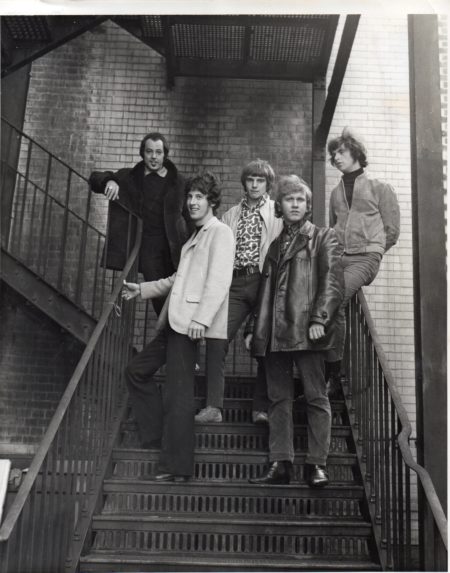
Happy Magazine, 1968. Alan Marshall (back left). Peter Kirtley (second right). Thanks to Peter for the image

Signed to Polydor, Happy Magazine cut three singles with Alan Price in the producer’s chair before splitting in early 1969. By this point, Marshall had moved into a studio flat on Denmark Street (aka as Tin Pan Alley) with his friend and manager Roger Burrow; Bobby Sass was a regular visitor. As the singer recalls, the doors were always open and musicians used to wander in.

This is the most likely explanation for how Dominica-born drummer and percussionist Conrad Isidore entered the picture that spring. An incredibly gifted musician, Isidore had first come to prominence working with noted R&B outfit Joe E Young & The Tonics during 1967 after playing with The Links and The Grendades. It was with The Toniks that Isidore worked with bass player Calvin ‘Fuzzy’ Samuels, a former member of The Blue-Act-Unit, who also featured future Bob Marley sideman, Junior Kerr (aka Junior Marvin).
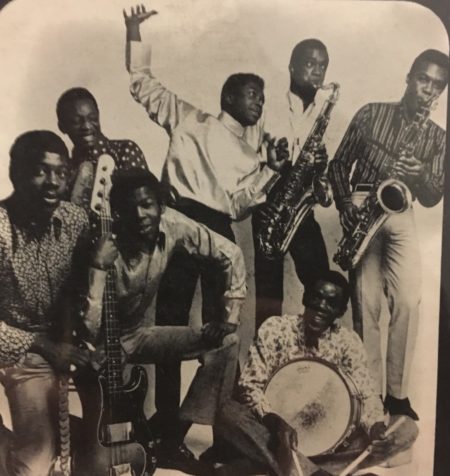
Conrad Isidore (bottom right) with Joe E Young & The Toniks, 1968

Isidore and Samuels soon moved on to form The Sundae Times with singer/guitarist Wendell Richardson. Produced by The Equals’ Eddy Grant, the trio recorded three singles and an LP, Us Coloured Kids, during 1968-1969 before the musicians went their separate ways. Somehow Isidore’s path crossed with Marshall and Sass and the drummer threw in his lot with the two Indian musicians.

Not long after, bass player Brent Forbes also joined the loose-knit set up. Originally from Salford, Greater Manchester, Forbes had previously played with The Rogues, who cut a lone single for Decca in December 1967. After changing their name to Sunshine in February 1968, the musicians turned pro and landed a residency in Turkey of all places. This was followed by a six-month stint playing clubs in Crete before the musicians returned to the drizzle of Greater Manchester.

At this point, Forbes joined a short-lived group called Zac, who moved down to London and cut an album’s worth of material at IBC Studios near Marble Arch. When this project failed to materialise, Forbes’s former band mate from Sunshine, guitarist Rod Alexander, who was managing Sound City on Shaftsbury Avenue, directed him to Marshall’s nearby studio flat.

The next musician to join was guitarist Kevin Fogerty, who had first come to prominence with Southport R&B group, Timebox. Fogerty appeared on the band’s early recordings but around October 1967, he jumped ship and signed up with The Dave Davani Four, which is where he later met tenor saxophonist and flutist Norman Leppard.

Originally from Handscross in West Sussex, Leppard was 23 years old when he turned professional. “I was mainly a freelance musician, working with different bands, touring all over the place,” he says. “I was always busy. I did a fortnight tour with The Temptations”.

Sometime in 1968, Leppard auditioned for The Dave Davani Four and landed the gig, despite being up against about 20 sax players. “Kevin was with them before I joined them,” he adds. “I ended up sharing a flat with Kevin and his then girlfriend Jenny in Kennington.”

According to Forbes, the loose-knit group of musicians spent ages rehearsing material before album sessions commenced at Trident Studios in St Anne’s Court, Soho, encompassing the latest in 16-track technology.

“We spent weeks, months, it felt like forever, in this studio [in Denmark Street] and the band would go in and play,” recalls the bass player. “We’d do an arrangement one day and go in the next day and it would be totally different as music should be. Depending on the mood of everybody it would be totally different.”
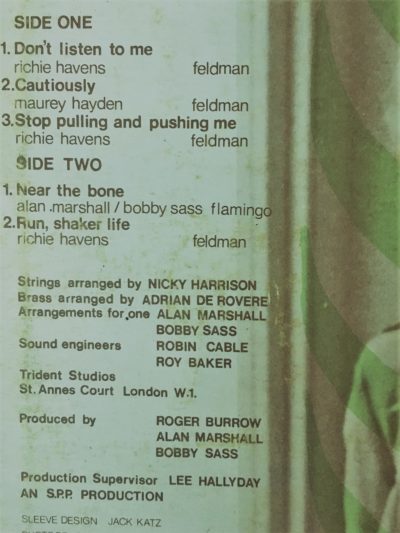
Production was split between the band’s manager Roger Burrow and Alan Marshall and Bobby Sass, working with sound engineers Robin Cable and Roy Baker. Production supervision meanwhile was handled by Lee Hallyday, who’d recently recorded his brother Johnny’s self-titled LP in France. According to several band members, the sessions at Trident’s studios also featured Alan Marshall’s former band mate from The Loose Ends and Happy Magazine, Peter Kirtley, who provided lead guitar on several cuts.

“Kevin was on some of the tracks,” explains Leppard. “He was mainly on rhythm guitar I think. I am not sure he’s on all the tracks, but he’s definitely on most of them.”

Brent Forbes is quick to credit Isidore and Marshall as the key inspirations during the recording process.

“Whether he’s playing guitar, percussion, drums or singing, [Marshall’s] just a warm spirit,” he says. “Conrad was [also] a fantastic influence for me. Great feel. He sat down one day and said: ‘Brent the notes are all right but the feel’. He made me think about that and I managed to maintain it and got a reputation for it over the years.”

Judging by the track listing, Richie Havens was a huge influence on the singer, but Marshall is not entirely happy with how some tracks turned out. “There are a couple that I am not too keen on,” says Marshall. “It was marijuana fuelled and they went on and on like ‘Run, Shaker Run’ but we didn’t know any better. We were young guys.”
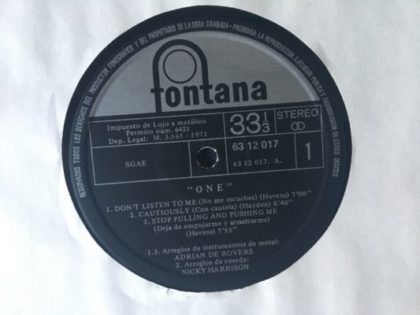
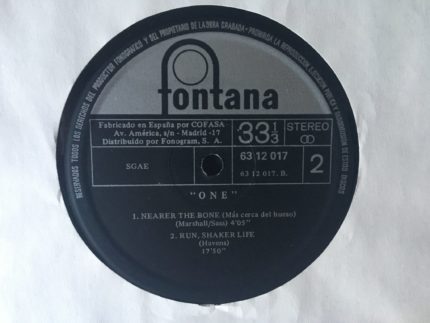
That may well be, but One’s storming cover of Havens’ “Don’t Listen To Me”, which opens the LP and third track, “Stop Pulling and Pushing Me” are inspired, extended workouts full of inventive playing and powerful instrumental passages. The musicians also do justice to “Cautiously”, an atmospheric reading of the ballad written by Maurey Hayden, singer, stand-up comedian and wife of Lenny Bruce. Alan Marshall and Bobby Sass’s “Near The Bone”, the band’s lone contribution to the song-writing stakes is also noteworthy.

According to Forbes, there were no left-overs from the album sessions, which is perhaps surprising considering how long the musicians spent rehearsing material.

With the sessions complete, Norman Leppard was invited to become a fully-fledged member of One. “After the album was done, they asked me to join the band, which I then did for quite a long time,” remembers the session player.

Fontana duly released the LP in the UK in late 1969, followed by continental releases in France, Germany and Spain. The label also issued several singles but like the LP, none of the releases charted, which is perhaps not surprising considering that One undertook very little live work to promote the records. One notable gig took place on 7 October 1969 when the musicians made a rare appearance on stage at Hatchettes Playground in Piccadilly.
During March-April 1970, the musicians got to meet Stephen Stills, who was in London to record sessions for his first solo LP. It’s not clear who in the band made the initial contact. Marshall says that he used to leave the flat door open and musicians used to wander in. One strong possibility is Roger Burrow, who of course was a friend of Graham Nash’s. Alan Marshall, however, is pretty certain that it was Bobby Sass who ran into Stills.

“I don’t know how he met Stephen [but] we used to go over to the house [in Elstead],” says Marshall. “[Stills] had Peter Sellers’ old house and we used to go out there and hang out.”

Impressed by Conrad Isidore and his friend Calvin Samuels, Stills recruited both for his solo LP sessions. In May 1970, no doubt concerned about the shortage of live work, the drummer jumped ship to join Manfred Mann Chapter 3.

“We didn’t do as many gigs as we should have,” admits Forbes. “We did a hop or two to [West] Germany and we probably did the Marquee. We never did enough work really. How on earth we existed [I don’t know] – I think Roger [Burrow] the manager helped support everybody.”

The German club in question was the Happy Cat in Eschollbrucken near Darmstadt, which is close to Frankfurt. However, the shortage of live work soon led to cracks in the group and by the summer of 1970 both Kevin Fogerty and Norman Leppard had also moved on.
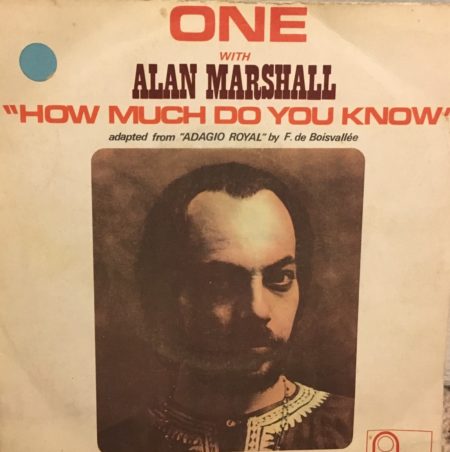
Interestingly, while One’s revolving door of personnel changes continued at pace, Fontana issued a French-only ‘45, ‘How Much Do You Know” (adapted from Adagio Royal by F de Boivallee), which was credited solely to Alan Marshall backed by One’s ‘Don’t Listen To Me”.

By the time the single appeared, Alan Marshall, Bobby Sass and Brent Forbes had pieced together a new formation which included guitarist Jack Lancaster and drummer Terry Stannard.

“There was a guitar player called Jack Lancaster, [who had] the same name as the famous one in Blodwyn Pig and he came from Swindon. He came in and took [Kevin Fogerty’s place],” says Forbes.

“God knows what we did after that. I can’t remember doing many gigs. It was a time when Fat Mattress got £200,000 advance and just sat rehearsing. It was a time when groups could afford to do that.”

Stannard, meanwhile, also originated from Wiltshire where he’d worked with Calne group, The Pack during late 1966. In the summer of 1967, the drummer moved up to London where he briefly landed a gig with Freddie Mack & The Mack Sound (and may have spent a short stint with Herbie Goins). He then moved on to join Junior Kerr (aka Junior Marvin) and Linda Lewis in the short-lived White Rabbit. By mid-1968, however, Stannard had moved on. While it’s not clear who he played with in the interim, one of the bands was Mirrors featuring Boz Burrell and Nick Judd.

Forbes remembers the new formation cutting an LP for Johnny Hallyday at a studio near Marble Arch, which could well have been IBC, towards the end of the year. “I remember getting session money for it because I went home to my uncle’s and had a very nice Christmas,” says the bass player.

Not long after, in early 1971, One underwent yet another reshuffle. On this occasion, Alan Marshall and Bobby Sass put together a short-lived version featuring former Them/Trader Horne guitarist/singer Jackie McAuley, future Traffic bass player Roscoe Gee and drummer Glenn LeFleur, who like his predecessor Terry Stannard, went on to play with Kokomo.

“I don’t know how I met Roscoe and Jackie,” says Marshall. “I used to meet so many musicians because I used to leave the door open in summer and musicians would drift in. We had a PA and Hammond organ and drums all set up.”

The new formation played at the Speakeasy and also Strawberry Fields where according to Marshall, “Paul McCartney and those guys used to love hearing us.”

During 1972/1973, Marshall’s old friend Ron Bryer, the original guitarist with The Loose Ends, joined after returning from Switzerland and playing with Brainticket.

Unfortunately, the group wound down in 1973/1974 after with the musicians scattering to work in a diverse range of projects.

Marshall ended up joining Strabismus, which subsequently changed its name to Riff Raff when the singer’s former band mate from The Loose Ends/Happy Magazine, Peter Kirtley joined and also featured bass player Roger Sutton and keyboard player Tommy Eyre. However, Marshall quit before Riff Raff’s debut album was recorded and pursued a solo career before recording with Zzebra. He then joined Gonzalez in the late Seventies in time for their 1979 release, Move It To The Music. Based in Thames Mead, he has become a pastor but continues to busk in Stratford, East London.

His school friend Bobby Sass later moved to Australia but died in the 2000s. Kevin Fogerty also passed away, in December 2010. During the early 1970s, he worked for a while in The Tommy Hunt Band.

As for Norman Leppard, he joined Eric Delaney’s band after leaving One and also appeared on Jack McDuff’s Blue Note LP, issued in late 1970. He continues to work as a session player.

Conrad Isidore meanwhile became a noted session player, working with the likes of Joe Cocker, Linda Lewis, Terry Reid, Vinegar Joe and Eddy Grant to name a few. He also later played with Junior Marvin in his band Hanson and with Hummingbird. Isidore later moved to Porvoo near Helsinki in Finland but died in 2019.

Brent Forbes also landed on his feet and, immediately on leaving One, joined the West End show, Catch My Soul. Like Isidore, he later moved into session work, playing with Doris Troy, Jimmy Helms, Lulu, Locus, Jim Capaldi and Hudson Ford among others. From 1975-1980, he also landed regular work on West End shows like Rocky Horror Picture Show and Les Miserables. During this period, he also briefly performed with Herbie Goins and Zzebra. Later, he moved into TV session work, providing music for Young Ones, the Lenny Henry Show, Victoria Wood among others.
As for One, the group remains something of an obscurity. While the LP has been issued on CD by two different labels, neither appear to be official releases. Given the collectability of the record and the fact that a mint copy will probably fetch you close to £100, perhaps it’s time that the band was given a proper re-issue treatment, complete with detailed liner notes.

Many thanks to the following for their help with the story: Alan Marshall, Brent Forbes, Norman Leppard and Jackie McAuley.

Copyright © Nick Warburton.  All Rights Reserved. No part of this article may be reproduced or transmitted in any from or by any means, without prior permission from the author.
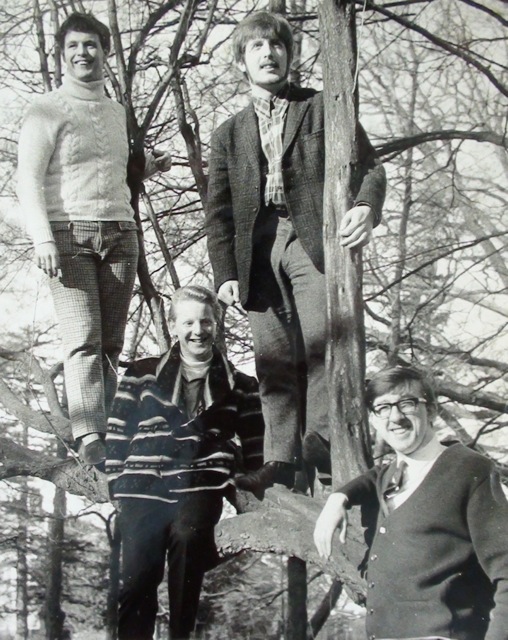
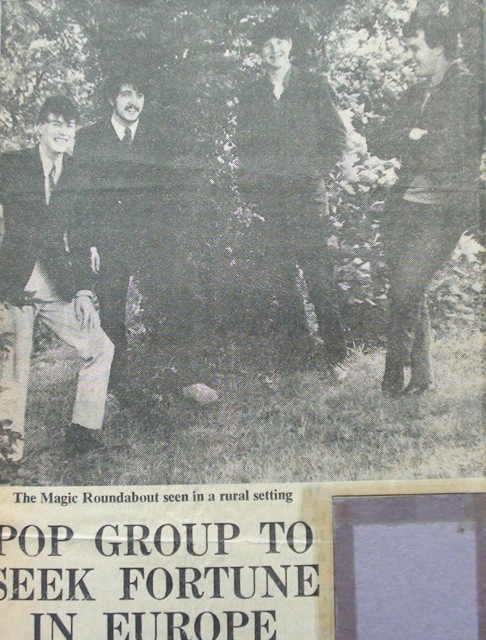
 

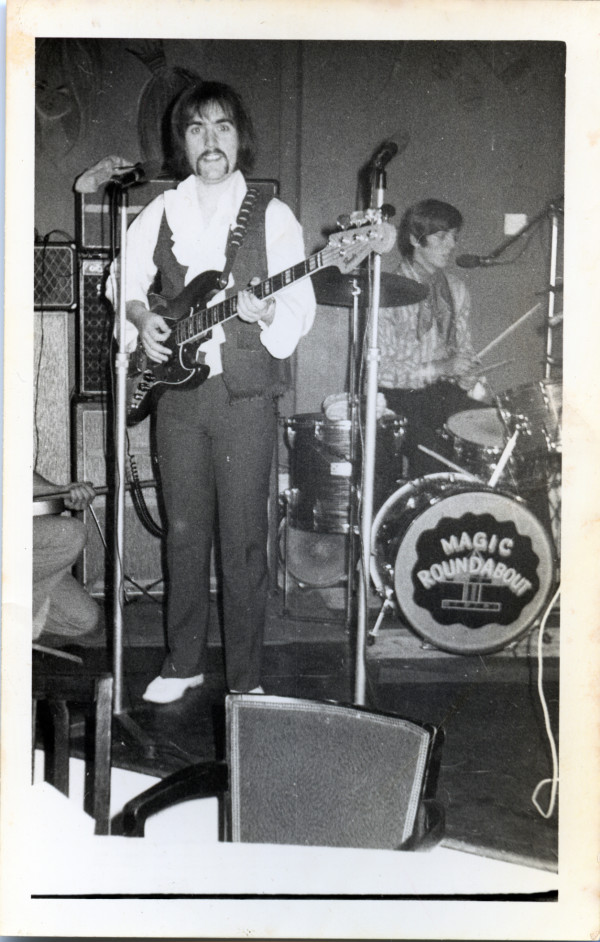
Magic Roundabout

Dave Martin Group, 1966. Left to right: Dave Martin, John Chinnery, Roger Flavell and Albert Woodward. Photo credit: John Chinnery
Dave Martin Group, 1966. Left to right: Dave Martin, John Chinnery, Roger Flavell and Albert Woodward. Photo credit:  Roger Flavell

This West London band’s roots can be found in The Dave Martin Group, which was formed around September 1966.

The original formation comprised:

Martin Thomas (aka Dave Martin) – lead vocals

John Chinnery – guitar/vocals

Roger Flavell – bass/vocals

Albert Woodward – drums

The Dave Martin Group was managed by John Chinnery’s older brother Geoff, who’d played with Mike Forde & The Fortunes in the early 1960s and briefly managed The Tridents (with a young Jeff Beck).

Guitarist John Chinnery had started out in a Hillingdon school band with Richard Walker and John Morgan. Albert Woodward, who attended another local school, completed the group.

Woodward introduced Martin Thomas and Roger Flavell and together with John Chinnery, the quartet began rehearsing at Ickenham Hall near Ruislip, Middlesex.

According to John’s brother Geoff Chinnery’s detailed gig list (complete with earnings for each performance), the new outfit’s debut show appears to have taken place on 28 October 1966 (most likely) at the Fisheries in Harefield, Middlesex. The gig list notes that The Dave Martin Group played at the same venue on 11, 18-19 and 26 November and also 3-4, 11 and 17 December.

The following gigs are then listed (during which period Roger Flavell was briefly replaced on bass while he had his tonsils out. John Chinnery suspects it was his school friend John Morgan, who covered Flavell’s absence).

Dave Martin Group gigs:

21 December 1966 – Ickenham Hall, Ickenham, northwest London

23 December 1966 – Warburton Arms, Hackney, north London

24 December 1966 – Harefield Football Club, Harefield, northwest London

30 December 1966 – Warburton Arms, Hackney, north London

31 December 1966 – the Fisheries, Harefield, northwest London


6 January 1967 – Warburton Arms, Hackney, north London

7 January 1967 – the Fisheries, Harefield, northwest London

14 January 1967 – the Fisheries, Harefield, northwest London

21 January 1967 – the Fisheries, Harefield, northwest London

24 January 1967 – Kew Boathouse, Kew, west London

28 January 1967 – the Fisheries, Harefield, northwest London (Roger Flavell returns after this show)

29 January 1967 – Hesden Hall, Ruislip, northwest London

31 January 1967 – Kew Boathouse, Kew, west London


4 February 1967 – Warburton Arms, Hackney, north London

5 February 1967 – the Fisheries, Harefield, northwest London

8-9 February 1967 – Kew Boathouse, Kew, west London

10 February 1967 – Warburton Arms, Hackney, north London

11 February 1967 – the Fisheries, Harefield, northwest London

13-16 February 1967 – Kew Boathouse, Kew, west London

17-18 February 1967 – Warburton Arms, Hackney, north London

19 February 1967 – the Fisheries, Harefield, northwest London

20-23 February 1967 – Kew Boathouse, Kew, west London

26 February 1967 – the Fisheries, Harefield, northwest London

27 February-2 March 1967 – Kew Boathouse, Kew, west London


4 March 1967 – Hanwell Sports Club, Hanwell, west London

5 March 1967 – the Fisheries, Harefield, northwest London

6-9 March 1967 – Kew Boathouse, Kew, west London

12 March 1967 – the Fisheries, Harefield, northwest London

13 March 1967 – Kew Boathouse, Kew, west London

Dave Martin Group, 1967. Left to right: Lindsey Bex, Roger Flavell, John Chinnery and Dave Martin. Photo credit: John Chinnery
Dave Martin Group, 1967. Left to right: Lindsay Bex, Roger Flavell, John Chinnery and Dave Martin. Photo credit: Roger Flavell

At this point, Lindsay Bex replaced Albert Woodward on drums, who later became a percussion lecturer.

Older than the others, Lindsay Bex had worked with Geoff Chinnery in Mike Forde & The Fortunes during early 1960s. In early 1964, Bex joined Chiswick band, The Tridents (who were managed by Geoff Chinnery). He remained with the group until about September 1964 during which time Jeff Beck joined on lead guitar.

In early 1965, Bex went to Germany for three months with The Redcaps and then played with various scratch bands before returning to Germany in 1966 to play American air bases with The Kathy Sampson Set. When Albert Woodward left suddenly, he accepted the call to join.


Dave Martin Group gigs (continued):

14-16 March 1967 – Kew Boathouse, Kew, west London

18 March 1967 – Wedding reception, Teddington, west London

20-23 March 1967 – Kew Boathouse, Kew, west London

24 March 1967 – Blue Coat Boy, Bishopsgate, City of London

25 March 1967 – Wedding reception, Old Kent Road, south London

26 March 1967 – the Fisheries, Harefield, northwest London

27-30 March 1967 – Kew Boathouse, Kew, west London

31 March 1967 – All Stars Club, Artillery Passage, Liverpool Street, east London (audition)


2 April 1967 – the Fisheries, Harefield, northwest London

3-6 April 1967 – Kew Boathouse, Kew, west London

7 April 1967 – West Dulwich Sports Club, West Dulwich, south London

8 April 1967 – Derwentwater Club, Acton, west London

9 April 1967 – the Fisheries, Harefield, northwest London

15 April 1967 – The Pheasant, South Oxhey, Watford

17 April 1967 – Whisky A Go Go, Wardour Streets, Soho, central London (audition)

22 April 1967 – Saracens Rugby Club, Finchley, north London

23 April 1967 – the Fisheries, Harefield, northwest London

27 April 1967 – Byron Hotel, Greenford, west London (audition)

30 April 1967 – the Fisheries, Harefield, northwest London


7 May 1967 – the Fisheries, Harefield, northwest London

8 May 1967 – St Moritz Club, Wardour Street, Soho, central London (audition)

13 May 1967 – Rank Xerox private party, Denham, Buckinghamshire

14 May 1967 – the Fisheries, Harefield, northwest London

19 May 1967 – Kew Boathouse, Kew, west London

20 May 1967 – Rank Xerox, Denham, Buckinghamshire

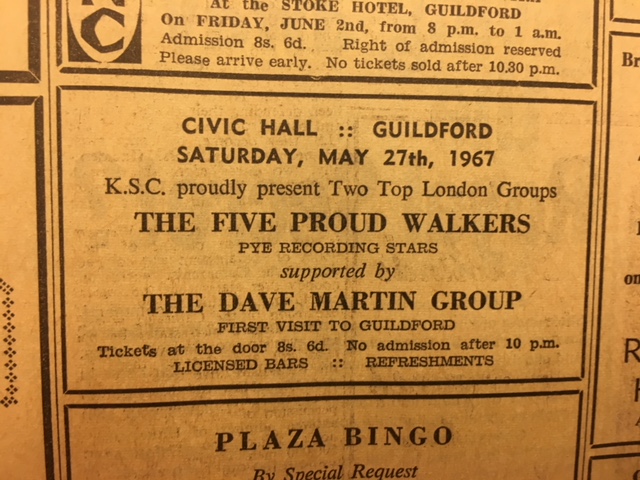
27 May 1967 – Civic Hall, Guildford, Surrey with Five Proud Walkers

28 May 1967 – the Fisheries, Harefield, northwest London


3 June 1967 – Wedding Reception, Tea Rooms, Kenton, northwest London

4 June 1967 – Byron Hotel, Greenford, west London

8 June 1967 – RAF Northwood

9 June 1967 – Unknown venue, Purfleet, Essex

10 June 1967 – Clay Pigeon, Eastcote, northwest London

12-15 June 1967 – Kew Boathouse, Kew, west London

16 June 1967 – ILI Co, Wembley, west London

17 June 1967 – Pavilion, Hemel Hempstead, Hertfordshire

19-23 June 1967 – Kew Boathouse, Kew, west London

23 June 1967 – UKAEA, Harwell, Oxfordshire with Brian Poole & The Unity

24 June 1967 – Wedding reception, Hendon, north London

26-29 June 1967 – Kew Boathouse, Kew, west London

30 June 1967 – Greenway School, Uxbridge, west London

During 1967, the band recorded a couple of demos at a studio in Denham, Buckinghamshire comprising Martin Thomas/Roger Flavell co-writes.


Dave Martin Group gigs (continued): 

3-6 July 1967 – Kew Boathouse, Kew, west London

8 July 1967 – Rank Xerox, Denham, Buckinghamshire

20 July 1967 – Pinn Club, RAF Uxbridge, West London

28 July 1967 – Epsom Youth Club, Epsom, Surrey

29 July 1967 – Pavilion, Hemel Hempstead, Hertfordshire


5 August 1967 – Thames Boat Trip, Westminster to Teddington

6 August 1967 – Clay Pigeon, Eastcote, northwest London

12 August 1967 – Thing-a-me-jig, Reading, Berkshire


31 August 1967 – Sword & Wheel Club, RAF Northolt, northwest London

At midnight, immediately after finishing the gig at RAF Northolt near Ruislip, the band had to pack up in order to drive down to Dover to catch the ferry to the continent and only just made the boat by the ‘skin of their teeth’. Having just turned professional, The Dave Martin Group changed its name to The Magic Roundabout and headed to Germany and then Switzerland.

Magic Roundabout in Bad Vilbel. Left to right: Roger Flavell, Dave Martin, John Chinnery and roadie Stuart Cook. Photo credit: John Chinnery
Magic Roundabout in Bad Vilbel. Left to right: Roger Flavell, Dave Martin, John Chinnery and roadie Stuart Cook. Photo credit: Roger Flavell

The Magic Roundabout gigs:

1-30 September 1967 – Ritterkelleer (9 performances) and Western Club (11 performances), Bad Vilbel, Frankfurt, West Germany

1-15 October 1967 – Haus Der Music, Wuppertal, West Germany with The Berkeley Squares (15 performances)


Arriving in Zurich, Switzerland, the band now briefly includes organist Dave Eldredge, a musician from Leicester group The Berkeley Squares, who split up after the shows in Wuppertal. Eldredge remains with the group until mid-November.

16 October-1 November 1967 – ‘Beat Club’, Hotel Hirschen, Zurich, Switzerland (17 performances)

3-6 November 1967 – ‘Taverns Bar’, Ingolstadt, West Germany (4 performances) (the band’s final night is cancelled; a fight had broken out the previous night between US servicemen and German police and the club was wrecked. The club is closed for refurbishment and The Magic Roundabout head home to the UK.)

On the band’s return to the UK, organist John Elliott joined after Eldredge left. Geoff Chinnery had convinced the organist to join The Effect but this proved short-lived. Eldredge subsequently joined Pussyfoot.

Elliott had previously played with Ealing band, Magnus Pike with lead guitarist/singer Jerry Smith, bass player Roger Searle and drummer Tony Haslam. Searle and Haslam will later go on to work with The Who’s road crew.

Magic Roundabout’s new line up comprised:

Martin Thomas (aka Dave Martin) – lead vocals

John Chinnery – lead guitar/vocals

John Elliott – organ/vocals

Roger Flavell – bass/vocals

Lindsay Bex – drums


The Magic Roundabout gigs (continued):

17 November 1967 – Women’s teachers’ training college (location not known)

18 November 1967 – Young Conservative’s Club, Twickenham, west London

25 November 1967 – YMCA, Baldock, Hertfordshire


4-7 December 1967 – Kew Boathouse, Kew, west London

8 December 1967 – Guild Hall, Ilford, east London

9 December 1967 – The Pavilion, Hemel Hempstead, Hertfordshire

15 December 1967 – Gillettes, Great West Road, west London with Fortunes and Episode Six

16 December 1967 – RAF Feltwell

23 December 1967 – Rugby Club, Upton Park, Slough, Berkshire

26 December 1967 – Halfway House, Dunstable, Hertfordshire

31 December 1967 – Sword & Wheel Club, RAF Northolt, northwest London


1-4 January 1968 – Kew Boathouse, Kew, west London

5 January 1968 – Youth Club, West Drayton, west London

6 January 1968 – Baker’s Row Club, Cardiff (Bex’s bass drums falls off the roof rack on the way)

12 January 1968 – USAF Woodbridge, Suffolk

13 January 1968 – Hanwell Community Centre, Hanwell, west London

20 January 1968 – Mildway Tavern, Highbury, north London

24-25 January 1968 – Mildway Tavern, Highbury, north London

26 January 1968 – Scotch of St James, Mayfair, central London

27 January 1968 – Kodak Hall, Hemel Hempstead, Hertfordshire

30 January 1968 – BBC Maida Vale (audition)

31 January-1 February 1968 – Mildway Tavern, Highbury, north London


Magic Roundabout, spring 1968. Left to right: Miki Anthony, Lindsey Bex, John Elliott, John Chinnery and Roger Flavell. Photo credit: John Chinnery
Magic Roundabout, spring 1968. Left to right: Miki Anthony, Lindsay Bex, John Elliott, John Chinnery and Roger Flavell. Photo credit: Roger Flavell


2 February 1968 – Northcote Arms, Southall, west London

3 February 1968 – Queen’s Hall, Halstead, Braintree, Essex

10 February 1968 – Thing-a-me-jig, Reading, Berkshire

12-15 February 1968 – Kew Boathouse, Kew, west London

16 February 1968 – Northcote Arms, Southall, west London

17 February 1968 – Rank Xerox, Denham, Buckinghamshire

21 February 1968 – Club A Go Go, Newcastle Upon Tyne

29 February 1968 – Bluebell Inn, Hackenthorpe, Sheffield, South Yorkshire


1 March 1968 – County Ballroom, Carlisle, Cumbria

2 March 1968 – Sheridan Rooms, Huddersfield, West Yorkshire

3 March 1968 – Woodhouse WMC, Sheffield, South Yorkshire

8 March 1968 – RAF Club, Tredegar, Wales

9 March 1968 – Howard Winstone Club, Merthyr, Wales

10 March 1968 – Beech Grove, Pengham, Wales

13 March 1968 – Faculty of Technology, Manchester

14 March 1968 – Bluebell Inn, Hackenthorpe, Sheffield, South Yorkshire

15 March 1968 – Northcote Arms, Southall, west London

18 March 1968 – Quaintways, Chester, Cheshire

24 March 1968 – The Pheasant, South Oxhey, Watford, Hertfordshire

25-27 March 1968 – Kew Boathouse, Kew, west London

29 March 1968 – Brighton Tech College, Brighton, West Sussex

After the above gig, singer Michael Derrick (aka Miki Anthony) took over from Martin Thomas and brought his own manager with him (which would see the band split with Geoff Chinnery).


The Magic Roundabout gigs (continued):

20 April 1968 – Northcote Arms, Southall, west London

21 April 1968 – Warmingham Grange Country Club, Sandbach, Cheshire

26 April 1968 – Kiosk Ballroom, Castleford, West Yorkshire

27 April 1968 – Sheridan Rooms, Huddersfield, West Yorkshire

28 April 1968 – The Pavilion, Bournemouth, Dorset

29 April-2 May 1968 – Kew Boathouse, Kew, west London


3 May 1968 – Bluebell Inn, Hackenthorpe, Sheffield, South Yorkshire

4 May 1968 – Morley Town Hall, Morley, West Yorkshire

5 May 1968 – Woodhill, WMC, Normanton, West Yorkshire

11 May 1968 – Bradford University with Jeff Beck Group

17 May 1968 – Board of Trade, Eastcote,  northwest London

18 May 1968 – Faculty of Technology, Manchester with Fleetwood Mac

19 May 1968 – Warmingham Grange Country Club, Sandbach, Cheshire

23 May 1968 – Arundel WMC, Sheffield, South Yorkshire

24-25 May 1968 – Raven Club, RAF Waddington

26 May 1968 – Kiosk Ballroom, Castleford, West Yorkshire

30 May 1968 – Kimbleworth Park Social Club, Rotherham, South Yorkshire

31 May 1968 – 270 Discotheque, Barnsley, West Yorkshire

Sometime around this time, the group recorded a cover of The Bee Gees’ “I Am The World”, which is never released.


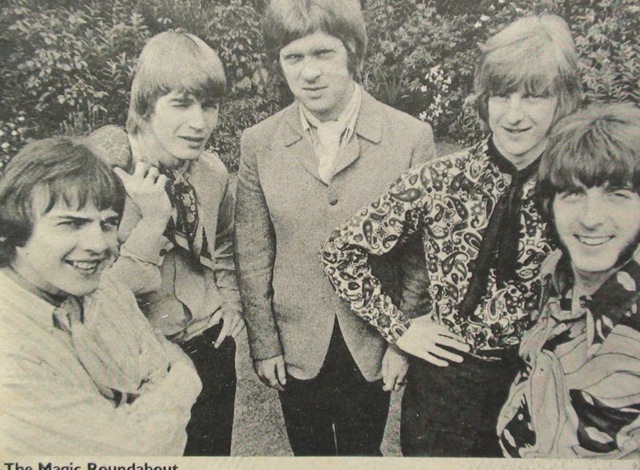
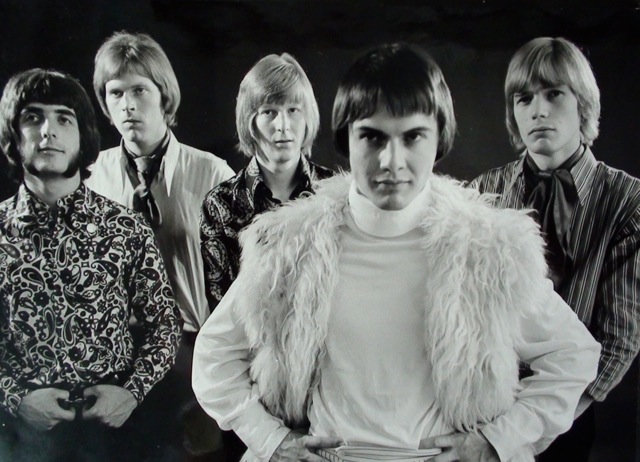
Magic Roundabout, 1968. Left to right: Roger Flavell, John Elliott, John Chinnery, Miki Anthony and Lindsey Bex. Photo credit: John Chinnery
Magic Roundabout, 1968. Left to right: Roger Flavell, John Elliott, John Chinnery, Miki Anthony and Lindsay Bex. Photo credit: Roger Flavell


The Magic Roundabout gigs (continued):

1 June 1968 – Manchester University

8 June 1968 – The Pavilion, Weymouth, Dorset

14 June 1968 – The Place, Hanley, Staffordshire

15 June 1968 – Alexander Hall, Halifax, South Yorkshire with Jackson Union

20 June 1968 – Kimbleworth Park Social Club, Rotherham, South Yorkshire

21 June 1968 – Woodhill, WMC, Normanton, West Yorkshire

22 June 1968 – Morley Town Hall, Morley, West Yorkshire

24-27 June 1968 – Kew Boathouse, Kew, west London

28 June 1968 – Shades, Sheffield, South Yorkshire

29 June 1968 – University of Aston, Birmingham

30 June 1968 – Arundel WMC, Sheffield, South Yorkshire


1 July 1968 – Wilbeck Country Club, Hatfield, near Doncaster, South Yorkshire

2 July 1968 – Top Ranke Suite, Southampton, Hants

5 July 1968 – Cossack Club, Sir James Altham School, Oxhey, Watford, Hertfordshire

6 July 1968 – Bellpunch, Uxbridge, west London

14 July 1968 – Industrial Club, Norwich, Norfolk

18 July 1968 – Cossack Club, Sir James Altham School, Oxhey, Watford, Hertfordshire

19 July 1968 – Victoria & Bull, Dartford, Kent

20 July 1968 – Bourne School, Ruislip Manor, northwest London

25 July 1968 – Oasis Club, RAF Biggin Hill, Kent

26 July 1968 – Catacombe, Eastbourne, East Sussex

28 July 1968 – A Train, Hayes, west London

29 July-1 August 1968 – Kew Boathouse, Kew, west London


2 August 1968 – Harrow Inn, Woolwich, south London

3 August 1968 – Thing-a-me-jig, Reading, Berkshire

10 August 1968 – Airman’s Club, USAF, West Ruislip, northwest London

11 August 1968 – Wake Arms, Epping, Essex

16 August 1968 – Kiosk Ballroom, Castleford, West Yorkshire

17 August 1968 – Black Swan, Sheffield, South Yorkshire

18 August 1968 – Manor House, near Skipton, North Yorkshire

20 August 1968 – Almonbury WMC, Huddersfield, West Yorkshire

21 August 1968 – Ponderose, Barnsley, West Yorkshire

22 August 1968 – Blue Bell, Sheffield, South Yorkshire

24 August 1968 – Morley Town Hall, Morley, West Yorkshire

30 August 1968 – RAF Whitton, Whitton, west London

Michael Derrick’s manager informed the band that he would take the singer away unless he can assume sole management and the musicians begrudgingly agreed as Geoff Chinnery had been managing them from the outset. Soon afterwards, Lindsay Bex and John Elliott both departed following the RAF Whitton gig, which (ironically) Chinnery believes was the band’s best performance to date.

Two weeks later, it was clear that the group’s career had ground to a halt and the band broke up. While Chinnery briefly abandoned a musical career and returned to work in insurance, Flavell subsequently joined Grand Union, the backing band for US soul act, Johnny Johnson & The Bandwagon in 1969.

In late 1970, Flavell briefly played with Geno Washington before working with Tony Hazzard/Richard Barnes, Judd, Kris Ife and The Tommy Hunt Band. In the early Seventies, Flavell joined Christie and then went on to Johnny Wakelin & The Kinshasha Band, The Lonnie Donegan Band and The David Byron Band.

Miki Anthony meanwhile established a highly successful solo career.

John Chinnery and drummer Roger Willis, who have known each other since childhood and are Arsenal FC fans, decided to reform The Magic Roundabout around February 1969 with John Elliott, who has been working in a bank since the band’s break up in September 1968.

The Kool, 1967, featuring Ray Brown (far left). Photo credit: Ray Brown

Ray Brown, who had previously played with Jeff Curtis & The Flames and The Kool agreed to join after his next band, Champagne appeared on the same bill as The Magic Roundabout.

Ray Brown (centre) with Champagne in 1968. Photo credit: Ray Brown

Lead guitarist Ian Hollands, who had previously played with Frankie Reid & The Casuals and The Legends answered an advert in the music press and completed the new formation.

The new Magic Roundabout formation now comprised:

Ian Hollands – lead guitar/vocals

John Chinnery – rhythm guitar/vocals

John Elliott – organ/vocals

Ray Brown – bass/vocals

Roger Willis – drums/vocals


The Magic Roundabout gigs (continued):

9 May 1969 – Harefield Youth Club, Harefield, northwest London

17 May 1969 – R&B Club, Feltham, Middlesex

18 May 1969 – Cooks Ferry Inn, Edmonton, north London

23 May 1969 – Lorraine Club, Chingford, east London

31 May 1969 – Wake Arms, Epping, Essex


6 June 1969 – Salvatorian College, Wealdstone, northwest London

7 June 1969 – White Hart, Tottenham, north London

13 June 1969 – Lorraine Club, Chingford, east London

21 June 1969 – Greenford Hotel, Greenford, west London

27 June 1969 – Woodford Youth Club, St Barnabos School

28 June 1969 – St Annes School, Hanwell, west London


3 July 1969 – New Penny Disco, Watford, Hertfordshire

4 July 1969 – Pinkwell Youth Centre, Hayes, west London

6 July 1969 – Cambridge Hotel, Edmonton, north London

12 July 1969 – Bourne School, Ruislip Manor, northwest London

13 July 1969 – the Cherry Tree, Welwyn Garden City, Hertfordshire

18 July 1969 – King’s Head Disco, Harrow, northwest London

19 July 1969 – Wake Arms, Epping, Essex

26 July 1969 – King’s Head, Harrow, northwest London


1 August 1969 – Lorraine Club, Chingford, east London

2 August 1969 – King’s Head, Harrow, northwest London

7 August 1969 – Top Rank Suite, Watford, Hertfordshire

15 August 1969 – El Grotto, Ilford, east London

16 August 1969 – Oldfield Tavern, Greenford, west London

22 August 1969 – King’s Head, Harrow, northwest London

23 August 1969 – Spa Ballroom, Cheltenham, Gloucestershire

24 August 1969 – Cambridge Hotel, Edmonton, north London

30 August 1969 – Links Pavilion, Cromer, Norfolk

31 August 1969 – Industrial Club, Norwich, Norfolk

26 September 1969 – Greenford Hotel, Greenford, west London

27 September 1969 – New Penny Disco, Watford, Hertfordshire

28 September 1969 – Oldfield Tavern, Greenford, west London


3 October 1969 – King’s Head, Harrow, northwest London

4 October 1969 – Oldfield Tavern, Greenford, west London

10 October 1969 – Grange Youth Centre, Hayes, west London

11 October 1969 – King’s Head, Harrow, northwest London

24 October 1969 – Greenford Hotel, Greenford, west London

25 October 1969 – Industrial Club, Norwich, Norfolk


1 November 1969 – King’s Head, Harrow, northwest London

2 November 1969 – Oldfield Tavern, Greenford, west London

7 November 1969 – King’s Head, Harrow, northwest London

8 November 1969 – Oldfield Tavern, Greenford, west London

9 November 1969 – Hunter’s Club, Horn Hotel, Braintree, Essex

14 November 1969 – Lorraine Club, Chingford, Essex

21 November 1969 – Kettering WMC, Kettering, Northamptonshire

28 November 1969 – Greenford Hotel, Greenford, west London


5 December 1969 – King’s Head, Harrow, northwest London

6 December 1969 – Oldfield Tavern, Greenford, west London

7 December 1969 – Headstone Hotel, North Harrow, northwest London

11 December 1969 – Oldfield Tavern, Greenford, west London

12 December 1969 – Harefield Youth Club, Harefield, northwest London

13 December 1969 – Greenford Hotel, Greenford, west London

19 December 1969 – Greenford Hotel, Greenford, west London


Magic Roundabout in 1969. Left to right: Ian Hollands, Ray Brown, John Chinnery and John Elliott. Photo credit: Ray Brown

2 January 1970 – King’s Head, Harrow, northwest London (Hollands ill)

8 January 1970 – Oldfield Tavern, Greenford, west London (Hollands ill)

16 January 1970 – King’s Head, Harrow, northwest London

17 January 1970 – Oldfield Tavern, Greenford, west London

23 January 1970 – El Grotto Disco, Ilford, east London

24 January 1970 – King’s Head, Harrow, northwest London

30 January 1970 – Greenford Hotel, Greenford, west London


7 February 1970 – Gillettes, Isleworth, Middlesex

8 February 1970 – Cambridge Hotel, Edmonton, north London

12 February 1970 – Oldfield Hotel, Greenford, west London

13 February 1970 – Cook’s Ferry Inn, Edmonton, north London

14 February 1970 – King’s Head, Harrow, northwest London

20 February 1970 – King’s Head, Harrow, northwest London

22 February 1970 – Oldfield Hotel, Greenford, west London

24 February 1970 – Civic Hall, St Albans, Hertfordshire

27 February 1970 – Greenford Hotel, Greenford, west London


6 March 1970 – King’s Head, Harrow, northwest London

7 March 1970 – Spotlight Club, RAF Brize Norton

12 March 1970 – Oldfield Hotel, Greenford, west London

14 March 1970 – Civic Hall, St Albans, Hertfordshire

20 March 1970 – King’s Head, Harrow, northwest London

21 March 1970 – Airmen’s Mess, USAF Wethersfield

26 March 1970 – Oldfield Hotel, Greenford, west London

28 March 1970 – King’s Head, Harrow, northwest London


Ray Brown (left) and Roger Willis on stage with Magic Roundabout. Photo credit: Ray Brown

3 April 1970 – AYA USAF West Ruislip, northwest London

4 April 1970 – Andromeda Club, Colchester, Essex

10 April 1970 – King’s Head, Harrow, northwest London

11 April 1970 – Oldfield Hotel, Greenford, west London

16 April 1970 – Oldfield Hotel, Greenford, west London

18 April 1970 – King’s Head, Harrow, northwest London

19 April 1970 – Links, Borehamwood, Hertfordshire

24 April 1970 – West Ham College, West Ham, east London


2 May 1970 – Airmen’s Club, USAF Mildenhall

9 May 1970 – Oldfield Hotel, Greenford, west London

14 May 1970 – Oldfield Hotel, Greenford, west London

26 May 1970 – Oldfield Hotel, Greenford, west London

29 May 1970 – King’s Head, Harrow, northwest London

30 May 1970 – NCOs Club, USAF High Wycombe


1 June 1970 – King’s Head, Edmonton, north London (audition)

The band auditioned for the John Edwards Agency (most likely the above date), performing three songs, including a cover of The Moody Blues’ “Ride My See-Saw”.


The Magic Roundabout gigs (continued):

4 June 1970 – Galaxy Club, RAF Northwood, northwest London

6 June 1970 – King’s Head, Harrow, northwest London

13 June 1970 – Oldfield Hotel, Greenford, west London

18 June 1970 – Oldfield Hotel, Greenford, west London

19 June 1970 – King’s Head, Harrow, northwest London

20 June 1970 – Braintree College, Braintree, Essex

26 June 1970 – Oases Club, RAF Biggin Hill, Kent


1 July 1970 – NCOs Club, USAF High Wycombe

3 July 1970 – Beaconsfield Youth Club

4 July 1970 – Airmen’s Annexe, USAF Upper Hayford

9 July 1970 – Angelique, King’s Road, southwest London

10 July 1970 – King’s Head, Harrow, northwest London

11 July 1970 – North Park, WMC, Kettering, Northamptonshire

15 July 1970 – Winston Churchill Hall, Ruislip, northwest London

16 July 1970 – RAF High Wycombe

24 July 1970 – Spotlight Club, RAF Brize Norton

25 July 1970 – Pavilion, Hemel Hempstead, Hertfordshire

31 July 1970 – The Pheasantry, King’s Road, southwest London

PLEASE NOTE: There are some missing gigs from this list. John Chinnery believes that the group played until at least November 1970.

Sometime in 1970, the new line up got the opportunity to record two tracks at Abbey Road, which are never released. One is a cover of a song called “Everything Under The Sun”. The other is an early cover of Neil Diamond’s “Red, Red Wine”.

Around October 1970, John Elliott was invited to sing lead on a backing track – the Findon, Shelley, Hazelwood and Hammond collaboration, “Dark Side of the Moon”. Incidentally, Elton John had earlier cut a version.

Not long after, the rest of the band was brought into the studio and recorded an instrumental track composed by Ian Hollands. For some reason, Ray Brown was not available and former member Roger Flavell, who named the track “Black Boots”, provided bass. However, the song was later credited to producers Ben Findon and Pete Shelley.

Tragically, the band’s career then came to a dramatic halt after returning from a gig in Bedford around late October/early November 1970. Stopping off at Toddington Services on the M1, the band’s roadies went into the service station to get some food and someone broke into the van and stole much of the band’s equipment. Only John Chinnery was insured!

All of the remaining the gigs were cancelled but The Magic Roundabout did play its final gig on 31 December 1970 on borrowed gear because the money (£100) was too good to give up.

In the meantime, Findon and Shelley brought John Elliott back into the studio to add more vocals to “Dark Side of the Moon”.

With the band no longer active and unable to use The Magic Roundabout name, the producers released the single on Decca in May 1971 under The Outer Limits name.

Ian Hollands later played with a group called Mobius. Ray Brown briefly played with a harmony group from Tooting from January-February1971 before joining Easy Virtue and then Crackers.

Roger Willis meanwhile joined Capability Brown in 1972. After several albums, Willis and two other band members joined Christie, which featured original Magic Roundabout bass player Roger Flavell in the group.

Willis later played with a number of groups, including Crazy Kat, before reuniting with Ray Brown in Crackers.

In recent years, John Chinnery, Roger Flavell, John Elliott and Lindsey Bex have held four reunions.

A huge thanks to John Chinnery and Lindsay Bex for providing the gig lists  (from Geoff Chinnery) and to Roger Flavell, John Chinnery, Lindsey Bex, John Elliott, Ray Brown and Ian Hollands for helping with the group’s history. Thank you Roger Flavell, Lindsay Bex and Ray Brown for photos.

Copyright © Nick Warburton. All Rights Reserved. No part of this article may be reproduced or transmitted in any from or by any means, without prior permission from the author. To contact the author, email: Warchive@aol.com or nick_warburton@hotmail.com


Tapestry

TAPESTRYMike Hutson – lead vocals

Pete Frolich – guitar (replaced original guitarist)

Martin Woodward – keyboards

Dave Moses – bass

Chic – drums

This five-piece harmony band was formed at Warlingham School in Surrey during 1968. The group recorded two singles for NEMS, kicking off with “Like the Sun” c/w “Florence”, which was released in September 1968. Both sides were produced by guitarist Pete Gage, who co-wrote “Like the Sun” with the band. “Florence” was written by Mike Hutson with a school friend.

A second single, “Heart and Soul” c/w “Who Wants Happiness” came out on 24 January 1969 by which point the band had split up. Produced again by Pete Gage, “Heart and Soul” was composed by R MacDonald and M Green while Dave Moses penned “Who Wants Happiness”. Pete Gage made the decision that Pete Frolich rather than Mike Hutson should sing on “Heart and Soul”.

Martin Woodward joined The Fantastics’ backing group, The House of Orange and later recorded with Aquila before working with the Tommy Hunt Band. Mike Hutson subsequently took up a post in promotions at United Artists and RCA.

Thank you Martin Woodward for providing information about this band and also to Pete Gage. Garage Hangover would be interested to hear from anyone that can add more information about the group.