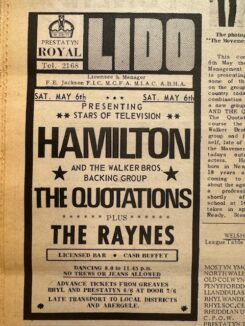
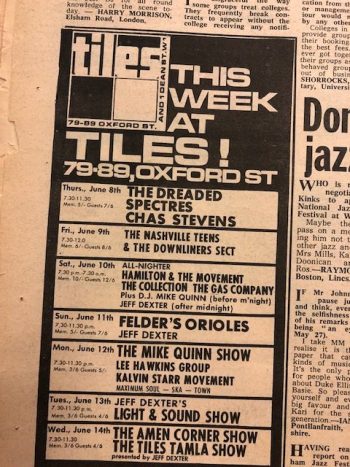
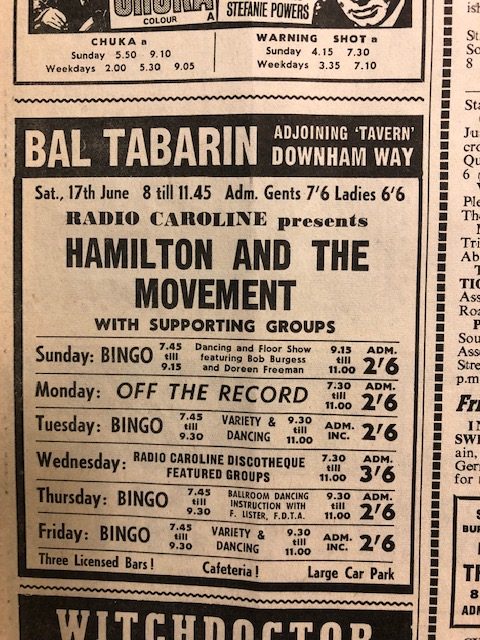
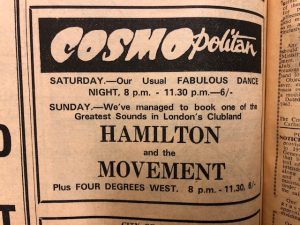
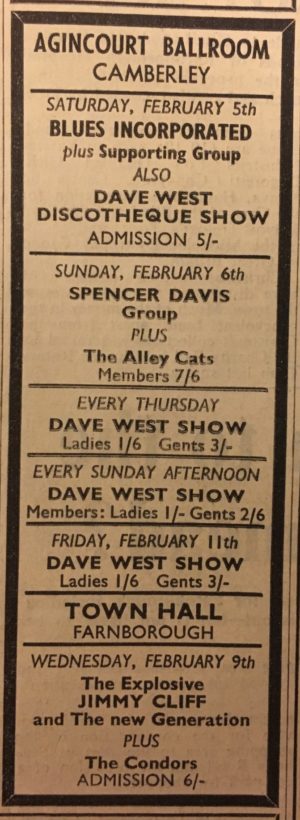
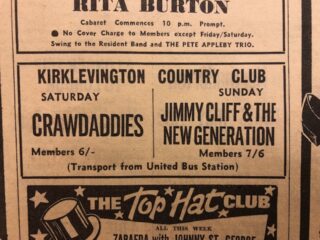
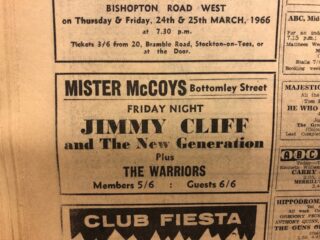
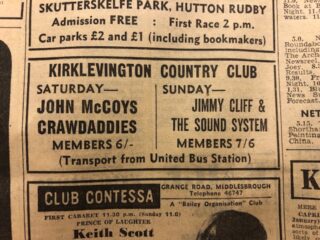
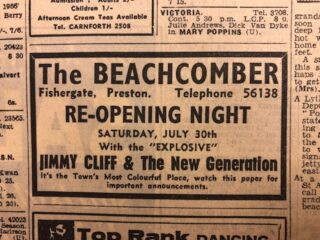
Dennis Lascelles (keyboards) replaced by Mick Fletcher
Terry Hewitt (bass)
Pete ? (drums)
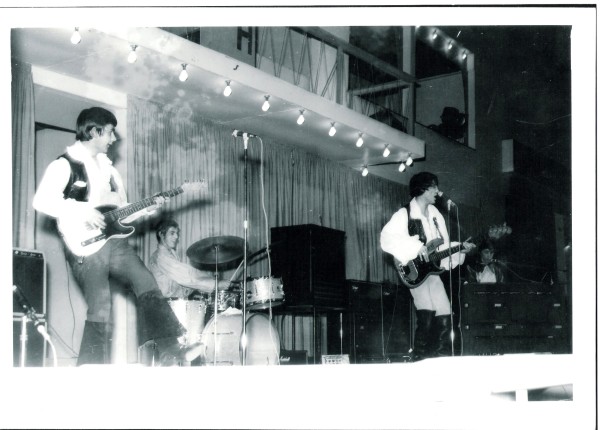
This short-lived band was called The Rifle and was the brainchild of former Carl Douglas & The Big Stampede guitarist Del Grace, who put together an earlier line up in late 1967 to play a lucrative ski resort gig in Verbier, Switzerland over the Christmas period.
The Rifle, Verbier
Malcolm Magaron had started out fronting Malcolm Magaron & The Blueshealers who were regulars at the Bag O’Nails in late 1966, which is probably where he first met Del Grace as Carl Douglas’ band worked there extensively during the same period.
The original keyboard player Dennis Lascelles went on to play with Fat Daughter but at the time was a member of Herbie & The Royalists who ended up recording a lone LP for Saga Records in 1968.
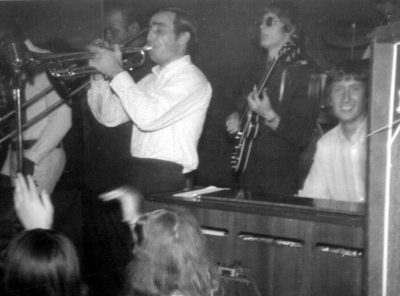
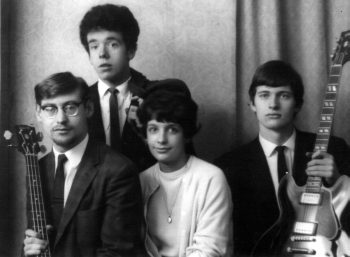
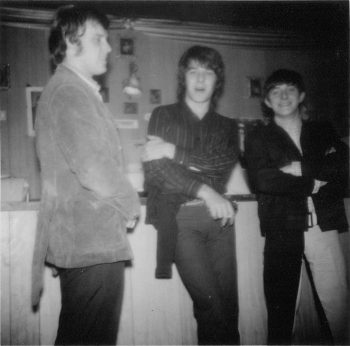
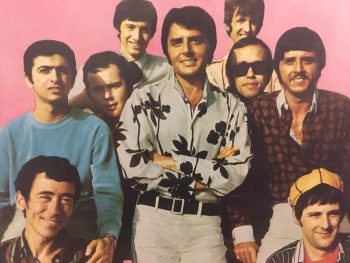
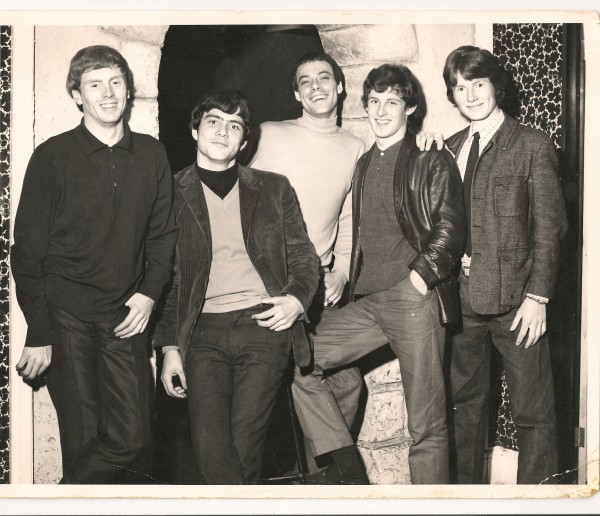
The Rifle, 1968 with Mick Fletcher (left)
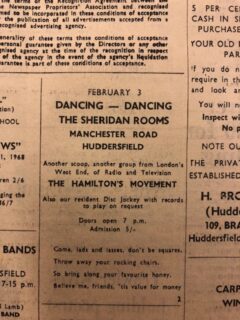
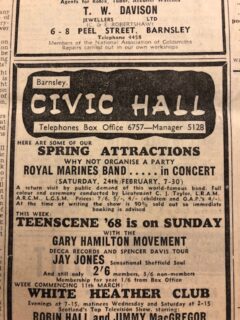
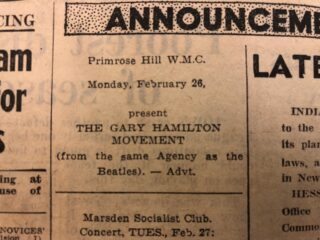
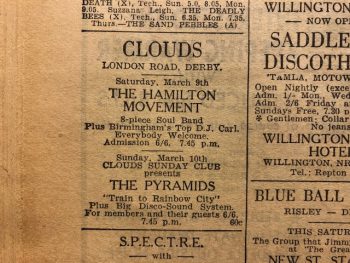
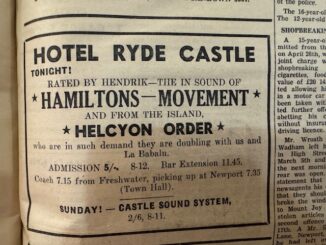
Mick Fletcher, who’d worked with Del Grace in The Epitaph Soul Band during 1963-1965 period, replaced Dennis Lascelles in early 1968 after working with Hamilton & The Hamilton Movement.
When the band split up, Del Grace did some recordings for Liberty Records. Mick Fletcher joined The Amboy Dukes and Malcolm Magaron sang with The Les Humphries Singers.
We’d love to hear from anyone who can add any additional information in the comments section below.
Dave Whittaker (aka Chet Mason) (lead vocals/congas)
Del Grace (lead guitar)
Bruce Duckworth (rhythm guitar)
Mick Kinzett (bass/manager) replaced by Mick Holland (bass)
Mick Fletcher (keyboards)
Dave Rolfick (baritone sax)
Mick Lye (tenor sax)
Rodney Peters (aka Karl Lee) (drums)
Formed as Karl Lee & The Epitaphs in Welling, southeast London in January 1963, they changed name to The Epitaphs in 1964 and then The Epitaph Soul Band in 1965.
Most of the group’s members were from the Sidcup/Bexley area although Lye came from Battersea and Rolfick was from Streatham.
The group often played at the Black Prince Hotel in Bexley. Len Fletcher who ran the club was their manager.
Del Grace says the band’s line-up was fluid with musicians coming and going. The spelling may not be correct for some of the players listed above.
Bruce Duckworth didn’t stay long and they stuck with only one guitarist after he departed.
Mick Holland joined on bass in 1964 so that Mick Kinzett could assume road management duties.
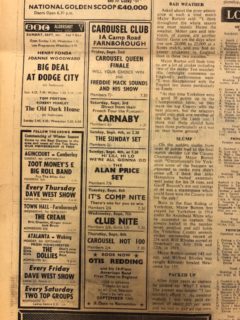
The band’s van was involved in a horrific crash on Rochester Way in October 1964 (see newspaper clipping below) and two of the members were hospitalised. Mick Holland was so badly injured that he couldn’t continue with the group.
Bexley Heath & Welling Observer and Kentish Times, 26 February 1965, page 12
The group was put on hold until early February 1965 when it was reformed with the following musicians:
Dave Whitaker (aka Chet Mason) (lead vocals/congas)
Del Grace (lead guitar)
Mick Fletcher (keyboards)
John James (bass) (possibly also known as John Porter)
Dave Rolfick (baritone sax)
Mick Lye (tenor sax)
Rodney Peters (aka Karl Lee) (drums)
The new formation played at the Black Prince Hotel in Bexley on Sunday, 21 February and began working as the resident band at the Last Chance Club in Oxford Street, central London.
Bexley Heath & Welling Observer and Kentish Times, 26 February 1965, page 12Bexley Heath & Welling Observer and Kentish Times, 26 February 1965, page 12
Towards the end of 1965 Del Grace’s friend Andy Clark came in on baritone sax.
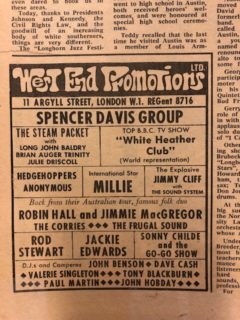
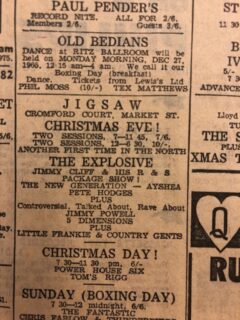
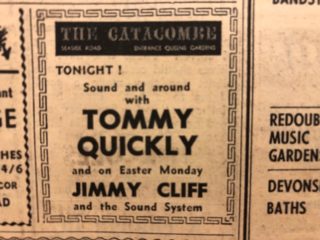
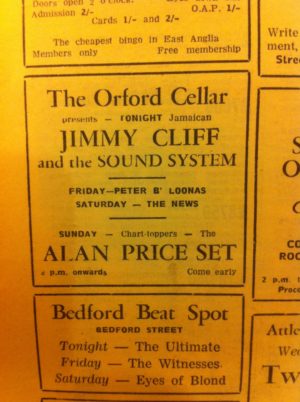
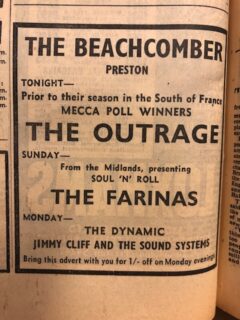
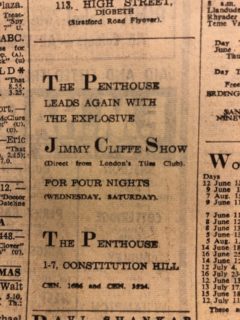
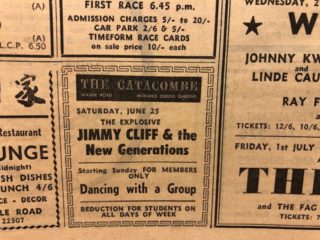
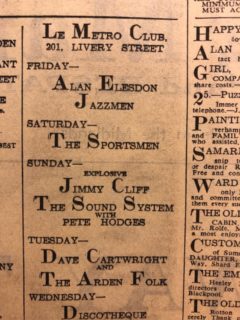
Soon after Mick Fletcher joined The Sound System who backed Jimmy Cliff before working with Hamilton & The Hamilton Movement, The Rifle (reuniting with Del Grace) and The Amboy Dukes.
Around the same time Del Grace joined The Big Wheel, who later recruited Andy Clark and Mick Holland.
Grace joined Carl Douglas & The Big Stampede in 1966 while Andy Clark later worked with The Fenmen, Sam Gopal Dream, VAMP, Clark-Hutchinson and Jeff Beck among many others.
Thanks to Ian Kinzett for the clipping
Notable gigs:
2 May 1964 – Beat Group Contest, Wickham Hall, West Wickham, Kent with The Blackhawks, Chris Finn & The Solents, The Sonics, The Melvin Toole Combo, The Original Deltones, The Electrons, The Copains, The Consorts and Paul & The Playboys (Beckenham & Penge Advertiser) Billed as The Epitaphs
February 1965 – Last Chance Club, Oxford Street, central London (Bexley Heath & Welling Observer and Kentish Times)
21 February 1965 – Black Prince Hotel, Bexley, southeast London with The Graham Bond Organisation (Bexley Heath & Welling Observer and Kentish Times)
1 June 1965 – 100 Club, Oxford Street, central London with The Bo Street Runners (Melody Maker)
5 June 1965 – Wimbledon Odeon, Wimbledon, southwest London with Beat Unlimited (Kingston & Malden Borough News) Advert says The Epitaphs are from Streatham so may be another band
17 June 1965 – Bromley Court Hotel, Bromley, southeast London (Melody Maker)
19 June 1965 – Jazz & Blues Festival, Black Prince Hotel, Bexley, southeast London with The Dutch Swing College, Solomon Burke, Zoot Money’s Big Roll Band, Unit 4 Plus 2, The Spencer Davis Group, The Downliners Sect, Alan Elsdon’s Jazzband, Brian Green New-O-Stompers and The Loose Ends (Bexley Heath & Welling Observer and Kentish Times)
Festival review in the same newspaper, 25 June 1965, page 12
30 June 1965 – Bromley Court Hotel, Bromley, southeast London (Melody Maker)
17 July 1965 – Flamingo, Wardour Street, Soho, central London with Tony Colton Big Boss Band (Melody Maker)
25 July 1965 – Black Prince Hotel, Bexley, southeast London with The Spencer Davis Group (Melody Maker)
Born in Kingston, Jamaica on 5 July 1939, Owen Gray (aka Grey) is one of the true reggae and ska greats but was also the author of a handful of superb soul/mod 45s, recorded in the UK and France between 1965-1969.
Very little is known about this period and so we’d welcome any additional information that readers can provide in the comments section below, particularly around the recording of these individual singles, any unreleased recordings and the personnel on the tracks.
Owen arrived in England in May 1962 and was a prolific recording artist. Like Jimmy Cliff, he’s best known for his reggae recordings but he was an exceptionally gifted soul performer and worked with some top British musicians during the mid-to-late 1960s. His backing bands included The Sound System, The Krew, Tony Knight’s Chessmen and Maximum Breed.
His first venture into soul appears to have been with two singles on the small Aladdin label (see below).
Image may be subject to copyright
Released on 12 March 1965, Owen Gray’s “Gonna Work Out Fine” c/w “Dolly Baby”, was the first of two 45s on the label, the first produced by Denny Cordell.
Advert from New Musical Express
His second release “Lindy Lu” was backed by a great version of “Can I Get a Witness”, which has since become a Northern Soul favourite.
Image may be subject to copyright
In mid-to-late 1965, he moved labels and to Island Records for three singles. The first coupled “Shook, Shimmy & Shake” with “I’m Going Back” and was followed by “Paradise” c/w “Bye Bye Love”. Little is known about the background to both of these releases and the personnel on the recordings.
Image may be subject to copyright
Initially, the singer worked with The Soul Sets, including a gig at the Cue Club in early January 1966.
Photo: Melody Maker
However, in January/February 1966, Chris Blackwell linked Owen with west London Mod outfit, The Sound System.
Photo: Melody Maker
The band had morphed out of The All-Nite Workers and featured guitarist Tony St Clair; bass player Ron Thomas; keyboard player Mick Fletcher; sax players Mel Wayne and Dave Mahoney; and drummer Phil Wainman, who later went on to produce The Sweet among others.
Together, they backed Owen on a lone 45, a rousing version of “You Don’t Know Like I Know” backed by “Take Me Serious”, which appears to have been penned by Ron Thomas, who later went on to work with The Heavy Metal Kids, among others.
Image may be subject to copyright
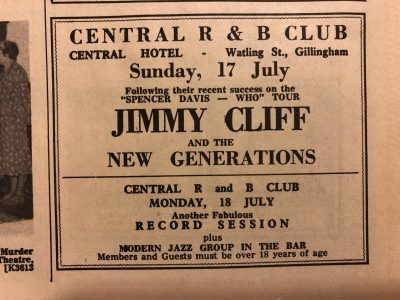
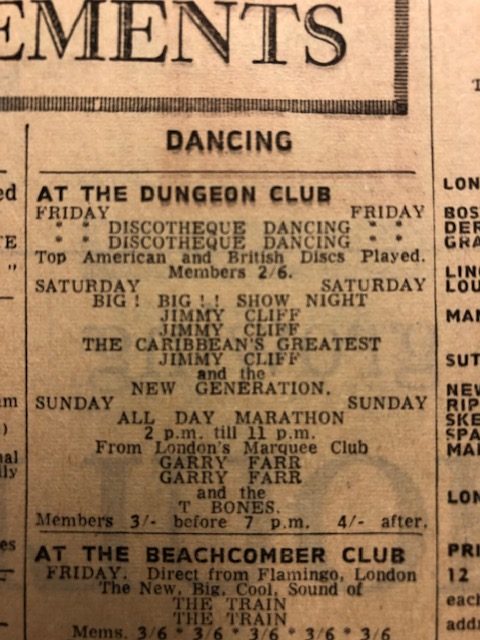
Owen Gray & The Sound System also gigged around the London club circuit in the first few months of 1966 before Blackwell linked them up with Jimmy Cliff and renamed them The New Generation. Later that year, the group became singer Gary Hamilton’s second version of The Hamilton Movement.
Photo: Melody Maker
Left without a band, Owen joined forces with The Krew who’d just lost their two lead singers Beryl Marsden and Steve Aldo.
Led by scouser and future Wings sideman Howie Casey on sax, the group also featured fellow Liverpudlian Tommy Murray on lead guitar (who was later replaced by Ted Tunnicliffe); Glaswegian Archie Legget; Yorkshireman Eddie Sparrow on drums; and Londoner Alan Reeves on keyboards.
Photo: Alan Reeves. Left to right (back), Eddie Sparrow, Archie Legget, Howie Casey, Alan Reeves. Front, left to right: Owen Gray and Tommy Murray
Owen Gray and The Krew moved to France in April 1966 and played several clubs in the ski resorts, notably the Bus Palladium in Courcheval, before landing a residency at exclusive Paris nightclub Le Bilboquet.
While playing in Paris in July that year, the musicians recorded an EP for Barclay Records’ subsidiary label, Riviera, comprising popular soul covers and strong Owen Gray originals, “Everything’s Alright” and “Somebody Stole My Girl”.
However, by the end of 1966, Owen Gray was back in London and back on the soul circuit, playing the clubs that were popular with the burgeoning Caribbean community such as Paddington’s Cue Club.
Back on Island Records, he recorded one of his finest soul outings, the stupendous “Help Me” coupled with “Incense”, which were produced by Chris Blackwell and Jimmy Miller respectively.
Issued in January 1967, the single should have been a massive hit but inexplicably it failed to chart and is now a much sought-after collectors’ item.
Image may be subject to copyright
A few months later, Owen was back with another London band, this time Tony Knight’s Chessmen, led by drummer Tony Brown. The singer remained with the group until about September 1967.
During Owen’s time with The Chessmen, the musicians passing through included noted sax players Dave Coxhill and Stan Sulzmann and future John Mayall’s Bluesbreaker Keith Tillman.
Photo: Fred D’Albert. Left to right: Terry Ede, Dave Coxhill (hidden), Owen Gray, Tony Brown (hidden), Keith Tillman and Fred D’Albert in Italy.
In July 1967, the band travelled out to Italy to play the Piper Club in Viareggio.
Photo: Melody Maker, 1967
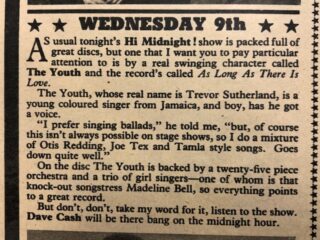
Little is known about his soul projects from this point on, although he did work with singers Ruby and Youth backed by The Shell Shock Show during late 1967 and early 1968.
However, during 1968, he started to do studio work on the Old Kent Road with producer David Hadfield.
Image may be subject to copyright
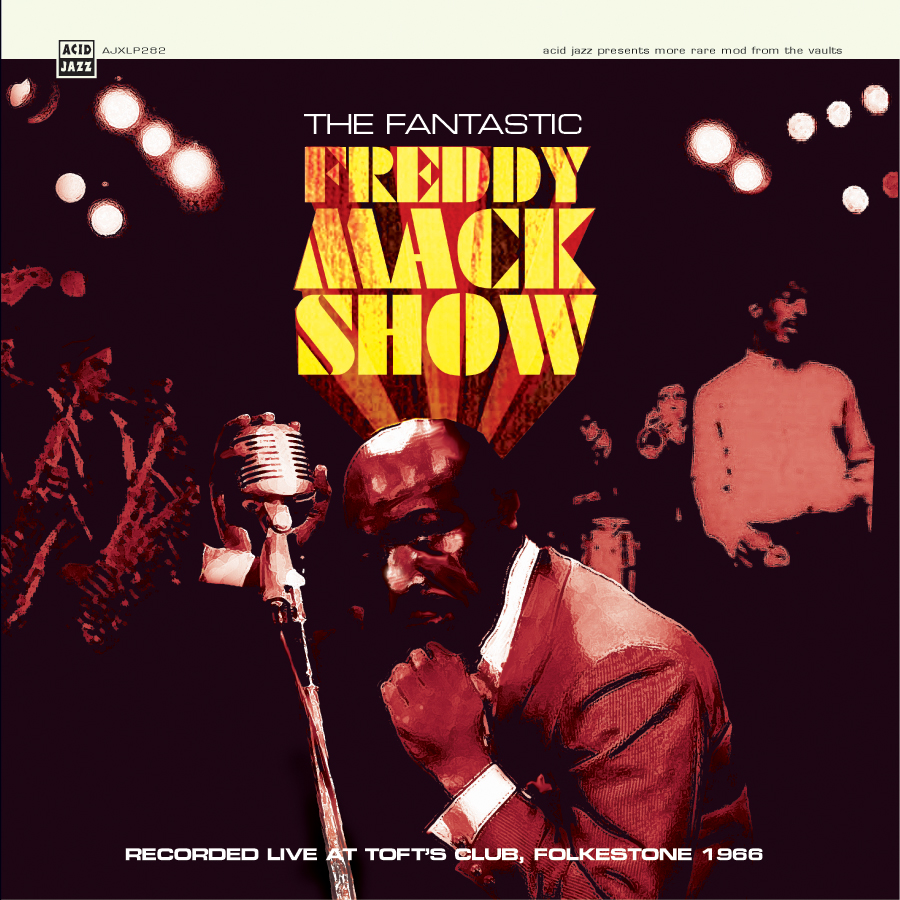
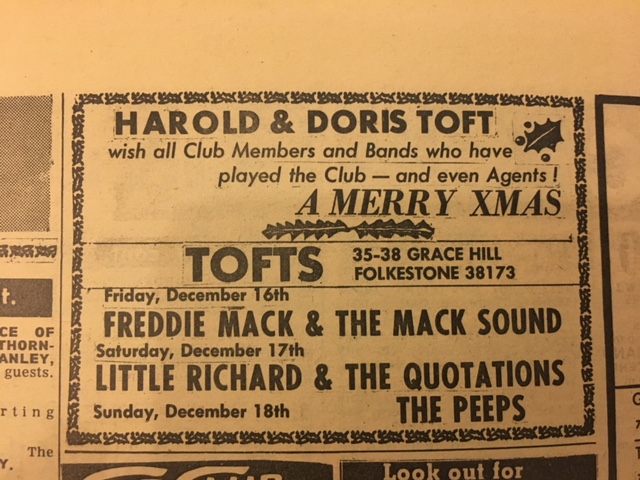
For the recordings, he was backed by Freddy Mack’s former band, The Mack Sound, who were going by the name Maximum Breed.
Future Butts Band and Gonzalez keyboard player Roy Davies was among the musicians in this talented band.
Several singles were issued during this period, including “Sitting in the Park” and “Dream Lover” but by now, Owen was starting to focus his efforts on the reggae audience.
I have tried to ensure the accuracy of this article but I appreciate that there are likely to be errors and omissions. I would appreciate any feedback from anyone who can provide any additions or corrections. Email: Warchive@aol.com
Welcome to another posting of a series of gig listings for 1960s bands. None of these lists is exhaustive and my idea is to add to them in the comments section below over time. They are here for future researchers to draw on and, where possible, I have added the sources used, whether they are newspapers or websites. I have also added a few interesting bits of information and will add images in time.
I’d like to encourage band members to get in touch to share memories, or for anyone to send corrections/clarifications to my email: Warchive@aol.com
Equally important, if you attended any of the gigs below or played in the support band, please do leave your memories below in the comments section for future historians to use. If you know of any missing gigs, please add them too, if possible, with the sources.
Clockwise from centre: Dave Kislingberry (vocals, trumpet), Trevor Lock (guitar), Ken McColm (sax), Rod Lee (trumpet), Pete Howard (bass) and Mick Jerome (drums). Image may be subject to copyright
Formed in Reading, Berkshire in early 1965 as a semi-professional group with the following line up:
Dave Kislingberry aka Kislingbury (vocals and trumpet)
Mick Lambden (trumpet and vocals)
Trevor Lock (lead guitar)
Dave Elam (bass)
Mick Jerome (drums)
1965
16 September 1965 – New Central Ballroom, Aldershot, Hampshire with The Moggies (Aldershot News)
Soon after its formation, The Amboy Dukes settled on the following line-up, which drew on musicians from the Reading music scene with the exception of Rod Lee, who came from Leicester.
David Else says that McColm and Hall came from Platform Six.
Dave Kislingberry aka Kislingbury (vocals and trumpet)
Trevor Lock (lead guitar)
Art Claridge (bass)
Rod Lee (trumpet)
Ken McColm (tenor sax)
George Hall (baritone sax and flute)
Mick Jerome (drums)
The band signs with the Rik Gunnell Agency on Geno Washington’s recommendation.
23 October 1965 – Orchid Ballroom, Oxford with The Cameos (Oxford Mail)
19 November 1965 – Fiesta Hall, Andover, Hampshire (Andover Advertiser)
27 November 1965 – Newmarket Memorial Hall, Newmarket, Cambridgeshire with The Soundtrekkers (Cambridge News)
Image may be subject to copyright
4 December 1965 – Co-op Rainbow Suite, Birmingham with The Cellarmen (Birmingham Evening Mail)
9 December 1965 – New Central Ballroom, Aldershot, Hampshire with The Bystanders (Aldershot News)
Image may be subject to copyright
17 December 1965 – Hook Social Centre, Walderslade, Kent with The Plus Four (Chatham, Rochester & Gillingham News)
Image may be subject to copyright
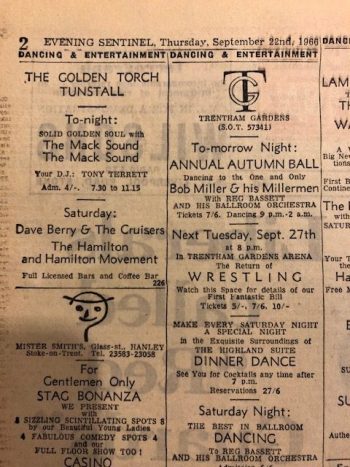
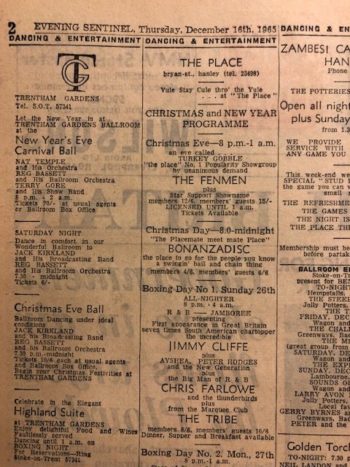
18 December 1965 – The Place, Hanley, Staffordshire (Evening Sentinel)
1966
1 January 1966 – Public Hall, Heacham, Norfolk with The Nightbeats and The Singing Postman (Lynn News)
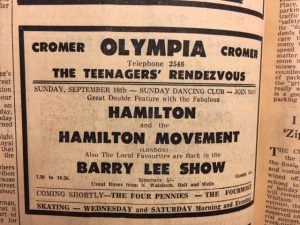
2 January 1966 – Cromer Olympia, Cromer, Norfolk with Circuit 5 (North Norfolk News)
Image may be subject to copyright
29 January 1966 – The Dolphin, Marine Court, St Leonards, East Sussex with All Things Bright (Roger Bistow’s research at Dizzy Tiger Music website/Hastings and St Leonards Observer)
Image may be subject to copyright
5 February 1966 – California Ballroom, Dunstable, Bedfordshire with The Overlanders and The Tribe (website: www.california-ballroom.info/gigs/)
19 February 1966 – Starlight Ballroom, Boston Gliderdrome, Boston, Lincolnshire with The Fortunes, The Candy Dates and The Hawks (Lincolnshire Standard)
Image may be subject to copyright
25 March 1966 – Carousel Club, 1 Camp Road, Farnborough, Hampshire with The Cherokees (Aldershot News)
9 April 1966 – Unknown Norfolk venue with The James Royal Set (Eastern Evening News)
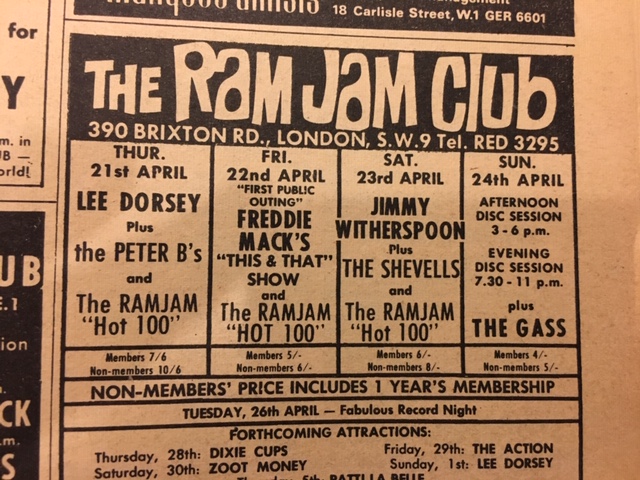
15 April 1966 – Ram Jam, Brixton, south London with Georgie Fame & The Blue Flames (Melody Maker)
23 April 1966 – Flamingo Ballroom, Redruth, Cornwall and The Poets (West Briton & The Royal Cornwall Gazette)
30 April 1966 – Gala Ballroom, Norwich with The Tribe (Eastern Evening News)
1 May 1966 – Hive Club, Guildford, Surrey (Surrey Advertiser)
21 May 1966 – Chelmsford Corn Exchange, Chelmsford, Essex with Screaming Lord Sutch (Essex Chronicle)
4 June 1966 – Ram Jam, Brixton, south London with Cliff Bennett & The Rebel Rousers (Melody Maker)
16 June 1966 – Marquee, Wardour Street, Soho, central London with John Mayall’s Bluesbreakers (Tony Bacon’s book: London Live)
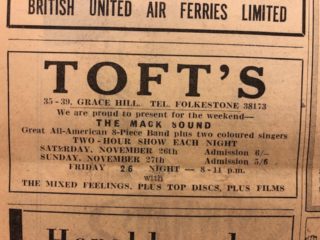
26 June 1966 – Toft’s, Folkestone, Kent (Folkestone, Hythe & District Herald)
2 July 1966 – Starlight Ballroom, Boston Gliderdrome, Boston, Lincolnshire with Roy C, Jimmy James & The Vagabonds, The League of Gentlemen and The Ferryboys (Lincolnshire Standard)
8 July 1966 – Flamingo, Wardour Street, Soho, central London with The Shevelles (Fabulous 208)
16 July 1966 – New Spot, Gosport, Hants (Portsmouth News)
23 July 1966 – Latin Quarter, Cellar Club, Leicester with Bluesology (Leicester Mercury)
30 July 1966 – Ram Jam, Brixton, south London with The Objects (Melody Maker)
6-7 August 1966 – Flamingo, Wardour Street, Soho, central London (Melody Maker)
10 August 1966 – Disco Blue, Ryde, Isle of Wight (Isle of Wight County Press)
13 August 1966 – Toft’s, Folkestone, Kent (Folkestone, Hythe & District Herald/Melody Maker)
14 August 1966 – Ram Jam, Brixton, south London (Melody Maker)
19 August 1966 – The Place, Hanley, Staffordshire (Evening Sentinel)
21 August 1966 – Ram Jam, Brixton, south London (Melody Maker)
31 December 1966 – Burton’s, Uxbridge, northwest London (Fabulous 208)
By the end of 1966, Reading musician Pete Howard had taken over from Art Claridge. Also, George Hall had also departed during 1966, leaving the group as a six piece. The band signed to Polydor Records in late 1966.
1967
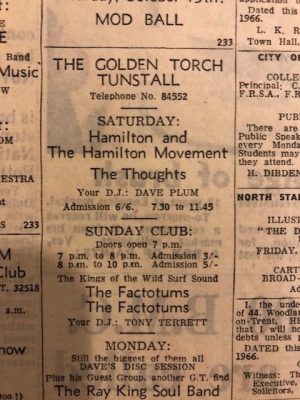
2 January 1967 – Golden Torch, Tunstall, Staffordshire (Evening Sentinel)
13 January 1967 – Tiger’s Head, Downham, southeast London (South East London Mercury)
14 January 1967 – Flamingo, Wardour Street, Soho, central London with Jon (Melody Maker)
15 January 1967 – Bluesville, Manor House, north London with others (Melody Maker)
19 January 1967 – Klooks Kleek, West Hampstead, north London (Geoff Williams research: Decca Studios and Klooks Kleek book)
12 February 1967 – King Mojo, Sheffield, South Yorkshire with The Move (The Star)
Image may be subject to copyright
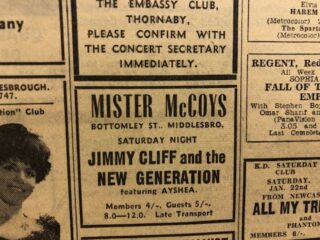
17 February 1967 – Mr McCoys, Middlesbrough (Middlesbrough Evening Gazette)
The Amboy Dukes’ debut 45 “Turn Back to Me”, which features George Hall guesting on flute, backed by “I Never Complain About You”, is released on 17 February 1967.
The two tracks are recorded at Advision Studios in New Bond Street with producer Jeff Cooper and engineer Eddie Kramer.
Not long after the debut single’s release, the band records a follow up, “All I Need” c/w “Doing the Best I Can”. The two tracks are also recorded at Advision Studios with Eddie Kramer and new producer Terry Kennedy. Keyboard player Ian Green guests on the recordings.
21 February 1967 – Bluesville, St Thomas’ Hall, Brentwood, Essex (Essex Chronicle)
23 February 1967 – Manhole, Redhill, Surrey (Crawley Advertiser)
26 February 1967 – Golden Torch, Tunstall, Staffordshire (Evening Sentinel)
During March 1967, former Geno Washington & The Ram Jam Band member Buddy Beadle joins on baritone sax.
3 March 1967 – Boulevard, Tadcaster, North Yorkshire (Fabulous 208)
3 March 1967 – Crystal Ballroom, Castleford, North Yorkshire (Fabulous 208)
4 March 1967 – College of Technology, Leeds, West Yorkshire (Fabulous 208)
5 March 1967 – King Mojo, Sheffield, South Yorkshire (The Star)
11 March 1967 – Burton’s, Uxbridge, northwest London (Fabulous 208)
12 March 1967 – Central Hotel, Gillingham, Kent (Fabulous 208)
13 March 1967 – Majestic Ballroom, Reading, Berkshire (Fabulous 208)
16 March 1967 – Klooks Kleek, West Hampstead, north London (Geoff Williams research: Decca Studios and Klooks Kleek book)
17 March 1967 – Chislehurst Caves, Chislehurst, southeast London (Fabulous 208)
18 March 1967 – Toft’s, Folkestone, Kent (Melody Maker)
19 March 1967 – Klue J Klub, Saracen’s Head Hotel, Chelmsford, Essex (Essex Chronicle)
20 March 1967 – Baths Hall, Ipswich, Suffolk (Fabulous 208)
24 March 1967 – Birdcage, Eastney, Hampshire (Dave Allen research) Check this isn’t 25 March
25 March 1967 – Saturday Club, Royal York Hotel, Ryde, Isle of Wight with Times Creation (Isle of Wight County Press)
26 March 1967 – Toft’s, Folkestone, Kent (Melody Maker)
28 March 1967 – Marquee, Wardour Street, Soho, central London with Geno Washington & The Ram Jam Band (Tony Bacon’s book: London Live)
31 March 1967 – Maberne Club, Sleaford, Lincolnshire (Fabulous 208)
8 April 1967 – Beachcomber, Nottingham (Nottingham Evening Post)
9 April 1967 – Kirklevington Country Club, Kirklevington, North Yorkshire (Middlesbrough Evening Gazette)
13 April 1967 – Golden Torch, Tunstall, Staffordshire (Evening Sentinel)
14 April 1967 – Dancing Slipper, Nottingham (Nottingham Evening Post)
18 April 1967 – Kirklevington Country Club, Kirklevington, North Yorkshire (Middlesbrough Evening Gazette)
Image may be subject to copyright
19 April 1967 – Hull College of Commerce Students’ Union, Skyline Ballroom, Hull, Humberside with Geno Washington & The Ram Jam Band, Tony Rivers & The Castaways, The Locomotion and The Jamm (Hull Daily Mail)
21 April 1967 – York Assembly Rooms, York, North Yorkshire (Tadcaster News)
22 April 1967 – The Riley-Smith, Tadcaster, North Yorkshire (Tadcaster News)
23 April 1967 – The Coffee House, Tadcaster, North Yorkshire (Tadcaster News)
23 April 1967 – Klue J Klub, Sarcens Head Hotel, Chelmsford, Essex (Essex Chronicle) More likely to be 24 April
25 April 1967 – Kirklevington Country Club, Kirklevington, North Yorkshire (Fabulous 208)
28 April 1967 – Candlelight Club, Scarborough, North Yorkshire (Fabulous 208)
Image may be subject to copyright
29 April 1967 – Clouds, Derby (Derby Evening Telegraph)
30 April 1967 – Golden Torch, Tunstall, Staffordshire (Evening Sentinel)
1 May 1967 – Watford Round Table, Top Rank Suite, Watford, Herts with Geno Washington & The Ram Jam Band (Harrow Observer)
4 May 1967 – Klooks Kleek, West Hampstead, north London (Geoff Williams research: Decca Studios and Klooks Kleek book)
6 May 1967 – Ricky Tick, Hounslow, west London (Melody Maker)
6 May 1967 – Cue Club, Paddington, central London (Melody Maker)
Image may be subject to copyright
7 May 1967 – Sunday Club, Addlestone, Surrey (Woking Herald)
13 May 1967 – Beachcomber, Nottingham (Nottingham Evening Post)
14 May 1967 – King Mojo, Sheffield (The Star)
16 May 1967 – Fishmonger’s Arms, Wood Green, London (Fabulous 208)
18 May 1967 – Winning Post, Doncaster, South Yorkshire (Fabulous 208)
19 May 1967 – Crystal Ballroom, Castleford, North Yorkshire (Fabulous 208)
20 May 1967 – Boulevard, Tadcaster, North Yorkshire (Fabulous 208)
21 May 1967 – Beau Brummel Club, Alvaston Hall Hotel, Nantwich, Cheshire with Phil Ryan & The Scorpions (Crewe Chronicle)
26 May 1967 – May Ball, Royal Agricultural College, Cirencester, Gloucestershire with The Alan Price Set, Johnny Patrick and Brenda Scott, The Sky Blue Show Band and Bill Nile’s Good Time Band (Poster from Stevie Barr)
27 May 1967 – Ricky Tick, Windsor, Berkshire (Fabulous 208)
28 May 1967 – Central Hotel, Gillingham, Kent (Fabulous 208)
31 May 1967 – Bag O’Nails, Kingley Street, Soho, London (Fabulous 208)
3 June 1967 – Toft’s, Folkestone, Kent (Melody Maker)
5 June 1967 – Queen’s Ballroom, Wolverhampton, West Midlands (Express & Star)
6 June 1967 – Kirklevington Country Club, Kirklevington, North Yorkshire (Middlesbrough Evening Gazette)
9 June 1967 – Bluesville, Manor House, London (Fabulous 208)
11 June 1967 – Black Prince Hotel, Bexley, London (Poster)
12 June 1967 – Manor House Ballroom, Ipswich, Suffolk (Fabulous 208)
16 June 1967 – Clouds, Derby (Derby Evening Telegraph)
17 June 1967 – Cue Club, Paddington, London (Melody Maker) Billed as The Amboy Dukes Band
18-20 June 1967 – Bag O’Nails, Kingley Street, Soho, London (Fabulous 208)
22 June 1967 – Sheffield City Hall, Sheffield with The Drifters, Alan Bown, Ronnie Jones & The Q Set and The Pitiful (The Star)
25 June 1967 – Sunday Club, Addlestone, Surrey (Woking Herald) Replaced The Shevelles
27 June 1967 – Fishmonger’s Arms, Wood Green, London (Fabulous 208)
29 June 1967 – Club A Go, Newcastle upon Tyne, Tyne & Wear (Fabulous 208)
2 July 1967 – Beachcomber, Nottingham (Nottingham Evening Post)
The Amboy Dukes’ second 45, “All I Need” is released on 4 July.
During July, the seven-piece group (with Buddy Beadle onboard) records its next single at Polydor’s studios near Oxford Street. Produced by Terry Kennedy, the tracks are two ska numbers that feature in the band’s live set. Taking part of the title from a Reading suburb where one of the band members came from, the tracks are named “Highlife in Whitley Wood Parts 1 and 2”.
Not long after the recording, Steve Gregory tenor sax player with The Alan Price Set takes over from Ken McColm.
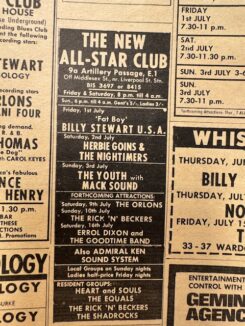
8 July 1967 – The New All-Star Club, 9a Artillery Passage, E1, London (Melody Maker)
18 July 1967 – Marquee, Wardour Street, Soho, London with Geno Washington & The Ram Jam Band (Tony Bacon’s book: London Live)
20 July 1967 – Klooks Kleek, West Hampstead, London (Geoff Williams research: Decca Studios and Klooks Kleek book)
22 July 1967 – Clouds, Derby (Derby Evening Telegraph)
Image may be subject to copyright
There is a great article and picture of the band in Record Mirror, 22 July 1967, page 10
23 July 1967 – Kirklevington Country Club, Kirklevington, North Yorkshire (Middlesbrough Evening Gazette)
26 July 1967 – Disco Blue, Ryde, Isle of Wight with The Stack (Isle of Wight County Press)
29 July 1967 – Witchdoctor, Catford, southeast London with Robb Storme Group (South East London Mercury)
By the start of August 1967, the band comprises:
Dave Kislingberry aka Kislingbury (vocals)
Trevor Lock (guitar)
Pete Howard (bass)
Rod Lee (trumpet)
Steve Gregory (tenor sax and flute)
Buddy Beadle (baritone and alto sax)
Mick Jerome (drums)
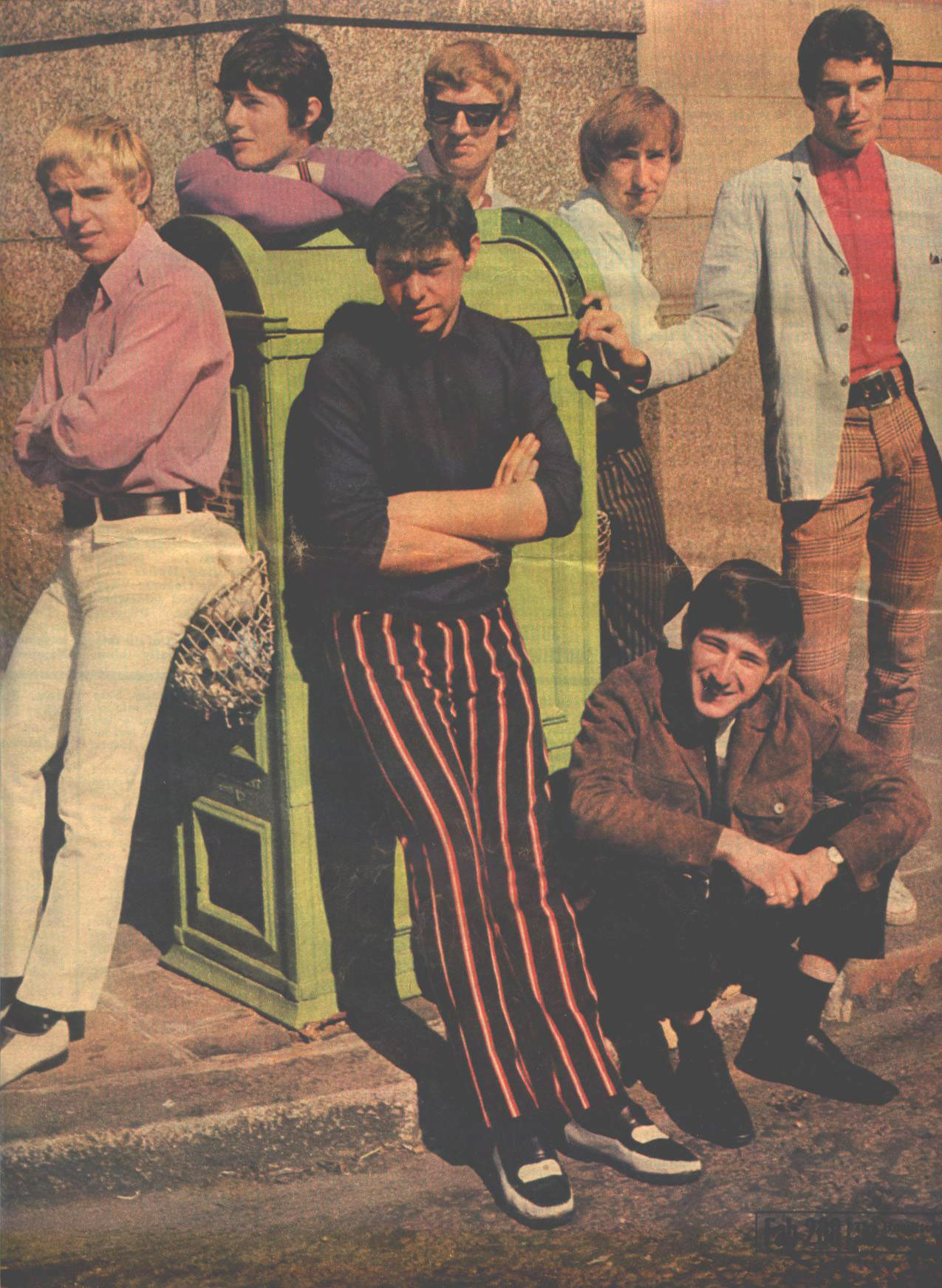
Photo: Buddy Beadle. The Amboy Dukes summer 1967. Top: Mick Jerome and then Trevor Lock. Bottom, left to right: Buddy Beadle, Pete Howard, Rod Lee, Dave Kislingberry and Steve Gregory.
18 August 1967 – Gaiety Ballroom, Grimsby, Humberside with Roger Bloom’s Hammer (Grimsby Evening Telegraph)
19 August 1967 – Toft’s, Folkestone, Kent (Melody Maker)
20 August 1967 – Central R&B Club, Central Hotel, Gillingham, Kent (Chatham, Rochester & Gillingham News)
22 August 1967 – High Wycombe Town Hall, High Wycombe, Bucks (Bucks Free Press)
24 August 1967 – Klooks Kleek, West Hampstead, north London (Geoff Williams research: Decca Studios and Klooks Kleek book)
26 August 1967 – Burton’s, Uxbridge, west London (Melody Maker)
Image may be subject to copyright
26 August 1967 – Tiles, Oxford Street, central London with The Peddlers and The Mynor Birds (Melody Maker)
Image may be subject to copyright
30 August 1967 – Big Beat Cruise, Solent, South Parade Pier, Portsmouth Harbour and Ryde Pier Head with Inspiration (Portsmouth News)
2 September 1967 – Witchdoctor, Catford, southeast London (South East London Mercury)
3 September 1967 – Black Prince Hotel, Bexley, southeast London (Poster)
8 September 1967 – Il Rondo, Leicester (Leicester Mercury)
The Amboy Dukes’ next single, “Highlife in Whitley Wood Parts 1 and 2” is released on 9 September.
11 September 1967 – Clouds, Derby (Derby Evening Telegraph)
16 September 1967 – Burton’s, Uxbridge, northwest London (Melody Maker)
Image may be subject to copyright
21 September 1967 – Flying Fox Club, RAF Cottesmore, Rutland with The Shivelles, The Wages of Sin and Pesky-Gee (Grantham Journal)
23 September 1967 – Clockwork Orange, Chester, Cheshire with The Swinging Machine (Crewe Chronicle)
24 September 1967 – The Place, Hanley, Staffordshire (Evening Sentinel)
30 September 1967 – Black Prince, Bexley, southeast London (Fabulous 208)
3 October 1967 – High Wycombe Town Hall, High Wycombe, Bucks (Bucks Free Press)
8 October 1967 – Black Prince Hotel, Bexley, southeast London (Fabulous 208)
14 October 1967 – Starlight Room, Boston Gliderdrome, Boston, Lincolnshire with The Tages, The Soul Sisters and Clockwork Orange (Lincolnshire Standard)
17 October 1967 – Marquee, Wardour Street, Soho, central London with Geno Washington & The Ram Jam Band (Tony Bacon’s book: London Live)
19 October 1967 – Civic Hall, Guildford, Surrey with Modes Mode (Surrey Advertiser)
20 October 1967 – Witchdoctor, Catford, southeast London (South East London Mercury)
21 October 1967 – Burton’s, Uxbridge, northwest London (Melody Maker)
22 October 1967 – Toft’s, Folkestone, Kent with Jr Walker & The All Stars and The Wages of Sin (Melody Maker)
Image may be subject to copyright
30 October 1967 – Foseco Sports & Social Club, Tamworth, Staffordshire (Tamworth Herald)
The band’s manager John Gunnell brings John Fred’s “Judy In Disguise” from the States for the band to record. The track is recorded in a small studio in Denmark Street with guest harmonica player Moxy. Terry Kennedy once again produces the session which also produces the flip side, “Who’s Foolin’ Who”.
The recordings also feature former Georgie Fame trumpet player Eddie Thornton.
24 November 1967 – Il Rondo, Leicester (Leicester Mercury)
Image may be subject to copyright
25 November 1967 – Twisted Wheel Club, Manchester with Ben E King and The Senate (Lancashire Evening Post)
26 November 1967 – Kirklevington Country Club, Kirklevington, North Yorkshire (Middlesbrough Evening Gazette)
2 December 1967 – Dreamland, Margate, Kent with The Gates of Eden (East Kent Times & Mail)
3 December 1967 – Black Prince Hotel, Bexley, southeast London (Poster)
4 December 1967 – The Parlour, Oasis Club, North End, Portsmouth, Hampshire (Portsmouth News)
4 December 1967 – King Mojo, City Hall Ballroom, Sheffield, South Yorkshire (The Star)
5 December 1967 – High Wycombe Town Hall, High Wycombe, Bucks (Bucks Free Press)
7 December 1967 – Marquee, Wardour Street, Soho, central London with Pride & Joy Buzz Band (Tony Bacon’s book: London Live)
8 December 1967 – Burton Constable Hall, Hull, Humberside with Ferris Wheel, Joe E Young & The Toniks, Roger Bloom’s Hammer, Gospel Garden and The Mandrakes (Scarborough Evening News)
The band’s cover of John Fred & The Playboy Band’s “Judy In Disguise (With Glasses)” is released on 8 December.
14 December 1967 – Constantine Students Union Astoria Ballroom, Middlesbrough with The Soul Merchants and Mr Poobah’s Chicago Line (Middlesbrough Evening Gazette)
16 December 1967 – The New All-Star Club, 9a Artillery Passage, east London (Melody Maker)
17 December 1967 – The Hub, Barnsley, West Yorkshire (Barnsley Chronicle & South Yorkshire News)
19 December 1967 – Clifton Hall, Rotherham, South Yorkshire with The Pitful Souls (South Yorkshire and Rotherham Advertiser)
20 December 1967 – St James’ Spectacular, Chesterfield, Derbyshire with The Richard Jackson Blues Band (Derbyshire Times)
Image may be subject to copyright
21 December 1967 – Thorngate Ballroom, Gosport, Hampshire (Portsmouth News)
23 December 1967 – Burton’s, Uxbridge, northwest London (Melody Maker)
26 December 1967 – Bluesville ’67 Club, St Mathew’s Baths, Ipswich, Suffolk (Ipswich Star)
28 December 1967 – Marquee, Wardour Street, Soho, central London with Tuesday’s Children (Tony Bacon’s book: London Live)
30 December 1967 – Tinned Chicken, Crystal Bowl, Castleford, North Yorkshire with Travellers Express and Richard G Simpson (Yorkshire Evening Post)
Image may be subject to copyright
31 December 1967 – Beau Brummel Club, Alvaston Hall Hotel, Nantwich, Cheshire, Nantwich, Cheshire with Phil Ryan & The Scorpions and Archie Allen (Crewe Chronicle)
1968
During January, longstanding drummer Mick Jerome leaves. Eddie Spevok takes his place behind the kit.
The new formation records a cover of “Simon Says” backed by “The Marquis” with Donnie Elbert in the producer’s chair.
13 January 1968 – Tin Hat, Kettering, Northamptonshire with Surrealist Adventure (Northamptonshire Evening Telegraph)
18 February 1968 – Carlton Club, Erdington, West Midlands with Cats Pyjamas (Birmingham Evening Mail)
Image may be subject to copyright
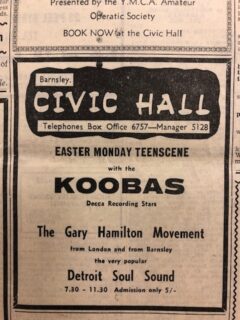
19 February 1968 – Barnsley Civic Hall, Barnsley, West Yorkshire with Lou Prinze & The Bedrocks and Jacksons Union (Barnsley Chronicle & South Yorkshire News)
20 February 1968 – High Wycombe Town Hall, High Wycombe, Bucks (Bucks Free Press)
24 February 1968 – Witchdoctor, Catford, southeast London (South East London Mercury)
26 February 1968 – Carlton Club, Warrington, Cheshire (Warrington Guardian)
29 February 1968 – Klooks Kleek, West Hampstead, London (Geoff Williams research: Decca Studios and Klooks Kleek book)
Image may be subject to copyright
4 March 1968 – Bluesville ’68 Club, St Matthew’s Baths, Ipswich, Suffolk (Ipswich Evening Star)
9 March 1968 – Victoria Ballroom, Chesterfield, Derbyshire (Derbyshire Times)
10 March 1968 – Black Prince Hotel, Bexley, London (Poster)
15 March 1968 – Grove School, Market Drayton, Shropshire with Baron Pollett & The New Regime (Shropshire Journal)
The band’s cover of “Simon Says” is released on 15 March. Immediately afterwards Eddie Thornton leaves to join Herbie Goins & The Nightimers.
23 March 1968 – Burton’s, Uxbridge, London (Melody Maker)
24 March 1968 – Corn Exchange, Maidstone, Kent (Maidstone Gazette)
25 March 1968 – Park Hall Hotel, Goldthorn Park, Wolverhampton, West Midlands with The ‘N’ Betweens and Barmy Barry Show (Express & Star)
Image may be subject to copyright
30 March 1968 – London College of Printing, Elephant & Castle with Timebox and The Grenades (Melody Maker)
Image may be subject to copyright
31 March 1968 – Beau Brummel Club, Alvaston Hall Hotel, Nantwich, Cheshire with The Jaytree Organisation (Crewe Chronicle)
1 April 1968 – King Mojo, City Hall Ballroom, Sheffield, South Yorkshire (Sheffield Star)
6 April 1968 – Kirklevington Country Club, Kirklevington, North Yorkshire (Middlesbrough Evening Gazette)
11 April 1968 – Manor Court Club, Drayton, Hampshire with Harlem Speakeasy and The Groovey Kind (Portsmouth News)
12 April 1968 – Burton’s, Uxbridge, London (Melody Maker)
13 April 1968 – Savoy, Catford, London (Melody Maker)
16 April 1968 – High Wycombe Town Hall, High Wycombe, Bucks (Bucks Free Press)
18 April 1968 – Klooks Kleek, West Hampstead, London (Geoff Williams research: Decca Studios and Klooks Kleek book)
19 April 1968 – Catholic Hall, Thatcham, Berkshire with The 27th All Stars (Newbury Weekly News)
20 April 1968 – New Broken Wheel, Retford, Nottinghamshire (Melody Maker)
22 April 1968 – Carlton Club, Warrington, Cheshire (Warrington Guardian)
27 April 1968 – Co-op, Chesham, Bucks (Bucks Free Press)
28 April 1968 – Downbeat Club, The Swan, Maldon, Essex (Essex Chronicle)
1 May 1968 – Summerhill House Hotel, Kingswinford, West Midlands (Express & Star) Opening night
4 May 1968 – Marine Ballroom, Central Pier, Morecambe, Lancashire with Grooveyard (Morecambe Visitor)
6 May 1968 – Bluesville ’68 Club, St Matthew’s Baths Hall, Ipswich, Suffolk (Ipswich Evening Star)
12 May 1968 – Clouds, Derby, Derbyshire (Derby Evening Telegraph)
Image may be subject to copyright
16 May 1968 – James Finegan Hall, Eston, Middlesbrough with The Tramline and The Chelfont Line (Middlesbrough Evening Gazette)
17 May 1968 – Billingham Synthonia Senior Club, Billingham with The Chelfont Line (Middlesbrough Evening Gazette)
25 May 1968 – Burton’s, Uxbridge, northwest London (Melody Maker)
26 May 1968 – Central R&B Club, Central Hotel, Gillingham (Chatham, Rochester and Gillingham Post)
1 June 1968 – Dreamland Ballroom, Margate, Kent with Candy Choir (East Kent Times & Mail)
3 June 1968 – Queen’s Hall, Leeds, West Yorkshire with The Herd, Bill Haley, Alan Bown, Edwin Starr, Fantastics, Gospel Garden, Clockwork Orange and others (Middlesbrough Evening Gazette/NME)
6 June 1968 – Klooks Kleek, West Hampstead, north London (Geoff Williams research: Decca Studios and Klooks Kleek book)
9 June 1968 – Beachcomber, Nottingham (Nottingham Evening)
Image may be subject to copyright
11 June 1968 – The Stage Door, Oxford (Oxford Mail)
13 June 1968 – Savoy, Southsea, Hants with Skip Bifferty, The Mojos, Brother Bung, The Motion, Tangerine Slyde, Technicolour Yawn and others (Portsmouth News)
15 June 1968 – Burton’s, Uxbridge, northwest London (Melody Maker)
16 June 1968 – Surrey Rooms, Kennington Oval, south London (Fabulous 208)
20 June 1968 – James Finegan Hall, Eston, Middlesbrough with The Chelfont Line (Middlesbrough Evening Gazette)
13 July 1968 – Seagull Ballroom, Ryde Pier Head, Ryde, Isle of Wight with Lemon Tree (Isle of Wight County Press)
During July, the band records its next single, “He Came to See Me Yesterday” c/w “Easy Going Me”.
Image may be subject to copyright
2 August 1968 – Hemel Hempstead Pavilion, Hemel Hempstead, Herts with The Epics (Berkhamsted Gazette/Welwyn & Hatfield Advertiser)
3 August 1968 – Burton’s, Uxbridge, northwest London (Melody Maker)
6 August 1968 – High Wycombe Town Hall, High Wycombe, Bucks (Bucks Free Press)
11 August 1968 – Kirklevington Country Club, Kirklevington, North Yorkshire (Middlesbrough Evening Gazette)
Buddy Beadle leaves around about now to rejoin Geno Washington & The Ram Jam Band.
15 August 1968 – Klooks Kleek, West Hampstead, north London (Geoff Williams research: Decca Studios and Klooks Kleek book)
16 August 1968 – Ship Hotel, Weybridge, Surrey (Woking Herald)
20 August 1968 – Concorde, Southampton, Hampshire (Southern Echo)
23 August 1968 – Bournemouth Pavilion, Bournemouth, Dorset with The Gass and The Fusion (Bournemouth Evening Echo)
24 August 1968 – New King’s Hall, Herne Bay, Kent with Virgin Sleep (Melody Maker)
25 August 1968 – Byron, Greenford, London (Thames Valley Times)
Image may be subject to copyright
30 August 1968 – Plaza, Tynemouth, Tyne & Wear with The Skyliners (Newcastle Evening Chronicle)
Image may be subject to copyright
31 August 1968 – Tees Pop ’68, Recreation Ground, Eston, Teesside with Traffic, Ben E King, Bonzo Dog Doo Dah Band, Alan Bown, Family, Joe Cocker & The Grease Band, The Tramline, Rivers Invitation and Chelfont Line (Newcastle Evening Chronicle)
2 September 1968 – Kirklevington Country Club, Kirklevington, North Yorkshire (Middlesbrough Evening Gazette)
12 September 1968 – Klooks Kleek, West Hampstead, north London (Geoff Williams research: Decca Studios and Klooks Kleek book)
14 September 1968 – Savoy, Catford, south east London (South East London Mercury)
15 September 1967 – G Ranch, Maidstone, Kent (Fabulous 208)
The band’s single, “He Came to See Me Yesterday” is released on 20 September. By the time the single is issued, Steve Gregory has left to rejoin Beadle in Geno Washington’s band.
25 September 1968 – Bag O’Nails, Kingley Street, Soho, London (Fabulous 208)
27 September 1968 – College Hall, Billingham, County Durham (Fabulous 208)
Image may be subject to copyright
28 September 1968 – Brookfield Hall, Ashford, Kent with Cair Paravel (Chatham, Rochester and Gillingham Evening Post/Kentish Express)
29 September 1968 – Kew Boathouse, Kew, west London (Fabulous 208)
In early October, the band’s line-up comprises:
Dave Kislingberry aka Kislingbury (vocals)
Trevor Lock (guitar)
Pete Howard (bass)
Rod Lee (trumpet)
Eddie Spevok (drums)
Image may be subject to copyright
5 October 1968 – Dreamland Ballroom, Margate, Kent with The Colour Supplement (Folkestone, Hythe & District Herald)
10 October 1968 – Concorde, Southampton, Hampshire (Southern Echo)
10 October 1968 – Bag O’Nails, Kingley Street, Soho, central London (Fabulous 208)
12 October 1968 – Cue Club, Paddington, central London (Melody Maker) Billed as Amboy Dukes Show Band
Image may be subject to copyright
13 October 1968 – 76 Club, Burton upon Trent, Staffordshire (Burton Daily Mail)
16 October 1968 – Bag O’Nails, Kingley Street, Soho, central London (Fabulous 208)
Image may be subject to copyright
20 October 1968 – Clifton Hall, Rotherham, South Yorkshire (South Yorkshire & Rotherham Advertiser)
21 October 1968 – Carlton Club, Warrington, Cheshire (Warrington Guardian)
24 October 1968 – Klooks Kleek, West Hampstead, north London (Geoff Williams research: Decca Studios and Klooks Kleek book)
27 October 1968 – Surrey Rooms, Oval, south London (Melody Maker)
1 November 1968 – Cobweb, Hastings, East Sussex (Fabulous 208)
2 November 1968 – Tofts, Folkestone, Kent (Fabulous 208)
3 November 1968 – Central R&B Club, Central Hotel, Gillingham, Kent (Chatham, Rochester & Gillingham Evening Post)
4 November 1968 – Civic Hall, Dunstable, Bedfordshire (Fabulous 208)
9 November 1968 – Burton’s, Uxbridge, northwest London (Melody Maker)
9 November 1968 – Cue Club, Paddington, central London (Melody Maker) Billed as Amboy Dukes Show Band
16 November 1968 – Kirklevington Country Club, Kirklevington, North Yorkshire (Middlesbrough Evening Gazette)
22 November 1968 – Astoria Club, Cardiff, Wales (Fabulous 208)
23 November 1968 – College of Education, Wolverhampton, West Midlands with Lady Jayne & The Royaltee (Fabulous 208/Express & Star)
28 November 1968 – Klooks Kleek, West Hampstead, north London (Geoff Williams research: Decca Studios and Klooks Kleek book)
30 November 1968 – Soul Club, Plaza Ballroom, Newbury, Berkshire with The Soul Bucket (Fabulous 208/Reading Evening Post)
5 December 1968 – City Hall, Sheffield, South Yorkshire (Fabulous 208)
6 December 1968 – Durham College, Durham, County Durham (Fabulous 208)
7 December 1968 – Savoy, Catford, southeast London (Fabulous 208)
9 December 1968 – Town Hall, High Wycombe, Bucks (Fabulous 208)
10 December 1968 – Bag O’Nails, Kingley Street, Soho, central London (Fabulous 208)
11 December 1968 – Hancock Hall, Newcastle upon Tyne, Tyne & Wear (Fabulous 208)
13 December 1968 – Trenton Gardens, Stoke-on-Trent, Staffordshire (Fabulous 208)
14 December 1968 – Bromley Tech College, Bromley, Kent (Fabulous 208)
17 December 1968 – Bag O’Nails, Kingley Street, Soho, central London (Fabulous 208)
20 December 1968 – Redcar Jazz Club, Redcar, North Yorkshire with Joe Cocker & The Grease Band and The Groove Soul Band (Dennis Weller, Chris Scott Wilson and Graham Lowe’s book/Middlesbrough Evening Gazette)
Image may be subject to copyright
21 December 1968 – Dreamland Ballroom, Margate, Kent with The Epics (Folkestone, Hythe & District Herald)
22 December 1968 – Central R&B Club, Central Hotel, Gillingham, Kent with Delroy Williams Show (Chatham, Rochester & Gillingham Evening Post)
23 December 1968 – St Matthew’s Baths Hall, Ipswich, Suffolk (Fabulous 208)
24 December 1968 – Burton’s, Uxbridge, northwest London (Melody Maker)
27 December 1968 – St Mary’s Youth Centre, Stockton-on-Tees (Fabulous 208)
29 December 1968 – Surrey Rooms, Oval, Kennington, south London (Fabulous 208)
Image may be subject to copyright
30 December 1968 – Carlton Club, Warrington, Cheshire (Warrington Guardian)
31 December 1968 – Burton’s, Uxbridge, northwest London (Melody Maker)
1969
3 January 1969 – Drill Hall, Stratford-upon-Avon, West Midlands (Fabulous 208)
Image may be subject to copyright
5 January 1969 – Union Rowing Club, Nottingham (Nottingham Evening Post)
Image may be subject to copyright
7 January 1969 – High Wycombe Town Hall, High Wycombe, Bucks (Fabulous 208)
8 January 1969 – Bag O’Nails, Kingley Street, Soho, central London (Fabulous 208)
12 January 1969 – The Place, Hanley, Staffordshire (Fabulous 208)
13 January 1969 – Bamboo Club, Stockport, Greater Manchester (Fabulous 208)
15 January 1969 – Bag O’Nails, Kingley Street, Soho, central London (Fabulous 208)
16 January 1969 – Klooks Kleek, West Hampstead, north London (Geoff Williams research: Decca Studios and Klooks Kleek book)
17 January 1969 – White Lion, Edgware, north London (Fabulous 208)
19 January 1969 – Good Companions Hotel, Slough, Berkshire (Fabulous 208)
20 January 1969 – Civic Hall, Dunstable, Bedfordshire (Fabulous 208)
22 January 1969 – Bag O’Nails, Kingley Street, Soho, central London (Fabulous 208)
23 January 1969 – St Matthew’s Hall, Oxford (Fabulous 208)
25 January 1969 – The Factory, Birmingham (Fabulous 208)
26 January 1969 – Black Prince Hotel, Bexley, southeast London (Fabulous 208)
27 January 1969 – St Matthew’s Hall, Ipswich, Suffolk (Fabulous 208)
29 January 1969 – Town Hall, Reading, Berkshire (Fabulous 208)
31 January 1969 – White Lion, Edgware, north London (Fabulous 208)
1 February 1969 – Savoy Club, Catford, southeast London (Fabulous 208/South East London Mercury)
5 February 1969 – Samantha’s, New Burlington Street, central London (Fabulous 208)
7 February 1969 – Town Hall, Abergavenny, Wales (Fabulous 208)
9 February 1969 – Railway Hotel, Wealdstone, northwest London (Melody Maker)
16 February 1969 – Crystal Palace Hotel, Crystal Palace, south London (Fabulous 208/South East London Mercury)
22 February 1969 – Hounslow Town Hall, Hounslow, west London (Hounslow Post)
1 March 1969 – Burton’s, Uxbridge, northwest London (Melody Maker)
2 March 1969 – Black Prince Hotel, Bexley, southeast London (Melody Maker)
6 March 1969 – Klooks Kleek, West Hampstead, north London (Geoff Williams research: Decca Studios and Klooks Kleek book)
11 March 1969 – Bassett Hotel, Southampton, Hampshire (Fabulous 208)
11 April 1969 – Mistrale, Beckenham Junction Station, south London (Melody Maker)
17 April 1969 – Klooks Kleek, West Hampstead, north London (Geoff Williams research: Decca Studios and Klooks Kleek book)
20 April 1969 – Redcar Jazz Club, Redcar, North Yorkshire with The Elastic Band (Dennis Weller, Chris Scott Wilson and Graham Lowe’s book)
15 August 1969 – Music Hall, Shrewsbury, Shropshire with The Powerhouse Soul Band (North Shropshire Journal)
19 August 1969 – Bag O’Nails, Kingley Street, Soho, central London (Time Out)
26 August 1969 – Bag O’Nails, Kingley Street, Soho, central London (Time Out)
30 August 1969 – Cue Club, Paddington, central London (Time Out)
Image may be subject to copyright
6 September 1969 – Savoy, Catford, southeast London (Melody Maker/South East London Mercury)
13 September 1969 – Savoy, Catford, southeast London (South East London Mercury)
The original band split up in September 1969 but reformed with new members in October:
Dave Kislingberry aka Kislingbury (vocals)
Max ??? (guitar)
Mick Fletcher (keyboards)
Tago Byers (bass)
Keith Guster (drums)
Keith Guster, who’d until recently been playing with The Fleur De Lys with Tago Byers, notes in his diary that it was Byers that asked him to join the newly reformed band. Byers was from Reading and knew the group’s singer.
Mick Fletcher was from southeast London and had previously worked with The Epitaph Soul Band, Jimmy Cliff & The New Generation and Hamilton & The Hamilton Movement.
Guster’s diary entry for Sunday, 28 September notes that Byers rang him. The drummer, who was living in Bayswater, then travelled from Paddington to a hall in Crown Street, Reading to rehearse material with the five-piece band on 30 September and 1 October before kicking off the dates on 2 October.
The following gigs are all from Keith Guster’s diary:
2 October 1969 – Hatchetts Playground, Mayfair, London
Image may be subject to copyright
4 October 1969 – Dreamland Ballroom, Margate, Kent with The Candy Choir (Folkestone & Hythe District Herald/Keith Guster’s diary) Billed as The Dave Amboy Big Band
7 October 1969 – Hatchetts Playground, Mayfair, London
10 October 1969 – Leicester Polytechnic, Leicester
12 October 1969 – gig in Gillingham, Kent (possibly Central Hall)
The band auditions Ted, a tenor sax player, in Chiswick, west London on 15 October 1969.
17-18 October 1969 – Domino Club, Bedlington and Showboat, Middlesbrough
24 October 1969 – Top Rank, Sheffield, South Yorkshire
25 October 1969 – Leeds Polytechnic, Leeds, West Yorkshire
26 October 1969 – The Swan, Birmingham (the club had doubled booked so they didn’t get paid)
27 October 1969 – The Yeoman, Stafford, Staffordshire
Ted, the sax player, is sacked during at a rehearsal in Reading on 30 October 1969.
31 October 1969 – Youth Centre, Beaconsfield, Bucks
1 November 1969 – Rainbow Suite, Birmingham
2 November 1969 – Surrey Rooms, Kennington Oval, London
8 November 1969 – Graduate Centre, Cambridge
12 November 1969 – Miners Welfare, Hucknall, Nottinghamshire
14 November 1969 – The Place, Hanley, Staffordshire
15 November 1969 – Tofts, Folkestone, Kent
16 November 1969 – Pope John House, Poplar, east London
21 November 1969 – Penthouse, Sheffield, South Yorkshire
22 November 1969 – The Town House, Wellington, Shropshire
23 November 1969 – Carlton Ballroom, Warrington, Cheshire
The Amboy Dukes recorded two tracks in Pan Studio, Denmark Street, London on 27 November 1969.
29 November 1969 – Newcastle upon Tyne gig cancelled due to snow
Image may be subject to copyright
30 November 1969 – Swan, Yardley, West Midlands
5 December 1969 – Secondary School, Welling and Avery Hill College, Eltham, London
7 December 1969 – Black Prince Hotel, Bexley, London
12 December 1969 – Dreamland Ballroom, Margate, Kent
16 December 1969 – Black Prince Hotel, Bexley, London
22 December 1969 – Central R&B Club, Central Hotel, Gillingham, Kent (Chatham Evening Post) Billed as Dave Amboy Big Band
24 December 1969 – Tofts, Folkestone, Kent
31 December 1969 – Surrey Rooms, Kennington Oval, London
1970
10 January 1970 – Dreamland Ballroom, Margate, Kent
18 January 1970 – Surrey Rooms, Kennington Oval, south London
7 February 1970 – Canley College, Coventry
8 February 1970 – Black Prince Hotel, Bexley, southeast London
11 February 1970 – Bal Tabarin, Bromley, southeast London
13 February 1970 – Melbourne Village College Hall, Cambridge
15 February 1970 – Carlton Club, Warrington, Cheshire
20 February 1970 – Goldsmith College, New Cross, south London
21 February 1970 – Apollo Club, Stoke-on-Trent, Staffordshire
7 March 1970 – Queen’s Hall, Wotton, Norfolk
14 March 1970 – Corn Exchange, Bourne, Lincolnshire
28 March 1970 – Tofts, Folkestone, Kent
17 April 1970 – Shades, Sheffield, South Yorkshire
24 April 1970 – Didsbury College, Manchester
26 April 1970 – Birdcage Club, Hoyland, Sheffield, South Yorkshire
7 May 1970 – HMS Pembroke, Chatham, Kent
On 9 May, Tago Byers gave a month’s notice.
16 May 1970 – RAF Wyton, near St Ives, Cambridgeshire
23 May 1970 – Corn Exchange, Melton Mowbray, Leicestershire
30 May 1970 – Civic Hall, St Albans, Herts
5 June 1970 – Exmouth College, Exmouth, Devon
6 June 1970 – Killington Manor, Exeter, Devon
21 June 1970 – Gillingham, Kent gig (cancelled due to World Cup Final)
On 22 June 1970, Keith Guster announced he was leaving and the band split up.
Many thanks to Mick Jerome, Buddy Beadle and Keith Guster for their help.
Hamilton and The Hamilton Movement, 1965. Back row, left to right: Chris Palmer, Gary Laub and Peter Vernon-Kell. Front: Fedon Tilberis
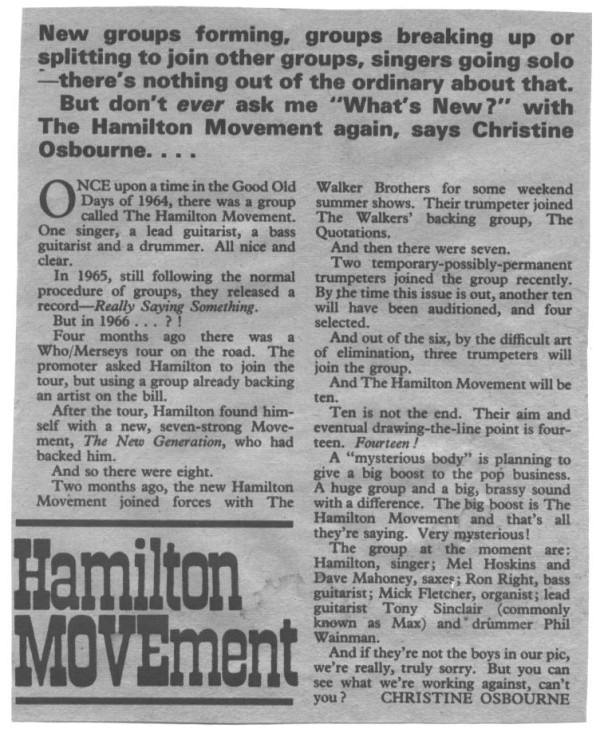
In August 1965, an obscure R&B outfit named Hamilton & The Hamilton Movement signalled its arrival on the London scene with an impressive rendition of The Velvelettes’ Motown classic “Really Saying Something” (later a sizeable UK hit for Bananarama) and then seemingly vanished off the face of the earth.
Then, almost two years later, a band calling itself Hamilton & The Movement descended on the airwaves with the infectious soul-rocker, “I’m Not the Marrying Kind”, a Bill Wyman penned and produced number, infused with punchy horn lines, funky drums and some groovy Hammond organ fills. Could this really be the same band and, if so, why such a long radio silence?
The answer to that question is both a yes and a no. While both outfits were fronted by a singer called Gary Hamilton, they were in fact two entirely different groups, albeit each with fascinating histories. To understand how these two bands became entwined, it’s important to go back to the early Sixties and the man who kick-started ‘the movement’, so to speak – Gary Hamilton.
The son of an English mother and American father, Gary Hamilton was in fact a certain Gary Laub, who grew up in London’s Marble Arch and St John’s Wood areas.
In 1962, Laub formed his first (unnamed) group with a school friend and lead guitarist named Graham who lived opposite Lords cricket ground. Soon after, they were joined by bass player Chris Palmer, rhythm guitarist Ian Hunt and (finally) drummer Fedon Tilberis, who all attended Haverstock School.
“How Chris and Ian met Gary I don’t know,” says Tilberis. “I joined a little later but Graham was still in the band and left soon after. We enlisted a replacement lead guitarist named Mike Allen and emerged as a five-piece named The Moondogs. The name was [Gary’s father] Mr Laub’s idea before we auditioned at the famous Two Is coffee bar.”
Fast forward to spring 1965 and Laub, Palmer and Tilberis had to reshuffle the pack when Allen and Hunt moved on. Through a friend of Tilberis, they were introduced to two older guitarists – Costas and Bernie – and started gigging as Cell Block 5.
“Costas was an ex-pro who had played US bases in Germany; he was a men’s tailor by trade. Bernie was from Rochdale. They were then in their late Twenties,” remembers Tilberis.
“We practised in the cellar of a scrap shop in south London that they knew. They did a three-nighter with us in a Greek Street cellar club called Les Cousins that I hustled but Bernie, not feeling very happy, left on the last night after the gig. Costas stayed on for a London suburb gig. They were only with us for about seven or eight weeks.”
Coining a new name, The Reaction, Tilberis hit the jackpot when he stumbled across Rayrik Studio owners Rick Minas and Bruce Rea, who offered up their Chalk Farm studio as a practice room. In return, the outfit would play free on any demo recording sessions when required.
“As it turned out, this was a great deal for us as we never had to record anything there other than our audition to clinch the agreement and practised for free,” continues the drummer.
Abetted by guitar legend Mick Green, The Reaction duly auditioned and Minas was bowled over by the performance.
“Chris and I had auditioned Mick at Chris’ place in Kilburn shortly before the Rayrik audition and we were both very impressed,” remembers Tilberis.
“Although Mick didn’t commit himself, he was interested in doing the Rayrik session, maybe hoping for some recording session gigs. I can’t remember what the number was that we recorded or if Gary was even there, but do remember listening to the backing take after and Mick’s comment. He said that it was a good clean recording and that you could build on it. Rick and Bruce agreed.”
Peter Vernon-Kell (front) with The Macabre outside the Ealing Club. Photo: Peter Vernon-Kell
However, when Mick Green opted to return to The Dakotas, with whom he had been playing with after leaving Johnny Kidd & The Pirates the previous year, Peter Vernon-Kell, a member of Goldhawk Social Club and Ealing Club regulars, The Macabre assumed guitar duties. Incidentally, Vernon-Kell had also been a brief member of The Detours, a forerunner of The Who.
“Both Mick Green and Peter Vernon-Kell came to us via a [Melody Maker] ad in that order. We did see other guitarists but finally settled for Peter after Mick moved on to greener pastures [excuse the pun],” explains Tilberis.
“Peter shared our new musical orientation and attitude, and as far as we were concerned, he fitted the bill. I then arranged our first practice at Rayrik.”
Prior to Vernon-Kell’s addition to the group’s ranks, Minas and Rea had introduced impresario Robert Stigwood, and the Australian subsequently offered Gary Laub a recording deal and put the band on his agency books.
Stigwood insisted that “Really Saying Something” should be the ‘A’ side while Rick Minas and his song-writing partner Mike Banwell offered up “I Won’t See You Tonight” for the flipside.
Before cutting both tracks at a demo session at Regent Sound in Denmark Street, Vernon-Kell coined a new name; The Reaction sounding too similar to The Action, The Who’s regular Tuesday night opener at the Marquee.
“He came up with The Hamilton Movement [in honour of Macabre guitarist Ed Hamilton] in the pub before the session [and] we thought it was great,” remembers Tilberis, who adds that Gary Laub, although at first not so keen, adopted ‘Hamilton’ as a stage name.
Having booked Olympic Sound (then situated in Baker Street) for the final recordings (and unbeknownst to the musicians), Stigwood augmented the band with Graham Bond on piano.
“We were aware who Graham was and were pleased to have him on board for the session,” says Tilberis.
According to the drummer, the tracks required only a few takes per playback and for the lead/backing vocals. Released in August 1965, the single entered the Radio Caroline charts at number 65 on 23 October and peaked at number 53 the following week.
However, the musicians soon realised that any talk of ‘band democracy’ was just that. Not only did the single list the outfit as Hamilton & The Hamilton Movement but Stigwood started promoting them as such.
“Only Gary was allowed to perform on Ready Steady Go using our playback, though we were allowed to attend the show,” explains Tilberis.
Interestingly, as future Hamilton Movement member Mel Wayne recalls, Stigwood insisted on the same conditions with another of his charges, The All-Nite Workers, who were backing Indian singer Simon Scott around the same time.
“Simon mimed to our backing track [on Ready Steady Go] while we had to stand on the balcony with the audience,” says the sax player. “It must have been a Stigwood thing.”
Aired on 22 October 1965, Gary Hamilton appeared on the popular British TV show alongside The Animals, The Searchers, Chris Farlowe & The Thunderbirds and The Rolling Stones, which may have been where the singer linked up with Bill Wyman.
By then, the group had started to pick up consistent live work, kicking off with a memorable gig at Sophia Gardens Pavilion in Cardiff on 30 August with The Who, The Graham Bond Organisation, The Merseybeats and The Easybeats (not the Australian outfit), which had been arranged by the Stigwood/Lambert-Stamp team.
“It looked like a sports hall with an enormous stage at one end. We went up the day before and slept in the van and hung about till early next afternoon to unload our gear,” says Tilberis.
“Townsend was also there early and limbering up in The Who’s dressing room. As our Pete knew him, he went to say ‘allo’ and introduce his new mates… [Townsend] asked Pete if he could borrow his Fender amp for the gig. Pete was more than wary, after all he didn’t want his amp wrecked so Townsend promised to only demolish his Marshall gear.
“Keith Moon and Tony Banks, drummer of The Merseybeats, were looning around and generally getting on everybody’s nerves, especially Entwistle’s as Moon had donned his bass and was running up and down the stage strumming it like a maniac. I thought John was going to thump him.”
More provincial gigs followed, not to mention the obligatory Mod clubs in London, including the El Partido in Lewisham where the outfit played alongside The Duke Lee Sounds on 30 October 1965.
However, in mid-late January 1966, the Stigwood/Lambert & Stamp team secured a spot for the band on a three-day, two shows a day package tour, once again opening for Vernon-Kell’s former band mates, The Who, and also featuring Screaming Lord Sutch & The Savages, The Graham Bond Organisation, The Merseybeats and The Fortunes.
“Bob [Stigwood] arranged for us to practise at the Granada TV rehearsal studios at the Oval about a week beforehand,” remembers Tilberis. “He and Lambert came to oversee the rep and offer presentation tips for our opening spot on the show.”
The tour debut duly took place at the Astoria Cinema, Finsbury Park on 4 February and was followed by a gig at the Odeon Cinema, Southend-on-Sea the next day, culminating with a final engagement on 6 February at the Empire Theatre, Liverpool.
The following month, on 11-12 March, the musicians found themselves on the campus of Essex University in Colchester where a number of bands, including the up and coming Pink Floyd were entertaining the students.
Then in April, Stigwood linked up with Chris Blackwell to promote a second package tour headlined by The Who, this time with Hamilton and The Hamilton Movement joining the likes of The Spencer Davis Group, The Band of Angels and (most notably) Jimmy Cliff & The Sound System (aka New Generation) (who featured musicians that would form part of the soon-to-be Hamilton Movement).
The four-day tour, with two shows a day, kicked off at the Gaumont Theatre in Southampton on 14 April. After weaving its way on to Fairfield Halls in Croydon, then the Odeon in Watford, the tour wound up at the Regal Theatre in Edmonton.
“Gary’s mum called me on Saturday, 16 April in the afternoon asking if we would do the Watford gig that evening,” says the drummer. “Although we all had other plans I rounded up Pete and Chris and we did that gig.”
Stigwood then proposed a second single and once again engaged Graham Bond on piano. The sessions included a stab at The Who’s “A Legal Matter” as the ‘B’ side, which was cut as an instrumental track. However, the recording of the ‘A’ side did not go well, as Tilberis recalls.
“We weren’t raving about the number. Stigwood arranged a practice room and gave us a single to learn but I can’t remember what it was called. I had a trouble with the drum part on the session.
“Bob was well peeved but let us play one of our tunes that we were working on, but there was no melody line or title at that stage and he didn’t like it. The Olympic session was a blow out and Bob gave us the thumbs down, we were out and the gig flow stopped.”
As Tilberis points out, there was still no signed contract, and the singer was looking out for himself. “Gary’s dad [Harry] being a shrewd businessman and used to dealing with contracts and small print had deleted a hefty portion of the contract!”
Chris Palmer and Fedon Tilberis soon left for Jimmy & The Rackets, a British beat group with hit parade successes in Germany, Switzerland and Austria.
Joining long-standing frontman, Jimmy Duncombe and guitarist Mike Bell, Tilberis remained with the Swiss-based outfit until spring 1968 while Palmer stayed on for another year.
The pair appeared on a cache of European-only released singles by The Rackets, kicking off with a cover of Eddie Cochran’s “C’mon Everybody” backed by a cover version of George Harrison’s “I Want To Tell You”.
The pair ended up setting up home in Switzerland where, in 1970, The Chris Palmer Band recorded the ultra-rare solo LP Fingertips, featuring originals from all the band members.
Palmer later hit pay day in 1980 when Surface Noise topped the UK dance music chart with a cover of his song, “The Scratch”. Tilberis re-joined The Rackets and played with local bands, including Swiss Sixties specialists, The Countdowns.
Vernon-Kell meanwhile subsequently moved into production. Setting up PVK Records, he managed Peter Green and produced a string of his late 1970s and early 1980s albums. More recently, he’s become an executive producer for films and currently runs Cabana Films Ltd.
But Gary Hamilton wasn’t finished with The Hamilton Movement. In late July/early August 1966, he linked up with Jimmy Cliff’s backing band, The New Generation, renaming them The Movement.
Bass player Ron Thomas, who years later struck fame with The Heavy Metal Kids, thinks the link-up came through The New Generation’s keyboard player Mick Fletcher.
“[Mick] was always going down all the clubs around Wardour Street,” says the bass player. “He was always ducking and diving and I thought he just met him [Gary Hamilton] out there one night.”
“Me and Mickie Fletcher were great mates and frequented The Ship in Wardour Street and drank with Gary there quite a bit,” confirms sax player Mel Wayne.
“We were all a bit frustrated the way things were going with Jimmy Cliff because he didn’t have a soul or pop voice, which was the sort of music Chris Blackwell wanted him to do and engaged us for.”
New Generation members Ron Thomas and Mel Wayne, together with fellow sax player Dave Mahoney, had first come together in West London R&B outfit Mike Dee & The Prophets.
Adding Thomas’s school friend Mick Stewart on guitar in mid-1965, they split from Mike Dee and worked as Anglo-Indian singer Simon Scott’s backing group, The All-Nite Workers. Their lone single together was produced by none other than Robert Stigwood!
By late 1965, former Paramounts drummer Phil Wainman had assumed leadership, and after cutting several singles with Errol Dixon and briefly backing Freddie Mack, Mick Stewart jumped ship to join Johnny Kidd & The ‘New’ Pirates.
Having previously introduced Mick Fletcher from The Epitaph Soul Band, guitarist Tony Sinclair (aka Tony St. Clair) completed the new formation, now gigging as The Sound System.
Through a chance meeting with Chris Blackwell, the sextet supported his roster of artists – Jackie Edwards, Millie, Owen Grey and most notably Jimmy Cliff. Trumpet player John Droy joined just before the Gary Hamilton pairing.
Clockwise from front: Ron Thomas, Mick Fletcher, Gary Laub, Tony Sinclair, Mel Wayne, Dave Mahoney and Phil Wainman
The expanded group began rehearsing at London’s Colony Club where Gary’s father was employed; US film star George Raft worked as its casino director and briefly financed the outfit. Mel Wayne adds that the group also rehearsed at Caesars Palace in Dunstable and Ken Collier’s London club.
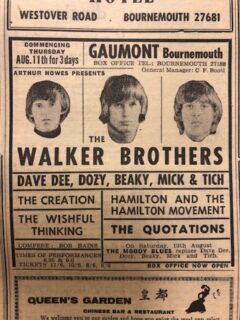
When John Droy bailed after a short nationwide tour with The Walker Brothers in mid-August to join The Quotations, The Movement expanded its line-up, bringing in trumpet players – Mike Bailey, Alan Ellis and Patrick Higgs, the latter from Elton John’s group, Bluesology around December. (Ed: One of the unsuccessful musicians to audition was trumpet player Verdi Stewart, who would be instrumental in landing Mel Wayne future work with Carl Douglas.)
“We had a ten-piece band; a five-piece brass section; three trumpets. When I think of it now, we were all on a wage,” recalls Thomas.
That November, Gary Hamilton landed a recording deal with CBS and the musicians entered IBC Studios to work with Rolling Stone Bill Wyman in the producer’s chair.
“That was something that [Gary’s father] Mr Laub put together. He said, ‘We’ve got a song for you’,” remembers Phil Wainman, who adds that the group nailed both sides in a couple of takes.
“He [Bill Wyman] just let us get on with it. The band was so good. We’d rehearsed it prior to the studio and… in three hours I think we were done, recorded and mixed.”
“I’m Not The Marrying Kind” c/w “My Love Belongs To You” was duly released on 10 February 1967 and hit single written all over it.
However, despite having supported The Who at Leeds University on 21 January and then making a notable appearance at the Saville Theatre opening for Chuck Berry and Del Shannon on 19 February, the single’s commercial failure prompted the backers to drastically reduce the group’s bookings.
Phil Wainman was the first to abandon ship for The Overlanders and then Jack Hammer, author of “Great Balls of Fire”.
After co-penning The Yardbirds’ cover “Little Games” and working with The Quotations, Wainman became a top session player and then a successful producer with Sweet and Boomtown Rats, among his credits.
“As a producer I did so much better than as a musician,” says Wainman. “That’s where I did well. I probably sold about 300 million records.”
James Smith, fresh from an audition with The New Pirates, reforming after Johnny Kidd’s death, assumed the drum stool.
“I got a call from Ron Thomas,” remembers the newcomer. “He said Mick Stewart had given him my number and would I be interested in auditioning? I got the gig, though it was a hard act to follow. Phil was one of the best drummers around at the time.”
Smith remembers the band finding plenty of work on the university circuit that spring, including Keele, Nottingham, Leeds and Birmingham.
In the first week of April, Melody Maker reported that the group had whittled down from a 10 piece to a seven piece. Mel Wayne left to join Carl Douglas & The Big Stampede and two other horn players also departed, most likely including Pat Higgs.
On 27 May, Hamilton & The Movement joined Cliff Bennett & The Rebel Rousers, The Action, The Bonzo Dog Doo Dah Band and The Swinging Blue Jeans to entertain the students at Oxford’s Hertford Balls.
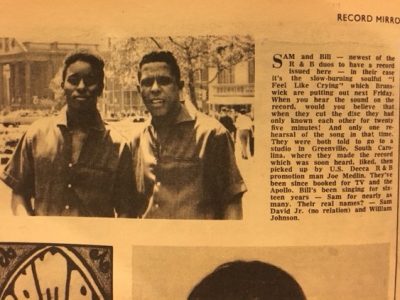
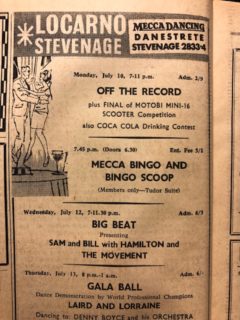
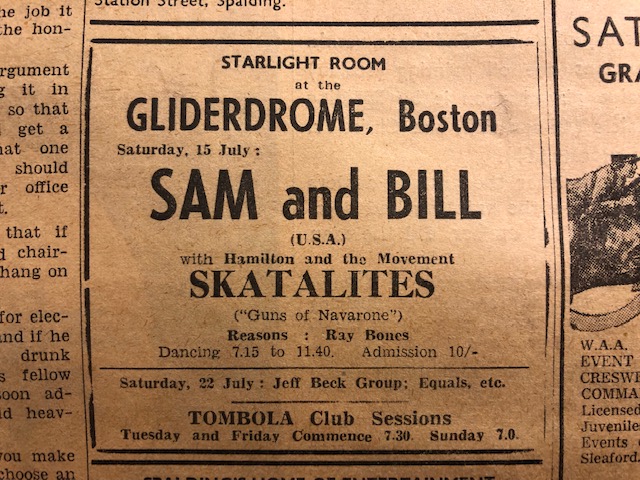
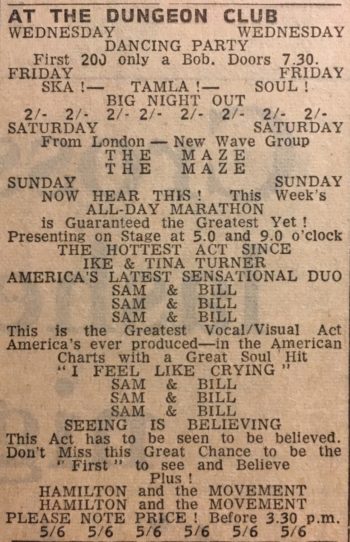
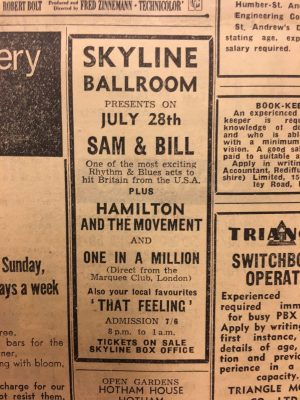
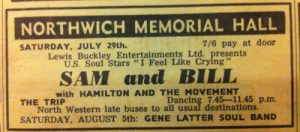
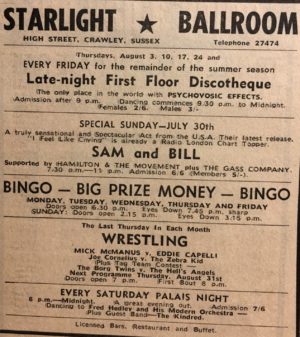
The drummer also says that The Hamilton Movement opened for US soul act Sam and Bill several times (most notably at the Boston Gliderdrome on 15 July) before further changes ensued during August and October 1967.
Sam and Bill, Record Mirror
“The brass section dropped out and this kind of triggered a fairly rapid exodus… There were no gigs for a while so Tony, Mick and Ron found other work,” says the drummer.
While Mick Fletcher failed to reunite with Mel Wayne in Carl Douglas & The Big Stampede (the job went to Rod Mayall), he next appears to have played with The Rifle (with guitarist Del Grace from Carl Douglas’ band and singer Malcolm Magaron) and then The Amboy Dukes in late 1969 for a short tour into mid-1970.
Tony Sinclair briefly played with Lace before joining Freddie Mack’s band in early 1968. The soul outfit split from the former boxer in 1969 and worked with Dave Hadfield at his studio on the Old Kent Road, providing backing tracks for various artists on Hadfield’s Revolution label.
Ron Thomas meanwhile got a job with guitarist Pip Williams’s band, The House of Orange, backing US soul act, The Fantastics.
“They were right in the middle of a tour backing Garnet Mimms,” he recalls. “They were a house band working with Roy Tempest. They just phoned me up. Their bass player had got slung out in the middle of the tour and they had a gig that night.”
With ‘The Movement’ on hold, James Smith had also started to explore other avenues and even had an offer on the table when Gary Hamilton convinced him to hang on.
“Gary came up with Mick Stewart and Tony Savva and said he wanted to change the style and format going with a three-piece backing band, so I decided to stay,” says the drummer.
Bass player Tony Savva was best known for his work with A Wild Uncertainty, the group that featured Eddie Hardin, who had replaced Stevie Winwood in The Spencer Davis Group that spring.
Savva is uncertain how the link-up with Hamilton came about but has some photos with A Wild Uncertainty drummer Gordon Barton and lead guitarist Peter Tidmarsh in them, which offers a clue.
“Gary and I were behind the camera,” he explains. “How and why I don’t know but obviously we were backing Gary as vocalist. Maybe Gordon and Peter split and Mick [Stewart] and Jimmy [Smith] came in.”
Mick Stewart, however, can throw more light on this transition period. “I believe that I played with Tony Savva for a little while because of something to do with Don Arden’s son David being a would-be-singer at the time,” says the guitarist.
“The intro to that was in a way due to Johnny Kidd. Over the years, he was in fact booked quite a bit by Don Arden’s agency and after he died, I believe that someone at Arden’s company suggested I play guitar in this back-up band. Tony was already in the line-up. At the end of the day, however, David Arden although he was a really great guy to be in a rock ‘n’ roll band with, he was not really a singer at all.”
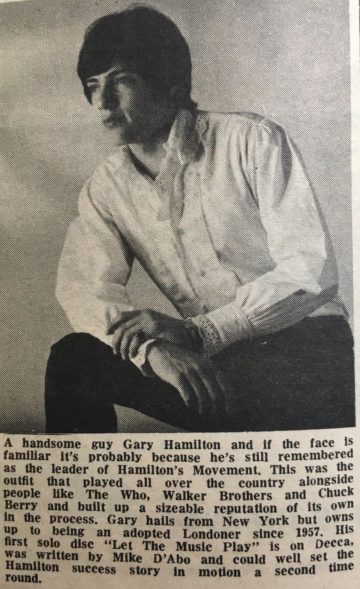
Gary Hamilton 25 November 1967 Record Mirror
With the new version finding its feet, Gary Hamilton returned to the studios with session musicians to cut a solo single. Produced by Tony Meehan and penned by Mike D’Abo, “Let the Music Play”, backed by the self-penned “Don’t Ask”, was released by Decca on 12 November 1967 but flopped. A dramatic, big band production, “Let the Music Play” appears on Colour Me Pop, Volume Three and Fading Yellow Volume 9: The Other Side of Life.
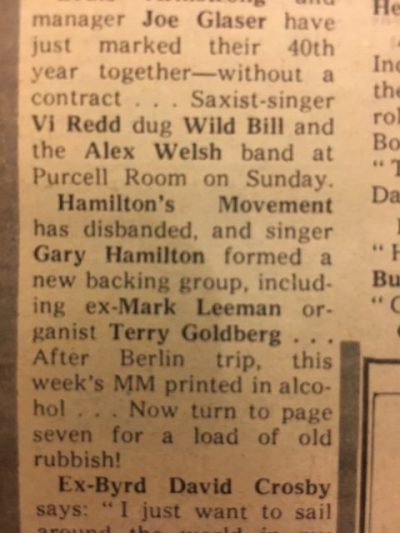
During early November 1967, Gary Hamilton expanded the line-up by bringing in organist Terry Goldberg, who had previously played with The Mark Leeman Five and would go onto Tintern Abbey.
Melody Maker, 11 November 1967
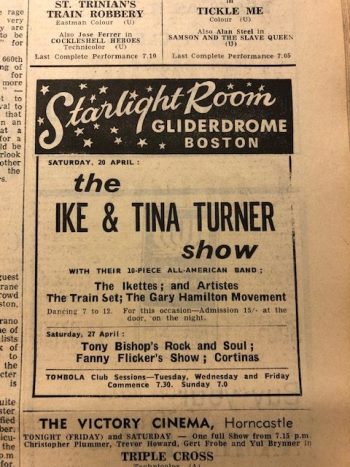
The five-piece gigged prolifically over the next four months, even opening for Ike & Tina Turner and others at the Boston Gliderdrome on 20 April 1968. Two days later, the musicians played possibly their final show with Mick Stewart at the 100 Club on Oxford Street.
Stewart immediately joined James Royal and participated in a prestigious concert tour alongside Johnny Cash, June Carter and Carl Perkins. During 1969-1970, he recorded three singles with Sweet before later moving to the United States in the late 1970s, where he works in Los Angeles and Nashville as a successful record producer and also owns a music publishing company and a recording studio.
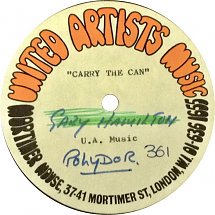
During 1968, Gary Hamilton recorded a one-track acetate “Carry The Can“, which was never released. The tracks were recorded with studio musicians and not the final version of The Hamilton Movement.
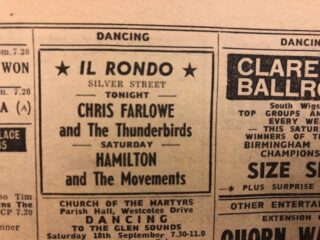
Judging by gigs below, Gary Hamilton continued to play with a band called The Movements into May and possibly July but it’s not clear if Savva, Smith or Goldberg were involved.
Tony Savva subsequently worked with Lionel Bart and Samuel Prody among others and currently lives in Cyprus. James Smith, who later recorded with Aquila, played with a revamped Nashville Teens before reuniting with Ron Thomas in The House of Orange.
“[Ron] said The Fantastics were coming back to the UK for a tour and he and Pip Williams were getting a backing band together and looking for a drummer and organist. I’d seen Ron and Pip previously so I didn’t need asking twice.”
As for Gary Hamilton, he joined the London production of Hair before resuming his solo career with a lone single for CBS and gigging briefly with Cozy Powell’s band, Big Bertha. Produced by Bernard Lee, the self-penned “Easy Rider” stalled when it was released on 5 December 1969.
Undeterred, he returned to Polydor for a cover of Ed Welch’s the “Monkey Song”, produced by Peter Knight Jr and arranged by John Fiddy. Released on 20 November 1970, the single flopped and Hamilton moved into movie acting; the eagle-eyed can catch him in the cult horror flick, Tower of Evil.
Thanks to Fedon Tilberis, Peter Vernon-Kell, Chris Palmer, Ron Thomas, Phil Wainman, Mel Wayne, James Smith, Mick Stewart and Tony Savva
To add information and make corrections, email: Warchive@aol.com
A version of this article appears in Ugly Things magazine.
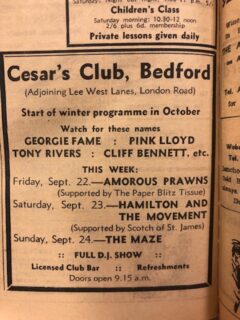
30 August 1965 – Sophia Gardens Pavilion, Cardiff, Wales with The Who, The Graham Bond Organisation, The Merseybeats and The Easybeats
18 September 1965 – Il Rondo, Leicester
16 October 1965 – Woodhall Community Centre, Welwyn Garden City
30 October 1965 – El Partido, Lewisham, south east London with The Duke Lee Sounds and The Loose Ends
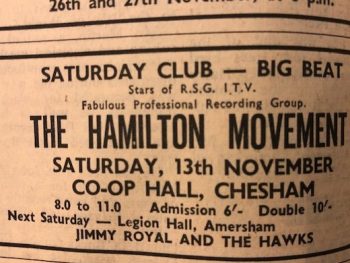
13 November 1965 – Co-Op Hall, Chesham, Bucks
27 November 1965 – Dungeon, Nottingham
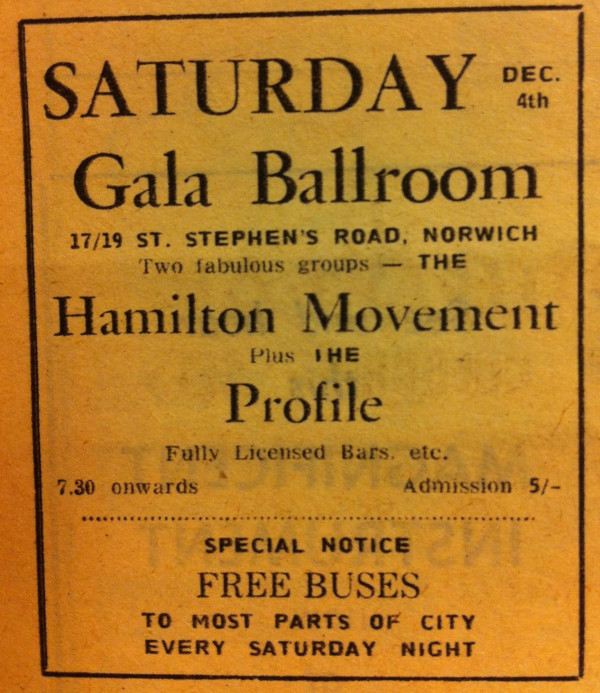
4 December 1965 – Gala Ballroom, Norwich, Norfolk with Profile
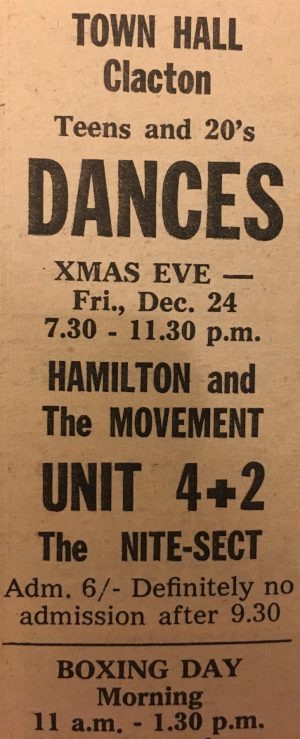
24 December 1965 – Clacton Town Hall, Clacton, Essex with Unit 4+2 and The Nite-Sect
4 January 1966 – Pavilion Ballroom, Bournemouth, Dorset
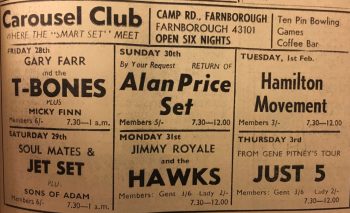
1 February 1966 – Carousel Club, Farnborough, Hants
4 February 1966 – Astoria Cinema, Finsbury Park, north London with The Who, The Merseybeats, The Fortunes, The Graham Bond Organisation and Screaming Lord Sutch & The Savages
5 February 1966 – Odeon Cinema, Southend-on-Sea, Essex with The Who, The Merseybeats, The Fortunes, The Graham Bond Organisation and Screaming Lord Sutch & The Savages
6 February 1966 – Empire Theatre, Liverpool with The Who, The Merseybeats, The Fortunes, The Graham Bond Organisation and Screaming Lord Sutch & The Savages
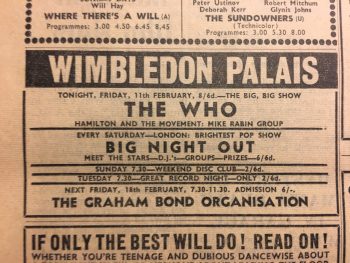
11 February 1966 – Wimbledon Palais, Wimbledon, London with The Who and The Mike Rabin Group
14 February 1966 – Dancing Slipper, Nottingham
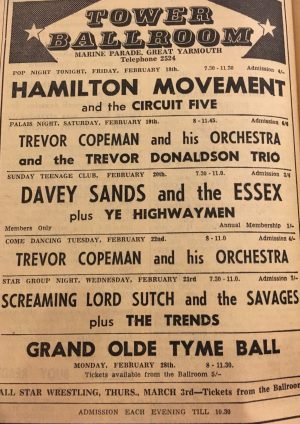
18 February 1966 – Tower Ballroom, Great Yarmouth, Norfolk with Circuit Five
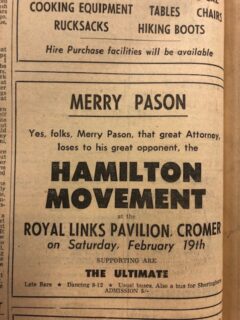
19 February 1966 – Royal Links Pavilion, Cromer, Norfolk with The Ultimate
27 February 1966 – The Downs, Hassocks, West Sussex with The Fairies
11-12 March 1966 – Essex University, Colchester, Essex with Pink Floyd and others
12 March 1966 – Cad-Lac Club, Florida Room, Brighton, East Sussex with 4-Bidden
18 March 1966 – Dancing Slipper, Nottingham with Carl Pagan & The Heathens
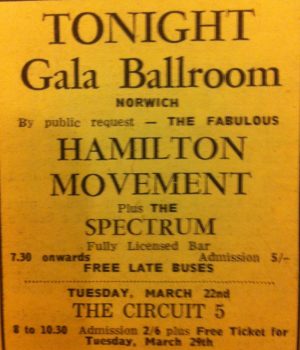
19 March 1966 – Gala Ballroom, Norwich, Norfolk with The Spectrum
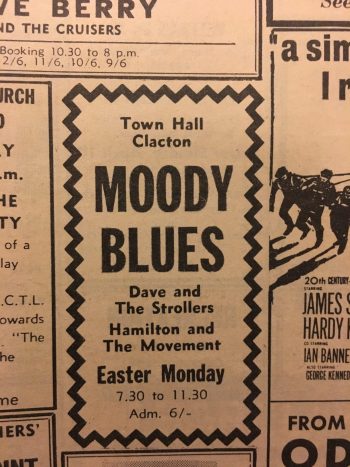
11 April 1966 – Clacton Town Hall, Clacton, Essex with The Moody Blues and Dave & The Strollers
14 April 1966 – Gaumont Theatre, Southampton, Hants with The Who, The Spencer Davis Group, The Band of Angels and Jimmy Cliff & The Sound System
15 April 1966 – Fairfield Hall, Croydon, south London with The Who, The Spencer Davis Group, The Band of Angels and Jimmy Cliff & The Sound System
16 April 1966 – Odeon, Watford, Herts with The Who, The Spencer Davis Group, The Band of Angels and Jimmy Cliff & The Sound System
17 April 1966 – Regal Theatre, Edmonton, north London with The Who, The Spencer Davis Group, The Band of Angels and Jimmy Cliff & The Sound System
21 May 1966 – New Central Ballroom, Aldershot, Hants with The Nuetrons
The original band split around June 1966 and Gary Hamilton put together a new version in late July
Gary Hamilton (vocals)
Tony Sinclair (aka St Clair) (guitar)
Ron Thomas (bass)
Mick Fletcher (keyboards)
Mel Wayne (sax)
Dave Mahoney (sax)
John Droy (trumpet)
Phil Wainman (drums)
11-13 August 1966 – Gaumont Cinema, Bournemouth, Dorset with The Kinks, The Walker Brothers, The Quotations, The Creation, The Wishful Thinking, Dave Dee, Dozy, Beaky, Mick & Titch and The Moody Blues
14 August 1966 – Tiles, Oxford Street, central London with The Anzacs
John Droy left soon after the tour to join The Quotations
26 August 1966 – The Place, Hanley, Staffordshire
3 September 1966 – Rhodes Centre, Bishop’s Stortford, Herts with The Mystery Men
9 September 1966 – Benn Memorial Hall, Rugby, Warwickshire with The Roaring 60s and The Imagination (Rugby Advertiser)
18 September 1966 – Cromer Olympia, Cromer, Norfolk with The Barry Lee Show
24 September 1966 – Golden Torch, Tunstall, Staffordshire with Dave Berry & The Cruisers
29 September 1966 – Thorngate Ballroom, Gosport, Hampshire
1 October 1966 – Golden Torch, Tunstall, Staffordshire with The Thoughts
16 October 1966 – Khyber Club, Taunton, Somerset with The Sabres (the band replaced MI5)
Three trumpets players joined around December – Mike Bailey, Alan Ellis and Pat Higgs
21 January 1967 – Leeds University, Leeds, West Yorkshire with The Who
19 February 1967 – Saville Theatre, Shaftsbury Avenue, central London with Chuck Berry, The Canadians and Del Shannon
26 February 1967 – Saville Theatre, Shaftsbury Avenue, central London with Chuck Berry, The Candians and Herbie Goins & The Night-Timers
4 March 1967 – The Union, Manchester with The Dimples and Sound Venture
11 March 1967 – Birdcage, Eastney, Portsmouth, Hants (cancelled)
Phil Wainman left around now and Jim Smith joined on drums
18 March 1967
18 March 1967 – Ewell Technical College, Ewell, Surrey with The Easybeats
Around early April, Mel Wayne and two trumpet players left, most likely including Pat Higgs. The band carried on as a seven-piece with two horn players.
6 May 1967 – Royal Lido Ballroom, Prestatyn, Wales with The Quotations and The Raynes (billed as Hamilton)
27 May 1967 – Hereford Balls, Oxford with Cliff Bennett & The Rebel Rousers, The Action, The Bonzo Dog Doo Dah Band and The Swinging Blue Jeans
10 June 1967 – Tiles, Oxford Street, central London with The Collection and The Gas Company
11 June 1967 – Starlight Ballroom, Crawley, West Sussex with Craig King & The Midnight Train
17 June 1967 – Bal Tabarin, Downham, south east London with supporting groups
2 July 1967 – Cosmo, Carlisle, Cumbria with Four Degrees West
6 July 1967 – Blue Lagoon, Newquay, Cornwall (billed as Hamilton & The Quotations but assuming it is the same band)
The group backed US soul singers Sam & Bill on a UK tour. The pair arrived on 12 July so it’s safe to assume the gigs listed below featured Hamilton & The Hamilton Movement
12 July 1967 – Locarno, Stevenage, Herts with Sam & Bill (most likely debut)
13 July 1967 – Sybilla’s, Swallow Street, Mayfair, central London (billed as Sam & Bill)
15 July 1967 – Starlight Room, Boston Gliderdrome, Boston, Lincolnshire with Sam & Bill, The Skatalites and The Reasons
16 July 1967 – Speakeasy, central London (billed as Sam & Bill)
20 July 1967 – Locarno Bristol with Sam & Bill
21 July 1967 – Big ‘C’, Farnborough, Hants with Sam & Bill
21 July 1967 – Cue Club, Paddington, central London (billed as Sam & Bill)
22 July 1967 – New All-Star Club, Liverpool Street, central London (billed as Sam & Bill)
23 July 1967 – Dungeon, Nottingham with Sam and Bill
23 July 1967 – Saville Theatre, Shaftsbury Avenue, London (billed as Sam & Bill)
28 July 1967 – Skyline Ballroom, Hull with Sam & Bill plus One In A Million and That Feeling
29 July 1967 – Northwich Memorial Hall, Northwich, Cheshire with Sam & Bill and The Trap
30 July 1967 – Starlight Ballroom, Crawley, West Sussex with Sam & Bill and The Gas Company
13 August 1967 – Dungeon, Nottingham (says they were Sam and Bill’s backing group)
23 August 1967 – Locarno, Stevenage, Herts
25 August 1967 – Steering Wheel, Weymouth, Dorset
31 August 1967 – Locarno Bristol
Dave Mahoney and the last trumpet player departed around now
2 September 1967 – Kirklevington Country Club, North Yorkshire
Sam & Bill played Floral Hall in Southport on 9 September 1967, but looks like John Smith’s Affair were the support band this time.
15 September 1967 – Fiesta Hall, Andover, Hampshire
16 September 1967 – El Grotto, Ilford, east London
23 September 1967 – Cesar’s Club, Bedford with The Scotch of St James
30 September 1967 – City Hall, Salisbury, Wiltshire with Jigsaw and Dave Jay
Ron Thomas, Mick Fletcher and Tony Sinclair all left during October and the band was put on hold as Gary Hamilton recruited new players
Gary Hamilton (vocals)
Mick Stewart (guitar)
Tony Savva (bass)
Jim Smith (drums)
21 October 1967 – Maple Ballroom, Northampton
Terry Goldberg joined on keyboards
11 November 1967 – Brackley Town Hall, Brackley, Northamptonshire (possibly Goldberg’s debut)
8 December 1967 – City University, central London with The Soft Machine and Robert Hirst & The Big Taste
6 January 1968 – Lion Hotel, Warrington, Cheshire with Styx and Just Us
3 February 1968 – Sheridan Rooms, Huddersfield, West Yorkshire
9 February 1968 – Tiger’s Head, Catford, south east London (billed as Hamilton’s Movements)
25 February 1968 – Barnsley Civic Hall, Barnsley, West Yorkshire with Jay Jones (billed as The Gary Hamilton Movement)
26 February 1968 – Primrose Hill Working Men’s Club, Huddersfield, West Yorkshire (billed as The Gary Hamilton Movement)
9 March 1968 – Clouds, Derby (says it’s an eight-piece soul band)
15 April 1968 – Barnsley Civic Hall, Barnsley, West Yorkshire with The Koobas and Detroit Soul Sound
20 April 1968 – Starlight Room, Boston Gliderdrome, Boston, Lincs with the Ike & Tina Turner Show, The Ikettes, The Artists and The Train Set
22 April 1968 – 100 Club, Oxford Street, central London
4 May 1968 – Hotel Ryde Castle, Ryde, Isle of Wight with Helcyon Order (Isle of Wight County Press)
19 May 1968 – Manor Blues Club, Thornton-in Craven, North Yorkshire (Craven Herald & Pioneer)
6 July 1968 – Sheridan Rooms, Huddersfield, West Yorkshire (Huddersfield Daily Examiner) Billed as Guy Hamilton & The Movements
Freddy Mack’s album recorded in 1967 (not 1966). Thanks to Dave Tedstone for image
Retired American light-heavyweight boxer Freddie Mack, sometimes spelt Freddy Mack and also known as Mr Superbad, relocated to the UK in 1965 and established a second career as a soul singer and disc jockey.
Between late 1965 and the mid-1970s, Mack fronted a succession of bands featuring a staggering number of notable British R&B and soul musicians.
Originally called The Mack Sound, the singer’s bands also worked under the names The Freddie Mack Sound, The Fantastic Freddie Mack Show and the Freddie Mack Extravaganza.
The first line-up of this band must have been formed in October 1965 because an advert in Melody Maker from October 1968 says that the group was due to play at the Whisky A Go Go in Wardour Street on 13 October 1968 to mark the band’s third anniversary.
Sometime in November, Freddie Mack was briefly paired with The Phil Wainman Band and female singer Cleo Sylvester (aka Sylvestre). The group’s line up at the time comprised lead guitarist Tony Sinclair; bass player Ron Thomas; organist Mick Fletcher; sax players Mel Wayne and Dave Mahoney; and drummer Phil Wainman.
According to Wainman, Mack was resident DJ at Dolly’s Club in Soho and they shared a brief residency there. The group was then lined up to play a Christmas/New Year show at Count Suckle’s Cue Club in Paddington with Mack.
Mel Wayne says that Mick Fletcher was staying with him in Twickenham and the pair had problems with the trains and arrived late. Mack was going to fine them but the rest of the band rallied and said they’d leave if he did.
Unfortunately, the show proved to be the end of their relationship and Wainman’s band went on to work with West End Promotions, backing a succession of Jamaican artists, including Millie Small, Owen Grey, Jackie Edwards and most notably Jimmy Cliff.
Around February 1966, Mack asked sax player Roger Warwick, who’d done some rehearsals with Phil Wainman’s band, to become part of a new, larger stage show that drew on musicians from two bands and subsequently became known as This ‘N’ That and The Mack Sound. The new formation retained singer Cleo Sylvester.
Mack had also asked American singer Ronald Bertram Greaves (aka Sonny Childe) to join the new stage show but Warwick doesn’t think he stuck around long.
Originally from Ealing, Warwick had attended Walpole Grammar School and was in the year below (and was friends with) John McVie. Studying sax under Don Rendell, he had previously played on The Tornados’ single “Early Bird”, produced by Joe Meek.
He then worked with Screaming Lord Sutch & The Savages and had played a few gigs with The Lower Third during April 1965 when David Bowie (still known as Davy Jones) joined them on sax after rehearsing with the band at the Whisky A Go Go in Wardour Street. Warwick remembers rehearsing a very short-lived group with a singer called Glen Singer, David Bowie and Steve Marriott of The Small Faces (with The Lower Third backing) during this time, but nothing ever came from it. After he dropped out that summer, Bowie enlisted The Lower Third as his next backing group.
In December 1965, Warwick backed singer Bobby Rio on a German tour with future Mack Sound bass player Alan Cartwright.
Back in England, Warwick joined a short-lived group based in Fulham, which also included an Irish singer called Leon, tenor sax player Nobby Clarke and a Welsh Hammond organist, who was possibly Mike Vaughn-Jones. When Warwick joined Freddie Mack, Leon, Clarke and Vaughn-Jones also came onboard. (Ed. Hammond organist Paul Abrahams says he had played with Warwick previously and was involved with the band by early June.)
The other group that Mack drew on for musicians were Screaming Lord Sutch’s latest version of The Savages, Liverpool outfit, Derry Wilkie & The Others.
Lord Sutch had been using the musicians as a backing group for several months but by April 1966 the players were keen to break away from Sutch and try something new.
The entire outfit – singer Derry Wilkie; lead guitarist Ernie Hayes; tenor sax player Phil Kenzie; baritone sax player Ashton Tootell; bass player Derek Bond; and drummer Billy Adamson accepted Mack’s offer and signed up.
Photo: Melody Maker. Image may be subject to copyright
Joining forces with Warwick’s Fulham players, the new formation debuted at the Ram Jam in Brixton on 22 April 1966 under the name Freddie Mack’s This ‘N’ That.
Warwick remembers that sax player Jimmy Jewell, a former member of Kris Ryan & The Questions, played some gigs with the band during this time.
Jewell confirms that he briefly played with Mack around April 1966 together with former Jimmy Powell & The Dimensions guitarist Martin Shaw and an American singer called Richard Lanham, who’d recently lived in Milan, Italy.
Jewell and Shaw did not stay long and would take part in a German tour with The Paramounts in September 1966 backing singer Chris Andrews.
The excellent Derry Wilkie website also lists a number of other players that became part of this larger show during mid-1966: American jazz singer Jo Baker; lead guitarist Geoff Krivit; trumpet player Mark Charig; and percussionist Eddie Lincoln.
Krivit, incidentally, had briefly been a member of John Mayall’s Bluesbreakers in 1965 and Julian Covey & The Machine in early 1966. He would go on to play with Dr K’s Blues Band. Charig meanwhile had been a member of The Sidewinders (recently playing at Count Suckle’s Cue Club in Paddington) and later worked with Bluesology (alongside Elton John).
Billed as This ‘N’ That, the line-up recorded a lone single, “Get Down With It/I Can’t Get No Satisfaction” c/w “I Care About You” for the Strike label, which was released on 10 June 1966.
Judging by an advert printed in 11 June 1966 edition of Melody Maker, the single features singers Derry Wilkie, Sonny Childe, Cleo Sylvester and Leon plus “the explosive sound of TNT and Mack Sound”.
The Redbridge & Ilford Recorder lists the band playing at Oscar’s Grotto in Ilford, east London on 11 June 1966.
The Marylebone & Paddington Mercury‘s 24 June issue (page 5) ran a piece on Mack and notes that the former boxer had booked his group into the Cue Club in Paddington for four nights a week for a month to showcase the 15-piece band, plus five singers, culminating in a big package show in mid-July.
On Mondays, The Mack Sound will back singer The Youth (born Trevor Sutherland and later future reggae artist IJahman Levi).
On Tuesdays, This ‘N’ That will appear with Derry Wilkie while on Wednesdays they will back Jo Baker. Sonny Childe meanwhile will appear on Thursdays.
Photo: Melody Maker
Melody Maker lists The Youth with The Mack Sound playing at the New All-Star Club near Liverpool Street station on 3 July.
Photo: Redbridge & Ilford Recorder. Image may be subject to copyright
The Redbridge & Ilford Recorder also lists the band, billed as The TNT Show with The Youth, Derek and Cleo playing at Oscar’s Grotto in Ilford, east London on 9 July 1966.
After these gigs ended in mid-July, most of the musicians left to work independently as Sonny Childe & The TNT. According to Ernie Hayes, when Sonny Childe returned to the US around August 1967, the guitarist, plus organist Mike Vaughn-Jones and drummer Billy Adamson joined forces with bass player Jet Harris and singer Pete Gage for a few months. Phil Kenzie meanwhile joined Tuesday’s Children for four months.
In November 1967, Ernie Hayes, Mike Vaughn-Jones, Billy Adamson and Phil Kenzie reunited in TNT to back American singer PP Arnold with former Creation’s member Eddie Phillips on bass. Adamson later played with The Searchers while Kenzie returned to Freddie Mack’s band in spring 1968 (see entry).
In the meantime Roger Warwick helped Freddie Mack put together a new version of The Mack Sound, retaining Cleo Sylvester, The Youth and Derry Wilkie. He brought in his old friend Alan Cartwright on bass plus some new players.
The band rehearsed extensively that summer and Warwick remembers the new line up playing a day long show at Douglas House at Lancaster Gate with Georgie Fame & The Blue Flames (Ed. Fame played here on 29 May 1966 but this would have been too early in the timeline unless Warwick meant an earlier version.)
Photo: Redbridge & Ilford Recorder. Image may be subject to copyright
The Redbridge & Ilford Recorder lists the band, billed as The Mac Sounds, playing at Oscar’s Grotto, Ilford, east London with The TNT on 30 July 1966.
Youth photo. Fabulous 208, 12 November 1966 issue. Image may be subject to copyrightPhoto: Fabulous 28, 12 November 1966 issue. Image may be subject to copyright
Around this time, Warwick and Cartwright were among the musicians who backed The Youth on a lone single for Polydor Records, a cover of Smokey Robinson’s “As Long As There Is Love” backed by Otis Redding’s “Your One and Only Man” at Abbey Road.
Freddie Mack live. Thanks to Miguel Terol for sharing this image sent to him by Ged Peck I would be grateful if anyone can identify any of the musicians shown here.
Drawing on a number of web sources, and accounts from several musicians, it looks like the new line up’s formation, which signed to Dumont Associates (as advertised in Melody Maker’s 15 October 1966 issue), comprised the following players at some point between September 1966 and January 1967:
Freddie Mack – lead vocals
Derry Wilkie – lead vocals
Tony Morgan – lead vocals, congas
Kenneth Harry – lead vocals
Kookie Eaton – lead vocals
Ged Peck – lead guitar
Billy Davidson – organ
Alan Cartwright – bass
Roger Warwick – baritone saxophone
Clarence Jackson (aka JJ Johnson) – trombone
Bernie Wehrman – tenor saxophone
Chris Burdett – alto saxophone (possibly joined later in 1966)
Eddie Thornton – trumpet (joined October 1966)
B J Wilson – drums (replaced by Roger Truth in November 1966)
Clarence Jackson was a member of Otis Redding’s touring band when the singer had made his UK debut in September 1966, so it’s probably safe to assume he joined after the tour had finished.
Eddie Thornton, however, was still working with Georgie Fame & The Blue Flames until October 1966, and therefore it’s possible that another trumpet player was there before.
Thanks to recollections from Ged Peck, it appears that the first keyboard player was Billy Davidson (who later worked with The Flowerpot Men among others) but he was replaced by Art Regis at some point in early 1967 (possibly start of February).
Unknown horn players, Ged Peck (guitar) and Billy Davidson (keyboards). Thanks to Miguel Terol for sharing this image sent to him by Ged Peck
Of the other musicians listed above, lead guitarist Ged Peck had been a member of The Favourite Sons before briefly playing with Chris Lamb & The Universals.
Ged Peck far right in the early 1960s. Thanks to Miguel Terol for sharing this image sent to him by Ged Peck
B J Wilson had played with The Paramounts and George Bean & The Runners. He was an old friend of Alan Cartwright’s.
BJ Wilson centre with Alan Cartwright (left). Thanks to Miguel Terol for sharing this image sent to him by Ged Peck
One thing is clear from tracing Freddie Mack’s bands during the 1960s, the line-ups tended to be pretty fluid and (particularly) horn players appeared to come and go on a regular basis, making pinning down definitive formations almost impossible. There were often around 15 musicians in the group at one time.
Throughout this period, musicians appear to have come and gone on a regular basis. According to Nick Simper’s excellent website, Roger Truth, who had played with the future Deep Purple bass player in Johnny Kidd & The Pirates, took over the drum stool from B J Wilson in late November 1966.
Roger Warwick left in December 1966 while the band were playing at the Upper Cut in Forest Gate, east London. Warwick moved to Turin, Italy to join a band being formed to back Lebanese singer Patrick Samson.
He remembers that when he left, singer Richard Lanham was with the band.
Roger Warwick (back left with white shirt) with The Patrick Samson Set
West Indian trumpet player Sonny Corbett joined during early 1967 as did English trumpet player Chris Dawe.
In January 1967, it’s possible The Mack Sound comprised the following (plus other unknown musicians):
Freddie Mack – lead vocals
Derry Wilkie – lead vocals
Tony Morgan – lead vocals, congas
Kenneth Harry – lead vocals
Kookie Eaton – lead vocals
Ged Peck – lead guitar
Billy Davidson – organ
Alan Cartwright – bass
Clarence Jackson – trombone
Bernie Wehrman – tenor saxophone
Chris Dawe – trumpet
Sonny Corbett – trumpet
Eddie Thornton – trumpet
Roger Truth – drums
Hammond organist Art Regis, who’d previously performed with Mel Turner & Rupert and The Red Devils, Dutch band The Defenders, The Arthur Brown Union and Ralph Denyer & The Uptown Band, remembers Derry Wilkie, Tony Morgan, Kookie Eaton, Dick Morrisey, Bernie Wehrman, Clarence Jackson and Eddie Thornton being in the band at the same time as him.
Art Regis recalls Freddie Mack coming to his flat in Portobello Road and discussing the possibility of forming “an extravagant international soul show”. The Hammond organist also remembers playing at Silver Blades Ice Rink in Streatham and a trek down to Cornwall to play an air sea rescue base in Falmouth.
More importantly, Art Regis also recalls performing with Freddie Mack at Billy Walker’s The Upper Cut in Forest Gate, which opened on 21 December 1966. According to Melody Maker, Mack’s band was the resident support band at this notable venue until early February 1967.
The New Pirates in February 1967. Mick Stewart (far left) who played with Mack in December 1965 and Nick Simper (second from right) who briefly played with Mack in early 1967. Photo: John Kerrison
Nick Simper also spent a week with the band when it was resident support act at the Upper Cut (most likely mid-January 1967) after working with Bobby Hebb’s touring band. However, Alan Cartwright was soon back and Simper formed The New Pirates the following month.
During the first few weeks of February Roger Truth dropped out briefly to reform The New Pirates with Simper but had a change of mind and returned to Freddie Mack after some early rehearsals. B J Wilson filled the drum stool in the interim.
Art Regis would reunite with Nick Simper and Ged Peck in June 1967 in Billie Davis & The Quality before working briefly with Engelbert Humperdinck. Regis confirms that he then joined Jimmy James & The Vagabonds on 27 July 1967.
The Loose Ends in 1966 with Roy Davies (far left). Photo: Alan Whitehead
Another keyboard player that is often associated with Freddie Mack during this time is future Gonzalez member Roy Davies, who’d previously been a member of Southeast London band, The Loose Ends. It looks most likely that Davies came on-board when Art Regis left (around mid-February).
In late February 1967, B J Wilson joined Sands and then Procol Harum. Roger Truth returned to the drum stool.
Ged Peck playing live. Thanks to Miguel Terol for sharing this image sent to him by Ged Peck
Ged Peck certainly was gone sometime in late March 1967 and joined Nick Simper in Billie Davis & The Quality that May before going on to a number of notable acts, including Warhorse (alongside Simper). His temporary replacement was former Tornados and Echoes guitarist Stuart Taylor.
Lead guitarist Dave Tedstone, who had previously been a member of The Doc Thomas Group, remembers going to Eel Pie Island to see Freddie Mack’s band and subsequently joined. Tedstone also recalls that Stuart Taylor was on guitar at the time. Thanks to Pete Watt’s excellent research this gig can be confirmed as 4 April 1967.
Selected gigs:
Photo: Aldershot News. Image may be subject to copyright
2 September 1966 – Carousel Club, Farnborough, Hants. Billed as Freddie Mack Sounds and His Show
9 September 1966 – The Place, Hanley, Staffordshire. Billed as The Mack Sound (ten-piece band)
10 September 1966 – Jigsaw, Manchester
10 September 1966 – The Cavern, Liverpool with Eddie Cave & The Fix, The Kop, The Hideaways, The Seftons and The Rocking Vicars
Photo: Evening Sentinel. Image may be subject to copyright
16 September 1966 – Beachcomber, Nottingham
22 September 1966 – Golden Torch, Tunstall, Staffordshire Billed as The Mack Sound
1 October 1966 – Flamingo Ballroom, Redruth, Cornwall with The Jaguars
8 October 1966 – Dunelm House, Durham University with Simon Dupree & The Big Sound
13 October 1966 – Burton Manor, Stafford, Staffordshire
15 October 1966 – Carlisle Market Assembly Hall, Carlisle, Cumbria with The Chuckles
15 October 1966 – Drill Hall, Dumfries, Scotland with The Misfits
Photo: Birmingham Evening Mail. Image may be subject to copyright
19 October 1966 – Elbow Room, Aston, West Midlands. Billed as The Mac Sound
Photo: Birmingham Evening Mail. Image may be subject to copyright
20 October 1966 – Black Horse, Northfield, West Midlands with The Visuals Billed as Mack Sound (11-piece)
Photo: Birmingham Evening Mail. Image may be subject to copyright
21 October 1966 – The Royal Oak, Hockley Heath, West Midlands Billed as Mack Sound (11-piece)
Photo: Birmingham Evening Mail. Image may be subject to copyright
22 October 1966 – Bromsgrove Baths, Bromsgrove, West Midlands with The Exchequers
Photo: City Week. Image may be subject to copyright
28 October 1966 – Cavalier Club, Belfast, Northern Ireland with Tony G Ford & The Crescendos. Billed as Derrie Wilkie & The Mack Sound. Note: The band played in Dublin just before this
29 October 1966 – Cavalier Club, Belfast, Northern Ireland with The King Bees. Billed as Derrie Wilkie & The Mack Sound
City Week, 27 October 1966. Image may be subject to copyright
5 November 1966 – Jigsaw, Manchester with Alan Bown Set
8 November 1966 – The Place, Hanley, Staffordshire Billed as Mack Sound (ten-piece with Derrie Wilkie)
Image may be subject to copyright
26 November 1966 – Toft’s, Folkestone, Kent
27 November 1966 – Toft’s, Folkestone, Kent
4 December 1966 – Douglas House, Lancaster Gate, Central London (listed as 13-piece band) with Herbie Goins & The Nighttimers
5 December 1966 – Whisky A Go Go, Wardour Street, Soho, central London
10 December 1966 – King’s Hall, Stoke-on-Trent with In-Betweens and Lonnie’s Few
11 December 1966 – Golden Torch, Tunstall, Staffordshire (Staffordshire Weekly Sentinel article, dated 16 December, page 13, lists 16 band members)
11 December 1966 – Esquire Club, Sheffield with The Orginators Creed, The Hobo Flats and The Chicago Line
Photo: Melody Maker. Image may be subject to copyright
16 December 1966 – Tofts, Folkestone, Kent
17 December 1966 – Hotel Leofric, Coventry
21 December 1966-12 February 1967 – Upper Cut, Forest Gate, east London:
Image may be subject to copyright
21 December 1966 – Upper Cut, Forest Gate, east London with Who
22 December 1966 – Upper Cut, Forest Gate, east London with Easybeats
23 December 1966 – Upper Cut, Forest Gate, east London with Dave Dee, Dozy, Beaky, Mick and Titch
24 December 1966 – Upper Cut, Forest Gate, east London with Eric Burdon & The Animals
26 December 1966 – Upper Cut, Forest Gate, east London with Jimi Hendrix Experience (day)
26 December 1966 – Upper Cut, Forest Gate, east London with Pretty Things (evening)
27-29 December 1966 – Upper Cut, Forest Gate, east London
30 December 1966 – Upper Cut, Forest Gate, east London with Spencer Davis Group
31 December 1966 – Upper Cut, Forest Gate, east London with Geno Washington & The Ram Jam Band (This may not have happened if gig below took place)
Photo: Dumfries and Galloway Standard. Image may be subject to copyright
31 December 1966 – Assembly Rooms, Dumfries, Scotland
1 January 1967 – Upper Cut, Forest Gate, east London with The Move (This may not have happened if above gig took place)
Photo: Wigtownshire Free Press & Galloway Advertiser. Image may be subject to copyright
2 January 1967 – Newton Stewart, Galloway, Scotland Second Scottish gig suggests not all Upper Cut shows in January happened
2-5 January 1967 – Upper Cut, Forest Gate, east London (This may not have happened due to Scottish tour)
6 January 1967 – Upper Cut, Forest Gate, east London with The Small Faces
7 January 1967 – Upper Cut, Forest Gate, east London with The Bitter End Singers
8 January 1967 – Upper Cut, Forest Gate, east London with The Mindbenders (Nick Simper’s website says Pink Floyd replaced The Mindbenders. Simper attended and saw Syd Barrett’s group perform. He filled in for Alan Cartwright for a week at this venue, possibly the following week)
9-12 January 1967 – Upper Cut, Forest Gate, east London (possibly with Nick Simper
13 January 1967 – Upper Cut, Forest Gate, east London with Four Pennies (possibly with Nick Simper)
14 January 1967 – Upper Cut, Forest Gate, east London with Terry Lightfoot’s Jazzmen (possibly with Nick Simper)
15-19 January 1967 – Upper Cut, Forest Gate, east London
20 January 1967 – Upper Cut, Forest Gate, east London with Sounds Incorporated
21 January 1967 – Upper Cut, Forest Gate, east London with The Fourmost
22-26 January 1967 – Upper Cut, Forest Gate, east London
27 January 1967 – Upper Cut, Forest Gate, east London with Jimmy James & The Vagabonds
28 January 1967 – Upper Cut, Forest Gate, east London with Jimi Hendrix Experience
29-31 January 1967 – Upper Cut, Forest Gate, east London
Possible that Art Regis took over from Billy Davidson around about now. Not long after Roger Truth dropped out to reform The New Pirates with Nick Simper. B J Wilson returned to the drum kit.
1-2 February 1967 – Upper Cut, Forest Gate, east London
3 February 1967 – Upper Cut, Forest Gate, east London with Winston’s Fumbs (now listed as 15-piece band)
4 February 1967 – Upper Cut, Forest Gate, east London with Herbie Goins & The Night-Timers, The Satin Dolls and The Avalons
7 February 1967 – Concorde, Basset Hotel, Southampton, Hants
5-9 February 1967 – Upper Cut, Forest Gate, east London
10 February 1967 – Upper Cut, Forest Gate, east London with The Rockin’ Berries
11 February 1967 – Gaiety Ballroom, Ramsey, Cambridgeshire with The Fireflies
12 February 1967 – Upper Cut, Forest Gate, east London
It’s possible that Roy Davies took over from Art Regis around about now
13 February 1967 – Winter Gardens Ballroom, Penzance, Cornwall with The Jaguars (The Sheffield Star says they also play the Esquire in Sheffield in South Yorkshire on this day which seems more likely with the Cleethorpes gig later this week)
14 February 1967 – Flamingo Ballroom, Redruth, Cornwall with The Dissatisfied (this was probably cancelled in light of the northern gigs)
15 February 1967 – The Village, Cleethorpes
16 February 1967 – Golden Torch, Tunstall, Staffordshire
18 February 1967 – Beachcomber, Nottingham with The Children (10-piece band)
After this gig, Roger Truth returned when B J Wilson left to join Sands
22 February 1967 – The Village, Cleethorpes
23 February 1967 – Black Horse, Northfield, West Midlands
25 February 1967 – Toft’s, Folkestone, Kent
8 March 1967 – Cromwell Club, Chesford Grange, Kenilworth, Warwickshire with Umpteenth Time
9 March 1967 – Concorde, Basset Hotel, Southampton, Hants
10 March 1967 – Beachcomber, Nottingham
13 March 1967 – Golden Torch, Tunstall, Staffordshire (back by demand)
17 March 1967 – Domino Club, Openshaw, Greater Manchester and Princess Theatre, Chorlton, Greater Manchester
Photo: Lincolnshire Standard. Image may be subject to copyright
18 March 1967 – Starlight Ballroom, Boston Gliderdrome, Boston, Lincolnshire with The Kool Combination, The Bone and The Caribbean Steel Band and Ray Bones
Photo: Leicester Mercury. Image may be subject to copyright
18 March 1967 – Nite Owl, Leicester with The Executives
19 March 1967 – Britannia Rowing Club, Nottingham
23 March 1967 – The Village, Cleethorpes
24-25 March 1967 – Kelvin Hall, Glasgow, Scotland with Dave Dee, Dozy, Beaky, Mick and Titch, Unit 4 Plus 2, Screaming Lord Sutch and The Roman Empire and The New Pirates
27 March 1967 – Kelvin Hall, Glasgow, Scotland with Dave Dee, Dozy, Beaky, Mick and Titch, Unit 4 Plus 2, Screaming Lord Sutch and The Roman Empire and The New Pirates
Ged Peck left around about now and Stuart Taylor took over lead guitar duties for a week. Possible Art Regis may have done the Cornwall gigs below
Photo: Melody Maker. Image may be subject to copyright
I would personally like to thank the following for helping to piece this story together: Mel Wayne, Phil Wainman, Roger Warwick, Art Regis, Dave Tedstone and Nick Simper.
PLEASE LEAVE COMMENTS BELOW TO ADD/CORRECT INFORMATION
Live gig sources:
During my research on Freddie Mack from 1965-1969, I have found gigs from many newspapers. Here are some of the sources:
The Cornish Guardian, Derby Evening Telegraph, Evening Sentinel, Melody Maker, West Briton & Royal Cornwall Gazette, Lincolnshire Standard, Birmingham Evening Mail, NME, Northwich Chronicle, Sheffield Star, Southern Evening Echo, Warrington Guardian, Wrexham Leader, Grimsby Evening Telegraph, Aldershot News, Manchester Evening News & Chronicle, Nottingham Evening Post, Dumfries and Galloway Standard, Stafford Newsletter and Cambridgeshire Times
Ram Jam Band, late 1968. Top, left to right: Buddy Beadle, Hans Herbert, Geno Washington, Keith O’Connell and Rod Baby Bottom, left to right: Steve Gregory, Pete Carney and John Culley. Photo courtesy of Buddy Beadle.
Geno Washington & The Ram Jam Band (August 1968)
Geno Washington – lead vocals Dave Greenslade – organ Dave Tedstone – lead guitar, vocals Peter Carney – bass, vocals Lionel ‘Rocky’ Kingham – tenor saxophone Buddy Beadle – baritone saxophone Pat Higgs – trumpet Colin Davey – drums
During May 1968 Geno Washington went to Madrid on his own and played at the Stones Club with Carl Douglas & The Big Stampede.
Back in the UK, during mid-August, he fired guitarist John Culley and trumpet player Pat Higgs while drummer Hans Herbert went into hospital for a hernia operation. Washington then put together a new formation around the surviving members.
Guitarist Dave Tedstone had a long pedigree, having worked with Herefordshire bands, Lee Starr & The Astrals and The Doc Thomas Group before joining Freddy Mack in London in April 1967. By early 1968, he was playing with Jimmy James & The Vagabonds with original Ram Jam members John Roberts and Herb Prestidge. Colin Davey had played drums with Tedstone in Freddy Mack’s band in 1967 and had also briefly played with Carl Douglas & The Big Stampede before that.
Original sax player Buddy Beadle returned after working with The Amboy Dukes, who’d shared the bill with The Ram Jam Band on numerous occasions.
The new line up recorded a three-hour BBC Radio 1 session at Maida Vale in late August. With Greenslade taking the lead as musical director, the group (with a session bass player) cut five tracks, including the old blues staple, “Rock Me Baby”, a cover of The Rolling Stones’ recent single “Jumpin’ Jack Flash” plus “Hi Heel Sneakers” and “Holdin’ On (With Both Hands)”, which were later picked up by collectors’ label Acid Jazz for a compilation EP.
Producer John Schroeder, however, was not happy with the new direction and with a live album lined up for August the new line up proved to be short-lived. Gigs were few and far between and while all of this was going on, Dave Greenslade began rehearsing with his new band, Colosseum.
Selected gigs (NME lists the following as the ones that Dave Tedstone line-up played):
10 August 1968 – Brighton Festival, Brighton, West Sussex
12 August 1968 – Portsmouth Guildhall, Portsmouth, Hants
15 August 1968 – Locarno, Bristol, Avon (Portsmouth News has Brave New World, Southsea, Hants)
16 August 1968 – Torquay Town Hall, Torquay, Devon with The Emotions
17 August 1968 – Winter Gardens, Weston-Super-Mare, Somerset
Melody Maker’s 13 July 1968 issue, page 4, reports that the group will leave on 21 August for five days of TV and radio appearances on the Spanish Costa Brava but it doesn’t look like this happened with the dates below.
23-24 August 1968 – Scene Two Discotheque, Scarborough, North Yorkshire
27 August 1968 – Royal Lido Ballroom, Prestatyn, Wales with The Informers (this is missing from NME list above so may be another month)
30 August 1968 – Hemel Hempstead Pavilion, Hemel Hempstead, Hertfordshire with Toast (this may have been done by next line up)
Geno Washington & The Ram Jam Band (August 1968-September 1968)
Geno Washington – lead vocals John ‘Silkie’ Culley – lead guitar Dave Greenslade – organ Peter Carney – bass, vocals Lionel ‘Rocky’ Kingham – tenor saxophone Buddy Beadle – baritone saxophone Hans Herbert – drums
In the last week of August, Dave Tedstone left to re-join Jimmy James & The Vagabonds. He later contributed recording sessions for Cartoone’s second album and then joined Tom Jones’s band, The Squires. In 1970, Tedstone joined Herbie Goins & The Night-Timers, reuniting with Buddy Beadle. The group cut an unreleased album at Trident Studios. John Culley resumed the guitar spot.
Colin Davey also departed at this point to join Chris Farlowe & The Thunderbirds and Hans Herbert returned. However, Buddy Beadle remained; Pat Higgs did not return.
The revised line up cut a lone single, “Bring It To Me Baby” c/w “I Can’t Let You Go” (Pye 7N 17649), which was released in November 1968.
Selected gigs:
31 August 1968 – Leas Cliffe Hall, Folkestone, Kent
1 September 1968 – Bank Holiday Bluesology Festival, Chateau Impney, Droitwich Spa, Worcestershire with The Move, Fleetwood Mac, Freddie Mack, Chris Farlowe, Wynder K Frogg, Family and John Mayall’s Bluesbreakers
1 September 1968 – Winter Gardens, Malvern, Worcestershire
1 September 1968 – Sherwood Rooms, Nottingham
2 September 1968 – Golden Torch, Tunstall, Staffordshire
7 September 1968 – Winter Gardens, Malvern, Worcestershire with The Soul Difference
Geno Washington & The Ram Jam Band (September 1968-December 1968)
Geno Washington – lead vocals John ‘Silkie’ Culley – lead guitar Keith O’Connell – organ Peter Carney – bass, vocals Buddy Beadle – baritone saxophone Steve Gregory – tenor saxophone Rod Baby – trumpet Hans Herbert – drums
In early September, Dave Greenslade formally departed to play with his new band, Colosseum. Longstanding member Lionel Kingham also departed and later worked with Jimmy James & The Vagabonds before doing sessions for Henry McCullough and Geoff Muldaur among others.
With Greenslade gone, the band recruited Manchester musician, Keith O’Connell, who’d played with local groups The Raging Storms and Glass Menagerie.
Beadle recommended his former band mate from The Amboy Dukes, Steve Gregory, who’d played with The Alan Price Set before that. The band also added trumpet player Rod Baby.
Selected gigs:
13 September 1968 – Mayfair, Newcastle upon Tyne, Tyne & Wear with The Idle Race
14 September 1968 – Imperial Ballroom, Nelson, Lancashire
27 September 1968 – Church Elm, Discotheque, Dagenham, London with supporting group (confirmed by Jim Smith)
27 September 1968 – Falkirk Town Hall, Falkirk, Scotland with The Brian Marshall Foundation and Absolute (Herbert recalls that Geno got laryngitis during one of the Scottish tours and he had to cover lead vocals from the drum kit. This date was probably 28 September)
28 September 1968 – Ayr Ice Rink, Ayr, Scotland with Vanity Fayre and supporting groups
29 September 1968 – Kinema Ballroom, Dunfermline, Scotland with The Shadettes (also played Maryland Ballroom, Glasgow around this time)
30 September 1968 – The Beach, Aberdeen, Scotland
4 October 1968 – Top Rank, Leicester
7 October 1968 – Rhodes Centre, Bishop’s Stortford, Hertfordshire
11 October 1968 – Salford University, Salford, Greater Manchester
12 October 1968 – California Ballroom, Dunstable, Bedfordshire
15 October 1968 – Top Rank, High Wycombe, Bucks
17 October 1968 – RAF Hollyhead, Anglesey
18 October 1968 – Bridge Place Country Club, Bridge near Canterbury, Kent
19 October 1968 – The College, Chester, Cheshire
21 October 1968 – Top Rank, Sheffield, South Yorkshire
2 November 1968 – The Swan, Yardley, West Midlands with Jigsaw
2 November 1968 – George Ballroom, Hinckley, Leicestershire
15 November 1968 – Romanos, Belfast, Northern Ireland with The Sands
16 November 1968 – New Arcadia, Bray, Republic of Ireland with The Trixons
22 November 1968 – Leicester College of Education, Leicester
23 November 1968 – Chelmsford Corn Exchange, Chelmsford, Essex with Apricot Brande
25 November 1968 –Top Rank, Cardiff, Wales
28 November 1968 – Top Rank, Sunderland, Tyne & Wear
6 December 1968 – Locarno Ballroom, Sunderland, Tyne & Wear
12 December 1968 – Mayfair Ballroom, Newcastle upon Tyne, Tyne & Wear with Jimmy Powell & The Dimensions, Mr Poobah’s Chicago Line, Georgia Quintet
20-21 December 1968 – Scene Two, Scarborough, North Yorkshire
22 December 1968 – Top Rank Suite, Birmingham, West Midlands
24 December 1968 – Cliffs Pavilion, Southend-on-Sea, Essex with Ruby James & The Trifle and The Purple Dream
Geno Washington & The Ram Jam Band (December 1968-April 1969)
Geno Washington – lead vocals John ‘Silkie’ Culley – lead guitar Keith O’Connell – organ Peter Carney – bass, vocals Buddy Beadle – baritone saxophone Steve Gregory – tenor saxophone Rod Baby – trumpet Malcolm Wolffe – drums
Hans Herbert did not stay long on his return. After leaving Geno Washington he worked with country-rock bands Jamie’s People and Lincoln Park Inn among others.
Malcolm Wolffe, who’d previously played with The Tribe and then Happy Magazine took his place.
Selected gigs:
4 January 1969 – Whitchurch Town Hall, Whitchurch, Wales with Shady Lane and The Antix (Saturday)
17 January 1969 – Central Pier, Morecombe, Lancashire
18 January 1969 – Imperial Ballroom, Nelson, Lancashire
20 January 1969 – St Matthew’s Hall, Ipswich
25 January 1969 – Bradford University, Bradford, West Yorkshire
25 January 1969 – Gaeity Ballroom, Ramsey, Cambridgeshire
26 January 1969 – Britannia Rowing Club, Nottingham
29 January 1969 – Oldham College of Further Education, Oldham, Lancashire
30 January 1969 – Riverton Barn, Bolton, Lancashire
31 January 1969 – Locarno Ballroom, Sunderland, Tyne and Wear with Cupid’s Inspiration
2-10 February 1969 – Showboat Variety Club, Middlesbrough
12 February 1969 – Top Rank Ballroom, Cardiff, Wales
13 February 1969 – Locarno Ballroom, Coventry, West Midlands
15 February 1969 – Winter Gardens, Weston-Super-Mare, Somerset
23 February 1969 – Kinema Ballroom, Dunfermline, Scotland with Alan Jordan & The KB Showband
3 March 1969 – Ice Rink, Liverpool
5 March 1969 – Winter Gardens, Morecambe, Lancashire with Spooky Tooth, Jon Hiseman’s Coliseum and Patents Pending
7 March 1969 – College Ballroom, Hinckley, Leicestershire
8 March 1969 – Music Hall, Shrewsbury, Shropshire
12 March 1969 – Skyline Ballroom, Hull, Humberside
14 March 1969 – Public Baths, Sutton-in-Ashfield, Nottinghamshire
15 March 1969 – Leeds University, Leeds, West Yorkshire
16 March 1969 – Pop World ’69, Empire Pool, Wembley, Middlesex with Fleetwood Mac, Amen Corner, The Move, The Gun, Barry Ryan and others
21 March 1969 – Silver Blades, Streatham, southwest London
23 March 1969 – Railway Hotel, Wealdstone, London
5 April 1969 – Kinema Ballroom, Dunfermline, Scotland with Alan Jordan & The KB Showband and The Shadettes
7 April 1969 – Belfry, Wishaw, West Midlands with Revolver
18 April 1969 – Kinema Ballroom, Stranraer, Scotland with Systems Go Most likely date for John Culley’s final gig
Geno Washington & The Ram Jam Band (April 1969-September 1969)
Geno Washington – lead vocals Keith Field – lead guitar, vocals Keith O’Connell – organ Peter Carney – bass, vocals Buddy Beadle – baritone saxophone Steve Gregory – tenor saxophone Malcolm Wolffe – drums
John Culley departed after a Scottish tour in March-April 1969, playing his final gig in Stranraer (see above). After working in the Ivory Coast with The Crazy Fingers, he joined Cressida in 1970 and later played with Black Widow. Rod Baby departed at the same time.
Guitarist Keith Field, formerly with The Blue Aces, and, more significantly, Ferris Wheel, took over from John Culley after cutting a solo single, “The Day That War Broke Out” c/w “Stop! Thief” for Polydor in September 1968.
The new line up recorded a lone single, “My Little Chickadee” c/w “Seven Eleven” (Pye 7N 17745), which was released in June 1969.
Selected gigs:
April 1969 – Gigs in Netherlands (according to Billboard)
25 April 1969 – White Lion, Edgware, London
26 April 1969 – Winning Post Hotel, Twickenham, London
29 April 1969 – Blackout, Zurich Airport, Switzerland
Source: Neue Zürcher Nachrichten, Volume 65, Number 96
20 May 1969 – Bradford University, Bradford, West Yorkshire with The Idle Race, The Honeybus, Clouds and others
23 May 1969 – Royal Agricultural College, Cirencester
24 May 1969 – The Pavilion, Buxton, Derbyshire
26 May 1969 – Skegness Seaside Soul Festival, Skegness, Lincolnshire with Amen Corner, Inez & Charlie Foxx, The Fantastics and Jimmy James & The Vagabonds
30 May 1969 – Newmarket Discotheque, Bridgwater, Somerset
31 May 1969 – California Ballroom, Dunstable, Bedfordshire with Tract and Virgin Hearse
June 1969 – Scottish tour (includes gigs with Jo Jo Gunne and Three Dog Night)
13 June 1969 – St Albans City Hall, St Albans, Hertfordshire with The Sweet and Pedestrian Crossing
6 July 1969 – Citation Hotel, Perth, Scotland
6 July 1969 – Grand Hall, Kilmarnock, Scotland
8 July 1969 – 400 Ballroom, Torquay, Devon
11 July 1969 – Ritz, Bournemouth, Dorset
13 July 1969 – Hastings Pier, Hastings, East Sussex with Canterbury Tales
19 July 1969 – Civic Hall, Guildford, Surrey with supporting acts
19 July 1969 – Mayfair Ballroom, Newcastle upon Tyne, Tyne & Wear (unlikely if Guildford date took place unless one is incorrect)
21 July 1969 – Quaintways, Chester, Cheshire with Roundabout with Wild Duncan and Syrian Blue
27 July 1969 – Start week at Fiesta, Stockton
August 1969 – Short tour of Northern Ireland and Republic of Ireland (around now)
5 August 1969 – 400 Ballroom, Torquay, Devon
9 August 1969 – Three-day Swedish tour starts (reported in Melody Maker)
29 August 1969 – Hemel Hempstead Pavilion, Hemel Hempstead, Hertfordshire with The Zoo
1 September 1969 – Pop and Blues Festival, Pennycross Sports Stadium, Plymouth, Devon with Fleetwood Mac, The Move, Dave Amboy, Rod Mason Jass Band and The Nashville Teens
12 September 1969 – Rex Hotel, Whitley Bay with supporting group
20 September 1969 – Belfry, Wishaw, West Midlands with Shy Limbs
The Coventry Evening Telegraph’s 29 September issue notes that Geno Washington has split from the group. The band were due to appear at Chesford Grange, Kenilworth tonight and were replaced by The Drifters.
Geno Washington & The Ram Jam Band (October 1969-November 1970)
Geno Washington – lead vocals Alan Griffin – lead guitar, vocals Tom Duffy – bass, vocals Winston ???? – keyboards Tony Hall – tenor saxophone Brent Scott Carter – tenor saxophone Frank Charlton – trumpet Larry ???? – drums
The Ram Jam Band split with Washington after working at the Neago Club in Majorca in mid-late September 1969.
Beadle and Gregory would go on to play a multitude of sessions with artists as diverse as Ginger Baker’s Airforce, Babe Ruth, Bell & Arc, Chicken Shack, Andy Fairweather-Low, Alan Hull, Otis Spann, Suzi Quatro, Freddie King and Lindisfarne. They also became members of Gonzalez and recorded a string of albums in the 1970s.
NME announced in the week ending 4 October 1969 that Geno Washington had split from The Ram Jam Band and returned to The United States. Fabulous 208 magazine mentioned in its 25 October issue that the group had split in the same week as Amen Corner and The Marbles.
The singer duly returned from the United States this month and put together an entirely new version of The Ram Jam Band.
Tom Duffy came from Newcastle and had previously played with The Sect. The group’s new drummer was another American, from California. Alan Griffin had previously played with Croydon, south London band, The Subjects and then The Loose Ends and Cats Pyjamas.
Londoners Tony Hall and Brent Scott Carter both came in from Simon K & The Meantimers. Tony Hall had a long pedigree having previously worked with West London outfits, Peter Nelson & The Travellers, Peter’s Faces, Wainwright’s Gentlemen, The Flowerpot Men and Rupert’s Spoon.
Selected gigs:
1 November 1969 – Belfry, Wishaw, West Midlands with BZN and Heaven
29 November 1969 – Imperial Ballroom, Nelson, Lancashire
21 December 1969 – Top Rank Suite, Birmingham
24 December 1969 – Dreamland Ballroom, Margate, Kent with The Candy Choir
29 January 1970 – Crescendo Club, Rex Hotel, Whitley Bay
5 February 1970 – Rebecca’s, Birmingham with Sonic Invaders
6 March 1970 – Carousel, Belfast, Northern Ireland with Derrick & Sounds
28 March 1970 – Belfry, Wishaw, West Midlands
4 April 1970 – Marquee, Wardour Street, Soho, central London
1 May 1970 – Flamingo, Ballymena, Northern Ireland
2 May 1970 – Romanos, Belfast, Northern Ireland
Possibly around this time keyboard Mick Fletcher joined from The Amboy Dukes. He had previously worked with groups like Jimmy Cliff & The New Generation, Hamilton & The Hamilton Movement and The Rifle. He remembers the band working in Benidorm, Spain.
24 July 1970 – Pavilion Ballroom, Bournemouth, Dorset with Tension
14 August 1970 – 400 Ballroom, Torquay, Devon
25 September 1970 – Oakengates Town Hall, Oakengates, Shropshire with Fluff and Amnesty
2 October 1970 – Fresher’s Ball, Liverpool Polytechnic Guild of Students, Liverpool with Stack Waddy
8 November 1970 – Up the Junction, Crewe, Cheshire
13 November 1970 – Ballerina Ballroom, Nairn, Scotland
14 December 1970 – Wall City, Chester, Cheshire with Satisfaction with Mike Cotton, Wall City Jazzmen
Around December 1970, Tom Duffy left and went on to record with Arc and Bell & Arc before playing and recording with Lindisfarne. Frank Charlton also left and later recorded with The Avant Gardeners.
Roger Flavell joined on bass after working with Grand Union (Bandwagon’s backing band) and Judd. Further personnel changes took place in early 1971 before the musicians broke away from Geno Washington.
Flavell subsequently played with The Tommy Hunt Band and recorded with The Byron Band among others. Brent Scott Carter later appeared on an album by Babe Ruth while Tony Hall did sessions for Dana Gillespie among others.
Selected gigs:
26 December 1970 – Marquee, Wardour Street, Soho, London
Sources include:Melody Maker, NME, Newcastle Evening Chronicle, Nottingham Evening Post, Fabulous 208, Kent Herald, Wrexham Leader, Berkhamsted Gazette, Birmingham Evening Mail, Southend Standard, Time Out, New Ross Standard, Wicklow People, Aberdeen Evening Express, Belfast Telegraph, Walsall Observer and South Staffordshire Chronicle, Newcastle Evening Chronicle, Wells Journal, Liverpool Echo, Torbay Express and South Devon Echo, Cheshire Observer, Wigtownshire Free Press & Galloway Advertiser and Shropshire Journal.
Huge thanks to Peter Carney, John Culley, Dave Tedstone and Tony Hall for helping with line ups.
Hamilton & The Hamilton Movement, clockwise from front: Ron Thomas, Mick Fletcher, Gary Hamilton, Tony Sinclair, Mel Wayne, Dave Mahoney and (sitting down) Phil Wainman. All except Gary Hamilton (and John Droy, not in photo) were in The New Generation (version 2) backing Jimmy Cliff.
Jamaican reggae singer Jimmy Cliff is best known to international audiences for the songs “Sitting in Limbo”, “You Can Get It If You Really Want” and “Many Rivers to Cross”, taken from the 1972 soundtrack album The Harder They Come. One of the first artists to introduce reggae to a wider audience, Cliff started performing in his native Jamaica during the early 1960s where he was spotted by Island Records founder Chris Blackwell, who brought him to England in October/November 1965.
Over the next four years, Cliff worked the UK club scene with a series of backing groups – The New Generation, The Sound System, Dave Anthony’s Moods, The Soul System (aka The Attack), The Shakedown Sound (December 1966-February 1968) and The Wynder K Frog Band, playing a mixture of soul and R&B.
Jimmy Cliff & The New Generation
(November 1965-February 1966)
Jimmy Cliff – lead vocals Dave Pegg – lead guitar Graham Gallery – bass Dave Brown – organ Frank Devine – drums Ayshea Brough – vocals Pete Hodge(s) – vocals
Cliff’s first band, The New Generation, was a Birmingham group known as Roy Everett’s Blueshounds, whose most notable member was future Fairport Convention bass player Dave Pegg.
Photo: Blueshounds
The Blueshounds were good mates of The Spencer Davis Group, who put in a good word for the band when Chris Blackwell was looking for musicians to support Cliff on the road. In November 1965, Blackwell released The Spencer Davis Group’s “Keep on Running”, the band’s first number one single.
Photo: Melody Maker, April 1966
Around the same time, Blackwell signed The Blueshounds to the agency he co-ran, West End Promotions Ltd, which also represented The Steampacket, Hedgehoppers Anonymous, The Alex Harvey Go Soul Show, Millie Small, Ayshea Brough and the newly arrived Jimmy Cliff.
With Pete Hodge(s) taking over from Roy Everett, The Blueshounds attended an “audition” recording session at Cecil Sharpe House in London on 23 November 1965 with promoter George Webb (The Spencer Davis Group’s agent) and DJ Alan Freeman.
Also in attendance that day were Jimmy Cliff and Ayshea Brough, a young singer that George Webb was trying to launch on the scene, who’d been working with future Hedgehoppers Anonymous drummer Glenn Martin.
Passing the audition, The Blueshounds were renamed The New Generation and Cliff travelled up to Birmingham to stay with Dave Pegg’s family for about two weeks while rehearsals took place to ready the band for the road. Singers Ayshea Brough and Pete Hodge(s) were also added to the touring band and had their own vocal spots in the show.
The (incomplete) gig listing below, which is taken from Dave Pegg’s scrap book unless otherwise noted), shows that the band’s debut took place at the Ritz Ballroom in King’s Heath, West Midlands in mid-December.
For most of these gigs, the band was billed as The New Generation, although the Marquee gigs list them as The Jimmy Cliff Big Sound. The only exception is a show at the Cue Club in Paddington, central London on 28 January where the band was billed as The Sound System, which may originally have been assigned for Cliff’s second support group (see below), although Dave Pegg’s version did honour this gig.
Notable gigs (from Dave Pegg’s diary unless noted)
15 December 1965 – The Ritz Ballroom, King’s Heath, West Midlands
17 December 1965 – The Carlton Ballroom, Erdington, West Midlands with Steampacket and Graham Bond
17 December 1965 – Birmingham Town Hall, Birmingham with Steampacket and Graham Bond
23 December 1965 – Marquee, Wardour Street, Soho, central London with Steampacket (billed as Jimmy Cliff Big Sound)
24 December 1965 – Jigsaw, Manchester with Jimmy Powell 5 Dimensions (Manchester Evening News & Chronicle) (Billed as Explosive Jimmy Cliff, The New Generation, Ayshea and Pete Hodges)
26 December 1965 – The Place, Hanley, Staffordshire with Chris Farlowe & The Thunderbirds and The Tribe (Evening Sentinel) (billed as Jimmy Cliffe, Ayshea, Peter Hodges and The New Generation). This is missing from Dave Pegg’s list
31 December 1965 – Dungeon, Nottingham with Ayshea and Pete Hodges (Nottingham Evening Post)
3 January 1966 – Cooks Ferry Inn, Edmonton, north London (Tottenham Weekly Herald)
6 January 1966 – The Village, Cleethorpes with Ayshea and Pete Hodges (Grimsby Evening Telegraph)
8 January 1966 – The Village, Cleethorpes with Ayshea and Pete Hodges (Grimsby Evening Telegraph) Says back by demand
14 January 1966 – Il Rondo, Leicester with Ayshea and Pete Hodges (Leicester Mercury)
15 January 1966 – Jigsaw, Manchester (Manchester Evening News) (billed as Jimmy Cliff plus New Generations Plus Ashea Plus Pete Hodges)
16 January 1966 – Black Prince Hotel, Bexley, south east London (Melody Maker) (billed as Jimmy Cliff & The New Generation with Ayshea and Pete Hodges)
22 January 1966 – Mr McCoys, Middlesbrough (Middlesbrough Evening Gazette) (billed as Jimmy Cliff & The New Generation)
23 January 1966 – Jigsaw, Manchester (Manchester Evening News) (billed as the Explosive Jimmy Cliff with New Generation, Pete Hodges and Ayshea) Replaced Manfred Mann
27 January 1966 – Marquee, Wardour Street, Soho, central London with The Steampacket
28 January 1966 – The Cue Club, central Paddington (billed as Jimmy Cliff, Owen Gray, Ayshea and The Sound System)
29 January 1966 – The Ricky Tick, Clewer Mead, Windsor, Berkshire
30 January 1966 – The Village, Cleethorpes with Ayshea and Pete Hodges (Grimsby Evening Telegraph)
4 February 1966 – Bluesville R&B Club, Manor House, Finsbury Park, north London (billed as Jimmy Cliff & The New Generation featuring Ayesha and Pete Hodge)
5 February 1966 – Chelsea College, south west London with The Spencer Davis Group
It’s not entirely clear why Jimmy Cliff & The New Generation went their separate ways in early February 1966. Dave Pegg’s diary shows that a gig planned for 6 February was cancelled and on 13 February he was back in Birmingham working with a new band – The Uglys.
Aldershot News does list Jimmy Cliff playing at Farnborough Town Hall on 9 February but this may not have happened.
The decision to find a second band to back Cliff on the road was probably made in mid-late January and Chris Blackwell already knew who he wanted for the job.
Jimmy Cliff & The Sound System/New Generation
(February-July 1966)
Jimmy Cliff – lead vocals Tony Sinclair – lead guitar Ron Thomas – bass Mick Fletcher – organ John Droy – trumpet Mel Wayne – sax Dave Mahoney – sax Pete Hodges – vocals Ayshea Brough – vocals Phil Wainman – drums
The next group to back Jimmy Cliff on the road was also, somewhat confusingly, initially billed as The New Generation, although they also used the name The Sound System. Promoters added to the confusion by sometimes billing the band as The Jimmy Cliff Big Sound and The Jimmy Cliff Sound.
The Sound System, as they became around early January, had originally been called The Phil Wainman Band/Set. Phil Wainman, who years later found fame as a noted producer among other things, had first started out as a drummer in the early 1960s, working with The Hi Grades in Sweden and The Paramounts before linking up with the remnants of west London band, The All-Nite Workers around October 1965.
Ron Thomas, Mel Wayne and Dave Mahoney had all been members of this group, which had morphed out of Mike Dee & The Prophets in early-mid 1965. Mick Fletcher joined from The Epitaph Soul Band when it became The Phil Wainman Band/Set around October 1965 after briefly playing in The Herd while Tony Sinclair and John Droy came in soon after, the former from Johnny Halliday’s band in France.
According to David Katz’s excellent book, Jimmy Cliff – An Unauthorised Biography, The Phil Wainman Band/Set secured a residency at Dolly’s Club in Jermyn Street in central London around November of that year. One night Chris Blackwell dropped in and introduced himself.
After be-friending Wainman, he kept the musicians in mind as a support band for the Jamaican acts on Island Records’ roster, including Jackie Edwards, Millie Small and Owen Gray.
Changing name to The Sound System, Wainman’s band started rehearsing with these acts in late January and one early gig, backing Owen Gray, took place at the New All Star Club in Artillery Passage near Liverpool Street station, London on 5 February 1966.
Around this time, it became clear that Cliff and the original New Generation would be separating so Wainman’s band started rehearsing with the singer when he wasn’t gigging with Dave Pegg’s group. After a few weeks’ rehearsals, Jimmy Cliff & The Sound System/New Generation debuted at the Marquee on 10 February, billed as The Jimmy Cliff Big Sound.
Over the next four and half months, Wainman’s band backed Cliff on the road, which included a package tour with The Who and The Spencer Davis Group in April 1966. It was during this time that Keith Moon spotted Wainman’s Red Sparkle Premier drum kit with two bass drums and decided to switch to the same set up two months later.
According to Wainman, Jimmy Cliff & The Sound System/New Generation were particularly popular in Grimsby and played there at least once a month. They also played four nights at the Penthouse.
However, some time in late July 1966, Jimmy Cliff and The Sound System/New Generation went their separate ways.
It’s not clear who backed Jimmy Cliff for a series of gigs that took place at London’s Whisky A Go Go on 9, 16 and 23 August as no support band is listed in Melody Maker, but he was joined by Dave Anthony’s Moods and The Soul System (aka The Attack) at some point during this period.
In December 1966, Jimmy Cliff hooked up with his next group, The Shakedown Sound with whom he worked with until February 1968. He then joined forces with Wynder K Frog.
As for The Sound System, the musicians joined forces with singer Gary Hamilton who was putting together a new version of Hamilton & The Movement (see future entry).
Notable gigs:
10 February 1966 – Marquee, Wardour Street, Soho, central London with Steampacket (Melody Maker) (billed as Jimmy Cliff Big Sound)
13 February 1966 – Nottingham Boat Club, Nottingham (Nottingham Evening Post) (billed as Jimmy Cliff & The New Generation)
15 February 1966 – Jigsaw, Manchester (Manchester Evening News & Chronicle) (billed as Explosive Jimmy Cliff, The New Generation, Pete Hodges and Ayshea)
19 February 1966 – Klooks Kleek, West Hampstead, north London (Melody Maker) (billed as Jimmy Cliff & The New Generation, with Ayshea and Pete Hodge)
20 February 1966 – Kirklevington Country Club, Kirklevington, North Yorkshire (billed as Jimmy Cliff & The New Generation)
21 February 1966 – Wall City Jazz Club, Quaintways, Chester, Cheshire with Lee, Eddie Showgroup, The Wall City Jazzmen and The Style (Cheshire Observer) (billed as Jimmy Cliff & The New Generation with Ayshea and Pete Hodges)
24 February 1966 – Marquee, Wardour Street, Soho, central London with Steampacket (Melody Maker) (billed as Jimmy Cliff Big Sound)
25 February 1966 – Southall Community Centre, Southall, west London (Hayes Gazette)
3 March 1966 – Blue Moon, Cheltenham, Gloucestershire (Gloucester Citizen)
4 March 1966 – Adelphi Ballroom, West Bromwich, West Midlands with The Ugly and The Craig (Birmingham Evening Mail) Dave Pegg from the first New Generation was on bass with The Uglys
8 March 1966 – Marquee, Wardour Street, Soho, central London with The Spencer Davis Group (Melody Maker) (billed as Jimmy Cliff & The New Generation)
10 March 1966 – R&B Burton Manor, Stafford, Staffordshire with The Soulmates (Staffordshire Newsletter)
11 March 1966 – Rialto, Derby (Derby Evening Telegraph)
12 March 1966 – Club A Go Go, Newcastle upon Tyne, Tyne & Wear (Newcastle Evening Chronicle) (billed as Jimmy Cliff & The New Generation with Ayshea)
19 March 1966 – King Mojo, Sheffield, South Yorkshire (Sheffield Star) (billed as Jimmy Cliff, Aysha and The New Generation)
25 March 1966 – Mr McCoys, Middlesbrough with The Warriors (Middlesbrough Evening Gazette) (billed as Jimmy Cliff & The New Generation)
26 March 1966 – Klooks Kleek, West Hampstead, north London (Melody Maker) (billed as Jimmy Cliff & The New Generation and Pete Hodge)
27 March 1966 – Shakespeare Hotel, Woolwich, south east London (South East London Mercury) (billed as Jimmy Cliff)
3 April 1966 – Kirklevington Country Club, Kirklevington, North Yorkshire (billed as Jimmy Cliff & The Sound System)
4 April 1966 – The Village, Cleethorpes with Ayshea and Pete Hodges (Grimsby Evening Telegraph)
8 April 1966 – El Partido, Lewisham, south east London with The Raisons (South East London Mercury)
10 April 1966 – Eel Pie Island, Twickenham, west London (Pete Watt’s research) (billed as The Jimmy Cliff Show)
11 April 1966 – The Catacombe, Eastbourne, East Sussex (Eastbourne Herald Chronicle) Billed as Jimmy Cliff & The Sound System
14 April 1966 – Gaumont Theatre, Southampton, Hants with The Who, The Spencer Davis Group, The Band of Angels and Hamilton & The Hamilton Movement (billed as Jimmy Cliff & The Sound System)
15 April 1966 – Fairfield Hall, Croydon, south London with The Who, The Spencer Davis Group, The Band of Angels and Hamilton & The Hamilton Movement (billed as Jimmy Cliff & The Sound System)
16 April 1966 – Odeon, Watford, Herts with The Who, The Spencer Davis Group, The Band of Angels and Hamilton & The Hamilton Movement (billed as Jimmy Cliff & The Sound System)
17 April 1966 – Regal Theatre, Edmonton, north London with The Who, The Spencer Davis Group, The Band of Angels and Hamilton & The Hamilton Movement (billed as Jimmy Cliff & The Sound System)
10 May 1966 – Marquee, Wardour Street, Soho, central London with Spencer Davis Group (Melody Maker) (billed as Jimmy Cliff Sound)
13 May 1966 – Club A Go Go, Newcastle upon Tyne, Tyne & Wear (Newcastle Evening Chronicle)
15 May 1966 – The Village, Cleethorpes (Grimsby Evening Telegraph) (billed as Jimmy Cliff & Package Show)
16 May 1966 – The Beachcomber, Preston, Lancashire (Lancashire Evening Post) Billed as Jimmy Cliff & The Sound Systems
20 May 1966 – Il Rondo, Leicester (Leicester Mercury)
21 May 1966 – Marcam Hall, March, Cambridgeshire (Cambridgeshire Times) (billed as Jimmy Cliff & The New Generation and straight from the Flamingo, central London)
22 May 1966 – Eel Pie Island, Twickenham, west London (Pete Watt’s research) (billed as The Jimmy Cliff Show)
2 June 1966 – Black Horse, Northfield, West Midlands (Birmingham Evening Mail) (Billed as Jimmy Cliff & The Sound System)
4 June 1966 – Jigsaw, Manchester (Manchester Evening News & Chronicle) (billed as Jimmy Cliff Show)
6 June 1966 – Wall City Jazz Club, Quaintways, Chester, Cheshire with The Max Colley Jazzband, The Wall City Jazzmen and The Connoisseurs (Cheshire Observer) (billed as Jimmy Cliff & Group)
8-11 June 1966 – Penthouse, Birmingham (Birmingham Evening Mail) (billed as Jimmy Cliff Show) Says direct from Tiles
12 June 1966 – Hotel Leofric, Coventry (Coventry Evening Telegraph) (billed as the Explosive Jimmy Cliff)
14 June 1966 – Marquee, Wardour Street, Soho, central London with Spencer Davis Group (Melody Maker) (billed as Jimmy Cliff Sound)
18 June 1966 – Stamford Hotel, Stamford, Lincolnshire (Stamford Mercury) (billed as Jimmy Cliff & The Sound System)
19 June 1966 – Eel Pie Island, Twickenham, west London (Pete Watt’s research) (billed as The Jimmy Cliff Show)
25 June 1966 – The Catacombe, Eastbourne, East Sussex (Eastbourne Herald Chronicle) (billed as Jimmy Cliff & The New Generations)
26 June 1966 – Le Metro Club, Birmingham (Birmingham Evening Mail) (billed as Jimmy Cliff & The Sound System with Pete Hodges)
1 July 1966 – California Ballroom, Dunstable, Bedfordshire with Him & The Others (website: https://www.california-ballroom.info/gigs/) (billed as Jimmy Cliff & The Sound System)
2 July 1966 – The Village, Cleethorpes with Pete Hodges (Grimsby Evening Telegraph)
8 July 1966 – Hull College of Technology Students’ Union, Skyline Ballroom, Hull with The Small Faces, The Mike Cotton Sound, Herbie Goins & The Night-Timers, The Mode and Eddie Gray & His Band (Hull Daily Mail) (Billed as Jimmy Cliff & The Sound System)
16 July 1966 – Twisted Wheel, Manchester (Manchester Evening News & Chronicle)
17 July 1966 – Central R&B Club, Central Hotel, Gillingham, Kent (Chatham, Rochester & Gillingham News) (billed as Jimmy Cliff & The New Generations)
22 July 1966 – Royal Oak, Hockley Heath, West Midlands (Birmingham Evening Mail)
23 July 1966 – Dungeon, Nottingham (Nottingham Evening Post) Says with New Generation
23 July 1966 – Klooks Kleek, West Hampstead, north London (Melody Maker)
30 July 1966 – The Beachcomber, Preston, Lancashire (Lancashire Evening Post) Possibly the band’s final gig before split with Cliff and teaming up with Gary Hamilton
I’d like to thank the following for their help in piecing this story together: Dave Pegg, David Katz, Laurie Hornsby, Andy Neill, Ron Thomas, Phil Wainman, Mel Wayne and Brian Hosking.
This site is a work in progress on 1960s garage rock bands. All entries can be updated, corrected and expanded. If you have information on a band featured here, please let me know and I will update the site and credit you accordingly.
I am dedicated to making this site a center for research about '60s music scenes. Please consider donating archival materials such as photos, records, news clippings, scrapbooks or other material from the '60s. Please contact me at rchrisbishop@gmail.com if you can loan or donate original materials

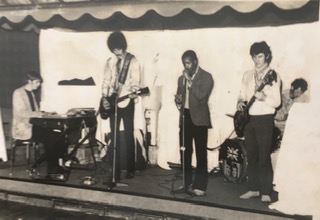
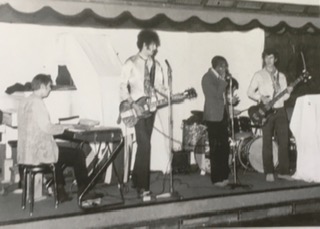
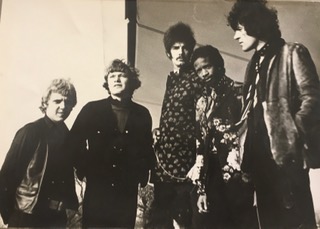
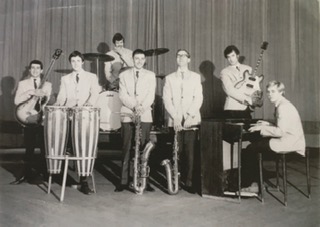
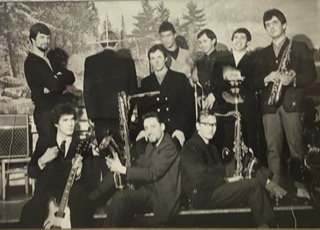
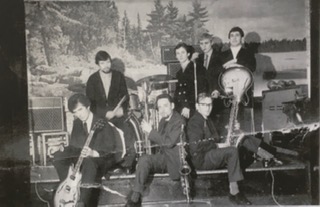
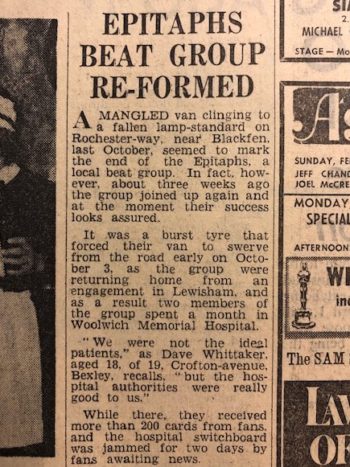
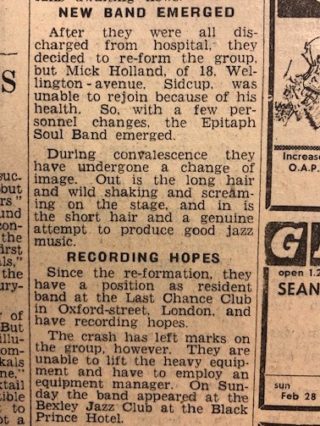
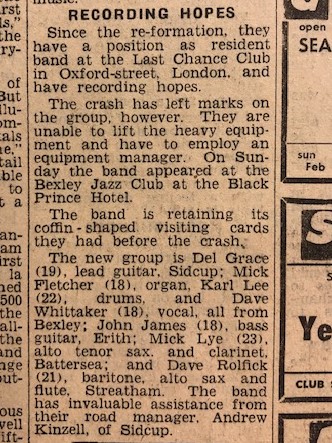
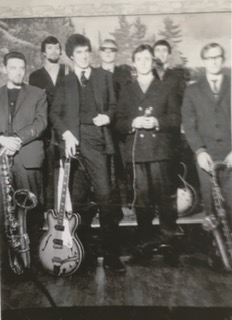
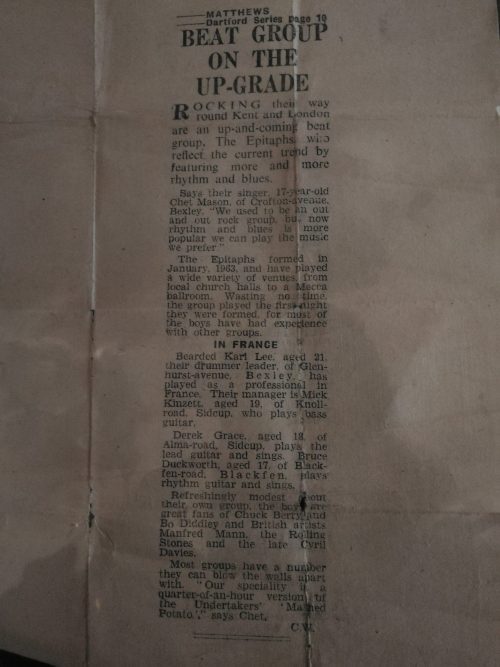
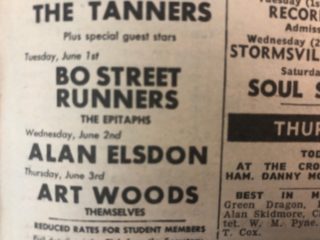
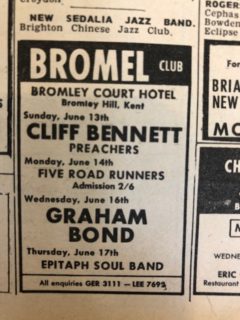
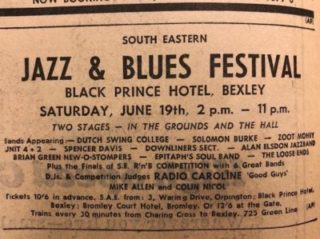
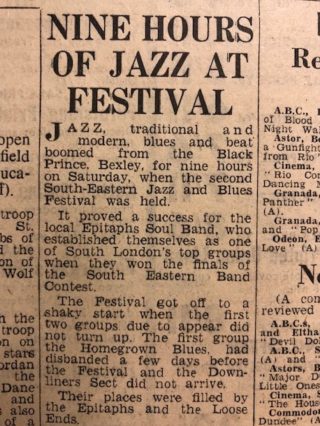
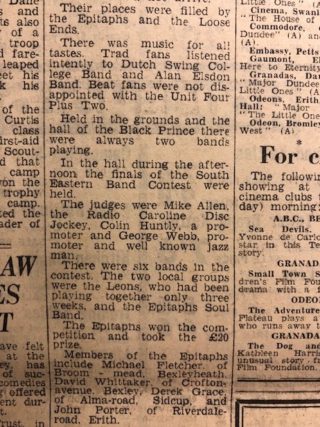
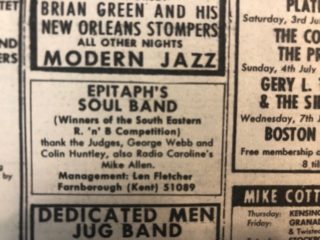
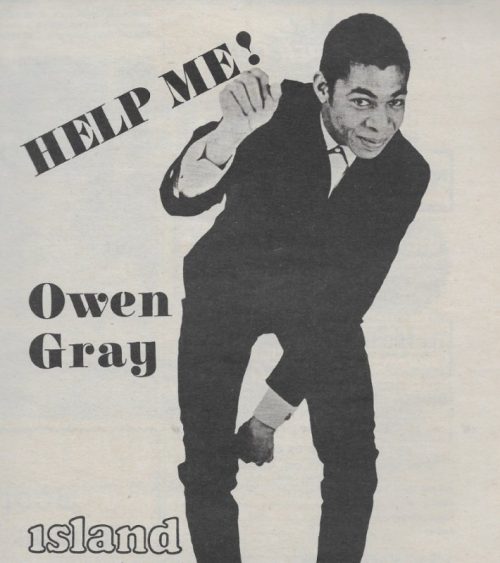
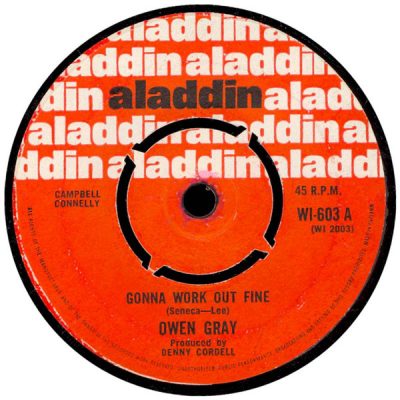
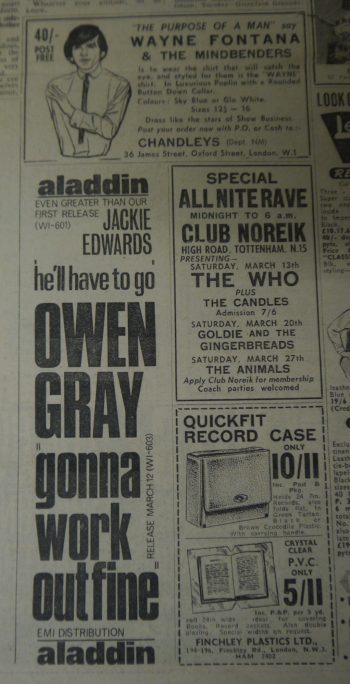
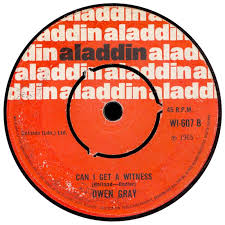
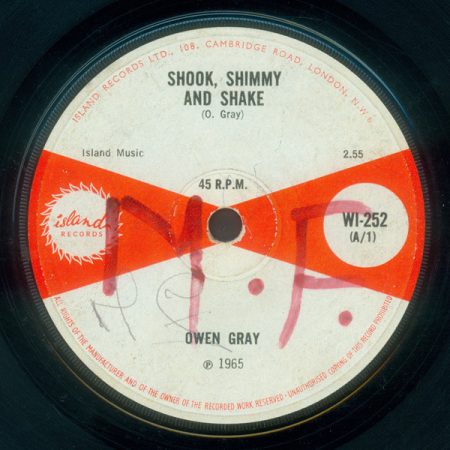
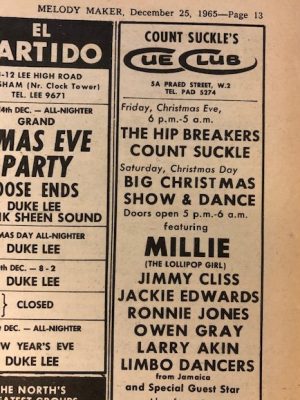
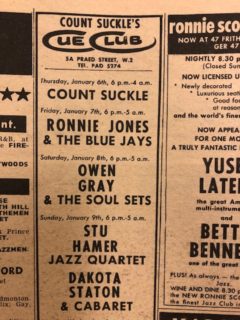
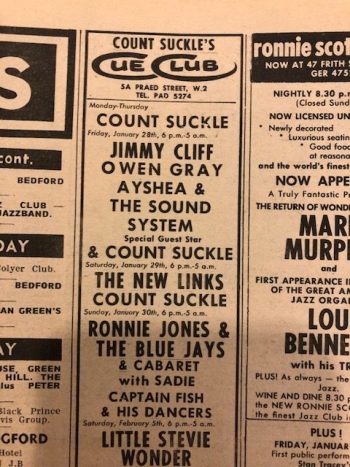
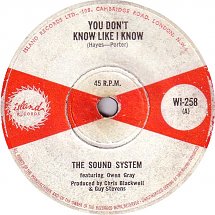
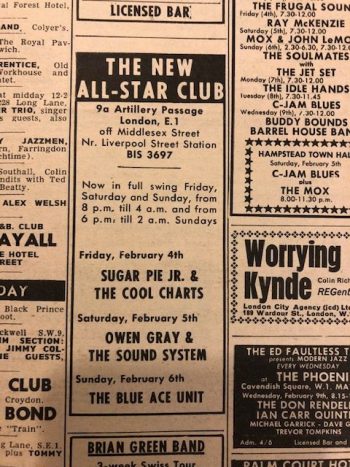
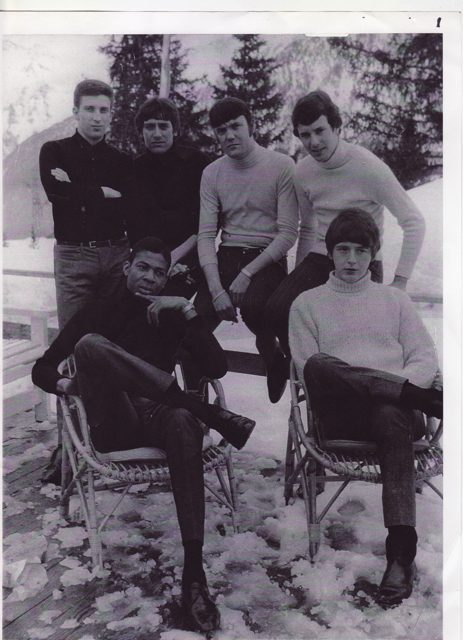
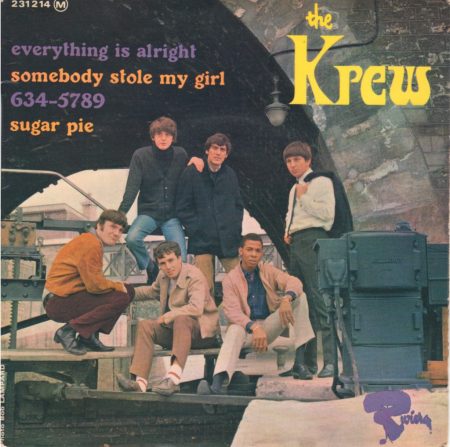
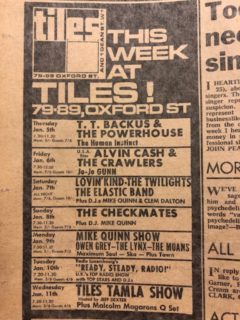
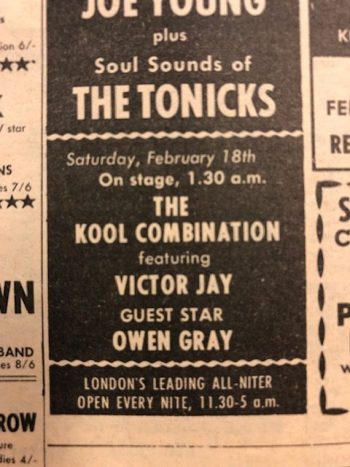
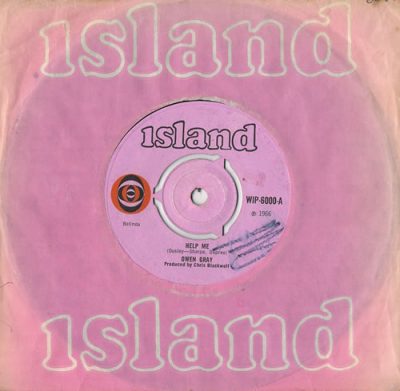
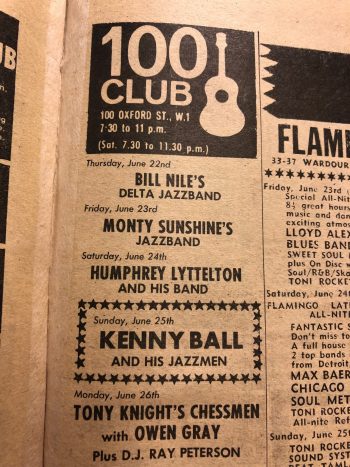
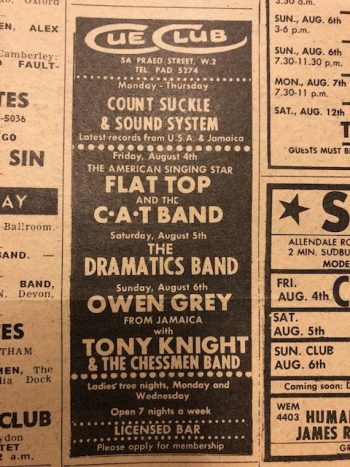
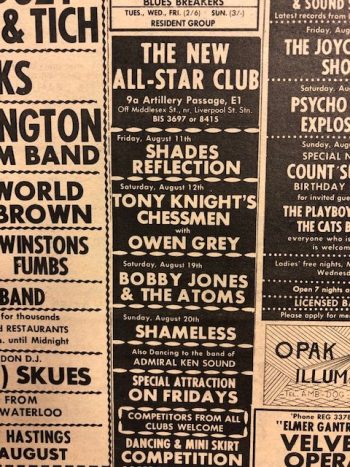
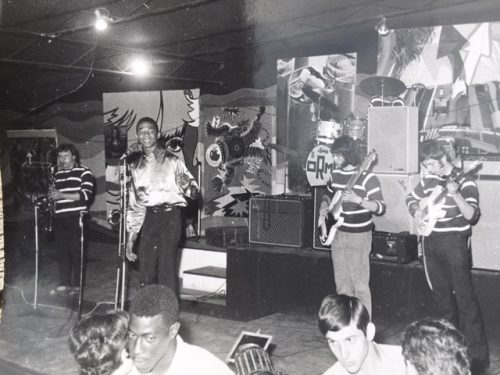
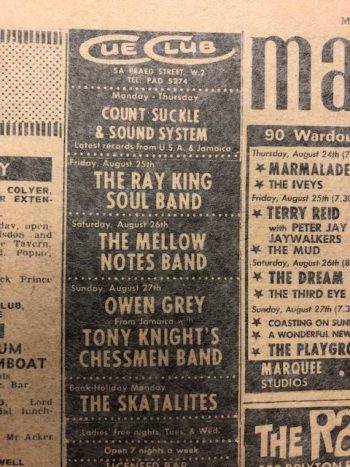
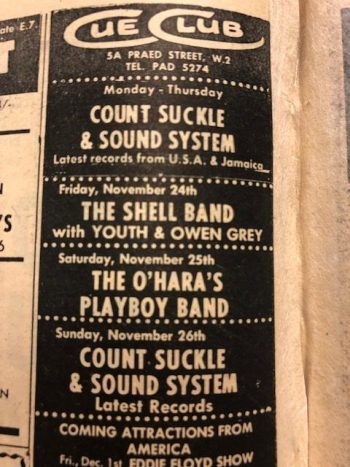
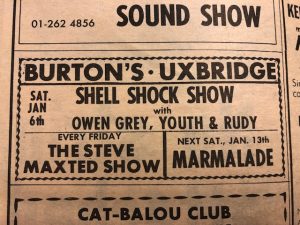
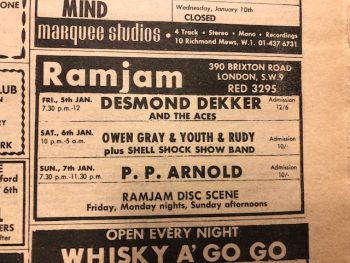
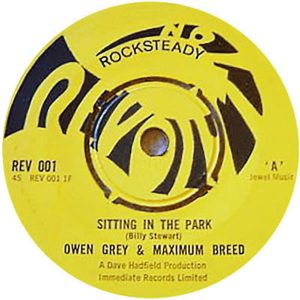
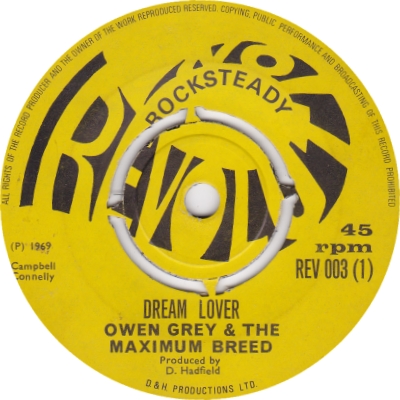
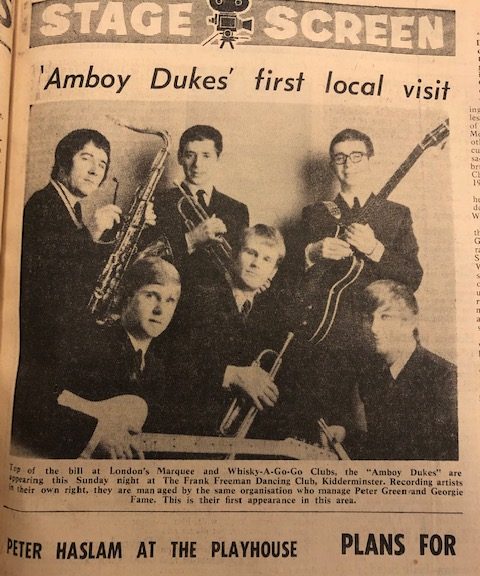
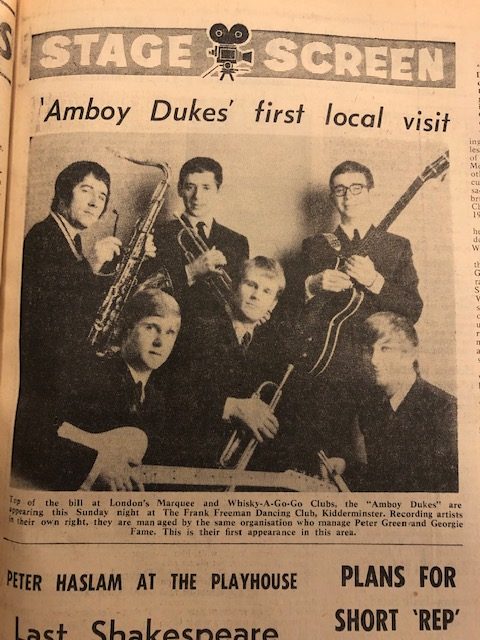
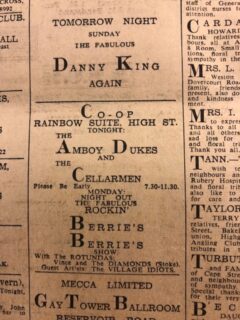
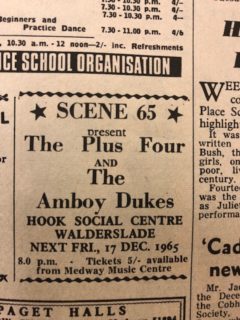
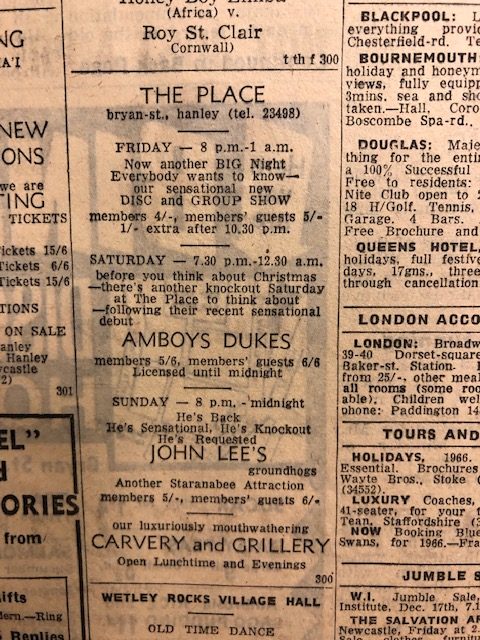
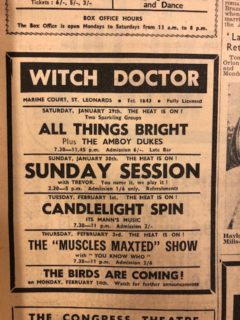
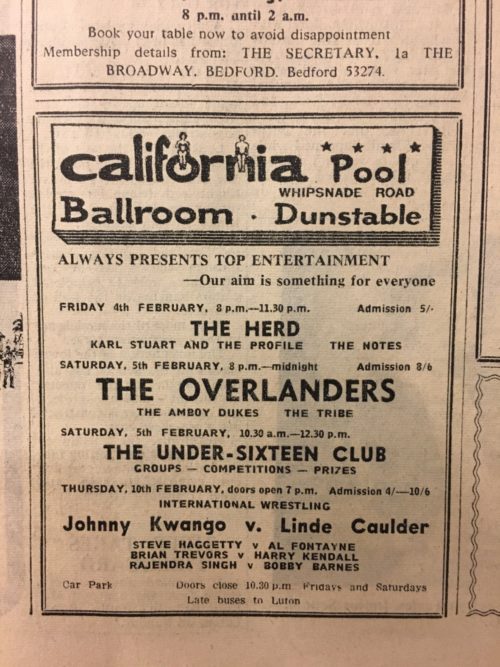
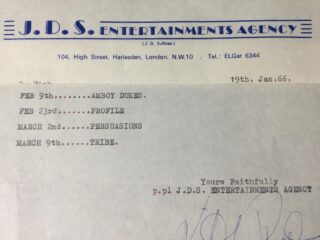
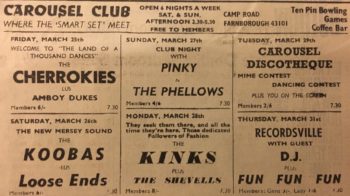
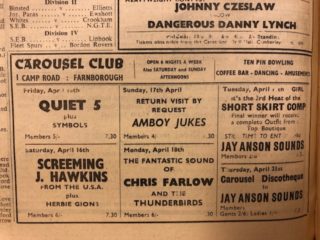
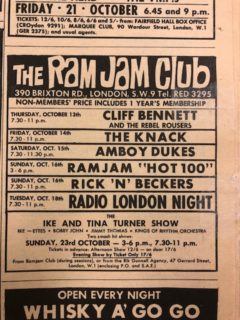
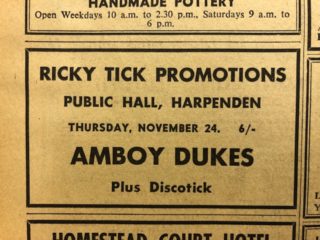
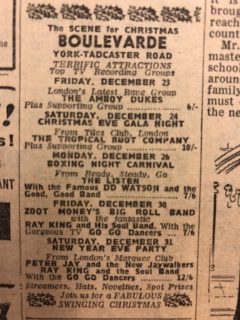
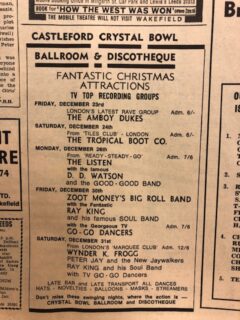
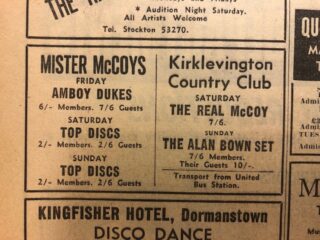
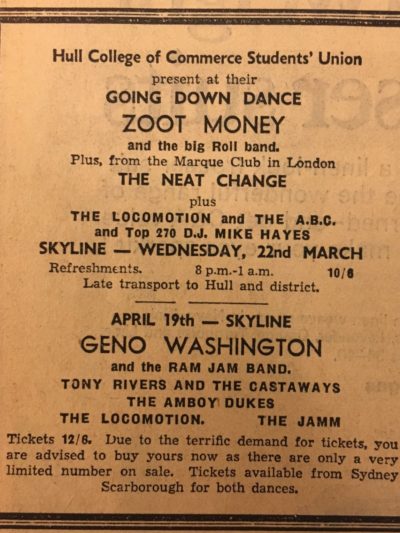
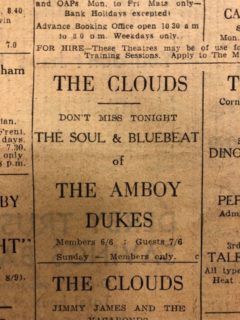
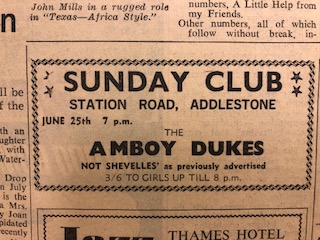
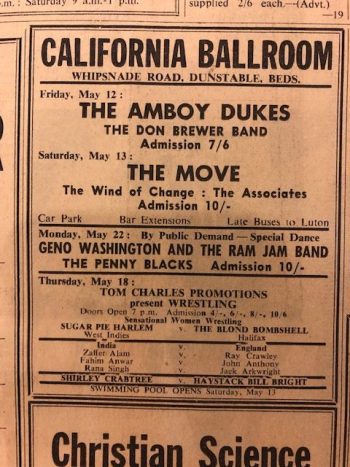
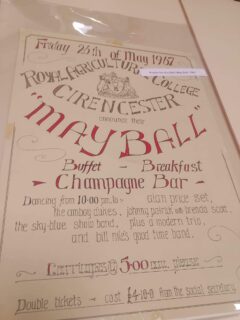
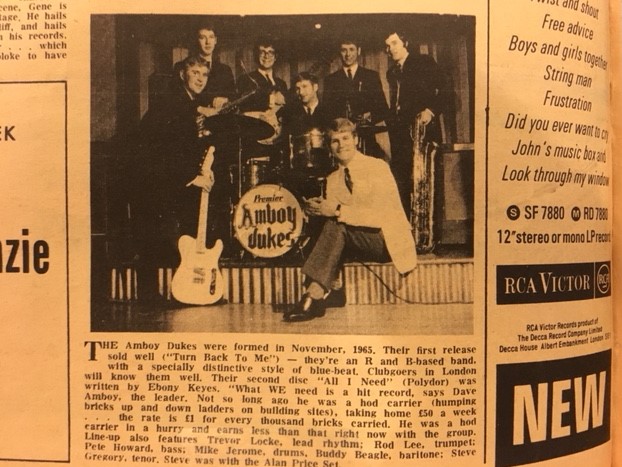
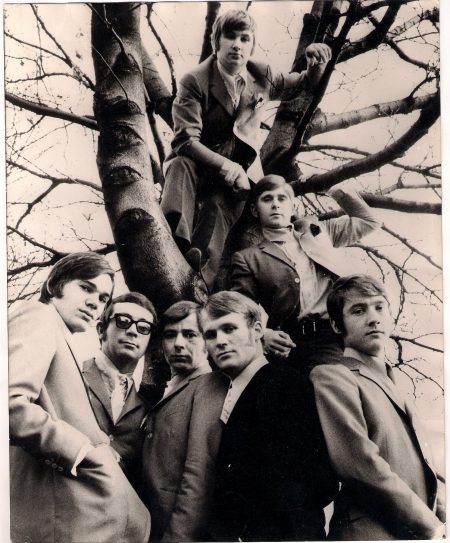
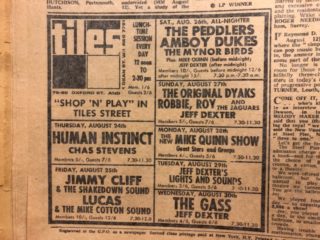
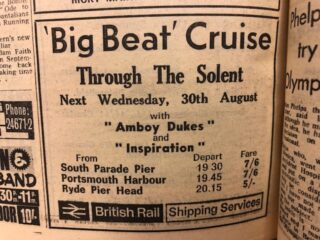
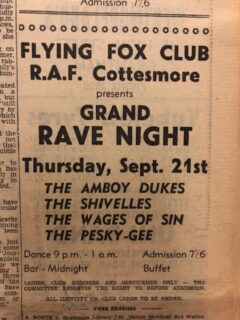
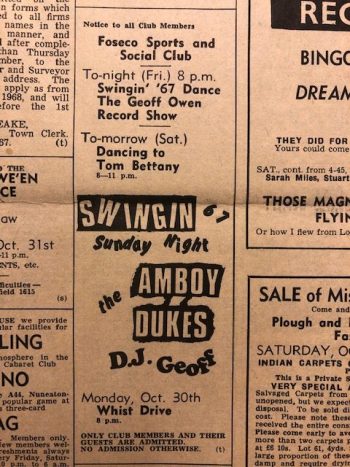
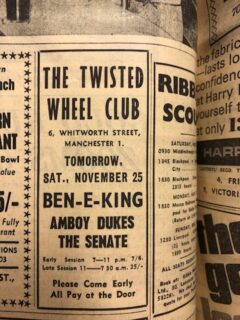
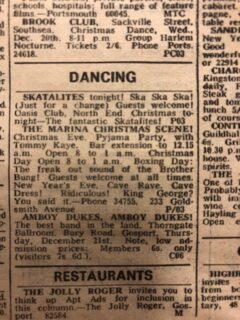
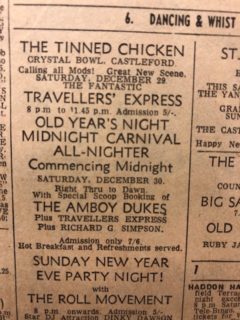
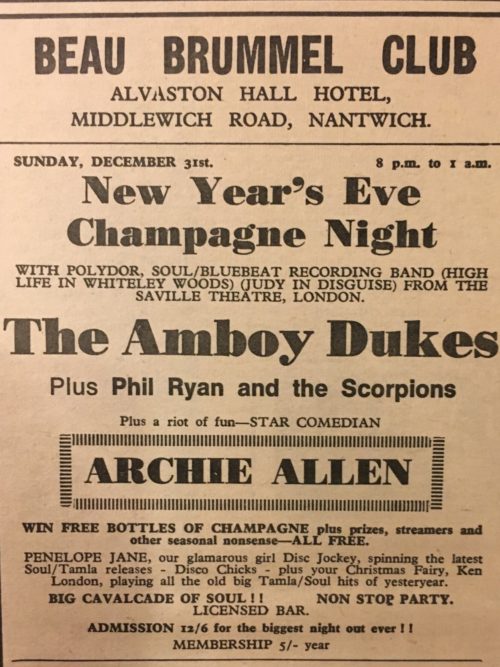
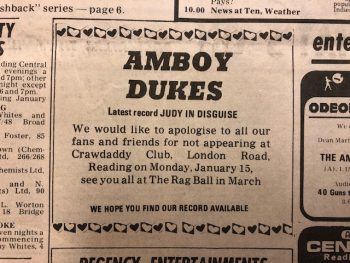
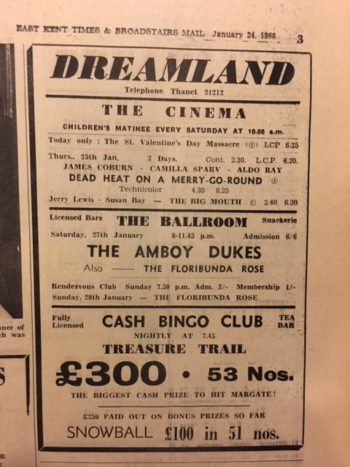
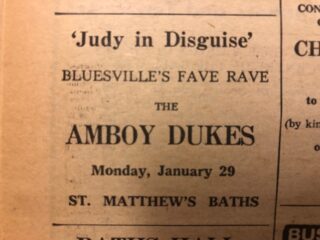
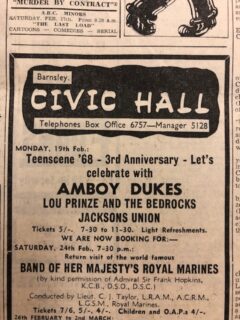
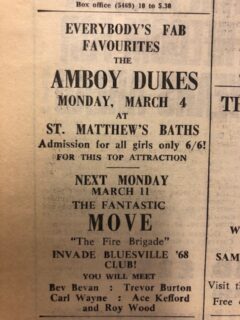
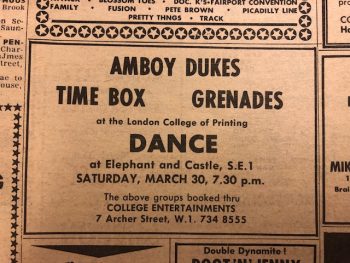
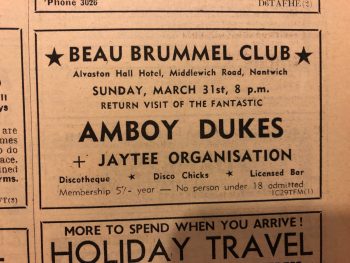
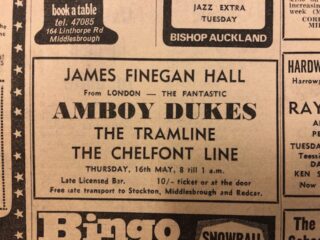
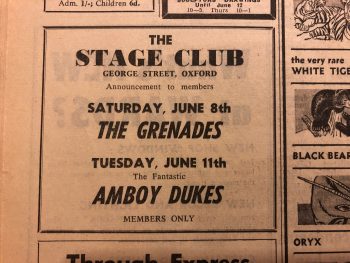
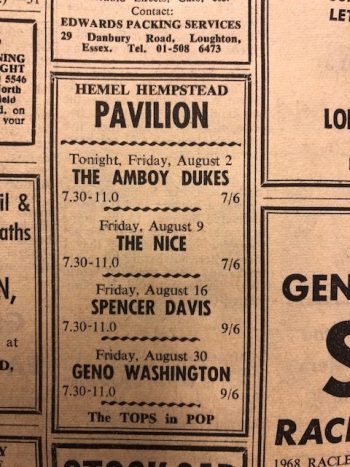
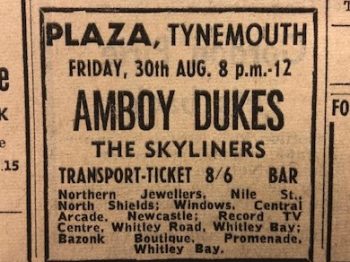
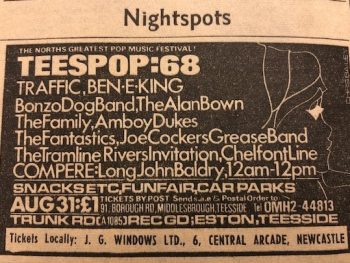
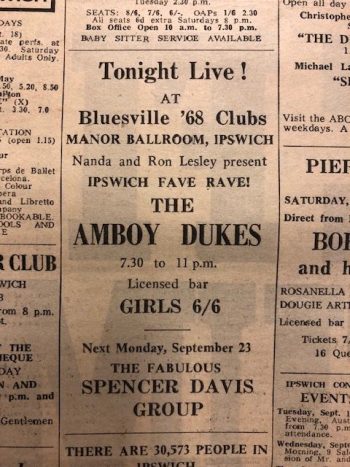
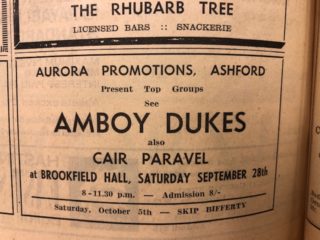
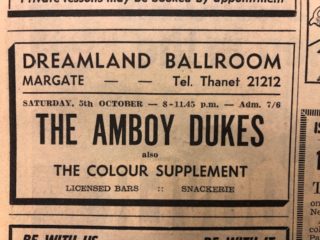
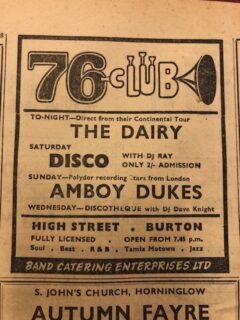
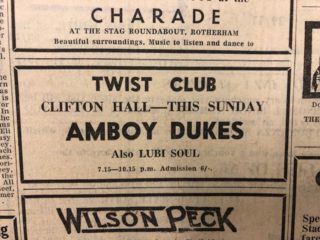
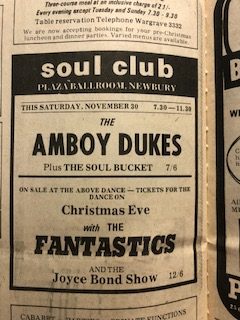
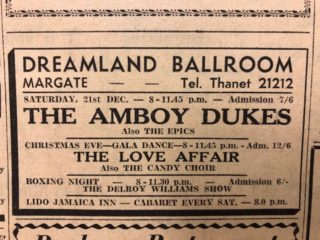
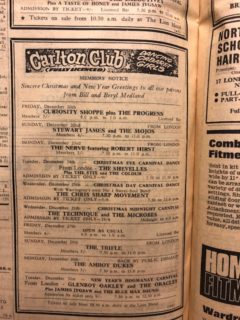
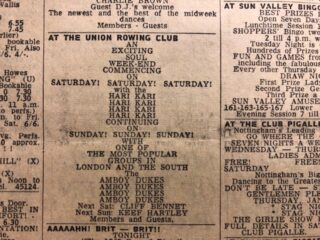
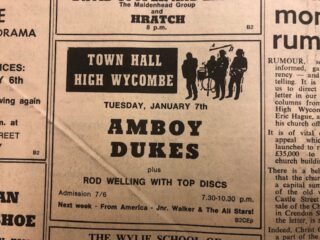
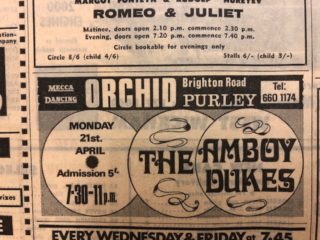
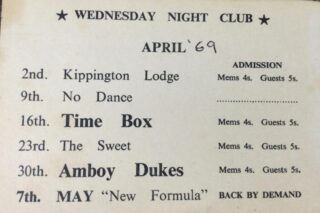
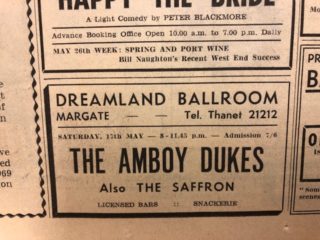
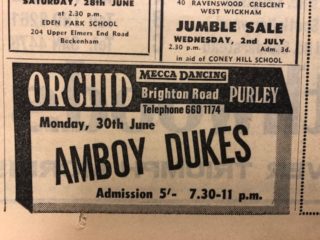
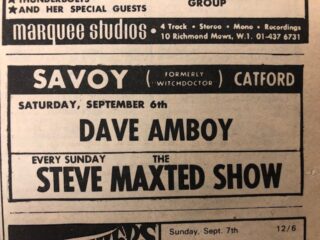
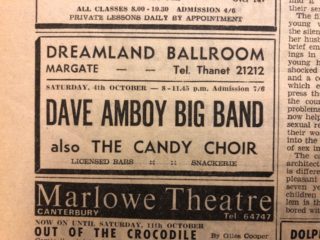
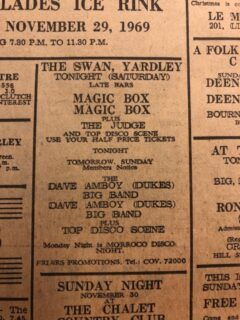
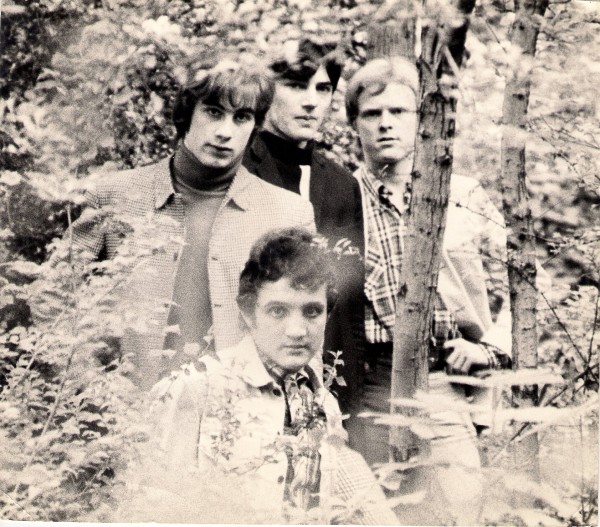
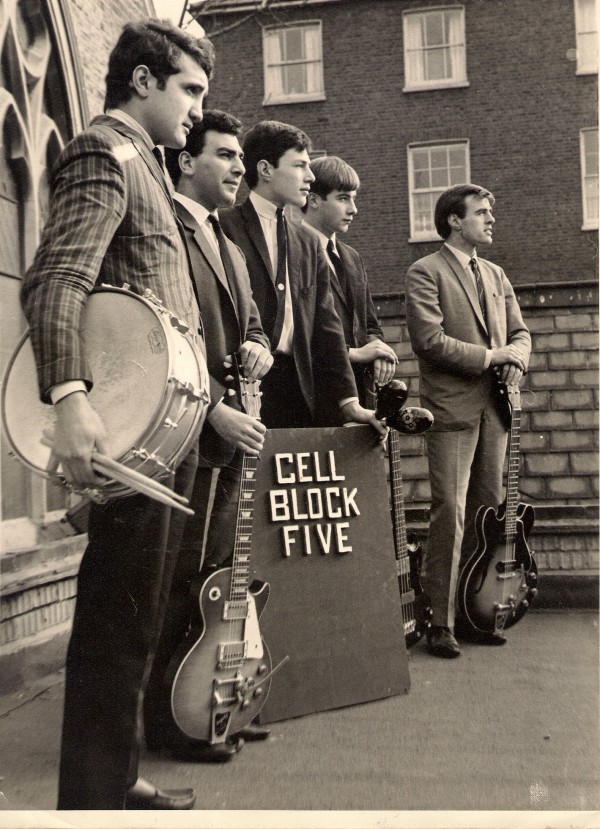
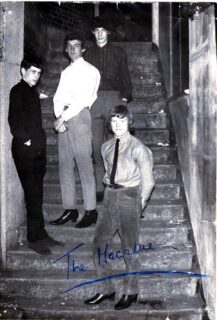
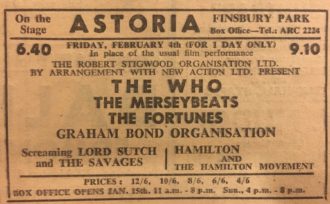 The following month, on 11-12 March, the musicians found themselves on the campus of Essex University in Colchester where a number of bands, including the up and coming Pink Floyd were entertaining the students.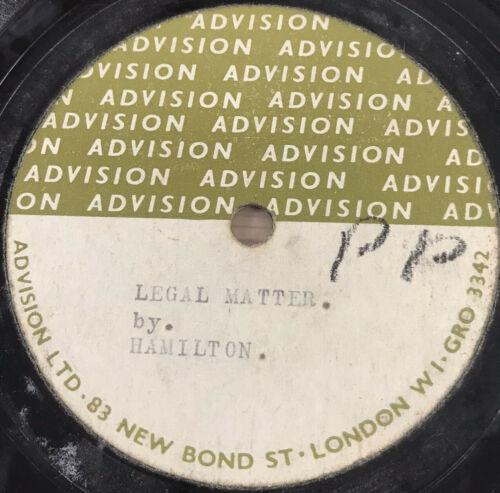
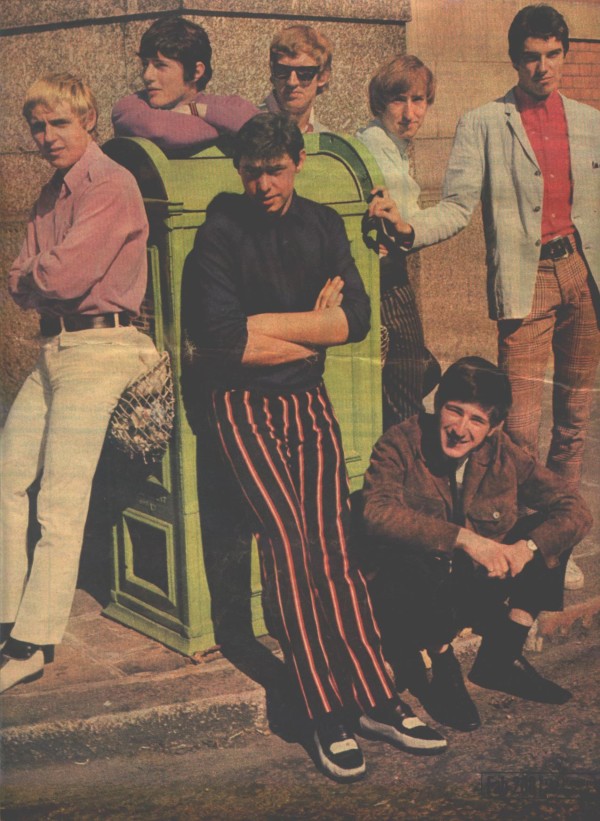
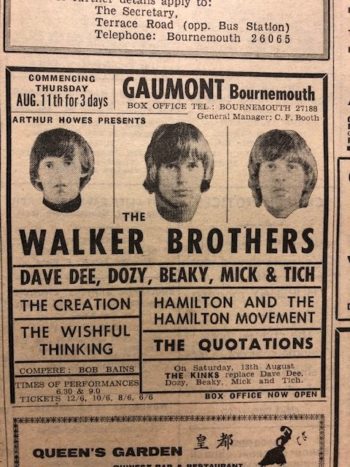
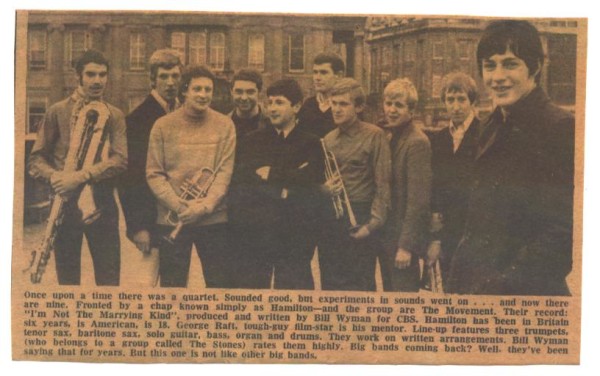
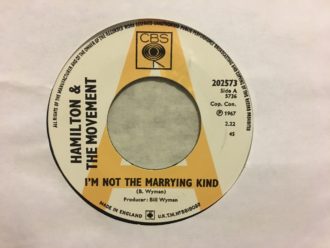 However, despite having supported The Who at Leeds University on 21 January and then making a notable appearance at the Saville Theatre opening for Chuck Berry and Del Shannon on 19 February, the single’s commercial failure prompted the backers to drastically reduce the group’s bookings.