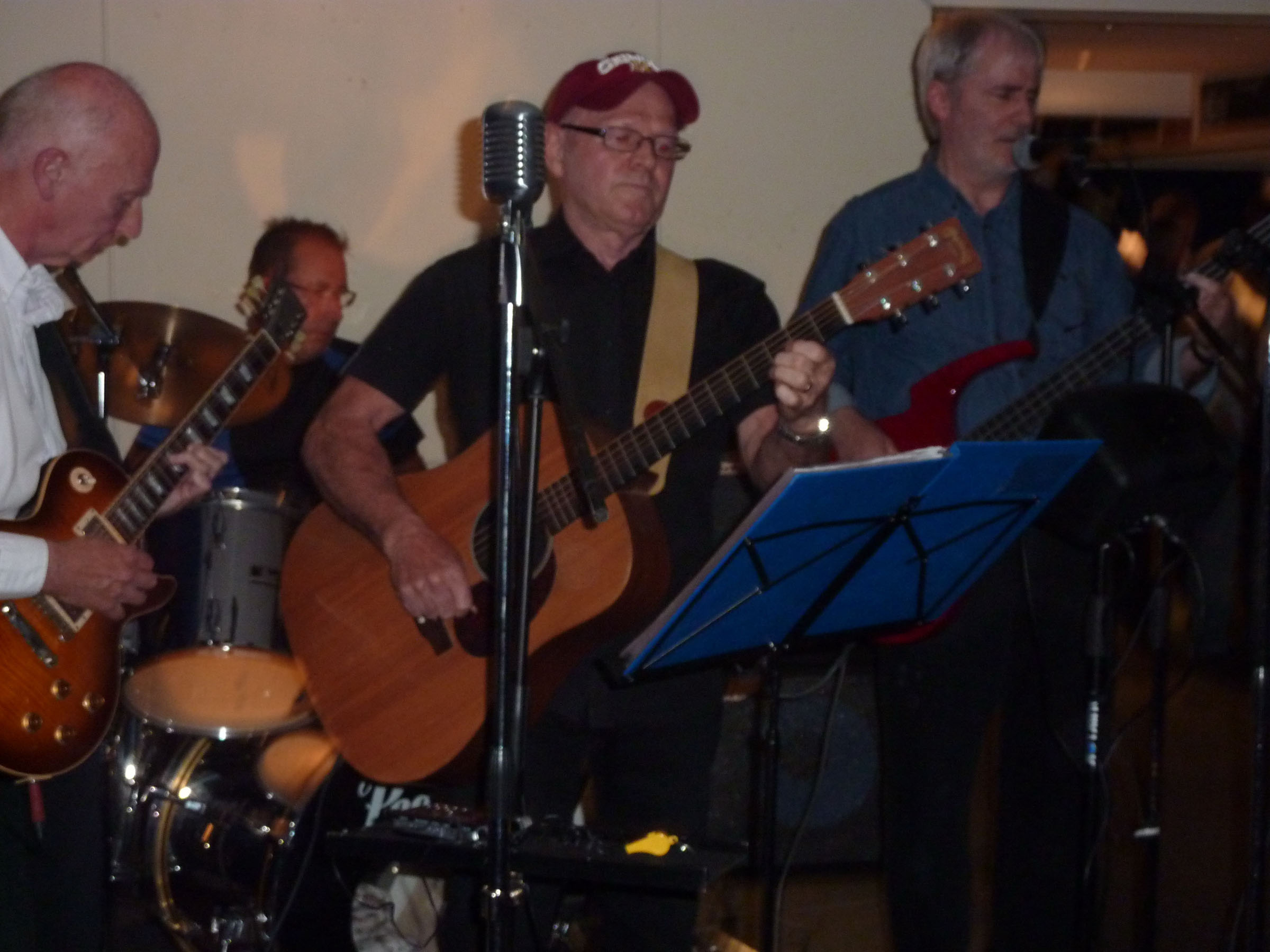
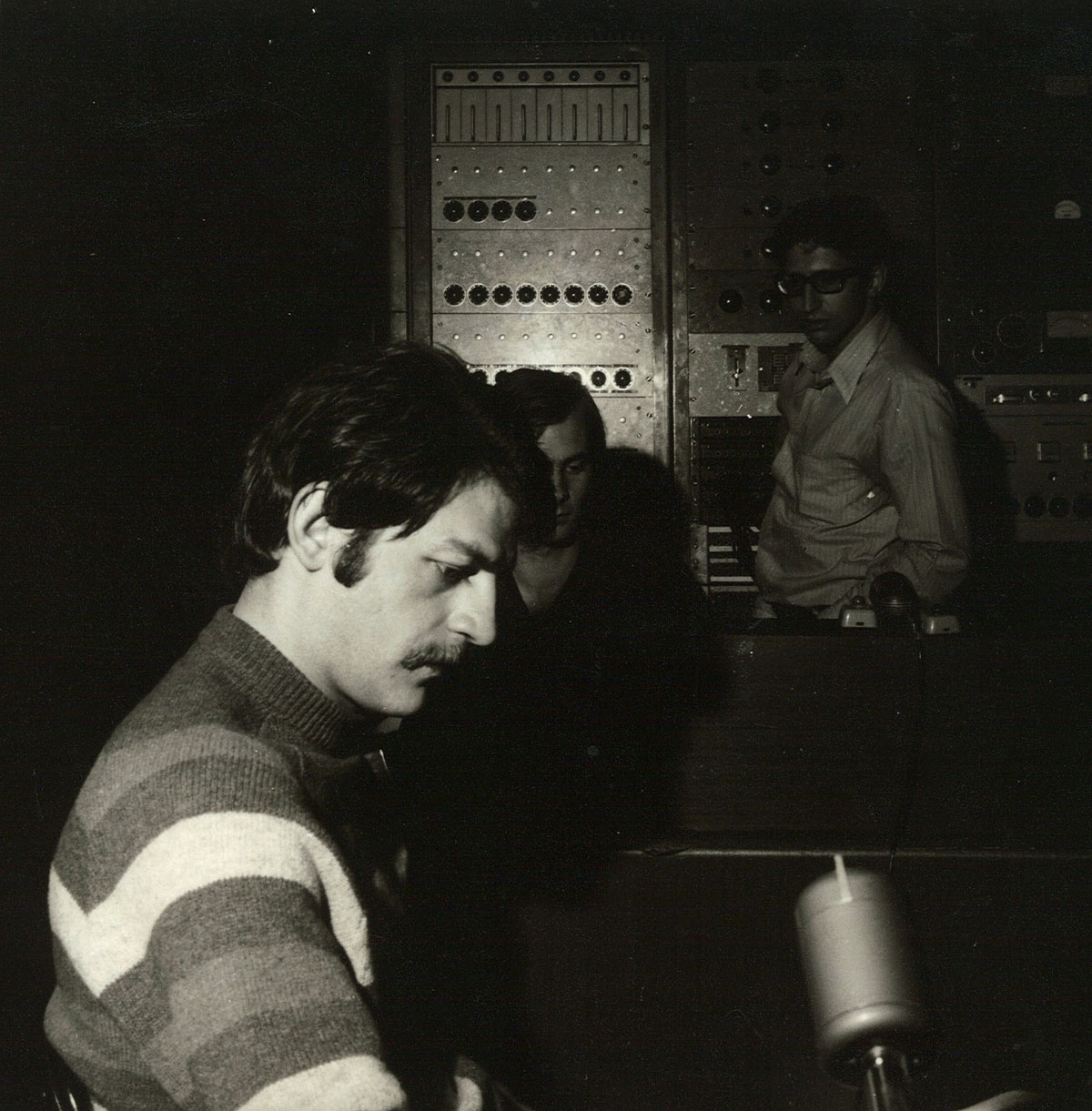
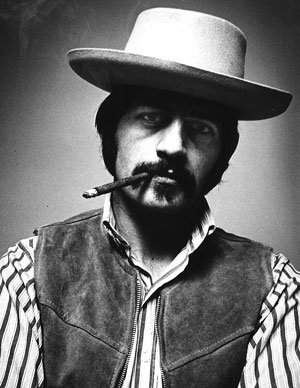
Milkwood, summer 1969. Left to right: Ron Frankel, Jack Geisinger, Louis McKelvey, Mary Lou Gauthier and Malcolm Tomlinson. Photo: Rosemary White
Mary Lou Gauthier (Lead vocals)
Louis McKelvey (Guitar, Vocals)
Malcolm Tomlinson (Guitar, Flute, Drums, Lead vocals)
Ron Frankel (Drums)
Ronnie Blackwell (Bass)
+
Jack Geisinger (Bass, Vocals)
This fascinating Anglo-Canadian group was put together by former Influence and Our Generation member Louis McKelvey (b. 31 October 1943, Killorglin, County Kerry, Republic of Ireland) with ex-King Curtis sideman Ron Frankel (b. April 1947, Montreal, Canada).
Frankel had previously played in The Soul Mates (and with his wife Mary Lou Gauthier) in the lounge band, Five of a Kind, who also featured Brian Wray, Brian Edwards and Freddie Gilbert. According to the Montreal Star‘s 7 November 1967 issue, page 4, Five of a Kind played at the King’s Inn in Freeport, the Bahamas that week.
They then joined King Curtis & The King Pins in 1968. (Ed: McKelvey may have met Frankel at the Hawk’s Nest on 23 July 1968 when King Curtis & The King Pins played there).
McKelvey approached Frankel and Gauthier about putting a new band together in September 1968 after leaving Influence, but the group didn’t form properly until early March 1969.
During the interim, McKelvey returned to England for around five months and reunited with his old friend Malcolm Tomlinson (b. 16 June 1946, Isleworth, Middlesex, England), from the early 1960s west London band Jeff Curtis & The Flames.
Jeff Curtis & The Flames, London, 1963. Louis McKelvey (far left) and Malcolm Tomlinson (drums). Photo: Dave Wigginton
Tomlinson was currently playing with Gethsemane (featuring future Jethro Tull guitarist Martin Barre), and had done a BBC radio session with Elton John in October 1968.
McKelvey and Tomlinson both auditioned for the guitar position in Jethro Tull, but when Barre was offered the place and Gethsemane split up, Tomlinson returned to Toronto with McKelvey around March 1969 to put together Milkwood.
Adding ex-Five Bells bass player Ron Blackwell (b. 27 July 1948, Montreal, Canada), the band played at the Penny Farthing in Toronto in early May. They also played regularly at the Electric Circus.
The band sent a four-track demo to Polydor Records around this time and, according to Billboard, the label signed the band before it had played a single show.
Left to right: Ron Frankel, Jack Geisinger, Louis McKelvey, Mary Lou Gauthier and Malcolm Tomlinson
In mid-June 1969, former Influence member Jack Geisinger (b. March 1945, Czech Republic) joined replacing Ronnie Blackwell in time for sessions at the Hit Factory in New York.
Kicking off on 20 June, the week-long sessions were overseen by famous producer and song-writer Jerry Ragavoy who produced the LP and also played piano on some tracks.
Cashbox, 28 June 1969
While in New York, the band took part in the Polydor Benefit gig at the Village Gate with Dutch band, The Golden Earring on 23 June.
Sessions were completed in July. Members of The Band were at the Hit Factory when the group cut “There’s A Man” and complimented Mary Lou Gauthier on her vocals.
RPM Weekly, 28 July 1969
Back in Toronto, the band signed to the Frederick Lewis booking agency and embarked on Canadian dates.
Meanwhile, the LP was slated for release in September to coincide with an American tour, which never happened.
A disagreement between Milkwood’s manager and Polydor resulted in the LP being shelved. In November 1969 the group split up.
The band’s greatest claim to fame is that it appeared at Toronto’s Rock ‘N’ Roll Revival concert on 13 September. Although the group wasn’t billed, they performed just before John Lennon & The Plastic Ono Band, according to roadie Dave Mandel.
McKelvey and Tomlinson (and later Geisinger) stuck together to work in Damage during 1969-1970.
McKelvey also briefly worked with Powerhouse in late 1970, before retiring from the music business.
Tomlinson later recorded with Rick James and Bearfoot and issued two solo LPs. Geisinger played with Charlee and Moonquake among others.
Frankel later did sessions for Jesse Winchester while Mary Lou Gauthier recorded a solo single, “In The Summertime” c/w “Come Run” for Polydor and later sang with Celine Dion at Caesar’s Palace in Las Vegas. Blackwell is a computer consultant and lives in Las Vegas.
Thanks to Carny Corbett for the supplying the image
Malcolm Tomlinson died in April 2016. Louis McKelvey died in November 2017 and Jack Geisinger has also passed away.
Advertised gigs
3 May 1969 – Penny Farthing, Toronto (possibly when Jimi Hendrix dropped in to listen)
25 May 1969 – Rock Pile, Toronto with Kensington Market, Grand Funk Railroad and Leather
June 1969 – Electric Circus, Toronto (this is where Rubbott Management spotted them)
21 June 1969 – Rock Pile, Toronto with Brother Brent
Record World, 28 June 1969
23 June 1969 – Village Gate, New York with The Golden Earring
18 August 1969 – Penny Farthing, Toronto (Led Zeppelin played this night at the Rock Pile and Robert Plant and John Bonham dropped in at the club afterwards)
13 September 1969 – Toronto Rock ‘N’ Roll Revival, Varsity Stadium with John Lennon & The Plastic Ono Band, Gene Vincent, Alice Cooper and many others
19 September 1969 – York University, Toronto with Teegarden and Vanwinkle
11 October 1969 – Electric Circus, Toronto
17 October 1969 – The Hawk’s Nest, Toronto
21 October 1969 – Van Morrison at Le Hibou This may be evening that Mary Lou and Malcolm jumped up on stage
14-29 November 1969 – Laugh-In, Montreal, Canada
Many thanks to Louis McKelvey, Mary Lou Gauthier, Ron Frankel, Ronnie Blackwell, David Mandel, Malcolm Tomlinson and Jack Geisinger for information.
Toronto gigs were taken from the After Four section of the Toronto Telegram. Also Ottawa Citizen and Montreal Star
From left to right: Keith McKie, unknown female singer, Donna Warner, Cathy Young, Orpheus and Jay Telfer at the piano.
Toronto singer/songwriter and multi-instrumentalist Jay Telfer is arguably best known for his work with 1960s rock group, A Passing Fancy, and for penning Steel River’s hit, “Ten Pound Note”.
Starting out with folk group, The Voyageurs at the age of 14, Telfer befriended future Bruce Cockburn manager Bernie Finkelstein, who was responsible for bringing the promising singer/songwriter into the ranks of The Dimensions and renaming the band, A Passing Fancy in 1965.
Fast-forward four years to spring 1969. Telfer has moved on from A Passing Fancy and composed some intriguing new songs. He approaches Finkelstein with the exciting new material and his old friend expresses an interest in producing an album, inviting into the sessions a diverse mix of musicians from the Toronto scene.
These include members of Kensington Market (managed by Finkelstein), a young Danny McBride years before he played lead guitar with Chris De Burgh and the Anglo-Canadian group Milkwood, including multi-instrumentalist Malcolm Tomlinson, who’d recently arrived in Toronto from London after working with a pre-Jethro Tull Martin Barre for two years.
As Telfer recalls, the musicians had a ton of fun doing the album, but when it came to selling it, Finkelstein asked the late Felix Pappalardi, who’d produced Kensington Market, but was turned down. The album was never mentioned again and Telfer lost his copies of the tapes. Over the years, Finkelstein also lost his.
As luck would have it, former A Passing Fancy member Fergus Hambleton salvaged some old tapes from his brother Greg’s driveway as they were being put out with the rubbish.
Jay Telfer article in the Toronto Star
Among those tapes was Greg’s copy of “Perch”, Telfer’s unreleased album from 1969. In total, there are 10 tracks waiting to be heard. The titles and the personnel on each track are as follows and I’d personally like to thank Jay for sharing these with me before he died.
ANYTHING MORE THAN YOUR SMILE
Jay Telfer – guitar, lead and backing vocals
Keith McKie – second guitar
Jimmy Watson – drums
John Mills Cockell – synth
I WRITE YOUR NAME ON THE WALL
Jay Telfer – guitar, bar stool, organ, lead and backing vocals
Murray McLaughlan – second lead guitar
WAR BABY (BABY)
Jay Telfer – guitar, vocals
Keith McKie – electric guitar
Ronnie Blackwell – bass
Malcolm Tomlinson – drums
Fergus Hambleton – saxophone
NUMER ONE HUM
Jay Telfer – electric guitar, piano, electric piano, vibraphone, drums, bass, lead and backing vocals
REVELATION (AKA I FELL IN LOVE)
Jay Telfer – guitar, vocals
Danny McBride – electric guitar
Phillip Jalsevec – piano
DOLDRUM
Jay Telfer – guitar, vocals
Igor Romanyk – violin
Heavanly Host Rentals – see chorus below.
TO ALL
Jay Telfer – guitar, vocals
Malcolm Tomlinson – flute
Rick Lyon – drums
WASHED DOWN
Jay Telfer – guitar, vocals
Louis McKelvey – electric guitar
Alex Darou – bass
Malcolm Tomlinson – drums
SUZIE
Jay Telfer – piano, drums, guitar, vocals
Ronnie Blackwell – bass
Fergus Hambleton – clarinet
GLOW
Jay Telfer – guitar, vocals
Murray McLauchlan – second guitar
Ray Bennett – harmonica
Donna Warner – backing vocals
Orpheus – backing vocals
Cathy Young – backing vocals
Keith McKie – backing vocals
Sydney – backing vocals
Perch is a lost gem from the Toronto scene and awaiting discovery. Anyone interested in finding out more about this recording, should contact the author at Warchive@aol.com
Jeff Curtis & the Flames, circa spring 1963. From left to right: Malcolm Randall, Louis McKelvey, Dave Wigginton, Keith Gardiner, Malcolm Tomlinson and Jeff Curtis
Revised February 2018
Jeff Curtis & The Flames #1 (circa May 1961-May 1962)
Jeff Curtis – lead vocals
Mick Cartwright – lead guitar
Robin “Jesse” James – rhythm guitar
Gary Wheeler – bass
Derek “Dell” Saville – drums
Twickenham born insurance salesman Jeff Curtis (born David Myers; 20 June 1940) had ambitions to be a singer/performer and reportedly put together the original Flames around mid-1961 after singing in a choir.
Little is known about the early Flames. However, according to drummer Dell Saville, Curtis approached him to join a version with three Whitton musicians in mid-1961. These comprised lead guitarist Mick Cartwright, rhythm guitarist Robin “Jesse” James and bass player Gary Wheeler. Curtis ran a short-lived club, the JC Rock Club in the New British Legion Hall on Long Lane, Hillingdon Circus and the musicians played there often, debuting on 26 July 1961. Around May 1962, however, the musicians went their separate ways and Saville joined Ray Dell & The Rocking Deacons. James joined The Downliners briefly.
Advert in Uxbridge Post, 8 November 1961
Curtis started to piece together a new version of The Flames in late 1962/early 1963, starting with Hounslow-based bass player Dave Wigginton (b. 25 February 1943, Isleworth, Middlesex), who held a senior position at an import/export warehouse at London (later Heathrow) Airport during the day, and was working with Twickenham outfit, Johnny & The Pursuers, who played at the JC Rock Club. Thanks to Wigginton’s connections, the new Flames would use the warehouse to rehearse in the evenings. The bass player quickly recommended fellow Pursuers’ guitarist Louis McKelvey (b. 31 October 1943, Killorglin, County Kerry, Eire).
Born above a pub Louis McKelvey came from an artistic background; his mother and father worked in theatre. After boarding at Silverlands House in Chertsey, he attended school in Twickenham, Middlesex, where he was classmates with Don Craine, later of The Downliners Sect fame. McKelvey’s first band was local outfit Johnny & The Pursuers.
Soon after, Curtis recruited rhythm guitarist Keith Gardiner (b. September 1942). In late 1957, when he was 15 years old, Gardiner had befriended 10-year-old drummer John “Mitch” Mitchell at Tudor Rose Youth Club in Southall, Middlesex and had formed a rudimentary band together with guitarist Pete Ross, who subsequently went on to Ealing band, The Flexmen. At the time, Mitchell was attending Jim Marshall’s shop in Hanwell, Middlesex where he was taking drum lessons while Gardiner was taking guitar lessons from top session player, the late Big Jim Sullivan among others.
Wiggington recommended Malcolm Tomlinson (b. 16 June 1946, Isleworth, Middlesex) on drums around December 1962 after seeing him at a local youth club playing with The Panthers. Tomlinson was brought up in Cranford, near London Airport, where his parents worked for British Airways.
A talented musician, who later became a multi-instrumentalist, Tomlinson had attended Spring Grove Grammar School in Isleworth where he was classmates with fellow drummer Mick Underwood, who went on to work with The Outlaws with Ritchie Blackmore among others, and guitarist Tony Bramwell (see later entry). Initially a guitarist, Tomlinson started playing drums in late 1962 and soon proved his natural ability on the kit.
The new formation debuted at Curtis’s Hillingdon club but it soon closed down.
Keith Gardiner says the band opened for The Rolling Stones a couple of times at the Station Hotel in Richmond during February-March 1963 before the club was renamed the Crawdaddy. They also played at the Ealing Club during this period a few times.
Louis McKelvey, Dave Wigginton, Malcolm Tomlinson (partially obscured), Keith Gardiner and Jeff Curtis. Photo: Dave Wigginton
Around March 1963, the musicians completed the new formation with jazz enthusiast, Harrow-on-The-Hill-based sax player Malcolm Randall (b. October 1942, Hendon, Middlesex), who later earned the nickname C B (current bun). Randall’s debut was a gig in Brighton.
Competing with The Rolling Stones, another Ealing Club regular, for local area gigs, Curtis’s band started to travel further afield, including the Whisky A Go Go in Manchester.
During 1963, they backed singer Roly Daniels for a show in Catford in Southeast London.
Wigginton remembers playing a club on Jermyn Street in central London in the early days. He also says the band performed at Chiswick Polytechnic, Wandsworth Polytechnic and Chiswick Town Hall during this period.
After working with a manager who also looked after local group Pete Nelson & The Travellers, Jeff Curtis & The Flames signed to Bob Potter’s agency and started working around the Surrey/Hampshire area, including the Agincourt Ballroom in Camberley.
During this time, they opened for Freddie & The Dreamers at Botwell House in Hayes, Middlesex and Cliff Bennett & The Rebel Rousers at Kew Boathouse among others.
Jeff Curtis & The Flames #2 (Circa December 1962-December 1963)
Jeff Curtis – lead vocals
Louis McKelvey – lead guitar
Keith Gardiner – rhythm guitar, backing vocals
Malcolm Randall – saxophone (joined around March 1963)
Dave Wigginton – bass
Malcolm Tomlinson – drums/backing vocals
Jeff Curtis & The Flames, Walthamstow, north London, January 1963. Interestingly Jeff Curtis is playing the piano. This was before Malcolm Randall joined.
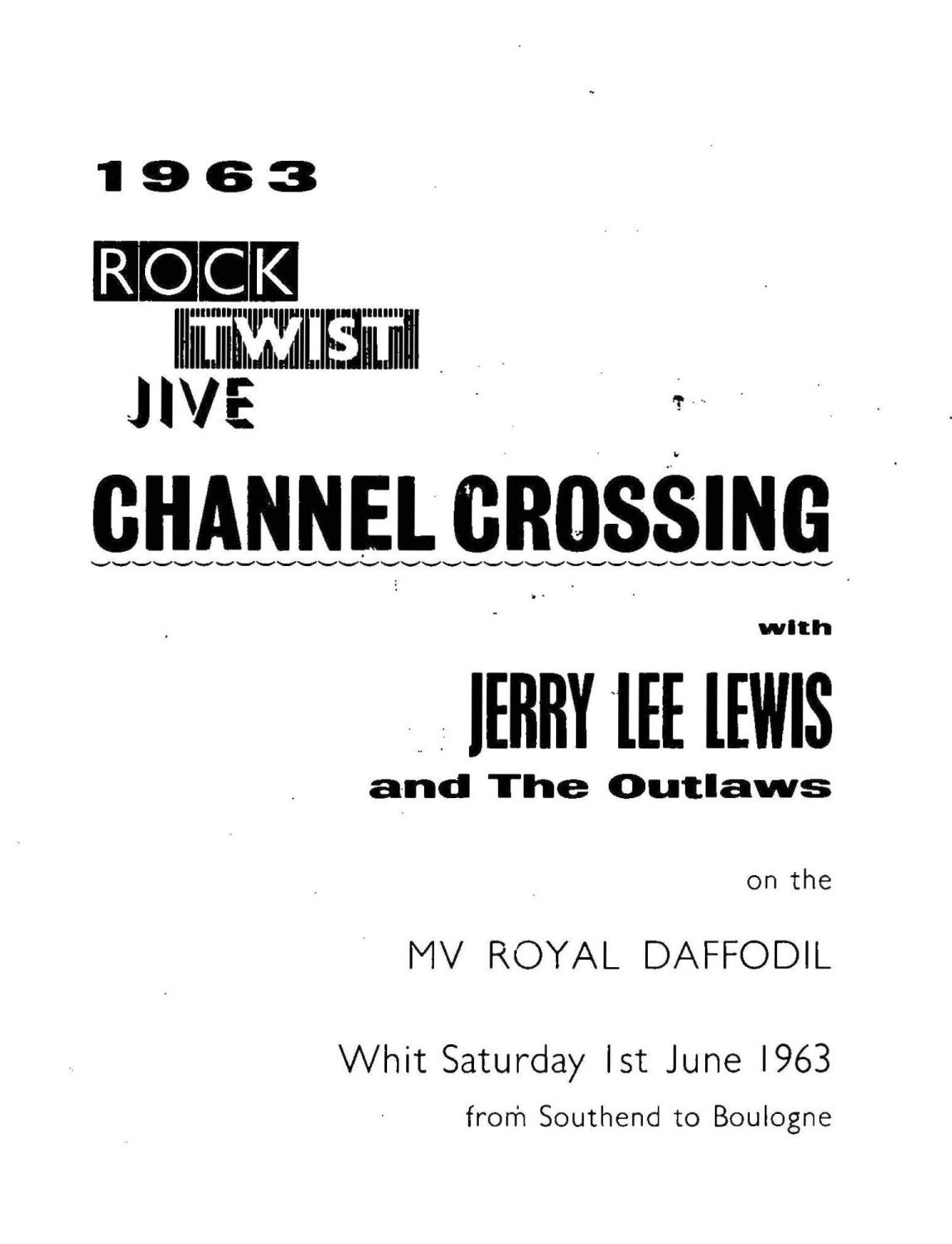
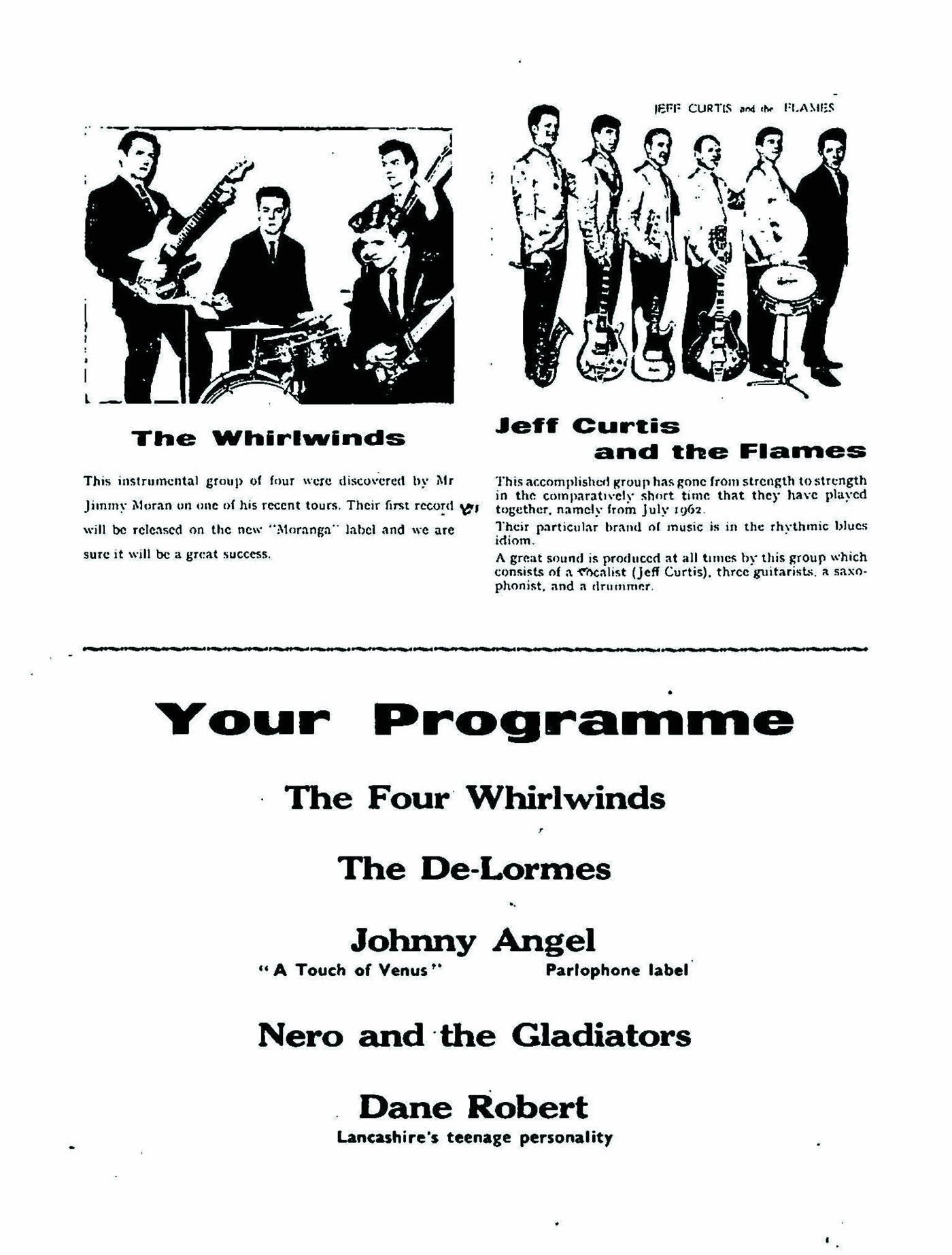
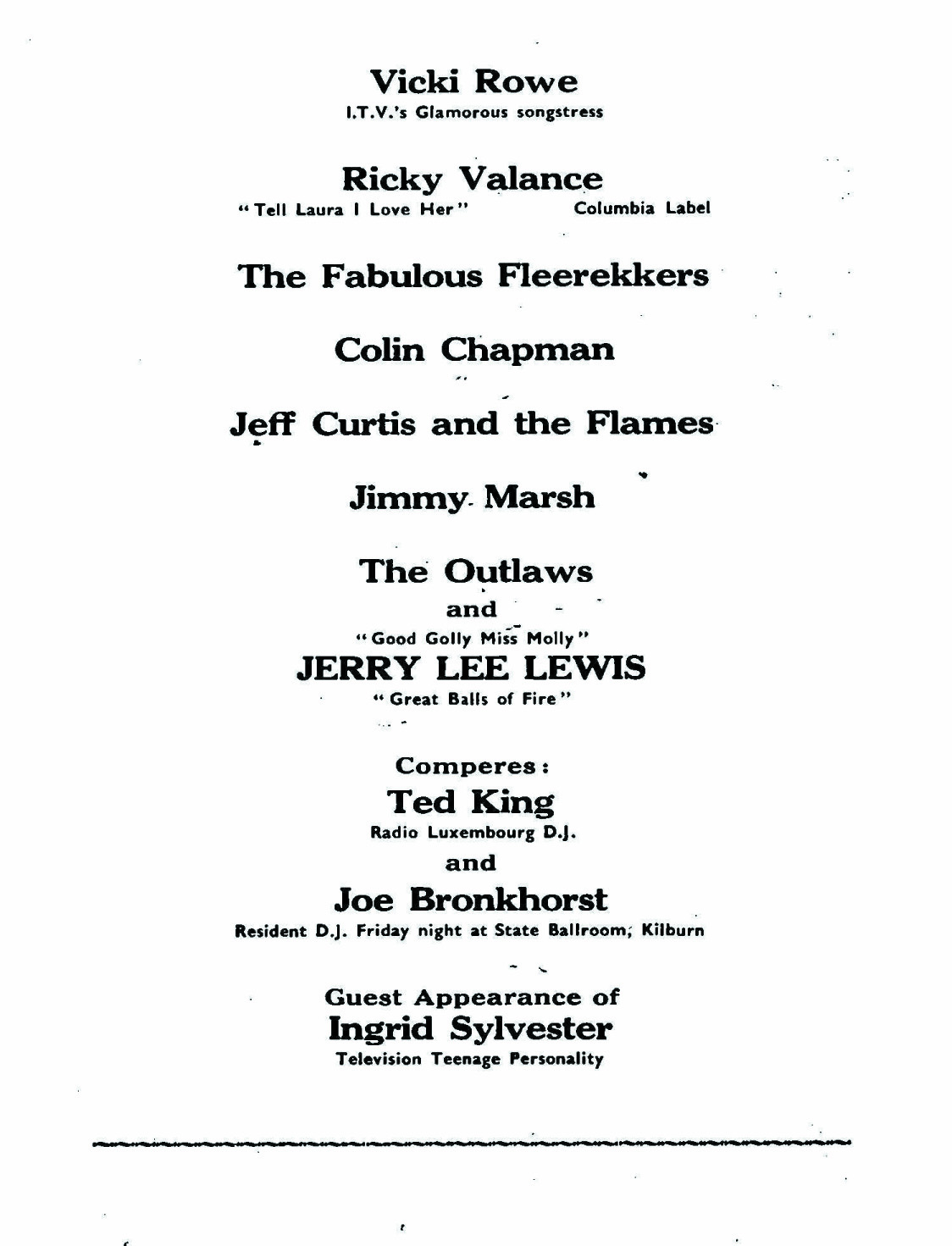
On 1 June 1963, Jeff Curtis & The Flames played their most high-profile gig to date, appearing with a number of local West London bands on the “Rock Twist Jive Channel Crossing”, a rock extravaganza that took place on-board the Channel ferry, the M V Royal Daffodil, which sailed from Southend, Essex to Boulogne. The billing included Tomlinson’s future band leader, Fulham-based singer Jimmy Marsh and his former Spring Grove class mate, Mick Underwood who was playing with The Outlaws and backing the show’s headline act, Jerry Lee Lewis.
Jeff Curtis & the Flames, 1963. Photo courtesy of Keith Gardiner. Left to right: Louis McKelvey, Keith Gardiner, Jeff Curtis, Malcolm Tomlinson, Dave Wigginton and Malcolm RandallJeff Curtis & the Flames, 1963. From left: Keith Gardiner, Louis McKelvey, Malcolm Tomlinson, Malcolm Randall, Dave Wigginton and Jeff Curtis (front)Poster for the Channel Crossing, 1 June 1963. Image courtesy of Keith Gardiner
On 4 October 1963, Jeff Curtis & The Flames were given the opportunity to record some demos. The band (minus Malcolm Randall) cut a four-track acetate at Lansdowne Recording Studios on Lansdowne Road in Holland Park, which comprised covers of Chuck Berry’s “Bye Bye Johnny” and “It Don’t Take But A Few Minutes” (with Lenny Hastings on drums); Robert Allen and Richard Adler’s “Everybody Loves a Lover”; and Bobby Troup’s “Route 66”.
Two tracks were allegedly readied for release as a single for HMV but when this did not happen, Gardiner departed and dropped out of the music scene, although he did briefly sub for Ken Lundgren in The Outlaws at a few gigs.
Years later he formed his own band The Keith Gardiner Band (KGB), which performed around the Shepperton, Middlesex area.
Acid Jazz Records subsequently used one of the recordings for its Rare Mod CD series.
Notable gigs:
Photo: Walthamstow GuardianPhoto: Dave Wigginton. The Flames at Walthamstow Assembly Hall, January 1963
19 January 1963 – Walthamstow Assembly Hall, Walthamstow with The Gallions and Paul & The Alpines (billed as The Flames)
9 March 1963 – Hillingdon Club, Sevenoaks, Kent
Photo: Harrow Observer
20 March 1963 – British Legion Hall, South Harrow, Middlesex
Photo: Surrey Comet
3 May 1963 – St Peter’s Hall, Kingston Upon Thames, Surrey with The Sinners (billed as The Flames) First time in Kingston
Photo: Woking Herald
10 May 1963 – Weybridge Hall, Weybridge, Surrey
1 June 1963 – Rock Twist Jive Channel Crossing with Jerry Lee Lewis & The Outlaws, The Four Whirlwinds, The Del-Lormes, Johnny Angel, Nero & The Gladiators, Dane Robert, Vicki Rowe, Ricky Valance, The Fabulous Fleerekkers, Colin Chapman and Jimmy Marsh
Photo: Surrey Comet
14 June 1963 – St Peter’s Hall, Kingston Upon Thames, Surrey with Tony Clayton & The Impalas (billed as The Fabulous Flames with saxophone backing)
20 July 1963 – Walton Hop, Walton-on-Thames, Surrey
At Silver Blades Ice Rink, The Streatham News, August 2, 1963
2-3 August 1963 – Silver Blades, Streatham, London
28 September 1963 – Agincourt Ballroom, Camberley, Surrey with Allen & The Blue Diamonds (billed as The Flames) According to Keith Gardiner who is in touch with the guitarist from Tommy Bruce’s band, The Flames actually played on 29 September as the opening act
Photo: Walthamstow Guardian
12 October 1963 – Walthamstow Assembly Hall, Walthamstow with Mel James & The Meltones and Jimmy Ritchie Combo (billed erroneously as Jess Curtis & The Flames)
30 November 1963 – Walton Hop, Walton-on-Thames, Surrey
Jeff Curtis & The Flames #3 (December 1963-July 1964)
Jeff Curtis – lead vocals
Louis McKelvey – lead guitar
Ray Soper – organ
Malcolm Randall – saxophone
Dave Wigginton – bass
Malcolm Tomlinson – drums/backing vocals
Jeff Curtis replaced Keith Gardiner with Putney, Surrey-based organist Ray Soper (b. 9 May 1941, Battersea, London), who would play with The Flames on several occasions over the next two years, venturing off to perform with various other local groups. Soper had gone to Sir Walter St John Grammar School in Battersea, south London and started playing classical piano at six years of age. In 1959, when he was 18 years old, Soper began working with local rock groups in the Chelsea area.
Around February 1964, the band did a demo session with Decca Records in West Hampstead but nothing came from it.
After leaving Bob Potter’s agency, Jeff Curtis & The Flames got work with the Roy Tempest agency. The new line up continued to gig widely but Tomlinson started to get bored.
In mid-summer the drummer took up an offer from former Fairlanes lead singer Jimmy Marsh, who he’d met on the cross Channel gig the previous summer, to join his new band, The Del Mar Trio. Tomlinson subsequently went on to play with The Noblemen, The Motivation, The Penny Peeps and Gethsemane before immigrating to Canada in January 1969 and continuing his musical career there. He subsequently worked with the likes of Bill King and Rick James among others and cut two solo albums in the late Seventies.
Notable gigs:
1 February 1964 – Hermitage Ballroom, Hitchin, Herts with The League of Gentlemen and The Dyaks
Photo: Walthamstow Guardian
29 February 1964 – Walthamstow Assembly Hall, Walthamstow with Pat McQueen Combo and The Preachers
Opening for the Rattles, March 14, 1964
14 March 1964 – Starlight Ballroom, Boston Gliderdrome, Lincolnshire with The Rattles (billed as Geoff Curtis & The Flames)
26 March 1964 – Ealing Club, Ealing, Middlesex
2 April 1964 – Ealing Club, Ealing, Middlesex
4 April 1964 – King’s Hall, Aberystwyth, Wales
5 April 1964 – Southall Community Centre, Southall, Middlesex with The Rattles
9 April 1964 – Ealing Club, Ealing, Middlesex
16 April 1964 – Ealing Club, Ealing, Middlesex
23 April 1964 – Ealing Club, Ealing, Middlesex
30 April 1964 – Ealing Club, Ealing, Middlesex
14 May 1964 – Rocky Rivers Top 20 Club, Conservative Club, Bedford
31 May 1964 – Silver Blades, Streatham, London
18 June 1964 – Majestic Ballroom, Luton, Beds with Peter’s Faces
Jeff Curtis & The Flames #4 (July 1964-January 1965)
Jeff Curtis – lead vocals
Louis McKelvey – lead guitar
Malcolm Randall – saxophone
Ray Soper – keyboards (left around September 1964)
Dave Wigginton – bass
Pete Burt – drums
+
Jeff Lake – saxophone (joined around September 1964)
The band’s new drummer was Pete Burt (b. 20 August 1946, Redhill, Surrey), younger brother of Mick Burt, sticks man with Cliff Bennett & The Rebel Rousers, who answered an advert in the music press. Brought up in South Harrow, Middlesex where he attended Roxeth Manor School, Burt had previously played with a non-professional band that started life at Botwell House, Hayes backing singer Robert (Bob) Chambers.
In an amazing twist of fate, the lead guitarist in the band was Tony Bramwell, Pete Burt’s predecessor Malcolm Tomlinson’s former class mate from Spring Grove Grammar School in Isleworth. The band played a couple of gigs before splitting up around mid-1964. Bramwell then went on to play with local bands, The Fantoms, The Fantom Creed, The Sheratons and The Hum Drum Band.
Sometime in August, the band auditioned for Joe Meek for the first time.
Clockwise from bottom left: Dave Wigginton (bass), Malcolm Randall (sax), Pete Burt (drums), Jeff Curtis (vocals), Jeff Lake (sax) and Louis McKelvey (guitar). Photo: Dave Wigginton
Around late September 1964, Ray Soper was sacked and Malcolm Randall introduced his friend, sax player Jeff Lake. Soper immediately found work with Buddy Britten & The Regents alongside future Deep Purple bass player Nick Simper. He would then work with Cyrano & The Bergeracs, where he reunited with Simper in 1965 but would remain on the fringes of The Flames.
Shortly after Jeff Lake’s arrival, the band returned to Lansdowne Recording Studios in October 1964 to record a two-track demo that included a cover of Solomon Burke and Bert Berns’ “Down In The Valley”.
McKelvey, however, was also growing restless and departed in early January 1965. On the afternoon of his wedding day (most likely in June 1965), he headed to Germany to reunite with former Jeff Curtis & The Flames drummer Malcolm Tomlinson, who was working with James Deane & The London Cats. The guitarist gigged with The London Cats for about a month before returning to London.
Then, around September 1965, McKelvey travelled to South Africa and ended up recording with The Upsetters and The A-Cads. In April 1966, The A-Cads moved to the UK to work with producer Mickie Most but when nothing happened, the guitarist moved to Montreal in September. Based in Canada, McKelvey recorded with Our Generation and Influence before returning to the UK in July 1968 briefly.
Back home he reunited with former Jeff Curtis & The Flames drummer Malcolm Tomlinson. The pair relocated to Toronto in January 1969 where they formed Milkwood and recorded an unreleased album with legendary producer, the late Jerry Ragavoy for Polydor Records. McKelvey would subsequently work with Toronto bands, Damage (alongside Tomlinson) and Powerhouse and record with Marble Hall. He currently lives in Toronto.
Notable gigs:
2 July 1964 – Majestic Ballroom, Luton, Beds with The All Stars
2 July 1964 – Winter Gardens Ballroom, Great Yarmouth, Norfolk with Malcolm & The Jetblacks
10 July 1964 – Berkhamsted Town Hall, Berkhamsted, Herts
11 July 1964 – Hermitage Ballroom, Hitchin, Herts with Clouds
18 July 1964 – Marcam Hall, March, Cambridgeshire
1 August 1964 – The Gaiety, Ramsey, Cambridgeshire with The Swinging Sounds
6 August 1964 – Rocky Rivers Top 20 Club, Conservative Club, Bedford, Bedfordshire
20 August 1964 – Winter Gardens Ballroom, Great Yarmouth, Norfolk with The E-Types
29 August 1964 – Hermitage Ballroom, Hitchin, Herts with Kit & The Saracens
8 October 1964 – Majestic Ballroom, Luton, Beds with The Roulettes
5 December 1964 – Hermitage Ballroom, Hitchin, Herts with The Midniters
8 December 1964 – Floral Hall, Gorleston-on-Sea, Norfolk
19 December 1964 – Ealing Club, Ealing, Middlesex with The Hobos
2 January 1965 – St George’s Hall, Exeter, Devon with Roger & The Sabres (billed as The Flames)
3 January 1965 – Majestic Ballroom, Luton, Beds with The Mojos
Jeff Curtis & the Flames, late ’64. From left: Louis McKelvey, Jeff Curtis, Dave Wigginton, Pete Burt (front on drums), Jeff Lake and Malcolm Randall.
Jeff Curtis & The Flames #5 (January-February 1965)
Jeff Curtis – lead vocals
Dave Caralambous (aka Dave Carol) – lead guitar
Jeff Lake – saxophone
Malcolm Randall – saxophone
Dave Wigginton – bass
Pete Burt – drums
Dave Marcus Theos Michael Caralambous aka Dave Carol (b. Dave Charalambous, 14 January 1949, Isleworth, Middlesex) was brought up in nearby Twickenham. His first band was The Drovers, which he joined around 1962 and also included rhythm guitarist Richard Allen and drummer Geoff Coxon, who would feature in The Flames’ history in later years when they changed name to The Kool.
In late 1963, The Drovers changed name to The Smokestacks after lead singer Mike Smith joined and Brian Hosking from Twickenham band, The Legend, joined on bass. The Smokestacks became resident band at the 51 Club in central London. In the summer of 1964, Carol joined Hounslow band, The Valkeries and remained with them until January 1965 when he joined The Flames. He was also in the same class at school as McKelvey’s younger sister. Carol says he made his debut at the Locarno Ballroom in Swindon.
The changes, however, didn’t end there. Sax player Malcolm Randall left in early February and subsequently joined Bognor Regis band Beau Brummell & The Noblemen for about six months. In July 1965, he jumped ship to join Manchester’s Playboys.
While with that band, Randall appeared on an excellent soul single for Fontana – “I Feel So Good” c/w “I Close My Eyes”. In an incredible twist of fate, during late 1966, Malcolm Randall was playing with Manchester’s Playboys at Liverpool’s Cavern Club when he saw the latest version of The Noblemen on stage and was amazed to see his former Jeff Curtis & The Flames compatriot Malcolm Tomlinson playing drums!
After leaving Manchester’s Playboys in mid-1968, Malcolm Randall moved to Cambridgeshire and ended up working with Red Express during the 1970s, which later morphed (after Randall had left) into Shakatak. He then worked with Sindy & The Action Men among others.
In need of a replacement, Jeff Lake introduced his friend from Harrow – George Russell.
Notable gigs:
11 January 1965 – Locarno Ballroom, Swindon, Wiltshire with Sonny Childe & The Elders Consolidated
22 January 1965 – Majestic Ballroom, Newcastle upon Tyne, Tyne & Wear
23 January 1965 – Marcam Hall, March, Cambridgeshire with The Fourmost
28 January 1965 – Majestic Ballroom, Luton, Bedfordshire with Johnny Thunder & The Thunderbirds
30 January 1965 – St George’s Ballroom, Hinckley, Leicestershire with The Martyns
13 February 1965 – Starlight Ballroom, Boston Gliderdrome, Lincolnshire with The Searchers and Rodgers Lodgers (possibly one of George Russell’s first gigs)
Jeff Curtis & the Flames listed as one of the Roy Tempest Organisation’s Top 20 for 1965
Jeff Curtis & The Flames #6 (February-April 1965)
Jeff Curtis – lead vocals
Dave Caralambous (aka Dave Carol) – lead guitar, vocals
Jeff Lake – saxophone
George Russell – saxophone
Dave Wigginton – bass
Pete Burt – drums
With two of the early band members gone, including his former band mate from Johnny & The Pursuers, Louis McKelvey, Dave Wigginton handed in his notice and agreed to work until mid-April. His replacement was Ray Brown (b. 1944, Hayes, Middlesex), who ended up buying Wigginton’s pink Fender Precision bass. Having rehearsed with Jeff Curtis’s band since January, Brown made his debut with Jeff Curtis & The Flames at Walthamstow Assembly Hall on 24 April.
Photo: Walthamstow Guardian
Brown started with the Sky Blue Skiffle Group in 1956 and two years later appeared on BBC TV’s Carol Levis Junior Discoveries. In 1961-1962, he worked with Hayes band The Preachers and also spent a brief period in a short-lived group with Nick Simper. Soon after joining The Flames, Brown and his school friend Steve Reading from the Sky Blue Skiffle Group wrote and sang backing vocals on “Heart Full of Sorrow” by Heinz, which was released on Columbia in November 1965.
Notable gigs:
28 February 1965 – Olympia, Cromer, Norfolk with Circuit Five
5-6 March 1965 – Boulevard, Tadcaster, North Yorkshire with The McCoys
27 March 1965 – Locarno Ballroom, Swindon, Wiltshire with Shane & The Shane Gang
At the Starlight Room, Boston, April 3, 1965 with the Barron Knights
3 April 1965 – Starlight Ballroom, Boston Gliderdrome, Lincolnshire with The Barron Knights
9 April 1965 – California Ballroom, Dunstable, Bedfordshire with The Escorts and Beaux Maverix (billed as Geoff Curtis & The Flames)
10 April 1965 – Floral Hall, Gorleston-on-Sea, Norfolk with Confessors
17 April 1965 – The Gaiety, Ramsey, Cambridgeshire with The Sons of Adam
Jeff Curtis & The Flames #7 (April-July 1965)
Jeff Curtis – lead vocals
Dave Caralambous (aka Dave Carol) – lead guitar, vocals
Jeff Lake – saxophone
George Russell – saxophone
Ray Brown – bass
Pete Burt – drums
The new line up gigged around the country and on 9 May appeared on the same bill as Beau Brummell & The Noblemen (featuring former member Malcolm Randall) at the Majestic Ballroom in Luton.
A few days after a gig at Clacton Town Hall with Cops ‘N’ Robbers in late June, Jeff Lake and George Russell took a holiday (a trip to Frankfurt to visit former member Malcolm Randall who was playing with Beau Brummell & The Noblemen), which didn’t go down well with singer Jeff Curtis.
Curtis had a band rule that the musicians all had to take a two-week summer holiday at the same time, usually in August. On their return in July, the two sax players were told their services were no longer needed.
Lake subsequently played with a number of local bands before reuniting with former Jeff Curtis & The Flames member Malcolm Randall as road manager for Manchester’s Playboys, which included their Swedish trip in September 1967. On his return, he joined Tommy Bishop & The Rock ‘N’ Roll Revival Show and appeared on the 1968 Decca single “Midnight Train” c/w “Oh Boy”.
Russell joined Hayes, Middlesex band, The Satellites in mid-1966, who changed name to The Army later that year. The band also included future Sweet bass player Steve Priest and cut two recordings in 1967 – covers of the Joe Tex hit “Sugar” and Sam & Dave’s “You Don’t Know Like I Know”. Russell remained with The Army until late 1968/early 1969. He subsequently gigged with Orange Rainbow before moving to Australia. He later returned to live in Hertfordshire.
Notable gigs:
Ray Brown’s first gig with the band, April 24, 1965
24 April 1965 – Walthamstow Assembly Hall, Walthamstow, London
29 April 1965 – Rocky Rivers Top 20 Club, Conservative Club, Bedford (back by demand)
1 May 1965 – Carfax Ballroom, Oxford with The Gangbusters
3 May 1965 – Radlett (most likely Radlett Centre), Hertfordshire
7-8 May 1965 – Silver Blades, Streatham, London
9 May 1965 – Majestic Ballroom, Luton with Beau Brummell & The Noblemen (former member Malcolm Randall on sax with The Noblemen)
15 May 1965 – Malvern Winter Gardens, Malvern, Worcestershire with Eric Benson & Orchestra
22 May 1965 – Manor Lounge, Stockport, Greater Manchester with The Thingumajigs (Stockport County Express) Gig cancelled
29 May 1965 – Starlight Ballroom, Boston Gliderdrome, Lincolnshire with The Hollies and The Red Squares
11 June 1965 – California Ballroom, Dunstable (replaced one of the billed acts)
12 June 1965 – Rivoli Ballroom, Brockley, London
18 June 1965 – USAF base, South Ruislip, London
25 June 1965 – USAF base, High Wycombe, Buckinghamshire
26 June 1965 – Clacton Town Hall, Clacton-on-Sea, Essex with Cops ‘N’ Robbers (last gig with Jeff Lake and George Russell)
1 July 1965 – Ealing Club, Ealing, London (reduced to four piece)
3 July 1965 – Hermitage Ballroom, Hitchin, Hertfordshire with Peter Fenton & The 3,000
4 July 1965 – Woodhall Community Centre, Welwyn Garden City, Hertfordshire
August 1965, from left: Jeff Curtis, Ray Soper, Dave Carol, Pete Burt and Ray Brown. Photo courtesy Ray SoperWhen they were just being billed as The Flames. Photo courtesy Ray Soper. From left: Ray Soper, Dave Carol, Pete Burt, Ray Brown and Jeff Curtis
Jeff Curtis & The Flames #8 (July 1965-May 1966)
Jeff Curtis – lead vocals
Dave Caralambous (aka Dave Carol) – lead guitar, vocals
Ray Soper – keyboards
Ray Brown – bass
Pete Burt – drums
On 5 July, Jeff Curtis auditioned two sax players to replace Jeff Lake and George Russell but decided against keeping the horns and instead invited former member Ray Soper to re-join the band on keyboards. Soper had been playing with future Deep Purple bass player Nick Simper in Cyrano & The Bergeracs for several months and then a group formed by the lead singer of The Gobbledegooks but had helped out at the auditions in January 1965, which had brought in Carol and Brown.
Ray Brown had a prearranged week’s holiday from 10-17 July and his predecessor Dave Wigginton returned to honour engagements in his absence, which included a gig at the Ticky Rick Club in Basingstoke, Hants on 17 July. With Brown back from his holiday, the five-piece rehearsed on 21 July before playing their first gig together at Luton’s Majestic Ballroom where there was a bomb scare.
Often billed as simply “The Flames”, the new line up lasted nearly a year (although Soper left in November briefly to work with a Casino band on the Isle of Man, which lasted a week before he returned).
Pete Burt, who worked as a window cleaner when The Flames weren’t gigging, got a window cleaning job with British rock ‘n’ roll legend, Johnny Kidd, who had split from his longstanding backing band, The Pirates on 19 April 1966. Kidd offered The Flames some work to fulfil his outstanding dates.
During late April/early May 1966, The Flames spent about a week backing the singer, including playing a gig at Chatham Dockyard Naval base (quite possibly the Pembroke Club on HMS Pembroke where Kidd had played the previous year with the original Pirates), but the arrangement did not suit either party.
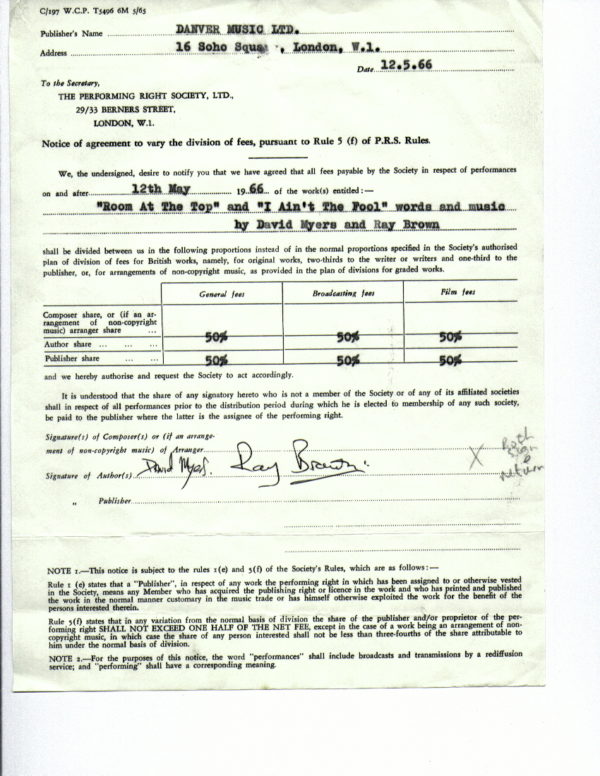
Around this time, The Flames returned to Lansdowne Studios to cut two original recordings – the David Myers/Ray Brown collaborations, “Room at the Top” and “I Ain’t The Fool”. The former was later cut by the band’s new identity, The Kool, in the summer of 1967. They also did a second audition with Joe Meek.
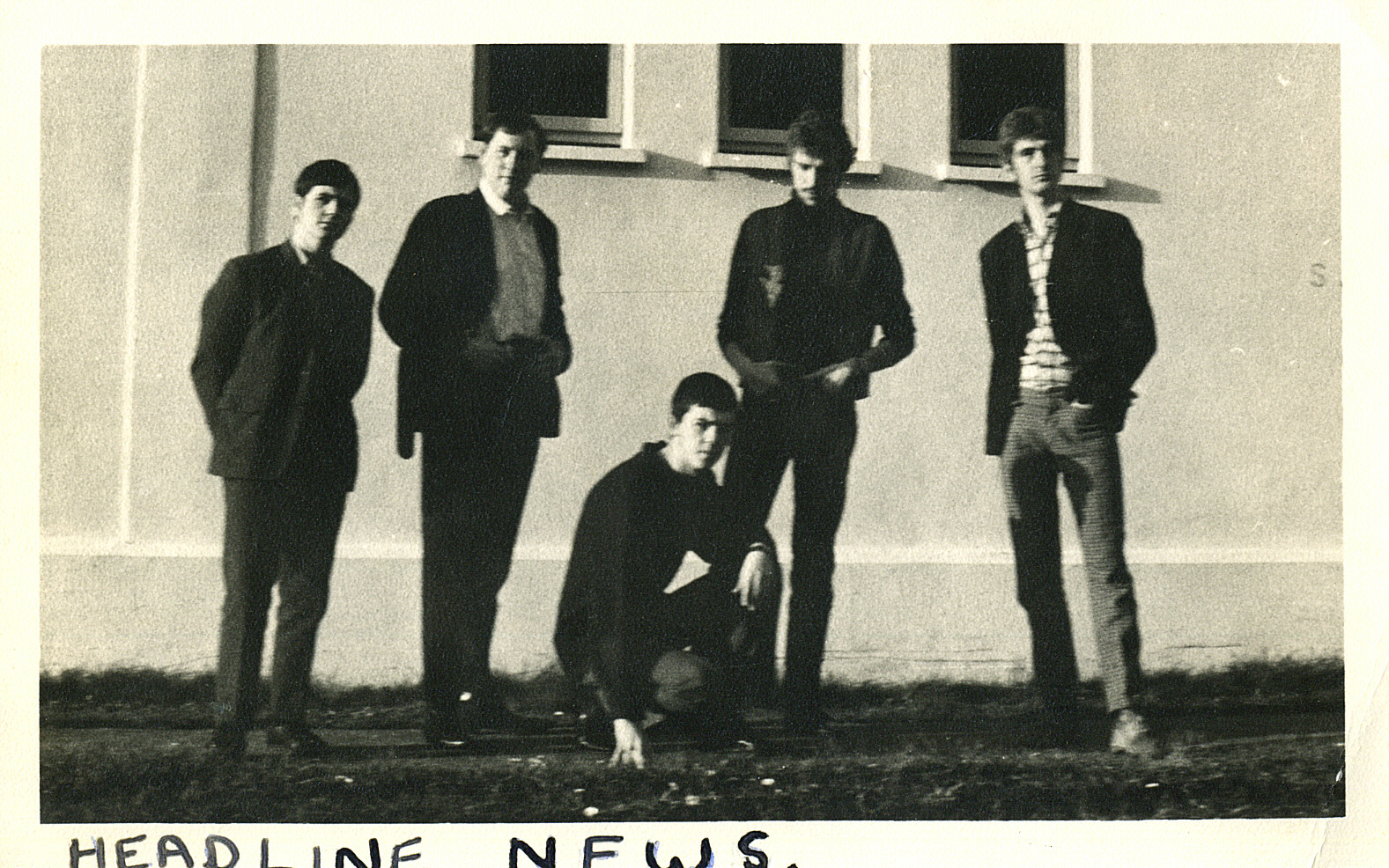
After Ray Soper was ousted from The Flames in May, he decided to stick with Kidd and formed a new version of The Pirates. The New Pirates (as they were called) supported Johnny Kidd throughout the summer but Soper stopped playing with the band in August. Two months later, he joined Bristol band, The Denims who were playing US bases in France. After working in Strasbourg for two months as The Headline News, he returned to the UK in April 1967.
Three months later, Soper found work playing in a band on the Cunard Cruise liner Carmania, which travelled between Southampton and Montreal on a six-week passage. Marrying a Canadian, he subsequently immigrated to Canada in 1970 and until recently played with The Dusty Roads Band from his home in Ontario. He also works as a film extra.
Notable gigs:
17 July 1965 – Ricky Tick Club, Carnival Hall, Basingstoke, Hants (Dave Wigginton fills in for Ray Brown)
22 July 1965 – Majestic Ballroom, Luton, Bedfordshire (RayBrown returns and Ray Soper’s first gig back with the band)
24 July 1965 – Locarno Ballroom, Swindon, Wiltshire with The Rising Sons
Photo: Leicester Mercury
25 September 1965 – Il Rondo, Leicester
Photo: Windsor, Slough & Eton Express
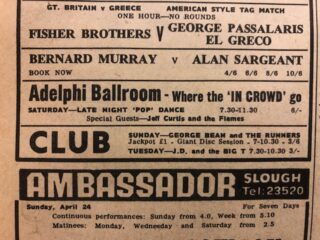
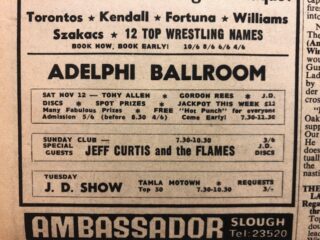
2 October 1965 – Adelphi Ballroom, Slough, Berkshire
30 October 1965 – Woodhall Community Centre, Welwyn Garden City, Hertfordshire
Photo: Surrey Comet
11 November 1965 – Byron Hotel, Greenford, London with The Keystones (billed as The Flames)
Jeff Curtis & The Flames were featured in the Surrey Comet‘s 13 November 1965 issue but it was full of factual errors (above)
9 December 1965 – Byron Hotel, Greenford, London with the Harmonies
16 December 1965 – Ealing Club, Ealing, London
18 December 1965 – Adelphi Ballroom, Slough, Berkshire
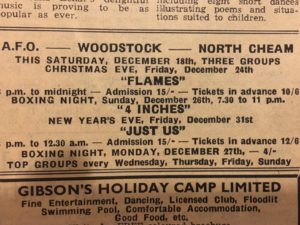
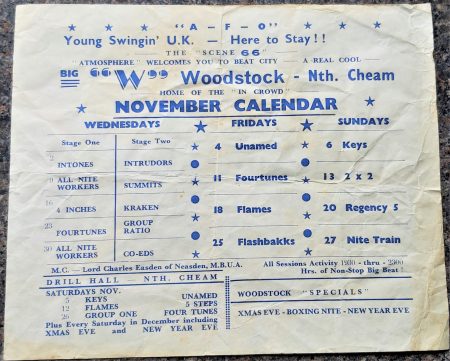
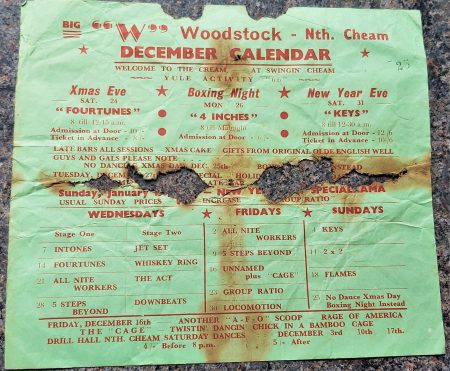
24 December 1965 – Woodstock Roadhouse, North Cheam, London
1 January 1966 – Starlight Ballroom, Boston Gliderdrome, Lincolnshire with The Nashville Teens and The Game
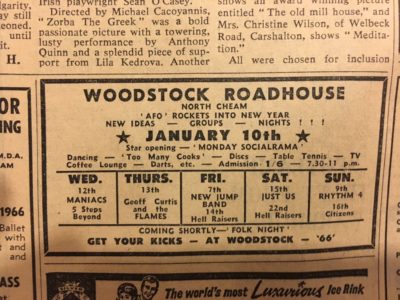
13 January 1966 – Woodstock Roadhouse, North Cheam, London (billed as The Flames)
22 January 1966 – Locarno Ballroom, Swindon, Wiltshire with Plain and Fancy
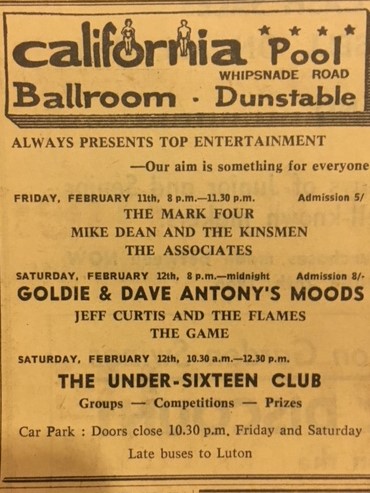
12 February 1966 – California Ballroom, Dunstable, Bedfordshire with Goldie & Dave Antony’s Moods and The Game
17 February 1966 – Byron Roadhouse, Greenford, London with The Mode (billed as The Flames)
31 March 1966 – Byron Roadhouse, Greenford, London with The Legends (billed as The Flames)
Photo: Windsor, Slough & Eton Express
23 April 1966 – Adelphi Ballroom, Slough, Berkshire
7 May 1966 – Locarno Ballroom, Swindon, Wiltshire with The Ying Yongs and The Cotswold Stones (one of Ray Soper’s final gigs)
Publishing contract for “Room at the Top” and “I Aint the Fool”, May 1966 courtesy of Ray BrownHeadline News, circa late 1966. Ray Soper is second from left
Jeff Curtis & The Flames #9 (May 1966-August 1967)
Jeff Curtis – lead vocals
Dave Carol – lead guitar, vocals
Jet Hodges (aka Richard Hodgins) – keyboards, vocals
Ray Brown – bass
Pete Burt – drums
The remaining members brought in Richard Hodgins, a keyboard player from Shepperton, Surrey, who used the stage name, Jet Hodges. Originally a bass player, Hodges had taken up music full time after training to be an architect.
Increasingly, the band moved away from using the name, Jeff Curtis & The Flames for live shows and often went by the name, The Jeff Curtis Set or just The Flames. One of the highlights from this period was opening for Ike & Tina Turner when they played at the California Ballroom in Dunstable.
In late 1966, rock promoter and entrepreneur Mervyn Conn, started to represent the band. In December 1966, he added Jeff Curtis & The Flames to a Who concert in Sunderland and renamed the band The Kool for this one-off gig, although the group didn’t appear at the venue.
After signing to CBS Records, Conn decided that The Kool was more representative of the band’s evolving sound and renamed them as the band’s debut single hit the shops.
Notable gigs:
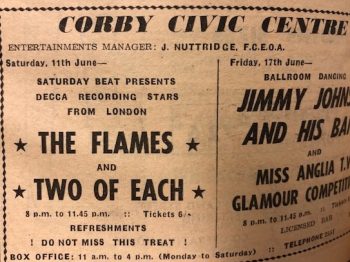
11 June 1966 – Corby Civic Centre, Corby, Northamptonshire with Two of Each (billed as The Flames)
20 August 1966 – Locarno Ballroom, Swindon, Wiltshire with The Showmen
Photo: Paul Quinton
2 September 1966 – Woodstock Roadhouse, North Cheam, London (billed as The Flames)
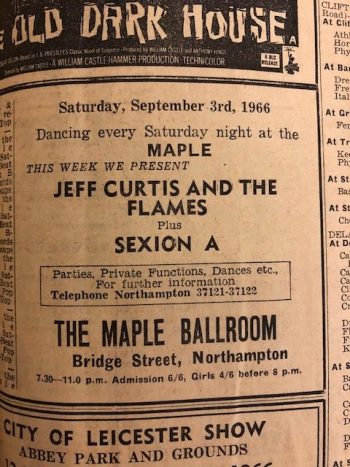
3 September 1966 – Maple Ballroom, Northampton with Sexion A (billed as The Flames)
18 September 1966 – White Lion, Edgware, London (billed as The Flames)
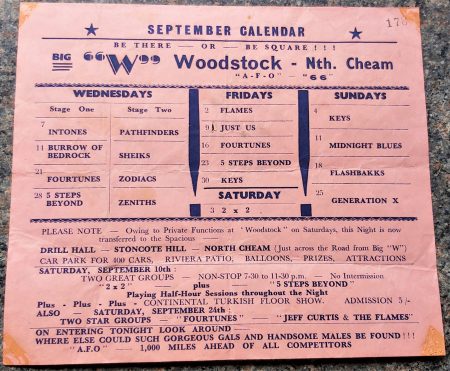
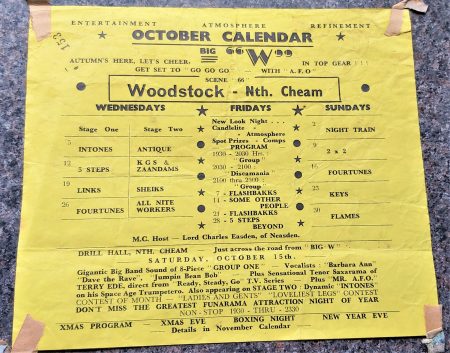
24 September 1966 – Drill Hall, North Cheam, London with The Fourtunes
Photo: Paul Quinton
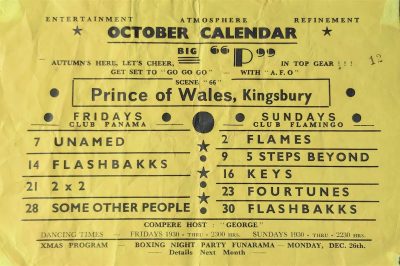
2 October 1966 – Prince of Wales, Kinsbury, London
22 October 1966 – California Ballroom, Dunstable with Ike & Tina Turner Revue & The Ikettes (with others)
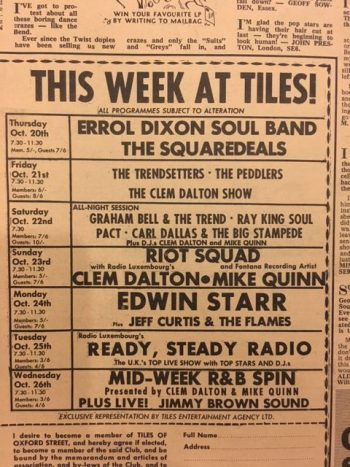
24 October 1966 – Tiles, Oxford Street, London with Edwin Starr
Photo: Paul Quinton
30 October 1966 – Woodstock Roadhouse, North Cheam, London (billed as The Flames)
5 November 1966 – Locarno Ballroom, Swindon, Wiltshire with The Undertakers and Some Other Guys. Billed as The London Flames (Jeff Curtis)
10 November 1966 – Byron Roadhouse, Greenford, London with The Boots (billed as The Flames)
Photo: Paul Quinton
12 November 1966 – Drill Hall, North Cheam, London with 5 Steps Beyond (billed as The Flames)
Photo: Windsor, Slough & Eton Express
13 November 1966 – Adelphi Ballroom, Slough, Berkshire
18 November 1966 – Woodstock Roadhouse, North Cheam, London (billed as The Flames)
10 December 1966 – Empire Theatre, Sunderland, County Durham with The Who, Dave Berry, She Trinity, The Slade Brothers and The Peddlers (billed as The Kool but band did not appear)
18 December 1966 – Woodstock Roadhouse, North Cheam, London (billed as The Flames)
15 January 1967 – White Lion, Edgware, London (billed as The Flames)
28 January 1967 – Queens Hall, Watton, Norfolk with The Eyes of Blond and The Bohemians
19 February 1967 – Kingsway Theatre, Hadleigh, Essex (billed as Flames)
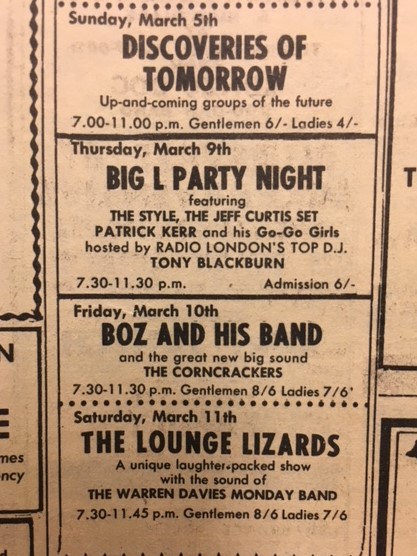
9 March 1967 – Upper Cut, Forest Gate, Essex with The Style (billed as Jeff Curtis Set)
27 March 1967 – Woodstock, North Cheam, London with The Starfires (billed as The Flames)
9 June 1967 – California Ballroom, Dunstable, Bedfordshire with Allen Bown Set (billed as Geoff Curtis Set)
The Keith Gardiner Band, July 2011
Many thanks to Dave Wigginton, Keith Gardiner, Louis McKelvey, Malcolm Tomlinson, Pete Burt, Dave Carol, Malcolm Randall, Ray Soper, Jeff Lake, Ray Brown, George Russell, Jimmy Marsh, Ian Hannah, Brian Hosking, Richard Bennett and Tony Bramwell.
Concert adverts taken from a number of newspapers including the Ampthill News & Weekly Record, Lincolnshire Standard, the Luton News, the Streatham News, the Surrey Comet, Walthamstow Guardian, Exeter Express & Echo, Cambridgeshire Times, Yarmouth Mercury, Middlesex County Times and West Middlesex Gazette, Hertfordshire Express, Hants & Berkshire Gazette, Hounslow Post, NME, Sevenoaks Chronicle, Westerham Courier and Kentish Advertiser, Swindon Advertiser and Melody Maker.
Huge thanks to Dave Wigginton, Keith Gardiner, Louis McKelvey, Malcolm Randall, Jeff Lake, Ray Brown and Ray Soper for photos.
I have tried to ensure the accuracy of this article but I appreciate that there are likely to be errors and omissions. I would appreciate any feedback from anyone who can provide any additions or corrections.
Page 3 of the Jerry Lee Lewis Channel Crossing ProgrammePage 6 of the Jerry Lee Lewis Channel Crossing ProgrammePage 7 of the Jerry Lee Lewis Channel Crossing Programme
Jim Robertson (Vocals) (circa May 1966-circa July 1969)
Tim Forsythe (Keyboards, Harmonica) (circa May 1966-August 1967)
Domenic Angelicchio (Drums) (circa May 1966-circa July 1969)
Danny Barrucco (Bass) (circa May 1966-December 1966)
Dave Hanna (Guitar) (circa May 1966-July 1966)
Don Duncan (Guitar) (July 1966-September 1966, May 1967-August 1967)
Jean Pierre Lauzon (Guitar) (September 1966)
Richard Lasnier (Guitar) (circa October 1966)
Gary Marcus (Guitar) (circa October-December 1966)
Bob Burgess (Bass) (December 1966-May 1967)
Louis McKelvey (Guitar) (December 1966-May 1967)
Ken Duffy (Bass) (May 1967-circa July 1969)
Les Kozichinsky (Guitar)(August 1967-July 1968)
Don Hay (Keyboards)(August 1967-December 1967)
Jerry Carruthers (Keyboards)(December 1967-July 1968)
Dick Stenstrum (Keyboards)(July 1968-circa July 1969)
Roald Longhi (Guitar)(July 1968-circa July 1969)
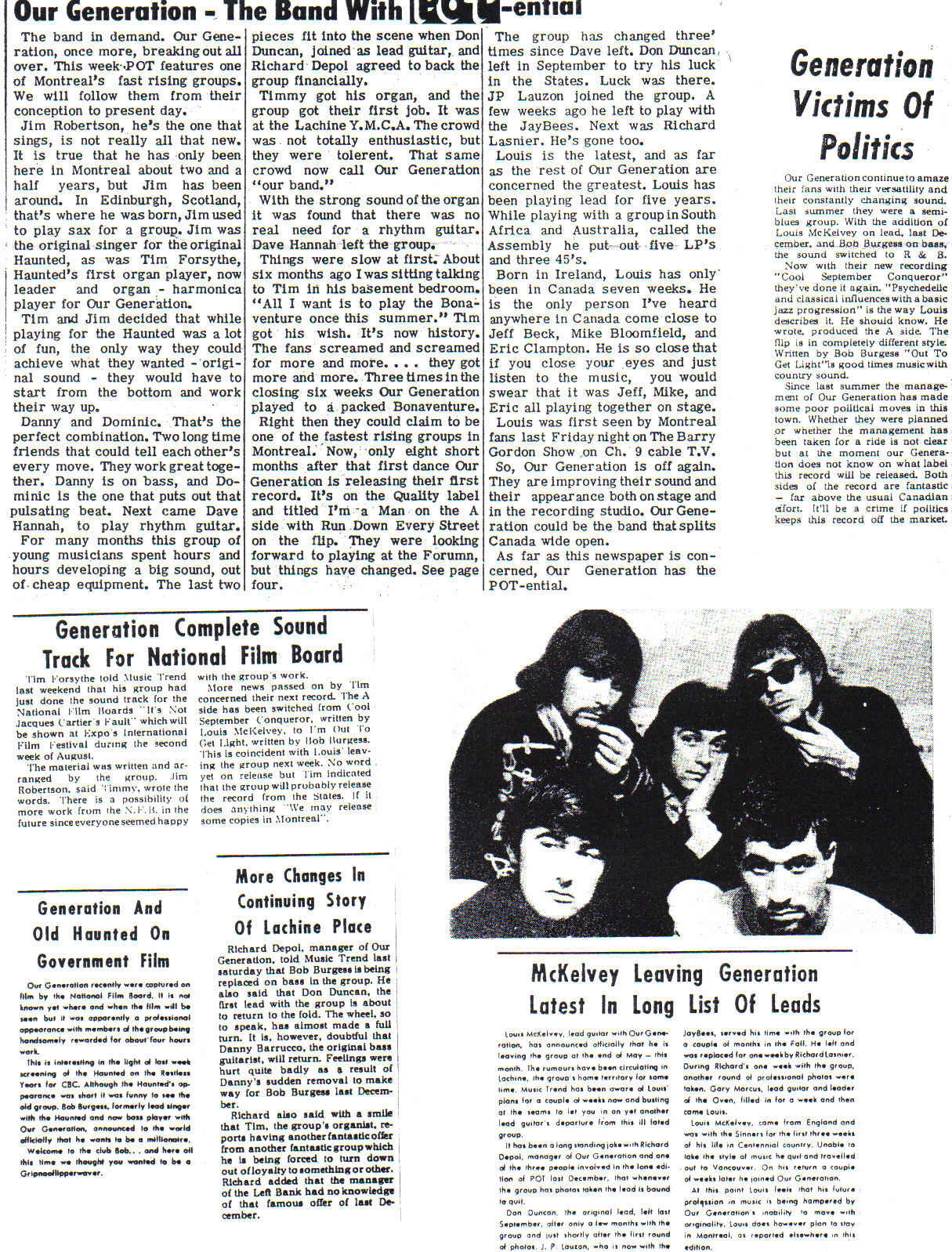
The original band was formed in the summer of 1966 by former Haunted members Jim Robertson and Tim Forsythe. Robertson was originally from Edinburgh, Scotland where he’d played sax in a group during 1964 before moving to Montreal.
Based in Lachine, Quebec, the band made its debut at the local YMCA.
Hanna left soon after the band started playing live. However, the group went through a succession of lead guitarists, starting with Don Duncan, who left in September 1966, before McKelvey joined in December.
McKelvey’s arrival coincided with that of Bob Burgess from The Haunted. In between Duncan leaving and McKelvey joining, Our Generation featured temporary stopgap guitarists, J P Lauzon, who went on to The Jaybees, Richard Lasnier and Gary Marcus from Oven.
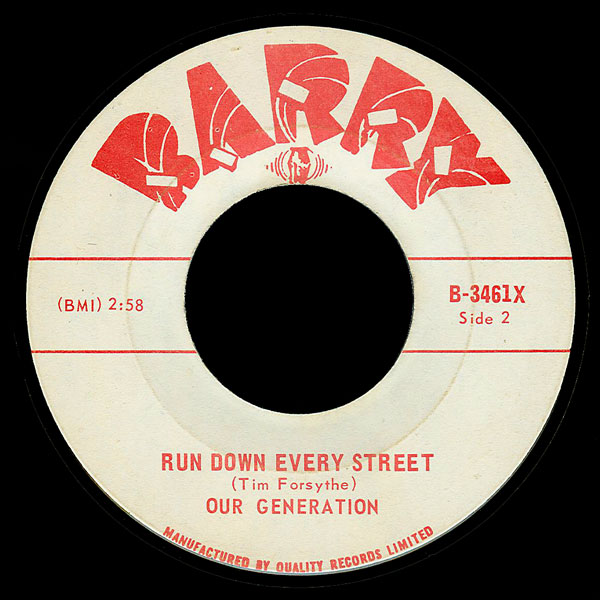
The line up with Duncan, however, was responsible for the first single, a cover of the Muddy Waters blues favourite ‘I’m a Man’, backed by Forsythe’s ‘Run Down Every Street’.
Irish-born and British raised guitarist Louis McKelvey, who had arrived in Montreal around October 1966 after playing with west London band Jeff Curtis & The Flames and later South African groups The Upsetters and The A-Cads, appeared on the band’s second single, before forming Influence in late May 1967.
Prior to joining Our Generation, McKelvey had played with Les Sinners for a few weeks and was later given co-production credit for The Haunted’s third single with fellow ex-A-Cads member Hank Squires.
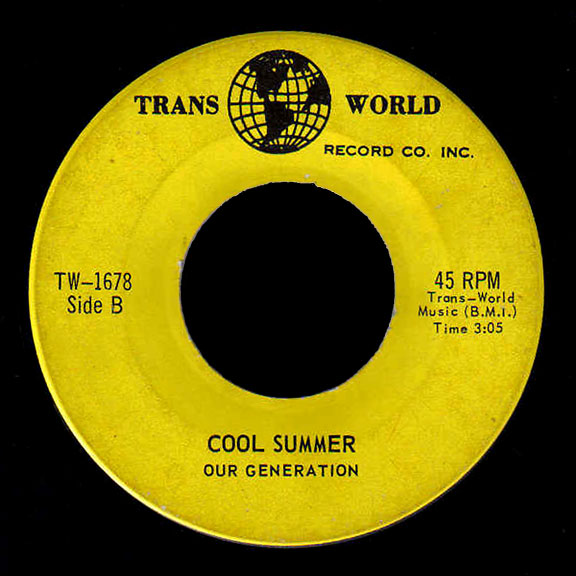
This line up of Our Generation provided the soundtrack to the Canadian Film Board film, ‘It’s Not Jacques Cartier’s Fault’. McKelvey wrote ‘Cool Summer’ while Burgess composed the A-side, ‘Out to Get Light’.
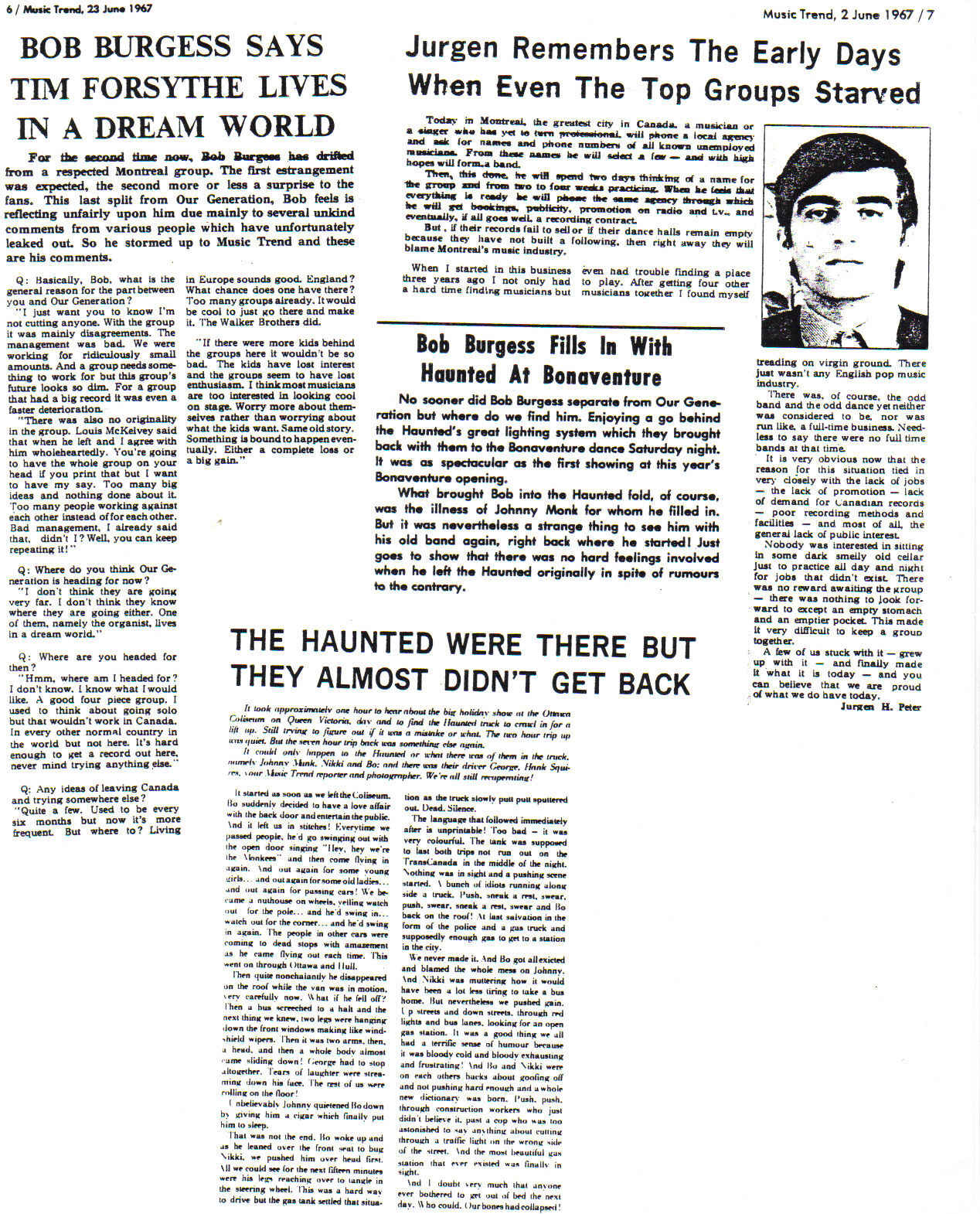
Burgess left Canada in late 1967 to spend some time in the UK where he recorded, and then returned to form a new band Lilac. In the ‘70s he led Aean.
Angelicchio, Forsythe and Robertson kept the band going bringing back guitarist Don Duncan and adding new bass player Ken Duffy. This line-up lasted until August 1967 when Forsythe left to join Peter & The Pipers and Duncan moved on.
Angelicchio, Duffy and Robertson brought in keyboard player Don Hay and guitarist Les Kozichinsky for a few months. Then in December Jerry Carruthers took over keyboards from Hay.
This line-up settled and performed into the summer of 1968 before further changes.
Keyboard player Dick Stenstrum and guitarist Roald Longhi joined Jim Robertson, Dominic Angelicchio and Ken Duffy and also played Our Generation’s most significant concert date, the Summer Pop Festival held at The Autostade, Montreal on 17 July, which was headlined by The Who, The Troggs, Mitch Ryder & Detroit Wheels and The Ohio Express. The Haunted also appeared at the festival.
The band continued on for another year or so before splitting.
After The Jaybees, Lauzon went on to play with The Carnival Connection, Life, Mylon Le Fevre and ultimately The Wackers. Marcus joined The Haunted.
Recordings
45 I’m A Man/Run Down Every Street (Barry 3461) 1966 45 Cool Summer/Out To Get Light (Trans World 1678) 1967
Selected advertised gigs
February 17 1967 – West Hill High, Montreal February 18 1967 – Stanstead College, Montreal February 24 1967 – Malcolm Campbell High, St Laurent, Quebec February 25 1967 – The Barn (on Du Hamel)
March 3 1967 – Gig in Hudson (Quebec?) March 4 1967 – Salle Espangnola, St Therese, Quebec March 10 1967 – The Jail, Montreal March 11 1967 – Gig in Huntington, Quebec March 18 1967 – St Hubert Inn Club, St Hubert March 25 1967 – Caveman’s Hive, Montreal March 27 1967 – St Augustine’s NDG (Montreal?)
April 8 1967 – The Jail, Montreal April 14 1967 – St Willabroads School (Montreal?) April 22 1967 – St Bartholemew (Montreal?) April 28 1967 – The Barn, Ile Perrot April 29 1967 – Roxboro Chalet, Roxboro May 5 1967 – Hot Spot, Rosemere May 6 1967 – Town and Country, Cote de Liesse with Munks May 7 1967 – Town and Country, Cote de Liesse with The Jaybees
September 24-30 1967 – Garden of Stars, Montreal
Live dates taken from the Montreal Star newspaper.
Many thanks to Bill Munson, Carny Corbett, Louis McKelvey, Bob Burgess, Ken Duffy.
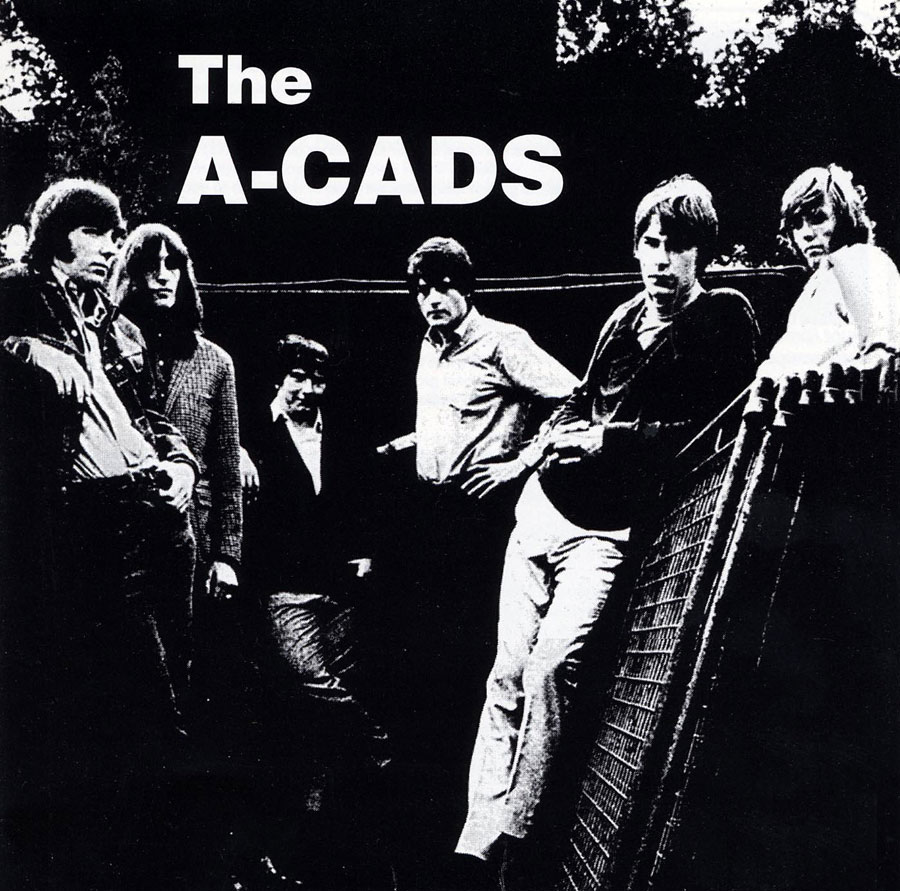
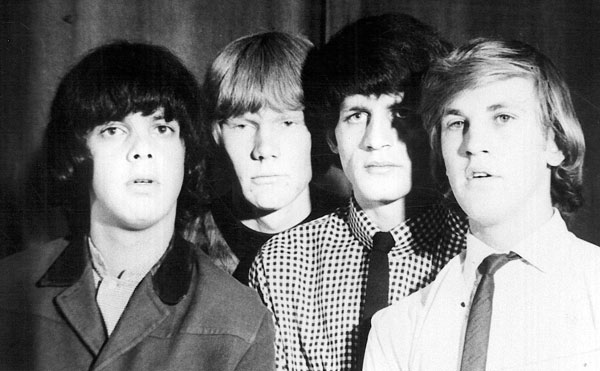
Left to right: Louis McKelvey, Les Goode, Sam Evans, Hank Squires, Dick Laws and Rob Kearney
Mid-1960s beat merchants The A-Cads heralded an exciting new age in South African rock music and were promoted by the local press at the time as a super group of sorts.
The band’s leading figure, rhythm guitarist/singer Hank Squires (b. Henry Stephen Smitsdorff, 20 May 1941, Johannesburg, South Africa) was well-established in South African musical circles, having previously worked with British expat Mickie Most, then a popular singer in South Africa and later one of rock’s most successful producers.
Hank Squires’ early career
Squires’s career began in the late 1950s when he made his debut on the city’s fledging rock ‘n’ roll scene playing with the popular rock ‘n’ roll outfit, The Playboys.
Training to become an electrical engineer, Squires soon abandoned Johannesburg Technical College after witnessing a concert by English émigré, the late Mickie Most (real name: Michael Hayes), a singer of modest talent who had moved to Johannesburg in 1958 to marry his South African fiancée. Impressed by the singer’s performance, Squires approached Most for guitar lessons and after a few months joined his original backing group, The Playboys.
Most’s move to the colonies proved to be extremely fortuitous – his British solo recordings (as well as singles recorded with future producer Alex Murray as The Most Brothers) had all met with widespread indifference back home.
However, after changing his name, Most and his newly formed group quickly established themselves as one of, if not, the most successful band(s) in South Africa, scoring six consecutive South African hits over the next three years (including one with Jackie Frisco). And although Most would subsequently return home during 1962 to try his hand at production, he would continue to maintain contact with Squires, seeing him as one of the few musicians in South Africa that he thought had the potential to go on to greater things.
Squires, meanwhile, had already left The Playboys prior to Most’s departure for the UK and formed a new band, The Silhouettes. This short-lived outfit also featured another ex-Playboys member, Leon Booysen (bass), alongside the late George Hill (drums) and the late Archie Van der Ploeg (lead guitar).
During The Silhouettes’ short lifespan, the group supported singer June Dyer on her number one single “Whirlpool of Love”. Squires moved on soon afterwards and joined another local group, The Giants, who scored a number one hit in late 1961 with “Dark and Lonely Street” and also recorded a rare album entitled Meet The Giants. The Giants subsequently changed their name to the Rebels and became June Dyer’s backing group.
While his old friend Mickie Most struck gold in the UK as a producer for The Animals and Lulu, among others, Squires kept busy performing and recording with Johnny Kongos and The G-Men. This exciting band was arguably one of the best outfits to emerge in South Africa during the early-mid 1960s and included some of the city’s most accomplished musicians.
The group’s potential, however, was cut short when the band’s singer (and future solo artist) John Kongos (best known for penning the international hit “He’s Gonna Step On You Again”, made famous by indie revellers The Happy Mondays in the 1990s) left to do national service.
Johnny Kongos & the G-men, 1964, l-r: Jesse Sumares, Johnny Kongos, Ed Burns (with bass), Rob Kearney (drums) and Hank Squires
Kongos later enjoyed moderate success with his solo work and his UK bands Floribunda Rose and Scrugg. The former also featured English expat Pete Clifford, who had toured South Africa with Dusty Springfield and worked with Tom Jones before forming The 004 and later joining South African rock-comedy group, The Bats.
Kongos’ replacement in The G-Men was another expat, singer Sam Evans (b. 1947, Glasgow, Scotland), a short, burly man with a rough-edged voice, who had arrived in South Africa in early 1964 after fronting a number of now long forgotten bands back home. Evans would ultimately become Squires’ first choice as the singer in what would become The A-Cads. Another former G-man, drummer Robbie Kearney (b. South Africa), fresh from a nine-month army stint at Simons Town naval base, joined him soon afterwards.
The Falling Leaves, 1965: Leib Brews, George McCauley (on chair), Hank (standing) and Arthur Fisher (high chair)
Before such a project could materialise, however, Squires left The G-Men during December 1964 to pursue a short-lived solo career. Spotted playing in a club by Mickie Most (on a flying visit to South Africa), Squires was subsequently offered a recording contract and a single, a cover of Fats Domino’s “I’ve Been Around”, produced by Most, was issued in spring 1965. A follow up single, “Stand By Me”, produced this time by Squires, also failed to attract much attention and the singer began to look around for fresh adventures.
The G-Men, l-r: Jesse Sumares, Leib Brews, Hank Squires and John E Sharpe
After brief stints with The Falling Leaves and a short-lived line up of The G-men featuring John E Sharpe, Squires started to put together a new group that would storm the South African charts.
l-r: Jesse Sumares, John E Sharpe, Hank Squires and Leib Brews
The A-Cads form
Formed during October 1965, The A-Cads were essentially the brainchild of English émigré Peter Rimmer, a former support musician for the likes of Marty Wilde and The Tempests, who had decided to try his hand at management following his move to South Africa in 1963. By the time that Rimmer ran into Squires, he had become the manager of the Rand Academy of Music, and it was probably this experience that inspired him to form what would essentially be the first South African super group.
Squires immediately recruited Evans and Kearney for the new project. He was also instrumental in bringing in the band’s remaining members, lead guitarist Dick Laws (b. 15 May 1946, London, England) and bass player Les Goode (b. 10 September 1946, Surrey, England). Both musicians had impressive pedigrees and were first-rate musicians.
Londoner Dick Laws had first visited Johannesburg in early 1963 when his band, Bill Kimber & The Couriers, got work in the city through local-born businessman Frank Fenter who had seen them play in his London coffee bar and raved about them to friends back home. Like many British artists who ventured to the colonies during this period, the group arrived to be greeted like visiting royalty.
Over the next year or so, Bill Kimber & The Couriers scored a string of South African hits for the Renown label, including covers of The Beatles’ “I Want To Hold Your Hand” and Booker T & The MG’s “Green Onions”. They had a starring role in South Africa’s first rock movie, Africa Shakes, where they also backed local singer Sharon Tandy on various songs, including the well-known R&B hit, “I’m Movin’ On”.
The Couriers eventually returned home, but Squires was convinced that Laws was key to his new group’s success, and with Rimmer’s support, managed to coax him back to join The A-Cads. Laws brought with him a unique guitar style and, perhaps more importantly, an in-depth knowledge of the UK rock scene, as well as choice material to cover.
Les Goode (real name: Les Gutfreund), meanwhile, had emigrated from England in 1952 and played with Shadows tribute band, Les Beats, which morphed into The Nitwits, before working with The Deans, formed in 1963 with the late singer/guitarist John E Sharpe. Coinciding with the arrival of The Beatles and The Rolling Stones, The Deans subsequently adopted the more progressive name John E Sharpe and The Squires and quickly became Johannesburg’s top R&B attraction.
The A-Cads’ unusual name appears to have been, according to press releases from that period, a compromise between Rimmer and the band. Apparently Rimmer was keen to name the group after the Rand Academy, while the group members’ preferred choice was The Cads, the result being The A-Cads.
After weeks of intensive rehearsals, Rimmer duly launched The A-Cads at a cocktail party at Ciros in Johannesburg, hosted by A G J McGrall, a managing director of a well-known record company. The event attracted a great deal of publicity and made the front cover of the South African music rag, Record Express.
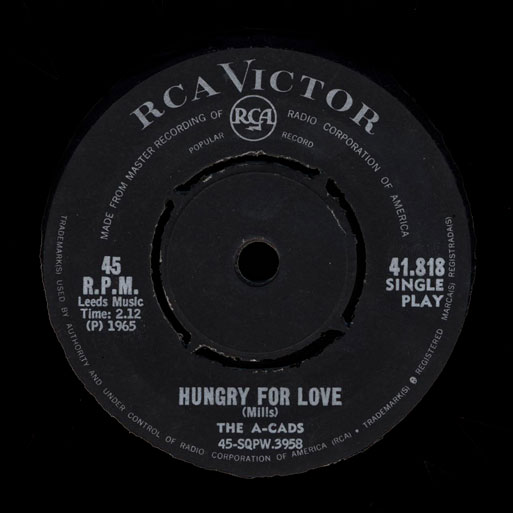
Soon afterwards, the band signed a recording deal with Teal Records (with distribution by RCA Victor) and, on the recommendation of Laws, recorded a stunning version of Johnny Kidd & The Pirates’ “Hungry For Love”, which reached #1 on the South African chart in January 1966. The South African music press was quick to praise the band’s debut disc, with one review quoted as saying “an excellent disc by an excellent group, backings are great, and vocal beautifully handled, this is about the best record ever produced in South Africa…”
Laws’ piercing guitar work on the single’s B-side, a storming version of Bo Diddley’s “Roadrunner” meanwhile, provided a more accurate insight into the group’s musical abilities and hinted at its potential to develop into a formidable force. In addition, the track featured some amazing throat shredding vocals from Sam Evans. However, as the next few months would prove, the band would never capitalise on this early success.
Review in Pop Gear, May 1966
During December, The A-Cads began work on an album, and while in the process recorded a cover version of The Small Faces’ “Sha-La-La-La-Lee”, which for some inexplicable reason was later omitted from the album when it was issued the following spring. To add to the confusion, the track was finally issued as a single following the album’s release and after the band had relocated to London in April 1966.
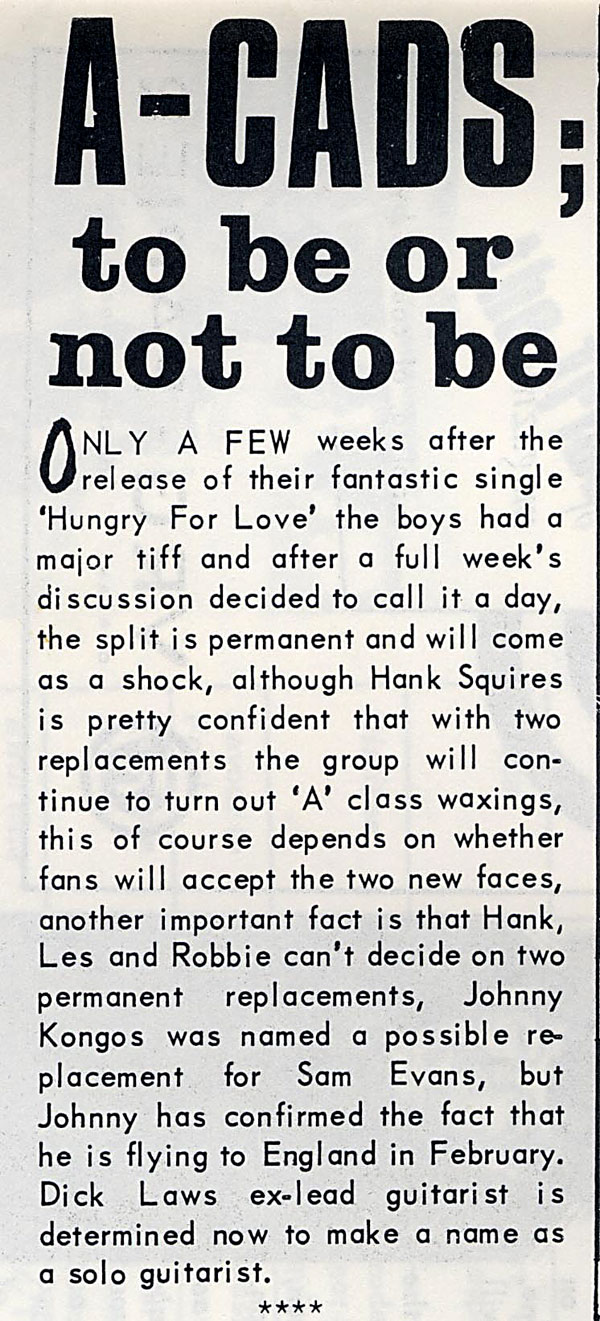
Pop Gear discusses the breakup, February 1966
Unfortunately during the recording process, the band started to unravel as Laws increasingly voiced his objections over the choice of material being presented to the group.
As he later recalled: “A lot of stuff we did was just floating around in memory (Chuck Berry, Rufus Thomas etc.), old favourites, that sort of thing. But some of it was producer Derek Hannan playing us things in his office that he thought would be good for us. I never agreed with his choices, but then I had a distinct vision of what the group should be. I always thought that it would have been better if Teal had just let us loose in the studio to get on with it ourselves (as we did initially with “Hungry For Love”). I think the band would have lasted a lot longer and surprised a few people.”
Louis McKelvey, Andy Keiller and the Upsetters
At this critical juncture, Squires decided to introduce a second lead guitarist Louis McKelvey (b. 31 October 1943, Killorglin, County Kerry, Republic of Ireland), as Laws looked increasingly to be on the verge of splitting. McKelvey, whose family had moved to Twickenham during his adolescence, was already a seasoned player on the West London club scene.
His earliest musical venture had been local group Johnny & The Pursuers, but he quickly jacked this in to become the lead guitarist in R&B outfit Jeff Curtis & The Flames, regulars at the famous Ealing Jazz club. Though no recordings ever emerged from this period, The Flames did record a four-track acetate in October 1963 and two further tracks in late 1964. The band’s main claim to fame was appearing on a cross-channel ferry with headline act Jerry Lee Lewis.
After the band’s drummer Malcolm Tomlinson quit the band to play with The Del Mar Trio, McKelvey eventually grew restless and took off for South Africa with his newly wedded bride (not before joining Tomlinson’s band in Germany for about a month’s worth of gigs).
McKelvey’s parents had run a theatre production company in Leicester Square and on their travels had been struck by Cape Town’s beauty. McKelvey’s dad was briefly director of theatre in South Africa and the guitarist had spent part of his childhood in the country. On the look out for fresh musical adventures, he decided to follow their advice and return to South Africa for a few months.
Arriving in Johannesburg around September 1965, McKelvey quickly fell in with another expat, singer Andrew Keiller. Though relatively new to the music business, Keiller had nevertheless, witnessed first-hand many of the hotbeds of the early London rock scene (including a brief incarnation of The Rolling Stones featuring Carlo Little and Rick Brown), before moving to South Africa in March 1964 and recording a single for Continental Records, “Find My Baby” c/w “Elaine”. This was followed by an album, Round About Midnight, which was held back for release until mid-1966 when it was given a write up in Teenage Personality in its 12 May issue.
Within a short space of time, Keiller and McKelvey established one of Johannesburg’s finest beat groups, The Upsetters, with former Playboys member Leon Booysen (bass) and future Freedom’s Children member Colin Pratley (drums), who soon made way for George Hill.
Thanks to Booysen’s contacts at Trutone Records, the band (with George’s brother Frank on the skins) recorded a single for the label, “Daddy Rolling Stone” c/w “Pain In My Heart”, at EMI studios in Johannesburg. The single’s a-side, which was brought to Keiller’s attention when he heard The Who cover it, is an arresting R&B tune written by Derek Martin and features some fiery guitar work from McKelvey. The flip meanwhile is more restrained and is the same Otis Redding song that had recently been made popular in the UK by The Rolling Stones.
The group’s name appears to have been McKelvey’s idea – The Upsetters being his idol, Little Richard’s original support band. The Upsetters proved to be particularly apt as it was also a fashion at the time to insult the audience and, according to sources close to the band, Keiller was keen to emulate what The Who were doing back in London.
Shortly after the single’s release, the band underwent a number of personnel changes as Leon Booysen and George Hill both left to be succeeded by 18-year-old drummer Gregory Allen Plotz and former Johnny Kongos & The G-Men bass player Jesse Sumares.
The new Upsetters line-up ventured back into the studio to record further material for a follow up single – “Down Home Girl”, “Boom Boom” and “High Heel Sneakers”, but for some inexplicable reason, the tracks were subsequently left in the can. Perhaps it was this disappointment that led to the group’s collapse later that autumn.
Whatever the reason, Keiller decided to return to London in late November and the others drifted apart after a short Bloemfontein tour with the A-Cads the following month, during which Sam Evans handled vocals for both bands. It was shortly after the final tour that Squires approached McKelvey about joining The A-Cads.
Dick Laws and Sam Evans depart the A-Cads
As mentioned earlier, McKelvey’s primary role appears to have been to take over from Dick Laws, who had increasingly come to blows over the band’s musical direction.
As Laws later admitted: “The band was moving in a super-commercial direction, recording puff pieces like “Fool, Fool, Fool”. I was interested in keeping the heavier sound of “Hungry For Love”. Also, there were too many people involved in the band’s management – three managers actually. It felt like no one was interested in the music itself. Producer Derek Hannan was coming up with these hits (which I suppose was his job). Yet the success of “Hungry For Love” should have proved that a song doesn’t have to have an infantile hook to top the charts, but no one was listening.”
Within weeks of McKelvey’s arrival, Laws abandoned the group, initially to work on a solo rock instrumental album for Teal Records, but he soon lost interest and the project was shelved. Over the next few years, Laws would maintain a relatively low profile, working occasionally with The Derick Warren Sound in South Africa during 1969.
However, that same year he joined Tommy Roe’s visiting support band and subsequently moved to the US. During the early 1970s, Laws contributed to Tommy Roe’s critically acclaimed albums We Can Make Music and Beginnings, but has kept a low profile since then, although he is still active musically in Los Angeles where he resides.
Sam Evans during his time with This Generation in mid 1966
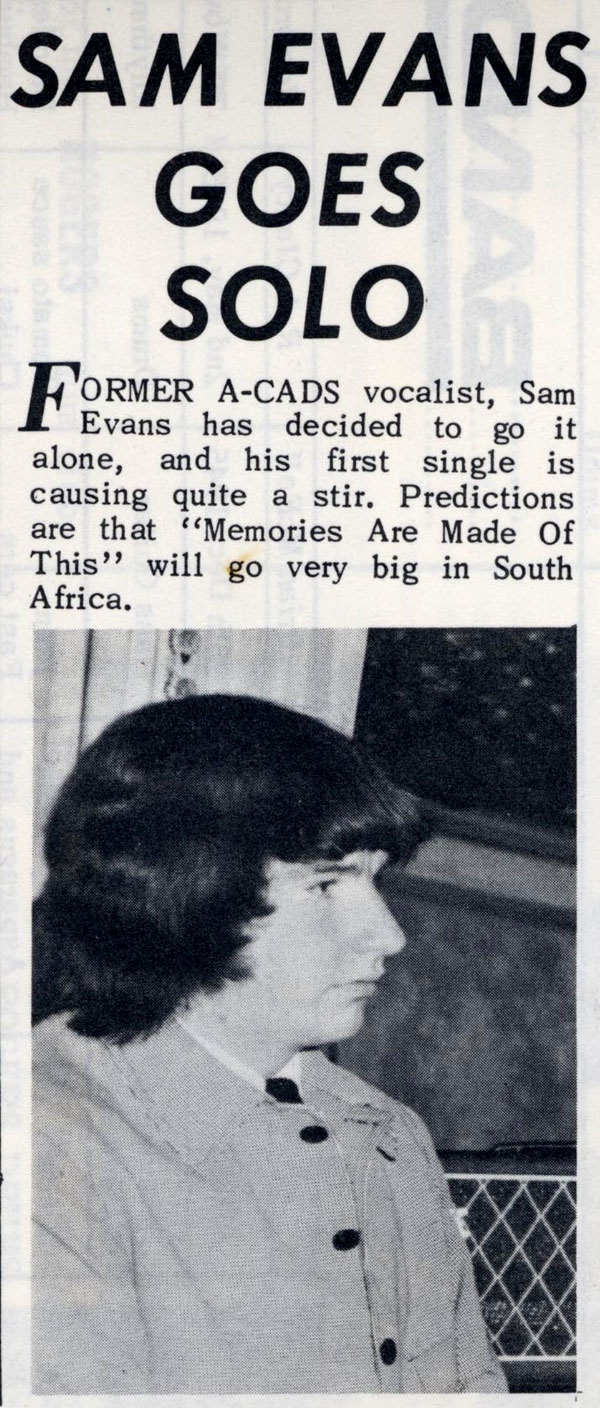
Laws was quickly followed by Sam Evans, who was keen to go solo and wisely used the success of the group’s debut single to launch his career. After a brief stint with local beat group This Generation, Evans debuted with a revival of Dean Martin’s “Memories Are Made of This” on the Pye label, and later that same year scored with Roy Hammond’s composition, “Shotgun Wedding”.
Incidentally, the song was at #10 in the South African charts on 12 August 1966 when the Beatles’ hit “Paperback Writer” was removed from the Springbok charts as a result of a SABC Board decision that no Beatles songs may be played on any government-sponsored radio station. They took the decision in response to Lennon’s apparent remark about the Beatles being more popular than Jesus.
Later, Evans would go on to record a string of singles throughout the late 1960s and early 1970s for the WRC, Parlophone and Nitty Gritty labels. He enjoyed further chart success with his singles, “Ain’t Love A Funny Thing”, “Goodbye Girl” and “Goodbye Guitarman”. Evans also issued a solo album in 1970 for Parlophone entitled “Ain’t Love A Funny Thing”, but sadly passed away in Johannesburg on 23 December 2004.
The A-Cads, meanwhile, briefly split up for a few weeks, but soon reformed with Hank Squires handling the vocal duties and McKelvey covering the lead guitar. “Evans and Laws were responsible for the group’s break up,” explains Squires. “Evans conspired to have me kicked out, Laws backed him. Their whole scheme backfired when Les and Robbie joined with me, giving us the majority to carry on as The A-Cads. McKelvey was in the right place at the right time, so I replaced Laws with him.”
The new line-up quickly emerged with a follow up single, “Fool Fool Fool” c/w “Zip-A-Dee Doh Dah” (the b-side in fact had been recorded before Evans’ departure) and, in a rather unusual move, also toured the Garden Route by train with the Boswell-Wilkie circus during the school holiday. One of the most memorable dates during this period was appearing at the Vaal Festival where the band played to 3,000 screaming fans. Soon afterwards, the new line up toured Mozambique.
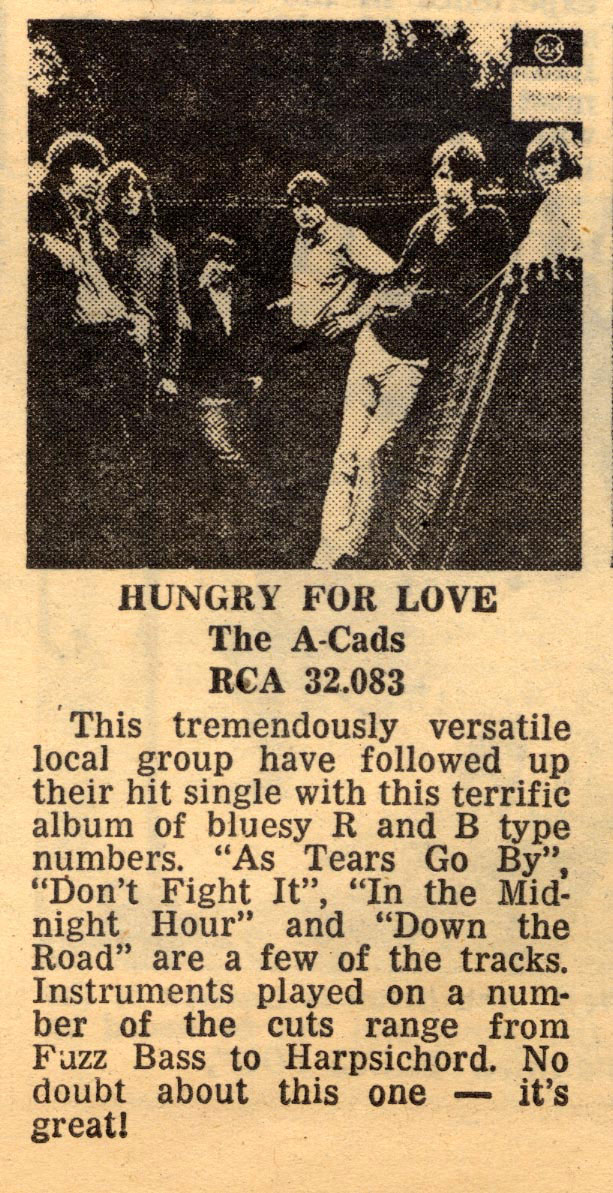
Hungry for Love
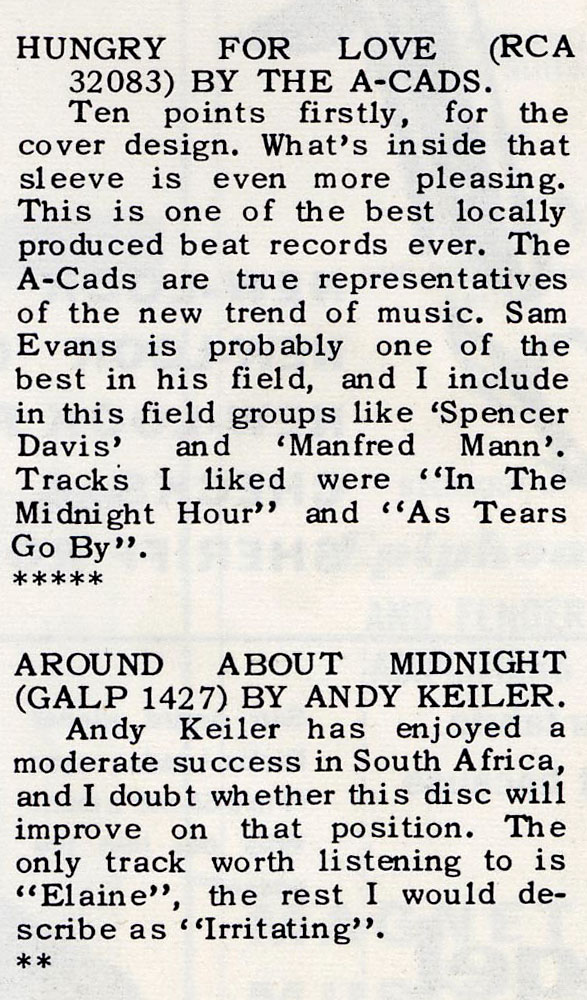
Amid all this activity, RCA Victor issued the band’s album, which credited McKelvey for lead guitar and Dick Laws for bass (Les Goode wasn’t mentioned at all in the sleeve notes!). Curiously, the label also chose to use a rare picture of the short-lived Laws-McKelvey line-up for the album’s front cover with the group pictured on the back of a lorry. The true extent of McKelvey’s involvement in the sessions, however, is a matter of contention.
According to Dick Laws, McKelvey wasn’t around in the studio when he was recording with the group, and Laws is almost certain that he played lead on all the album tracks and three of the singles. Other sources close to the band, most notably Hank Squires, support his claim although McKelvey insists he played on some tracks.
Pop Gear, June 1966
One possible explanation is that both guitarists recorded material for the album and RCA Victor handpicked the best cuts when choosing on a final track listing. That might explain the delay in the album’s release and may also explain why the group’s second single, as well as earlier recordings with Laws – “Roadrunner” and “Sha-La-La-La-Lee” were subsequently excluded.
Whatever the reason, the media was unaware of any musical differences, and its response was overwhelmingly positive. Record Express gave the album a beaming write up in the April 1966 issue: “This tremendous, versatile, local group have followed up their hit single with this terrific album of bluesy R&B type numbers.”
Though no long lost classic, the album, named after the group’s debut single, does show The A-Cads in fine form with the band tearing its way through covers of R&B favourites like “In The Midnight Hour” and “Got My Mojo Working”. If any criticism could be levelled at the record, it would have to be the absence of any original material. Even The A-Cads’ British contemporaries, Them, The Rolling Stones and The Animals were writing their own songs, and The A-Cads’ dependence on such well-trodden material would probably not have helped the group’s cause over the long-term.
The album’s appearance also coincided with the belated release of the non-album track “Sha-La-La-La-Lee”, which as mentioned earlier, had been recorded while Laws was still in the band. Despite the changes in personnel and fresh developments in the group’s career, which will be discussed in a moment, the media continued to sing the group’s praises.
Record Express’ Cordy Gunn enthusiastically told readers in that month’s issue: “’Sha-La-La-La-Lee’ is the A-Cads’ best since ‘Hungry For Love’ …I predict that this new single will immediately leap to the top.” Though it never quite matched the success of the band’s debut single, “Sha-La-La-La-Lee” did indeed become a sizeable hit that spring, but by then the band was no longer in the country to promote it.
Departure to London
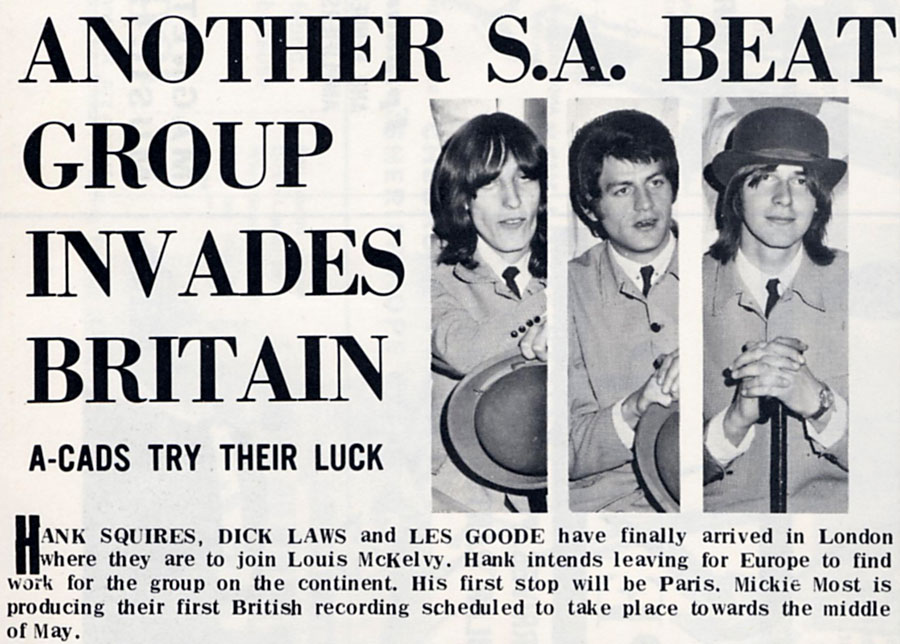
With Squires’ old mate Mickie Most now acting as the group’s agent in London, the group’s fortunes appeared to be on the up, and plans were made to launch the group overseas. Record Express was quoted as saying in the April issue, that “Louis McKelvey has left South Africa on the Edinburgh Castle bound for London where he’ll meet the other members of the group in a month’s time”.
Pop Gear, May 1966
Squires and Goode (joined by former member Dick Laws) sailed on the Windsor Castle during May 1966, and the trio ended up renting a flat in Notting Hill Gate where McKelvey occasionally dropped by.
Robbie Kearney meanwhile decided against the move as he had recently married the leading dancer from the Boswell-Wilkie circus. He would maintain a profile of sorts, reportedly playing briefly with The Falling Leaves and recording with Birds of A Feather in late 1968. Later qualifying as an artist, he went on to design the cover of the Ancient Mariner album, which featured Les Goode on bass! Today, he is a successful artist.
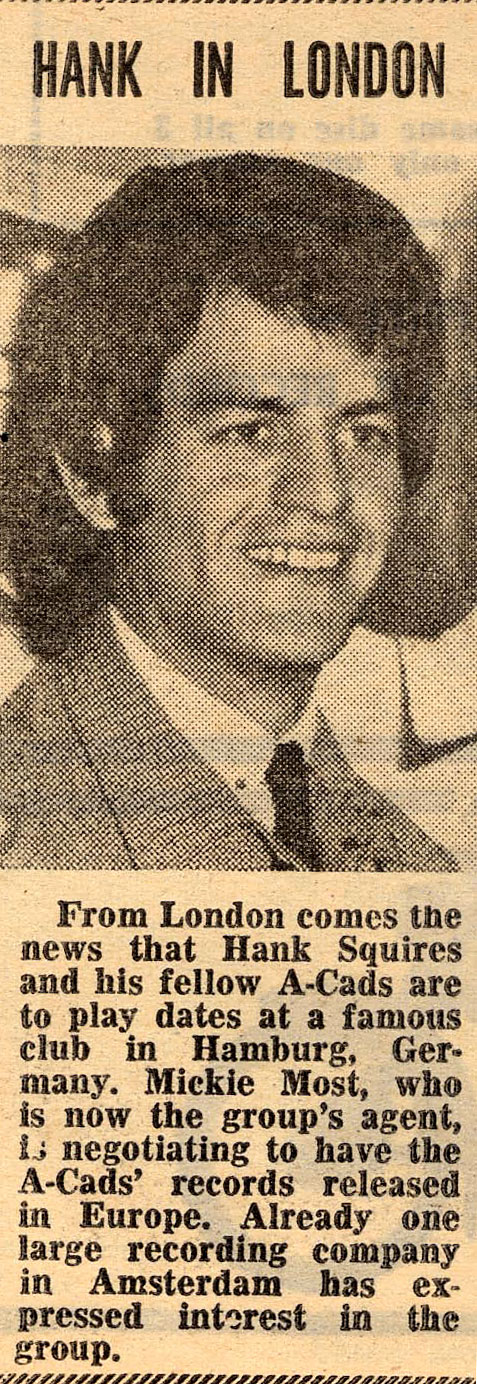
Hank Squires in London clipping, July 1966
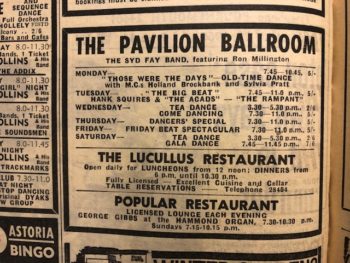
However, plans to get The A-Cads’ singles issued in Europe remained just that, and though a recording company in Amsterdam was reportedly interested, Most’s attempts to negotiate a deal quickly floundered. The Bournemouth Evening Echo interestingly has Hank Squires & The A-Cads playing at the Pavilion Ballroom on 12 July 1966.
Hank Squires & The A-Cads billed to play in Bournemouth, England in mid-July 1966
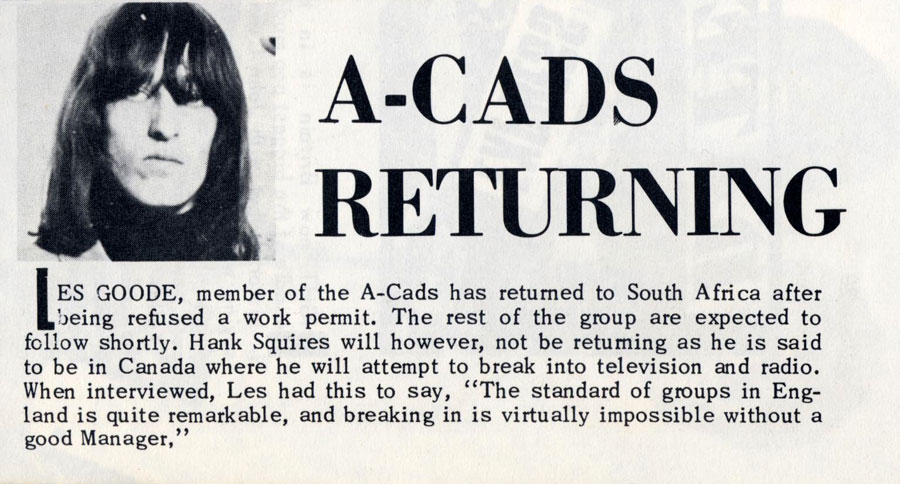
When the opportunity to play some dates in Hamburg also failed to materialise, and tentative plans to move to India to play at a major festival fell through, Goode returned somewhat despondently to South Africa in September 1966. (Incidentally, Teenage Personality reported in its 21 July issue that Squires was in Hamburg, so perhaps he did play there as a solo artist?)
Re-establishing ties with John E Sharpe, Les Goode became a member of The John Sharpe Set. Goode continued to work with the guitarist and was also a member of his next outfit, Impulse, which was formed in September 1967 with John Elliot (sax), Albert Rossi (drums) and Nic Martens (keyboards). Impulse recorded a lone 45 for Scepter Records, which coupled Booker T’s “Green Onions” with Herbie Hancock’s “Watermelon Man”.
Impulse changed its name to The Board of Directors in August 1968 and recorded two tracks for a lone 45: “Way Down Yonder in New Orleans” and “Legend of A Big Toe”, before Sharpe and Goode left in November to put together The Crystal Drive alongside South African guitar legend Julian Laxton from Freedom’s Children. Goode also briefly played with The Derick Warren Sound during this period, recording two singles with the group for the Continental label: “Lingering On” and “Every Other Saturday”.
Pop Gear, September 1966
Since then, he has become one of South Africa’s most highly regarded bass players and has appeared on records by (or played with) such notable outfits as Dickory, Backtrax, Morocko, Foxy and 909. Goode also worked with future Yes member and fellow South African Trevor Rabin’s support group when he toured England in 1979, and during the 1970s was also a member of Hawk. He is currently A&R and owner/director of Great Value Music in Johannesburg, a successful wholesale/distribution budget record company.
After the A-Cads: Hank Squires and Louis McKelvey in Canada Back in England Hank Squires’ decided to trade in a career as a performer. His decision may primarily have been influenced by The A-Cads’ recent demise, but it is likely that other factors played a part.
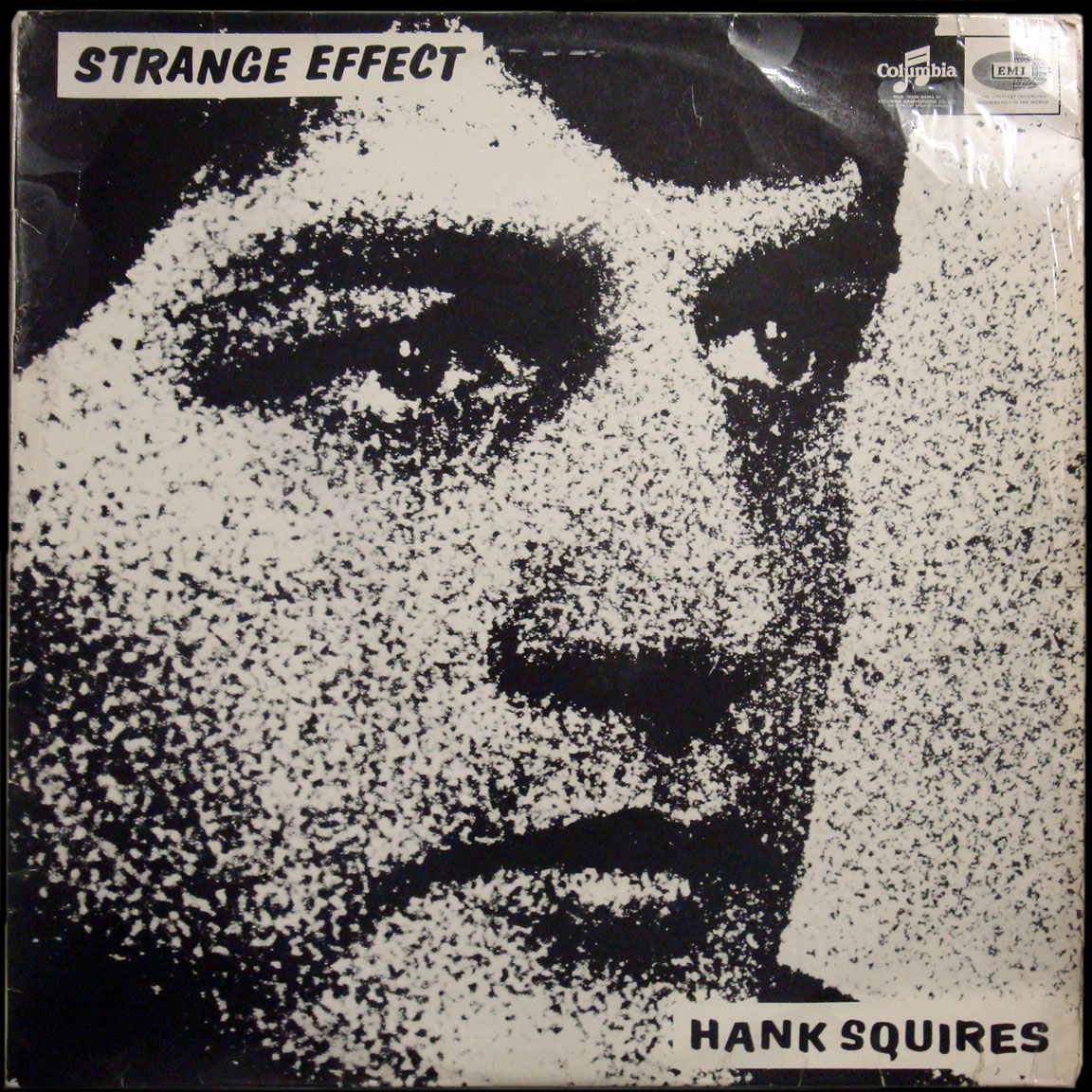
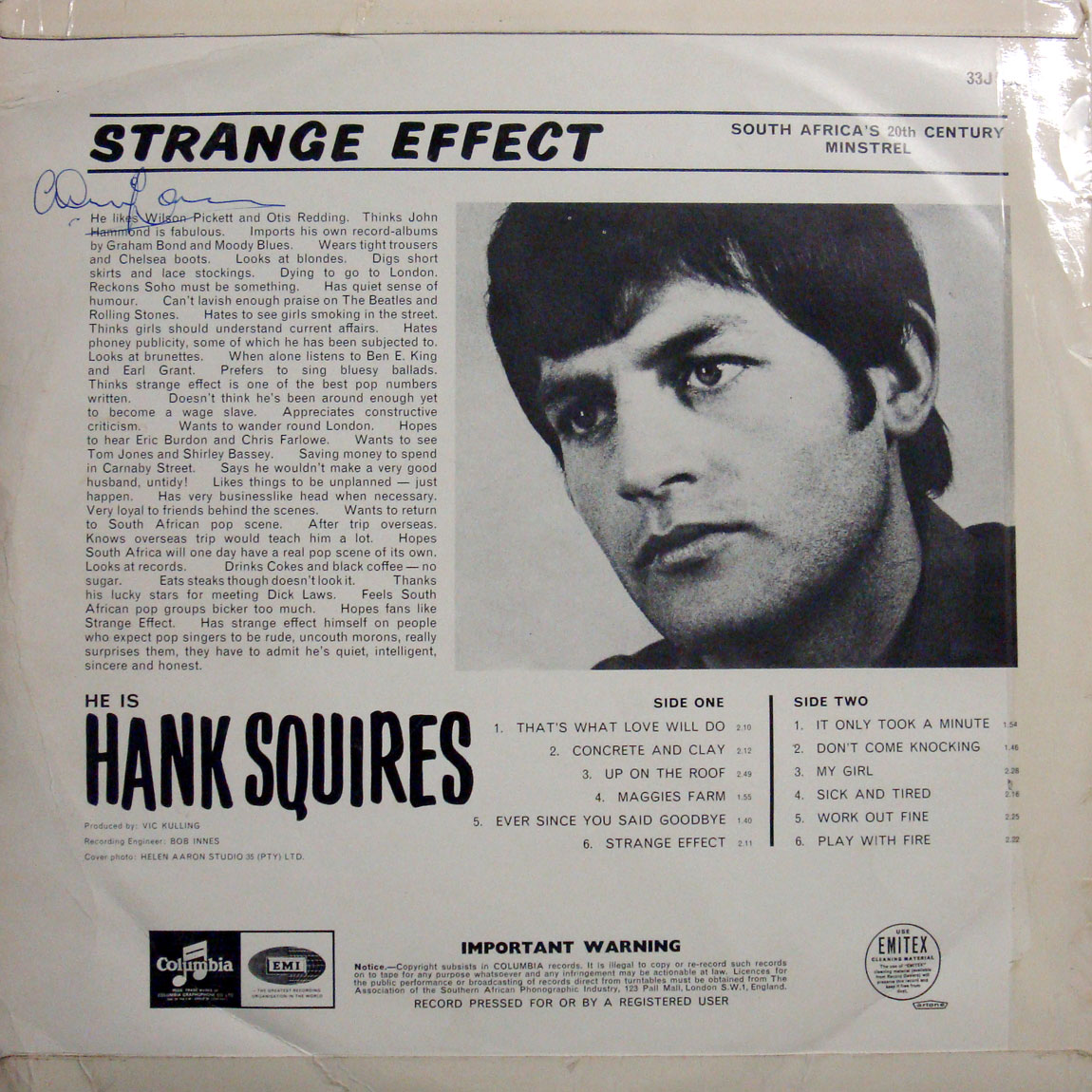
During the summer, the South African division of Columbia Records had released Squires’ solo album Strange Effect, but neither it nor two singles – “Don’t Come Knockin’” and “Strange Effect” had been commercially successful. Nevertheless, the album, recorded in late 1965/early 1966 (largely with the original A-Cads in support, although McKelvey appears on a couple of tracks), did receive a positive write up in the South African music press.
Tony Hamilton writing in Teenage Personality that summer said: “[The album] carries 13 carefully chosen numbers including “It Only Took A Minute”, “Concrete and Clay”, “Up On The Roof” and “My Girl”. Hank has lots of talent and deserves a break. He is now in England, and this new LP may help him over there.”
Unfortunately, it didn’t and after recording a number of demos with American producer Steve Rowland, South African songwriter Hugh Patterson and his mentor Mickie Most, Squires was forced to leave the country. “Due to the politics practised in South Africa I wasn’t able to secure a work permit and had no choice but to leave the UK, so I immigrated to Canada,” recalls Squires.
According to Teenage Personality in its 22 December 1966 issue, Squires recorded a rare single in Europe and then headed to Canada for a three-month engagement after he couldn’t get a work permit to perform in England. Arriving in Montreal in December 1966, he hooked up with McKelvey who’d made the crossing months earlier.
Like Les Goode, Louis McKelvey decided that England was not the ideal place to pursue his musical ambitions and around September 1966 he took the boat to Montreal with only $10 in his pocket. However, after only a few weeks in the city playing with the French-speaking Les Sinners, during which time he performed at the Paul Sauve Arena sporting a Union Jack jacket (an extremely daring move considering the political climate in Quebec), he took off for a cross-country jaunt to Vancouver. Returning to Montreal that December, he hooked up with Our Generation.
Hank Squires in the studio, 1969
Reunited with Hank Squires, McKelvey helped his former A-Cads band member find work with (arguably) Montreal’s finest garage band, The Haunted, who had recently scored a sizeable Canadian hit with “1-2-5”. Squires would work with the band and be given co-production credit on their lone album, which has since become a popular collector’s item.
McKelvey was also briefly involved with The Haunted. He was given co-production credit for the single “Searching For My Baby” c/w “A Message To Pretty” with Squires and, according to band member Jurgen Peter, was responsible for suggesting the ‘A’ side’s gutsy guitar intro. In an interesting side note, The Haunted single was given a South African release on the Continental label during early 1968 and was given a positive write up by Tony Hamilton in Teenage Personality.
A short while later, Hank Squires became a talent scout for Johannesburg-based label Highveld and through Jurgen Peter produced a single for Montreal singer, Andrew Storm (real name: Andrew Lacroix). Storm’s single, “Tic-Tac-Toe” c/w “I’d Love To Love You Again”, which features McKelvey on guitar, was later given a South African release on Highveld in 1970. Squires sadly died on July 13, 2009.
McKelvey meanwhile had thrown in his lot with Our Generation – a Haunted spin-off featuring former members Bob Burgess, Tim Forsythe and Jim Robertson. Our Generation already had one single to their credit, “I’m a Man”” c/w “Run Down Every Street”, issued on the Transworld label, but McKelvey’s arrival gave the band a “shot in the arm”. His fiery lead guitar work is immediately distinguishable on the group’s second (and arguably best) single, “Cool Summer” c/w “Out To Get Light”, which was issued in May 1967 and was produced by Squires.
By the time it reached the shops, McKelvey had moved on and pieced together a new musical project, Influence alongside Andy Keiller from The Upsetters. Keiller had arrived in Montreal in April 1966 and spotted McKelvey playing on TV with Our Generation. Influence subsequently recorded an album for ABC in late 1967 before splitting late the following year. McKelvey then worked with the short-lived groups Milkwood, Damage and Powerhouse.
During the early 1970s, McKelvey briefly re-united with Hank Squires, working as a songwriter and session guitarist for Squires’ short-lived studio group Marble Hall, which featured singer Brian Redmond. McKelvey contributed to the group’s lone single, “Marble Hall” (originally recorded as a demo with Influence).
Hank Squires in Montreal, 1970
Following his work with Andy Storm, Hank Squires released one more solo recording that year – “Ecstasy”, which appeared on a compilation album called Command Performance. Squires later produced a number of recordings in the early 1970s for a singer known as Martin Martin. Based in Victoria, British Columbia, he is preparing an album of new material, which will be released under the name, SmityBoy.
Interest in The A-Cads has grown meanwhile and an Italian label, Crystal Emporium, brought out a CD of The A-Cads album in 1998 complete with bonus tracks featuring some rare Hank Squires solo material, taken from an unreleased EP recorded in 1966.
Many thanks to the following for generously helping to piece the story together: Hank Squires, Les Goode, Dick Laws, Louis McKelvey, Andy Keiller, Tertius Louw, Jurgen Peter, Ian Hannah, Mike Paxman, Garth Chilvers, Tom Jasiukowicz, Gregory Plotz and Leon Booysen.
Strange Effect LP photos courtesy of Ivan Amirault.
This site is a work in progress on 1960s garage rock bands. All entries can be updated, corrected and expanded. If you have information on a band featured here, please let me know and I will update the site and credit you accordingly.
I am dedicated to making this site a center for research about '60s music scenes. Please consider donating archival materials such as photos, records, news clippings, scrapbooks or other material from the '60s. Please contact me at rchrisbishop@gmail.com if you can loan or donate original materials

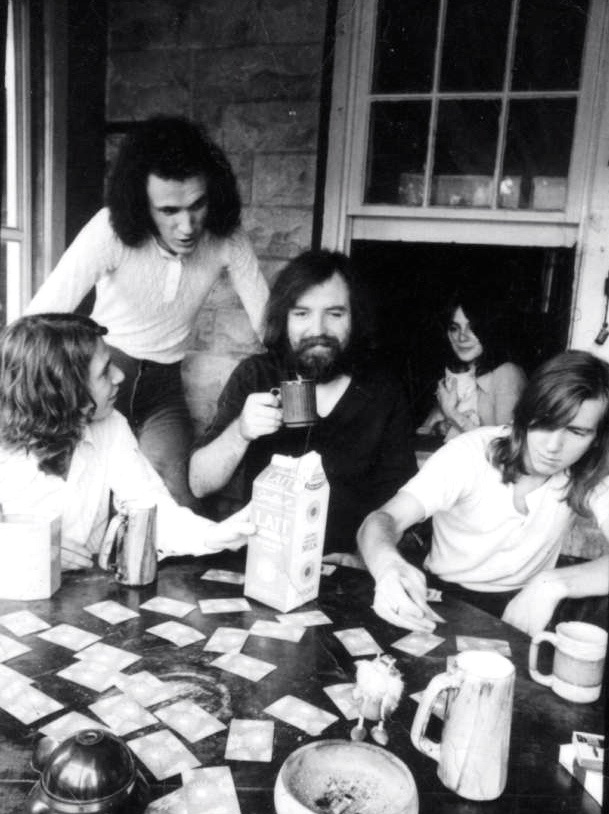
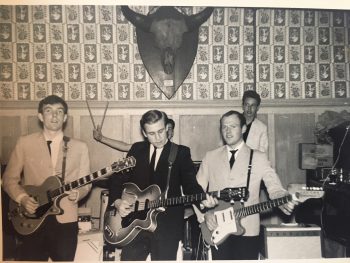
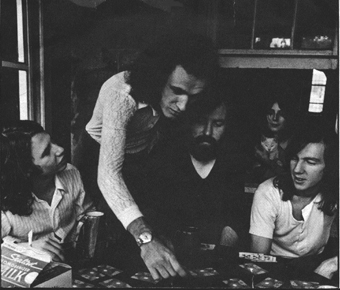
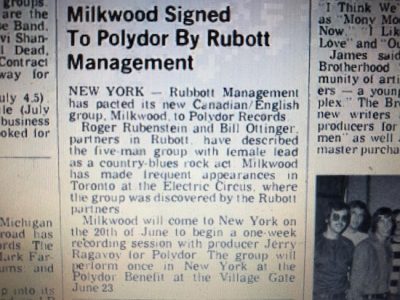
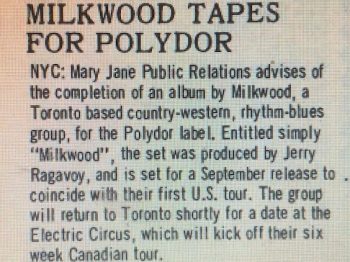
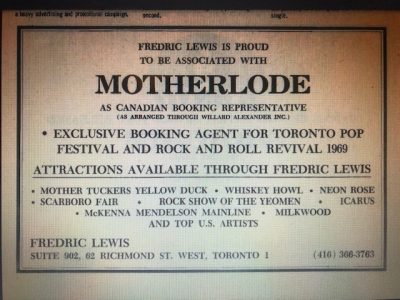
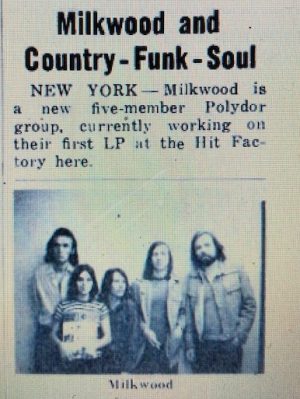
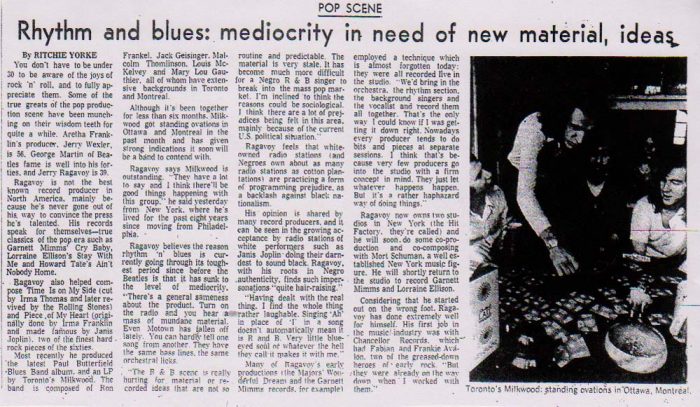
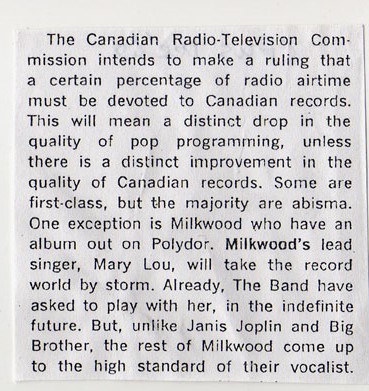
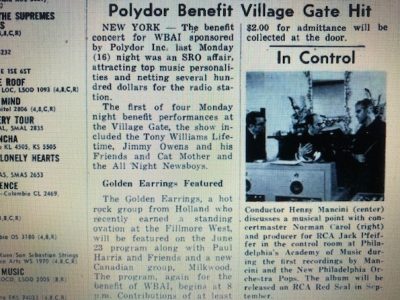
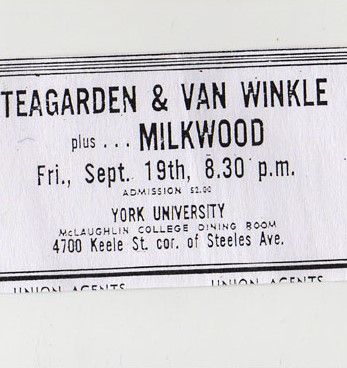
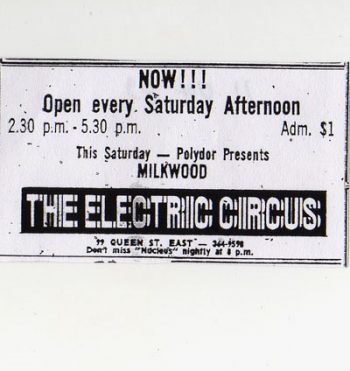
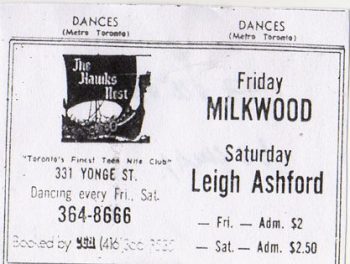
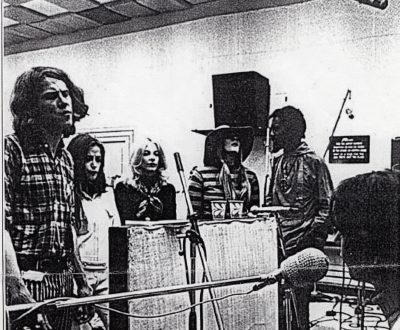
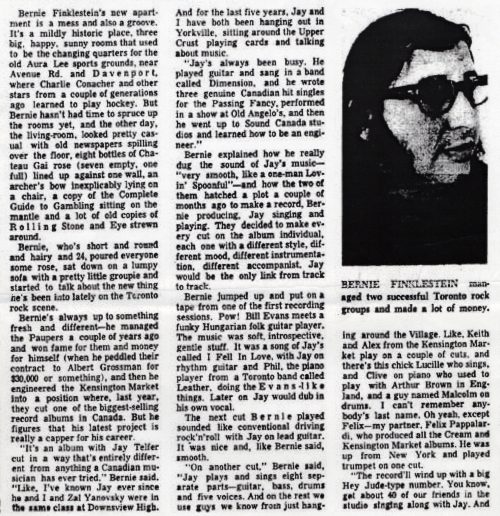
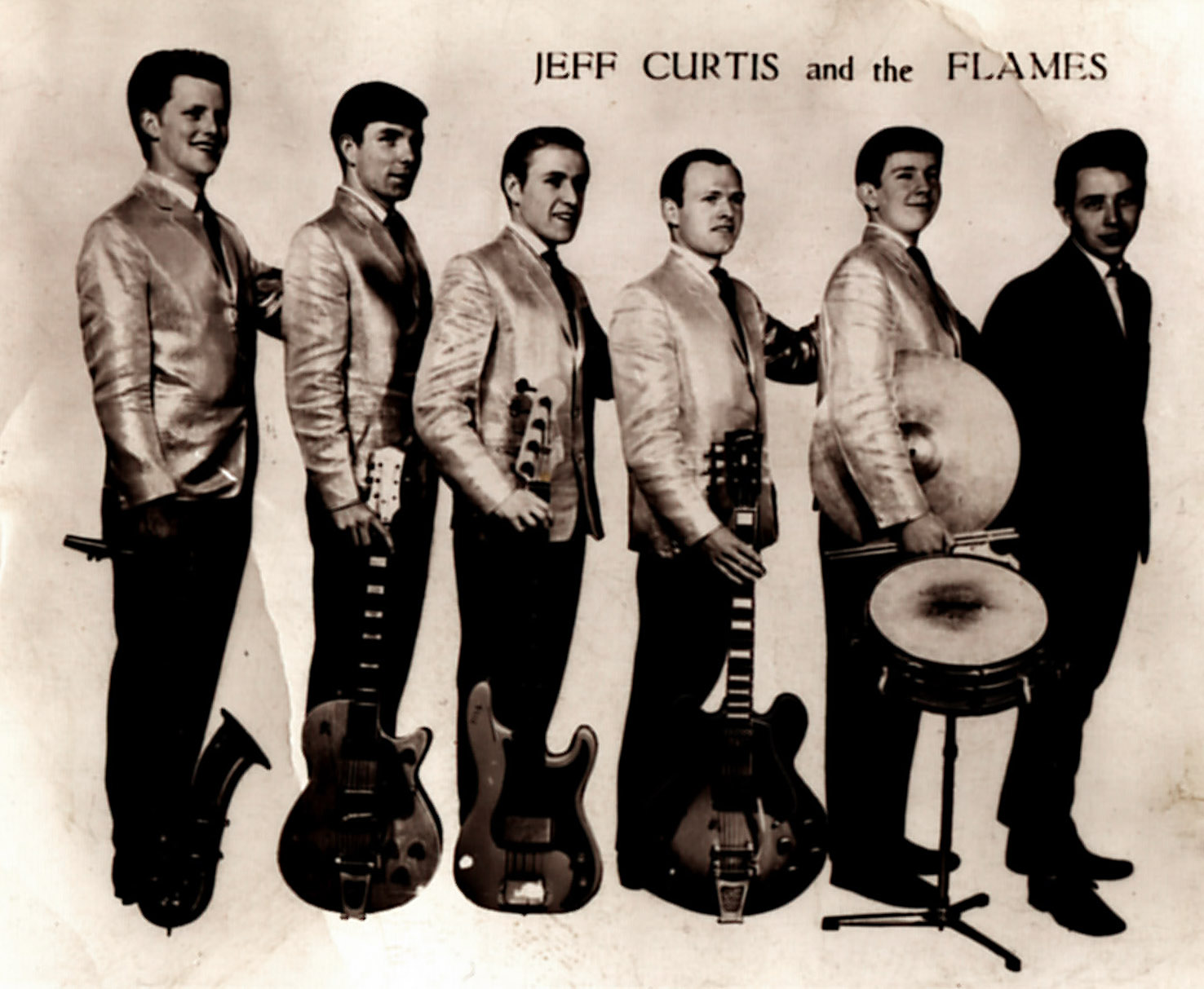
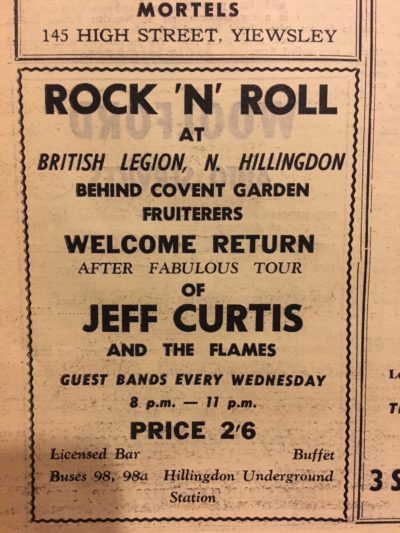
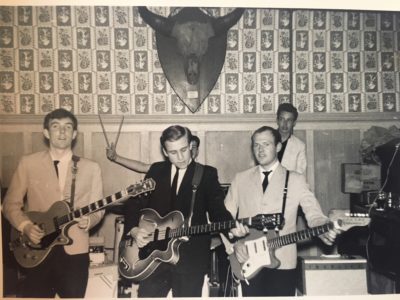
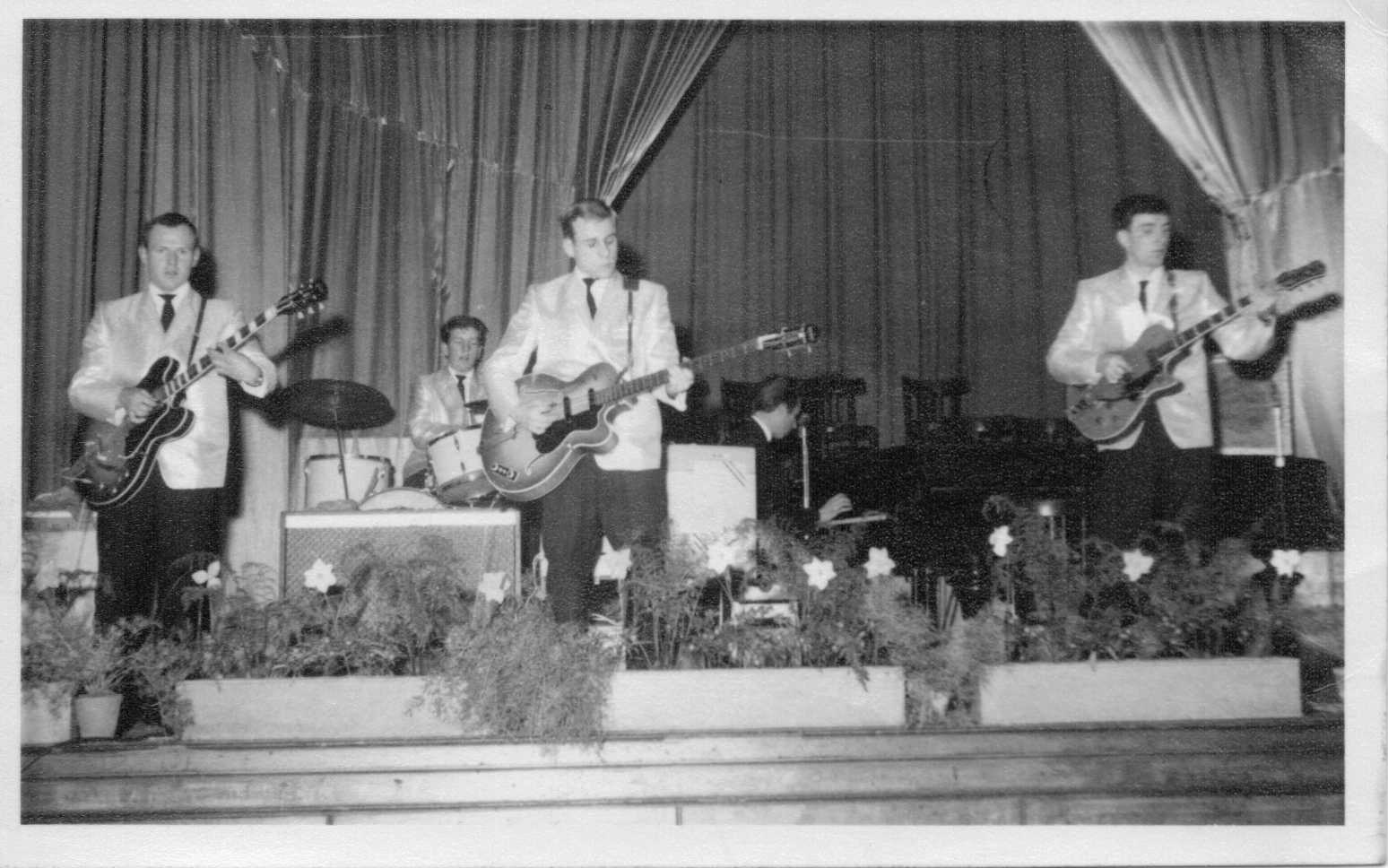
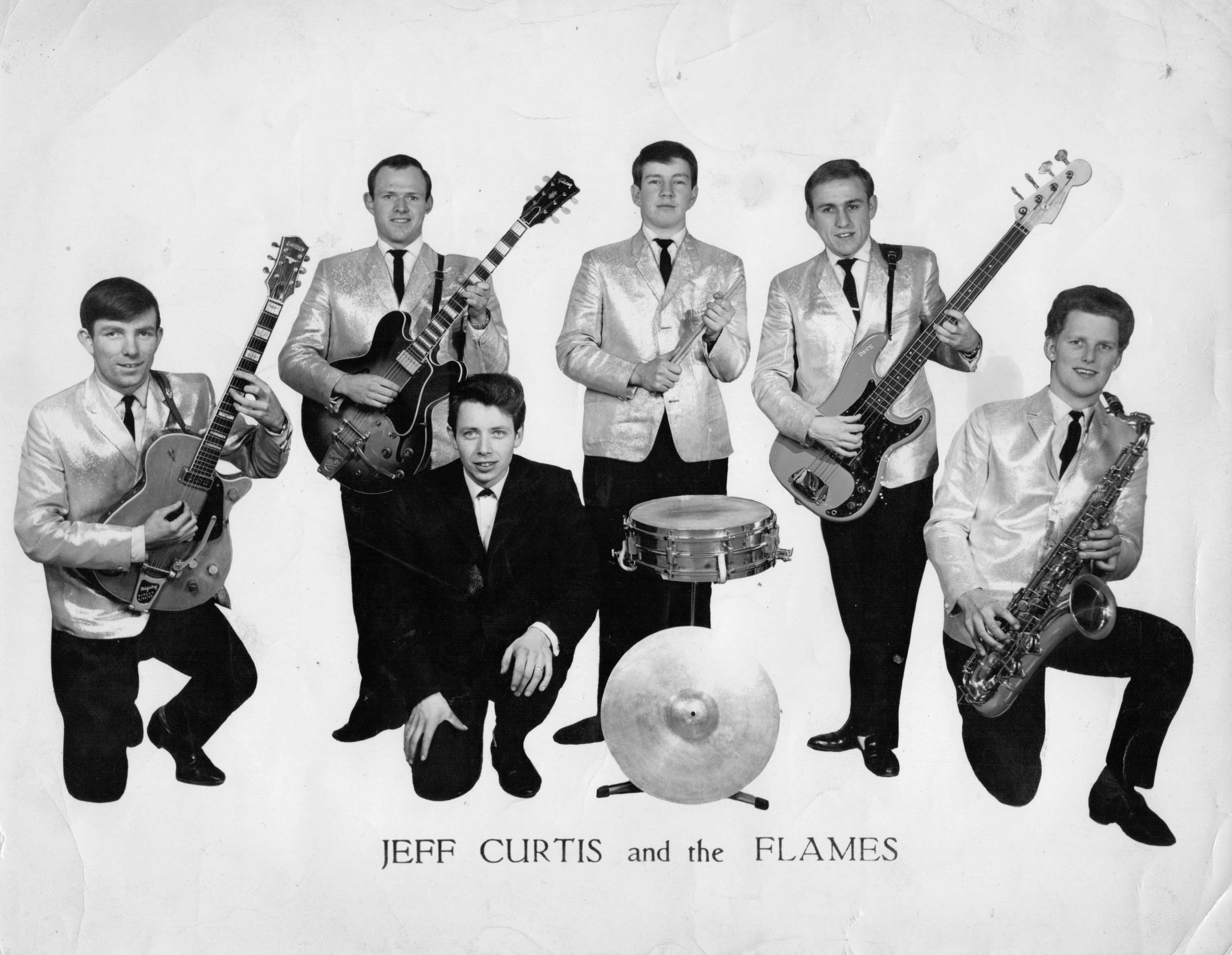
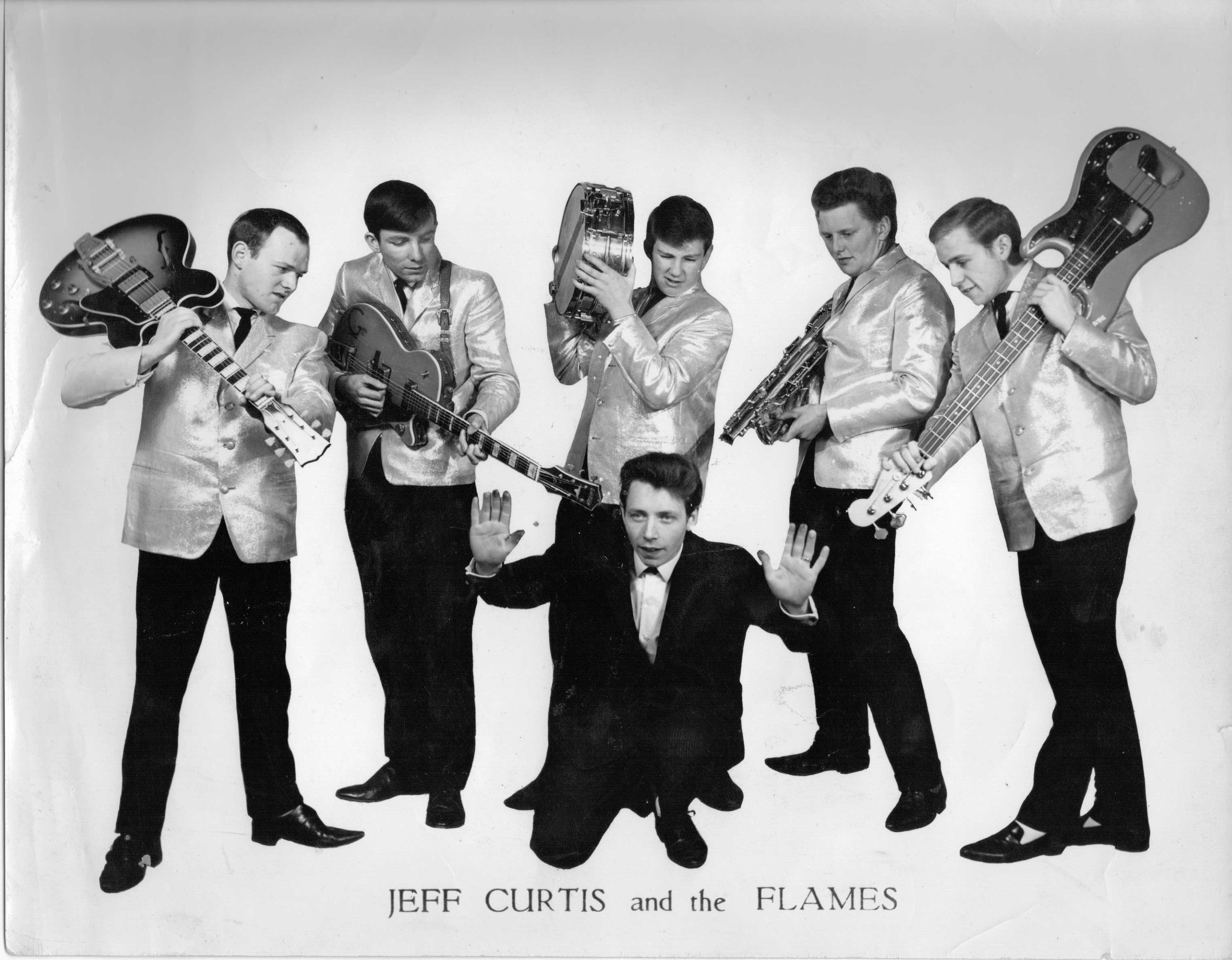
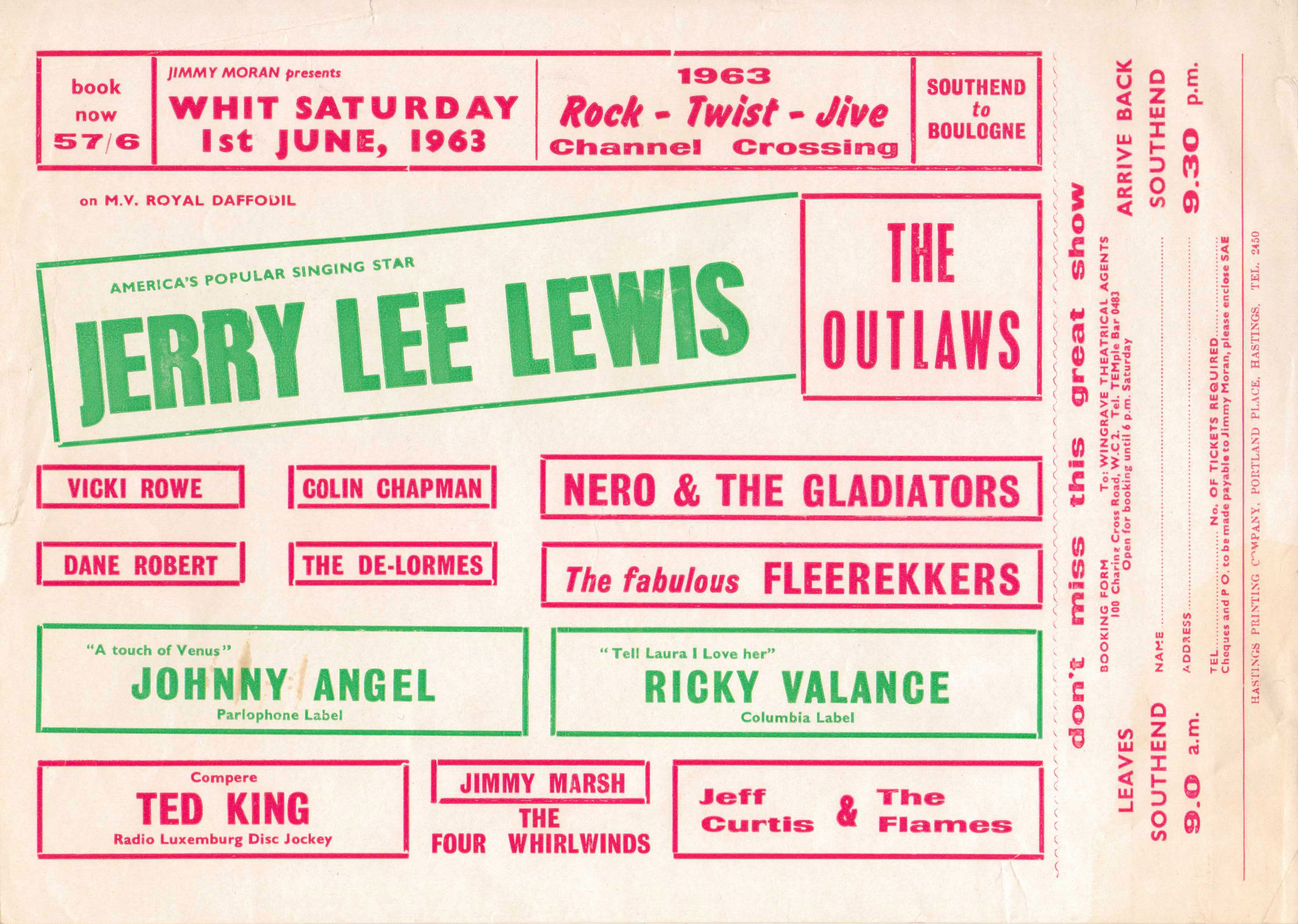
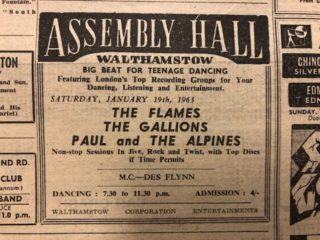
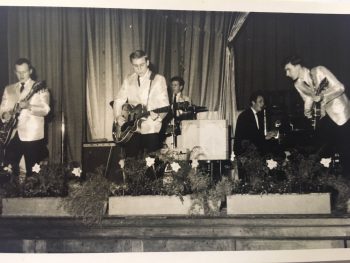
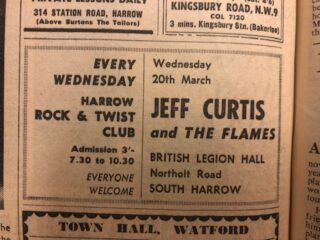
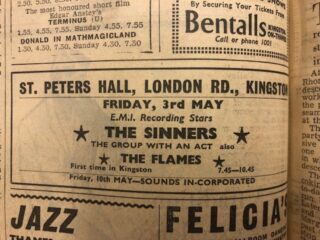
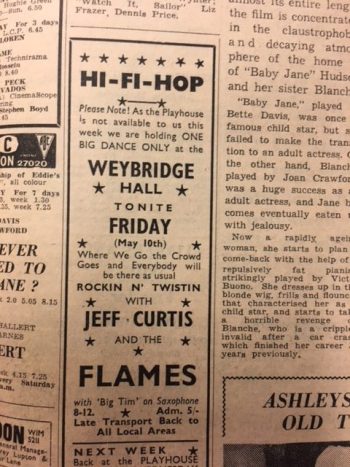
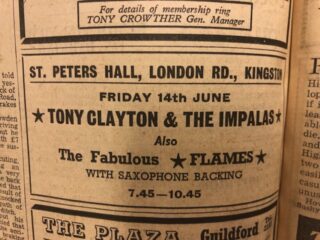
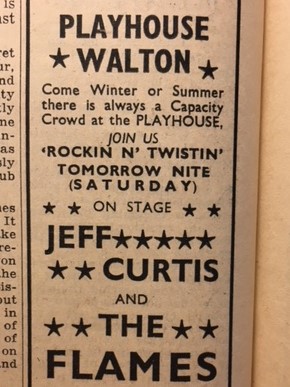
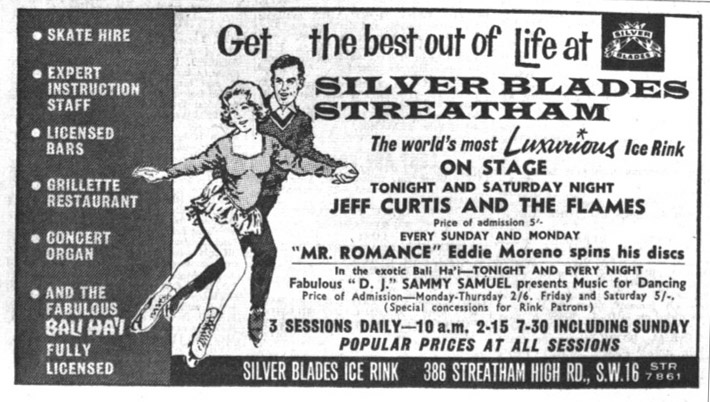
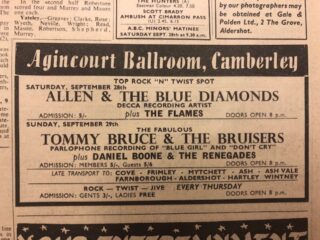
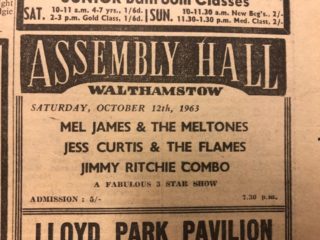
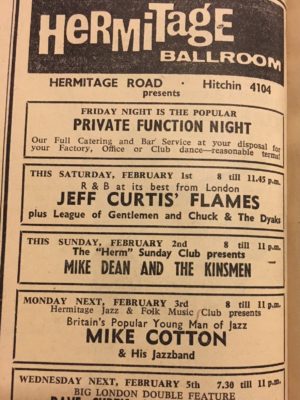
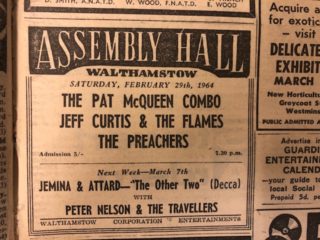

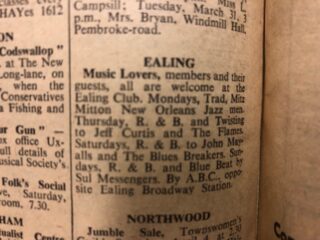
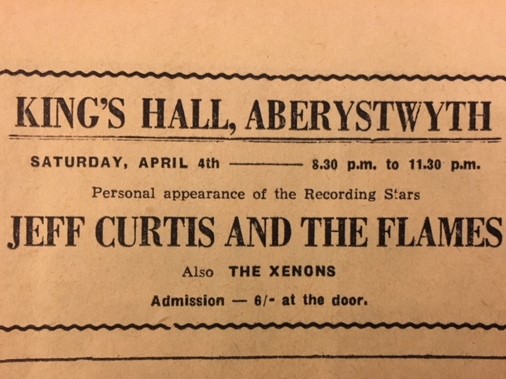
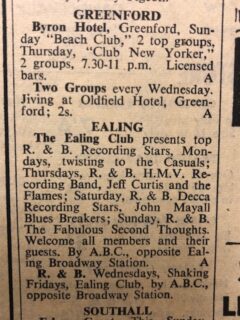
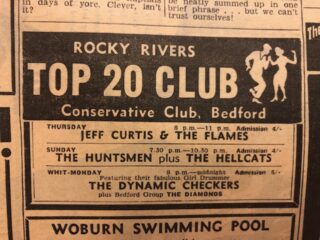
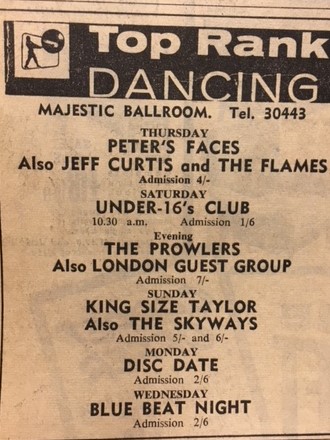
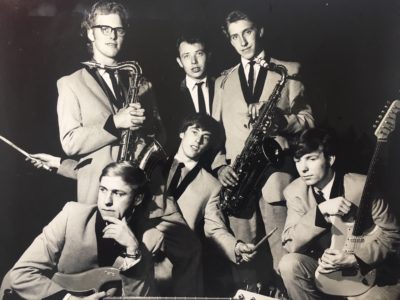
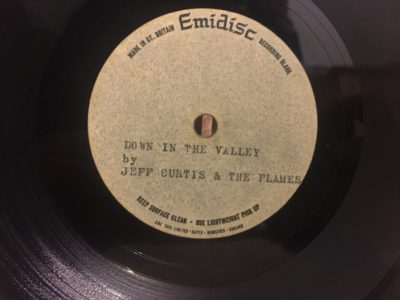
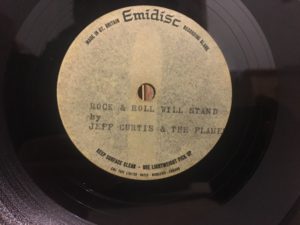
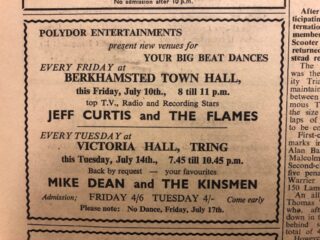
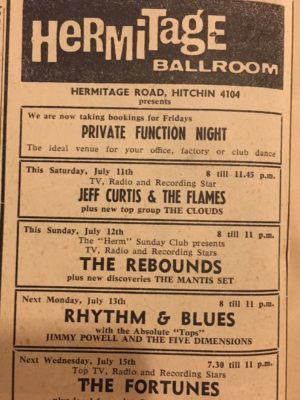
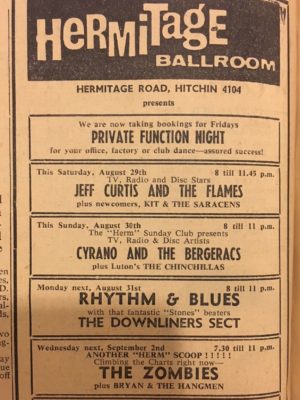
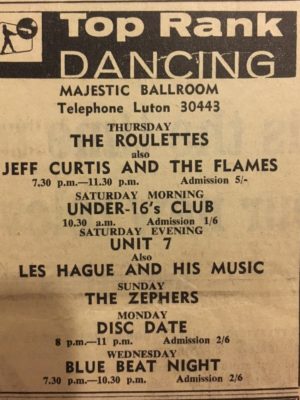
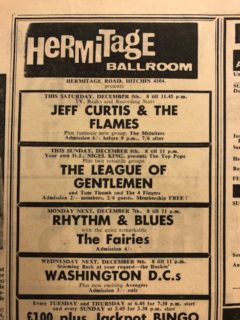
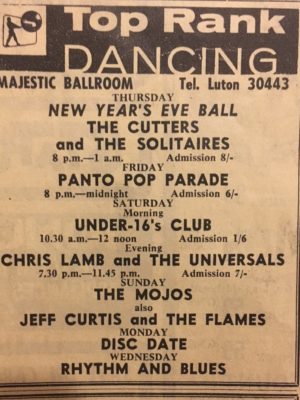
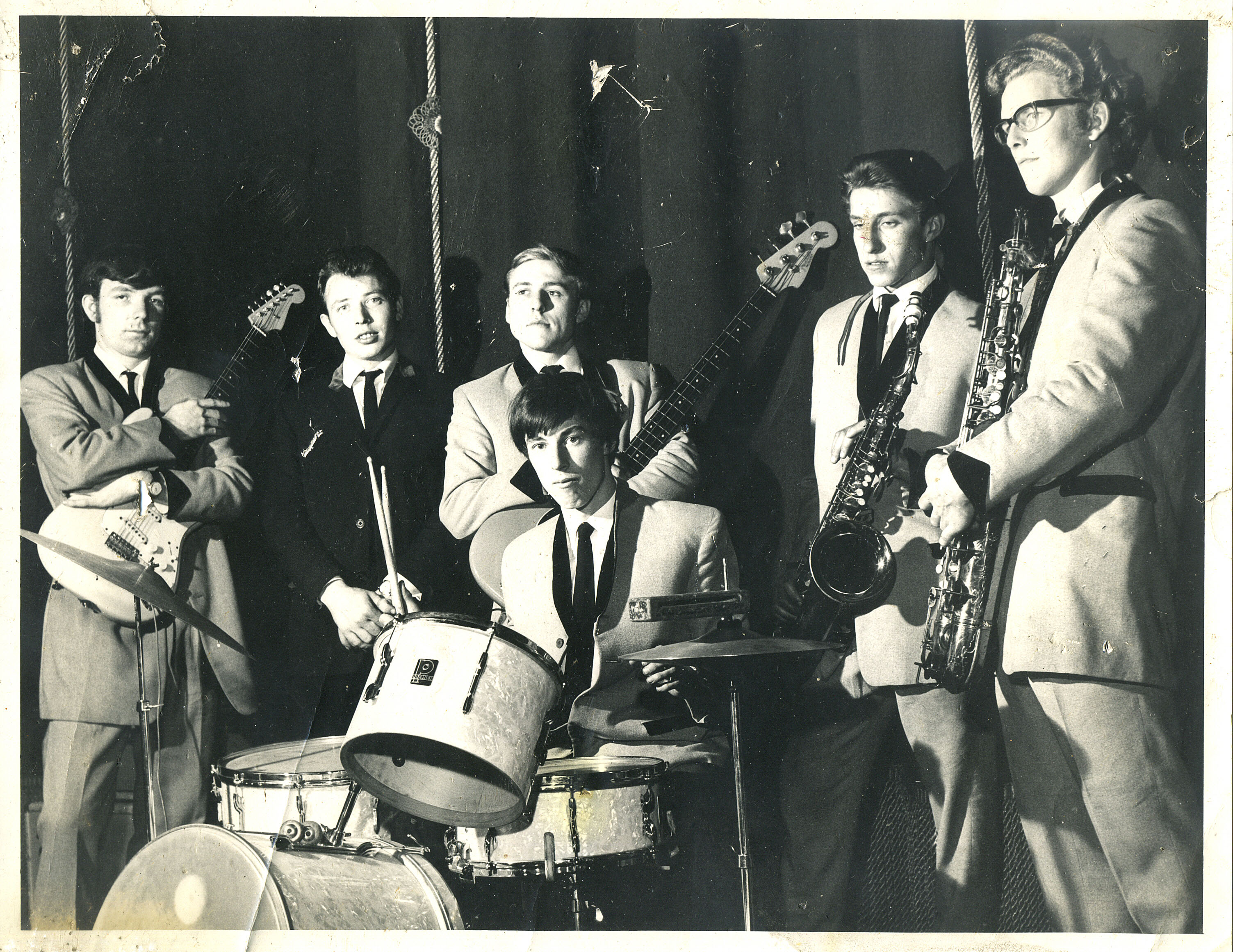
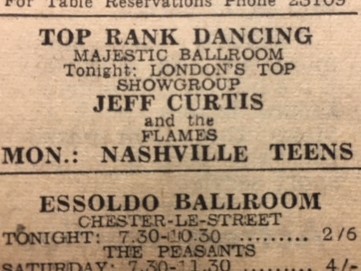
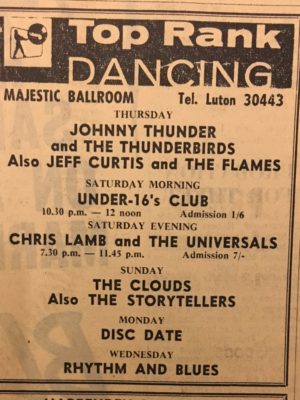
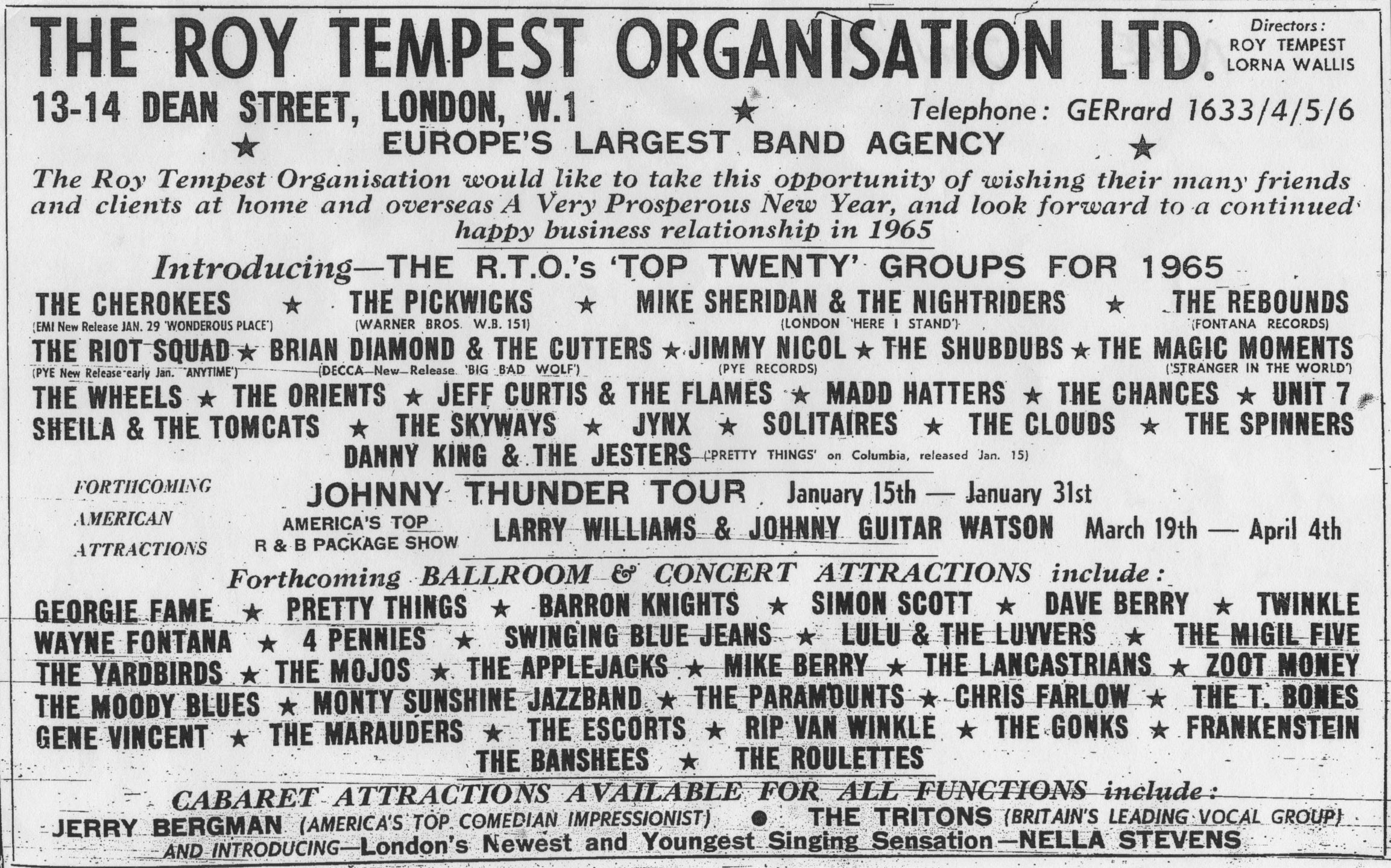
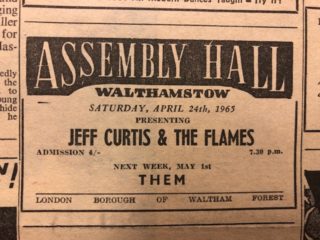
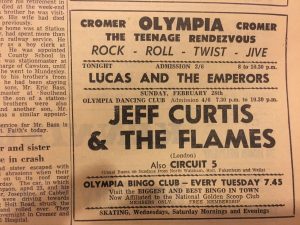
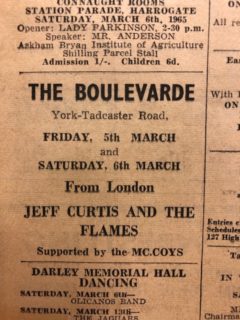
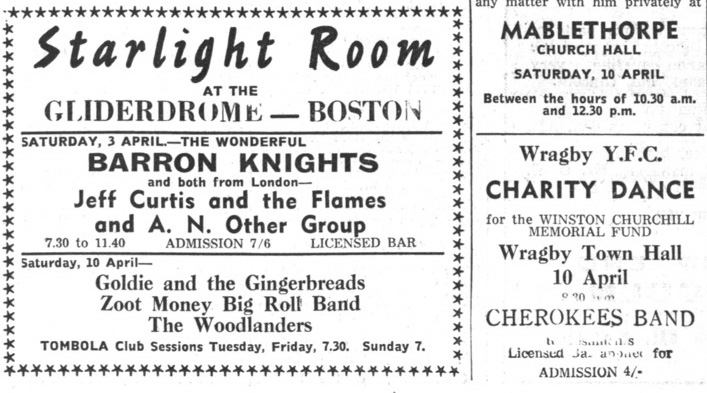
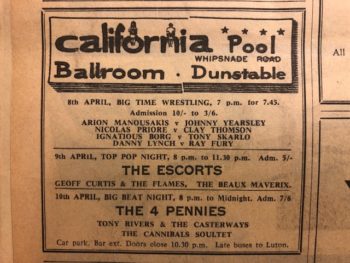
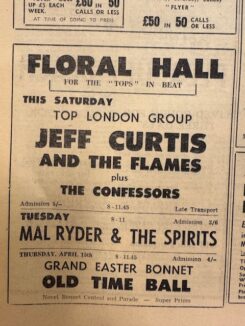
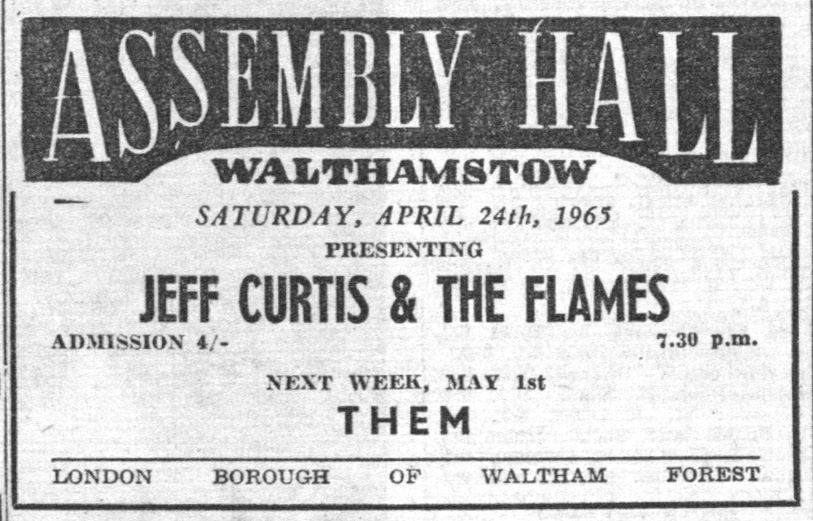
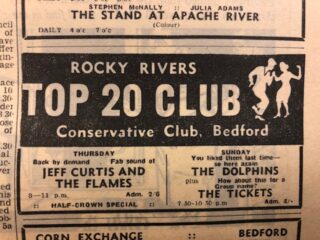
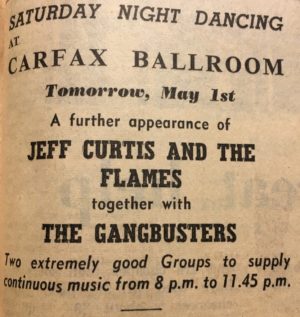
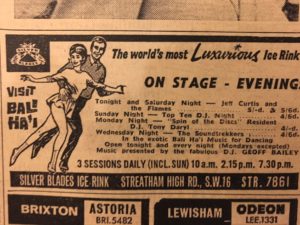
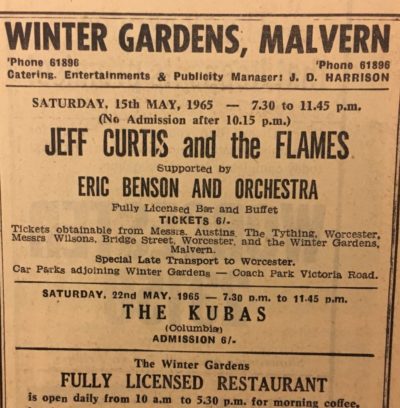
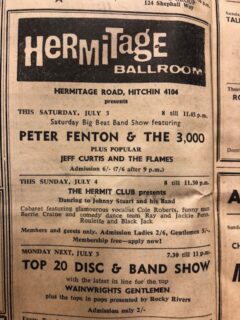
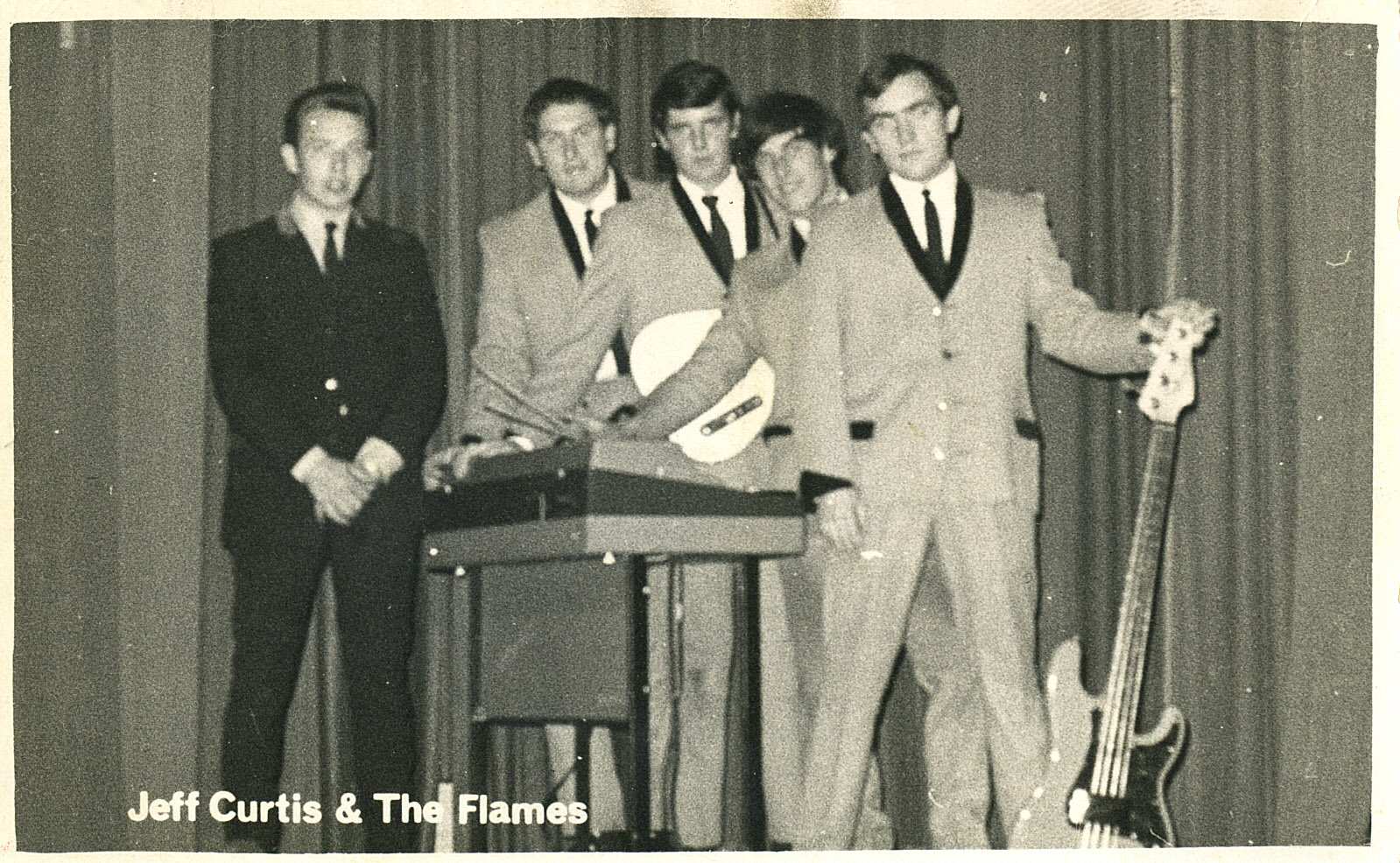
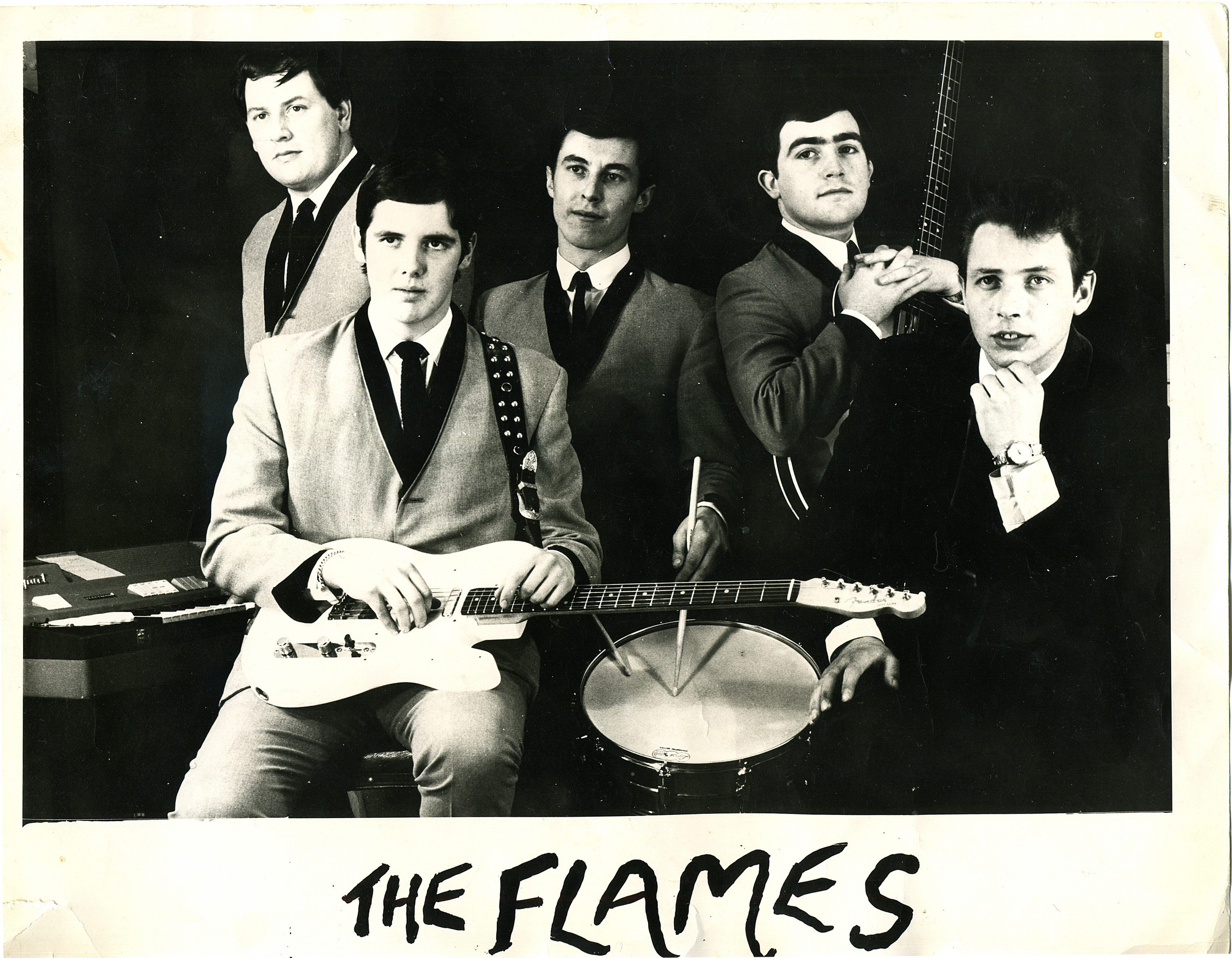
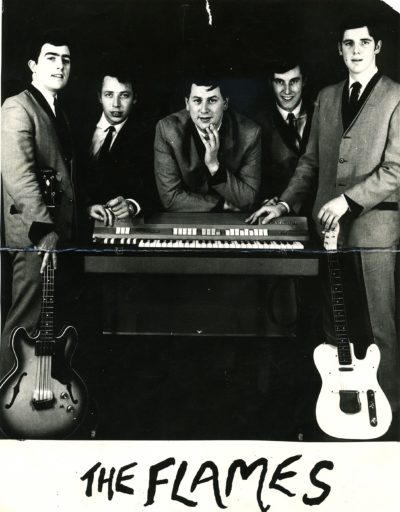
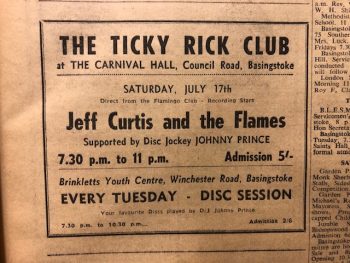
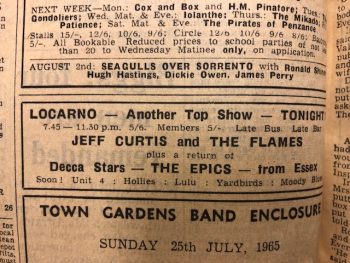
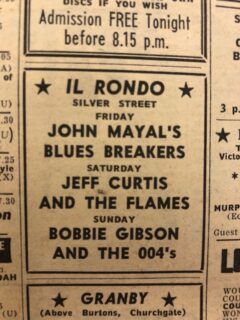
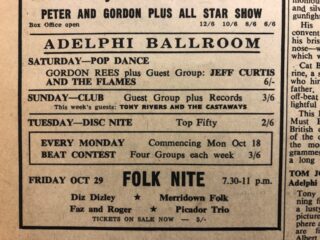
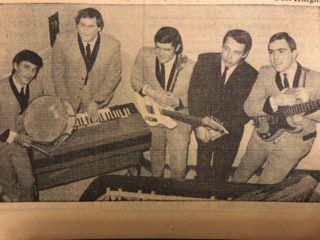
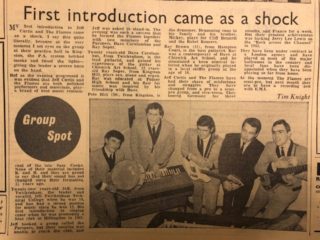
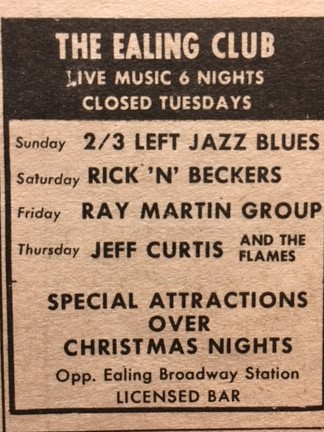 16 December 1965 – Ealing Club, Ealing, London