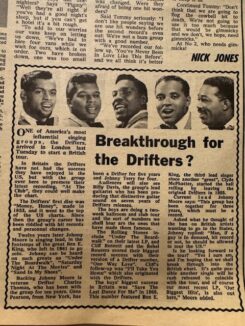
The Drifters’ history is incredibly complicated because so many singers have passed through its ranks since the group was first formed in mid-1953 with original lead tenor Clyde McPhatter.
I would like to credit US music historian Marv Goldberg, who has painstakingly pieced together their convoluted history here and here for helping me to piece together the very brief outline below.
When McPhatter left (after a final recording session in late 1954 while completing military service) for a solo career, the group’s manager George Treadwell acquired the rights to the band’s name.
In early 1958 he fired first tenor/bass singer Bill Pinkey following a dispute over money; Pinkney was also the band’s road manager and therefore was well aware of the state of their finances. A short time later, Treadwell fired the remaining members and established a new Drifters from The Crowns featuring longstanding member Charlie Moore (lead and tenor).
Pinkney quickly rounded up former Drifters – lead tenor singer David Baughan, who’d replaced McPhatter when he’d left for a solo career, as well as brothers Gerhart (second tenor) and Andrew Thrasher (baritone).
After securing the legal rights to the “Original Drifters” brand, they hit the road in 1958 and continued to tour (with Pinkney alongside changing personnel) until his death in 2007.
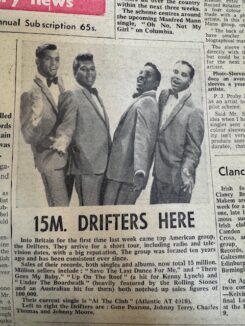
In the spring of 1965, British rock promoter Roy Tempest brought Treadwell’s latest version of The Drifters over for their debut British tour to promote their latest single “At the Club”.
According to Record Mirror’s 9 October 1971 issue, this was the only British tour that The Drifters undertook during the 1960s until September 1971.
All of the subsequent British tours The Drifters undertook during the 1960s (and there were around a dozen) were by Bill Pinkney’s rival version, The “Original Drifters” plus a fake version that was in fact The Invitations (see separate entry).
This entry, however, covers The Drifters (the original group) that George Treadwell managed. While future solo star Ben E King had been front man between mid-1958 and mid-1960, the line-up that participated in this spring 1965 comprised the following line up and, according to Melody Maker’s 3 April 1965 issue (page 7), had been together for three years (although that doesn’t appear to be correct judging by other sources).
It is not clear which British rock group backed The Drifters on this tour and Garage Hangover would like to hear from anyone who can provide further details of this group and the tour.
The Drifters, Record Retailer, 1 April 1965, page 1
The Drifters:
Johnny Moore – lead and tenor
Charles Thomas – lead and tenor
Gene Pearson – baritone
Johnny Terry – bass
+
Bill Davis (aka Abdul Samad) – guitar
Johnny Moore was arguably the most longstanding member, having been there from mid-1955 when key members of The Drifters were present, notably Bill Pinkney and David Baughan. He’d been drafted in late 1957 but returned in spring 1963. Significantly, Moore was the only member of The Drifters to still be with the group when they returned to Britain in September 1971 for their second tour.
Charles Thomas was the second most longstanding member, having joined in mid-1958. He would remain until August 1967 and was briefly replaced by Charles Baskerville before Milton Turner joined later that year. Don Thomas subsequently replaced Turner in late 1969 and remained until early 1971.
Gene Pearson had joined in mid-1962 and left in the summer of 1966 to be briefly replaced by Eddie Bowen and then Rick Sheppard, who remained until 1970.
Johnny Terry, who’d previously worked with James Brown, was the last to join this touring version of The Drifters in early 1963 and also left in mid-1966. First Dan Dandridge and then William Brent briefly replaced him that same year before baritone/bass singer Bill Fredericks joined around December 1966. Fredricks was still there when The Drifters returned to Britain for their second tour in late 1971.
When The Drifters returned in 1971, Johnny Moore and Bill Fredericks were joined by Butch Leak and Grant Kitchens.
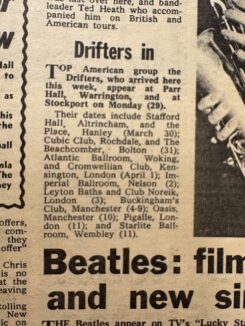
Melody Maker’s 27 March issue, page 5, lists the following tour dates:
30 March 1965 – Stafford Hall, Altrincham, Greater Manchester (Melody Maker)
30 March 1965 – The Place, Hanley, Staffordshire (Melody Maker)
31 March 1965 – Cubic Club, Rochdale, Greater Manchester (Melody Maker)
31 March 1965 – Beachcomber, Bolton, Lancashire (Melody Maker)
1 April 1965 – Atalanta Ballroom, Woking, Surrey (Melody Maker)
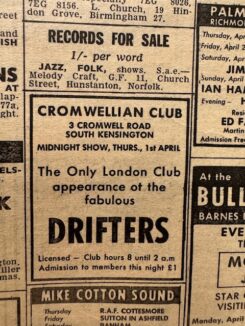
1 April 1965 – Cromwellian, South Kensington, west London (Melody Maker)
2 April 1965 – Imperial Ballroom, Nelson, Lancashire (Melody Maker)
3 April 1965 – Leyton Baths, Leyton, east London (Melody Maker)
3 April 1965 – Club Noreik, Tottenham, north London (Melody Maker)
4-9 April 1965 – Buckingham’s Playboy Room, Manchester and the Riverboat Club (formerly the Whisky A Go Go), Salford, Greater Manchester (Melody Maker/Manchester Evening News & Chronicle)
10 April 1965 – Oasis, Manchester with Johnny B Great & The Quotations (Melody Maker/Manchester Evening News & Chronicle)
11 April 1965 – Pigalle Club, Piccadilly, central London (Melody Maker)
11 April 1965 – Starlight Ballroom, Wembley, northwest London (Melody Maker)
We would welcome any recollections in the comments below
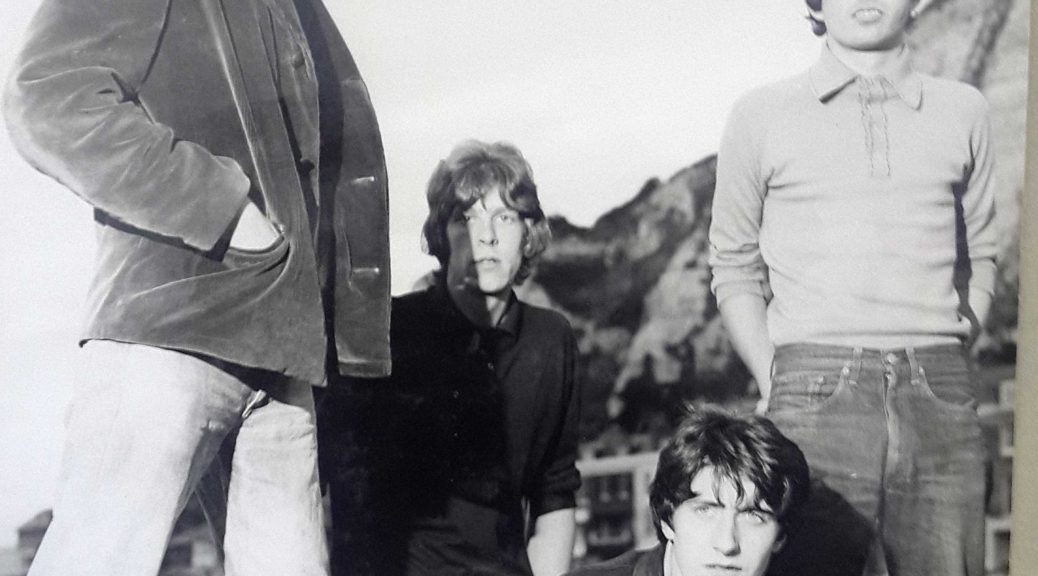
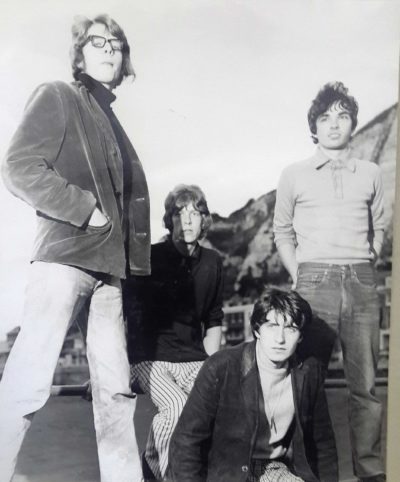
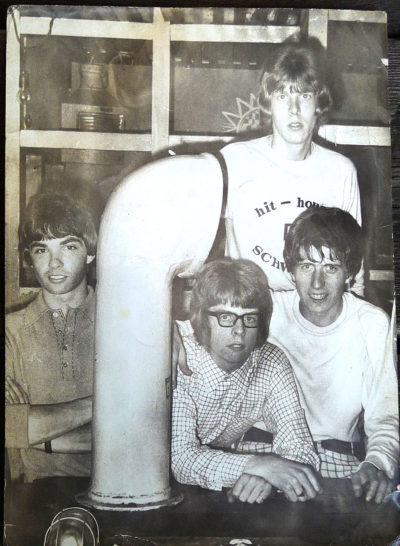
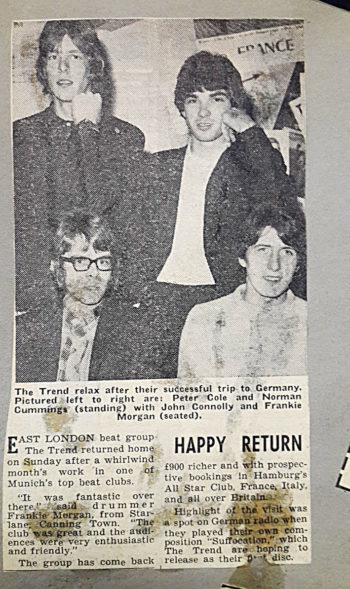
Photo: Pete Cole and Norman Cummins. Clockwise from left: John Connolly, Pete Cole, Norman Cummins and Frankie Morgan
Norman Cummins – lead guitar/vocals
John Connolly – rhythm guitar/vocals
Pete Cole – bass/vocals
Frankie Morgan – drums
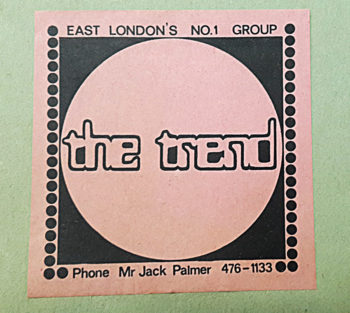
Formed in Dagenham, Essex, and originally called The Buddy’s, the group changed its name to The Trend in mid-1965 after manager Jack Palmer saw Pete Cole playing with the East Ham based group The Prospectors and brought him in to replace the original bass player Jeff.
Soon afterwards, Ken, the group’s singer, and Brian, the rhythm guitar player, both departed. Norman Cummins took over on lead vocals (alongside lead guitar) and John Connolly joined on rhythm guitar.
The Buddy’s had started out without Norman Cummins who joined after answering an advert in a tobacconist’s window. The Buddy’s used to rehearse in a pub’s cellar in Whalebone Lane in Chadwell Heath. The group then started performing in local pubs, community halls and youth clubs in and around the Dagenham area.
According to an old friend, Norman Cummins used to carry his guitar everywhere and would get up on stage in pubs and play Bob Dylan and Donovan songs.
Norman Cummins started playing music at the age of seven, his first instrument being a piano accordion which was a gift one Christmas. However, he couldn’t quite get on with all the push buttons, so he just played the piano keys on his lap and worked the bellows with his feet.
His brother, however, had a guitar but he wasn’t allowed to touch it. When his brother was out of the house Norman picked up the guitar and learnt to play.
Not long afterwards, he sold the piano accordion and bought a cheap Spanish guitar. He later became adept at playing in a Chet Atkins style and purchased a secondhand Hofner Congress acoustic guitar to which he added a neck pickup. He used this guitar throughout his entire time with The Trend.
The aspiring guitarist also had a Gretsch Tennessee that had belonged to Gerry Marsden from Gerry and The Pacemakers. The guitar still had Gerry’s name and address in its case, but he couldn’t get on with it, so he just left it propped up on stage to show that he also had a “better” guitar.
Originally from East Ham, Pete Cole grew up in the next street to British guitar legend Bert Weedon. Lonnie Donegan was also a neighbour in East Ham and became famous for his skiffle group and the hit song “Rock Island Line”.
Pete was introduced to music when he lived with his grandmother (up until he was seven years old) in East Ham. After breakfast every morning he would sit in front of his granny’s old valve radio and listen to Django Reinhardt, Yehudi Menuhin, Count Basie and Stéphane Grappelli.
Later, his friend Geoff showed him the three chords from “Riders in the Sky”, a popular instrumental hit at the time, on an old acoustic guitar. His parents wouldn’t buy him one, so Pete made his own guitar and started The Prospectors who played once a week in Saint Paul’s Church in East Ham.
When he reformed the band, Pete Cole bought a Hofner 173 solid bodied guitar but after having to teach the bass player how to play, he decided to find a better lead guitarist than himself (Mick Baggeridge) as well as a rhythm guitarist (Tom Robinson), and switched to bass using an EKO Florentine bass. He later bought a Slab Body Fender Precision Bass from the J60 music Bar in Manor Park when he joined The Trend.
Pete also befriended future Small Faces front man Steve Marriott during this time. He remembers meeting up with Steve when they rode their track bikes around a cinder track in Little Ilford Park, Church Road, Manor Park.
“There were a lot of stinging nettles in the park which eventually inspired Steve and Ronnie Lane to write their hit song ‘Itchycoo Park’,” he says.
Steve Marriott used to work on Saturdays in a music shop in High Street North Manor Park called the J60 Music Bar. The shop had a small recording room in the basement where musicians could record directly onto a 45-rpm disc.
The Prospectors recorded “Just You” there for a prospective single. During their time together, Pete’s band supported some well-known acts, including Georgie Fame and The Blue Flames at East Ham Town Hall, John Lee Hooker at the Granada Cinema on the Barking Road and Sounds Incorporated at Leyton Baths.
Photo: Pete Cole and Norman Cummins
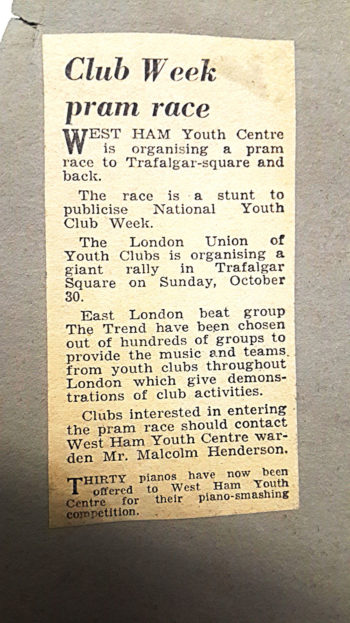
Shortly after the name change to The Trend, Norman Cummins remembers the group playing at the foot of Nelson’s column in Trafalgar Square and winning £15 in the “Best Band in East London” competition with an extra £5 for the best original song.
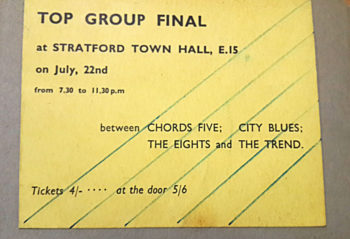
On 22 July 1966, The Trend joined Chords Five, City Blues and The Eights for the Top Group Final, held at Stratford Town Hall.
Photo: Pete Cole and Norman Cummins
Through Jack Palmer and local promoter Kenny Johnson, The Trend landed an audition with a German club owner, Paul Neuman, who offered the musicians work for a month at the PN Hit House in Schwabing, Munich in September 1966.
The Trend took over from The Giants, who featured Gibson Kemp on drums from the group Paddy, Klaus and Gibson.
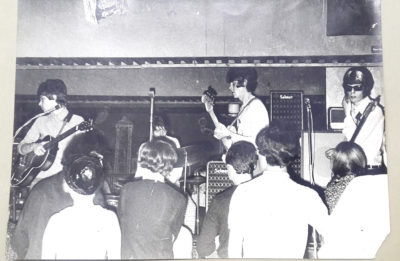
Photo: Pete Cole and Norman Cummins. The Trend at PN Hit House, 1966
Norman and John had decided to hitch hike to Munich because The Trend’s van was overloaded and did not have enough room for more than one passenger. However, after the ferry crossing the plan was to meet Pete and Frankie in the van the next day in Belgium and somehow make enough room to travel together.
However, Norman and John never saw the van the next morning. The guitarist recalls that, after sleeping by the side of the road near the ferry the pair managed to hitch a lift from a German driving a BMW, who took them to a remote town called Blaubeuren. As they knew the guy had kidnapped them and drove like a maniac on the motorway, John kept calling him a c***. When the guy asked the rhythm guitarist what it meant, John replied “good driver” after which the guy kept saying “Me c***!
Norman Cummins says the two musicians tried for days to convince the driver to take them to Munich. Eventually, they managed to leave, got to a train station and travelled on to Munich.
Pete Cole remembers the pair turning up at night, unshaven, and 30 minutes before they were about to go on stage (but two days after they were due to begin their residency).
Photo: Pete Cole and Norman Cummins. The band in Munich
After two nights on stage Norman got laryngitis and lost his voice during the concert. Pete tried his best to get The Trend to the end of their set and they lost another two nights with Norman returning to the stage singing like a bird after having cortisone injections given to him by a local doctor.
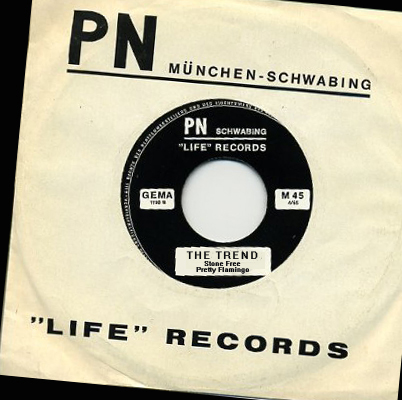
While in Munich, the band cut two tracks for a 45, issued on the PN Schwabing’s “Life Records” label (see image below).
It wasn’t the last time the group would play in West Germany. Pete remembers many tours there and never having any problems with permits (something that would dog a subsequent line-up). He also recalls one day not having a valid passport when a last-minute German gig was booked.
“I went to my local post office and for £1 I got a year’s visitor’s passport over the counter,” he says. “However, after a few trips to Germany that year, the passport office got wise and asked me to return it”.
Photo: Pete Cole and Norman Cummins
Pete and Norman recall that when they played at the PN Hit House the Americans had an army base nearby and the soldiers used to come and listen to The Trend playing.
Photo: Pete Cole and Norman Cummins
“It was pretty sad to watch these guys in the audience knowing full well that they were going to be shipped out to fight in the war in Vietnam and so many of them would never come back alive,” says Norman.
“Some of the guys were like us and had played in bands at home before they were called up for duty. We got friendly with some of them and they would come back to our apartment in Schwabing across from the club, where we would talk shit all night. Many of them would be A.W.O.L. (absent without leave) and the Military Police in their white helmets, knowing where they were, would come knocking on the door in the early hours of the morning to collect them and take them back to the army base.”
Photo: London Life magazine
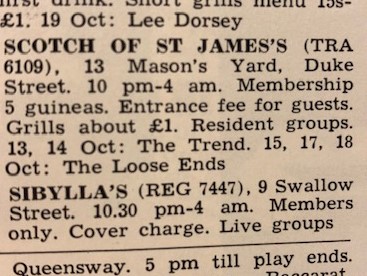
Back in the UK, The Trend landed a notable gig at the exclusive Scotch of St James in Mayfair, performing on 13-14 October 1966.
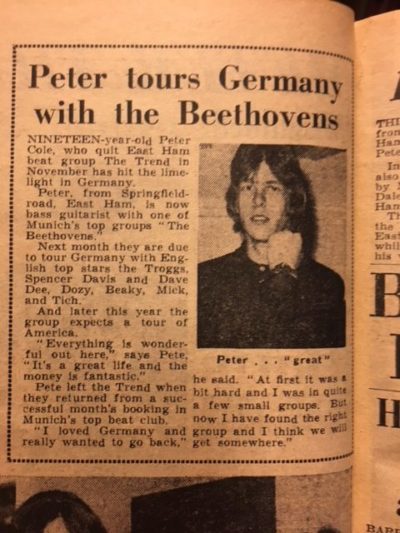
However, in November, Pete Cole and John Connolly both left and returned to West Germany. John didn’t stay long, returning to the UK soon afterwards. He appears to have disappeared from the music scene.
Photo: Newham and Stratford Express
Pete meanwhile joined a band called The Beathovens who had a single in the charts.
The bass player toured West Germany with the band and remained there for about nine months before returning home.
Back in east London, he subsequently re-joined The Trend in September 1967 (more of which later).
Photo: Newham and Stratford Express
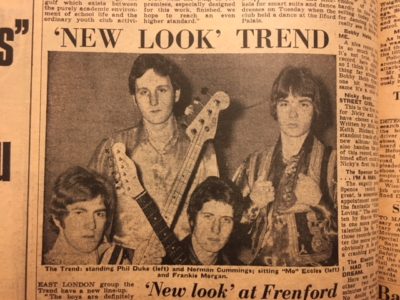
Jack Palmer meanwhile brought into two new musicians so The Trend could continue.
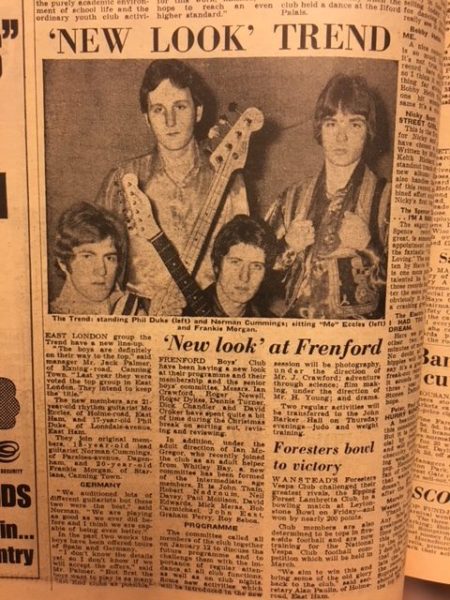
Introduced to the public in the 20 January 1967 edition of the Newham and Stratford Express, rhythm guitarist Mo Eccles and bass player Phil Duke were both East Ham lads.
In the same article, it said the group had been offered work in Spain and Germany, but that Jack Palmer had turned it down because he wanted The Trend to play more East End clubs.
Photo: Newham and Stratford Express
However, this formation proved to be very short-lived. In the 24 March 1967 edition of the Newham and Stratford Express, the article noted that The Trend had signed up two new members.
Although it’s not clear if this was a fifth member, there was at least one new musician – guitarist and organist/singer Michael Claxton who took over from Mo Eccles (Ed. the same newspaper’s 10 February 1967 edition said Eccles had left and Claxton had joined).
Hailing from Barking, Michael Claxton remembers that he was standing in for a musician in his brother’s band who was ill. On the night in question, the band opened for The Trend, the headlining act, at St Philip and St James Church Hall in Plaistow.
Michael recalls: “Their manager, Jack Palmer, came up to me as I was watching, and despite hearing me sing ‘Stone Free’ and ‘Mustang Sally’, asked me to join.”
The new recruit also remembers that The Trend played at the Upper Cut in Forest Gate (most likely 4 March when the musicians battled with local groups The Jokers, The New Jump Band and The Survivors in the ‘Discoveries of Tomorrow’ show) and Stratford Town Hall during his time with the band.
He also remembers playing at Soho clubs, the Bag O’ Nails and Whisky A Go Go.
Photo: Newham and Stratford Express
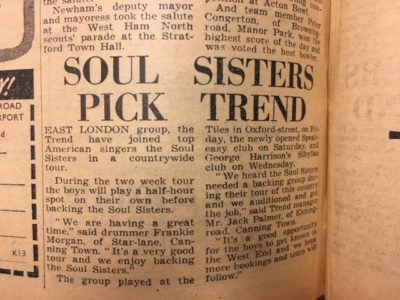
The 28 April 1967 edition of the Newham and Stratford Express noted that The Trend had been chosen to back visiting US singing duo, The Soul Sisters on a two-week countrywide tour, which was arranged through the Roy Tempest Agency.
The article also mentioned that, the previous week, the group had played central London clubs, Tiles in Oxford Street (21 April), the Speakeasy (22 April) and Sibyllas (26 April). Hampshire historian David Allen, confirms that The Soul Sisters backed by The Trend played at the Birdcage in Southsea earlier in the day on 22 April with The Bizarre also on the bill.
Photo: Spalding Guardian. The Soul Sisters on 15 April 1967 but backing band not listed
Judging by a concert billing in the Reading Evening Post promoting The Soul Sisters’ show at the Harvest Moon in Guildford, Surrey on 14 April, it seems likely that the tour had actually started mid-month (although The Trend may not have been there at the outset and had taken over from the original backing band).
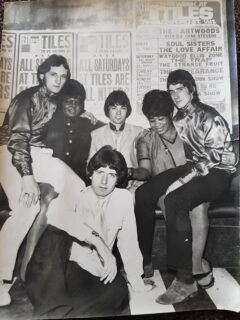
Photo: courtesy Betty Palmer. The Soul Sisters with The Trend at Tiles, April 1967. Band members (clockwise from bottom), Frankie Morgan, Phil Duke, Norman Cummins and Michael Claxton
Melody Makerconfirmed the Tiles gig on 21 April (which also had The Love Affair on the bill). It also listed two further gigs attributed to Soul Sisters – the California Ballroom in Dunstable on 28 April and the New All-Star Club near Liverpool Street station the following day.
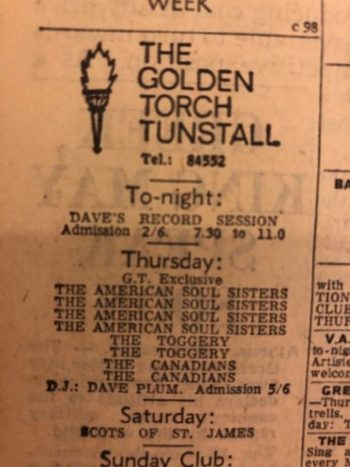
Stoke-on-Trent newspaper, The Evening Sentinel, listed a Soul Sisters’ gig at the Golden Torch in Tunstall on 27 April with The Canadians (featuring a very young David Foster) and The Toggery.
Photo: Evening Sentinel
Another Soul Sisters’ gig (advertised in the Crewe Chronicle) suggests the singing duo played at Warmingham Grange Country Club in Cheshire on 30 April, but The Trend are not named in the advert.
According to the Newham and Stratford Express, Jack Palmer added drummer/turned lead singer Wade Maddison from Goodmayes in early May and the expanded five-piece headed to West Berlin for a four-week West German tour a week or so later.
Maddison had previously played drums with a few bands, including with Ilford group The Inner Sect. He then drummed with a group from Peyton called The Unknown who opened The Small Faces and The Who. They also backed The Truth, who recorded The Beatles song “Girl” in 1966.
Although Michael Claxton insists that the new front man did not join The Trend until after the German dates and that he also provided lead vocals during the tour, Maddison remembers the tour well (see comments).
The idea was to relieve singer Norman Cummins, so he could focus on playing lead guitar when The Trend played for long hours during the German shows. In many German clubs, visiting British bands had to play four or five one-hour sets a night and often work into the early hours of the morning.
Norman remembers that The Trend were backing The Soul Sisters in Stoke-on-Trent on the final night of the tour when they received the telephone call from the Roy Tempest Agency’s secretary telling them that they had to get to West Berlin as soon as possible.
After driving back to London to collect their passports and a change of clothes, the band drove non-stop through Belgium, West Germany and into East Germany before arriving at their destination exhausted.
“We drove straight to West Berlin to play four US air force bases the same evening and after driving all day from London,” recalls Michael Claxton.
Norman remembers the Russians giving the musicians hell at the check points, making them unload the band’s equipment as they entered East Germany and re-entered West Germany at the East Berlin/West Berlin border. Soldiers looked in the guitar cases and in the back of the amplifiers, looking for drugs; all the musicians had long hair and looked a bit scruffy after their long trip.
After backing one of the singers from The Fabulous Drifters for three nights, the musicians received another phone call from Roy Tempest’s secretary telling them that the agency had sent the wrong band and that The Trend were supposed to be playing a month’s residency at the Atlantic Bar in Hanau near Frankfurt.
On arrival, Norman Cummins recalls getting friendly with another English band who were playing at the K52 Club in Frankfurt and they decided to swap gigs (they never knew what the club owners must have thought!).
The Trend played the K52 for a few nights, but the hours were horrendous, so they swapped back with the other group, the guitarist recalls.
Norman adds: “During one of The Trend’s nights at The K52 Club, Jimi Hendrix, Mitch Mitchell and Noel Redding walked in. Everybody wanted Jimi to play but there wasn’t a left-handed guitar, so he played my Fender Telecaster upside down and still played it better than me, son of a b****!”
The club in Hanau was where the American GIs hung out of at night. On one occasion, one of the soldiers, threw a rock and smashed the windscreen of the band’s van because one of the members (probably Norman) had stolen his girlfriend. They had a hard job getting a replacement windscreen. Finally, one night the club got raided by the police and The Trend, not having work permits, got thrown out of West Germany.
Photo: Newham and Stratford Express
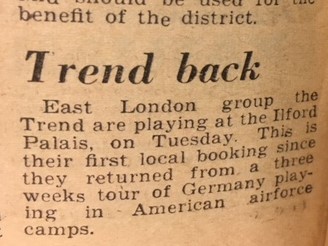
An article, which appeared in a mid-June edition of the Newham and Stratford Express, noted that The Trend had just returned from three weeks in West Germany and on 13 June had played their first gig back in the UK at the Ilford Palais, which later became a legendary venue.
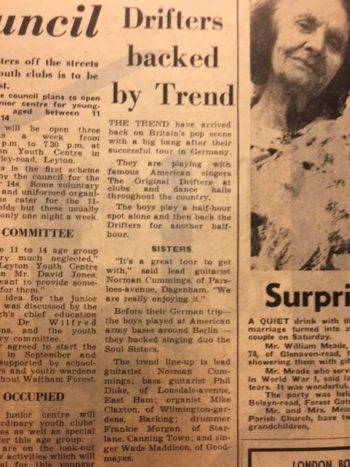
The Trend were then given another booking through the Roy Tempest Agency, opening for The Original Drifters on a countrywide tour, playing their own half hour slot before the US soul act came on stage.
Melody Maker listed some of these shows: the Upper Cut in Forest Gate, east London on 10 June; the Whisky A Go Go in Wardour Street, Soho on 15 June; and the Starlite in Greenford, northwest London on 18 June.
Photo: Newham and Stratford Express, 30 June 1967
According to the Nantwich Chronicle, The Original Drifters also played at Warmingham Grange Country Club on 2 July.
However, The Trend weren’t advertised for any of these shows so it’s not possible to determine with any certainty whether they were the backing band at every show.
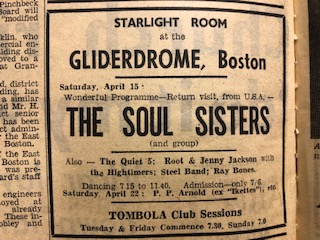
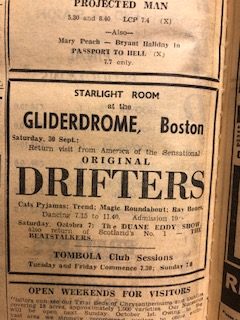
What is clear from the Lincolnshire Standard is that The Trend did back The Original Drifters on 8 July at the Starlight Room, Boston Gliderdrome, Boston, Lincolnshire with Six-Across, The Charades and Ray Bones.
Photo: Newham and Stratford Express
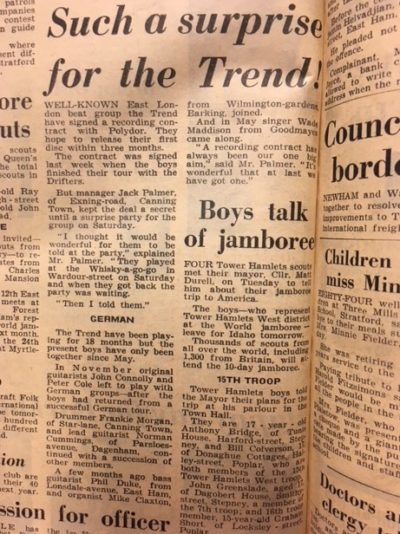
In the 28 July 1967 edition of the Newham and Stratford Express, the article mentioned that the group had secured a recording contract with Polydor Records, which had been signed the previous week when the tour with The Original Drifters had drawn to a close.
Jack Palmer had kept the deal secret until a surprise party for the group on the Saturday after a gig at the Whisky A Go Go (most likely the one on 11 July).
Photo: Newham and Stratford Express
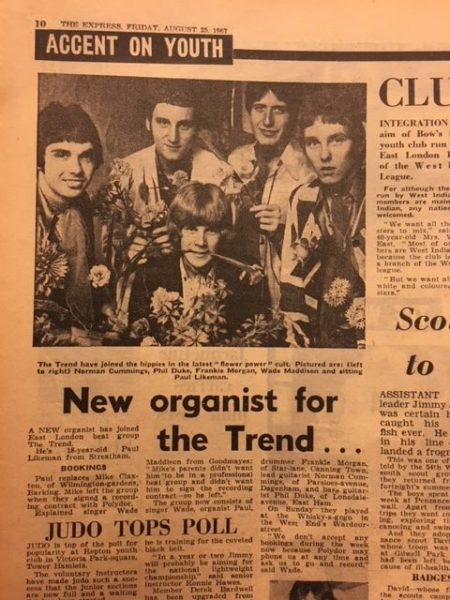
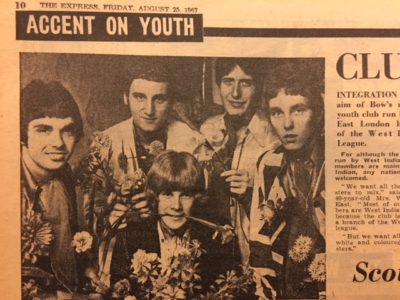
However, the same newspaper ran another story on 25 August which said that Michael Claxton had left the group when they signed the contract with Polydor.
According to singer Wade Maddison, Michael’s parents didn’t want him to be in a professional band and didn’t want him to sign the recording contract.
The keyboard player has different recollections and reasons for his departure, which sounds like it was around mid-August: “When we came back [from West Germany], there were few jobs for us as I recall, and I had to ‘sign on’ for three weeks to survive.”
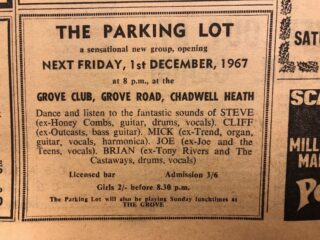
Michael Claxton’s departure was noted by another local band, The Parking Lot, who’d picked up on the news after reading the story in the paper and subsequently asked him to join.
Photo: Newham, West Ham & East Ham, Barking and Stratford Express
When Claxton accepted the offer, The Parking Lot included guitarist/singer Steve Taylor; drummer/singer Brian Hudson; Cliff ? on bass; and lead singer Joe Wheal.
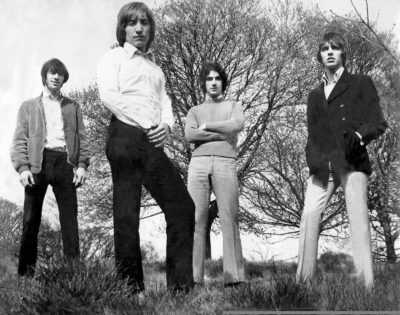
The Parking Lot. Thanks to Michael Claxton for the photo
A revamped version of The Parking Lot (who will be profiled at a later date) recorded a lone 45 with Paul Samwell-Smith producing. Claxton subsequently moved to Sweden and played with funk band Inside Looking Out. He currently lives in Tokyo, Japan.
Photo: Newham and Stratford Express
Claxton’s replacement in The Trend was something of a surprise. Paul Likeman was the first and last member who didn’t come from the East End, hailing from Streatham in southwest London.
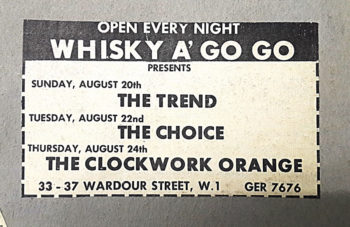
One of his first appearances with The Trend took place at the Whisky A Go Go in Soho on 20 August.
Photo: Melody Maker
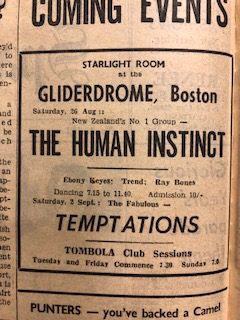
The following week (26 August), The Trend performed at the Boston Gliderdrome in Boston, Linconlshire alongside New Zealand group The Human Instinct, The Ebony Keys and Ray Bones .
Photo: Spalding Guardian. Gig on 26 August 1967
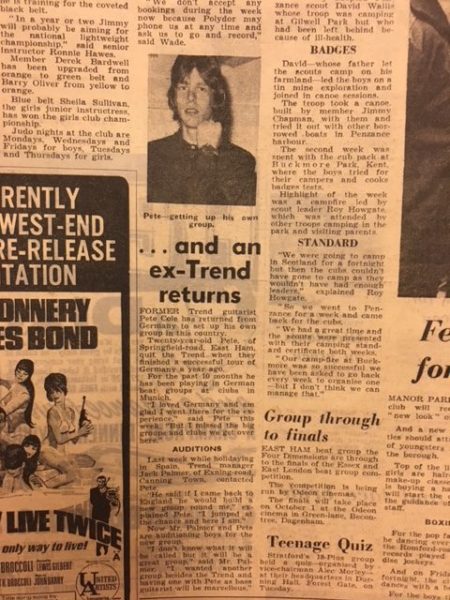
Interestingly, in the same edition (25 August) of the Stratford and Newham Express, there was a short piece on former member Pete Cole who had just returned from Munich. The article mentioned that Jack Palmer was going to help Cole to piece a new band together.
In the article, Jacky said: “I don’t know what it will be called but it will be a great group. I wanted another group besides The Trend and having one with Pete as the bass guitarist will be marvelous.”
Photo: Newham and Stratford Express
As events transpired, the new group never happened and in mid-September 1967, Pete Cole returned to The Trend after a major shake-up in the band.
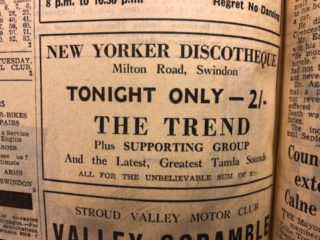
Photo: Swindon Evening Advertiser
Not long after a gig at the New Yorker Discotheque in Swindon, Wiltshire on 2 September, Phil Duke moved on to join Sam Gopal while lead singer Wade Maddison also jumped ship.
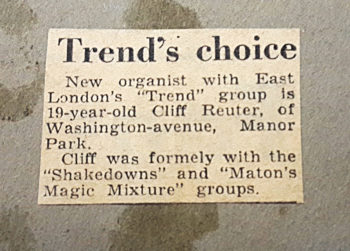
Paul Likeman was likewise gone, replaced by Lowrey organist Cliff Reuter from The Shakedowns and Maton’s Magic Mixture, who only played in the band for a short period.
Norman and Pete both recall: “Cliff Reuter was a very good organist and always looked the part. We didn’t fully understand why he never stayed with us for any length of time. We think maybe it was because we were workaholics. If we weren’t playing, which wasn’t that often because by then we were playing seven days a week, we used to rehearse, so it was very rare to have a day off and even if we did we nearly always stayed together, met up for a drink and a meal.”
Photo: Pete Cole and Norman Cummins
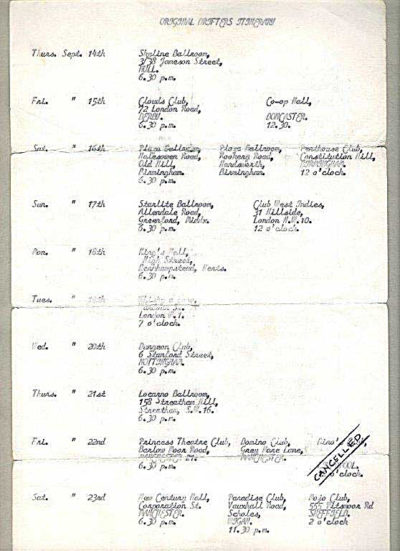
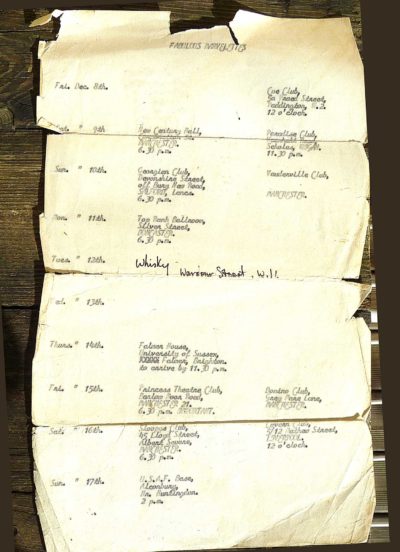
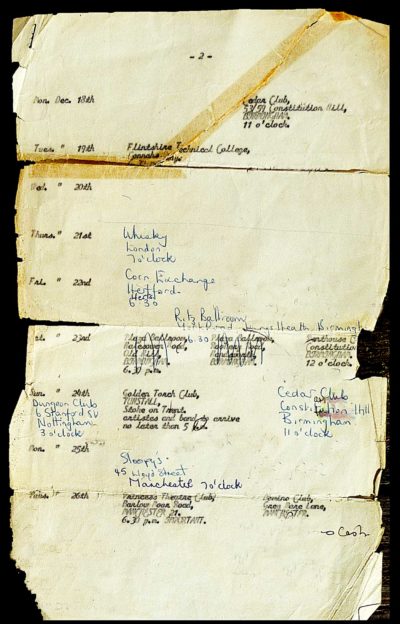
Pete Cole had literally retaken his position on bass when The Original Drifters were back in the UK for another tour. Norman Cummins kept a track of the tour dates which are as follows:
14 September 1967 – Skyline Ballroom, Hull
15 September 1967 – Clouds, Derby and Co-op, Doncaster
16 September 1967 – Plaza Ballroom, Old Hill, West Midlands; Plaza Ballroom, Handsworth, West Midlands and Penthouse, Birmingham
17 September 1967 – Starlite, Greenford, northwest London and Club West Indies, northwest London
18 September 1967 – King’s Hall, Berkhamsted, Herts
19 September 1967 – Whisky A Go Go, Wardour Street, central London
21 September 1967 – Locarno, Streatham, southwest London
22 September 1967 – Princess Theatre, Chorlton, Greater Manchester and Domino Club, Openshaw, Greater Manchester
23 September 1967 – New Century Hall, Manchester, Paradise Club, Scholes, Wigan, Lancashire and King Mojo, Sheffield, South Yorkshire
24 September 1967 – The Place, Wakefield, West Yorkshire and the Hub, Barnsley, South Yorkshire
26 September 1967 – Playhouse, Walton-on-Thames, Surrey
27 September 1967 – The Place, Hanley, Staffordshire
29 September 1967 – Tin Hat, Kettering, Northamptonshire
Photo: Spalding Guardian
30 September 1967 – Boston Gliderdrome, Boston, Lincolnshire with Cats Pyjamas, Magic Roundabout and Ray Bones and Nite Owl, Leicester
1 October 1967 – Dungeon, Nottingham (with Garnet Mimms & The Senate)
2 October 1967 – Parr Hall, Warrington, Cheshire
Photo: Pete Cole and Norman Cummins
Both Pete Cole and Norman Cummins concur on the intensity of the touring itinerary: “The tours dates would sometimes list three concerts in three different towns on the same night but somehow we managed to arrive at the venues on time”.
The Trend backed no less than three different formations of The Drifters on tours of the UK and in between these engagements the musicians continued to play clubs like the Whisky A Go Go, the Scotch of St James, Blaises, the Speakeasy and the Bag O’Nails.
Pete Cole remembers the Speakeasy had a very small stage. “I can’t for the life of me see how we managed to get the band and all the equipment on the stage, it was so small, no more than 3 or 4 m wide. It was a great venue though. I remember years later, with my American girlfriend at the time, having dinner there with Johnny Winter and his brother Edgar who my girlfriend knew from when she lived in the US.”
Around this time, the band briefly added sax player Bob Mather from Scottish soul band, The Senate, who was given separate billing with The Trend when they backed the next round of US soul acts, again as part of the Roy Tempest packages.
The Senate, incidentally, were also booked as a backing group on some of the Roy Tempest Agency tours (backing Edwin Starr and Garnet Mimms among others). A few of its members went on to become part of The Average White Band who had a mega hit with “Pick up The Pieces”.
Interestingly, The Trend were later the opening act for The Brian Auger Trinity featuring Julie Driscoll on vocals at one venue and Robbie McIntosh from The Senate was on drums.
During October the band returned to provide support for The Soul Sisters on another tour, appearing at the Whisky A Go Go in Soho on 12 October.
Immediately afterwards The Original Drifters returned to the UK for another tour. According to Melody Maker, the US soul act’s tour included two shows on the 24 October: one at the Whisky A Go Go in Soho and another at Klooks Kleek in West Hampstead, north London.
During late October/early November, The Trend started backing Nepenthe, which included an appearance at the Dungeon Club in Nottingham on 12 November. They also joined Nepenthe for two shows at the Whisky A Go Go in Wardour Street on 16 and 23 November.
Photo: Portsmouth News
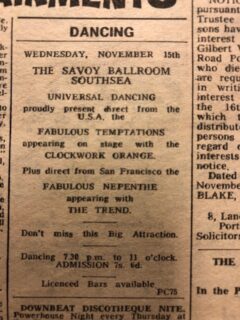
On 15 November, The Trend backed Nepenthe at the Savoy Ballroom in Southsea, Hampshire that also featured The Fantastics, backed by The Clockwork Orange.
The Roy Tempest tours kept the musicians busy on the road. In December, they backed The Fabulous Marvelettes, who were previously known as The Gypsies, and consisted of the sisters Earnestine, Shirley and Betty Pearce and Viola Billups. One show, on 24 December, took place at the Dungeon in Nottingham.
Photo: Pete Cole and Norman Cummins
The tour straddled December with Bob Mather driving the girls in his ‘S’ type Jag and standing in on sax.
Then, on 30 December, The Trend returned to the Starlight Room, Boston Gliderdrome, Boston, Lincolnshire for a show with Geno Washington & The Ram Jam Band, Ebony Keys and Ray Bones.
On their return in 1968 for another tour with The Trend, The Fabulous Marvelettes took up residence in Britain and changed name to The Flirtations. That same year they recorded a song on Deram in 1968 called “Nothing but a Heartache”.
Photo: Pete Cole and Norman Cummins
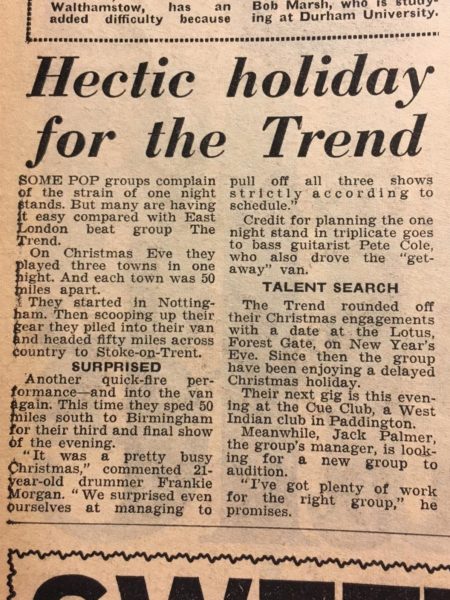
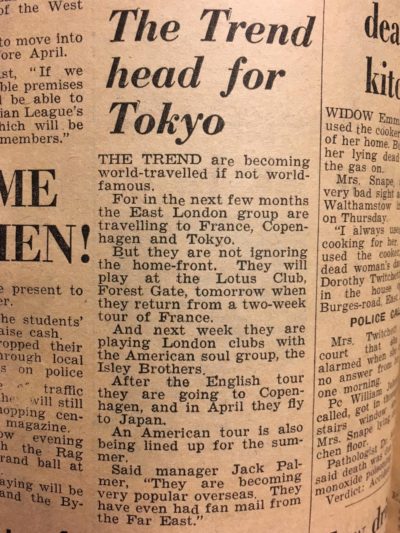
After the tour, The Trend saw in the New Year with a show at the Lotus Club in Forest Gate.
Photo: Newham and Stratford Express, 5 January 1968
In January 1968, The Trend backed The Fabulous Platters and again later that year on a second highly successful tour (during May-June).
Norman Cummins remembers The Platters had a very professional stage show and one performance took place at the Hub in Barnsley, West Yorkshire on 7 January. Another took place at Nottingham’s Dungeon on 12 January.
“They were always immaculately dressed and had a nonchalant side step when approaching their microphones, all part and parcel of their stage routine,” the guitarist recalls.
Photo: Eastern Evening News
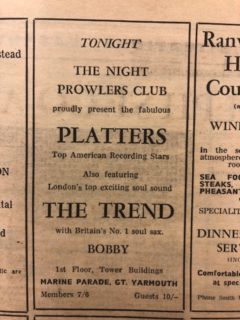
The Eastern Evening News advertised a gig with The Platters at the Night Prowler in Great Yarmouth on 18 January 1968 while the Ipswich Evening Star lists a show at the Bluesville ’68 Club at St Matthew’s Baths in Ipswich on 22 January.
On one of the Roy Tempest tours The Trend also played at The Cavern in Liverpool. Pete Cole remembers how cramped it was, consisting of two arched alcoves, one having a stage.
“It was very hot and sweaty, because of the low ceilings that were painted white,” he says. “The paint was falling off in flakes that stuck in your hair and on lay on your shoulders. The club was lite with blue ultra violet lights that made the spots of paint look like snowflakes.”
In mid-February The Trend returned to the Lotus Club in Forest Gate to play a show (see pic below).
Photo: Newham and Stratford Express, 9 February 1968
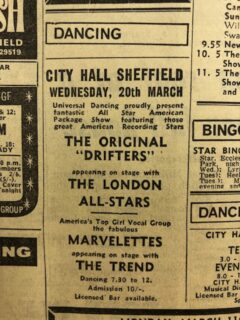
According to the Sheffield Star, The Trend opened for The Marvelettes at Rawmarsh Baths in Rotherham, South Yorkshire on 11 March 1968 on a bill that also featured The Original Drifters backed by The London All-Stars. The same artists appeared at Sheffield City Hall on 20 March 1968.
Photo: Sheffield Star
Not long after both Bob Mather and Cliff Reuter moved on and The Trend continued as a trio, although the 28 June issue of the Newham, Barking & Stratford Express reported that the group was looking for an experienced organist.
Later that year, The Trend toured with Clyde McPhatter, one of The Original Drifters, who wrote “It’s a Lovers Question” in 1958. Norman Cummins remembers him as being a real character who was either pissed or stoned and was never happy if he didn’t pull a bird after every gig. Clyde moved back to the US in 1970 and, after an amazing career, died at the age of 39.
One of the most memorable Roy Tempest bookings was the “Tour de France” as Pete Cole and Norman Cummins call it. On the face of it, it seemed a romantic and exotic assignment. However, it all went terribly wrong.
“We arrived at about 2.30 in the morning at Calais and being as the road signs are orientated in a different manner to those in England and it was also a bit foggy, it got confusing as to how to get on the road to Bordeaux where we were due to play our first gig,” says the guitarist.
“At a roundabout Pete saw a policeman and stopped to ask him the way. The policeman kept pointing at a headlight on the van. We couldn’t understand a word he was saying but he insisted and eventually we could see that the headlight was working but one of the side lights wasn’t.”
Norman Cummins continues: “He signaled us to follow him. We thought ‘Great, he’s going to put us on the right road to Bordeaux’. However, instead he took us to the local Gendarmerie where they locked us up for the night.”
Pete Cole remembers the police at the station played cards most of the night and that one of them used to come into the cell balancing a wooden baton in front of his nose.
“We stayed locked up until about 8.30 in the morning when they escorted us to a local garage to purchase a five-watt side light bulb,” adds the guitarist. “We managed to drive down to Bordeaux and to the club in time.”
Pete Cole remembers the club being located near Bordeaux in the countryside. “There was a welcoming smell of a burning wood fire and we had a small but cozy changing room,” he says.
“There was a cardboard box with Fox cubs in it. Apparently, there had been a fox hunt that week and their mother had been killed. The club owner’s wife had managed to find and retrieve the cubs and was rearing them at the club.”
The bass player remembers the French tour took in Bordeaux, Bergerac, Toulouse, Tours and Neufchatel near Le Mans. One of the clubs in Toulouse is still there. During the 1960s (and 1970s), the city was known as France’s “rock ‘n’ roll town”, with every bar and hall (salle de fête) having live music during the week days and at weekends.
Back in the UK, Pete Cole remembers The Trend opened for The Jeff Beck Group at the Dome in Brighton (Ed. it’s not been possible to find this gig). The guitarist and bass player remember watching Jeff Beck from a balcony seat. Rod Stewart, who was Jeff Beck’s singer at the time, was singing from behind the tall Marshall guitar amplifiers.
“We both thought at first that it was because Jeff Beck didn’t want to get upstaged by the singer,” says Norman Cummins. However, it later transpired that Rod Stewart admitted he did that because he was shy.
During 1968, the pair also remember The Trend supported Geno Washington & The Ram Jam Band, Jethro Tull, Amen Corner and The Herd featuring Peter Frampton.
Newham, Barking and Stratford Express‘ 7 June issue notes that The Trend had just finished a three-week tour with The Platters. It added that the musicians were taking a week off and then were backing The Isley Brothers on a two-three week tour.
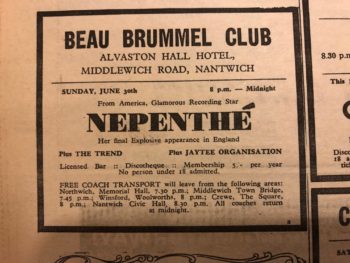
It’s not clear if The Isley Brothers tour transpired. However, The Trend did back Nepenthe on another tour, including a show at the Beau Brummel Club at the Alvaston Hall Hotel in Nantwich, Cheshire on 30 June.
Photo: Nantwich Chronicle
In early 1969, towards the end of their time together, The Trend toured England as support act for The Crickets.
Norman Cummins recalls: “Jerry Allison was great and mesmerising when he played the snare on ‘Peggy Sue’. I don’t remember much about them though as they were then ageing hippies. However, I didn’t take too well to Sonny because he remarked that my hero, Buddy Holly, wasn’t a particularly good guitarist.”
In mid-1969, The Trend finally called it day. However, the two musicians soon reunited in The House of Orange who backed The Fantastics. The US soul act had originally been brought over by The Roy Tempest Agency to tour England as The Fabulous Temptations in August 1967.
Pete Cole had started off as the personal driver for The Fantastics but later became their rhythm guitarist and finally replaced the bass guitarist, Ron Thomas, who years later joined The Heavy Metal Kids with Gary Holton on vocals. Holton played the part of Wayne Winston Norris in the popular TV comedy drama Auf Wiedersehen Pet.
When guitarist Pip Williams dropped out in July 1969 while the group were in Frankfurt, Pete Cole called Norman Cummins to come to the rescue. The Fantastics’ work visas for England had expired and they had to stay out of the country for six months before being able to renew them.
Based in Frankfurt, The Fantastics (backed by The House of Orange) played the American air bases. During that summer, however, they also played at the Black Out Club in Zurich, a week’s residency at the American air base in Naples, a residency at a night club in Cannes, France, and a month at Sloopy’s Club in Palma on the island of Majorca.
When the pair split, Pete Cole continued in the music business, driving and playing bass guitar. He replaced Phil Chen on bass in The Joyce Bond Review and toured the West Indies with them after Joyce Bond recorded “Do the Teasy” and a cover of the Beatles “Ob La Di Ob La Da” for Richard Branson’s Island Records, which topped the Jamaican charts in 1970.
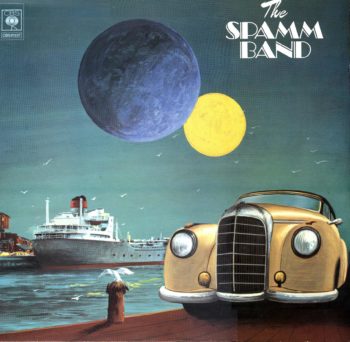
The bass player later returned to England and worked for Reg King, Charisma Records and A&M Records. He also reunited with Gibson Kemp from The Giants (see earlier) in Hamburg. Gibson was working for Phonogram Records and Pete Cole was looking for a contract to release an LP he had produced with his group, The Spamm Band, which had been issued on CBS Records in France. The project fell through, however, because CBS insisted on having the rights for West Germany.
Photo: Pete Cole
Named after Pete Cole’s nickname “Spam”, the group’s members consisted of Terry Scott on vocals; Bob McGuiness on lead guitar; John Edwards on bass; Jeff Peach on saxophone and flute; Graham Broad on drums; and Brian Johnston on piano. Although the LP didn’t sell, some of the members went to successful careers – Terry Scott (Heaven), John ‘Rhino’ Edwards (Status Quo), Graham Broad (Pink Floyd and Bill Wyman’s Rhythm Kings) and Brian Johnston (Whitesnake).
Pete Cole also worked in France and played briefly with singer Nino Ferrer who had a mega hit called “Le Süd” (“The South”) and spent several years in the Caribbean as a painter/artist. During his time there, he played bass with the founder of The Fabiano Orchestra and Tao Ravao.
After leaving The Fantastics’ backing band, The House of Orange, Norman Cummins worked for the Post Office in England and continued to work for them after moving to South Africa. He has played with several different bands over the years, including Platinum, Kenny Small and The Big Boys to name a few. Norman Cummins runs a successful sound installation business but continues to play folk, classical and rock guitar and sings as a solo artist.
I would like to give a massive thank you to Pete Cole who spent a huge amount of time collating material on the band with Norman Cummins and provided many of the photos. Thanks also to Michael Claxton for this recollections.
Freddie Mack gig, 28 July 1968. Photo: Melody Maker
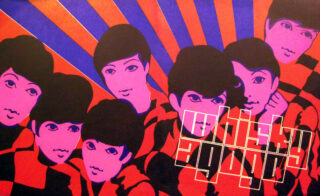
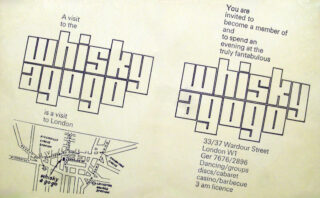
Located at 33/37 Wardour Street, the Whisky A Go Go was a major rock music venue during the mid-late 1960s and was situated in the same building as the Flamingo.
It’s not clear when it first opened its doors to rock artists but according to London Life magazine, occasional live groups did perform at the venue during 1965. However, it appears that the club really took off in late 1966, with listings four times a week. I have started to compile a list of artists who were advertised from 1966 to 1970 and would welcome any additions/corrections.
Melody Maker advertised gigs for the Whisky A Go Go every week, although there were gaps in places, particularly in late 1968 and during 1970. All of the shows listed below are from Melody Maker unless otherwise noted. Disc & Music Echo also regularly advertised the venue.
It is important to stress that these are listings for artists who were advertised in the music press so it’s quite possible that changes in the final billing may have taken place. I’d be interested to hear from anyone who can add any memories of particular shows in the comments below.
Source:Melody Maker unless otherwise noted
1968
1 January – Blue Rivers & His Maroons
2 January – Granny’s Attic
4 January – Wilson’s Transaction
7 January – Freak-Down-Lucifer
9 January – Garnet Mimms (either backed by The Senate or Clockwork Orange)
11 January – Warren Davis Monday Band
13 January – The Castaways (probably Tony Rivers’ band)
14 January – Freak-Down-Lucifer
16 January – Garnet Mimms (either backed by The Senate or Clockwork Orange)
18 January – Watson T Browne (& The Explosion)
20 January – Love Machine
21 January – The Cortinas (confirmed by Paul Griggs’ diary)
22 January – Freddie Mack & The Mack Sound
23 January – Locomotion
27 January – Purple Pipe Line
28 January – The Gold
30 January – Freddie Mack & The Mack Sound with Lamb Bros & Co)
Photo: Melody Maker
1 February – Warren Davis Monday Band
4 February – Glenroy Oakely & The Oracles
6 February – Locomotion
8 February – Clyde McPhatter (with The Trend backing?)
11 February – Glenroy Oakley & The Oracles
13 February – Clyde McPhatter (with The Trend backing?)
15 February – Clyde McPhatter (with The Trend backing?)
18 February – Locomotion
20 February – The Diplomats
22 February – Margitte Bardot
23 February – The Chanters
25 February – Mr Mo’s Messengers
27 February – The Original Drifters
29 February – Watson T Browne & The Explosion
3 March – Sonnie Burke
5 March – The Original Drifters
7 March – Blue Rivers & His Maroons
10 March – The Ice Show
12 March – The Marvels
14 March – The Shiralee
16 March – Philosopher’s Stone
17 March – The Chanters
19 March – The Fabulous Impressions
Thanks to Jerry Booth for the images. He was handed these flyers when he attended the club in mid-March 1968Thanks to Jerry Booth for this image too!
21 March – The Cortinas (confirmed by Paul Griggs’ diary)
23 March – The Art Movement
24 March – The Gold
26 March – The Fabulous Impressions
28 March – The Cortinas (confirmed by Paul Griggs’ diary)
31 March – Warren Davis Monday Band
Photo: Melody Maker
2 April – The Fabulous Platters & Group (with The Trend backing?)
4 April – Mr Mo’s Messengers
6 April – The Klooks (Pete Carter’s Roy Tempest contract)
7 April – The Bunch
9 April – The Original Drifters
11 April – Glenn Oakely & The Oracles
14 April – Dr Marigold’s Prescription
16 April – Fantastic Little Anthony & The Imperials
18 April – The Cortinas (confirmed by Paul Griggs’ diary)
21 April – Dr Marigold’s Prescription
23 April – Garnet Mimms (most likely with The Village Green backing)
25 April – Fantastic Little Anthony & The Imperials
28 April – The Cortinas (confirmed by Paul Griggs’ diary)
30 April – The Fabulous Ronettes
2 May – The Fabulous Platters (with The Trend backing?)
5 May – Sonnie Burke
7 May – Duane Eddy
9 May – The Chanters
12 May – The Cortinas (confirmed by Paul Griggs’ diary)
16 May – The De-Tours with Gene Latter
19 May – Sonnie Burke
21 May – The Diplomats
Photo: Melody Maker
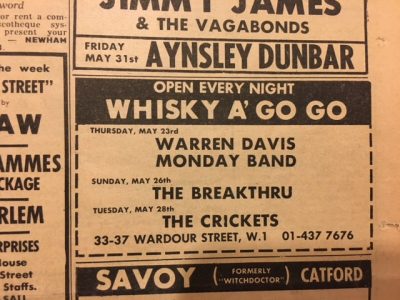
23 May – Warren Davis Monday Band
26 May – The Breakthru
28 May – The Crickets
30 May – The Coasters
2 June – The Cortinas (confirmed by Paul Griggs’ diary)
3 June – Warren Davis Monday Band
4 June – The Coasters
Melody Maker stopped providing full listings for the club until December but I’ve found individual shows in New Musical Express, which suggests the club still put on shows during this period
Photo: Melody Maker
20 June – Ruby & The Romantics (New Musical Express)
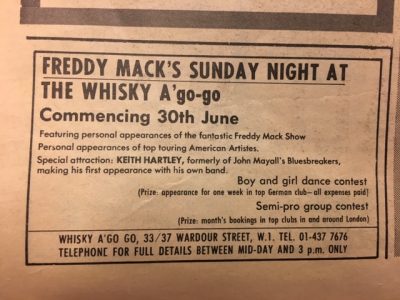
30 June – Freddie Mack & The Mack Sound and Keef Hartley (New Musical Express has The Crystals)
Photo: Melody Maker
6 July – The Crystals (New Musical Express)
28 July – Freddie Mack & The Mack Sound
5 August – The Crystals (New Musical Express)
11 August – The Cortinas (Paul Griggs’ diary)
25 August – Freddie Mack & The Mack Sound
8 September – The Cortinas (Paul Griggs’ diary)
25 September – Freddie Mack & The Mack Sound (cancelled)
6 October – Freddie Mack & The Mack Sound (postponed until 13 October)
Paul Griggs’ diary notes that The Cortinas played on 6 October so it looks like they replaced Freddie Mack.
13 October – Freddie Mack & The Mack Sound (marks the group’s third anniversary)
Photo: Melody Maker
22 October – Dee Dee Warwick (New Musical Express)
24 October – Interstate Road Show
31 October – Dee Dee Warwick (New Musical Express)
10 November – The Cortinas (Paul Griggs’ diary)
12 November – The Impressions (aka The Topics) backed by Village Green (Steve Fitzgerald’s gig diary)
14 November – The Impressions (aka The Topics) backed by Village Green (Steve Fitzgerald’s gig diary)
21 November – Garnet Mimms backed by Village Green (Steve Fitzgerald’s gig diary)
24 November – J J Jackson (Melody Maker advert says Sunday, 24 December but November is correct)
28 November – Garnet Mimms backed by Village Green (Steve Fitzgerald’s gig diary)
3 December – The Chiffons
5 December – The Bandwagon
8 December – Interstate Road Show
12 December – The Track
14 December – South Sea Bubble
15 December – Toast
17 December – Sea Jam Blues
19 December – Bunkers Brain
21 December – Jalopy Ride
22 December – Cherry Smash
24 December – Rainbow Ffolly and The Riot Squad
26 December – The Nite Walkers (The All Night Workers?)
28 December – Spring
29 December – Octopus (confirmed by Paul Griggs’ diary)
This site is a work in progress on 1960s garage rock bands. All entries can be updated, corrected and expanded. If you have information on a band featured here, please let me know and I will update the site and credit you accordingly.
I am dedicated to making this site a center for research about '60s music scenes. Please consider donating archival materials such as photos, records, news clippings, scrapbooks or other material from the '60s. Please contact me at rchrisbishop@gmail.com if you can loan or donate original materials