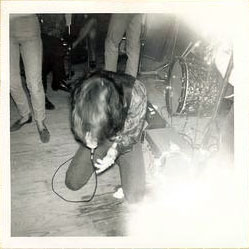
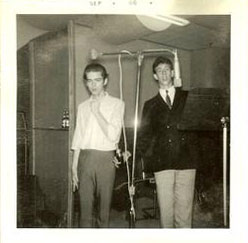
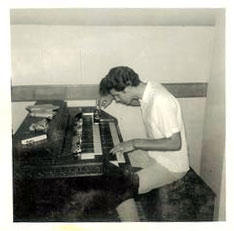
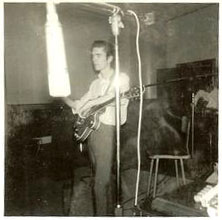
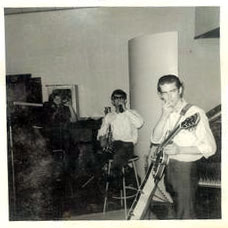
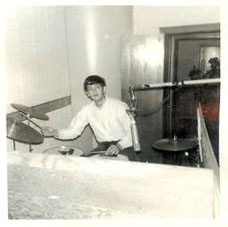
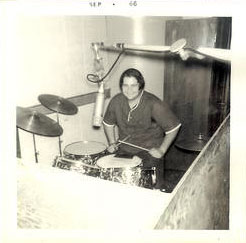
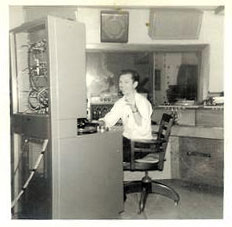
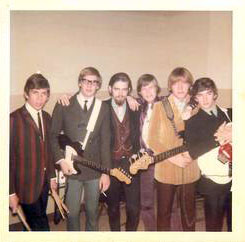
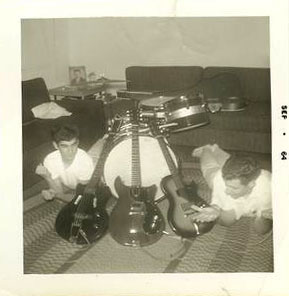
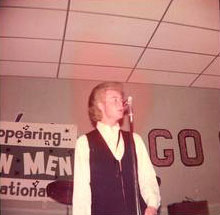
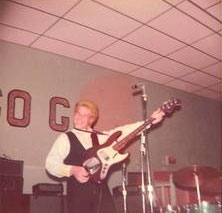
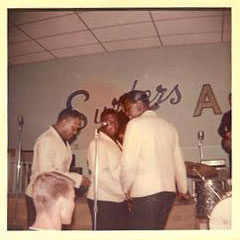
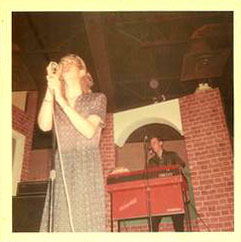
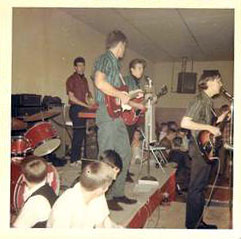
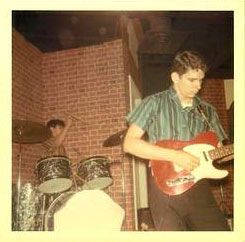
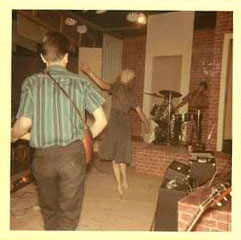
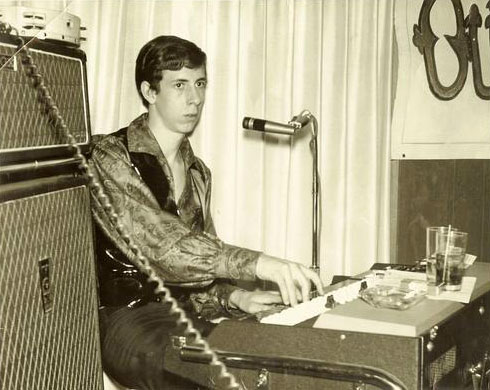
The Raymarks formed in 1962 in Bremerton, Washington, across the Puget Sound from Seattle. They began as the Orbits, changing their name twice, first to the Galaxies, and in 1964 to the Raymarks. They embody the Pacific Northwest sound – playing tough organ-based r&b numbers with a heavy rhythm section with little or no British Invasion influences.
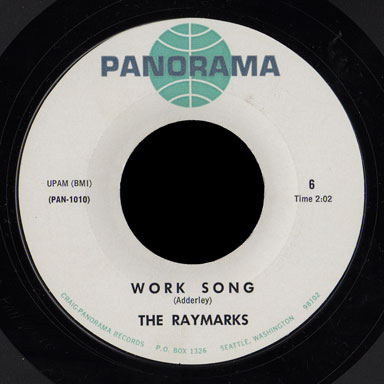
Their first 45 is a stomping version of “Work Song”, my favorite cut by the band. The flip, “Backfire” is a good instrumental. Mike Spotts wrote most of the band originals, including their second 45, the pounding “Louise”, which was mistakenly released under the name the Paymarks.
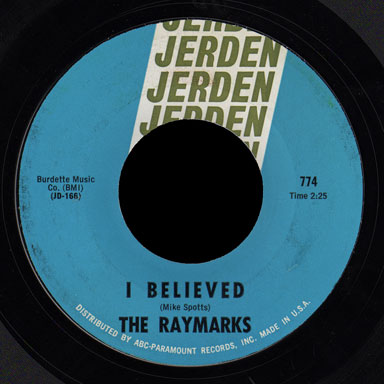
Their last 45 is another fine garage number, “I Believed”, again written by Spotts. The Raymarks also had several good songs that went unreleased at the time, including “Walking Down the Street”, “Feelin’ No Good”, “Hard Times” (which uses the same rhythm as “I Believed”) and an untitled piece.
Members included Mike Spotts on keyboards, Ken Huff and Chuck Snyder on guitars, Greg Pettit and Terry Carter on saxophone, Larry Trudeau bass, and Terry Selvidge on drums. Like the Wailers (whose live album At the Castle features singer Gail Harris), the Raymarks’ live shows included a female vocalist, Gail Davies, who is not on their studio recordings.
Chuck Snyder went to the Tacoma group the Noblemen in 1964. Ken Huff and Terry Selvidge were drafted in 1966 which spelled the end for the band.
The JuJus started as a trio doing a parody of the Beatles at Godwin high school in Grand Rapids in 1963. Members were Rod Shepard on guitar, Max “Junior” Colley on sax; and Bill Gorski drums, their name came from Max’s little brother’s pronunciation of “Junior”.
In 1964 the band added Ray Hummel III on vocals and guitar and Rod moved to the bass. Hummel had a distinctive voice, and his talent for folk-influenced songwriting changed the band’s sound. Later on Rick Stevens of the Paeans (who had an unreleased 45 recorded at Fenton) came in to play guitar.
The band played live shows at the Ponytail in Grand Rapids and nearby towns like Holland and Saugatuck. In 1965 worked out a deal with Dave Kalmbach of Great Lakes Recording to do their live act between films at the Hour Theater in exchange for recording time when the theater was closed.
Great Lakes was a vanity label: the bands had to cover all recording and pressing costs and do their own promotion. Studios were originally in Dave Kalmbach’s basement, then moved to the Hour Theater, and later to the nearby town of Sparta. Bands would chose whatever label name they wanted for their 45, Fenton being the most common choice. The records were pressed at the American Record Co. in Owosso, MI, later destroyed by fire in October, 1972. Rod Shepard says, “those records sold for about ninety-eight cents of which we ended up with about a dime.”
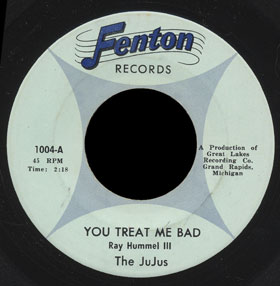
The Ju Jus first 45 had two Hummel originals, the amazingly powerful “You Treat Me Bad” and the fifties-sounding “Hey Little Girl”. The record did well locally, supposedly reaching #2 on a chart in western Michigan in October, 1965. The future looked good and Drummond Records of Detroit offered Ray Hummel a contract based on his songwriting. The band couldn’t sign because a newly-married Ray refused to tour out of state, and Ray soon left the band. He recorded a few solo pop 45s over the years, including “Gentle Rain” / “Fine Day” on Fenton with Max Colley playing sax and Bill Gorski on drums.
The JuJu’s had several personnel changes before making their next record. Brett Wells came in on vocals, and Bruce Essex, who had played guitar with Rick Stevens in the Paeans joined for part of 1966. Then Max Colley left and Bill Gorski was drafted, so the band found guitarist Ron Burke and drummer Ron Homrich. Before long Brett left and Ron Burke took over on vocals. Rick Stevens now became the primary songwriter for the band.
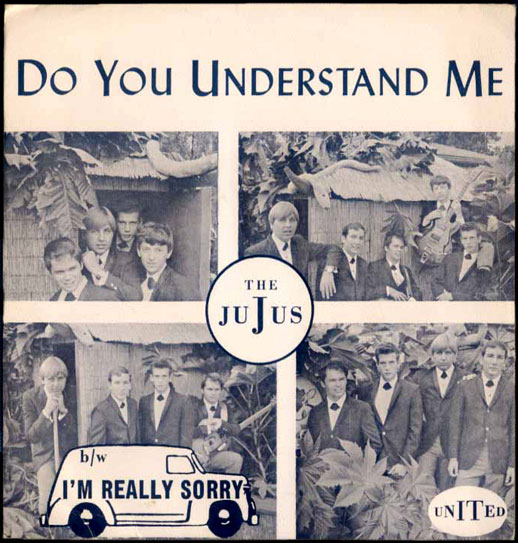
Though missing Ray’s unique vocals, their second 45, from 1966, is just as good as their first. “I’m Really Sorry” has been one of my favorite garage songs since I first heard it, and “Do You Understand Me” is a strong Stones-influenced punker with sharp guitar, buzzing sounds and broken glass. The United label is another band-financed record recorded through Fenton.
In the summer of ’67 their manager Jim Geeting opened The Island, a teen club in Ludington, in which the Ju Ju’s played regularly and supported touring national acts like the Kingsmen and the Electric Prunes. By this time the band had a tougher rock sound.
In late 1967 the band broke up as Rod Shepard and Rick Stevens went into the military. Rick Stevens joined the Air Force and later died in a plane crash in New Mexico. A number of unreleased songs recorded over the years at the Hope, Chess, and Phil Robert studios have yet to see commercial release. Until recently they were distributed on tape and CDR, but they are currently unavailable, and I haven’t heard them yet.
The Spectres formed at Louisiana Tech in Ruston, and then based themselves in Monroe, which is about halfway between Shreveport, LA and Jackson, Mississippi. Band members included Daniel Gilbert on lead guitar, Jim Steele on vocals, Sidney Boone on keyboards and vocals and Woodie Bardin on keyboards.
Their repertoire leaned heavily on soul songs, and they often played at the Dynasty in West Monroe.
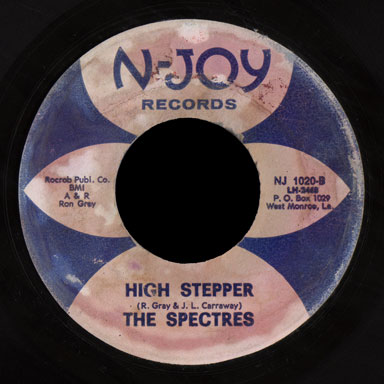
Monroe was also the base for the N-Joy label, run by Rocky Robbins. Both sides of the Spectres 45 were written by Ron Gray and J.L. Carraway. Gray did A&R for the label and had his own group, the Countdowns, with whom he released three earlier 45s on the N-Joy label, some of which I hope to feature soon. I’d be interested to know why he had the Spectres record these songs instead of his own group.
“No Good, No Where World” has a neat keyboard riff, and a heavy beat. It’s well produced with a nice pop sensibility, while “High Stepper” is a bit of a throwaway, maybe closer to their live sound. My copy of the record has some serious Katrina/Rita water damage on the labels.
Jim Steele contacted me and also sent in the two songs from the later 45:
The writers Ron & Jerry were disc jockeys in Sherveport where we cut those two sides on N-joy at Sound on Sound Studios, which burned down many years ago. Other band members besides Daniel, Sidney, and Woodard were Terry Montgomery on bass – his brother the late Vince Mongomery played bass in the very popular band from Mississippi, The Gants, and our crazy drummer Billy Bass…he’s still crazy after all these years.
You’re right about “High Stepper” it should have been thrown away! The lyrics were handed to me as I was singing them. Sidney did the harmony. He did all the soul stuff. The band even changed to gold jackets for that part of the show. I sang on the Brit Invasion and pop stuff. Unfortuately Sidney died years ago..a very talented man. We all miss him.
For some reason Daniel didn’t play guitar on Stepper, Bobby Stampley, who played in The Uniques with his brother Joe played on it. We cut two more sides in the the fall of 66.
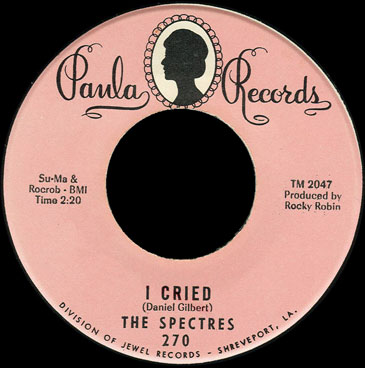
I got drafted in the Army in Aug of that year, but came home on leave and we went to Robin Hood Brians studio in Texas to record two songs that Daniel had written. “I Cried” and “Psychodelic Situation”. Their new singer also sang, but I forgot his name. They came out on Paula, Stan Lewis’ label in Shreveport. I recently found “I Cried” on an Aussie compilation, Wyld Sydes Vol5. Did you get your royalities Daniel? Since I got out of the Army, I’ve played in a few bands and worked in radio. I currently DJ at Classic Hits LA105.3 in Monroe, Louisiana.
“Psychodelic Situation” is not very mind-bending, but it’s a solid song, and “I Cried” is even better. Both sides were produced by Rocky Robin. Thank you Jim for your comments and for sending in these two songs.
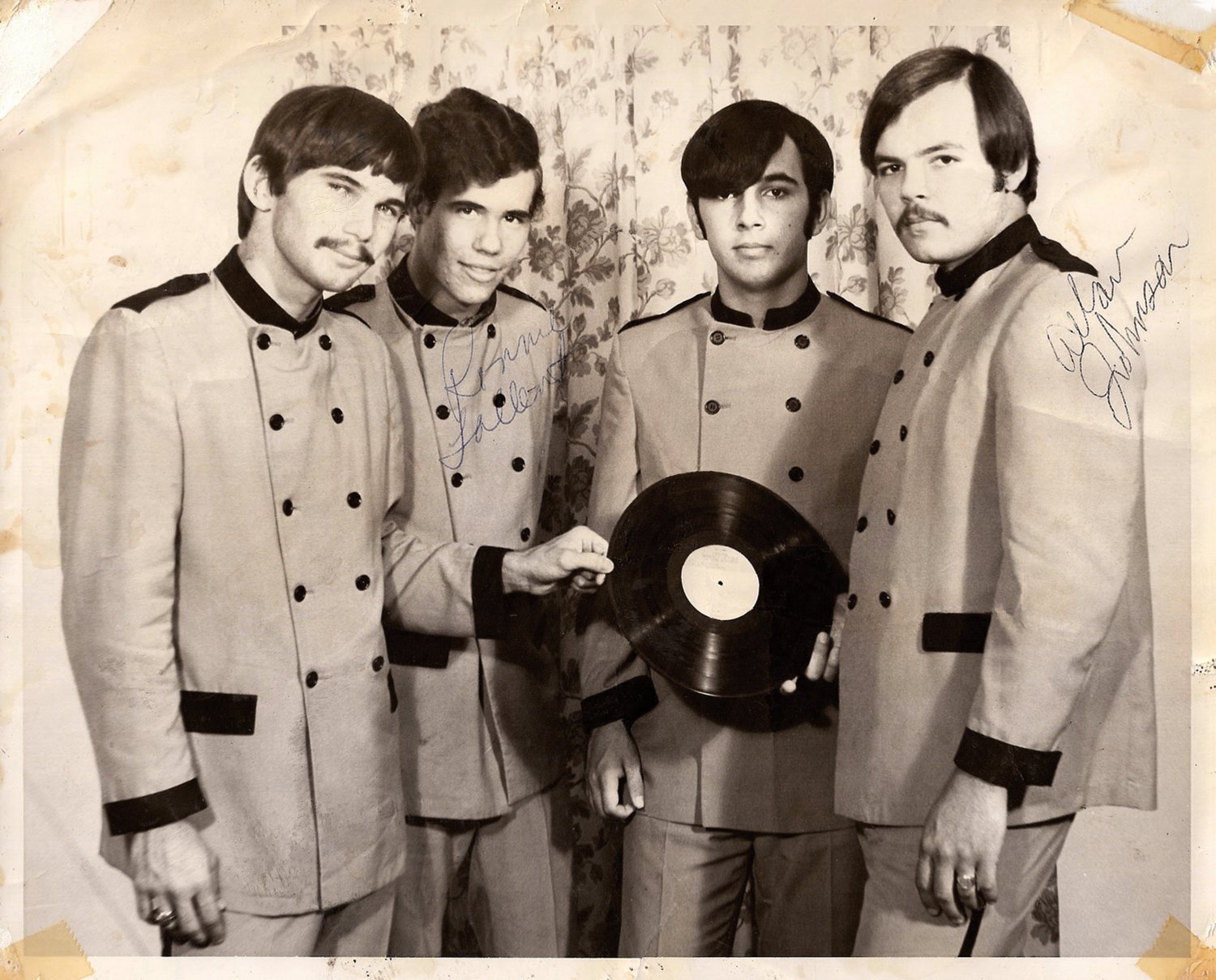
Left to right: John Laviolette, Ronnie Tallent, Sal Serio and Allan Johnson A later lineup of the group with what looks to be an acetate record.
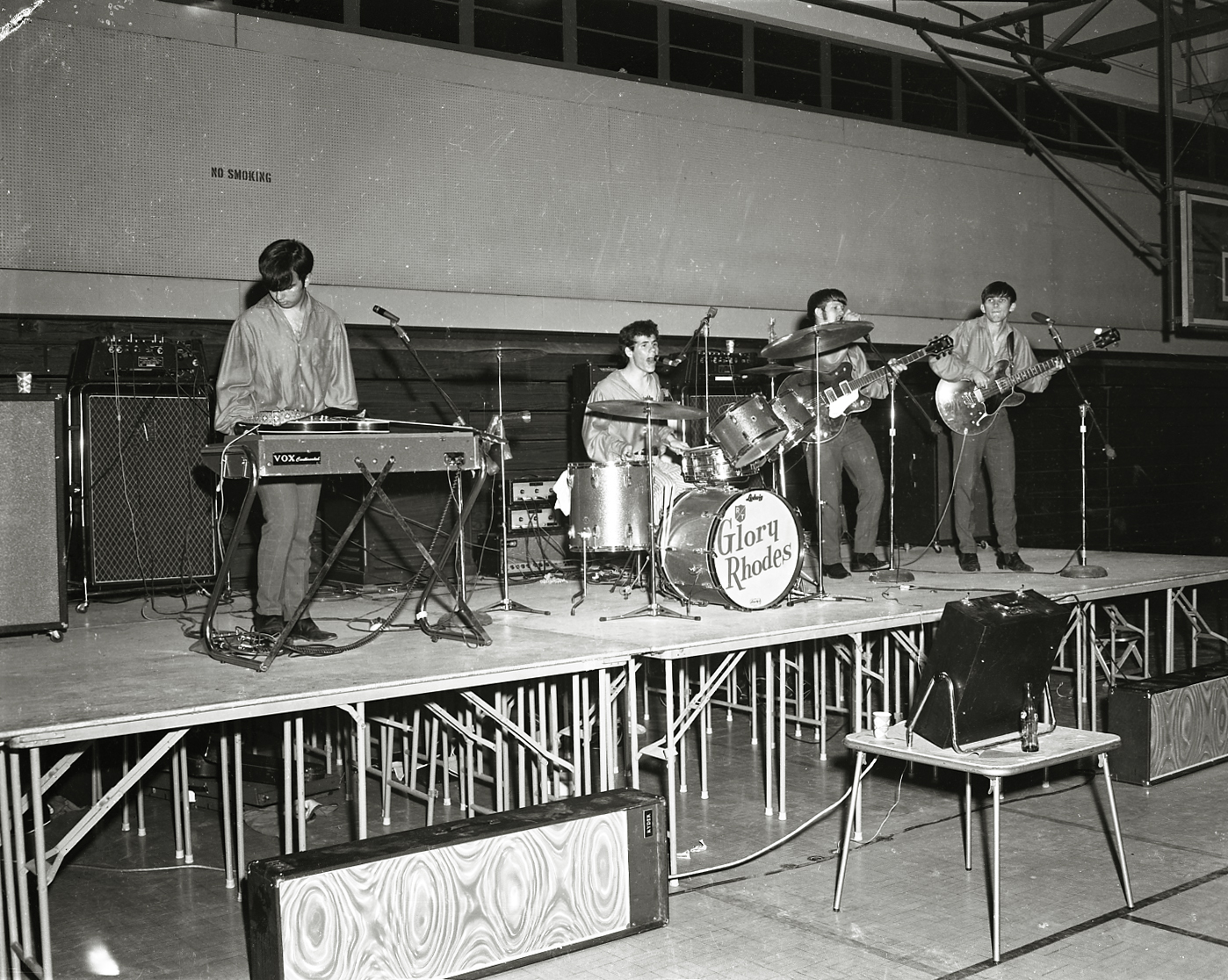
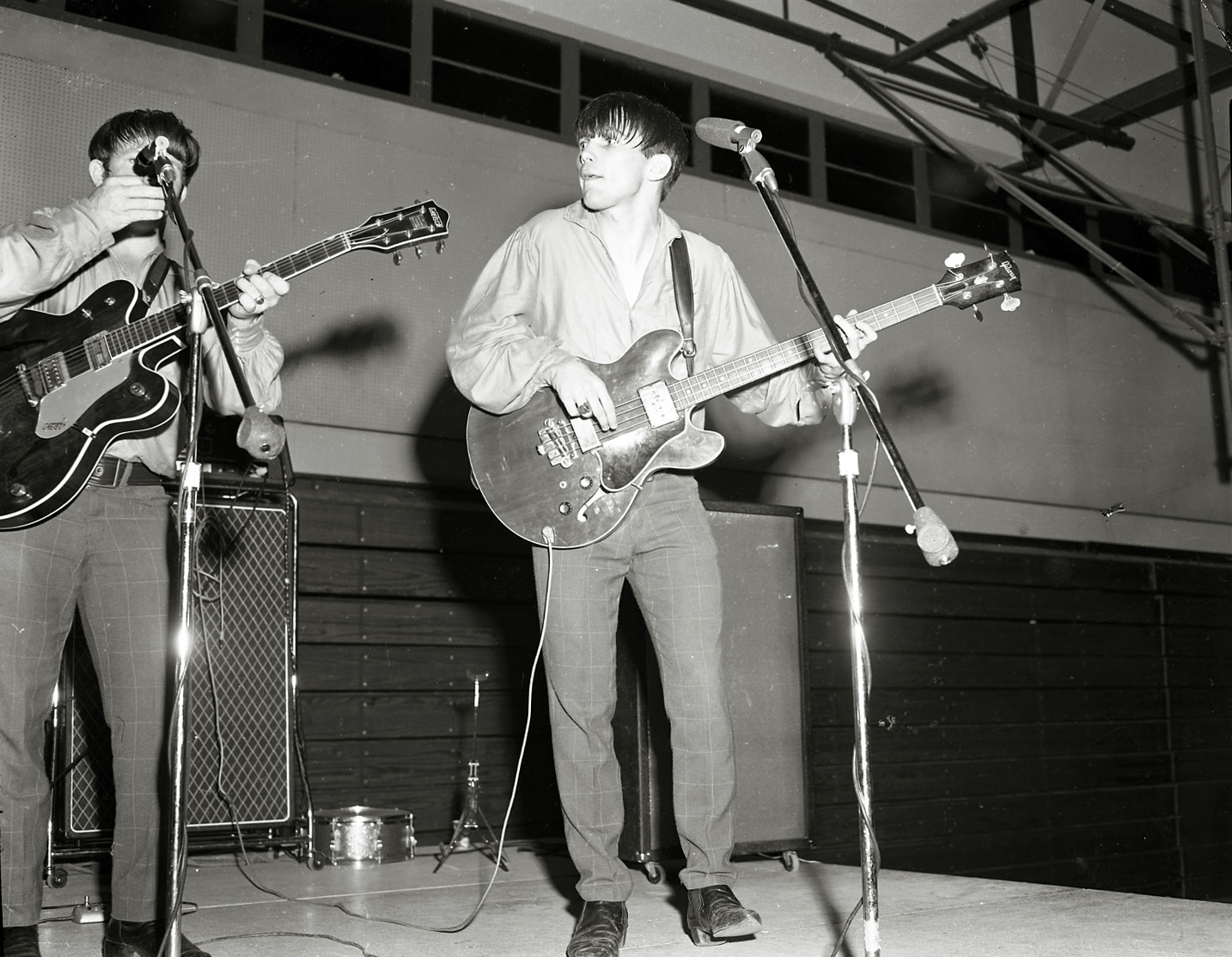
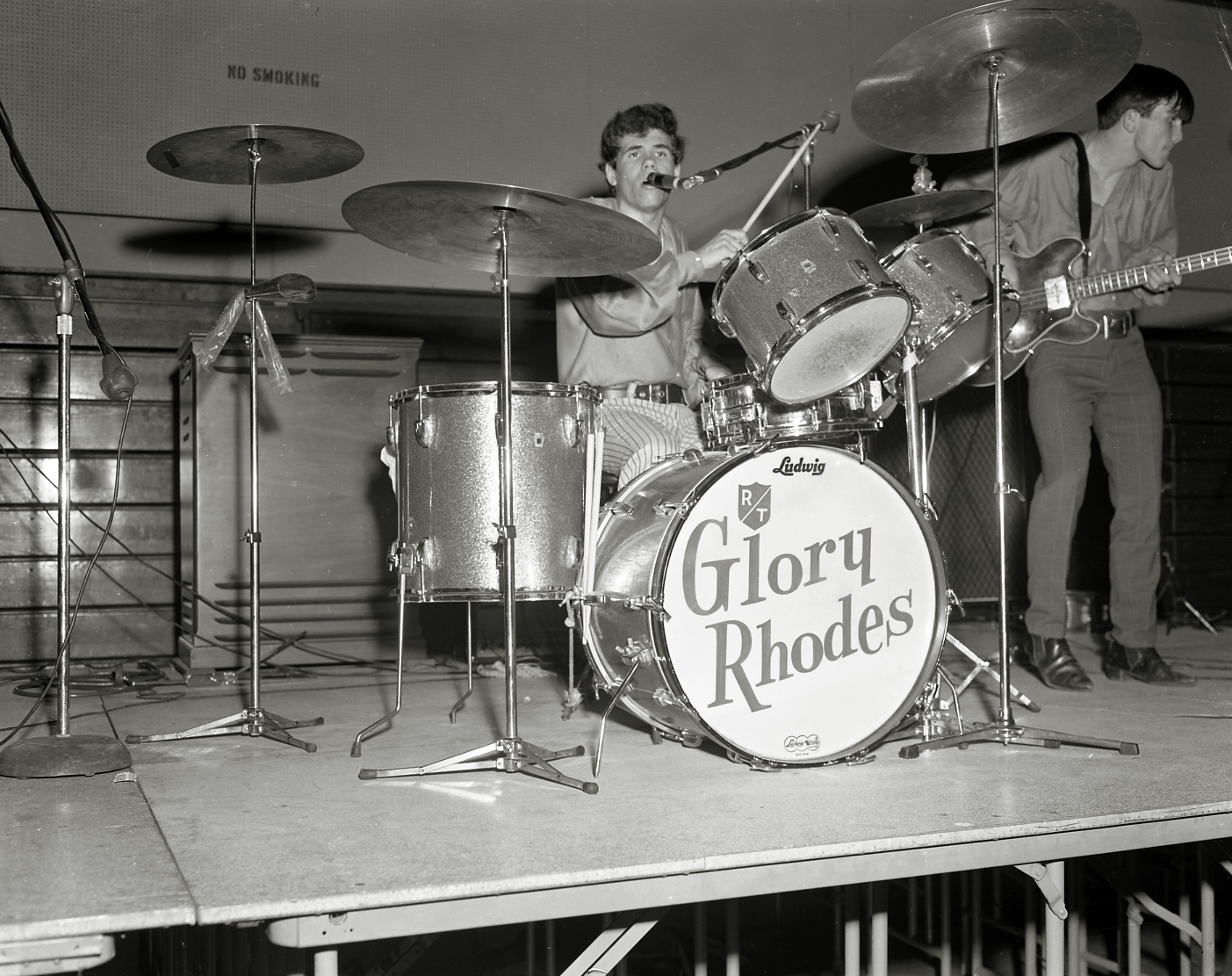
New Orleans’ Glory Rhodes original lineup was Kenny Lyles (lead vocals), Frankie Spencer (lead guitar), Sal Serio (keyboards and rhythm guitar), John Laviolette (bass) and Greg Nobile (drums).
Their first 45 in January of 1966 covers the Animals’ “I’m Gonna Change the World”, with “Stay Out of My Way” on the flip.
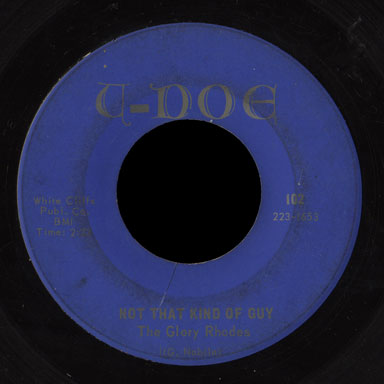
The second, equally good, features two originals: Greg Nobile’s “Not that Kind of Guy” along with “Gonna Be Somebody” written by Nobile, Serio and Ken Lyles. Both sides use 12-string guitar.
These are the first two 45s on the U-Doe label, which would also release rare 45s by the Palace Guard and the Better Half Dozen.
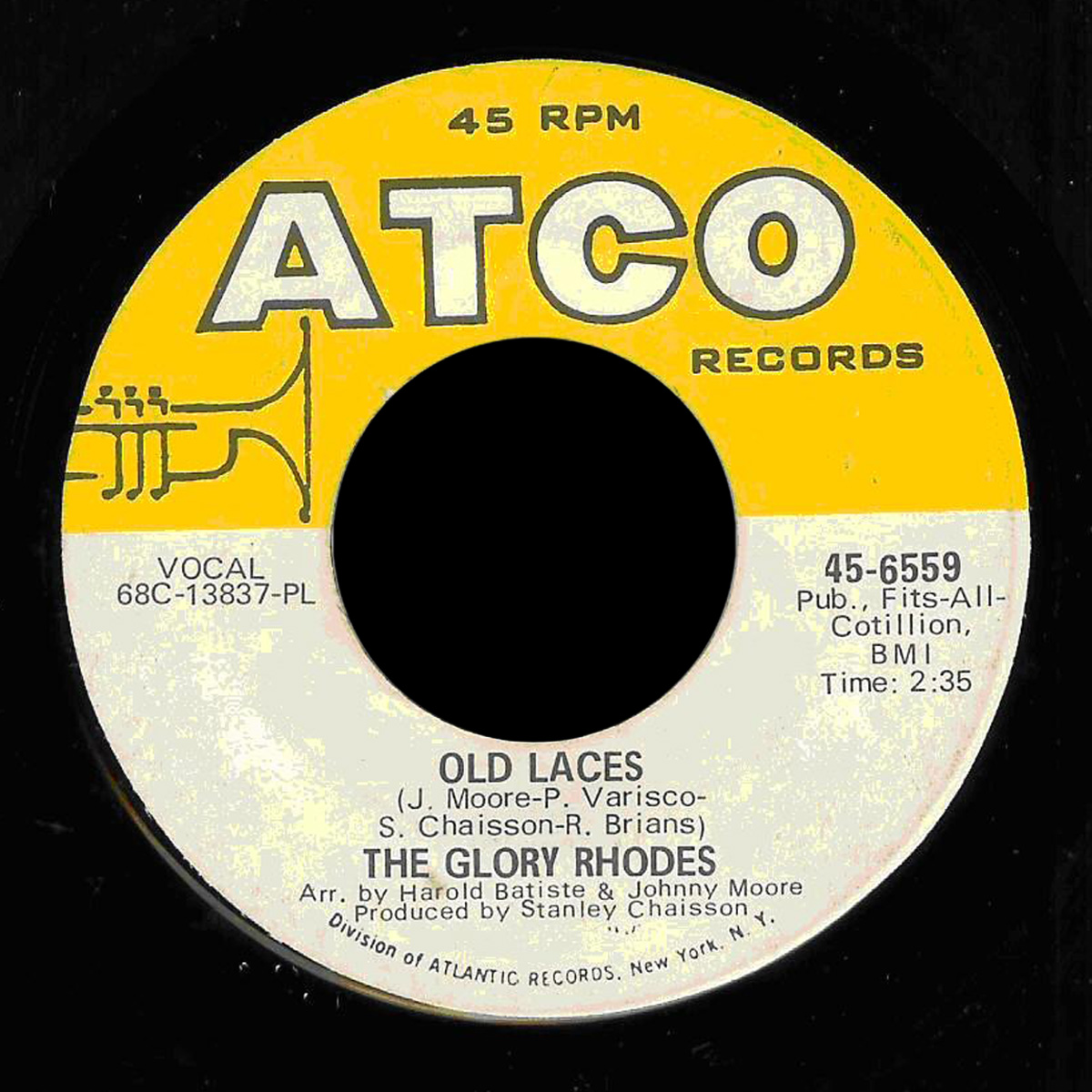
Their next 45, on the related White Cliffs label, featured two covers, “One Track Mind” and “Run for Your Life”. In 1968 they signed to Atco for two releases which are much more pop in sound, with strings and horns. Ronnie Tallent became drummer and lead vocalist after Kenny Lyles left and is featured on the Atco 45s:
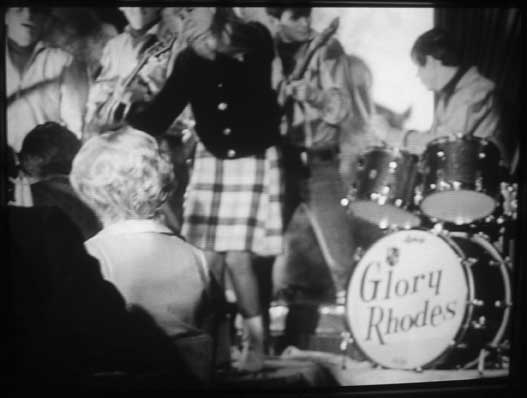
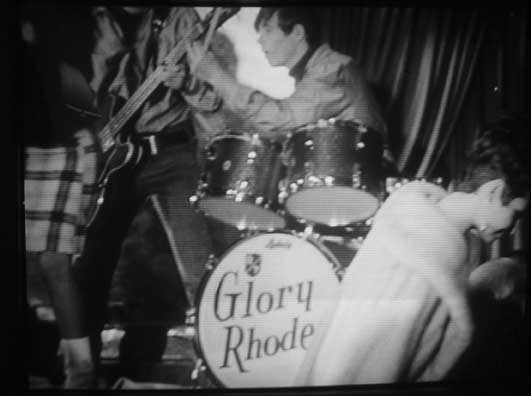
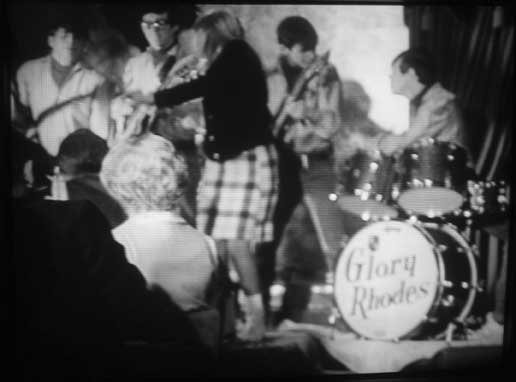
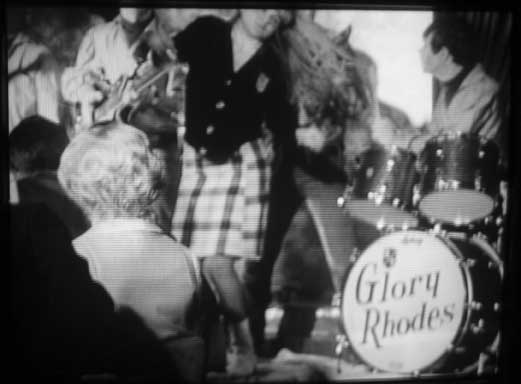
The band had a brief appearance in a schlocky 1967 feature, Hot Thrills and Warm Chills, though the music heard in the film is probably not them. Not a movie I’d highly recommend, but it does have a lot of good footage of the actual Mardi Gras, as well as an ending scene in a cemetery that might put you in mind of Easy Rider.
Later members included Allan Johnson on lead guitar and Kenny White of the Other Guys on drums.
Top photo courtesy of Laura Matherne Ditta, with more shots to come if we’re lucky! Thanks to Myeck Waters for cleaning up the original.
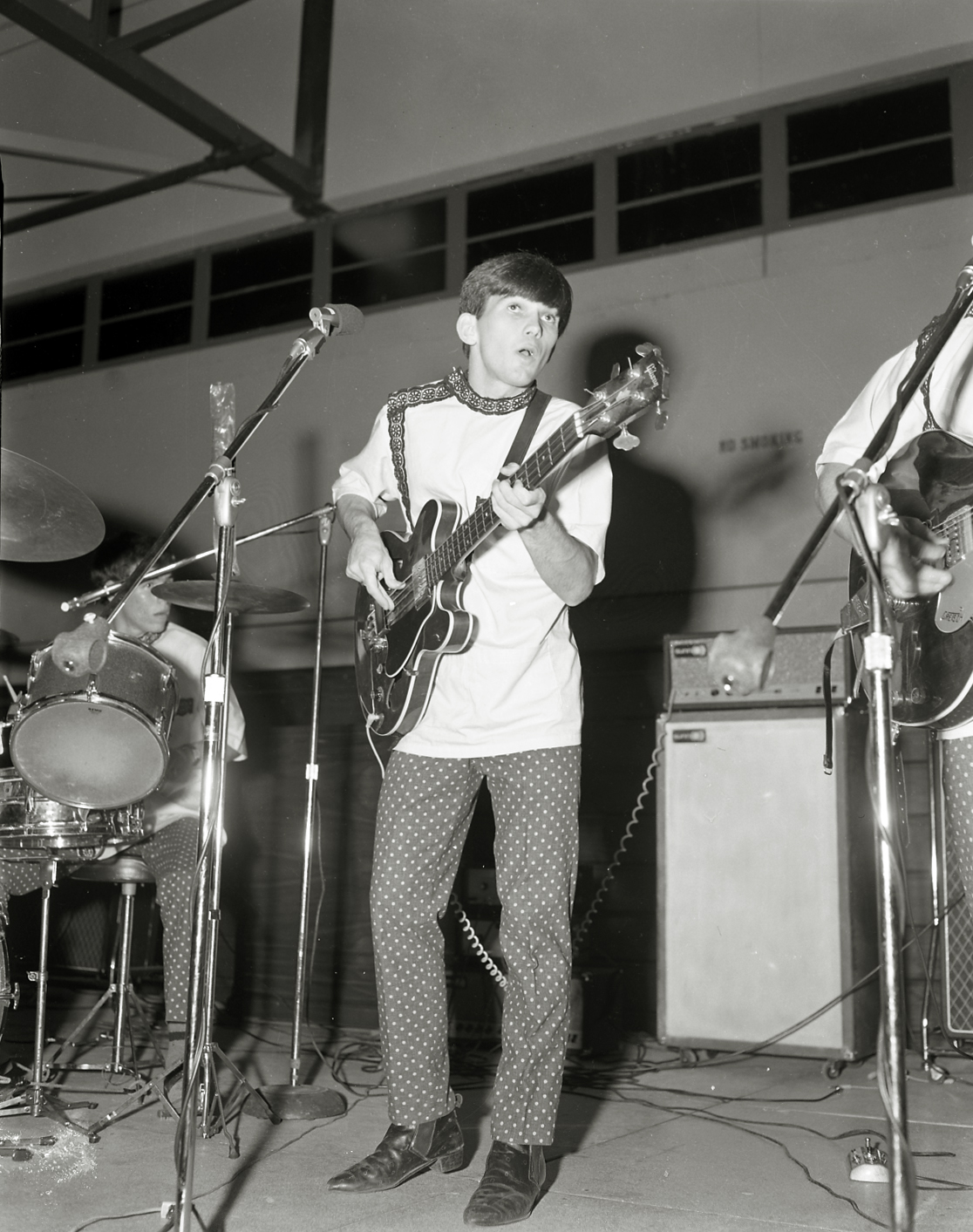
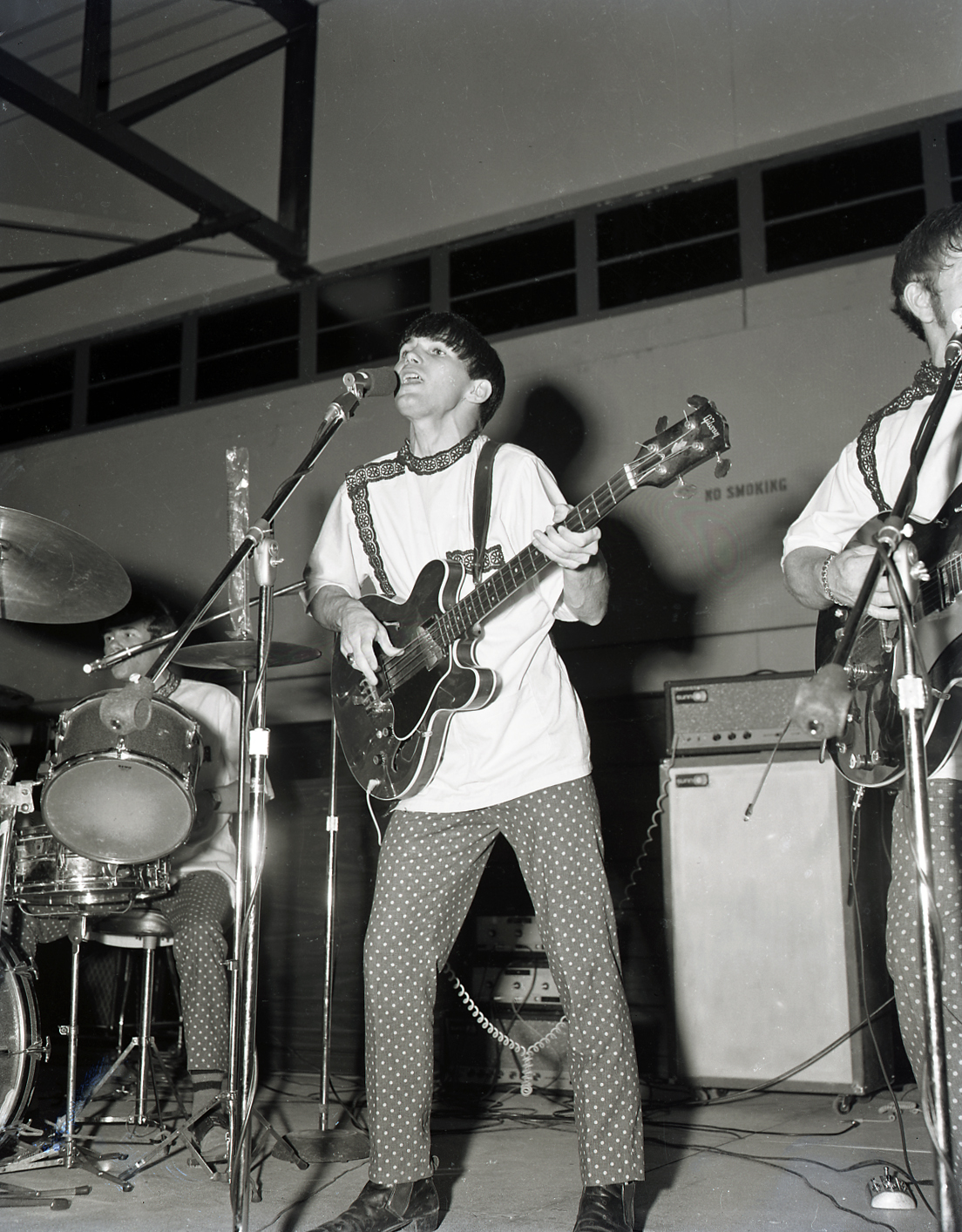
Jerry Lenfant sent in the photos from Rummel High School, all taken by Dalton Masson. Thanks to Mike Legendre for sending in the transfers of “Old Laces” and “I’m So Happy”.
Screen shot of the Glory Rhodes appearing in Hot Thrills and Warm Chills.Screen shot of the Glory Rhodes appearing in Hot Thrills and Warm Chills. These are the earliest photos of the group I’ve seen.Screen shot of the Glory Rhodes appearing in Hot Thrills and Warm Chills. The dancer is Darlene.Screen shot of the Glory Rhodes appearing in Hot Thrills and Warm Chills. The dancer is Darlene.
The six photos below were taken by Dalton Masson at Rummel High School and sent to me by Jerry Lenfant.
John Laviolette on bass with Ronnie Tallent behind the drums. Photo by Dalton Masson at Rummel High School and sent to me by Jerry Lenfant.John Laviolette on bass with Ronnie Tallent behind the drums and Frank Spencer partially seen on the right Photo by Dalton Masson at Rummel High School and sent to me by Jerry Lenfant.from left: Sal Serio, Ronnie Tallent, Frank Spencer and John Laviolette. Photo by Dalton Masson at Rummel High School and sent to me by Jerry Lenfant.from left: Sal Serio, Ronnie Tallent, Frank Spencer and John Laviolette. Photo by Dalton Masson at Rummel High School and sent to me by Jerry Lenfant.from left: Frank Spencer and John Laviolette. Photo by Dalton Masson at Rummel High School and sent to me by Jerry Lenfant.from left: Ronnie Tallent and John Laviolette. Photo by Dalton Masson at Rummel High School and sent to me by Jerry Lenfant.
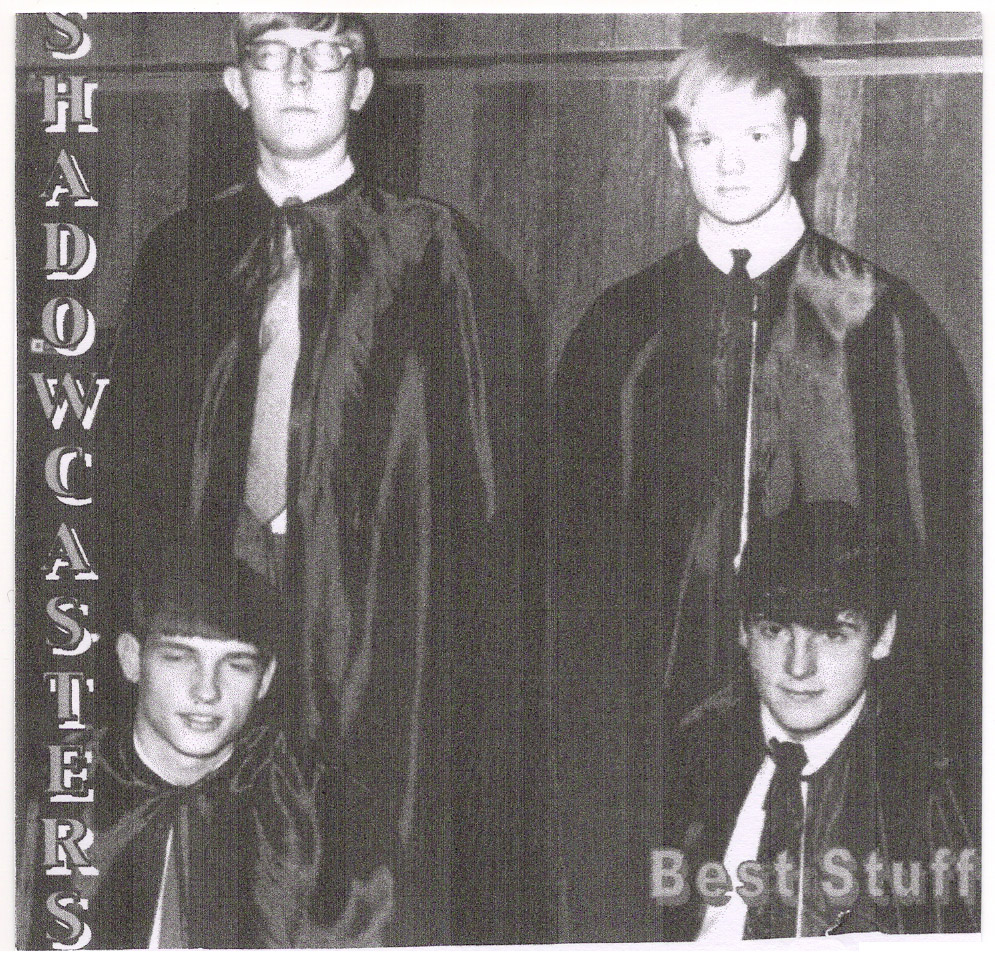
The Shadow Casters were students from West Aurora High School in Aurora, Illinois, on the edge of the greater Chicago area. The band was active from 1966 to 1969, when members left for college.
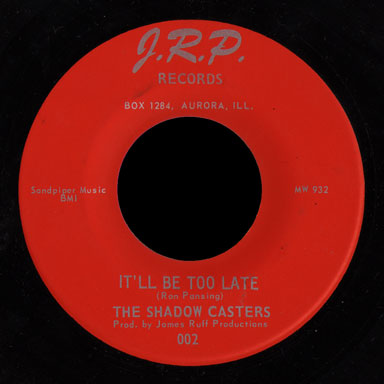
They released two 45s on J.R.P. Records (James Ruff Productions) in November 1967 and April 1968. I knew little about the group until members of the band started leaving comments, below, so I’m rewriting this post with this new information.
Bill Maakestad – lead vocalist Gregory Ellis – lead guitar (replaced by Thom Swiss) Ron Pansing – bass Bill Buff – drums
“It’ll Be Too Late” is their first 45, credited to Ron Pansing. The flip “Going to the Moon” has a slow, late night atmosphere. Singer Bill Maakestad says that this song made it to American Bandstand.
Their second record featured a guest vocalist, Dick Johnson. “But Not Today” was their most upbeat song, credited on the label to Bill Buff. “Cinnamon Snowflake” is an excellent melancholy number credited to Greg Ellis.
Originally I was surprised to see each of the Shadowcasters’ songs written by a different member of the group (plus one credited to their producer, James Ruff). Bill Buff corrects this, saying Bill Maakestad wrote all lyrics and co-wrote the music with Greg Ellis. Maakestad’s name was left off the labels only because James Ruff couldn’t remember how to spell it. Ruff was not musically inclined, but somehow listed himself as writer of “Going to the Moon”.
The only other single on J.R.P. that I can find is Something Obviously Borrowed, a band who may have included D. Geinosky and L. Carr as members.
Thanks to Ad Zwaga for sending in the soundclip of “Cinnamon Snowflake”.
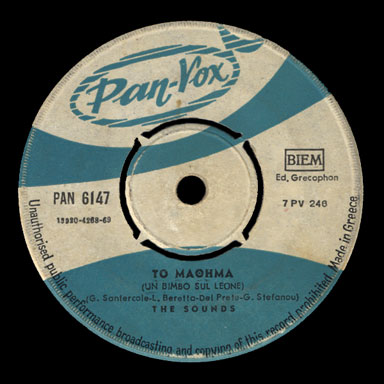
The Sounds released a number of 45s and at least one album, and backed a singer named Tammy on some of her recordings. Info on them in English is hard to come by.
“To Maohma (Un Bimbo sul Leone)” has a nice horn arrangement and Georgie Fame-influenced vocals. It was written by G. Santercole, L. Beretta, Del Preto, G. Sefanou.
Two other songs that are supposed to be good are “Parakseno takseidi” (Strange Trip), and a cover of the Count Five’s “They’re Gonna Get You”.
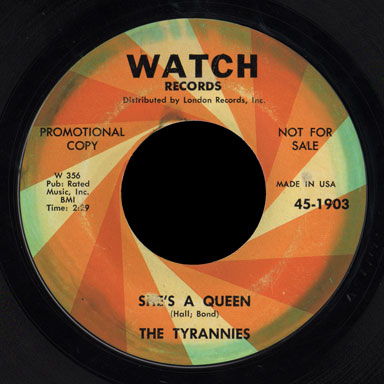
A band I know almost nothing about, I hear the Tyrannies were from Abita Springs, Louisiana.
Fine guitar with a melancholy vocal delivery, this 45 was released in June 1965 on the Watch label. Songwriting credits for “She’s a Queen” and the flip, “Little Girl” go to Hall and Bond.
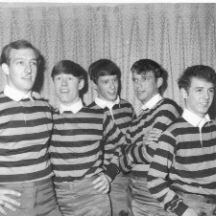
The Rugbys formed when all the members of the popular Louisville group the Oxfords left that band except the drummer, Jim Guest. Guest kept the Oxfords name and brought in members of the Spectres, soon releasing a good 45 on the Mala label.
The Rugbys took the Spectres’ drummer, Glenn Howerton to replace Guest; the other members being Steve McNicol on lead guitar, his brother Jim McNicol on bass, Chris Hubbs on guitar and Doug Black on sax. The band’s name supposedly came from wearing rugby shirts onstage.
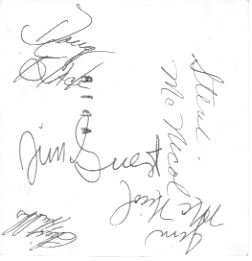
At least, that was what I had read, but then Susan Harkins sent in this photo of the Rugbys signed by Jim Guest on the back, and Glenn Howerton’s signature is not included. Perhaps the Oxfords changed their name to the Rugbys, then Guest left or was kicked out and restarted the Oxfords with new members.
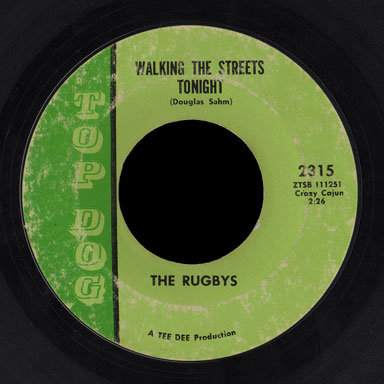
In any case, their first release is this great version of a Doug Sahm song, “Walking the Streets Tonight”, on the Top Dog label, from July, 1966. The flip side, “Endlessly”, a ballad original by Steve McNicol, has been ignored until now, though mellow it’s very good.
The Rugbys continued on until 1970 with some personnel changes, releasing several 45s and an album in a hard rock style.
Thanks to Susan Harkins for sending in the photo of the group.
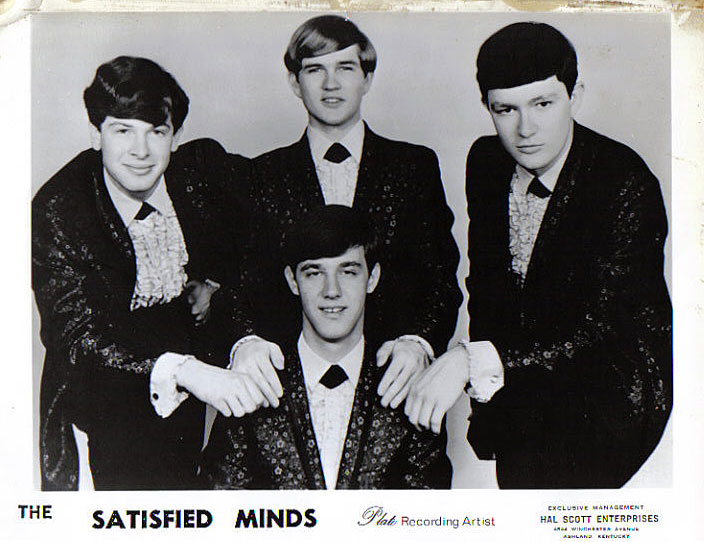
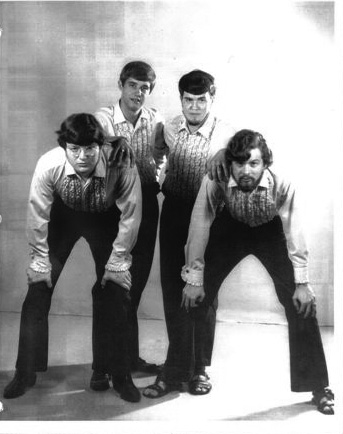
The Satisified Minds, 1966 clockwise from left: Darrell Fetty, Danny Ward, Yancey Burns and Hale Talbot
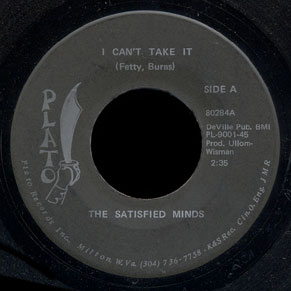
The Satisified Minds formed at Marshall University in Huntington, West Virginia and recorded the first and liveliest garage 45 released on the Plato label. Fuzz guitar drives this one throughout, and the distortion gets especially wild during the solo. “I Can’t Take It” was written by Darrell Fetty and Yancey Burns. Darrell Fetty also wrote the softer b-side, “Think About Me”.
I just heard from Yancey Burns, bassist and vocalist (and later guitarist) with the group. Following is his history of the group and his answers to some questions I had about the band.
My name is Yancey Burns, and I’m the Burns in “Fetty/Burns” on the Plato record “I Can’t Take It” by the “Satisfied Minds.” When I found out about your website, I was shocked that anyone remembered what we were up to in 1967.
from left: Yancy “Ed” Burns, Hale Talbot, Mike Fincham, & Darrell Fetty. Thank you to Lola Fincham for the photo scan
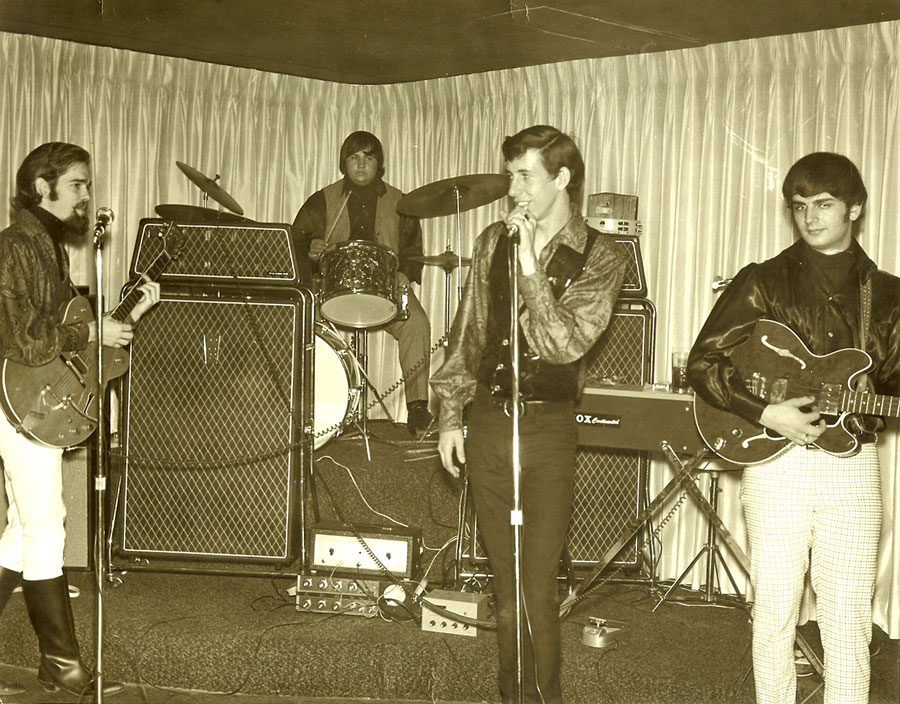
Our record did very well here in the West Virginia, Kentucky, and Ohio area, but never charted. At the time, Darrell and I were going to Marshall University in Huntington, West Virginia. The band had personnel changes all through our time at Marshall, but the constant in the band was Darrell and I. The first photo is the original line-up on the record: Darrell on B-3 organ and vocals, Danny Ward on guitar, Hale Talbot on drums, and me on bass and vocals.
I switched to guitar later when we went to a three-piece, with Darrell handling the bass by adding a Fender Bass Keyboard (like Ray Manzarek used in the Doors) to his customized B-3 set-up. We had gigs all throughout the south, performed as the opening act for a few local concerts, but mostly played tri-state area rock clubs, college parties, and high school dances.
Local music store owner and county fine arts educator Pat Wiseman began Plato Records in 1967 with a pharmacist and music lover named Bob Ullom. They booked their sessions at King Studios in Cincinnati, Ohio.
We were playing a lot of live gigs at that time, and on the night before our recording date, our hustling manager Hal Scott of Hal Scott Enterprises in Ashland, KY (besides booking rock bands. he ran a mortuary business) had us booked for a high school prom from 9pm to 1am, THEN an after-prom party at a DIFFERENT high school from 4am to 6am! So, with no sleep for 36 hours, our voices raw from singing for six hours, our bodies aching from packing and unpacking our equipment, and driving the hundred plus miles from West Virginia, we arrived for our session at around 11am. Because our voices were so ragged, we weren’t able to do the harmonies that we did live, but everybody seemed to like the rawness of the record.
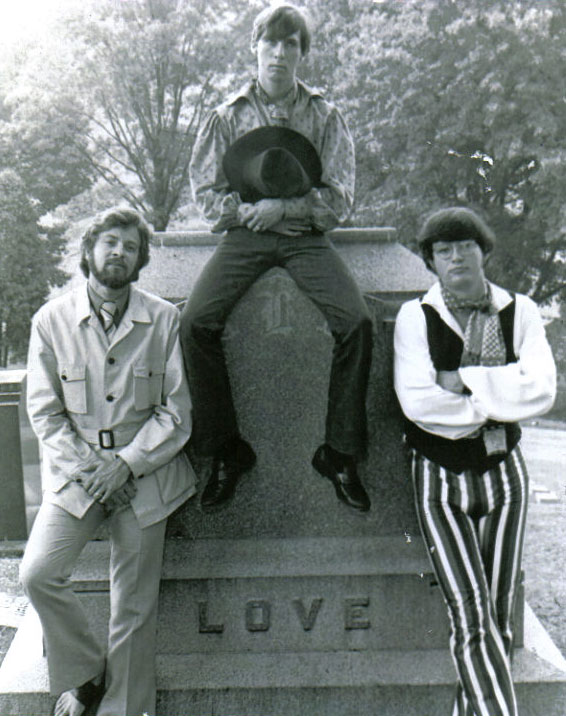
The Satisfied Minds, 1968
After college graduation, I did two years in the Army, then started teaching, while Darrell took off for Hollywood to pursue acting. But we kept in touch, and I kept playing. In 1977 Darrell called me out to L.A. to play music and be in a film he was co-starring in called “Big Wednesday”, a surf epic written and directed by John Milius that’s become somewhat of a classic. Shortly after that, Darrell starred in a CBS comedy series pilot written by Lorenzo Music called “Friends” about a couple of rock stars, loosely based on Flo and Eddie from The Turtles. Darrell got me on that show as the guitar player in his band. In the opening credits for the show, there’s a scene of Darrell & his co-star playing a gig at the legendary Troubadour club. Along with the show’s fictional band, the marquee proclaims “Now Playing ……..The Satisfied Minds!”
The pilot wasn’t picked up, but Darrell and I continued to play in groups in L.A. -. Among them, a group called “Pacific Ocean,” which featured singer Edward James Olmos before he became a famous actor. We also played a number of gigs with David Carradine and his younger brother Robert Carradine. In 1979, we did a concert with the entire family: David, Robert, their brother Keith, and father John Carradine at the Wilshire Ebell theatre, called “An Evening With The Carradines.” Filmed live, the concert became part of a documentary that’s now on DVD.
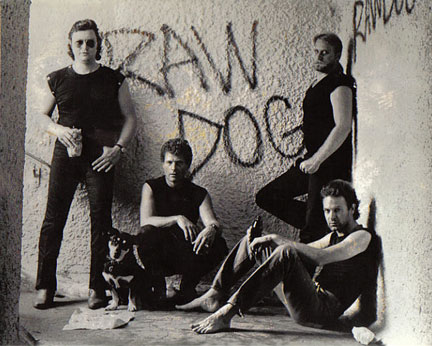
After that we started a California version of the Minds with our good friend Sam Melville a co-star with Darrell on Big Wednesday who had been one of the three leads on the ABC hit show “The Rookies”. We called this band “Raw Dog”, but it was still the Minds. A couple of years later, I moved back to the family farm in Lincoln County, West Virginia to be with my aging parents. I started teaching again but kept right on playing. Darrell segued into writing and producing TV and films.
The pictures enclosed are the band in 1966 (check those tuxedos), in 1968 (times were a-changin’ and the guy sitting on the stone was our drummer, Jim Frazier–Hale had gone off to the Berklee School of Music in Boston). The third one is 1980 of “Raw Dog,” and the guys with Darrell and me are Sam Melville on bass and Jeff Marx on drums.
Darrell and I still stay in touch and try to play music together whenever he’s in town. Lately, we’ve been talking about writing a stage musical based on some songs I’ve written about the “Chemical Valley” (the heavily industrial Charleston, St. Albans, Nitro area) where I grew up. Don’t worry….we’re not through yet!!!
Q. How did you start in music? Was the Satisfied Minds your first band?
Yancey Burns: I had played in high school groups, but I didn’t know Darrell or any of the other guys then. When I came to Marshall, I formed an R & B group called “The Seagram Seven.” We featured a big black guy who looked and sounded just like Junior Walker on saxophone and a crazy New York Italian guy who sang soul songs. Since we were a mixed group (black guys & white guys) we played a lot of black clubs and frat gigs.
One night, during a snow storm at about 3 a.m., we were driving from a gig in the customized hearse we used to haul our equipment. No one else was on the road at that hour but the occasional truck driver. Suddenly, we saw this silhouetted figure crawling out of a snow drift in the Interstate median – It was Darrell Fetty struggling across the highway to flag us down. He had been driving from a gig in the opposite direction when his car broke down. He had been out there alone (remember this was before cell phones) for a couple of hours and was about to freeze to death. That’s how we met.
Darrell was still in high school at the time, but had been playing in various rock groups for several years. He started playing piano when he was eight for church choirs and gospel quartets. We happened to be looking for a new keyboard player at the time, so Darrell gave me his number. I called him a couple weeks later, and he was thrilled to join the “Seagram Seven” to play college bookings and get away from the Elks Club and Moose Lodge gigs he’d been playing with an older group.
When Darrell came to college the following year, his Dad bought a boarding house where a bunch of us guys lived and practiced music in the basement.
Q. How’d the band get it’s name?
Yancey Burns: After the “Seven” broke up, we were looking to play a new kind of music that was happening then. It was 1967, so we still had to play a lot of R & B for the local gigs, but we started stretching things out with guitar solos and so forth and played sort of “psychedelic soul” style. We got a light show, and I started burning guitars and setting off smoke bombs onstage. We wanted a name that reflected sounded kind of mind expansive, so Darrell came up with the “Satisfied Minds” which was actually pulled from the lyrics of an old country song about “a man with a satisfied mind.”
Q. Did you know other bands on the Plato label, or were friends with other local acts?
Yancey Burns: We knew all the acts! They weren’t exactly friends, because, then, we saw them as our our competition. Although secretly we were all kinda fans of each other. Most of the acts on Plato were managed and booked around the area by Hal Scott Enterprises.
This was a great time for music in this area. We’d see professional acts like Paul Revere and the Raiders, then later Led Zeppelin, the Who, etc. but none of them seemed as exciting as some of our local groups! Among some of the other groups in the Tri-State area at that time were “The Explosive Dynamiks” who featured three lead singers, a white guy and two black guys (one sounded like James Brown and the other like Brooke Benton). The Dynamiks had a local hit, but it was a record they produced and distributed themselves (not on Plato). [for more info on the Dynamiks, check out this entry at Capitol Soul Club]
There was also “The Fugitives” who went to New York for awhile and actually opened for “The Young Rascals” for a couple of concerts. Darrell and I were also big fans of “Little Archie & The Parliaments” an all-black group who also recorded their own records (not on Plato). Little Archie was about seven feet tall who could sing, dance, and gave as great of a show as Otis Redding!
Q. I’ve heard that Plato was started as a label for black music. This doesn’t really fit in with the fact that the Satisfied Minds was the first record released on Plato. What would you say were Wiseman and Ullom’s ambitions for the label?
Yancey Burns: Maybe because of the number of black groups on the label and in the area. Actually, Wiseman and Ullom just wanted to tap into that locally-happening music scene and just get a hit! Our record was the first release, but remember we were segueing from a soul band (you saw the tuxedos) to a psychedelic/rock band at the time.
Q. Are there any unreleased or live recordings of the band?
Yancey Burns: Not that I know of.
Thank you to Yancey Burns for his history and photos of the group.
Update, October 2010:
I’m very sorry to hear that Yancey passed away on June 6, 2010.
Darrell Fetty wrote to me about some of the music he and Yancey did after the Satisfied Minds:
“Reds and Blues” is from a live performance we did in L.A. (I think it was the old Palomino Club) as “Leon Keyboard & the Bilnor Spashers” – it was the “Raw Dog” core musicians: Yancey on guitar, me singing and on keyboards, etc., but for a few gigs we brought in a number of friends of ours who were celebrities at the time. It was a fun, ever-evolving gang of people modeled after the “Mad Dogs & Englishmen” group. On this performance, in addition to Sam Melville and Mark Singer, and our wives Annie Melville, Hau Nani Singer, Carolyne McCoy Fetty, we had Carradine brother Bobby on guitar.
Yancey wrote “Red and Blues” one night after watching a documentary on Custer’s Last Stand. It’s a funky rock/folk song with a raw reggae feel that tells the story (with real names of some of the soldiers involved) from the Indians point of view. This is also a rare recording of Yancey himself singing the lead vocal.
Kit and the Outlaws, 1967 l-r: Kit Massengill, Joe Jessmer on drums, Jerry Colwell at the mic and Alan Ravkind
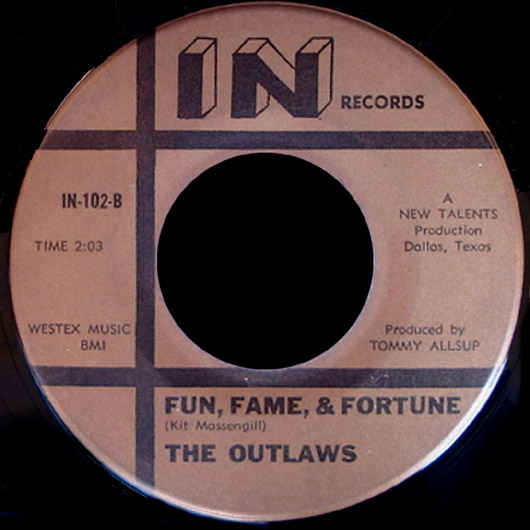
Kit and the Outlaws evolved from the Outlaws, the Dallas group led by Kit Massengill. As the Outlaws, they had a great early Texas garage 45 on the In label, produced by Tommy Allsup. Both sides, “Worlds Apart” / “Fun, Fame & Fortune” were written by Kit.
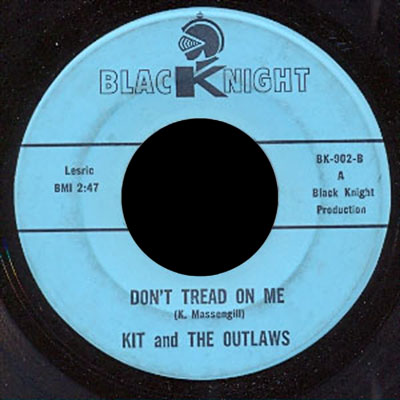
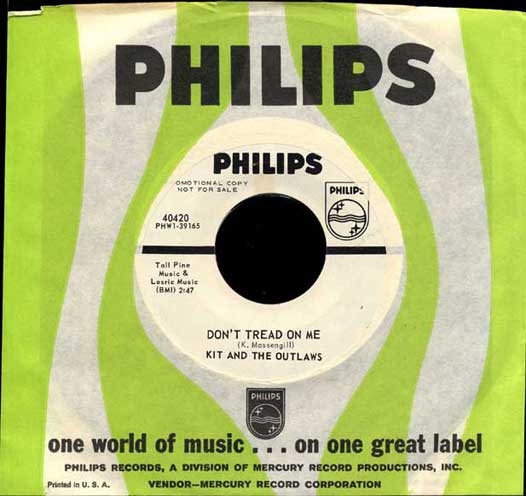
With a change of members, the group hit the big time with their second 45, a fuzzed-up version of “Midnight Hour”. It was picked up by Philips for national distribution in late 1966, mainly on the strength of the a-side. That’s a fine cover version, but it’s the b-side, Kit’s original “Don’t Tread on Me”, that gets the attention nowadays.
The first BlacKnight pressings list the band as “The Outlaws”, later pressings read “Kit and the Outlaws”. Philips licensed the single through its subsidiary Mercury Records, from San-Lin Corporation on November 23, 1966.
Members included:
Kit Massengill – lead vocals and rhythm guitar Dennis Lowe – lead guitar Jerry Colwell – keyboards Alan Ravkind – bass Joe Jessmer – drums
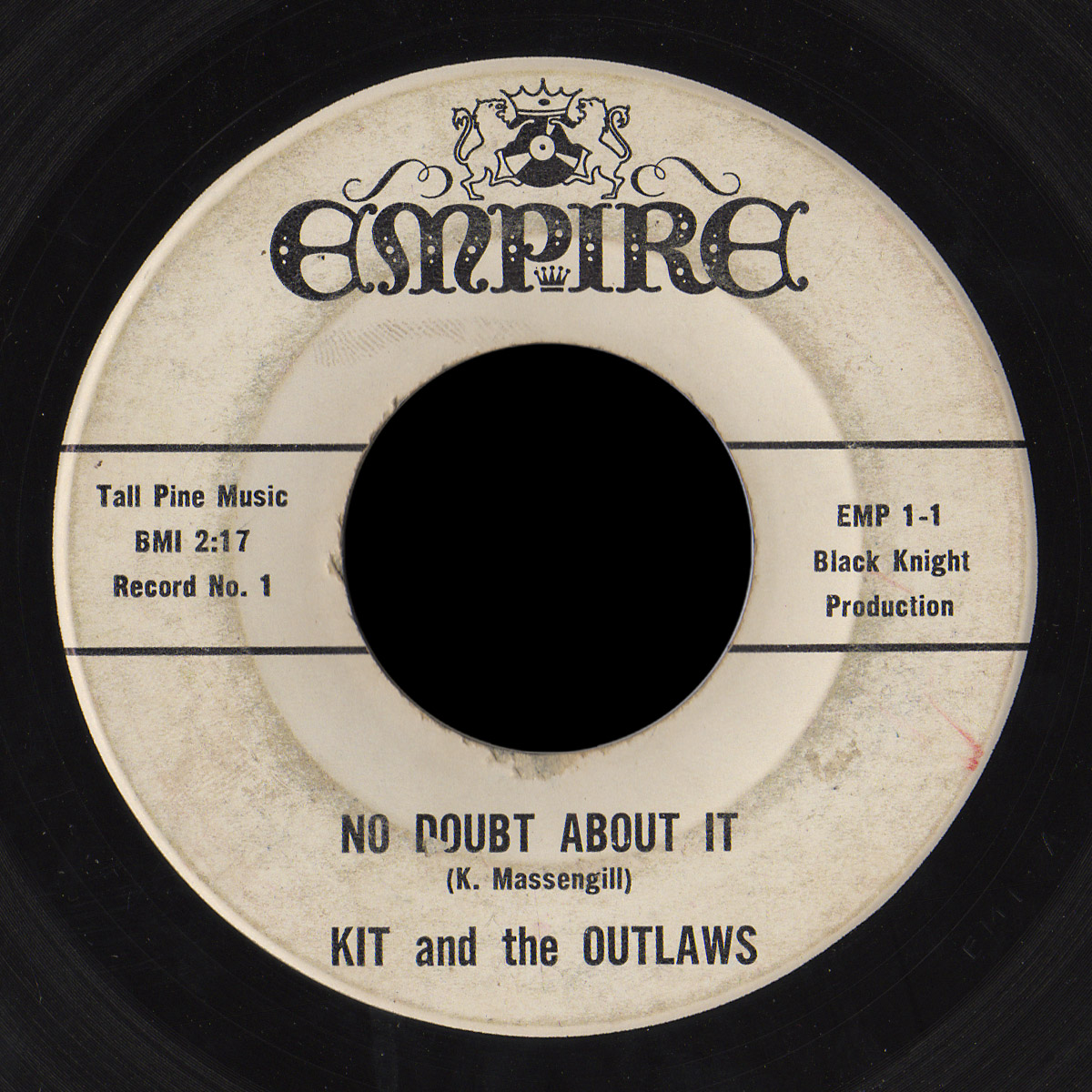
There is also one further 45 as Kit and the Outlaws, “Now Doubt About It” / “Mama’s Gone” on the Empire label, another of Bob Sanders’ labels. Both sides written by Kit Massengill and published by Tall Pine Music, Black Knight Production. I don’t know the date of this one, or where it fits in to the chronology of their releases, but it seems to be a rare 45.
I recently heard from keyboardist and occasional vocalist Jerry Colwell, and asked him about Kit and recording “Don’t Tread on Me”:
I met Kit in late ’65, he was working with the owner of the Cotton Club, a topless bar on Lemmon Ave. He had a bass player named Alan Rafkin [actually Alan Ravkind], and drummer named Joe Jesmer [Joe Jessmer seems to be correct spelling], but needed a keyboard player and lead guitar. I was on my way out of a band called the Gobyzurks, we were a college and night club band in North Texas.
Dennis Lowe was the lead guitar and I was the organ player. Dennis and I went to high school together and were fairly good friends. Kit told us we had 2 weeks to learn about 50 songs and play nightly at this club.
Recording Midnight Hour at Sellers Recording Studio, Dallas
After about a year of playing night clubs in Dallas we recorded the record Midnight Hour/ Don’t Tread on Me. The Sellers Studio was close to downtown [2102 Jackson Street]. I sang on the song Don’t Tread on Me, as background.We had it pressed on the Black Knight Label. Frank Jolly at KBOX really liked us and would play the song every night, Finally all the DJ’s at KBOX started playing the song and it went up the charts. [It reached #1 on KBOX on December 2, 1966.] We were shocked that it was doing so good. KLIF wouldn’t play it cause we wern’t with a major record label.
Thanks to Bob Sanders, the recording engineer for the Sellers studio and our manager, we got signed to a 5 year contract with Philips. And changed our name to Kit and the Outlaws.
We played at a daily televised venue called “Something Else” [Sump’N Else] hosted by Ron Chapman, as well as opening for Sonny & Cher, The Hollies, Herman Hermitts, Noel Harrison, and The Byrds. We toured and had some great stories, like me and Kit putting a huge dead fish in the Galvez hotel swimming pool one night at three in the morning. Had pictures of Graham Nash and the Hollies drinking about 14 cases of beer before they went on at Will Rodgers in Fort Worth.By 1968 was almost 20 and still hadn’t completed high school, somehow lost interest due to work and touring. Can you imagine going to high school and having a #1 record. Needless to say I dated just about anyone, and I did!
Early days:
Started playing bass guitar and got with some older guys called the Centurys in Mesquite. Later [1964] formed my first band “The Malibus” with Don Doss, Gary Stultz, & Glen Milsap. Started playing in old bars down on Grand and Haskel Ave. These places had dirt floors, we used to put a hat down and play Jimmy Reed stuff. Thats how I learned blues harp.
Johnny Green of the GreenmenJohnny Green of the GreenmenThe Drifters ?
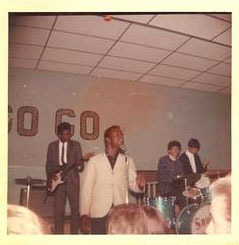
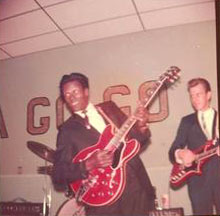
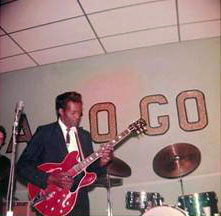
The Kavemen backing Chuck Berry at Surfers a Go goThe Kavemen backing Chuck Berry at Surfers a Go go
Later joined the #1 Dallas band The Cavemen and played battle of the bands against Jimmy Vaughan and his band, and the Royals and others. In 1965 the Cavemen was the home band for a Night club “Surfers A Go Go” in Dallas, where we played with Chuck Berry, Roy Head, The original Drifters, Jimmy Velvet and Johnny Green and the Greenmen. We played at clubs all over Texas, my favorites were the “Bamboo Hut” in Galveston, and “Panther Hall” in Fort Worth, a televised event every week. We were also played at Louanns many times.
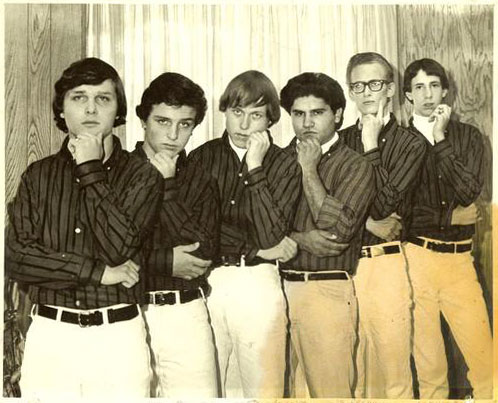
The Kavemen, Dallas 1965 from left to right: Roland Allen, Jimmy Allen, Rodney Vinyard, Tommy Fonseca, Bill Walden & Jerry Colwell
In 1965 my favorite club was the Purple Orchard in downtown were my buddy Little Anthony was the host. I could go in just about any night club in Dallas and get a drink for free when I was just 16. Had a great time one night with Fats Domino.
The Gobezerks at the Sugar Shack in Mesquite
In 1966 played with “The Gobezurks” a college and night club band, I dressed in drag for some of the songs and would fall off the stage as if I was drunk.The Outlaws broke up in spring of 1968 and I went on to form the Jerry Layne Orchestra with 10 various horns and a stand up bass with Teresa Morrision on vocals.
I still play a B-3 and have recorded and produced 3 live CD’s in Austin.
Special thanks to Jerry Colwell for his history of the band and photos.
Update, February 2021:
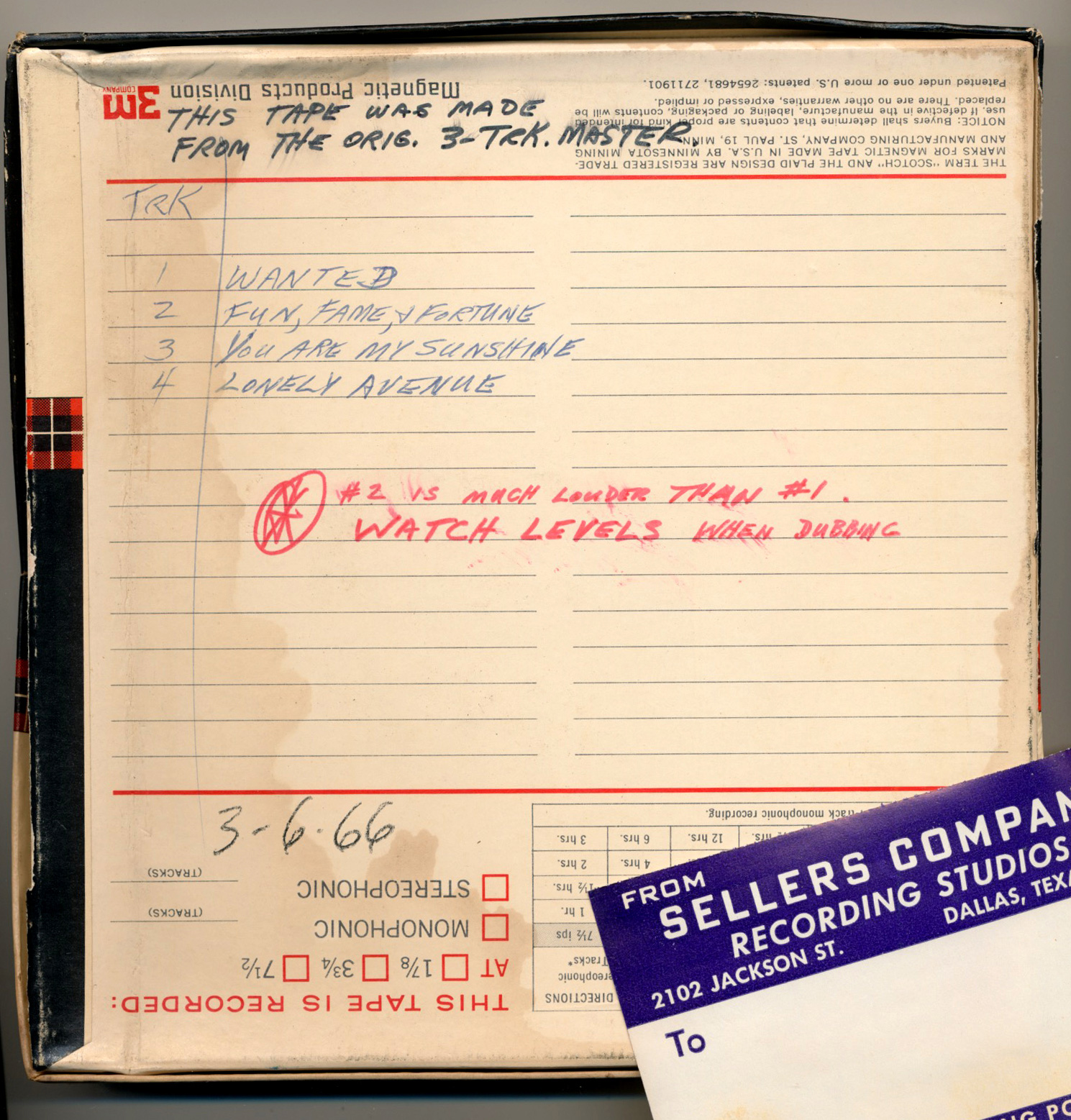
March 1966 demo tape of Kit & the Outlaws from Sellers Recording
George Gimarc sent this image of an early demo tape of Kit & the Outlaws from March, 1966. “Fame, Fun and Fortune” is a different version than the In single. The other three songs are “Wanted”, “You Are My Sunshine” and “Lonely Avenue”. None have been released. The tape was found in the storage of the Sellers Company Recording Studio.
Update, September 2021:
Ron Lansing wrote to me about early days with the Outlaws:
I started playing with Kit when he joined my band Revelee’ in early 1965. We had met when my band was playing Louanns. Kit played with my band at a Mardis Gras party in February of 1966.
He and I both played with other bands from time to time. Band members came and went just like many of my high school buds who I played with at the time. Ultimately I ended up playing lead guitar with Kit when he and I along with Joe Jesmer and Tommy Johnson (I think that is correct last name) formed The Outlaws.
I am not positive, but I think our trip to Odessa with our ‘Outlaw’ band was in April 1966 to record the two songs Kit and Joe Jesmer came up with.
This site is a work in progress on 1960s garage rock bands. All entries can be updated, corrected and expanded. If you have information on a band featured here, please let me know and I will update the site and credit you accordingly.
I am dedicated to making this site a center for research about '60s music scenes. Please consider donating archival materials such as photos, records, news clippings, scrapbooks or other material from the '60s. Please contact me at rchrisbishop@gmail.com if you can loan or donate original materials


 The Spectres formed at Louisiana Tech in Ruston, and then based themselves in Monroe, which is about halfway between Shreveport, LA and Jackson, Mississippi. Band members included Daniel Gilbert on lead guitar, Jim Steele on vocals, Sidney Boone on keyboards and vocals and Woodie Bardin on keyboards.
 “No Good, No Where World” has a neat keyboard riff, and a heavy beat. It’s well produced with a nice pop sensibility, while “High Stepper” is a bit of a throwaway, maybe closer to their live sound. My copy of the record has some serious Katrina/Rita water damage on the labels.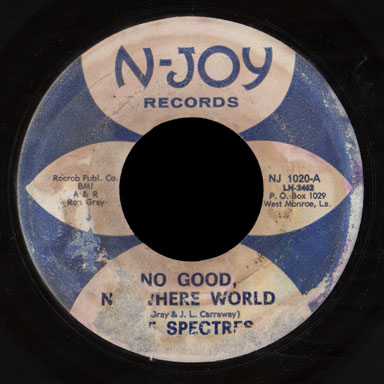

 Updated December, 2009