Category Archives: Label

The Pop’s


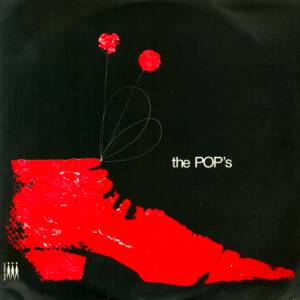
The Pop’s are one of the best and most underrated Brazilian pop-rock groups from the 1960s. Like Renato e Seus Blue Caps, The Sunshines and The Fevers, they are from our fun-in-the-sun postcard land, Rio de Janeiro; but, unlike them, they didn’t rely much on covers of current hits or their own material, being best remembered for their unlikely but very good rock versions of Carnaval evergreens and Christmas, birthday and suchlike songs, as well as having been purveyors of the samba-rock fusions backing the late, great singer-songwriter Oswaldo Nunes or on their own. But their least remembered albums are the ones on which they ventured into their own songwriting.

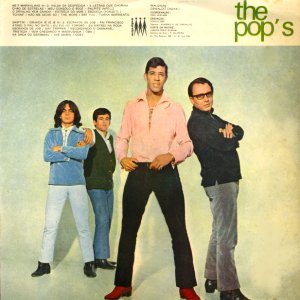
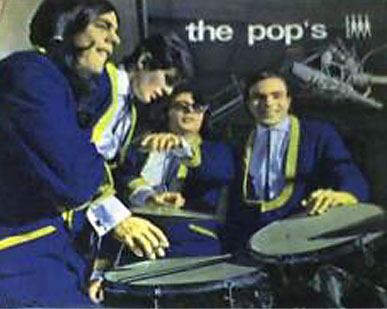
They formed late 1964 with Julio Cesar “J.C.” (lead guitar), Pippo (rhythm guitar) and brothers Silvio Jose Parada (bass) and José Henrique Parada (drums). They did not chose the name The Pop’s inspired by “pop music”, but rather from “popcorn”, when someone commented they were so full of energy they kept jumping around while playing. When the Brazilian ye-ye wave hit full stride in 1965-6, The Pop’s started appearing on TV programs and were immediately contacted by no less than nine record companies simultaneously, and they decided to sign to the first one who called, and it was the medium-sized Equipe (by chance favoured over RCA, CBS and other biggies!)

Around 1968 their line-up started changing; former members started spinoff groups like Parada 5 (led by drummer José Henrique Parada) and Os Populares (led by J. C. and acknowledging The Pop’s meant “pop music” too); the group became somewhat of a revolving door around guitarist Pippo. They deserve a bigger feture than this, but other members of renown include guitarist Euclides (from Os Santos and Luziinho e Seus Dinamites), drummer Zezinho and keyboard player Neguinho. By 1973 even Pippo had left – but in the early 2000s the original line-up os Pippo, J.C. and the Parada brothers reformed – and decent official reissues of their first albums are due late in the year.

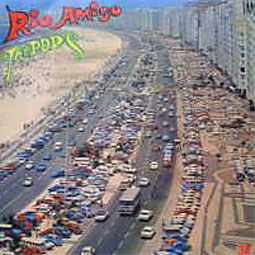
I decided to include here three works from their authoral period plus one samba-rock gem. From a 1968 single we have “Mina Malu” (“Malu The Gal”), written by Pippo and Morais; the song was also included in their Rio Amigo album from 1971, from which we can hear two further tracks, the instrumental “O Apocalipse” (“The Apokalypsis”, by Pippo and Cerdeira; imagine “20000 Light Years From Home” on the Ventures In Space album) and folk-rockish “Só Minha” (“Only Mine”, by Pippo and Deofranci). And “O Que É Isso, Menina?” (literally “What’s That, Girl?”, in the sense of “Come Now, Girl” or “Do Me A Favour, Girl”), the samba-rock number, is a group composition from around 1968.

Ayrton Mugnaini Jr.

www.ayrtonmugnainijr.blogspot.com

Editor’s note, April 2010: I just heard the Pops’ single “Som Imaginario de Jimmi Hendrix”, on Equipe CS-580-B. It’s a cool mix of the James Gang’s “Funk #49” with the Meters’ “Cissy Strut” and some Hendrix type riffs. I don’t know if this was the flip of a well known single or just a promotional-only release. Hear it on Joel Stones’ new compilation Brazilian Guitar Fuzz Bananas.

Jack Bedient and the Chessmen

Jack Bedient was born in Mason City, Washington, by the Coulee Dam. Kevin Woods tells me “Jack was voice trained and was a member of an acappella quartet at Gonzaga University in Spokane, Washington.”
In 1961 he had a small hit with a pop ballad “The Mystic One” on the Los Angeles label Era, while he was living in Wenatchee, WA.

By 1964 he and his band, the Chessmen had a series of standing engagements in the Lake Tahoe and Reno, Nevada region, and they lived in Carson City, Nevada for some of that time. Long-time members were Jack Bedient vocalist and rhythm guitar, Kevin Woods lead guitar, Bill Britt on 6-string bass, and drummer Jewell Hendricks. Jewell would leave the group in the later half of 1965.

Jack Bedient and the Chessmen’s live show catered to the pop sound of the times, featuring covers of current hits, lounge songs and comedy bits, and the band wore tuxedos for some upscale engagements. They released twelve 45s and five LPs during the ’60s, much of which is a reflection of their lounge act or too pop for my taste. Within all this product are some very fine cuts.
That year they cut their second 45, “Pretty One” / “Silver Haired Daddy” for the Trophy label, along with an LP, Two Sides of Jack Bedient, which I haven’t heard.

In 1965 the band recorded five songs at Fantasy Studios in Berkeley. The first single, “See the Little Girl”, is a British-influenced number. Interestingly Fantasy released it twice with the same catalog number, once as by ‘Jack Bedient and the Chessmen’ backed with “Here I Am” and once as simply ‘The Chessmen’ backed with “Looking for a Good Love”.

Kevin Woods wrote to me that this 45 was “intended to be released under the name ‘Jack Bedient and the Chessmen,’ [but] the first copies were printed as ‘The Chessmen.’ A corrected label soon followed. When the performing name was corrected, the B- side song title was also corrected. ‘Here I Am’ and ‘Looking for a Good Love’ are the same song. The correct title is ‘Here I Am’ written by Glen Campbell and Marc Douglas. The lyrics are, ‘If you’re looking for a good love, here I am….’ Easy to see where the confusion exists.”

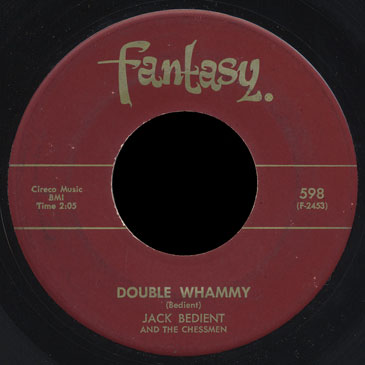
Their next Fantasy single is the fantastic hard-edged rocker “Double Whammy”, backed by “I Want You to Know” (the Fats Domino song, “Don’t you Know”). The guitar riff for “Double Whammy” comes from Dorsey Burnette’s “Bertha Lou” as done by Johnny Faire on the Surf label (or perhaps Clint Miller’s version). “Double Whammy” reached #19 on KCBN 1230 AM Reno in early July, 1965.

Seeking to update their sound they hired Walter Hanna as keyboardist in time to record their Fantasy LP, Live at Harvey’s. I’ve only heard parts of the album, but there are good takes on “Louie Louie”, “Mary Had a Little Lamb” (aka the Searchers “Ain’t That Just Like Me”), “See the Little Girl” and “Double Whammy”, though for this last one I prefer the single version.
October 1965 saw the band’s next 45, “Drummer Boy (Play Us a Song)” / “Dream Boy (Count Your Dreams)” on Tutti Camarata’s Palomar label, then being distributed by London Records. Walt Hanna co-wrote “Drummer Boy” with Jack and Bill.

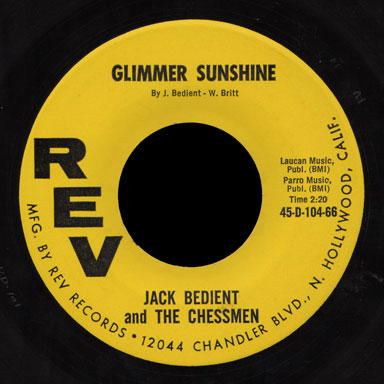
In 1966 they cut their great single, “Glimmer Sunshine” for the obscure Rev Records label. It’s not like anything else the band ever recorded and is now their most sought-after release.

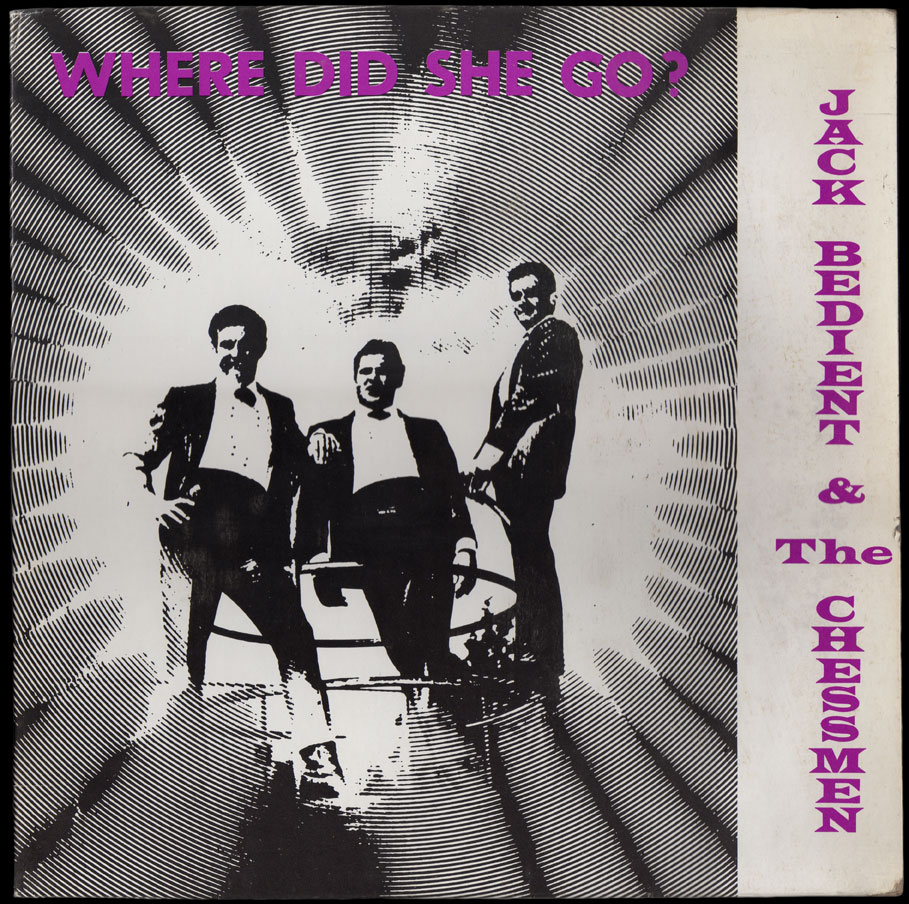
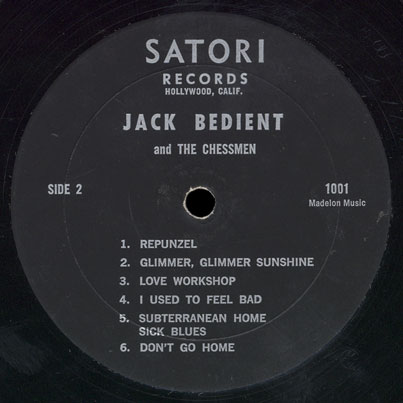
Their 1967 album, Where Did She Go? seems to have been drawn from various recording sessions and shows both sides of the band with one side each of schmaltzy pop and tougher rock material. From the first side I’ve included “Candy Roses and Love” as maybe the best example of the group’s commercial pop. The second side is quite solid, with highlights being “Glimmer Sunshine” (the same version as on the 45) and “I Used to Feel Bad”. The opening guitar on “Subterranean Homesick Blues” is so crude it’s practically hardcore, and “Repunzel” and “Love Work Shop” are also good.

A later LP has typical covers of the day, but a version of “Purple Haze” is supposed to be good. Other members of the Chessmen include Steve Eggleston, and drummer Jerry Bledsoe. Drummer Sam Wisner worked with Jack after the group disbanded in August, 1970. In 1972 bookings became scarce and the band broke up for good. Jack Bedient passed away in 1998.

Walter wrote about his time with the band:

I was the 1st and I think only organist for Jack Bedient and the Chessmen, added just before their first venture into the world of Nevada casino lounge and then headliner room bookings. They had some earlier 45’s out and one album when I joined. I recorded on the later 45’s and wrote a couple of songs that went on ‘B’ sides. We also had an album recorded “Live At Harvey’s” casino at Lake Tahoe. This was in their new “go-go” room, all dance stuff, done by a on-site Sunset Sound recording crew from Los Angeles, released with Fantasy Records pre-Creedence, not to mention Sunset Sound pre-Electra records in Hollywood.

I was “discovered” by the Chessmen playing in a pizza parlor in Redwood City, California on their night off – they had a gig down the road at a classy night club. I played organ and an early Wurlitzer electric piano with friends from 1st year of college. We were the house band for a couple of pitchers of free beer and pizzas plus $15 per man a night playing surf music and whatever else was on the Top-40 radio, Beach Boys, Buffalo Springfield, Ray Charles etc. This was around “spring break” 64-65 when I dropped out of Belmont Community College and split from friends and pizza gig to grab a lucrative job offer and regular gigs with Jack and the Chessmen, $300 a week to start – big money in those days and the end of my former every-day life.

As it turned out, this was the beginning of Jack Bedient and The Chessmen’s first real big-money success, mainly in Nevada, changing gradually from a dance-club band into more of a ‘Vegas show group’ act. As I joined and went to Nevada with them, ‘instant local stardom’ continued for nearly two years.

[Manager] Bob Dee had the Chessmen lined up with good Nevada bookings: the Golden Hotel in Reno, the Silver Nugget nearby in Carson City, and Harvey’s Hotel and Casino just up the hill at Lake Tahoe. We soon were headlining at the Golden Hotel (later to become Harrah’s Club. We started getting airplay on recently recorded 45’s and over about a year had 4 # 1 Top-40 hits. The line at the casino hotel was so long to get in for our shows, the tail of the line was near the start, going around the whole city block. It really was a mind-blower for hicks like us.

In between some Nevada bookings we went to Sacramento to play a couple of weeks at one of the popular local nightclubs, following Question Mark and the Mysterians, with one of our 45’s at # 16 on [Sacramento] radio… [but] the Chessmen’s popularity was not able to break out of the local area.

The drug scene in Nevada consisted of the casino pit bosses making easily available a steady supply of Dexamil Spansules, a great, ‘tiny-time-pill’ combination of the ‘upper’ Dexadrine and ‘downer’ Miltown (Mother’s Little Helper) which kept you wide awake without being ‘wired’ for 12-24 hours. If you weren’t near a ‘cool’ casino, the constant stream of truckers through everywhere always had something ‘speedy’ on hand. A user could stay up for days, gambling, drinking, making out, etc.

Time passed quickly and popularity faded. Following a dreary dinner plus music/entertainment booking at a dead Bakersfield eatery, Bob Dee actually booked us into the Playboy Club (the “Tiger-A-Go-Go” disco?) at the S.F. airport. Part of the show was Jack Bedient backed by the house orchestra – his dream come true.

Jack, with Bob Dee’s urging, was trying to ‘secretly’ slip away and become a single big-name artist, like Roy Orbison, Jimmy Rogers, Andy Williams, etc. Jack’s attitude towards ‘his’ musicians reflected this – we got ‘no respect’, especially drummer Jewell and I, and later Jewell’s replacement. The Chessmen were cut to a trio of Jack with Bill and Kevin – drummer and keyboard as sidemen with a cut in pay!

So, Jewell, the original drummer was relegated to sideman status with a cut in pay, and so was I, just before we did the Live At Harvey’s album. Jewel quit soon after, moved to L.A. Jewell was replaced by Art – can’t recall the last name – and I stayed as a sideman for a while, needing the money, which was still pretty good, and enjoying the life-style. It’s an old story in music ‘show-biz’ – one person in a successful group is willing to dump the others, despite their hard work on the way up. That’s a different situation than being in a dead-end band moving from one subsistence gig to another. And, it’s a different situation from a long-term success combination deciding to call it quits and go their own ways – some then on to personal star status. Jack had the voice, absolutely beautiful – but, lacking strong musicianship, he needed musicians with him that knew his weaknesses and could compensate.

I headed for Los Angeles into a long career of fun garage and original bands, a few ‘almost-made-it’ big rock ‘n’ roll bands, and many better-to-forget traveling club bands, always with Hollywood as home base. Reliable gossip I heard years later said Jack was working as a solo act with his guitar at Harold’s club in Reno hotel in one of their in-house bars.

Jack Bedient and the Chessmen releases:
This is the most complete list of releases for the group out there, and corrects several errors from other sources. Any additional info would be appreciated, especially on his “Executive Productions” releases.

45s

The Mystic One / Question – Era 3050, July 1961
Pretty One / Silver Haired Daddy – Trophy 1001, 1964
See the Little Girl / Here I Am – Fantasy 595, 1965
See the Little Girl / Looking for a Good Love – Fantasy 595, 1965 (released as by “The Chessmen”)
Double Whammy / I Want You To Know – Fantasy 598, 1965
Drummer Boy (Play Us a Song) / Dream Boy (Count Your Dreams) – Palomar 2212, October 1965
Glimmer Sunshine / Where Did She Go – Rev 104/5, 1966
Love Workshop / I Could Have Loved You So Well – Columbia 4-44302 1967
Pretty One / See That Girl – Columbia 4-44481, 1968
The Pleasure of You / It’s Over – Columbia 4-44565, 1968
My Prayer / Independence Day – Columbia 4-44671, 1968
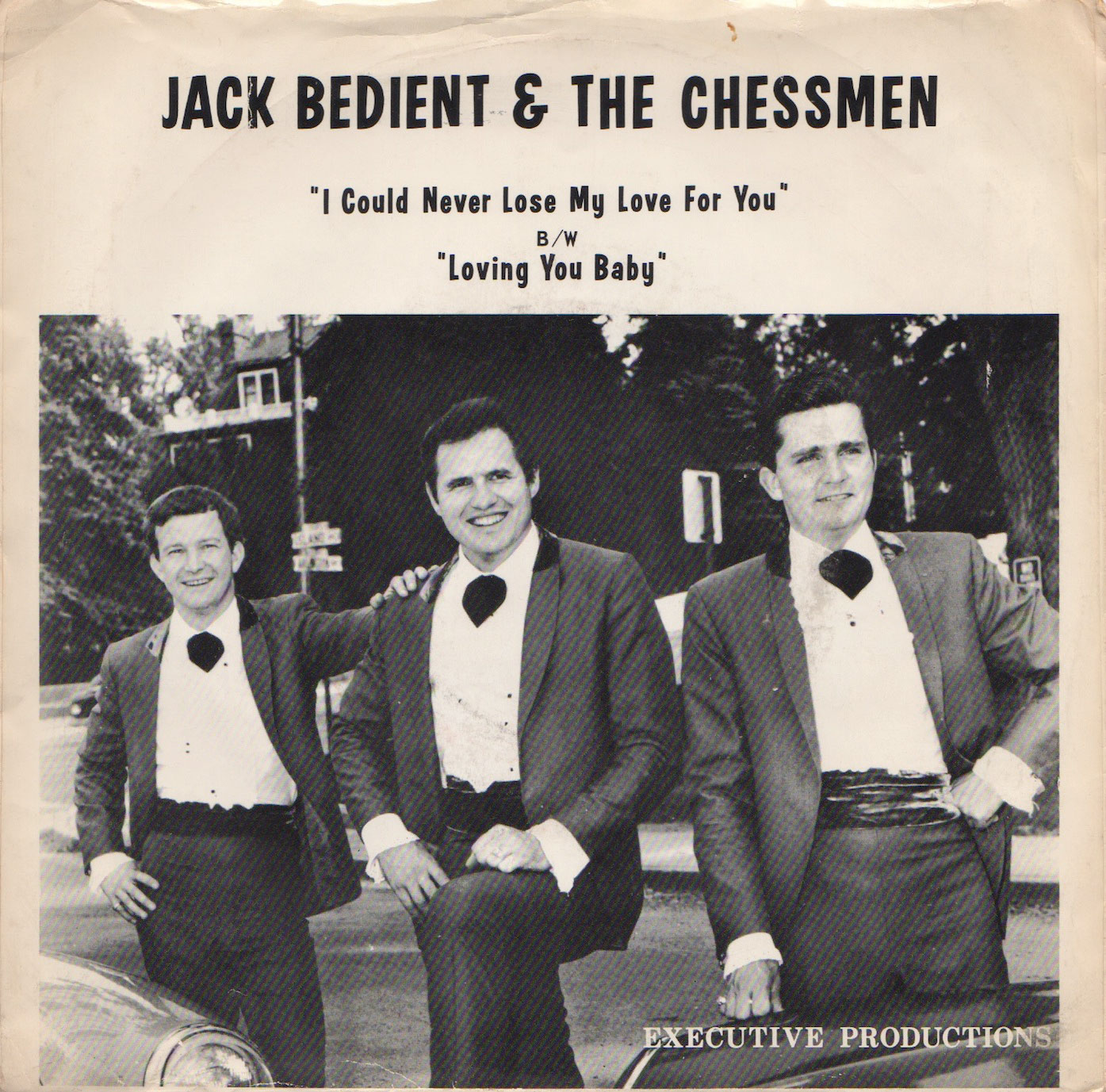
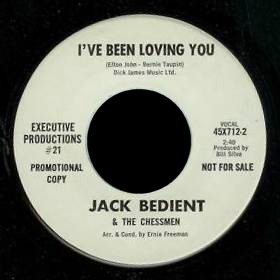
I’ve Been Loving You / I Could Never Lose My Love for You – Executive Productions 21, 1969, with picture sleeve
Beautiful (Takes a Trip) / Release Me – Executive Productions 21

LPs

Two Sides of Jack Bedient – Trophy 101, 1964
Live at Harvey’s – Fantasy 3365, 1965
Where Did She Go – Satori 1001, 1967
Songs You Requested – Chessmen no #, 196?
In Concert (Harolds) – Chessmen no #, 1969
Jack Bedient – Executive Productions, 196? (rumored, but apparently this does NOT exist – if so please send confirmation)

Thank you to Jeffrey Lee for the scan and transfer of “I’ve Been Loving You” and to Fred Hoyt for the scan of the Executive 45 sleeve. Special thanks to Kevin Wood for his help in correcting some of the information in this article.

Sources for this article include: Inland Empire Rock: The Sound of Eastern Washington, and The PNW Bands site.
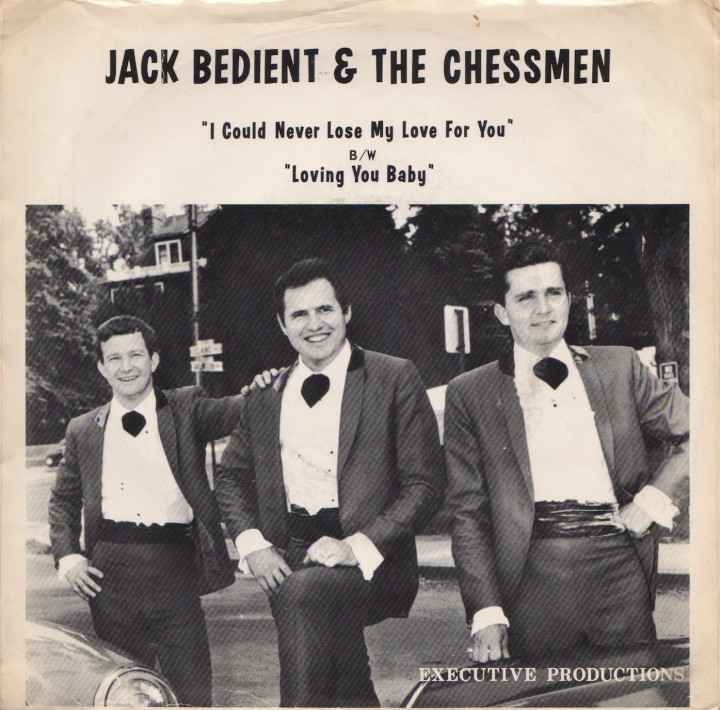
Jack Bedient & the Chessmen, Executive PS "I Could Never Lose My Love for You"

The Marksmen

The Marksmen, April 1966: Lyle McLean (lead guitar), Bob Kerr (vocals), Tony Markham (drums), Danny Coutts (rhythm guitar), Neil Porter (bass) - this is the line-up that plays on "But Why" / "Moonshine ". Photo and caption supplied by Ged Fitzsimmons, courtesy of Neil Porter
The Marksmen, April 1966: Lyle McLean (lead guitar), Bob Kerr (vocals), Tony Markham (drums), Danny Coutts (rhythm guitar), Neil Porter (bass) – this is the line-up that plays on “But Why” / “Moonshine “. Photo and caption supplied by Ged Fitzsimmons, courtesy of Neil Porter

The Marksmen were a surf band from the town of Wollongong near Sydney, not to be confused with the instrumental group from Melbourne called the Marksmen who released singles on the W & G label in the early ’60s.

Original members were Neil Porter bass, Dan Coutts lead guitar, Lyle McLean guitar and Dave Kirkup on drums. Tony Markham replaced Kirkup, and needing a singer for variety in their live shows, they found first Brian Davitt and later Bobby Kerr of the Chevrons.

Marksmen Enterprise 45 MoonshineIn 1966 they released their one self-financed 45 on the Enterprise label. It’s now among the rarest of all Australian garage 45s and truly one of the best. “Moonshine” is pure tough garage, “But Why” more melancholic with its harmonies, driven by the catchy guitar riff.

I heard from vocalist Bob Kerr, who stated:

I picked the name Marksmen although the others will probably dispute this. At the time at practise the guys were playing and learning a Shadows song and I was fiddling with a box of slugs used in a slug gun which happened to be named Marksmen so thus the name.

We did sell a lot of copies of the disc in a couple of local music shops, I think somewhere in the vicinity of 10,000 which was pretty good in those days we were the most popular band in town at that time. The guys got a new singer and changed to the name Imagination. They wanted to go into different types of music and anyway I was married with a young son so I didn’t want to turn professional, couldn’t take the risk with a family. As it was it only lasted about a year and no payments for gigs etc so it all folded.

Most recently I interviewed bassist Neil Porter:

“The Marksmen were a surf band from the town of Wollongong near Sydney…”

Neil Porter: I’m fascinated by this because it is not generally known or recognised, but this is the raw basic truth. Deep in my heart, the only real Marksmen were our original surfing instrumental band. All the bands in those days were instrumental bands and, being part of the British Commonwealth, Aussie bands were seriously influenced by The Shadows. They never quite had their deserved success in the USA, although they were huge in Europe, Africa and other places. We had the best of all worlds out here because we also got all the American stuff such as Ventures, Duane Eddy, and so on. For most bands, a singer was a token add-on, somewhat forced onto the band because “You’ve got to have a singer”. We certainly played most of our gigs without one for the first two years. Some places would not book you unless you had a singer, but the singers were generally underworked while the band played instrumentals for most of the night.

The band was originally called “The Tremors”. We were quite influenced by Johnny and the Hurricanes and, even though we had no sax or organ, we adapted many of their tracks to just 2 guitars, bass and drums. Well, initially just 3 guitars! Dan Coutts was a composer of originals from the word go, and was especially creative with instrumentals. He composed a piece called “Tremor” as well another one called “Earthquake”. Check out the names of many of the Hurricanes tracks and you will see why. We decided to call ourselves “The Tremors” after Dan’s tune. We commenced in late 1961 with Dan, myself and Lyle McLean. We managed to obtain a great drummer in Dave Kirkup early in 1962. We practised like it was going out of style and played a few gigs, mostly freebies – weddings, parties, anything – the usual kick-off gigs for new, young bands.

We had initially knocked the doors of all the guys we knew who remotely seemed as though they might be able to sing, but none were interested, and we were more than happy just to play guitar instrumentals. About half-way through 1962 we were able to get a great singer with a great stage charisma, Brian Davitt, and we worked out the year with him, working every week as the resident band at a local dance. This was pretty good, really, as, when we first started, we could hardly play!

Surfing music started to get heaps of Aussie airplay in 1962, initially with the Beach Boys “Surfin’ Safari” but, more importantly for that era, the Chantays with “Pipeline” followed sometime later with “Wipeout” by the Surfaris. And then the Aussie band the Atlantics came out with “Moonman”, later followed by their international #1 hit with “Bombora”. And we were still stuck in the old scene! Overnight, in one fell swoop we adapted many of our already-pounding repertoire into surf tracks and went for a name change. By this time Brian Davitt had an uncomfortable TV appearance and disappeared on us, so we were left alone as a 4-piece instrumental group.

Q. When did the Tremors change their name to the Marksmen?

The Tremors became the Marksmen in about February 1963. A specific memory-trigger reminds me that the name-change came at the end of summer which, in Australia, finishes in February. The latest would have been March. We didn’t work much through the year as Lyle was finishing his last year at school. When school and Uni exams were over in October/November we were raring to go and we did, all though the summer of ’63-”64 – as the Marksmen, a 4-piece surfing instrumental band. And we were likely the first band in Wollongong to sing Beatles songs live, getting on the bandwagon very early. We had always given Brian Davitt vocal backing and harmonies right from the start, and loved the Beatles, as everyone did. So, even without another singer, we sang ourselves. Initially, this was Dan, Dave and myself, although Lyle took a much larger vocal role very soon after.

Nevertheless, in spite of the ‘groups’ scene that emerged from England and swamped the world, the culture still demanded that, “You’ve got to have a singer” so we advertised for one and got Bob. The earliest this could have been would have been February 1964, but it may have even been as late as March or April. Prior to that Bob had been the lead singer of the Chevrons, mates of ours, and we had not been aware that he had left them. This, then, is more than a year after the Marksmen were named.

Dan Coutts was the original lead guitarist until Lyle hit full throttle, then rhythm guitarist, prolific composer, and great singer. Dan and I did most of the vocal harmonies no matter who else was singing lead, as well as taking the lead on many songs as well. Dan and I spent many 100s of hours together practising harmonies and often did duets together, such as those sung by John Lennon and Paul McCartney, especially those songs from several of their earlier albums.

Lyle was lead guitar and, although he doesn’t really know it or understand it, he became a legend in his own time, even to local young ’80s guitarists who never even met him or heard him play.

Lyle’s best friend, Frank Jones, was, on two different occasions, going to be our sax player, but it didn’t eventuate. Nevertheless, he still hung around from to time and, yes, he was at the meeting we held to find a new band name, probably January or February of 1963. It was Frank who was fiddling with a box of Marksmen slugs and suggested the name. I hated it from the start, but Lyle, and I suspect he felt a bit guilty about being in the band while his best mate wasn’t, strongly supported Frank’s name choice and eventually persuaded us to go with it. But not Bob, who didn’t come into the band until over a year later!

Q. Your 45 on Enterprise was self-financed?

This is certainly true. They call them indie releases nowadays, but we didn’t call them anything back then!

Q. The 45 seems to have been popular, but it is very rare now.

Just last Saturday, someone was advertising in a our major Sydney newspaper for a copy of “But Why/Moonshine”. Well, I never!

Q. How many copies were pressed, and how were they distributed – at shows or in shops?

We had no proper distribution and had only 500 copies produced, which we paid for entirely ourselves. Our manager of that time, Larry Lawrence, was completely in charge of this, so I know little of the details. We did a big mailout to all the major radio stations in every state, and this took up a significant number of the copies.

As far as I know they did sell as many as we put into their stores but in spite of our local popularity, we didn’t even chart in our own home town.

Q. So You didn’t sell 10,000 copies?

If we had sold 10,000 copies of “But Why/Moonshine” in the mid-’60s, we would have had, because of the very small population of Australia, quite a huge national hit. This certainly did not happen. In those days, 10,000 sales would have made us local heroes.

Q. It’s truly one of the best…

It is most humbling to find out this also appears to be quite true, as far as ’60s garage fans are concerned. Thanks for the compliment.

Believe it or not, 4ZZZ in Brisbane, Queensland played “Moonshine’ just last week. Apparently they have a regular ’60s nostalgia session. My older married daughter, who lives in Brisbane, heard it while driving home from work, and rang me straight away. “That was my Dad!” she went and told everyone she could! I have no idea what happened to any leftovers, so we must presume they no longer exist. I must confess that I have been astonished at this very belated interest in the record, even as far away as the USA and Denmark, let alone other states in Australia. It’s all a mystery to me! Makes me think that I didn’t entirely waste my youth after all!

Q. Did you write any other original material besides “But Why”?

I always did, as did Dan Coutts. Lyle wrote several songs as well. Bob wrote a few. There were a number of problems. The whole Australian music scene was geared to making money out of cloning USA hits and some British ones. There was always the odd group or singer who broke the mold and recorded original material but, in those days, it was hard to do that. We always included originals in our live sets but we mainly played top-40 covers as did everyone else. Probably our major problem was that ‘they’ were ‘there’ and we were ‘here’. ‘There’ was Sydney or Melbourne and ‘they’ were the bands that lived there and were not always any better than we were, and often not as good. “Here’ was Wollongong, miles away from the big smoke where ‘it’ was always happening, somewhat isolated, and always a little bit behind where ‘it’ was really at. ‘They’ got recording contracts, while we, being ‘here’, had little to no such opportunities. Not entirely though. We had already started to work in Sydney prior to the release of “But Why” and worked there many times afterwards over the next few years. Many fans used to say that there were only two decent bands, The Marksmen from Wollongong and “The — ——-” (insert favourite band name) from Sydney, so it wasn’t all bad, as far as distance and opportunity went.

“But Why” was composed completely by me, although I recall Lyle wanting to change a couple of chords in the middle section. Even though it seems at odds with my love of harmony groups, I really used to love the early ’60s British r’n’b groups such as Animals, Yardbirds, early Kinks and similar. I used to spend hours trying to compose songs in that genre, but I couldn’t play them that well (being ‘only’ the bass player!) and I couldn’t present them as well as I would have liked, not being the ‘real’ lead singer! Thus, I was regularly ignored by the rest of the band. In retrospect, I have wondered how on earth they picked up on “But Why”. The answer is the riff, a genuine Neil Porter original creation! Ha, ha! “But Why”, then, was composed as my attempt at British ’60s r’n’b. I actually think it’s too ‘nice’ to succeed, but others can judge that. Also, in retrospect, I realise that “But Why” has quite a unique structure, with no real verse/chorus/middle patterns and no rhyming lines. Well, I never – how inventive! Ha, ha! I didn’t deliberately do that and certainly didn’t know it at the time.

Q. Terry Stacey writes that you had recorded with Ossie as early as 1964 – what kind of material was that, and do the recordings still exist?

Mainly top-40 covers, but with one original by Dan Coutts, Bob singing lead. I have the only surviving tape at this time, and I am working on digitally remastering it on my computer home-studio. There are also some other lounge-room tapes that scrub up reasonably well. At this time I am working on a fairly large and somewhat long-term recording project and I can’t get back to the Marksmen tapes. I want to soon, though.

These were done in the local Tarrawanna backyard studio of Ossie Byrnes. He recorded most of the local bands of that time. He eventually relocated to Sydney, which is where we recorded “But Why/Moonshine” with him engineering. We effectively had no producer, and just played and sung what we had learned at practices beforehand. Ossie went on to become quite famous as engineering and co-producing the Bee Gees early big hits, notably “Spicks and Specks”, “New York Mining Disaster” and “Massachusetts”.

Q. As for Bobby saying that gigs were unpaid?

Not entirely true. As typical full-time starving musos, Imagination actually got paid very well, and certainly much more than several of the other F/T bands of the time. We did, as you might expect, have our share of rip-offs where we didn’t get paid.

Q. Considering your popularity and original material, why do you think the Marksmen didn’t receive a major label contract [until the formation of Imagination in 1968]?

From 1966 on, there was a major national band competition called The Hoadleys Battle of the Sounds. Some big international acts came out of this, although, to my knowledge, none of then became household names. There were always the city/metropolitan winners and the rest-of-the-state winners (called country finalists, but not to be confused with country music). In 1968, with Bob still as lead singer, we won the NSW country finals singing 3 original songs, 2 of which were written by Dan Coutts even though he had left the band earlier that year due to ill health. Lyle wrote the third. On paper, then, we became one of Australia’s top 12 bands of 1968. The reality, of course, was that many great bands didn’t even bother to enter!

Nevertheless, it was a very exciting and life-changing experience, after which we knew we had to throw in our day jobs and go full-time in music. A number of things quickly became clear. As Bob said, he was married with a son. (Little did I know that I was very soon after to follow suit – in the middle of being F/T!). Also, it had taken us many years to deprogram and detoxify Bob from his Cliff Richard and Elvis addictions and bring him into the new era. He couldn’t properly sing either soul or underground, the two big USA movements of the mid and late ’60s, just prior to the invention of the term ‘heavy’ (excluding political/protest songs, or course, which didn’t go over especially well for our type of band and clientele, so we mainly ignored that genre). So it became time to swap Bob for Alex Stefanovic. This occurred in the vicinity of August 1968. Co-incidentally we had just then acquired a new Sydney-based manager/agent and had commenced working in Sydney several nights a week, as well as Wollongong, and as well as still having full-time ‘real’ jobs.

The next thing was a name change, yes, into Imagination. This was chosen because of the hippy, druggy, fantasy, mystical ‘thing’ that was around at that time. Imagination recorded with Alberts music on the Parlophone label, the same label that released Beatles songs in Australia. Alberts also released the Easybeats and Billy Thorpe and the Aztecs, so we felt pretty cool about being signed by them – clearly a major Australian label. We were then compelled to do clones of songs we hated – it’s all about the money! They did, however, allow us to put originals on the b-sides.

Although all the band members names were listed as composers, both songs came about in the same manner. Sitting around idly at practice and trying to be creative, Alex came up with the first line or two, but got stuck right there. I then finished either all or most of the rest of the lyrics. I did this often with Dan, too. i.e. not having a theme to suit myself but expanding on a seed coming from someone else. Lyle’s contribution was mostly with chord patterns and the lead guitar riffs.

Although there were several reasons why Imagination split, a major one for me was that, after getting married directly before going full-time, we had a son in September 1969 and I could not continue to put dreams before hard reality. So, goodbye band, hello family and day job.

[After Imagination] I played in a local band all through the ’70s. I adapted to lead guitar and lead vocal, playing in a trio with keyboards, drums, and myself also doubling on bass. We all sang lead and harmony. Bob even sat in on a couple of songs when we played at his office party one time.

I then went into Christian music via my local church. During this period I always kept my hand in with fill-in spots in the usual secular bands who wanted a bass player or guitarist. In the mid-’80s I also played in a top-40 covers band with guys all 20 years younger than me! At their invitation! Very flattering! In the late ’80s and into the ’90s I went back to playing in the more clubby type bands, and eventually then back to just fill-ins.

In the Christian music scene I lost count of the number of albums I assisted in on bass, lead and rhythm guitar, harmonies and co-production, as well as some engineering. I also wrote numerous songs in that genre, some of which went around the world, but in a somewhat private manner, Christian music hardly being mainstream.

I have always played some of what is new in each decade and have not stuck with, as John Lennon once said, the music of those high school years. As recently as 3 years ago, my daughter, then 19, pulled me out of band music retirement to form yet another wedding-parties-anything band. We used MIDI backing, mostly created by myself, with myself on live lead guitar and my wife, daughter and son all singing. We all sang lead and any harmony. Mainly due to the Beach Boys, the Beatles, and many ’50s vocal groups, I have always loved harmonies more than anything else, and it was a great blessing to have a family who all could sing harmony with minimal effort – they were all gifted! As for me (and Dan, back then) I had to work hard to get them right.

Thank you to Neil Porter for his detailed history of the band in response to my questions.

Terry Stacey had a good site on the band with a long history and many photos, but that seems to be defunct now. Ged Fitzsimmons is compiling a comprehensive look at the Wollongong music scene of the ’60s, hopefully seeing publication soon.

The Bedforde Set

The Bedforde Set fan club card, Bill Singer, Steve Schein, Norman Bull, and Louis Miller.
The Bedforde Set, from the top: Bill Singer, Steve Schein, Norman Bull, and Louis Miller.

Bedforde Set RCA Victor 45 Girl Go Run AwayThe Bedforde Set formed in Silver Spring and Rockville, Maryland, with members William Singer lead guitar, Lewis Miller organ, Norman Bull bass and Steve Schein drums.

I heard from a fan who told me they started out as the Jaguars. They also took 2nd place at the Cap Center in a national battle-of-the-bands.

“The World Through a Tear” was a cover of a Neil Sedaka song. The Jan. 21, 1967 issue of Billboard predicted the single would reach the Billboard Hot 100, but I haven’t seen any record of it in the charts. “Girl, Go Run Away” is a fine original by the band and has appeared on several ’60s garage compilations over the years. Production by Joe René.

I’ve heard of an earlier 45 by Ronnie Dean and the Bedforde Set, “Oh Don’t You Know” / “Little Girl”, but wasn’t sure if it was the same group until Bill Singer wrote to me with some information on the group and the photo at top:

We did back up Ronnie Dean and recorded some songs with him.

The way we got signed was that our manager Hirsch Dela Viez, set up an audition at a dance we were playing. RCA sent down a scout, and was impressed that we sounded good vocally live. When asked if we had original material, of course we said yes. So we went to RCA in NY and did a demo. Turned out great so we eventually recorded 6-8 songs. “The World Through a Tear” was not one of them. We came back to DC and got a call to go work with Joe Rene on a Neal Sedaka remake, “The World Through a Tear”. Went back to NY and cut the record.

It was a toss up between “Girl Go Runaway” or “The World Through a Tear” as to the first release. The publishing company that owned the rights put up 25,000 for promotion. So “The World Through a Tear” was released, backed by “Girl Go Runaway”.

Got a lot of airplay in major cities. I heard it sold around 100,000. Joe Rene wrote “Tossing and Turning”. I have some pix of the RCA sessions.

We were asked to tour to support the record, and RCA fronted the money. But, Steve and Louis had just started college, I was teaching and we had to make a decision whether or not we wanted to give up guaranteed work. Well, common sense won out. We were making a fortune playing one-nighters in the area, and were booked a year in advance. We could do four part harmonies and covers of just about everything. So, our recording days came to an end. The band disbanded in 69-70.

I went on to work for ARP instruments. Helped develop the Avatar guitar synthesizer, and became their guitar product specialist. Got to travel all over the world and retired from the music business in 1985. Bought some land in WV and built two log homes, which is the quintessential hippy dream. For the past 19 years I have worked with children with autism and have a studio that keeps me busy.

The Mor-Loks

The first Mor-Loks at the Yankee Clipper Hotel, from left: Mike Wall, Johnny Hartigan, Don Henry, Sammy Hall and Ron Armstrong

Mor-Loks, vocal Sam Hall, Loks 45 There Goes LifeFt. Lauderdale’s Mor-Loks had two distinct lineups, each of which recorded a 45.

The original group changed their name from the Impressions V to the Mor-Loks, and consisted of Sammy Hall vocals, Johnny Hartigan lead guitar, Don Henry rhythm guitar, Ron Armstrong bass and Mike Wall on drums.

Mor-Loks Living Legend 45 There Goes LifeTheir 1965 release combines one delicate song, “There Goes Life”, with the upbeat “Elaine”. This was originally released on the Loks label. When Gary Stites became the band’s manager, he re-released the record on his own Living Legend label (not to be confused with the Living Legend run by Kim Fowley).

Sammy Hall left to join the Birdwatchers, and the rhythm section of Armstrong and Wall reformed the band with Bill “Nappy” Lynn on lead vocals, Billy Burke keyboards, and Craig Held on lead guitar. This lineup landed a contract with Decca in February 1966, only to have the draft break them up in September. Their only record is the raver “What My Baby Wants” (written by Bill Lynn and Craig Held) and the equally fine “Lookin’ For a New Day” (by Armstrong and Held), released in April of ’66.

The second version of the Mor-Loks, outside the MCA building in New York, 1966.

I recently asked bass player Ron Armstrong about the band and he sent me two photos:

The first one is of the original line up that included Mike Wall drums, Sammy Hall vocals, Johnny Hartigan lead guitar, Don Henry rhythm guitar and myself on bass. The picture was taken at the Yankee Clipper Hotel on Ft. Lauderdale Beach where we performed for a New York Yankees family function. Ft. Lauderdale was the spring training grounds for the Yankees and the Yankee Clipper was always their host hotel.

With regards to the breakup of the original group, it was a combo of things. One, I was facing extreme pressure from the draft board and 2, the Birdwatchers, Gary Stites and WQAM were actively courting Sammy.

As it turned out, I was granted a temporary deferral from the draft but only learned of it after I had informed the Mor-Loks that I would be leaving the group. With plenty of bookings to play and a good following of fans and an extension of time I sought to put together another group quickly. I added Craig Held on guitar first, followed by Bill Lynn and learned of Billy Burke through my dad who worked with Billy’s dad.

Mor-Loks Decca 45 What My Baby WantsThe second pic is of the revised line up of Mor-Loks with new additions Bill Lynn vocals, Craig Held lead guitar and Billy Burke keyboards. Mike and I were the only holdovers from the original group. The picture was taken right before we entered the MCA building in New York to sign our contact with Decca Records.

I am happy to report that I have located all living members of the Mor-Loks, both the original members and the revised line up. Billy Burke and Johnny Hartigan as you already know are deceased. After years of off and on searching this week I located vocalist Bill “Nappy” Lynn, in Georgia, Craig Held lead guitar in Florida, and the drummer from both lineups of Mor-Loks, Mike Wall, also in Florida.

Sources: Jeff Lemlich’s history of Florida bands Savage Lost, and my interview with Ron Armstrong.

Mor-Loks article

The Zephyrs

Both sides of the Zephyrs 45 on Colonial are very sedate ballads.

“Take Her Back” has a loner garage feel to it, though I find the backing vocals intrusive. “The Price of Love” is a folky duet, and if it’s awkward as music, the downbeat vibe is somehow endearing.

Don’t know a thing about the Zephyrs other than the Berkeley Springs, West Virginia location and the songwriting credits – R. Fulton and J. Newbraugh for both songs.

Keith Allison “Louise” and “Freeborn Man”

Though born in Texas, Keith Allison made his mark in Los Angeles. A resemblance to Paul McCartney helped him land a starring role on the national show Where the Action Is.

He became close friends with Mark Lindsay of Paul Revere and the Raiders and Mike Nesmith of the Monkees, and soon he was playing sessions for both groups on guitar and keyboards.

His album In Action features “Louise”, a fantastic Gary Usher production and the single hit the charts in March of ’67. Louise was written by Jesse Lee Kincaid (real name Nick Gerlach), who was a member of the Rising Sons with Gary Marker, Kevin Kelley, Taj Mahal and Ry Cooder.

The flip, “Freeborn Man”, written by Allison with Mark Lindsay has become a country standard. Keith joined the Raiders in late 1968, then went into acting.

The Ravin’ Blue

Ravin' Blue Monument 45 It's Not RealThe Ravin’ Blue recorded two 45s in Nashville for producer Jack Clement and the Monument label.

Lead guitarist Bob Bernard wrote their best side, “It’s Not Real” and co-wrote “Love” with band members Art Christopher and Larry Nix. Art Christopher Jr. wrote the top side of their second record, the more pop-flavored “Colors” which was backed with “In My Sorrow”.

Ravin' Blue Monument 45 ColorsNeither record seems to have done very well, though their first received a release in Germany, France and Italy, and “Colors” also had a German release with a rare picture sleeve of the band.

I hadn’t been able to find out much about the group until I heard from Charlie Davis, drummer of the Cavaliers of Mississippi, who wrote to me:

I played drums on the session with The Ravin’ Blue, “Love” and “It’s Not Real”. They were all attending Mississippi State University in Starkville, MS and were called The Knights from Starkville. We also had Jo Frank and the Knights from Leland, MS: “Can’t Find a Way”.

Photo of the Ravin’ Blue that was used on a German release of “Colors”. Can anyone ID who was who in this photo?
The Viet Nam war was raging about this time and The Knights drummer was drafted. We [the Cavaliers] were playing a gig which [Knights bassist] Jimmy Johnson had heard about and was looking for talent (for the manager of The Gentrys out of Memphis). He phoned me afterwards and asked if I would do the session. I had just completed my sophomore year of high school. We laid down the instrumental tracks at a studio in Memphis, TN named Sonic Studios owned by Roland Janes, where Travis Womack cut the instrumental “Scratchy”. And yes it was produced by Jack Clement from Nashville. They also changed their name to The Ravin’ Blue.

The vocals were added at Sun/Phillips studio the following Monday but I had returned to school. So, later on Jimmy Johnson mailed me one copy which I lost and never heard the songs again until I made contact through a friend that knew Bob Bernard about six years ago.

That was the only session or time that I was hired but Jimmy Johnson did phone me a few months later to join the group and to be on the TV show Hullabaloo but I was already in a rock ‘n’ roll group and still in high school. I don’t know if they were ever on that TV show.

In 2022 the nephew of Ronald Baldwin sent the photos of the Ravin’ Blue, below. Ronnie Baldwin was originally from Houston, but he had been attending Mississippi State University and lived in Tennessee until 1970. It seems likely this is a later version of the group, but I need confirmation of that. If anyone can ID the other musicians in this photo, please contact me.

Is this the same band who recorded on Monument? Ronnie Baldwin on guitar, second from left. Can anyone ID the other musicians?

Peavey promotional photo for the Ravin’ Blue. Ronnie Baldwin on guitar.

Ravin' Blue sleeve for '60s French release
sleeve for ’60s French release

Ravin' Blue Italian Monument PS It's Not Real
sleeve for ’60s Italian release
Rare German sleeve for "Colors" that shows the only photo of the band I've ever seen. Does anyone have this sleeve or the photo in better quality?
Rare German sleeve for “Colors”

The Blue Chords “So Far Away” / “The Mini Movement” on Reverb Records

The Blue Chords
The Blue Chords circa 1960-61 at a TV studio in Bluefield, W. VA.
From left; Steve Epperly (drums), David Epperly (keyboard /tenor sax), John Laughter (tenor & bari sax), Bluefield College student Alfred Thompson (tenor sax) and Roger Bailey (guitar).
John Laughter writes, “Arnold Smith played bass but was unable to make it in time for the photo. He presently performs with The Emeralds.”

The Blue Chords released only one record, “So Far Away”, a very well-played and recorded ballad b/w this cool bit of soul-garage with horns “The Mini Movement. The Reverb Records label of Roanoke released the single as 6745M01, with no writer credit on “So Far Away”.

Steve Epperly wrote “The Mini Movement”, which runs all of 1:28! Since first posting about the band, Steve Epperly wrote to me:

The Blue Chords were from the Bluefield, VA area, and played from 1958 to 1978.

The Blue Chords were especially known in the Virginia Beach-Norfolk area where they played in The Top Hat and other club venues from 1959-1962. The Blue Chords opened for many nationally known artists including but not limited to The Del Vikings, The Gladiolas (later known as Maurice Williams and the Zodiacs), Jerry Lee Lewis, Fats Domino, Ricky Nelson, Art Neville, The Delfonics, Percy Sledge, Bill Deal and the Rhondells, and The Okaysions.

The Blue Chords recorded “So Far Away” and “The Mini Movement” in May, 1967 in the basement recording studio of James E. Parcell who owned Associated Recording Service in Roanoke, VA. The musicians were Arnold Smith who played bass and provided lead vocal on “So Far Away”; Larry Frost and Ron Sagady on horns: Jack McCormick – guitarist; David Epperly – organist, vibes, and saxophone; and Steve Epperly – drums and lead vocalist on “The Mini Movement”. The Blue Chords made other recordings in that studio, but “So Far Away” and “The Mini Movement” were the only ones ever pressed.

The Blue Chords - Steve Epperly, John Laughter, David Epperly, Alford Thompson, Roger Bailey. Missing from photo, Arnold Smith
The Blue Chords, left to right; Steve Epperly (drums but holding a bass), John Laughter (bari sax),
David Epperly (tenor sax), Alford Thompson (tenor sax), Roger Bailey (guitar).
Missing from photo, the late Arnold Smith (electric bass)

John Laughter sent in the great photos of the band seen here. His comment about Blue Chords around 1960 is worth repeating here in the main article:

I was fortunate to have played sax with the “Fabulous Blue Chords” for about two years before moving to Florida. I recall 1959-1960 or maybe it was 1960-1961. We played in various dance halls and frat houses in and around the Bluefield, West Virginia and Virginia area.

But the real good times were spent during the summer months at Virginia Beach in the Top Hat Club. The club had two stages and two bands six nights a week so when we kicked into our break song the other band picked it up to keep the music going. On an hour, off an hour.

The door next to our stage opened onto the boardwalk where a lot of the underage college kids would stand or dance. When the club was packed some of the patrons would dance on the table tops after consuming the 3.2 beer. And those summer night were HOT! We would sweat and play the new hits of the day.

I remember a drummer with one of the guest bands, “T & T” Braggs. What he could do with only a bass, snare, hi-hat and ride cymbal was fantastic! Another band was from Philly. They also brought down the house.

We would visit the local music store on Saturday and pick up the latest 45 rpm’s to learn on Sunday. Then to the Neptune restaurant at the corner for First Street and Atlantic Blvd. for a seafood dinner in the 56 two tone green Ford station wagon with the band’s name on the side.

One of the apartments that we lived in was on the south end of town next to an all night doughnut/coffee house. I would go down and listen to the jukebox until the hours of the morning. And as with several of the other members, we are still rockin’ to this day!

Update 2015: James Shott of the Sinsations writes that Arnold Smith and David Epperly have passed away.

The Top Hat Nightclub, Virginia Beach
Top Hat interior

Top Hat photos taken from the Bill Deal website, now defunct.

The Blue Chords, from left: Arnold Smith, Smokey Shott (?), Steve Epperly, Larry Frost and Jack McCormick

Update, January 2026 with three more photos:

My name is Jack McCormick and I go back a ways with the Blue Chords Band. I was the guitar player with the Blue Chords on the Reverb recording we made in a basement recording studio in Roanoke Va. on May 2, 1967. A-side “So Far Away” featuring ARNOLD SMITH vocal AND B-side, “Mini Movement” featuring STEVE EPPERLY vocal. The musicians on this recording are as follows: RON SAGADY (the best I ever knew) tenor sax, LARRY FROST tenor sax, STEVE EPPERLY drums, ARNOLD SMITH (deceased) world class singer and bass player, DAVID EPPERLY (deceased) world class musician vibes/Hammond B3 organ player and respectively JACK MCCORMICK guitar.

Our original mode of travel was a 1952 Caddy hearse. We later expanded and acquired a old Greyhound bus that was customized for band travel.

David Epperly left the “Blue Chords Band” to join a world famous circus in 1967. The band was reorganized/reformed. The musicians were as follows: Arnold Smith lead vocalist / bass, Steve Epperly vocalist / drums (super syncopated “fatback” style), Ron Sagady and Larry “Frosty” Frost on tenor sax, and Jack McCormick guitar. We regularly played several clubs in Roanoke VA, as well as Charleston WV and others in WV, Va, NC AND SC.

I am pleased to say I have played with Arnold since 1965 until his death in 2013 and Ron Sagady thru 2015. Over the years, Arnold and I worked with several bands, namely “WOODEN HORSE”.,”LEGACY” AND “THE EMERALDS” until 2013 (Arnold’s passing). In addition to the above mentioned Blue Chord members, I would like to name John Laughter Sax, Petie Belcher, electric piano, Roger Bailey guitar, Lonnie Woodall guitar, Jim Marino sax, Smokey Shott trumpet, all great musicians that I know, knew and made music with them all.

Jack McCormick

The Blue Chords on stage, from left: Ron Sagady, Larry Frost and Jack McCormick
The Blue Chords on stage, from left: Arnold Smith, Steve Epperly (drums), Ron Sagady, Larry Frost and Jack McCormick