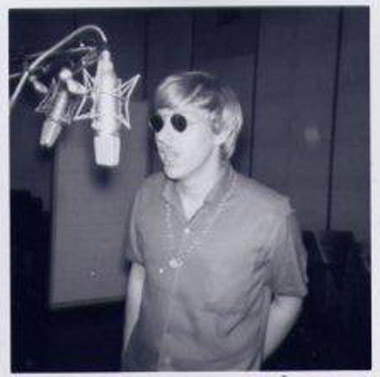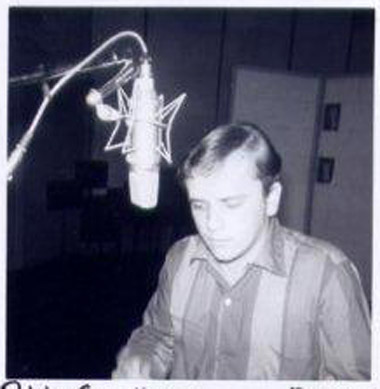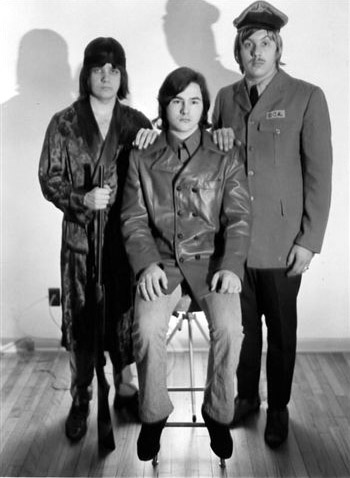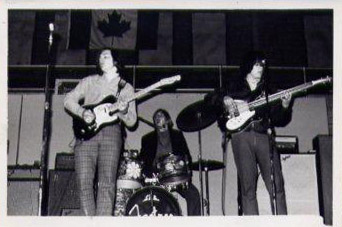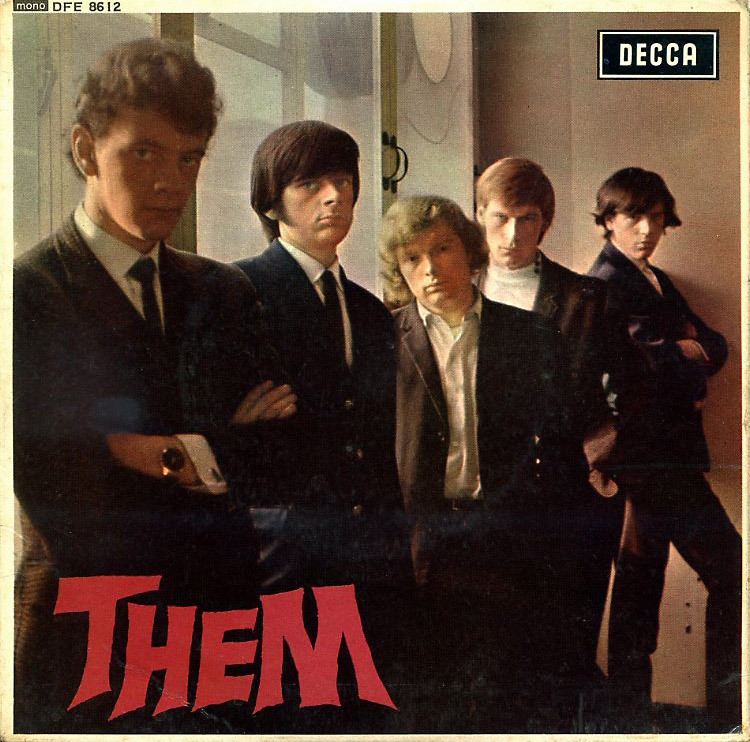
Van Morrison (harmonica, saxophone, vocals)
Alan Henderson (bass)
Billy Harrison (lead guitar)
Eric Wrixon (keyboards)
Ronnie Millings (drums)
1963
The group is formed in Belfast, Northern Ireland by Henderson (b. 26 November 1944, Belfast, N. Ireland), Harrison (b. 14 October 1942, Belfast, N. Ireland) and Millings (or Mellings), who have previously played in a local three-piece outfit, The Gamblers. The trio adds keyboard player Eric Wrixon (b. 29 June 1947, Belfast, N. Ireland) and a short while later completes the original line up with singer Morrison (b. George Ivan, 31 August 1945, Belfast, N. Ireland) from local band The Monarchs. Wrixon names the band after a 1950s B horror film.
1964
April (10) According to an article in Belfast weekly, Cityweek, dated 22 September 1966, Them had played their first ever gig at the Maritime Hotel in College Square North as a trio of Harrison, Henderson and Millings as Van Morrison was playing at the Plaza and had to give two weeks’ notice. The trio played in the break for The College Boys.
(17) One of the first R&B/beat group’s in the province, the Morrison fronted Them quickly build a reputation as a strong live act holding down a residency at the Maritime Hotel. The group’s repertoire includes a blistering 15-minute version of Bobby Bland’s “Turn On Your Love Light”, and a 20-minute improvisation of Morrison’s celebration of teenage lust, “Gloria”. (Although Morrison is credited for the song’s lyrics, Harrison and Henderson have contributed significantly on the musical side.)
(24) Them return for a show at the Maritime Hotel in Belfast.
May The band attracts the attention of manager Phil Solomon (currently working with Irish pop trio The Bachelors), who is greatly impressed by the band’s live performances (and Morrison in particular). Solomon encourages Decca’s Dick Rowe to see the band perform at the Maritime, and Rowe in turn arranges a session in London. (According to Cityweek‘s 22 September 1966 issue, the group had already recorded a three-track demo for local producer Peter Lloyd comprising “Stormy Monday”, “I Got My Mojo Working” and “Don’t Start Crying Now”.)
(1) Them play at the Martime Hotel, Belfast.
(8) The group appears at the Maritime Hotel, Belfast.
(15) Another show takes place at the Maritime Hotel, Belfast.
(22) The group returns for a show at the Maritime Hotel, Belfast.
(29) Them appear at the Martime Hotel, Belfast.
June Them relocate to London and a hotel in Portobello Road, where they hang out with their label mates The Poets.
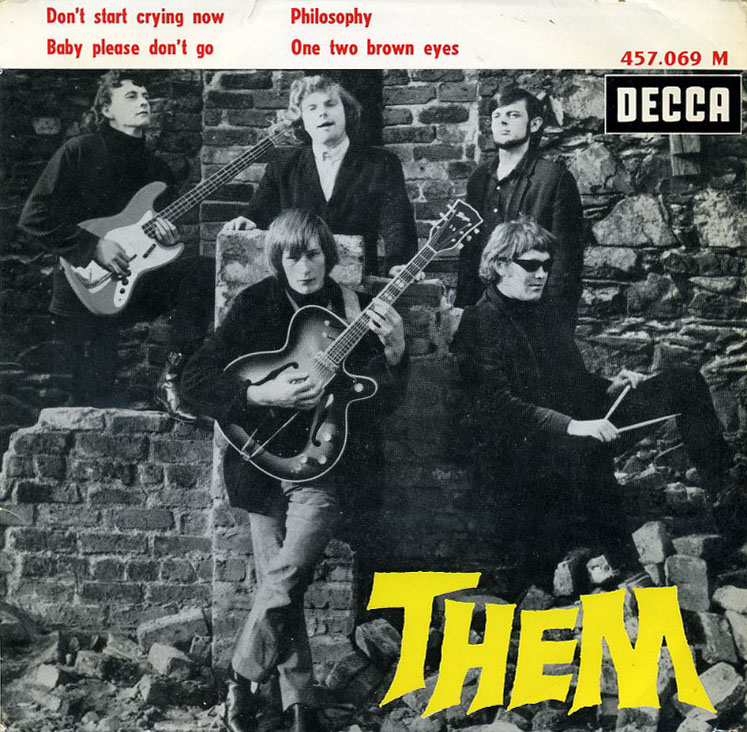
July (5) The group enters Decca’s West Hampstead, London studios to begin recording, but the three-hour session is a stressful affair and Rowe decides to employ session musicians Arthur Greenslade (organ) and Bobby Graham (drums) to “fill out” the sound. Them records Slim Harpo’s “Don’t Come Crying Now” and Van Morrison’s “Gloria”, “One Two Brown Eyes” and “Philosophy”, which are all released over the next year. The band also records covers of “Groovin’”, “Turn On your Love Light” and “You Can’t Judge A Book By Its Cover” which are shelved. After the recordings, Wrixon is forced to leave (in part because his father objects to a disproportionate royalty split between the management and the group and in part because he is still at school and has ‘A’ levels to complete). Pat McAuley (b. 17 March 1944, Coleraine, N.Ireland) takes over the keyboard position.
September (4) The group’s debut single, “Don’t Start Crying Now” backed by “One Two Brown Eyes” is released but fails to chart.
October The group returns to the studio to record an electrifying version of Big Joe Williams’s blues classic “Baby Please Don’t Go”. Session guitarist Jimmy Page adds rhythm guitar to the recording (and does not play lead as some sources suggest).
(15) Them are billed to perform at the Zeeta House, Putney, Surrey. However, there is another west London band with this name who soon become Themselves to avoid confusion with Van Morrison’s band so this may be that group.
November (6) “Baby Please Don’t Go” backed by Morrison’s “Gloria” is released. Millings leaves and Pat McAuley moves onto drums.
December The short-lived (yet well photographed) new line-up appears on the popular TV show Ready Steady Go!
1965
January Pat’s brother Jackie (aka John) (b. 14 December 1946, Coleraine, N. Ireland) is added on keyboards as the group begins work on its next single, a recording of their new producer, Bert Berns’s “Here Comes The Night”. Some sources maintain that organ player Phil Coulter and drummer Alan White are brought in to play the McAuley brothers’ parts, but this is disputed by the band members. (Berns, an American producer working in the UK is impressed with Morrison as a vocalist and will continue to work with the group over the next few months.)
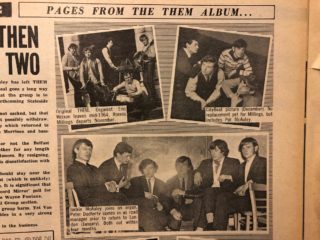
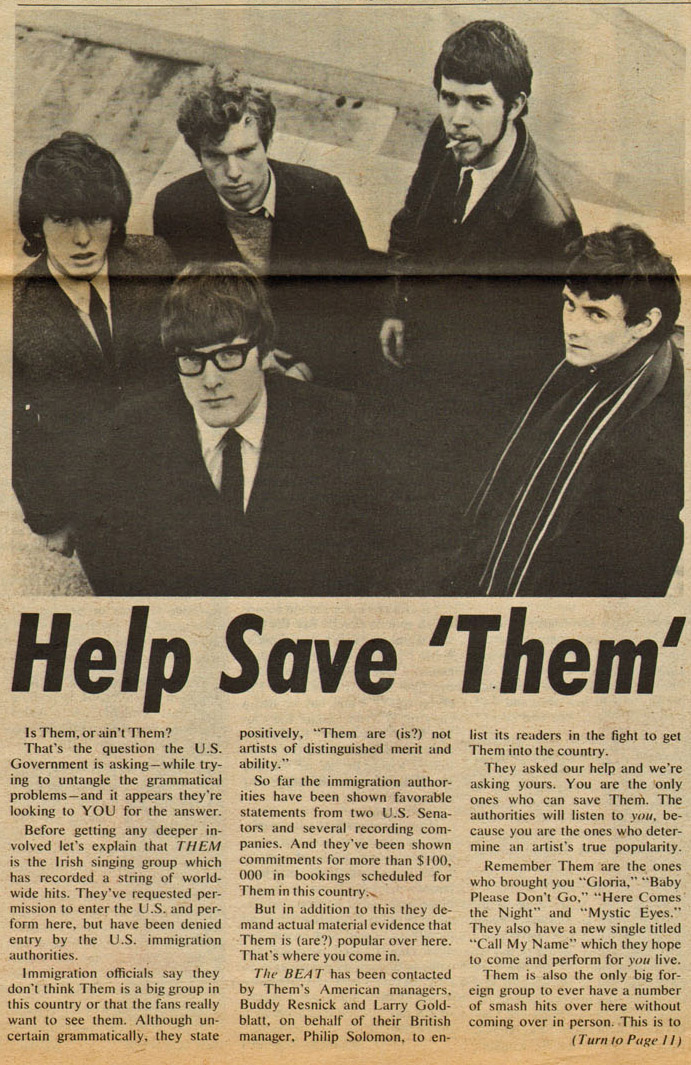
February Aided by TV appearances, “Baby Please Don’t Go” hits UK #10, while “Gloria” quickly becomes an anthem for the emerging US garage band generation. Decca releases an EP featuring both sides of Them’s debut single, the recent hit and Morrison’s “Philosophy” recorded during the July sessions.
(10) Western Scene lists the band playing at Bristol Corn Exchange.
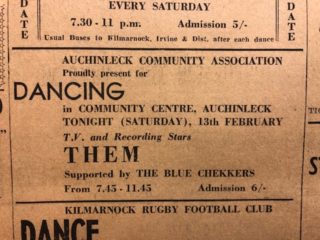
(13) The Kilmarnock Standard lists the band playing at the Community Centre, Auchinleck, Scotland with The Blue Chekkers.
(15) Western Scene lists the band playing at Bath Pavilion.
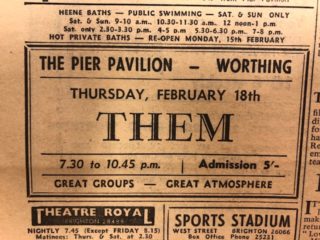
(18) According to the Worthing Herald, the band appears at the Pier Pavilion in Worthing, West Sussex.
(20) Them appear at the Club Noreik, Tottenham, north London.
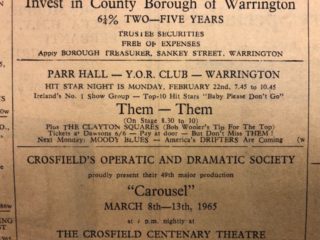
(22) The Warrington Guardian lists the group at the YOR Club, Parr Hall, Warrington, Cheshire with The Clayton Squares.
(25) The band performs at Swindon’s Locarno Ballroom with The Knives and Forks.
(26) Them plays at Woolwich Polytechnic in southeast London.
(27) The band appears at Manchester University.
March “Here Comes The Night” hits UK #2 and is the group’s most successful release. The band begins work on its debut album, but sessions are once again plagued with problems. Some sources suggest that the group’s three producers Bert Berns, Dick Rowe and Tommy Scott supplement the band with session players, although this is disputed by band members.
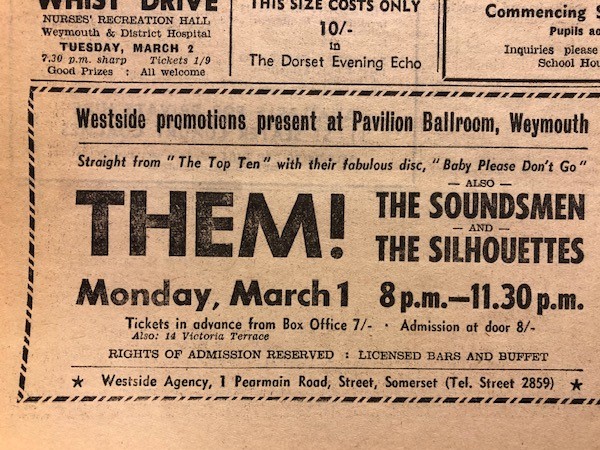
(1) The Dorset Evening Echo lists Them at the Pavilion Ballroom, Weymouth, Dorset with The Soundsmen and The Silhouttes.
(2) The band plays at Wallington Public Hall in Wallington, Surrey.
(3) Them perform at Stourbridge Town Hall in Worcestershire.
(4) The group appears at Kidderminster Town Hall in Worcestershire.
(9) The Yorkshire Evening Post lists the group performing at the Three Coins in Leeds, West Yorkshire.
(13) The Stockport County Express says Them appear at the Manor Lounge in Stockport with The Mersey Squares.
(14) The Birmingham Evening Mail reports that the band plays at the Brum Kavern Club, Small Heath, West Midlands with The King Bees.
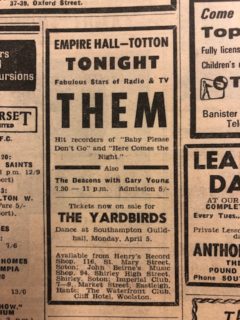
(16) The Southern Echo lists the band playing at the Empire Hall, Totton with Gary Young & The Deacons.
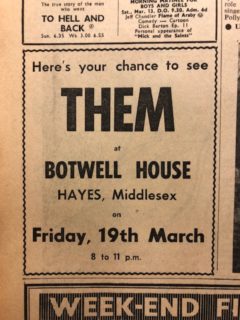
(19) The Ruislip & Northwood Gazette lists the group playing at Botwell House, Hayes, Middlesex.
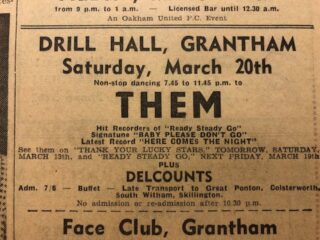
(20) The Grantham Journal has Them playing at Drill Hall, Grantham, Lincolnshire with The Delcounts.
(21) Them perform at the Pigalle in central London.
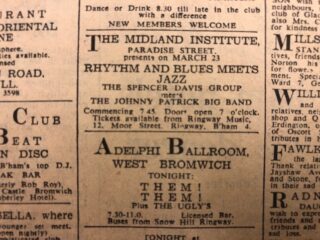
(22) The group plays at the Adelphi in West Bromwich, West Midlands with the Uglys.
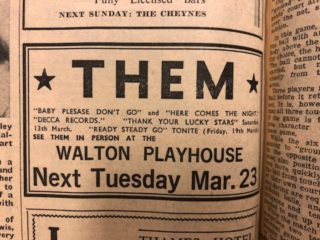
(23) The Woking Herald lists the band at Walton Playhouse.
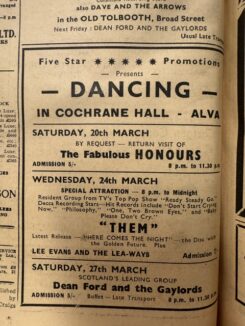
(24-28) Them takes part in a short tour of Scotland, according to Beat Instrumental. The Bridge of Allan Gazette newspaper lists a show at the Cochrane Hall, Alva, Scotland on 24 March with Lee Evans & The Lea-Ways.
(25) During the Scottish tour, the band appears at the Two Red Shoes in Elgin.
(29) Music Echo from Liverpool reports that Them appear at Silver Blades in Liverpool.
(30) Them play at the Floral Hall in Gorston-on-Sea, Norfolk with Ye Highwaymen.
April (1) The band returns to perform at the Manor Lounge, Stockport, Greater Manchester with The Mersey Squares.
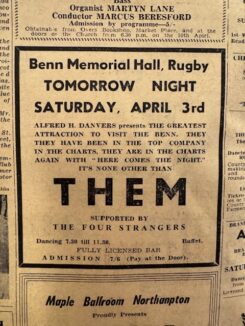
(3) Them appear at Benn Memorial Hall in Rugby, Warwickshire with The Four Strangers, according to the Rugby Advertiser.
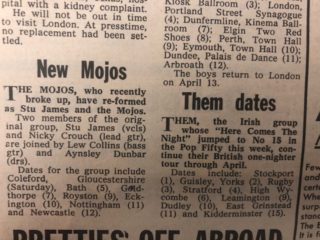
(4) Them appear at the Ritz in Birmingham.
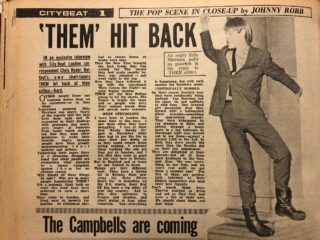
(9) The group plays at Leamington Town Hall in Warwickshire. On the same day, Billy Harrison responded to the band’s critics in an article entitled “‘Them’ Hit Back” in the Belfast publication Cityweek.
(10) Them performs at Dudley Town Hall in the West Midlands.
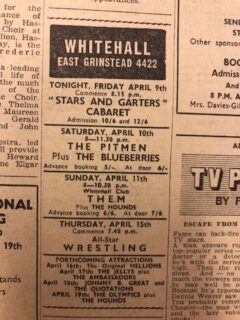
(11) Them perform at the New Musical Express Poll Winners Concert at the Empire Pool, Wembley, west London with many others. Beat Instrumental also has the band appearing at the Co-Op in Gravesend, Kent earlier during the day. It is not clear whether this happens as the Sussex Evening Express also lists the band appearing at the Whitehall in East Grinstead, West Sussex with The Hounds.
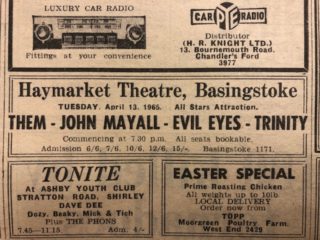
(13) The Southern Echo lists the band at Haymarket Theatre, Basingstoke, Hampshire with John Mayall’s Bluesbreakers, The Evil Eyes and The Trinity.
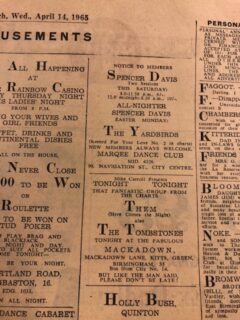
(14) The Birmingham Evening Mail reports that Them appear at the Mackadown, Kitts Green, West Midlands with The Tombstones.
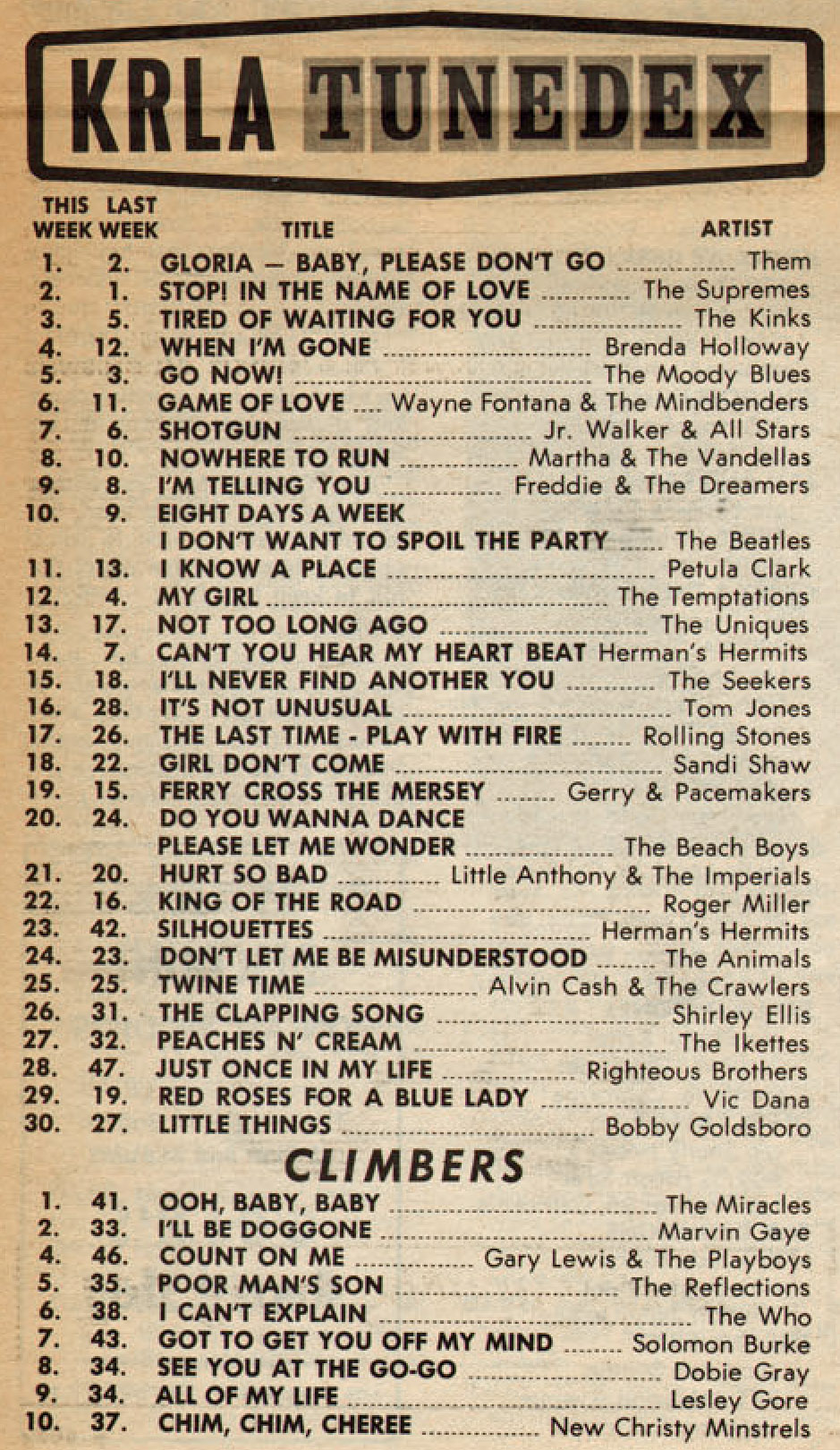
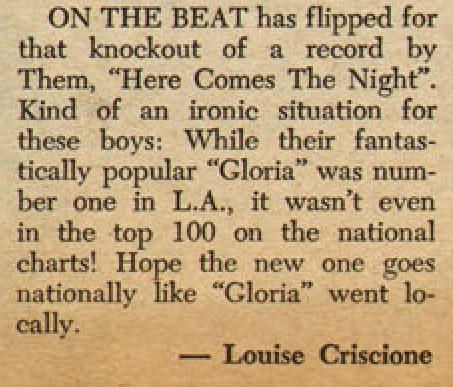
(17) Beat Instrumental reports the band performing at the Market Hall in Redhill, Surrey.
(18) Beat Instrumental lists Them at the Oasis, Manchester.
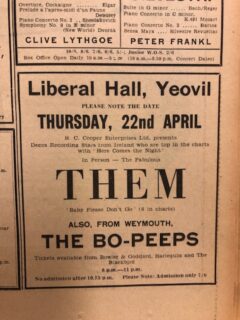
(22) The Western Gazette advertises the group appearing at the Liberal Hall, Yeovil, Somerset with The Bo-Peeps.
(23) Beat Instrumental reports that the band is performing another show in Gravesend, Kent but this is unlikely.
(24) Beat Instrumental lists Them playing in Kirkcaldy, Scotland but this is unlikely as the band headed back to Northern Ireland around this time. Unhappy with the band’s direction and his personal treatment, Jackie McAuley leaves after a show at St Columbana’s Parish Church in Ballyhome, Northern Ireland and is replaced by ex-Cheynes member Peter Bardens (b. 19 June 1944, Westminster, London, England; d. 22 January 2002).
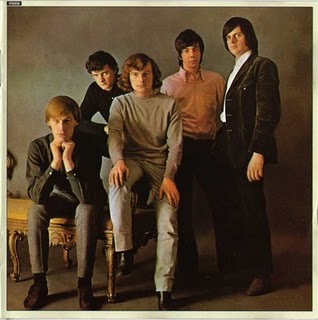
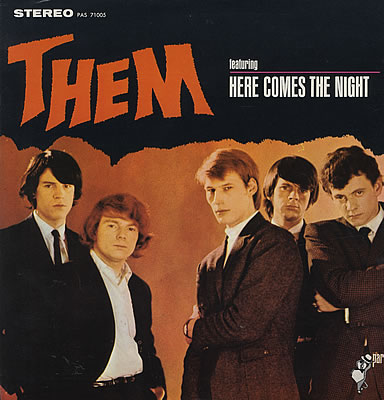
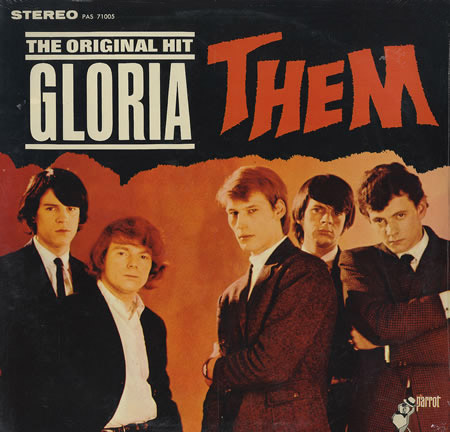
May “Gloria” charts for a week at US #93, selling mostly in California where it hits Top 10 in some major cities.
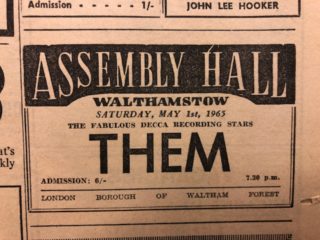
(1) The Walthamstow Guardian reports that Them play at Walthamstow Assembly Hall, Walthamstow, north London.
(7) Belfast publication, Cityweek reports that Them have been recording a lot in the past few days with new organist Peter Bardens.
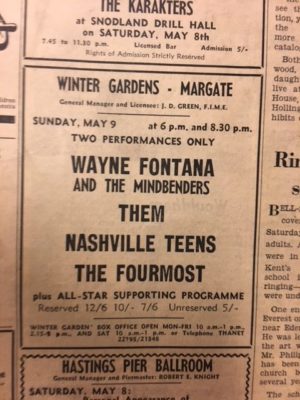
(9) Them perform at the Winter Gardens in Margate, Kent with Wayne Fontana & The Mindbenders, The Nashville Teens and The Fourmost.
(11) The band appears at Bristol Chinese R&B Club, Corn Exchange, Bristol, according to the Western Scene.
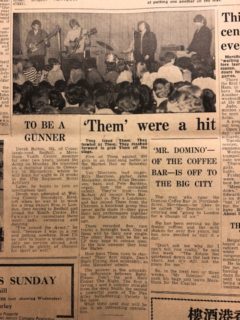
(14) The Streatham News reports that Them appear Wimbledon Palais, southwest London.
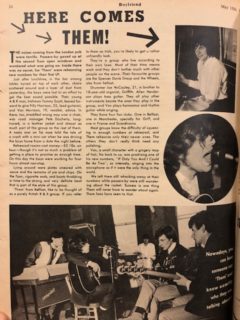
(17) The Enfield Gazette & Observer reports that Them perform at the Potter’s Bar Ritz in north London with The Zephyrs, Screaming Lord Sutch & The Savages and The Mark Four.
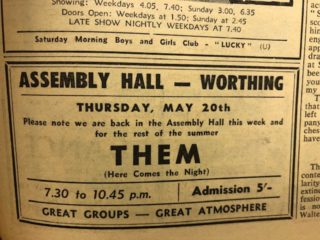
(20) The Worthing Herald lists the band playing at Worthing Assembly Hall.
(23) The Yorkshire Evening Gazette reports the band appearing at the Futurist Theatre, Scarborough, North Yorkshire with Wayne Fontana & The Mindbenders, The Rocking Berries, Dave Berry & The Cruisers, Sandra Barry and The Artwoods.
(25) Them appear at the Assembly Hall, Wallington, near Croydon, south London.
(26) The band performs at Stourbridge Town Hall in Worcestershire.
(28) Them play at Winchester Town Hall in Hampshire.
(29) The band appears at the Rhodes Centre in Bishop’s Stortford in Hertfordshire.
(30) The band plays at Elm Park in Hornchurch, east London.
June (1) Them begin a UK tour at Tunbridge Wells Public Hall. (The tour will end on 21 June at the Beachcombers, Leigh and Bolton). During this period, Pat McAuley is briefly replaced by former drummer Ronnie Millings before rejoining the group.
(2) Western Scene lists the band playing at Bristol Corn Exchange.
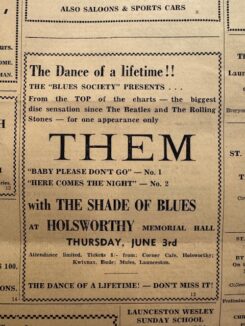
(3) The Cornish Post has the Morrison’s group playing at Holsworthy Memorial Hall in Holsworthy, Cornwall.
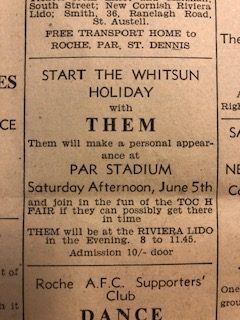
(5) The Cornish Guardian notes the band will play at the Par Stadium in St Austell before later appearing at the Riveria Lido in the evening.
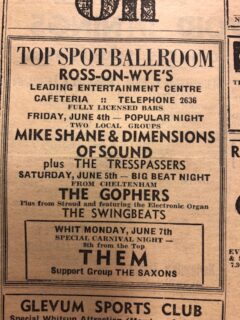
(7) The Gloucester Citizen reports the band appearing at the Top Spot, Ross-on-Wye, Herefordshire with The Saxons.
(11) The Morrison-penned “One More Time” fails to chart. Them’s debut album (The Angry Young) Them is released in the UK to coincide with the single but is another chart failure.
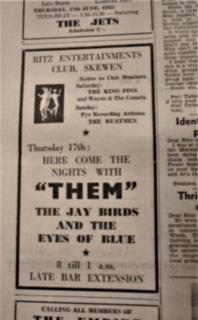
(17) Them perform at the Ritz Club, Skewen, south Wales with The Jay Birds and The Eyes of Blue.
(18) Belfast publication Cityweek reports that Jackie McAuley is back home and is helping to reform The Yaks. McAuley, however, soon moves to Dublin and learns to play guitar. He will rejoin his brother in a rival Them in late December 1965.
(19) Them play at Dudley Town Hall in the West Midlands.
(21) The band appears at the Beachcomber in Leigh.
(24) Them perform at Leeds University.
(25) The group appears at the Starlight Room, Boston Gliderdrome, Boston, Lincolnshire with Rodgers Lodgers.
(26) “Here Comes The Night” hits US #24. On the same day, the Lincolnshire Standard reports that Them play at the Starlight Ballroom, Boston Gliderdrome, Lincolnshire with Mike Sheridan & The Nightriders and Rodgers Lodgers.
July Original Them member, Eric Wrixon completes his studies.
(2) The Middlesbrough Evening Gazette reports that Them play at the Queen’s Rink Ballroom, Hartlepool with Russ & The Nickels and The Evergreens.
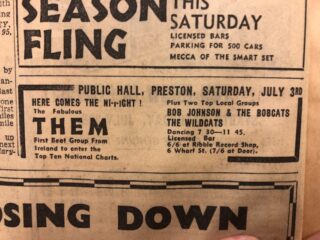
(3) The Lancashire Evening Post reports that Them appear at Public Hall, Preston, Lancashire with Bob Johnson & The Bobcats and The Wildcats.
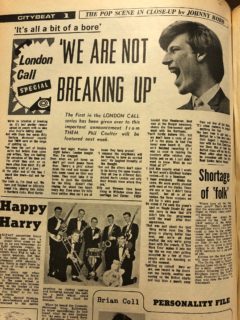
(9) Harrison responds to rumours that Them are breaking up in an article in Cityweek. In the article, entitled “We are not breaking up”, he insists the group has no intention of splitting.
(15) Them perform at Salisbury City Hall, Salisbury, Wiltshire. Around his time Billy Harrison is sacked and replaced by Scottish guitarist Joe Baldi (b. Joseph Baldi, 16 March 1943, La Spezia Italy), who has played with Bardens in Hamilton King’s Blues Messengers. Harrison will briefly return in mid-October.
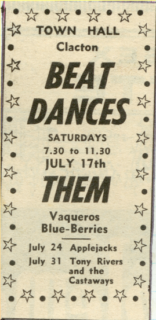
(17) Them appear at Clacton Town Hall, Clacton, Essex with The Vaqueros and The Blue-Berries.
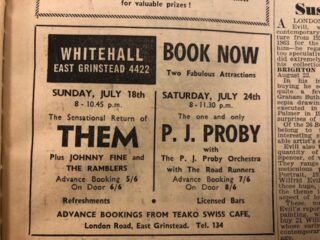
(18) The new line-up plays the Whitehall in East Grinstead, West Sussex backed by Johnny Fine & The Ramblers, according to the Sussex Evening Express.
(19) The Belfast Telegraph reports that Pat McAuley was sacked today. He is subsequently replaced by Englishman Terry Noon, who has previously worked with Gene Vincent.
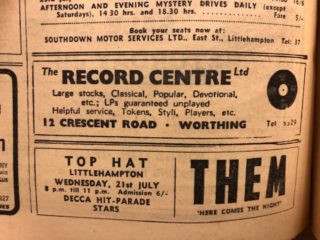
(21) The Littlehampton Gazette lists the band at the Top Hat in Littlehampton, West Sussex, possibly marking Noon’s debut.
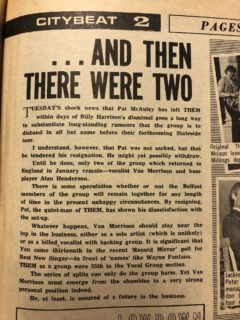
(23) Cityweek reports that Them now contains only Van Morrison and Alan Henderson in an article entitled “…And then there were two”. Peter Bardens, however, does remain with the band. The Belfast publication also notes that Pat McAuley resigned from the band rather than was sacked. On the same day, the Bridge of Allan Gazette newspaper lists Them playing at the Plaza in Stirling, Scotland with supporting groups.
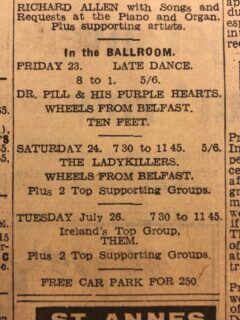
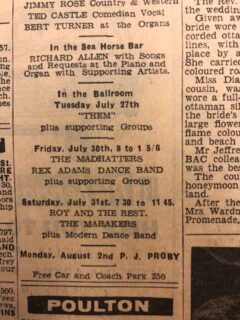
(26-27) Them’s new line up appears at the Queen’s Ballroom, Cleveleys, Lancashire with two supporting groups after playing in Scarborough on the 25th July.
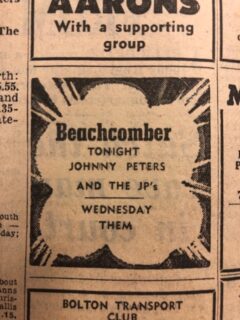
(28) The Bolton Evening News says the band performs at the Beachcomber, Bolton, Greater Manchester.
(29) Beat Instrumental reports that Them are appearing at the Pavilion Ballroom on the Isle of Man.
August A second Berns song, “(It Won’t Hurt) Half As Much” is released but doesn’t chart. In the US the single’s b-side “I’m Gonna Dress In Black”, written by producer Tommy Scott under the pseudonym ‘Gillon’, is released instead but is not a success.
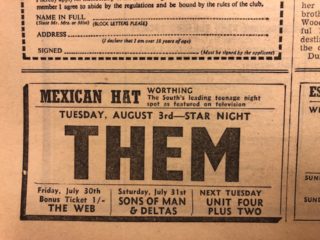
(3) Them play at the Mexican Hat, Worthing, West Sussex, according to the Worthing Gazette.
(4) The Camberley News reports that Them play at the Agincourt Ballroom in Camberley, Surrey.
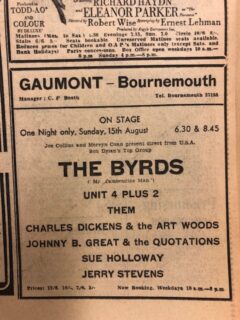
(15) The Western Gazette advertises the group appearing at the Gaumont, Bournemouth, Dorset with The Byrds, Unit 4 Plus 2, Charles Dickens & The Artwoods, Johnny B Great & The Quotations, Sue Holloway and Jerry Stevens .
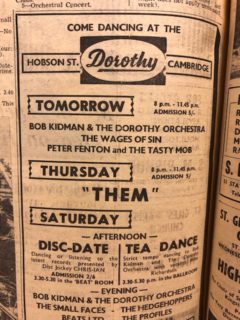
(23) The Cambridge News reports that Them play at the Dorothy Ballroom in Cambridge.
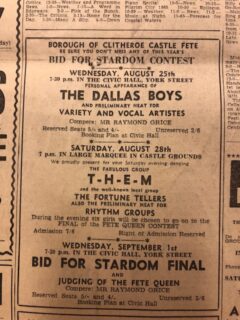
(28) The Lancashire Evening Post lists the band appearing in the Marquee in the grounds of Clitheroe Castle, Burnley, Lancashire with The Fortune Tellers.
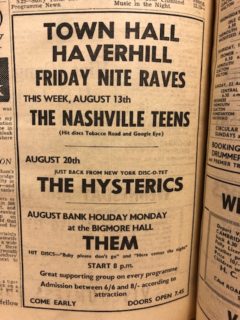
(30) The Cambridge News advertises the group appearing at Bigmore Hall in Cambridge.
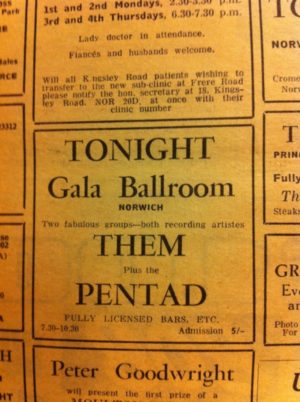
(31) The Eastern Evening News reports that Them appear at the Gala Ballroom in Norwich with Pentad.
September (1) Former members Billy Harrison and Pat McAuley (now on keyboards) announce their own version of Them in London on this day, which contains singer Nick Wymer (ex-Pink Faires), drummer Skip Alan (ex-Donovan) and bass player Mark Scott (ex-Adam Faith). The group is initially dubbed “Some of Them”.
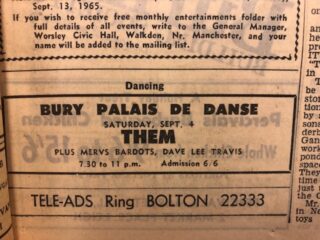
(4) The Bolton Evening News reports that Van Morrison’s Them play at Bury Palais De Danse, Bury, Greater Manchester. Soon afterwards, Baldi returns to Scotland. Bardens also departs and forms The Shotgun Express. He later moves into session work, records two solo albums for Transatlantic Records and then forms 1970s progressive/rock outfit, Camel. Terry Noon also leaves but will return briefly in mid-October.
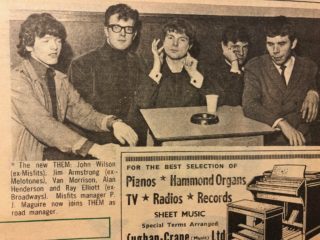
Back in Belfast, Morrison and Henderson have formed a new version of Them with lead guitarist Jim Armstrong (b. 24 July 1944, Belfast, N. Ireland) from The Melotones and keyboard/sax, flute player and vibes player Ray Elliott (b. 23 January 1944, Belfast, N. Ireland; d. June 1993, Toronto) from The Broadways. Apparently, original keyboard player Eric Wrixon fills in briefly but soon leaves to rejoin Portadown band, The People before Elliott joins. The new version of Them is completed with new drummer John Wilson (b. 6 November 1947, Belfast, N. Ireland) from The Misfits. The band rehearses at the Martime for two weeks before making its live debut in Lisburn on 24 September (see below). Belfast’s publication Cityweek had reported in its 23 September issue that Morrison rehearsed with Wilson’s band The Misfits as a potential new version of Them for three days before the new line up was agreed.
(24) The Manchester Evening News & Chronicle reports that Them play at the New Birch Park Club in Rusholme in Greater Manchester with The Corvettes. This must be the rival version led by Billy Harrison and Pat McAuley.
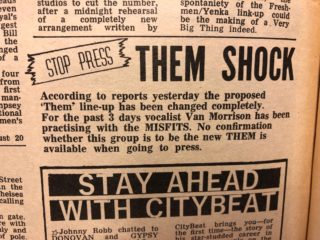
(24) Morrison’s new version of Them make their debut at the Top Hat club, Lisburn, Northern Ireland where they perform a 40-minute set. Shortly after a show at the Flamingo in Ballymena, Morrison’s band returns to London and resumes work on its second album. The group’s debut album is released in the US as Them and hits #54.

(30) Cityweek‘s 30 September issue features an article on the new formation entitled “The return of Them”.
October (4) The Middlesborough Evening Gazette reports that Them appear at the Astoria Ballroom in Middlesbrough.
(11) Morrison’s Them play at the Thorngate, Gosport, Hants.
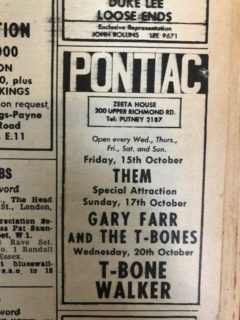
(15) Van Morrison’s Them play at Zeeta House, Putney, southwest London.
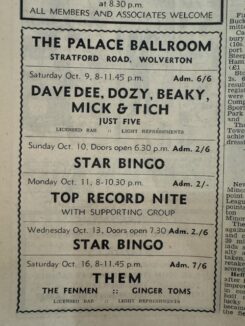
(16) The Wolverton Express lists Them playing at the Wolverton Palace in Bucks with The Fenmen and Ginger Toms. This could well be the rival version with Billy Harrison and Pat McAuley unless they played the gig below in Halifax.
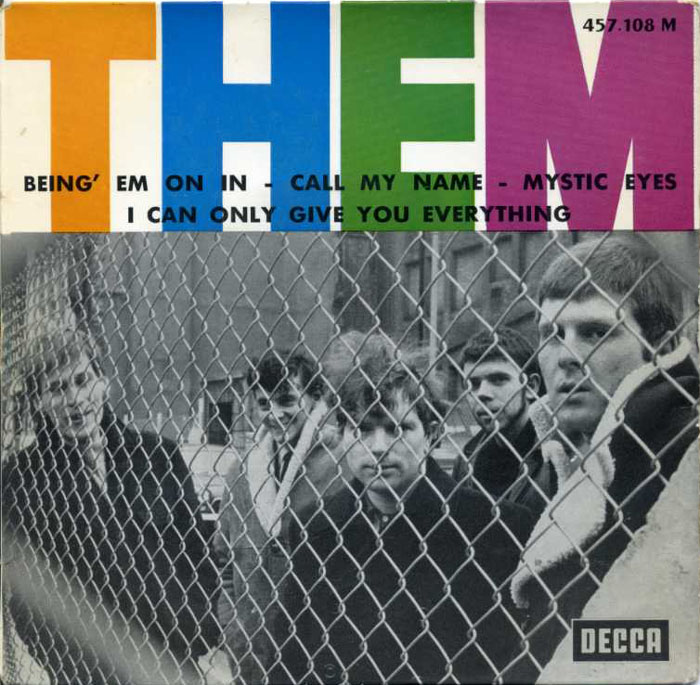
(16) Them are billed to play at Big Daddy’s in Halifax, West Yorkshire with The Blues Set. Around this time, Jim Armstrong is forced to pull out of the band at short notice. Billy Harrison is drafted in to play some UK dates before joining the group for French and (in December) Scandinavian dates (see later).
(17) The Manchester Evening News & Chronicle reports Them appear at the Cavern in Manchester with Ivan’s Meads.
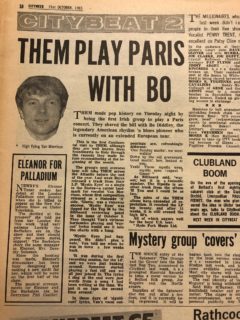
(19) Them (with Billy Harrison) appear at the Olympia in Paris, France with Bo Diddley. The gig is reported in Cityweek‘s 21 October issue. John Wilson, who is considered to be too young to travel, is replaced by former member Terry Noon. The group then travels to Scandinavia for more live dates (although this may be later in the year). Back in England later this month, Noon makes way for a returning John Wilson and joins The Yum Yum Band before moving into rock management, working initially with Honeybus.
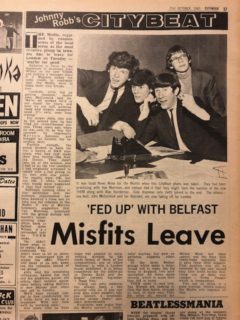
(21) Belfast publication, Cityweek reports that John Wilson’s former band, reduced to a trio since he left, is moving to London.
(22) Streatham News reports that Them play at the Wimbledon Palais in southwest London. However, it is not clear whether this is the rival Them or Morrison’s group after returning from Paris but most likely the former.
(30) According to the Lincolnshire Echo, Them performs at the Raven Club, RAF Waddington, Lincolnshire with Pathfinder Five and Penny Farthings. Again, it’s not clear which version this is.
(31) The Eastern Evening News reports that Them appear at the Royal Hotel in Lowestoft, Suffolk with The Easi-beats.
November Early in the month, Skip Alan leaves the Harrison/McAuley Them to replace Viv Prince in The Pretty Things, who soon takes up Skip Alan’s place for a few weeks. Harrison, who has briefly returned to the rival Them after Jim Armstrong resumes his place, departs when Skip Alan lands the job with The Pretty Things. Harrison does session work for producer Joe Meek.
(4) Pat McAuley’s rival Them registers the Them name. By now the group contains a new guitarist, known as Don, who has replaced Billy Harrison.
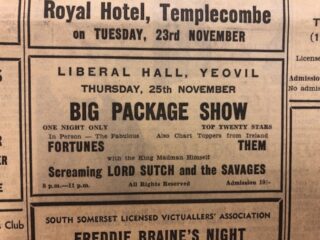
(25) The Western Gazette advertises the band (but not clear which version) appearing at Liberal Hall, Yeovil, Somerset with The Fortunes and Screaming Lord Sutch & The Savages.
December (2) When Viv Prince leaves Pat McAuley’s rival Them, his place is taken by Ken McLeod.
(4) “Mystic Eyes” fares better in the States where it reaches #33. On the same day, Boyfriend magazine notes that Them appear at Leeds College. This could be the rival version.
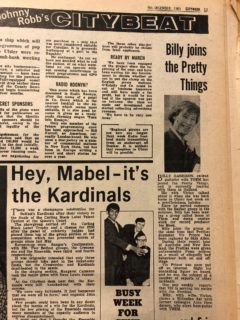
(9) Cityweek reports that Billy Harrison has joined The Pretty Things and is currently touring with that band in Holland. He also plays with The Pretty Things on a Scandinavian tour in early December. At the turn of the year, he also covers for Jim Armstrong in Them for their first Scandinavian shows. Harrison quits the music business in mid-1966 after playing with The Pretty Things in the Isle of Wight during March (this might have been in August 1965 instead) and joins the GPO. Original Them keyboard player Eric Wrixon meanwhile had joined The Kings showband in late November before re-joining The People, according to Cityweek.
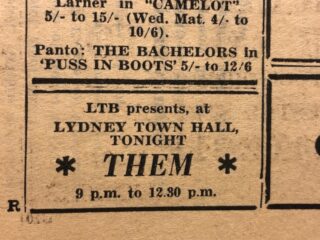
(10) The Gloucester Citizen reports that Them appear at Lydney Town Hall, Lydney, Gloucestershire, which might be a gig by the rival version of Them.
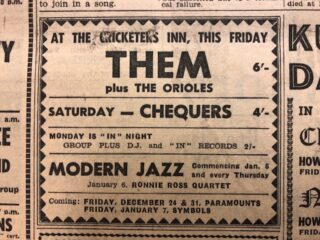
(17) The Southend Standard lists Them appearing at the Cricketers Inn, Westcliff, Southend, Essex with The Orioles.
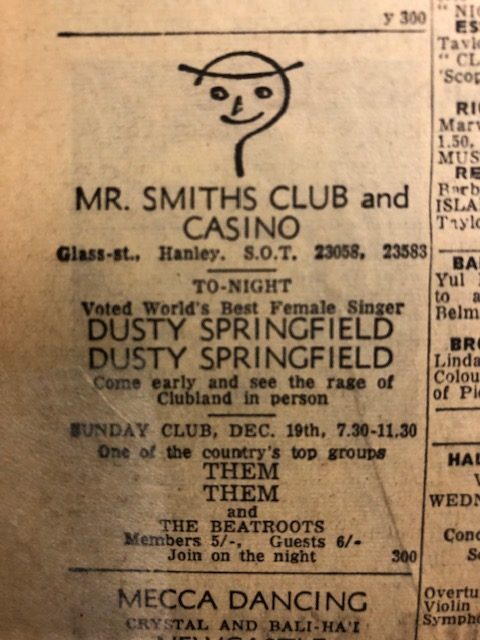
(19) Wymer leaves the rival Them after a gig in Stoke-on-Trent (this is Mr Smith’s in Hanley with The Beatroots). Soon afterwards, he is replaced by Pat’s brother Jackie McAuley on keyboards/vocals, who has been living in Dublin. Pat moves on to drums and Ken McLeod takes over guitar from Don who leaves in mid-January. On the same day, Them play at the nearby Majestic Ballroom in Shropshire, which could have been an earlier gig by the rival band. Around this time, Morrison’s group plays in Liverpool and after the show Armstrong collapses with a suspected perforated appendix. He spends Christmas in the emergency ward at Liverpool’s Southern Hospital, according to Cityweek‘s 6 January 1966 issue.
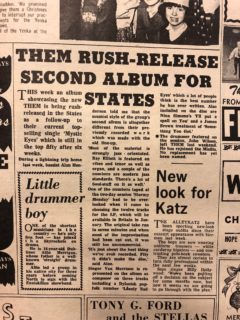
(23) Cityweek notes that John Wilson left Them last weekend but no replacement has been announced. The article entitled “Them rush-release second album for States” also profiles the forthcoming Them Again LP. Wilson rejoins The Misfits (until April 1967) and then works with Belfast groups, Derek & The Sounds and Cheese. In the late 1960s, he joins guitarist Rory Gallagher in Taste before forming Stud in the early 1970s.
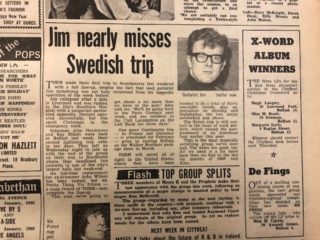
(29) Cityweek‘s 6 January 1966 issue reports that Alan Henderson and Ray Elliott have flown to Stockholm to join the other Them members (Van Morrison and Billy Harrison) for two shows at the weekend of 31-December-2 January. The group is still without a permanent replacement for John Wilson. However, David Harvey (b. David Tufrey 29 July 1943, Bude, Cornwall, England) takes his place on the drums in January after the group use a succession of temporary fill ins.
(31) Boyfriend magazine reports that Them play at the Fender Club in Kenton, northwest London but it’s not clear which version this is. However, it is most likely the Pat McAuley version considering Morrison’s version play in Stockholm this weekend.
1966
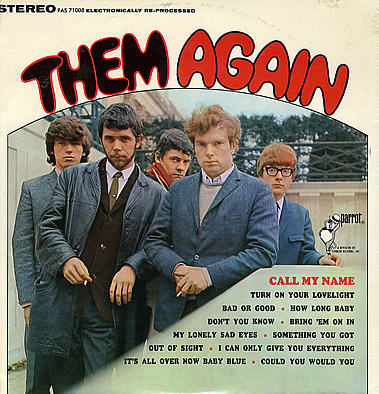
January Them’s second album Them Again fails to chart in the UK. It contains two of Morrison’s best songs: “Hey Girl” and “My Lonely Sad Eyes”, as well as an edited version of Bobby Bland’s “Turn On Your Love Light”. Original Them member Eric Wrixon leaves The People, who have relocated to Blackpool, and joins another expatriate Belfast band, The Wheels in February, who record two singles for Columbia.
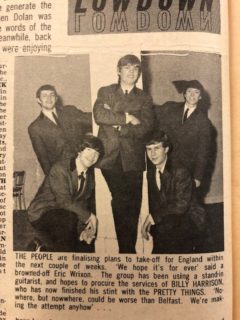
(1) Jackie McAuley makes his debut with the rival Them in Peckham, southeast London. On the same day, Cityweek reports that Them make their first trip to Scandinavia this weekend, even though Armstrong hasn’t fully recovered from his hernia operation in late December. Billy Harrison takes Armstrong’s place.
(3) Them appear at the Shoreline club in Bognor Regis, West Sussex. This could be the McAuley brothers’ version.
(4) Them play at the Assembly Hall, Aylesbury, Bucks. Again, this could be the McAuley brothers’ version.
(6) Cityweek reports that Them will return to Paris’ Olympia next week and are also resident in the Club Locomotive for three days.
(10) Them appear at the Labour Hall, Bletchley, Bucks. This could be the McAuley brothers’ version.
(11) Them play at the Hut, Westcott, Surrey. Again, this could be the McAuley brothers’ version.
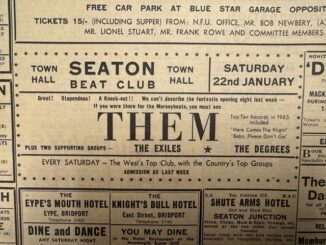
(22) The Coulsdon & Purley Advertiser reports that Them perform at the Club Nevada, West Croydon, south London. This is most likely Van Morrison’s version as on the same day another Them are billed to appear at the Seaton Beat Club at Seaton Town Hall, Seaton in Devon with The Exiles and The Degrees, according to Pulman’s Weekly News.
(27) Them appear at the Whitehall, East Grinstead, West Sussex. On the same day, Cityweek reports on the legal row over who is Them. Van Morrison’s version is currently on tour in Wales.
(29) Durham University’s student paper Palatine advertises a gig for Them (with Van Morrison) at Aidan’s on the university campus. The show is reviewed in the student newspaper’s 10 February issue, page 8.
(30) The North Herts Herald reports that Them perform at Newbury Plaza Ballroom in Berkshire with The Just Men.
February (4) The McAuley brothers’ Them record three tracks at a demo session: a cover of Graham Bond’s “I Want You”, a cover of Bob Dylan’s “It’s All Over Now Baby Blue” and Jackie McAuley’s “Movin’ Free”.
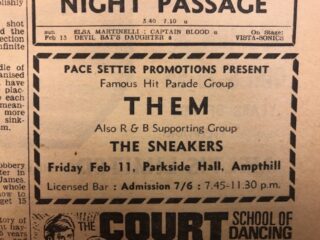
(11) The Luton News reports that Them appear at Parkside Ampthill, Bedfordshire with The Sneakers but it is not clear which version this is.
(12) The Manchester Evening News & Chronicle reports that Them play at the Faculty of Tech Union in Manchester with Five of a Kind. It’s not clear however if this is Morrison’s group or the rival version.
(15) The Coulsdon & Purely Advertiser reports that Van Morrison’s Them appear at Club Nevada, West Croydon, south London.
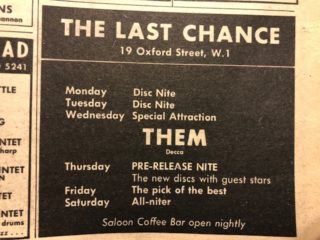
(16) Melody Maker lists the band playing at the Last Chance on Oxford Street, central London.
(18) The rival Them perform at the KB Hall, Copenhagen, Denmark with The Pretty Things.
(19) Van Morrison’s version appears at Floral Hall, Southport, Lancashire with The Cryin Shames.
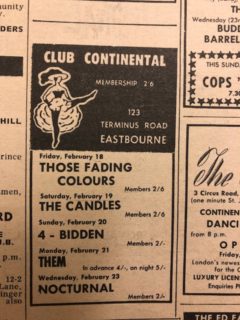
(21) According to Melody Maker, Them play at the Club Continental in Eastbourne.
(22) Chris Groom’s book Rockin’ and around Croydon lists Them at the Gun Tavern in Croydon, south London.
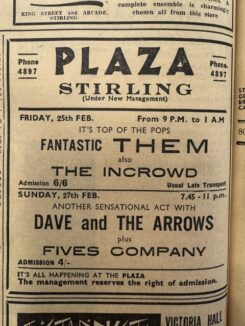
(25) The Bridge of Allan Gazette newspaper lists Them playing at the Plaza in Stirling, Scotland with The In Crowd.
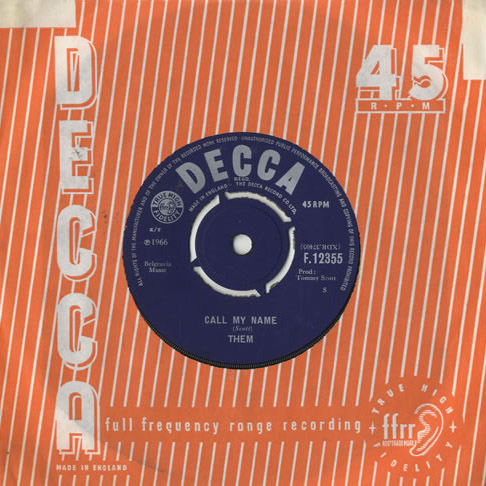
March Morrison’s version of Them’s cover of producer Tommy Scott’s “Call My Name” fails to chart.
(5) The Malvern Gazette reports that Them perform at the Malvern Winter Gardens in Worcestershire with Lighting Blues but it is not clear which version this is.
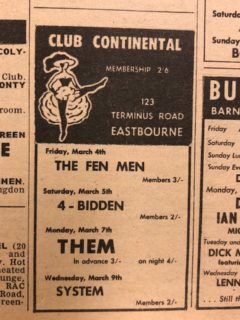
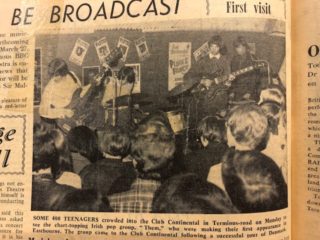
(7) The McAuley brothers’ Them appear at the Club Continental, Eastbourne.
(9) The rival Them lose their court case and change name to “Some of Them”.
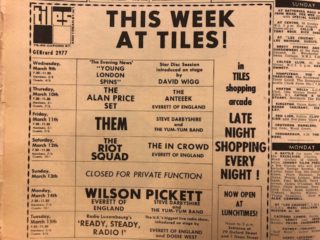
(11) Van Morrison’s version play at Tiles on Oxford Street, central London with Steve Darbyshire and The Yum Yum Band.
(26) The Warrington Guardian lists Them playing at the Mersey View Ballroom in Frodsham, Cheshire with The SOS but it’s not clear which version of the band this is.
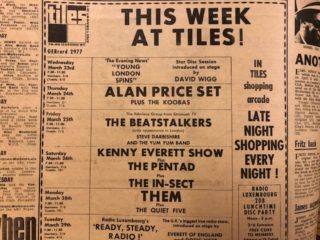
(28) Van’s version returns to Tiles for another show with The Quiet Five in support.
April Morrison’s Them’s final session produces a cover of Paul Simon’s “Richard Cory” and Morrison’s “Mighty Like A Rose”. “Gloria” is re-issued and climbs to US #71.
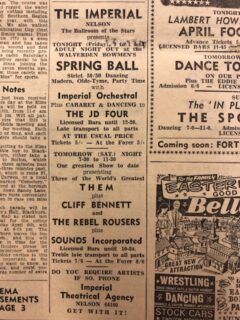
(2) The Nelson Leader reports that Them appear at the Imperial, Nelson, Lancashire with Cliff Bennett & The Rebel Rousers and Sounds Incorporated.
(9) Van Morrison’s version of Them appears at Torquay Town Hall in Devon with The Hunters and The Javelins, according to the Herald Express.
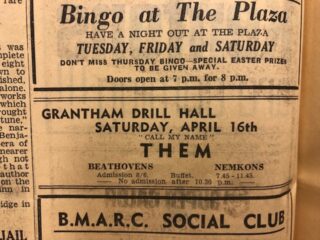
(16) The Shadows Of Knight’s version of “Gloria” hits US #10. On the same day, the Grantham Journal has Them playing at Drill Hall, Grantham, Lincolnshire with The Beathovens and The Nemkons.
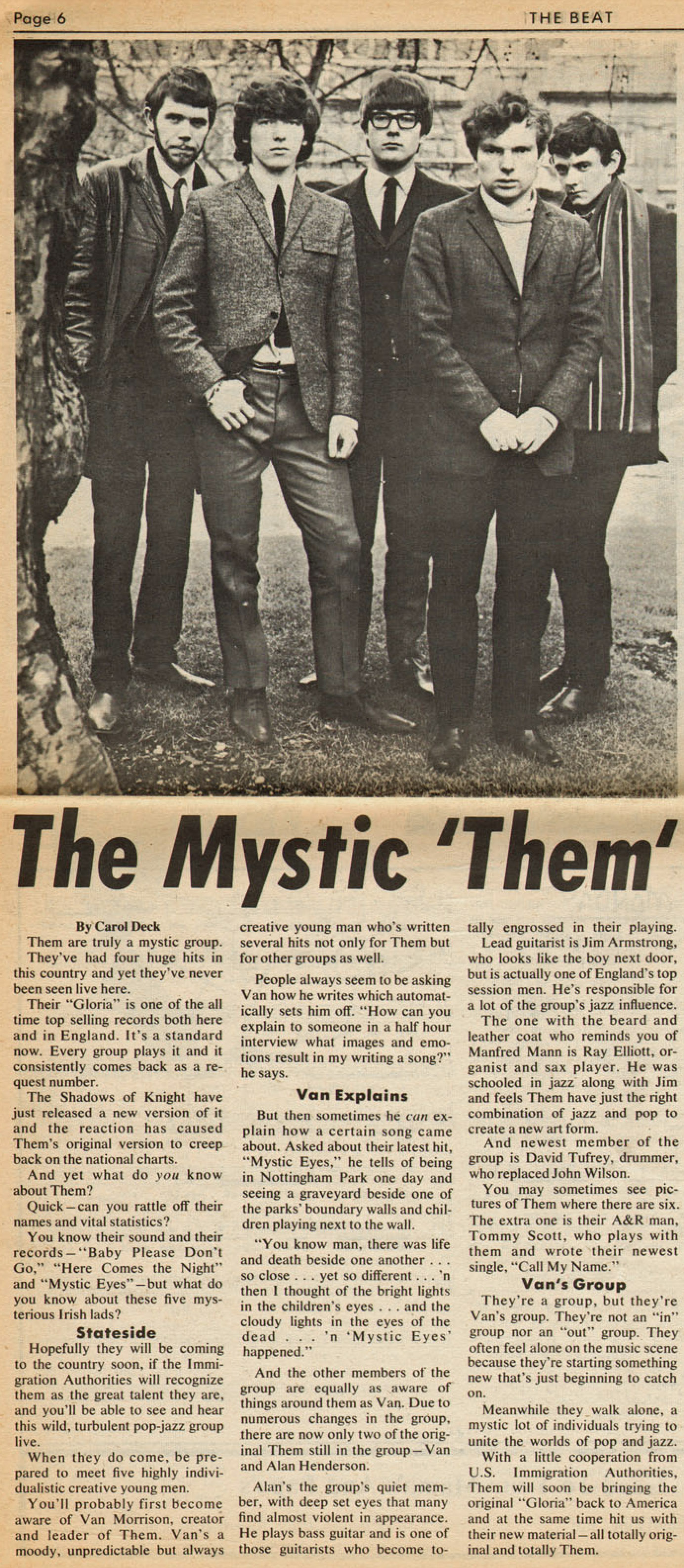
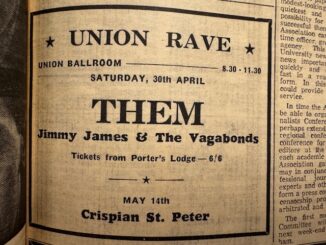
(30) Billed as Them, what looks like the rival version perform at Newcastle University’s Union Rave held in the Union Ballroom, on a bill with Jimmy James & The Vagabonds. The university’s student newspaper, The Courier, reviews the shows in its 4 May issue, page 3.
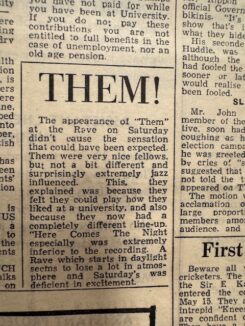
May Paul Simon’s “Richard Cory” is the group’s last official single but is not a success. Morrison is particularly annoyed by its release, preferring his own song “Mighty Like A Rose” as a prospective single. In the US, Tommy Scott’s “I Can Only Give You Everything” is released as a final single and is quickly adopted by US garage bands like The MC5 as a punk anthem. Them Again reaches US #138.
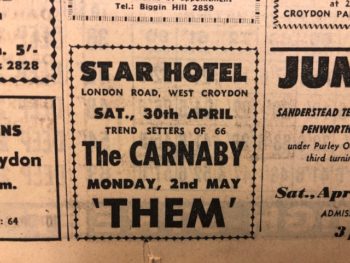
(2) The Coulsdon & Purley Advertiser reports that Them perform at the Star Hotel in Croydon, south London.
(7) The Luton News reports that Them appear at Harpenden Public Hall, Harpenden, Herts with The Fuzz Bugs but it is not clear which version this is.
(14) Them perform at Decca Entertainment Centre, Ashton-under-Lyne, Greater Manchester.
(21) The Malvern Gazette reports that Them perform at the Malvern Winter Gardens in Worcestershire with Group 66 but it is not clear which version this is. In late May, PACE magazine reports that Van Morrison’s version play at Crayford Town Hall in southeast London. Soon afterwards, Morrison’s version flies out to New York to begin its debut US tour, with the first show in Arizona.
(27) Some of Them record two tracks with Kim Fowley – “Gloria’s Dream” and “Secret Police”. On the same day, Van Morrison’s Them appear at the Rollarena, San Leandro, California.
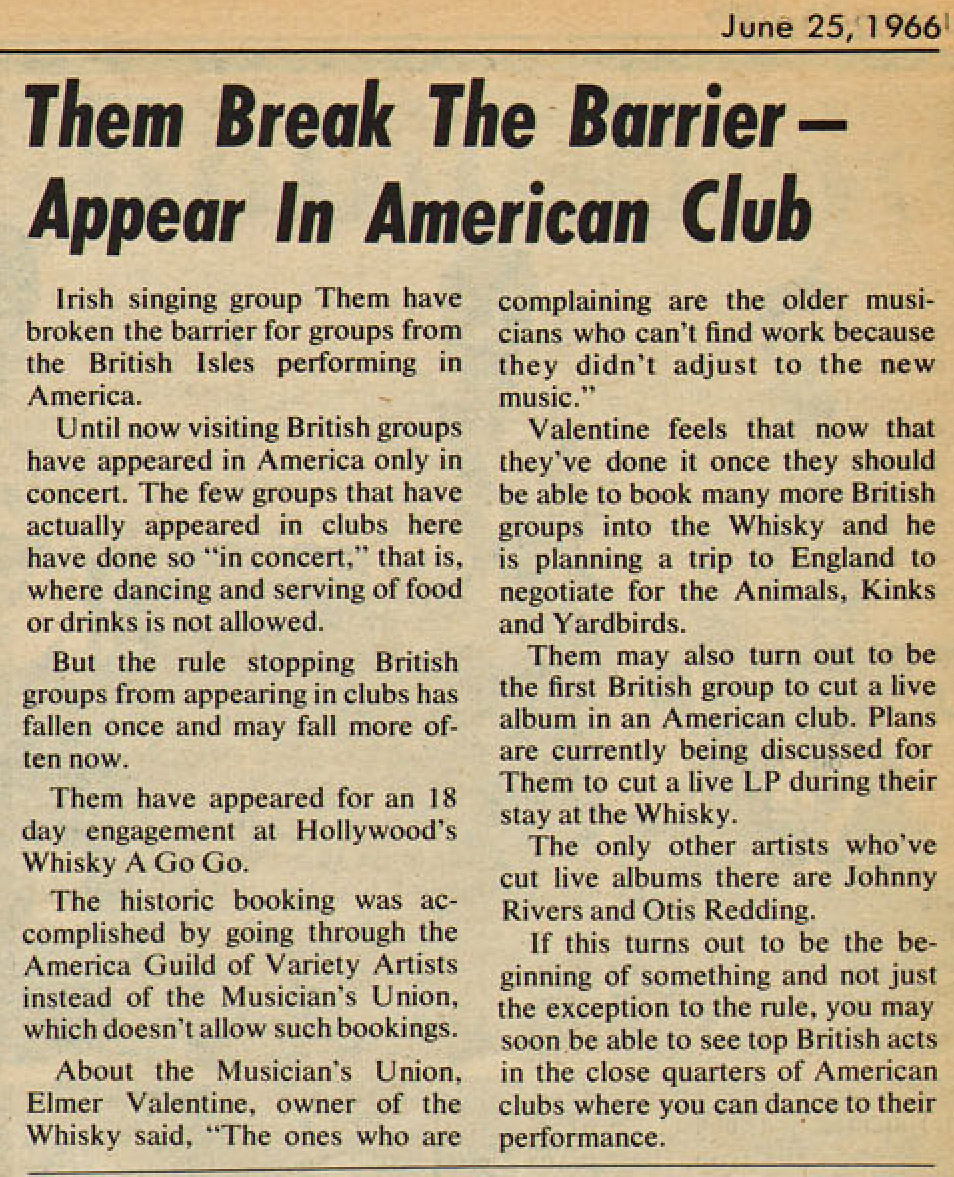
(30) Some of Them perform in Blackpool, Lancashire. On the same day, Van Morrison’s Them begins a residency at the Whisky-A-Go Go, West Hollywood, California.
May (31) – June (17) Morrison’s Them performs at the Whisky-A-Go-Go, West Hollywood, California, where they are sometimes supported by The Doors.
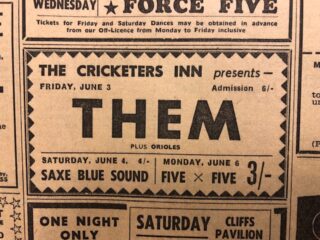
June (3) The rival version of Them performs at the Cricketers Inn, Westcliff, Southend, Essex with the Orioles, according to the Southend Standard.
(13 & 15) Some of Them record further tracks in London.
(18) On the last night at the Whisky, The Doors’ vocalist Jim Morrison joins Van Morrison’s group on stage for a 20-minute improvisation of “Gloria”.
(19) The band discovers that the club has been willing to pay the group $10,000 per week. However, due to their management deal with Phil Solomon (whereby they have agreed to play for $2,000 a week minus a 35% management fee and a guarantee), Them have received considerably less than they think they should. This causes a lot of bitterness between the group and Solomon, and as a result Them inform promoter Bill Graham that they will only play at their forthcoming Fillmore concert if they are paid in advance.
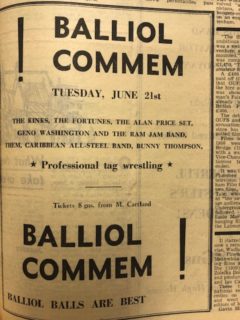
(21) Some of Them (billed as Them) appear at Balliol College, Oxford University alongside The Kinks, The Fortunes, The Alan Price Set, Geno Washington & The Ram Jam Band, The Caribbean All-Steer Band and Bunny Thompson.
(23) Morrison’s Them appear at San Francisco’s Fillmore Auditorium with The New Tweedy Brothers. After their performance, Morrison meets his future wife Janet Planet who accompanies the band on the rest of the tour. (She will be the inspiration for Morrison’s Astral Weeks.)
(26) Morrison’s group is supported by The Association at the Oakland Auditorium, Oakland, California.
(27-29) Some of Them move to Denmark where they perform as Them. The group performs three shows in Copenhagen and finish their final recordings. Over the next five months, the band gigs in Denmark, Sweden and Norway. In the last week of July, the band is briefly joined by former Them member Peter Bardens on keyboards, allowing Jackie McAuley to come up front as lead singer.
July (1-2) Morrison’s Them perform at the “Beat On The Beach”, Santa Monica, California with The New Generation.
(8-9) Them appear at the Waikiki Shell, Kapiolani Park, Honolulu, Hawaii.
(23) The band performs at the Strand Theater, Modesto, California.
(28) Morrison’s group is supported by The Doors and The Count Five at the Starlight Ballroom, Oxnard and (in the evening) the Earl Warren Showgrounds, Santa Barbara, California.
(29-30) Morrison’s Them is supported by The Sons Of Champlin at the Fillmore Auditorium, San Francisco.
August (9) The McAuley brothers’ Them play at the Complain-LA-Tour jazz festival in Belgium.
(19-21) Morrison’s group performs at the Losers North, San Jose, California.
(23-28) A further set of dates take place at the Losers North.
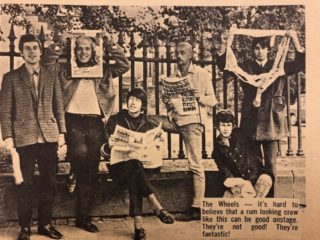
September (1) Belfast publication Cityweek reports that The Wheels are back in the city. The band will split soon after, however. In 1967, Eric Wrixon will move to West Germany with The Never Never Band and plays regularly at Hamburg’s Star club, supporting soul acts like Sam & Dave.
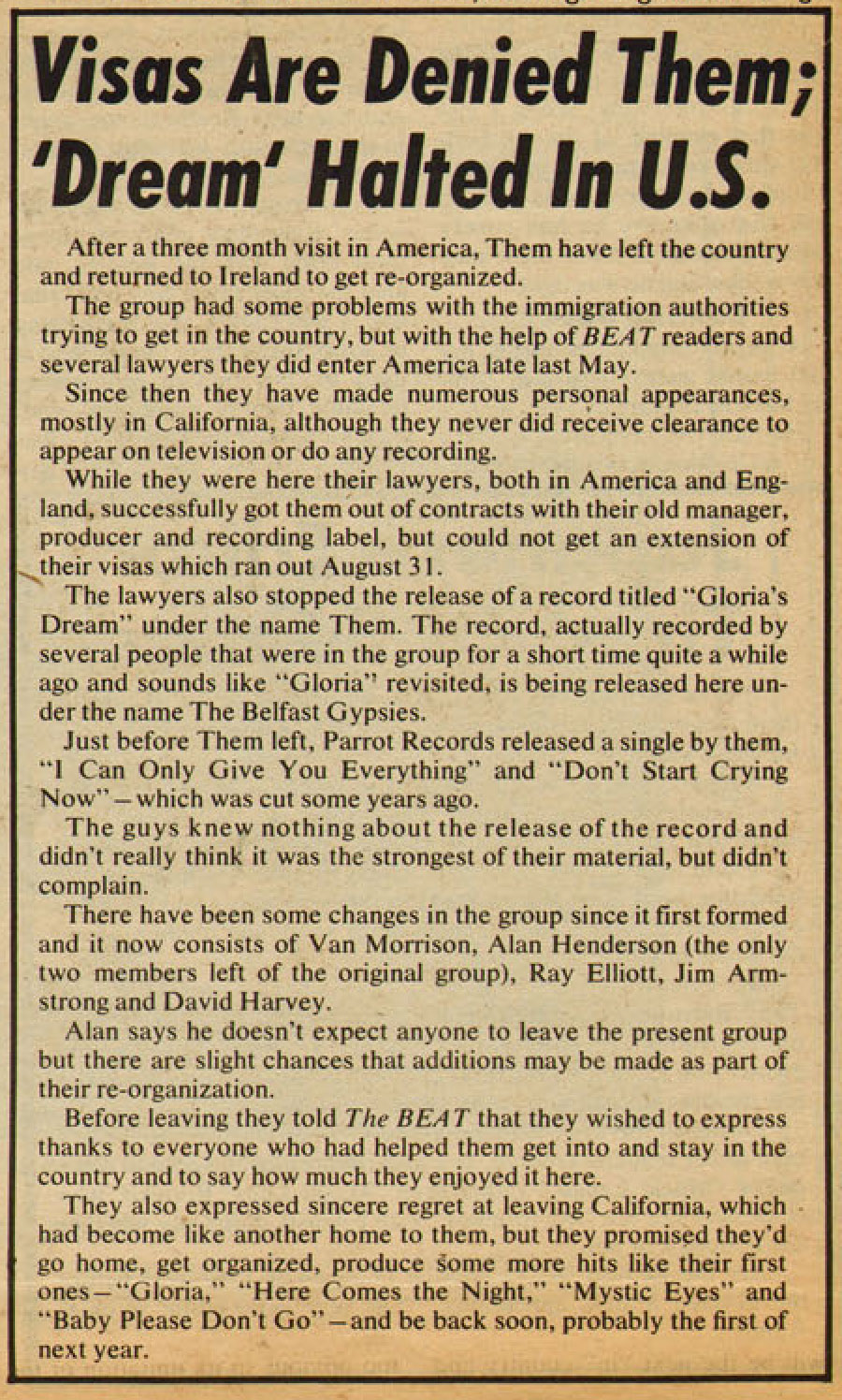
(2-3) Them performs at the Longshoreman’s Hall, San Francisco.
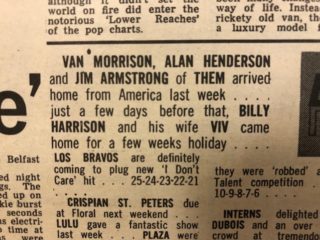
(8) Cityweek reports that Van Morrison, Alan Henderson and Jim Armstrong arrived home from America last week so it’s not clear whether the September US dates took place despite being advertised.
(9) They are billed to appear in Fresno, California. However, Morrison and Henderson may have already returned to London to sort out business matters with Solomon. Morrison continues to work on some new songs that will later comprise his masterpiece Astral Weeks.
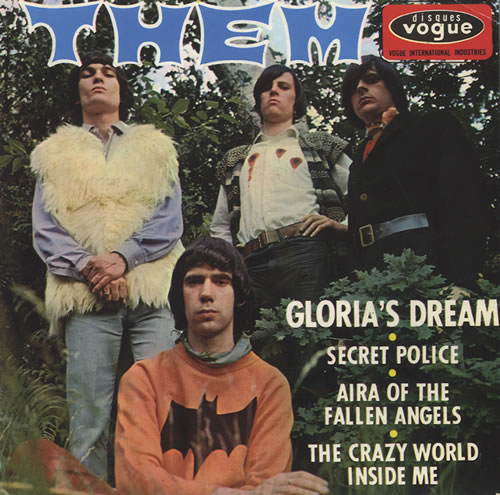
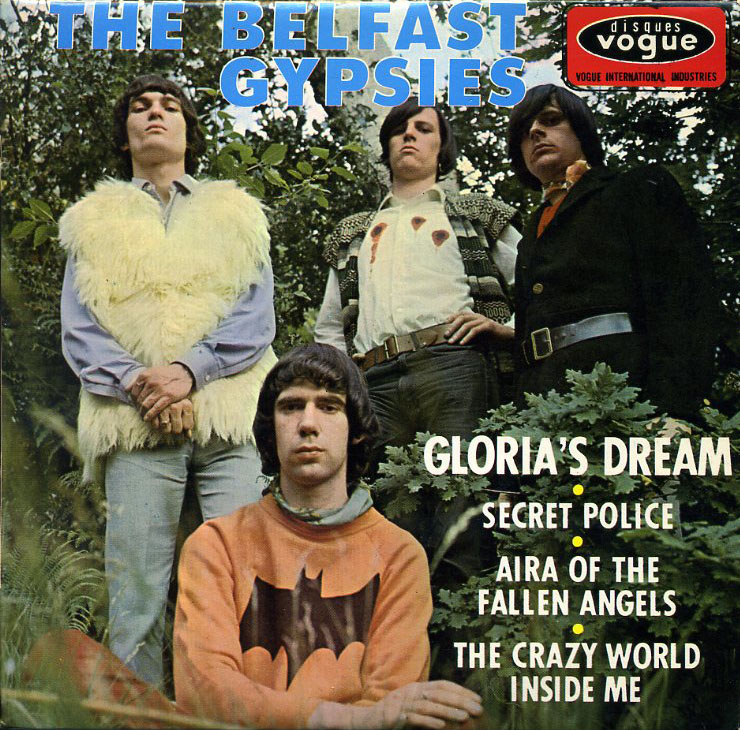
(17) The McAuley brothers’ group, now dubbed The Belfast Gypsies score a minor US hit when “Gloria’s Dream” hits #124.
(22) Morrison and Henderson are profiled in Cityweek‘s 22 September issue in an article entitled ‘Van and Co. back to “square one”‘.
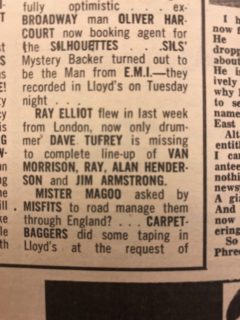
(29) Cityweek reports that Ray Elliott flew in to Belfast last week.
October (2) The Weston Mercury reports that Them appear at the Winter Gardens, Weston-Super-Mare, Somerset. This would have been the McAuley brothers’ version. In Belfast, Morrison soon returns to occasional live work in a new outfit dubbed, Van Morrison and “Them Again”, which features former Castaways and Unit guitarist Eric Bell alongside former Alleykatz members Joe Hanratty (drums) and Mike Brown (bass). Alan Henderson doubles up on second bass.
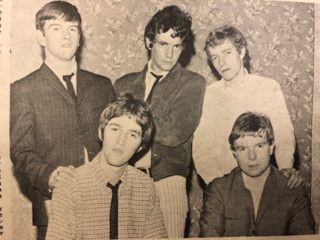
(13) Cityweek reports that Jim Armstrong has left Them to play with The Federals. Ray Elliott will also briefly join this outfit, according to the paper, a short while later.
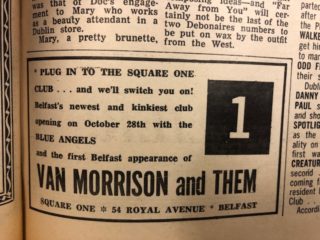
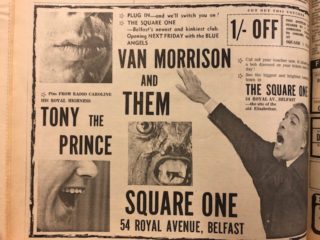
(28) The Belfast Telegraph reports that Van Morrison and Them play (their debut show) at the Square One Discotheque in Belfast with The Blue Angels.
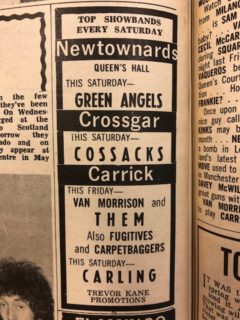
November (4) Cityweek‘s 3 November issue reports that Them appear at Carrickfergus Town Hall today with The Carpetbaggers and The Fugitives.
(5) The McAuley brothers’ Them play their final date in Stockholm.
(10) The Belfast Telegraph reports that Van Morrison & Them perform at Sammy Houston’s Jazz Club. When Eric Bell leaves immediately after the Queen’s University rag ball gig, the band implodes. Van Morrison concentrates on a solo career. Bell meanwhile moves to Glasgow and plays with The Bluebeats for two years.
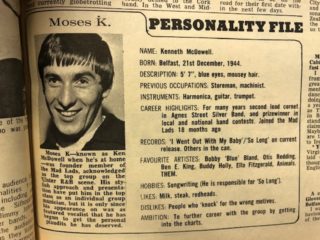
December Armstrong, Elliott, Harvey and Henderson decide to carry on with Them’s name, now that Morrison has abandoned the name and is pursuing a solo career. The group recruits a new vocalist Ken McDowell (b. 21 December 1944, Belfast, N. Ireland), previously a member of Belfast group The Mad Lads, who have recorded a number of singles for Decca Records, as well as a lone release “I Went Out With My Baby” as Moses K. & The Prophets. The new version of Them writes to Carol Deck, Californian editor of Flip magazine (who had given the band some encouraging reviews during its US tour) asking for help, and she in turn introduces them to Texan producer Ray Ruff, who has his own indie label, Ruff Records. The new version of Them moves out to Amarillo, Texas in June 1967.
1967
January Major Minor Records releases “Gloria”, backed by another Morrison song, the acoustic “Friday’s Child” as a UK single. The McAuley brothers’ Them implodes and Jackie McAuley returns to Dublin and forms Cult with singer/songwriter and guitarist Paul Brady.
March A second Major Minor single “The Story Of Them” is released. Morrison signs a solo contract with Bert Berns and travels to New York to record for his Bang label. This will result in an immediate US hit “Brown Eyed Girl”, which makes #10. After Berns’ death in December 1967, Morrison will sign with Warner Brothers and record the classic Astral Weeks, which proves to be the beginning of an illustrious career.
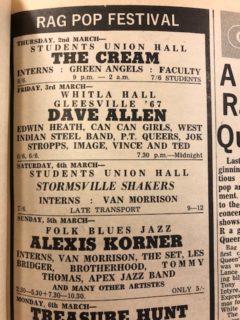
(4) The Belfast Telegraph reports that Van Morrison is one of the opening acts for The Stormsville Shakers at Queen’s University’s student union in Belfast together with The Interns.
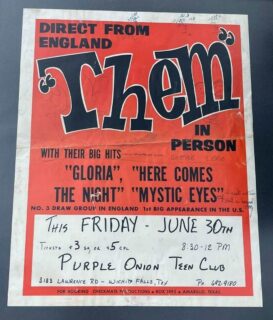
June (30) The US-based Them appear at the Purple Onion Teen Club, Wichita Falls, Texas.
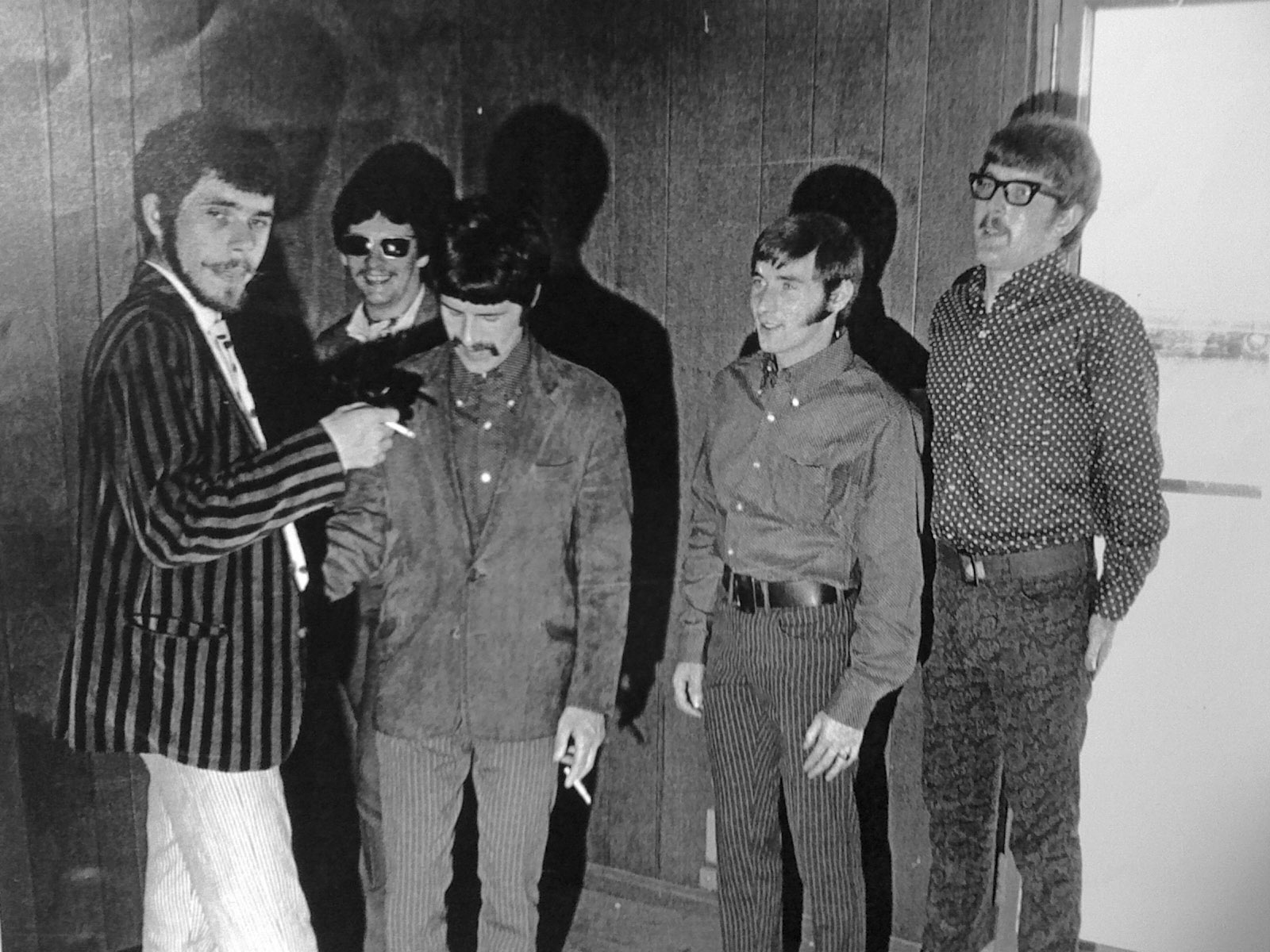
July (12) According to the Childress Index, Them appears at Fair Park Auditorium, Childress, Texas. The next day they also play a gig in Farmington, New Mexico. The newspaper says they will tour for five months and play 20 times in Texas.
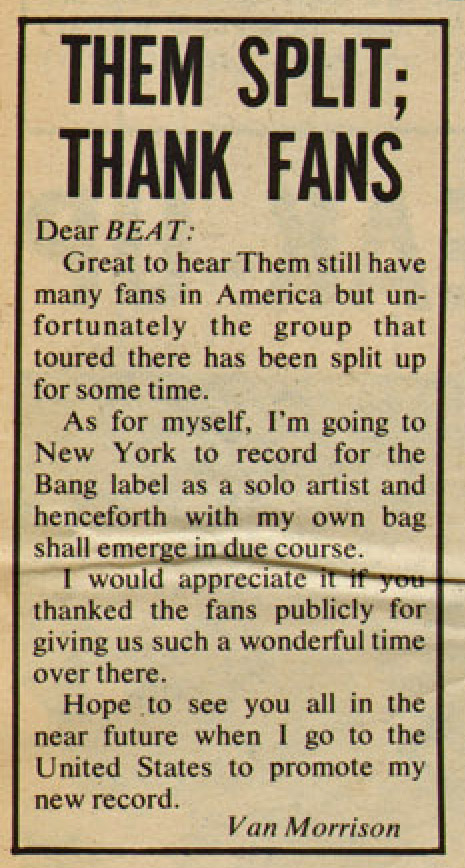
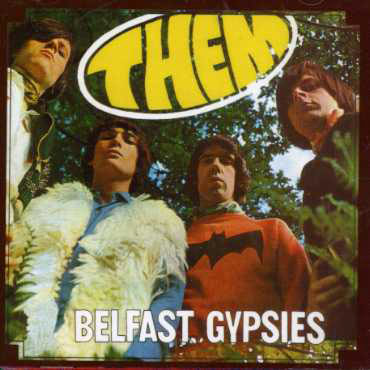
August Nearly year after the band’s final performance, the McAuley brothers’ group The Belfast Gypsies have a belated album release on the Swedish label Sonet as Them Belfast Gypsies. Having relocated to Amarillo, Texas, Henderson’s Them release their debut single without Morrison, a cover of Tom Lane’s “Dirty Old Man (At The Age Of Sixteen)” / “Square Room” on Sully Records before a nation-wide distribution deal is struck with Tower Records.
(10) The Evening Sentinel reports that Eric Wrixon’s latest group, The Never Never Band appear at the Golden Torch in Tunstall, Staffordshire.
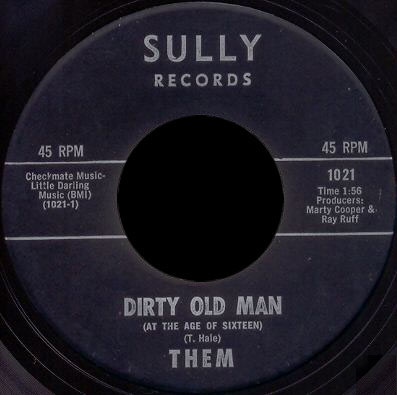
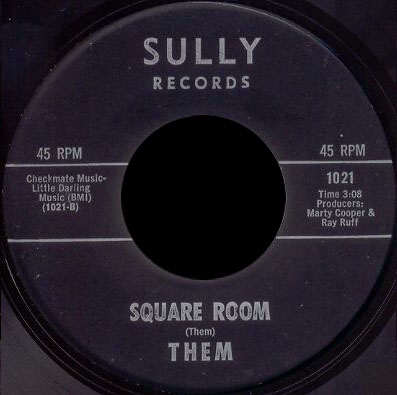
September Starting off in Amarillo, Henderson’s group kicks off a major tour. The gruelling 61-date tour takes the musicians across the US Midwest and then to Los Angeles, where Them begin work on its first album without Morrison. Santa Rosa, California-based newspaper, the Press Democrat notes in its 1 January 1968 issue that the LP is recorded in studios in Texas, Oklahoma and Hollywood, California.
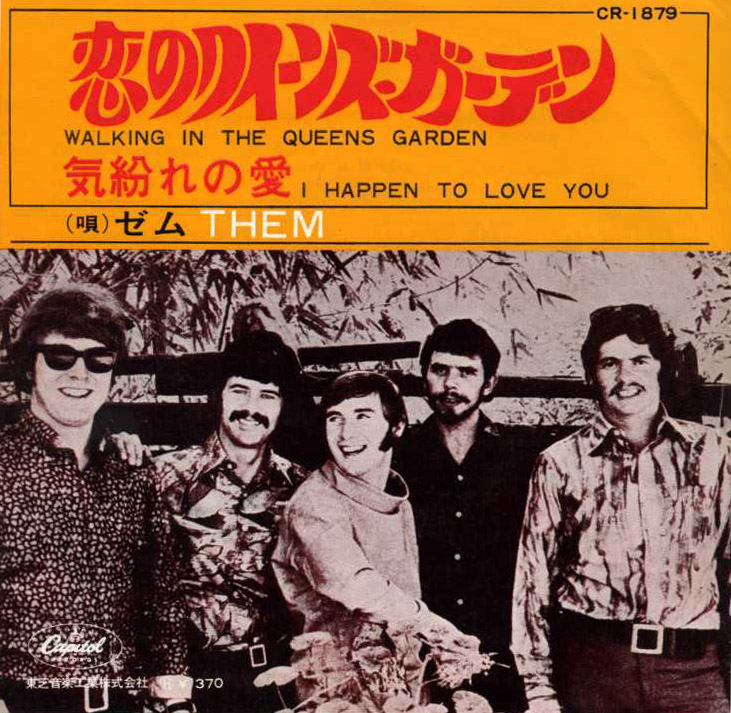
November Henderson’s Them release a second 45, the band composition “Walking In The Queens Garden” b/w “I Happen to Love You” on Ruff Records.
December Tower issues two singles, one includes newly recorded versions of “Dirty Old Man (At The Age Of Sixteen)” and “Square Room” and the second reissues the Ruff 45.
(8-10) The band appears at the Whisky-A-Go-Go, West Hollywood, California with Love and Blue Cheer. Santa Rosa paper the Press Democrat, says they play at the Vets Building in Santa Rosa, California over the Christmas weekend.
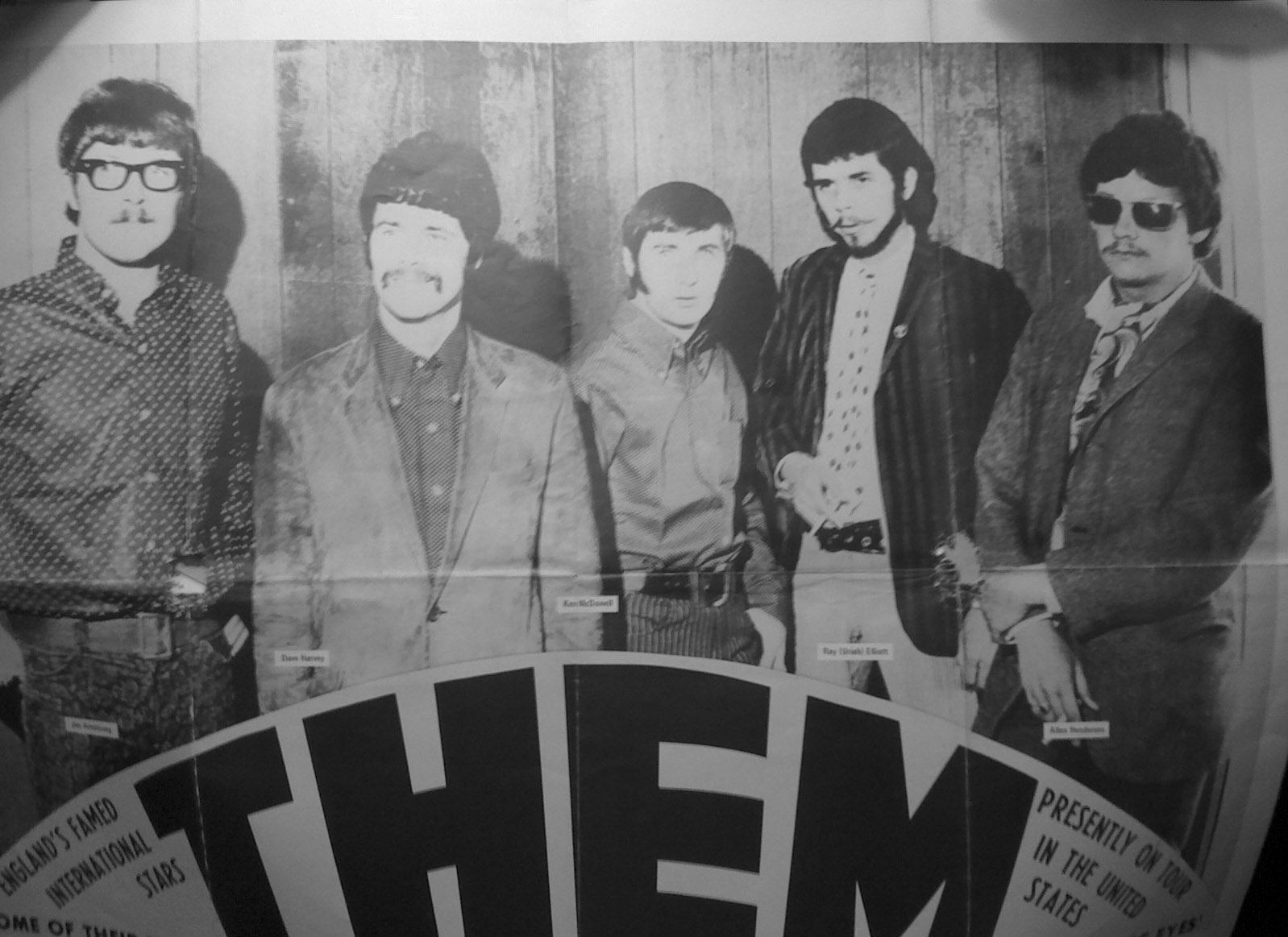
 1968
1968
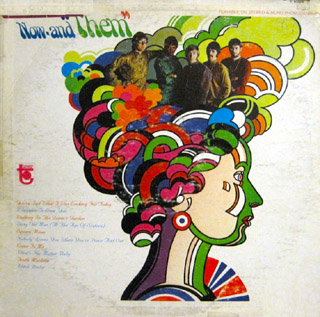
January A new album, Now And Them is released featuring Them’s reply to the Doors’ “The End”, the extended raga piece “Square Room”.
February Tower reissues the Ruff 45 of “Walking In The Queens Gardens” but its success is limited to the West Coast.
March (24) The Hamilton Spectator’s 22 March issue, page 30, notes Them are playing in Toronto and will appear at Carl’s in Hamilton, Ontario on this date with David Clayton-Thomas and Combine. The group’s incessant touring prompts Elliott to quit the band while Them are in New York. He returns to Belfast briefly before working with an Irish showband in Leeds alongside guitarist Eric Bell from “Them Again”. Bell soon returns to Belfast to replace guitarist Gary Moore in The Shades of Blue before working with the Dublin-based The Dream showband.
April “But It’s Alright”, an out-take from the album is released as a single but doesn’t sell.
(11) According to the Odessa American newspaper, Them plays at Ector County Coliseum, Odessa, Texas.
May (24-25) Henderson’s Them appear alongside The Incredible String Band at the Kaleidoscope, Hollywood, California.
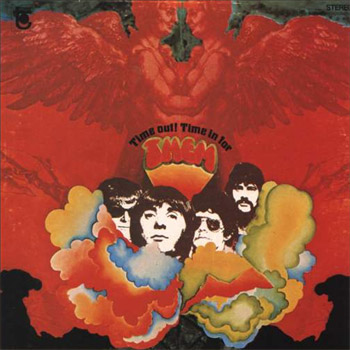
July The title track from their forthcoming album Time Out For Time In is released but is not a success.
August (14-15) The band plays with Frank Zappa & The Mothers of Invention at the Electric Theatre, Chicago. Them also performs at the Baton Rouge Festival on a bill that features Freddie King.
November Them’s second album Time Out Time In For Them is released. It has been recorded at Los Angeles’ Gold Star studios in the wake of Elliott’s departure and features session drummer John Guerin on a number of tracks. A single “Waltz Of The Flies” is extracted but fails to chart.
1969
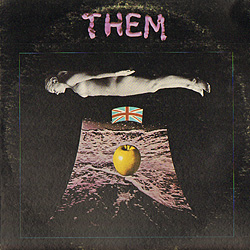
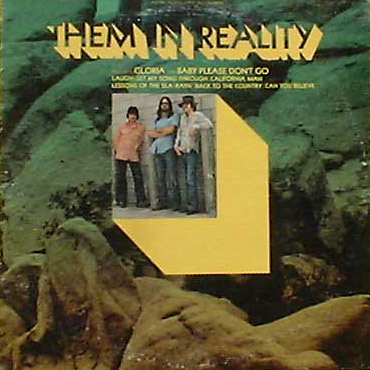
March Them’s final single, a cover of the traditional Corinna is released but fails to chart. Unhappy with Ruff’s management and production, Armstrong and McDowell leave and return to Belfast where they put together Sk’Boo with Ricky McCutcheon and Colm Connolly. Henderson, meanwhile, remains with Ruff in L.A. and continues with the Them name; using guitarist Jim Parker and drummer John Stark from Amarillo band, The Kitchen Cinq, he produces two further albums: Them (1969) and In Reality (1970) for the Chicago label Happy Tiger. David Harvey also stays behind in California but will leave the music business.
June After working briskly throughout Ireland and the British mainland, Armstrong and McDowell shelve Sk’Boo (after a farewell gig in Wolverhampton) and return to the US later that year. Based in Chicago, the duo recruit an American rhythm section comprising bassist Curt Bachman (ex-The Buckinghams) and drummer Reno Smith formerly of Baby Huey and The Babysitters in a new group called Truth, which becomes house band at Beavers. The Chicago Tribune‘s 2 November 1969 issue runs a spread on the newly formed group. The band tours extensively around the Chicago area for the next 18 months, and also contributes several songs to the soundtrack for Pat Mulcahy’s film Cum Laude Fraud (later released as College For Fun And Profit), before being offered a recording deal with Epic Records. Ex-Them member Ray Elliott rejoins the band during its lifespan but subsequently leaves after contributing to some recordings and returns to England.
July (26) Them and Truth* both appear at the Eugene Pop Festival, Hayward Field, University of Oregon, Eugene alongside Alice Cooper, The Doors and others.
* Neal Skok and I have been trying to find out for some time now what “Them” this was — there is a slim chance it was the Tower Records ensemble. But the “Truth” that is listed for this gig is most definitely not the Chicago-based Truth comprised of the ex-Them gents (whose CD Neal and I put out on his “Epilogue” label in ’94). This “Truth” was a NW teen rock band – and of course there were several Christian bands that used that name in the ’60s and later.
– John Berg
October Having returned from Germany and joined The Trixons showband, original Them member Eric Wrixon joins guitarist Eric Bell from the short-lived “Them Again” in the original Thin Lizzy. He leaves in early 1970 and returns to Germany to play with Junior Walker, Junior Wells and Buddy Guy among others.
1970
January (21) Truth play at the New Cellar, Chicago alongside The Mauds.
March Having moved to Beirut in Lebanon with The League of Gentlemen the previous year, former Them member Jackie McAuley returns to England and forms Trader Horne with Judy Dyble, who has previously worked with the original Fairport Convention. The duo release the album, Morning Way, which features contributions from former Them member Ray Elliott. When Trader Horne split later in the year, McAuley forms the short-lived One with Rosko Gee and Adam Marsh before starting on a solo album.
1971
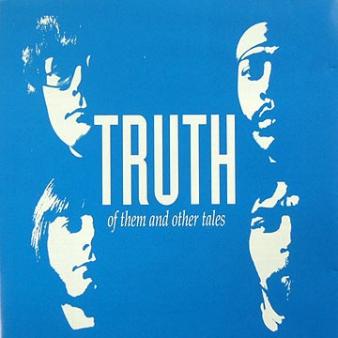
February Truth return to Belfast for a working holiday before sessions in London begin later that month. Unfortunately, Epic Records undergoes a change in management and following a communication problem, Truth’s band members fall apart before they have a chance to enter the studio. Elliott subsequently moves to Canada (where he dies in June 1993 in Toronto), while Bachman and Smith return to the US. Armstrong and McDowell move back to Belfast where Armstrong joins the Civil Service and McDowell becomes a member of The College Boys. (Truth’s private recordings and studio sessions from Chicago are later released by Epilogue Records as The Truth Of Them And Other Tales in 1995.)
March Jackie McAuley releases his eponymous debut solo album on the small Dawn label, before later working with bands Wand and Mackeral Sky. He also spends four years working with Lonnie Donegan. Jackie’s brother Pat (who turns down an offer to play with Marc Bolan), sadly dies in a drowning accident in Donegal on 11 August 1984.
1972
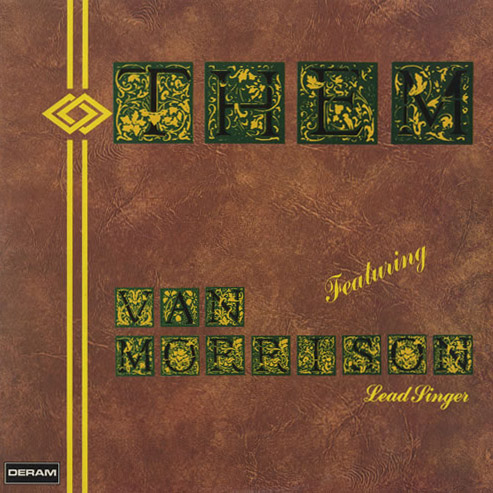
August Compilation album Them Featuring Van Morrison hits US #154.
1973
After working with cabaret singer Roly Stewart, Jim Armstrong has rejoined Ken McDowell in The College Boys in the early 1970s. The pair then join Reunion before working with another former Them member John Wilson in Bronco. The pair also form the band Spike, which works at the Pound club in Belfast. Wilson subsequently becomes Northern Ireland’s top session drummer.
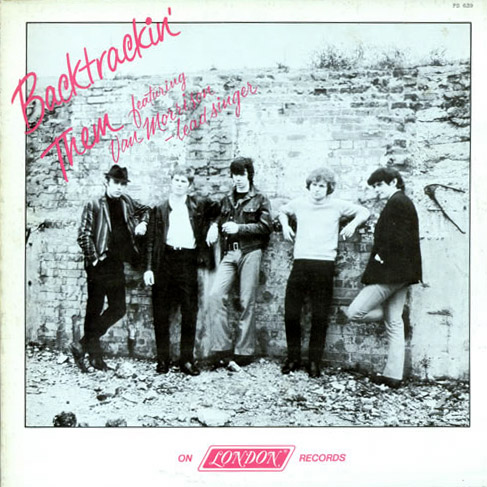
1974 Backtrackin’ released only in the U.S., featured obscure b-sides and songs not previously available in the U.S.: “Richard Cory”, “I Put a Spell on You”, “Just a Little Bit”, “I Gave My Love a Diamond”, “Half as Much”, “Baby Please Don’t Go”, “Hey Girl”, “Don’t Start Crying Now”, “All for Myself” and “Mighty Like a Rose”. All the tracks except the last, however, were in simulated stereo.
1978
Armstrong leaves Spike and forms his own band Light, who record an eponymous album on the small Mint label in Ireland only.
1979
Billy Harrison reforms Them with original keyboard player Eric Wrixon. Initially, Harrison intended to complete the group with John Wilson, who’d played drums on Them Again album, together with bass player Jackie Flavelle and singer Mel Austin but Wilson and Flavelle drop out prompting him to bring in drummer Billy Bell. He also brings back Henderson, who has spent several years working on his Connecticut farm. Them move to Germany where they hold down a residency in Hamburg. While there the group records the album Shut Your Mouth for Teldec/Decca before Jim Armstrong and Brian Scott from Light replace Harrison and Wrixon. However, after a brief tour of Germany the group splinters. Armstrong reunites with Ken McDowell in a new version of Sk’Boo, who release one single “It’s A Hard Road” for the small Cuecomber label.
1980
Harrison emerges with the solo album Billy Who? on the German Vagabond label. He then abandons a music career and become a marine electrician. Jackie McAuley spends most of the 1980s and 1990s working with Poor Mouth, who release a number of albums, including Gael Force. In 1982, he co-writes “Dear John”, which is a hit for Status Quo.
1989
Original member Eric Wrixon forms The Belfast Blues Band with another former Them member, John Wilson.
1994
Jackie McAuley emerges with a new solo album, Headspin. Guitarist Jim Armstrong meanwhile has formed The Belfast Blues Band with original Them member Eric Wrixon. His former band mate, Ken McDowell has continued to work with Sk’Boo and then plays with Hens Teeth before forming The Kenny McDowell/Ronnie Greer Band in the early 2000s.
1998
Jackie McAuley releases another solo release, Shadowboxing.
2000
Jackie McAuley puts out another solo release, Bad Day At Black Rock. McAuley subsequently joins The Harbour Band, who release the album Live In The Spirit Tour in 2003.
2003
The Ken McDowell/Ronnie Greer Band release the album, Live At The Island. Jim Armstrong leaves The Belfast Blues Band and reforms The Jim Armstrong Band.
Sources:
Clayson, Alan. Call Up The Groups – The Golden Age Of British Beat,
Blandford Press, 1985, pages 168-170.
Doggett, Peter. “Them”, Record Collector # 149, January 1992, pages 112-116
Du Noyer, Paul. “Heart & Soul Of Van Morrison”, Mojo Magazine, November 1993, page 84.
Gray, Michael. Mother – The Frank Zappa Story, Plexus, 1993.
Grushkin, Paul D. Art Of Rock – Posters From Presley To Punk, Artabras, Cross River Press Ltd, 1987.
Harper, Colin. Sleeve notes to CD Belfast Beat, 1998.
Harper, Colin and Hodgett, Trevor. Irish Folk, Trad & Blues – A Secret History, Cherry Red Books, 2004.
Hodgett, Trevor. “Them After Van Morrison”, Record Collector #89, pages 52-57.
Hogg, Brian. “Van Morrison & Them”, Strange Things Are Happening, Vol 1, #4, Sep/Oct 1988, Bam-Caruso Books, pages 6-14 and 20.
Housden, David Peter. The Castle, Love #9, December 1995, page 28 and 57.
Housden, David Peter. The Castle, Love #10, 1996, pages 6-7.
Rees, Dafydd and Crampton, Luke. Guinness Book Of Rock Stars, 2nd Edition, Guinness Publishing, 1991, page 528.
Rogan, Johnny. CSN&Y – The Visual Documentary, Omnibus Press, 1996, page 10.
Shaw, Greg. The Doors On The Road, Omnibus Press, 1997, pages 14 and 172.
Turner, Steve. Van Morrison – Too Late To Stop Now, Bloomsbury, 1993, pages 49 and 60.
Unterberger, Richie. “Belfast Gypsies” article in Ugly Things issue 23.
Whitburn, Joel. Bubbling Under Hot 100 1959-1985, Billboard Researchers Inc, 1985.
Sleeve notes to the Deram Anthology The Story Of Them – Featuring Van Morrison, 1997.
Sleeve notes to Epilogue CD, The Truth Of Them And Other Tales, 1995.
Melody Maker, March 5, 1966, page 13.
News clippings from KRLA Beat.
Gigs from Beat Instrumental and Melody Maker.
Thank you to John Warburg, Simon Gee, Nigel Norman. Tom McCarty and Mike Markesich.
Copyright © Nick Warburton. All Rights Reserved. No part of this article may be reproduced or transmitted in any from or by any means, without prior permission from the author.
Email: Warchive@aol.com
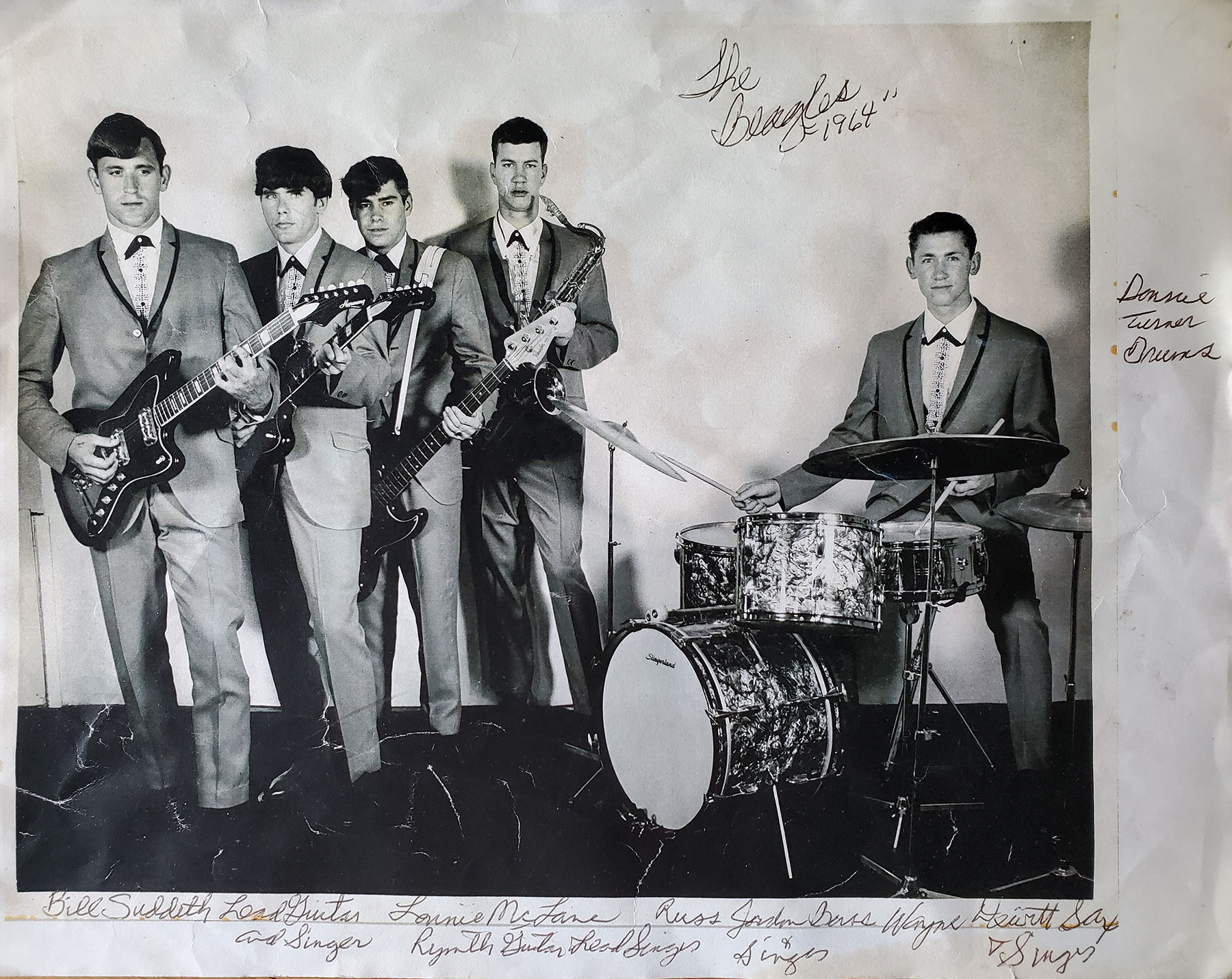
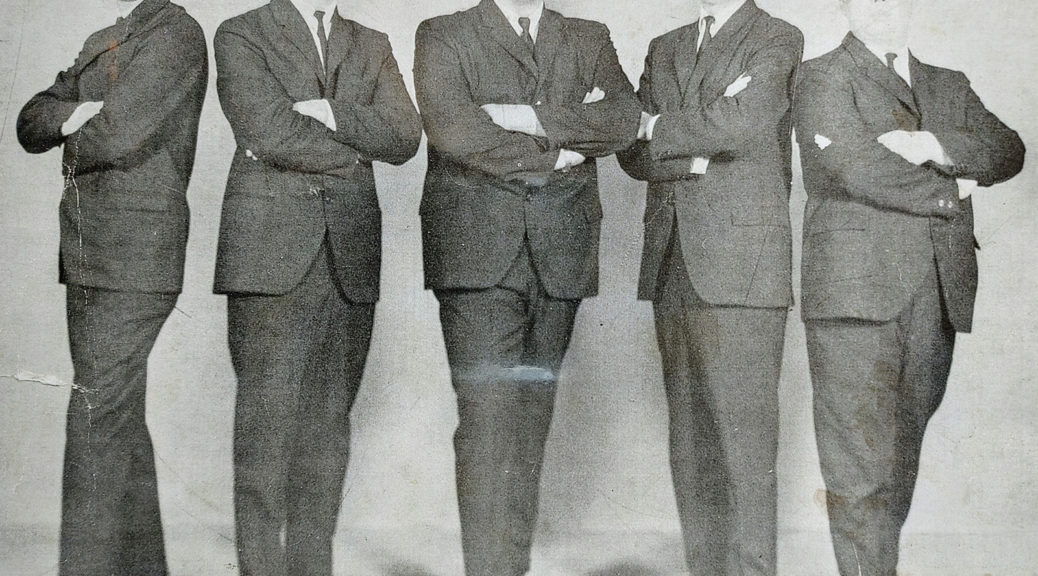
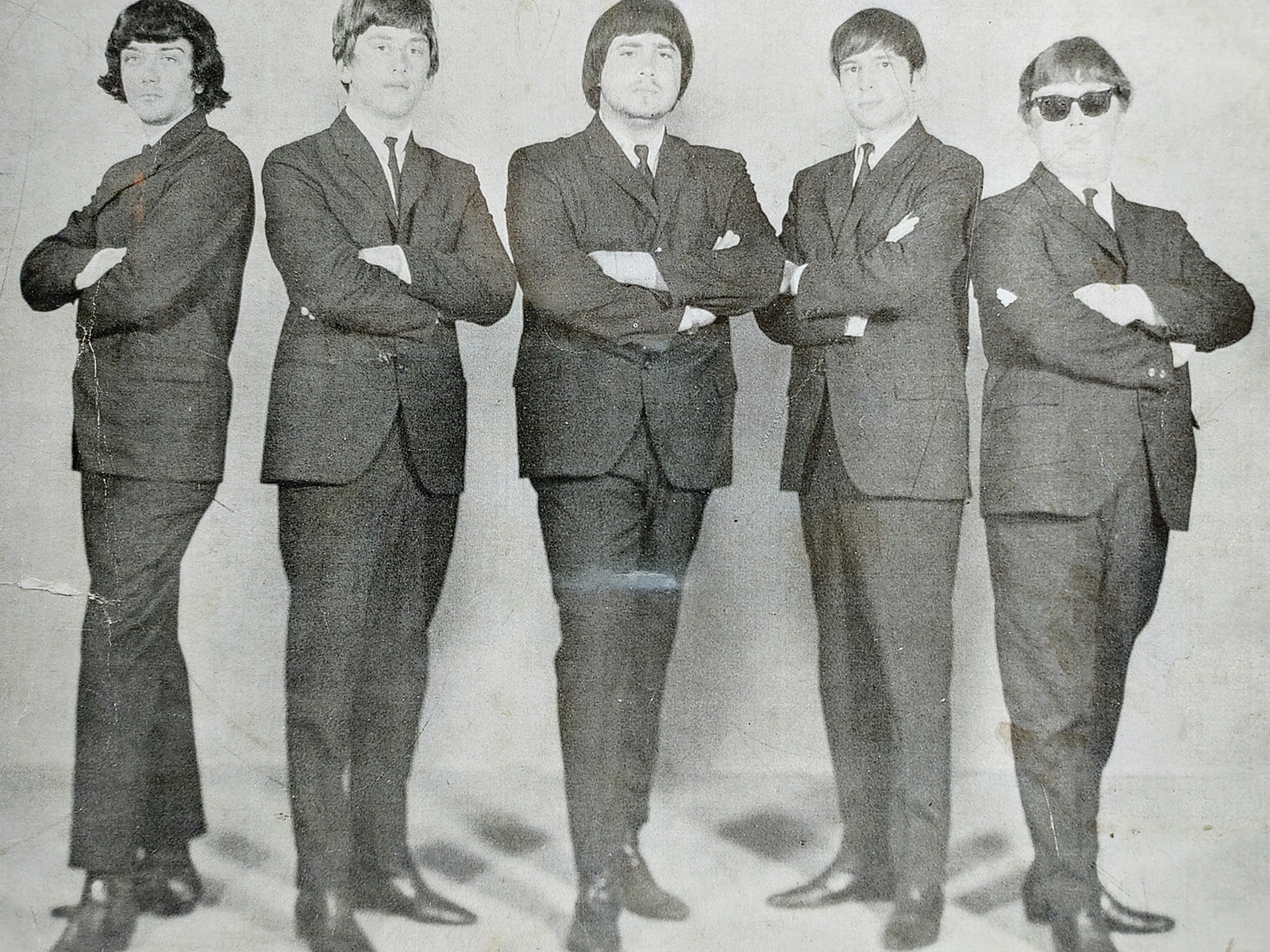
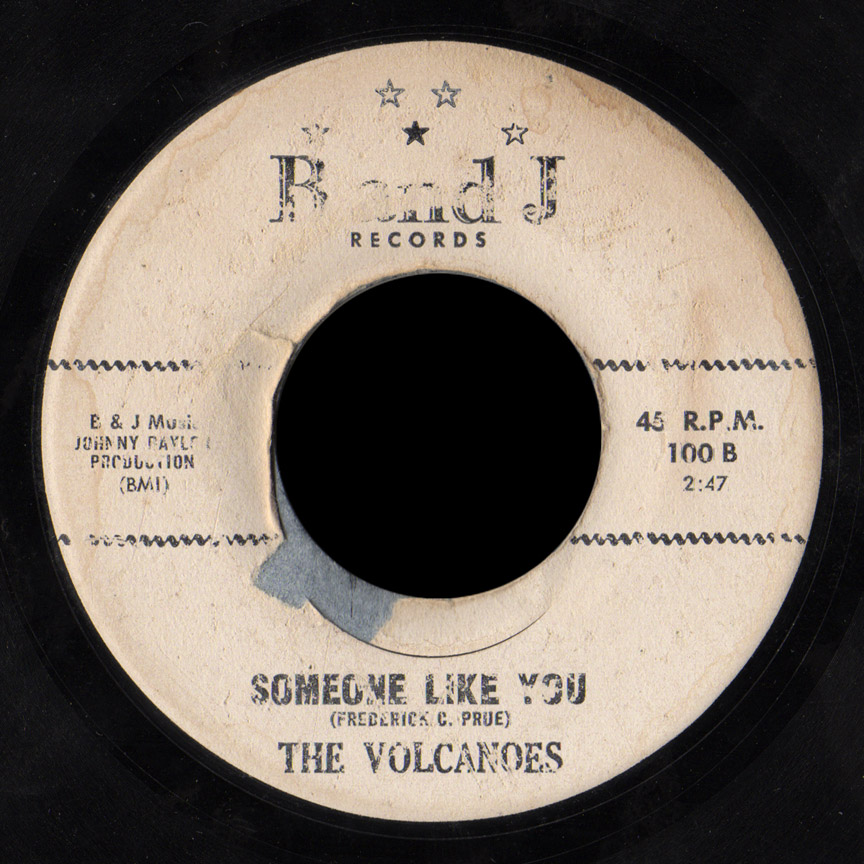
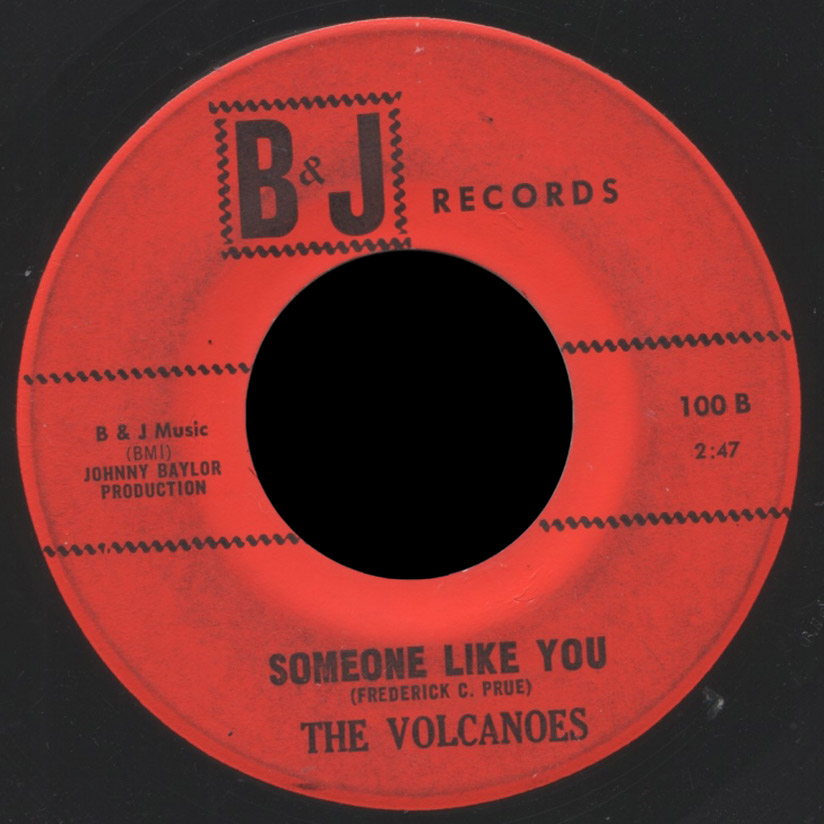
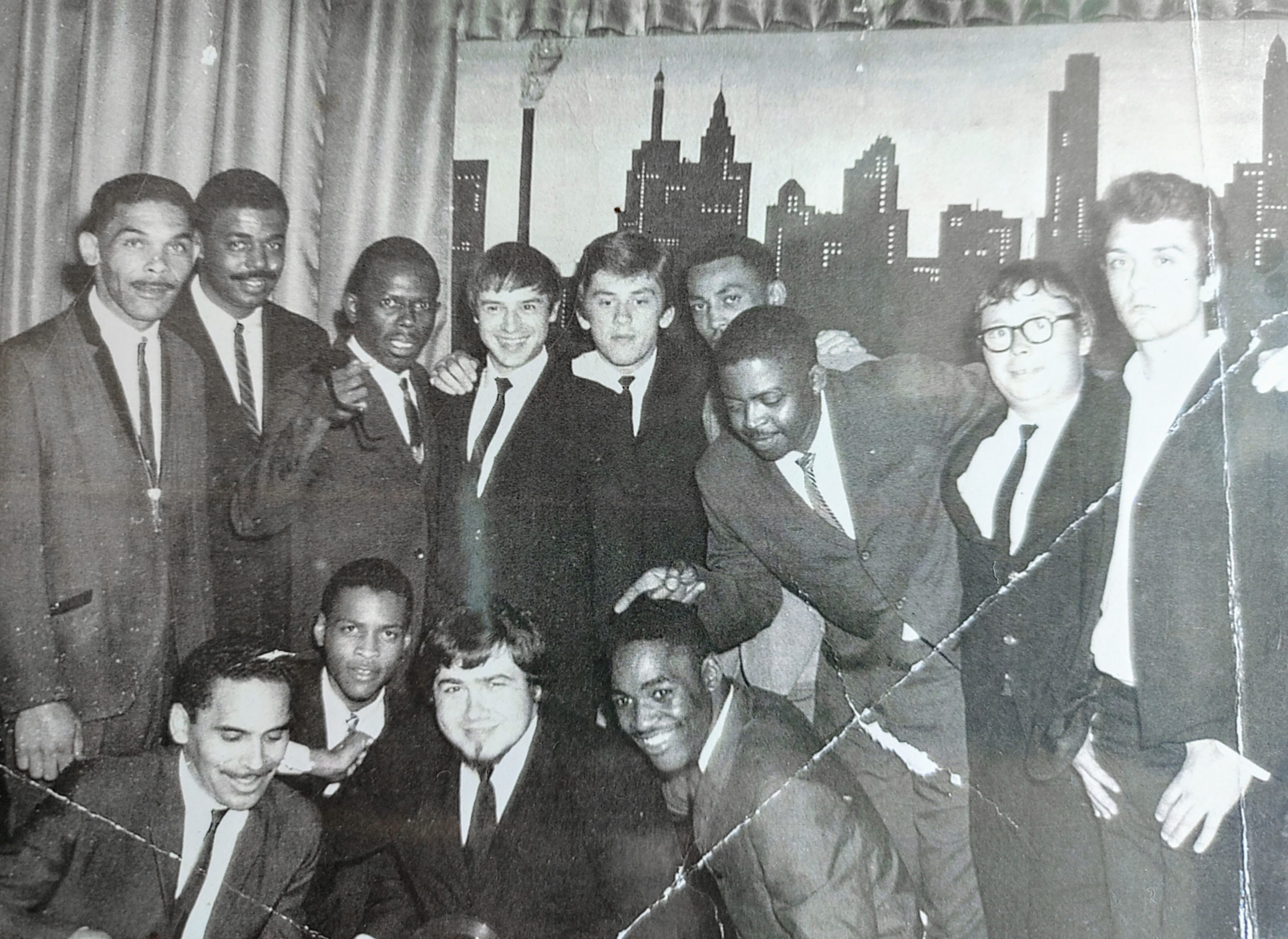
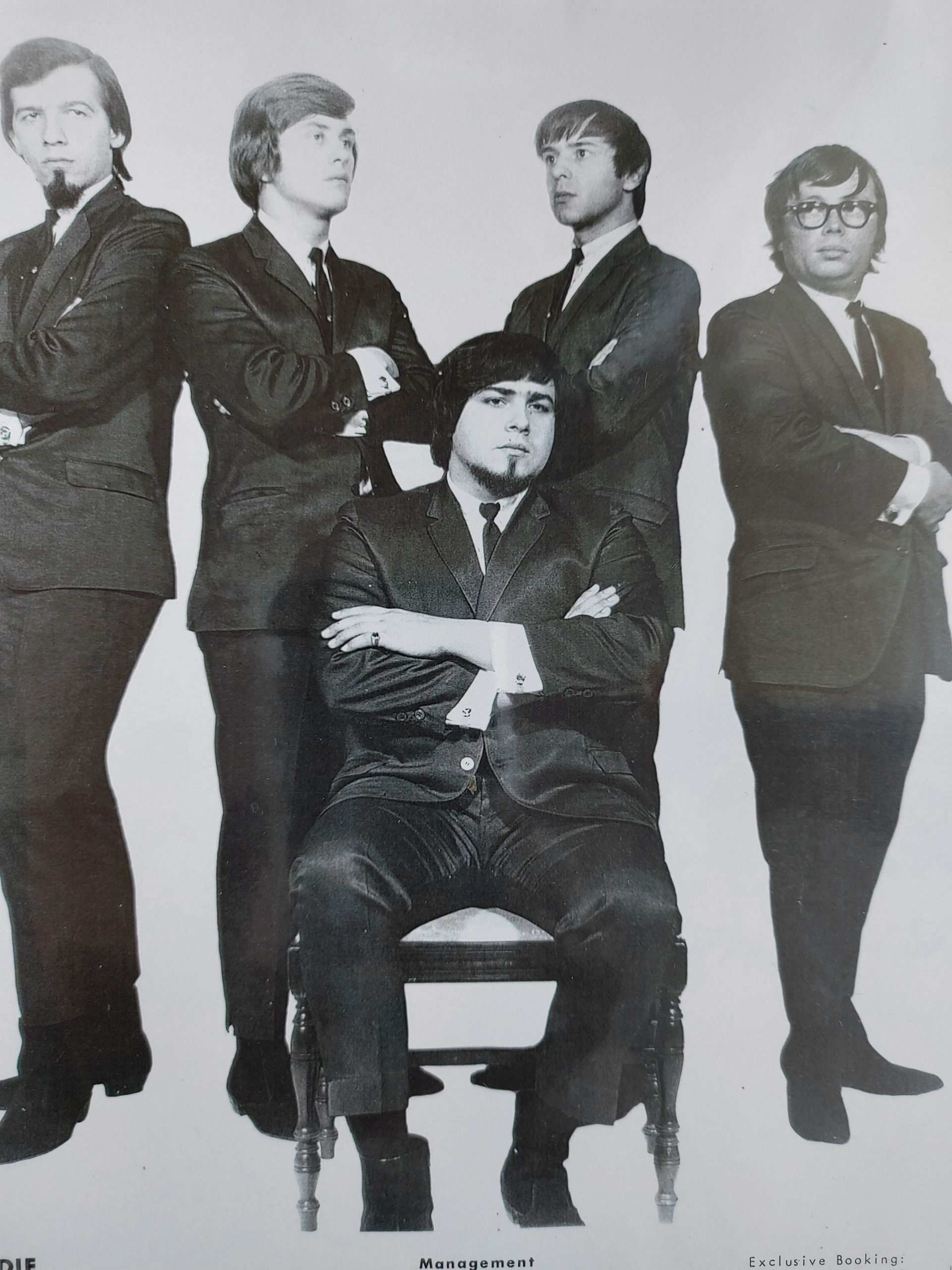
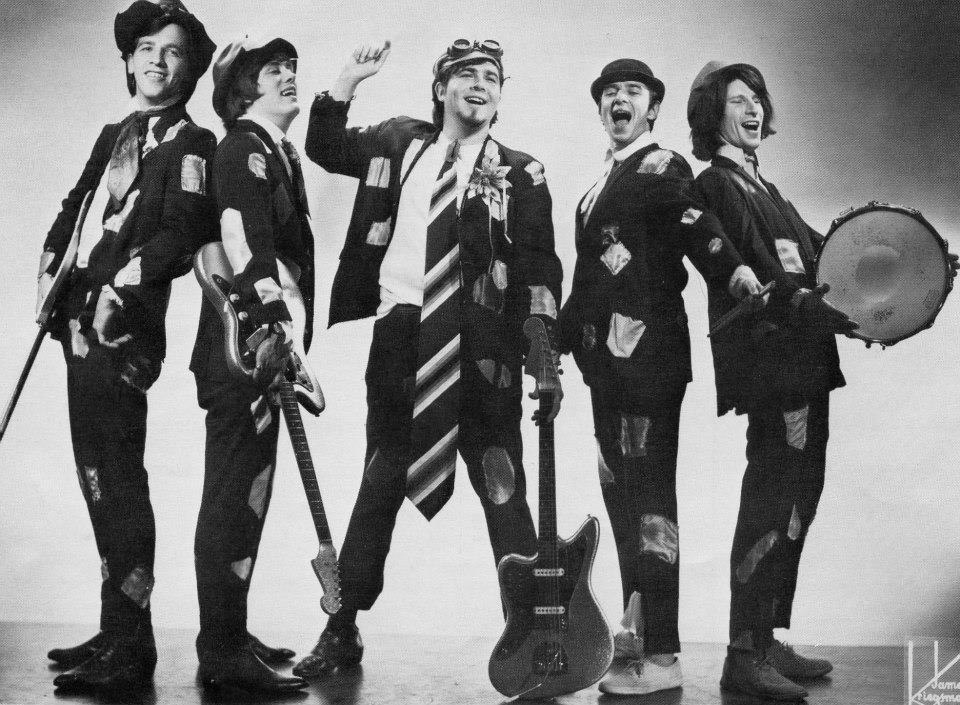
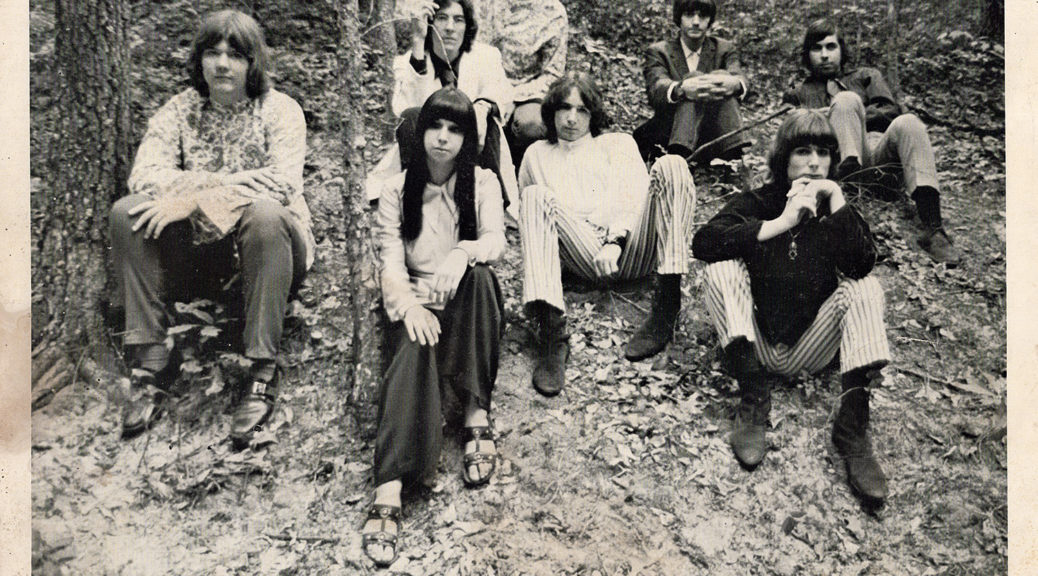
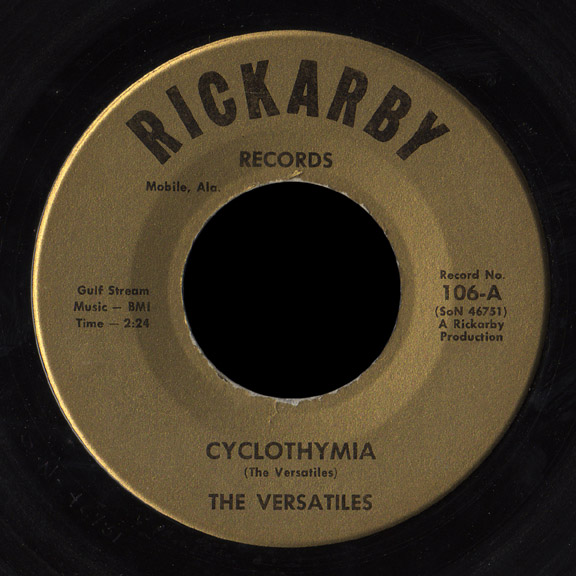 The Versatiles were from Mobile, Alabama. They played at The Happening and the Stork Club, among other venues. Members were: