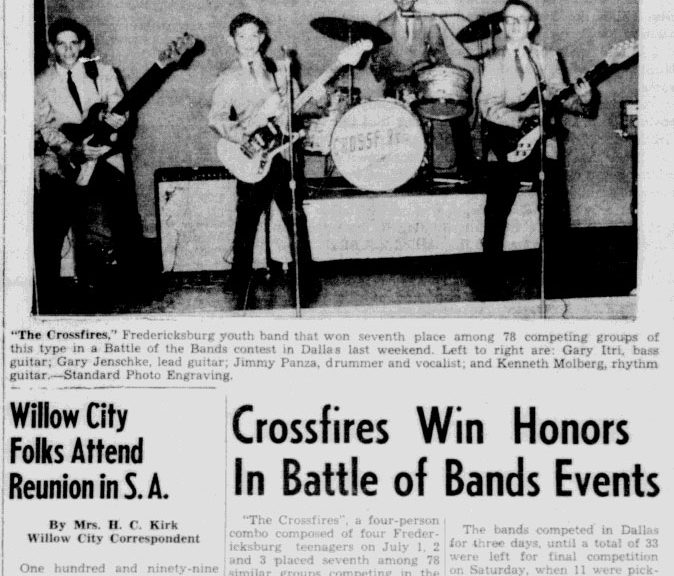
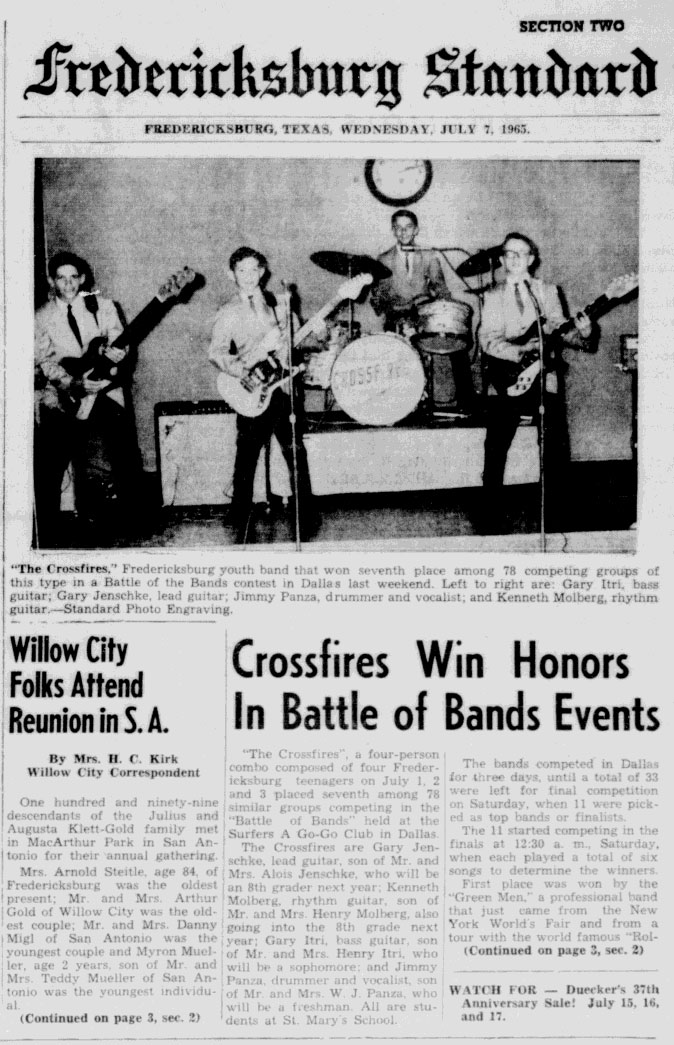
The Fredericksburg Standard of July 7, 1965 published a photo and profile of the Crossfires, a band that would go on to become the Fountain of Youth.
The Crossfires won seventh place among 78 groups at a battle of the bands at the Surfers A Go Go club in Dallas. They were all students at St. Mary’s School in Fredericksburg.
Gary Itri – bass guitar Gary Jenschke – lead guitar Jimmy Panza – drummer and vocalist Kenneth Molberg – rhythm guitar
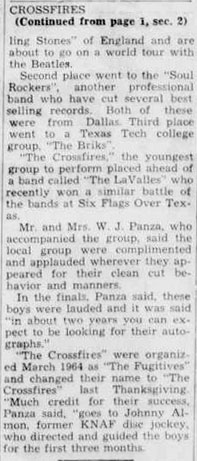
Two bands from Dallas won the top prizes: the Green Men, (I believe that would be Johnny and the Green Men) won first place and the Soul Rockers second. The Briks from Denton came in third.
The article notes that the Crossfires were the youngest group in the contest, and placed ahead of the LaVelles. The Crossfires started in March 1964 as the Fugitives, and had guidance from KNAF DJ Johnny Almon.
Although the article states that the Soul Rockers “have cut several best selling records”, I am unaware of any by that group name.
The Crossfires cut a version of Robb London and the Rogue‘s “Who’ll Be the One” / “Making Love Is Fun” on Tower 278 in 1966. I’ve seen a copy with a stamp from the Itri Record Shop in Fredericksburg!
The band relocated to California and with a name change to the Fountain of Youth, had four singles on Colgems. Billboard ran a full-page ad titled “Fountain of Youth has been discovered in Texas” to promote their first Colgems single, “Livin’ Too Fast”.
I’m a big fan of the B-side of their second Colgems single, “Don’t Blame Me (for Trying)” from June of 1968, by a somewhat obscure song writer, Ken Walker. “Day Don’t Come”, the B-side of “Sunshine on a Cold Morning” is also a standout.
Ken Molberg had left the group by the time of their last single. “Witness People” is the only recorded song that the band wrote themselves, by Itri, Panza and Jenschke. It’s one of their best, with a heavier sound than the earlier singles.
The group had a Kickstarter campaign to remaster & reissue their singles on CDR and vinyl, which has some additional info about the group.
Gary Itri passed away in January, 2014.
If anyone has photos or info on any of these groups please contact me. This photo from the Fredericksburg Standard is not bad by microfilm standards, but better quality photos must be out there.
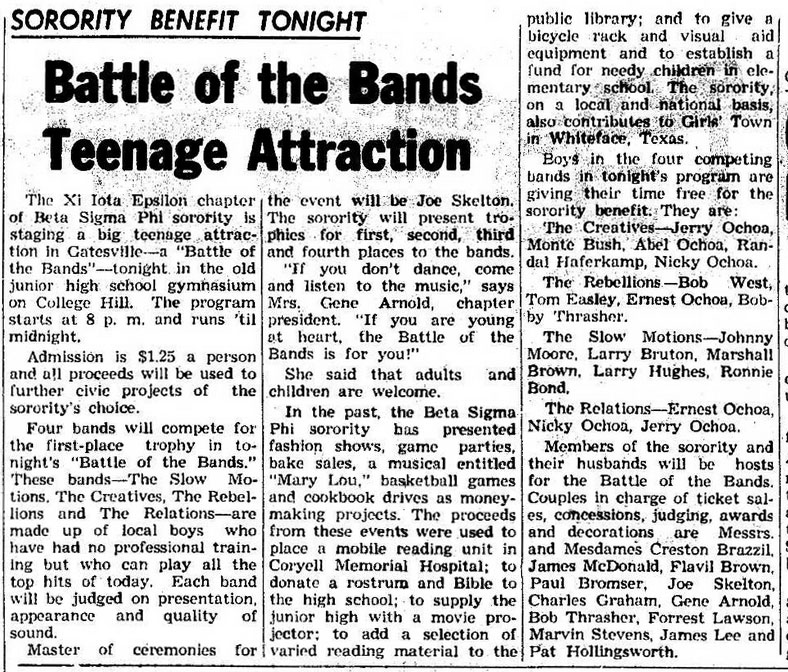
The Gatesville Messenger and Star Forum ran this profile of four groups who competed at a battle of the bands at the Gatesville National Guard armory on January, 26,1968.
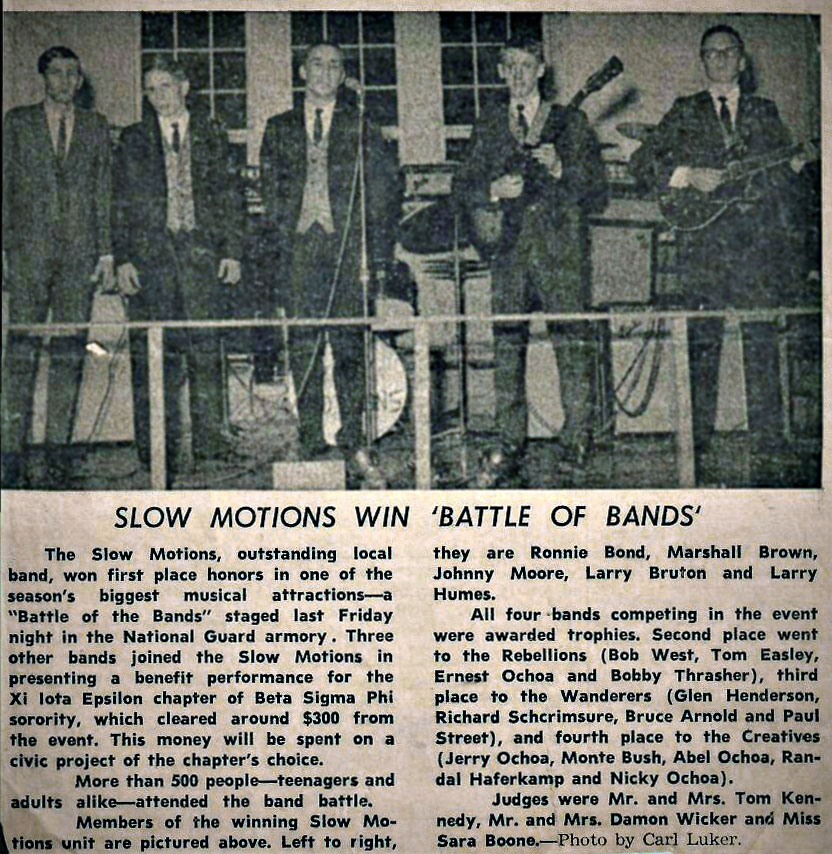
The Slow Motions won the event. Members were Ronnie Bond, Marshall Brown, Johnny Moore, Larry Bruton and Larry Hughes.
Marshall Brown, who played drums with the Slow Motions wrote to me with the photo below and the better-quality news clipping at top:
The Slow Motions played in about a 60-80 mile radius of Gatesville in 1967-1968. Usually on Friday or Saturday night we would be playing in Copperas Cove, Belton, McGregor, Hico, Hamilton, Waco, Gatesville or other surrounding small towns.
The Slow Motions played in about a 60-80 mile radius of Gatesville in 1967-1968. Usually on Friday or Saturday night we would be playing in Copperas Cove, Belton, McGregor, Hico, Hamilton, Waco, Gatesville or other surrounding small towns.
Ronnie Bond – Singer Larry Bruton – Rhythm/Lead Guitar Penny Spencer Massingill – Organ Marshall Brown – Drums Larry Humes – Lead Guitar Johnny Moore – Bass Guitar
Most of us moved on after graduating from Gatesville High School. I went onto college and played the drums.
Johnny Moore played around in some C&W bands. Larry Humes went into the Army. He was a great guitarist back in the day. He lives in the greater LA area now.
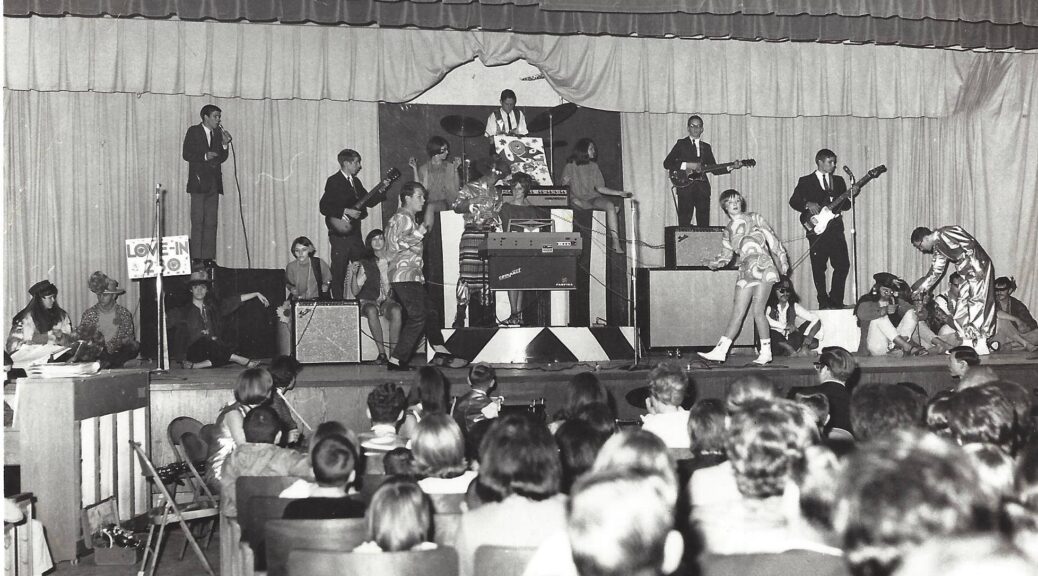
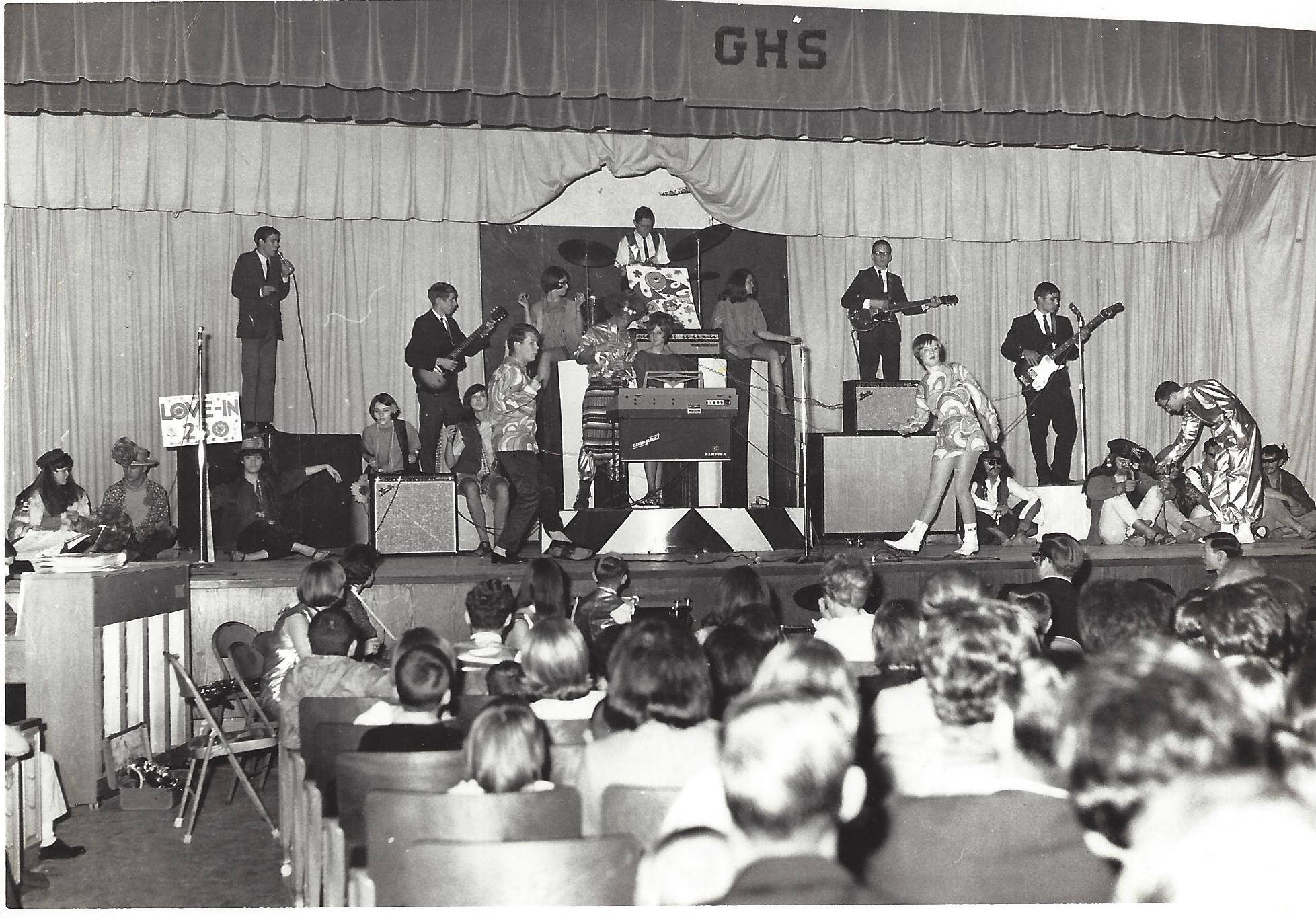
The Slow Motions and friends at the Gatesville High School 1968 Band Follies. From left: Ronnie Bond (with mic, standing on table), Larry Bruton (guitar), Al Pearce (dancer on stage), Penny Spencer Massingill (organ), Deborah McCoy, Marshall Brown (drums), Larry Humes (guitar), Johnny Moore (bass) and Paul Edwards (boy in silver outfit on far right)
The Rebellions won second place, they were Bob West, Tom Easley, Ernest Ochoa and Bobby Thrasher.
The Wanderers won third, members included Glen Henderson, Richard Schcrimsure (Richard Schrimsher ?), Bruce Arnold and Paul Street.
This was the same Wanderers who recorded “Higher Education” / “I Feel So Blue” on T.R.C. Texas Record Company 2067 in 1966. The record added Ronnie Cole as vocalist and song writer. The Wanderers came from Waco, 35 miles east of Gatesville.
Fourth place went to the Creatives: Jerry Ochoa, Monte Bush, Abel Ochoa, Randal Haferkamp and Nicky Ochoa.
An article announcing the event doesn’t mention the Wanderers, but lists another group, the Relations (Ernest Ochoa, Nicky Ochoa and Jerry Ochoa – no wonder the band name), and notes that the groups are all local.
I don’t believe any of the Creatives, the Rebellions or the Slow Motions recorded.
If anyone has more photos or info on any of these groups, please contact me.
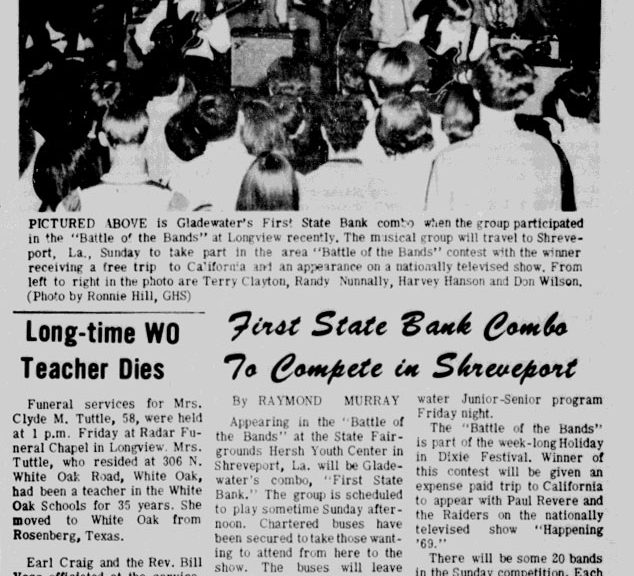
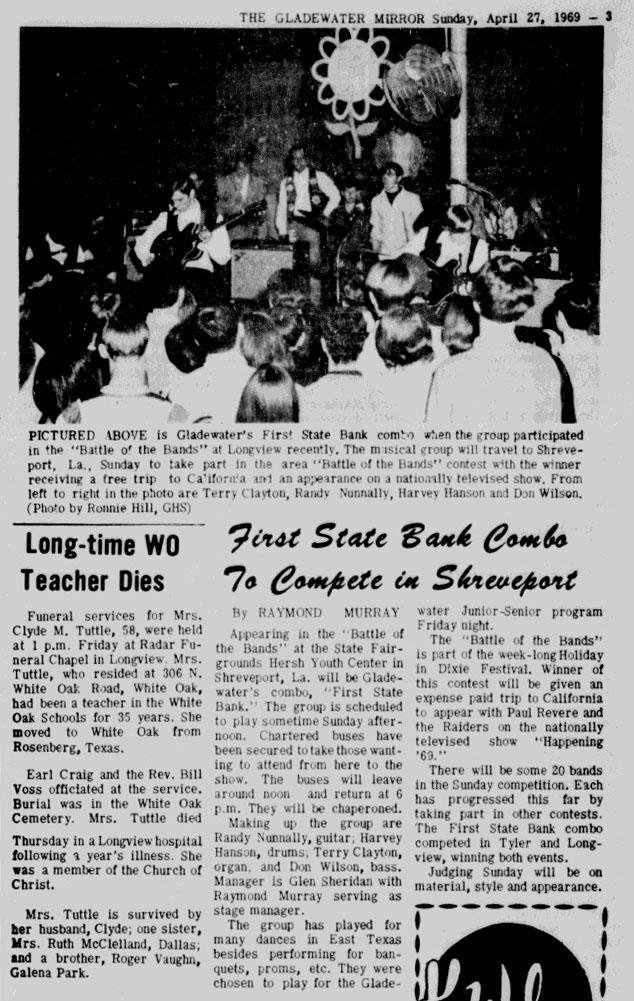
Here is a very early photo of the First State Bank, a band that would last into the 70s and record three highly-regarded hard rock singles. The article comes from the April 27, 1969 Gladewater Mirror.
Members at this early stage were:
Terry Clayton – keyboards Randy Nunnally – guitar Harvey Hanson – drums Don Wilson – bass
The article lists Glen Sheridan as manager and Raymond Murray as stage manager.
The First State Bank won battle of the bands competitions in Tyler and Longview, and would be traveling to Shreveport, LA hoping for a chance to win a “paid trip to California to appear with Paul Revere and the Raiders on the Happening ’69 show.” I haven’t found the results of that contest yet.
The First State Bank originated in Gladewater, a town near Longview and Tyler, but moved to Dallas where they appeared on the club circuit, along with regular shows in Arlington and Houston.
Randy Nunnally wrote all six songs on their records. He seems to have been the only constant in the group, whose membership also included at times:
Donny Hyles Terry Salyer Shannon Day
Kirk Brewster – guitar Michael Williams – bass David Eppes – drums
Marty Warren Rabbitt Scruggs Brian Johnson Kelly Kemp John Windle
Discography:
Music Mill 1012 – “Coming Home to You” / “Mr. Sun” Banke RHB 714 – “It’s Not Easy to Say” / “King Snake” (Sunnybrook Music BMI), recorded at Robin Hood Brians Studio in Tyler Banke 91321 – “A Long Long Time” / “Before You Leave” Mockingbird Music Pub., “A Steve Wright Production”
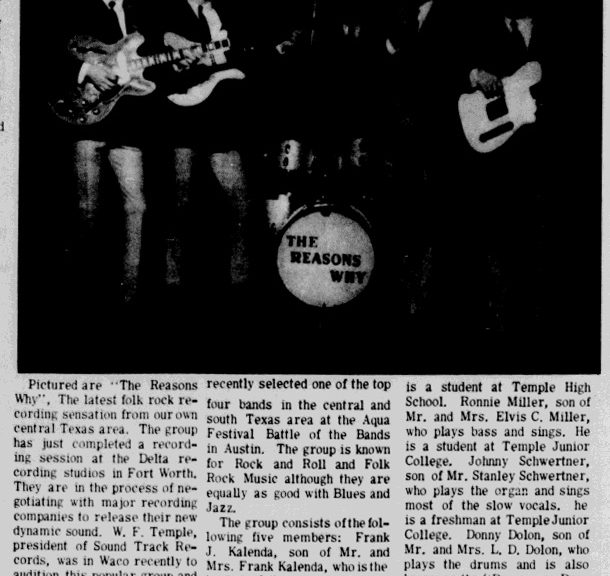
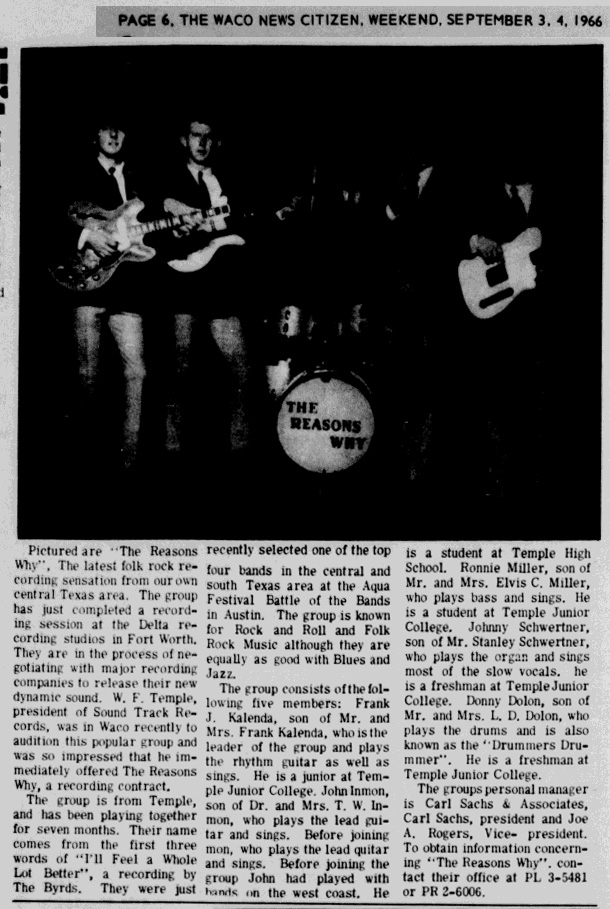
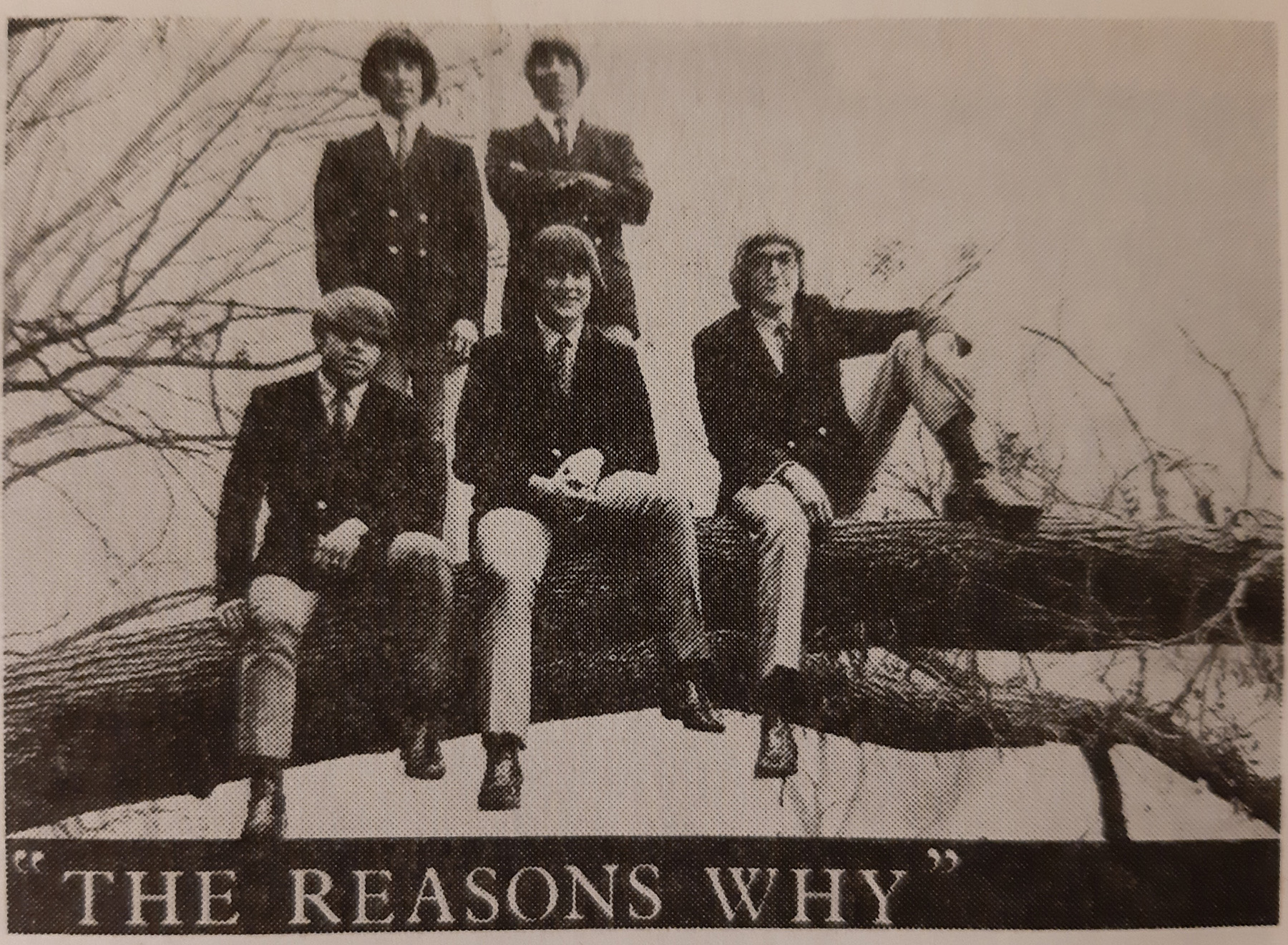
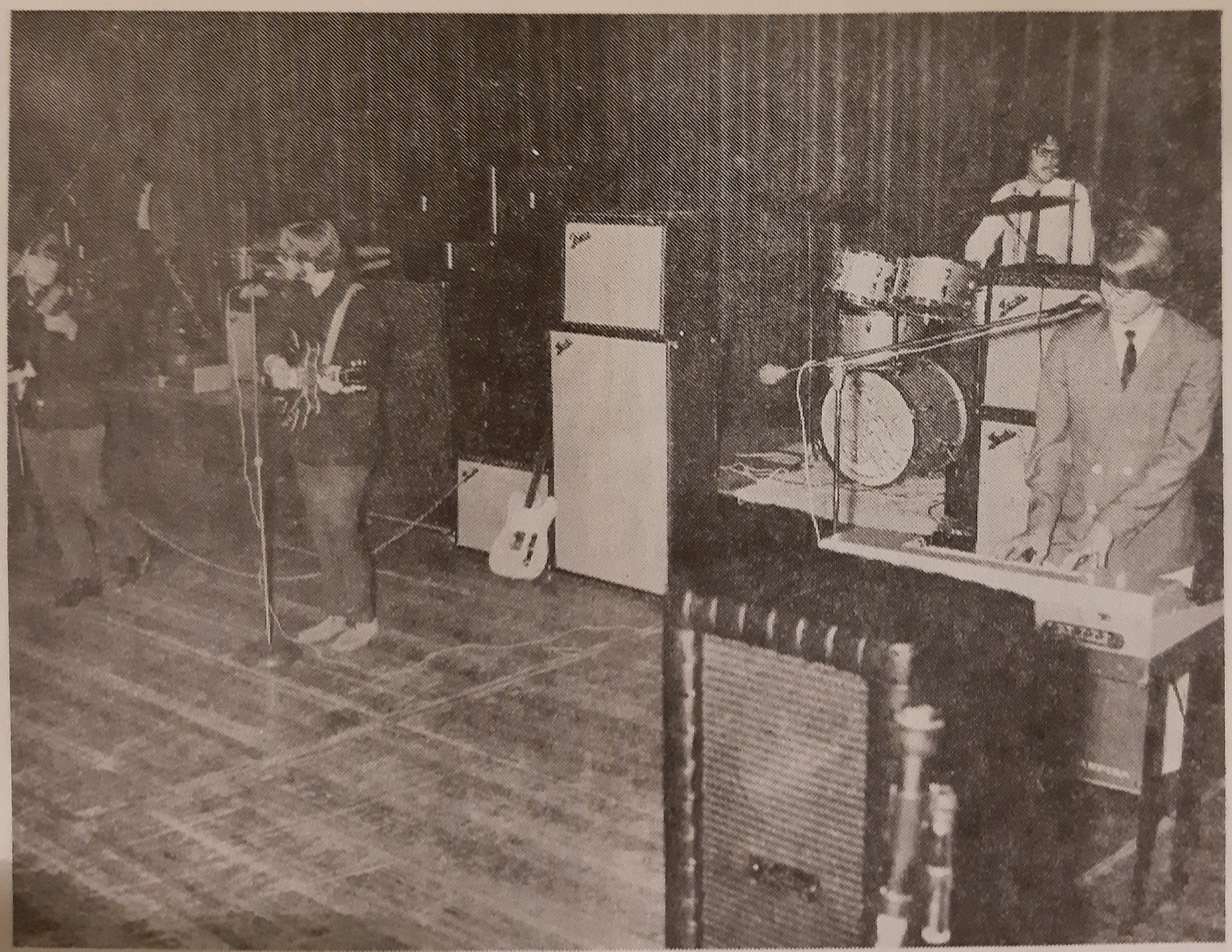
The Reasons Why in the Waco News-Citizen, September 3, 1966. Anyone have a better photo of the group?
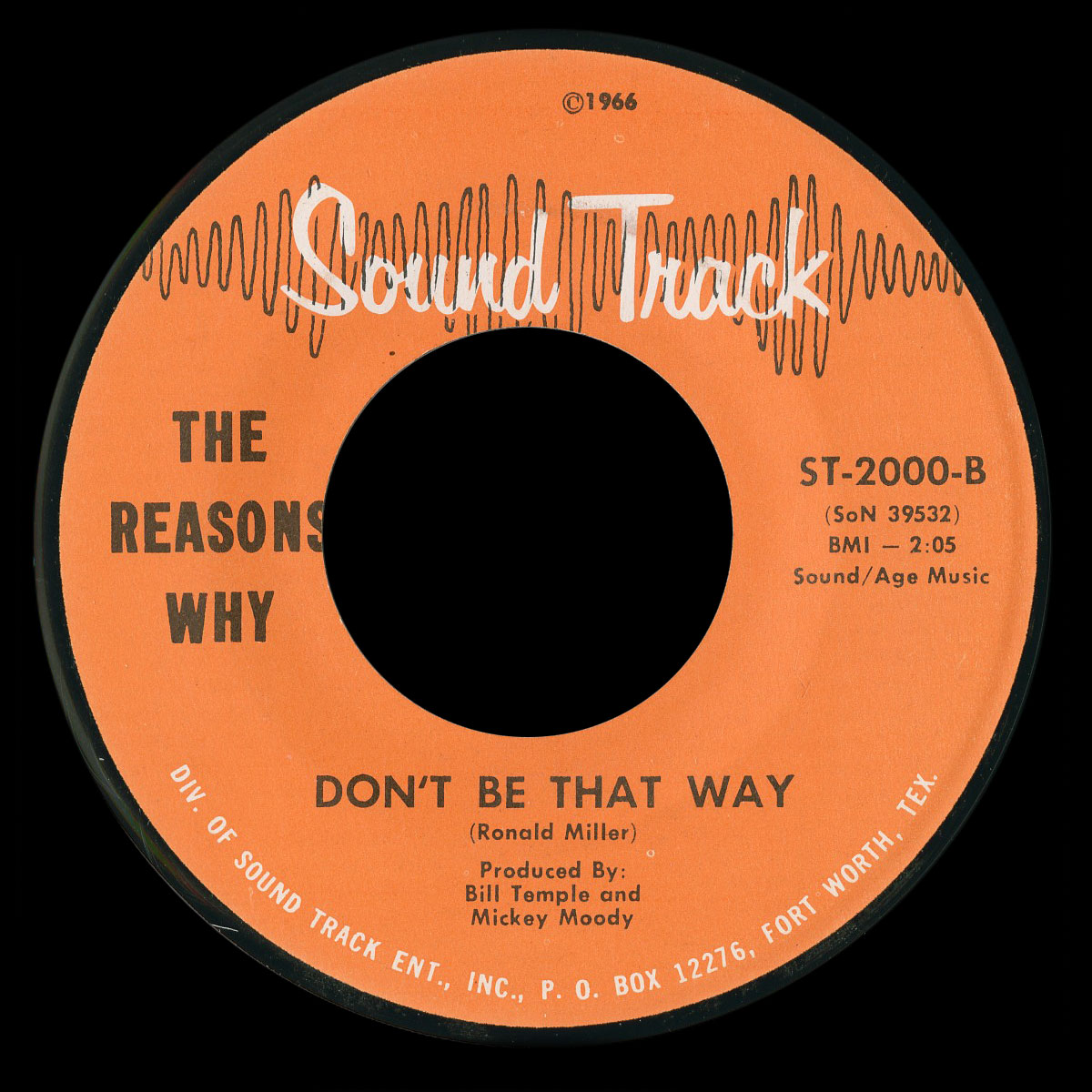
The Reasons Why cut one of the top Texas records in the ’60s, “Don’t Be That Way” on Sound Track ST-2000. I don’t own a copy, but I found this article on the group from the Waco, and since I don’t remember seeing this photo of the group before.
Members of the Reasons Why were:
Frank Kalenda – rhythm guitar and vocals John Inmon – lead guitar and vocals Johnny Schwertner – organ and vocals Ronnie Miller – bass, vocals – replaced by Tommy Langford Donny Dolon – drums and vocals
The article is very informative, noting “The group has just completed a session at the Delta recording studios in Fort Worth” [Delta Recording Center].
“W.F. Temple, president of Sound Track Records, was in Waco recently to audition this popular group and was so impressed that he immediately offered The Reasons Why, a recording contract.
The group is from Temple, and has been playing together for seven months. Their name comes from the first three words of “I’ll Feel a Whole Lot Better”, a recording by the Byrds.”
Most of the group attended Temple Junior College, except John Inmon: “Before joining the group John had played with bands on the west coast. He is a student at Temple High School.”
Carl Sachs managed the band and brought them to the Sound Track label. Bill Temple and Mickey Moody produced the single, released on Sound Track in late 1966 with a SoN 39531/2 mastering code.
“Melinda” was the A-side, written by Denis Jones who does not appear to have been a band member. Dennis Jones seems to have been a song-writer published through Sound-Age or Soundage, Bigtop and Le Bill Music. I suppose Bill Temple had publishing on “Melinda” and had the Reasons Why do the song. Luckily the Reasons Why were allowed to put their own song on the flip side.
Bassist and vocalist Ronald Miller wrote “Don’t Be That Way”. He seems to have left the group shortly after the single’s release, as most photos I’ve seen show Tommy Langford instead.
Top: Frank Kalenda, John Schwertner; bottom: Tom Langford, John Inmon, Donnie Dolan. Promo photo reproduced in Not Fade Away #3 Not Fade Away #3 had an interview with John Schwertner:
“The Reasons Why played … Fat City in Kilgore, Catacombs in Houston, LouAnn’s in Dallas, Pussy Cat a Go Go in San Antonio, and the New Orleans Club, Swingers a-Go-Go and Jade Room in Austin.”
John Schwertner is quoted:
The Beyersville SPJST was a great club, all the bands from Austin and Temple would play there: the Wig, Baby Cakes, Elevators … and all these kids from all the little towns in the area would pack the place.
John described the Baby Cakes:
We had always looked up to them ’cause they were the first band I remember to play English style rock and roll. A real scruffy looking band, sort of the Texas Rolling Stones I guess. They helped us get some bookings and they’d come to our shows and tell us how to improve our band, really helped us alot.
1967 recordings at Robin Hood Brian’s studio in Tyler have never been released.
In the fall of 1967 Frank Kalenda left the band and John Schwertner joined the Lavender Hill Express as vocalist. Other members of the Reasons Why changed their name to the Feast of Stephen. Not Fade Away states that others joined the South Canadian Overflow, a band I’ve found notices for as early as November, 1967.
Schwertner, Donnie Dolan and John Inmon would later form Plymouth Rock.
In the 1970s, Inmon joined the Lost Gonzo Band.
At the Austin Aqua Festival ’67 Battle of the Bands, from left: Tom Langford, John Inmon, Donnie Dolon and John Schwertner; photo reproduced in Not Fade Away #3
Sound/Age Music published both songs on their Sound Track single. The only other single I know of with Dennis Jones’ credit is the Industrial Image “Living in the Middle Ages” by D.A. Jones on Epic 5-10096, published by Bigtop Records & Soundage Music. The Industrial Age were from the Glen Rose, Texas area, and had been known as the Heartbeats. One member may have been Larry Witt.
Thank you to Matthew B. for helping me access the news clipping, and to Enrico Benassi for scans of the Not Fade Away article.
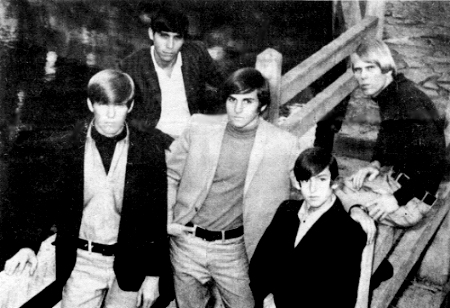
The Remaining Few, from left: Robby Glodt, Frosty McKee, Joel Mulkey, Robby Specht, and Mike Jones
Librarian, musician and record collector Claus Rosenblad, who interviewed Bob Jabour of the Cavemen last month, returns with a detailed interview with Robert Specht, lead guitarist of the Remaining Few.
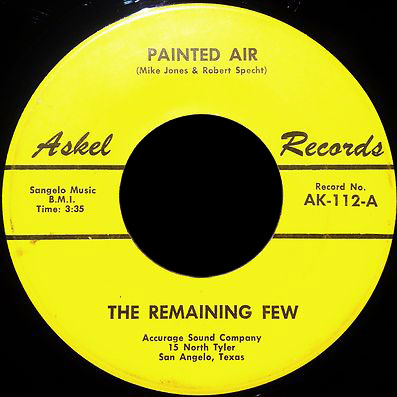
Robert Specht and Mike Jones wrote the incredible “Painted Air,” released on Askel Records AK-112 in October 1968. Sprecht also wrote the flip side, the lesser-known but still very worthy “In the Morning.” Askel Records released other legendary garage singles, most notably the Chevelle V “Come Back Bird” and the Outcasts “I’m in Pittsburgh (and it’s Raining).”
Where did you grow up?
My father’s work required us to move several times while I was growing up: I was born in Illinois in 1950 then moved to: Minnesota, Oklahoma, Houston Texas, El Paso Texas, Dallas Texas then San Angelo Texas.
What was your musical background and did you play any kind of instruments as a child?
I began taking guitar lessons at the age of 13 or 14 while I lived in Dallas, but nothing before that.
How and why did you get involved in the music scene, and what was your first band?
I took guitar lessons in Dallas at the Fred McCord School of music in the 60’s when rock was really getting big. After a few months of lessons, my teacher told my father I was a “potential flamenco genius” and so I was largely schooled in that type of music, but I was always trying to pick up on rock. We moved to San Angelo in 1965 and I began taking classical guitar from a truly amazing musician named Frank Trevino. After taking from Frank for a while, I met a guy in school, Robert Glodt – a drummer, who convinced me to come by his house and hear the band he was in practice. That was my first “band” experience.
How and when did the Remaining Few get together?
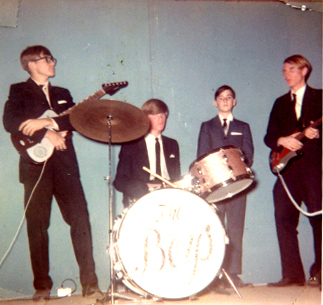
The Boys, before changing their name to the Remaining Few
When I went to listen to them (Glodt and his friends) they suggested that I go get my guitar and join in. It was a rag-tag event: the drummer had a bass, a tom-tom, a snare and one cymbal, the bass player (Chuck Brooks) played a regular guitar that had the speaker built in to the guitar, and the other guitar player (Mike Jones) had a dirt cheap guitar and a tiny, tiny amp. I had a Sears Silvertone guitar that had the amp and speaker built right in to the guitar case.Since I was the only one to have had any training, after about 5 minutes of playing they asked me to join them as the lead guitar player. We needed a name for the group and chose the name we had been given by parents and neighbors as they’d always yell at us “You boys turn that noise down!” – we became The Boys.
The bass player departed the group, the victim of a conspiracy by two unnamed members and was replaced by a really good bassist, J. Frost (Frosty) McKee, and we added a singer, Joel Mulkey, an acquaintance from school. At this point we became The Remaining Few.
Our drummer (Glodt) left for college and J. Frost suggested that we have Jim Yankovich sit in. He was awesome and became part of the group until he left for college and then Charles Usery became our drummer and Larry Logan became our organist.
Later things fell apart due to the draft, the war in Vietnam (Joel and Larry served in Vietnam and I ended up in ROTC), wives, and well, just life. At the end, Mike left to play for the Cavaliers, and with Larry in the Army, Joel, Frosty, Charlie and I played as a three piece with a singer for a while and then we disbanded. It has been reported at various websites that we moved to San Francisco, but that never happened.
What other big acts were your musical inspiration, (or genres) please name some of it?
Beatles, Stones, Yardbirds, Byrds, Paul Revere and the Raiders, Motown, Vanilla Fudge, and Cream were strong influences on us, later we became more heavy acid rock influenced with some blues thrown in.
What year did the Boys evolve into the Remaining Few? When are you born?
It was around late 1966 when we changed to the Remaining Few.
Who were the members and what they play?
The Remaining Few, V1:
Robert Glodt – drums Mike Jones – rhythm guitar Joel Mulkey – vocals J. Frost McKee – bass Robert Specht – lead guitar
The Remaining Few V2:
Jim Yankovich – drums Mike Jones – rhythm guitar Joel Mulkey – vocals J. Frost McKee – bass Robert Specht – lead guitar
The Remaining Few V3:
Charles Usery – drums Mike Jones – rhythm guitar Joel Mulkey – vocals J. Frost McKee – bass Larry Logan – organ Robert Specht – lead guitar
The final version is the one that recorded “Painted Air” and “In the Morning”.
Where did the band practice take place?
Until Larry Logan joined as organist, we practiced in someone’s garage. But Larry’s dad owned a lumberyard and we practiced in the warehouse there.
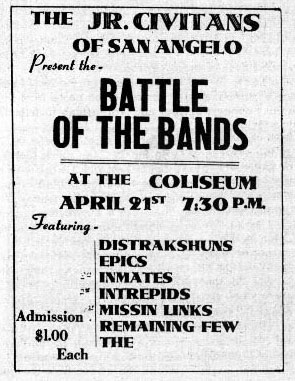
San Angelo Battle of the Bands with the Distrakshuns, the Epics, the Inmates, the Intrepids, the Missin’ Links, and the Remaining Few. Image from Not Fade Away #4. The Epic Five from San Angelo cut the great “I need Your Lovin'” on Sully – same band?
Where did you play live, and what was your best gig (and your worse)?
We played at rental venues, where we rented a hall, advertised on local radio and hoped what people would come and pay to listen and dance to our music. We became the sort of “house band” at a local bar/night club called “The Thirteenth Hour” – where we played many Wednesday, Friday and Saturday nights. We also played at high school dances for many of the surrounding towns in west Texas (places like Big Lake, Sterling City and Iraan Texas). We didn’t play much in San Angelo schools as the record we produced got us banned from playing in San Angelo schools. Most of the time, when we played in the surrounding towns, the local rednecks would threaten to kick our butts because we were “long haired hippy freaks”. We had to load up fast after the gigs and get out of town to prevent getting beaten up.
Did you do any battle of the bands?
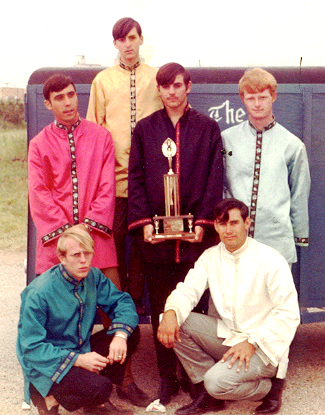
We participated in the Tri-State Battle of the Bands (bands from Texas, New Mexico and Oklahoma) and placed second (see the trophy in the photo I sent) and I seem to remember playing at the local coliseum that showcased many of our local bands, but I don’t remember any declared “winner”.
Clockwise from bottom left: Mike Jones (in blue), Frosty McKee (in red), Robert Specht (in gold), Joel Mulkey (in black), Charles Usery (in light blue), and Larry Logan (in white). Taken at the “Tri-State Battle of the Bands” just north of Lubbock.
How did the record on Askel come to be made?
We wanted to record and Mike knew a guy who had turned his garage into a recording studio. We came up with several songs and recorded them. The two we chose to have put on 45’s were “Painted Air” and “In The Morning”. We took the tape to Ron Newdoll at Accurate Sound here in San Angelo (he produced the Cavaliers’ “Last Kiss”) and he produced the songs on his label.
Which studio did you record the songs in?
George Talley’s studio converted garage.
Any fun facts and stories from the making of the record?
There has been conjecture and argument at various websites about how I made the tones in “Painted Air”; what kind of guitar, what kind of amp – I guess so they could be duplicated. Many were convinced that I used a Fender Stratocaster and Fender something amp, but they are all wrong. I used, and still own, a 1967 Guild T-100D hollow body electric guitar, and I used a Kustom amp.
I used no effects pedals; the only effects available on the amp were reverb and vibrato. The only effects pedals I ever owned were a Fuzz Face fuzz tone and Maestro Wah Wah pedal. Today there is an amazing range of effects pedals and manipulations that can be done in recording studios, I can only imagine what we could have done with that technology.
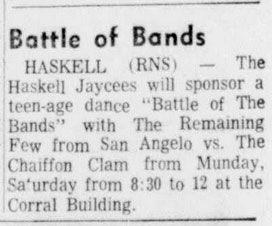
Remaining Few vs the Chaiffon Clam from Munday at the Haskell Battle of the Bands, reported in the Abilene Reporter-News, October 24, 1968
How were the records received? Did they get any airplay, did you get any good/bad reviews?
We sent records all over. The local radio station said “It looks like the Remaining Few have a national hit on their hands” and then, nothing. Not for years, until in the early 1980’s people started calling me and asking about the song, the record and if we’d sell an original 45 or authorize re-release. People from Great Britain, Germany, various parts of Europe even from Austin, Texas contacted me; I was kind of shocked.
I saw that original 45’s were being purchased for almost $6,000 by collectors. The songs had been picked up and published on a couple 33 1/3 LPs, one called High in the Mid Sixties, which I have a copy of. Requests and interest keep coming to this day. I even heard that “Painted Air” was played along with a video in Los Angeles at some rock hall of fame type museum. Over time the records have been duplicated and digitized without our permission and sold with no royalties ever being paid to us. You can even go to Amazon and buy the recordings for like 90 cents (American), but I do not receive royalties from those sales. The recording also appears with added videos on YouTube and, again, not a dime has ever been paid in royalties.
What is the story behind the legendary tormented song “Painted Air”?
It was originally just a part of a longer song called “Death Angel” – pretty dark stuff. When we were considering songs to record, I proposed it. But it was way too long so I chose the part that was made in to “Painted Air” and Mike Jones worked with me to create the arrangement.
What other groups in that area did you compete with? Or make friends with?
Bands like The Prophets, The Centrics, The Mystics, The Cavaliers, The Inmates and The Pagans. At that time here in San Angelo, EVERYONE was in a band and they were ALL better than everyone else. There were more bands in this little town than you could count. And you couldn’t swing a dead cat without hitting someone who played the guitar – all better than everyone else in the entire universe and very arrogant about it. It was dog-eat-dog and cut throat competition. None of the bands were friends with each other.
Do any other unreleased recordings exist, besides the 45s? Live recordings, demos or acetates?
There are tapes of all the songs we recorded in the process of making the record. No one knows the location of those tapes.
When and why did the band split up?
You grow up and realize you’re not going to hit it big. We had the draft, Vietnam, wives and kids; lives to prepare for. I guess our final split was in 1972.
What happened to you and the other band members after the band split up?
Our first bass player, Chuck Brooks was never heard from again after he left.
Robert Glodt attended Texas A&M University, served in the Army and became and entomologist in the Pan Handle of Texas.
Jim Yankovich attended technical school and went to on to work for various companies. We are still friends and keep in touch on a daily basis.
Larry Logan succumbed to cancer some years ago. It is my understanding that he longed for a band reunion up until the last.
Charlie Usery pursued various jobs and, as I was told, collapsed at his place of work and died of heart failure.
Mike Jones, who had been my close friend, who shared the loves of photography, hunting, fishing, camping, and music with me for more than 43 years, was also lost to cancer.
Frosty McKee did some amazing things like getting in the Guinness Book of Records for feats of memory, even appeared on national TV (Leeza Gibbons Show, I think) to demonstrate his amazing skills. He is still with us.
Joel Mulkey still lives here in San Angelo and we keep in touch and have even jammed together a few times. He pursued a career in the telecommunications industry working at the same company I piloted for.
As for me, I graduated from college and earned a commission as an officer in the United States Air Force and then flew professionally as a pilot for almost 30 years. I changed lanes and became an IT manager for some 15 years and retired from that industry in 2015. I currently write songs and perform in a local band called The Rivertown Blues and for the praise band at a local church.
Do you have any kind of band pictures, scrap book clips, or concert annoncements?
Attached are the only three pictures I have. These and other information can also be viewed at our website, theremainingfew.com. There may be other photos out there, but I don’t know where.
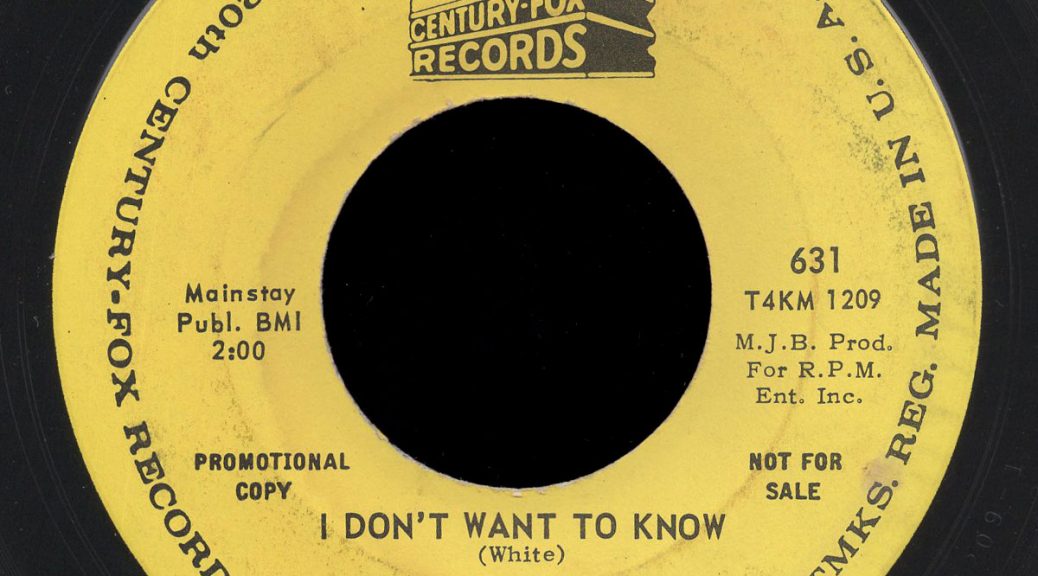
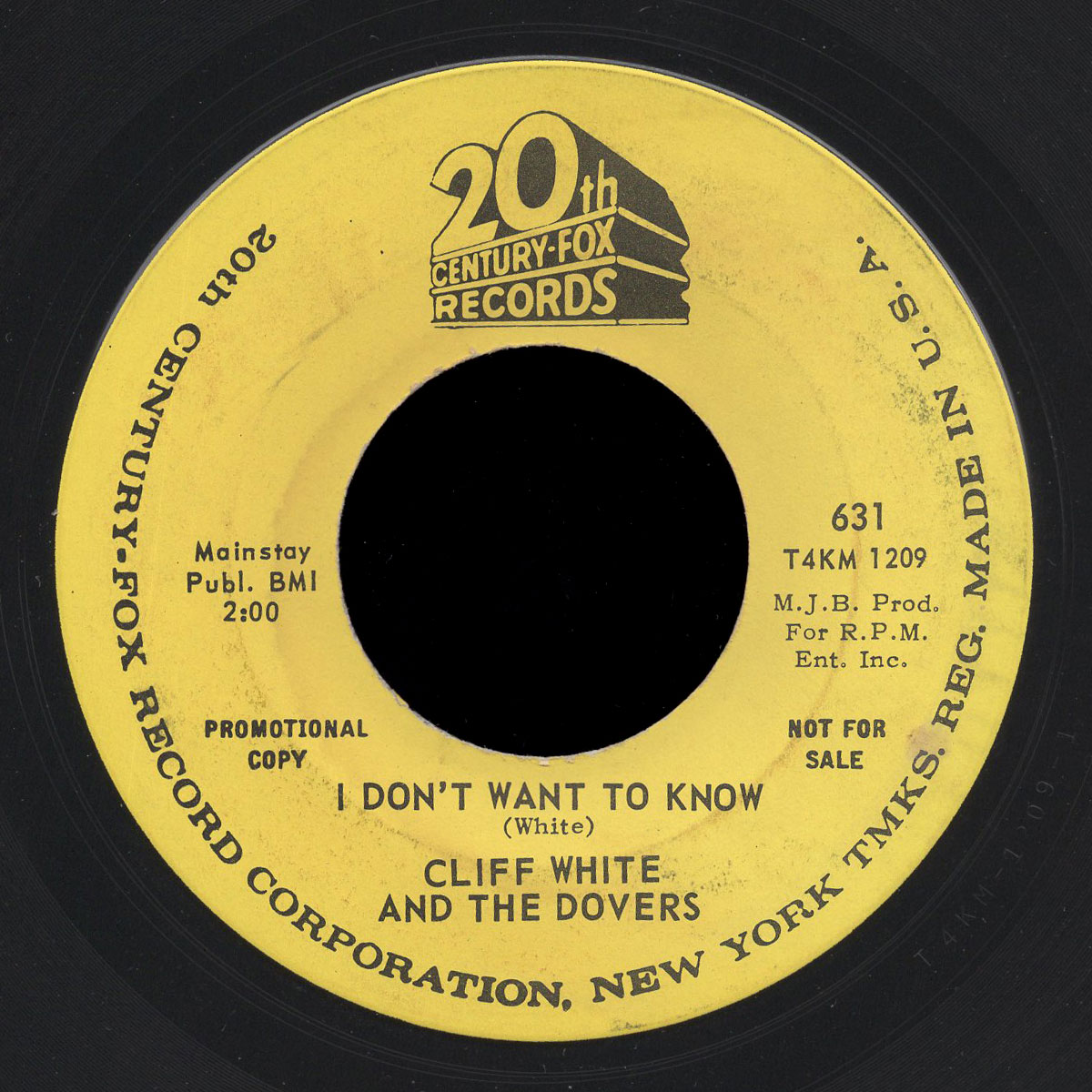
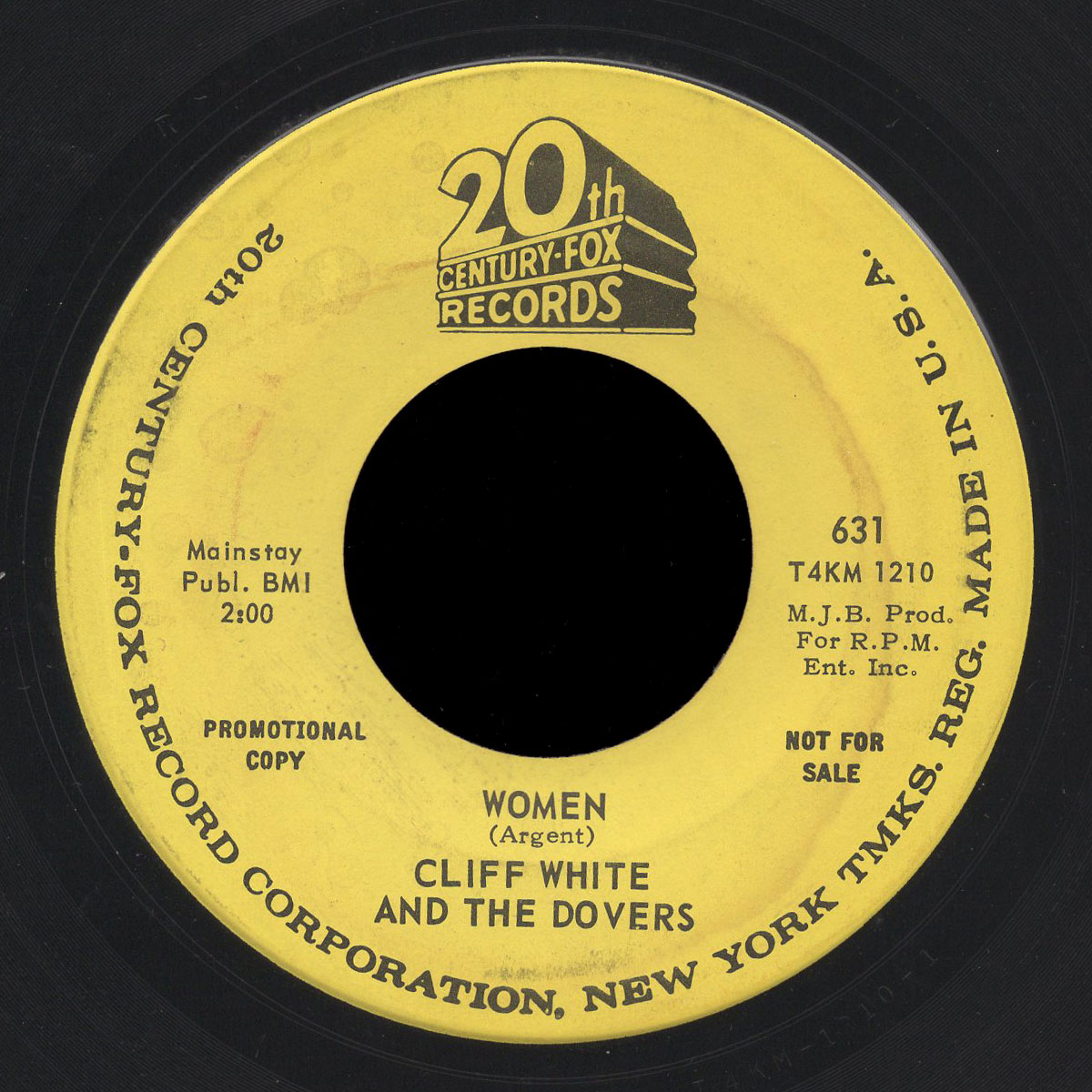
This is an odd single, an unknown group named Cliff White and the Dovers doing two non-hit Zombies songs “I Don’t Want to Know” (written by Chris White), backed with Rod Argent’s “Women”.
The group do a decent job on both songs, though neither cut has the magic of the originals. There’s a question of whether this is an English recording only released in the U.S., or if this is a U.S. act. I think the latter, as I found the English accent on “I Don’t Want to Know” to be contrived. Also, the production credit, M.J.B. Prod. for R.P.M. Ent. Inc. may give one clue, as RPM Enterprises was Charles Calello’s production company for some Lou Christie MGM recordings.
Released on 20th Century Fox 631 in the first half of 1966, the Mainstay Publishing credit is correct for the Zombies songs.
There was a Cliff White from London who was in a beat or R&B group in 1966, but went on to be a writer and reissue producer, but I don’t know if this is his recording. A suggestion that this was the Dovers on Miramar is laughable.
From La Crosse, Wisconsin, the Ladds had three singles on Transaction, Universal Audio and Teen Town between 1967 and 1969. In 1970, they changed their name to Today’s Tomorrow and had a minor hit with “Bring Back The Days” / “Witchi Tai To ” on Bang Records.
As the Silver Bullets they made an instrumental single for Teen Town, “The Lone Ranger” / “No Name Boogie”.
Members were:
Chuck Holzer – vocals Ralph Russell – guitar Alex Campbell – keyboards Eric Melby – bass, also Randy Taylor, and Clare Troyanek (of the Unchained Mynds) Mark Melby – drums
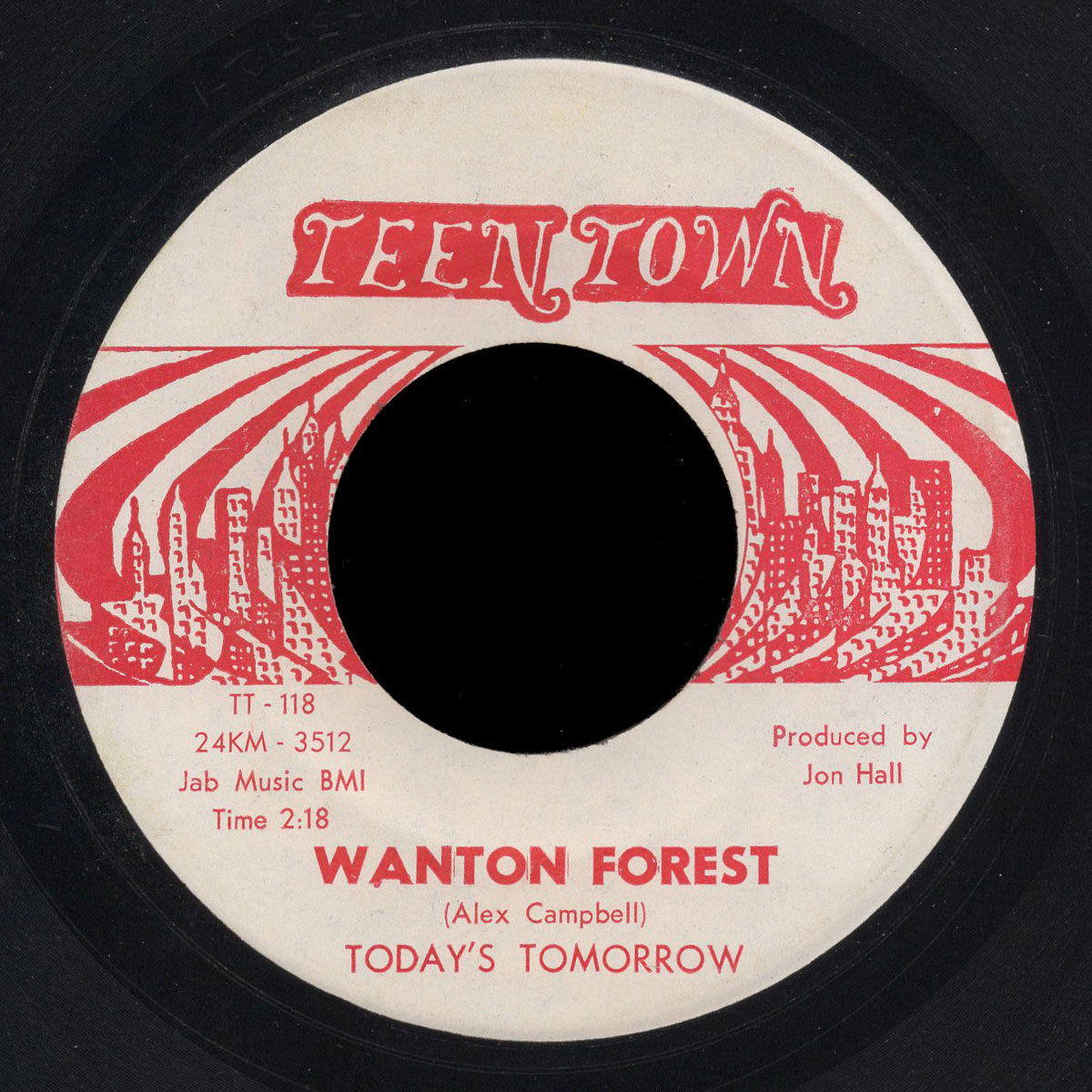
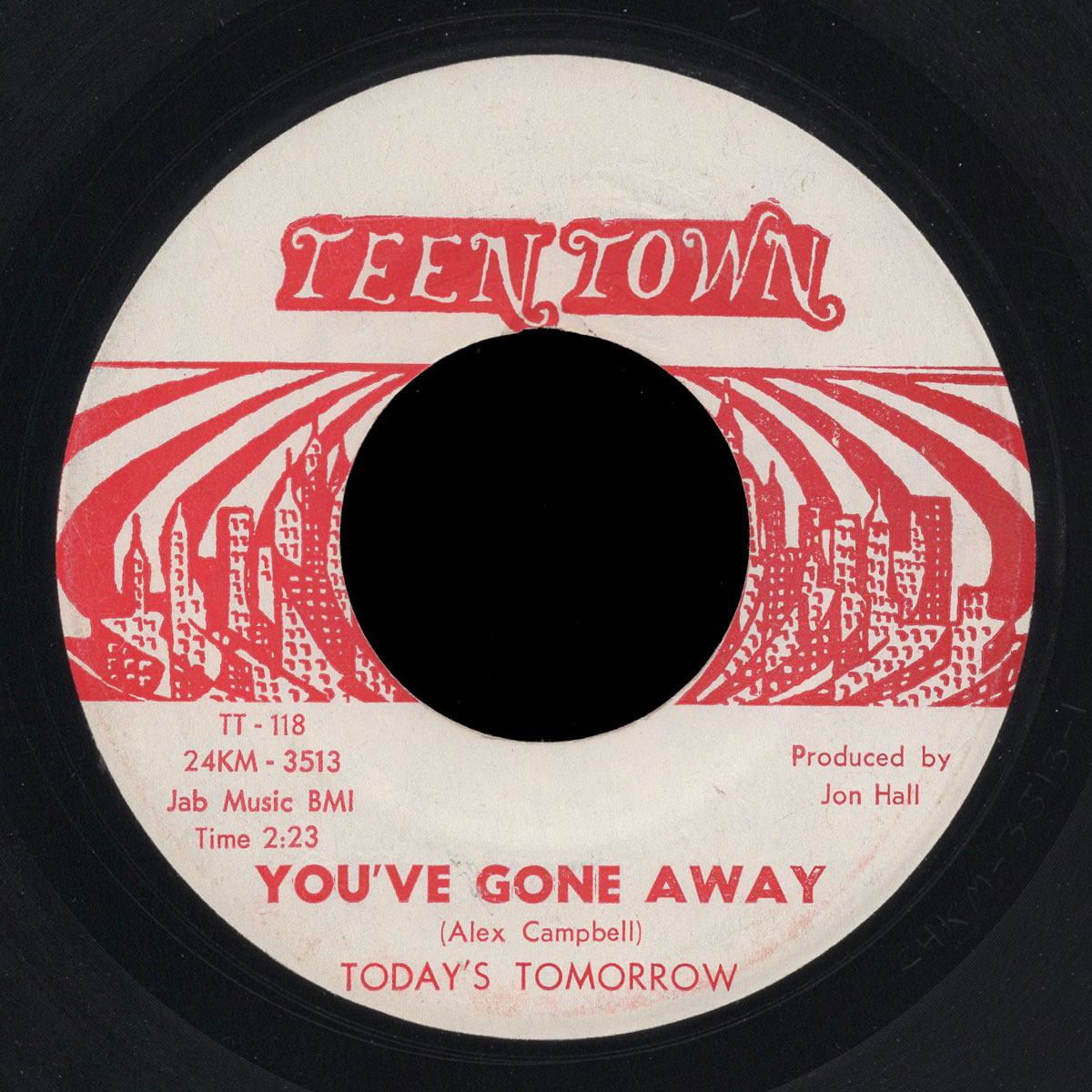
This is their next single, “Wanton Forest” / “You’ve Gone Away” as Today’s Tomorrow, on Teen Town TT-118, from about mid-1970. “Wanton Forest” is fine light psychedelia, and “You’ve Gone Away” is well-crafted and commercial. Alex Campbell wrote both songs, published by Jab Music BMI.
John Hall produced. Hall later started the Blue Ribbon label and released a great punk single, the Ones “Short Dress / Tight Rope ”
The July 11, 1970, La Crosse Tribune had a note about the recording of this single. I like how they call them “old hands” when most of the group were still teenagers:
“Today’s Tomorrow,” who are old hands at making records and working in recording studios, seemed a little shook up as they entered the RCA Victor Studios in Chicago a couple of weeks ago to put their vocal tracks on their latest 45 single. Looking at the big-star albums hanging on the walls, one of the members of the group asked the recording engineer who had recorded in just the past couple of days. He replied in a very mild mood, The “Guess Who” were in the other day and cut their new single, “Hand Me Down World.” That was enough to give any young band the winks. The session pulled off great. It’s the best job of composing thus far for Alex Campbell. The two new sides are entitled, “You’ve Gone Away” and “Wanton Forest.” The tapes have already been sent in to the Bang record office in New York.
It didn’t get a release on Bang, but Cash Box listed “Wanton Forest” on the playlist of WOKY in Milwaukee on October 24, 1970.
Today’s Tomorrow would have one final single, a version of Paul McCartney’s “Smile Away” that I haven’t heard yet, backed with another Alex Campbell original, “Lifeless”, which has a ’70s funky hard-rock sound.
Alex Campbell had an early single with the Fax in August, 1966 when he was just 14, “Just Walking In The Rain” / “Not Too Long Ago” on Transaction 702, produced by Lindy Shannon.
If anyone has the picture sleeves for the Ladds first two singles, “Keep On Running” / “‘Wild Angels’ Theme” on Transaction or “I Found The Girl” / “Survival” on Universal Audio, please contact me. Also if anyone has photos of the band other than those on the Ladds picture sleeves, please write in.
Source: Do You Hear That Beat: Wisconsin Pop/Rock in the 50’s & 60’s by Gary E. Myers has extensive information that was vital to this post.
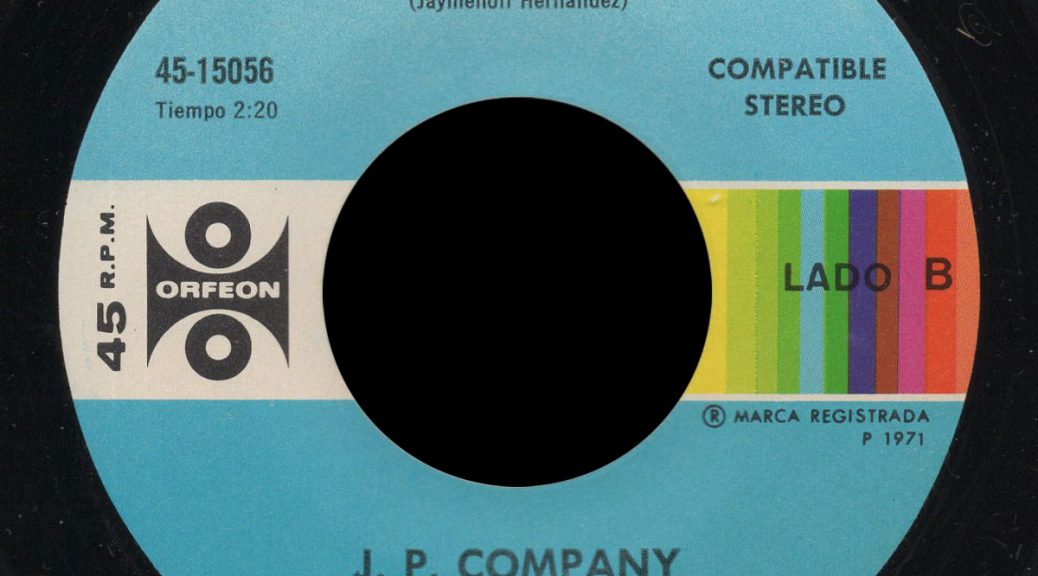
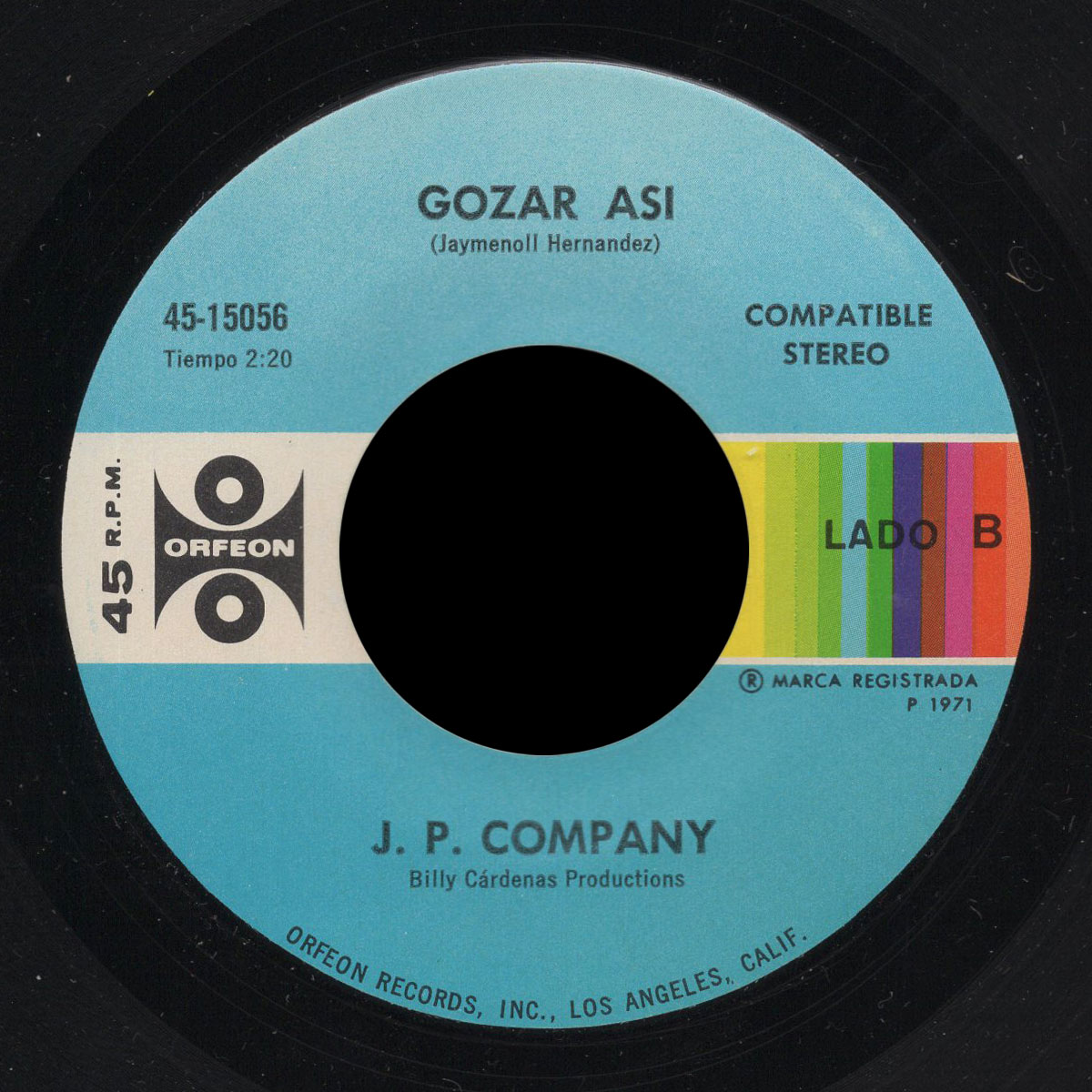
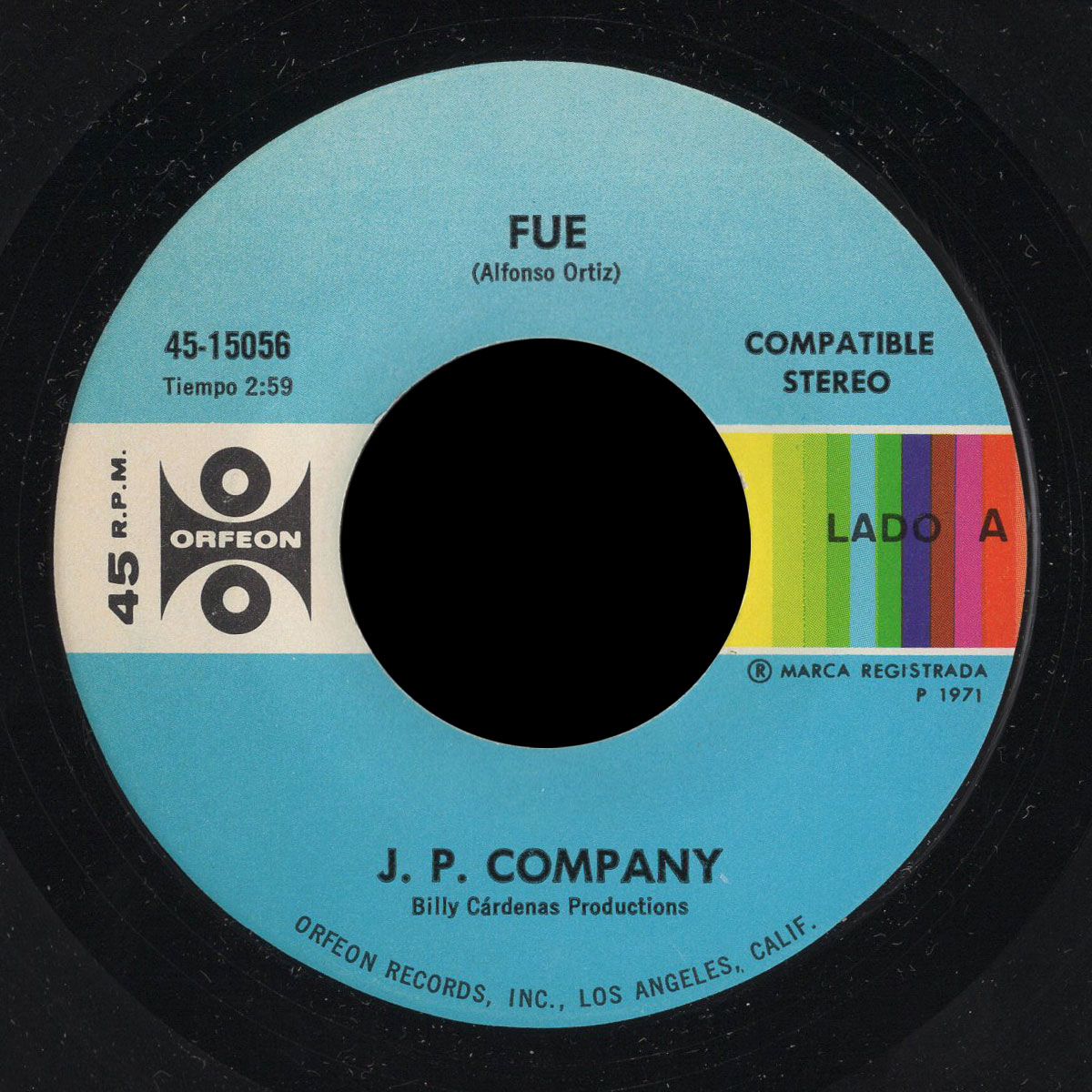
I didn’t expect this 45 by J.P. Company to be almost unknown, but it appears that way. “Gozar Asi” has many of the elements you might expect from early ’70s funky psych, including organ, wah wah rhythm, harmony vocals, a good guitar break and more. It’s a fine song, written by Jaymenoll Hernandez.
The flip is a more conventional ballad, “Fue” by Alfonso Ortiz.
Released on Orfeon 45-15056 in 1971, I thought this could have been a group from Mexico. I had a Los Locos del Ritmo single on the same Orfeon label with a Los Angeles address which turned out to be a reissue of two different sides originally issued in Mexico years before.
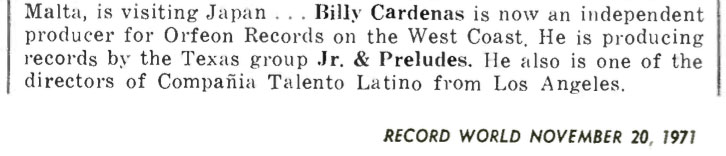
As it turns out, this J.P. Company release is an original Billy Cardenas Production out of Los Angeles. Cardenas was famous for his involvement with the ’60s Eastside Sound, including the Romancers, the Premiers, the Blendells, Cannibal & The Headhunters, Ronnie & The Pomona Casuals, Mark & The Escorts and many more. For Orfeon he would produce Jr. & the Preludes, La Tribu and others.
Billy Cardenas producing for Orfeon, Record World, November 20, 1971
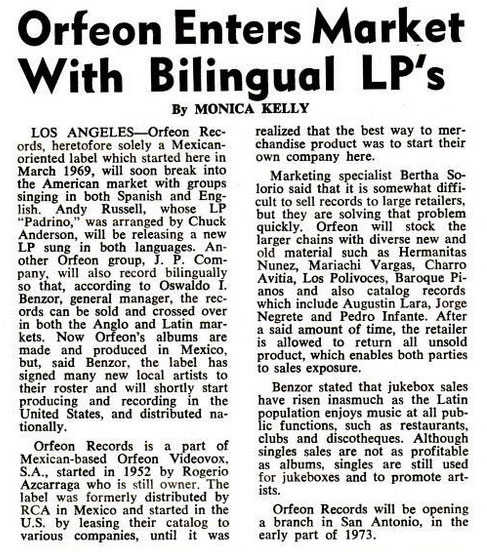
A December 23, 1972 notice in Billboard notes Orfeon General Manager Oswaldo Benzor would be recording J.P. Company bilingually. If it happened, I haven’t heard or seen it. From the quality of “Gozar Asi”, this is a group that deserves more attention.
Orfeon promoting J.P. Company as a bilingual act in Billboard, Dec. 23, 19721972
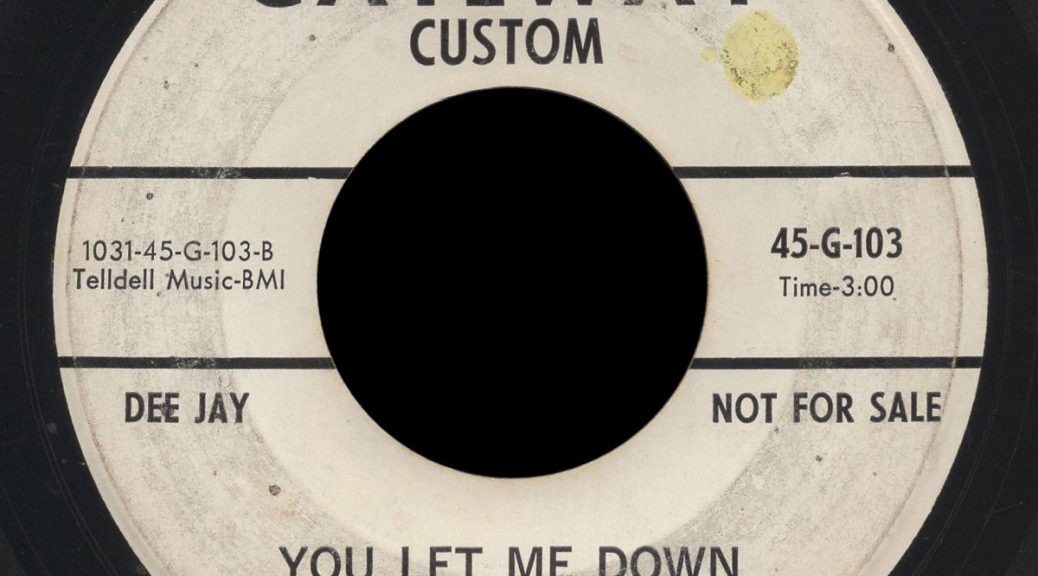
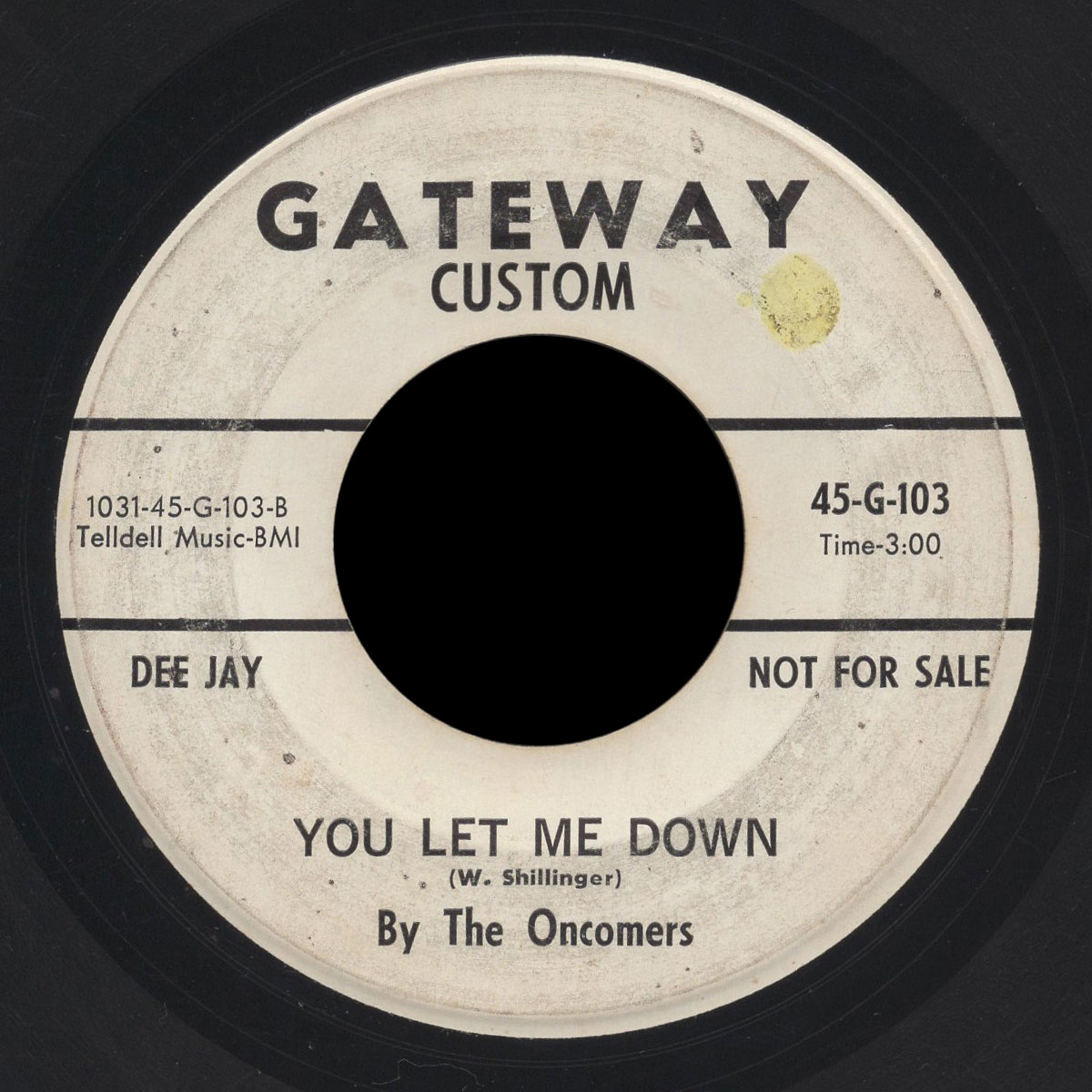
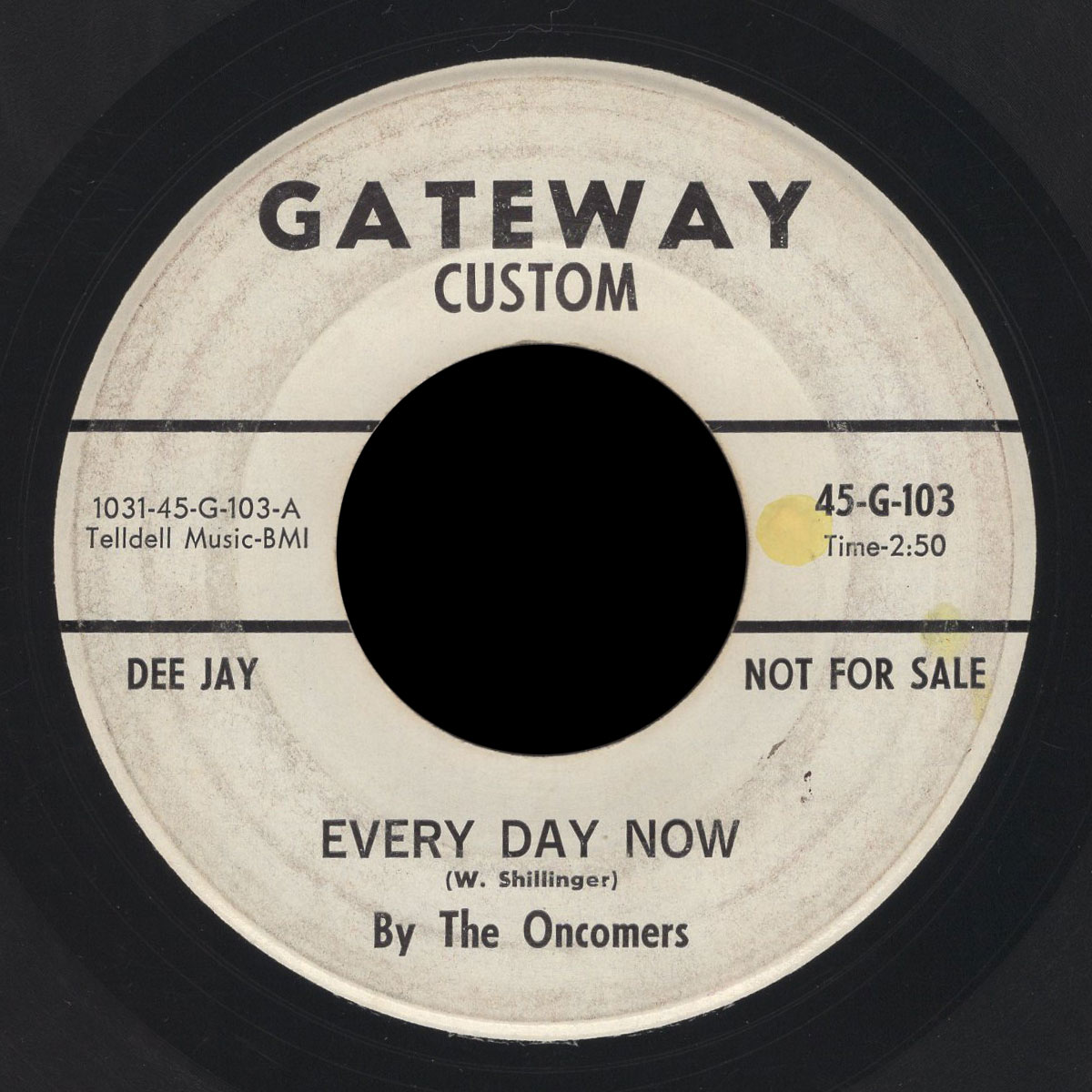
The Oncomers came from the Mon Valley (Monongahela River) region south and east of Pittsburgh. Turtle Creek and McKeesport seem to be the main locations for the band members or where they played live.
The group members were:
Wayne Schillinger – guitar Billy Capranica – bass Jack O’Neill – drums
The Oncomers started in the early ’60s and often played live with a slightly younger act, the Arondies. This is their only release, on the Gateway Custom label. Wayne Schillinger wrote both songs, published by Telldell Music. Teen Beat Mayhem dates the 45 to 1967 but I’ve read the group had broken up in 1965.
“Every Day Now” is something of a throwback to early styles. “You Let Me Down” is a classic moody song, with a fine lead vocal and guitar work.
I’ve read there are more studio recordings and even a live tape from the Cove nightclub in the town of Large, PA, but I haven’t heard these yet.
The Oncomers later became Grant Street Exit with some lineup changes. Wayne Schillinger wrote both sides of the Grant Street Exit’s 1968 single on Del-la single (and re-released on Millage) “I Got Soul” b/w “That’s Why I Love You”, which I haven’t heard yet. Telldell Music is the publisher and distributor for that release.
Jack O’Neill joined Jim Pavlack and Gary Pittman of the Arondies to form the Soul Congress.
Source: the Tube City Almanac has some remembrances of the band & the local scene at that time.
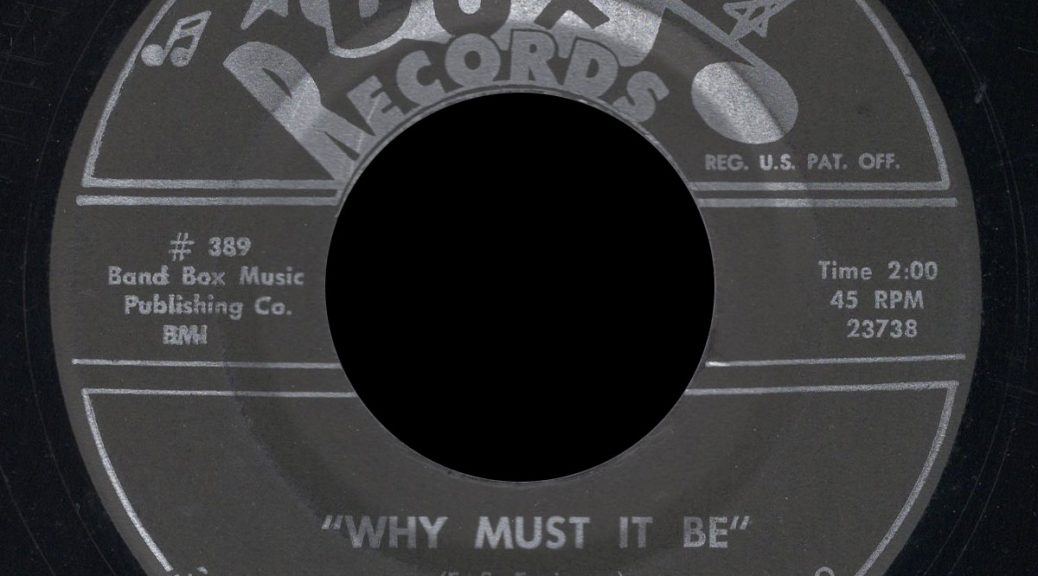
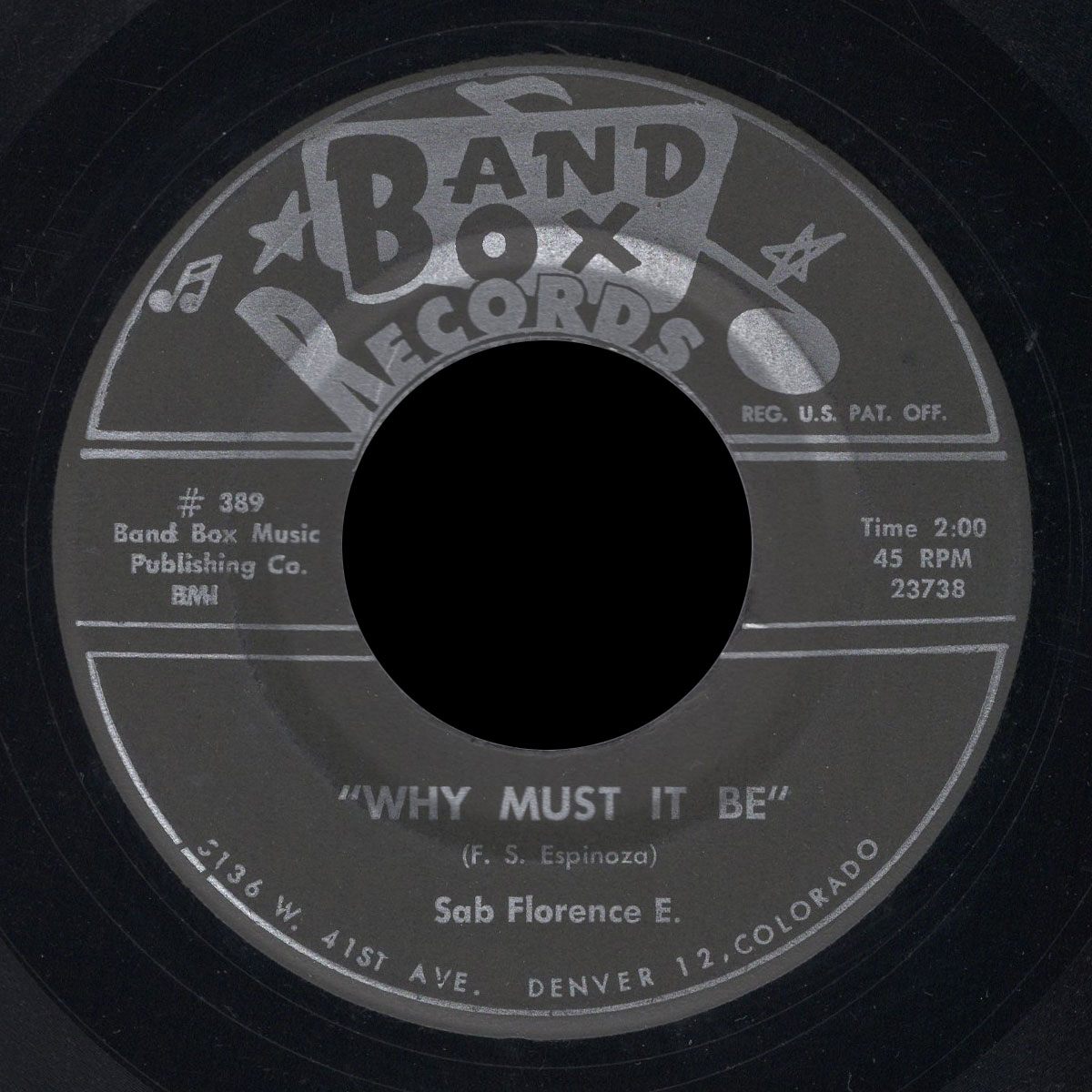
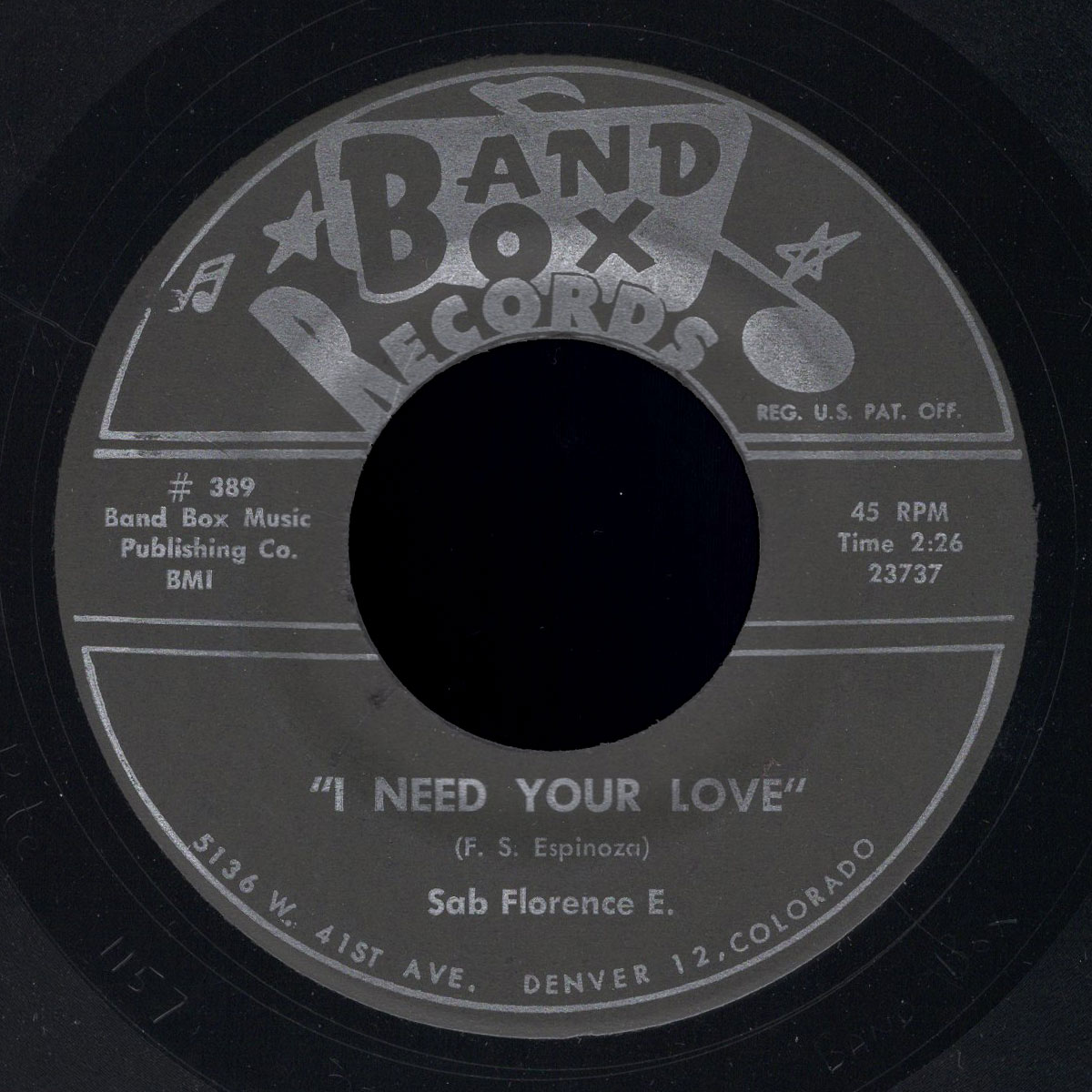
The typically murky Band Box production enhances the strange outsider effect of this 1969 single from Florence S. Espinoza, credited on the label as Sab Florence E.
“Why Must It Be” has a gloomy guitar riff and a female chorus cooing the title. “I Need Your Love” adds harmonies over another leaden rhythm from the guitar, drums and very distant bass. Both songs are originals by Florence Espinoza, with copyright registration in October 1968.
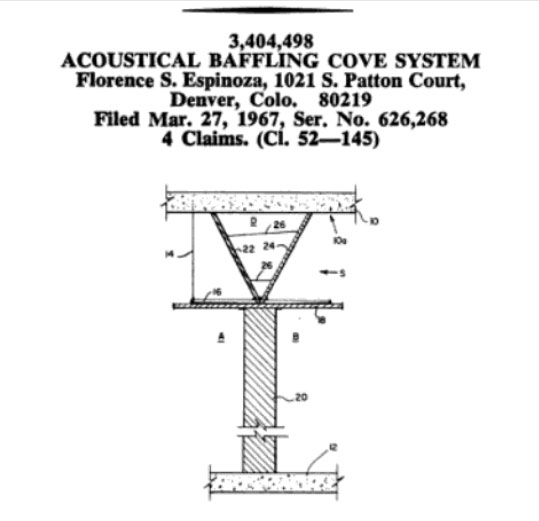
Released on Band Box 389 during that label’s last year or two of production. This is a Rite pressing, 22737/8. Florence S. Espinoza’s patent diagram, from the Official Gazette of the US Patent Office, volume 855
A quick search turns up Espinoza was awarded a patent in March, 1967 for an “Acoustical Baffling Cove System: A method and apparatus for soundproofing the head space in drop ceiling construction … barricades space above the room dividing walls with a V-shaped sound baffling cove for deflecting sounds…” The patent gives his address as 1021 S. Patton Court, Denver, internet records suggest he or his family may still be living there.
An obviously creative person, I wonder if he did more in music besides this solitary release.
This site is a work in progress on 1960s garage rock bands. All entries can be updated, corrected and expanded. If you have information on a band featured here, please let me know and I will update the site and credit you accordingly.
I am dedicated to making this site a center for research about '60s music scenes. Please consider donating archival materials such as photos, records, news clippings, scrapbooks or other material from the '60s. Please contact me at rchrisbishop@gmail.com if you can loan or donate original materials

 Two bands from Dallas won the top prizes: the Green Men, (I believe that would be Johnny and the Green Men) won first place and the Soul Rockers second. The Briks from Denton came in third.