“One of the gassiest groups in Miami, man. Got a smash-a-demus going for ’em. The Invaders — it’s rated number two on the survey tonight. It’s called ‘She’s A Tiger’!”
Rick Shaw’s words in ’65 let teens in sixteen counties know that a band from South Florida — for that night, at least — had the second most-requested song in the area. On that night, the Invaders had outperformed the Beatles, the Supremes, the Byrds, and Herman’s Hermits, as their fans all flocked to their phones to give support to the guys who’d just won the Burdines Combo Castle Battle Of The Bands.
“She’s A Tiger”‘s brief success was certainly a highlight for the group, which had started out way back in 1962 as the Playboys. After adding Don Goodson on drums and Kenny Ahern on guitar, keyboard player Robert Haas renamed the group The Invaders.
Their electronics expert manager Richard Sano leased a rehearsal studio for the guys on Northwest 27th Avenue, near the Palmetto Expressway. Inspired by the Canadian Legends, the guys decided to buy all new Fender equipment. Ahern exited, and Dave Davis came in as the band’s new lead guitarist.
It was about that time that Goodson purchased a new Chevy van to transport the group’s new gear. Haas designed a logo that was then painted on the van. Everyone knew when the Invaders were coming!
By ’64 the band was booked solidly all over Dade County, and into Hollywood and Ft. Lauderdale as well. They played at spots such as PAL, Code One, the Diplomat, the Fontainebleau, the Bath Club, the Hollywood Armory, and the Surfside Community Center.
Notice both the Shaggs and the Blue Beatles had their names misspelled on this flyer.Burdine’s Combo Castle Ballot
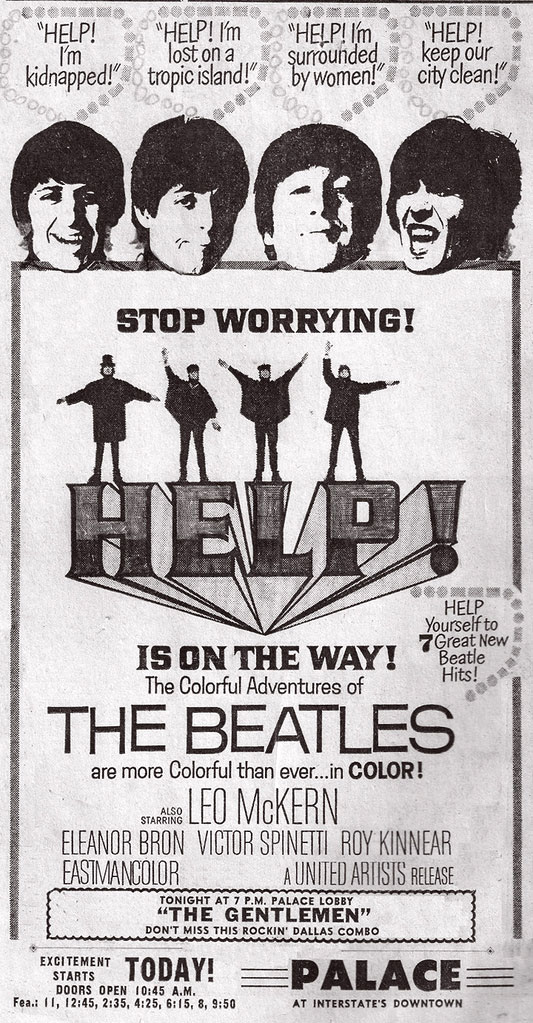
The band members traded in their Fender equipment, after agreeing to an endorsement deal with Vox. Haas became one of the first keyboard players in America to own a Vox Continental organ. The Invaders appeared in a series of ads for Vox, including the one above that promoted the House Of Pianos and Organs, on Northwest 7th Avenue and 34th Street. The band also played at the South Florida premier of the movie “Help!”
The Invaders caught the attention of several WQAM Tiger d.j.s, including Rick Shaw and Jim Dunlap. It was only natural that their record would get airplay on the station. (Having the word “Tiger” in the title didn’t hurt matters, either). The single, by the way, was engineered by Mac Emmerman at Criteria.
The B-side title was changed from “She’ll Come Back” to please one of their sponsors, Honda… even though the word “Honda” is never mentioned in the tune.
Rick Shaw introduced two Capitol Records A&R men to the boys in the band, who were then offered a record deal — with one catch. The boys were told they’d have to devote all their time to their career, which would mean dropping out of school. That offer was turned down.
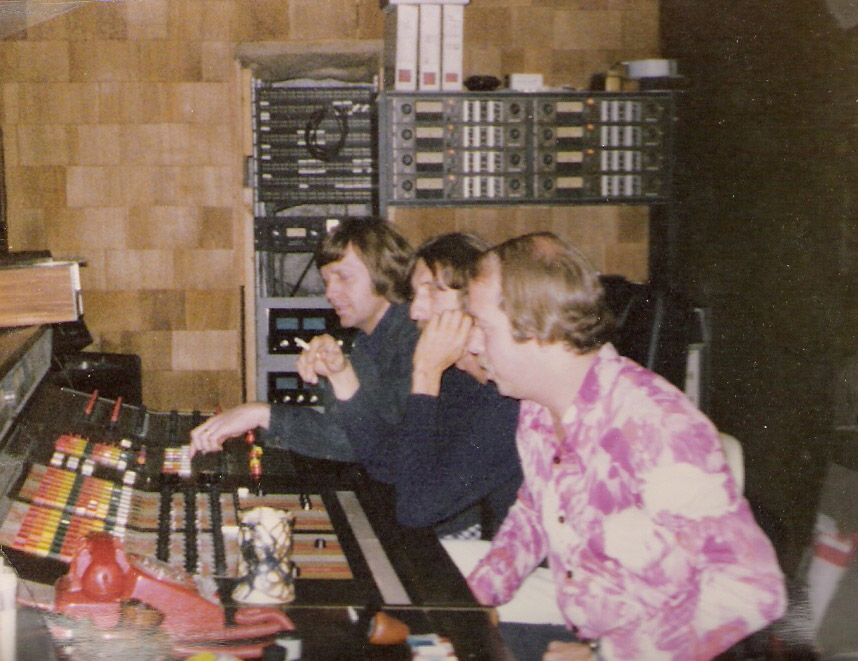
Steve Seitz and Dave Davis at the “She’s A Tiger” session
Some additional information on the Invaders, from Robert Haas:
The Honda Corporation, a sponsor of Burdine’s Combo Castle Battle of the Bands, insisted that the Invaders use the brand name, “Honda,” in one of the songs the group recorded. The recording, which took place at Criteria Studios on W. Dixie Highway in N. Miami, was as part of the grand prize for winning the contest. The requirement to use “Honda” in one of the two songs recorded was made known to the band AFTER I had written the lyrics to the original tune, “She’ll Come Back.” It was an absurd request since the song had nothing to do with a Honda motorbike and the only solution I could come up with on the spur of the moment was to use “Honda” as a nickname for the girl referenced in the song. Silly, but those were the rules!
The Invaders, the Calientes and the Stops appearing with WQAM DJs at screenings for Help!“She’s A Tiger” was never used intentionally for promotional purposes. I wrote the lyrics prior to winning the battle-of-the-bands-contest. WQAM, purely by coincidence, was called “Tiger Radio” and the DJs there did not miss the opportunity to capitalize on the coincidence. It was good for the Invaders, who had already caught the ear of DJs Rick Shaw and Jim Dunlap. Rick was instrumental in getting Capitol Records to offer the group a recording contract (which we turned down). He nevertheless continued to play the song nightly and used it to promote not only the Invaders but also WQAM.
There was another DJ on FM radio who came to prominence two or three years after the Invaders had disbanded. Her name was Trish. I don’t recall the station’s call letters. I would tune Trish’s show in at night and listen to her talk about the Invaders. She apparently had been a big fan of the group. To my knowledge, I never met Trish. She would regularly play “She’s A Tiger,” for her audience.
I think that’s about as much exposure as the song got. It was the very first song I had ever written, so I guess that’s not too bad for a first effort. Little did I realize that it would not be until I was 40 years old that I would become a major label recording artist and pen a few Billboard-charting songs! From 16 to 40 is quite a wait!
Peter Pan Productions was the name of the Invaders’ publishing/recording company. I cannot recall why we chose that name but I am fairly certain it was the result of a standing band joke. Humor ruled the day whenever the Invaders got together.
Don Goodson on the drums, at the “She’s A Tiger” session
Not long after, Dave Davis left town, and the members of the Invaders drifted into different directions. Don Goodson would join former Invader Kenny Ahern in The Echoes. Haas would replace Richie Borkan in Sounds Unlimited. (Borkan would soon join the Kollektion.)
Steve Seitz opened an artist management firm on Miami Beach in the 1980s.
Don Goodson worked at Ace Music in North Miami for many years, and made appearances recently at both Geezerpalooza and the “While We Still Can” reunions. Don passed away in late 2007.
Ahern can still play surf guitar with the best of them, and a few years ago was in a duo called The Stratospheres with Bill Kerti, another Echoes/Echo veteran.
Robert Haas went on to write the best-selling health and fitness book, Eat To Win, and collaborated with Cher on another best-selling book. He landed a major label recording contract with Mercury/Polygram with the group Siren (aka Red Siren), and has been told one of his songs is on hold for recent American Idol winner Taylor Hicks.
Unfortunately, Dave Davis killed himself in the 1970s, before he could see his music appreciated by a new generation of fans. I do not know what happened to Jeff Glass.
Thanks to Robert Haas for most of the photos. Invaders van picture by Linda Neary. Thanks also to Billy DeMoya. 45 transfers from Jeff’s Florida Flashbacks.
The Invaders story by Jeff Lemlich. Originally published on the Limestone Lounge and reproduced with permission.
“Left to right are Mark Hinton, Ronnie House, Ken Hutchinson and Mike Pugh. The picture was taken just before the group went to New York to record for United Artists. We were 17, 17, 17 and 18.” – Ken Hutchinson
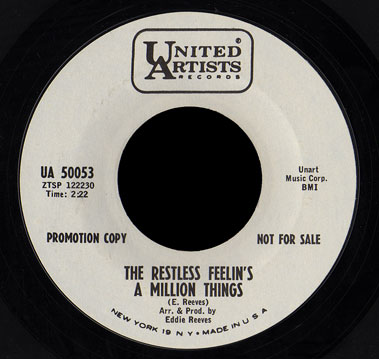
A double-sided winner from Amarillo, Texas. Both sides were written by M. Hinton (Markus Lee Hinton according to the song publishing info).
The producer Eddie Reeves was working for United Artists publishing at the time; he’d had a prior career as a vocalist with the Nighthawks and a solo 45 on Warwick, “Cry Baby” / “Talk Talk”. He was from Amarillo, and may have provided these songs for a home-town group.
There is a likely connection to a group who recorded a 45 as the Hysterical Society Boys, “Funny Face” / “I Got Shot Out Of The Saddle” on the EBR (Eddie B. Reeves) label in the early ’60s, but I haven’t heard that one yet. (Thanks Davie G for this info.)
Despite good songwriting, production and performance on both sides, the 45 didn’t make a dent in the charts.
The band had one more release, “I Put A Spell On You” b/w “Summertime (Variations)” on an Amarillo label, Tipton, in 1968.
Update May, 2018:
Michael Thom acquired a 10″ acetate of one song recorded at Associated Recording Studios in New York. Michael wrote, “the acetate is very badly damaged, with a lot of lacquer separation that goes through the entire disc”. Michael spent hours restoring the sound so we can hear what this unreleased song sounded like. Perhaps someone associated with the band has another copy of the demo, or the master tape from this session.
The Hysterical Society with friends including Mark Kirk
I knew next to nothing about the band until Woody Key contacted me about the band. I’ll reproduce the comment he left below here, because it contains so much info about the group:
The Hysterical Society lineup on this record (and most of their career) was Mark Hinton – guitar, organ, vocals; Ronnie House – guitar, vocals; Ken Hutchinson – bass, vocals; and Mike Pugh – drums, vocals. There was indeed a link between Eddie Reeves and the Hinton family; Mark Hinton’s uncle Mike was one of the members of the Hysterical Society Boys, which I think were a band that was formed in Austin when Mike went to University of Texas. I don’t think that Eddie Reeves was in the Hysterical Society Boys, but he and Mike Hinton were in the Nighthawks.
The record (and I think 4 more sides, which weren’t released) was done in New York City. The boys were excited to be in the Big Apple, and had the opportunity to meet Bob Dylan and Napoleon XIV of “They’re Coming to Take Me Away” fame.
The Hysterical Society were a popular TX Panhandle and regional band from 1966 – 1969. They recorded “Summertime” / “I Put a Spell On You” in 1968 at Norman Petty’s studio in Clovis, NM, with Norman producing. By this time, they had replaced Ken Hutchinson with David Fine on bass and keyboards. They eventually replaced Ronnie House with Mark Kay on guitar, and kept this lineup until they broke up in late 1969.
Mark Hinton and Eddie Reeves kept crossing paths musically, with Eddie producing demos by Mark’s band Piper in Los Angeles, and also Mark’s solo demo projects in the early ’70s.
Update January 2012
Ken Hutchinson sent in the photo at top, and answered some of my questions about the band:
The photo was one of my favorites and I’m happy that I found it. True that Eddie had some promo shots of us done while we were in New York but as the single never made a dent in the charts we saw proofs but I do not believe finished copies were ever made. My sister remembered some studio shots done in Amarillo by our mother who was a photographer with a local studio. My mother also took the shot that I sent you.
The formation of the band came about by a chance connection of me and Ronnie House, the lead guitar player. He also knew Mark Hinton from school and as he and I worked together he suggested that we get together with Mark who knew a drummer (Mike Pugh). At the first get together the chemistry was good and we decided to become a group. Mark and Mike were the real talent of the group and Ronnie and I were good enough to compliment them.
After a while we kind of took the Texas panhandle by storm as we were all high school students and were very good at copies. We practiced enough to keep our material current, were very energetic on stage and popular enough around school that the buzz got going pretty quick. What probably kicked us off the most was the opportunity to open for Buffalo Springfield and Jay and the Americans at The Amarillo Civic Center [Tri-State Exposition on June 23, 1967 with additional acts the Dearly Beloved and the Stumps – anyone have a poster of this?]. The crowd was packed and I believe we represented the local talent well as we were the only local band. There were a lot of people in the audience who had never heard of us and could not believe we were local. Members of both of the lead bands complimented us back stage on our performance.
The Hysterical Society February 1968
The connection with Eddie Reeves did indeed come through Mark’s uncle Mike Hinton who was pursuing a law degree at The University of Texas at Austin. He had booked us at some frat parties and such in Austin as he was still active in music and had a lot of connections down there. We had to be careful about booking Austin as it was a 500 mile drive one way from Amarillo but the pay was so good that it seems we were playing down there a lot. I’m not sure yet what those college kids saw in a high school band from Amarillo but we continued to be asked back.
Mike asked Eddie to come listen to us in Amarillo. I believe Eddie had some family ties in the area. He came, listened and asked us if we would be interested in coming to New York to record for the label – he would produce us and take care of us while there. How could four 17 year old kids refuse?
We did indeed cut six sides while there however the promo copy of the two that you acquired was all that was released. We received copies of the other four, but I have lost track of mine after being passed around to family members for 45 years. There were five rock and roll songs written by Mark and one ballad written by me recorded. Eddie picked the two for release.
“Come With Me” was very current for the time – it must have been as the Beatles used the same riff for “Tax Man” a short time later with a lot better result. The flip side, “I Know”, was, I think, a little ahead of it’s time but what is my opinion worth.
We did have the opportunity while in New York to meet Bob Dylan and Napoleon XIV but I doubt that it made any sort of impression on either of them as we were just some high school kids from Texas who happened to draw the attention of UA momentarily and they were stars. Probably just bored.
Drummer Mike Pugh
When I left the band I had an opportunity to tour with The Shirelles who later connected up with The Drifters and The Coasters. So I had a chance to appear on stage with all three for quite a while. This was late 1969 and the early ’70s and all three of the groups had seen the shining days of their careers go by but were still active on tour and still drew reasonably good crowds. I’m sure the groups I played with did not still retain all of the original members but the music was good, the crowds were large and the tour was fun so I stuck around for a while.
I also played with some opening bands around Los Angeles while we were there and got to meet quite a few more “stars” and perform for huge crowds. When I finally decided that what I was doing was really to big for me I returned to Amarillo. I was after all married with children and needed to settle down.
I took a break from music that turned out to be extended to almost 20 years before the itch was too much trouble to scratch and started playing again about 1992.
A couple of really good local bands and about 15 years later I took another break and do not at 62 have much desire to do it any more. That’s why I respect Woody Key so much. He is not that much younger than me and is still out there doing it every day and succeeding. The difference between an artist and a practitioner I guess but I would not give one minute of it back for anything.
Ken (Hutchinson) Warren
Thank you to Woody for info on the band, and to Ken Warren for the photo at top and history of the band.
Special thank you to Mike Pugh’s niece Deborah for providing scans of all the photos except the top one. These were added to this article in November, 2014.
From left: Ken Hutchinson, Mark Hinton, Mike Pugh and Ronnie House
Tommy Faia is the force behind Tommy & the True Blue Facts, writing his own songs, singing and playing the acoustic guitar. I didn’t know anything else about him until he contacted me in January 0f 2009.
“I’m Back” is an anti-drug song, more convincing than most with great lines like “I’m not trying to bring you down, but how long ago was your mind really sound?” The arrangement of guitar, congas and an out of tune electric piano perfectly matches the mood of the song; Tommy sounds like he was way out there indeed.
“Who’s Got the Right” is a bit of a rant sticking up for cops (“he must refrain from protecting his life because if he does, he’ll get the blame”) and denigrating looters, law breakers and welfare bums. It’s just an example of reactionary attitudes in the late ’60s.
I’ve heard one other 45 by Tommy, an original called “You’ve Got My Soul”, which sounds like Neil Diamond, backed with “An Exception to the Rule”. Gone are the politics, instead you get love songs, with fuller production, girl group backing singers and a generally unconvincing result.
Tommy recently got in touch with me and told me the story about his records on A&M:
Around 1966 I jumped in my friend David Rosenkranz’s pick up truck loaded with his drums and my guitar and amp etc and headed down to LA from Carmel. I was about 19-20 years old. We rented a little dump in Hollywood where we could practice..we’d only been playing together for 1-2 months. I had been writing songs for about a year.
David got a gig playing drums for a little recording studio on Santa Monica Blvd. He told the owner about me and the guy recorded Who’s Got The Right … just David and I played. I played an amplified acoustic classical guitar with a flat pick … like Willie Nelson (unfortunately I didn’t sound like Willie but it was a big driving rhythm sound). The guy said he’d take it around town.
About 2-3 days later we get a call at night from a guy that says to me “do you want to be a star?” I said sure but wasn’t convinced by the big talk. His name was Ed Forsyth and he had a nice plush office on Sunset Strip right across from the Whiskey. We loaded up David’s truck and drove over there the same night and played for him in his office.
About a week later we walked into a huge recording studio with lots of musicians. Jim Economides was the producer (he was a producer at Capitol Records and worked with Dick Dale, Johnny Burnette, Bobby Vee, Bobby Darin and others). What really impressed me on that session was that the guitar player was James Burton. He’s doing that Eastern sounding guitar on “I’m Back”. They spared no expense. Funny because David and I were disappointed that we didn’t have much say in the process. All the records are large productions. On the later ones we had three male back up singers and three female (the Blossoms!)
Just a note on “Who’s Got The Right”. I wrote that song during the Watt’s riots. Later my friends told me it was a “right wing song”. I was not yet political. But I think that my manager Ed Forsyth really liked the message of that song and that’s what got us the deal. I later wrote many anti-war songs during Vietnam. Anyway didn’t want you to think I had a shaved head.
The True Blue Facts was really just David and I. Our management came up with the name. We were horrified at the time. We were a duo. Now I kind of like the name. I also played harmonica (Jimmy Reed was my mentor). We had a big sound for two guys.
I’m 63 now and just starting up another band with original music that I’ve written over the years. After Tommy and the True Blue Facts I continued writing music hoping to get another record deal with a hit song….never happened….came close a few times….even spent 3-4 years in Nashville. Finally gave up in 1983 and moved back to my home town on the Monterey Peninsula in California. Today my songs are much better and I’m playing with some guys and eventually will record our stuff. It’s fun to be back and so cool to find your site.
Tommy Faia
Update June 2012
Tommy has a new website and is performing around Monterey. See www.tommyfaia.com for his current shows.
From Pasco in south eastern Washington State, near Kennewick and the Oregon border, the Pastels formed in 1964. Original members were:
Dale Anderson on guitar Mark Gage on keyboards Ron “Arjai” Jones on guitar and bass Red Elder on drums
They became one of the bigger draws in that part of the state, playing shows at Richland Roller Rink and other venues, and appearing occasionally on local TV.
This original lineup of the band released three 45s between the fall of 1965 and the spring of ’66. All were recorded at Ron Jones’ family house by a Century label agent.
The first of these is the upbeat “Why Don’t You Love Me” b/w the slower “What Can I Say”. It did well enough locally to have a second pressing. Their second 45 was “Circuit Breaker”, demonstrating a darker sound, probably influenced by other Northwest acts like the Sonics.
Their third 45 is their best, at least to me. Fast and danceable, “Mirage” is an intense four minutes of music! Things slow down considerably for the flip, “Where Is the Answer”, a good, idealistic song but a little repetitive at over about four minutes long.
Frank Hames wrote on PNW bands.com:
I was in The Pastels from 1966 until the summer of 1968. I played keyboards. The guitar player was Dale Anderson who was eventually replaced by Larry Rogers sometime during 1967. The other guitar player who also doubled on bass is Ron Jones. Red Elder was the original drummer and was replaced by Larry Horne from Richland in 1966. The first keyboard player was Mark Gage from Pasco. I replaced the second keyboard player who was Don Clauson. Ron Jones’ father, Don, was our manager and produced our recordings.
The Pastels were very well organized. We each had several professionally designed costumes, individual voice coaches, a paid account at a local barber shop in Pasco as well as individual college fund bank accounts.
In 1967 we played the Teen Fair in Spokane where we were forced to join the union. We opened for The Vanilla Fudge there. Other bands on that show were Harpers Bazaar, The Chambers Bros, and Glen Campbell. Our PA system that was designed and built by Don Jones ended up being the house PA because it was so good. We worked almost every weekend and played all over the northwest.
In an interview with 60sgaragebands.com Frank Hames discussed recording with the group:
I joined the band after these recordings [the three 45s] were released. I did record with the band subsequent to the singles. All the Pastels’ recordings were done in the band’s rehearsal room in the band house: The Jones’. Don performed all the engineering and everything was cut on a consumer stereo recorder.
I recall recording eight or ten songs that were never released. There were many original pieces written and dragged on the stage. Most didn’t last long. Dale Anderson was the primary composer.
The band ended when Ron graduated from high school and went away to college. It was in the summer of 1968.
Red Elder and Mark Gage left the band in 1966 to join the Rock n’ Souls, who won a big area Battle of the Bands sponsored by KALE and later released one 45, Not Like You / Got No Love on Rich Tone.
Red Elder and Arjai Jones later formed the Backward Door with Billy Blair, and later added Larry Rogers as well.
Sources include: PNW Bands.com, and Mike Dugo’s interview with Frank Hames on 60’sgaragebands.com.
Don Griffin and Jerry Strickland were primarily songwriters. In 1965 and ’66, they cut some of their originals as Don & Jerry with the Fugitives.
Their first 45 was “In The Cover Of Night” b/w “I Can’t Quit”, released on Fabor Robinson’s label in late spring of 1965. Ron Gray and the Countdowns would later record an excellent version of “Cover of Night” for N-Joy.
They next backed singer Delna Lee for another record on Fabor which I haven’t heard yet, “One Year Today” b/w “Big Man (That Ain’t Love, It Ain’t Right)” from June of 1965.
Returning to Louisiana, they released another original with a quick tempo, “Better Run & Hide” b/w “Too Much Confusion” on N-Joy. I’ve heard “Better Run & Hide”, and it’s good, but I don’t have a copy to make a transfer yet.
Jerry Strickland went on to work with Bobby Patterson on producing and writing songs for the Jewel and Paula family of record labels. He started two labels of his own, Soul Power with Bobby Patterson in ’72 and Alarm with Stewart Madison in ’75.
The Monkey Men at the Cheetah Lounge NYC, 1966, from left: Bobby Hartnagle, Sam Allen, unidentified, Jimmy Hannah (?), and Ricky Riccitiello
The Luv Bandits’ “Mizzer-Bahd” is a great bit of psychedelia, laden with exotic-sounding guitar lines and gloomy coming-down vocals, released on Parrot 45-PAR-316 in January, 1967.
The flip is “Blues #2” which has the by-the-numbers sound you’d expect from the title, though the most prominent instrument is harmonica and the guitarist mostly hits some odd chords here and there.
Sam Allen and James Hannah wrote both songs. Hugo & Luigi produced.
Jimmy Hannah – lead vocals Bobby Hartnagle – lead guitar Harry Wallace – rhythm guitar Sam Allen – bass, vocals Ricky Riccitiello – drums, replaced by Freddy Morris who played on the Luv Bandits single
Other members included Joe Seddon and Harry Wallace, and possibly Roy Buchanan as well!
Fans remember them playing in a cage at the Satellite, getting in fights with soldiers over their long hair, and riding motorcycles on stage!
I was with the Monkeymen during their 2 summer reign at Bay Shores, I think 67 and 68. Sam, James, Ricky, Bobby and and myself Harry then in 68 Fred Morris on drums. Great times stayed the Anchorage one year and some motel the next. Played at the Dunes with the The Insects I think and Johnny Caswell to start then moved up to Bay Shores. Played with Malcolm and the Bonnevilles one of those years. Sam and Bobby have passed. Fred, James and I are still here…..have no idea why! They were the fastest times of our lives and will never forget. After the Dunes we would drink beer and played pool at O’Burns which was on the way to the Dunes. The Monkeymen had one record under the name The Luv Bandits. We had to use that name because The Monkees were hot then and the label was afraid of being sued. James and I also did a few albums later Google CDbaby and look for The Monkeymen Then and Now or Google The Monkeymen or Itunes.
Joe Seddon wrote:
Joe Seddon here, lead singer and guitarist for Plymouth Rock which consisted of Frank Appice on drums (Carmine Appice`s cousin), Ron Lovett on bass, Allen Weber on sax. I played Somers Point during the 60`s and shared the stages with such good buddies as Johnny Caswell and The Crystal Mansion, Ray Sharp and The Soul Set and many more … At one point I left The Sterling Brothers, my earlier group, featuring myself and Mark Hutchinson, and joined Sam Allen and The Monkey Men. Sam and the guys worked opposite The Sterling Brothers Band at the Satellite Lounge in Wrightstown, N. J. many times. It was fun stuff building that cage, and hard work. My friend Roy Buchanan took my place with the Monkey Men when I left for Hollywood. Roy was my inspiration.
Bobby Hartnagle would co-write “Chinese Chicken” with two former members of the Galaxies IV, Duke Williams (aka Chris Holmes) and T.J. Tindall, and play guitar on both albums by Duke Williams and the Extremes on Capricorn. Bobby Hartnagle died in December, 1994, according to an announcement in the Home News of a concert in his memory at the Trenton City Gardens nightclub on Sunday, March 12, 1995.
Ricky Riccitiello passed away in 1996.
I’d like to know more about the early days of the group, how they formed and where were they based originally.
Anyone have a photo of the group?
—-
Hugo & Luigi at Parrot Records
Parrot was a division of London Records and mainly released UK artists such as Them, the Zombies and Lulu, but also put out over a dozen singles recorded in the US, including this one. The release as Parrot 316 in January 1967 follows the Yesterday’s Children’s great “To Be or Not To Be” / “Baby I Want You”, released as Parrot 314 in December, 1966. Both singles share H. & L. Music Corp. BMI as publisher, and a similar quality of production. Hugo & Luigi were cutting some interesting music in late ’66!
Edward Pivirotto is listed as composer of the Yesterday’s Children songs. The only other act on Parrot that has Hugo & Luigi credits (that I know of) was Flip Cartridge with three singles on Parrot.
Parrot’s US artists usually came from either the upper Midwest or the West Coast, but Yesterday’s Children were from the towns of Cheshire and Prospect, Connecticut.
Both bands also had four-song EPs released in France that included two extra songs not released in the U.S.
The Luv Bandits EP came out on Disc AZ EP 1100 with both sides of the single, plus another original by Allen and Hannah, “The Land Of Ecstasy”, which sounds similar to “Mizzer Bahd”, and “Why Tell The World” (written by N.P. Tassone & Robert Mellin) which could be a different band altogether.
The Yesterday’s Children EP followed as Disc AZ EP 1101 and included “Love and Things” and “Dance All Night”. Unfortunately the Luv Bandits EP didn’t feature a cool band photo like the Yesterday’s Children. Yesterday’s Children were Denis Croce, Richard Croce, Reggie Wright, Chuck Maher and Ralph Muscatelli.
The Young Monkeymen were Trenton, New Jersey’s top band in the mid-60’s. Members were Al Dyott, James Markley, Eugene Patricella on lead guitar and Dean Wilcox.
Eugene was only a young teenager when he played the solos on “I Believed You” and “Bald Headed Woman”. These two songs were their first 45, recorded at Frankford-Wayne Recording Labs in Philadelphia.
Their second record, “I’m Waitin’ For the Letter” was written by Phil and Mary Ann Lombardo and released on their P & M label. The flip is a good original credited to the group, “I Love You”, with a catchy guitar riff and nice bass playing.
Joe Patricella is listed as their manager on the promotional material. I’ve read the band broke up from the draft. They have a later 45 on the P & M label I haven’t heard yet, “They’re Not Forgetting You” b/w an instrumental version of the same song.
Back row: Jim Ovaitt (keyboards), Rick Garfield (drums), Rick Blomstrom (lead guitar). Second row Mike Gilliam (bass guitar), Bruce Reinoehl (rhythm guitar). The Chancellors were a quintet from Lansing, Michigan with two 45s on the great Fenton label. Since my original post I’ve been in touch with Chancellors rhythm guitarist Bruce Reinoehl, who wrote up a short history of the band:
The Chancellors was a mid-Michigan band which was active between mid 1965 and late 1967. The band formed around the direction of keyboard man and lead singer Jim Ovaitt. During the summer of 1965, the group underwent several personnel changes before its final composition of Jim Ovaitt, keyboards and lead singer, Rick Garfield drums, Rick Blomstrom lead guitar and vocals, Mike Gilliam bass guitar and vocals and Bruce Reinoehl rhythm guitar and vocals. At the time we were all high school students in East Lansing and Okemos, Michigan.
Our first jobs consisted mainly of high school dances. As we continued to improve we moved up to Michigan State University fraternity parties and local night clubs. In early 1966, we cut our first record. This was the “Journey” / “One in a Million” record of which only a few hundred were pressed. Today that record is quite scarce. I can remember the fairly primitive by today’s standards studio which at that time did not have the ability to double track recordings. That meant everyone had to play all parts of both songs well enough to make a record. That sounds easy especially with all of the rehearsing we had done before going to the recording studio. As with anything one makes, the builder is the one who knows where the blemishes are. There always seemed to be something that just was not good enough. By the time we were finished, I never wanted to play or hear either of those songs again. That changed when I heard “Journey”, an instrumental, used by one of the local radio stations as a lead up to one of their news broadcasts.
By late 1966, the Chancellors were becoming fairly well known in the mid Michigan area. We were playing jobs in Saginaw, Bay City, Jackson and as far away as Harbor Springs. We played at nightclubs where the Byrds and Beach Boys had played a week or two previously. We also cut out second and final record around this time. This was the “Dear John” / “5 minus 3” record.
The picture which was staged on the piano was taken in at the studio of Jim Ovaitt’s piano teacher. The on stage pictures taken while playing were taken at the Band Canyon a nightclub in Bay City, Michigan. Among other bands playing there were the Byrds. The pictures of the equipment were taken at Club Ponytail in Harbor Springs, MI. The Beach Boys also played that club. The motel photos were taken in Harbor Springs. Neither club is still standing.
Playing with the Chancellors was a great experience but it was also obvious that we were not cut out to be professional musicians. All of the members of the band ended up going into professions other than music. In looking back, it was a lot of work but also a lot of fun. I treasure the friendships and memories that have resulted from my experiences with the Chancellors.
Bruce Reinoehl
Bruce Reinoehl and Jim Ovaitt co-wrote both songs on the first 45, “One in a Milliion” and “Journey”. “Journey” and “5 Minus 3” feature Jim Ovaitt’s organ playing, but “5 Minus 3” is especially interesting for being a raucous duet by just Ovaitt and drummer Garfield.
The organ also dominates their first vocal song, “One in a Million”. “Dear John” gives the guitarist and vocalist more room and succeeds as a pop song.
Thank you to Paul Reinoehl for helping me get in touch with his brother and for sending in these great photos, and to Bruce Reinoehl for his history of the band.
Note: one source lists this group as cutting a third 45 on Chamus: “Places We Once Knew” / “Something for Sure”. However, this was a different Chancellors band out of Lincoln, Nebraska featuring Keith Goins and Max Carl Gronenthal. That band had another release on El Cid: “Everbody’s Got To Lose Someone Sometime” / “It Was A Very Good Year”, both singles are good blue-eyed soul with horns. Tip of the hat to Martin Hancock for pointing out this was a different band.
The Chancellors at the Band Canyon in Bay City, MIThe Chancellors at the Band Canyon in Bay City, MIThe Chancellors at the Band Canyon in Bay City, MIAt the Club Ponytail in Harbor Springs, MI
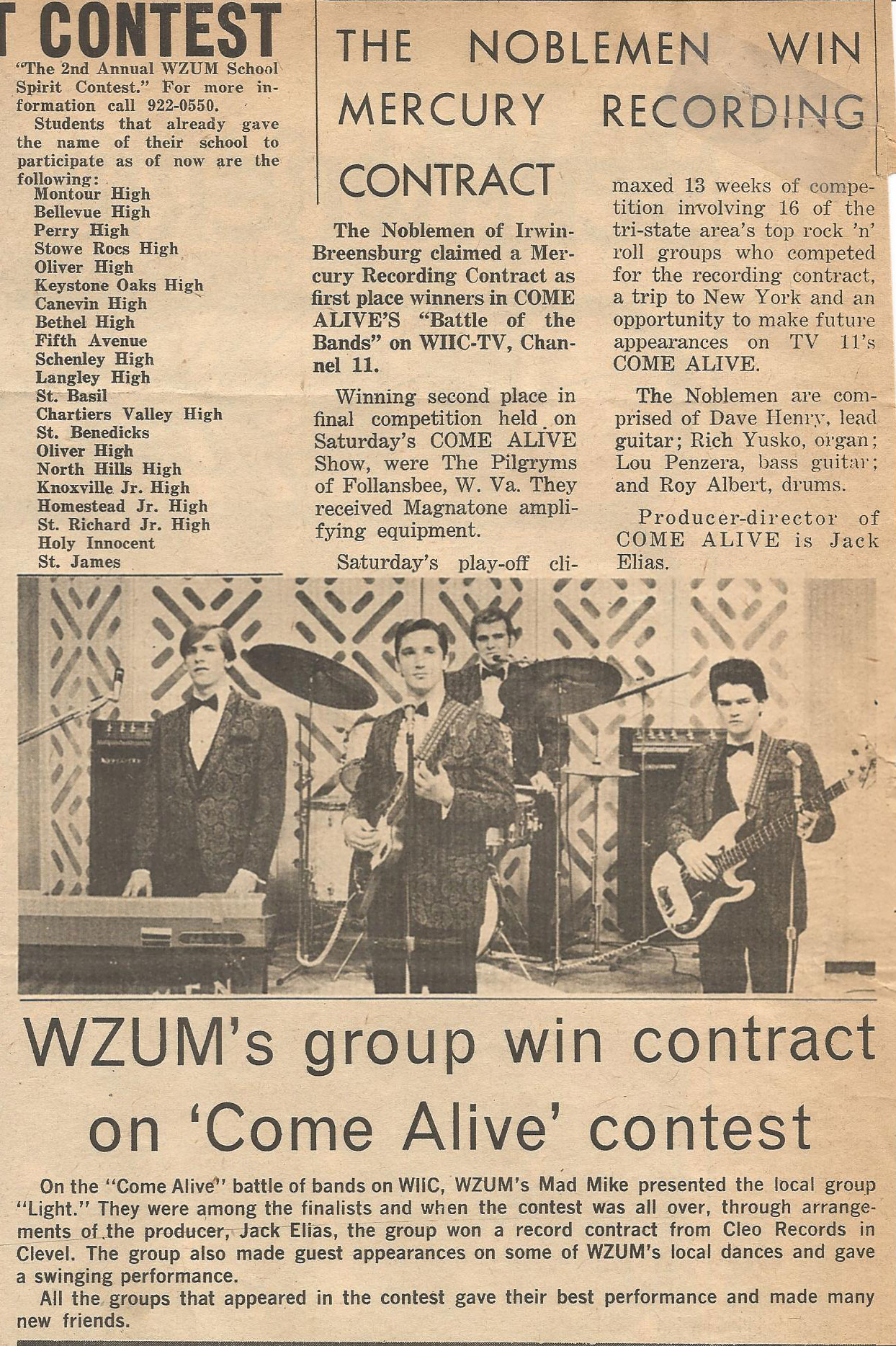
Once rumored to be from Wichita, Kansas, Moby Dick and the Whalers were actually based in Midwest City, just outside of Oklahoma City. Members were Tom Rushlow on vocals, Bobby Harris rhythm guitar, Jim Parr on bass, Gary Stevens on organ and Blue Fox on drums. As a quintet they had been playing since August ’67, though Tom Rushlow, Bobby Harris and Jim Parr had been in earlier groups together.
They participated in a nationally-televised band competition, the Paul Revere & Mark Lindsay hosted show, Happening ’68. In the contest, two bands would lip sync one of their recordings (original or cover song) in front of a panel of three judges and studio audience, with the winner going on to the next round. The judges varied from show to show, but at the time of the Moby Dick and the Whalers broadcast, may have been Jackie DeShannon, Tommy Roe and Jay North (Dennis the Menace).
The song Moby Dick and the Whalers did for the show was “I Love Her So”, an excellent organ-driven rocker, written by Tom Rushlow and Bobby Harris. From the few episodes I’ve seen (and I haven’t seen theirs yet), I would say “I Love Her So” must have been one of the better original songs featured on Happening ’68.
The flip side is the mellower “Only the Good Times,” written by Curtis Hays, the former drummer of the group. According to the article, the 45 was released just after the appearance on Happening ’68.
The original lineup, 1966, l-r: Franklin Harris, George Feree, Tom Rushlow, Jim Parr and Bobby Harris.
Bassist Jim Parr sent in the photo and article from the Oklahoma Journal, and provided some history of the band:
The lead singer and manager was Tom Rushlow, who was stationed at Tinker Air Force Base near OK city when the band was first beginning to form. I met Tom through Bobby Harris, who invited me to a jam session. Tom Rushlow, Bobby Harris – and Bobby’s brothers – William Harris and Franklin Harris – were all extremely talented musicians. We all lived in or around the OK City area at the time.
After a few jam sessions and practices, I was very excited and proud to be invited to become the bass player for the group. If I remember correctly, Tom Rushlow came up with the name for the group.
Thus, the original ‘Moby Dick & The Whalers’ band was born and was composed of – Tom Rushlow, lead singer – Bobby Harris, rhythm guitar – Franklin Harris, lead guitar – George Feree, drummer – & Jim Parr, bass guitar. This was sometime around the year ’66, give or take a year.
After the original drummer, there was Curtis Hayes – who is credited with the song ‘Only The Good Times’ on the flip side of the 45. Next came Blue Fox, who played the drums with the group during the time the record was made and was with the group during the invitation to Hollywood. William Harris, drummer, was with the band from time to time, and eventually was with the band full time.
One very popular member of the group that deserves mention was Joe Sawyer, organist, who replaced Gary Stevens.
Notice from the Ardmore Daily Ardmoreite, March 6, 1969, describing an April release for their 45During the time frame of the recording and release of the record, in ’68 and ’69, the group was composed of Tom Rushlow, lead singer – Bobby Harris, guitarist – Gary Stevens, organist – Blue Fox, drummer – and Jim Parr, bass guitar. The master tape for the 45 was recorded by this group at a studio in Tyler, Texas.
The group performed numerous times on local OK City television shows, one of which was a popular show titled ‘The Scene’, hosted by a very popular DJ – Ronnie Kaye. The group was also invited to appear in Hollywood, on a television show titled ‘Happening ‘68’. This show was a Dick Clark production and was hosted by Paul Revere and Mark Lindsay, of ‘Paul Revere & The Raiders’.
Tom Rushlow’s son Tim played with Little Texas and is now a solo country artist. Tim’s online biography mentions a later version of his father’s band:
After getting out of the military, Tom Rushlow moved his family to Arlington, Texas, where he joined his wife Patricia’s three brothers in a band called Moby Dick and the Whalers.
“The Whalers were one of those good regional acts that opened for stars like Mitch Ryder and James Brown,” remembers the proud son. “They put out their own records, and even came close to appearing on ‘American Bandstand.’ They got real close to making it.”
Update:
I’m very sorry to report that Jim Parr passed away on February 10, 2009. His son Robert wrote to me, “He was a very talented artist and a great father – I couldn’t ask for a better life. He loved music and played a lot at home for the family.”
It was an honor for me to correspond with Jim about his music, my deepest condolences to his family.
The Marke 5 were high schoolers from Fayetteville, near Raleigh. Members were Donnie Wofford on vocals, Bill Muffet lead guitar, Pete Sanchez guitar, Steve Kellburg bass and Eddy Truman on drums.
“Pay” has a lot going for it: unusual staccato guitar work, a solo heavy on reverb, sharp drumming and good lead and harmony vocals. Great bass work stands out on “The Leader”, a solid shout-along tune. Both songs are credited to Donnie Wolford and Bill Muffett.
Ed Truman later played with a version of Minnesota band the Castaways (of “Liar Liar” fame) when Castaways’ guitarist Bob Folschow was stationed in Fayetteville while in the military.
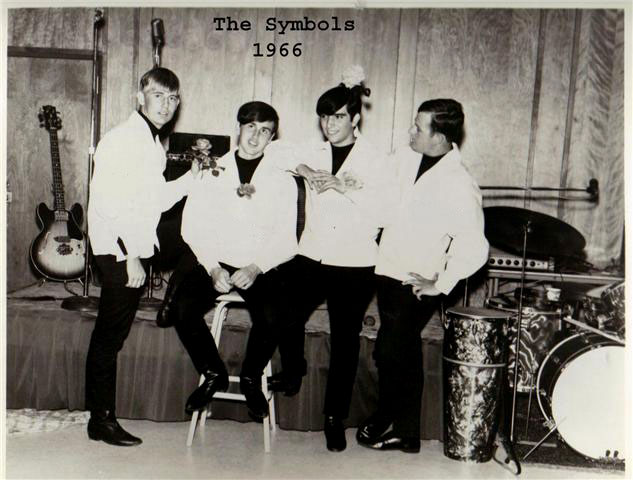
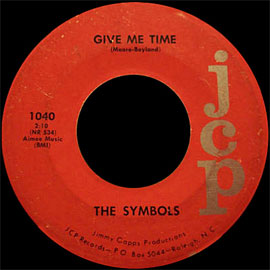
Jimmy Capps was a very popular DJ on WPTF in Raleigh and started the JCP label in early 1965. He released records by dozens of groups including the Unknown IV,the Counts IV,the Symbols, the Vigilantes, the Nightwalkers, Davy Butler, and the Vibra-Sonics, recording in his studio behind the McDonald’s on Hillsborough Street. Jimmy Capps died in 1967 at age 47, and the label soon folded, ending a remarkable run at documenting the local Raleigh-Durham scene.
Sources include: Tobacco-A-Go Go vol. 2, and Fuzz, Acid and Flowers.
This site is a work in progress on 1960s garage rock bands. All entries can be updated, corrected and expanded. If you have information on a band featured here, please let me know and I will update the site and credit you accordingly.
I am dedicated to making this site a center for research about '60s music scenes. Please consider donating archival materials such as photos, records, news clippings, scrapbooks or other material from the '60s. Please contact me at rchrisbishop@gmail.com if you can loan or donate original materials