Morticians photo circa 1965, top row l-r: Bubba Rowell lead guitar, Donny Guess keyboards and Steve Smith bass guitar. Bottom row l-r: Royce Sisk drums and Donnie Humphreys vocals
Donny Guess sent in these photos of two bands from Levelland, Texas, just west of Lubbock. The Morticians would become the Shyles with different lineups over the years. I first encountered the Shyles name in a news clipping about a battle-of-the-bands in Brownfield, which featured a photo of the Charvonnes.
Donny writes:
The Shyles, a garage band from Levelland played venues in west Texas and eastern New Mexico from May 1965 to August 1968.
Their first gig was late May 1965 in Brownfield, TX, at a end of school year battle of the bands dance. At that time they didn’t have a name so the organizer for the youth center suggested the The Morticians, since the other band was the Undertakers. The youth director then suggested that both band members ride in the back of a pickup through town with a borrowed casket to promote the dance.
The Shyles, top row l-r: Brad Billingsley drums, Loyd Summers vocals, bottom row l-r: Gary Butner bass guitar, Bubba Rowell lead guitar, Donny Guess keyboards.
We did not record a record as the Shyles. One band member, who left the Shyles in late 1966 did record with another group, no details available though. As the Shyles we did make a trip to Norman Petty studios in Clovis to visit about cutting a record but were unable to raise the money to produce it.
We played mainly youth centers, ballrooms and National Guard armories.
Other members of the Shyles not in the photo include:
Ronnie Stoughton – guitar Jan Pharis – drums
Shyles reunion, June 2020: Steve Smith, Bubba Rowell and Donny Guess reunited in Garland, Texas.
Leon Starr was a Memphis, Tennessee musician whose roots go back to rockabilly days. In 1966 he had a country single “Honey Chile”, written by G. Huskey (Bill Huskey) and Johnny Surber, b/w “Have I Wasted My Time” by Arthur Kyle and Richard Needham, released on Millionaire Record Co.
His next single may have been this one, Leon Starr and the Fire Birds “Little Live Wire”, which gets a good sound by combining fuzz guitar with organ and a throbbing beat. I’d like to know which musicians were the Fire Birds.
Released on VU Record Co. 45-101, and recorded at Tempo Recording Studio in Memphis, as were all the singles on the VU label, I believe. Leon Starr produced both sides. VU Record Co. had at least five other singles, country and spiritual, by George Wilhite, Don Miller, Jerry Gillentine, and the Mellorettes.
Arthur Kyle wrote “Little Live Wire” (copyright registered in April, 1968) and co-wrote “Endless Dream” with Herchell Hunton (registered May, 1967). Hernando Pub. Co. published both songs.
In 1970, Leon Starr also wrote a couple other songs with Arthur Kyle, “Go Ahead, Laugh” (with Marvin Griffith) and “Imitation of You”. I’m not sure if these were recorded.
Allan Breed with the Third Level had only one release, “City Where I Once Lived” / “Many’s the Time”, both full pop productions with light psychedelic touches. By accident, some of the lyrics on “City Where I Once Lived” are incredibly apt to our situation in 2020:
Well here I am, in the city where I once lived, But no one bothers to speak, Attitude is simply oblique, It’s not the same anymore.
Love once surrounded me here, In the city where I once lived, But the love I once knew is gone, Only faces of misery drawn, Puts the blame of it all.
Where are the people who once smiled and said hello, Where did they go?
Have I stayed away too long or is there really something really wrong?
So as I walk, through the city where I once lived, And see this disease I’ve seen, That destroys the reasons for being, I can’t understand.
Allan Breed notably co-wrote “Frozen Sunshine” with Rick McClellan, which in recent years has become a well-known hit with retro club DJs, especially in Europe. Breed and McClellan collaborated on a number of songs, not all of which seem to have been released. The first may have been “Goodbye My Friend”, registered in 1966.
In May of 1968 they registered copyright on “City Where I Once Lived” and “Many’s the Time”. Allan Breed produced the songs with Steve Clark for release on their own label Treswood TW 101.
The following year, Lawrence Allen Breed and Rick McClellan wrote “Frozen Sunshine”, copyright registered in May of 1969. Breed and Mike Henderson (for Treswood Productions) produced that single on Ranwood R-849, and also his follow-up, “Redheaded Woman” / “2:30 in the Morning” for Quad Records QU 105, where Allan Breed was head of A&R.
Quad Records also reissued “Frozen Sunshine”, without the violins, and with a different B-side, “Julie Makes It Right”. A Cash Box notice from July, 1970 lists some other Quad releases and notes Al Perry was executive vice-president of Quad. An ad in Cash Box from the same month for Four Star / Stellar Music / BNP Music Publishing lists Alfred Perry and Fred Benson as VP, and has Allan Breeds name but without title.
Later copyrights by Breed and McClellan include “By the Light in Your Eyes”, “Here Comes the Sun” and “Who Taught You”. I’m not sure if these were recorded or released.
Allan Breed would go on to produce a few more records with Mike Henderson, including two singles of Sandy & Dick St. John on Congress, and two by CaShears on pbm Records. Also on pbm Records Breed produced Sidro’s Armada’s “Little Girl from Greenwood, Georgia”.
Steve Clark is likely the same person who partnered with Curt Boettcher in Our Productions (thanks for the tip Max Waller). Clark and Mike Henderson both worked on some Tommy Roe productions from this period.
July 1970 publishing ad including writers R.B. Greaves, Dean Kay, Hal Blair, Arthur Hamilton, Kelly Gordon, Peter Daniels, Norma Green, Tad Suckling, Gloria Sklerov, Douglas Fir, Rick McClellan, Jerry Wright, Nick Alexander, Lala Schrifrin, Bob Simpson, Chuck Jones, Buzz Siler and Martin Kosins
“Homebrew” is a storming instrumental, with a foreboding rhythm guitar and bass behind sharp lead guitar work, excellent drumming and rockin’ piano.
I can’t find much about Archie Liseo other than an odd news item from December, 1965, where an Archie Liseo “is resigning from the Denver Young Democrats in protest against what he described as ‘filth’ in the organization’s newspaper. Liseo said he objected to the review of a play in the December issue of the paper The Vanguard. He said the paper had been read by his children before he arrived home Thursday.”
I suppose that could be a different person, considering this group titled their record “Homebrew”.
“Homebrew” has a writing credit of A. Trujillo, which could be another name for Archie Liseo. This may be the only record he ever made. The band is so good I hope there are more recordings somewhere.
The ballad A-side, “Lonely” was written by L. Pickett and J. Ward. CLW Music Pub published both songs.
Released on CLW 45-6576, this is a Rite pressing, 13705/6 from 1965. CLW owner Jim Ward produced the single with Geo Chapekis. The address for CLW is given as 522 Knox Ct., Denver.
I’m not sure if the San Diego Marauders were an actual group or a studio creation. Cecil Calvert ran Compose Records from his home at 450 Orlando St. in El Cajon, just east of San Diego.
Compose Records released two singles by the San Diego Marauders. The first had an original by Cecil Calvert, “Don’t Come Around” backed with a good version of the Olympics “The Bounce”. Released as Compose Records 1901/2, the Monarch Δ number 56767 dates it to April or May of 1965. “Don’t Come Around” has a good garage sound, and runs a minute and a half!
The second single is interesting for including “Ervin Rucker, vocal” and featuring an original song by Rucker and Ervin Groves, who often collaborated together. Compose Records 1903/4: “Baby Can’t You Feel It” (E. Rucker and E. Groves) / “Sentimental Reasons”.
In July 1967 and 1968, Cash Box’s list of ASCAP publishers includes “Groham c/o Cecil Calvert, 450 Orlando”. Calvert also had a June, 1964 copyright for a song called “Shackles of Love” written with Robert L. Jackson. If it ever was recorded, I don’t believe it saw release.
Bob Galindo, brother of 13th Floor Elevators bassist Danny Galindo, wrote on a now-defunct San Antonio music history site, “Max Range was not the ‘Stepfather’ of Texas pyschedelia, he was ‘THE GODFATHER’. He was a very influential guy, in a subversive sort of way, if you know what I mean.”
On the same site, Margaret Moser posted, “Max Range gets no credit as one of THE visionaries of South Texas music”.
I have not found much detail on how Max Range influenced the Elevators and the psychedelic scene in Texas, but one thing is certain, Range fronted three bands that included five future members of the Elevators.
Max Range’s full name was George Max Range, born in Beeville, TX, an hour’s drive from Corpus Christi (also birthplace of John Ike Walton, who moved to Kerrville in 1950). Max went to school in Beeville, and became an Eagle Scout.
Max moved to Kerrville in the early ’60s, perhaps with his family to finish school, or as an apprentice printer for the local newspaper the Daily Times.
Traditions, Kerrville Daily Times, July 23, 1963 In Kerrville he would join a group called the Traditions. The Kerrville Daily Times featured a photo of the Traditions on July 23, 1963 with the accompanying text:
The Arcadia Theatre of Kerrvile will present a Summer Stage Show during the intermission of two big twist hits, “Don’t Knock the Twist” and “Twist Around the Clock” July 24 and 25 at 8 p.m. The music of “The Traditions” will be presented.
“The Traditions” is a group of young local musicians that produce an activated tempo-type sound. Five members comprise the band.
Max Range, 19, from Beeville is the vocalist. Max has had four years experience in the musical field and has performed in two bands before organizing the Traditions.
Bobby Hunter, 19, from Freeport, plays the lead guitar. He has had four years of training…
Bobby Sanchez, 16, from Kerrville, is the rhythamatic drummer with a set of “talking” drums. He has put three years into the mastery of the drums and has won several awards in the Tivy High School Band.
Randy Jackson, 18, from San Juan … plays the bass guitar and has had two years of experience.
Stacy Sutherland, 17, from Kerrville provides the basic rhythm … which enables The Traditions to give that special sound quality necessary for a top grade band.
All of these band members from various parts of Texas are now combined into one soundsation group…
Marvin Taylor, “The Traditions” manager and the assistant manager of the Arcadia …
I’d like to know more about Max Range’s two earlier bands from his four years experience in music, but have not turned up any info other than a group with Stacy called the Signatures, mentioned in Ben Graham’s A Gathering of Promises.
Although the Daily Times article states Max organized the Traditions, it seems the group formed in 1961 or 1962, well before Max joined. An early photo shows Stacy Sutherland, Bob Schmerbeck, Eddie Flores, Bobby Sanchez and Randy Jackson.
In April 1964, the Kerrville Daily Times runs an ad for the Grove restaurant “now under new management, Grady and Shirley Sharp” with “Live Band – Max Range and “The Traditions” featuring Joe Burkett III and His “Backwoods Fiddle”.
On August 23, 1964, the Kerrville Daily Times makes the first mention of Max Range appearing with the Penetrators (as the Penetrations):
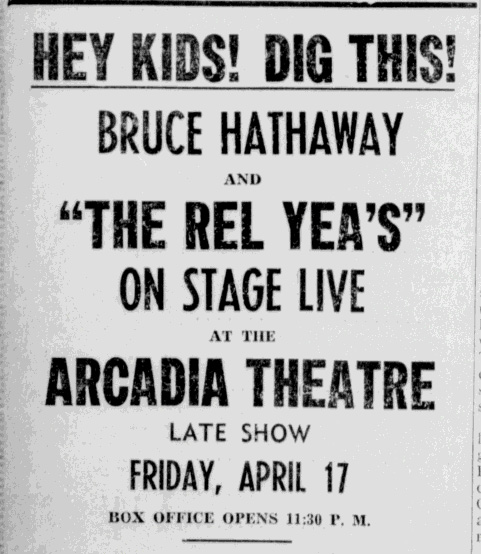
Jamey Ryan of San Antonio, Miss KTSA, is schedule to appear at the Arcardia Theatre on Thursday, Aug. 27 in connection with the Gigantic Hootenanny Stage Show. Headlining the show will be Denny Ezba and the Goldens; Bruce Hathaway of KTSA as master of cermonies; Max Range, local vocalist; and the Penetrations, a local group from Kerrville.
Range is band leader of The Traditions but will be appearing with The Penetrators.
April 6, 1965 Notices in the Kerrville Daily Times on September 20, October 2 and November 6, 1964; and on January 14 and 28, 1965 all include Max Range as vocalist of the Penetrators.
On, April 5, 1965 and earlier dates, the Kerrville Daily Times ran a 1″ x 1″ classified display ad “for Sale, Ideal for musical group. Premier P-14 PA System … Max Range, Daily Times.”
Penetrators, Kerrville Daily Times, June 6, 1965
A Daily Times article from June 6, 1965 writes:
The Penetrators … have released their first record which is available to the public. The record, “Praying Till Then” and “Kurl” is on the Trater Record label. “Praying Till Then”, a slow ballad, was composed by Max Range, vocalist for the group. The flip side “Kurl”, was composed by all members of the ensemble, who are, Danny Klein, Bob Morrison, Ron Leatherman, Pat Morrison and Max Range.
The single was released as by Max and the Penetraters on Trater Records 650528. As far as I know, this is the only recording Max Range ever made.
In the spring of 1965, Kerrville musicians Stacy Sutherland and drummer John Ike Walton met violinist Benny Thurmond at Dirty Martin’s hamburgers in Austin. After a trip to Mexico together, they stopped at the Gulf Coast town of Port Aransas on the way home. There they met Ralph Plumlee and talked their way into a residency at the Dunes club. They brought Max Range into the group, which they named the Lingsmen.The Lingsmen at Bonnie and Dougs, Aransas Pass, September 1965
I’ve read that Tommy Hall was a member of the Lingsmen, but that seems to be incorrect, although the band would see Tommy and Clementine Hall in Port Aransas that summer.
I’d also read that Stacy, John Ike and Benny left Max to go form the Elevators, but it seems that Max was the first to leave the group. Tony Joe White filled in for some shows, and the Lingsmen may have recorded a demo with Tony, now lost.
Perhaps the last show of the Lingsmen with Sutherland, Walton, & Thurman at the Maison Rouge in Corpus Christi, November 16, 1965 Corpus Christi Times Nov. 1, 1965
Judging by local news ads, the group continued at least until mid-November, 1965. About that time Stacy, John Ike and Benny left Port Aransas, supposedly because of attention from local police. In Austin, they would form the 13th Floor Elevators with Tommy Hall and Roky Erickson, playing their first show on December 8, 1965.
June 16, 1966, Max and the Laughing Kind at the Dunes Annex and also at the Carousel on 10th St.Max Range however returned to Port Aransas, recruiting members of a San Antonio group called the Loose Ends circa January, 1966:
Dan Galindo – bass Bob Galindo – guitar Bill King – guitar Buddy Toscano – drums
This group may have performed as the Lingsmen initially, but by June had become Max and the Laughing Kind.
“Two of the Laughing Kind hitting the chords at the Dunes.(guit and bass)” – Max and the Laughing Kind profile in the Corpus Christi Caller Times, July 24, 1966
An article in the Corpus Christi Caller Times on July 24, 1966 lists the other members as:
Keith Miller – lead guitar Bill King – guitar Bill Smith – bass Tom McTaggart – drums
Hundreds Flock to Port Aransas Danceland Every Weekend
The popularity of the Dunes Danceland at Port Aransas appears to be climbing in its second season, and owner Ralph Plumlee says he has plans for a bigger place in the future.
On a Saturday night now it starts about 8 p.m. – a line of headlights heading down the Padre Island beach toward Horace Caldwell Pier, begins to turn into a laughing, dancing crowd of young peoople at the Dunes.
Plumlee, a retired Dallas business man, and head of White Marlin Enterprises in Port Aransas, said that the average Saturday night attendance ranges from 700 to 1,000. The July 4 weekend drew a crowd estimated at 2,700 on one night…
Max and The Laughing Kind provide the warmth and the music. The long haired band leader wears sunglasses for the evening performance.
… the five-piece band is composed of Max Range, from the Beeville area, who is leader and singer; Bill King, guitar; Tom McTaggart, drums; Keith Miller, lead guitar; and Bill Smith, bass.
The Danceland’s popularity has spread out of the immediate area. College students from Kingsville and even as far as San Antonio and Houston make the Saturday night dances.
Max and the Laughing Kind profile in the Corpus Christi Caller Times, July 24, 1966
Miller, Smith and McTaggart had been in a San Antonio group the Mysterions with Roy Cox. When the summer was over, they went back to San Antonio and continued to use the Laughing Kind name with Bobby Trevino on keyboards and Tommy Smith on vocals. Dan Galindo would soon join the 13th Floor Elevators in time to record much of Easter Everywhere.
1967: Max Range’s Lingsmen with a new lineup, back at the Dunes
The following year, the Corpus Christi Times announced “Max and the Lingsmen” for the grand opening of the new Dunes Danceland, on Friday, May 12, 1967; “main dance floor enlarged and redecorated.”
The lineup at this time was listed on the now-defunct Mike’s Band Archive site:
Max Range – vocals Chris Holzhaus – lead guitar Bill King – guitar Ronnie Huth – vox organ Mike Marechal – bass Sam Allen – drums
That is the last document of Max Range’s music career that I have found until 1970, when an International Artist list of bands includes Ice with Max Range, Stacy Sutherland, David Browne, Michael Marschell and Ron Viviano (reproduced in Paul Drummond’s 13th Floor Elevators: A Visual History). Ice reportedly went into a studio twice, but no recordings have survived.
According to an online obituary, “Max was a printer for the Houston Chronicle for many years. George Max Range of Copperas Cove died at 59, on July 10, 2003, after a long illness.”
The X-Centrics came from Ardmore, Oklahoma, a town south of Oklahoma City, about halfway to Denton, TX. All were teenagers at the time of this detailed feature in the Ardmore Daily Admoreite on April 27, 1969.
Members included:
Joe Ben Pruitt – organ, guitar Kenny Pruitt – drums James Buck – lead vocalist, guitar Mike Fitzgerald – lead guitar Roger Littrell – bass guitar
The group, which plays heavy, psychedelic and soul music, defeated five top Texas bands in a battle of hte bands in Gainesville, Tex. recently to receive a recording contract with the Sonco Record Company in Fort Worth, Tex.
They recorded “get Out of My Life Woman,” and “Try a Little Tenderness” at a recent recording session, but the record has not yet been pressed.
I don’t believe the record ever saw release.
The X-Centrics played at Keeler Junction in Colorado Springs, and planned on appearing on Dick Clark’s Happening ’69 show.
Ronnie Leatherman is best known for playing bass on The Psychedelic Sounds of the 13th Floor Elevators. Before that time, he had at least two other bands, the Penetrators and the Beau-Mondes, formed while he was at Tivy High School in Kerrville, Texas, a town about 65 miles northwest of San Antonio.
Kerrville Mountain Sun, September 18, 1963
The Penetrators started as “The Counts”. On September 18, 1963, the Kerrville Mountain Sun reported:
“The Counts,” a small band group at Tivy, performed on the radio September 10. The group is composed of Pat Morrison, guitar; Ronnie Leatherman, bass; Danny Klein, guitar; and Bobby Morrison, drums. They played “Bulldog” and one of their own songs, “The Swing.”
Listed as the Penetrations, March 25, 1964
The earliest notice I can find for the Penetrators is from March 25, 1964, where the Kerrvile Mountain Sun lists the group name as the “Penetrations”. Members were the same as the Counts:
Danny Klein – lead guitar Pat Morrison – rhythm guitar Ronnie Leatherman – bass Bobby Morrison – drums
This quartet would be the heart of the band through several changes in lineup.
Penetrators, Kerrville Daily Times, July 14, 1964
On July 12, 1964 the same lineup played a show at the Jaycee Center with the Reverbs, which included Bobby Schmidtke, Frank Lola and Pat Young.
Penetrators, Kerrville Daily Times, October 2, 1964Penetrators, Kerrville Daily Times, November 6, 1964
A notice in the Kerrville Daily Times from August 23, 1964 is the first time Max Range is connected to the band: “Range is band leader of The Traditions but will be appearing with The Penetrators, local combo.”
On September 20, 1964, the Daily Times column Hill Top Village Views includes Max Range as a member, and also includes Bobby Solomon whose name I do not see in any other listing. The October 2 Daily Times includes a photo of the band with Max Range.
A notice from November 6 in the Daily Times for a Jaycee Youth Center dance the next day lists yet another short-lived member, Carlton White on rhythm guitar. Carlton’s name would also appear in notices from January 14 and 28, 1965. Carlton White had been in a folk group with Stacy Sutherland, the Travelers Four.
The Penetrators from left: Bob Morrison, Ron Leatherman, Max Range, Danny Klein, and Pat Morrison
On February 25, 1965, the Daily Times reused the photo from October, but noted:
Kerrville’s Penetrators made their first TV appearance Saturday afternoon on the Ricci Ware show … on Channel 5 … The boys have written several songs and played one composed by Max Range, “I’ll Keep Praying Til Then” on the TV show. Left to right are Bob Morrison, drummer, and student at Tivy High School; Ron Leatherman, bass player and Tivy student; Max Range, vocalist and harmonica player who is employed at the Daily Times; Danny Klein, Tivy senior and lead guitarist; and Pat Morrison, rhythm guitar and student at Schreiner Institute.
Penetrators, Kerrville Daily Times, June 6, 1965
A Daily Times article from June 6, 1965 writes:
The Penetrators … have released their first record which is available to the public. The record, “Praying Till Then” and “Kurl” is on the Trater Record label. “Praying Till Then”, a slow ballad, was composed by Max Range, vocalist for the group. The flip side “Kurl”, was composed by all members of the ensemble, who are, Danny Klein, Bob Morrison, Ron Leatherman, Pat Morrison and Max Range.
This is the last mention of the Penetrators I can find. The single was released as by Max and the Penetraters on Trater Records 650528.
By the summer of 1965, Max Range left to Port Aransas with the Lingsmen, a group featuring two other Kerrville musicians, Stacy Sutherland and John Ike Walton.The Beau-Mondes, Kerrville Mountain Sun, November 24, 1965
An article in the Kerrville Mountain Sun from November 24, 1965 on the Beau-Mondes shows the original Penetrators quartet has been expanded into a septet and renamed, featuring:
Mark Atterbury – vocals Danny Klein – lead guitar Pat Morrison – rhythm guitar and manager Bill Stacy – rhythm guitar Bob Schmerbeck – piano Ronnie Leatherman – bass guitar Bobby Morrison – drums
The Beaumondes, Kerrville Daily Times, December 29, 1965
The last mention I can find of the Beau-Mondes was from December 29, 1965, and mentions a single that I do not believe was ever released:
The Beaumondes … have recently cut a record. The name of the record is “Won’t You Cry for Me?” It will be released January 11. The lead singer, Mark Atterbury, wrote the song and sings it with the other boys providing the background The members are Mark, Pat Morrison, Bobby Morrison, and Ronnie Leatherman.
From an interview on It’s Psychedelic Baby by Justin Jackley, Ronnie Leatherman mentioned a trio with two friends who passed away the same year. He also said the Lingsmen asked him to come to Port Aransas for a few weeks to play with them and help Bennie Thurman learn how to play the bass, and that Stacy wanted Ronnie in the 13th Floor Elevators.
Thank you to Matthew B. for his continued help to access news sites.
The Thingies were a peripatetic band, settling and playing shows in a number of locations, and occasionally recording. A full story of the band is on the Cicadelic site. I wanted to include a brief post on the Thingies because of their single on Casino Records.
In late 1962, Larry Miller formed the TR4 while he was stationed with the Air Force in Topeka, Kansas.
The TR4 were:
Don Ferguson – lead guitar Dave Daws – organ Larry Miller – bass and vocals Joe Rodriguez – drums
The TR4 released a single in 1963, “Peter Rabbit” backed with a stomping instrumental, “Surfin’ TR” on Exclusive Records.
In 1964 the band added Phil Weaver as lead vocalist and changed their name to the Coachmen. Gordon Marcellus replaced Joe Rodriguez on drums.
By 1965 the lineup changed again along with the band name to the Thingies:
Fabulous Thingies at the Emporia Civic Auditorium, Nov 11, 1966
Phil Weaver – lead vocals John Dalton – lead guitar Ernie Swisher – organ Larry Miller – bass Gordon Marcellus – drums
They released “It’s a Long Way Down” / “Merry Go Round Of Life” on Casino in early 1966. The group played often in Omaha, Nebraska, where the band first learned about psychedelics. The West Coast Pop Art Experimental Band played at The Tiki Club in Topeka, and they helped the Thingies get a light show together according to Larry Miller.
In December, 1966, the Thingies recorded two original at Fairyland Studios in Columbia, MO, “English Eyes” / “No Matter What The World May Say” that were not released at the time, but “English Eyes” appeared on the CD “The Thingies Have Arrived” on Collectables. That CD also features one vocal and two instrumental takes of another original, “I’m Going Ahead”.
The Thingies spent the summer of 1967 in Miami, playing regularly at a huge teen club called The World.
Georgetown Megaphone Sept. 29, 1967
They went to Waco, where Phil Weaver had family, then moved to Austin, Texas in September. One of their earliest shows in Austin was at a Love-In at Zilker Hillside Theater on September 24.
In an article headlined Capital Cops Tops With Hippie Love-In, reporter Mary Callaway gets a little carried away, but still presents a great window onto the Thingies stage show:
Freak-out music dramas presented by the Thingies, a national psychedelic band.
Dressed in a collage of costumes from full monk garbe to Daniel Boone, the Thingies presented a trip experience in which an amber light caught on the jags and peaks of a lump of raspberry jello one into a dream of all worldly objects and abstract concepts merging into one single sound which becomes dust, spirals, and creates a new being. Then the drums and guitars pick up the poet’s rhythm and “Gloria” crashes in in full orchestra.
In “Suzi Creamcheez, What’s Got Into You” the female member of the band expresses a trip experience in which for twenty minutes, with wailing guitars, computer sounds, and aggressive band members, throw her absurd world into supersonic gear, and pathetically enough she screams frantically throughout the drama.
The Austin Daily Texan writer Merry Clark had a more sober account, and named the other bands on the bill:
The Jackels from Dallas began the afternoon playing a new sound for the group formerly known as the Chessmen. They were followed by the Austin Conqueroo …. then a newer Austin band composed mostly of University architecture students, Shiva’s Head Band … A group of men from Bergstrom Air Force Base called the Afro-Caravan [with] Robert King, the leader of the group.
The evening program began and ended with a light show, “Mothers of Invention” sound, and freak out of the Thingies band from Miami.
Austin Love-In with the Jackals, the Conqueroo, Shiva’s Headband, Afro-Caravan, and the Thingies, Austin Daily Texan, Sept. 26, 1967 Over the next six months, the Thingies would play many live shows at the Matchbox, the Vulcan Gas Company, the Pleasure Dome and other venues. Their manager (Night Productions) owned the 11th Street Folk Club, and the group recorded some live shows but the tapes have apparently been lost.
The band signed with Sonobeat, who recorded them at the Swinger’s Club during the club’s off hours, and did overdubs at KAZZ-FM studios. The single featured Gordon Marcellus and Larry Miller’s original “Mass Confusion” backed with Phil Weaver and Bob Cole’s “Rainy Sunday Morning”. Recorded in December, 1967, Sonobeat didn’t release it until the spring of 1968, by which time the Thingies had split up.
Unreleased songs from the Sonobeat sessions include “I Died”, “Mrs. Baker”, “Richard’s Song”, all without finished vocal tracks. You can hear “Mrs. Baker” on the Sonobeat page for the Thingies.
Gordon Marcellus passed away in 2004, Phil Weaver passed in 2014, and Larry Miller passed away at 74 in 2017.
Thingies at the Match Box, Austin Daily Texan, Nov 29, 1967
An additional source was Mojo Mills’ interview with Larry Miller in Shindig.
Night Productions: the Thingies management in Austin
The Thingies, partial gig list:
September 3, 1966 – at the Skyline Club, Manhattan, Kansas
November 12, 1966 – The Fabulous Thingies at the Emporia Civic Auditorium
June 30, 1967 – Atchison, KS Memorial Auditorium
September 24, 1967 – Zilker Hillside Theater, Austin, TX, Love-In with the Jackals, the Conqueroo, Shiva’s Headband and the Afro-Caravan.
September 29 and September 30, 1967 – the IL Club, Austin, TX
October 3, 1967 – New Orleans Club, Austin October 20 and October 21, 1967 – The IL Club, Austin (“After Hours 1 a.m. – 4 a.m.”) October 31, 1967 – New Orleans Club, Austin (“Halloween Ball … wear mask”)
November 29, 1967 – The Match Box, Austin
December 15 and December 16, 1967 – The Pleasure Dome, Austin
December 29 and December 30, 1967 – Hilltop Club, Atchison, KS “The Thingies out of Austin … Just back from the Bahama Islands” ?!
Notorious even in distant Fort Stockton, TX, reported in the Pioneer, Nov. 30, 1967
Final poster for The Other Place, featuring the Huckleberry Mudflap
Once upon a dream, a sage became a bright butterfly and visited secret places in far-away lands. The dream was so real that, upon awakening, he wondered: am I now a man who dreamt he was a butterfly, or am I a butterfly now dreaming I am a man?
Thus read the legend on the most gorgeous concert poster from ‘60s North Carolina I had ever seen. In fact, the colors and lettering were so good that I spent the last several years with the image in the back of my mind with a mental footnote that it was probably a later reproduction. A magenta and aquamarine background camouflaged the face of a lovely woman peering down on a red-capped mushroom with white stalk, on which the opening paragraph was written sideways in small cursive script, while a large, ornate and matching red/white butterfly design drew the eye up and right. It was exquisite.
The design and color scheme was just what you hope for in a psychedelic piece of the era. It would have been good enough to announce the appearance of Jefferson Airplane and Moby Grape at the Fillmore West. Alas, this was no lost San Francisco concert herald. The headline in white against the red mushroom top in beautiful stylized lettering read, “The Other Place, The Huckleberry Mudflap, Monday Aug. 26 thru Saturday Aug. 31 at the Rec. Center near mile post 12 Nags Head.”
Huckleberry Mudflap was no mystery. They were a well-remembered group around eastern Carolina, hailing from Harkers Island, NC. Their two 45s are quite nice. “Blue Surf” is a mellow sunshine pop account of a stroll on the beach. “Goodnight Mrs. Kollendoffer (Wherever You Are)” is the more mind-bending side.
This venue The Other Place at the Rec Center was more obscure. The most popular concert club in Nags Head was The Casino, their equivalent of the Myrtle Beach Pavilion. That’s where all the beach circuit bands landed. In fact, whatever The Other Place had going during the summer of ’68 would have been up against some serious competition from the Casino calendar that season. No trip to Nags Head was complete without a visit to the Casino or so I’ve been told.
‘Fessa John Hook would be able to rattle off a string of artists that played the Casino. As a beach music expert and DJ, ‘Fessa (that’s professor in cool-speak) John is conversant in all things shag-worthy. So, when he asked me recently, on the reputation of my Facebook group Carolina Rock ‘n’ Roll Remembered, if I could recommend any interesting show posters, I immediately thought of the Other Place. I told him the provenance was still in question, the jury was still out, but they (I had an inkling of two other designs in the series) were beautiful and deserved more study. While they weren’t really for beach dance bands, the events, if they were genuine, in that location at that time would certainly have some overlapping interest. John agreed. I was on the case.
I shot Morris Willis of Huckleberry Mudflap a message. Did the show as advertised take place? If the poster were a fantasy piece, it’s possible the related content was dreamt up. Morris responded shortly and gave me my first glimpse inside The Other Place. It most certainly did exist and The Mudflap had played that week.
Third poster for the Other Place, featuring the Wild Kingdom and the Aliens, each playing a week
How about those posters, though? The thought still hung with me that someone had revisited an idealized version of their youth and designed these in more recent years, maybe to sell in gift shops up and down the Outer Banks. It wasn’t a bad idea. They were just too good and raised many unanswered questions. Who was capable of such a thing in 1968? Why would they be associated only with a tiny, forgotten club on the beach and feature small regional acts mostly unknown an hour’s drive away? They obviously represented considerable effort and skill. There was no immediate example of anything nearly so well-done in the region. There was one pretty cool pink and orange Janis Joplin poster from UNC the next year, but it was bland alongside The Other Place posters. Most of the Carolina concert posters of the era were boxing style “blanks,” a reusable standard layout that would have the name of artists and dates swapped out with little expense before the next printing. That was another head-scratcher. How were these minor works of art an affordable marketing tool?
Nags Head, NC Rec Center at milepost 12, April 1968.
Among the many questions, the one I hoped to answer next was, “Did these posters exist in 1968?” I turned to facebook. In an Outer Banks “remember when” group I ran across some mention of The Other Place and the Nags Head Rec Center, sometimes called the Mann’s Center after the family who managed it. Since the early ‘50s it had featured a revolving array of amusements; Bingo parlor, roller skating rink, duck pin bowling, dance hall, pinball and pool tables, snack bar and grill. It was built by Gaston Mann who also built the nearby fishing pier. By 1968 his son Bryan and daughter-in-law Blanche were overseeing the operation. Gaston’s wife Ella was still the grandmotherly matron of the place, running the popcorn and cotton candy machines. The Other Place occupied the north half of the large one-story building that summer. Folks in the facebook group remembered blacklights, strobes, day-glo body paint, far-out designs on the walls, even Huckleberry Mudflap, but no one would say for sure that they remembered the posters.
Deep in the recesses of the facebook group’s photo archive I ran across an image posted some years ago. It was an announcement for a couple of shows at The Other Place, The Swinging Machine and Willie T. & The Magnificents. It wasn’t quite as fancy as the posters I had seen. The Other Place lettering was similar and it did feature the same detailed butterfly design. Most importantly, it had yellowed tape in a couple of spots along the edges with the feel of age and authenticity. The print also featured a three-color fade effect I call “Neopolitan ice cream” that was common in North Carolina at the time, a technique overused by the Benton Card Co. of Benson, NC. I was feeling convinced that at least some elements in the posters were period accurate.
I turned back to my friends at Carolina Rock ‘n’ Roll Remembered on facebook with these developments and asked, “Does anyone remember these posters? Are they legit?” A few comments in, our Virginia expert Jack Garrett confirmed. He remembered one of the posters hanging on a friend’s wall when they were in high school. He knew they were for real the moment I posted, he said. “Because Jack said so,” is good enough for me, but I wanted to wave the smoking gun in people’s face.
Fourth poster for The Other Place, featuring the Swinging Machine for a week, followed by the Slithy Toves, both Virginia bands
Aside from Huckleberry Mudflap there were no band names I recognized on the posters. I didn’t think they were Carolina groups. I Googled The Swinging Machine and The Slithy Toves. They were Virginia groups. The Swinging Machine had been tackled here on Garage Hangover and both of those groups have facebook pages. The Slithy Toves soundcloud stream is impressive. I especially like their version of “Early Morning Fear.”
I dove into The Swinging Machine facebook page, reading comments on photos posted years before. I ran across a very cool amateur bit of psychedelia in the form of a flyer for a show at The Light House in Portsmouth, VA. Comments suggested it was the handiwork of band member Vince Screeney. It wasn’t on the level of The Other Place material, but the feel was there. These guys were undoubtedly a part of that scene and must know who was behind The Other Place posters.
Ron Primm, psychedelic artist, 1967.
Somewhere in the exchange of captions and comments on The Swinging Machine page I spotted a clue, a passing reference to a local psychedelic design artist named Ron Primm. Soon friend requests and follow-up inquiries were sent to Mr. Primm and the office of the Norfolk advertising agency bearing his name.
My message to Ron Primm was not much different than a dozen I had sent in recent days. Do you know anything about The Other Place or this Huckleberry Mudflap poster? I had also posted obsessively about The Other Place on my facebook profile for a few days leading up to this attempt at contact.
The next day when I logged on to facebook I found a notification that Ron Primm had accepted my friend request. Further, he had commented on my post about the Mudflap mushroom poster. “It’s the work of the artist Chas Ober,” was his brief answer, then another half-dozen comments, each containing an image of a different poster from The Other Place. I was gobsmacked.
Charlie Ober, in Travel Bureau t-shirt, intensely focused during an exhibition in New Jersey, 1967.Ernie Hamblin, technical engineer and spokesman for The Travel Bureau.
Shortly I found myself on the telephone with Ron and scribbled like crazy on a notepad for nearly an hour. He was the youngest, at 85, and only living member of an artist collective known as The Travel Bureau. He and Charlie Ober (1928-2014) were the trained artists in the group, but the troupe was very much a multi-media experiment.
Ernie Hamblin (1933-2011), who Ron credits as spokesman for the group, was billed in press of the day as technical engineer and visionary Bob Fischbeck (1922-1999) was described as a photographer and musician.
The Travel Bureau, l to r: Bob Fischbeck pours oil into a clock glass on an overhead projector while Ernie Hamblin, Charlie Ober and Ron Primm operate tandem slide projectors during an exhibition in Atlantic City, NJ, Oct 6, 1967.The Travel Bureau logo, by Ron Primm, circa 1967.
The Travel Bureau were a bit of a psychedelic circus, bringing liquid light shows and sounds to a number of venues and happenings along the east coast at least as early as the spring of 1967. I asked Ron if any in the group had ever experimented with hallucinogens. “We were too old for that,” he said, adding that he was the only one of the four who was even much of a drinker. They were curious professional types.
Ron worked for The Virginian-Pilot, a large circulation newspaper covering Hampton Roads. The paper was keenly aware of the changing youth culture and, in a bid to stay hip, published a weekly tabloid magazine insert for the teen set called Action. The paper sponsored a battle of the bands at the Virginia Beach Dome emceed by local radio personality Gene Loving. This was one of the first events the group undertook to make psychedelic.
from the Norfolk, VA Ledger-Star, Saturday Feb. 3, 1968: “A Compelling Show [at the Norfolk Museum].” Original caption reads, “The three men are, left to right, graphic artist Ron Primm, photographer Bob Fischbeck and graphic artist Charley Ober. They are members of ‘The Travel Bureau,’ a group which explores psychedelic effects.”Ron traveled to New York City and visited clubs in Long Island and Lower Manhattan that had already developed a reputation for the new look. He took what he observed back to Virginia and wrote about it for Action magazine. The Travel Bureau would soon apply some of these borrowed lighting techniques and gradually develop some of their own innovations. It was the first time most of the Tidewater kids had ever seen strobes or blacklights, let alone wet slide projections and color organs.
The Travel Bureau lenticular calling card, circa 1967.
And it wasn’t just the kids who were curious about the new light shows. Early Travel Bureau exhibitions were held in art galleries and at Norfolk Museum and written up in local art columns. The group booked events as far afield as Philadelphia and Atlantic City. The name Travel Bureau was not only a nod to their skill at providing drugless trips, it summed up their “have light show, will travel” dedication to exhibit on the move. Soon they would become artists-in-residence at teen rock clubs, where live music provided an important organic element missing from some of their early shows, which relied on recorded sound.
The first such club they were to design was The Light House in Portsmouth, VA. From the article “Psychedelic Light House Opens” in the July 9, 1967 edition of The Virginian-Pilot:
Psychedelic projection was developed locally by the Travel Bureau. These four have made over 1,000 color slides that project patterns of squares, circles and abstract images in-between at a rapid pace. Two projectors run at the same time, focused on the same screen — producing double images that jump, twist and gyrate in time to the loudest, wildest rock ‘n’ roll music that can be found in this area.
The bandstand will be lighted by no less than six projectors. The bands will actually be performing in the patterns of projection which will be thrown upon a large circular background — similar to a Cinerama movie screen. The rear wall of the Light House will be illuminated by strips of light eight feet high that will pulsate to the beat of the music. In addition to the projections, the band runway will have sound-actuated colored spotlights.
A seventh machine will project large abstract forms on a translucent screen which allows viewing from both inside and outside the building. The other wall will feature a mural of designs that fluoresce under strips of ultra-violet lights.
It is easy to see why the owners decided to name the place The Light House.
If they don’t blow a fuse on opening night, the place will be open from 8 until 11:30 o’clock Wednesday through Saturday nights. Opening on Friday will be The Swingin’ Machine and The Prophets in Flight with the Chaparalls. On Saturday night, the background noise-music will be provided by The Beechnuts and The Sound Effects. Coming soon will be Dennis and the Times, The Sheepherders and The Malibus.
Charlie Ober in booth at the Other Place
The Other Place, newspaper advertisement for opening weekend, May 31st, 1968.
In a preview press showing at the club, the effect could truthfully be said to be visually stunning. In other showings, F.D. Cossitt, The Virginian-Pilot’s art critic, called it “very sophisticated and often breathtaking visually.”
More than fifty years later, Ron Primm is still impressed by the symbiotic relationship their visuals shared with the music, pulsing light and color nestled into a heartbeat of sound. “It was pretty stimulating,” Ron reflects. And it was loud. From the article “Your Senses Deepen in Land of Psychedelia” in the September 8, 1967 edition of the Norfolk Ledger-Star:
Powerful amplifiers are a must, so that the music will blot out every other sound, and project physical vibration to the individuals assembled.
Ron Primm of Norfolk, a pioneer of psychedelic effects in the area, explained that the purpose is to “combine the effects on sight, sound, motion and touch to obliterate everything but the immediate activity.”
Second poster for The Other Place featuring the face of Swinging Machine vocalist Gary Richardson
The Swinging Machine would become a regular act at The Light House and, the next summer, The Other Place. Lead singer Gary Richardson would become the literal poster child of the scene. His face in blue stares out from one of The Other Place posters designed by Ron Primm.
The Swinging Machine from Portsmouth, VA, 1968. Gary Richardson front and center, just a month before his death.
Tragically, Gary died in July of 1968 while inhaling freon. While the band continued for a time with a new singer, “Gary was the soul of the group,” the way Ron recalls it. His death also hit his friends in The Travel Bureau hard. In Charlie Ober’s scrapbook there are several lengthy articles from the local press clipped and lovingly tipped in. He was the bright star that burned out too fast.
Ernie Hamblin applies a finishing touch in preparing to open The Other Place. Far out designs covered nearly any available surface.
The summer of ’68 found The Travel Bureau at the height of their achievement. Charlie Ober’s daughter Chris was 18 that year. She was “conscripted” by her father to work on The Other Place project. Ahead of the May 31st opening a complete interior redesign was in store for the north half of Nags Head Rec, by the pier near milepost 12.
Attention to detail; table tops in The Other Place featured the iconic butterfly logo and assorted psychedelic designs.The light and sound control booth at The Other Place.
First the walls were painted black. Then the new club logo, Ron Primm’s butterfly emblem, was screen-printed on walls, floors and table tops in a variety of bright day-glo colors. An assortment of necessary gear was installed in the light/sound booth to include the trademark overhead projector. It would be plied with shallow glass bowls borrowed from the faces of school clocks doused with colored oils, caressed and guided as the planchette on a spirit board until vibrant ghosts were summoned and cast eerily over the walls, the crowd and performers alike.
Opening poster for The Other Place featuring the Hang 5 Mann and Sheepherders International Trade UnionButterfly logo for The Other Place, by Ron Primm, 1968.
The first poster for the new venue featured the butterfly, The Travel Bureau logo, also designed by Ron, and the note “Under 20.” It was intended as a teen club. It was something new, an alternative to the usual shag dance, like the one happening the same night over at The Casino and featuring Bob Marshall & The Crystals. At least The Other Place had the novelty of something new on their side, and the cooler poster. It can be seen in situ posted on the wall outside the entrance in one of the color photos from Charlie’s album.
Entrance to the new teen club, The Other Place. Opening week poster is visible on the right.
What made these old guys pour everything into such a project? Ron talks about how much work went into preparing and operating the club that season. These family men would work their regular day jobs in Virginia, drive down to Nags Head, stay until midnight and drive back to Virginia, or sometimes stay over on the weekends. Chris Ober was their resident body paint artist. It was a family affair. For all the hard work, it must have held all the excitement of a brand new hobby. Even without beer sales, the lifesblood of most nightspots, Ron says the club managed to make a little money during that brief era which he described as “a hiccup in time,” when things were strange and novel for a moment.
The Mush Room inside The Other Place, Nags Head.
Bryan Mann was tolerant of what went on next door, but it was so loud he would occasionally stroll over and threaten to pull the plug if they couldn’t keep it down. The uneasy peace between two worlds about to collide was nothing new in Nags Head, or even on Mann’s property. I imagine the guys drinking beer and shooting pool were about as happy about the racket from The Other Place as they were about the surfers getting close to the pier while they were fishing. Some of the old surfers tell me it wasn’t the “Absolutely No Surfboarding” signs that kept them away from the pier. It was the singular experience of being pelted with 3-ounce lead weights by the angry fishermen.
Other Place interior double-exposure image
Bryan Mann’s daughter Anna said it was a thrilling time and place to be 13 years old. Her dad may have been concerned about ill-behaved hippies coming to town, but the band members were nice and got along with her parents and grandmother. She remembers one of the band members, though she’s not sure from which group, being very friendly and making conversation with the older Mrs. Mann. They must have talked about the music that was popular when she was a girl, because the band dedicated a pepped up version of “O Susanna” to her that night. I like to think it was Morris Willis from Huckleberry Mudflap, who told me The Other Place was one of their favorite gigs and they enjoyed everyone they met. Or maybe even Gary Richardson from The Swinging Machine who would be dead in less than a month but had an unmistakable charm that reached beyond his generation.
Second-to-last poster for the Other Place, with the Franklin Freight Train, The Genesis and The NyteThe Other Place large butterfly medallion, custom made for members of The Travel Bureau, 1968.
With the approach of Labor Day, The Other Place closed up along with the Nags Head Rec Center. The Travel Bureau had finished their last long-term installation. They discussed opening again for the 1969 season but the prospect of that tiresome commute and truly hard work was daunting. When they went down that spring and found everything packed up and ready to go, the decision was easy. The Other Place was done.
Very shortly The Travel Bureau as a group would write “finis” to the project that had brightened a lot of lives over the previous two years. Bob Fischbeck would buy out the other partners and keep the lighting equipment and continue to put on shows for quite some time. There was something profound about Bob’s passion for these things. He found a sort of mysticism surrounding their sensory experimenting. It can be said without slight that Bob had a special mind. He had received a serious head injury in an automobile accident and was thereby “freed from normal perception,” as one of Charlie’s children helped me put it into words when we discussed the matter.
Bob Fischbeck and Ron Primm turning a portion of the Nags Head Rec Center into The Other Place, May 1968.A new chapter opens, The Other Place, page from Charlie Ober’s scrapbook.
The pages of Charlie Ober’s scrapbook are filled with tantalizing items relating to a time and place virtually undocumented elsewhere. The Neopolitan ice cream Other Place announcements were postcards, a set preserved in Charlie’s album. Event pages from local newspapers announce concerts by famous traveling acts while Light House events took place on the fringe. It was a small and precious counterculture. Soon pop culture would embrace psychedelia and wear the novelty off.
Somewhere in that far off Other Place, half a century ago, the shutters are open to a salty ocean breeze and a glowing, translucent butterfly is winging in for a landing on a giant mushroom. Maybe it was only a hiccup in time, but, man! What a colorful hiccup!
Vance Pollock April 2020
List of bands at the Other Place, 1968:
Friday May 31, 1968 (Opening night) and Saturday, June 1: The Hang 5 Mann Friday, June 7 – Thursday, June 13: The Sheepherders Trade Union International Friday, June 14 – Thursday, June 20: The Swinging Machine Friday, June 21 – Sunday, June 30: Willie T. & the Impressions Monday, July 1 – Sunday, July 7: Wild Kingdom Monday, July 8 – Sunday, July 14: The Aliens Monday, July 15 – Sunday, July 21: The Swinging Machine Monday, July 22 – Sunday, July 29: The Slithy Toves Monday, July 29 – Sunday, August 4: The Huckleberry Mudflap Monday, August 5: Dividing Line Tuesday, August 6: Agents Wednesday, August 7: The Psychos Thursday, August 8 and Friday, August 9: The Sun Saturday, August 10 and Sunday, August 11: The Sassafras Tea Monday, August 12 – Sunday, August 18: Franklin Freight Train Monday, August 19 – Thursday, August 22: The Genesis Friday, August 23 – Sunday, August 25: The Nyte Monday, August 26 – Sunday, August 31: Huckleberry Mudflap
This site is a work in progress on 1960s garage rock bands. All entries can be updated, corrected and expanded. If you have information on a band featured here, please let me know and I will update the site and credit you accordingly.
I am dedicated to making this site a center for research about '60s music scenes. Please consider donating archival materials such as photos, records, news clippings, scrapbooks or other material from the '60s. Please contact me at rchrisbishop@gmail.com if you can loan or donate original materials