All posts by Nick Warburton

Dewey Martin & Medicine Ball

The New Buffalo Springfield, late 1968. Photo: Mike Zalk. Left to right: Dave Price, Jim Price, Dewey Martin, Bob Apperson, Gary Rowles and (sitting) Don Poncher

After separating from The New Buffalo Springfield around late July 1969, drummer Dewey Martin signed a solo deal with Uni Records in October.

Shortly afterwards, he returned to the studio and, abetted by several session musicians (including guitar ace James Burton), he recorded a version of the country favourite “Jambalaya (On the Bayou)” backed by his own composition “Ala-Bam”, as a prospective single.

Record World, 22 November 1969
Advert in Record World, 22 November 1969 to promote new single release

Under the musical direction of Mike Zalk, his former group meanwhile changed its name to Blue Mountain Eagle and recorded an eponymous album for Atco Records under the direction of David Geffen. Listening to it, the record bears all the hallmarks of The Buffalo Springfield sound.

By the time Blue Mountain Eagle’s album finally appeared in the shops in May 1970, Martin had been busy working on his next project, which was a more straightforward country-rock affair.

The seeds of the new group, later to be called Medicine Ball, had been sown shortly after the release of his solo single “Jambalaya (On The Bayou)” in October.

Credited to Dewey Martin, the single attracted little attention and even fewer sales, although this probably had something to do with the fact that only a handful of copies were pressed.

Undeterred, Martin set about piecing a new group together with 12-string guitarist John Noreen (b. 13 August 1950, Los Angeles, California), a former member of folk-rock band The Rose Garden – and best known for scoring a top 20 US hit in 1967 with “Next Plane to London”.

“I think Dewey and I got together through a mutual business partner, Charlie Greene of Greene and Stone,” recalls Noreen.

“They produced my band The Rose Garden and they also produced The Buffalo Springfield among many others.

“It was just myself on guitar and steel guitar, Dewey on drums and a bass player named Terry O’Malley. We would rehearse at my house in the San Fernando Valley. I remember making some recordings of the rehearsals to check our progress.

“Two of the songs I remember were ‘When The Telephone Rings’ and ‘Sittin’ Here Thinkin’. Anyway, it was decided to try another bass player, and we tried a few [but] I do not remember any names.”

Sometime in mid-December, Noreen bailed out. “I was going through a bad period in my life at that time. Uncle Sam was trying to send me off to Vietnam and I was a mess. My recollection of Dewey was that he was a good guy, he was funny and a good drummer.”

Starting from scratch, Martin ran into lead guitarist Billy Darnell in Nudie’s tailors around Christmas 1969 and asked him to form a new group with a guitarist and drummer who had recently come off the road with the late pianist Billy Preston. It wasn’t the first time the two had met.

Born in Michigan and raised in the San Fernando Valley, Darnell first bumped into Martin during a session break for Buffalo Springfield Again in late 1967.

Popping out to buy some drum sticks from a local music store, Martin noticed Darnell playing Stephen Stills’s “Go and Say Goodbye” on a guitar and the pair immediately struck up a rapport.

Though Martin subsequently invited Darnell back to the studios to watch Buffalo Springfield record, the pair wouldn’t meet again for another year, when Darnell found his band opening for New Buffalo Springfield on a couple of southern Californian dates.

Darnell’s previous musical accomplishments were modest – besides working with a Hollywood band called The Orphans and playing a couple of local dates with Albert King, his other notable achievement was doing session work for Dave Allen & The Arrows.

Nevertheless, Darnell would ultimately become Medicine Ball’s longest serving member and would continue to work with Martin, on and off, over the next three decades.

Within days of Darnell’s arrival, Martin decided to dispense with the drummer and guitarist and began looking around for fresh blood.

To fill the bass slot, Martin hired Terry Gregg (b. 18 March 1945, Port Angeles, Washington), formerly a member of Merrilee Rush & The Turnabouts and also a recent try out for the Righteous Brothers’ support band.

Around the same time, Martin added singer/songwriter and guitarist Ray Chafin (b. 26 December 1940, Williamson, West Virginia), whose musical career had started in the early 1960s when he rubbed shoulders with the original Beatles while playing at the Star Club in Hamburg, Germany.

From there he returned home and worked for Fraternity Records in Cincinnati before recording for the LHI and Tower labels and co-writing songs for singer Dobie Gray.

Chafin’s arrival coincided with the addition of singer/songwriter and keyboard player Peter Bradstreet (b. 12 April 1947, Oak Park, Illinois).

While Chafin’s involvement with Medicine Ball would prove to be brief, Bradstreet, like Darnell, became another Medicine Ball mainstay. He’d also later co-found the country-rock band Electric Range with Darnell in the early ’90s.

Raised in Chicago, Buffalo and Dayton, Bradstreet had previously recorded an unreleased album with folk artists John Alden, Sandy Roepken and Dave Garrison in New York for the Vanguard label before moving out to Los Angeles in late 1969.

“Ray Chafin introduced me to Dobie [Gray] and Terry Gregg, whom I joined for a Turnabouts session [and] also got us together with Dewey and Billy,” remembers Bradstreet.

With Darnell arranging material and former Rolling Stones engineer Dave Hassinger producing, Medicine Ball entered the studios in early 1970 to record Ray Chafin’s “The Devil & Me”.

“I remember Dewey loved the song, which initiated our meeting,” says Chafin. “It was that meeting which started my involvement with Medicine Ball [but] the whole experience was rocky from the beginning.”

While the strong material bode well for the group’s future, it soon became apparent that Medicine Ball was not going to be a democratic band; rather it was merely a vehicle for Dewey Martin’s solo career.

This realisation led Chafin to move on after the first session and the remaining members cut two more tracks – Dewey Martin’s “Indian Child” and Peter Bradstreet and John Alden’s “I Do Believe”.

With Bob Stamps added on guitar, the band played an unannounced set at a small local venue.

As Gregg fondly recalls: “The first and last live performance I did with Dewey was at a North Hollywood lounge, I can’t remember the name. Dewey knew the owner and set up a showcase appearance for the group to plug the album. Well, the band shows up and we’re ushered to a reserved table at the back of the club. They’ve got a cover band playing that was very good. Next, bottles of champagne show up at our table and we’re really lappin’ this stuff up!

“After the other band’s set, the owner gets up on stage and proceeds to tell the audience that he has a special treat for them that night and at the climax of his announcement says, ‘ladies and gentlemen, Dewey Martin and The Buffalo Springfield’.

“Dewey immediately gets up and heads for the stage and the rest of us sit and stare at each other. From there everything was a real struggle dealing with that announcement, plugging into amps we didn’t have time to really get to know or the time to adjust to us, and did three songs we had nailed pretty good in the studio, but they were studio arrangements not arranged for a live performance! Needless to say, we did the songs, the audience was pretty forgiving.”

Gregg says that soon after the gig, he got an invitation back in Seattle that he couldn’t refuse and left the band, followed by recent recruit Bob Stamps.

Dewey Martin live. Photo: Jim Britt

Martin soldiered on recruiting former Sir Douglas Quintet bass player Harvey Kagan (b. 18 April 1946, Texas) and ex-Blue Mountain Eagle/New Buffalo Springfield member Randy Fuller (b. 29 January 1944, Hobbs, New Mexico) on rhythm guitar and vocals.

“I had been working with The Sir Douglas Quintet and we had a lull between performances, recordings, tours, etc. and somehow, through mutual friends, I got to meet Dewey and Bobby Fuller’s brother, Randy,” remembers Kagan.

“We did a couple of early sessions with Dewey singing (his voice reminded me somewhat of Joe Cocker) and used a well known studio drummer, Hal Blaine, who I was excited to meet.

“I did not know why Dewey even wanted to use any other drummer because he was a very good drummer in his own right. He did play drums on the Medicine Ball album and threw together a bunch of musicians from different venues to try to capture the sound he wanted. Randy and I were the two Texas boys. He was a very nice person and always treated me like one of his best friends.”

As the recordings progressed, Martin began to take over production duties from Hassinger and the new line-up proceeded to cut two more tracks – Pete Bradstreet’s “Race Me On Down” (which the keyboard player says was written in about 20 minutes as Dewey had decided that the album wasn’t quite long enough!) and a cover of Buddy Holly’s “Maybe Baby”.

“It was my idea to do ‘Maybe Baby’ on the album and I wanted to sing it but Dewey did it,” says Fuller, who soon lost faith in the Medicine Ball project.

Some rare photos of Medicine Ball was taken up in Decker Canyon before further personnel changes ensued. “[Randy and I] did do a few gigs together around the L.A. area with Dewey, including some college campuses, but I ended up going back with the Quintet and Dewey continued with other replacements,” remembers Kagan.

With Randy Fuller also gone, Martin brought in session steel guitar ace Buddy Emmons and former Danny Cox bass player Stephen Lefever and continued with the sessions.

Around the same time, Billy Darnell also left Medicine Ball (albeit temporarily) following a dispute over his guitar solo on “Maybe Baby” – and Martin invited his former Buffalo Springfield cohort Bruce Palmer to record one of his own compositions, the raga “Recital Palmer”.

Darnell agreed to return to Medicine Ball on a session basis a few weeks later and contributed to the final sessions, which culminated in the recording of five tracks.

Amid all this activity, Martin received some much-needed exposure in the national music press when a Billboard article entitled “Dewey Martin As Innovative Producer” appeared discussing the fruits of the sessions.

In the review, published in July 1970, Martin revealed that he had been “using pan techniques in recording drums, steel guitar and strings”. The supposed advantage of using such effects was that an instrument could “move from one channel to another”.

Billboard review, July 1970

However, despite the advances in the studio, the group was slowly imploding.

Following the final sessions, Peter Bradstreet dropped out (he subsequently reunited with Darnell in Doug Kershaw’s road band and the Atlantic Records’ band Starbuck) and a new short-lived line up featuring Martin and Darnell alongside bass player Tom Leavey (who Martin had first met at Peter Tork’s house) and singer/songwriter and pianist Charles Lamont, formerly a member of Alexander’s Timeless Bloozband came together.

The quartet were given a studio in Universal City to rehearse, but despite working on some interesting jazz-inspired material, the project quickly fell apart. It may well have been this line up that photographer Jim Britt captured while playing at a small club called Jason’s (see photographer’s details at the end).

While Martin struggled to keep Medicine Ball together, Uni released the group’s eponymous album, which attracted a positive write up in the August edition of Variety magazine. Other reviewers agreed.

Variety review, August 1970

Dick Hartsook, writing in the Texas newspaper, Abilene Reporter-News on 13 September noted that, “Dewey Martin & Medicine Ball should have a tremendous amount of excitement in the music world for a while. The group has one of those necessary winning combinations.”

The reviewer goes on to describe the record as good, heavy music with fresh lyrics.

“Dewey has one of the most dynamic voices I’ve heard in a while, and considering he’s the drummer for the group, that’s saying a lot,” beams Hartsook.

“Playing good drums takes a lot of concentration, and Dewey plays drums and sings at the same time, doing a lot with both.”

Dewey Martin with Elton John, September 1970

Indeed, although Dewey Martin & Medicine Ball has often been slighted, there is much to commend it.

With the exception of a few tracks, the album stands up surprisingly well and this is largely due to the group’s stellar performances and Martin’s careful choice of material.

As he had indicated in Billboard in July, Martin had selected all the songs for the album “looking first at the lyrics”, since the album was his first vehicle as a singer.

Among the highlights are covers of Jim Ford’s sprightly “Right Now Train” (aka “Love on the Brain”), two introspective Ron Davies songs – “Silent Song Thru’ The Land” and “Change”, and the excellent Bradstreet/Alden collaboration “I Do Believe”.

Incidentally, Bradstreet and Alden composed a number of songs during this period including, “Gone Under No Uncertain Terms”, apparently a reference to Darnell’s brief departure, which would be recorded some 25 years later with their group Electric Range.

Yet despite this positive review and the publicity surrounding the use of Martin’s composition “Indian Child” on the soundtrack to the film Angels Die Hard, Uni Records dropped the band shortly after the album’s release.

Sessions for an album with RCA culminated in five tracks, although only two emerged on a lone single – “Caress Me Pretty Music/There Must Be a Reason”, released in early 1971. While the single is credited to Dewey Martin & Medicine Ball, it features Martin backed by Elvis Presley’s band.

“After Medicine Ball, I went with RCA and got through five takes,” says Martin. “My producer got everyone of the people on the session from the Elvis big band and I sang it live.”

The single pretty much ended Martin’s recording career; after producing an album for Truk, entitled Truk Tracks, and appearing on a late ’70s Hoyt Axton record, he dropped out of music for the rest of the ’70s and became a car mechanic.

Martin did briefly reunite with Darnell and bass player Tom Leavey in the mid-’70s and worked with songwriter P F Sloan on a proposed album. The project however, failed to progress beyond the rehearsal stage.

During the mid-’80s, Martin did return to the drum stool reuniting with Bruce Palmer in the tribute group Buffalo Springfield Revisited in 1985. The band toured fairly extensively (an appearance at the Vietnam Veteran’s Benefit concert at the L.A. Forum in February 1986 being among the highlights) and recorded a version of Neil Young’s “Down To The Wire”, before Martin pulled out.

Reunited with Darnell, Martin worked with a short-lived band called Pink Slip. The group, which also included former Byrds bass player John York and ex-Crazy Horse guitarist Michael Curtis, gigged informally in the San Fernando area, but never recorded any material.

At the same time, Darnell, Martin and York made a demo with former Eagle Randy Meisner, which resulted in both Darnell and Martin being recruited in to Meisner’s band Open Secret. Led by ex-Firefall singer Rick Roberts, and also featuring Bray Ghiglia, Open Secret subsequently changed name to the Roberts-Meisner Band.

Darnell and Martin, however, soon lost interest and dropped out to form a new group with Michael Curtis and former Al Stewart bass player Robin Lamble, which went under the name Buffalo Springfield Again.

Not surprisingly, Martin’s latest project soon ran foul of the other original members, most notably Richie Furay, who took legal action to prevent him from using the name.

In 1993, Martin moved up to Canada and did several tours in Western Canada as Buffalo Springfield Revisited with Frank Wilks, his brother John on bass/vocals and Derek Atherton on lead guitar/vocals but retired from live work soon afterwards.

After that, he developed his own drum rim, a multi-level drum rim, which he planned to call the “Dewey Rim”. According to Martin, the noted drummer Jim Keltner tried out a proto-type and was going to give him an endorsement. Sadly it wasn’t to be. Dewey Martin died on 31 January 2009, aged 68.

Despite the quality of musicianship, Martin’s post-Buffalo Springfield work with The New Buffalo Springfield and Medicine Ball failed to capture the public’s imagination.

Nevertheless, The Medicine Ball album includes some first-rate material that, arguably, is comparable with the work produced by Martin’s erstwhile colleagues from The Buffalo Springfield. The album’s release on CD, including the non-album tracks, is long overdue.

Many thanks to the following for their generous help: Dewey Martin,  Billy Darnell, Terry Gregg, Ray Chafin, Randy Fuller, Harvey Kagan, John Noreen, Peter Bradstreet, John Einarson, Carny Corbett, Trevor Brooke, Derek Atherton and David Peter Housden. The Electric Range website also proved invaluable.

Jim Britt has some excellent photos of Dewey Martin which readers can buy from this website. Some examples include:


I have tried to ensure that the article is as accurate as possible. However, I accept that there may be errors and omissions and would be interested to hear from anyone who can add material or correct any mistakes.

Copyright © Nick Warburton. All Rights Reserved. No part of this article may be reproduced or transmitted in any from or by any means, without prior permission from the author.

This article was originally posted on the Nick Warburton website on 6 June 2008.

Dewey Martin’s New Buffalo Springfield

Photo: Mike Zalk. Left to right: Dave Price, Jim Price, Dewey Martin, Bob Apperson, Gary Rowles and (sitting) Don Poncher

Dewey Martin’s post-Buffalo Springfield career has never received the attention bestowed to his fellow cohorts Steve Stills, Neil Young and Richie Furay.

Like his erstwhile colleague, bass player Bruce Palmer, Martin (b. Walter Milton Dewayne Midkiff, 30 September 1940, Chesterville, near Ottawa, Canada; d. 31 January 2009, Van Nuys, California) struggled to maintain a profile in the aftermath of Buffalo Springfield’s premature demise.

While Stills and Young found international stardom in the super group Crosby, Stills, Nash & Young and as successful solo artists, and Furay as founder and guiding light of country-rock pioneers Poco, Martin’s own projects, the ill-fated New Buffalo Springfield and Medicine Ball quickly faded into obscurity.

The fact that he revived the name of his former group suggests that Martin recognised his best hope of securing a musical future lay in carrying on where the old group had left off.

Yet when Buffalo Springfield performed their final date on 5 May 1968, the prospect of anyone reviving the band’s name was an unlikely proposition.

Initially, Martin’s plans involved going on the road as a duo with his wife Jane, but this idea never progressed beyond the statement he made to the music press that spring. It is also understood that he did some recordings with Paul Williams’ band Holy Mackerel during this period.

According to a Teen Set press release from August 1968, the married couple spent the best part of the summer playing golf, while Martin looked around for suitable players to back him in an unnamed group specialising in soul, country, blues and jazz.

A month or two later, Martin’s band began to take on shape with the recruitment of four musicians that he’d spotted playing at a club in Phoenix, Arizona.

Bass player Bob Apperson, drummer/vocalist Don Poncher (b. 29 July 1947, Chicago, Illinois), horn player Jim Price (b. 23 July 1945, Fort Worth, Texas) and lead guitarist Gary Rowles (b. 24 January 1943, New York) were friends from the San Fernando Valley in California, but had only been playing together as a band for a month when Martin discovered them.

Rowles, who was the son of famous jazz pianist, Jimmy Rowles, had organised the quartet after leaving his previous employer Nooney Rickett and his group, The Noon Express.

Prior to the quartet’s formation, Apperson and Poncher had first worked together with future Blue Rose guitarist John Uribe in power trio Brothers Keepers in the San Fernando Valley.

Apperson had joined the trio around 1967 after playing in the final incarnation of surf group, The Dartells while Poncher had gravitated to rock music after first working for country artist Tex Williams when he was 16-years-old.

According to Poncher, it was Rowles who brought in Jim Price to complete the quartet.

With the core of the band formed, Martin added another Texan, former Armadillo rhythm guitarist/vocalist David Price (b. 23 September 1944, Ballinger, Texas), an old college friend of Mike Nesmith’s from San Antonio who’d been closely involved with The Monkees’ studio work and previously worked with Austin, Texas group, The Chelsea.

David Price had also acted as Davy Jones’s stand in for the TV series and also appeared as an extra in many of the episodes of the popular TV show, most notably as the chemist in The Prince and The Pauper.

“Mike [Nesmith] called and said Dewey Martin was auditioning a post-Buffalo Springfield band at his house in the hills and suggested I come up and check it out,” remembers Dave Price. “I had known Dewey from The Monkees tour days.”

In late October, Martin’s group drove up to Boulder, Colorado to rehearse material (mixing old Springfield songs with band originals like Jim Price’s “The Pony Express Man”) and to play some warm up gigs at a local dinner club for a few weeks.

According to Jerry Fuentes’ research, the musicians held down a brief residency at the Function in Boulder from 22 October to 8 November, opening for The Everly Brothers.

It may well have been during this period that the decision was made to adopt the Buffalo Springfield moniker.

According to Gary Rowles, none of the group was a party to the decision and only realised the fact when they started turning up at concerts, only to find the band billed as “New Buffalo Springfield”.

The fateful decision to use the name would subsequently lead Rowles and others to desert Martin’s band once Stills and Young took legal action and the guitarist suspects the band’s manager, Mike Zalk, was instrumental in persuading Martin to use the name.

Dave Price concurs: “Mike Zalk was always out for a quick buck, so whatever he could book us as, he would.”

The New Buffalo Springfield soon hit the road and on 15 November performed at San Luis Obispo Junior High School and Gym with The Mynd and Wendigo.

The group then flew out to Hawaii for a show the following day, opening for The Turtles and Canned Heat at the Honolulu International Center.

Billboard notice, November 1968

“It was the first time I’d played with 50,000 people all surrounding me and I was on a 20-foot high stage,” says Poncher.

“I was about six feet above the band, so that’s something you never forget. It was really quite overwhelming.”

Back in California, the musicians performed at the Sound Factory in Sacramento on 23 November, on a bill that also included Mad River and Sanpaku.

A week later, on 30 November (and billed as The Buffalo Springfield) they supported The Sir Douglas Quintet at the Terrace Theatre in Salt Lake City.

One of the most notable shows was opening for Eric Burdon & The Animals at the Swing Auditorium, Orange Show Grounds in San Bernadino on 6 December where the group was once again billed as “The Buffalo Springfield”.

The next day, The Buffalo Springfield joined Charlie Musselwhite, Three Dog Night and Sields for a gig at the Earl Warren Showgrounds in Santa Barbara.

Photo: Jerry Fuentes

More shows low-key gigs followed. Neither Stills nor Young were in California at the time, and it was only later when they caught wind of what was happening.

In fact, it was probably Furay who alerted them to the deception after his new outfit (then called Pogo) performed in San Francisco on 25-26 December, the same time that Martin’s bogus group was playing across town.

On that occasion, Pogo were performing at the Fillmore West in San Francisco while Martin’s band was taking part in the highly publicised Holiday Rock Festival, held at the Cow Palace.

The Holiday Rock Festival show on 26 December was New Buffalo Springfield’s most high-profile concert date so far and also featured top acts, Canned Heat, Santana, The Electric Prunes and Steppenwolf among others.

Billboard notice, December 1968

The Thursday before the show, Martin had been interviewed about his new group’s appearance at the festival by journalist Peggy King for an article in the Oakland Tribune, which was published under the title “A new ‘Buffalo’ in rock roundup” on Saturday, 21 December.

In the interview, Martin revealed that the show would include nine songs by the group, half old songs with the new sound and the rest new “Springfield” originals. A conglomeration of jazz, rock and blues.

“We have a more powerful sound that’s the way I would compare it with the old group,” Martin told King. “Before it was east-going country-western. Now we’ve added some electronic sound devices and Jim Price on amplified trumpet and trombone.”

Martin goes on to explain that after the show, the band will “finish mapping out an album for Atlantic” (more of which later) and also reveals that, “we’re booked up pretty solid with jobs. We just take them as they come and try to do our best with each one, no big plans.”

A week or so before the Holiday Rock Festival, the band had driven up to the Pacific Northwest, Martin’s old stomping ground and performed, somewhat mischievously, under the “Buffalo Springfield” banner at several venues – the Pacific Coliseum in Vancouver on 21 December and the Memorial Coliseum in Portland, both opening for The Chambers Brothers and The Buddy Miles Express.

Photo: Jerry Fuentes

They also appeared at the Evergreen Ballroom in Olympia, Washington on 23 December, with The White Hearts in support.

Olympia was small enough to get away with such a stunt but the Holiday Rock Festival had received too much publicity for Mike Zalk to risk billing the group as simply “The Buffalo Springfield”.

Even so, according to Rowles, the manager pulled out all the stops to publicise the band’s performance at the festival and hired some local help to ensure that its limos arrived on time.

“The Hell’s Angels escorted us from the Fairmont Hotel to the Cow Palace gig – we didn’t have to stop once, and it was an amazing journey, to say the least.”

“I remember the Hell’s Angels breaking us into the back door of the Cow Palace even though we were an act there working,” adds Poncher.

“They broke down the door and maced one of the cops. They wanted to help us with our gear on stage. They unplugged the entire stage and the whole house went dark for a couple of minutes.”

“The Cow Palace was a real disaster,” remembers Dave Price, who has his own take on the event.

“We were supposed to go on relatively late in the day; we were fairly high on the bill and [Zalk] thought that if we just go over there and walk on stage and do our stuff, we’d just fade into the woodwork, so we needed to make a big splash.

“When we finally went on stage, the Hell’s Angels all went out and stood around the stage like they were our protectors and everybody in the place booed us something fierce. We really had a hard time. It was not a good show.”

Despite the reception, many no doubt had been led to believe that the original group had reformed for a one-off date. Having caught wind of Martin’s activities, Furay presumably contacted Stills, who was back in L.A. in early 1969 after a brief stint in London rehearsing his new project, Crosby, Stills & Nash.

On 11 January 1969 Martin’s group, billed as The Buffalo Springfield, appeared at San Diego Community Course with The Sir Douglas Quintet.

As with all of the shows the band played, Martin fronted the group on stage, with Poncher handling the drums.

“Dewey mostly would go out front and sing and then he’d come back and we’d double on drums on one song,” remembers Poncher.

Critic Mike Martin, who was in attendance, was not convinced and felt the “whole scene was a cheap ride on the well-earned fame of The Buffalo Springfield. Regrettably, someone is making money off the deception.”

On 17 January, The Buffalo Springfield joined The Steve Miller Band, Black Pearl, Three Dog Night and Jet Set for a show at the Convention Center in Anaheim, California.

Soon afterwards, Stills and Young took legal action to prevent their former drummer from using the name.

Martin retaliated but subsequently lost the case, and with it his royalties. Nonetheless, he refused to give up and simply shortened the name to New Buffalo, although that didn’t last long.

While all this was going on, Jim Price took the opportunity to find employment elsewhere joining Leon Russell and later Delaney & Bonnie’s backing group.

Bob Apperson and Gary Rowles soon followed Price out the door – Apperson subsequently pursuing session work with the likes of Jose Feliciano among others, while Rowles found employment with Love, the group he’d been asked to join the previous autumn, later appearing on the albums Out Here and False Start.

Don Poncher also decided that he’d had enough and split to do session work.

“It was a dead horse,” sighs the drummer. “You’d go to a job out of state in another town and you’d get to the hotel and somebody would call up your room and say, ‘Hi, is Steve Stills there?’ Erm no.”

In February 1969, Billboard magazine revealed that Martin’s band (called The New Buffalo Springfield) had been signed by Atlantic Records to record an album.

Record World advert, spring 1969

For some reason these plans never materialised and a line up comprising Dewey Martin, Dave Price, lead guitarist Bob “B J” Jones (b. 9 November 1942, Woodbury, New Jersey; d. 15 June 2013,  Sioux Falls, South Dakota), who’d previously worked with Little Richard and an obscure band called Danny & The Saints, and former Bobby Fuller Four bass player and singer Randy Fuller (b. 29 January 1944, Hobbs, New Mexico), spent the next few months or so playing venues across the country.

Photo: Jerry Fuentes. The Buffalo Springfield, 1969. Clockwise from the top: Dewey Martin, Bob Jones, Dave Price and Randy Fuller

The new formation kicked off with a show at the Mother Duck in Chicago with Hot Fudge on 31 January. Occasionally, the band was billed as Blue Buffalo.

Billed as The Buffalo Springfield, Dewey’s new version then opened for Iron Butterfly at the Civic Auditorium in Albuquerque, New Mexico on 8 February.

Photo: Jerry Fuentes

Later that month, again billed under the old name, the quartet joined Canned Heat, The Outsiders and The Seeds for a show at the Mosque in Richmond, Virginia on 23 February.

The following month, on 22 March, The Buffalo Springfield joined a bogus version of the British band The Zombies and Dewey’s old band, The Standells for a show at the 1st Washington Spring Pop Music Festival, held at the Ritchie Coliseum, the University of Maryland.

During the spring, the band played the Easter Rock Festival at Lockhart Park in Fort Lauderdale, Florida alongside top names like Creedence Clearwater Revival, Canned Heat, Steve Miller and The Grass Roots, which ran for three days from 30 March to 1 April.

Photo: Jerry Fuentes

“My whole experience with Dewey was kind of playing off of, one way or another, The Buffalo Springfield, even when it was Blue Buffalo,” admits Price.

“But once we had the four-piece band with Randy and B J, we started trying to write originals and we did do some recording.

“I don’t know how it all transpired but Dewey somehow was able to get some studio time at a studio down in Hollywood. It was either Gold Star or Sunset Sound. We recorded one or two songs of mine and Dewey had some stuff of his that he threw in but it was all very chaotic. We were writing things on the spot. Dewey then sent those tapes to Atlantic.”

As Dave Price recalls, the label was not impressed with the tapes’ quality but sent out producer Tom Dowd to check out Martin’s latest project.

“Dewey had, for whatever reason, brought in Hal Blaine to play on the session,” explains Price.

“Tom Dowd was very hard-nosed about things and rightfully so. He did one session with us and obviously went back to New York and said, ‘This is bullshit’, so nothing came of it.”

In an interesting side note, the rhythm guitarist remembers Martin crossing paths with one of his former Buffalo Springfield cohorts at one of the earlier sessions.

“Before Tom Dowd came into town, Neil Young was recording in the same studio down the hall from us. I didn’t see him myself but all I heard was that he was pissed off with Dewey and whoever we were that he didn’t know.”

Interestingly, Dewey’s band and Neil Young had originally been booked to appear together at the Warehouse India in Providence, Rhode Island on 18 May but the show was cancelled when local officials banned rock shows. Not long afterwards, Young was asked to join Crosby, Stills & Nash.

Sometime in late May or early June, Blue Buffalo/Buffalo Springfield added a second lead guitarist Joey Newman (b. Vern Kjellberg, 29 August 1947, Seattle, Washington), who’d previously worked with Northwest acts Merrilee Rush & The Turnabouts, The Liberty Party and Don & The Good Times, and L.A-based outfit, Touch.

“We got him through Mike Zalk,” remembers Price. “He was from the Northwest and had been in and around all those bands. Zalk decided that B J wasn’t up to the lead guitar chores, which he was, but Mike didn’t think so. B J and I started drifting more into a hard rock sound. We were sort of Jimi Hendrix fans. I think Mike didn’t like that direction so he brought in Joey. He added a whole new dimension to the band.”

The band then set off on a six-week driving tour of the Pacific Northwest, which would test the nerves of everyone involved.

Just before the tour kicked off, the band performed two Californian shows with support acts Mixed Company and Divine Maddness – the first at the Veteran’s Memorial Building in Santa Rosa on 30 May and the second (billed as The New Buffalo Springfield) at the Municipal Auditorium in Eureka the following day.

Reverting back to using The Buffalo Springfield name, the group started off playing two low-key dates in Longview and Westport, Washington state on 6 and 7 June respectively.

Photo: Jerry Fuentes

Next up was a performance at Chehalis Civic Auditorium in Chehalis, Washington on 21 June where the group was supported by Slugg.

A succession of shows followed into early July, including one at the Evergreen Ballroom in Olympia on 3 July (where The New Buffalo Springfield had played the previous December), once again billed as The Buffalo Springfield.

Photo: Jerry Fuentes

More high-profile dates followed with the band billed as The Buffalo Springfield. These included opening for Paul Revere & The Raiders and The Grass Roots at the Seattle Center Arena on 8-9 July, the Breakthru in Tacoma, Washington on 11 July and another Seattle booking at the Happening on 19 July.

Photo: Jerry Fuentes

“We did some stuff along the coast and playing places like Moses Lake, Washington, Walla Walla, those sort of things,” says Price. “Hermiston, Oregon was a good one [but] it was mainly a small town tour.”

Soon into the tour, however, the relationship between the band’s leader and the group began to sour.

“Dewey and the rest of the band weren’t really getting on that well,” says Price.

“Dewey had a lot of personal demons and at that time he was really wild and basically a loose cannon, not that all the rest of us weren’t being idiots as well. We came back to L.A and we got together without Dewey and said, ‘This is crazy’ and essentially fired Dewey. Mike Zalk left with us. I don’t know if that was good or bad.”

“Dewey really should have had more success than he did but lacked a ‘song’ and was somewhat a victim of his own excessive behaviour,” adds Joey Newman, on his brief involvement with Martin.

Left without a band, Martin struck lucky and signed a solo deal with Uni Records in October 1969.

Record World ,11 October 1969

Shortly afterwards, he returned to the studio and, abetted by several session musicians (including guitar ace James Burton), he recorded a version of the country favourite “Jambalaya (On the Bayou)” backed by his own composition “Ala-Bam”, as a prospective single.


Under the musical direction of Mike Zalk, his former group meanwhile changed its name to Blue Mountain Eagle and recorded an eponymous album for Atco Records under the direction of David Geffen. Listening to it, the record bears all the hallmarks of The Buffalo Springfield sound.

By the time Blue Mountain Eagle’s album finally appeared in the shops in May 1970, Martin had been busy working on his next project, which was a more straightforward country-rock affair.

CONTINUED HERE

Many thanks to the following for their generous help: Dewey Martin, Dave Price, Gary Rowles, Don Poncher, Randy Fuller, Joey Newman, Bob Jones, Mike Zalk, John Einarson, Carny Corbett, Trevor Brooke, Derek Atherton and David Peter Housden. 

A massive thank you must go to music historian Jerry Fuentes who helped with The New Buffalo Springfield dates found here: http://www.angelfire.com/rock3/deliverin/BUFFALOSPRINGFIELD/buffaloshows.htm

I have tried to ensure that the article is as accurate as possible. However, I accept that there may be errors and omissions and would be interested to hear from anyone who can add material or correct any mistakes.

Copyright © Nick Warburton. All Rights Reserved. No part of this article may be reproduced or transmitted in any from or by any means, without prior permission from the author.

This article was originally published on the Nick Warburton website on  6 June 2008.

Jay Telfer’s lost LP Perch

From left to right: Keith McKie, unknown female singer, Donna Warner, Cathy Young, Orpheus and Jay Telfer at the piano.

Toronto singer/songwriter and multi-instrumentalist Jay Telfer is arguably best known for his work with 1960s rock group, A Passing Fancy, and for penning Steel River’s hit, “Ten Pound Note”.

Starting out with folk group, The Voyageurs at the age of 14, Telfer befriended future Bruce Cockburn manager Bernie Finkelstein, who was responsible for bringing the promising singer/songwriter into the ranks of The Dimensions and renaming the band, A Passing Fancy in 1965.

Fast-forward four years to spring 1969. Telfer has moved on from A Passing Fancy and composed some intriguing new songs. He approaches Finkelstein with the exciting new material and his old friend expresses an interest in producing an album, inviting into the sessions a diverse mix of musicians from the Toronto scene.

These include members of Kensington Market (managed by Finkelstein), a young Danny McBride years before he played lead guitar with Chris De Burgh and the Anglo-Canadian group Milkwood, including multi-instrumentalist Malcolm Tomlinson, who’d recently arrived in Toronto from London after working with a pre-Jethro Tull Martin Barre for two years.

As Telfer recalls, the musicians had a ton of fun doing the album, but when it came to selling it, Finkelstein asked the late Felix Pappalardi, who’d produced Kensington Market, but was turned down. The album was never mentioned again and Telfer lost his copies of the tapes. Over the years, Finkelstein also lost his.

As luck would have it, former A Passing Fancy member Fergus Hambleton salvaged some old tapes from his brother Greg’s driveway as they were being put out with the rubbish.

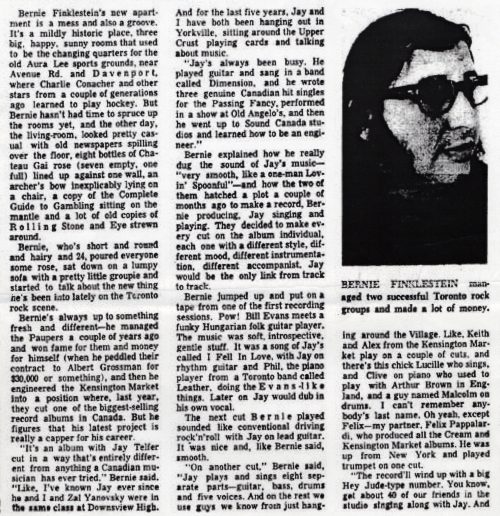
Jay Telfer article in the Toronto Star

Among those tapes was Greg’s copy of “Perch”, Telfer’s unreleased album from 1969. In total, there are 10 tracks waiting to be heard. The titles and the personnel on each track are as follows and I’d personally like to thank Jay for sharing these with me before he died.

ANYTHING MORE THAN YOUR SMILE

Jay Telfer – guitar, lead and backing vocals

Keith McKie – second guitar

Jimmy Watson – drums

John Mills Cockell – synth

I WRITE YOUR NAME ON THE WALL

Jay Telfer – guitar, bar stool, organ, lead and backing vocals

Murray McLaughlan – second lead guitar

WAR BABY (BABY)

Jay Telfer – guitar, vocals

Keith McKie – electric guitar

Ronnie Blackwell – bass

Malcolm Tomlinson – drums

Fergus Hambleton – saxophone

NUMER ONE HUM

Jay Telfer – electric guitar, piano, electric piano, vibraphone, drums, bass, lead and backing vocals

REVELATION (AKA I FELL IN LOVE)

Jay Telfer – guitar, vocals

Danny McBride – electric guitar

Phillip Jalsevec – piano

DOLDRUM

Jay Telfer – guitar, vocals

Igor Romanyk – violin

Heavanly Host Rentals – see chorus below.

TO ALL

Jay Telfer – guitar, vocals

Malcolm Tomlinson – flute

Rick Lyon – drums

WASHED DOWN

Jay Telfer – guitar, vocals

Louis McKelvey – electric guitar

Alex Darou – bass

Malcolm Tomlinson – drums

SUZIE

Jay Telfer – piano, drums, guitar, vocals

Ronnie Blackwell – bass

Fergus Hambleton – clarinet

GLOW

Jay Telfer – guitar, vocals

Murray McLauchlan – second guitar

Ray Bennett – harmonica

Donna Warner – backing vocals

Orpheus – backing vocals

Cathy Young – backing vocals

Keith McKie – backing vocals

Sydney – backing vocals

Perch is a lost gem from the Toronto scene and awaiting discovery. Anyone interested in finding out more about this recording, should contact the author at Warchive@aol.com

Copyright © Nick Warburton. All Rights Reserved. No part of this article may be reproduced or transmitted in any from or by any means, without prior permission from the author.

This article was originally posted on the Nick Warburton website on 25 May 2009.


Morning

When guitarist Jay Donnellan was dismissed from Arthur Lee’s band Love in late 1969, he reverted to his former name, Jay Lewis, and contacted guitarist/singer Barry Brown to join him in a new group with keyboard player/singer Jim Hobson, which became known as Morning (see part one of the story).

Brown had only recently dissolved his group The East Lynne and was writing a fresh batch of material.

Months earlier, during the summer of 1969, Brown had taken the opportunity to record some demos of these new songs at Hobson’s studio. For the sessions, Brown enlisted former Moorpark Intersection members, Matt Hyde on lead guitar and Jim Kehn on drums plus his old friend Gary Horn on bass to provide musical support.

Barry Brown, 1970. Photo: Jeff Allen

According to Kehn, four tracks were recorded and attributed to East Lynne on the tape: “Good Time Music”, “I’m Just A Poor Boy”, “I’ll Be Happy”, which Hobson overdubbed organ on, and a song that subsequently turned up on Morning’s debut LP, the country-rocker “It’ll Take Time”.

As promising as these recordings were, however, they were put aside once Lewis suggested forming a new group at the end of 1969. The yet-to-be named trio then took its first steps towards recording Morning’s debut LP by cutting three tunes at Hobson’s studio, using various configurations.

The first song the trio turned to was Jim Hobson’s gospel-flavoured “Time” featuring Jay Lewis on acoustic guitar, session player Paul Martin on electric guitar and two members from Love: George Suranovich on drums and Frank Fayad on bass.

“You can hear how tight and different sounding that track is as these three played together a lot,” says Jim Kehn, who, along with Barry Brown, had no part in the recording aside from singing backing vocals.

Next up was the superb “Angelina”, an old East Lynne song co-written by Barry Brown with guitarist Rick Dinsmore.

“He helped write part of the chorus with me, so I put him on that song,” explains Brown.

“[Angelina] was about a love relationship. Actually, the name is fictitious. The relationship is not. The actual girlfriend’s name was Vicky but who’s gonna write a song called Vicky right? So, I had a bass player buddy called Gary Horn and he had a little daughter named Angelina and I grabbed the name. I was actually at his place the morning I started writing ‘Angelina’.”

With Brown’s heartbreaking vocals carrying the song, Kehn provides a solid drum pattern to complement Lewis’s tasteful acoustic guitar flourishes. But it is Hobson, doubling up on organ and piano, who really takes the song to another level with his exquisite piano solo.

Barry Brown, 1970. Photo: Jeff Allen

“That was not the original piano,” admits Hobson. “Basically we went out in the studio and we worked on the tune, just Jim Kehn and I if I remember correctly. I played a piano part and he played off the part I was doing and then we got the drum track. Then we started from scratch, probably acoustic guitar and one step at a time to get it the way we wanted it. We had a lot of time to rehearse and essentially live in the studios.”

To complete the initial recordings, the group turned to Lewis’s “Early Morning”, a mellow jazz-flavoured number, noteworthy for its call and response harmonies and Hobson’s jazzy piano break.

As Hobson makes clear, the three tracks were recorded to shop around for a possible record deal. At this very early stage, the trio still didn’t have a drummer or bass player and there were no firm plans to put together a group at this stage.

Armed with the recordings, the musicians approached former Coachman Bob Mercer, who was now working as a record distributor, to help push the demos to various labels in search of a deal.

Morning in the studio, 1970. Left to right: Jim Hobson, Barry Brown, Jay Lewis and Terry Johnson. Photo : Jeff Allen

Hobson remembers that a number of record companies expressed an interest but in the end they signed with the tiny Vault label.

“I think the main reason why we went with Vault was because we were going to have a free rein as to how the music would develop,” he says.

One of the musicians, however, was not happy with the turn of events. Looking back on the first batch of recordings, Jim Kehn remembers that no one was particularly interested in recording his own contributions. Upset that he was not being considered as an equal member, Kehn says the experience left him deflated.

“Jay, Barry and Hobson took their three tunes and with help from Bob Mercer got a record deal, with them as producers,” he says.

“In hindsight, I probably should have left rather than becoming a sideman. Nevertheless, I played and sang on the album and eventually got a song on it.”

Hobson, however, says that the set up has to be put into context. “We didn’t have a whole lot of money from the record company so we couldn’t go out and hire musicians,” he says.

“That’s when we decided we were going to get the group thing happening. We said, ‘Anybody who has a song we have the right of not doing it but if you’ve got a song that’s going to sit with what we are doing, you get a shot and you get to keep your publishing. You also get to play in a group’. It really was a co-operative thing at the time.”

Jay Lewis, 1970. Photo: Jeff Allen

Lewis also defends the way things turned out. “It was all equal in royalties, it was equal in every single thing and they [Kehn and the other musicians] had the luxury of not being locked into a contract that held them accountable after the band broke up. In some respects they were much better off.

“We had a difficult time making them [the record company] accept three people with control and we chose the most active participants/writers. It was not presented, apart from that first cover, that the three of us were the main team. In the studio it was never presented that way.”

Kehn, however, refuses to accept this interpretation. “It was very evident they had complete control and they exercised it,” he says.

“They [later] edited my drum solo on ‘And I’m Gone’, taking out sections, throwing some away and re-sequencing the rest. All of this was done without my knowledge until after the fact. I wasn’t asked about it or present when it was done.”

Despite his initial reservations, Kehn agreed to sign on as drummer and singer.

With another former Moorpark Intersection member Terry Johnson providing rhythm guitar alongside bass player Bruce Wallace, the trio of Barry Brown, Jim Hobson and Jay Lewis began to record a new batch of material to add to the tracks already in the can.

Bruce Wallace, 1970. Photo: Jeff Allen

“Terry was the original bass player in The Coachmen and he also played pretty good guitar,” says Lewis.

“We needed a second guitar in the band and he got changed over to being a guitar player and a bass player brought in.”

One of Hobson’s strongest contributions is the infectious “Tell Me A Story”, which was subsequently lifted from the debut LP as the lead off single. The track is reminiscent of Jackson Browne’s early ’70s work, which is even more remarkable considering it pre-dates the singer/songwriter’s debut LP for Asylum by an entire year.

“I have a really low tolerance for bullshit and basically there were several instances where I decided I needed to write a song about it,” explains Hobson on the meaning behind the song. Graced with a superb lead vocal from Barry Brown, “Tell Me A Story” should have been a huge hit but fell under the radar due to poor promotion on Vault’s part.

“I sang the lead on ‘Time’ but that’s the only thing I sang lead on,” admits Hobson. “I was never a great singer and I couldn’t get it together on ‘Tell Me A Story’. Barry was the strongest singer in the group.”

For “Sleepy Eyes” Hobson, Kehn and Lewis offer up a beautiful harmonic blend.

“That was all in two or three part I believe,” says Lewis. “If there was going to be harmony vocal, two or three people went out around one mike and sang it. Nothing was separated out. It was just one big room with us, which to this day, I believe is a far superior way to record than to do one instrument at a time.”

Jay Lewis, 1970. Photo: Jeff Allen

Lewis came into his own with the superb “And I’m Gone”, an eerie multi-layered vocal mood piece complete with shifting acoustic guitar figures, Hobson’s breathtaking piano interlude and Kehn’s funky drum solo, which is brought to an abrupt end by the sound of an explosion.

“I came into the studio with that idea,” explains Lewis. “I was probably very Beatles’ influenced on the ‘Day In The Life’ thing. I thought, ‘What I’d like to do is keep this song small’ and at this moment in time, I wanted to hit with everything we had in the studio. I wanted to be like the kitchen sink fell you know. As big a bomb as we can possibly lay at this one spot and then continue in this other direction.”

Despite the impressive effect, the guitarist is quick to point out that the musicians avoided using any studio tricky on the first LP.

“There was no echo available. That’s one of the reasons why it [the album] pulls off so well. There is nothing with echo on it, unless it was the reverb on my guitar. There’s nothing on the vocals, nothing on the drums. It was just simply that we worked pretty hard on the sound of the individual instruments. A lot of that thankfully was due to Jim Hobson who to this day is a real purist.”

Jim Hobson, 1970. Photo: Jeff Allen

According to Brown, the song “As It Was”, which he co-wrote with Jay Lewis, goes back to their time together in Bobby Bond & The Agents.

“We’d be sitting around at about four in the morning at his house blitzed out of our minds,” says Brown. “That’s all we’d do. We’d go do our gig and then party all night. It was all music and fun.”

For his own heartfelt ballad, “Roll ‘Em Down”, Brown turned to his religious background for inspiration.

“I was raised Jewish. I always had an affinity to open up the Old Testament here and there. I related to the freedom movement within the black community. At that time people wanted to take things in a new direction and not feel oppressed. I just related the fighting cause of freedom to how God had used Moses to free the Israelites from Egypt. That song is a parallel of different meanings in terms of people seeking their freedom.”

Closing the LP, Kehn manages to sneak on his own country-flavoured “Dirt Roads” featuring guest player Al Perkins on steel guitar.

Jim Kehn, 1970. Photo: Jeff Allen

“For two years in my life as a kid, I lived on a farm in a very small Northern California community,” says Kehn on the inspiration behind his lone contribution.

“It was the best part of my childhood and is what I was reminiscing about. I played the rhythm guitar on this track and Hobson sang harmony with me on the end section.”

Hobson adds that either Brown or Lewis also added to the background vocals/harmonies on this track and that Lewis played rhythm guitar.

Relegated to a sideman from the outset, Kehn kept busy as a session player throughout the LP’s recording.

In early-mid 1970, Richie Podolor brought him into the studio to record demos with Iron Butterfly, replacing drummer Ron Bushy, and also invited him to lay down some drum tracks for Blues Image, featuring soon-to-be Iron Butterfly member Mike Pinera.

Looking back on the whole recording process, Lewis estimates that the entire LP was laid down over a three-six month period.

“It all seemed to go pretty quick,” he says. “Everybody was pretty excited and many times our instruments were just set up in the studio, miked and ready to go, so when we walked in the door we continued from where we were and that was a great luxury.

“Occasionally, we’d have somebody like Hoyt Axton come in or some other person and we’d say, ‘Ah shit, we gotta break our stuff down and put it in the other room’ and we’d have a break for a few weeks. Those breaks were always used very well, particularly with between Barry and I. We would always get together and play guitars and work on his new song or work on mine.”

“It was hours and hours in the studio,” adds Brown. “We lived in that studio. We’d be there all night long. There were some days where we’d be in there two days straight. We’re talking all day and all night. A lot of that arranging was not that it was not very meticulously planned out and orchestrated but it was created right there in the studio. It was quite a creative process.”

Barry Brown and Terry Johnson, 1970. Photo: Jeff Allen

Produced by Lewis, Brown and Hobson, with assistance from Matt Hyde as engineer, and mixed at Larrabee Sound, a studio built by Carole King’s former husband, Gerry Goffin, Morning’s eponymous debut was a remarkable achievement. All that was left to do was come up with a suitable name.

“If I remember correctly, I was the one that came up with it,” says Hobson. “I just thought, ‘Early Morning’, ‘New Day’ and I just thought, ‘You know what, Morning would be a cool name for this group, it’s so much like the beginning of something, an awakening’. I am pretty sure that’s how it came about. Contrary to what some websites are listing, Morning was never named ‘the Morning and the Evening’.”

For the band’s remarkable cover, the group turned to artist Kent Bash (see comment section at the end), who was homeless at the time.

Pre-release reviews sounded a positive note. John Gibson, writing in The Hollywood Reporter’s 9 September issue, was particularly impressed and presented an encouraging write up.

“The group is five guys who play, sing, write and even record themselves. This is noteworthy only because Morning is one of the few groups who know what to do with total control; they make good records.

“Their album is like Elton John’s in that it will seemingly come out of nowhere, and before you know what has happened they will be covered by everyone in the business. Their music is original and surprisingly imaginative The songs themselves are very good, and the playing is from good to incredible. Drums and piano especially.”

Record World, reviewing the LP months after its release on 2 January 1971, was equally positive.

“Here’s a new group with all the promise of their title. Label would be wise to pick almost any cut and get them going on singles as well. They are in the Creedence style of things, but have enough original of their own to make a go of it.”

David Lees, reviewing the record two week’s later in the UCLA Daily Bruin, was less impressed, however, noting, “Once beyond their aesthetically atrocious album cover it becomes apparent that the group sounds like many of your high school favourites, but it’s hard to figure out just which ones.

“Beneath their early Beach Boy high harmony patina Morning manage to approximate the styles of The Association, The Rascals, The Byrds and The Band. Even to attempt to copy the aforementioned demands a collection of first-rate musicians, writers and arrangers, and Morning include all three. The group works hard, but they’re asking you to pay for something you’ve already heard.”

This writer doesn’t agree with that assessment; Morning may have had their influences but the music is fresh and original (and really quite unique). Even so, having spent months perfecting the recordings, it was disheartening to see Vault do little to no promotion once the LP hit the shops in the fall of 1970.

“We had airplay,” remembers Hobson. “There was a station in L.A, that was actually a great old underground radio station called KPPC. I think they had the ultimate comment. I was listening one night and they played ‘New Day’, ‘As It Was’ and ‘Time’, all three of those and at the end of it the guy said: ‘That was Morning. There’s a group who’ve sold as many records as the Russians have landed men on the moon!’ I will always remember that.”

Despite the limited exposure, Morning did play about six live shows in a bid to push up sales.

“I think we did the University of Santa Barbara, something down at the Santa Monica Civic Auditorium, the San Diego Civic Auditorium and an American Civil Liberties Union or something,” Hobson recalls.

Morning, 1970. Photo: Jeff Allen

Lewis also remembers playing at the Troubadour [opening for Mason Williams] and a private party for the record company [with The Hampton Hawes Trio] where Phil Spector was in attendance.

“Jim [Hobson] just reminded me that ‘Yeah, I’m the guy that knocked Phil Spector’s plate of food out of his hand’,” laughs the guitarist. “I was lucky he wasn’t packing a gun in those days.”

Brown has fond memories of one particular gig, which he places at the Santa Monica Civic Auditorium.

“The bass player got so drunk that he couldn’t stand up! It wasn’t Bruce [Wallace] or Stuart [Brotman]. It’s what led us to getting Stuart. It was another bass player.”

As the guitarist notes, Morning needed to find an urgent replacement on bass when Bruce Wallace walked away from the group.

Bruce Wallace, 1970. Photo: Jeff Allen

As luck would have it, the musicians enlisted the services of a brilliant musician, former Kaleidoscope member Stuart Brotman, who came on board in time to appear on most of the sessions for Morning’s second LP, Struck Like Silver, recorded in mid-1971.

One of Lewis’s strongest contributions to the set is the largely acoustic “Only To Say Goodbye”, based on several real life events, including the guitarist’s departure from Love and, more specifically, his narrow escape from a wild fire that burned down a 12-acre ranch that he had leased and was in the process of doing up. “I was realising how many things I had taken for granted in retrospect,” says Lewis.

Equally strong is the superb “And Now I Lay Me Down” with its impressive gut string guitar intro, which conjures up images of Love’s early work.

“There was quite a lot of story to that inspiration, as someone very close to me died and I was singing from their position…. or what I perceived the position to be anyway,” explains Lewis. “It was their spirit completing the tasks needed and being able to rest at long last.”

On a different note, the guitarist chips in with the beautiful instrumental piece, “Jay’s Movie Song”, featuring Lewis doubling up on bass. “That was something [Bob] Mercer brought to me to do, an instrumental song to be a theme song for this particular movie,” he explains.

“It was like a Jack Nicholson movie or something; it was some big deal. I guess I didn’t get it but we thought the song turned out good enough. It never had a title and we just left it with that and put it on the album.”

Jay Lewis and Jim Hobson, 1970. Photo: Jeff Allen

As song-writing goes, Brown came up with arguably the strongest original material on the second LP.

“You’ll see with my songs that there’s a theme and it’s relational usually,” says the guitarist on the inspiration behind his contributions to Struck Like Silver.

One of his very best, “Comin’ In Love”, featuring a superb fiddle solo courtesy of guest player Chris Darrow, is a case in point.

“My sister and her family had moved to the East Coast. I was sitting on a couch in my mom’s living room and they were coming that night to California to see us and so I wrote ‘Comin’ In Love’. It was just about the family coming in love and then I kinda singled it out a little bit but that was the inspiration behind that song.”

Brown’s “Understand My Ways”, which once again features Lewis doubling up on bass, relates to the songwriter’s struggle with his own anger.

“You’d love to have me as a friend but you just wouldn’t want me to be pissed off at you,” he laughs.

“Believe it or not, it’s a song to my wife. Basically, it’s a kind of apology [while] at the same time a statement of ‘It’s nice to know you understand my ways’.”

The songwriter’s wife is also the subject of his best contribution, the majestic “I Ain’t Gonna Leave”, which features some sumptuous piano playing from Hobson, Brown’s heartfelt lead vocals and Lewis’s spine tingling steel guitar work.

Jay Lewis and engineer Steve Richardson, 1970. Photo: Jeff Allen

Interestingly, it’s another woman that provides the inspiration behind the LP’s title track, explains Brown. “It was actually written about this beautiful blonde girl I was chasing for a long time back in the club days. I never did hook up with her! She was the prettiest girl I had ever seen. She was a groupie.”

Brown’s “Struck Like Silver” is also, incidentally, the only song on the album that does not feature Kehn’s drum work with the songwriter doing the duties.

Billboard, which reviewed the album in its 6 November issue, gave the album a positive spin.

“Morning’s first album was recorded for the Vault label a little over a year ago and was one of those meritable sleepers that critics liked but few others got to hear,” it reported. “Their new release, Struck Like Silver includes Joni Mitchell’s ‘For Free’ and ‘Never Been To Spain’, written for the group by Hoyt Axton (Ed-this is not true), in addition to Morning’s own musical alchemy. It’s a new dawn.”

While Struck Like Silver is a natural progression from Morning’s eponymous debut, and arguably a more mature offering, the sessions were marred slightly by the coming and goings of various musicians, including Terry Johnson, who stuck around to play on only “Comin’ In Love” before dropping out.

“[It was] personalities I think and nothing happened [with the first album],” says Hobson.

“There was a lot of work going into the group. It was typical of a lot of bands. I’ve seen more bands over the years with a lot of talent that couldn’t stay together for practical reasons or personal reasons or whatever.”

“We put all this heart and effort into the first album and we’re really proud of it and nothing happened,” adds Lewis on Morning’s slow unraveling. “I think that’s what started to take the band apart.”

Jim Hobson, 1970. Photo: Jeff Allen

On a more alarming note, Hobson was starting to separate himself from the rest of Morning, contributing no songs to the new record. Not only that, but he left production chores to Lewis and Brown and only pitched in to engineer the LP with Hyde and Lewis. What’s more string arrangements are by Lewis and former Coachman Mike Dean, who sadly died of cancer in 2013.

“I was basically fulfilling my contract,” suggests Hobson on his gradual withdrawal from the recording process. “I was starting to go in a different direction. I had some personal situations that I wasn’t happy with so I was getting pretty negative about things.”

To compensate for the loss of Hobson’s songs, Brown and Lewis brought in material that Morning had been playing live, a superb version of Joni Mitchell’s “For Free” and an equally superlative reading of Hoyt Axton’s “Never Been To Spain”.

“Hoyt was in the studio for a couple of weeks I guess,” says Brown. “We loved ‘Spain’ so we started doing it like a live rendition. ‘For Free’ was a philosophical statement. I mean obviously, what a beautiful tune. We used those tunes live and then decided to record them.”

According to Hobson, Morning had first heard “Never Been To Spain” in early 1970 when Axton was recording at the studio while the group was laying down “Angelina” for its debut LP.

Morning had approached the singer/songwriter with the intention of recording a cover only to discover that Three Dog Night had already expressed an interest in cutting their own version.

“Then Three Dog Night came out with ‘Joy To The World’ and we were thrilled that they didn’t do ‘Spain’, so we recorded it,” says Hobson.

“If I remember correctly, it was almost simultaneous, the day the second Morning album was released and the day Three Dog Night’s version of ‘Never Been To Spain’ was released. Totally different feels between our version and theirs of course, but you already knew who was going to get the attention on this tune.”

Despite playing on most of the record, Hobson increasingly focused his attention on doing engineering work at Larrabee Sound. Morning recorded and mixed most of Struck Like Silver there and Hobson would use the facilities to engineer John Mayall’s Memories.

“There was going to be a third album,” says Hobson. “Barry and Jay were keeping it going and I remember we recorded a couple of my tunes at Western [Recorders]. One of them was called ‘Lady’ and the other one was called ‘Take Me In’. [But] We never finished them.”

This writer has been fortunate enough to hear the still-to-be-released “Lady”, which features L.A. bass player Jim King and Texan drummer Jim Marriot . If the recording was a barometer of what might have followed, Morning’s third LP would have been an absolute killer.

With Hobson providing a rare lead vocal, the track has all of the ingredients that make up a classic Morning song: brilliant musicianship, gorgeous multi-part harmonies and a melody to die for. To top of it off, Chris Darrow provides another stellar performance on fiddle.

“There’s another one of mine,” says Lewis regarding an unfinished, untitled piece that he contributed to the final Morning sessions.

“I can’t judge it. It’s not one of my best efforts but other people tell me exactly the opposite, so I would be happy if it was considered [for release]. Maybe it would be called ‘In My Eyes’. That’s the title I would use today.”

As Brown recounts on the group’s final weeks together, business decisions were a major cause behind the band’s eventual demise.

“Everything was being sold off to Fantasy,” he says. “We weren’t the best businessmen and there was a lot going on. There was a lot of dissension and a lot of problems within the band.

“We went up to Fantasy and started asking for all kinds of money and here they’d already poured money into two albums and hadn’t had the sales they wanted. They said, ‘We’ll give you this to finish the album’, and we were stupid and said, ‘No, we want this’ and that’s why the third album never got done.”

Looking back on Morning’s final split, Brown feels that there wasn’t enough money being pumped into promoting the albums to keep the band afloat. With no one interested in pursuing the Morning project further, the individual musicians went their separate ways.

“I was totally disgusted with the whole thing,” says Brown. “I did do some demos after that of some of my new tunes. They were post-Morning demos, which I sent around here and there. I ended up, interestingly enough [in order] to make a living and pay some bills, playing drums and singing background for a guy called Walking Cochran. It must have been two years straight with this guy. It was a covers band.”

Burned by the whole Morning experience, Brown subsequently quit the music business and moved into the real estate industry. While he gave up performing in the commercial field decades ago, he continues to perform at his local church near Ventura, California and recorded a number of gospel CDs.

The whereabouts of guitarist Terry Johnson remained a mystery for a long time. However, after this article was originally published in 2009, the guitarist got in touch and reunited with his former band mates.

Terry Johnson, 1970. Photo: Jeff Allen

“Benson Electronics was sold around 1968 and I went with it,” says Johnson. “That company was then sold in 1972 and again I went with it to Kinemetrics. I worked for that company until retirement in 2016. I’m still consulting for them part-time. The company made earthquake sensors and recording equipment.

“I quit music entirely by 1975. After a long layoff, I took up guitar and bass again in 2012. Still playing just for myself for fun now.”

Drummer James Kehn maintained his personal and professional relationship with Richie Podolor and joined a group he had recorded called Gold.

“We did several gigs but not much transpired from it,” he says. “But the leader of that group, Larry E Williams, went on to write a big hit called ‘Let Your Love Flow’.”

From there, he joined Uncle Tom, working with producers Jerry Goldsmith and Steve Gold. The group began work on an LP but it was never completed and lead singer Bubba Keith and guitar player Richard Shack subsequently joined The James Gang.

“We used to open for War around town at the Roxy at the Watts Jazz Festival,” remembers Kehn.

“They changed the band name to L.A.P.D and put one of our tunes on the Live at Watts Jazz Festival, Volume 1. I’m referred to as Jim Keen.”

The band later put out an LP called LAPD, which, according to Kehn, was a take off on the Los Angeles Police Department. “To protect and serve” was on the side of police cars at the time and the LP had “to play and sing” as a take off on that. The group featured Andy Chapin on organ and the writer/guitarist Richard Shack who can be heard on the instrumental track “Big Herm”.

After a brief break from the craziness of Hollywood in the early 1970s when he gained a BA in Music in Olympia, Washington, Kehn returned to L.A and recorded with British artists Chad Stuart of Chad and Jeremy fame and actress Sarah Miles.

Reuniting with Al Perkins in the late 1970s, Kehn played with the group Ark and recorded a lone LP, The Angels Come. Around the same time, he appeared on an LP by well-known steel guitar players, once again featuring Perkins, called Pacific Steel Co.

Then in the early 1980s, Kehn met and worked with Bryan MacLean of Love fame.

“We recorded several songs with his sister Maria McKee who went on to form Lone Justice,” says Kehn.

“Bryan discussed contemporary country music a lot and soon wrote a hit song recorded by Patty Loveless called ‘Don’t Toss Us Away’.”

The drummer finally got tired of the roller coaster income from playing sessions and gigs around L.A and abandoned live work to go to technical school and learn computer programming.

When Kehn was interviewed in 2009, the drummer was in the process of recording a CD of his songs.

“I have been doing [computer programming] for the last 20 years plus, all the time writing, recording and playing in various bands,” he said at the time.

“I am currently the leader of the percussion section in a 70-piece concert band and I also play the kit in a 16-piece swing/dance band.”

By 2020, Kehn had retired from computer programing, left the concert band and had renewed contact with original Coachman member Matt Hyde. Kehn was still living in Portland, Oregon.

“Hyde and I have been recording original tunes (over the internet, as he is in the Los Angeles area),” he says.

“We made two CDs, are currently getting our third pressed, while working on our fourth.  Having lots of fun doing whatever we want, however we choose. We doubt anyone else is interested so give the CDs to family and friends.”

Jim Hobson’s post Morning years were a mine of activity. Over the next forty years, he gained extensive experience as a staff and freelance recording engineer and did recording sessions that covered everything from song demos to radio and TV commercials, and from LP recordings for people like Albert King, John Mayall, John Fahey, Albert Hammond and Delaney Bramlett to CBS TV’s Sonny & Cher and movies.

During the mid-1970s, Hobson even reunited with Jay Lewis, working together with Albert Hammond.

After basing himself in San Francisco where he worked at Fantasy Studios and re-did the keyboard parts to the Emotions’ Sunshine LP, Hobson moved up to Seattle in 1978 and became a full-time employee at KING Broadcasting in its radio engineering department. There he helped build and install new studios for KING AM and KING FM in Seattle. He also found time to play keyboards on Country Joe McDonald’s LP Leisure Suite.

From the mid-1980s, Hobson began freelance contract engineering for numerous radio stations in the Seattle area but kept his hand in the performance side by playing jazz piano gigs. He also maintained his interest in writing, engineering, arranging and recording his own personal music project.

Since the early 2000s, Hobson’s focused largely on his personal solo piano music project and has kept in regular contact with Jay Lewis, contributing piano to two songs on the guitarist’s 2003 solo CD, This Island Earth, released under the name James J Donnellan.

Donnellan enjoyed an equally hectic career since Morning’s demise. His most notable achievement was a Grammy nomination for his work on engineering Gary Wright’s Dreamweaver LP in 1976. His engineering and production credits include such notable artists as Danny O’Keefe, Ringo Starr, John Travolta and Gordon Lightfoot.

As a musician, he’s recorded and/or performed with a who’s who of famous artists, including Art Garfunkel, Johnny Cash, Petula Clark, Albert Hammond and Mark/Almond. He’s also struck gold with his compositions, scoring numerous songs for a number of noteworthy movies, such as Fatal Charm, Almost Dead and the Teen Wolf TV series.

In 2003, Donnellan recorded his debut solo CD, This Island Earth. Tragically, his health deteriorated in 2010s and his current whereabouts are unknown.

The only thing that is left to do is get Morning’s recorded work from the early 1970s to a wider audience by finding a suitable label to re-issue the group’s two LPs plus previously unreleased tracks from the aborted third LP on one CD.

Huge thanks to Jeff Allen for the kind use of his photos. Copyright applies to all his photos. His work can be seen at this website.

I’d like to thank Barry Brown, James Donnellan, Jim Hobson, Terry Johnson and James Kehn for generously giving up their time to help piece Morning’s story together. Thanks as always to Mike Paxman for his help.

Morning now have a MySpace page: www.myspace.com/morningfromthe70s

Copyright © Nick Warburton. All Rights Reserved. No part of this article may be reproduced or transmitted in any from or by any means, without prior permission from the author.

This article was originally posted on the Nick Warburton website on 22 June 2009.


Morning – The early years, including Wind and Moorpark Intersection

Morning, 1970. Left to right: Terry Johnson, Barry Brown, Jim Hobson, Jay Lewis, Jim Kehn, Bruce Wallace

“Unequivocally the best ‘first’ LP I have heard for years, Morning’s music defies description” praised Ripple’s glowing review, albeit some six months after the group’s eponymous debut sneaked out on the tiny Vault label.

Quite a compliment you may well think and a little too presumptuous?

Well maybe, but when Morning’s debut outing hit the record stores in November 1970, very few were fortunate enough to snap up this rare and increasingly sought-after record; a highly polished production, and, to this writer’s ears, arguably one of the most eclectic and innovative records of its time.

Undoubtedly there was tough competition when Ripple’s review hit the news stores in May 1971, what with David Crosby’s superlative debut solo album one of the leading contenders.

But whereas the musicians’ anonymity went a long way in ensuring Morning never graced the heights of their more self-promotional contemporaries, the music speaks for itself and remains as fresh and timeless as it was when the group wrapped up recording the LP in the summer of 1970. And that’s without mentioning the band’s equally superlative second LP, released nearly two years later.

By then, most of the musicians who eventually Morning had accumulated a decade’s worth of collaborative work.

Looking back over the group’s long and tangled history, Morning’s roots can be traced back to a San Fernando Valley high school outfit called The Coachmen, formed in the early months of 1960.

One of Morning’s central figures, pianist, organist and singer Jim Hobson (b. 27 December 1945, Chester County, Pennsylvania) and rhythm guitarist Terry Johnson, who played bass with The Coachmen, appear to have been members of this group near the outset alongside lead guitarist and front-man Matt Hyde.

While never a member of Morning, Hyde would become part of the tight circle of friends and later assist in engineering both of the band’s LPs.

Towards the end of 1960, another future Morning alumni, drummer and singer Jim Kehn (b. 30 August 1947, Los Angeles), who today prefers to be referred to as James Kehn, took over the drum stool but the line-up refused to settle.

Invited to join another local group, The Duvals, Hobson defected and spent the next four years playing around the L.A area, including a brief spell in 1963 providing back up for The O’Jays.

While with The Duvals, Hobson cut a lone 45 coupling “The Last Surf” with “Ferny Roast” on the Prelude label.

“The Duvals were several years older than I was and were gigging a lot, so I was making a bit of money during my high school years playing with them,” says Hobson, who also worked with several other groups during this time.

In spring 1965, after an eight-month club gig with two different bands, Hobson began recording and participating in demo sessions at American Recording Studios for producer Richie Podolor (more of which later).

To fill the vacant spot in The Coachmen, the remaining members turned to James Donnellan (b. 16 December 1946, Burbank, California), a prodigious guitarist, who grew up with the name Jay Lewis.

The Coachmen, 1964. Left to right: Jim Kehn, Mike Dean, Bob Mercer, Matt Hyde, Terry Johnson and Jay Lewis. Photo: Bob Mercer

James Donnellan/Jay Lewis would become one of the central figures in Morning’s story and arguably the band’s most famous member thanks to his participation in Arthur Lee’s legendary group, Love with whom he recorded under the name, Jay Donnellan. But we are jumping ahead of ourselves here.

With the novelty of showcasing two lead guitar players, The Coachmen began to pick up more lucrative work in the valley.

Trading largely in instrumentals, the quartet remained steady over the next four years but in 1964 took on a front man, singer Bob Mercer, as well as sax, organ and flute player Mike Dean, who was snatched from Richie Ray & The Del Prados.

“One day my stepbrother and I heard a band without a drummer at a neighbour’s,” says Kehn, who ended up taking the job and working with The Coachmen and Richie Ray & The Del Prados simultaneously.

“Mike Dean was playing saxophone with them. I asked Mike to do some gigs with The Coachmen, so he played on and off with the group. I also played several gigs with Richie Ray and recorded a dance song called ‘The Twirl’ at American Recording in Studio City.” (Ed: During 1965, Dean, Hyde and Kehn also played as a trio in The Krabs).

Photographs from this period reveal that, for a brief time, The Coachmen also secured the services of two female singers. 

The Coachmen with female singers. Photo: Bob Mercer

However, by late 1965, both they and Mercer (who would years later assume a management role for Morning) had departed as The Coachmen morphed into a new identity, the inappropriately named, Wind.

The Coachmen/Wind, late 1965. Left to right: Matt Hyde, Jay Lewis, Terry Johnson, Jim Kehn and Mike Dean. Photo: Matt Hyde

Under its new guise, the band began rubbing shoulders with L.A’s hip and happening crowd, and in early 1966 got hired to play private parties for blonde bombshell Jayne Mansfield and English actor Peter Lawford.

Word soon spread among the well-to-do and socially connected, and in a truly remarkable turn of events, the American government asked the musicians to entertain the Mexican president on his arrival in the United States!

While all of this was going on, Kehn had started working on sessions at American Recording Studios with producer Richie Podolor, oblivious to the fact that Podolor had recently taken on former Coachman, Jim Hobson as a session pianist.

Through Kehn’s association with Podolor, Wind were able to utilise the producer’s studio and paid for the recording of two tracks for a prospective single.

(Ed. In an interesting side note, Hobson’s entry into American Recording was a former DuVal member, Roger Yorke, who was writing and recording some demos at American Recording and Screen Gems for Lester Sill. Yorke and DuVal band leader Bill Wild had been in the Munster’s TV show band, and had played gigs promoting the TV programme.)

Issued in April 1966 on the obscure Van Nuys-based label, Early Morning (an early nod to the later group), the single coupled the Hyde, Kehn and Mercer penned “Your Man Is Gonna Leave You”, with the intriguingly titled, “He Who Laughs Last (Laughs Best)”, a Hyde-Mercer co-write, featuring Kehn and Lewis singing harmony lead.

As very few pressings were made, original copies are virtually impossible to find these days and would certainly fetch a hefty price.

Even so, and despite its rarity, the A-side surfaced decades later on the compilation album, Teenage Shutdown 15: She’s A Pest, released on the tiny Teenage Shutdown label in 2000.

Interestingly, a short while before the single was cut, the band (possibly still billed as The Coachmen) had recorded three tracks on an acetate, which surfaced years later attributed to Moorpark Intersection (more of which later) – “Come and Take a Walk with Me”, “Young Married Blues” and “Your Man” (aka “Your Man Is Gonna Leave You”).

Kehn recalls rehearsing “Come and Take a Walk with Me” in a back room at the Lively Arts music store in Northridge. He believes Jay Lewis wrote the song.

“You can definitely hear The Beatles influence – though we all liked them, Jay and Terry were the stalwart fans back then,” he says.

“I think Mike sang the lead vocal, Jay the low harmony and I did the high harmonies.”

Kehn says that Mike Dean wrote the basic parts of “Young Married Blues” and Matt Hyde and Jay Lewis wrote the chorus.

“Matt sang lead vocal and I sang harmony,” he recalls. “Jay played the continuous lead guitar parts weaving in and out of the song, with Mike on keyboards. I played the drums with Terry on bass and Matt playing other guitar parts.”

The final track, “Your Man”, was a demo version of the soon-to-be cut “Your Man Is Gonna Leave You”.

“It’s slightly different from the 45 we put out with a more melodic bridge and a bit rougher feel,” says the drummer.

“We cut it at American Recording with Richard Podolor and Bill Cooper at the controls.  Matt and I sang unison and then broke into harmonies.

“It may have been Podolor who sat in with his fantastic old Telecaster – he let us record for free in return for allowing him and Bill to produce and play on the tune. I may have done some sessions for them in exchange.”

However, when the lone single failed to take off, Wind’s members scattered to pursue separate projects with Kehn resuming his session work with Podolor.

The drummer’s former band mates, Jay Lewis and Terry Johnson decided to stick together and joined forces with the final piece in the Morning jigsaw, singer/songwriter and guitarist Barry Brown (b. 4 August 1947, Toronto, Canada), who had moved to California with his family at an early age and taken up drums in his teens.

Fresh out of high school, Brown signed on with Bobby Bond & The Agents as a drummer and with Lewis and Johnson also added to the group’s ranks, the quartet (later expanded when pianist Dick Hargreaves joined) began playing the clubs in the San Fernando Valley, including the Fireball Inn.

Judging by everyone’s recollections of this “hazy period”, Lewis and Johnson’s tenure with Bobby Bond lasted little more than a year.

During their time playing together, Lewis and Brown forged a strong friendship and when the pair decided to go their separate ways in the summer of 1967, a tacit understanding was that they would collaborate in the future.

“I was very close with Jay for a quite while, even though we weren’t involved musically,” says Brown. “He was going different directions and I was going different directions but we were always tight. We were always hanging out.”

While Brown moved on to form the original version of East Lynne with bass player Jack McAuley and singer/songwriter and guitarist Rick Dinsmore, Lewis and Johnson revived the old Wind line-up with former cohorts, Matt Hyde, Mike Dean and Jim Kehn, re-branding themselves as Moorpark Intersection.

One story goes that it was Pat Hicks, a local music store owner in the San Fernando Valley,  who introduced the group to jazz guitarist Howard Roberts.

It was Roberts who used his connections at Capitol Records to get Moorpark Intersection signed to the label and placed under the wing of hip and up and coming producer, David Axelrod.

However, it’s possible Terry Johnson was the link. “I started at Benson Electronics making ‘boutique’ amps for Hollywood studio musicians,” he says.

“The company was owned by Howard Roberts and Ron Benson with several studio musicians being minor shareholders.”

Whatever the truth, the future looked promising but it wasn’t to be. As work commenced on recording a single in November 1967, Axelrod got pulled away from the session.

“David’s time got consumed with issues he was having with a more important client of his, Lou Rawls,” remembers Kehn.

“So he passed us over to a new house producer – Bob Padilla – and this proved to be a death knell because we had no support anymore, got lost in the shuffle and withered away.”

The ensuing session produced two completed tracks, which turned up on a lone single in early 1968.

The breezy folk-pop cover of in-house writer Jack Keller’s “I Think I’ll Go Out and Find Me a Flower” may not have been the musicians’ desired choice of material but the song is executed brilliantly.

Kicking off with Lewis’s ringing acoustic guitar, the track builds up to a superb and atmospheric flute solo courtesy of Mike Dean, who also provides the lead voice, culminating in some excellent harmony work.

The flip side, “Yesterday Holds On”, written by David Axelrod and Jay Lewis, is arguably superior and is notable for its dense vocal harmonies and intricate guitar work that remind this listener of Curt Boetcher and Gary Usher’s innovative work with Sagittarius.

Also during the sessions, the group recorded a third track “Sure Is Good” as a rough take on 10 November, which survives as an acetate in Kehn’s possession.

Like its previous incarnation, Wind, Moorpark Intersection’s lone recording suffered a similar fate chart-wise and around February 1968 the musicians once more scattered to pursue separate projects.

To add to Kehn’s frustration, it was while he was pondering the Capitol deal with Moorpark Intersection that he made the fateful decision to turn down an offer to join another group destined for greater things.

“A friend of mine had asked me to join him in a ‘sure thing’ band as we were working out contract issues but I turned him down,” rues the drummer. “That group became Kenny Rogers and The First Edition.”

With Moorpark Intersection consigned to the history books, Kehn began gigging with another local group, The Accent’s Limited. To help pay the bills, he also reconnected with his former employer.

“I played on a session for Richie Podolor, which produced several songs on Donovan’s Barabajagal album in 1969,” recalls the drummer.

“I played on ‘Atlantis’, ‘To Susan on The West Coast Waiting’, ‘I Love My Shirt’ and ‘Pamela Jo’. I sang background on a couple of tunes as well with Davy Jones of The Monkees.”

Tired of the endless slog of playing night after night, Kehn’s former band mate Matt Hyde hung up his guitar and joined an existing business partnership with his old friend from The Coachmen, Jim Hobson.

“I had drifted into the recording studio business with Joe Long by accident, way before Hyde got involved,” says Hobson.

“During these times, I continued to do club and casual work along with some recording work.”

As well as session work with Richie Podolor in 1967, appearing on six Sandy Nelson albums for Imperials Records and also touring with the drummer, Hobson had also been working for Holzer Audio Engineering, building and installing recording equipment and consoles, including A&M’s new studios, located on the site of Charlie Chaplin’s old sound stage.

With the help of financial partner, Joe Long, Hobson (abetted by Hyde as business partner) built “The Recording Studio” (including the mixing console) in Tarzana, California, which is where Love and Hoyt Axton recorded among others. In 1970, it would also provide the setting for Morning’s own studio sessions.

While all of this was going on, Jay Lewis, who’d taken to being called Jay Donnellan, had signed up with The Mustard Greens, an upscale club band led by former Love members Snoopy Pfisterer and Tjay Cantrelli.

Donnellan’s recollections of this band are hazy but he does recall one humorous incident while playing at the Factory in Beverly Hills (most likely in May 1968).

“The Beatles came in the place one night and watched a couple of sets. The leader [of the group] had an ego the size of a small planet and when The Beatles sat down, he said, ‘Okay Lady Madonna 1,2, 3,4’ and I was so embarrassed I wanted to melt into the corner.”

While playing with Snoopy’s group, Donnellan made sure to keep in touch with Barry Brown, and on numerous occasions dropped in at East Lynne’s gigs at the Corral in Topanga Canyon (where they were house band) to sit in on several numbers of their set.

“We played at the Topanga Corral before it burnt down the first time,” remembers Brown.

“A lot of famous people used to jam at the Corral, you know like Buffalo Springfield, Neil Young, they all lived up there. Spirit lived up there too. I remember jamming with Stephen Stills.”

Fortunately for Donnellan, his tenure with The Mustard Greens was sparingly short and a more attractive offer soon appeared on the table, an invitation to audition for a revamped Love.

“Snoopy was the one who hooked me up with Arthur Lee and I did an audition at Arthur’s house with George [Suranovich] and Frank [Fayad] already in the band” recalls Donnellan, who signed up to Lee’s new vision of Love in October 1968.

“I thought it was going to be something like Forever Changes and pulled out an acoustic guitar but they dove into ‘August’ so a quick change of guitars and amp and that was my ‘audition’ song. One hour later I was in the band.”

Donnellan made his public debut with Love at the Shrine Exhibition Hall in Los Angeles on 9 November and remained with the band for about a year, contributing to the Elektra LP Four Sail and the double set, Out Here, issued on the Blue Thumb label. It was while with Arthur Lee’s group that Donnellan began to take his song-writing seriously and penned a couple of notable songs.

“The ‘Singing Cowboy’ song I did co-write with Arthur,” says the guitarist.

“I had the melody and the chords and I lived in Laurel Canyon somewhere near him. He came over to visit one day and we talked for a minute and I said, ‘Hey, check this out’ and he said, ‘Whoa, I’ve got a lyric for that’. The other one, ‘I Still Wonder’ – that was my own drug experience. I wrote that without him and just brought it to the band and they recorded it. Since then, many, many albums give him half the credit and all of the publishing.”

As events turned out, it was Donnellan’s decision to take Love into Hobson’s recording studio in Tarzana to finish up recording Out Here that ultimately paved the way for Morning in early 1970.

Morning in the studio, 1970. Left to right: Jim Hobson, Barry Brown, Jay Lewis and Terry Johnson. Photo: Jeff Allen.

“Jay was playing with Love and I went to one of their recording sessions to listen,” recalls Kehn, who was responsible for putting the two musicians back in touch and turned down an opportunity to replace Suranovich.

“I suggested to Jay that they contact Matt or Jim to use their studio, which they did.”

Hobson’s studio provided the perfect environment for Love to wind up the Out Here sessions. Unfortunately, it was also the setting for Donnellan’s dismissal from Arthur Lee’s group.

“I can remember the last moment with Love very clearly,” recalls the guitarist.

“One day I showed up to the studio and the door was locked. I banged on the door and it was still locked. I sat down and waited for three or four minutes and then all of a sudden the door opened and Arthur stuck his head out and said, ‘We don’t need you today’. I said, ‘Oh Really?’ and he said ‘Yeah, we got someone else on this song’ and closed the door and locked it.

“Later that day, I got a telegram from the manager or the record company and to this day I remember the exact words because it said: ‘Pursuant to your desires and wishes you are no longer a member of the group Love’.”

CONTINUED HERE

I’d like to thank Barry Brown, James Donnellan, Jim Hobson, Terry Johnson and James Kehn for generously giving up their time to help piece Morning’s story together. Thanks as always to Mike Paxman for his help over the years. Thanks to Mike Duggo for info about The Coachmen acetate.

Huge thanks to Jeff Allen for the kind use of his photos. His work can be seen at this website.

Morning now have a MySpace page: www.myspace.com/morningfromthe70s

Copyright © Nick Warburton. All Rights Reserved. No part of this article may be reproduced or transmitted in any from or by any means, without prior permission from the author.

This article was originally posted on the Nick Warburton website on 22 June 2009.


Del Grace & The Rifle

The Rifle in Verbier, Switzerland, 1967

Malcolm Magaron (lead vocals)

Del Grace (lead guitar)

Dennis Lascelles (keyboards) replaced by Mick Fletcher

Terry Hewitt (bass)

Pete ? (drums)

This short-lived  band was called The Rifle and was the brainchild of  former Carl Douglas & The Big Stampede guitarist Del Grace, who put together an earlier line up in late 1967 to play a lucrative ski resort gig in Verbier, Switzerland over the Christmas period.

The Rifle, Verbier

Malcolm Magaron had started out fronting Malcolm Magaron & The Blueshealers who were regulars at the Bag O’Nails in late 1966, which is probably where he first met Del Grace as Carl Douglas’ band worked there extensively during the same period.

The original keyboard player Dennis Lascelles went on to play with Fat Daughter but at the time was a member of Herbie & The Royalists who ended up recording a lone LP for Saga Records in 1968.

The Rifle, 1968 with Mick Fletcher (left)

Mick Fletcher, who’d worked with Del Grace in The Epitaph Soul Band during 1963-1965 period, replaced Dennis Lascelles in early 1968 after working with Hamilton & The Hamilton Movement.

When the band split up, Del Grace did some recordings for Liberty Records. Mick Fletcher joined The Amboy Dukes and Malcolm Magaron sang with The Les Humphries Singers.

We’d love to hear from anyone who can add any additional information in the comments section below.

Thanks to Del Grace for the photos.

The Epitaph Soul Band

Dave Whittaker (aka Chet Mason) (lead vocals/congas)

Del Grace (lead guitar)

Bruce Duckworth (rhythm guitar)

Mick Kinzett (bass/manager) replaced by Mick Holland (bass)

Mick Fletcher (keyboards)

Dave Rolfick (baritone sax)

Mick Lye (tenor sax)

Rodney Peters (aka Karl Lee) (drums)

Formed as Karl Lee & The Epitaphs in Welling, southeast London in January 1963, they changed name to The Epitaphs in 1964 and then The Epitaph Soul Band in 1965.

Most of the group’s members were from the Sidcup/Bexley area although Lye came from Battersea and Rolfick was from Streatham.

The group often played at the Black Prince Hotel in Bexley. Len Fletcher who ran the club was their manager.

Del Grace says the band’s line-up was fluid with musicians coming and going. The spelling may not be correct for some of the players listed above.

Bruce Duckworth didn’t stay long and they stuck with only one guitarist after he departed.

Mick Holland joined on bass in 1964 so that Mick Kinzett could assume road management duties.

The band’s van was involved in a horrific crash on Rochester Way in October 1964 (see newspaper clipping below) and two of the members were hospitalised. Mick Holland was so badly injured that he couldn’t continue with the group.

Bexley Heath & Welling Observer and Kentish Times, 26 February 1965, page 12


The group was put on hold until early February 1965 when it was reformed with the following musicians:

Dave Whitaker (aka Chet Mason) (lead vocals/congas)

Del Grace (lead guitar)

Mick Fletcher (keyboards)

John James (bass) (possibly also known as John Porter)

Dave Rolfick (baritone sax)

Mick Lye (tenor sax)

Rodney Peters (aka Karl Lee) (drums)

The new formation played at the Black Prince Hotel in Bexley on Sunday, 21 February and began working as the resident band at the Last Chance Club in Oxford Street, central London.

Bexley Heath & Welling Observer and Kentish Times, 26 February 1965, page 12


Towards the end of 1965 Del Grace’s friend Andy Clark came in on baritone sax.

Soon after Mick Fletcher joined The Sound System who backed Jimmy Cliff before working with Hamilton & The Hamilton Movement, The Rifle (reuniting with Del Grace) and The Amboy Dukes.

Around the same time Del Grace joined The Big Wheel, who later recruited Andy Clark and Mick Holland.
Grace joined Carl Douglas & The Big Stampede in 1966 while Andy Clark later worked with The Fenmen, Sam Gopal Dream, VAMP, Clark-Hutchinson and Jeff Beck among many others.
Thanks to Ian Kinzett for the clipping
Notable gigs:


2 May 1964 – Beat Group Contest, Wickham Hall, West Wickham, Kent with The Blackhawks, Chris Finn & The Solents, The Sonics, The Melvin Toole Combo, The Original Deltones, The Electrons, The Copains, The Consorts and Paul & The Playboys (Beckenham & Penge Advertiser) Billed as The Epitaphs

February 1965 – Last Chance Club, Oxford Street, central London (Bexley Heath & Welling Observer and Kentish Times)
21 February 1965 – Black Prince Hotel, Bexley, southeast London with The Graham Bond Organisation (Bexley Heath & Welling Observer and Kentish Times)
1 June 1965 – 100 Club, Oxford Street, central London with The Bo Street Runners (Melody Maker)
5 June 1965 – Wimbledon Odeon, Wimbledon, southwest London with Beat Unlimited (Kingston & Malden Borough News) Advert says The Epitaphs are from Streatham so may be another band
17 June 1965 – Bromley Court Hotel, Bromley, southeast London (Melody Maker)
19 June 1965 – Jazz & Blues Festival, Black Prince Hotel, Bexley, southeast London with The Dutch Swing College, Solomon Burke, Zoot Money’s Big Roll Band, Unit 4 Plus 2, The Spencer Davis Group, The Downliners Sect, Alan Elsdon’s Jazzband, Brian Green New-O-Stompers and The Loose Ends (Bexley Heath & Welling Observer and Kentish Times)
Festival review in the same newspaper, 25 June 1965, page 12


30 June 1965 – Bromley Court Hotel, Bromley, southeast London (Melody Maker)


17 July 1965 – Flamingo, Wardour Street, Soho, central London with Tony Colton Big Boss Band (Melody Maker)

25 July 1965 – Black Prince Hotel, Bexley, southeast London with The Spencer Davis Group (Melody Maker)

Photo: Melody Maker, 3 July 1965

Jo Jo Gunne

Jo Jo Gunne, late 1965/early 1966. Left to right: Don Bax, Renwick MacDonald, Alan Townsend, Doug Gordon, Ronny Butterworth and Pete Pennycate. Photo: Ronny Butterworth

Readers will be familiar with the American early 1970s rock band Jo Jo Gunne, helmed by former Spirit members Jay Ferguson and Mark Andes.

However, the first band to use the name Jo Jo Gunne was in fact a little known British R&B outfit, formed at Debrome school in Feltham, Middlesex in early-to-mid 1965.

The original line up comprised:

Ronny Butterworth – lead vocals

Simon Spackman – lead guitar

Don Bax – rhythm guitar

Alan Townsend – bass

Doug Gordon – drums

However, later that year the musicians made the decision to move in a more soul direction and took on a new lead singer, Pete Pennycate, to accommodate the new configuration.

Spackman moved from lead guitar to keyboards to allow newcomer Renwick MacDonald to join from local rivals Themselves. Butterworth and Townsend focused on trumpets and Bax took up the bass.

By early 1966, Jo Jo Gunne comprised: 

Pete Pennycate – lead vocals

Renwick MacDonald – lead guitar

Simon Spackman – organ

Don Bax – bass

Alan Townsend – trumpet and trombone

Ronny Butterworth – trumpet

Doug Gordon – drums

During June 1966, the band won Melody Maker’s National Beat Competition, which was held at Brighton’s Regent Ballroom. Also, during August, they took part in the London Palladium competition.

Over the next 18 months, this line up (minus Butterworth who dropped out around November 1966 to play with Twickenham band, The All Night Workers) played the following gigs:

Photo: Middlesex Chronicle. Image may be subject to copyright

5 October 1965 – Nurses Club, Jolly Gardeners, Isleworth, west London with The Road Agents


25 February 1966 – Cavern Club, Burnley, Lancashire with The Fruitdrops May not be the same band

Photo: Melody Maker. Image may be subject to copyright

19 March 1966 – London Cavern, Holland Park, west London with supporting group

25 March 1966 – Cellar Club, Kingston upon Thames, southwest London


2 April 1966 – Cellar Club, Kingston upon Thames, southwest London

12 April 1966 – 100 Club, Oxford Street, central London with The Pretty Things

17 April 1966 – Imperial Ballroom, Nelson, Lancashire with The Generation


14 May 1966 – Cellar Club, Kingston upon Thames, southwest London

28 May 1966 – Zeeta House, Pontiac, Putney, southwest London


11 June 1966 – Cellar Club, Kingston upon Thames, southwest London

16 June 1966 – Pontiac, Putney, southwest London

Photo: Melody Maker. Image may be subject to copyright

18 June 1966 – Zeeta House, Pontiac, Putney, southwest London with The Roger Harris Show


16 July 1966 – Brackley Town Hall, Brackley, Northamptonshire with The Future Set

Photo: Bletchley District Gazette. Image may be subject to copyright

22 July 1966 – Bletchley Young Conservatives, Coronation Hall, Bletchley, Buckinghamshire

Photo: Middlesex Chronicle, 15 July 1966. Image may be subject to copyright

6 August 1966 – Cellar Club, Kingston upon Thames, southwest London

12 August 1966 – Cellar Club, Kingston upon Thames, southwest London

Photo: Bletchley District Gazette. Image may be subject to copyright

13 August 1966 – Bletchley Carnival Week, Bletchley, Buckinghamshire with The Future Set


3 September 1966 – Brackley Town Hall, Brackley, Northamptonshire with The Alan James Sound

17 September 1966 – Borough Assembly Hall, Aylesbury, Bucks with The Future Set

18 September 1966 – Lee-West Disc & Dance, Stopsley, Bedfordshire

24 September 1966 – Palace Ballroom, Wolverton, Bucks with The Future Set

30 September 1966 – Beachcomber, Luton, Bedfordshire


8-14 October 1966 – Beachcomber, Luton, Bedfordshire

10 October 1966 – Borough Assembly Hall, Aylesbury, Bucks with The Future Set and The Choozey Beggars (this needs confirmation as this may be December instead)


11 November 1966 – Chesham Co-op Hall, Chesham, Bucks


9 December 1966 – Beachcomber, Luton, Bedfordshire

Photo: Melody Maker. Image may be subject to copyright

6 January 1967 – Tiles, Oxford Street, central London with Alvin Cash & The Crawlers (billed as Jo Jo Gunn)

13 January 1967 – The Flamingo, Wardour Street, Soho, central London with Derek Savage Foundation (billed as Jo Jo Gunn)

Photo: Brackley Advertiser. Image may be subject to copyright

27 January 1967 – Brackley Town Hall, Brackley, Northamptonshire

Photo: Northampton Chronicle. Image may be subject to copyright

28 January 1967 – White Bicycle, Maple Ballroom, Northampton with The Crew (billed as Jo-Jo-Gunn)

Photo: Newham, East and West Ham, Barking and Stratford Express. Image may be subject to copyright

17 February 1967 – Upper Cut, Forest Gate, east London with The New Pirates and The Afex (billed as Jo-Jo Gunns)

18 February 1967 – Flamingo, Wardour Street, Soho, central London with The All Night Workers

22 February 1967 – St Michael’s Youth Centre, Sydenham, southeast London (billed Jo Jo Gun)

Photo: Melody Maker. Image may be subject to copyright

24 February 1967 – Upper Cut, Forest Gate, east London with David Essex and Mood Indigo (billed as The Jo-Jo Gunns)

25 February 1967 – Rub-a-Dub, Reading, Berkshire


5 March 1967 – New Yorker Discotheque, Swindon, Wiltshire with The Iveys and The Inspiration

Photo: Melody Maker. Image may be subject to copyright

10 March 1967 – The New All Star Club, 9a Artillery Passage, E1, east London


According to an article in the Hounslow, Brentford and Chiswick Post, dated 5 May, Jo Jo Gunne split up in late April with Simon Spackman joining McDonald’s former band Themselves in early May while Pete Pennycate went solo.

The newspaper’s 16 June issue adds more information. It notes that bass player Don Bax was working with The Penny Blacks, the same band that would feature soon-to-be-joining members Alan Barratt, Paul Maher and Tom Marshall.

In late August 1967, Jo Jo Gunne reformed with Alan Barratt replacing Pete Pennycate on lead vocals.

The Penny Blacks, 1967. Alan Barratt (second left), Paul Maher (second right) and Tom Marshall (far right).

Barratt had started out singing with The Penny Blacks, which also included lead guitarist Tom Marshall; rhythm guitarist John Day; bass player Dave Arnold; and drummer Paul Maher.

When Barratt joined Jo Jo Gunne that summer he also brought Paul Maher with him (who took over from Doug Gordon) and recent recruit Don Bax.

Simon Spackman and Renwick MacDonald joined the new version (presumably both from Themselves, who soon changed name to Virgin Sleep). Original member Alan Townsend also rejoined.

According to Alan Barratt, the new version debuted on 8 September 1967 at the California Ballroom in Dunstable, Bedfordshire.

In late 1967, Jo Jo Gunne signed a deal with Don Arden’s Starlight Agency after Amen Corner’s singer Andy Fairweather-Low recommended the band to the infamous promoter.

Amen Corner and Jo Jo Gunne had shared a billing at the California Ballroom in Dunstable on 29 September 1967 alongside rival west London band, The All Night Workers.

The All Night Workers would maintain a close link with Jo Jo Gunne and several musicians would play with both bands.

The first of these was original member, trumpet player Ronny Butterworth, who re-joined Jo Jo Gunne from The All Night Workers around late September/early October 1967.

The revamped line up now comprised:

Alan Barratt – lead vocals

Renwick MacDonald – lead guitar

Simon Spackman – organ

Don Bax – bass

Alan Townsend – trumpet and trombone

Ronny Butterworth – trumpet

Paul Maher – drums

However, around late October lead guitar player Renwick MacDonald left and another former Penny Blacks member, lead guitarist Tom Marshall joined the line up for the rest of 1967 and into spring 1968.

Jo Jo Gunne, Hampton Court Palace, circa October 1967. Left to right: Tom Marshall, Alan Barratt, Alan Townsend, Ronny Butterworth, Paul Maher, Simon Spackman and Don Bax. Photo: Tom Marshall

When Marshall left around February/March 1968 to join The Playground (and subsequently Harmony Grass and Capability Brown), Spackman moved from organ to lead guitar and keyboard player Ken Carroll joined Jo Jo Gunne.

Carroll had spent the past few months playing with a band called Deep Purple, which had been formed in late 1967, some six months before the more famous version (although there were a few other local groups across England that used the name before 1968).

The following concert dates are taken from this period:

8 September 1967 – California Ballroom, Dunstable, Bedfordshire with James and Bobby Purify and The Yum Yum Band

Photo: Berkhamsted Gazette and Tring and District News. Image may be subject to copyright

23 September 1967 – Hemel Hempstead Pavilion, Hemel Hempstead, Herts with The Chris Allen Band

29 September 1967 – California Ballroom, Dunstable, Bedfordshire with Amen Corner and The All Night Workers

Photo: Crawley Advertiser. Image may be subject to copyright

1 October 1967 – Starlight Ballroom, Crawley, West Sussex with The Move (spelt Jo Jo Gun)

14 October 1967 – Luton Boys Club, Luton, Bedfordshire with The Vistas (spelt Jo Jo Gunn)

15 October 1967 – Starlight Ballroom, Crawley, West Sussex with The Jimi Hendrix Experience (they may have been replaced by The Doves at short notice)

20 October 1967 – Pavilion, Southend, Essex with The Mindbenders and Tiles Big Band (Southend Standard lists this gig as 21 October 1967)

21 October 1967 – Wimbledon Palais, Wimbledon, southwest London with Tony Rivers and The Castaways (possibly one of MacDonald’s final gigs)

27 October 1967 – London School of Economics, central London with Elmer Gantry’s Velvet Opera (possibly one of Marshall’s first gigs)

Photo: Northamptonshire Evening Telegraph. Image may be subject to copyright

5 November 1967 – Kettering Working Men’s Club, Kettering, Northamptonshire with The Barry Lee Show (billed as Jo Jo Gunn)

11 November 1967 – California Ballroom, Dunstable, Bedfordshire with The Symbols and The Fifth Dynasty (spelt Jo Jo Gunn)

12 November 1967 – Starlight Ballroom, Crawley, West Sussex with Modes Mode

17 November 1967 – Southlands College, Roehampton, southwest London with The Nashville Teens

Photo: Eastbourne Herald Gazette. Image may be subject to copyright

18 November 1967 – The Catacombe, Eastbourne, East Sussex

24 November 1967 – California Ballroom, Dunstable, Bedfordshire with The Shevelles and The Crew

Photo: Stratford upon Avon Herald. Image may be subject to copyright

25 November 1967 – Bagatelle Club, Ettington Park Hotel, Alderminster, Stratford-upon-Avon, Warwickshire


8 December 1967 – Boston Gliderdrome, Lincolnshire with Jimmy James & The Vagabonds and Reformation (billed as Jo-Jo Gun Band)

Photo: Woking Herald. Image may be subject to copyright

16 December 1967 – Walton Hop, Walton-on-Thames, Surrey

19 December 1967 – Boston Gliderdrome, Lincolnshire with Jimmy James & The Vagabonds, Reformation and Ray Bones (billed as Jo Jo Gunn)

Photo: Crawley Advertiser. Image may be subject to copyright

24 December 1967 – Starlight Ballroom, Crawley, West Sussex with The Exits

31 December 1967 – Starlight Ballroom, Crawley, West Sussex with Precisely This

Photo: Woking Herald. Image may be subject to copyright

9 January 1968 – Walton Hop, Walton-on-Thames, Surrey

21 January 1968 – Starlite Ballroom, Greenford, west London with Ronnie Jones & The Q Set

26 January 1968 – Elbow Room, Aston, West Midlands

28 January 1968 – Carlton Club, Erdington, West Midlands with Chris Farlowe & The Thunderbirds

Photo: Crawley Advertiser. Image may be subject to copyright

10 February 1968 – Starlight Ballroom, Crawley, West Sussex with The Doves

11 February 1968 – Starlight Ballroom, Crawley, West Sussex with The Who

13 February 1968 – Walton Hop, Walton-on-Thames, Surrey

24 February 1968 – Cliffs Pavilion, Southend, Essex with The Human Instinct and Almond Marizpan (billed as Jo Jo Gunn)

25 February 1968 – Starlight Ballroom, Crawley, West Sussex with The Human Instinct

28 February 1968 – Hemel Hempstead Pavilion, Hemel Hempstead, Herts with The Herd

Photo: Possibly Northamptonshire Evening Telegraph. Image may be subject to copyright

2 March 1968 – Nags Head, Motown Club, Wollaston, Northamptonshire with Mick’s Soulotek (billed as Jo Jo Gunn)

9 March 1968 – Locarno Ballroom, Swindon, Wiltshire (billed as Jo Jo Gunn)

9 March 1968 – Starlight Ballroom, Crawley, West Sussex with Modes Mode

10 March 1968 – Starlight Ballroom, Crawley, West Sussex with The Fabulous Temptations (this is The Fantastics)

23 March 1968 – Feltham R&B Club, Feltham, Middlesex

Photo: Northamptonshire Evening Telegraph. Image may be subject to copyright

25 March 1968 – Kettering Working Men’s Club, Kettering, Northamptonshire with The Crusaders (billed as Jo Jo Gunn)

Photo: Derby Evening Telegraph. Image may be subject to copyright

30 March 1968 – Clouds, Derby (billed as Jo-Jo Gunn Group)

30 March 1968 – Walton Hop, Walton-on-Thames, Surrey

31 March 1968 – Starlight Ballroom, Crawley, West Sussex with The Original Drifters (Paul Maher filled in for The Original Drifters’ ill drummer)


11 April 1968 – Walton Hop, Walton-on-Thames, Surrey

Photo: Derby Evening Telegraph. Image may be subject to copyright

13 April 1968 – Clouds, Derby (billed as Jo Jo Gunn)

Photo: Woking Herald. Image may be subject to copyright

15 April 1968 – Ship Hotel, Weybridge, Surrey

Photo: Berkhamsted Gazette and Tring and District News. Image may be subject to copyright

8 May 1968 – Hemel Hempstead Pavilion, Hemel Hempstead, Hertfordshire with Captain Beefheart & The Magic Band

Photo: Greenford Post. Image may be subject to copyright

25 May 1968 – Starlite Ballroom, Greenford, west London


1 June 1968 – Walton Hop, Walton-on-Thames, Surrey

3 June 1968 – Hatchetts Playround, Piccadilly, central London

7 June 1968 – Victoria Hall, Selkirk, Scotland

Having signed to Decca Records, Jo Jo Gunne recorded their debut single, R & H Barter’s “Every Story Has An End” c/w  Don Bax and Alan Townsend’s “Should Live Like That” (Decca F 12807), which was released on 12 July 1968 but failed to chart.

Just after the recording, Carroll introduced a second singer in to the band, Mick Wheeler, who’d previously worked with Ronny Butterworth in The All Night Workers during 1966-1967 and then in Carroll’s short-lived Deep Purple in late 1967-early 1968. When Wheeler joined, he also doubled up on congas.

Jo Jo Gunne, spring 1968, just before Mick Wheeler joined. Left to right: Simon Spackman, Alan Barratt, Ronny Butterworth, Ken Carroll, Alan Townsend, Paul Maher and Don Bax

The revised line up comprised:

Alan Barratt – lead vocals

Mick Wheeler – lead vocals, congas

Simon Spackman – lead guitar

Ken Carroll – organ

Don Bax – bass

Alan Townsend – trumpet and trombone

Ronny Butterworth – trumpet

Paul Maher – drums

Around mid-July, Jo Jo Gunne were offered the opportunity to play some gigs in Saint-Tropez in France but Ronny Butterworth didn’t participate and dropped out just before the continental trip.

The line-up on the band’s debut single before Mick Wheeler joined. Photo: Record Mirror. Image may be subject to copyright

From 2 August to 5 September 1968, the band (minus Butterworth who has since died) played a nightly residency at the Club St Hilaire de la Mer in Saint-Tropez before returning to the UK.

On their return Ken Carroll left the band and went on to play with Johnny Johnson & The Bandwagon. He currently works with Samtana.

The following gigs were advertised with the above line up:

12 June 1968 – Samantha’s, Bournemouth, Dorset (possibly one of Wheeler’s first gigs)

15 June 1968 – Clouds, Derby (billed as Jo-Jo Gunn Group)

22 June 1968 – Locarno Ballroom, Swindon, Wiltshire with Hoffman’s Biscuits (billed as Jo Jo Gunn)

28 June 1968 – Hatchetts Playground, Piccadilly, central London

29 June 1968 – Broken Wheel, Retford, Nottinghamshire

Image may be subject to copyright

6 July 1968 – St Albans City Hall, St Albans, Hertfordshire with The Rocky

Photo: Possibly East Kent Times & Mail. Image may be subject to copyright

12 July 1968 – Supreme Ballroom, Ramsgate, Kent (billed as Jo Jo Gunn)

Photo: Possibly Newbury Weekly News. Image may be subject to copyright

19 July 1968 – Soul Club, Plaza, Newbury, Berkshire with J J Bender & SOS

Photo: Eastbourne Herald Chronicle. Image may be subject to copyright

20 July 1968 – Eastbourne Town Hall, Eastbourne, East Sussex with The Soul Stars

27 July 1968 – Red Cross Hall, East Grinstead, West Sussex

28 July 1968 – Beau Brummel Club, Nantwich, Cheshire with The Scorpions (billed as Jo Jo Gunn) (one of Butterworth’s final gigs)


3 August 1968 – Walton Hop, Walton-on-Thames, Surrey (unlikely to have happened if they went to France)

Photo: Chester Chronicle. Image may be subject to copyright

10 August 1968 – Clockwork Orange, Chester, Cheshire with Headline News (billed as Jo Jo Gunn) (unlikely to have happened if they went to France)

11 August 1968 – Victorian Club, Liverpool (unlikely to have happened if they went to France)

31 August 1968 – Walton Hop, Walton-on-Thames, Surrey (unlikely to have happened if they went to France)


7 September 1968 – Walton Hop, Walton-on-Thames, Surrey (one of Carroll’s final gigs)

Photo: Redbridge & Ilford Recorder. Image may be subject to copyright

12 September 1968 – El Grotto, Ilford, east London (billed as Jo Jo Gunn)

13 September 1968 – El Grotto, Ilford, east London (billed as Jo Jo Gunn)

18 September 1968 – Samantha’s, New Burlington Street, central London (billed as Jo Jo Gunn)

20 September 1968 – Victoria Hall, Selkirk, Scotland with Geno Washington & The Ram Jam Band and The End

22 September 1968 – Kinema Ballroom, Dunfermline, Scotland (this needs confirmation) (billed as Jo Jo Gunn)


2 October 1968 – Hatchetts Playground, Piccadilly, central London

6 October 1968 – Drokiweeney, Manchester (billed as Jo Jo Gunn)

12 October 1968 – St Albans City Hall, St Albans, Hertfordshire

26 October 1968 – Hermitage Ballroom, Hitchin, Herts

Around mid-November 1968, Simon Spackman also left (and has since died) and west London guitar hero Dave Wendels (ex-Cliff Bennett & The Rebel Rousers, Lulu’s backing band, The Luvvers, Tom Jones’s backing band, The Squires and The Krew) joined the band.

This new line up transformed the group and played dozens of successful gigs around the UK, including Mr Smiths in Manchester, Bournemouth Winter Gardens, Pantiles in Bagshot, Surrey plus London venues like Hatchetts Playground in Piccadilly, the Valbonne Club, Samantha’s, the Scotch of St James and Sibylla’s.

They also supported Three Dog Night on a Scottish tour. In Scotland they supported Geno Washington and the Ram Jam Band, as well as playing The Electric Garden (Radio 1 club) in Glasgow.

The new line up played the following:

3 November 1968 – Cosmo, Carlisle, Cumbria with Pete Kelly Solution (Paul Maher says it was cancelled)

5 November 1968 – Sibylla’s, central London (billed as Jo Jo Gunn)

Photo: Melody Maker. Image may be subject to copyright

7 November 1968 – 100 Club, Oxford Street, central London with PP Arnold (billed as Jo Jo Gunn)

7 November 1968 – Willesden College of Technology, Willesden, northwest London with PP Arnold (possibly one of Spackman’s final gigs)

9 November 1968 – Clouds, Derby

11 November 1968 – Bamboo Club, Wilmslow, Cheshire (billed as Jo-Jo Gunn)

11 November 1968 – Chesham Jump Club, Co-op Hall, Chesham, Bucks

16 November 1968 – Fellowship Inn, Eltham, southeast London (possibly one of Wendels’ first gigs)

Photo: Redbridge & Ilford Recorder. Image may be subject to copyright

22 November 1968 – El Grotto, Ilford, east London

Photo: Eastern Evening News. Image may be subject to copyright

23 November 1968 – Cromer Links Pavilion, Cromer, Norfolk with Kiss (billed as Jo Jo Gunn)

Re: North Norfolk News. Image may be subject to copyright

24 November 1968 – Crystal Palace Hotel, Crystal Palace, south London

25 November 1968 – Sibylla’s, central London (billed as Jo Jo Gunn)


8 December 1968 – Mr Smith’s, Manchester (billed as Jo Jo Gunn)

14 December 1968 – Walton Hop, Walton-on-Thames, Surrey

16 December 1968 – Hatchetts Playground, Piccadilly, central London

Photo: Possibly Northamptonshire Evening Telegraph. Image may be subject to copyright

23 December 1968 – Corby Civic Centre, Corby, Northamptonshire with Size Seven and State Express (billed as Jo Jo Gunn)

Photo: Woking Herald. Image may be subject to copyright

24 December 1968 – Walton Hop, Walton on Thames, Surrey (billed as Jo Jo Gunn)

29 December 1968 – Bull’s Head, Yardley, West Midlands (billed as Jo Jo Gunn)

However, around January 1969 longstanding member Alan Townsend departed (and has since died) and Dennis Fisher came in on trumpet from the group, Mothers Ruin.

Townsend spent several months working with The All Night Workers before subsequently working with The Roy Young Band later in the year and doing a multitude of sessions.

Clockwise from top left: Dennis Fisher, Dave Wendels, Paul Maher, Mick Wheeler, Alan Barratt, Don Bax.

By now, the line up comprised:

Alan Barratt – lead vocals

Mick Wheeler – lead vocals, congas

Dave Wendels – lead guitar

Don Bax – bass

Dennis Fisher – trumpet

Paul Maher – drums

This configuration recorded the band’s second single – Potter and Dee’s “Beggin’ You Baby” c/w  “Bad Penny” (Decca F 12906), which was released on 25 April 1969.

The band played the following dates:

4 January 1969 – Clouds, Derby

7 January 1969 – Whisky a Go Go, Wardour Street, Soho, London (billed as Jo Jo Gunn)

11 January 1969 – Royal Lido Ballroom, Prestatyn, Wales with Strawberry Cartoon (billed as Jo Jo Gunn Soul Band)

15-16 January 1969 – Hatchetts Playground, Piccadilly, central London

24 January 1969 – Club Lafayette, Wolverhampton, West Midlands

25 January 1969 – St Albans City Hall, St Albans, Hertfordshire

27-28 January 1969 – Hatchetts Playground, Piccadilly central London


1 February 1969 – Blue Lagoon, Newquay, Cornwall with The Vigilantes

17 February 1969 – Hatchetts Playground, Piccadilly central London


18 March 1969 – Alex’s Disco, Salisbury, Wiltshire

22 March 1969 – Eastbourne Suite, Eastbourne, East Sussex with Discorama with Kevin Long

27 March 1969 – Hatchetts Playground, Piccadilly central London

28 March 1969 – Marquee, Glasgow, Scotland

29 March 1969 – Marquee, Glasgow, Scotland with The Chessmen Showband


5 April 1969 – Le Metro, Birmingham (billed as Jo Jo Gunn Soul Show)

5 April 1969 – St Albans City Hall, St Albans, Hertfordshire

When “Beggin’ You Baby” flopped, Jo Jo Gunne split with Don Arden. According to Barratt, the singles were too poppy and did not represent the band’s live set, which was funkier/soul orientated material.

After the band proposed an album of its own material and Decca turned the opportunity down, Jo Jo Gunne split from the label.

Around Easter, Jo Jo Gunne signed with Laurie O’Leary who landed them a three-month residency in Freeport, Grand Bahamas, where they played nightly in the House of Lords club, returning in July. Wheeler has kept the outgoing flight from England, which was on the 10 April.

The following dates were advertised but were not possible as they weren’t in the UK:

9 May 1969 – Rush Common House, Abingdon, Oxfordshire with Status Quo and Fire (billed as Jo Jo Gunn)

24 May 1969 – Il Rondo, Leicester

25 May 1969 – Railway, Wealdstone, northwest London

26 May 1969 – Hatchetts Playground, Piccadilly, London


5 June 1969 – Blaises, Kensington, west London (billed as Jo Jo Gunn)

11 June 1969 – Revolution, central London (billed as Jo Jo Gunn)

21 June 1969 – Pavilion Ballroom, Bournemouth, Dorset with Finnians Fogg


3 July 1969 – Revolution, central London

Photo: Redbridge & Ilford Recorder. Image may be subject to copyright

6 July 1969 – El Grotto, Ilford, east London

10 July 1969 – Blaises, Kensington, west London

Left to right: Dave Wendels, Alan Barratt, Dave Booker and Mick Wheeler, summer 1969

On their return in early-to-mid July, Dennis Fisher and Don Bax departed and the remaining quartet of Alan Barratt, Mick Wheeler, Paul Maher and Dave Wendels formed a short-lived version with Manchester bass player Dave Bowker (now David Booker) who’d previously worked with Ivan Meads, The Richard Kent Style, Kirk St James and Sponge among others. Booker had met the musicians in the Bahamas while playing with Sponge.

Left to right: Mick Wheeler, Alan Barratt, Dave Wendels and Dave Booker

The group travelled to Cologne in July/August and played the Storyville Club but on their return, Wendels and Booker both left and played with Billy J Kramer, a week-long engagement at Batley Variety Club.

Left to right: Dave Booker, Dave Wendels and Mick Wheeler, Cologne, summer ’69. Photo: Mick Wheeler

Wendels then joined The Roy Young Band while Booker joined O’Hara’s Playboys after auditioning unsuccessfully for Badfinger (Joey Molland got the job).

The short-lived line-up played the following dates:

23 August 1969 – Marine Court, St Leonards, East Sussex with Sunshine Sky

Photo: Surrey Advertiser. Image may be subject to copyright

6 September 1969 – Civic Hall, Guildford, Surrey with Marshall Hammond

Photo: Redbridge & Ilford Recorder. Image may be subject to copyright

12 September 1969 – El Grotto, Ilford, east London

19 September 1969 – Winter Gardens, Penzance, Cornwall


2 November 1969 – Ship & Rainbow, Wolverhampton, West Midlands with Deuteronomimous

Longstanding lead singer Alan Barratt was offered a backing vocal spot with The Roy Young Band but declined. He also departed around this time and later went on to sing with The Good Old Boys with Nick Simper from the original Deep Purple.

Mick Wheeler and Paul Maher then put together an entirely new version of Jo Jo Gunne.

Mick Wheeler – lead vocals

George Williams – lead guitar

Barney Barnes – organ

Billy Ball – bass

Paul Maher – drums

In early 1970, Wheeler’s former band mate from The All Night Workers, Malcolm Randall briefly took over the drum stool before Phil Chesterton came in full-time.

This new line up continued into the early 1970s and returned to Saint-Tropez for a residency. The group subsequently morphed into a later version of The Love Affair, long after its lead singer Steve Ellis had left.

Pantiles, Bagshot, Surrey, 1971. Photo: Martin H Samuel

Huge thanks to Alan Barratt, Paul Maher, Mick Wheeler, Ken Carroll, Tom Marshall, Ronny Butterworth, David Booker and Dave Wendels for their help in piecing the story together.

I’d like to thank Alan Barratt, Tom Marshall, Mick Wheeler and Paul Maher for providing photos.

Thanks also to Jason Barnard at Strange Brew who originally posted this article. This is a substantially revised and updated version.

Concert dates were taken from a number of sources, mainly local and regional newspapers.  Thanks to Alan Barratt for providing some live dates from late 1967-early 1968 from his personal diary. Most of the London dates were taken from Melody Maker.

Copyright © Nick Warburton. All Rights Reserved. No part of this article may be reproduced or transmitted in any form or by any means, without prior permission from the author.

To contact the author, email: Warchive@aol.com


Owen Gray’s soul years

Image may be subject to copyright

Born in Kingston, Jamaica on 5 July 1939, Owen Gray (aka Grey) is one of the true reggae and ska greats but was also the author of a handful of superb soul/mod 45s, recorded in the UK and France between 1965-1969.

Very little is known about this period and so we’d welcome any additional information that readers can provide in the comments section below, particularly around the recording of these individual singles, any unreleased recordings and the personnel on the tracks.

Owen arrived in England in May 1962 and was a prolific recording artist. Like Jimmy Cliff, he’s best known for his reggae recordings but he was an exceptionally gifted soul performer and worked with some top British musicians during the mid-to-late 1960s. His backing bands included The Sound System, The Krew, Tony Knight’s Chessmen and Maximum Breed.

His first venture into soul appears to have been with two singles on the small Aladdin label (see below).

Image may be subject to copyright

Released on 12 March 1965, Owen Gray’s “Gonna Work Out Fine” c/w “Dolly Baby”, was the first of two 45s on the label, the first produced by Denny Cordell.

Advert from New Musical Express

His second release “Lindy Lu” was backed by a great version of “Can I Get a Witness”, which has since become a Northern Soul favourite.

Image may be subject to copyright

In mid-to-late 1965, he moved labels and to Island Records for three singles. The first coupled “Shook, Shimmy & Shake” with “I’m Going Back” and was followed by “Paradise” c/w “Bye Bye Love”. Little is known about the background to both of these releases and the personnel on the recordings.

Image may be subject to copyright

Initially, the singer worked with The Soul Sets, including a gig at the Cue Club in early January 1966.

Photo: Melody Maker

However, in January/February 1966, Chris Blackwell linked Owen with west London Mod outfit, The Sound System.

Photo: Melody Maker

The band had morphed out of The All-Nite Workers and featured guitarist Tony St Clair; bass player Ron Thomas; keyboard player Mick Fletcher; sax players Mel Wayne and Dave Mahoney; and drummer Phil Wainman, who later went on to produce The Sweet among others.

Together, they backed Owen on a lone 45, a rousing version of “You Don’t Know Like I Know” backed by “Take Me Serious”, which appears to have been penned by Ron Thomas, who later went on to work with The Heavy Metal Kids, among others.

Image may be subject to copyright

Owen Gray & The Sound System also gigged around the London club circuit in the first few months of 1966 before Blackwell linked them up with Jimmy Cliff and renamed them The New Generation. Later that year, the group became singer Gary Hamilton’s second version of The Hamilton Movement.

Photo: Melody Maker

Left without a band, Owen joined forces with The Krew who’d just lost their two lead singers Beryl Marsden and Steve Aldo.

Led by scouser and future Wings sideman Howie Casey on sax, the group also featured fellow Liverpudlian Tommy Murray on lead guitar (who was later replaced by Ted Tunnicliffe); Glaswegian Archie Legget; Yorkshireman Eddie Sparrow on drums; and Londoner Alan Reeves on keyboards.

Photo: Alan Reeves. Left to right (back), Eddie Sparrow, Archie Legget, Howie Casey, Alan Reeves. Front, left to right: Owen Gray and Tommy Murray

Owen Gray and The Krew moved to France in April 1966 and played several clubs in the ski resorts, notably the Bus Palladium in Courcheval, before landing a residency at exclusive Paris nightclub Le Bilboquet.

While playing in Paris in July that year, the musicians recorded an EP for Barclay Records’ subsidiary label, Riviera, comprising popular soul covers and strong Owen Gray originals, “Everything’s Alright” and “Somebody Stole My Girl”.

However, by the end of 1966, Owen Gray was back in London and back on the soul circuit, playing the clubs that were popular with the burgeoning Caribbean community such as Paddington’s Cue Club.

Photo: Melody Maker, 1967

Back on Island Records, he recorded one of his finest soul outings, the stupendous “Help Me” coupled with “Incense”, which were produced by Chris Blackwell and Jimmy Miller respectively.

Issued in January 1967, the single should have been a massive hit but inexplicably it failed to chart and is now a much sought-after collectors’ item.

Image may be subject to copyright

A few months later, Owen was back with another London band, this time Tony Knight’s Chessmen, led by drummer Tony Brown. The singer remained with the group until about September 1967.

Photo: Melody Maker, 1967

During Owen’s time with The Chessmen, the musicians passing through included noted sax players Dave Coxhill and Stan Sulzmann and future John Mayall’s Bluesbreaker Keith Tillman.

Photo: Fred D’Albert. Left to right: Terry Ede, Dave Coxhill (hidden), Owen Gray, Tony Brown (hidden), Keith Tillman and Fred D’Albert in Italy.

In July 1967, the band travelled out to Italy to play the Piper Club in Viareggio.

Photo: Melody Maker, 1967

Little is known about his soul projects from this point on, although he did work with singers Ruby and Youth backed by The Shell Shock Show during late 1967 and early 1968.

Photo: Melody Maker, 1967
Photo: Melody Maker, 1968

However, during 1968, he started to do studio work on the Old Kent Road with producer David Hadfield.

Image may be subject to copyright

For the recordings, he was backed by Freddy Mack’s former band, The Mack Sound, who were going by the name Maximum Breed.

Future Butts Band and Gonzalez keyboard player Roy Davies was among the musicians in this talented band.

Several singles were issued during this period, including “Sitting in the Park” and “Dream Lover” but by now, Owen was starting to focus his efforts on the reggae audience.

Image may be subject to copyright


Copyright © Nick Warburton. All Rights Reserved. No part of this article may be reproduced or transmitted in any from or by any means, without prior permission from the author.

I have tried to ensure the accuracy of this article but I appreciate that there are likely to be errors and omissions. I would appreciate any feedback from anyone who can provide any additions or corrections. Email: Warchive@aol.com

Wainwright’s Gentlemen

Chris Wright – lead vocals

Jim Searle – lead guitar

Alfred Fripp – rhythm guitar

Jan Frewer – bass, vocals

Phil Kenton – drums

West London band Wainwright’s Gentlemen are most notable for containing several musicians who went on to fame and fortune in the late 1960s and early 1970s – Ian Gillan (Deep Purple) and Brian Connolly and Mick Tucker (The Sweet).

Formed as Unit 4 in early 1963, the band’s original formation comprised lead guitarist Jim Searle, rhythm guitarist Alfred Fripp (who had previously played with Hayes, Middlesex high school band, Paul & The Alpines) and bass player/singer Jan Frewer. Soon after, the trio were joined by lead singer Chris Wright and drummer Phil Kenton.

Paul & The Alpines, 1963 with Alf Fripp far right. Photo: John Kerrison

Taking on Jan’s father, John, as the group’s manager, the musicians began gigging at youth clubs and social clubs in the Hayes, Harrow and Wembley areas.

During late 1963, however, the band changed name to Wainwright’s Gentlemen after the musicians discovered that there was another Unit 4 on the west London scene (future Brinsley Schwartz Ian Gomm’s group).

In early 1964, Wainwright’s Gentlemen became resident band at Hayes Beat Club in Hayes, Middlesex and also landed a residency at two coffee bars in London’s West End – Le Chat Qui Peche in Regent Street and the Cave St Germain in Poland Street.

Having entered the Mecca Dancing and Walls Ice Cream nationwide Beat Group contest, Wainwright’s Gentlemen appeared at Hammersmith Palais on 9 January 1964 in their area competition, beating several groups, including The Detours, who later became The Who.

Wainwright’s Gentlemen returned to the Hammersmith Palais on 6 February for the ‘Hall Final’, which the band won.

Photo: Daily Sketch cutting, 2 April 1964

Unfortunately, when the national finals were held at the Lyceum on the Strand on 4 May, the group finished fifth out of 13 bands.

Later that year, Wainwright’s Gentlemen secured a recording test at Jackson Sound Studios in Rickmansworth but the session was not successful.

In mid-October, the band added Annette Culley as a second singer. She may have been the same Annette who sang with The Keymen.

Wright, who worked at Dawe Instruments in Acton, Middlesex, invited tenor sax player Dave Brogden from The Midnites to join the group in early November 1964 but the very night he auditioned and joined Wainwright’s Gentlemen, Wright had a falling out with Jan Frewer’s father and departed.

Selected gigs:

9 January 1964 – Mecca Dancing and Walls Ice Cream’s nationwide Beat Group Contest, Hammersmith Palais, Hammersmith, west London

10 January 1964 – Bedsitter Club, Holland Park, west London

11 January 1964 – Le Chat qui Peche, Regent Street, central London


6 February 1964 – Hall Final of Mecca Dancing nationwide Beat Group Contest, Hammersmith Palais, Hammersmith, west London

21 February 1964 – Bedsitter Club, Holland Park, west London

28 February 1964 – Bedsitter Club, Holland Park, west London


1 March 1964 – Beat contest at Watford Town Hall, Watford, Herts with others The group came third

7 March 1964 – The Scene, Florida Room, Brighton, West Sussex

9 March 1964 – Bedsitter Club, Holland Park, west London

30 March 1964 – Hi-Fi Hop, Walton Playhouse, Walton-on-Thames, Surrey


30 April 1964 – Bedsitter Club, Holland Park, west London


2 May 1964 – Long’s Ballroom, Bishop Stortford, Herts with The Marauders

4 May 1964 – Mecca Dancing nationwide Beat Group Contest finals, Lyceum Ballroom, Strand, central London with others

23 May 1964 – Hi-Fi Hop, Walton Playhouse, Walton-on-Thames, Surrey

6 June 1964 – Assembly Hall, Walthamstow, north London with Johnny Lonesome & The Travellers adn Keith Young & The Skyways

9 June 1964 – Hi-Fi Hop, Walton Playhouse, Walton-on-Thames, Surrey

12 June 1964 – Long’s Ballroom, Bishop’s Stortford, Hertfordshire with Manfred Mann

27 June 1964 – Hi-Fi Hop, Walton Playhouse, Walton-on-Thames, Surrey


6 July 1964 – Attic Club, 1a High Street, Hounslow, Middlesex with Rory Blackwell & His Monsters

25 July 1964 – Assembly Hall, Walthamstow, north London with The Four Zodiacs and The Nu-Trons

31 July 1964 – Whitehall, East Grinstead, West Sussex with The Shades


8 August 1964 – Bedsitter Club, Holland Park, west London


13 September 1964 – Attic, Hounslow, Middlesex

25 September 1964 – Attic Club, 1a High Street, Hounslow, Middlesex with Ken Gordon & The Downsiders

29 September 1964 – Kodak Hall, Wealdstone, Middlesex with The Dolphins and The Beachcombers

4 October 1964 – Kihoty Club, Guildford, Surrey with The Aces and The Shieks

24 October 1964 – Witham Public Hall, Witham, Essex (Billed as Annette with Wainwright’s Gentlemen)

Ian Gillan – lead vocals

Annette Cully – lead vocals

Jim Searle – lead guitar

Alfred Fripp – rhythm guitar

Dave Brogden – tenor saxophone

Jan Frewer – bass, vocals

Phil Kenton – drums

Within days of Dave Brogden joining on tenor saxophone, Wainwright’s Gentlemen brought in Chris Wright’s replacement – Ian Gillan, lead singer with Hayes, Middlesex group, The Javelins.

The new formation remained steady until early March 1965. Brogden’s diary shows that the musicians traveled to Jackson Sound Studios in Rickmansworth on a number of dates in February (3rd, 10th, 15-16th, 19th and 28th) presumably to cut material. However, his original date sheet puts the recording dates for the three tracks that the band cut as 3rd, 8th and 15th March.

Wainwright’s Gentlemen recorded three tracks – “Ain’t That (Just Like Me)”, which has since surfaced on Acid Jazz’s Rare Mod 3 CD compilation; “Que Sera Sera”; and “Slow Down”.

Thanks to Dave Brogden for sharing

At the start of March, Dave Brogden gave three months’ notice that he was leaving Wainwright’s Gentlemen to join west London group Jean & The Statesides. His first contribution to his new band was at EMI Abbey Road studio on 17 June. He would remain with The Statesides until 26 September when Phil Kenton got in touch to join him in an Irish show band at an Irish dance hall in Balham, south London (see later entry).

Around the same time, Ian Gillan started to get itchy feet and covertly started his own band Ian & The Dragsters who gigged intermittently while he remained with Wainwright’s Gentlemen until late April. Dave Brogden played with Gillan’s band on nights when Wainwright’s Gentlemen weren’t gigging.

Selected gigs:

7 November 1964 – Star & Garter, Windsor, Berkshire

8 November 1964 – La Dolphin Club, Baker Street, central London

12 November 1964 – Wistowe House dance hall, Hayes, Middlesex

14 November 1964 – Dreamland, Margate, Kent with Tony Lindell & The Cruisers

15 November 1964 – Star & Garter, Windsor, Berkshire

16 November 1964 – Seagull Hotel, Southall, Middlesex

21 November 1964 – Assembly Hall, Walthamstow, north London with The Mad Hatters and Brian Ford & The Sapphires

22 November 1964 – Star & Garter, Windsor, Berkshire

25 November 1964 – USAF Ruislip, Ruislip, Middlesex

26 November 1964 – Wistowe House dance hall, Hayes, Middlesex

29 November 1964 – Star & Garter, Windsor, Berkshire

30 November 1964 – Seagull Hotel, Southall, Middlesex

1 December 1964 – Hammersmith Town Hall, Hammersmith, west London with The Grenades, The Impacts and The Fairlanes

3 December 1964 – Locarno Ballroom, Streatham, southwest London

6 December 1964 – Star & Garter, Windsor, Berkshire

7 December 1964 – Seagull Hotel, Southall, Middlesex

10 December 1964 – Wistowe House dance hall, Hayes, Middlesex

12 December 1964 – Hammersmith Town Hall, Hammersmith, west London

13 December 1964 – Start & Garter, Windsor, Berkshire

17 December 1964 – Locarno Ballroom, Streatham, southwest London

18 December 1964 – Willesden Grammar School Youth Club, Willesden, northwest London

19 December 1964 – Hotel in Holborn, central London

20 December 1964 – Star & Garter, Windsor, Berkshire

22 December 1964 – Overseas Visitors Club, Fulham, west London

23 December 1964 – Ventures Youth Club, Greenford, Middlesex

24 December 1964 – Plaza Ballroom, Guildford, Surrey with The Downsiders

26-27 December 1964 – Star & Garter, Windsor, Berkshire

28 December 1964 – Seagull Hotel, Southall, Middlesex

31 December 1964 – Whitehall, East Grinstead, West Sussex


1 January 1965 – Ventures Youth Club, Greenford, Middlesex

2 January 1965 – Watford Town Hall, Watford, Herts

3 January 1965 – Star & Garter, Windsor, Berkshire

7 January 1965 – Wistowe House dance hall, Hayes, Middlesex

8 January 1965 – Ashford Golf Club, Ashford, Middlesex

9 January 1965 – Unknown venue in West Wickham, Kent

10 January 1965 – Star & Garter, Windsor, Berkshire

11 January 1965 – Seagull Hotel, Southall, Middlesex

14 January 1965 – Wistowe House dance hall, Hayes, Middlesex

15 January 1965 – London School of Economics, central London

16 January 1965 – Dreamland, Margate, Kent with Twinkle and The Gonks

17 January 1965 – Locarno Ballroom, Leicester

20 January 1965 – Ballroom in Dartford, Dartford, Kent

21 January 1965 – Clay Pigeon, Eastcote, Middlesex

23-24 January 1965 – Star & Garter, Windsor, Berkshire

27 January 1965 – Hall in Carpenter’s Park (this could be Carpenders Park, Watford)

28 January 1965 – Wistowe House dance hall, Hayes, Middlesex

29 January 1965 – Hoover Social Club, Alperton, Middlesex

30 January 1965 – Hi-Fi Hop, Walton Playhouse, Walton-on-Thames, Surrey

31 January 1965 – Star & Garter, Windsor, Berkshire


1 February 1965 – Seagull Hotel, Southall, Middlesex

5 February 1965 – Ealing Club, Ealing, Middlesex with Unit 5

6 February 1965 – Annunciation Club, Wembley, Middlesex

7 February 1965 – Star & Garter, Windsor, Berkshire

11 February 1965 – Wistowe House dance hall, Hayes, Middlesex

13 February 1965 – Tottenham Town Hall, Tottenham, north London

14 February 1965 – Kodak Social Club, Hemel Hempstead, Herts

17 February 1965 – London School of Economics, the Strand, central London

18 February 1965 – BOAC Social Club, Northolt, Middlesex

20 February 1965 – Railway Hotel, Greenford, Middlesex

21 February 1965 – Star & Garter, Windsor, Berkshire

22 February 1965 – Seagull Hotel, Southall, Middlesex

23 February 1965 – Kodak Social Club, Harrow, Middlesex

25 February 1965 – Wistowe House dance hall, Hayes, Middlesex

25 February 1965 – Clay Pigeon, Eastcote, Middlesex (advertised in newspaper)

26 February 1965 – Kookey Nook, Windsor, Berkshire

27 February 1965 – Whetstone Hotel, Finchley, north London

28 February 1965 – Star & Garter, Windsor, Berkshire

Ian Gillan – lead vocals

Annette Cully – lead vocals

Jim Searle – lead guitar

Alfred Fripp – rhythm guitar

Dennis ??? – tenor saxophone (or Dave Brogden intermittently)

Jan Frewer – bass, vocals

Phil Kenton – drums

During early March 1965, Wainwright Gentlemen’s employed a tenor sax player called Dennis to cover for Dave Brogden, who was unable to commit to the band fully (he was working covertly and intermittently with Gillan’s band The Dragsters). Dennis, however, only lasted around a month until late March.

Even though he was leaving in mid-June to join Jean & The Statesides, Dave Brogden agreed with Jan Frewer to continue to perform with Wainwright’s Gentlemen from 1 April to 24 September whenever he was able to honour gigs (see gigs with *).

After a gig on 26 April, lead singer Ian Gillan left Wainwright’s Gentlemen to concentrate on his own group, Ian Gillan & The Dragsters. However, soon after performing a gig on 20 May with his band, Gillan joined Episode Six and later found fame with Deep Purple.

Alf Fripp (centre) with Jaymes Fenda & The Vulcans, December 1965. Photo: Alf Fripp

Alfred Fripp departed on the same date as Ian Gillan and joined south London band Jaymes Fenda & The Vulcans. Fripp would briefly return to Wainwright’s Gentlemen in January 1967 when Frewer was injured in a car accident and covered bass duties until Frewer recovered.

Selected gigs:

2 March 1965 – Kodak Hall, Wealdstone, Middlesex with The Gaylords and The Beachcombers

4 March 1965 – Clay Pigeon, Eastcote, Middlesex

18 March 1965 – Clay Pigeon, Eastcote, Middlesex


1 April 1965 – Clay Pigeon, Eastcote, northwest London *

2 April 1965 – Leonian Hall, Harrow, northwest London *

3 April 1965 – Blythe Hotel, Sevenoaks, Kent *

4 April 1965 – Windsor, Berkshire (most likely Star & Garter)

5 April 1965 – Seagull Hotel, Southall, west London

8 April 1965 – Wistowe House dance hall, Hayes, west London

9 April 1965 – Café des Artistes, Fulham, southwest London

10 April 1965 – Scala, Dartford, Dartford, Kent *

11 April 1965 – Windsor, Berkshire (most likely Star & Garter)

12 April 1965 – Co-op Hall, Wealdstone, northwest London *

15 April 1965 – Clay Pigeon, Eastcote, northwest London

16 April 1965 – Café des Artistes, Fulham, southwest London

17 April 1965 – Cinema in Watford, Watford, Herts *

18 April 1965 – Kodak Social Club, Hemel Hempstead, Hertfordshire

19 April 1965 – Dreamland Ballroom, Margate, Kent with Tony Rivers & The Castaways

22 April 1965 – Wistowe House dance hall, Hayes, west London

23 April 1965 – Café des Artistes, Fulham, southwest London

25 April 1965 – Southall Community Centre, Southall, west London

26 April 1965 – Seagull Hotel, Southall, Middlesex (Gillan and Fripp’s last gig)

Annette Cully – lead vocals

Jim Searle – lead guitar

Jan Frewer – bass, vocals

Phil Kenton – drums

+

Dave Brogden – tenor sax (intermittently)

The stripped back line-up played just over a week’s worth of gigs with Brogden helping out when he could make the commitment. However, around 10 May, Jan Frewer’s father brought in two new musicians – keyboard player Tyni Manning and new tenor sax player Robert Schole.

Selected gigs:

29 April 1965 – Clay Pigeon, Eastcote, northwest London

30 April 1965 – Café des Artistes, Fulham, southwest London


2 May 1965 – Windsor, Berkshire (most likely Star & Garter)

3 May 1965 – Wimbledon Palais, Wimbledon, southwest London * (this was mentioned in a newspaper cutting, dated 19 May)

6 May 1965 – Wistowe House dance hall, Hayes, west London

7 May 1965 – Café des Artistes, Fulham, southwest London *

8 May 1965 – Venue in Reading, Berkshire (possibly Olympia Ballroom) *

9 May 1965 – Windsor, Berkshire (most likely Star & Garter)

Annette Culley – lead vocals

Jim Searle – lead guitar

Tyni Manning – keyboards

Jan Frewer – bass, vocals

Robert Schole – tenor saxophone

Phil Kenton – drums

The new line-up was short-lived and could have only lasted a month or so (possibly until 4 June) despite being promoted (and photographed) in the Harrow Weekly Post on 19 May.

Selected gigs:

13 May 1965 – Clay Pigeon, Eastcote, northwest London

15 May 1965 – St Mary’s College (most likely in Twickenham, west London)

16 May 1965 – Star & Garter, Windsor, Berkshire

20 May 1965 – Wistowe House dance hall, Hayes, west London

21 May 1965 – Old Lyon Hall, Harrow, northwest London (may have been Café de Artiste in Fulham, southwest London instead but was advertised in Harrow Observer & Gazette)

22 May 1965 – Star & Garter, Windsor, Berkshire

23 May 1965 – gig in Mudeford (Dorset?)

27 May 1965 – Clay Pigeon, Eastcote, northwest London

28 May 1965 – Café des Artistes, Fulham, southwest London

29 May 1965 – Starlite (but was this Greenford, northwest London)

30 May 1965 – Windsor, Berkshire (most likely Star & Garter)


2 June 1965 – Clay Pigeon, Eastcote, northwest London with Tony Rivers & The Castaways (Melody Maker says 3 June)

3 June 1965 – Wistowe House dance hall, Hayes, west London

4 June 1965 – Café des Artistes, Fulham, southwest London

Annette Culley – lead vocals

Jim Searle – lead guitar

Jan Frewer – bass, vocals

Phil Kenton – drums

+

Dave Brogden – tenor saxophone (intermittently)

As agreed with Jan Frewer, Dave Brogden continued to occasionally gig with Wainwright’s Gentlemen (see below gigs with*) when he wasn’t working with The Statesides, who he officially joined on 17 June. This agreement to sit in with Wainwright’s Gentlemen lasted until late September.

Dave Brogden (third from left). Photo: Dave Brogden

Brogden remembers that a few days after 26 September, Wainwright Gentlemen’s drummer Phil Kenton got in touch (possibly because there was a hiatus in Wainwright Gentlemen’s gigs) and said he’d been offered an extremely well paid gig with an Irish show band performing at an Irish dance hall in Balham. The group also needed a sax player and the residency, which guaranteed three nights a week, started on 1 October.

The sax player left The Statesides and Kenton departed Wainwright’s Gentlemen to join the Irish show band but Kenton only lasted the weekend before being replaced by an Irish drummer. Kenton briefly returned to Wainwright’s Gentlemen but was clearly getting itchy feet to move on.

Brogden meanwhile lasted a few more weeks before the Irish show band stopped working and he returned to The Statesides on 29 October.

Selected gigs:

5 June 1965 – Assembly Hall, Walthamstow, north London with The Prophets *

6 June 1965 – Windsor, Berkshire (most likely Star & Garter)

10 June 1965 – Clay Pigeon, Eastcote, northwest London

11 June 1965 – Café des Artistes, Fulham, southwest London *

12 June 1965 – LSE, Malden (Surrey?)

13 June 1965 – Windsor, Berkshire (most likely Star & Garter)

15 June 1965 – gig in Dagenham, Essex

17 June 1965 – Wistowe House dance hall, Hayes, west London

18 June 1965 – Café des Artistes, Fulham, southwest London

19 June 1965 – Star & Garter, Windsor, Berkshire *

20 June 1965 – Star & Garter, Windsor, Berkshire

24 June 1965 – Clay Pigeon, Eastcote, northwest London

25 June 1965 – Café des Artistes, Fulham, southwest London

26 June 1965 – Kodak Hall, Hemel Hempstead, Herts

27 June 1965 – Windsor, Berkshire (most likely Star & Garter)


3 July 1965 – Café des Artistes, Fulham, southwest London *

5 July 1965 – Hermitage Ballroom, Hitchin, Herts

9 July 1965 – Café des Artistes, Fulham, southwest London *

24 July 1965 – Hi-Fi Hop, Weybridge Hall, Weybridge, Surrey


6 August 1965 – Café des Artistes, Fulham, southwest London *

13 August 1965 – Café des Artistes, Fulham, southwest London *

21 August 1965 – Royal Star Ballroom, Maidstone, Kent (Kent Messenger)

21 August 1965 – The Savoy Rooms, Catford, southeast London  with Trendsetters Ltd

28 August 1965 – Gari Ballroom, Great Yarmouth, Norfolk with John’s Court


11 September 1965 – Queen of Harts (location not known) *

18 September 1965 – Club de Dance, Colchester, Essex *

22 September 1965 – Clay Pigeon, Eastcote, northwest London *

24 September 1965 – Café des Artistes, Fulham, southwest London

Left to right: Jim Searle, Val Cockayne, Annette Cully, Jan Frewer, Phil Kenton and Peter Cockayne, circa late 1965. Thanks to Phil Cockayne for providing.

Annette Cully – lead vocals

Val Cockayne – lead vocals

Jim Searle – lead guitar

Peter Cockayne – keyboards

Jan Frewer – bass, vocals

Phil Kenton – drums

Around late September, the band appeared to have stopped gigging briefly, which was when Kenton landed the gig with the Irish show band. When that didn’t work out, he returned to Wainwright’s Gentlemen who had brought in a second (female) singer Val Cockayne and her husband Peter on keyboards during the drummer’s absence.

It isn’t clear how long the Cockaynes stayed with Wainwright’s Gentlemen but possibly until November-December (and long enough to be photographed).

Peter Cockayne recalls that Mick Tucker joined shortly before the couple  departed Wainwright’s Gentlemen. However, it’s also plausible that Tucker just auditioned when Kenton left to work with the Irish show band and the group held on to his details as a future replacement when Kenton did finally depart sometime in late 1965.

Selected gigs:

9 October 1965 – Hi-Fi Hop, Weybridge Hall, Weybridge, Surrey

Annette Cully – lead vocals

Gordon Fairminer – lead guitar

Jim Searle – lead guitar

Tony Hall – tenor saxophone (joined slightly after Fairminer)

Jan Frewer – bass, vocals

Mick Tucker – drums 

Gordon Fairminer (left) and Ian Gillan (centre) with The Javelins 1964. Photo: Tony Tacon

Lead guitarist Gordon Fairminer, who had played with Ian Gillan in The Javelins and who joined Wainwright’s Gentlemen immediately after the Cockaynes left, remembers that Mick Tucker came to see the group play at the Clay Pigeon in Eastcote on one occasion and that he replaced Kenton soon after. Tucker had started out in an instrumentals band with future Wainwright’s Gentlemen and Sweet guitarist Frank Torpey.

Shortly after Fairminer joined (circa November/December 1965), Wainwright’s Gentlemen also brought in tenor saxophone player Tony Hall, who had started out playing with early ‘60s west London band Peter Nelson & The Travellers. As Peter’s Faces, this group had made some recordings.

Fairminer and Searle began playing harmony solos on guitar, which was innovative for its time.

The new guitarist remembers that Wainwright’s Gentlemen had a regular Friday night residency at the Café des Artistes in Fulham from late 1965 through to 1967.

The new line up remained stable until around June-July 1966 when the musicians auditioned for another male singer and brought in Brian McManus (aka Connolly), who had previously sung with The Troop from Harefield, northwest London.

Selected gigs:

11 December 1965 – Acre Hall, Northwood, northwest London


25 June 1966 – Dorothy Ballroom, Cambridge with Bob Kidman & His Band, The Paramounts, Mood Indigo and The Astrobeats

Annette Cully – lead vocals

Brian McManus (aka Connolly) – lead vocals

Gordon Fairminer – lead guitar

Jim Searle – lead guitar

Tony Hall – tenor saxophone

Jan Frewer – bass, vocals

Mick Tucker – drums

Sometime around early November Annette Cully departed and the group continued with Brian Connolly as sole lead singer.

Selected gigs:

30 July 1966 – Borough Assembly Hall, Aylesbury, Bucks with The Reasons

24 September 1966 – Victoria Ballroom, Cambridge (featuring Annette)


1 October 1966 – Harrow County School for Boys, Harrow, London with The Stalkers

22 October 1966 – ABC North Harrow Bowling Centre, Moonlight Bowl, Harrow, London (featuring Annette)

Brian McManus (aka Connolly) – lead vocals

Gordon Fairminer – lead guitar

Jim Searle – lead guitar

Tony Hall – tenor saxophone

Jan Frewer – bass, vocals

Mick Tucker – drums       

The remaining members – Brian Connolly, Tony Hall, Jim Searle, Gordon Fairminer, Jan Frewer and Mick Tucker – recorded two demo tracks at Regent’s Sound in late 1966/early 1967, which surfaced on an acetate – “You Look So Tame” and “One of a Kind”.

On 2 January 1967, Jan Frewer, Gordon Fairminer and Mick Tucker were involved in a car crash on the way home from a gig on the south coast, possibly in Brighton.

According to Fairminer, Frewer was driving his Singer Chamois when the incident happened. The guitarist was in the front passenger seat and Mick Tucker was in the back seat.

The car hit a tree at around 50-60 mph on a wet Mortlake Road. The guitarist broke both legs. Frewer fractured his pelvis and Tucker had some internal bleeding. The bass player and drummer were both hospitalised for about a week.

Former Wainwright’s Gentlemen guitarist Alf Fripp covered for Frewer while he recovered.

Fairminer had a full length plaster on his left leg for about four to five months and half length on his right leg for about a month. While he recuperated, Jim Searle carried all the lead guitar duties.

The guitarist remembers that after the plaster was removed from his right leg, he continued to gig with Wainwright’s Gentlemen and recalls a show at the Café Des Artistes in Fulham perched high at the front of the stage, with his straight plastered leg hanging over the edge of the stage with a very large black boot. Some of the audience scribbled messages on the plaster.

The Hounslow Post reported its 14 July 1967 issue, page 10, that Julie was singing with the band. However, Fairminer has no recollection of another female singer after Cully left.

Selected gigs:

12 November 1966 – Sperry FC, Bracknell, Berkshire

19 November 1966 – Winter Gardens, Banbury, Oxfordshire with The Cinette Sounds

4 March 1967 – Harrow Boys County School, Harrow, London with The Mustangs

8 April 1967 – Sperry FC, Bracknell, Berkshire with The Movement

10 June 1967 – Sperry FC, Bracknell, Berkshire with The Rite Amount

11 August 1967 – Les Jeux Interdits, Cambridge


2 October 1967 – Harrow County Boys School, Harrow, London with Two of Each


1 November 1967 – Les Jeux Interdits, Cambridge

8 November 1967 – Les Jeus Interdits, Cambridge

Brian McManus (aka Connolly) – lead vocals

Frank Torpey – lead guitar

Tony Hall – tenor saxophone

Jan Frewer – bass, vocals

Mick Tucker – drums

Around November 1967, former Tribe lead guitarist Frank Torpey came in for Gordon Fairminer. Jim Searle also departed at this point (if not earlier) and later became a classical guitarist.

However, Torpey (who’d started out in a band with Mick Tucker in 1962) only lasted a handful of months and by late January 1968, Frewer’s friend Robin Box had succeeded him on lead guitar. According to an article in the Harrow Observer, dated 24 October 1969, Box had previously played with The Phantoms and Five’s Company.

Torpey notes in his diary that his final gig took place on 20 January at a hospital but he doesn’t have any more details. The gigs below are from his diary (where he has firm details).

Selected gigs:

17 November 1967 – Bedford College, Regent’s Park, central London

18 November 1967 – London University, London

25 November 1967 – Gillingham, Kent (possibly Aurora Hotel)

2 December 1967 – Harrow County Boys’ School, Harrow, northwest London with Two of Each

9 December 1967 – Croydon, south London (no details)

15 December 1967 – Ealing Town Hall, Ealing, west London

23 December 1967 – Clay Pigeon, Eastcote, northwest London

31 December 1967 – Private party

Photo may need copyright. Wainwright’s Gentlemen, January 1968, left to right: Tony Hall, Robin Box, Mick Tucker, Jan Frewer and Brian Connolly

Brian McManus (aka Connolly) – lead vocals

Robin Box – lead guitar

Tony Hall – tenor saxophone

Jan Frewer – bass, vocals

Mick Tucker – drums

Photo may need copyright. Wainwright’s Gentlemen, January 1968

Tucker and Connolly weren’t happy with Torpey’s dismissal and in early February 1968 they left the band. The pair reunited with Torpey and together with bass player Steve Priest from another west London band, The Army, they formed The Sweet.

The Sweet, July 1968. Left to right: Steve Priest, Brian Connolly, Frank Torpey and Mick Tucker

Remaining members Robin Box, Jan Frewer and Tony Hall brought in drummer Roger Hills and, according to an article in the Harrow Observer from 24 October 1969, toured the northern clubs with Gordon Waller from Peter & Gordon.

They then toured Europe for three months, including playing at the P&N Club in Munich, West Germany as Rupert’s Spoon. Returning to the UK around late May, they toured the northern club circuit.

Selected gigs:

17 February 1968 – Ship Hotel, Weybridge, Surrey with The Effect


4 May 1968 – Harrow County Boys’ School, Harrow, northwest London with Orbit 5

1 June 1968 – Aurora Hotel, Gillingham, Kent with The Web and The Foundations

Minus Frewer, who later went on to roadie for The Sweet, Robin Box, Tony Hall and Roger Hills found work backing The Flowerpot Men whose members included Hall’s ex-colleagues from Peter’s Faces. They toured Europe as their backing band, Rupert’s Spoon.

Hall later left to join Simon K & The Meantimes before joining Geno Washington & The Ram Jam in mid-1970. In early 1971, however, he reunited with Robin Box and Roger Hills in White Plains.

In later years Hall went on to work with the Houseshakers, Screaming Lord Sutch, Flying Fox and Chas & Dave among others and also did session work for Shakin’ Stevens and Sheena Easton.

Huge thanks to Dave Brogden (who very kindly shared his diary entries), Jan Frewer, Alf Fripp, Val Cockayne, Phil Cockayne, Frank Torpey, Gordon Fairminer, Tony Tacon and Tony Hall for helping with the story. I’d also like to credit Mark Lay’s book on the band’s early years.

This is an extensively updated version of an article that was originally published on the Strange Brew website.  I’d like to thank Jason Barnard for all of his help and support over the years.

Gigs above were sourced from many newspapers and magazines. This is not a complete list but includes Melody Maker, Middlesex County Times & West Middlesex Gazette, Walthamstow Guardian, Hayes Gazette, Yarmouth Mercury, Herts & Essex Observer, Hertfordshire Express, Harrow Observer & Gazette, Woking Herald, Cambridge News, Surrey Advertiser and Evening Argus.

Copyright © Nick Warburton. All Rights Reserved. No part of this article may be reproduced or transmitted in any from or by any means, without prior permission from the author.

I have tried to ensure the accuracy of this article but I appreciate that there are likely to be errors and omissions. I would appreciate any feedback from anyone who can provide any additions or corrections. Email: Warchive@aol.com

Thanks to Dave Brogden for sharing