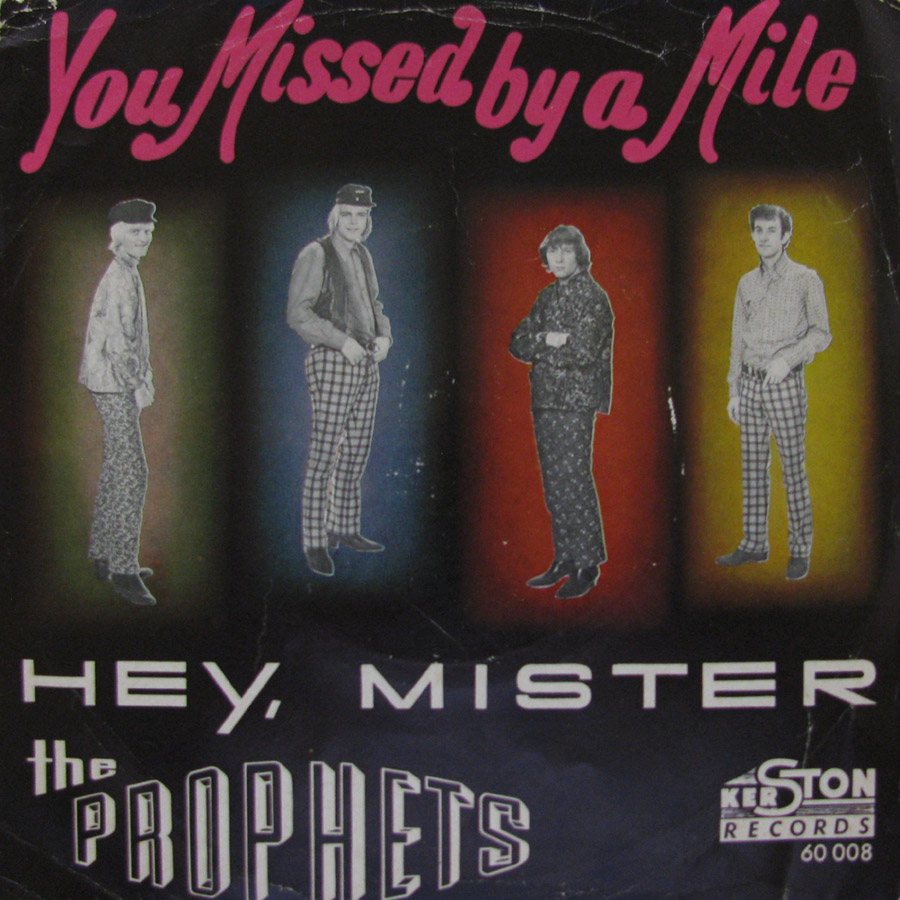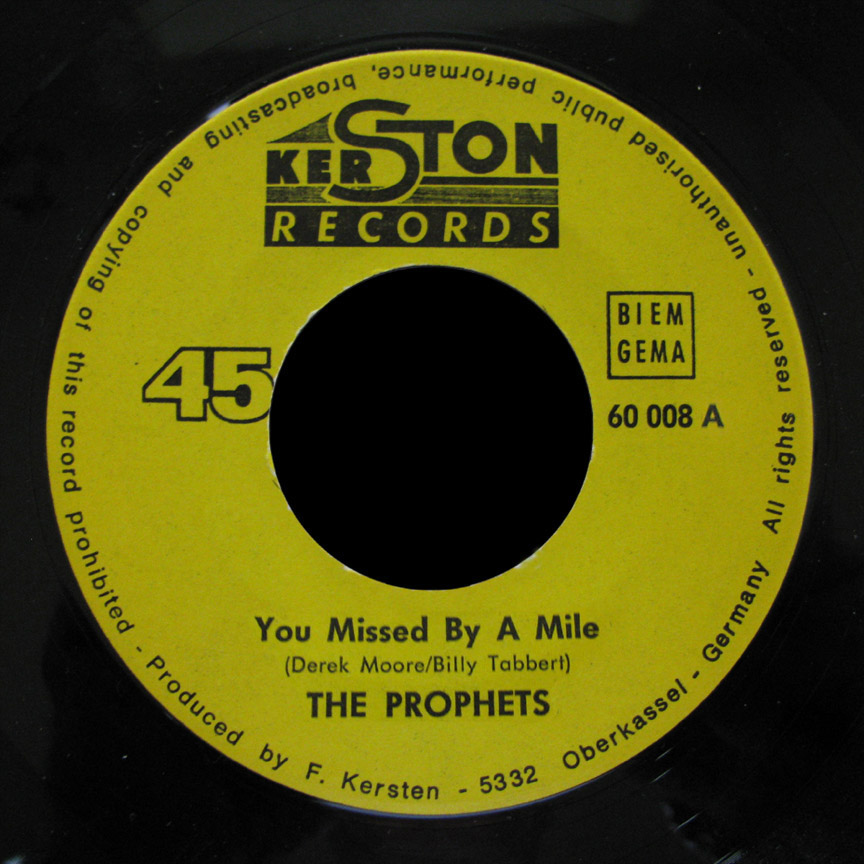
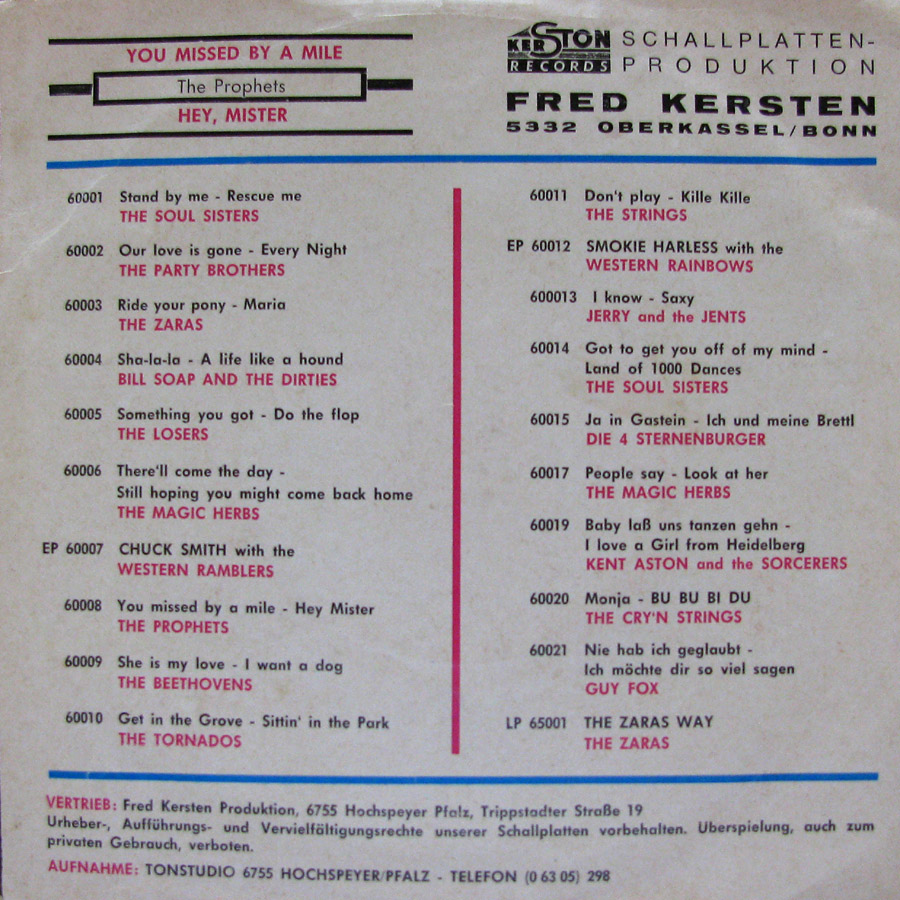
The Prophets seem to have been a short-lived group with one release on Kerston. At least three of the Prophets were British musicians who were based in Germany:
Billy Tabbert – guitar, vocals Derek Moore – bass, vocals Ron Howden – drums ? – guitar, vocals
In 1964, Derek “Mo” Moore was in two groups, the Upsetters and Beast. While touring France with the Upsetters, he met Ron Howden. I’ve seen conflicting accounts of what happened next, either Ron joined the Upsetters in France, or else Derek jammed with Ron when Beast toured through Hamburg.
In any case, the two of them formed the Prophets with guitarist Billy Tabbert. I’m not positive who the fourth member of the group was. It could have been Tommy McGuigan, a friend of Tabbert’s who had been vocalist and saxophonist in the Scottish rock band, the Waysiders from 1962-1965.
“You Missed by a Mile” and “Hey Mister” are two excellent originals by Moore and Tabbert. One is upbeat, the other more sedate, but each has fine vocals over expressive guitar playing, resounding bass lines and agile drumming.
Sometime between 1965 and 1967 Derek and Ron met keyboardist Allan “Taff” Freeman and guitarist Allan Murdoch from MI5, another English group who had relocated to Germany. Derek and Ron either joined MI5 or else formed a new group with them, Prophecy. By 1968 that group had evolved into Nektar, with LPs on Bacillus and United Artists. Billy Tabbert joined Allan Murdoch and Tommy McGuigan in Message, who also had releases on Bacillius. I’ve been told that Billy Tabbert passed away in 1995.
Fred Kerston ran his Kerston label from Oberkassel, Bonn with an impressive list of releases, including the Beethovens “I Want a Dog” / “She Is My Love”, the Party Brothers “Our Love Is Gone” / “Every Night”, the Magic Herbs “There’ll Come the Day” / “Still Hoping You Might Come Back Home”, the Strings “Don’t Play”, the Strangers “Hurt It”, the Tramps “I Do”, the Vampires “It’s Enough”, the Vanguards “I Know a Girl” / “My Babe” and the cool instrumental “A Life Like a Hound” by Bill Soap & the Dirties.
Keith Kessler’s “Don’t Crowd Me” is an anthem to garage-punk fans, with a sound to match the intensity of the lyrics: “Inside looking out, got no place to shout … I’m locked inside this place, problems I can’t face, I’m getting out breaking free … don’t crowd me! / My soul is cramped and bare, there’s freedom I can’t share … my independence crushed, don’t crowd me, give me air, give me time …”
Keith Kessler recorded “Don’t Crowd Me” at Kearney Barton’s Audio Recording Studio at 2227 5th Avenue in Seattle in 1966, using musicians from Keith’s group, the Impulses.
The Impulses formed in Bellevue (just across Lake Washington from Seattle) in 1964 and included Michael Elliot on lead guitar, Jack Joseph on rhythm, Keith on keyboards and vocals, Jim Simmons on bass and Lew McCall on drums. After the session for “Don’t Crowd Me”, Doug Holloway replaced Lew on drums. The Impulses split around 1967 and Keith joined Calliope for a time but left before they signed to Buddah.
“Don’t Crowd Me” wouldn’t be released for two years, and it was only with some luck that it was issued at all.
During the summer of 1968, Mike Wing, a Bellevue musician and aspiring record producer, liked one of Keith’s original songs “Sunshine Morning” enough to set up a publishing company and finance the recording, pressing and promotion of the record. Keith’s 1966 recording “Don’t Crowd Me” filled in for the b-side, and they released the record and sleeve in August. “Sunshine Morning” didn’t hit, but “Don’t Crowd Me” deserves to be ranked among the top examples of the tough Pacific Northwest sound.
My friend and fellow record collector Gregor Kessler (no relation to Keith) asked Keith about this record and his career in music:
I wrote “Don’t Crowd Me” back in 1966 during a period of general turmoil. Vietnam War. Seemingly mindless, rigid authority by government. Suffocation. A need for freedom of thought and action. Dissatisfaction. Frustration.
That was the backdrop.
Although I was with the Impulses at the time, this was never an Impulses song. We did play it at some of our gigs, but the late 60s and early 70s dance styles made it difficult to dance to.
Guitar on “Don’t Crowd Me” was Mike Elliott (also in the Impulses). I let him go wild on his solo in the middle of the song. My last contact with him was many years ago when he was a studio musician in Los Angeles.
Jim Simmons was on bass (also in the Impulses). He was respected for a creative, rapid walking movement. Although he wasn’t James Jamerson, he was very likely the best in Seattle.
My brother Kent sang back-up. We’d sung together throughout our youth. He wrote a number of songs that I always felt would be hits if he pushed them.
Both Kent and I recorded at the MTW studio (Mike Wing), along with Ann and Nancy Wilson of Heart. They obviously made the most of their talent.
The sleeve: “Sunshine Morning” was intended as the “A” side – sort of a Young Rascals light-weight, mellow 60s song. So the photo was taken at Golden Gardens State Park in Seattle to suggest waking up and enjoying a new morning. Although it was covered by two bands on separate recordings, it was basically not that exciting and lacked traction.
The “B” side – “Don’t Crowd Me” – got the airplay and, oddly, was popular with late Boomers and early GenXers. It was included (without permission) on a number of punk rock albums. Only one group – The Flying Saucers – asked for permission to record it. When I said “Of course”, they told me that there were at least 15 versions recorded by different bands across the country, and they sent me a tape with several versions. I have kept that very interesting tape, as wells as the Flying Saucers’ vinyl 45 version.
What caused the break-up of the Impulses? It’s incredibly difficult to keep musicians together. I was offered an opportunity to work with a newly forming band of the top musicians in the Pacific Northwest. Each of them had been with a band that had successful records. They were all extremely talented, and it was an amazing experience. The band – Calliope – worked day and night while I was trying to also attend college and raise a family. Ultimately, I left and was replaced by Danny O’Keefe who later had a popular hit – “Good-time Charlie’s Got the Blues”.
For what it’s worth, I chose law school over rock-n-roll, and am a trial attorney today. But in the process, I became addicted once again to playing rock music, and ended up doing a lot of writing, working with exceptional musicians from Alaska. We made no recordings, but, given their incredible talent, I thoroughly enjoyed the year that we spent together. Ultimately, as expected of musicians, we exploded, and most of them returned to Alaska.
Keith Kessler, September 2010
Mike Wing added this history in consultation with the Kessler brothers:
“Sunshine Morning” was recorded in June 1968 at Audio Recording’s 5th Avenue studio in Seattle, with engineer Kearney Barton at the controls and me in the producer’s chair. The musicians on the session were:
Keith Kessler – vocal, keyboards, songwriter, named artist Kent Kessler – backing vocal, keyboards, chimes Jack Joseph – bass, trumpet, arranger Doug Holloway – drums Leonard Olive – violin
We pressed up copies of the record with a photo sleeve and sent them to every music-oriented radio station in Washington, Oregon and Idaho. We got airplay on a number of the smaller stations, but unfortunately not in the larger markets like Seattle, Portland or Spokane.
The promo guy at a Seattle record wholesaler liked the record and pitched it to his contacts at RCA Records. I followed up with them a number of times hoping to work out a master licensing deal, but they eventually backed out citing the lack of major market airplay.
Meanwhile, a contact in London pitched the record to the Beatles’ newly formed Apple label. I was hoping for a master licensing deal for the UK or Europe. But to my surprise they asked about a publishing deal for the record’s flip side, “Don’t Crowd Me,” for possible use by their new group known as Badfinger. [Cool!!] Unfortunately, the deal never came together.
“Don’t Crowd Me,” was recorded at Audio Recording by Keith and his band at the time, the Impulses, in 1966. I was not involved with that session. Years later it was discovered as a punk/garage classic, but by that time neither Keith nor I were involved in the music business. I’ve always felt honored by the underground popularity of the track even though my involvement was limited to picking it as a flip side.
While there have been a number of cover recordings of “Don’t Crowd Me,” there is only one cover of “Sunshine Morning” that I am aware of. That was by New Era on their Observation album (the track can be found on YouTube).
Notes by Mike “MTW” Wing, January 2015.
Thanks to Keith Kessler and his brother Kent, and to Gregor for bringing this article together.
“We kicked out the horn players and went psychedelic” – The Omen and Their Luv, 1967 Front: Don McGlamery and Jeff Neighbors, back: Bill McClain, Bruce Hopper and Tommy Stuart
Omen and Their Luv released one of the best singles from Alabama during the ’60s. “Maybe Later” sounds fantastic – Tippy Armstrong’s buzzing guitar is all over the song while Tommy Stuart sings his too-cool-for-you lyrics. I especially dig the way he wails the end of each chorus:
Ain’t gonna get me in church You try all you like, but it ain’t gonna work. Not gonna go downtown I’m staying out here where no pictures around
Gotta know you better baby, And if I like you, well, maybe later!
Won’t thread the needle baby Don’t wear your shoes and I think you’re crazy Gonna be a cold day in June Leave me alone I’m going to finish my tune
Need to know you better baby, And if I like you, well, maybe later!
Need some time to think about it baby And if I think real hard, well, maybe later!
Won’t pick flowers in the rain Leave me alone and I’ll go back where I came, I see a lot of things I need And I need your love, but just as long as it’s free
Need some time to think about it baby And if I think real hard, well, maybe later!
If “Need Some Sunshine” doesn’t catch you at first, wait until 1:22 into the song, when it shifts into a different time signature and, thanks to some eerie backing vocals, a whole other realm.
Bruce Hopper wrote to me about the group, and also sent some unreleased songs, including the fantastic “Another Girl” from the same sessions that produced “Maybe Later”. I’m including an excerpt of the songs here, in the hope that they can receive a proper release at some time in the near future.
I am the founder and former bass player for the Omen and Their Luv. I formed the O-men in 1966 with Fred Deloach. We were originally a 60’s white soul group with horns. The original lineup was myself on bass, Fred Deloach vocals and sax, Mike Hatchett on drums, David Popp on trumpet, Billy McClain on guitar and John Purdue on keyboards.
Labels spell Tommy’s name “Tommy Stewart”
We went into the studio in the fall of ’66 and cut a six song demo tape: “Hold on I’m Coming”, “Hungry”, “Steppin’ Stone”, “Wooly Bully” (we were the opening act for Sam the Sham when he played Tuscaloosa), also two originals, “You” and “Hurry on Back” written by me and Fred Deloach. This tape was done at Boutwell’s “church” studio with Ed Boutwell doing the engineering. Boutwell Studios located in Birmingham was the only decent studio in central Alabama that recorded rock’n’roll. This tape I presented to Duane Allman (who liked it) and to Steve Caldwell of the Swinging Medallions / Pieces of Eight, whose dad, Earl Caldwell owned several clubs in Panama City Beach, Fl. This demo landed us a gig in Panama City working for Earl.The O-men would play a jam session at the Beach Party every day from 2-4. We would then open for the “Pieces of Eight ” at 8pm and do a set. They did a set and we would come back on at 10 for a set. Then we had one hour off to get down beach to the Cork & Bottle Club (later renamed the Red Rooster) for our regular gig of playing from midnight to 5am! This was our work schedule seven days a week for two months straight.
We added Tommy Stuart right before we started this gig. He had just left the Rubber Band after they had a hit with “Let Love Come Between Us” that Johnny Wyker wrote (later with Sail Cat). Tommy played sax, sang and played keyboards. Due to band stress, Fred left the band half way through the summer.
When we got back to Tuscaloosa, Mike brought Jimi Hendrix’s first album to practice and that changed everything. We switched from white soul to psychedelic rock. David Popp left on trumpet.
Because of the change to harder rock, we changed the name to The Omen and Their Luv. Hatchet moved to Atlanta and we brought in Jeff Neighbors on drums. We also added Don McGlamery on rhythm guitar and sax. This was the lineup in the pic by the gas pump.
We went into the studio in the fall of 1967 to record four of Tommy’s songs. Again we recorded at Boutwell’s Studio. Tommy Stuart wrote “Maybe Later” and sang lead vocals. We snuck some young girls in to sing backup, but their parents would never let them tour with us.
We brought in Tippy Armstong (later a studio musician in Muscle Shoals) to play lead guitar on all four songs. Since Tippy came to the session, Eddie Hinton (Muscle Shoals session man) showed up to visit and started telling Ed Boutwell how to mix. Boutwell got pissed and told Eddie to mix it. So “Maybe Later” ended up with some top notch studio guys helping us out.
I met David Keller when he was playing with The Preachers in 1967. After the Preachers, David had a booking agency that he ran out of Montevallo where he had attended college. He was wanting to expand into booking and producing and club ownership. He liked our tape and we were the first band he booked onto his Daisy label. “Maybe Later” was the A side and “Need Some Sunshine” was the B side. The record sales had minimal success, but the airplay led to great crowds at gigs promoted by Keller.
“Good Man” which was to be our next single, but it never happened under David Keller. “Another Girl” was to be the “B” side of our next release.
He had a group of bands that included the Omen, The Outer Mongolian Herd and W.C. Doan and Co. that he booked. For a short while he opened a recording studio on 15th St. in Tuscaloosa where some of his bands recorded. He also started a club in Panama City in June of 1968 called the Head Shop. We were the opening act. For two weeks we played as The Omen and Their Luv, then we would play for two weeks as the Preachers doing their hit song “Inspiration”. Fun times.
David countined to book us across the South for at least a year. He also had the Shingaling Club in Selma, AL. We played there every Saturday night for at least six months until one night we let some black musicians sit in with us. The next Saturday we showed up and the Sheriff had put a pad lock on the door with a sign reading “Closed until further notice by order of the Sheriff of Dallas County”. Selma 1968!
Omen and Their Luv, 1968, from left: Tommy Stuart, Mike Thornton, Jeff Neighbors and Bruce HopperThe Rubber Band 45 from 1970 featuring the last Omen lineup of Tommy Stuart, Mike Thornton, Bruce Hopper and Asa Gaston
Billy left and was replaced by Mike Thornton from the Shadows. By 1969 we were down to a 4 piece as shown in the other photo. Bill Stewart (Allman Brothers Band) replaced Jeff for about six months and then Asa Gaston (Locust Fork Band) came in on drums.
The four piece of Stuart, Hopper, Thornton, and Gaston went on to re-aquire the name Rubber Band which Stuart owned the copyright on (Tommy later sued and won a copy right infringement case against Bootsy’s Rubberband). We recorded on 1 2 3 Records [“Your Man Done Gone” / “Peeking Through Your Window”] with Tommy playing keyboards, flute, sax and doing the lead vocals. Unfortunately our song had the exact same rhythm and chord changes as “Spirit in the Sky” which was released one week before our song.
We did an east coast tour the summer of 1970. Things were falling apart by that time. Mike Thorton left and was replaced by Tommy Joe White. Asa didn’t want to do the tour because he just got married, so we added a session drummer from Colorado for the tour. I left the group after the tour.
Asa and I later formed another local band with Jim Coleman (check out his website) and Jimmy Butts. We were known as Mr. Wizard and recorded a one hour special for Alabama PBS. More bands in the 70’s. Owned the Chukker in Tuscaloosa in the 80’s and promoted music for years. Now I back up Carroline Shines, the daughter of blues legend Johnny Shines.
Mike Hatchett later went on to play with the Brick Wall out of Atlanta and worked as a roadie for Little Feat and George Jones and many others including Kiss, Ronnie Milsap, Blue Oyster Cult, etc. Billy McClain died of cancer after a succesful photography career. Don McGlamery later moved to Norway and was a succesful street muscian there. [ChasKit: Don passed away in January, 2006].
I have been listening to our body of work with the Omen, Omen & Their Luv and the Rubber Band and am going to talk with Tommy about doing a retrospective CD of all the material from the ’60’s and 1970.
Bruce Hopper
In a comment on the post about the Preachers, Tommy Stuart added:
We’d recorded it on our own but a disc jockey from Northport knew David & that’s how all of that happened. He had a big teen dance place in Panama City in about 1968 & we played there as The Preachers, & also a one nighter or two that way. It was a little weird but we learned their record “Hallowed Ground” & got up there & I sang it like it was mine. Later, I bought Dave’s screaming white Hammond M2 organ he’d used in the Preachers.
Tommy Stuart has a new group called O-Men and Their Luv, with a CD No Twin.
Thank you to Bruce Hopper for sending in the photos and song transfers and for patiently answering my questions.
On the Quad at the University of Alabama. From left: Tommy Stuart, Mike Thornton, Asa Gaston and Bruce Hopper.
Mustangs EMI PS “Love Is Blue”, ‘Lies”, “Nina’s Theme” and “Summer Wine”
Joseph C. Pereira, author of Legends of the Golden Venus, will be contributing rare oddities to Garage Hangover from time to time.
I have attached a picture of a band from Madras called Mustangs. Must have been a Mustangs from every country in the world.
I spent time in Chennai visiting second hand book stores and a few shops selling old vinyl, which is where I got this Mustangs single.
The record was released in 1968 I guess because “Love Is Blue” is present. The line up is Derek Norris (sax), Kittu Rufus (lead), Darryl Cordeiro (rhythm), Haroon Mohamed (bass), S. P. Ananth (drums).
The songs are “Love Is Blue”, ‘Lies”, “Nina’s Theme” and “Summer Wine”. The style though is restrained supper club music. Maybe they were told to record in that manner by the record company executives.
Derek Norris looks like a Anglo Indian given his Caucasian features. The rest of the band are Indians and includes a Muslim, a Hindu and two Christians.
Joseph C. Pereira
The Mustangs 1967 single, “Escape”, a cover of the Ventures, written by Danny Hamilton of the T-Bones
The Humans, 1966, standing l-r: Marty Busch, Dick Doolan, Bill Kuhns, Danny Long, Gar Trusselle sitting: Jack Dumrese
Dick Doolan – vocals Danny Long – vocals and harmonica Bill Kuhns – lead guitar Gar Trusselle – keyboards Marty Busch – bass Jack Dumrese – drums
The Humans were from Albion, New York, 20 miles north of Batavia. According to the liner notes for Back From the Grave vol. 5, all six members were in high school marching band when they decided to form a band in the summer of 1964. Their band’s moniker was a dig at all the groups naming themselves after insects and animals.
They toured throughout the northeast, opening for some big acts, including playing the Rheingold Festival in Central Park, Manhattan in 1966.
Their only 45 has a fine folk-rock original on the A-side, “Take a Taxi”. The instrumental passage is a neat combination of twelve-string guitar and organ.
For years now, it’s been overshadowed by the B-side, “Warning”, which has become almost an anthem in garage-rock circles, and rightly so. It’s a well-arranged combination of ringing guitar chords, thudding drum beat and bass line, simple organ melody, a great rough lead vocal answered by a second singer and a harmonica solo.
Lead guitarist Bill Kuhns (listed as William R. Kuhns, Jr. on the label) wrote both songs. It was recorded at Riposo Studios in 1966 and released on the Audition label, which had a number of classic mid-60s singles. I don’t know what happened to the band after its release, or if the record sold at all. It’s pretty hard to find these days.
Gar Trusselle answered some of my questions about the band:
Q. How did the band sign get to tour around the Northeast?
We were managed locally by Al Cecere in Rochester. As far as we knew, Al Cecere was the sole owner of Audition. He had some connections so he got us signed up with Premier Talent Associates (PTA) in NYC. Our agent with them was Rich Nader who went on to promote R&R revivals across the country. We also opened for the Hollies, Mitch Ryder and the Detroit Wheels (several times) and played a two week gig in Miami with the Standells.
We were friends with “The Heard” as they were also managed by Al Cecere. We alternated at Oak Orchard Lanes in Albion [with] Caesar and His Romans from Buffalo. By the way, Oak Orchard Lanes was quite a hot spot. In the summer, the owners would cover all 12 lanes with plywood and have dances on the lanes with some pretty big names. A couple that come to mind are the Rivieras and the Shadows of Knight.
Q. Do you remember any details about the Riposo Studio and making the record?
All I can remember is that the studio was in Syracuse. Someone said Wooly Bully was recorded there but I cannot verify that.
Q. Did it get any airplay at the time?
We did get good local airplay and some national as well. Billboard reported us in the top twenty in a Michigan and Texas market but it did not last.
Q. Did the band perform “Warning” and “Take a Taxi” during your live shows?
We did perform the two songs live at every performance.
Q. The band had long hair for 1966, did that cause any trouble?
Nothing but. However, we had a lot of local support even from the adult side.
Q. How did the band break up, and did you stay in music after?
It began when Dan died in a car accident in September of 1966. We went on from there but the draft started to whittle at the group. I think our last job was in November of 1966 at our own venue in Albion. We had rented the local (out of business) movie theater, remodeled it, and named it “Happiness Is…”.
Gar D. Trusselle
The photo at top originally provided to RambleMusic.com (link dead as of 2013) by Bill Vosteen. The site includes photos and clippings of other Batavia-area groups like Beethoven’s Dream Group, The Majestics, the Plague, Salt of the Earth, The Revengence, the Squires.
Al Cecere owned the record labels Audition and Nu Sound Ltd., of Rochester, New York. It seems Cecere changed the label’s name to Nu Sound Ltd. with release #6111 by the Wee Four. Any help completing this discography, or info on Al Cecere’s productions or Riposo Studios would be appreciated.
Discography:
Audition
6102 – The Vaqueros – Desert Wind / Echo (both by Weld-Heath-Corona) 6103 – Dick Jans Duo – I Am (Edwards, Shuman) / Venus (the Frankie Avalon hit) – June 64 6104 – The Vitrones – Linda (Cheshire, Couto, Downing) / London Fog (licensed to Barry, #3326X in Canada) 6105 – America’s Children – Do-Maka / No Need For Blame (1965) 6106 – America’s Children – Star / Swinging Christmas (1965) 6107 – The Heard – Laugh with the Wind (Jeff Wheat and Brad Wheat) / Stop It Baby (Karim Copli) (mentioned in Billboard, May 7, 1966) 6108 6109 – The Humans – Take a Taxi / Warning (both by Bill Kuhns, Jr.) 6110 – The Rogues – Train Kept a-Rollin’ / You Better Look Now (Jim Perotti*, Bob Radell*, Mike Spriggs)
Nu Sound Ltd.
6111 – The Wee Four – Weird (James Obi, T. Pilittere) / Give Me a Try 6112 – Terry Pilittere – It’s Not That Way / You Wouldn’t Believe Me 6113 – Pete Morticelli – Lost / If You See Me
* correct spellings of these two Rogues names are Jim Pierotti and Bob Radel.
Most originals on Audition and “Weird” by the Wee Four 45 published by Cecere Music, BMI.
The Heard have an unreleased song, “Leave Well Alone” on a Capitol Custom acetate.
The Montereys “Bye Bye” / “Sheryl-ane” also recorded at Riposo Studios.
Thank you to Davie Gordon for his help with this discography.
Laurie Wade’s Cavaliers on CBS Records, from left: Warren Isaacs, Laurie Wade, Chris Rees and Ivan Norman. Photo courtesy of Warren Isaacs.
Laurie Wade’s Cavaliers started as a surf group, cutting one instrumental single for the Linda Lee label, “Cloudburst” / “The Phantom Guitarist” (written by Laurie Mudge). Hear this first singel on Big Beat’s excellent compilation: Board Boogie: Surf ‘n’ Twang from Down Under).
The Cavaliers included:
Laurie Wade – guitar, vocals Ivan Norman – guitar, vocals Robert Campbell – bass, replaced by Warren Isaacs Chris Rees – drums
Laurie Wade signed to CBS and cut four excellent singles in 1965 and 1966. The style of music changed to beat, but his roots in surf served him well as all the records feature sharp original guitar work. I don’t know the membership of the group, but I assume Laurie played lead guitar, and sang lead on the CBS recordings.
First came the minimal “Say Hey”, backed by a song I haven’t heard, “The Adventurer”. Laurie Wade wrote both.
Warren Isaacs sent in the photo seen here and told me, “Robert Campbell was the bass player on ‘Phantom Guitarist’. I replaced him after that and was on all the CBS records. I was in the group right up to the very end which I think was about 1968.”
The second was an excellent Laurie Wade original, “To Win Your Love”. It’s probably my favorite of their recordings that I’ve heard, with two good guitar breaks, rollicking piano and solid rhythm backing over Laurie’s great vocal. The flip is another Wade original, “Don’t Quit Now”. It’s not a bad song, though I’m mystified by the engineering, as the rhythm guitar starts off too loudly, only to be dimmed along with the rest of the band just six seconds into the song.
In 1966 they cut their most adventurous song, Wade’s “The Colour of Her Eyes”, beginning with a riff like something out of a Sonics song. The rhythm guitarist takes a page out of the surf guitar book, strumming over deadened strings with heavy reverb for a cool background sound. Laurie’s vocals alternate between gloomy and wailing!
I guess CBS didn’t know what to make of this song, as they threw it on the b-side of a cover of “Greensleeves”. The band does an interesting version, with some eerie guitar in the background, but it’s an awkward song and hardly a good choice for them.
I knew Marty Rhone’s raving version of “Every Minute of You”, but I hadn’t heard Laurie Wade’s original recording of it when I first wrote this article. It surprised to hear the band going in a more soulful direction, though it suits Laurie’s voice. Marty Rhone’s release came shortly after.
Although the label credits read just N. Kipner, the notes to Big Beat’s CD Hot Generation! say that “Every Minute of You” was a collaboration between Carl Keats, guitarist for Steve and the Board and Nat Kipner, father of that band’s singer Steve Kipner. For once neither song was a Laurie Wade original. The flip, “Let Me Down Easy” was written by Glasser and Glasser.
Their producer at CBS was Sven Libaek, a staff producer from 1963-1968 whose credits include the Atlantics (including “Bombora”), Lynne Randall, the Jet Set, the Jackson Kings, the D-Men, Kenny Shane and the Pilgrims Five. As far as I know CBS hasn’t bothered to reissue Laurie Wade’s work, which is a shame, I’m sure a remastering from original tapes, if they exist, would sound excellent, and there’s probably some good unreleased songs.
If anyone has more info on the group, please let me know.
45 releases:
Linda Lee LL-008 – Cloudburst / The Phantom Guitarist CBS BA-221215 – Say Hey / The Adventurer (1965) CBS BA-221235 – To Win Your Love (Wade) / Don’t Quit Now CBS BA-221273 – Greensleeves / The Colour of Her Eyes (1966) CBS BA-221357 – Every Minute of You (N. Kipner) / Let Me Down Easy (Glasser – Glasser) (1966)
John English in KRLA’s Beat newspaper, May 21, 1966
Updated with information from my phone interview with John from September 2010
The Retail Clerks Auditorium, 2010 8550 Stanton at Crescent in Buena Park Can anyone provide a better or vintage photo?John English played a small but very vital role in the Los Angeles band scene of the mid-60s. He was born in Kensington, London. His mother was British and his father from Oklahoma. Growing up he listened to skiffle, and later r&b and country music. His father always liked music, and bought him a harmonica when he was nine or ten years old. His favorite harp player was Sonny Boy Williamson.When he was twelve the family moved to Texas for one year, and then to California, where he lived until he joined the service at 21. In high school he started taking music seriously.
While enrolled in college at San Fernando Valley State College (now California State University, Northridge), he met the Heathens, initially sitting in as a guest during their performances. John told me he performed with the Heathens at Pandora’s Box, around Orange County and the legendary Retail Clerks Union Auditorium with the Crossfires.
When English was in the group, the Heathens included Dirk Acree (aka Vern Acree, Jr., former guitarist for the Blazers of “Beaver Patrol” and “Bangalore” fame), his sister Char Acree (Sharon Acree?) and drummer Johnny Rogers,.
English wasn’t with the band for long, as he doesn’t seem to appear in any photos of the group, at least not that I can tell.
The Heathens at the Pussy-Kat a Go Go, circa 1966, after English had left the band. From left: Johnny Rogers (drummer), Don Adey, Colin Adey (with tambourine), unidentified girl in front, Dirk Acree, Char Acree
The first mention he receives in the press is from the May 13, 1965 edition of the Valley News of Van Nuys, California:
Dance, Show Event at College
NORTHRIDGE — Zeta Beta Tau Fraternity will hold a dance and show, “A Go Go Continental,” on Saturday, May 22, from 8 p.m. to midnight in the college gymnasium at San Fernando Valley State College, 18111 Nordhoff St.
The entertainment will highlight nationally famous recording artists, including The Parlays, formerly with Round Robin who made the Slauson popular. Their records include “Dance to the Slauson” and “Kick Your Little Foot, Sally Ann.”
Also on the program will be Bobby Day who made “Little Bitty, Pretty One” and “Rockin’ Robin” which was once No. 1 all over the world.
Direct from England and the first time in Los Angeles, John English and the Heathens will perform and sing a number of songs soon to be released. Finally, a surprise group will be featured doing many of its million sellers, it was stated.
The dress is school dress and tennis shoes …
As John related the story, someone named Brian who had done PR work for the Beatles brought Lelan Rogers to see the Heathens show at Pandora’s Box. According to John, Lelan had them record three or four sides, but only two were ever issued.
“I Need You Near” has a slashing rhythm from Acree, who takes an excellent solo early in the song. John’s singing is gravelly and cutting, and he has a great shouted bit, something like “alright Vern now step for me, c’mon give me that stroke (?) now!” “Some People” is much different, with a ringing acoustic guitar and an almost whispered vocal.
John’s singing on this record and his later ones shows not a trace of an English accent. I don’t believe the Heathens recorded anything besides this 45.
Both songs are English originals with “Some People” co-written with Vern Acree, publishing by Rattan Music, BMI. The record was produced by Lelan Rogers and arranged by Glen Spreen. Sabra released it in May, 1965, just after another disc produced by Rogers: “I Want My Woman” / “And Then” by the Emperors.
It’s hard to say why the single of “I Need You Near” is so rare now (literally only 4 or 5 copies are known!). Other 45s on the Sabra label, like the Emperors are not as difficult to find. The Heathens (master numbers S-5009 and S-5010) was actually ready to release before the Emperor’s (S-5011 and S-5012) but was given the next catalog number (5556 compared to the Emperors 5555). I would guess Sabra thought the Emperors disc was stronger, and once it started making an impact, Lelan and Sabra put all their promotional efforts into that record and let the John English & the Heathens record wither on the vine. Another reason could be Lelan soon left Sabra and then returned to Texas.
John told me the Sabra record received some good reviews, and the band was offered a deal to tour, but some of the Heathens were still in high school. John left the Heathens and went out on a 1965 Shindig summer tour as a solo artist.
September 18, 1965John English, lyrics and lead vocals
This Lemondrops were actually the PreachersThe September 18, 1965 issue of KRLA’s Beat paper has an interesting “personals” letter from one Chris Jones asking: “To John H. English of the used-to-be Heathen’s: What happened to the group? Will we never heard your beautiful London accent again?”
John English’s Sabra single was released in May, 1965, the same month the Preachers, another Los Angeles group, issued their first great single, “Who Do You Love” / “Chicken Papa” on Moonglow. After the Preachers released their second single, “The Zeke” / “Quit Talkin’ Bout Him” in August ’65, they’d realized their mistake in replacing their first singer, Richard Fortunato, with the smoother vocalist Burke Reynolds. Fortunato had a commanding r&b voice which helped make “Who Do You Love” such a classic.
Unable for whatever reason to bring Fortunato back into the group, the Preachers auditioned singers before their live crowds. John English did well with their audience and had the tough-sounding vocals the band wanted, and John told me he was also good friends with the Preachers’ bassist, Zeke. At this point the Preachers consisted of John English III (vocals), Hal Tennant (lead guitar), Rudy Garza (piano), James ‘Zeke’ Camarillo (bass) and Steve Lagana (drums).
English also had lyrics to two songs that would become the Preacher’s third 45, “Stay Out of My World” / “Pain and Sorrow”. Rudy Garza wrote the music for each song. As usual for Moonglow releases the production credit goes to the company’s owner Ray Maxwell. Recorded at R.J. Recorders in Hollywood, it was released in October ’65.
“Stay Out of My World” is a fantastic record, featuring dual harmonicas played by guitarist Hal Tennant and organist Rudy Garza over Steve Lagana’s catchy drum beat. John’s distinctive trebly rasp is even more expressive than it was on “I Need You Near”.
“Pain and Sorrow” is a gentler track, sung in a quiet voice just above the whisper he used on “Some People”. Moonglow later released another version of “Pain and Sorrow” by a singer named Wayne Dailey, but using the identical instrumental track recorded by the Preachers. It shows up on the flip to “Wreck of a Man”, Moonglow 5010.
While John English was in the band, the Preachers appeared on American Bandstand, the Lloyd Thaxton Show and KHJ-TV’s 9th St West dance show.
The Preachers returned to the studio and recorded two more songs, “Moanin'” (originally written by Bobby Timmons for Art Blakey, with lyrics by Jon Hendricks) and another English-Garza collaboration, “Just Don’t Complain”. A nihilist look at nuclear war, the music is full of tension, English’s vocals are snide and his lyrics unforgiving: the best advice he can give is “you got to maintain”.
They also cut a demo of “Hey Joe”. Rudy Garza said to Jeff Jarema:
We heard Arthur Lee and Love. He was doing “Hey Joe” in his nightclub act. We thought, man, that is a good song. Those other versions, like the Leaves’, weren’t out yet. We wanted to demo it for Moonglow Records. We had only heard it once or twice so we didn’t have the words, but we wanted to show them what the song was like. So Johnny English put some lyrics to it. They are completely different. He always seemed to write those doom and gloom, anti-war lyrics. We just did a demo for them, really. They didn’t like it!
After only a few months with the Preachers, John said, the FBI showed up at his door to make sure he would see to his induction, and he was drafted in December of ’65.
The Preachers were falling apart in any case, and Rudy Garza soon left the band because he felt Moonglow had buried his piano in the mix on “Moanin'”, and also that Moonglow was not producing the records as the band would like.
Lacking a band to support the new single, Moonglow thought they could promote John English as a solo act and released the single as by John English III and the Lemondrops in May, 1966. John’s solo career would have to wait until his stint in the Army finished four years later.
As an aside, I’d read a rumor of a group called John English III and The Carnaby Commoners but hadn’t seen any documentation to support it, and John told me he had never heard of that backing group.
The May 19, 1966 edition of the Beat:
English Long-hair Joins U.S. Army
John English is British. Less than a year ago he had shoulder length hair and was a member of the Preachers. Now he has a standard U.S. Army hair cut and proudly wears the uniform of this country’s army although he’s still a British subject. And he doesn’t regret for one moment cutting his hair or going in the army. John more or less went into the army voluntarily. He was drafted on December 13 and the same day he enlisted in order to get more of a choice of what he did in the service. He could have easily gotten out of it. He’s a British subject living here on a permanent visa and all he had to do was go back to England and they couldn’t have touched him. But he feels that if he lives in this country and takes advantage of everything it has to offer then he has to pay for it just like everyone else.
An Extra Year
Because he enlisted he’ll have to spend three years instead of two in the service but he’s doing what he wants to. He’s in weapons training at Fort Ord now and he’s continuing his career as a singer but as a solo singer now. “The Army’s not as bad as I thought it would be,” he says. “It’s good experience, as long as they don’t send me to Vietnam.” As it stands now the only way he’ll go to Vietnam is as a performer to entertain the troops. As for his hair, he had a Beatle cut for quite a while then he really let it grow, down to 12 to 14 inches long. “I liked it when I had it,” he says. “But I did want to cut it.” John cut his hair before he actually went into the army. “I wouldn’t have ridden down there on that bus with my hair long for all the money in the world.” And now he’s glad that he did cut it. “After you cut it off it feels real good.”
From Preachers To?
The Preachers, who have since disbanded, were a very long haired and very wild act. Where did they go? Well, John’s in the army, three other members of the original group are in The Vejtables, one is in The Bees and one is a physicist for Lockheed Air Corps! John’s starting out on his career as a solo singer and he has his first single release out now. It’s called “Moanin'” and it’s an old jazz number that’s pretty wild. …
Commenting on Sadler’s “Ballad of the Green Berets,” John says, “We used to hate it in basic training.” …
John’s somewhat unique in the pop world. He’s one singer who deliberately and voluntarily cut his hair and went into the armed service. It isn’t so bad after all according to this one exception.
After the Preachers, Richard Fortunato and Zeke Camarillo joined the Vejtables in time to cut their great 45 “Shadows” / “Feel the Music”, both sides co-written by Rich Fortunato.
Hal Tennant joined the Bees, who became the WC Fields Memorial Electric Guitar String Band and then was part of both ESB and Fields. Steve Lagana found a gig playing drums for Johnny Rivers and Rudy Garza went to work for Lockheed.
John English served four years as an officer in the Army, stationed at Ft. Lewis in Washington, where he had bands.
After leaving the service in 1969, he became a songwriter, writing “I’m Going Home” for Buck Owens who he toured with. His songwriting collaborators include Terry Clement, Larry Collins, Bryan Garofalo, Bob Moulds, Steven Diamond and David Wills.
John signed to Warner Bros in the mid-70s, then went back to Cal State for a graduate degree. In the ’80s, he went into production, first at Record One in Sherman Oaks and then in Nashville. In 1981 he hit the country charts with “Your Daddy Don’t Live in Heaven” and in 1989 produced Michael Ballew for Liberty Records. He now works as a communications consultant and lecturer.
Discography of the Preachers and John English III
John English III and the Heathens – “I Need You Near” / “Some People” (Sabra 5556, May 1965)
The Preachers – “Who Do You Love?” / “Chicken Papa” (Moonglow 240, May 1965, Richard Fortunato lead vocals) The Preachers – “The Zeke” / “Quit Talkin’ ‘Bout Him” (Pep 102, August 1965 – Pep was a Moonglow subsidiary, Burke Reynolds lead vocals) The Preachers – “Stay Out of My World” / “Pain And Sorrow” (Moonglow 5006, October 1965, John English lead vocals) The Preachers – “Hey Joe” (Moonglow demo, John English lead vocals)
John English, III with the Lemondrops (actually the Preachers) – “Moanin'” / “Just Don’t Complain” (Moonglow 5011, May 1966)
Rudy Garza mentioned an unreleased song by the Preachers called “Two Brothers” with Burke Reynolds on vocals, but that appears to be lost.
All four singles recorded by the Preachers are included on the Bacchus Archives release The Preachers – Moanin’, which I recommend, and “Hey Joe” appears on a Sundazed EP with “Who Do You Love?” and “Stay Out of My World”.
Sources include my conversation with John in September, 2010, Mike Dugo’s interview with Rudy Garza, and release dates provided by Mike Markesich. Heathens photo from hollywoodagogo.com.
Special thanks to Mark Taylor for scans and transfers of the Sabra 45.
Given Bobby Runnel’s career as a lounge act during the mid-late ’60s, you’d think it unlikely that one of his songs could become something of a classic of mid-60s rock. His original song “True Love – Heartaches” has been a favorite of mine since hearing it on Teenage Shutdown vol. 11. He certainly must have believed in the song, as he recorded it three times in as many years.
Bobby Runnel was born Robert Wilson, the son of a Southern Baptist preacher, and raised in eastern Arkansas, a rural area now part of Little Rock. Across the river was Memphis, where he picked up some of the early rock ‘n roll styles of the ’50s. He moved to Miami and started the Faux Pas trio, touring the east coast and mid-west.
In Nashville he recorded “True Love – Heartaches – False Love” as the b-side of his first single, released in September 1965 on the Buccaneer label from Jackson, Mississippi. The A-side is what I’ve heard is a soul ballad featuring flute, “If Your So Mart”. The artist is listed as Bob Runnel’s Faux Pas III with John Sherwood and Ivano Comelli (sp? – Ivann Comelli?). He had a second 45 on Buccaneer (509) “For My Baby” / “Where’s Willie Walker” that I haven’t heard.
I recently heard a clip of this first version of “True Love – Heartaches – False Love” and it’s pretty cool, slower with piano as prominent as the guitar and good drumming. If anyone has sound transfers or label scans please email me.
In 1966 the band found long-term work in northern Ohio, based mainly in Akron at Ninos’ restaurant and lounge. The clientele was older and Runnel’s repertoire ranged to all kinds of pop styles from folk to mainstream pop. The Faux Pas trio changed personnel from time to time, but always with Runnel playing lead guitar and singing. The two records I’ve heard also feature piano, so at least in the studio they were more than a trio.
Runnel cut “True Love – Heartaches – False Love” for a second time at Cleveland Recording (not in Little Rock as noted elsewhere) in 1966, released on Suburban Records CRC 2031 (white labels). On this release the band is listed as simply the Faux Pas III. It was the b-side of “Baby What You Gonna Do”, a good New Orleans-type r&b.
Songwriting credits on both sides are listed as Runnel, Comelli and Lott. Also on Suburban is another single featuring the Faux Pas backing a Janet Stewart, “What Can I Do” / “Brand New Love”.
In January 1968 he released the third and best version of “True Love – Heartaches”, recorded at Akron Recording and released on his own Faux Pas label (a Rite pressing: 21131/21132 with black labels). The A-side this time was a cover of “Black Cloud”, a hit for Me and Dem Guys on Palmer from late 1966. It’s a song I’m not very fond of but the Faux Pas do a great job, especially the drummer who lays down a beat like a locomotive. Whatever the limitations of their lounge act, this band could rock when it wanted to.
On this 45 the band is credited as Bobby Rúnnel’s Faux Pas, with an accent over the “u” in Rúnnel. Rúnnel is also listed as sole song writer on “True Love – Heartaches”, as well as producer.
In 1969 they released a pop 45 as the Faux Pas that I haven’t heard, and also during the late ’60s Runnel had two LPs featuring his typical lounge repertoire and probably sold as souvenirs of his club act. Bobby Runnel, A Winning Streak Of One on the Hawk label features a photo of Bobby with an acoustic guitar, and lists some of the songs: “Big Boss Man”, “A Place in the Sun” and “Malaguena” along with original jokes!
In the early ’70s he broke up the Faux Pas and did well as a songwriter in Nashville.
All info cribbed from Buckeye Beat, with some 45 release info from Mop Top Mike.
The band’s names are on the song credits – G. Nole, G. Fick, D. Silvis and R. Saunar. I didn’t know anything about the group until J.C. commented below, which I’ll excerpt here:
The band was from Aurora, Colorado (suburb of Denver). All 4 original members attended Aurora Central High School and included bandleader Gary Nale on vocals, lead and rhythm guitar, Gary Fick on vocals and bass guitar, Dwight Silvis on vocals, keyboards, lead and rhythm guitar and Robert Sauner on drums.
The 2 songs were primarily written by Gary Nale.
I’ve read that the Lidos disc predates the British Invasion, but from the Rite pressing number, 13555, it dates to mid-late 1964. So the Invasion had started, but the Lidos weren’t really paying attention. “Since I Last Saw You” is repetitive and crude, with its cool opening bass line, pounding drums and a great shout before the guitar break, which comes earlier than usual. I think this would make a great instrumental. The ensemble vocals are a little bizarre. It ends with a fantastic drum break and repeat of that sliding bass line.
The chorus of serenaders on “Trudi” turns it into a parody of the doo-wop style. The band must have been disappointed in the absolutely crappy fidelity they got out of the Band Box studio, even though that cloudy sound is part of the charm of “Since I Last Saw You”. However, I do like the intense decay on the last chord of “Trudi” – so, you have one reason to take a listen to it.
Anyone have a photo of the Lidos?
Vicky Morosan started Columbine Records in Denver Colorado, changing the name to Band Box Records when Columbia objected. After starting on East Sixth, she moved locations to 220 S. Broadway. Releases started with drummer Ronnie Kae’s “Boom Boom” in the late ’50s and continued into the late ’60s, totaling almost 200 singles altogether.
For more info on Band Box check out this article from the Denver Post on the documentary Gears, Grease and Guitars, as well as Rockin’ Country Style, and this extended, though partly incorrect list of releases (the Lidos are not listed and #359 is attributed to “The Royals and The Shades”).
This site is a work in progress on 1960s garage rock bands. All entries can be updated, corrected and expanded. If you have information on a band featured here, please let me know and I will update the site and credit you accordingly.
I am dedicated to making this site a center for research about '60s music scenes. Please consider donating archival materials such as photos, records, news clippings, scrapbooks or other material from the '60s. Please contact me at rchrisbishop@gmail.com if you can loan or donate original materials