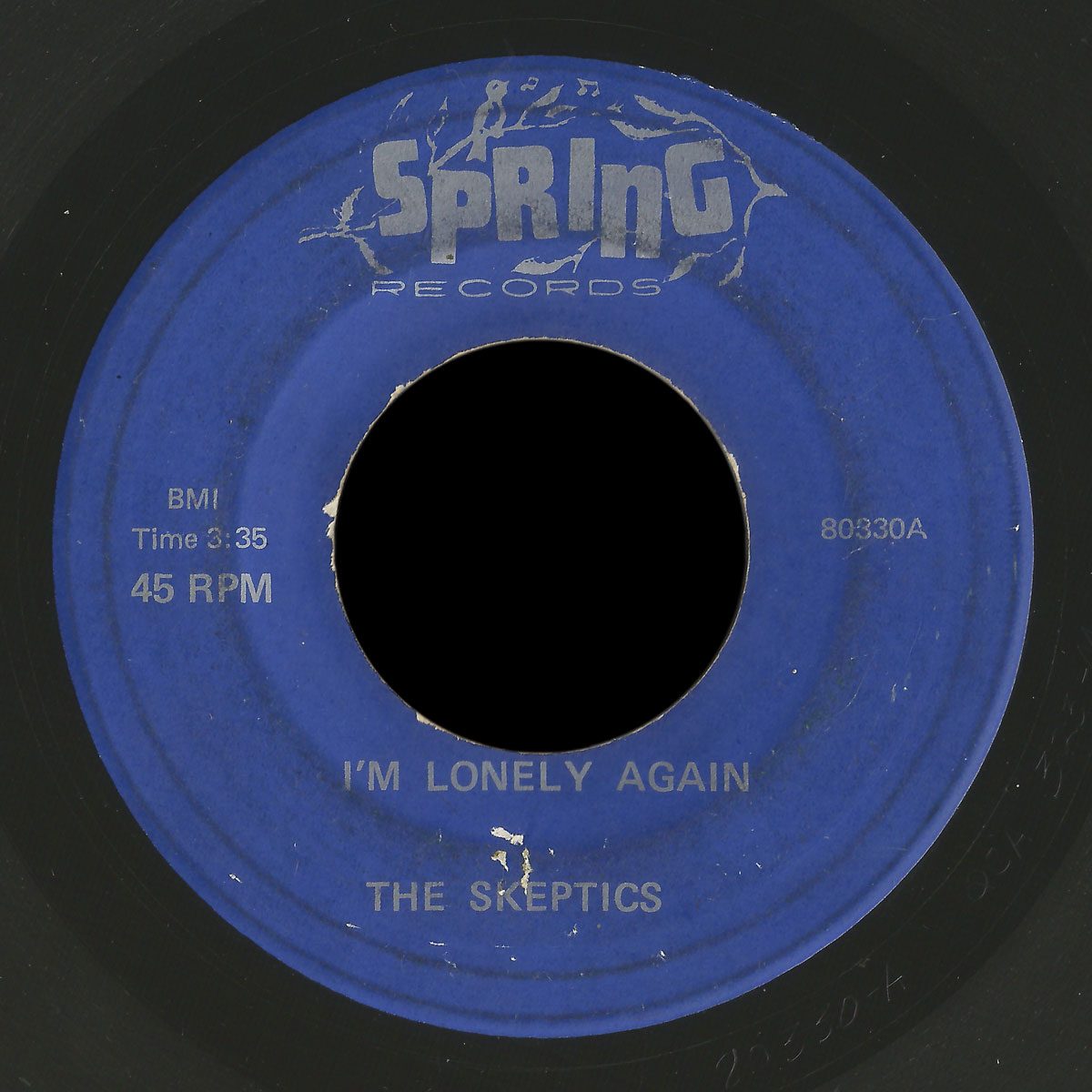
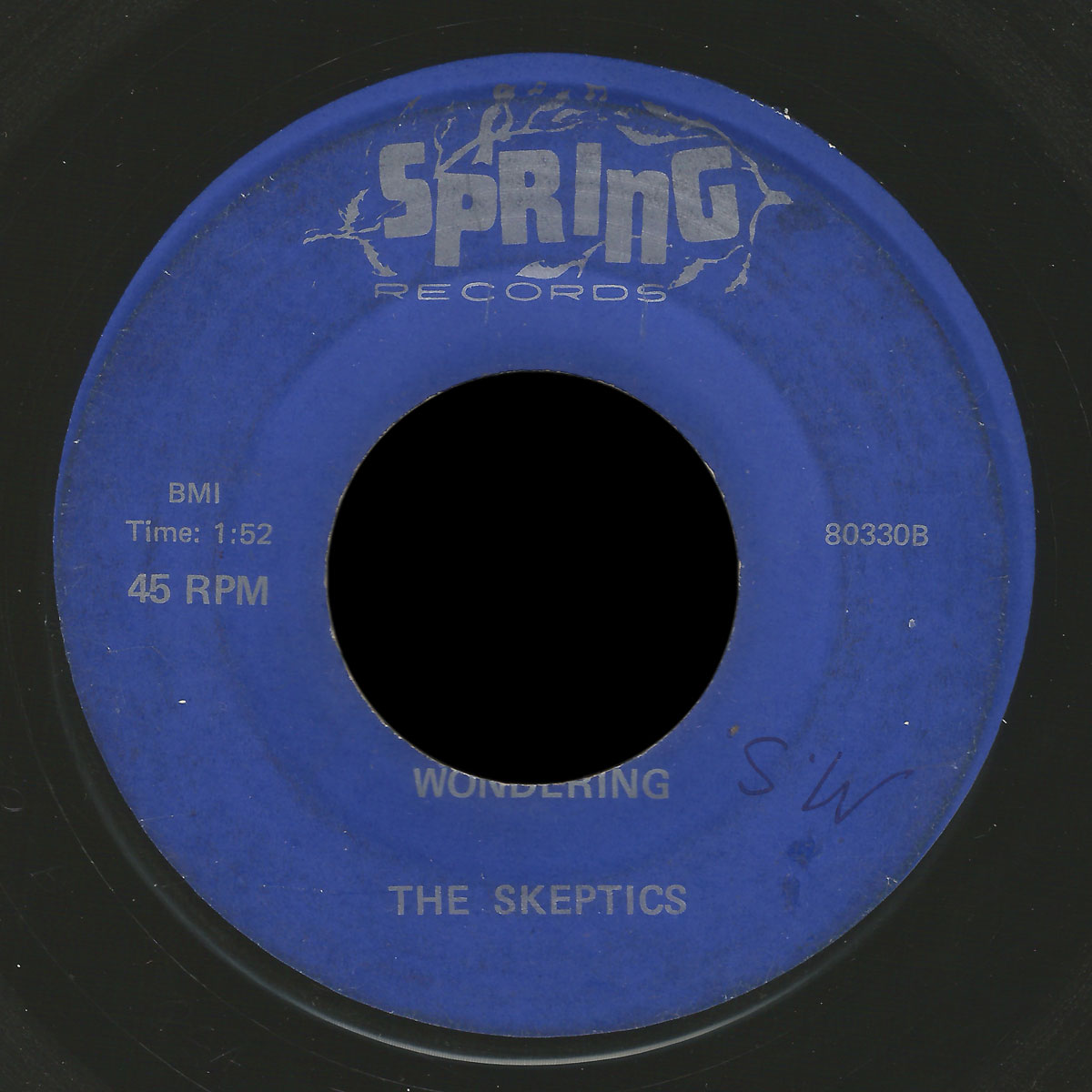
Here’s a great single by the Skeptics, whom I’ve read were from Dayton, Ohio. The urgency and scuzzy burning distortion on the guitar on “Wondering” scream out 1968 to me, a date confirmed by the QCA # 80330, specifically March 1968. The flip is a slow recitative called “I’m Lonely Again” that I find less essential.
This band of Skeptics is not related to the Oklahoma group who cut “Apple Candy”, “Stripes”, and “Turn It On” among other classics.
There’s very little info on the label, even the publishing is limited to simply BMI. No trace seems to exist in BMI’s databases, but I found a Library of Congress copyright record listing Michael Downing (Michael Joseph Downing) and John Hoskins as co-composers of both songs, plus Donald Ray Parrett on “Wondering”, published by Lamar Music in May of 1968. Presumably Downing, Hoskins and Don Parrett were members of the band.
Spring Records was part of O’Brien’s Recording Service in Springfield, Ohio, 24 miles north east of Dayton. There were at least a few releases on the Spring label, but this may be the only one in a rock style. The 45s were pressed at Queen City Albums in Cincinnati.
O’Brien’s Recording Service did register copyrights for a few of song-poem composer Irene Dollar Heffner’s songs, including one, “Vietnam Sweetheart” that was sung by Rodd Keith (under the alias of John Dough). The flip of that was arranged by Jeanne O’Brien.
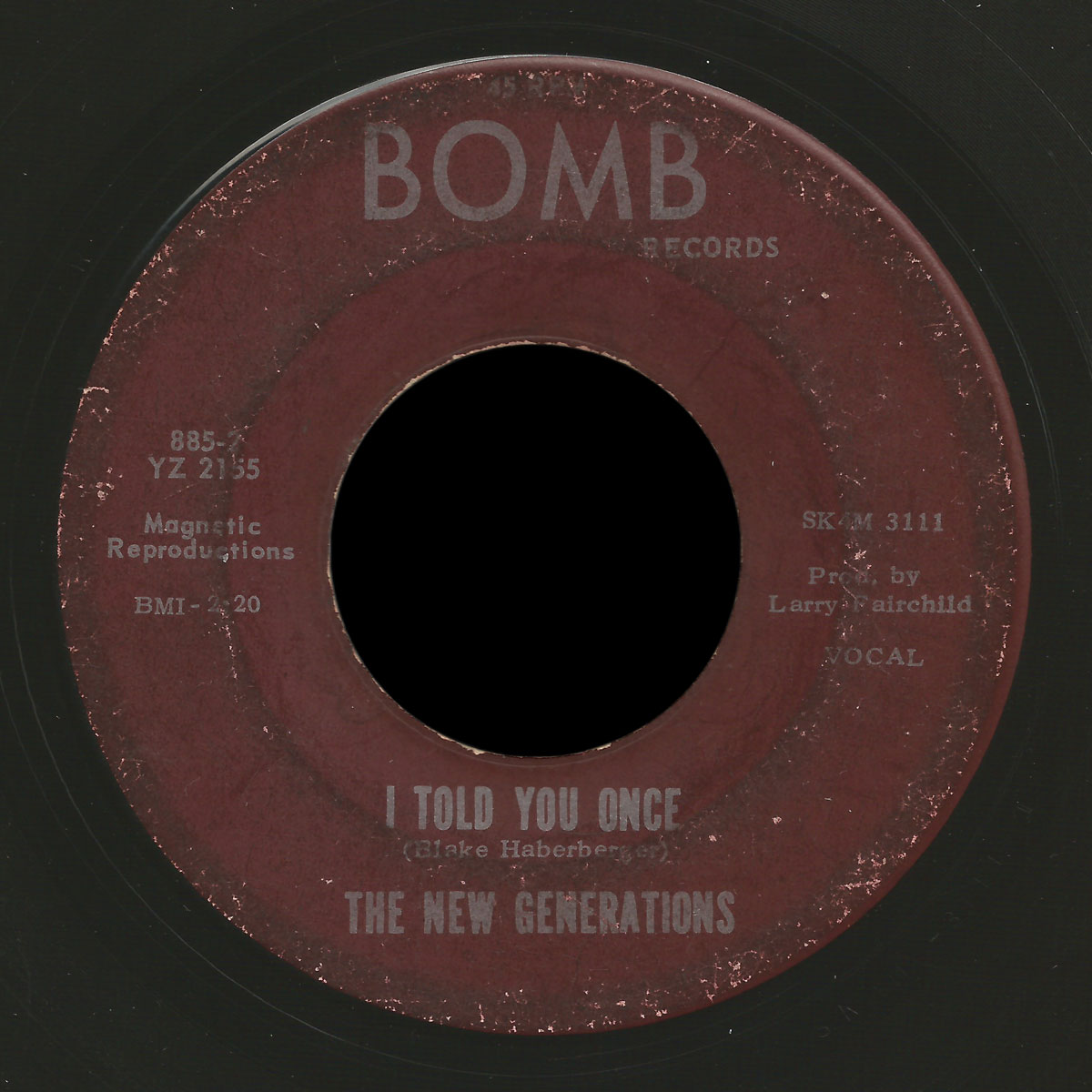
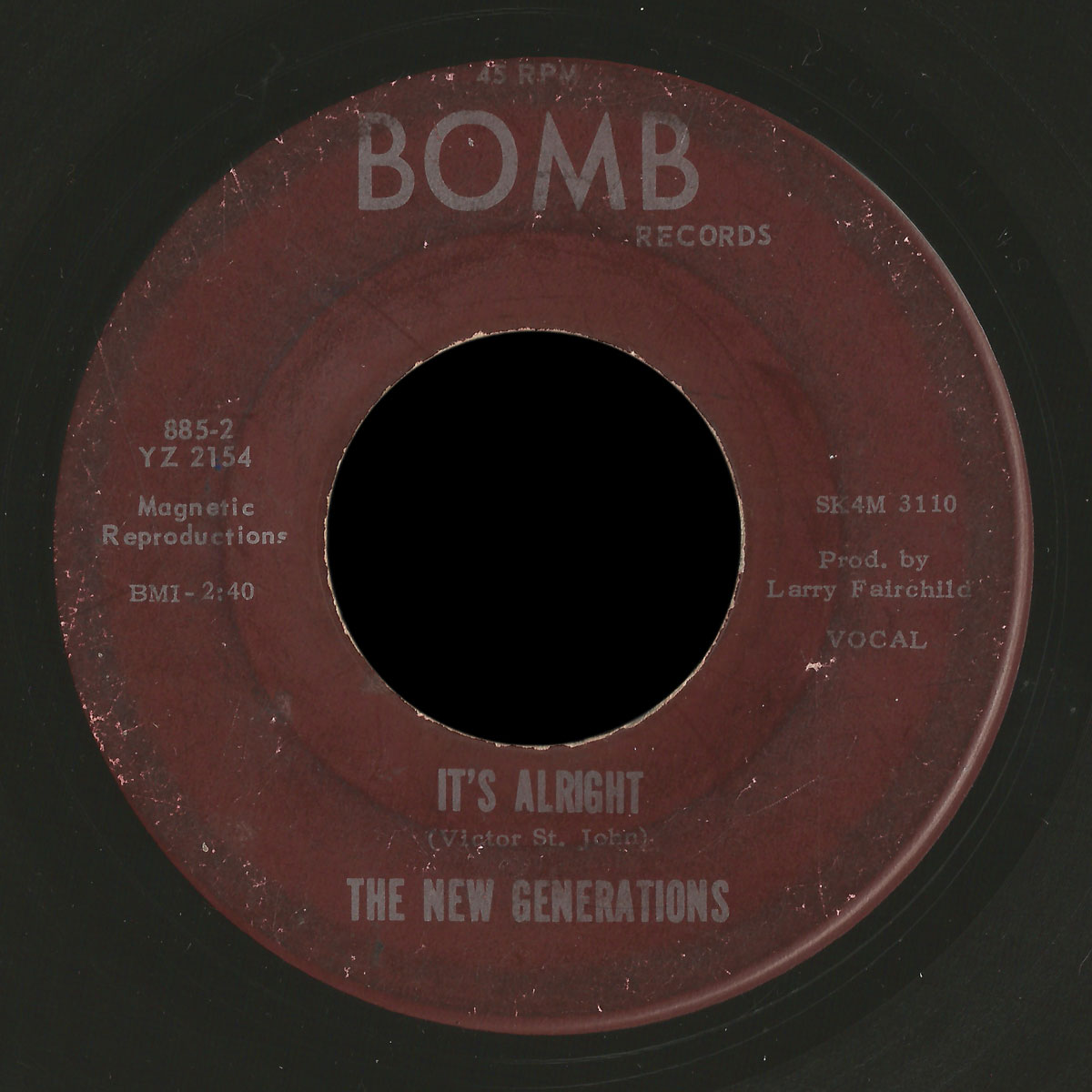
The New Generations came from St Marys, a rural town in NW Pennsylvania. They had one single on the amazingly-named Bomb Records, “It’s Alright” written by Victor St. John b/w “I Told You Once” by Blake Haberberger. Both songs were produced by Larry Fairchild and published by Magnetic Reproductions, BMI
I’m partial to the b-side, “I Told You Once” which has a perfectly moody, low-key atmosphere.
The RCA custom pressing code SK4M 3110/1 indicates the second half of 1965, the labels also have other codes: 885-2, YZ 2154/5 whose meaning I don’t know.
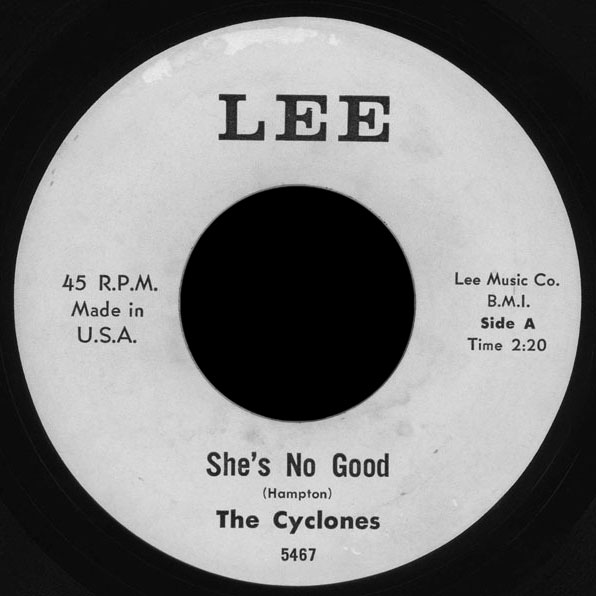
I’ve read two members were with the St. Marys band the Cyclones, who had their own excellent single, “She’s No Good” / “Time for Me to Leave” both written by Hampton for Lee Music BMI in December 1965.
If anyone knows the names of other members of either band, or has a photo of either group, please contact me.
Denny Murphy – lead vocals Terry Murphy – lead guitar, lead vocals Kenneth Sigler – bass John Sebring – rhythm guitar Ronnie Cooper – drums
The great majority of the information in this post is from Andrew Brown’s Brown Paper Sack.
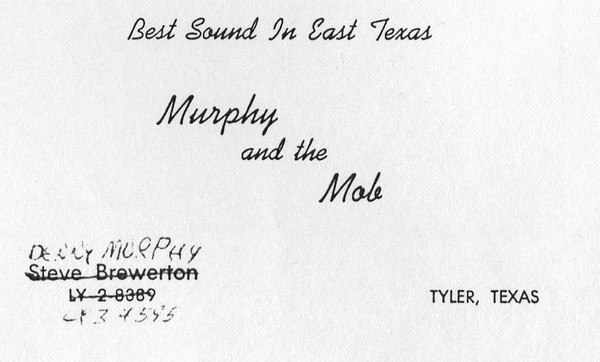
Terry Murphy started playing with school friends when he was in 7th grade in 1964 in Tyler, Texas. The group was dubbed Murphy and the Mob by an adult as a joke but it stuck. A year later Terry found a more serious group of musicians, kept the band name and started practicing regularly in the Murphy family living room.
The group played live at a local teen club called The Plum, at the Bergfeld Park ampitheatre, at the YMCA and at their Catholic high school. At the Bergfeld Park battle of the bands produced by Rodney Kamel, Murphy & the Mob would compete with The Marauders (from Troup, TX), the Hobos from Jacksonville, and the Indifferents from Tyler, featuing Terry’s friend Sam Blanchard. (The Indifferents had a 45 on Valor, “Cindy” / “She’ll Be Back”).
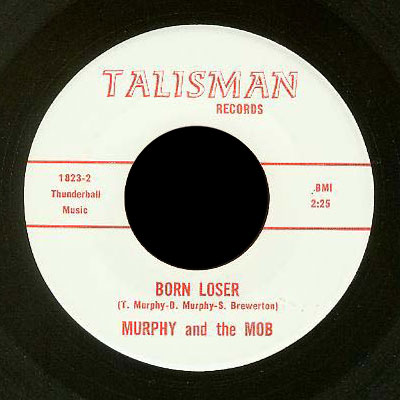
In October 1966, the band went to Steve Wright Studios in Tyler to cut their only single, hoping for some success with “Because You Love Me” an original by Terry and featuring his lead vocal. Funds for the recording came from the father of Terry’s girlfriend, Diane Whitten. For a B-side, the band tried “Born Loser”, a song co-written by Terry, Denny and the group’s manager, Steve Brewerton, who was attending Tyler Junior College that year.
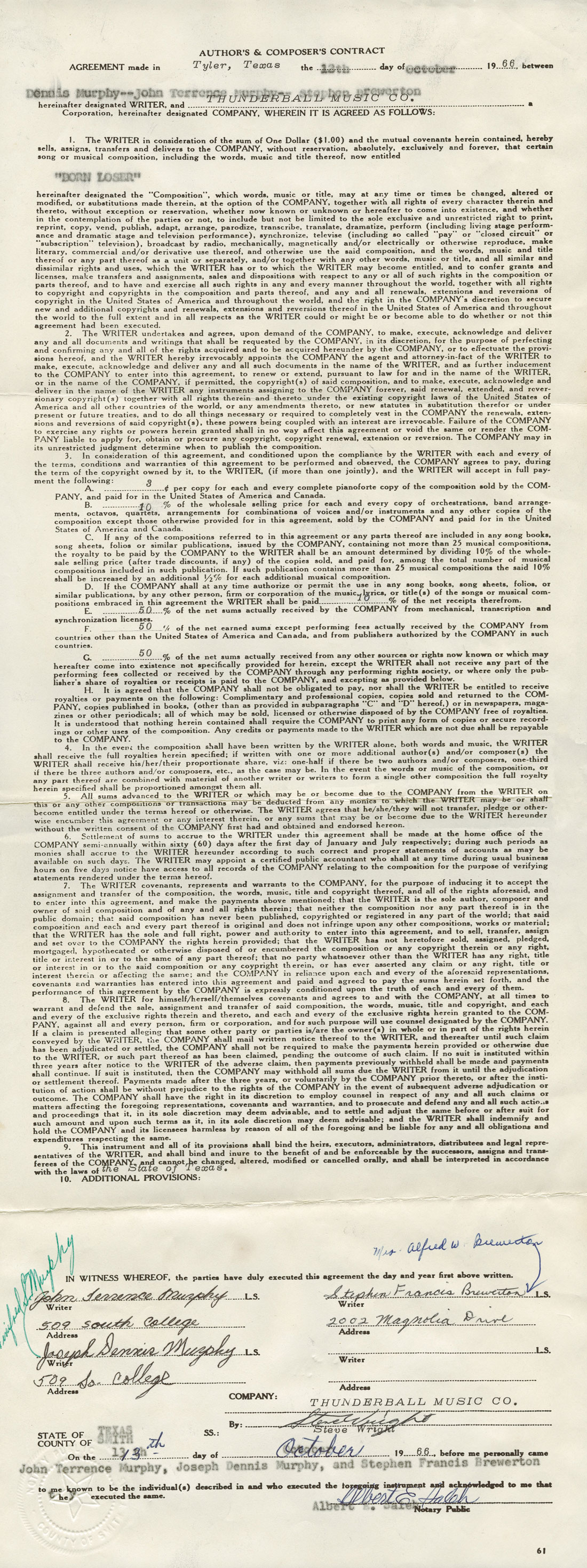
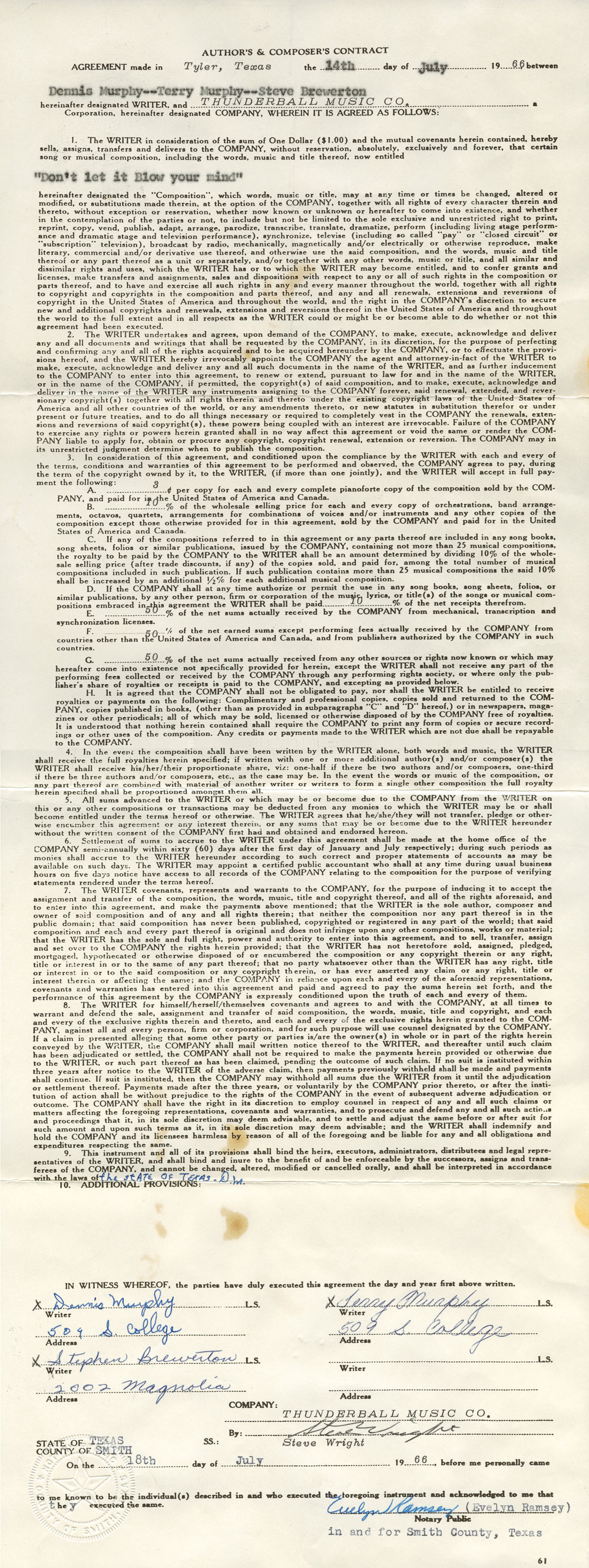
Dennis and Terry Murphy and Steve Brewerton (and their moms!) signed publishing contracts with Steve Wright’s Thunderball Music Co. for “Born Loser” in October 1966. Interestingly the three also signed a contract on July 14, 1966 for an unrecorded song called “Don’t Let It Blow Your Mind”.
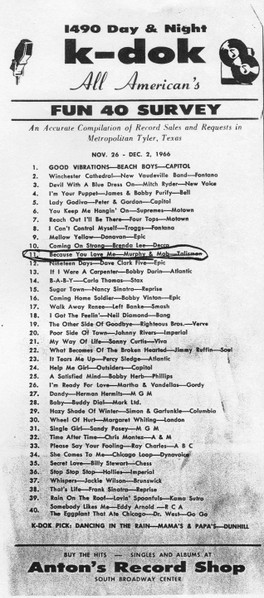
The band pressed 500 copies to be sold at Anton’s Records in the Weingarten Shopping Center, and reached #11 on KDOK’s charts in November 1966. The band continued until the summer of 1967. Terry Murphy stayed in music while Denny Murphy and Ronnie Cooper left music. Sadly, Kenneth Sigler and John Sebring passed away many years ago.
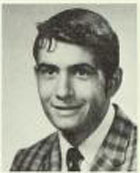
Stephen Brewerton, in the 1966 Tyler Junior College yearbook
I was a nerd going to junior college trying to avoid the draft. I began making fur vest out of old fur coats discarded behind a local high end department store. I began selling these fur vests to rock bands. Some were sold to bands that recorded at Robinhood Bryan’s recording studio and Steve Wright’s recording studio. I met Terry and Dennis Murphy and somehow became their manager. I wrote the lyrics to “Born Loser.” I managed them for two months. After I quit managing them, Terry and Dennis put music to my lyrics and recorded the songs at Steve Wright’s recording studio.
The “A” side made it to the top 10 on KDOK radio station, the local rock station. “Born Loser” made it into the top 40 on KZEY, the local R & B station. After that I joined the Navy and went to war and became an alcoholic. I am a hell of a lot more proud of my small volume of poetry, “Ramblings Of An Alcoholic Mind” than I am the lyrics of “Born Loser.”
Stephen added to Oktay Gürbüz:
I have lost touch with all persons involved in [the] Mob and don’t know where to find them. As I stated before, I am not interested in any MOB projects. I can’t remember even one word of “Born Loser”. Terry and Dennis probably consider this infatuation with Murphy and the Mob as I do as a mere childhood juvenile frivolity.
Thank you to Andrew Brown, Morgan Young, Terry Murphy and Stephen Brewerton, and to Oktay Gürbüz who prodded me to do this article for a long time! Pics of the radio survey and business card from Andrew Brown via Oktay.
I am a loner baby, I swing alone I’ve got my own pad and an unlisted phone A steady job, that’s all I need One pocket to fill, baby, just one mouth to feed
I got no pals, but look who’s got the gals They come to my pad because they want me so bad I sleep all day and I swing all night I’m so cool, baby, I’m just out of sight
(spoken) All these people. I mean, people they just don’t understand. They see me coming, they shake their head and say, “Look at him. He’s the born loser. Well, look at him. Born loser.” All right.
– Born Loser by Murphy, Murphy and Brewerton
Murphy and the Mob and Thunderball Music contract for “Born Loser”, courtesy of Stephen Brewerton
Murphy and the Mob and Thunderball Music contract for “Don’t Let It Blow Your Mind”, courtesy of Stephen Brewerton
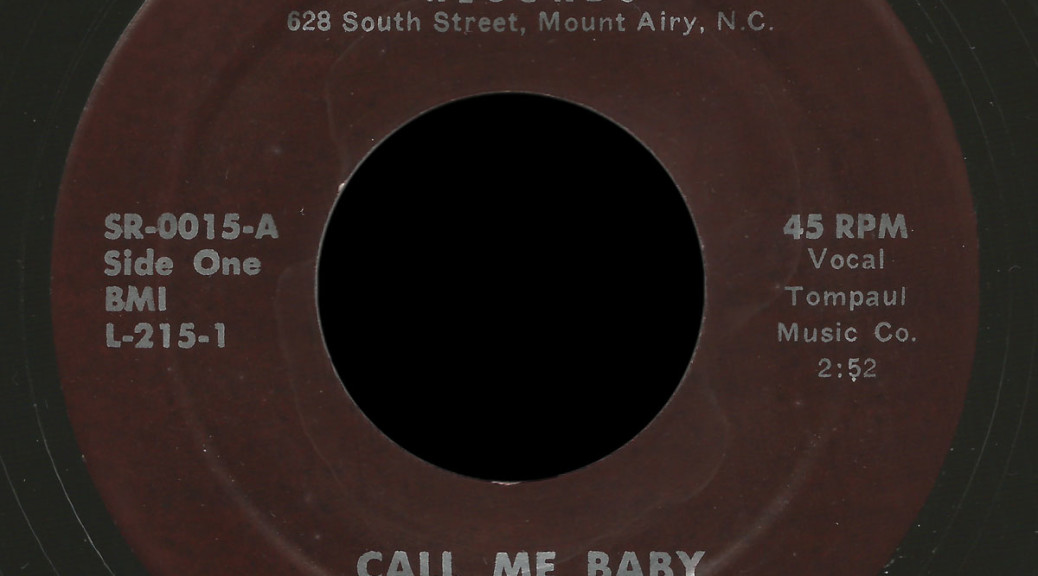
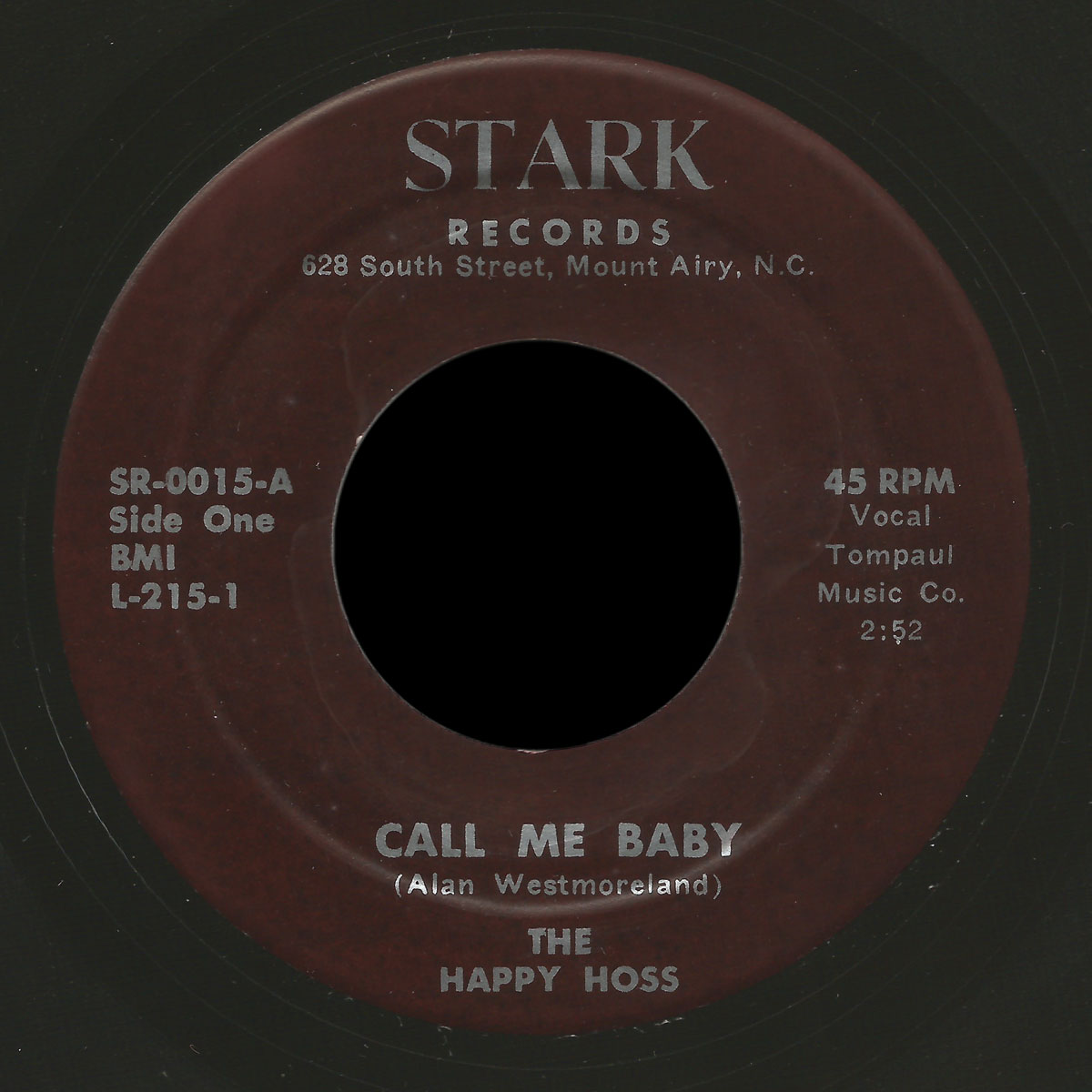
Stark Records in Mount Airy, North Carolina is famous for the single by the Nomads, “Not For Me” / “How Many Times” as well as a good rockabilly 45 by David Southerland and the Southerns. This is a soulful and very crude single by the Happy Hoss, which seems to be a pseudonym for song writer Alan Westmoreland.
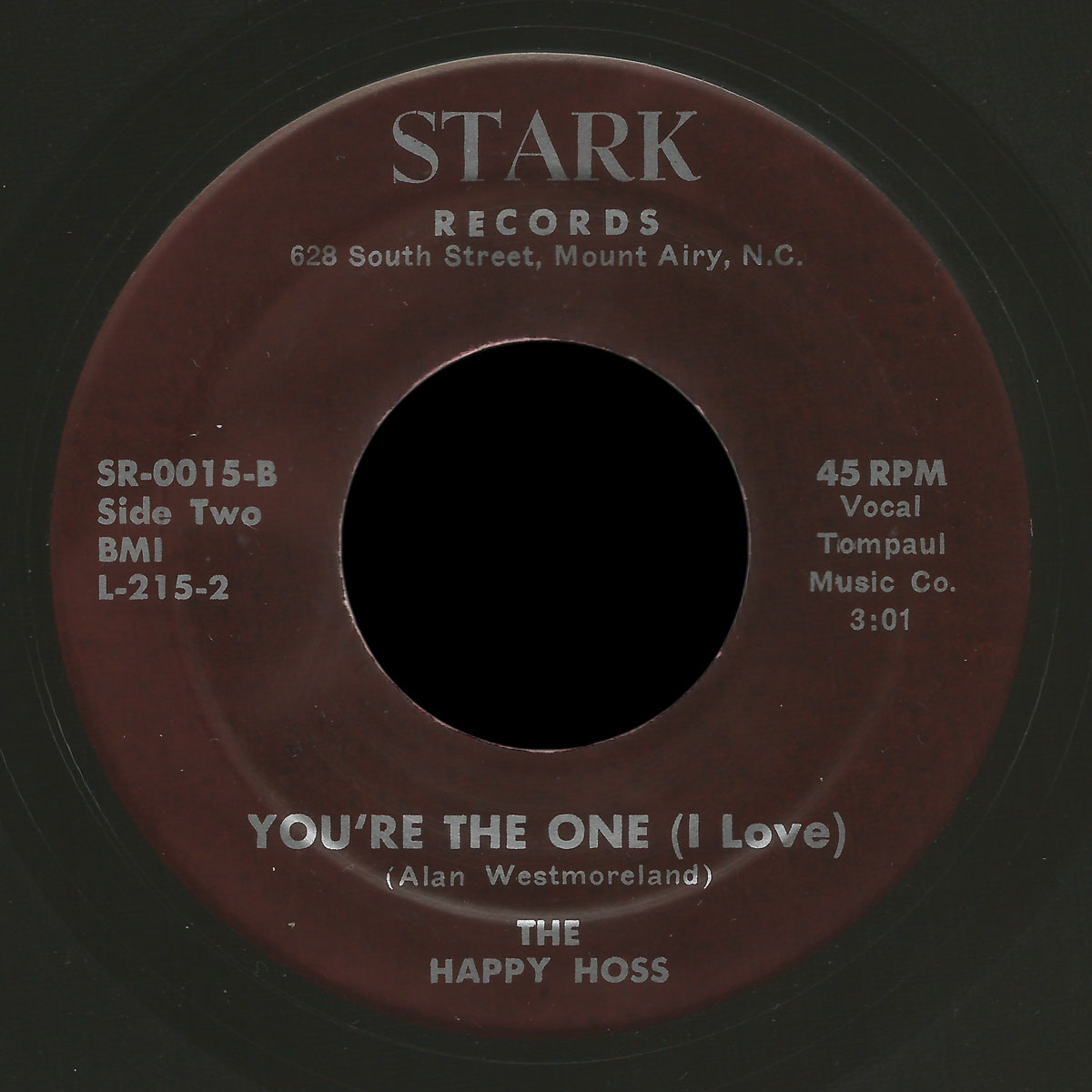
The top side is “Call Me Baby”, the vocalist shouting out the repetitive lyrics in a hoarse voice (ha ha) answered by high-pitched backing vocals. The flip “You’re The One (I Love)” is a ballad with saxophone.
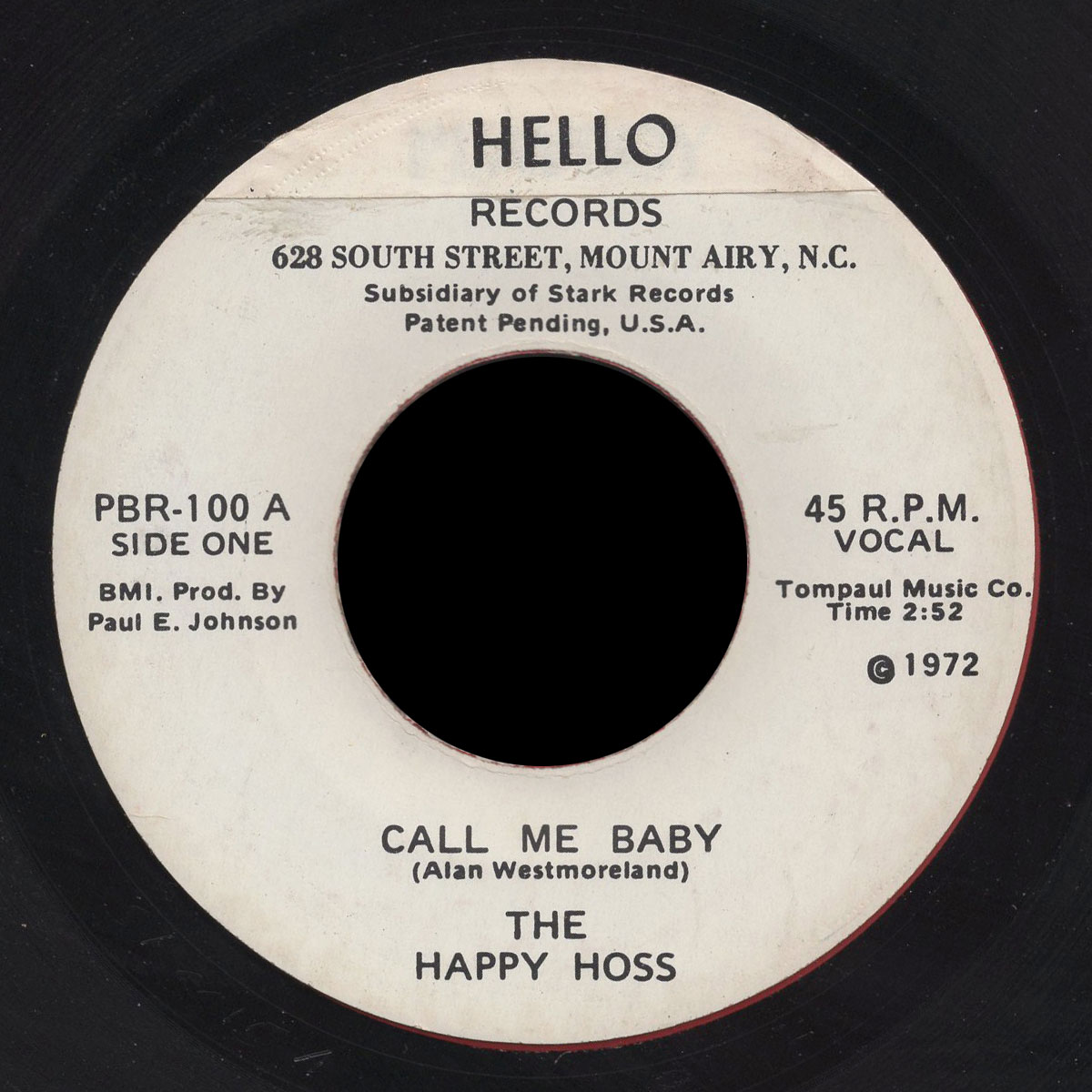
Released circa 1967, it seems to have been repressed in 1972. I have a copy with white labels pasted over what appear to be maroon Stark labels. Most of the info is identical, except a 1972 date and “Prod. by Paul E. Johnson” have been added, and the release number changed to PBR-100. The second label had been pasted over again, so it reads “HELLO RECORDS”! The shape of the vinyl under the labels is different from the 1967 dark maroon label version.
It appears that Stark revived the label in 1972, intending to call it Playboy Records, as a copy has turned up with white Playboy Records labels of the Four Souls “Freedom Bound” / “Louise”, except the catalog number on the labels is SR-0016. Perhaps under a cease-and-desist threat from Playboy Magazine, whose Playboy Records was going through its own expansion in 1972, Stark thought better of the new label name. This would explain the “Hello Records” coverup, and the return to the Stark Records label name for the rest of its existence.
White labels are pasted over what look to be maroon Stark labels, then “HELLO” pasted over the label name!Mount Airy is a small town very close to the Virginia border, 37 miles northwest of Winston-Salem. Stark Records had at least fourteen singles and a couple albums. The label seems to have been run by Thomas Paul Stark, as every release has Tom Paul Music Co. BMI in the publishing.
The Nomads single is their first, and they recalled the studio being in a basement when they cut their 45 and demos. Their next 45 “Thoughts of a Madman” / “From Zero Down” was released on the Tornado Records label (Tornado 159 in April of 1967), which also featured a release by Joe Stone and Bobby Atkins (Tornado T-136, “Mister Bluegrass”) who have a 45 on Stark. Tornado Records was similarly dominated by country releases.
Stark Records Discography(any help with this would be appreciated):
Stark S-001 – Cara Stewart with Lee Hudson Orchestra – “My Darling” / “Be Sure That You Mean It” (both by Jerry Thomas, W-300/W-301) Stark SR-002 – Joe Stone and Bobby Atkins & the Dixie Mountaineers – “Love Is A Lot To Understand” / “Bob’s Special” Stark SR-003 – Bobby Atkins & the Farm Hands – “Lonesome Banjo” / “My Darling And Me” Stark SR-004 – The Country Cousins – “Wrong Side Of Town” / “Bought Me A Farm” Stark SR-005 – David Sutherland and the Southerns – “You Better Leave My Baby Alone” (Sutherland) / “Whispering Bill” (“A Product of Pilot Record Co.”) Stark SR-006 – Randy Scott – “If Seeing Is Believing” (David Sutherland) / “You’ve Lost Too Much” Stark SR-006 EP – Siney Ann Wooten – “Darling You Don’t Love Me Anymore” (Paul Johnson, Johnny Long) / “Crazy Mixed Up Town” (David Sutherland) I believe the A-side of the EP repeats the two songs from the Randy Scott SR-006 single, but I need confirmation of that. Stark SR-007 – Randy Scott – “So Welcome to the Club” / “Back Up Troubles” Stark SR-008 – Bob Hastings – “Crazy Mixed Up Town” (David Sutherland) / “Two Kings and One Kingdom” (Johnny Long) Stark SR-009 – The Nomads – “How Many Times” / “Not For Me” (Bruce Evans, Larry Deatherage, Tom Paul Music Co. BMI, July 1966) Stark SR-0010 – Intellectuals Combo – “Our True Love” / “That Ain’t Nice” (instrumental, written by Mike Dee Love) Stark SR-0011 – Siney Ann – “I’m So Lonesome (I Could Cry)” / “I Can’t Help It (If I’m Still In Love With You)” Stark SR-0012 – Jimmy and Wesley and the Twin County Pardners – “Make Me A Pallet On The Floor” / “The World Is Still Waiting For The Sunrise” (Jimmy Arnold and Wesley Golden) Stark SR-0013 – Hank Riley – “Record Of Heartbreak” / “Consolated Egotated Love” Stark SR-0014 – Deep Valley Boys – “Please Don’t Honey, Please” / “Some Dark Hollow” Stark SR-0015 – The Happy Hoss – “Call Me Baby” / “You’re The One (I Love)” both by Alan Westmoreland, Tompaul Music Co. Stark SR-0016 – Four Souls – “Freedom Bound” / “Louise” (both by Paul Cain, Dennis Inman) Stark SR-0017 – Tony Zito – “Hide Away Moments in Prayer” / ? Stark SR-0018 – Bobby Atkins – “Memories Of President John F. Kennedy” (Paul Johnson) / “Love Valley” (1968, recorded by Lookabill’s Studio, Greensboro) Stark SR-0019 – Don Sawyers and the Grangers – “My Favorite Way to Cry” (Larry D. Alderman – Don Sawyers, vocal by Larry D. Alderman and Don Sawyers) / “Imagination Trapped Within My Mind” (Don Sawyers, vocal by Don Sawyers) 1970 Stark SR-0020 – Carl P. Tolbert – “Liquor By the Drink” / “Changing of the Time” (1974) Stark 100 – Pete Holden & the Baux Mountain Boys – “Truck Driver’s Vow” / “Legend Of Charlie Monroe”
LPs:
Stark SR-200-1 – Easter Brothers & the Green Valley Quartet – Bluegrass & Country Hymns (1967) Stark SR-0001 – The Carolina Gospel Singers (1969)
Most of Stark’s output was country music, but as Bob pointed out in a comment below, the first release on Stark seems to be a lush arrangement of song-poems: see The Wonderful and the Obscure for more info. This single has light blue labels and a 1301 Park Drive address.
Other early singles have deep red labels and give the address as 1312 Summit Drive, Mt. Airy, North Carolina. Later ones read 628 South Street, Mount Airy, N.C. Later singles were produced by Paul Johnson.
Max Waller writes: “The Intellectuals had at least one further 45, “I Don’t Want To Cry” (as Mike Watson & the Intellectuals) / Danny Boy (as Glenn Wall & the Intellectuals) on M.K.B. 120 from Jan 1968 (SO 4898)”. MKB Recording was located in Tobaccoville, NC, just northwest of Winston-Salem.
Thank you to Max Waller, Lightnin’ Wells and Franz Kunst for help with this discography. Thank you also to Mike Fouts for sending me (in 2026) the photos of the Four Souls release with Playboy Records labels. I’ve updated the article with this new information, but haven’t revised the old discography.
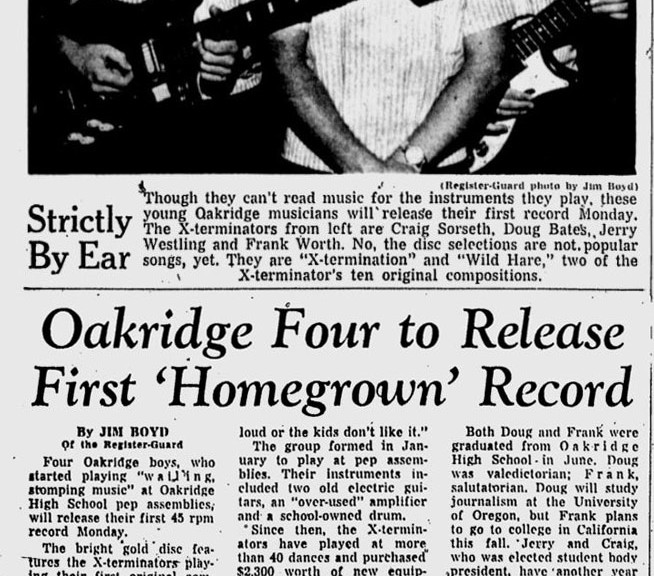
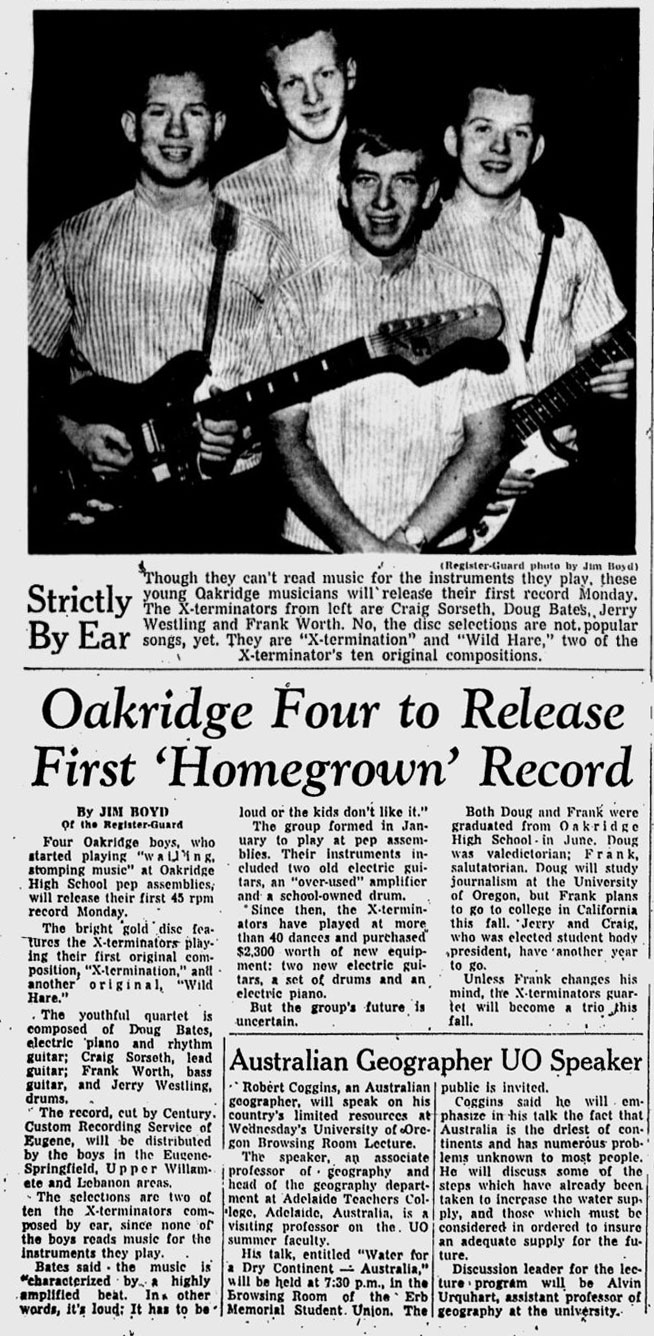
The X-Terminators came from Oakridge, Oregon, a small town about 40 miles southeast of Eugene, OR. I don’t have this 45 yet (if anyone has a copy please write to me) but came across this article and thought I’d write about the band.
Members were:
Craig Sorseth – lead guitar Doug Bates – rhythm guitar, electric piano Frank Worth – bass guitar Jerry Westling – drums
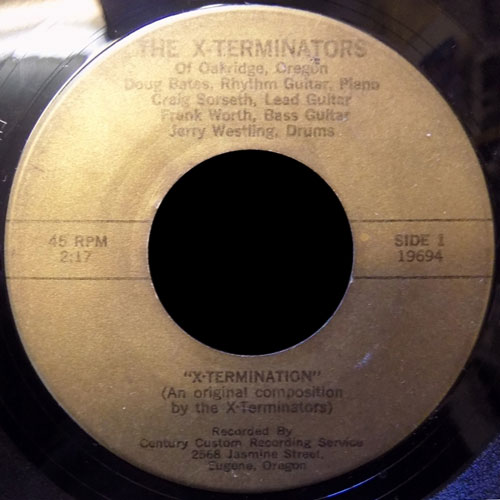
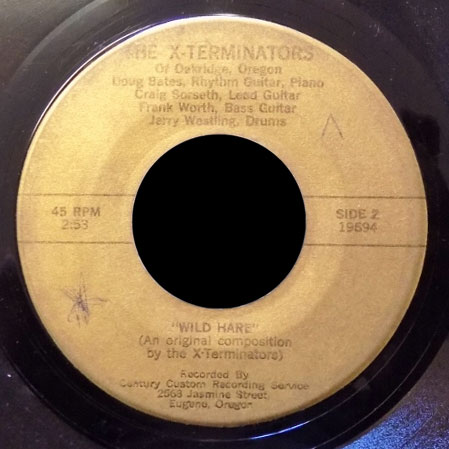
The group formed in high school in January 1964. About six months later they went to Century Custom Recording Service in Eugene and cut two great original instrumentals, “X-Termination” and “Wild Hare” You can find both on Youtube, but for some reason slowed down by roughly 10%.
An article in the Register-Guard from July 1964 says “the selections are two of ten [original songs] the X-terminators composed by ear, since none of the boys read music for the instruments they play.”
With two of the members going to college in the fall, it’s unlikely the band stayed together much longer.
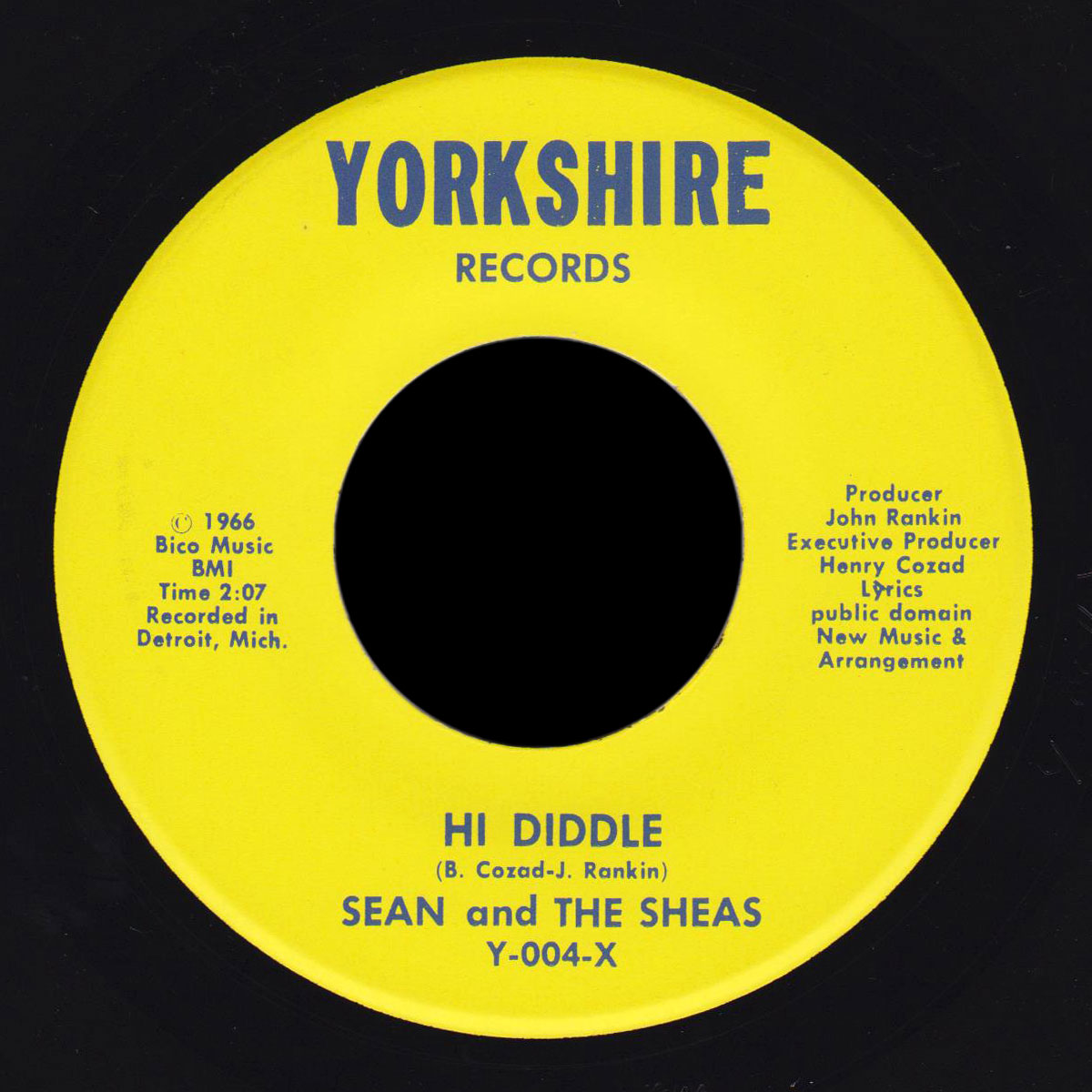
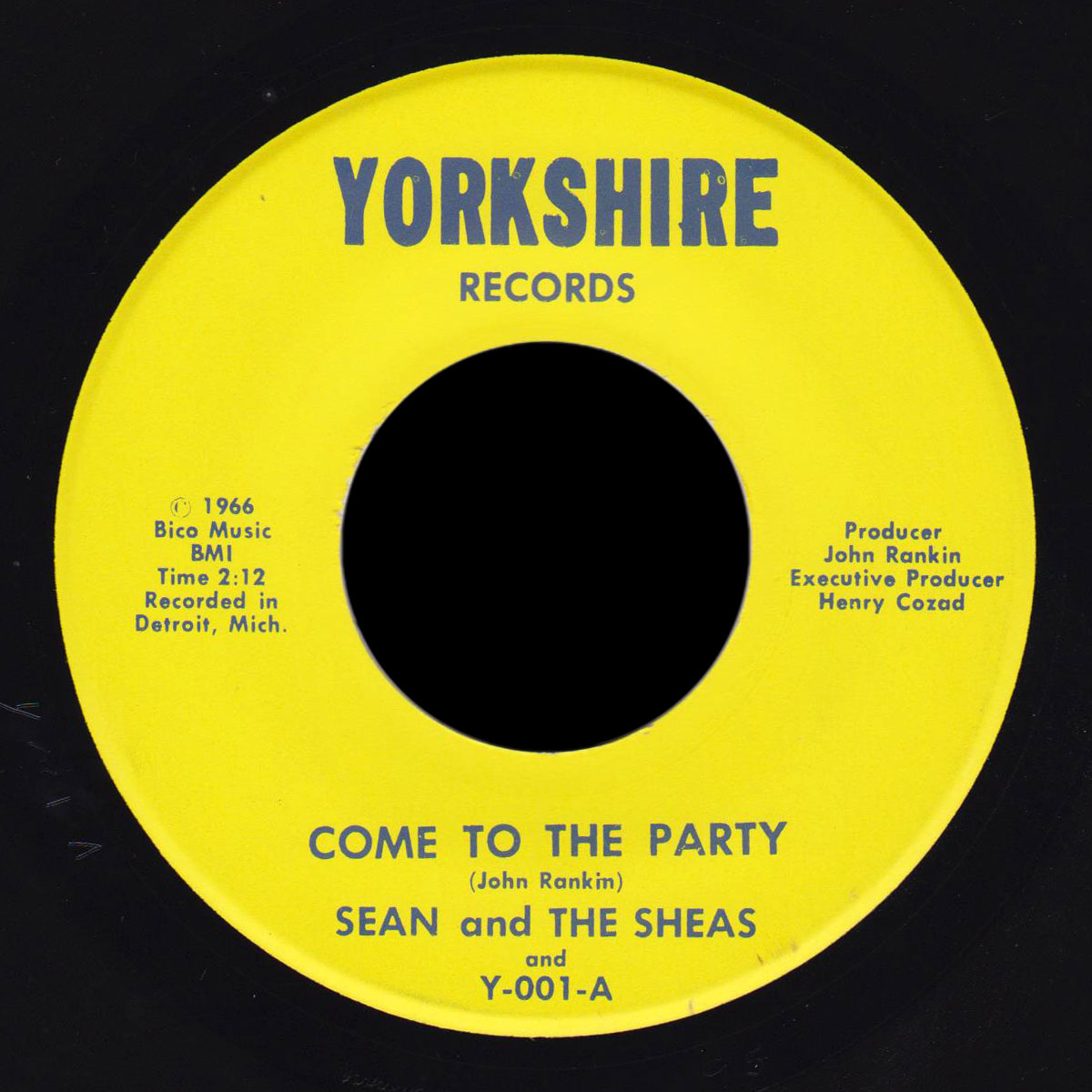
Joe Rodie sent the excellent scans seen here of rare singles by an unknown Detroit area band, Sean and the Sheas, who released two 45s in 1966. Joe is looking for information on the group, but unfortunately I couldn’t provide any yet.
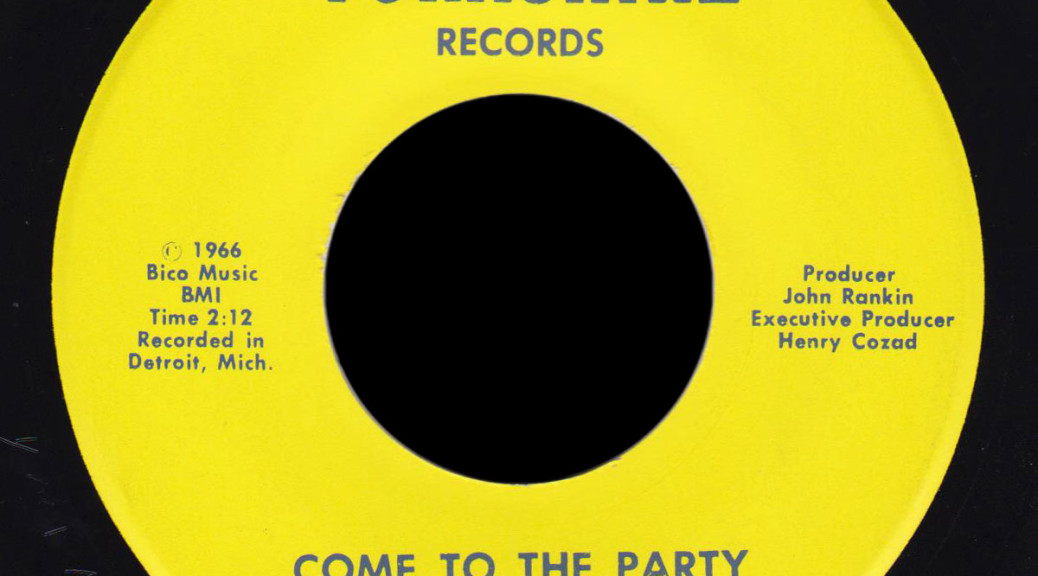
Sean and the Sheas first release is the upbeat soul-influenced “Come to the Party” backed with an adaption of the nursery rhyme, “Hi Diddle”.
This was Yorkshire Y-001-A/Y-001-X, with “Come to the Party” written by John Rankin and “Hi Diddle” credited to B. Cozad – J. Rankin. The writers must have been aware a new arrangement of a traditional song could be copyrighted. The label reads recorded in Detroit, Mich., but I don’t know which studio. The producer was John Rankin, and executive producer Henry Cozad.
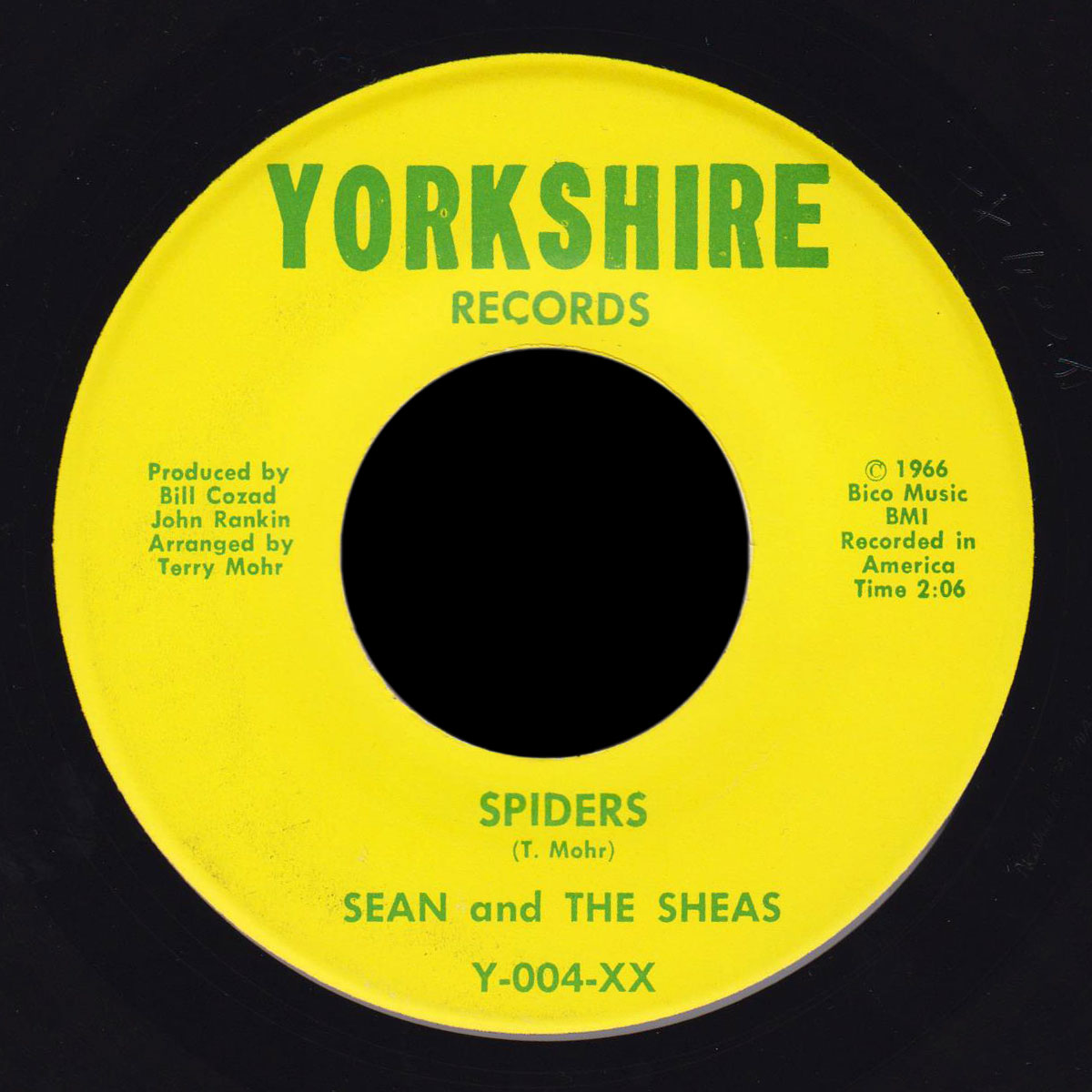
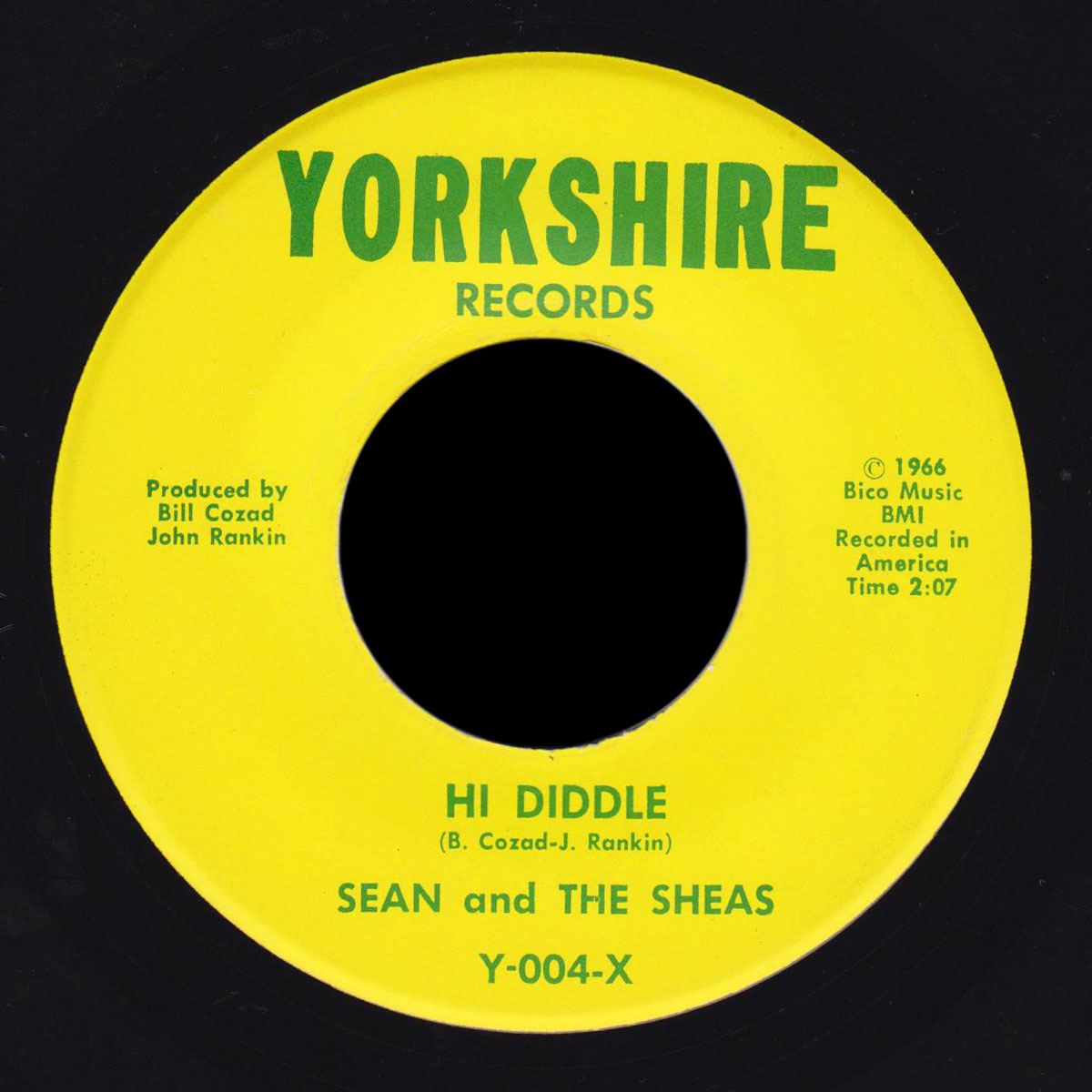
second release of “Hi Diddle”For the second single, “Hi Diddle” repeated this time as Yorkshire Y-004-X while “Spiders” which I haven’t heard is listed as Yorkshire Y-004-XX. Terry Mohr wrote “Spiders” and he also appears as arranger on this 45, produced by Bill Cozad and John Rankin and this time oddly “Recorded in America”.
All songs published by Bico Music BMI, 1966.
The 45s have Nashville Matrix stamps and “95” etched into them. The “95” means they were pressed by Norman Archer at Archer Record Pressing, at 7401 E. Davidson in Detroit, as that was his account number at Matrix of Nashville. Archer handled many smaller Detroit labels, so despite the resemblance to the font used for Wheel’s 4 Records, Yorkshire was probably an unrelated label. There were several Yorkshire Records labels around the country at the time, but I can’t find any other release by this Detroit company.
With all the names on these singles I would think there would be some information on the group out there, but I can’t find any yet.
Thank you to Joe Rodie for the scans and motivating me to write about this group.
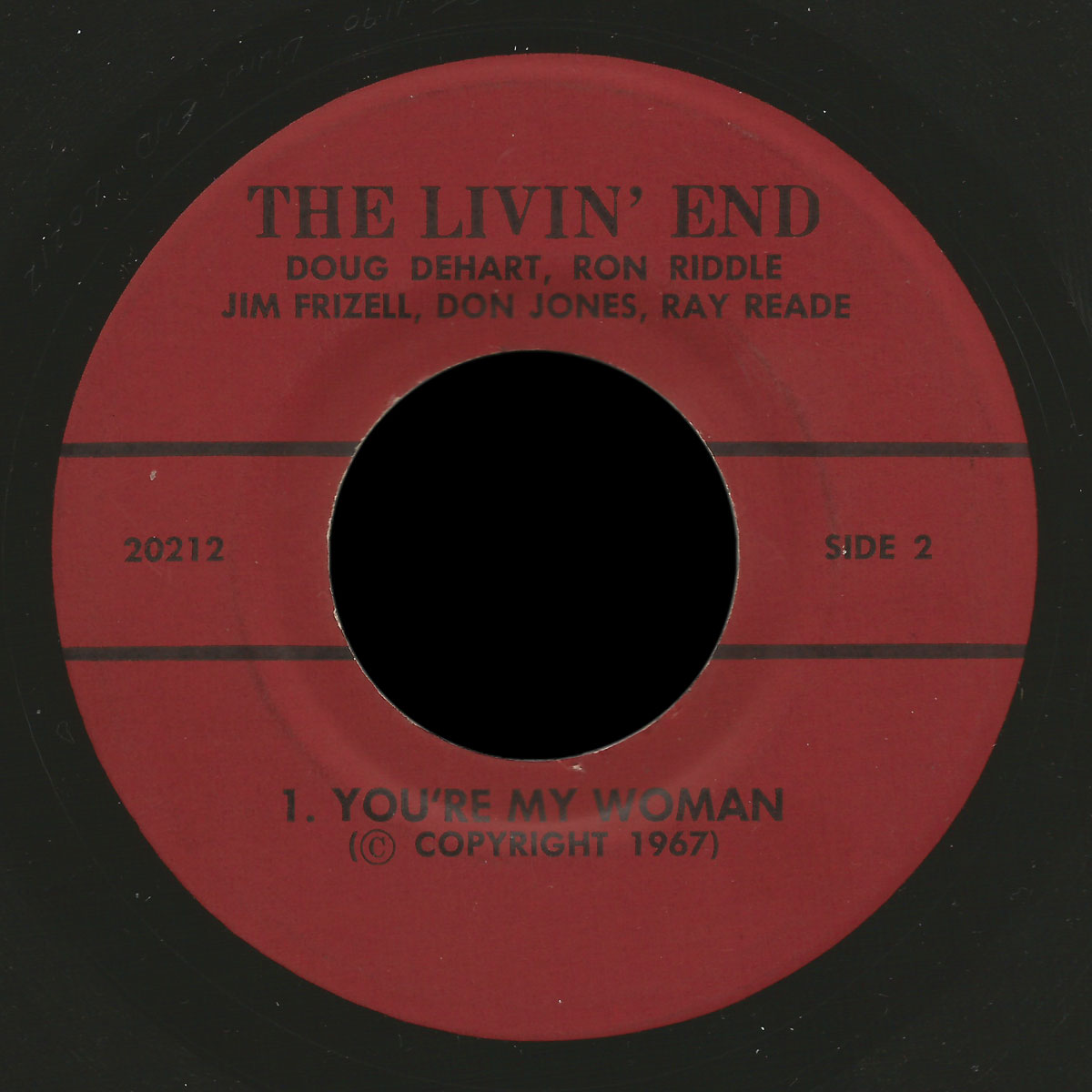
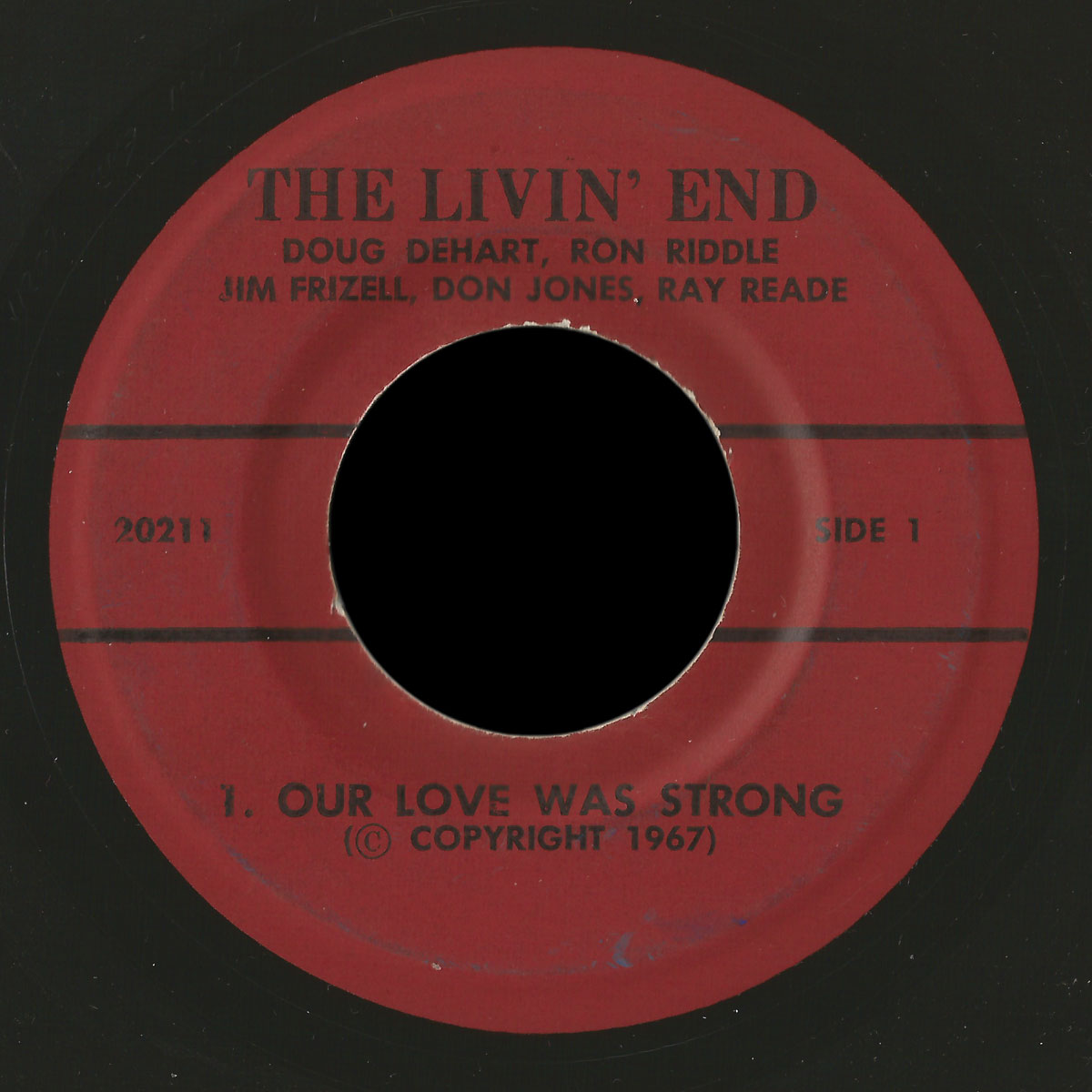
Despite the band members’ names on the label, this group is still something of a mystery. Members were Doug Dehart, Ron Riddle, Jim Frizell, Don Jones, and Ray Reade.
“You’re My Woman” has a murky, dirty sound to the rhythm guitar that flashes throughout the song. It has a dim, psychedelic aura from the last days of 1967. The flip side, “Our Love Was Strong” is a strange number alternating long harmony aahs with a plain, almost recited vocal.
The Buckeye Beat site states it was recorded at Commercial Recorders in Dayton, Ohio. This is a Rite pressing, with account # 1190 in the dead wax of both sides.
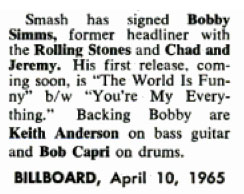
Bobby Simms was born Robert Siemiaskzo. While still in high school in 1961 he joined the Mus-Twangs as lead vocalist. The Mus-Twangs were based out of Harvey, Illinois, about 20 miles south of central Chicago and just west of Hammond, Indiana. The Mus-Twangs had two instrumental singles on Smash, including the very first single ever released by that label, “Marie” / “Roch Lomond”.
Simms left the Mustangs in 1962 and started the Bobby Simms Trio with Mus-Twangs bassist Keith Anderson, recording a good Mersey-influenced single in 1964 on New Breed “And Your Mine” / “Do Things Right” featuring the drumming and harmonica of Verne Johnson (later of Illinois Speed Press).
In 1965 Simms had his own single on Smash, “The World Is Funny” / “You’re My Everything” which I haven’t heard yet.
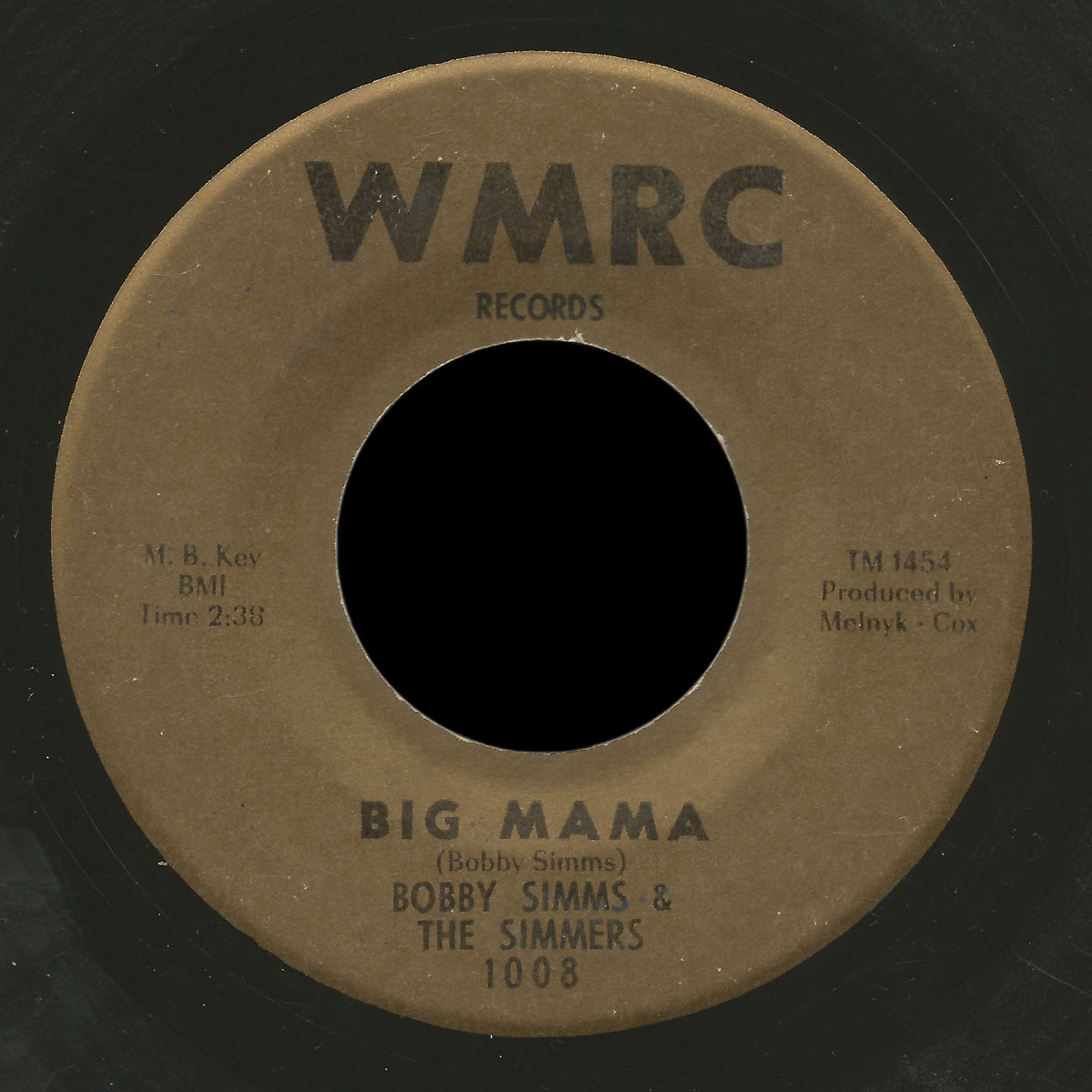
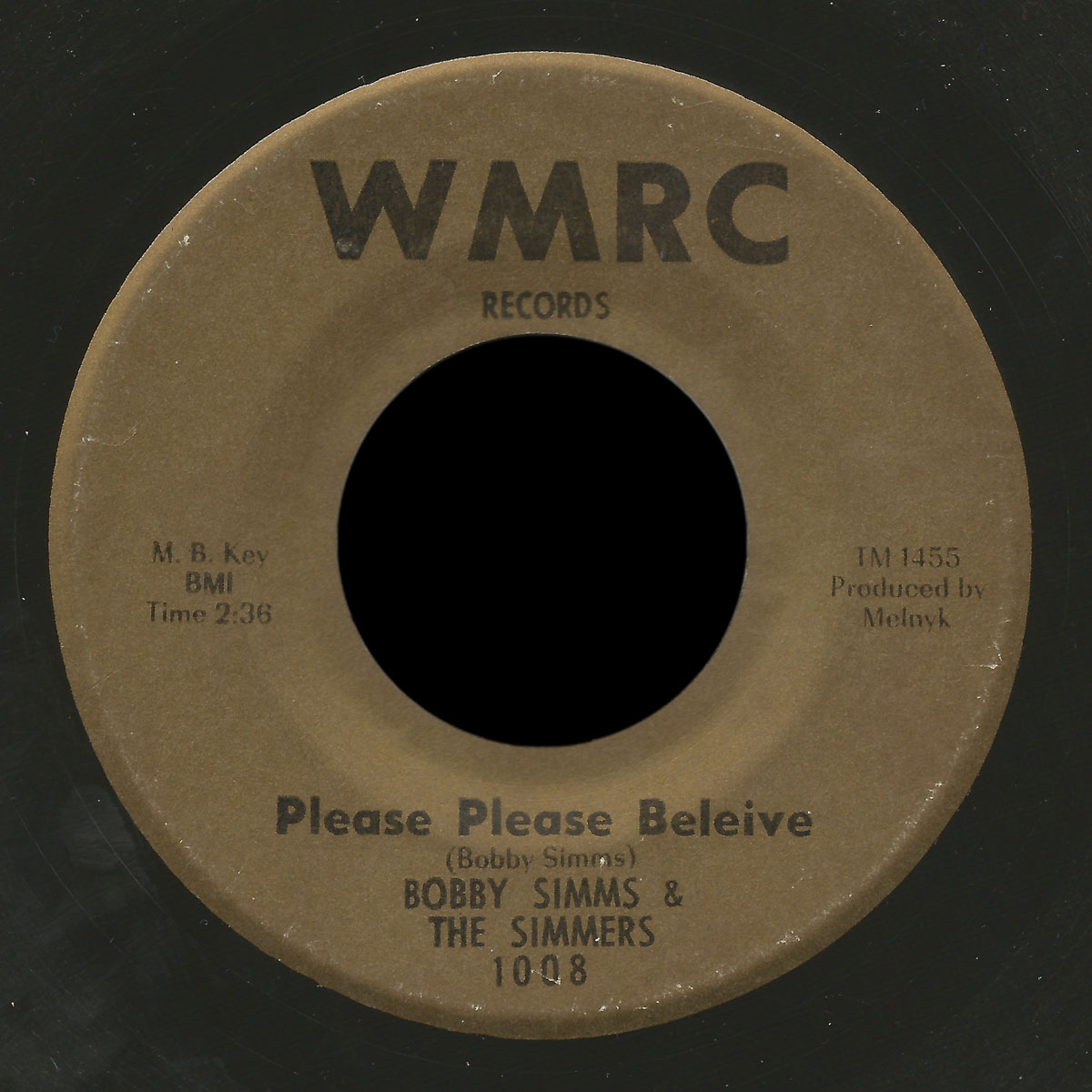
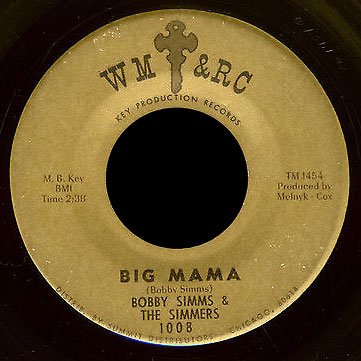
The following year he released a 45 as Bobby Simms and the Simmers, featuring two of his original songs, the raucous “Big Mama” backed with a much gentler harmony sound in “Please Please Believe”.
This seems to be the only release on WM & RC Records, though there were two different labels, one featuring a key and distribution by Summit. WM standing for Walter Melnyk, the manager of Simms and owner of the M.B. Club in the Burnside neighborhood of Chicago. The “C” in RC stands for Cox, co-producer of the sinle with Melnyk. Publishing was by M.B. Key BMI.
Musicians on the Simmers single included Keith Anderson and Verne Johnson from the Trio, plus guitarist Paul Cotton from the Mus-Twangs.
In 1967 Simms became one of the founding members of the Rotary Connection. Keith Anderson and Paul Cotton formed the Rovin’ Kind, which evolved into Illinois Speed Press.
I’m sorry to report that while researching this post I saw a comment from Keith Anderson that Bobby Simms passed away on May 29, 2015.
Information for this post came from Paul Cotton’s excellent site, especially this page on Bobby Simms.
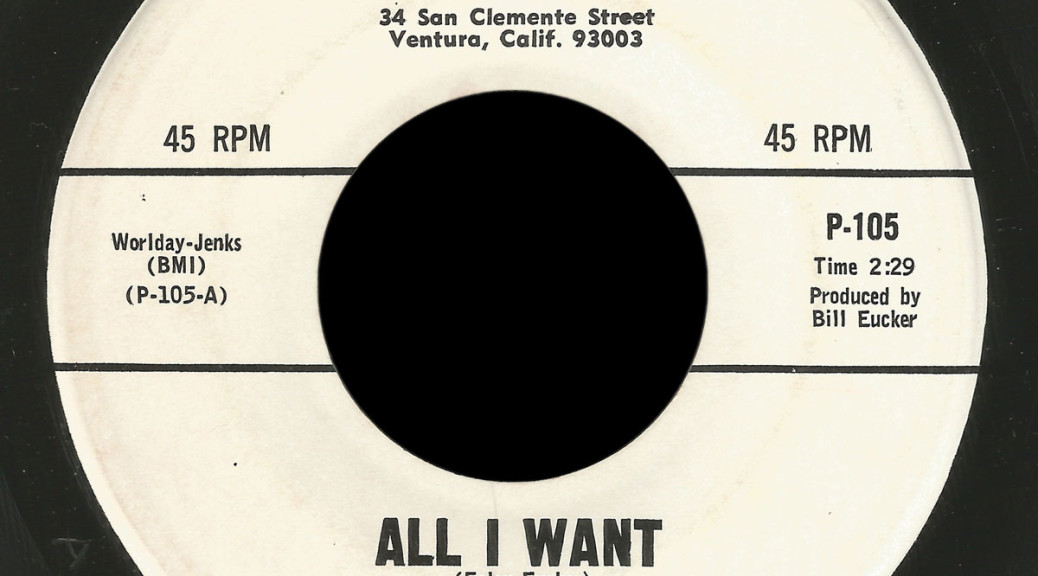
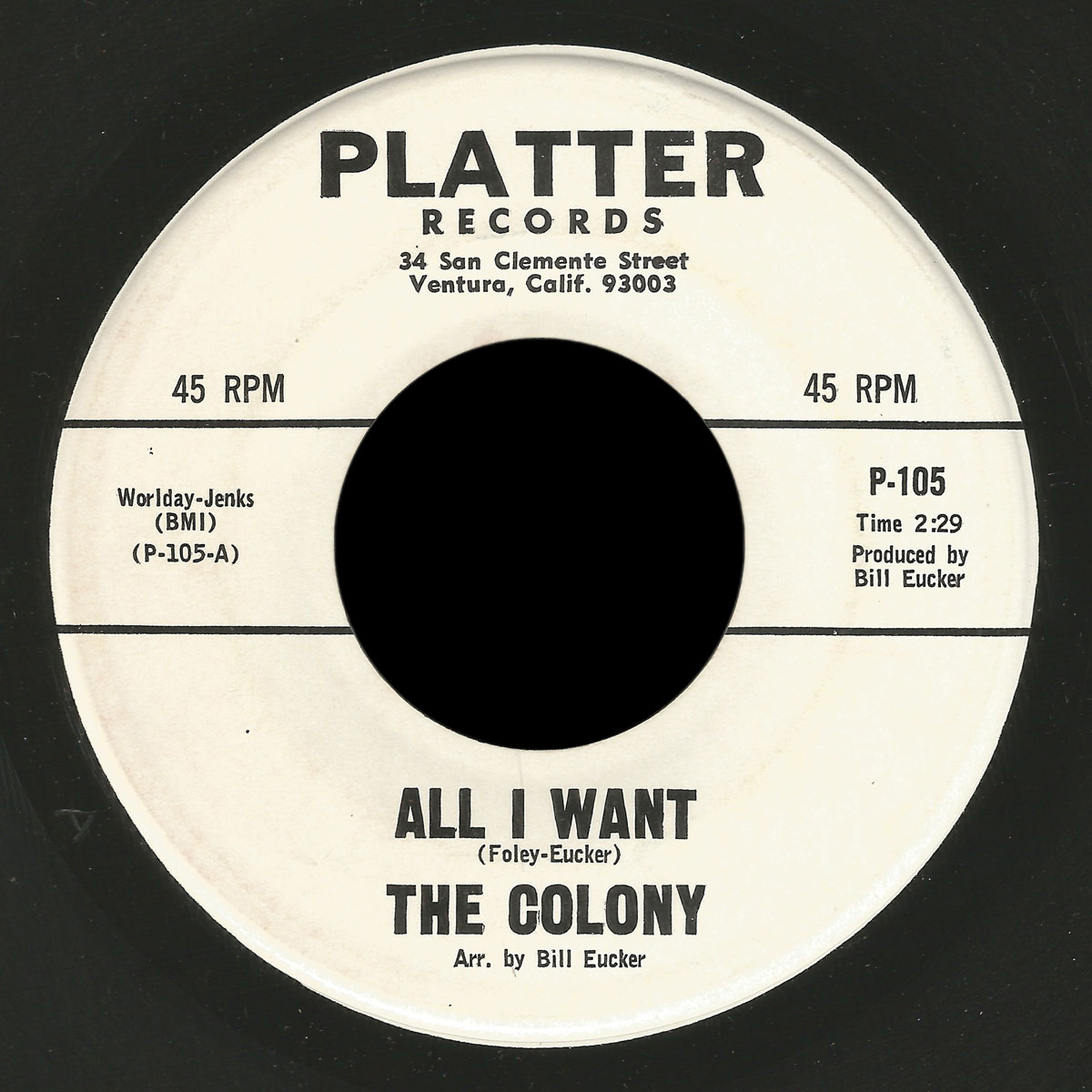
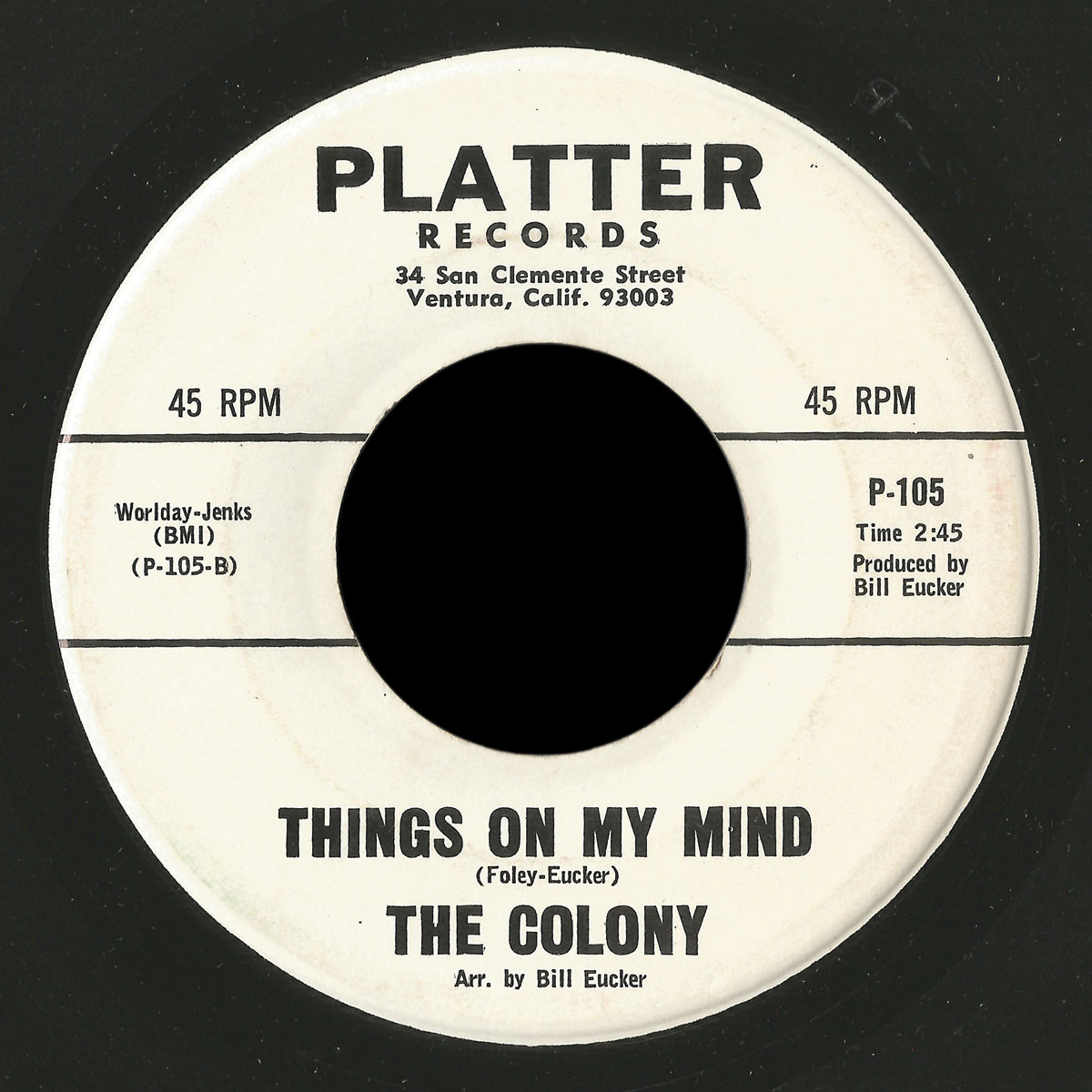
In April of 1967 a band called The Colony released their only single, the wild “All I Want” b/w a great song called “Things On My Mind” on Platter Records P-105. The two make for an interesting contrast: one is hard-edged r&b with a desperate-sounding vocal, the other a much more polished production that includes string arrangements but keeps its drive.
Both songs were written by Mike Foley and Bill Eucker for Worlday-Jenks BMI.
Platter Records: a redundant name wouldn’t you say? Platter was located at 34 San Clemente St, in Ventura, California.
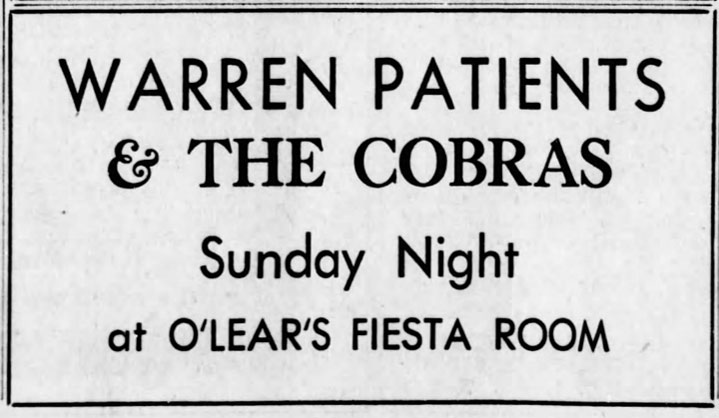
Warren Patients and the Cobras playing in Hazleton, PA, Feb. 25, 1967
The Platter Records discography looks like this (any additions would be appreciated):
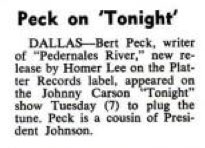
Platter 1001: Homer Lee – “Pedernales River” (Bert Peck) / “I’ve Got Some Crying To Do” (June 1966) Platter 1002: The Cobras featuring Warren Patience – “It’s a Lie” (Michael Walker) Worlday-Jenks BMI / “Thoughts of You (Are Wrecking Me)” Sept. 1966 Platter 1003: Morrie Hamilton “Wimoweh” / “Pickin’ and Grin’in” (Morrie Hamilton – Chas. Wright for Worlday-Proctor BMI) (produced by Joe Bill D’Angelo) Platter 1004: The Two of Us (Bill & Dorice) “You’ll Love Me” (Richie Carpenter, Lightup Music BMI.) / “Piki Teepee” (no artist listed) Platter 1005 – The Colony – “All I Want” / “Things On My Mind” (Mike Foley and Bill Eucker) April 1967
Billboard mentions Burt Peck and Homer Lee’s Platter release, Billboard, June 18, 1966
The Cobras came from Kingston, Pennsylvania, west of Scranton. I have no idea how they came to be on Platter Records, but their 45 is a rare and classic garage single. The label for the Cobras reads “featuring Warren Patience” but an ad I found in a central PA newspaper puts his name as Warren Patients.
Homer Lee worked with a song writer out of Dallas, Texas. Morrie Hamilton worked in various locations including Denver. The Two of Us (Bill McClure and Dorice Vance) worked around Anaheim and Santa Ana in Orange County.
With the widespread origins of these artists, the Colony may have been the only act on the label actually from the Ventura area.
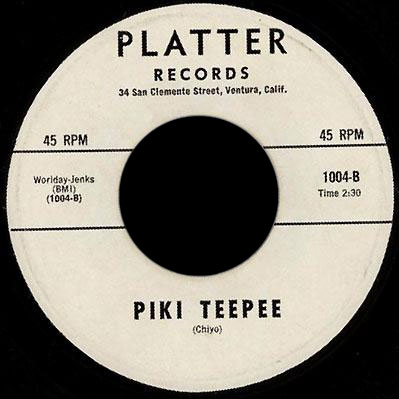
Platter Records reissue of “Piki Teepee”, originally the b-side of the Sundancers Breakout 45 “Devil Surf”Bill Eucker produced and arranged both sides of the Colony single. His full name is William Herschel Eucker. I have no other clue as to who performed on the Colony single, or if they were even a real band outside the session for these two songs. Bill Eucker’s name connects Platter Records with an earlier label from the Oxnard area, Break Out Records.
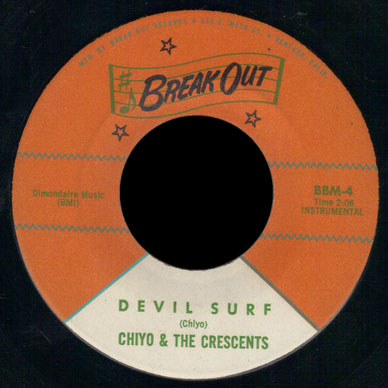
One odd thing about this discography is the B-side to the Two of Us single, credited only by its title “Piki Teepee”. This instrumental had original release two years earlier as the flip to the Sundancers’ Break Out Records single, “Devil Surf”. Who were the Sundancers? They were Chiyo & the Crescents by another name.
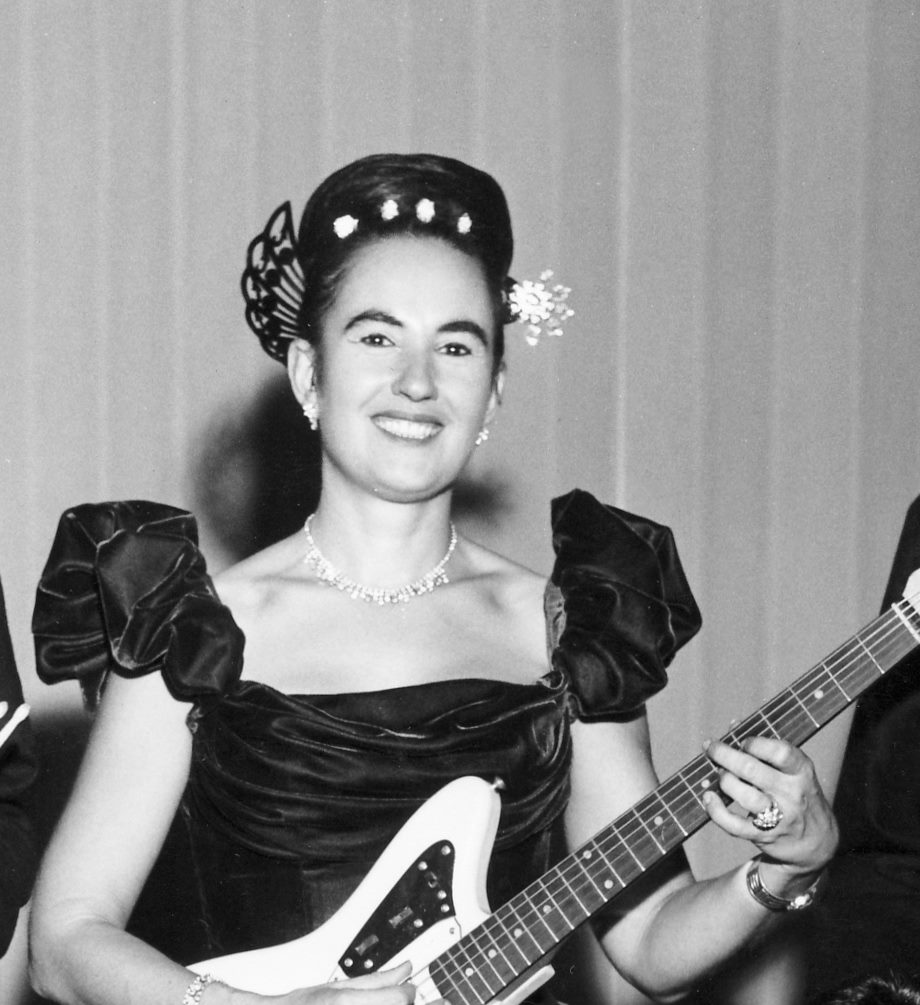
Chiyo Ishii, detail from a group photo
Chiyo & the Crescents and Break Out Records
The best info on Chiyo comes from the article and comments section of Office Naps’ post Everybody Wipe Out Now(officenaps.com/instrumentals-surf/everybody-wipe-out-now/ but this is now defunct), which I’ll summarize here, though I can’t attest to the veracity of all this information.
Chiyo was supposedly of Hopi Indian descent, originally named Chizomana. However, see the comment from Carolyn below, about one Fredericka Bick … “born & raised in Nebraska.”
In the 1940s Chiyo went to the University of Nebraska in Lincoln to study music. She married an engineer by the name of Fred Ishii who worked at Pt. Mugu Naval Air Station in Oxnard. She began giving lessons in various instruments at her home, but by the early ’60s she opened up her shop, Chiyo’s Guitars and Drums, on Saviers Road in Oxnard where she continued teaching, notably flamenco-style guitar.
Around 1962 or 1963, Chiyo formed a band called the Crescents:
Chiyo Ishii – lead guitar Thom Bresh – rhythm guitar Tom Mitchell – bass Ray Reed – sax Bob Ross – drums
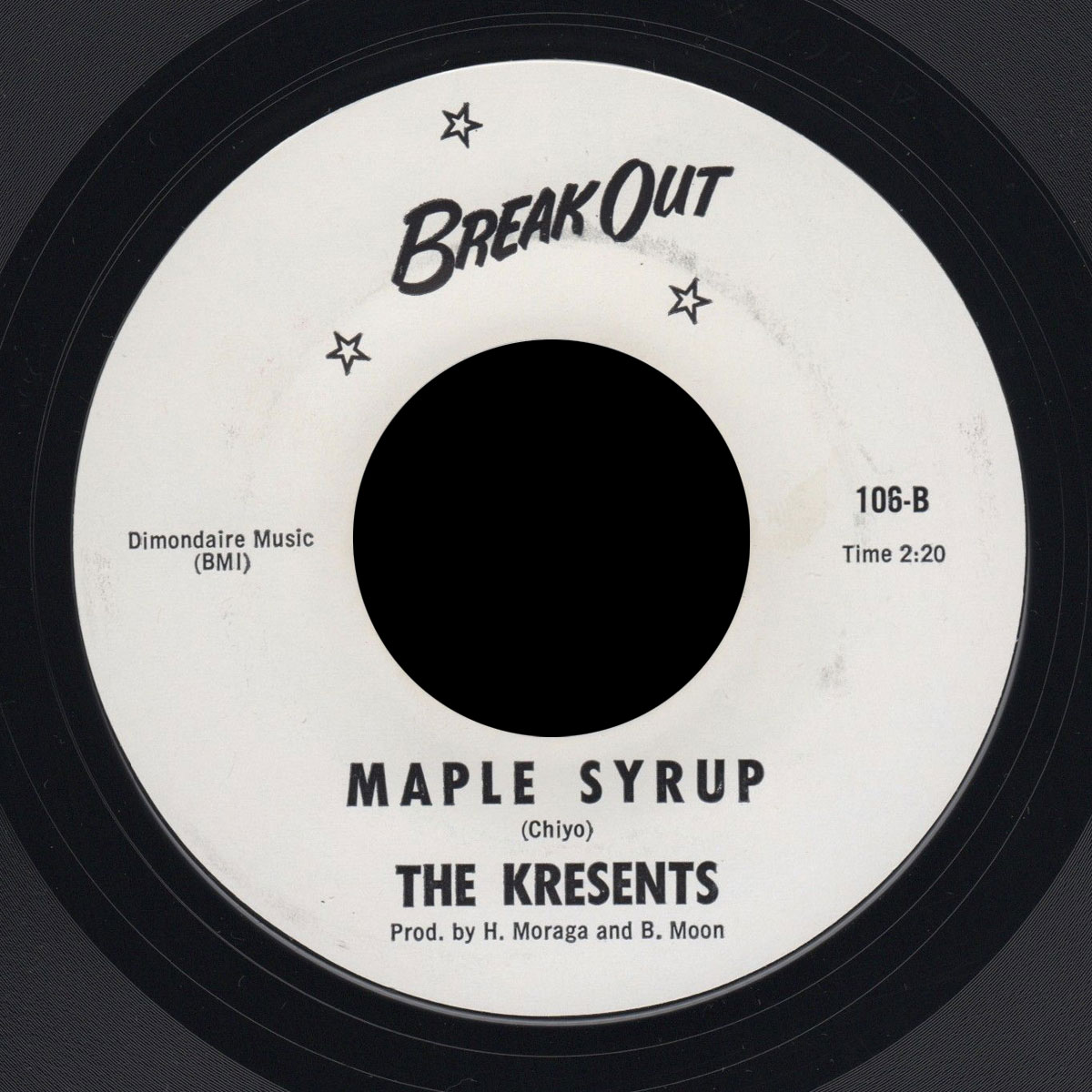
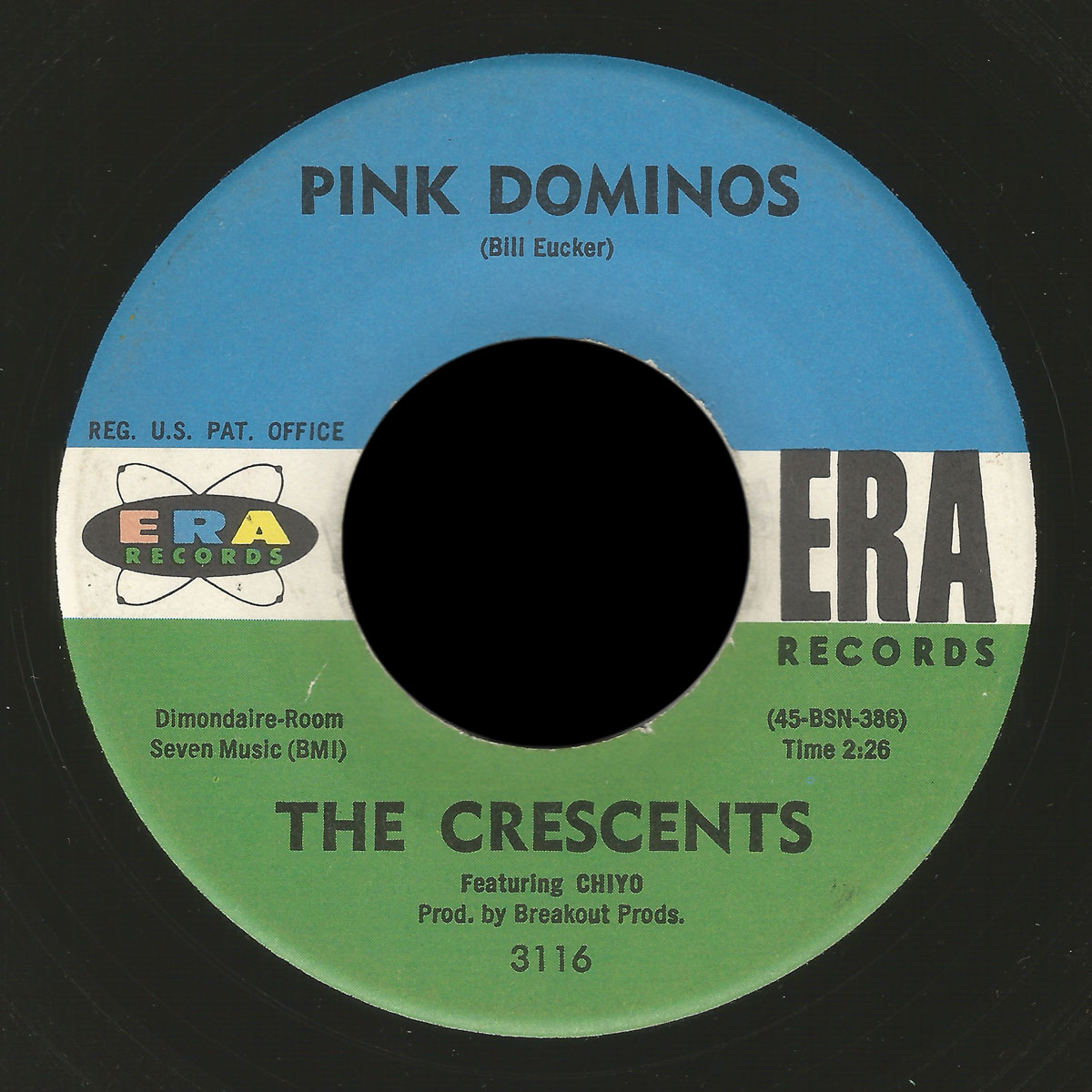
Thom Bresh is Merle Travis’s son. He would have been about 15 or 16 at the time of these recordings. Bresh was taking lessons at Ernie Ball’s store in Thousand Oaks, where Bill Eucker was teaching. Eucker wrote an instrumental he called “Pink Dominos”, which would become the first of three singles by the Crescents on Break Out Records. Oddly each of the three releases has a different artist name, even though all are by Chiyo & the Crescents.
The only single on Breakout not by Chiyo and the Crescents was by the Dar Vons: “Hot Pepperoni” (obviously trying to cash in on the Dartells “Hot Pastrami”) b/w “Bowling Alley Baby”. The Dar Vons or Darvons included Dave Bowers and previously were known as the Surftones – but I don’t believe this is the same Surftones that backed Dave Myers, that band included Johnny Curtis, Ed Quarry, Dennis Merritt, Seaton Blanco, and Bob Colwell.
Break Out Records discography
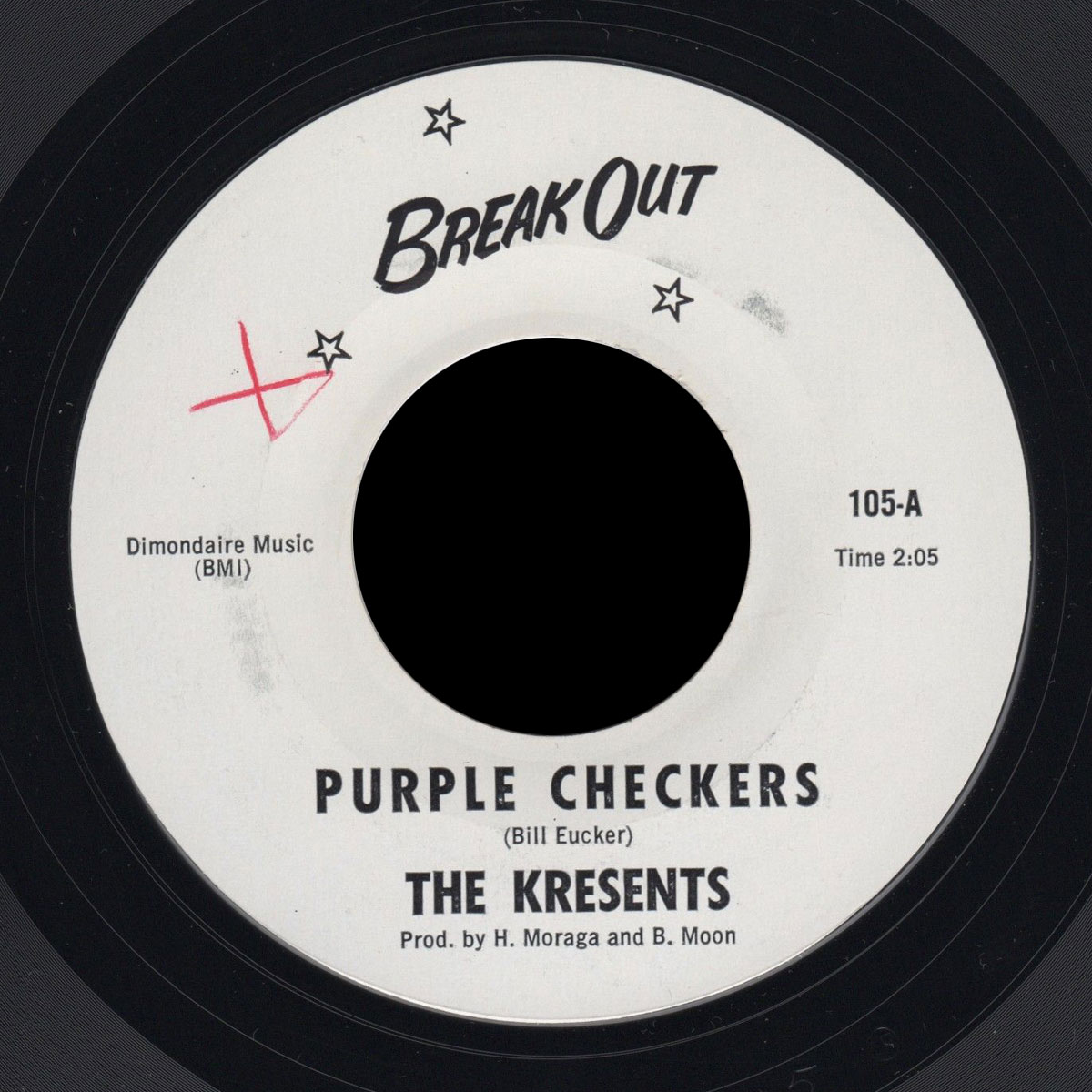
Break Out BBM-3/4 – Chiyo & the Crescents – “Pink Dominos” (Bill Eucker) / “Devil Surf” (Chiyo) (Sept. or October 1963) Break Out 105-A/106-B – Kresents – “Purple Checkers” (Bill Eucker, Dimondaire Music BMI) / “Maple Syrup” (Chiyo) (February, 1964) Break Out 107-AA/108 – Dar Vons – “Hot Pepperoni” (Steve Middleton, B. Peeler) / “Bowling Alley Baby” (Waldemar Mennigen – Jerry Jaye) produced by Moraga- B. Moon Break Out 111 – The Sundancers – “Devil Surf” / “Piki Teepee” (both by Chiyo)
Break Out was at least partly owned by Harold Moraga. Moraga also owned part of Dimondaire Music BMI, which published all the songs on Break Out.
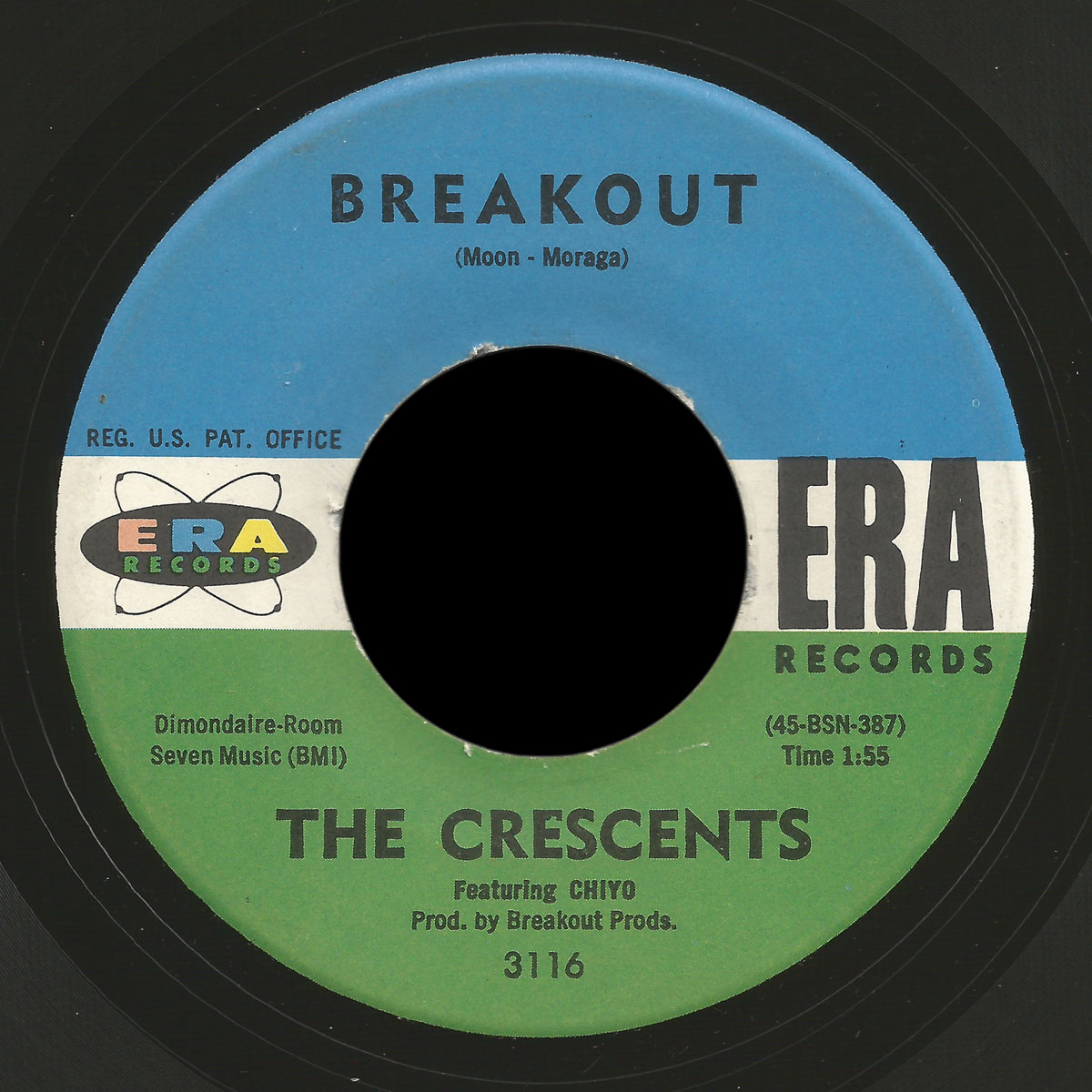
The Crescents featuring Chiyo, Era 45 “Pink Dominos” – written by Bill EuckerKim Fowley bought the master for “Pink Dominos” and placed it with Era Records for a wider release, reaching #95 in Billboard on December 28, 1963 and reportedly climbing as high as #69 in early 1964. I read Ghoulardi used it on his show so it became an in-demand in the Cleveland, Ohio area.
Fowley controlled half the publishing for both sides through Room Seven Music, BMI. The flip side “Breakout” is credited to Moon and Moraga and even though Chiyo’s name is on the label, this sounds like a different group using a cheap organ sound.
Despite the success of the single, the two follow ups on Break Out were recorded under different band names. The Kresents single features a song Bill Eucker wrote called “Purple Checkers”, while the band remade “Devil Surf” with saxophone under a new title, “Maple Syrup”. As the Sundancers, they do yet another version of “Devil Surf” with “Pink Teepee” on the flip. BMI shows he wrote a song called “Torment” during this period, which seems to have gone unrecorded.
I wonder what Bill Eucker was doing in the two or three years between writing for the Crescents and recording the Colony single. It’s also a mystery how “Pink Teepee” shows up on the flip to the Two of Us single, as there doesn’t seem to be any overlap in publishing or production between the Break Out and Platter labels.
I find no more credits for Bill Eucker until 1972, when he turns up playing guitar on the John Henry Kurtz LP Reunion on ABC Records. That record that contains the original version of “Drift Away”, a later version of which continues to be heard in supermarkets across the country.
Thank you to Dick Blackburn for adding the Dar Vons to the Break Out discography. Thank you to Chuck Keever for suggestions about the order of release.
“Breakout” – credited to the Crescents, but sounding like another group altogether.
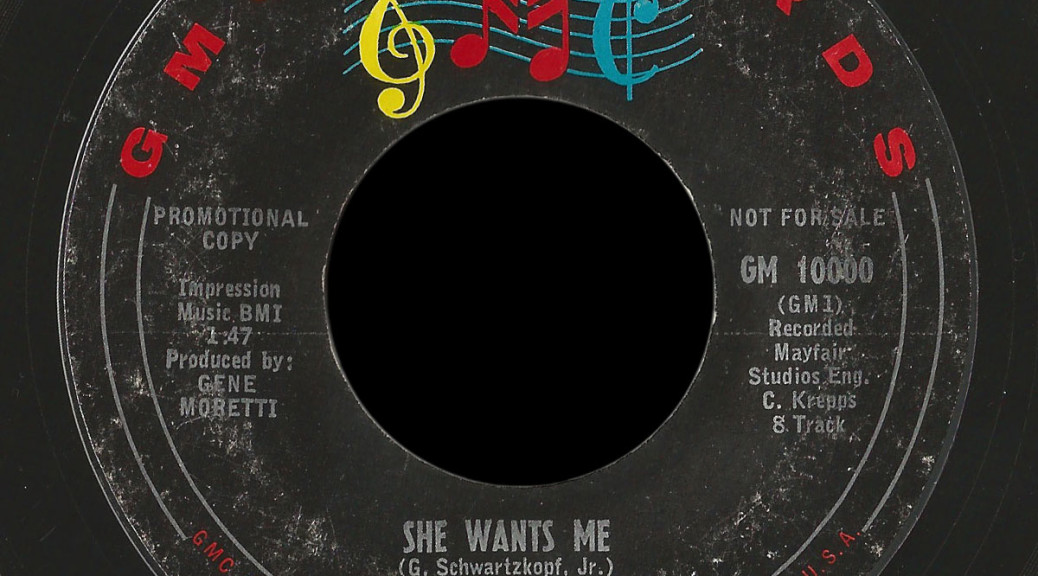
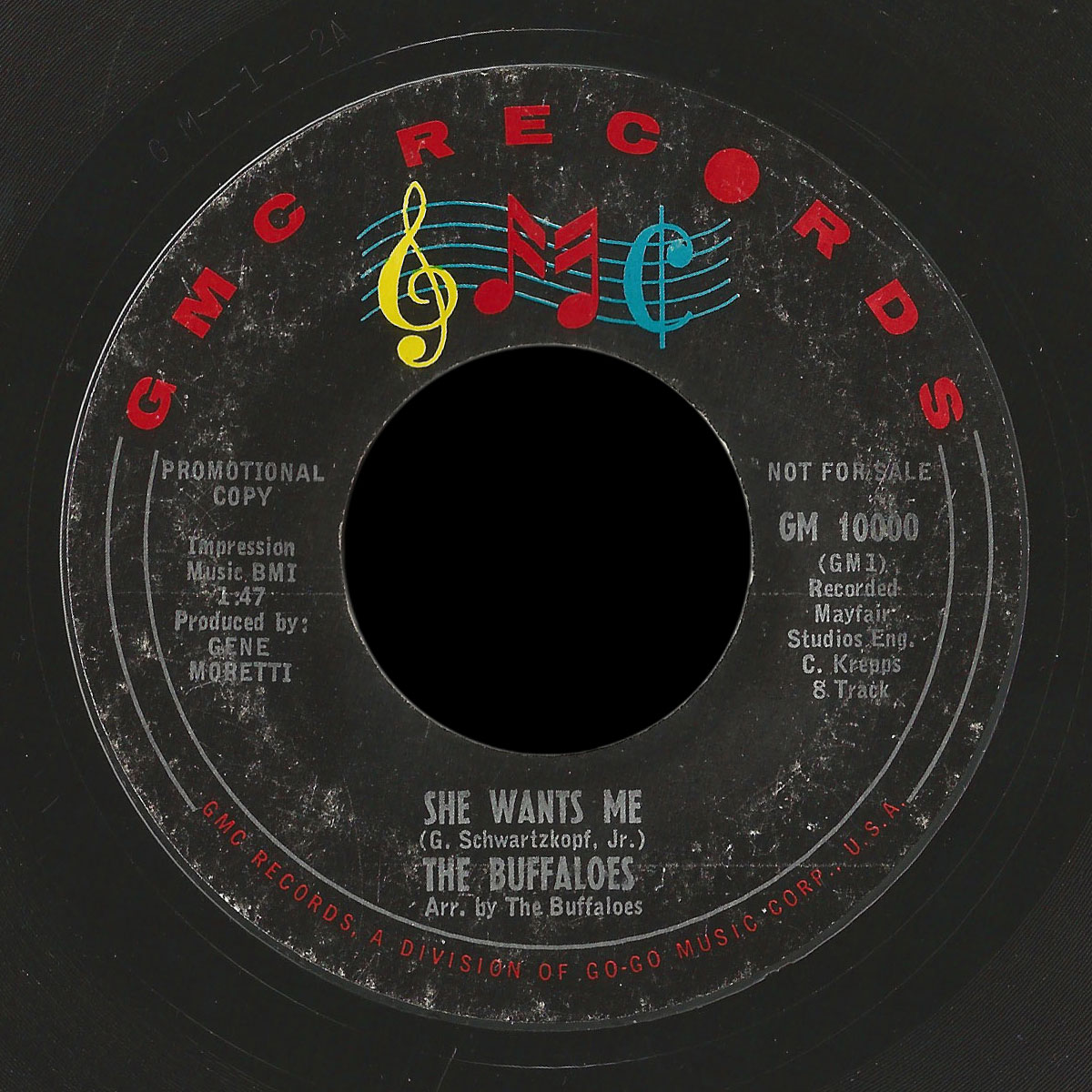
Considering the names on the labels of this 45 and the quality of single, it’s amazing how obscure this group called the Buffaloes seems to be. I knew nothing about the group except for their last names and first initial until Mike Kuzmin contacted me with additional copyright information.
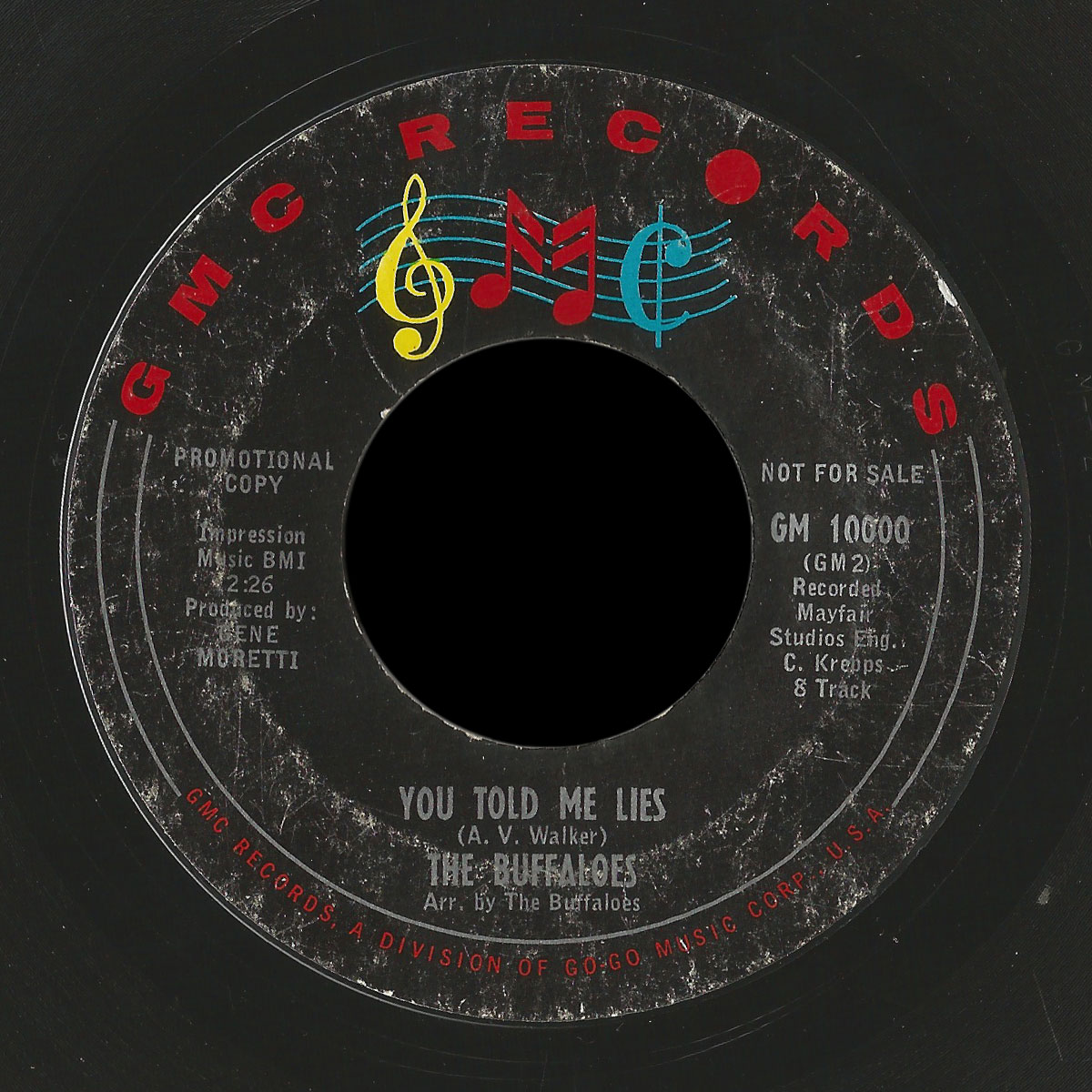
The A-side is the jangly blaster, “She Wants Me”, written by George Schwartzkopf, Jr of Old Bridge, New Jersey. It’s a catchy song and I could imagine it being a hit, but seems to have missed. The flip is a ballad written by Arthur V. Walker of Sea Cliff, NY, on Long Island, “You Told Me Lies”. The copyright name for correspondence or refund is listed as Joel E. Shenton of Glen Cove, NY. Both songs published by Impression Music, BMI.
The Buffaloes may have had the first release on the GMC label. Gene Moretti founded the label; he had been director of international sales for MGM-Verve in 1964 after starting in the mail room of ABC-Paramount (according to Billboard).
Joel Shenton contacted me in July 2021 and kindly provided info about the band, GMC and Mayfair Studio.
The band:
Arthur Walker – lead singer / rhythm guitar George Schwartzkopf – bass James (Jimmy) Wolf – drummer Joel Shenton – lead guitar, vocals, keyboard
I met Jimmy during high school years, late 50’s, through a mutual friend who got me interested in guitars. We fooled around as a 3-piece instrumental group until college interfered. I met George, a guitarist, at college. We formed a 4-piece group and played frat parties pretty much every weekend using various drummers including Jimmy, who was at school a few miles away. George decided to play bass, and we recruited a classmate to play rhythm and sing leads. That began our addition of vocals to our group.
After college and eventual return to Glen Cove, Jimmy introduced me to Arthur (“Artie”), and George, although living in New Jersey, joined up and we became the Buffaloes and played a few local clubs.
Gene Moretti lived near Jimmy, got interested, and that was the link to GMC. Gene had a few other musical groups as well, including the “Gumdrops 2”, a girl duet. We backed them up for a few gigs, and Jimmy eventually married one of the pair (Joan) who later became a vocalist for some Buffaloes numbers.
The link to Mayfair came from George. He got married while in college, and his wife was Clair Krepps’ daughter. Clair, at that time, had his own mixing studio (Knickerbocker Sound) on E47th Street in NYC, where he did subcontract mixing and overdubbing for several major NY studios. George and I had access to Knickerbocker and fooled around there on weekends during our summers off from college. Clair eventually formed the Mayfair organization in the theater building of the same name, adding multiple live recording and mixing rooms.
Mayfair was unique when it came to equipment. The control room was designed and built by Clair’s brother (I think) who had an electronics manufacturing company in Chicago. Nothing was conventional, and it became a testing ground for Ampex and Sennheiser. I recall Clair showing us one of the first 8 track and 16 track tape machines he used for recording, provided by Ampex for evaluation. The wall in the main control room was autographed by many well-known artists with comments like, “Fantastic sound,” “Wonderful experience”, etc. I think Sinatra, Streisand, the Stones, and even Hendrix were among the signers.
After the release of our first & only 45, and doing some club work, it became clear to us that our musical future was going to be more for fun than for a career path. We all had decent day jobs, and there was no economic security at our level of dedication and talent. We continued to play for fun, made several demo discs for posterity, but peddling them was rather futile even though we had contacts at UA and Decca.
We went our separate ways in the early 70’s. Jimmy and Artie wound up in Florida, George stayed in NJ working as a chemical engineer, and I moved to upstate western NY to run a plastics factory.
Although it has little to do with the Buffaloes, my interest in guitars and playing continues to this day, although my focus changed from R&R to country music…mostly due to the interests of the local population…and I currently enjoy playing lead guitar for several local bands.
[editor’s note: I’ve changed the spelling of Krepps’ name to Clair from Clare.]
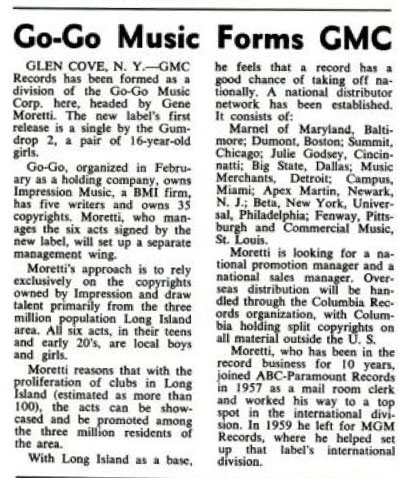
Gene Moretti’s GMC Records announced in Billboard, April 2, 1966
Gene Moretti and GMC Records “a Division of Go-Go Music Corp”
The April 22, 1966 issue of Billboard noted how Gene Moretti would be managing and recording six acts for his new label: “Moretti’s approach is to rely exclusively on the copyrights owned by Impression and draw talent primarily from the three million population Long Island area. All six acts, in their teen and early 20’s, are local boys and girls.”
Billboard announced the Gumdrop 2 would have the first issue on GMC, “Getting Over You” / “So I Try”, numbered GM 10001, However, the Buffaloes single, dated to October ’66 in Teen Beat Mayham, is numbered GM 10000. GMC had about fifteen releases in total, featuring a dozen artists including Priscilla Price, Tony Kaye, Johnny D., Doreen Rose, the Miller Sisters, the Islanders, the Spoilers, Frankie ‘Slim’ Summerville, and Frankie Gracie & the Plastics.
Mayfair Studios
Another interesting connection is the studio, listed as Mayfair Studios (8 Track). Clair Krepps had been a recording engineer for Capitol, MGM and Atlantic Records and also did a lot of stereo percussion albums for Audio Fidelity. About the same time Moretti started GMC, Krepps began Mayfair Recording Studios at 701 Seventh Ave in Manhattan. Other clients would include the Velvet Underground, Al Caiola’s Caiola Combo All Strung Out LP on United Artists, Nico, the Chameleon Church, the Ultimate Spinach, the Beacon Street Union, Puff, Galt MacDermot, Ricardo Ray, Jimi Hendrix, the Mothers of Invention, etc.
Thank you to Joel Shenton and Mike Kuzmin for their help with this article.
If anyone has a photo of the Buffaloes, please contact me!
This site is a work in progress on 1960s garage rock bands. All entries can be updated, corrected and expanded. If you have information on a band featured here, please let me know and I will update the site and credit you accordingly.
I am dedicated to making this site a center for research about '60s music scenes. Please consider donating archival materials such as photos, records, news clippings, scrapbooks or other material from the '60s. Please contact me at rchrisbishop@gmail.com if you can loan or donate original materials

 Here’s a great single by the Skeptics, whom I’ve read were from Dayton, Ohio. The urgency and scuzzy burning distortion on the guitar on “Wondering” scream out 1968 to me, a date confirmed by the QCA # 80330, specifically March 1968. The flip is a slow recitative called “I’m Lonely Again” that I find less essential.