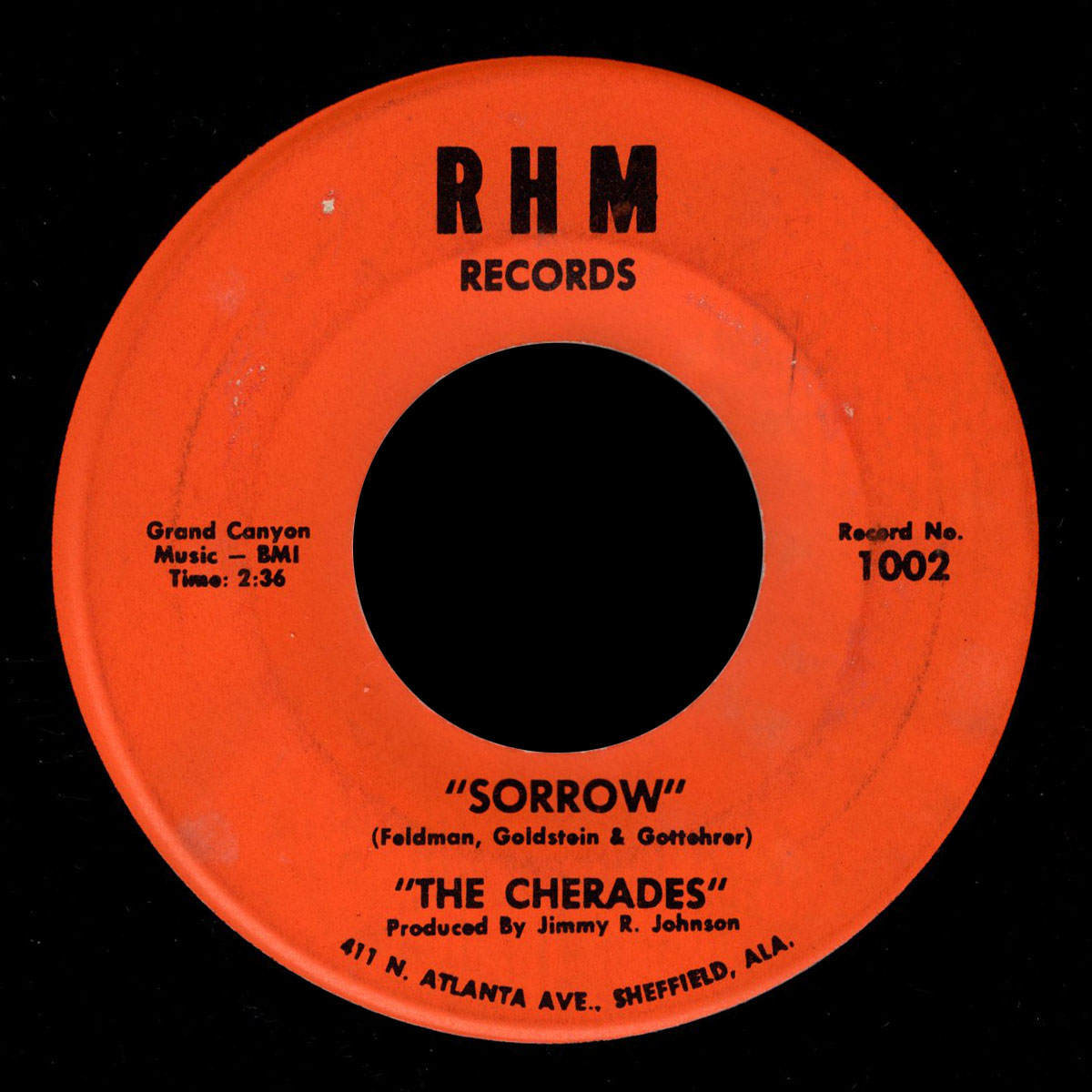
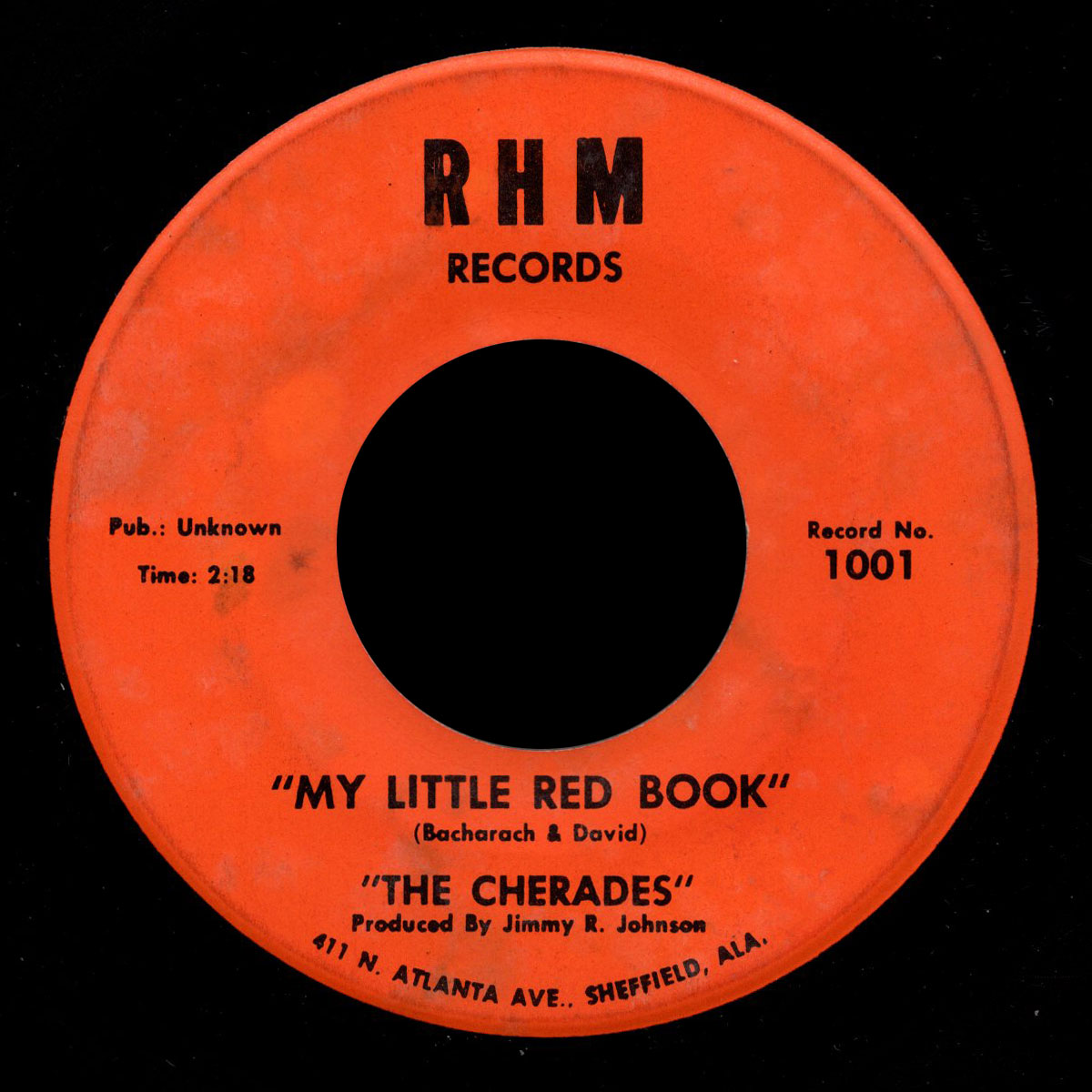
The Cherades are an unknown group who covered two hits from ’65 and ’66 for release on RHM Records 1001/1002. Their version of Love’s arrangement of “My Little Red Book” is very good, I’d say this was a studio group except the lead singer sounds unpolished. It was backed with the McCoys’ “Sorrow”.
The single was produced by Jimmy R. Johnson, the session guitarist who would become co-owner of Muscle Shoals Sound Studios. These were most likely cut at FAME Studios in Muscle Shoals, Alabama, where Johnson produced the Rockin’ Rebellions excellent “Don’t Let Go” / “Anyway the Wind Blows” for Gold Groove 111.
RHM Records has an address of 411 N. Atlanta Ave, in Sheffield, Alabama. The deadwax of SIMS RHM 1001 / RHM 1002 with a “Nashville Matrix” stamp indicates this may have been considered for the Sims label owned by Russell Sims, who had released many soul singles cut at FAME.
Oddly the labels show correct publishing for “Sorrow” but list “My Little Red Book” as “Pub. Unknown”!
Max Waller wrote to me that he had a note from an unknown source listing “members include Ronnie, Joe, Frankie”.
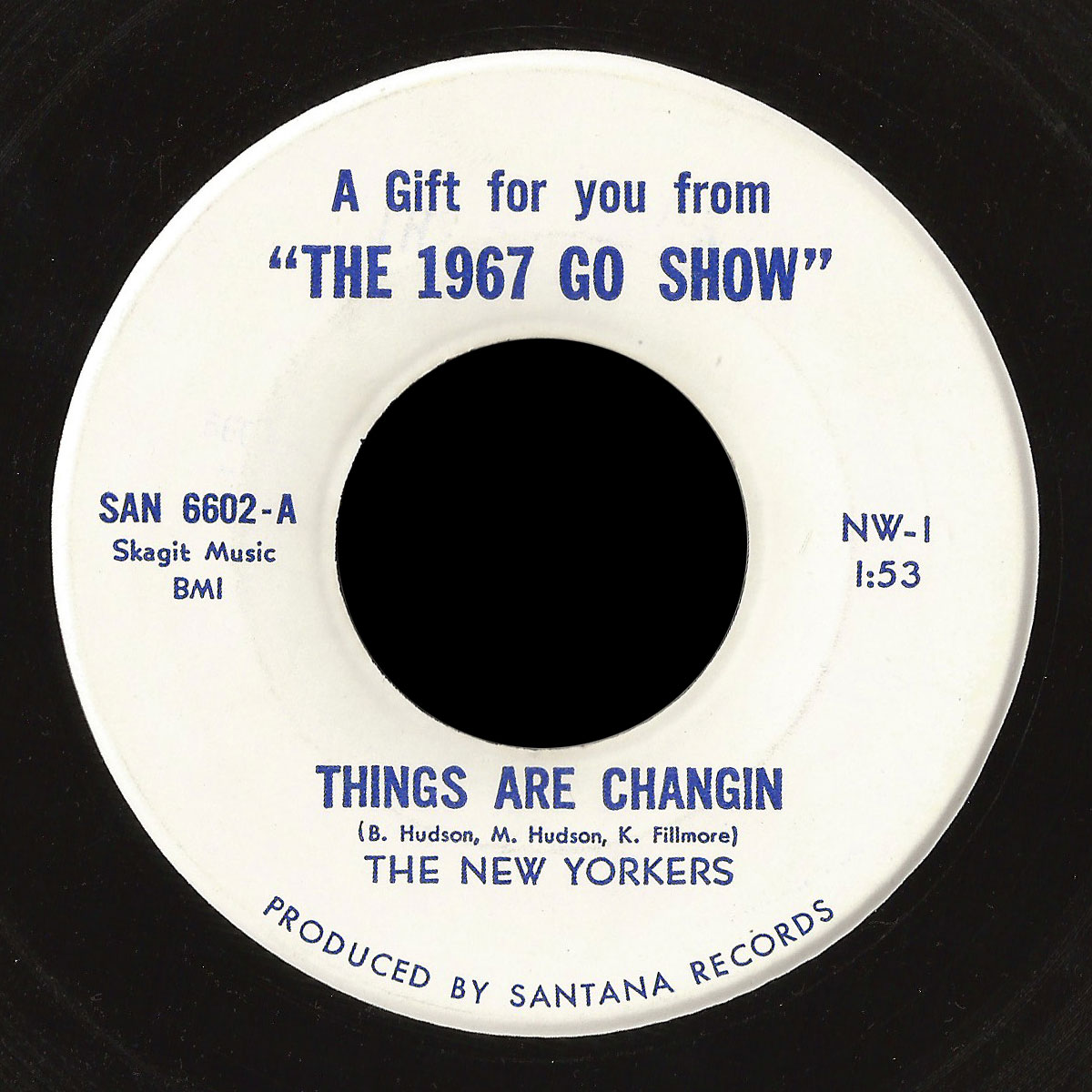
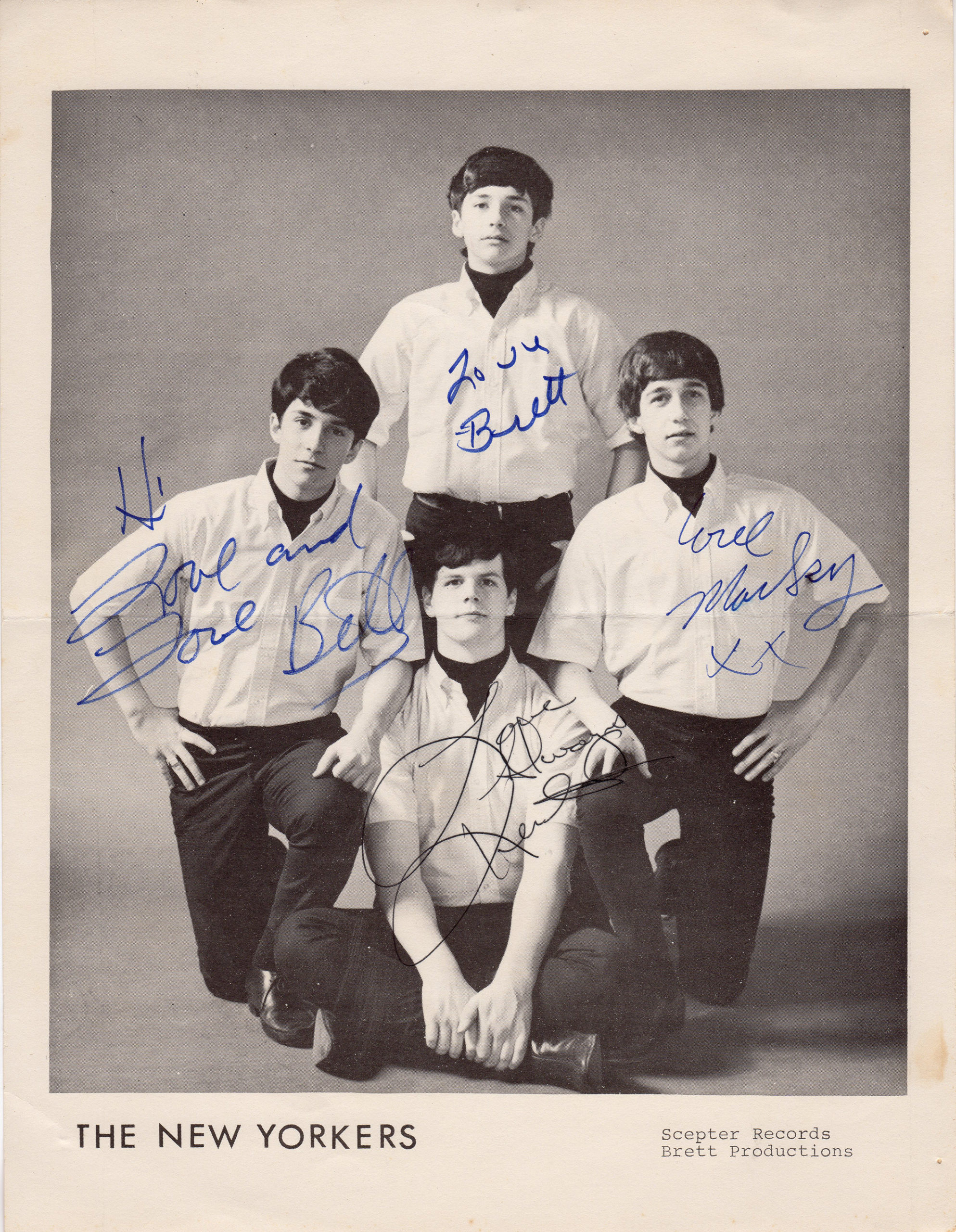
“Things Are Changin” is the very first single by the New Yorkers, who would cut the classic “Mr. Kirby” for Scepter before going on to greater fame as the Hudson Brothers. The group started in 1965 as the My Sirs in Portland, Oregon. Members in the early years were:
Bill Hudson – guitar, vocals Kent Fillmore – guitar Brett Hudson – bass, vocals Mark Hudson – drums, vocals
In 1959, Jim Bailey, a DJ at KAGT in distant Anacortes, Washington, had produced the Swags “Rockin’ Matilda” on his Westwind Records label. He was able to promote it to Del-Fi for national hit release in 1960. Bailey is listed as co-writer of “Rockin’ Matilda” with Swags guitarist Gailen Ludtke, and he published the song through his Skagit Music Company. He’s noted as booking acts in the Pacific Northwest, but I can’t find much about Bailey’s recording activity until he reappears with the New Yorkers in 1966.
Bailey heard a few demos the My Sirs had cut with $40 in an unnamed studio and set up a sponsorship with Chrysler. Bailey renamed the group the New Yorkers after the Chrysler auto, and found another group, possibly also from Portland, and named them the Fury Four after the Plymouth Fury (also made by Chrysler).
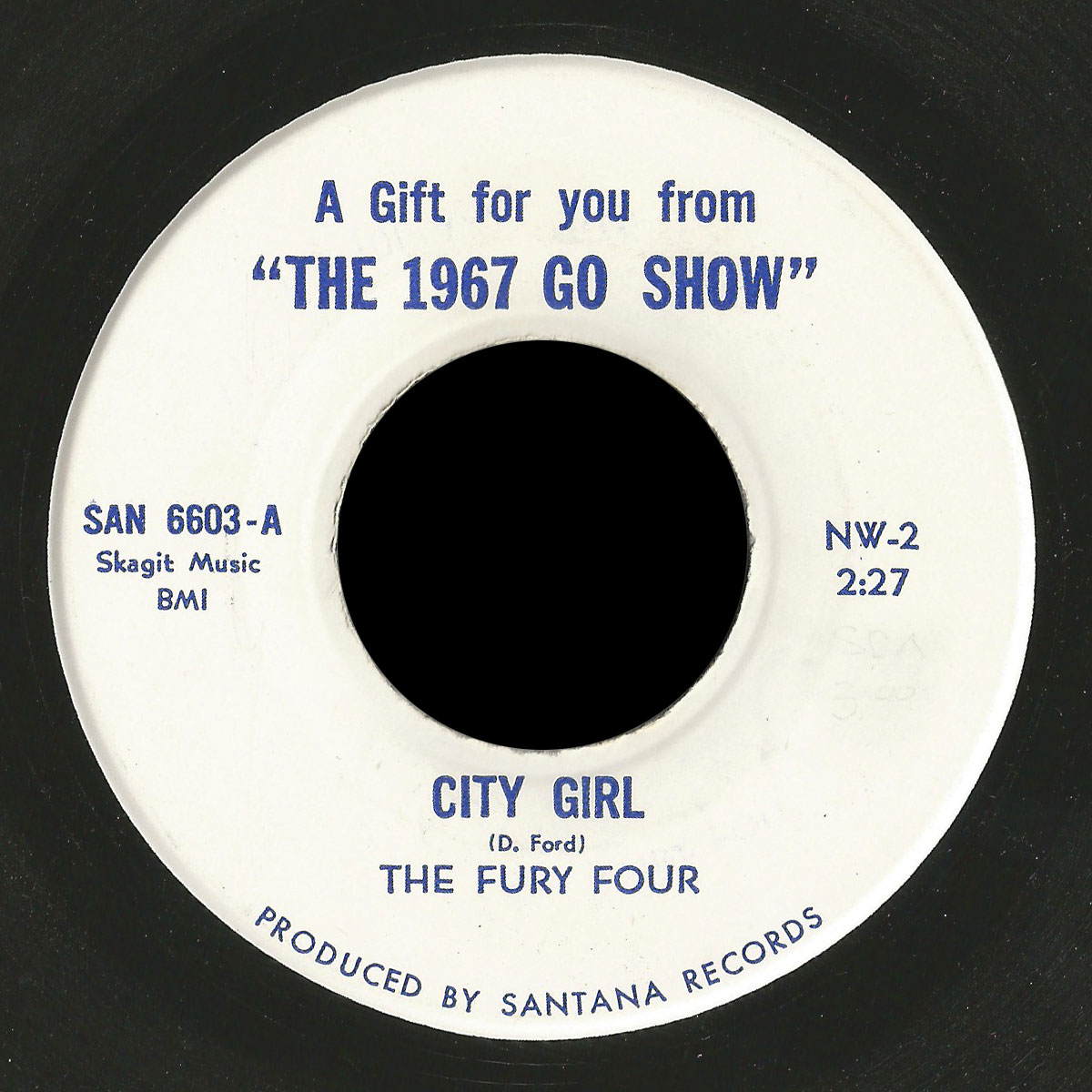
Labeled “A Gift for you from the 1967 Go Show”, Bailey released a 45 with the New Yorkers singing their catchy original “Things Are Changin” on Santana Records SAN 6602-A / SAN 6603-A, NW-1 / NW-2. On the other side is the Fury Four’s “City Girl” (written by D. Ford) with harmonies and fuzz guitar throughout. Skagit Music published both songs.
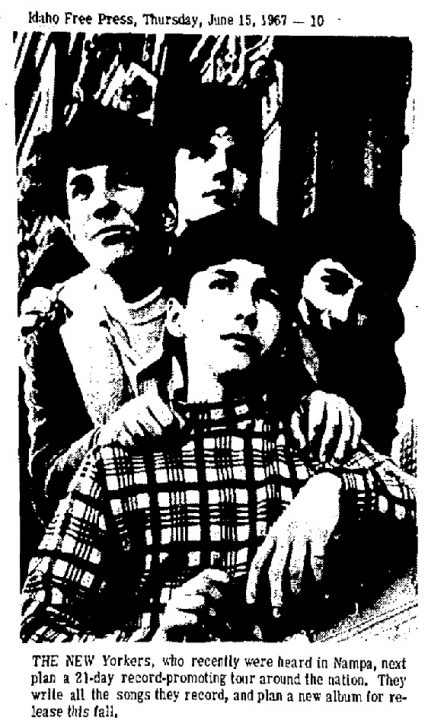
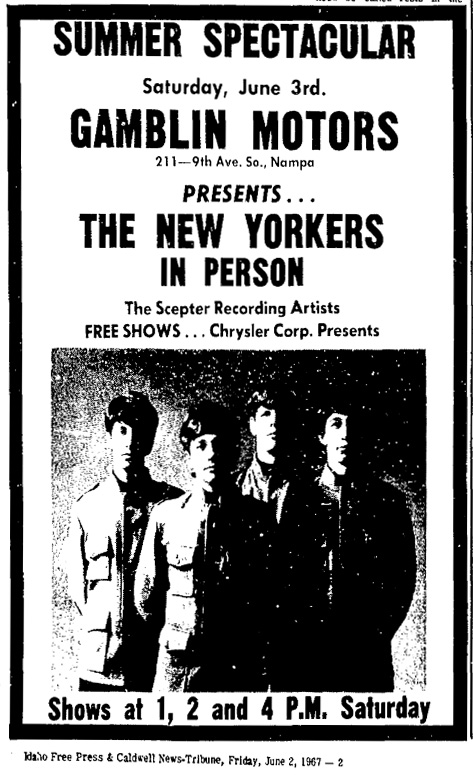
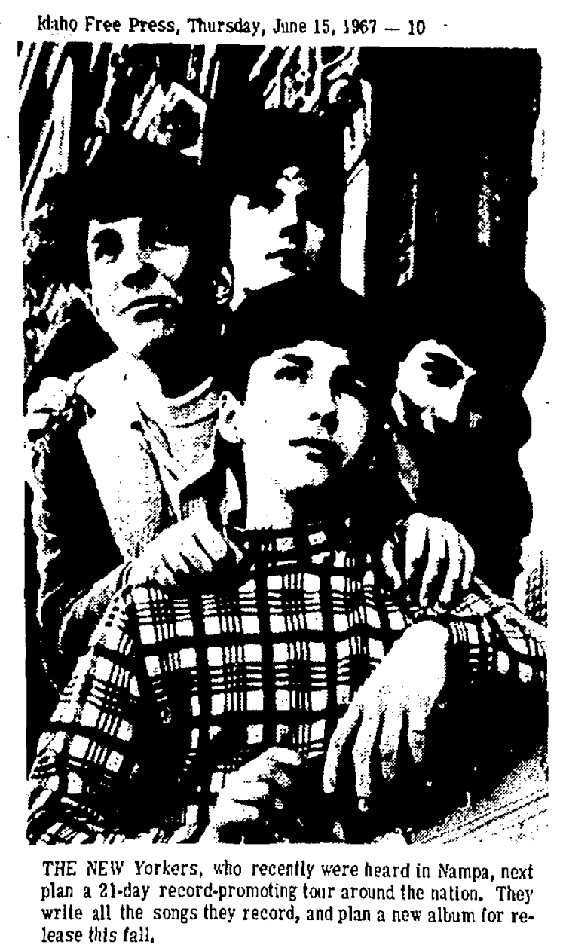
An article from the June 15, 1967 Idaho Free Press shows that the New Yorkers toured to promote Chrysler right up to the release of their second Scepter single:
TEEN SCENE Group Tells Tour Plans
The New Yorkers, who recently were heard in Nampa, next plan a 21-day record-promoting tour around the nation. They write all the songs they record, and plan a new album for release this fall.
The New Yorkers recently played their last Chrysler Go Show performance at Nampa. Members of the group are: Bill, lead guitar, Brett, bass guitar; Mark, drums; and Kent, rhythm guitar. Upon completion of the Chrysler Go Show, the New Yorkers will now go on a 21 day tour around the nation to promote their new record, “Mr. Kirby,” to be released this month.
Flip side of “Mr. Kirby” will be either “Seeds of Spring” or “Show Me The Way To Love”. All of the songs the New Yorkers record are written by them. The current release by the New Yorkers, “When I’m Gone” failed to move nationwide. In July the group plans to go on tour with Herman’s Hermits. They have just finished a tour with Don and the Goodtimes in Washington and Oregon. The New Yorkers record on the Sceptor label in Seattle and Los Angeles. An album is planned for release this fall.
Mark Hudson, the drummer, does most of the singing for the group. It is his voice that is heard on “When I’m Gone.” Offstage the New Yorkers are probably one of the funniest groups around. At the airport when the group was preparing to leave for Portland Bill confessed he doesn’t like to fly. Mark, who seems to have an eternal feud with their manager, kept wanting to buy an insurance policy out of a vending machine, but his manager wouldn’t let him. Kent was trying to […] fool with the public address system. All in all, the New Yorkers aren’t the best in the business but they aren’t the worst either. [!]
Bailey’s name turns up on New Yorkers releases through their 1969 Decca single, “I Guess the Lord Must Be in New York City”, and also on The Live Five’s “Take the Good & the Bad”. The Fury Four were never heard from again, at least under that moniker.
Source: An interview with Brett Hudson on RockTalkTV.
Thank you to Mikael for looking up the text of the Free Press article for me, and to Matthew Baker for help with access to the microfilm images.
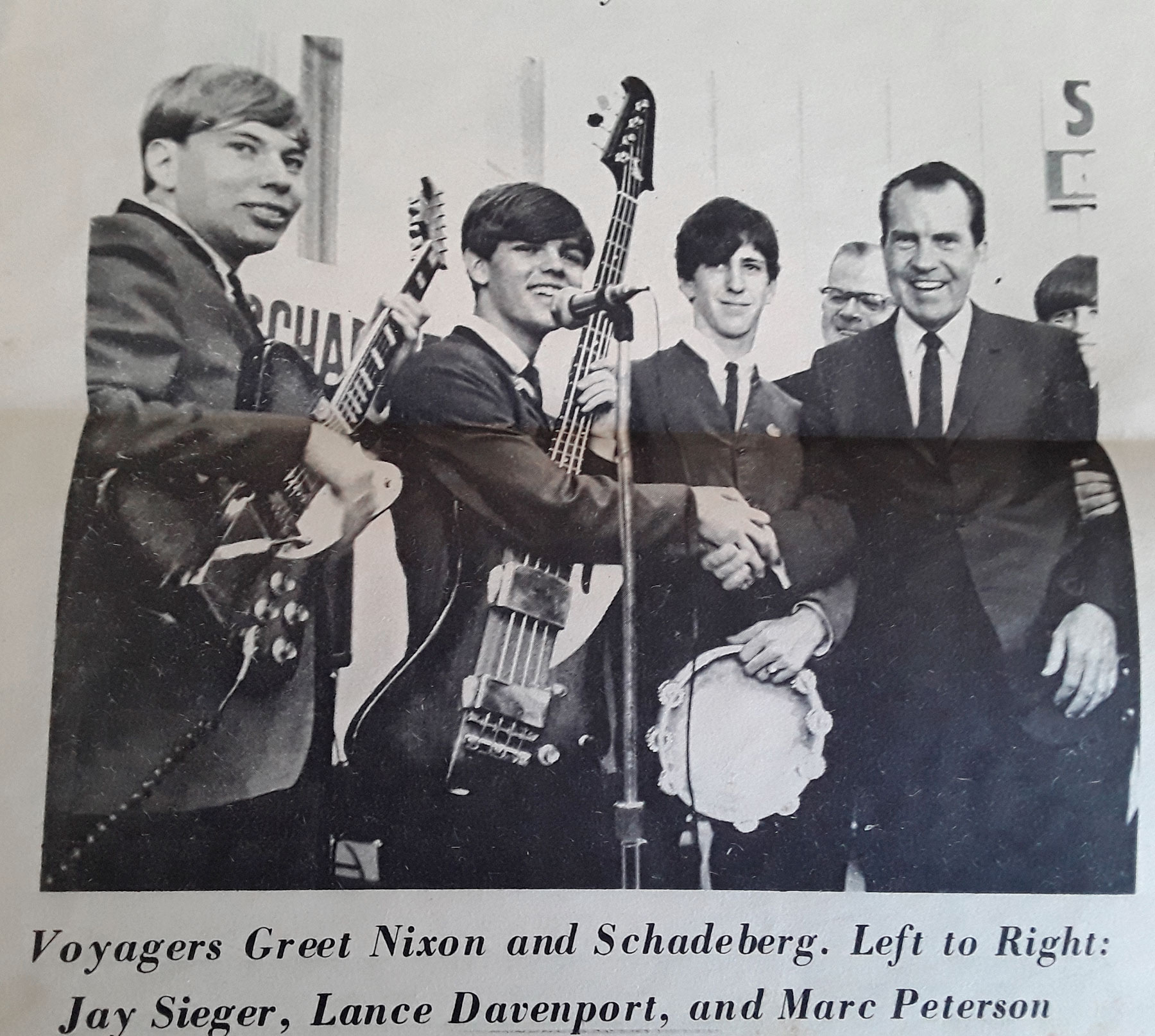
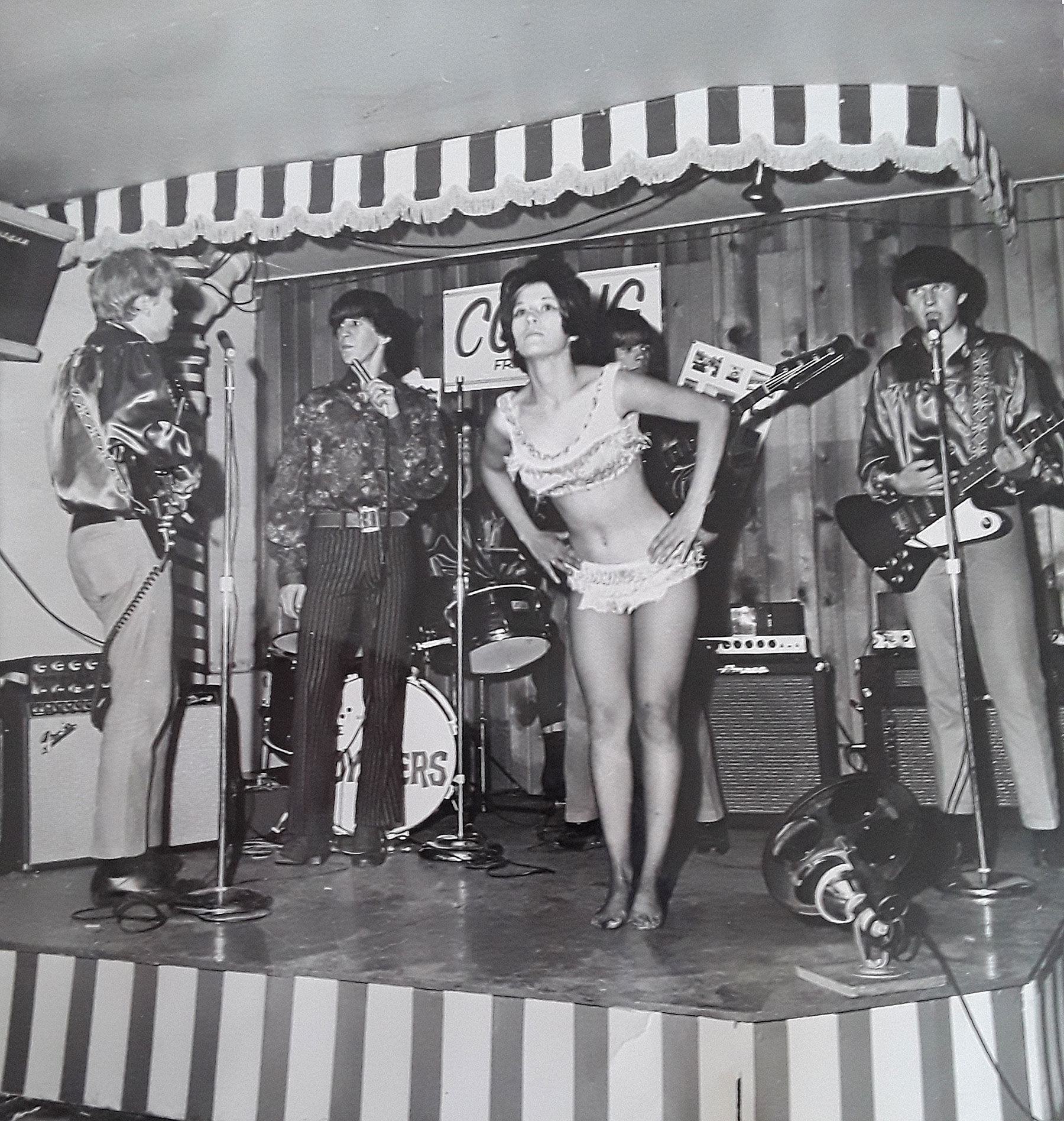
“Voyagers Greet Nixon and Schadeberg”, from left: Jay Sieger, Lance Davenport and Marc Peterson. Photo courtesy of Eddy Hauser.
The Voyagers came from Racine, Wisconsin, cutting two 45s for the Feature Records label out of Janesville.
The band first recorded as a quintet with:
Mark Peterson – vocals Jay Sieger – lead guitar Ed Hauser – rhythm guitar Lance Davenport – bass Steve Porter – drums
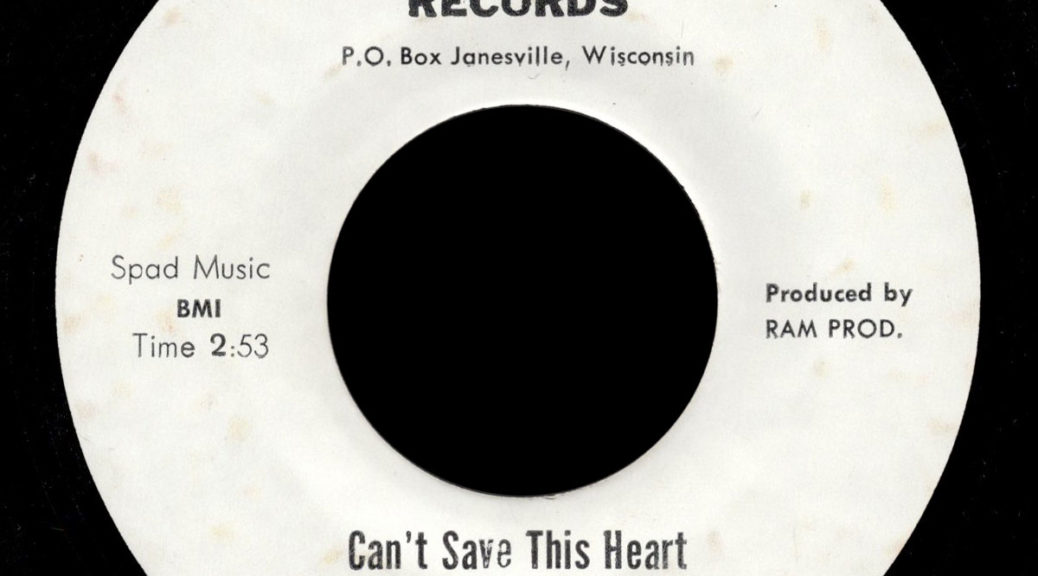
Their first 45 was the excellent “Away” backed with “I’m So Lonely”, both songs written by Sieger and Davenport, from August 1966 on Feature Records 817R-111, an RCA custom press. Spad Music would publish all their original songs.
The band met Richard Nixon at a political rally in October, 1966, and another photo from this event ran in Newsweek on October 10, 1966, with the caption “Nixon stumping Wisconsin: Always a gracious thank you for the band” (tip of the hat to Chas G.).
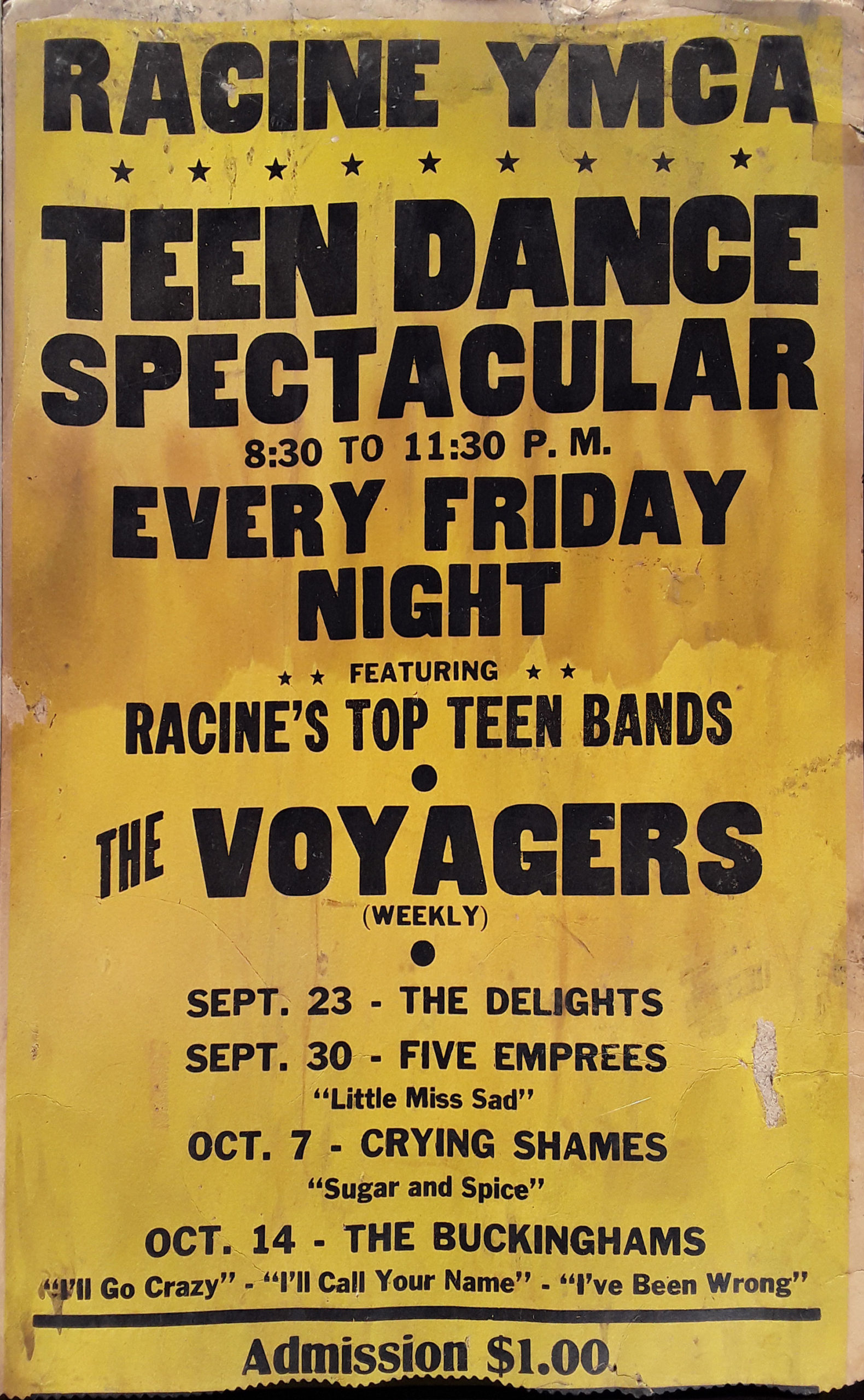
Voyagers appearing weekly at the Racine YMCA, with special shows by the Delights, Five Emprees, Crying Shames, and Buckinghams. Poster photo courtesy of Eddy Hauser.
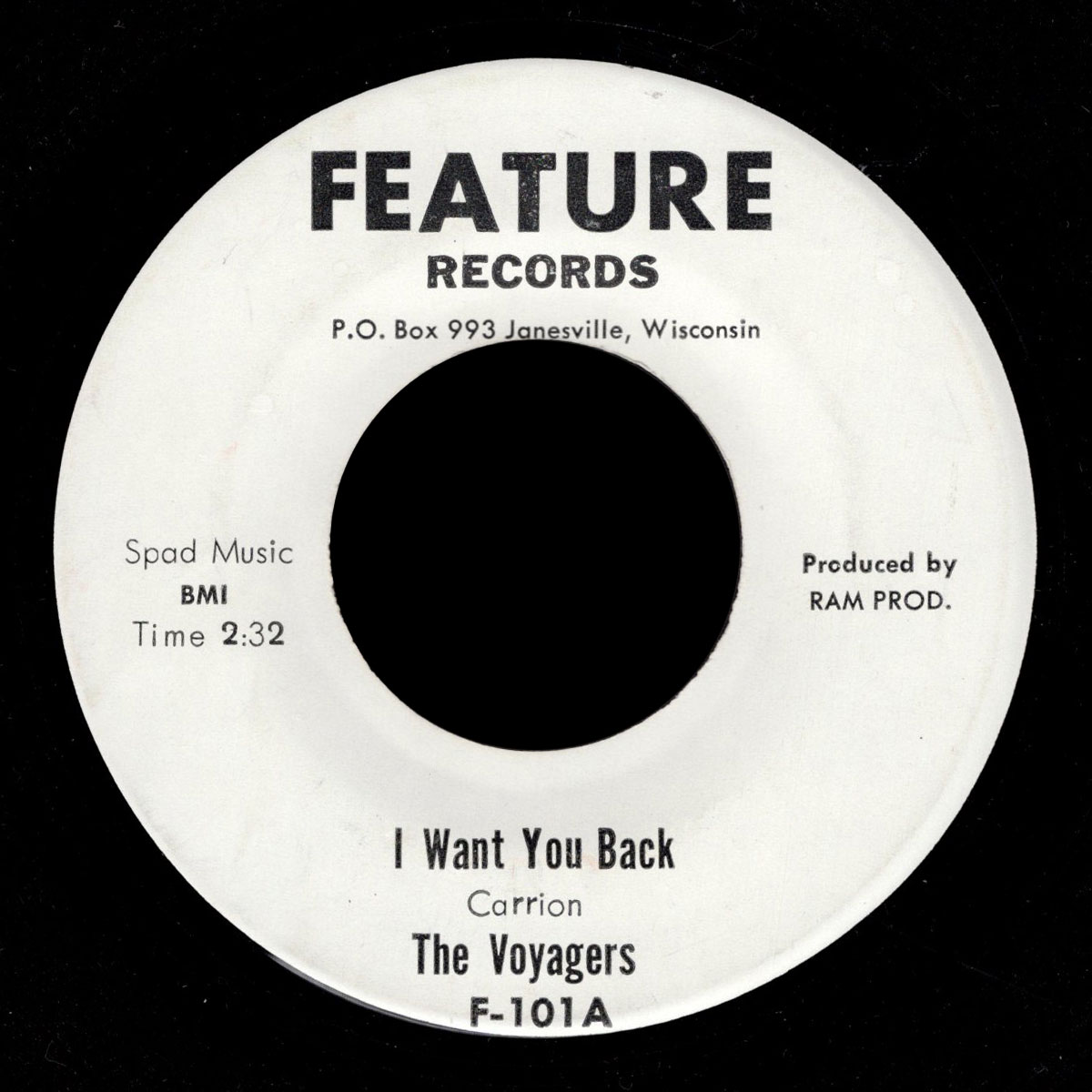
By the time of their second single, in 1967, Marc Peterson and Ed Hauser had left, replaced by Joey Carrion (Tino Gonzales) on lead vocals and rhythm guitar. This lineup recorded two more originals, “Can’t Save This Heart” by Sieger / Davenport, and “I Want You Back” by Carrion. It was released as Feature Records F-101, and produced by RAM Prod. After the single, Jay Sieger left and was replaced on lead guitar by Bob Spock.
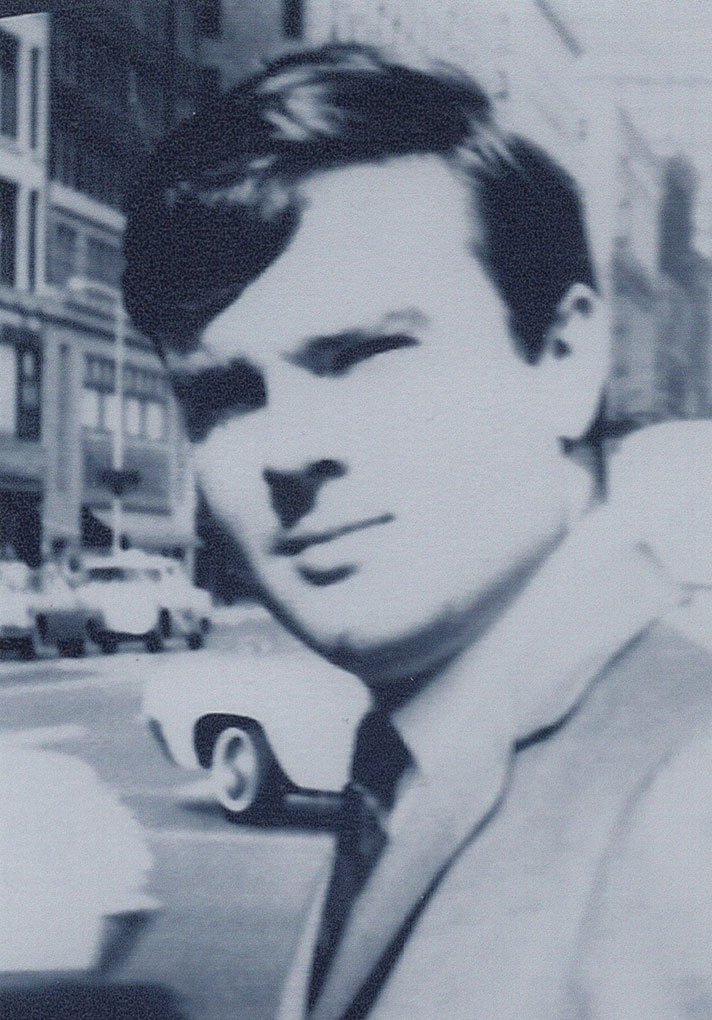
Steve Sperry in Chicago, 1966Voyagers photo, with Ed Hauser on Gibson Firebird (photo courtesy of Eddy Hauser)
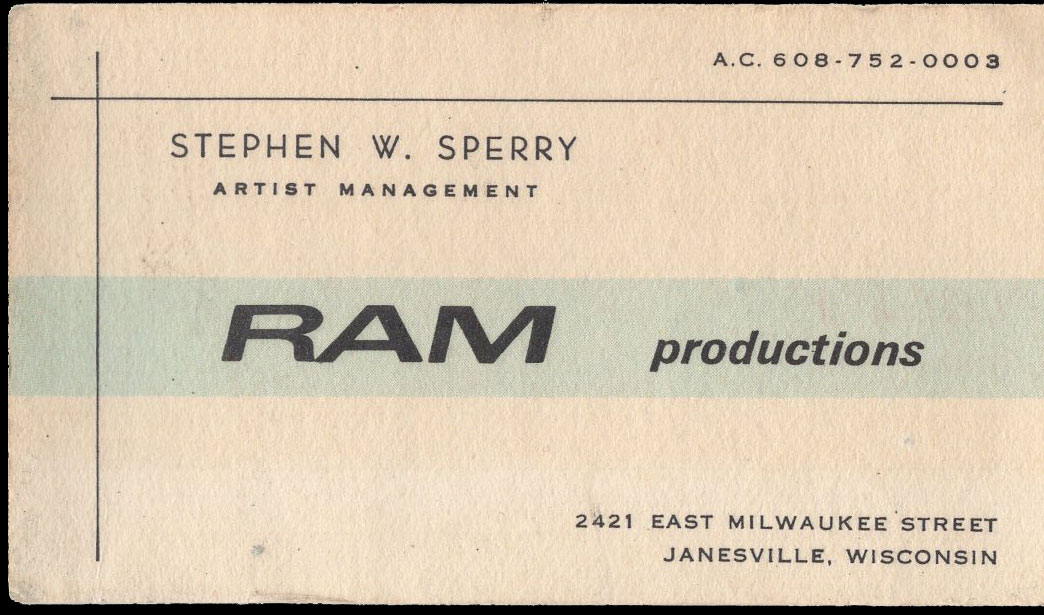
Arthur Sullivan sent me Stephen Sperry’s photo and business card, and wrote to me with some information:
This group, The Voyagers was produced by Steve Sperry who operated Ram Productions during the 1960s. This group was probably managed for bookings by Ken Adamany who lived in Janesville during that time. Steve lived in Janesville WI and also managed Dick Campbell of Monroe WI for a while. I don’t know where it was recorded but it has a very good clean sound. There was Leaf Studio in Janesville or Cuca at Sauk City.
Stephen Sperry & Ram Productions card, Janesville
Steve Sperry had an early 45 on Cuca J-1008 “That Ain’t So” / “Our Summer Love” before starting Ram Productions artist management and the Rampro label.
Arthur Sullivan had his own release on Swan Records S-4153 as Artie Sullivan with the Rhythm Beats – “It’s Time” / “Suzanne”, and produced singles with vocalist Dick Campbell on Camsul Records out of Worcester, MA (The Wild Ones “Surfin’ Time Again” for example), and CineVista Records out of Monroe, Wisconsin, among many others.
Thank you to Eddy Hauser for some of the photos in this article.
Sources: Gary E. MyersCan You Hear That Beat and On That Wisconsin Beat, and 45 cat
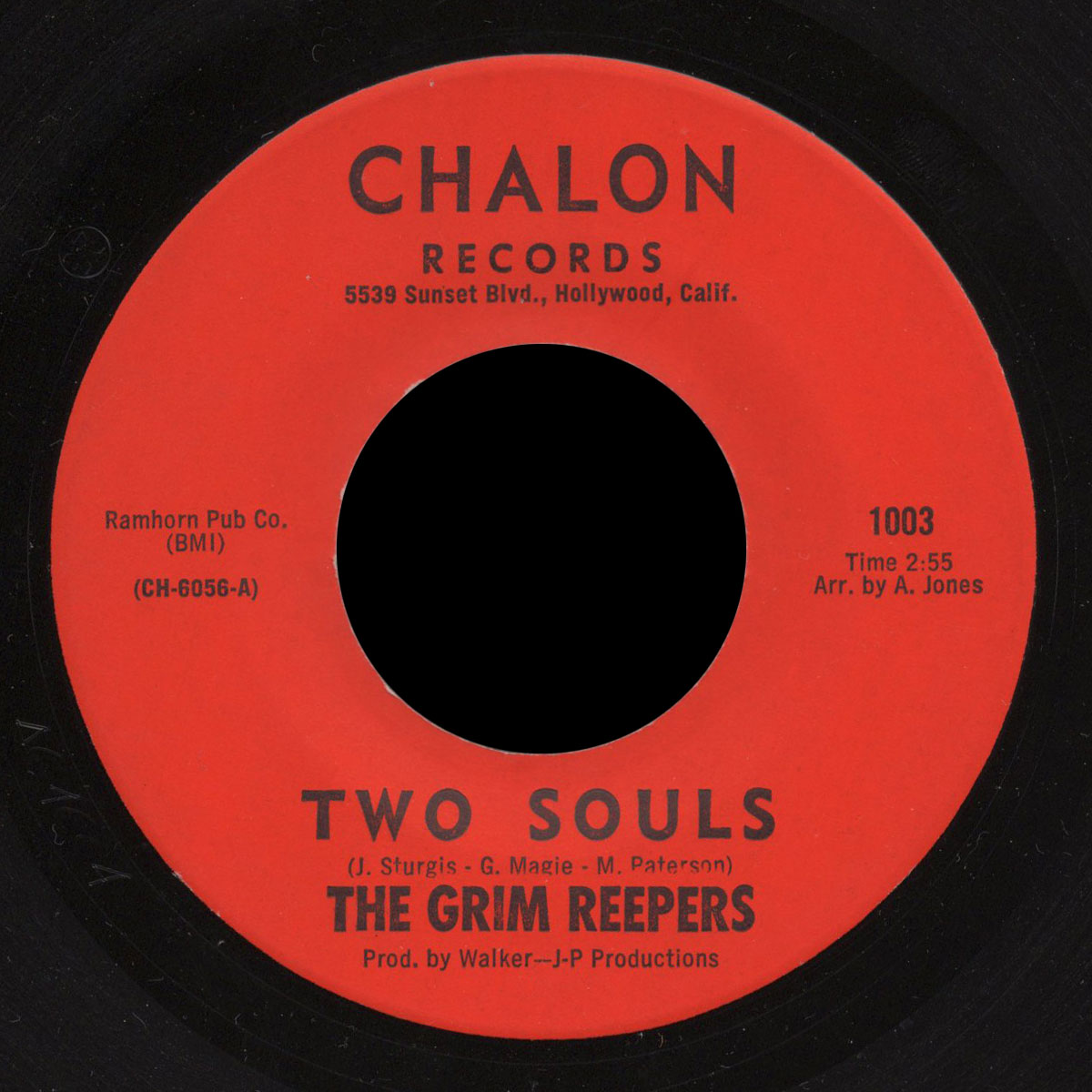
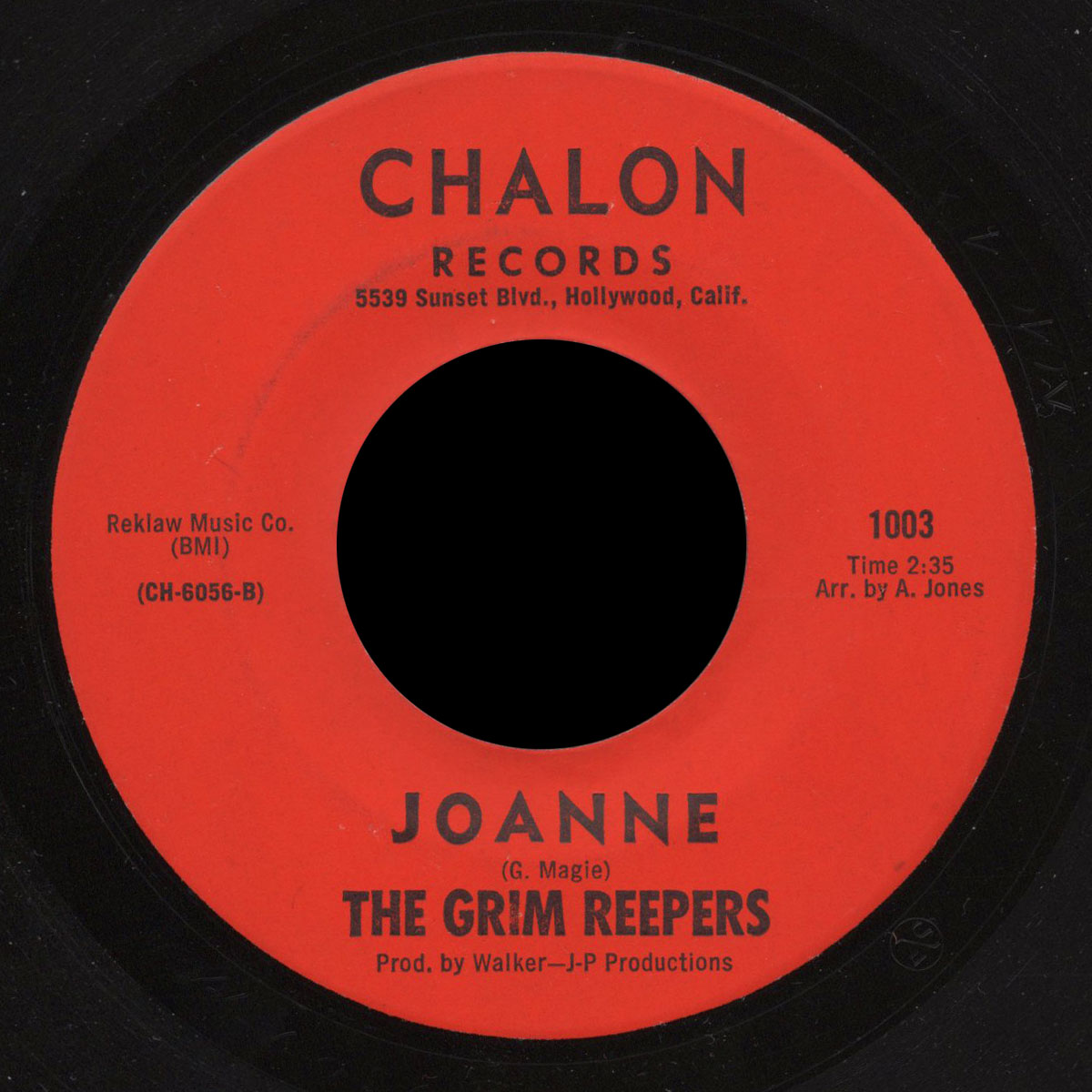
The Grim Reepers cut the excellent single “Two Souls”, but are still something of a mystery group. I haven’t been able to find any photos or gig listings for the Grim Reapers or Reepers, however they intended to spell the band name.
Two likely members are Greg Magie and Mark Paterson. Greg Magie’s name is in the song writing credits of the album “Stuntrock” by the late ’70s Los Angeles group Sorcery, (sound track to the movie Stunt Rock), and he is also, I believe, the vocalist in Sorcery as Greg McGee.
J. Sturgis is another name on the song writing credits, but in the BMI database, “Two Souls” shows only Mark Patterson, Richard Serrana and Joanne Funk.
“Two Souls” / “Joanne” was released on Chalon 1003 in January of 1967. Besides a few country singles by Roy Stevens, the Grim Reepers is the only other release on Chalon Records that I know of. Produced by Walker – J-P Productions (including B. Walker?).
Chalon Records shared an address of 5539 Sunset Boulevard with Impression Records. Ramhorn Pub. Co. published “Two Souls” and also published many of the songs released on the Impression label. J-P Productions shows up on the Dirty Shames’ Impression single. A. Jones who is credited with arranging the Grim Reepers single is almost certainly Al Jones. Al Jones and Joe Osborn’s names show up on many Impression singles, and on the writing credits to Roy Stevens “Over Again” on Chalon 001.
Greg Magie’s “Joanne” is published through Reklaw Music Co.
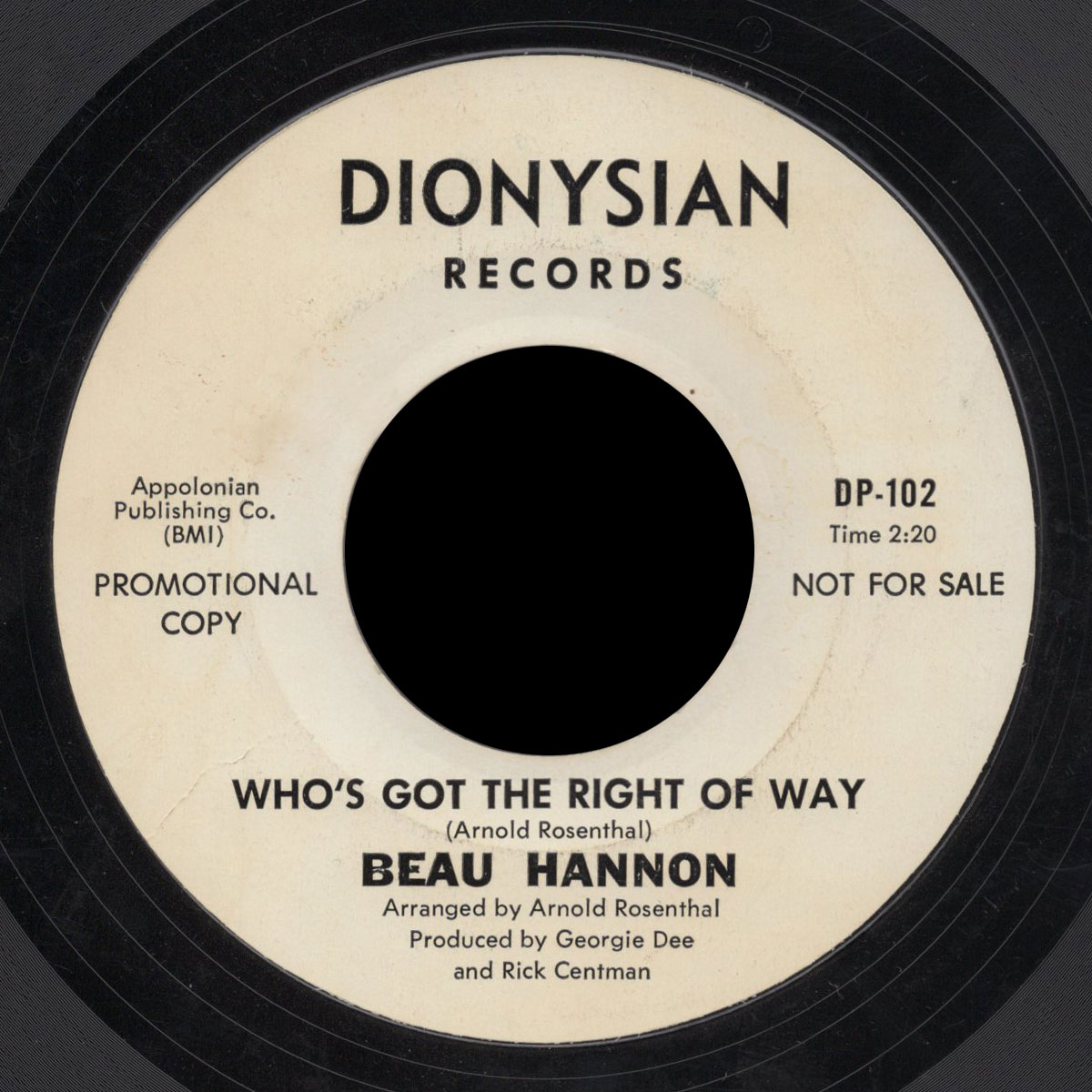
“Who’s Got the Right of Way” is the snotty, upbeat B-side to the light “Rosie, Rosie”. This Los Angeles production on Dionysian from late 1967 comes roughly in the middle of Beau Hannon’s recording career.
I had read that Beau Hannon was a Canadian singer from Niagara Falls, Ontario, but Mellow’s Log Cabin website says that the group was from Arkansas and started as Beau-Hannon and the Mint Juleps.
They cut a good rockin’ teen single “It’s All Over” / “Brainstorm” on the Hot Springs, Arkansas label United Southern Artists, Inc in 1961. The song writing credits for “It’s All Over” reveals his actual name, Jim Bohannon; “Brainstorm” is credited to Larry Fite who played bass. Other members of the group included Buddy Dodd lead guitar,and Ken Martin on drums.
After touring the east coast, the band did a months-long engagement in Montreal at the Black Orchid club. The band broke up due to the draft and other reasons, but Hannon stayed in Canada & New England and continued his career.
His second single “Stop Me From Falling In Love” on Eskee was picked up for release in Canada, Belgium and Germany. Later he had an LP of lighter pop, Most Requested on Birchmont.
“Who’s Got the Right of Way” was the first of two releases on Dionysian Records, DP-101 / DP-102. Arnold Rosenthal wrote both songs, published by Appolonian (BMI), and Georgie Dee and Rick Centman produced both sides. Δ-69230 in the deadwax indicates a December 1967 pressing. It was almost certainly cut in Los Angeles.
The only other release I know of is Dionysian DP-103 A/B, Richard Williams singing I’m a Free Man” with a similar arrangement of “Who’s Got the Right of Way” on the flip. Notable on this release is Jesse Edwin Davis credited with arrangement, and a co-writing credit on “I’m a Free Man” to Davis and Bramlett (published by Appolonian / Lawana).
A white label promotional copy of Dionysian DP-103 has the artist credited as “Beyond Good And Evil”. On the label photo I’ve seen, this artist name is crossed out and Richard Williams’ name is written at top.
One source notes Richard Williams was Dick Anthony Williams who had a career as an actor, but I can’t confirm this.
Arnold Rosenthal has many song-writing and occasional production credits, but he doesn’t seem to have held a position at any label or company for long. He seems to have been most active from ’69 to ’72, when he wrote much of Gary Lewis’s ”I’m On The Right Road Now” album, and played bass on Jesse Ed Davis’s version of “White Line Fever” and on a couple tracks from Ben Sidran’s Feel Your Groove LP.
The Duprays came from Washington Court House, Ohio, which lies about 40 miles southwest of Columbus and a little further from Dayton.
Members were:
Bruce Daulton – lead vocals Ray Joslin – guitar Mike Burnette – guitar Dennis Minshall – keyboards Don Miller – bass Carl Mullen – drums
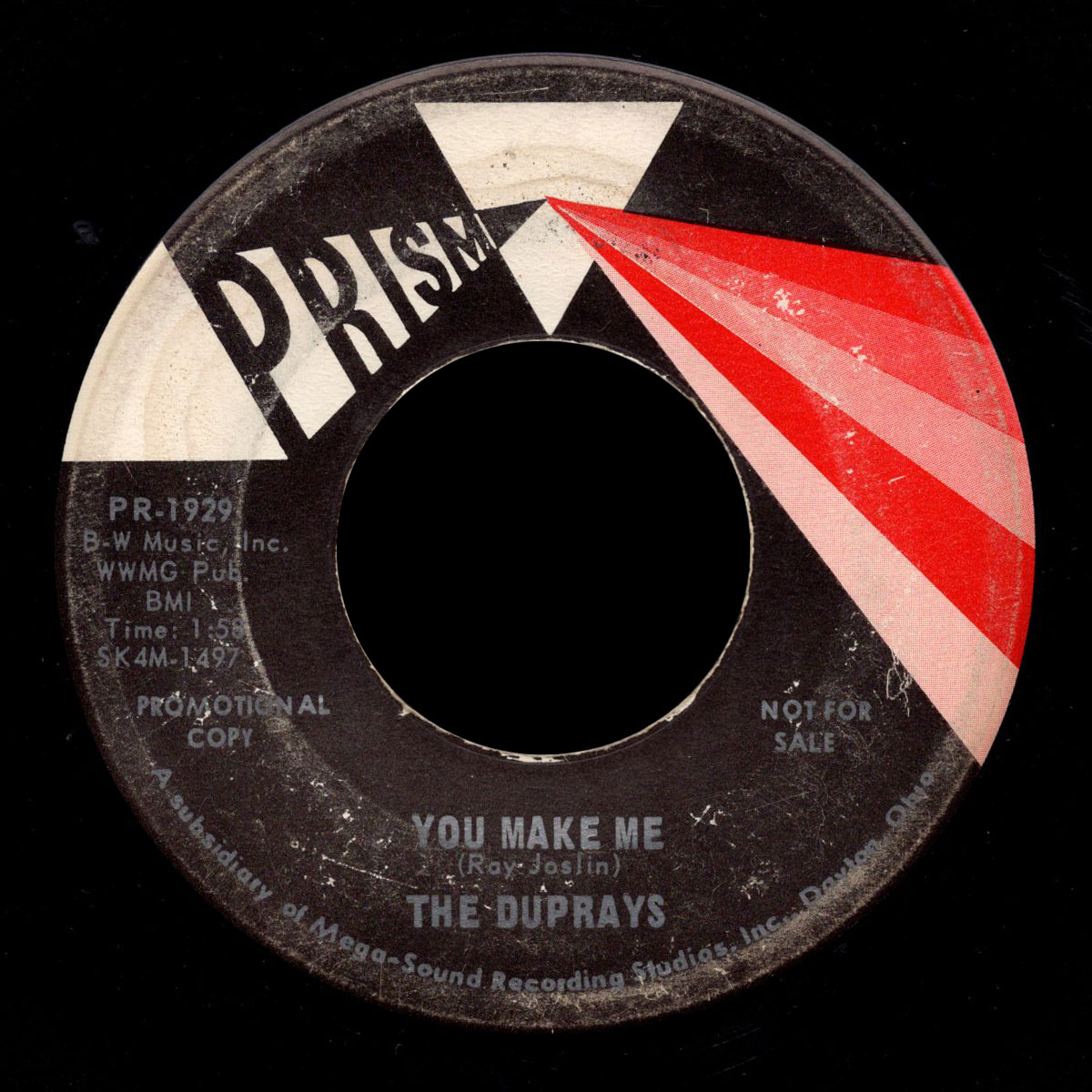
Guitarist Ray Joslin wrote the excellent top side, “You Make Me”, which starts with what is supposed to be his girl’s wailing, with some unusual echoed drumming. The wailing continues through the guitar break and short recitation.
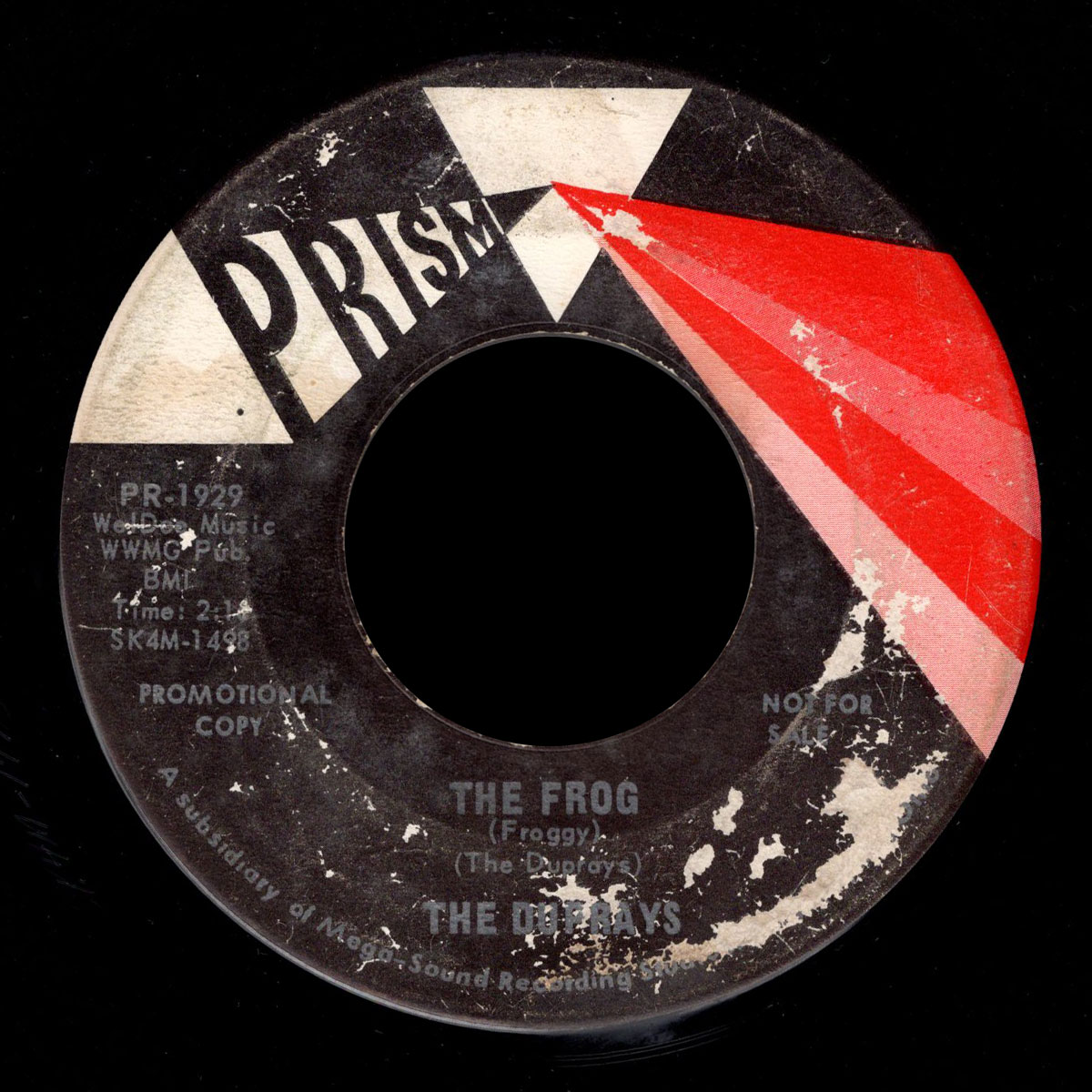
The band shares composition credit on the bizarre B-side, “The Frog (Froggy)”.
Released on Prism Records PR-1929, the RCA custom pressing code SK4M-1497/8 dates it to late 1965.
B-W Music, Inc and WWMG Pub. published “You Make Me”, while WelDee Music and WWMG Pub. published “The Frog (Froggy)”, though I couldn’t find Library of Congress registrations for either song.
Unlike many Ohio bands of the era, the Duprays did not seem to get any local press coverage, perhaps because they were young teenagers.
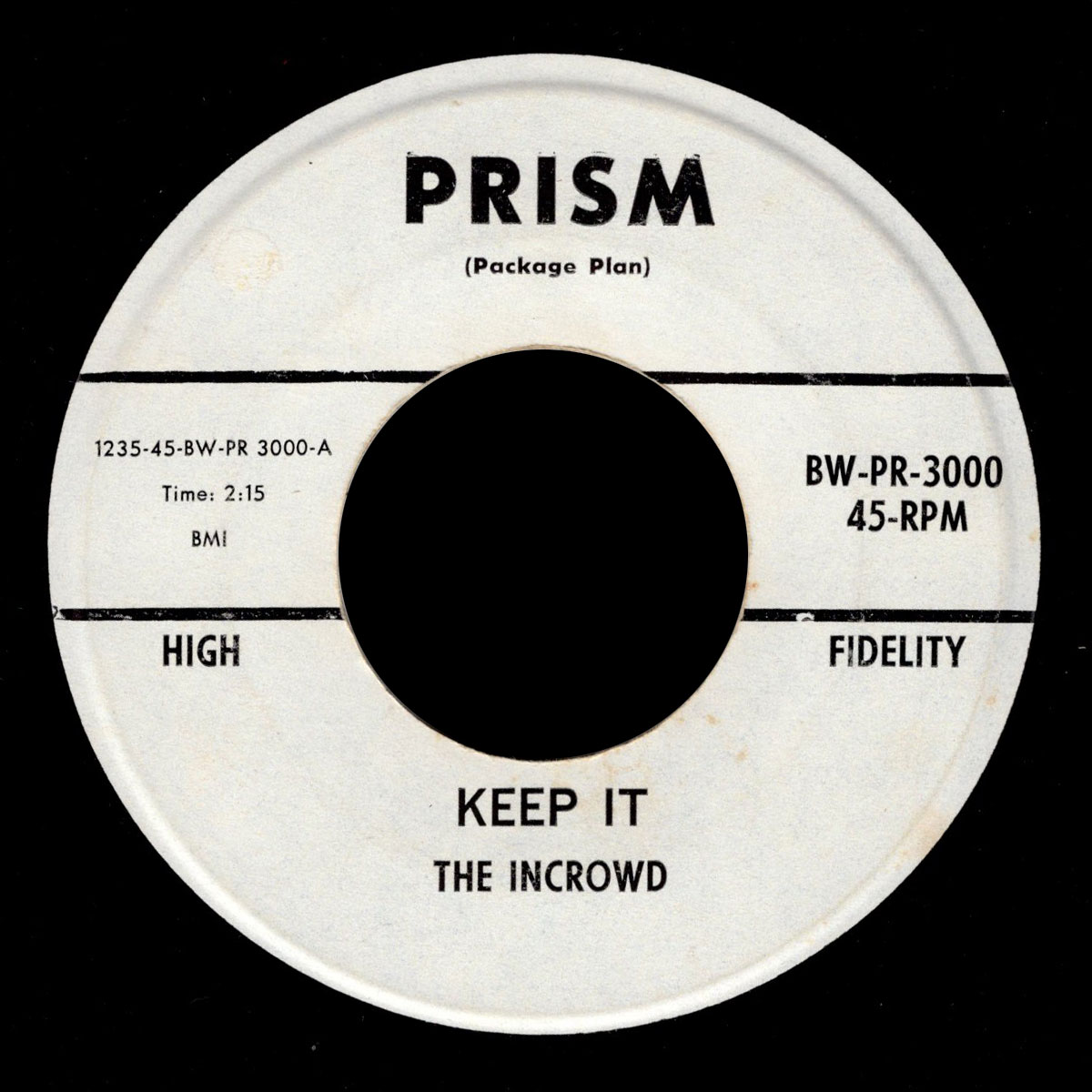
The Incrowd came from Hillsboro, Ohio, close to 60 miles east of Cincinnati. Members were:
Larry Zuggs – vocals Randy Applegate – guitar Paul “Bud” Long – guitar Charles Murphy – organ Mike Waddell – bass Jay Cooper – drums
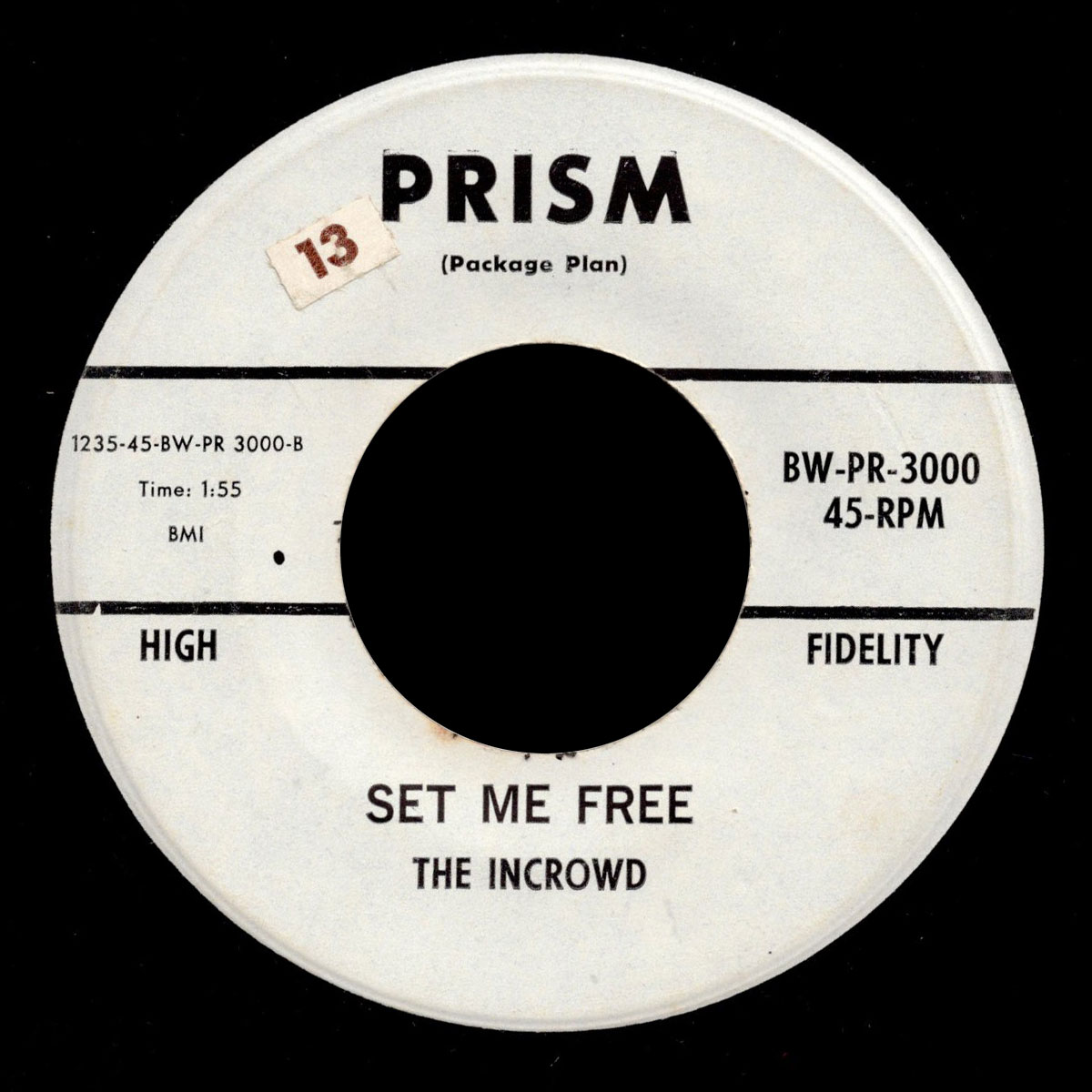
Circa 1965 they traveled to Dayton’s Mega Sound Studio (distinct from Mega-City Studio) to record their only single, featuring an intensely wrought soul ballad “Keep It” on the A-side. On the flip is the frantic and distorted “Set Me Free”. Both songs were supposedly written at the recording session!
Instead of release on Mega Sound’s standard Prism label, they were given the plain b&w Prism package plan for their pressing of 500 copies. Other bands on this 3000 custom series included the Senators and the Warbucks.
Anyone have a photo of the band?
Info from Buckeye Beat, with help from Matthew Baker in distinguishing Mega Sound and Mega-City studios.
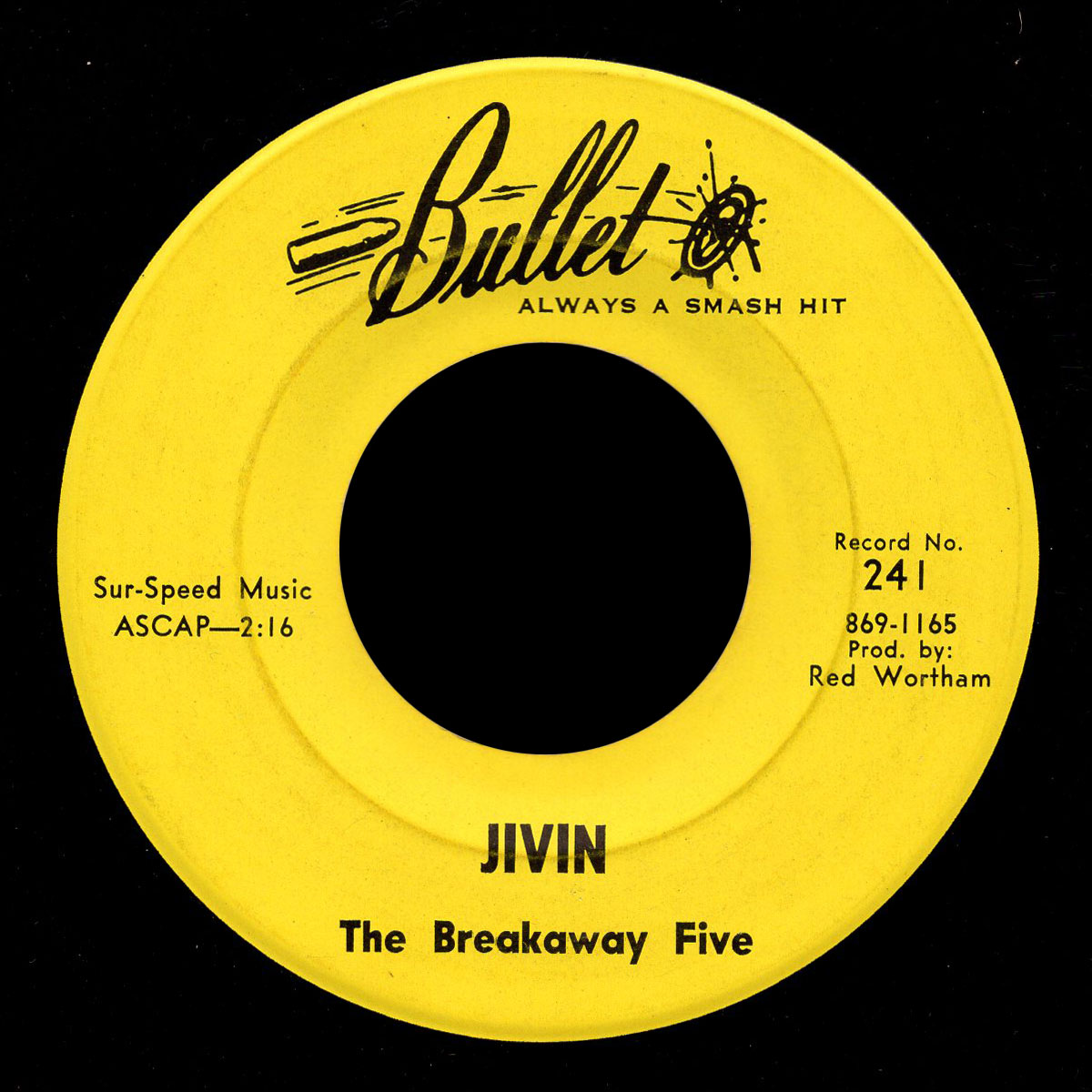
The Breakaway Five cut the great instrumental “Jivin” for Red Wortham’s revived Bullet label, featuring pounding drums in the intro and great guitar work, including a quote from Hank Snow’s “I’m Movin’ On”. The flip “I’m Gonna Walk” is a country song by F.L. Parrish, livened up by the echo on the guitar lines.
Members of the Breakaway Five included Norman Davis, Larry Davis, Larry Morgan, and possibly Ronnie Morgan. According to a comment on youtube, the band may have started as the Rivieras from Dickson, Tennessee, just west of Nashville.
Sur-Speed Music ASCAP is listed as publisher on both songs, though “Jivin” does not have any writing credit.
I’m not sure of the release date on this, but I would guess late ’50s or early ’60s. The label credits do not match the Villains 45s or any other Bullet 45 releases of the 1960s. The release number 241 is closer to Bullet’s early 78 rpm releases by Cecil Gant and Wynonie Harris. No other Bullet 45s have similar mastering codes (869-1165/6 in this case), a production credit to Wortham, or (in most cases) lack of an address.
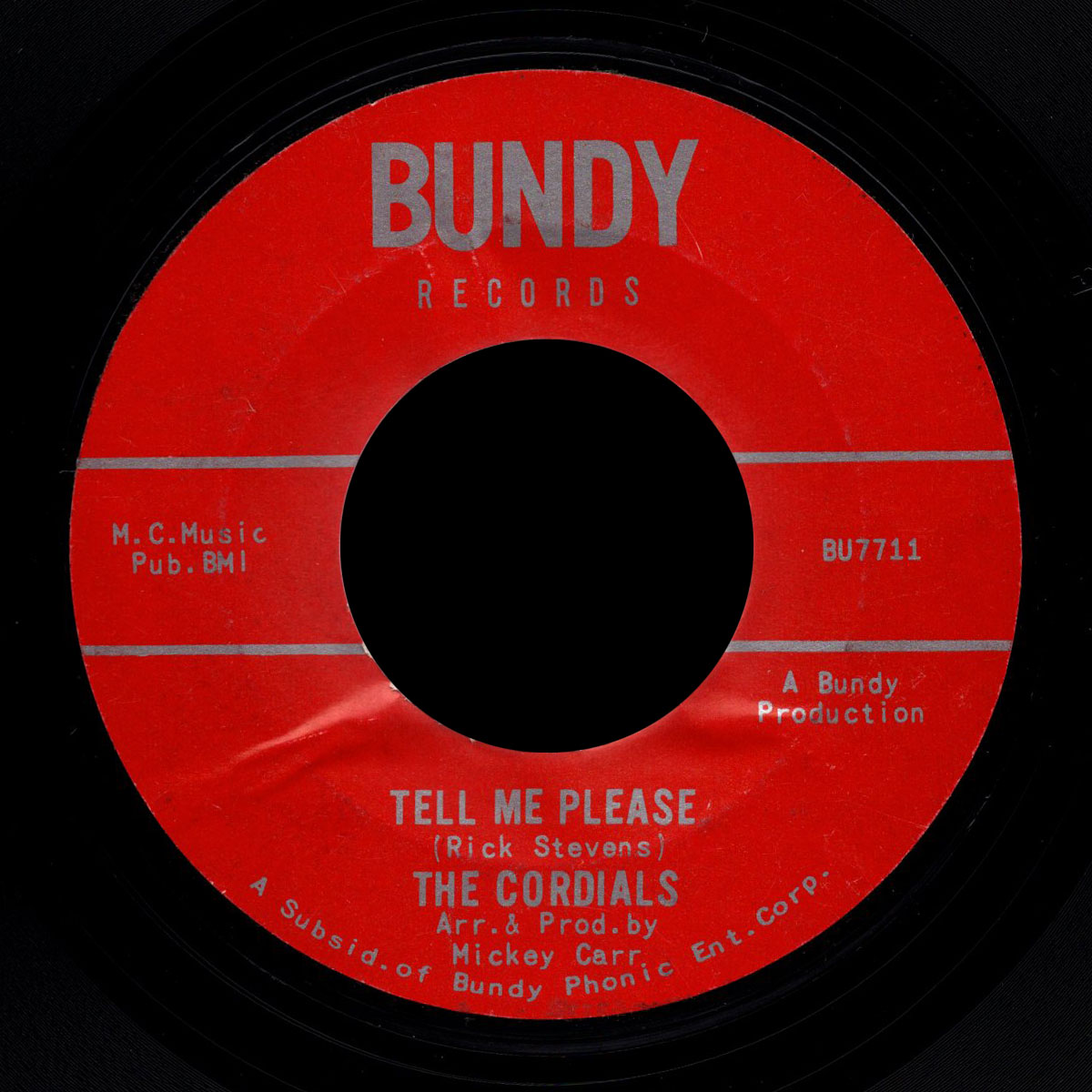
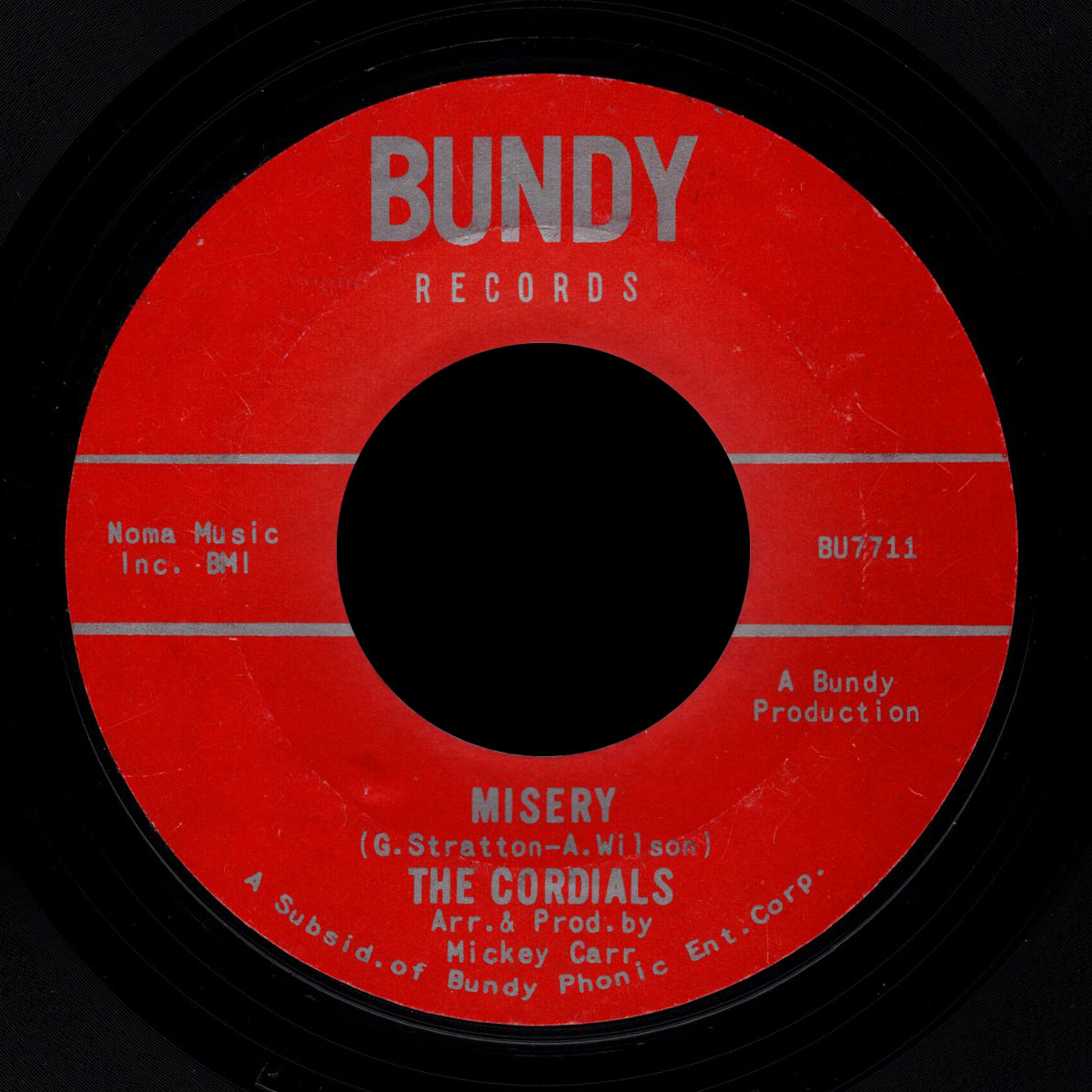
The Cordials recorded for the Bundy label of Freeport, New York. They may have been a local group, but Freeport is not far from Brooklyn, so the group could have been from anywhere in the New York metro area.
The Cordials cut a fine version of “Misery”, originally done by the the Dynamics on their 1963 single on Big Top. I prefer the flip, “Tell Me Please”, a moody original with great harmonies, written by Rick Stevens and published by M.C. Music Pub. BMI.
An article in Cash Box from August 7, 1965 gives an approximate date for the Cordials release and some background on Bundy:
“Bundy-Fonic Expands”
Mickey Carr, top man at The Bundy-Fonic Corp., is in the process of expanding the firm’s activities, and has appointed Bob Spina to veep and Clarence Finnell as A&R boss.
The diskery, with Dee Dee Records as a subsidiary line, will be offering two new releases, the first tagged “Misery” b/w “Tell Me Please” by the Cordials, and another by the Diablos, the titles on which will be announced at a later date. Both disks will be on Bundy Records. The address of the firm is 22 Pine St., Freeport, L.I.
Although Bundy had a 1962 release by Ray Artis, “Dear Liz” / “Wella-Wella” (Bundy BU-222), I haven’t found the Diablos single or anything else on Bundy. There were several record companies called Dee Dee, and I’m not sure if the one mentioned in the Cash Box article actually released anything.
The Cordials is a styrene 45, released on Bundy BU7711, Mickey Carr gets credit for arranging and producing both sides, and Bundy is listed as a subsidiary of Bundy Phonic Ent. Corp.
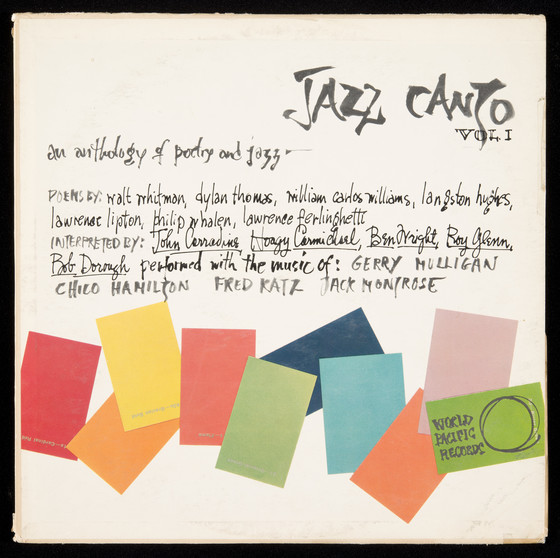
As you may have heard, Bob Dorough passed away this week at the age of 94. He had a range of talents, including a unique singing voice, arranging, writing and playing piano.
My favorite of his works is “The Dream Keeper”, one of his three adaptions of songs by Langston Hughes, from the Jazz Canto LP on Pacific Jazz. The other two songs are “Daybreak in Alabama” and “Night and Morn”, plus the LP features his setting of Lawrence Ferlinghetti’s “Dog”. None of these were mentioned in reports when he passed, or even on his Wikipedia page.
I wrote to Mr. Dorough in 2013 and this is what he told me about this album:
Billy Bean used to come to NYC, from his native Philadelphia, to blow in a jam session I held at my apt. – in the 50’s.
Then I lived in LA for 3 years. I had already composed and performed the three songs to Langston Hughes, with Ralph Pena on bass, at the Lenox Jazz School.
After Ralph knew I was in LA he spoke to Lawrence Lipton about the songs and Dr. L called me to ask me to record them for Jazz Canto. I said “It’s not ‘Jazz & Poetry’ – they’re ‘art songs’ in the jazz idiom.” “I want them on the album anyway,” he said. So I said, “OK, but let me do one at least that I would think of as ‘Jazz & Poetry.'”
“What would you do” he asked – without hesitation I said “Dog” by Ferlinghetti. He was astounded and said OK.
Bunker and Hardaway were just cats I’d met since moving to LA and also special pals of Pena’s.
The lineup on the album is:
Bob Dorough – piano Ralph Pena – bass Billy Bean – guitar Bob Hardaway – tenor sax Larry Bunker – drums and vibes
This site is a work in progress on 1960s garage rock bands. All entries can be updated, corrected and expanded. If you have information on a band featured here, please let me know and I will update the site and credit you accordingly.
I am dedicated to making this site a center for research about '60s music scenes. Please consider donating archival materials such as photos, records, news clippings, scrapbooks or other material from the '60s. Please contact me at rchrisbishop@gmail.com if you can loan or donate original materials

 The Cherades are an unknown group who covered two hits from ’65 and ’66 for release on RHM Records 1001/1002. Their version of Love’s arrangement of “My Little Red Book” is very good, I’d say this was a studio group except the lead singer sounds unpolished. It was backed with the McCoys’ “Sorrow”.